This is an early access version, the complete PDF, HTML, and XML versions will be available soon.
Article

Quality by Design-Guided Development of Ketoprofen-Cationic Aspasomes Unlocks the Antifungal Potential of Repurposed Ketoprofen for Topical Therapy

1
Department of Industrial Pharmacy, College of Pharmaceutical Sciences and Drug Manufacturing, Misr University for Science and Technology (MUST), Giza 12585, Egypt
2
Department of Pharmaceutics, College of Pharmaceutical Sciences and Drug Manufacturing, Misr University for Science and Technology (MUST), Giza 12585, Egypt
3
Department of Microbiology and Immunology, Faculty of Pharmacy, Cairo University, Cairo 11562, Egypt
4
Department of Microbiology and Immunology, Faculty of Pharmacy, Galala University, New Galala City 43511, Suez, Egypt
5
Department of Pharmaceutics and Industrial Pharmacy, Faculty of Pharmacy, Cairo University, Cairo 11562, Egypt
6
School of Engineering and Sciences, Tecnológico de Monterrey, Monterrey 64849, Mexico
7
R&D Directorate, MultiCare Egypt for Pharmaceutical Industries S.A.E., Industrial Area, New Cairo 3, Cairo 11511, Egypt
8
Basic Health Sciences Department, College of Medicine, Princess Nourah bint Abdulrahman University, P.O. Box 84428, Riyadh 11671, Saudi Arabia
*
Authors to whom correspondence should be addressed.
Pharmaceuticals 2026, 19(9), 1394; https://doi.org/10.3390/ph19091394
Submission received: 11 August 2026 / Revised: 29 August 2026 / Accepted: 30 August 2026 / Published: 2 September 2026
(This article belongs to the Section Pharmaceutical Technology)

Abstract

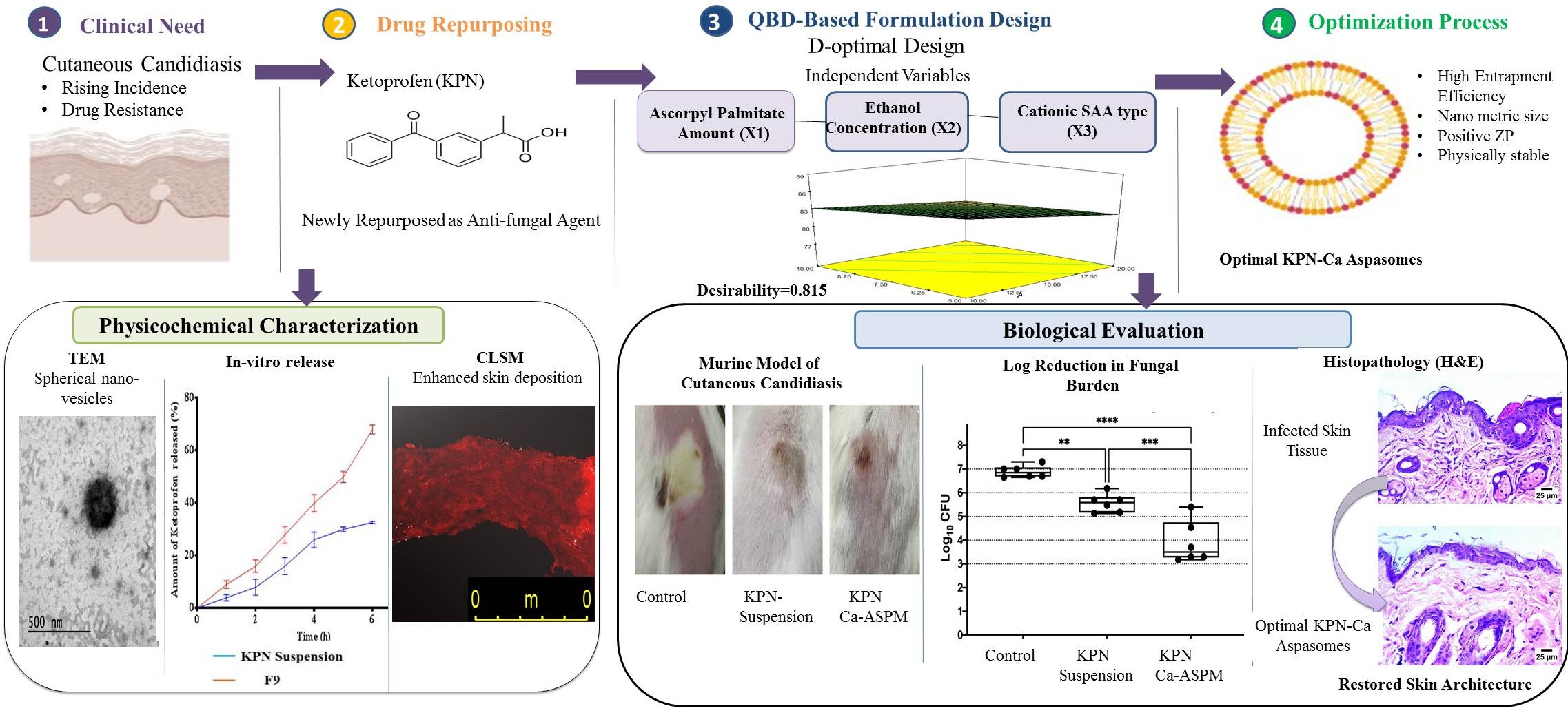
Background/Objectives: Cutaneous fungal infections remain a major therapeutic challenge due to poor skin penetration and emerging antifungal resistance of current treatments. Drug repurposing offers a promising strategy to expand antifungal therapy, with ketoprofen (KPN) recently demonstrating antifungal activity. Methods: In this study, KPN-cationic aspasomes (Ca-ASPMs) were developed using a Quality by Design (QbD) approach to enhance topical delivery and maximize the therapeutic potential of repurposed KPN. A D-optimal experimental design was implemented to investigate the influence of ascorbyl palmitate amount (X1), ethanol concentration (X2), and cationic SAA type (X3) on the critical quality attributes of KPN-Ca-ASPMs, namely entrapment efficiency, particle size, and zeta potential. Results: Numerical optimization identified an optimum formulation comprising 10 mg ascorbyl palmitate, 5% ethanol, and didodecyldimethylammonium bromide (DDAB) as cationic SAA, with an overall desirability of 0.815. The optimal KPN-Ca-ASPM (F9) exhibited nanosized vesicles (213.24 ± 2.20 nm) and 91.30 ± 10.01% entrapment efficiency. TEM confirmed the spherical morphology of the vesicles, while DSC demonstrated successful incorporation of KPN within the aspasomal matrix. F9 exhibited enhanced in vitro drug release (68% after 6 h) and excellent storage stability. Confocal laser scanning microscopy demonstrated enhanced skin penetration of F9. In a murine cutaneous candidiasis model, F9 significantly enhanced the antifungal efficacy of KPN, producing a 2.989-log reduction in fungal burden compared with the untreated group and significantly outperforming the free drug (p = 0.0005). Histopathological examination confirmed restoration of normal skin architecture. Conclusions: Collectively, the QbD-guided development of KPN-Ca-ASPM provided a reproducible nanocarrier that significantly enhanced the topical antifungal efficacy of repurposed KPN, highlighting its potential for the treatment of cutaneous candidiasis.
Keywords: quality by design; drug repurposing; cutaneous candidiasis; cationic aspasomes; Ketoprofen quality by design; drug repurposing; cutaneous candidiasis; cationic aspasomes; Ketoprofen
Graphical Abstract