This is an early access version, the complete PDF, HTML, and XML versions will be available soon.
Article

Pharmacological Effects of Wenjing Decoction in a Rat Model of Cold Coagulation and Blood Stasis Primary Dysmenorrhea: An Integrated Analysis of Serum Pharmacochemistry, Network Pharmacology and Metabolomics

School of Pharmacy, Changchun University of Chinese Medicine, Changchun 130117, China
*
Authors to whom correspondence should be addressed.
Pharmaceuticals 2026, 19(9), 1385; https://doi.org/10.3390/ph19091385
Submission received: 22 July 2026 / Revised: 25 August 2026 / Accepted: 26 August 2026 / Published: 1 September 2026

Abstract

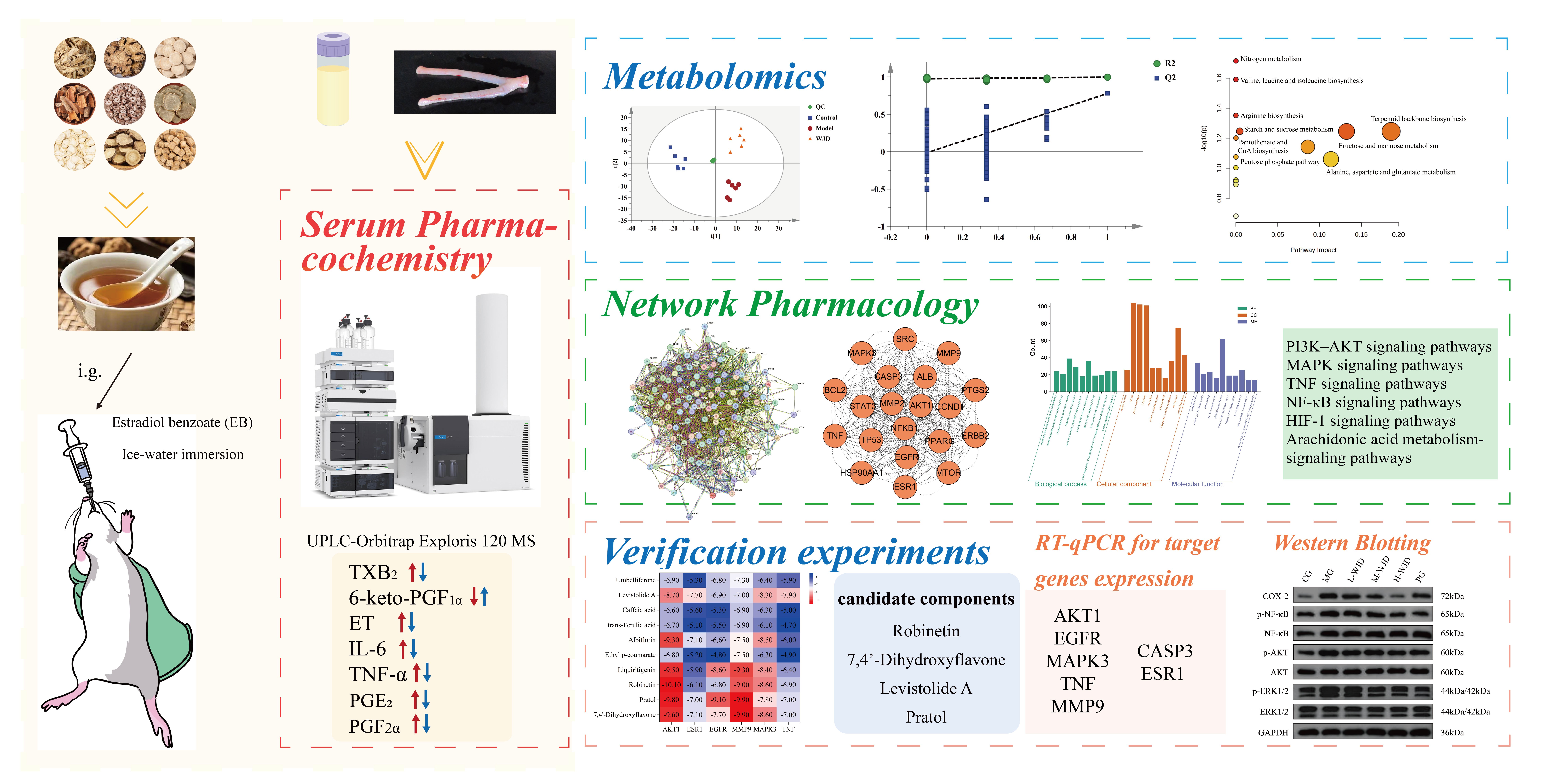
Background: Primary dysmenorrhea (PD) is a prevalent gynecological condition that significantly compromises the quality of life in adolescents and women of reproductive age. Within traditional Chinese medicine (TCM), Cold Coagulation and Blood Stasis Primary Dysmenorrhea (CCBS-PD) represents the most frequently observed syndrome pattern of PD. Wenjing Decoction (WJD), a classical TCM formulation, has been extensively employed for the treatment of CCBS-PD. However, given the multi-component and complex nature of WJD, the potential mechanisms underpinning its therapeutic effect have yet to be elucidated. Methods: A rat model of CCBS-PD was induced through ice-water bath stimulation in conjunction with estradiol benzoate and oxytocin. The pharmacological effects of WJD were evaluated by writhing response, hemorheological parameters, uterine index, histopathological examination, and biochemical assays. Serum-exposed constituents of WJD were characterized using UPLC-Orbitrap Exploris 120 MS. To study the mechanisms of WJD, methods from network pharmacology, molecular docking, and off-target metabolomics were used. Western blot analysis examined representative proteins in the signaling pathways predicted by network pharmacology. Network pharmacology and metabolomics were integrated to construct a pathway–metabolite–target–compound network, and representative targets were analyzed by RT-qPCR. Results: WJD treatment reduced writhing responses, improved hemorheological abnormalities, and alleviated uterine pathological changes in CCBS-PD rats. Serum pharmacochemistry identified 62 WJD-derived constituents. Metabolomics analysis indicated that WJD was associated with alterations in nitrogen metabolism, valine/leucine/isoleucine biosynthesis and arginine biosynthesis. Network pharmacology and molecular docking suggested several candidate compounds and targets, including Robinetin, Levistolide A, Pratol, 7,4′-dihydroxyflavone, EGFR, AKT1, ESR1, MMP9, MAPK3, and TNF. RT-qPCR showed that selected genes, including AKT1, EGFR, MAPK3, TNF, ESR1, MMP9 and CASP3, were changed in the model group and partially restored following WJD improvement. Western blot analysis demonstrated that WJD treatment decreased the phosphorylation levels of AKT, ERK1/2, and NF-κB, and down-regulated the protein expression of COX-2. Conclusions: WJD showed beneficial effects in a CCBS-PD rat model. Synthesized assessments indicate a potential link to the actions of serum-exposed constituents, alterations in amino acid metabolism, and modulation of inflammation-related signaling pathways. This research offers initial indications suggesting the multi-component and multi-target pharmacological actions of WJD, although the underlying mechanisms remain to be validated through targeted metabolomics and functional studies.
Keywords: Wenjing decoction; Cold Coagulation and Blood Stasis Primary Dysmenorrhea; serum pharmacochemistry; metabolomics; network pharmacology Wenjing decoction; Cold Coagulation and Blood Stasis Primary Dysmenorrhea; serum pharmacochemistry; metabolomics; network pharmacology
Graphical Abstract