Ketone Supplementation Decreased Lipopolysaccharide-Generated Anxiety-like Behavior in Female WAG/Rij Rats




Abstract
1. Introduction
2. Results
2.1. Influence of KEKS Food on Anxiety-like Behavior
2.2. KEKS Food Administration-Generated Effects on Blood Levels of R-βHB and Glucose, as Well as Body Weight
3. Discussion
4. Materials and Methods
4.1. Animals
4.2. Light–Dark Box Test
4.3. Treatments
4.4. Statistics
5. Conclusions
Author Contributions
Funding
Institutional Review Board Statement
Informed Consent Statement
Data Availability Statement
Conflicts of Interest
Abbreviations
| ASC | apoptosis-associated speck-like protein |
| βHB | β-hydroxybutyrate |
| IL-1β | interleukin 1β |
| i.p. | intraperitoneal |
| KE | ketone ester |
| KEKS | a mix of KE and KS |
| KEMCT | a mix of KE and MCT oil |
| KMT | ketogenic metabolic therapy |
| KS | ketone salt |
| KSMCT | a mix of KS and MCT oil |
| LDB | Light–dark box |
| LPS | lipopolysaccharide |
| MCT | medium chain triglyceride |
| NF-kB | nuclear factor kappa B |
| NLRP3 | nucleotide-binding and oligomerization domain-like receptor pyrin domain-containing protein 3 |
| R-βHB | R-β-hydroxybutyrate |
| ROS | reactive oxygen species |
| TLR4 | Toll-like receptor 4 |
| TNF-α | tumor necrosis factor alpha |
| WAG/Rij | Wistar Albino Glaxo/Rijswijk |
References
- Zhang, Z.; Chen, X.; Wu, S.; Chen, X.; Wang, X.; Liu, C.; Zeng, N.; Liu, Y.; Huo, T.; Liu, X.; et al. Global, regional and national burden of anxiety and depression disorders from 1990 to 2021, and forecasts up to 2040. J. Affect. Disord. 2026, 393, 120299. [Google Scholar] [CrossRef] [Scilit] [PubMed]
- Gandy, M.; Sharpe, L.; Perry, K.N.; Miller, L.; Thayer, Z.; Boserio, J.; Mohamed, A. Anxiety in epilepsy: A neglected disorder. J. Psychosom. Res. 2015, 78, 149–155. [Google Scholar] [CrossRef] [Scilit] [PubMed]
- Mendez, M.F. The Relationship Between Anxiety and Alzheimer’s Disease. J. Alzheimers Dis. Rep. 2021, 5, 171–177. [Google Scholar] [CrossRef] [Scilit] [PubMed]
- Bandelow, B.; Michaelis, S. Epidemiology of anxiety disorders in the 21st century. Dialogues Clin. Neurosci. 2015, 17, 327–335. [Google Scholar] [CrossRef] [Scilit] [PubMed]
- Omori, N.E.; Malys, M.K.; Woo, G.; Mansor, L. Exploring the role of ketone bodies in the diagnosis and treatment of psychiatric disorders. Front. Psychiatry 2023, 14, 1142682. [Google Scholar] [CrossRef] [Scilit] [PubMed]
- Dias, B.G.; Banerjee, S.B.; Goodman, J.V.; Ressler, K.J. Towards new approaches to disorders of fear and anxiety. Curr. Opin. Neurobiol. 2013, 23, 346–352. [Google Scholar] [CrossRef] [Scilit] [PubMed]
- Li, X. Using the conditioned fear stress (CFS) animal model to understand the neurobiological mechanisms and pharmacological treatment of anxiety. Shanghai Arch. Psychiatry 2012, 24, 241–249. [Google Scholar] [CrossRef] [PubMed]
- Bandelow, B.; Michaelis, S.; Wedekind, D. Treatment of anxiety disorders. Dialogues Clin. Neurosci. 2017, 19, 93–107. [Google Scholar] [CrossRef] [Scilit] [PubMed]
- Domschke, K.; Seuling, P.D.; Schiele, M.A.; Bandelow, B.; Batelaan, N.M.; Bokma, W.A.; Branchi, I.; Broich, K.; Burkauskas, J.; Davies, S.J.C.; et al. The definition of treatment resistance in anxiety disorders: A Delphi method-based consensus guideline. World Psychiatry 2024, 23, 113–123. [Google Scholar] [CrossRef] [Scilit] [PubMed]
- Vogelzangs, N.; Beekman, A.T.; de Jonge, P.; Penninx, B.W. Anxiety disorders and inflammation in a large adult cohort. Transl. Psychiatry 2013, 3, e249. [Google Scholar] [CrossRef] [Scilit] [PubMed]
- Duivis, H.E.; Vogelzangs, N.; Kupper, N.; de Jonge, P.; Penninx, B.W. Differential association of somatic and cognitive symptoms of depression and anxiety with inflammation: Findings from the Netherlands Study of Depression and Anxiety (NESDA). Psychoneuroendocrinology 2013, 38, 1573–1585. [Google Scholar] [CrossRef] [Scilit] [PubMed]
- Kim, T.D.; Lee, S.; Yoon, S. Inflammation in Post-Traumatic Stress Disorder (PTSD): A Review of Potential Correlates of PTSD with a Neurological Perspective. Antioxidants 2020, 9, 107. [Google Scholar] [CrossRef] [Scilit] [PubMed]
- Pitsavos, C.; Panagiotakos, D.B.; Papageorgiou, C.; Tsetsekou, E.; Soldatos, C.; Stefanadis, C. Anxiety in relation to inflammation and coagulation markers, among healthy adults: The ATTICA study. Atherosclerosis 2006, 185, 320–326. [Google Scholar] [CrossRef] [Scilit] [PubMed]
- Guo, B.; Zhang, M.; Hao, W.; Wang, Y.; Zhang, T.; Liu, C. Neuroinflammation mechanisms of neuromodulation therapies for anxiety and depression. Transl. Psychiatry 2023, 13, 5. [Google Scholar] [CrossRef] [Scilit] [PubMed]
- Hou, R.; Ye, G.; Liu, Y.; Chen, X.; Pan, M.; Zhu, F.; Fu, J.; Fu, T.; Liu, Q.; Gao, Z.; et al. Effects of SSRIs on peripheral inflammatory cytokines in patients with Generalized Anxiety Disorder. Brain Behav. Immun. 2019, 81, 105–110. [Google Scholar] [CrossRef] [Scilit] [PubMed]
- Zheng, Z.H.; Tu, J.L.; Li, X.H.; Hua, Q.; Liu, W.Z.; Liu, Y.; Pan, B.X.; Hu, P.; Zhang, W.H. Neuroinflammation induces anxiety- and depressive-like behavior by modulating neuronal plasticity in the basolateral amygdala. Brain Behav. Immun. 2021, 91, 505–518. [Google Scholar] [CrossRef] [Scilit] [PubMed]
- Youm, Y.H.; Nguyen, K.Y.; Grant, R.W.; Goldberg, E.L.; Bodogai, M.; Kim, D.; D’Agostino, D.; Planavsky, N.; Lupfer, C.; Kanneganti, T.D.; et al. The ketone metabolite β-hydroxybutyrate blocks NLRP3 inflammasome-mediated inflammatory disease. Nat. Med. 2015, 21, 263–269. [Google Scholar] [CrossRef] [Scilit] [PubMed]
- Fu, S.P.; Li, S.N.; Wang, J.F.; Li, Y.; Xie, S.S.; Xue, W.J.; Liu, H.M.; Huang, B.X.; Lv, Q.K.; Lei, L.C.; et al. BHBA suppresses LPS-induced inflammation in BV-2 cells by inhibiting NF-κB activation. Mediat. Inflamm. 2014, 2014, 983401. [Google Scholar] [CrossRef] [Scilit] [PubMed]
- Fu, S.P.; Wang, J.F.; Xue, W.J.; Liu, H.M.; Liu, B.R.; Zeng, Y.L.; Li, S.N.; Huang, B.X.; Lv, Q.K.; Wang, W.; et al. Anti-inflammatory effects of BHBA in both in vivo and in vitro Parkinson’s disease models are mediated by GPR109A-dependent mechanisms. J. Neuroinflamm. 2015, 12, 9. [Google Scholar] [CrossRef] [Scilit] [PubMed]
- Ari, C.; Kovács, Z.; Juhasz, G.; Murdun, C.; Goldhagen, C.R.; Koutnik, A.P.; Poff, A.M.; Kesl, S.L.; D’Agostino, D.P. Exogenous Ketone Supplements Reduce Anxiety-Related Behavior in Sprague-Dawley and Wistar Albino Glaxo/Rijswijk Rats. Front. Mol. Neurosci. 2016, 9, 137. [Google Scholar] [CrossRef] [Scilit] [PubMed]
- Bornebusch, A.B.; Mason, G.F.; Tonetto, S.; Damsgaard, J.; Gjedde, A.; Fink-Jensen, A.; Thomsen, M. Effects of ketogenic diet and ketone monoester supplement on acute alcohol withdrawal symptoms in male mice. Psychopharmacology 2021, 238, 833–844. [Google Scholar] [CrossRef] [Scilit] [PubMed]
- Hollis, F.; Mitchell, E.S.; Canto, C.; Wang, D.; Sandi, C. Medium chain triglyceride diet reduces anxiety-like behaviors and enhances social competitiveness in rats. Neuropharmacology 2018, 138, 245–256. [Google Scholar] [CrossRef] [Scilit] [PubMed]
- Kashiwaya, Y.; Bergman, C.; Lee, J.H.; Wan, R.; King, M.T.; Mughal, M.R.; Okun, E.; Clarke, K.; Mattson, M.P.; Veech, R.L. A ketone ester diet exhibits anxiolytic and cognition-sparing properties, and lessens amyloid and tau pathologies in a mouse model of Alzheimer’s disease. Neurobiol. Aging 2013, 34, 1530–1539. [Google Scholar] [CrossRef] [Scilit] [PubMed]
- Kesl, S.L.; Poff, A.M.; Ward, N.P.; Fiorelli, T.N.; Ari, C.; Van Putten, A.J.; Sherwood, J.W.; Arnold, P.; D’Agostino, D.P. Effects of exogenous ketone supplementation on blood ketone, glucose, triglyceride, and lipoprotein levels in Sprague-Dawley rats. Nutr. Metab. 2016, 13, 9. [Google Scholar] [CrossRef] [Scilit] [PubMed]
- Kovács, Z.; D’Agostino, D.P.; Ari, C. Anxiolytic Effect of Exogenous Ketone Supplementation Is Abolished by Adenosine A1 Receptor Inhibition in Wistar Albino Glaxo/Rijswijk Rats. Front. Behav. Neurosci. 2018, 12, 29. [Google Scholar] [CrossRef] [Scilit] [PubMed]
- Rauch, E.; Ari, C.; Kovács, Z. Dose-Dependent Beneficial Effect of Ketone Supplement-Evoked Ketosis on Anxiety Level in Female WAG/Rij Rats: Sometimes Less Is More. Nutrients 2023, 15, 4412. [Google Scholar] [CrossRef] [Scilit] [PubMed]
- Stavitzski, N.M.; Landon, C.S.; Hinojo, C.M.; Poff, A.M.; Rogers, C.Q.; D’Agostino, D.P.; Dean, J.B. Exogenous ketone ester delays CNS oxygen toxicity without impairing cognitive and motor performance in male Sprague-Dawley rats. Am. J. Physiol. Regul. Integr. Comp. Physiol. 2021, 321, 100–111. [Google Scholar] [CrossRef] [Scilit] [PubMed]
- Kovács, Z.; D’Agostino, D.P.; Diamond, D.; Kindy, M.S.; Rogers, C.; Ari, C. Therapeutic Potential of Exogenous Ketone Supplement Induced Ketosis in the Treatment of Psychiatric Disorders: Review of Current Literature. Front. Psychiatry 2019, 10, 363. [Google Scholar] [CrossRef] [Scilit] [PubMed]
- Yamanashi, T.; Iwata, M.; Kamiya, N.; Tsunetomi, K.; Kajitani, N.; Wada, N.; Iitsuka, T.; Yamauchi, T.; Miura, A.; Pu, S.; et al. Beta-hydroxybutyrate, an endogenic NLRP3 inflammasome inhibitor, attenuates stress-induced behavioral and inflammatory responses. Sci. Rep. 2017, 7, 7677. [Google Scholar] [CrossRef] [Scilit] [PubMed]
- Yamanashi, T.; Iwata, M.; Shibushita, M.; Tsunetomi, K.; Nagata, M.; Kajitani, N.; Miura, A.; Matsuo, R.; Nishiguchi, T.; Kato, T.A.; et al. Beta-hydroxybutyrate, an endogenous NLRP3 inflammasome inhibitor, attenuates anxiety-related behavior in a rodent post-traumatic stress disorder model. Sci. Rep. 2020, 10, 21629. [Google Scholar] [CrossRef] [Scilit] [PubMed]
- Kovács, Z.; Brunner, B.; D’Agostino, D.P.; Ari, C. Age- and Sex-Dependent Modulation of Exogenous Ketone Supplement-Evoked Effects on Blood Glucose and Ketone Body Levels in Wistar Albino Glaxo Rijswijk Rats. Front. Neurosci. 2021, 14, 618422. [Google Scholar] [CrossRef] [Scilit] [PubMed]
- Coenen, A.M.; Van Luijtelaar, E.L. Genetic animal models for absence epilepsy: A review of the WAG/Rij strain of rats. Behav. Genet. 2003, 33, 635–655. [Google Scholar] [CrossRef] [Scilit] [PubMed]
- Himanshu; Dharmila; Sarkar, D.; Nutan. A Review of Behavioral Tests to Evaluate Different Types of Anxiety and Anti-anxiety Effects. Clin. Psychopharmacol. Neurosci. 2020, 18, 341–351. [Google Scholar] [CrossRef] [Scilit] [PubMed]
- Midzyanovskaya, I.S.; Shatskova, A.B.; Sarkisova, K.Y.; van Luijtelaar, G.; Tuomisto, L.; Kuznetsova, G.D. Convulsive and nonconvulsive epilepsy in rats: Effects on behavioral response to novelty stress. Epilepsy Behav. 2005, 6, 543–551. [Google Scholar] [CrossRef] [Scilit] [PubMed]
- Brunner, B.; Ari, C.; D’Agostino, D.P.; Kovács, Z. Adenosine Receptors Modulate the Exogenous Ketogenic Supplement-Evoked Alleviating Effect on Lipopolysaccharide-Generated Increase in Absence Epileptic Activity in WAG/Rij Rats. Nutrients 2021, 13, 4082. [Google Scholar] [CrossRef] [Scilit] [PubMed]
- Kovács, Z.; D’Agostino, D.P.; Diamond, D.M.; Ari, C. Exogenous Ketone Supplementation Decreased the Lipopolysaccharide-Induced Increase in Absence Epileptic Activity in Wistar Albino Glaxo Rijswijk Rats. Front. Mol. Neurosci. 2019, 12, 45. [Google Scholar] [CrossRef] [Scilit] [PubMed]
- Roy-Byrne, P.P.; Davidson, K.W.; Kessler, R.C.; Asmundson, G.J.; Goodwin, R.D.; Kubzansky, L.; Lydiard, R.B.; Massie, M.J.; Katon, W.; Laden, S.K.; et al. Anxiety disorders and comorbid medical illness. Gen. Hosp. Psychiatry 2008, 30, 208–225. [Google Scholar] [CrossRef] [Scilit] [PubMed]
- Costello, H.; Gould, R.L.; Abrol, E.; Howard, R. Systematic review and meta-analysis of the association between peripheral inflammatory cytokines and generalised anxiety disorder. BMJ Open 2019, 9, e027925. [Google Scholar] [CrossRef] [Scilit] [PubMed]
- van Eeden, W.A.; El Filali, E.; van Hemert, A.M.; Carlier, I.V.E.; Penninx, B.W.J.H.; Lamers, F.; Schoevers, R.; Giltay, E.J. Basal and LPS-stimulated inflammatory markers and the course of anxiety symptoms. Brain Behav. Immun. 2021, 98, 378–387. [Google Scholar] [CrossRef] [Scilit] [PubMed]
- Vogelzangs, N.; de Jonge, P.; Smit, J.H.; Bahn, S.; Penninx, B.W. Cytokine production capacity in depression and anxiety. Transl. Psychiatry 2016, 6, e825. [Google Scholar] [CrossRef] [Scilit] [PubMed]
- Sah, A.; Rooney, S.; Kharitonova, M.; Sartori, S.B.; Wolf, S.A.; Singewald, N. Enriched Environment Attenuates Enhanced Trait Anxiety in Association with Normalization of Aberrant Neuro-Inflammatory Events. Int. J. Mol. Sci. 2022, 23, 13052. [Google Scholar] [CrossRef] [Scilit] [PubMed]
- Won, E.; Kim, Y.K. Neuroinflammation-Associated Alterations of the Brain as Potential Neural Biomarkers in Anxiety Disorders. Int. J. Mol. Sci. 2020, 21, 6546. [Google Scholar] [CrossRef] [Scilit] [PubMed]
- Layé, S.; Parnet, P.; Goujon, E.; Dantzer, R. Peripheral administration of lipopolysaccharide induces the expression of cytokine transcripts in the brain and pituitary of mice. Brain Res. Mol. Brain Res. 1994, 27, 157–162. [Google Scholar] [CrossRef] [Scilit] [PubMed]
- Lei, Y.; Chen, C.J.; Yan, X.X.; Li, Z.; Deng, X.H. Early-life lipopolysaccharide exposure potentiates forebrain expression of NLRP3 inflammasome proteins and anxiety-like behavior in adolescent rats. Brain Res. 2017, 1671, 43–54. [Google Scholar] [CrossRef] [Scilit] [PubMed]
- Li, Z.; Ma, L.; Kulesskaya, N.; Võikar, V.; Tian, L. Microglia are polarized to M1 type in high-anxiety inbred mice in response to lipopolysaccharide challenge. Brain Behav. Immun. 2014, 38, 237–248. [Google Scholar] [CrossRef] [Scilit] [PubMed]
- Rossi, S.; Sacchetti, L.; Napolitano, F.; De Chiara, V.; Motta, C.; Studer, V.; Musella, A.; Barbieri, F.; Bari, M.; Bernardi, G.; et al. Interleukin-1β causes anxiety by interacting with the endocannabinoid system. J. Neurosci. 2012, 32, 13896–13905. [Google Scholar] [CrossRef] [Scilit] [PubMed]
- Sulakhiya, K.; Keshavlal, G.P.; Bezbaruah, B.B.; Dwivedi, S.; Gurjar, S.S.; Munde, N.; Jangra, A.; Lahkar, M.; Gogoi, R. Lipopolysaccharide induced anxiety- and depressive-like behaviour in mice are prevented by chronic pre-treatment of esculetin. Neurosci. Lett. 2016, 611, 106–111. [Google Scholar] [CrossRef] [Scilit] [PubMed]
- Koo, J.W.; Duman, R.S. Interleukin-1 receptor null mutant mice show decreased anxiety-like behavior and enhanced fear memory. Neurosci. Lett. 2009, 456, 39–43. [Google Scholar] [CrossRef] [Scilit] [PubMed]
- Goldsmith, D.R.; Bekhbat, M.; Mehta, N.D.; Felger, J.C. Inflammation-Related Functional and Structural Dysconnectivity as a Pathway to Psychopathology. Biol. Psychiatry 2023, 93, 405–418. [Google Scholar] [CrossRef] [Scilit] [PubMed]
- Levy, M.; Thaiss, C.A.; Elinav, E. Taming the inflammasome. Nat. Med. 2015, 21, 213–215. [Google Scholar] [CrossRef] [Scilit] [PubMed]
- Roy, S.; Arif Ansari, M.; Choudhary, K.; Singh, S. NLRP3 inflammasome in depression: A review. Int. Immunopharmacol. 2023, 117, 109916. [Google Scholar] [CrossRef] [Scilit] [PubMed]
- Li, M.; Li, C.; Yu, H.; Cai, X.; Shen, X.; Sun, X.; Wang, J.; Zhang, Y.; Wang, C. Lentivirus-mediated interleukin-1β (IL-1β) knock-down in the hippocampus alleviates lipopolysaccharide (LPS)-induced memory deficits and anxiety- and depression-like behaviors in mice. J. Neuroinflamm. 2017, 14, 190. [Google Scholar] [CrossRef] [Scilit] [PubMed]
- Zhu, W.; Cao, F.S.; Feng, J.; Chen, H.W.; Wan, J.R.; Lu, Q.; Wang, J. NLRP3 inflammasome activation contributes to long-term behavioral alterations in mice injected with lipopolysaccharide. Neuroscience 2017, 343, 77–84. [Google Scholar] [CrossRef] [Scilit] [PubMed]
- Dong, Y.; Li, S.; Lu, Y.; Li, X.; Liao, Y.; Peng, Z.; Li, Y.; Hou, L.; Yuan, Z.; Cheng, J. Stress-induced NLRP3 inflammasome activation negatively regulates fear memory in mice. J. Neuroinflamm. 2020, 17, 205. [Google Scholar] [CrossRef] [Scilit] [PubMed]
- Wang, C.Y.; Jiang, S.Y.; Liao, S.M.; Liu, T.; Wu, Q.S.; Pan, H.Q.; Nie, W.; Zhang, W.H.; Pan, B.X.; Liu, W.Z. Dimethyl fumarate ameliorates chronic stress-induced anxiety-like behaviors by decreasing neuroinflammation and neuronal activity in the amygdala. Int. Immunopharmacol. 2024, 137, 112414. [Google Scholar] [CrossRef] [Scilit] [PubMed]
- Okun, E.; Barak, B.; Saada-Madar, R.; Rothman, S.M.; Griffioen, K.J.; Roberts, N.; Castro, K.; Mughal, M.R.; Pita, M.A.; Stranahan, A.M.; et al. Evidence for a developmental role for TLR4 in learning and memory. PLoS ONE 2012, 7, e47522. [Google Scholar] [CrossRef] [Scilit] [PubMed]
- Li, J.; Wang, H.; Liu, D.; Li, X.; He, L.; Pan, J.; Shen, Q.; Peng, Y. CB2R activation ameliorates late adolescent chronic alcohol exposure-induced anxiety-like behaviors during withdrawal by preventing morphological changes and suppressing NLRP3 inflammasome activation in prefrontal cortex microglia in mice. Brain Behav. Immun. 2023, 110, 60–79. [Google Scholar] [CrossRef] [Scilit] [PubMed]
- Platnich, J.M.; Chung, H.; Lau, A.; Sandall, C.F.; Bondzi-Simpson, A.; Chen, H.M.; Komada, T.; Trotman-Grant, A.C.; Brandelli, J.R.; Chun, J.; et al. Shiga Toxin/Lipopolysaccharide Activates Caspase-4 and Gasdermin D to Trigger Mitochondrial Reactive Oxygen Species Upstream of the NLRP3 Inflammasome. Cell Rep. 2018, 25, 1525–1536.e7. [Google Scholar] [CrossRef] [Scilit] [PubMed]
- Newman, J.C.; Verdin, E. β-hydroxybutyrate: Much more than a metabolite. Diabetes Res. Clin. Pract. 2014, 106, 173–181. [Google Scholar] [CrossRef] [Scilit] [PubMed]
- Qian, J.; Zhu, W.; Lu, M.; Ni, B.; Yang, J. D-β-hydroxybutyrate promotes functional recovery and relieves pain hypersensitivity in mice with spinal cord injury. Br. J. Pharmacol. 2017, 174, 1961–1971. [Google Scholar] [CrossRef] [Scilit] [PubMed]
- Zhang, Y.; Liu, K.; Li, Y.; Ma, Y.; Wang, Y.; Fan, Z.; Li, Y.; Qi, J. D-beta-hydroxybutyrate protects against microglial activation in lipopolysaccharide-treated mice and BV-2 cells. Metab. Brain Dis. 2023, 38, 1115–1126. [Google Scholar] [CrossRef] [Scilit] [PubMed]
- Soni, S.; Martens, M.D.; Takahara, S.; Silver, H.L.; Maayah, Z.H.; Ussher, J.R.; Ferdaoussi, M.; Dyck, J.R.B. Exogenous ketone ester administration attenuates systemic inflammation and reduces organ damage in a lipopolysaccharide model of sepsis. Biochim. Biophys. Acta Mol. Basis Dis. 2022, 1868, 166507. [Google Scholar] [CrossRef] [Scilit] [PubMed]
- Sharma, A.K.; Rani, E.; Waheed, A.; Rajput, S.K. Pharmacoresistant epilepsy: A current update on non-conventional pharmacological and non-pharmacological interventions. J. Epilepsy Res. 2015, 5, 1–8. [Google Scholar] [CrossRef] [Scilit] [PubMed]
- van der Putten, C.; Zuiderwijk-Sick, E.A.; van Straalen, L.; de Geus, E.D.; Boven, L.A.; Kondova, I.; IJzerman, A.P.; Bajramovic, J.J. Differential expression of adenosine A3 receptors controls adenosine A2A receptor-mediated inhibition of TLR responses in microglia. J. Immunol. 2009, 182, 7603–7612. [Google Scholar] [CrossRef] [Scilit] [PubMed]
- Gessi, S.; Merighi, S.; Stefanelli, A.; Fazzi, D.; Varani, K.; Borea, P.A. A(1) and A(3) adenosine receptors inhibit LPS-induced hypoxia-inducible factor-1 accumulation in murine astrocytes. Pharmacol. Res. 2013, 76, 157–170. [Google Scholar] [CrossRef] [Scilit] [PubMed]
- Smythe, J.W.; Murphy, D.; Bhatnagar, S.; Timothy, C.; Costall, B. Muscarinic antagonists are anxiogenic in rats tested in the black-white box. Pharmacol. Biochem. Behav. 1996, 54, 57–63. [Google Scholar] [CrossRef] [Scilit] [PubMed]
- Lacosta, S.; Merali, Z.; Anisman, H. Behavioral and neurochemical consequences of lipopolysaccharide in mice: Anxiogenic-like effects. Brain Res. 1999, 818, 291–303. [Google Scholar] [CrossRef] [Scilit] [PubMed]
- Martin, P. Animal models sensitive to anti-anxiety agents. Acta Psychiatr. Scand. Suppl. 1998, 393, 74–80. [Google Scholar] [CrossRef] [Scilit] [PubMed]
- Slawecki, C.J. Comparison of anxiety-like behavior in adolescent and adult Sprague-Dawley rats. Behav. Neurosci. 2005, 119, 1477–1483. [Google Scholar] [CrossRef] [Scilit] [PubMed]
- Kliueva, I.A.; Chepurnova, N.E.; Berdiev, R.K.; Mart’ianov, A.A.; Mogimi, A.; Chepurnov, S.A. Anxiety and behavior in WAG/Rij strain rats with genetically induced absence attacks. Zhurnal Vyss. Nervn. Deiatelnosti Im. IP Pavlov. 1999, 49, 1018–1026. [Google Scholar]
- Ari, C.; Murdun, C.; Goldhagen, C.; Koutnik, A.P.; Bharwani, S.R.; Diamond, D.M.; Kindy, M.; D’Agostino, D.P.; Kovacs, Z. Exogenous Ketone Supplements Improved Motor Performance in Preclinical Rodent Models. Nutrients 2020, 12, 2459. [Google Scholar] [CrossRef] [Scilit] [PubMed]
- Ciarlone, S.L.; Grieco, J.C.; D’Agostino, D.P.; Weeber, E.J. Ketone ester supplementation attenuates seizure activity, and improves behavior and hippocampal synaptic plasticity in an Angelman syndrome mouse model. Neurobiol. Dis. 2016, 96, 38–46. [Google Scholar] [CrossRef] [Scilit] [PubMed]
- Nava, F.; Caputi, A.P. Central effects of cromoglycate sodium salt in rats treated with lipopolysaccharide. Eur. J. Pharmacol. 1999, 367, 351–359. [Google Scholar] [CrossRef] [Scilit] [PubMed]
- Kozak, W.; Conn, C.A.; Kluger, M.J. Lipopolysaccharide induces fever and depresses locomotor activity in unrestrained mice. Am. J. Physiol. 1994, 266, 125–135. [Google Scholar] [CrossRef] [Scilit] [PubMed]
- Yirmiya, R. Endotoxin produces a depressive-like episode in rats. Brain Res. 1996, 711, 163–174. [Google Scholar] [CrossRef] [Scilit] [PubMed]
- Bluthé, R.M.; Dantzer, R.; Kelley, K.W. Effects of interleukin-1 receptor antagonist on the behavioral effects of lipopolysaccharide in rat. Brain Res. 1992, 573, 318–320. [Google Scholar] [CrossRef] [Scilit] [PubMed]
- Crestani, F.; Seguy, F.; Dantzer, R. Behavioural effects of peripherally injected interleukin-1: Role of prostaglandins. Brain Res. 1991, 542, 330–335. [Google Scholar] [CrossRef] [Scilit] [PubMed]
- Saré, R.M.; Lemons, A.; Smith, C.B. Behavior Testing in Rodents: Highlighting Potential Confounds Affecting Variability and Reproducibility. Brain Sci. 2021, 11, 522. [Google Scholar] [CrossRef] [Scilit] [PubMed]
- Bear, T.; Roy, N.; Dalziel, J.; Butts, C.; Coad, J.; Young, W.; Parkar, S.G.; Hedderley, D.; Dinnan, H.; Martell, S.; et al. Anxiety-like Behavior in Female Sprague Dawley Rats Associated with Cecal Clostridiales. Microorganisms 2023, 11, 1773. [Google Scholar] [CrossRef] [Scilit] [PubMed]
- Lezak, K.R.; Missig, G.; Carlezon, W.A., Jr. Behavioral methods to study anxiety in rodents. Dialogues Clin. Neurosci. 2017, 19, 181–191. [Google Scholar] [CrossRef] [Scilit] [PubMed]
- Rauch, E.; Ari, C.; D’Agostino, D.P.; Kovács, Z. Exogenous Ketone Supplementation Enhances the Anti-Epileptic Effect of Levetiracetam in Wistar Albino Glaxo/Rijswijk Rats. Nutrients 2025, 17, 1721. [Google Scholar] [CrossRef] [Scilit] [PubMed]
- D’Agostino, D.P.; Pilla, R.; Held, H.E.; Landon, C.S.; Puchowicz, M.; Brunengraber, H.; Ari, C.; Arnold, P.; Dean, J.B. Therapeutic ketosis with ketone ester delays central nervous system oxygen toxicity seizures in rats. Am. J. Physiol. Regul. Integr. Comp. Physiol. 2013, 304, 829–836. [Google Scholar] [CrossRef] [Scilit] [PubMed]
- Ari, C.; D’Agostino, D.P. Divergent Hepatic Outcomes of Chronic Ketone Supplementation: Ketone Salts Preserve Liver Health While Ketone Esters and Precursors Drive Inflammation and Steatosis. Pharmaceuticals 2025, 18, 1436. [Google Scholar] [CrossRef] [Scilit] [PubMed]
- Morris, T.J.; Morris, M.D.; Parker, A.J.; Heggie, J.R.; Roeth, E.J.; Parker, G.; Beus, M.K.; Ricks, R.; Shafer, T.L.; Poulos, T.S.; et al. Disparate Hepatic Mitochondrial and Inflammatory Effects of Ketone Supplements. Nutrients 2026, 18, 675. [Google Scholar] [CrossRef] [Scilit] [PubMed]



| Standard Rodent Food + Saline (Group 1/Control Group; Mean ± S.E.M.) | Standard Rodent Food + LPS (Group 2/LPS Group; Mean ± S.E.M.; Level of Significance/p-Value) | KEKS-Supplemented Food + LPS (Group 3/KEKS + LPS Group; Mean ± S.E.M.; Level of Significance/p-Value) | |
|---|---|---|---|
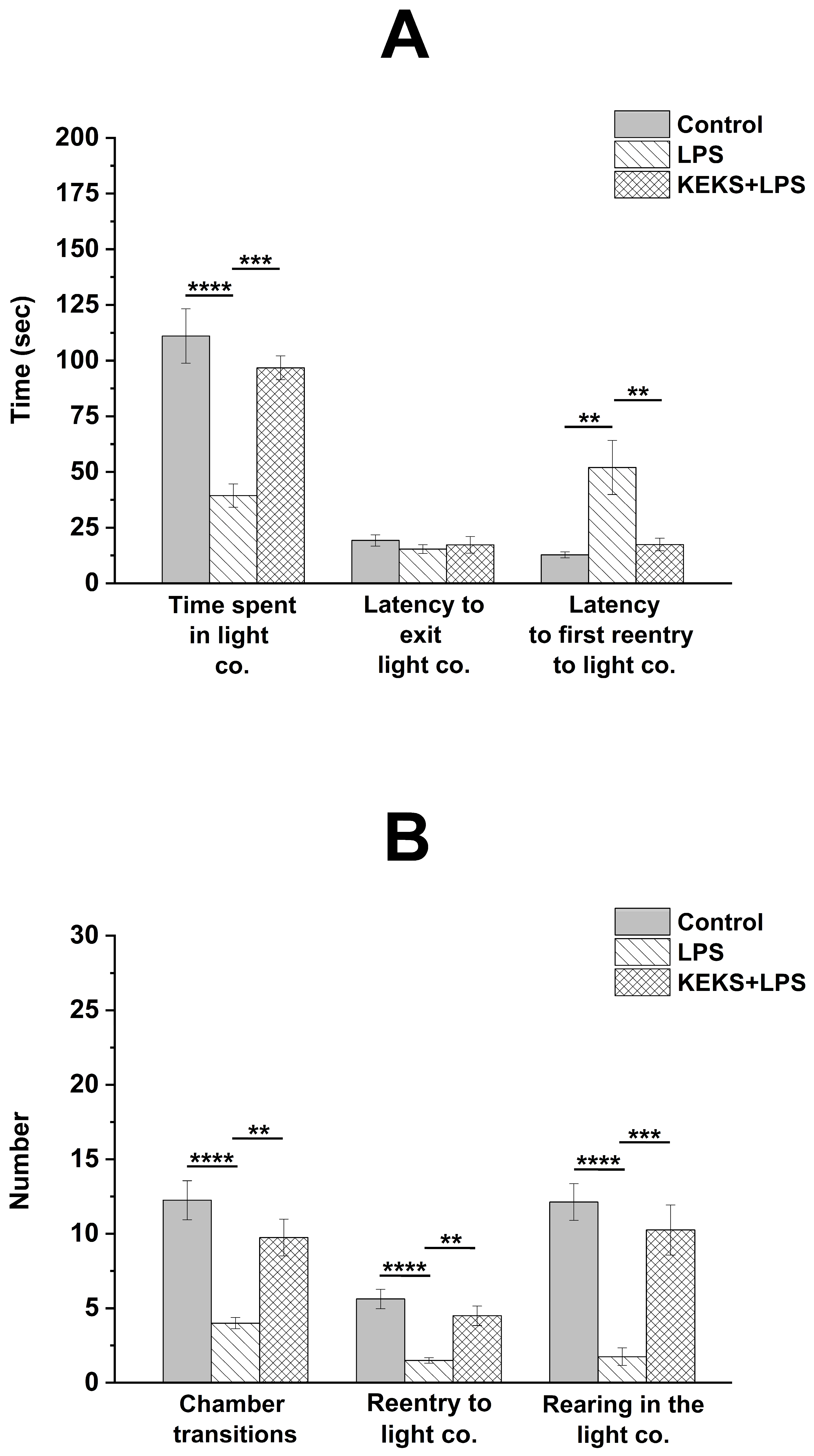
| Time spent in light compartment (sec) | 111.0 ± 12.17 - | 39.4 ± 5.28 ****/<0.0001 | 96.8 ± 5.30 ns/0.454 |
| Latency to exit light compartment (sec) | 19.3 ± 2.57 - | 15.4 ± 1.98 ns/0.6116 | 17.3 ± 3.76 ns/0.8751 |
| Latency to first re-entry to light compartment (sec) | 12.8 ± 1.3195 - | 52.0 ± 12.17 **/0.0027 | 17.4 ± 2.78 ns/0.8944 |
| Number of chamber transitions | 12.3 ± 1.31 - | 4.0 ± 0.38 ****/<0.0001 | 9.8 ± 1.24 ns/0.2411 |
| Number of re-entries to light compartment | 5.6 ± 0.65 - | 1.5 ± 0.19 ****/<0.0001 | 4.5 ± 0.66 ns/0.3298 |
| Number of rearing in the light compartment | 12.1 ± 1.23 - | 1.8 ± 0.59 ****/<0.0001 | 10.3 ± 1.69 ns/0.5498 |
| Blood R-βHB Level (Group 3/KEKS + LPS Group); mmol/L; Mean ± S.E.M.; Level of Significance/p-Value) | Blood Glucose Level (Group 3/KEKS + LPS Group; mg/dL; Mean ± S.E.M.; Level of Significance/p-Value) | |
|---|---|---|
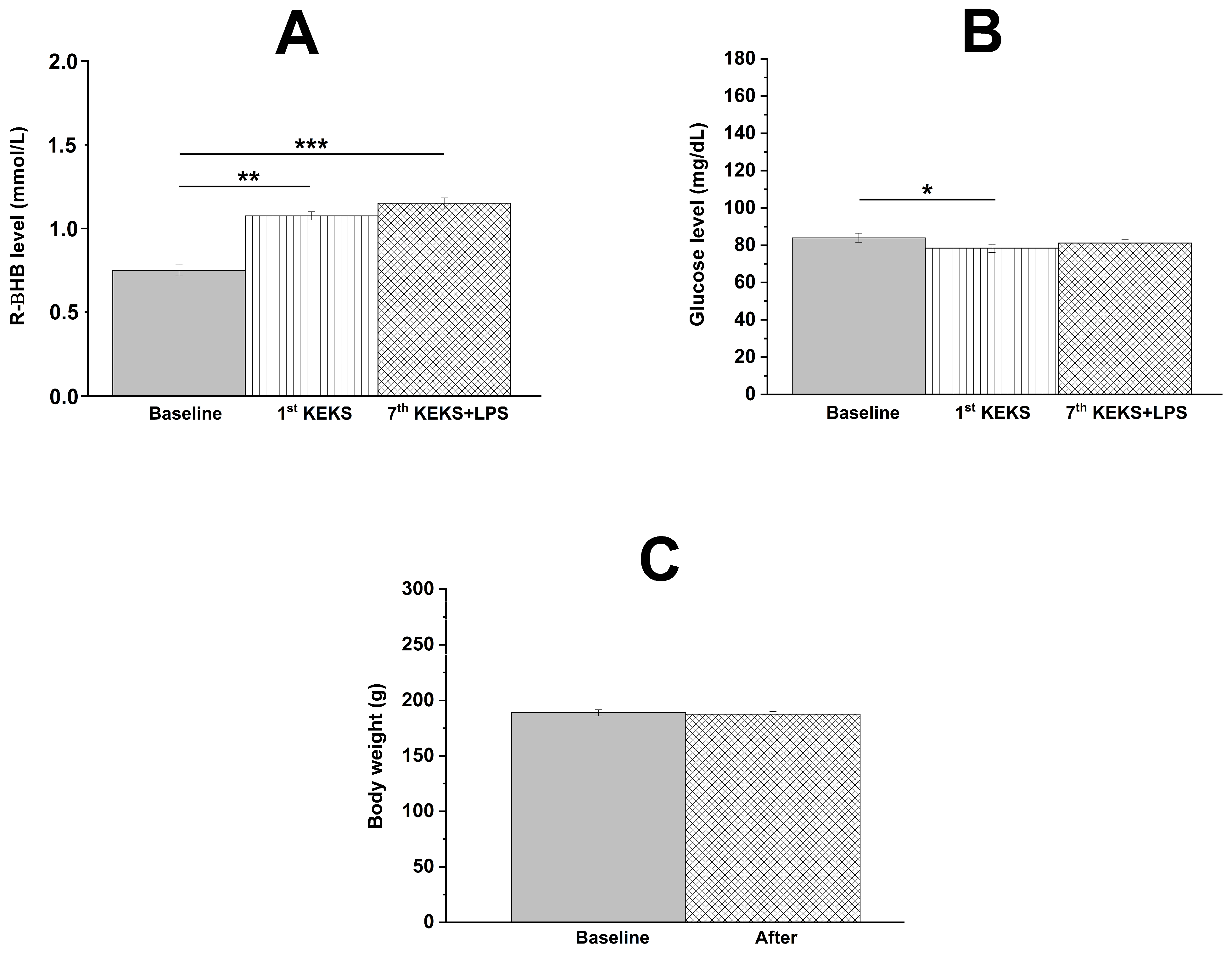
| Baseline | 0.75 ± 0.03 - | 84.00 ± 2.38 - |
| First KEKS-supplemented food + saline | 1.08 ± 0.03 **/<0.0011 | 78.38 ± 2.20 */0.0228 |
| Seventh KEKS-supplemented food + LPS | 1.15 ± 0.03 ***/0.0005 | 81.25 ± 1.69 ns/0.3145 |
Disclaimer/Publisher’s Note: The statements, opinions and data contained in all publications are solely those of the individual author(s) and contributor(s) and not of MDPI and/or the editor(s). MDPI and/or the editor(s) disclaim responsibility for any injury to people or property resulting from any ideas, methods, instructions or products referred to in the content. |
© 2026 by the authors. Licensee MDPI, Basel, Switzerland. This article is an open access article distributed under the terms and conditions of the Creative Commons Attribution (CC BY) license.
Share and Cite
Rauch, E.; Ari, C.; D’Agostino, D.P.; Kovács, Z. Ketone Supplementation Decreased Lipopolysaccharide-Generated Anxiety-like Behavior in Female WAG/Rij Rats. Pharmaceuticals 2026, 19, 1359. https://doi.org/10.3390/ph19091359
Rauch E, Ari C, D’Agostino DP, Kovács Z. Ketone Supplementation Decreased Lipopolysaccharide-Generated Anxiety-like Behavior in Female WAG/Rij Rats. Pharmaceuticals. 2026; 19(9):1359. https://doi.org/10.3390/ph19091359
Chicago/Turabian StyleRauch, Enikő, Csilla Ari, Dominic P. D’Agostino, and Zsolt Kovács. 2026. "Ketone Supplementation Decreased Lipopolysaccharide-Generated Anxiety-like Behavior in Female WAG/Rij Rats" Pharmaceuticals 19, no. 9: 1359. https://doi.org/10.3390/ph19091359
APA StyleRauch, E., Ari, C., D’Agostino, D. P., & Kovács, Z. (2026). Ketone Supplementation Decreased Lipopolysaccharide-Generated Anxiety-like Behavior in Female WAG/Rij Rats. Pharmaceuticals, 19(9), 1359. https://doi.org/10.3390/ph19091359