Research Trends and Emerging Frontiers in Proteolysis Targeting Chimeras (PROTACs): A Bibliometric Analysis of 2630 Publications (2001–2025)

Abstract
1. Introduction
2. Results
2.1. The Historical Features of the PROTACs Literature
2.1.1. Distribution of Publications
2.1.2. Citation Structure of the PROTACs Research Field
2.1.3. Scientific Cooperation
2.2. Variation in the Most Active Topics
2.2.1. Subject Category Burst
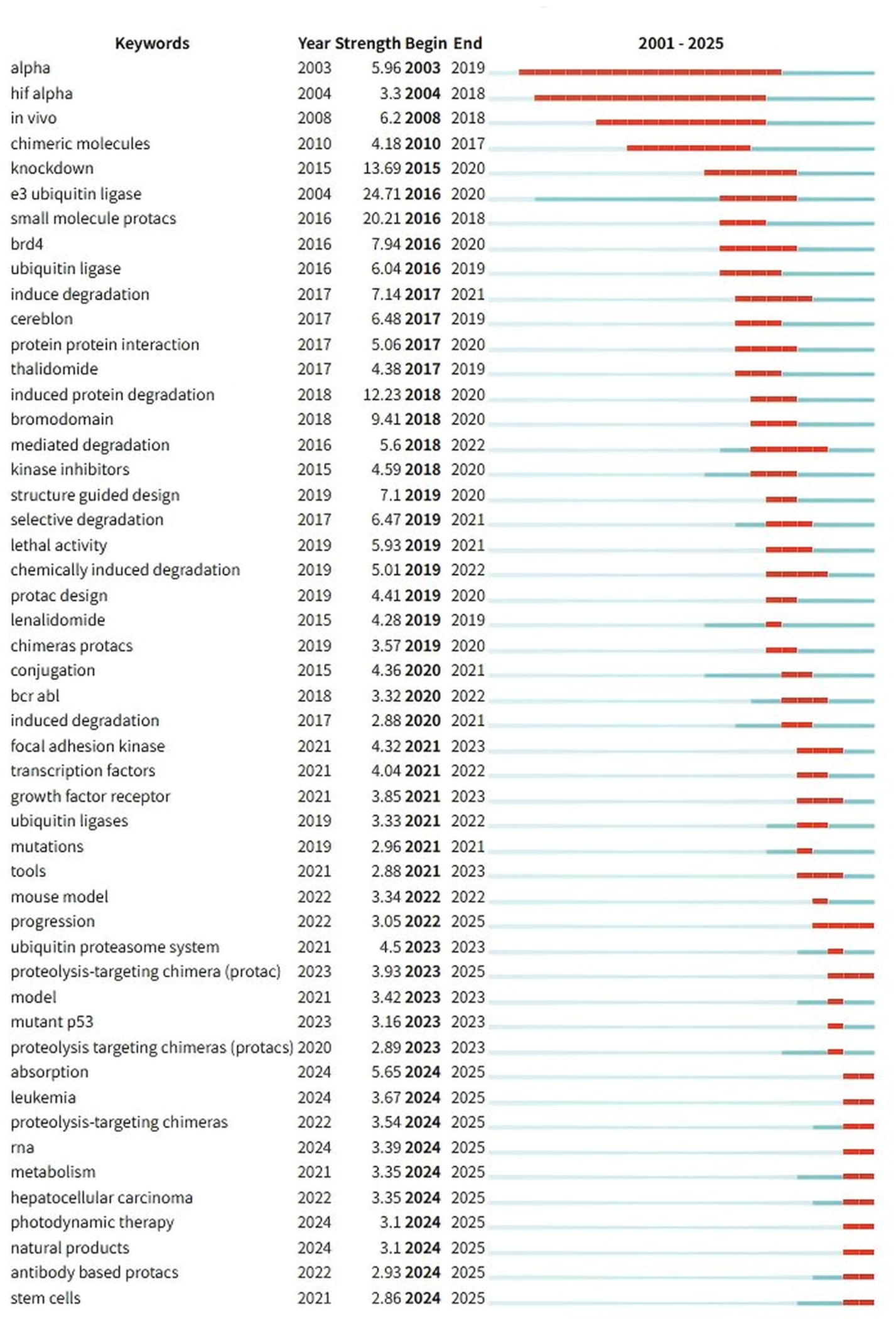
2.2.2. Keywords Burst
2.2.3. Reference Burst
2.3. Emerging Trends and New Developments
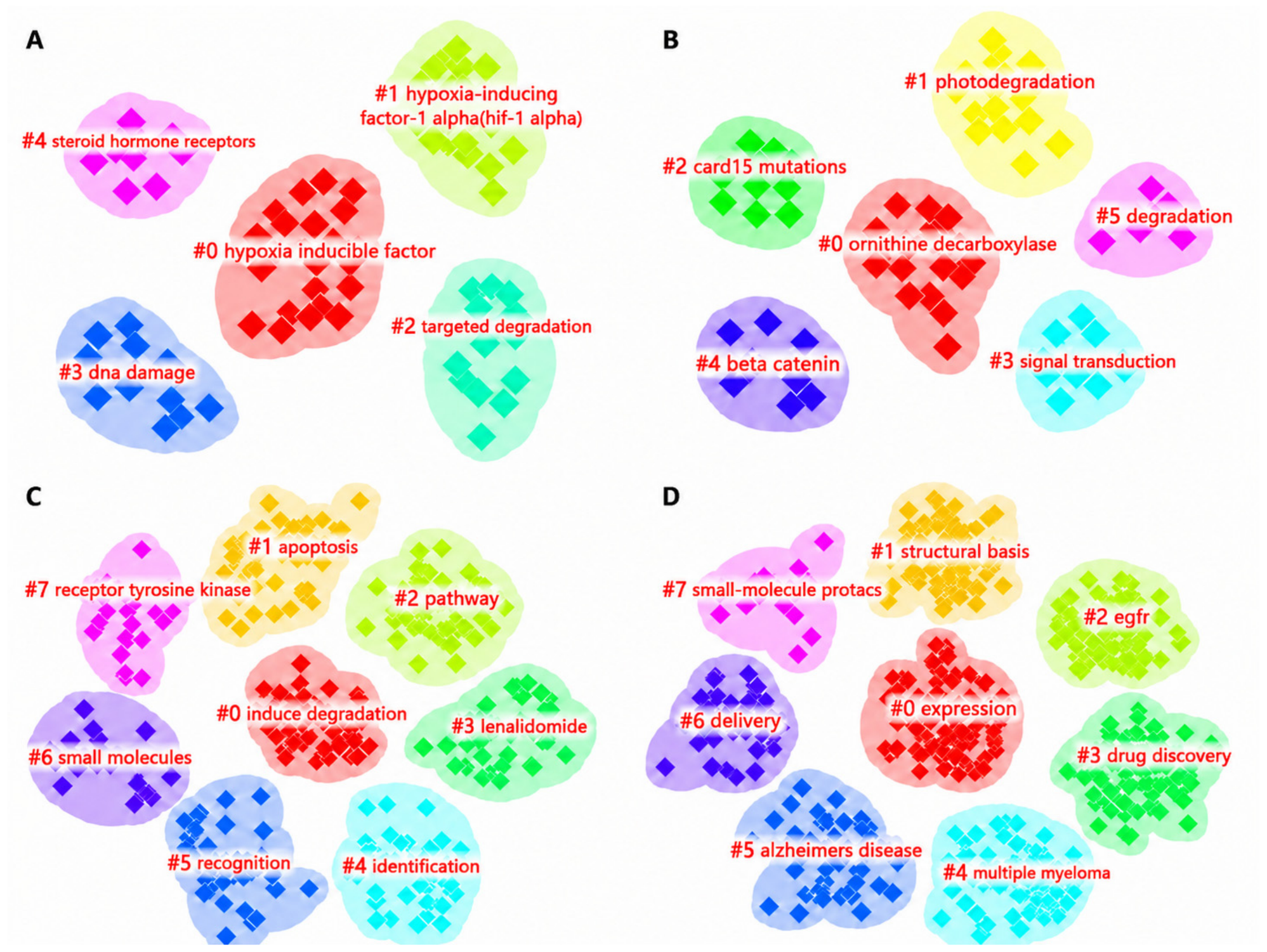
2.3.1. The Temporal Variation in Keyword Clusters
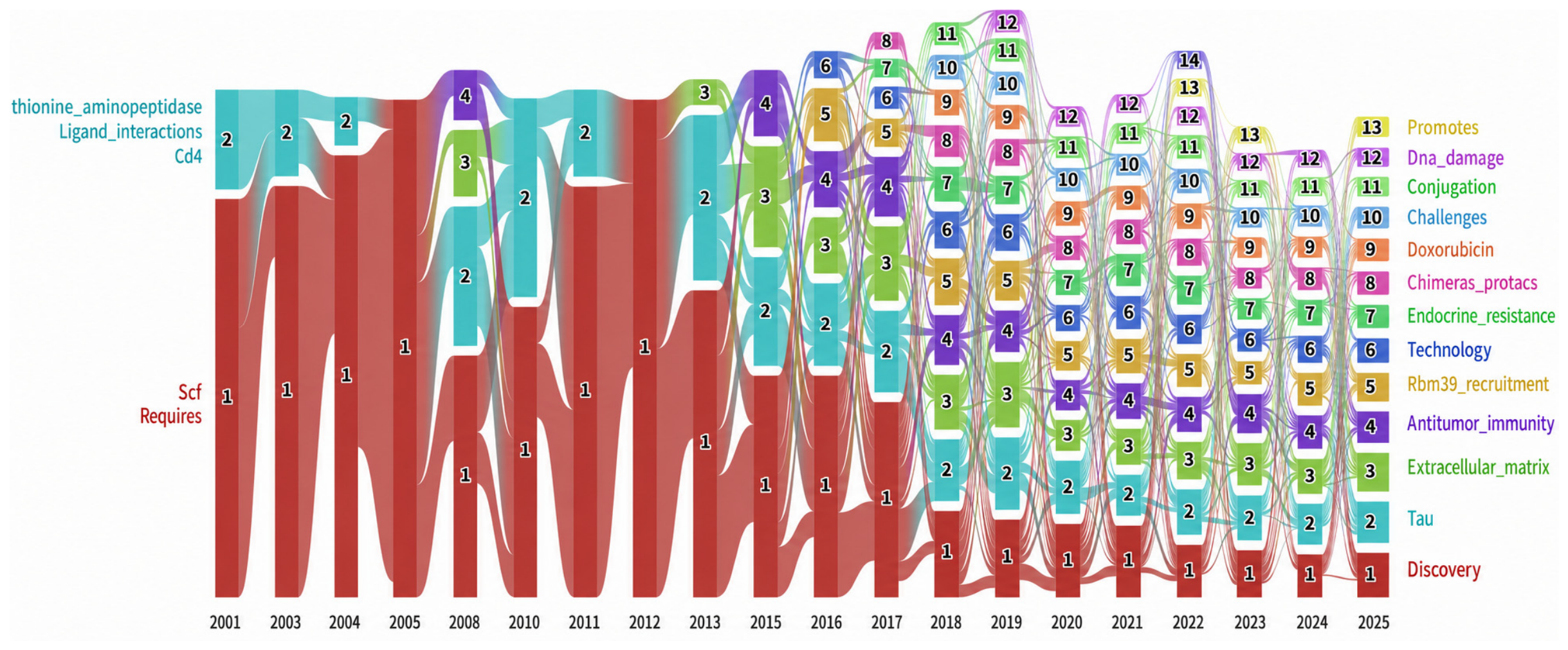
2.3.2. The Keyword Alluvial Flow Visualization
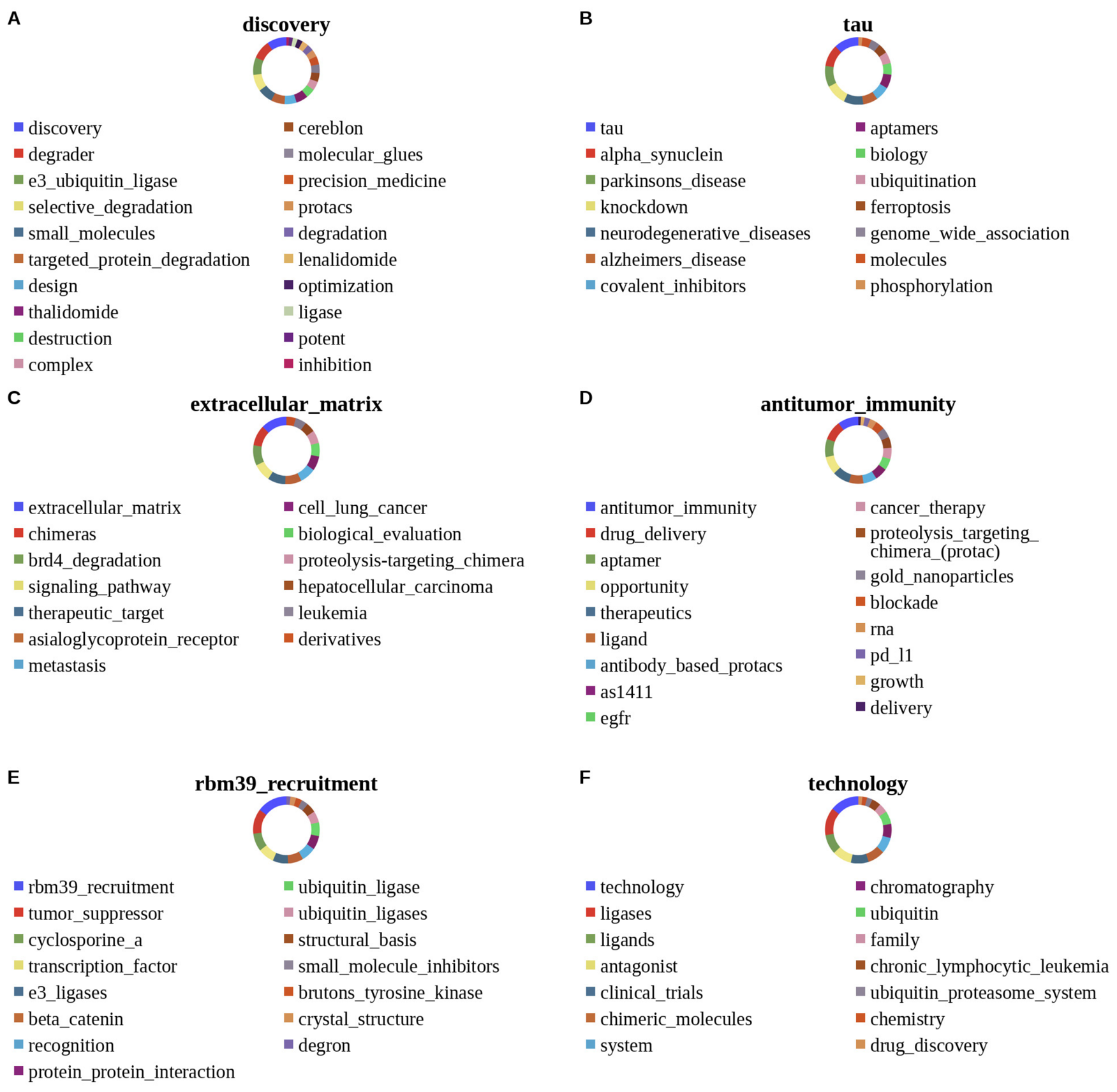
2.3.3. Detailed Composition of Emerging Keyword Modules
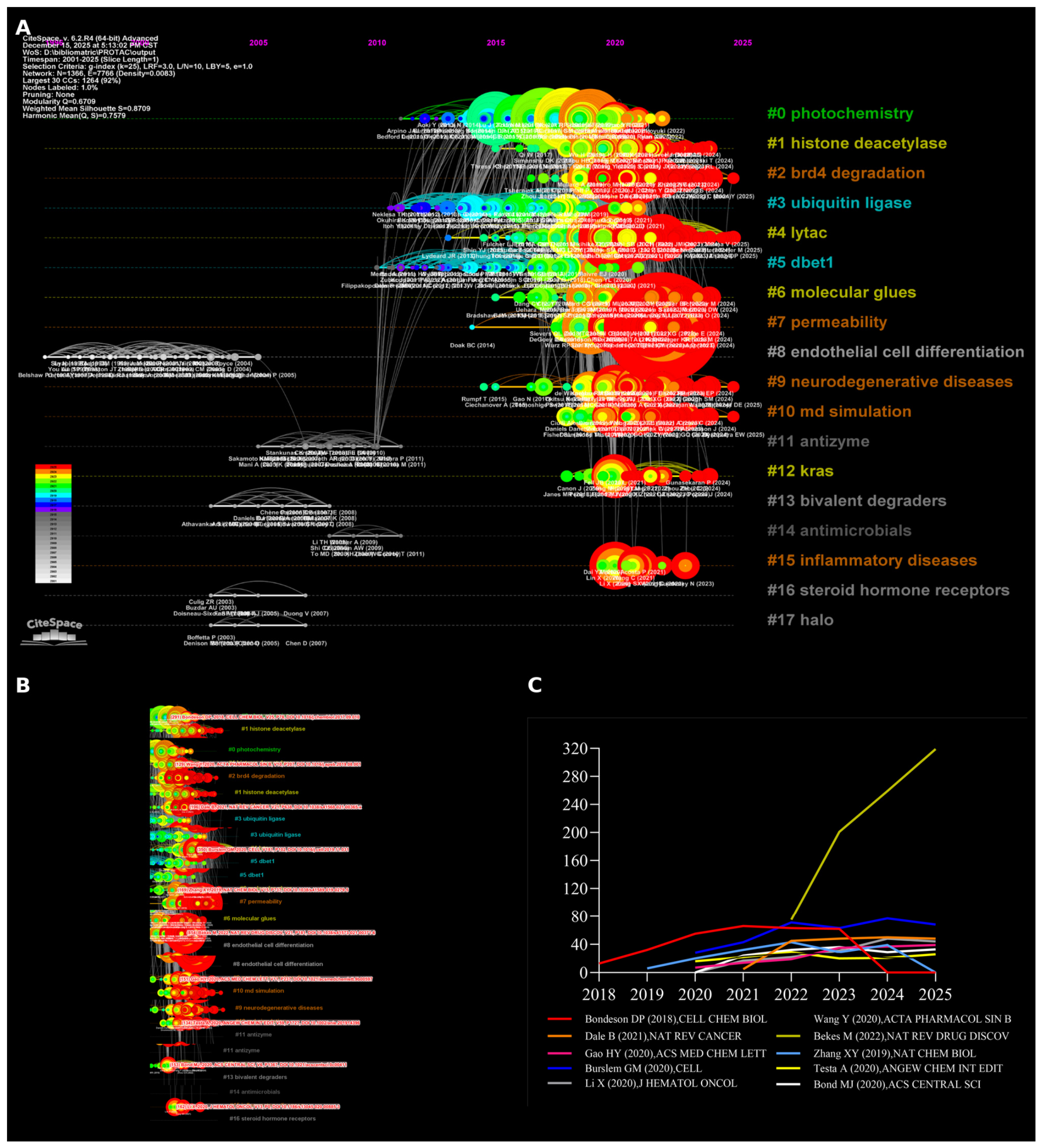
2.3.4. The Timeline Visualization of References
3. Discussion
3.1. General Information
3.2. Emerging Research Hotspots
3.2.1. Structural Basis and Rational Design of PROTACs
3.2.2. Overcoming Drug Resistance via Targeted Degradation
3.2.3. Medicinal Chemistry Optimization and Oral Bioavailability
3.2.4. PROTACs in Oncology: Hematological Malignancies and Beyond
3.2.5. PROTACs for Neurodegenerative Diseases
3.2.6. Delivery Strategies and Precision Activation
3.2.7. Computational Approaches: MD Simulation and AI-Driven Design
3.3. Limitations
4. Materials and Methods
4.1. Data Collection and Statistics
4.2. Tools for Bibliometric Analysis
4.2.1. CiteSpace
Co-Occurrence Networks
Burst Detection
Cluster Analysis
Parameter Settings
4.2.2. HistCite
4.2.3. Alluvial Generator
4.2.4. R
4.3. Use of Generative AI
5. Conclusions
Supplementary Materials
Author Contributions
Funding
Institutional Review Board Statement
Informed Consent Statement
Data Availability Statement
Acknowledgments
Conflicts of Interest
Abbreviations
| AI | Artificial Intelligence |
| ADC | Antibody–Drug Conjugate |
| BBB | Blood–Brain Barrier |
| BET | Bromodomain and Extra-Terminal motif |
| bRo5 | beyond Rule of Five |
| CNS | Central Nervous System |
| CRBN | Cereblon |
| DAC | Degrader–Antibody Conjugate |
| EGFR | Epidermal Growth Factor Receptor |
| GCS | Global Citation Score |
| LCS | Local Citation Score |
| MD | Molecular Dynamics |
| PROTAC | Proteolysis Targeting Chimera |
| TPD | Targeted Protein Degradation |
| VHL | von Hippel–Lindau |
| WoSCC | Web of Science Core Collection |
References
- Sakamoto, K.M.; Kim, K.B.; Kumagai, A.; Mercurio, F.; Crews, C.M.; Deshaies, R.J. Protacs: Chimeric molecules that target proteins to the Skp1-Cullin-F box complex for ubiquitination and degradation. Proc. Natl. Acad. Sci. USA 2001, 98, 8554–8559. [Google Scholar] [CrossRef] [PubMed]
- Békés, M.; Langley, D.R.; Crews, C.M. PROTAC targeted protein degraders: The past is prologue. Nat. Rev. Drug Discov. 2022, 21, 181–200. [Google Scholar] [CrossRef] [PubMed]
- Nalawansha, D.A.; Crews, C.M. PROTACs: An emerging therapeutic modality in precision medicine. Cell Chem. Biol. 2020, 27, 998–1014. [Google Scholar] [CrossRef] [PubMed]
- Bondeson, D.P.; Mares, A.; Smith, I.E.D.; Ko, E.; Campos, S.; Miah, A.H.; Mulholland, K.E.; Routly, N.; Buckley, D.L.; Gustafson, J.L.; et al. Catalytic in vivo protein knockdown by small-molecule PROTACs. Nat. Chem. Biol. 2015, 11, 611–617. [Google Scholar] [CrossRef] [PubMed]
- Winter, G.E.; Buckley, D.L.; Paulk, J.; Roberts, J.M.; Souza, A.; Dhe-Paganon, S.; Bradner, J.E. Phthalimide conjugation as a strategy for in vivo target protein degradation. Science 2015, 348, 1376–1381. [Google Scholar] [CrossRef] [PubMed]
- Gough, S.M.; Flanagan, J.J.; Teh, J.; Andreoli, M.; Rousseau, E.; Pannone, M.; Bookbinder, M.; Willard, R.; Davenport, K.; Bortolon, E.; et al. Oral estrogen receptor PROTAC vepdegestrant (ARV-471) is highly efficacious as monotherapy and in combination with CDK4/6 or PI3K/mTOR pathway inhibitors in preclinical ER+ breast cancer models. Clin. Cancer Res. 2024, 30, 3549–3563. [Google Scholar] [CrossRef] [PubMed]
- Campone, M.; De Laurentiis, M.; Jhaveri, K.; Hu, X.; Ladoire, S.; Patsouris, A.; Zamagni, C.; Cui, J.; Cazzaniga, M.; Cil, T.; et al. Vepdegestrant, a PROTAC estrogen receptor degrader, in advanced breast cancer. N. Engl. J. Med. 2025, 393, 556–568. [Google Scholar] [CrossRef] [PubMed]
- Wei, L.; Wang, Z.; Jing, N.; Lu, Y.; Yang, J.; Xiao, H.; Guo, H.; Sun, S.; Li, M.; Zhao, D.; et al. Frontier progress and reflections on paradigm shift in targeted protein degradation from a bibliometric perspective. Front. Oncol. 2024, 14, 1393599. [Google Scholar] [CrossRef] [PubMed]
- Labhade, S.; Tambe, S.; Amin, P.; Shende, P.; Mhaiskar, A.; Moitra, B.; Saboo, S. Molecular glue degraders: A bibliometric study with implications for current and future trends. Naunyn Schmiedebergs Arch. Pharmacol. 2026, 399, 4321–4339. [Google Scholar] [CrossRef] [PubMed]
- Li, D.; Yu, D.; Li, Y.; Yang, R. A bibliometric analysis of PROTAC from 2001 to 2021. Eur. J. Med. Chem. 2022, 244, 114838. [Google Scholar] [CrossRef] [PubMed]
- Burslem, G.M.; Crews, C.M. Proteolysis-targeting chimeras as therapeutics and tools for biological discovery. Cell 2020, 181, 102–114. [Google Scholar] [CrossRef] [PubMed]
- Bondeson, D.P.; Smith, B.E.; Burslem, G.M.; Buhimschi, A.D.; Hines, J.; Jaime-Figueroa, S.; Wang, J.; Hamman, B.D.; Ishchenko, A.; Crews, C.M. Lessons in PROTAC design from selective degradation with a promiscuous warhead. Cell Chem. Biol. 2018, 25, 78–87.e5. [Google Scholar] [CrossRef] [PubMed]
- Gadd, M.S.; Testa, A.; Lucas, X.; Chan, K.-H.; Chen, W.; Lamont, D.J.; Zengerle, M.; Ciulli, A. Structural basis of PROTAC cooperative recognition for selective protein degradation. Nat. Chem. Biol. 2017, 13, 514–521. [Google Scholar] [CrossRef] [PubMed]
- Lai, A.C.; Crews, C.M. Induced protein degradation: An emerging drug discovery paradigm. Nat. Rev. Drug Discov. 2017, 16, 101–114. [Google Scholar] [CrossRef] [PubMed]
- Li, K.; Crews, C.M. PROTACs: Past, present and future. Chem. Soc. Rev. 2022, 51, 5214–5236. [Google Scholar] [CrossRef] [PubMed]
- Dale, B.; Cheng, M.; Park, K.-S.; Kaniskan, H.Ü.; Xiong, Y.; Jin, J. Advancing targeted protein degradation for cancer therapy. Nat. Rev. Cancer 2021, 21, 638–654. [Google Scholar] [CrossRef] [PubMed]
- Zhang, X.; Crowley, V.M.; Wucherpfennig, T.G.; Dix, M.M.; Cravatt, B.F. Electrophilic PROTACs that degrade nuclear proteins by engaging DCAF16. Nat. Chem. Biol. 2019, 15, 737–746. [Google Scholar] [CrossRef] [PubMed]
- Gao, H.; Sun, X.; Rao, Y. PROTAC technology: Opportunities and challenges. ACS Med. Chem. Lett. 2020, 11, 237–240. [Google Scholar] [CrossRef] [PubMed]
- Testa, A.; Hughes, S.J.; Lucas, X.; Wright, J.E.; Ciulli, A. Structure-based design of a macrocyclic PROTAC. Angew. Chem. Int. Ed. 2020, 59, 1727–1734. [Google Scholar] [CrossRef] [PubMed]
- Bond, M.J.; Chu, L.; Nalawansha, D.A.; Li, K.; Crews, C.M. Targeted degradation of oncogenic KRASG12C by VHL-recruiting PROTACs. ACS Cent. Sci. 2020, 6, 1367–1375. [Google Scholar] [CrossRef] [PubMed]
- Li, X.; Song, Y. Proteolysis-targeting chimera (PROTAC) for targeted protein degradation and cancer therapy. J. Hematol. Oncol. 2020, 13, 50. [Google Scholar] [CrossRef] [PubMed]
- Wang, Y.; Jiang, X.; Feng, F.; Liu, W.; Sun, H. Degradation of proteins by PROTACs and other strategies. Acta Pharm. Sin. B 2020, 10, 207–238. [Google Scholar] [CrossRef] [PubMed]
- Buckley, D.L.; Van Molle, I.; Gareiss, P.C.; Tae, H.S.; Michel, J.; Noblin, D.J.; Jorgensen, W.L.; Ciulli, A.; Crews, C.M. Targeting the von Hippel-Lindau E3 ubiquitin ligase using small molecules to disrupt the VHL/HIF-1α interaction. J. Am. Chem. Soc. 2012, 134, 4465–4468. [Google Scholar] [CrossRef] [PubMed]
- Zhao, L.; Zhao, J.; Zhong, K.; Tong, A.; Jia, D. Targeted protein degradation: Mechanisms, strategies and application. Signal Transduct. Target. Ther. 2022, 7, 113. [Google Scholar] [CrossRef] [PubMed]
- Pike, A.; Williamson, B.; Harlfinger, S.; Martin, S.; McGinnity, D.F. Optimising proteolysis-targeting chimeras (PROTACs) for oral drug delivery: A drug metabolism and pharmacokinetics perspective. Drug Discov. Today 2020, 25, 1793–1800. [Google Scholar] [CrossRef] [PubMed]
- Nayak, D.; Lv, D.; Yuan, Y.; Zhang, P.; Hu, W.; Nayak, A.; Ruben, E.A.; Lv, Z.; Sung, P.; Hromas, R.; et al. Development and crystal structures of a potent second-generation dual degrader of BCL-2 and BCL-xL. Nat. Commun. 2024, 15, 2743. [Google Scholar] [CrossRef] [PubMed]
- Li, C.; Zhang, Y.; Wang, J.; Liu, Y.; Yang, Y.; Jin, Y.; Zou, Y.; Liu, Y.; Liu, T.; Xu, Z.; et al. Structure-based design of “head-to-tail” macrocyclic PROTACs. JACS Au 2024, 4, 4866–4882. [Google Scholar] [CrossRef] [PubMed]
- Mabanglo, M.F.; Wilson, B.; Noureldin, M.; Kimani, S.W.; Mamai, A.; Krausser, C.; González-Álvarez, H.; Srivastava, S.; Mohammed, M.; Hoffer, L.; et al. Crystal structures of DCAF1-PROTAC-WDR5 ternary complexes provide insight into DCAF1 substrate specificity. Nat. Commun. 2024, 15, 10165. [Google Scholar] [CrossRef] [PubMed]
- Tsai, J.M.; Nowak, R.P.; Ebert, B.L.; Fischer, E.S. Targeted protein degradation: From mechanisms to clinic. Nat. Rev. Mol. Cell Biol. 2024, 25, 740–757. [Google Scholar] [CrossRef] [PubMed]
- Hsia, O.; Hinterndorfer, M.; Cowan, A.D.; Iso, K.; Ishida, T.; Sundaramoorthy, R.; Nakasone, M.A.; Imrichova, H.; Schätz, C.; Rukavina, A.; et al. Targeted protein degradation via intramolecular bivalent glues. Nature 2024, 627, 204–211. [Google Scholar] [CrossRef] [PubMed]
- Ignatov, M.; Jindal, A.; Kotelnikov, S.; Beglov, D.; Posternak, G.; Tang, X.; Maisonneuve, P.; Poda, G.; Batey, R.A.; Sicheri, F.; et al. High accuracy prediction of PROTAC complex structures. J. Am. Chem. Soc. 2023, 145, 7123–7135. [Google Scholar] [CrossRef] [PubMed]
- Du, Y.; Chen, Y.; Wang, Y.; Chen, J.; Lu, X.; Zhang, L.; Li, Y.; Wang, Z.; Ye, G.; Zhang, G. HJM-561, a potent, selective, and orally bioavailable EGFR PROTAC that overcomes osimertinib-resistant EGFR triple mutations. Mol. Cancer Ther. 2022, 21, 1060–1066. [Google Scholar] [CrossRef] [PubMed]
- Zhu, Y.; Ye, X.; Wu, Y.; Shen, H.; Cai, Z.; Xia, F.; Min, W.; Hou, Y.; Wang, L.; Wang, X.; et al. Design, synthesis, and biological evaluation of novel EGFR PROTACs targeting C797S mutation. J. Med. Chem. 2024, 67, 7283–7300. [Google Scholar] [CrossRef] [PubMed]
- Popow, J.; Farnaby, W.; Gollner, A.; Kofink, C.; Fischer, G.; Wurm, M.; Zollman, D.; Wijaya, A.; Mischerikow, N.; Hasenoehrl, C.; et al. Targeting cancer with small-molecule pan-KRAS degraders. Science 2024, 385, 1338–1347. [Google Scholar] [CrossRef] [PubMed]
- Yoshinari, T.; Nagashima, T.; Ishioka, H.; Inamura, K.; Nishizono, Y.; Tasaki, M.; Iguchi, K.; Suzuki, A.; Sato, C.; Nakayama, A.; et al. Discovery of KRAS(G12D) selective degrader ASP3082. Commun. Chem. 2025, 8, 254. [Google Scholar] [CrossRef] [PubMed]
- Poongavanam, V.; Wieske, L.H.E.; Peintner, S.; Erdélyi, M.; Kihlberg, J. Molecular chameleons in drug discovery. Nat. Rev. Chem. 2024, 8, 45–60. [Google Scholar] [CrossRef] [PubMed]
- Garcia Jimenez, D.; Rossi Sebastiano, M.; Vallaro, M.; Ermondi, G.; Caron, G. IMHB-mediated chameleonicity in drug design: A focus on structurally related PROTACs. J. Med. Chem. 2024, 67, 11421–11434. [Google Scholar] [CrossRef] [PubMed]
- Hornberger, K.R.; Araujo, E.M.V. Physicochemical property determinants of oral absorption for PROTAC protein degraders. J. Med. Chem. 2023, 66, 8281–8287. [Google Scholar] [CrossRef] [PubMed]
- Apprato, G.; Poongavanam, V.; Garcia Jimenez, D.; Atilaw, Y.; Erdelyi, M.; Ermondi, G.; Caron, G.; Kihlberg, J. Exploring the chemical space of orally bioavailable PROTACs. Drug Discov. Today 2024, 29, 103917. [Google Scholar] [CrossRef] [PubMed]
- Kofink, C.; Trainor, N.; Mair, B.; Wöhrle, S.; Wurm, M.; Mischerikow, N.; Roy, M.J.; Bader, G.; Greb, P.; Garavel, G.; et al. A selective and orally bioavailable VHL-recruiting PROTAC achieves SMARCA2 degradation in vivo. Nat. Commun. 2022, 13, 5969. [Google Scholar] [CrossRef] [PubMed]
- Montoya, S.; Bourcier, J.; Noviski, M.; Lu, H.; Thompson, M.C.; Chirino, A.; Jahn, J.; Sondhi, A.K.; Gaynor, L.M.; Cirrincione, A.M.; et al. Kinase-impaired BTK mutations are susceptible to clinical-stage BTK and IKZF1/3 degrader NX-2127. Science 2024, 383, eadi5798. [Google Scholar] [CrossRef] [PubMed]
- Robbins, D.W.; Noviski, M.A.; Tan, Y.S.; Konst, Z.A.; Kelly, A.; Auger, P.; Brathaban, N.; Cass, R.; Chan, M.L.; Cherala, G.; et al. Discovery and preclinical pharmacology of NX-2127, an orally bioavailable degrader of Bruton’s tyrosine kinase with immunomodulatory activity for the treatment of patients with B-cell malignancies. J. Med. Chem. 2024, 67, 2321–2336. [Google Scholar] [CrossRef] [PubMed]
- Chirnomas, D.; Hornberger, K.R.; Crews, C.M. Protein degraders enter the clinic: A new approach to cancer therapy. Nat. Rev. Clin. Oncol. 2023, 20, 265–278. [Google Scholar] [CrossRef] [PubMed]
- Dehay, B.; Bourdenx, M.; Gorry, P.; Przedborski, S.; Vila, M.; Hunot, S.; Singleton, A.; Olanow, C.W.; Merchant, K.M.; Bezard, E.; et al. Targeting α-synuclein for treatment of Parkinson’s disease: Mechanistic and therapeutic considerations. Lancet Neurol. 2015, 14, 855–866. [Google Scholar] [CrossRef] [PubMed]
- Silva, M.C.; Ferguson, F.M.; Cai, Q.; Donovan, K.A.; Nandi, G.; Patnaik, D.; Zhang, T.; Huang, H.-T.; Lucente, D.E.; Dickerson, B.C.; et al. Targeted degradation of aberrant tau in frontotemporal dementia patient-derived neuronal cell models. eLife 2019, 8, e45457. [Google Scholar] [CrossRef] [PubMed]
- Wang, W.; Zhou, Q.; Jiang, T.; Li, S.; Ye, J.; Zheng, J.; Wang, X.; Liu, Y.; Deng, M.; Ke, D.; et al. A novel small-molecule PROTAC selectively promotes tau clearance to improve cognitive functions in Alzheimer-like mouse models. Theranostics 2021, 11, 5279–5295. [Google Scholar] [CrossRef] [PubMed]
- Yao, D.; Li, T.; Yu, L.; Hu, M.; He, Y.; Zhang, R.; Wu, J.; Li, S.; Kuang, W.; Yang, X.; et al. Selective degradation of hyperphosphorylated tau by proteolysis-targeting chimeras ameliorates cognitive function in Alzheimer’s disease model mice. Front. Pharmacol. 2024, 15, 1351792. [Google Scholar] [CrossRef] [PubMed]
- Fang, Y.; Wang, J.; Zhao, M.; Zheng, Q.; Ren, C.; Wang, Y.; Zhang, J. Progress and challenges in targeted protein degradation for neurodegenerative disease therapy. J. Med. Chem. 2022, 65, 11454–11477. [Google Scholar] [CrossRef] [PubMed]
- He, S.; Gao, F.; Ma, J.; Ma, H.; Dong, G.; Sheng, C. Aptamer-PROTAC conjugates (APCs) for tumor-specific targeting in breast cancer. Angew. Chem. Int. Ed. 2021, 60, 23299–23305. [Google Scholar] [CrossRef] [PubMed]
- Serafini, M.; Twigger, S.A.; Delfas, G.; Mallerman, M.; Bailey, E.P.; Calder, E.D.D.; Hammond, E.M.; Conway, S.J. Indolequinone-based hypoxia-activated proteolysis targeting chimeras selectively degrade BRD4 in hypoxic cancer cells. J. Am. Chem. Soc. 2025, 147, 36352–36364. [Google Scholar] [CrossRef] [PubMed]
- Yang, L.; Yang, Y.; Zhang, J.; Li, M.; Yang, L.; Wang, X.; Chen, M.; Zhang, H.; He, B.; Wang, X.; et al. Sequential responsive nano-PROTACs for precise intracellular delivery and enhanced degradation efficacy in colorectal cancer therapy. Signal Transduct. Target. Ther. 2024, 9, 275. [Google Scholar] [CrossRef] [PubMed]
- Chen, C. CiteSpace II: Detecting and visualizing emerging trends and transient patterns in scientific literature. J. Am. Soc. Inf. Sci. Technol. 2006, 57, 359–377. [Google Scholar] [CrossRef]
- Chen, C. Searching for intellectual turning points: Progressive knowledge domain visualization. Proc. Natl. Acad. Sci. USA 2004, 101, 5303–5310. [Google Scholar] [CrossRef] [PubMed]
- Kleinberg, J. Bursty and hierarchical structure in streams. Data Min. Knowl. Discov. 2003, 7, 373–397. [Google Scholar] [CrossRef]
- Chen, C.; Dubin, R.; Kim, M.C. Emerging trends and new developments in regenerative medicine: A scientometric update (2000–2014). Expert. Opin. Biol. Ther. 2014, 14, 1295–1317. [Google Scholar] [CrossRef] [PubMed]
- Rosvall, M.; Bergstrom, C.T. Mapping change in large networks. PLoS ONE 2010, 5, e8694. [Google Scholar] [CrossRef] [PubMed]



| Categories | Publication | Articles | Review | Authors | Institutions | Journals | Subject Categories |
|---|---|---|---|---|---|---|---|
| Amount | 2630 | 1818 | 812 | 14,269 | 7679 | 516 | 82 |
| NO | Article Information | Journal | LCS | GCS |
|---|---|---|---|---|
| 1 | Protacs: Chimeric molecules that target proteins to the Skp1-Cullin-F box complex for ubiquitination and degradation | P NATL ACAD SCI USA | 947 | 1715 |
| 705 | PROTAC targeted protein degraders: the past is prologue | NAT REV DRUG DISCOV | 854 | 946 |
| 20 | Catalytic in vivo protein knockdown by small-molecule PROTACs | NAT CHEM BIOL | 593 | 758 |
| 41 | Structural basis of PROTAC cooperative recognition for selective protein degradation | NAT CHEM BIOL | 539 | 698 |
| 36 | Induced protein degradation: an emerging drug discovery paradigm | NAT REV DRUG DISCOV | 512 | 1565 |
| 17 | Hijacking the E3 Ubiquitin Ligase Cereblon to Efficiently Target BRD4 | CHEM BIOL | 473 | 645 |
| 18 | Selective Small Molecule-Induced Degradation of the BET Bromodomain Protein BRD4 | ACS CHEM BIOL | 461 | 503 |
| 62 | Lessons in PROTAC Design from Selective Degradation with a Promiscuous Warhead | CELL CHEM BIOL | 426 | 566 |
| 27 | PROTAC-induced BET protein degradation as a therapy for castration-resistant prostate cancer | P NATL ACAD SCI USA | 377 | 499 |
| 254 | Proteolysis-Targeting Chimeras as Therapeutics and Tools for Biological Discovery | CELL | 350 | 582 |
| 24 | Small-Molecule PROTACS: New Approaches to Protein Degradation | ANGEW CHEM INT EDIT | 325 | 772 |
| 61 | The Advantages of Targeted Protein Degradation Over Inhibition: An RTK Case Study | CELL CHEM BIOL | 322 | 654 |
| 197 | Targeted protein degradation: expanding the toolbox | NAT REV DRUG DISCOV | 314 | 1838 |
| 8 | Targeted intracellular protein degradation induced by a small molecule: En route to chemical proteomics | BIOORG MED CHEM LETT | 314 | 2042 |
| 23 | Modular PROTAC Design for the Degradation of Oncogenic BCR-ABL | ANGEW CHEM INT EDIT | 313 | 989 |
| 778 | PROTACs: past, present and future | CHEM SOC REV | 271 | 868 |
| 93 | Plasticity in binding confers selectivity in ligand-induced protein degradation | NAT CHEM BIOL | 269 | 1102 |
| 309 | Lysosome-targeting chimeras for degradation of extracellular proteins | NATURE | 258 | 903 |
| 196 | A selective BCL-XL PROTAC degrader achieves safe and potent antitumor activity | NAT MED | 247 | 804 |
| 47 | Targeted protein degradation by PROTACs | PHARMACOL THERAPEUT | 233 | 653 |
| 3 | Chemical genetic control of protein levels: Selective in vivo targeted degradation | J AM CHEM SOC | 231 | 657 |
| 163 | BAF complex vulnerabilities in cancer demonstrated via structure-based PROTAC design | NAT CHEM BIOL | 224 | 750 |
| 151 | Targeted protein degradation: elements of PROTAC design | CURR OPIN CHEM BIOL | 216 | 522 |
| 65 | Protac-Induced Protein Degradation in Drug Discovery: Breaking the Rules or Just Making New Ones? | J MED CHEM | 215 | 502 |
| 98 | Delineating the role of cooperativity in the design of potent PROTACs for BTK | P NATL ACAD SCI USA | 211 | 475 |
| 34 | Protein Degradation by In-Cell Self-Assembly of Proteolysis Targeting Chimeras | ACS CENTRAL SCI | 208 | 668 |
| 166 | Proteolysis targeting chimeras (PROTACs) in ‘beyond rule-of-five’ chemical space: Recent progress and future challenges | BIOORG MED CHEM LETT | 207 | 496 |
| 19 | HaloPROTACS: Use of Small Molecule PROTACs to Induce Degradation of Halo Tag Fusion Proteins | ACS CHEM BIOL | 207 | 496 |
| 95 | Targeting the C481S Ibrutinib-Resistance Mutation in Bruton’s Tyrosine Kinase Using PROTAC-Mediated Degradation | BIOCHEMISTRY-US | 204 | 443 |
| 132 | Discovery of ARD-69 as a Highly Potent Proteolysis Targeting Chimera (PROTAC) Degrader of Androgen Receptor (AR) for the Treatment of Prostate Cancer | J MED CHEM | 198 | 783 |
Disclaimer/Publisher’s Note: The statements, opinions and data contained in all publications are solely those of the individual author(s) and contributor(s) and not of MDPI and/or the editor(s). MDPI and/or the editor(s) disclaim responsibility for any injury to people or property resulting from any ideas, methods, instructions or products referred to in the content. |
© 2026 by the authors. Licensee MDPI, Basel, Switzerland. This article is an open access article distributed under the terms and conditions of the Creative Commons Attribution (CC BY) license.
Share and Cite
Su, G.; Wang, Y.; Yao, L. Research Trends and Emerging Frontiers in Proteolysis Targeting Chimeras (PROTACs): A Bibliometric Analysis of 2630 Publications (2001–2025). Pharmaceuticals 2026, 19, 988. https://doi.org/10.3390/ph19070988
Su G, Wang Y, Yao L. Research Trends and Emerging Frontiers in Proteolysis Targeting Chimeras (PROTACs): A Bibliometric Analysis of 2630 Publications (2001–2025). Pharmaceuticals. 2026; 19(7):988. https://doi.org/10.3390/ph19070988
Chicago/Turabian StyleSu, Ganglin, Yihan Wang, and Lin Yao. 2026. "Research Trends and Emerging Frontiers in Proteolysis Targeting Chimeras (PROTACs): A Bibliometric Analysis of 2630 Publications (2001–2025)" Pharmaceuticals 19, no. 7: 988. https://doi.org/10.3390/ph19070988
APA StyleSu, G., Wang, Y., & Yao, L. (2026). Research Trends and Emerging Frontiers in Proteolysis Targeting Chimeras (PROTACs): A Bibliometric Analysis of 2630 Publications (2001–2025). Pharmaceuticals, 19(7), 988. https://doi.org/10.3390/ph19070988