This is an early access version, the complete PDF, HTML, and XML versions will be available soon.
Open AccessReview
Molecular Imaging in Pancreatic Cancer: Current Applications and Future Perspectives
by
Yongshun Liu
 Yongshun Liu
Kexin Lan
Kexin Lan
Zhaonan Sun
Zhaonan Sun
Wenpeng Huang
Wenpeng Huang
1
Department of Medical Imaging, Peking University First Hospital, Beijing 100034, China
2
Department of Nuclear Medicine, Peking University First Hospital, Beijing 100034, China
3
Department of Radiology, Geriatric Hospital of Nanjing Medical University (Jiangsu Province Official Hospital), Nanjing 210024, China
*
Authors to whom correspondence should be addressed.
Pharmaceuticals 2026, 19(7), 1078; https://doi.org/10.3390/ph19071078 (registering DOI)
Submission received: 15 June 2026
/
Revised: 6 July 2026
/
Accepted: 8 July 2026
/
Published: 13 July 2026
Abstract
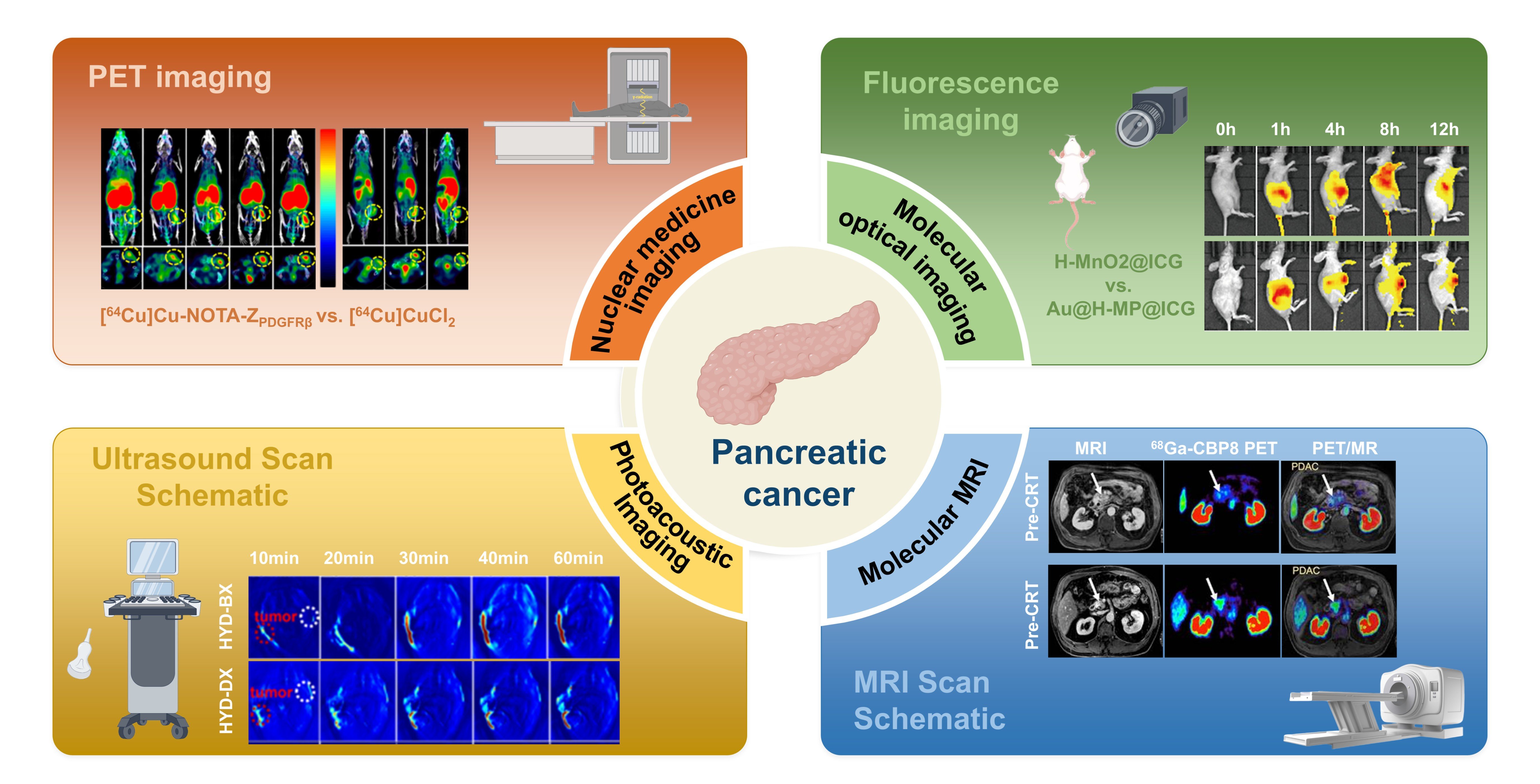
Pancreatic cancer ranks among the most lethal malignancies, characterized by a five-year survival rate of approximately 10%. This dismal prognosis is largely attributable to diagnoses occurring at advanced stages and the inherent limitations of conventional imaging modalities in detecting early lesions, identifying metastases, and assessing tumor heterogeneity. Consequently, there is a critical need for non-invasive imaging techniques capable of visualizing pancreatic cancer lesions to enable accurate diagnosis, risk assessment, and the development of personalized treatment strategies. Molecular imaging, which combines highly specific targeted probes with advanced imaging technologies, offers the potential to elucidate disease-associated pathways. This review provides a comprehensive overview of recent advancements in molecular imaging platforms for pancreatic cancer, including positron emission tomography (PET), single-photon emission computed tomography (SPECT), optical molecular imaging, photoacoustic imaging, and molecular MRI. We begin by elucidating the biological rationale for targeting key molecules, including fibroblast activation protein (FAP), integrins, and programmed death ligand 1 (PD-L1). Moreover, we critically evaluate the development and clinical translation of these probes, highlighting their ability to enhance lesion detectability, characterize intratumoral heterogeneity, and guide both targeted therapy and surgical resection. Compared with existing reviews, this work uniquely integrates a comprehensive cross-modality analysis of the latest molecular imaging strategies for pancreatic cancer. Furthermore, we examine prevailing challenges and emerging frontiers in this domain, specifically focusing on multimodal hybrid imaging, artificial intelligence-driven analytics, and integrated theranostic platforms as pivotal strategies to advance precision oncology.
Share and Cite
MDPI and ACS Style
Liu, Y.; Lan, K.; Sun, Z.; Huang, W.
Molecular Imaging in Pancreatic Cancer: Current Applications and Future Perspectives. Pharmaceuticals 2026, 19, 1078.
https://doi.org/10.3390/ph19071078
AMA Style
Liu Y, Lan K, Sun Z, Huang W.
Molecular Imaging in Pancreatic Cancer: Current Applications and Future Perspectives. Pharmaceuticals. 2026; 19(7):1078.
https://doi.org/10.3390/ph19071078
Chicago/Turabian Style
Liu, Yongshun, Kexin Lan, Zhaonan Sun, and Wenpeng Huang.
2026. "Molecular Imaging in Pancreatic Cancer: Current Applications and Future Perspectives" Pharmaceuticals 19, no. 7: 1078.
https://doi.org/10.3390/ph19071078
APA Style
Liu, Y., Lan, K., Sun, Z., & Huang, W.
(2026). Molecular Imaging in Pancreatic Cancer: Current Applications and Future Perspectives. Pharmaceuticals, 19(7), 1078.
https://doi.org/10.3390/ph19071078
Note that from the first issue of 2016, this journal uses article numbers instead of page numbers. See further details
here.
Article Metrics
Article Access Statistics
For more information on the journal statistics, click
here.
Multiple requests from the same IP address are counted as one view.