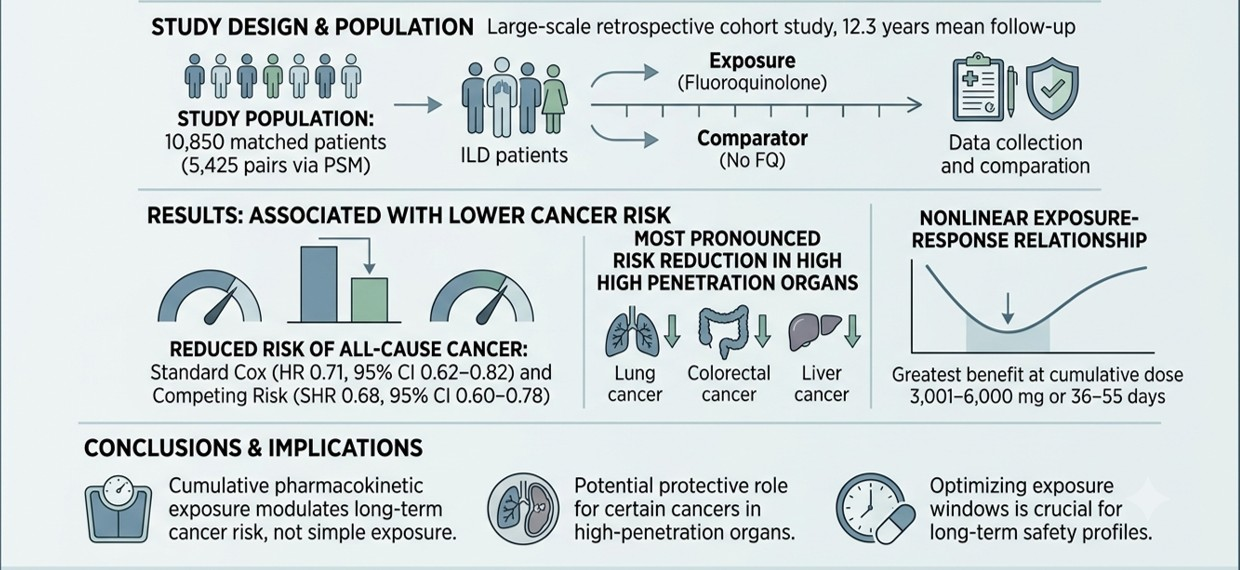
Fluoroquinolone Exposure and Cancer Risk in Interstitial Lung Disease: A Propensity-Score-Matched Cohort Study Using Cox and Competing-Risk Models

 ,
, 
Abstract
1. Introduction
1.1. Research Background and Rationale
1.2. The Unique Risk Profile of Patients with Interstitial Lung Disease
1.3. Study Objectives and Core Research Questions
2. Results
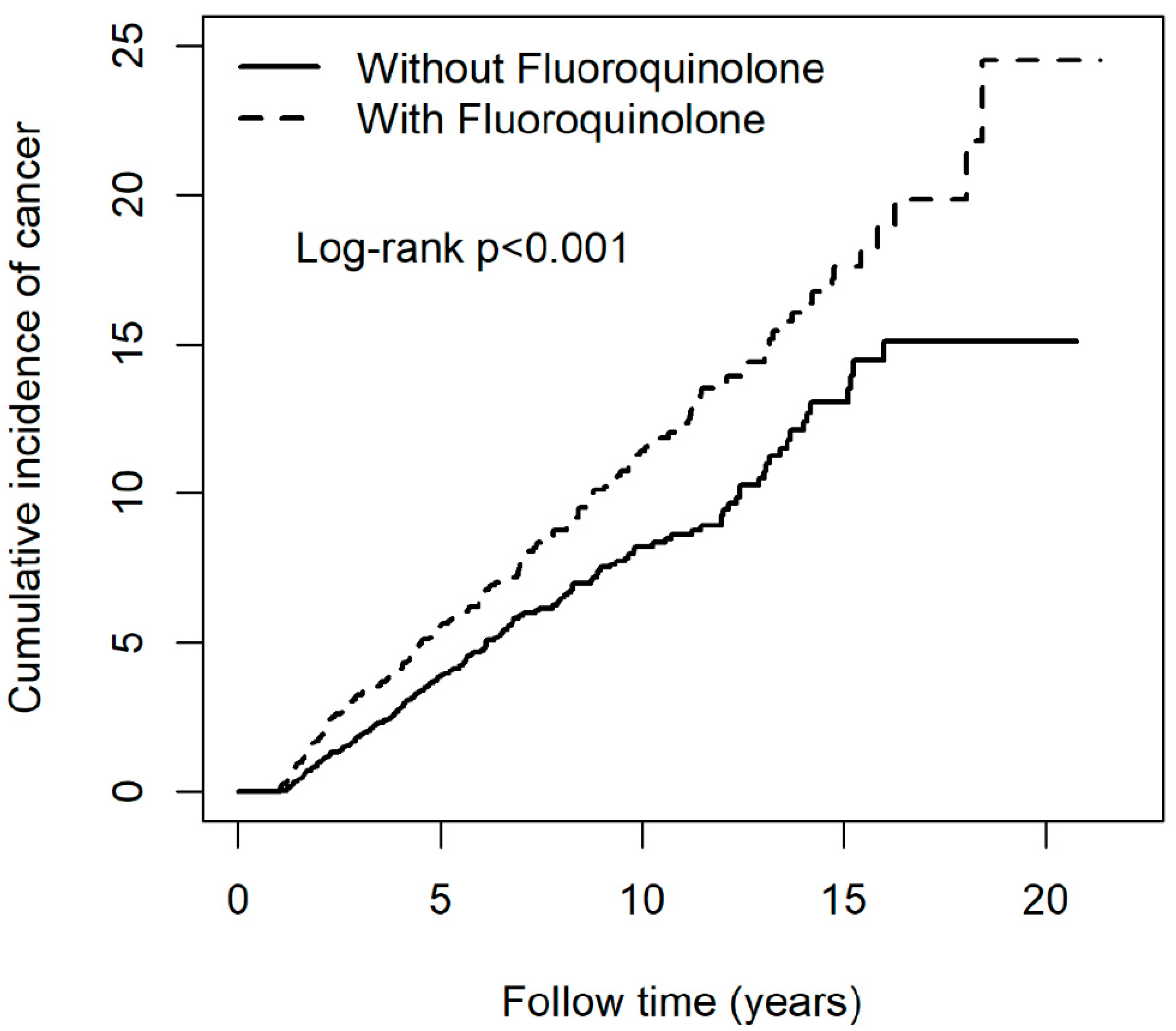
Continuous Exposure Variable Analysis
3. Discussion
3.1. Main Findings
3.2. Strengths
3.3. Limitations
4. Materials and Methods
4.1. Data Source
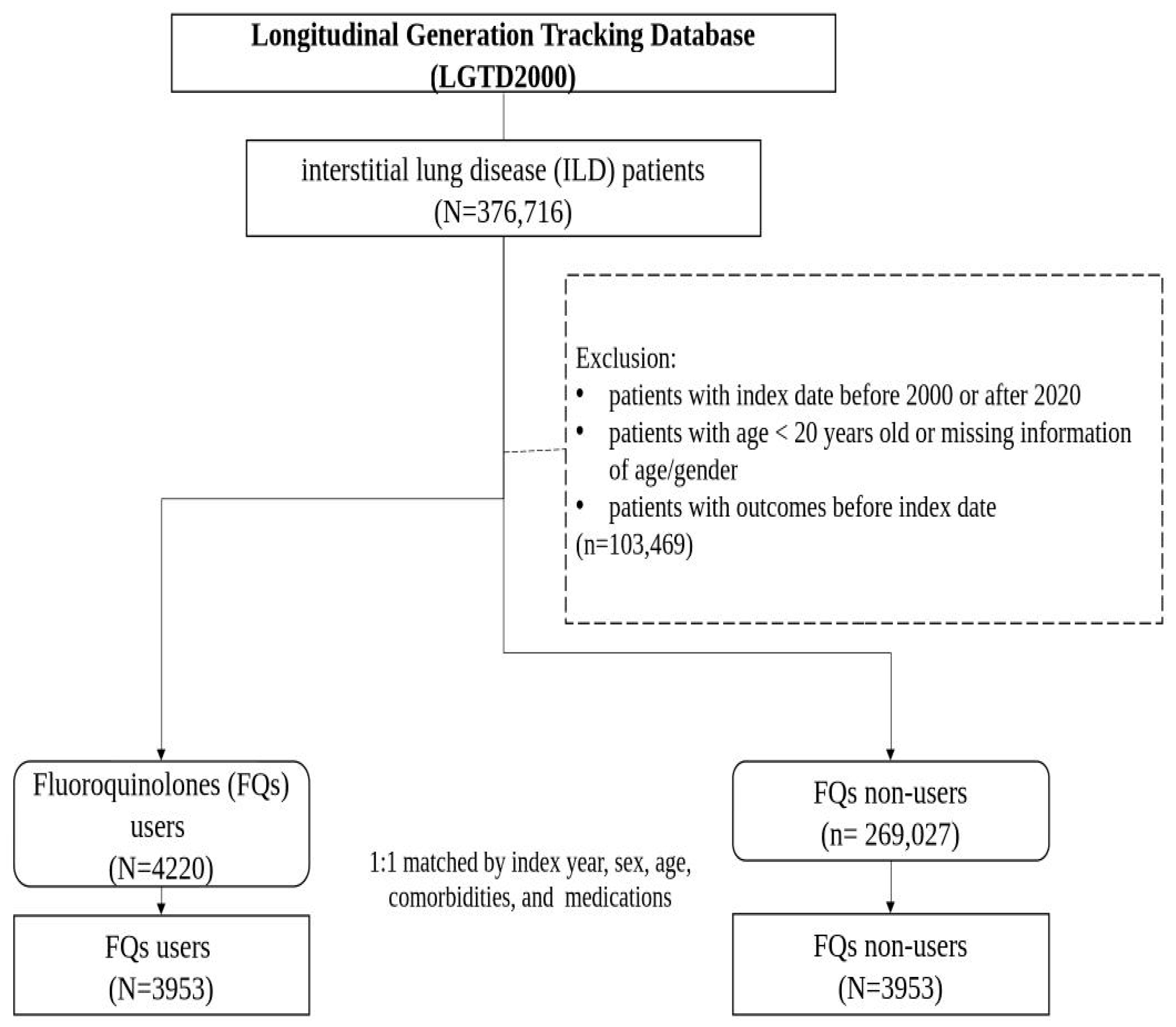
4.2. Study Population
4.3. Main Outcome and Covariates
4.4. Selection of Comorbidities and Medications
4.5. Statistical Analysis
5. Conclusions
Supplementary Materials
Author Contributions
Funding
Institutional Review Board Statement
Informed Consent Statement
Data Availability Statement
Acknowledgments
Conflicts of Interest
Abbreviations
References
- Rodrigues, C.F.; Silva, F. The rise, fall, and rethink of (fluoro)quinolones: A quick rundown. Pathogens 2025, 14, 525. [Google Scholar] [CrossRef] [PubMed]
- Kloskowski, T.; Szeliski, K.; Fekner, Z.; Rasmus, M.; Dąbrowski, P.; Wolska, A.; Siedlecka, N.; Adamowicz, J.; Drewa, T.; Pokrywczyńska, M. Ciprofloxacin and levofloxacin as potential drugs in genitourinary cancer treatment-the effect of dose-response on 2d and 3d cell cultures. Int. J. Mol. Sci. 2021, 22, 11970. [Google Scholar] [CrossRef] [PubMed]
- Nowakowska, J.; Radomska, D.; Czarnomysy, R.; Marciniec, K. Recent development of fluoroquinolone derivatives as anticancer agents. Molecules 2024, 29, 3538. [Google Scholar] [CrossRef] [PubMed]
- Kassab, A.E. The most recent updates on the anticancer potential of fluoroquinolones: A mini review. Future Med. Chem. 2025, 17, 2067–2078. [Google Scholar] [CrossRef] [PubMed]
- Kassab, A.E.; Gomaa, R.M.; Gedawy, E.M. Drug repurposing of fluoroquinolones as anticancer agents in 2023. RSC Adv. 2024, 14, 37114–37130. [Google Scholar] [CrossRef] [PubMed]
- Chrzanowska, A.; Kurpios-Piec, D.; Żyżyńska-Granica, B.; Kiernozek-Kalińska, E.; Lay, W.X.; Ciechanowicz, A.K.; Struga, M. Anticancer activity and metabolic alteration in colon and prostate cancer cells by novel moxifloxacin conjugates with fatty acids. Eur. J. Pharmacol. 2023, 940, 175481. [Google Scholar] [CrossRef] [PubMed]
- Huang, C.Y.; Yang, J.L.; Chen, J.J.; Tai, S.B.; Yeh, Y.H.; Liu, P.F.; Lin, M.W.; Chung, C.L.; Chen, C.L. Fluoroquinolones suppress tgf-β and pma-induced mmp-9 production in cancer cells: Implications in repurposing quinolone antibiotics for cancer treatment. Int. J. Mol. Sci. 2021, 22, 11602. [Google Scholar] [CrossRef] [PubMed]
- Felicetti, T.; Di Iacovo, N.; Della Fazia, M.A.; Piobbico, D.; Pieroni, S.; Pacetti, M.; Yu, J.; Sun, Y.; Massari, S.; Barreca, M.L.; et al. New anti-ovarian cancer quinolone derivatives acting by modulating microrna processing machinery. RSC Med. Chem. 2025, 16, 98–124. [Google Scholar] [CrossRef]
- Ishaq, M.; Zafar, E.; Maqbool, M.F.; Mansha, M.; Khan, M.; Li, Y. Repurposing fluoroquinolones as cancer chemosensitizers: A way to overcome cancer therapeutic bottleneck. Naunyn Schmiedebergs Arch. Pharmacol. 2026, 399, 47–62. [Google Scholar] [PubMed]
- Yeh, J.J.; Hung, T.W.; Lin, C.L.; Chen, T.T.; Liw, P.X.; Yu, Y.L.; Kao, C.H. Colchicine is a weapon for managing the heart disease among interstitial lung disease with viral infection: Have we found the holy grail? Front. Cardiovasc. Med. 2022, 9, 925211. [Google Scholar] [CrossRef] [PubMed]
- Naccache, J.M.; Gibiot, Q.; Monnet, I.; Antoine, M.; Wislez, M.; Chouaid, C.; Cadranel, J. Lung cancer and interstitial lung disease: A literature review. J. Thorac. Dis. 2018, 10, 3829–3844. [Google Scholar] [CrossRef] [PubMed]
- Manoharan, S.; Iyappan, O.R.; Prabahar, A.; Bhasuran, B.; Raja, K. Gut-lung axis microbiome: Towards precision medicine in respiratory disorders (review). World Acad. Sci. J. 2025, 7, 88. [Google Scholar] [CrossRef]
- Goto, T. Airway microbiota as a modulator of lung cancer. Int. J. Mol. Sci. 2020, 21, 3044. [Google Scholar] [CrossRef] [PubMed]
- Xu, H.; Yin, L.; Bian, W.; Kang, M.; Adami, H.-O.; Ye, W. Interstitial lung disease and risk of lung cancer. JAMA Netw. Open 2025, 8, e2519630. [Google Scholar] [CrossRef] [PubMed]
- Wu, T.-S.J.; Shih, F.-Y.F.; Yen, M.-Y.; Wu, J.-S.J.; Lu, S.-W.; Chang, K.C.-M.; Hsiung, C.; Chou, J.-H.; Chu, Y.-T.; Chang, H.; et al. Establishing a nationwide emergency department-based syndromic surveillance system for better public health responses in taiwan. BMC Public Health 2008, 8, 18. [Google Scholar] [CrossRef] [PubMed]
- Chen, J.; Ye, F.; Shang, K.; Li, N.; Li, C.; He, H. The mendelian randomized study revealed the association of prostatitis with prostate cancer risk. Sci. Rep. 2024, 14, 24643. [Google Scholar] [CrossRef] [PubMed]
- Yeh, J.J.; Liw, P.X.; Wong, Y.S.; Kao, H.M.; Lee, C.H.; Lin, C.L.; Kao, C.H. The effect of colchicine on cancer risk in patients with immune-mediated inflammatory diseases: A time-dependent study based on the taiwan’s national health insurance research database. Eur. J. Med. Res. 2024, 29, 245. [Google Scholar] [CrossRef] [PubMed]
- Airola, C.; Severino, A.; Spinelli, I.; Gasbarrini, A.; Cammarota, G.; Ianiro, G.; Ponziani, F.R. “Pleiotropic” effects of antibiotics: New modulators in human diseases. Antibiotics 2024, 13, 1176. [Google Scholar] [CrossRef] [PubMed]
- Chen, N.; Li, L.; Han, Y.; Chen, Z. The role of gut microbiota in the modulation of pulmonary immune response to viral infection through the gut-lung axis. J. Inflamm. Res. 2025, 18, 11755–11781. [Google Scholar] [CrossRef] [PubMed]
- Noble, A.; Pring, E.T.; Durant, L.; Man, R.; Dilke, S.M.; Hoyles, L.; James, S.A.; Carding, S.R.; Jenkins, J.T.; Knight, S.C. Altered immunity to microbiota, b cell activation and depleted γδ/resident memory t cells in colorectal cancer. Cancer Immunol. Immunother. 2022, 71, 2619–2629. [Google Scholar] [CrossRef] [PubMed]
- Iaccarino, J.; Mignini, I.; Maresca, R.; Giansanti, G.; Esposto, G.; Borriello, R.; Galasso, L.; Ainora, M.E.; Gasbarrini, A.; Zocco, M.A. The impact of air pollution on the lung–gut–liver axis: Oxidative stress and its role in liver disease. Antioxidants 2025, 14, 1148. [Google Scholar] [CrossRef] [PubMed]
- Deepika; Alsharari, Z.D.; Ahmad, M.F.; Singh, J.; Yadav, M.; Kumari, A.; Kumar, A.; Matthews, K.R.; Aluko, R.E.; Raposo, A.; et al. Gut-lung axis, probiotics, and prebiotics: Insights on dysbiosis, mechanism, and prevention of lung cancer. Front. Nutr. 2025, 12, 1624803. [Google Scholar] [CrossRef] [PubMed]
- Ohtani, N.; Hara, E. Gut-liver axis-mediated mechanism of liver cancer: A special focus on the role of gut microbiota. Cancer Sci. 2021, 112, 4433–4443. [Google Scholar] [CrossRef] [PubMed]
- Shao-Yu, Y.; Niu, D.; Chen, J.; Li, W.-Y.; Wang, X.; Meng, Q.-W.; Song, W.-J.; Yang, Y.-G.; Wang, H.; Li, R.-R.; et al. Antibiotic cocktail-induced changes in gut microbiota drive alteration of bile acid metabolism to restrain th17 differentiation through the fxr–nlrp3 axis. Gut Microbes 2025, 17, 2582944. [Google Scholar] [CrossRef] [PubMed]
- Abdel-Aal, M.A.A.; Abdel-Aziz, S.A.; Shaykoon, M.S.A.; Abuo-Rahma, G.E.-D.A. Towards anticancer fluoroquinolones: A review article. Arch. Pharm. 2019, 352, 1800376. [Google Scholar] [CrossRef]
- Ferrario, N.; Marras, E.; Vivona, V.; Randisi, F.; Fallica, A.N.; Marrazzo, A.; Perletti, G.; Gariboldi, M.B. Mechanisms of the antineoplastic effects of new fluoroquinolones in 2d and 3d human breast and bladder cancer cell lines. Cancers 2024, 16, 2227. [Google Scholar] [CrossRef] [PubMed]
- Pazzagli, L.; Linder, M.; Zhang, M.; Vago, E.; Stang, P.; Myers, D.; Andersen, M.; Bahmanyar, S. Methods for time-varying exposure related problems in pharmacoepidemiology: An overview. Pharmacoepidemiol. Drug Saf. 2018, 27, 148–160. [Google Scholar] [CrossRef] [PubMed]
- Pottegård, A.; Friis, S.; Stürmer, T.; Hallas, J.; Bahmanyar, S. Considerations for pharmacoepidemiological studies of drug-cancer associations. Basic Clin. Pharmacol. Toxicol. 2018, 122, 451–459. [Google Scholar] [CrossRef] [PubMed]
- Anwar, A.; Assaad, M.; Jos Walsh, J. Post-obstructive pneumonia as a presenting feature of endobronchial squamous cell carcinoma in a 42-year-old patient. CHEST 2023, 164, A4447–A4448. [Google Scholar] [CrossRef]
- Pottegård, A.; Hallas, J. New use of prescription drugs prior to a cancer diagnosis. Pharmacoepidemiol. Drug Saf. 2017, 26, 223–227. [Google Scholar] [CrossRef] [PubMed]
- Tamim, H.; Monfared, A.A.; LeLorier, J. Application of lag-time into exposure definitions to control for protopathic bias. Pharmacoepidemiol. Drug Saf. 2007, 16, 250–258. [Google Scholar] [CrossRef] [PubMed]
- Hicks, B.; Kaye, J.A.; Azoulay, L.; Kristensen, K.B.; Habel, L.A.; Pottegård, A. The application of lag times in cancer pharmacoepidemiology: A narrative review. Ann. Epidemiol. 2023, 84, 25–32. [Google Scholar] [CrossRef] [PubMed]
- Thommes, E.W.; Mahmud, S.M.; Young-Xu, Y.; Snider, J.T.; van Aalst, R.; Lee, J.K.H.; Halchenko, Y.; Russo, E.; Chit, A. Assessing the prior event rate ratio method via probabilistic bias analysis on a bayesian network. Stat. Med. 2020, 39, 639–659. [Google Scholar] [PubMed]



| Fluoroquinolone | |||
|---|---|---|---|
| Variable | No (N = 3953) N (%) | Yes (N = 3953) N (%) | p-Value |
| Age | 0.58 | ||
| ≤49 | 607 (15.4%) | 641 (16.2%) | |
| 50–64 | 1205 (30.5%) | 1193 (30.2%) | |
| 65+ | 2141 (54.2%) | 2119 (53.6%) | |
| Mean Age (SD) # | 66.1 (15.0) | 65.8 (15.1) | 0.43 |
| Sex | 0.43 | ||
| Female | 1934 (48.9%) | 1899 (48.0%) | |
| Male | 2019 (51.1%) | 2054 (52.0%) | |
| Comorbidities | |||
| Tuberculosis | 499 (12.6%) | 524 (13.3%) | 0.40 |
| Pneumonia | 2503 (63.3%) | 2510 (63.5%) | 0.87 |
| Peptic ulcer disease | 2825 (71.5%) | 2157(54.6) | 0.77 |
| COPD | 2170 (54.9%) | 3077 (56.7%) | 0.56 |
| Cirrhosis | 515 (13.0%) | 534 (13.5%) | 0.53 |
| Atopic disease | 2678 (67.8%) | 2661 (67.3%) | 0.68 |
| Diabetes | 2244 (56.8%) | 2265 (57.3%) | 0.63 |
| Hypertension | 3197 (80.9%) | 3187 (80.6%) | 0.78 |
| Hyperlipidemia | 2997 (75.8%) | 4000 (73.7%) | 0.35 |
| Chronic kidney disease | 1911 (48.3%) | 1853 (48.7%) | 0.19 |
| Stroke | 1673 (42.3%) | 1694 (42.9%) | 0.63 |
| Pelvic inflammatory disease | 5 (0.13%) | 8 (0.20%) | 0.41 |
| Heart failure | 1247 (31.6%) | 1298 (32.8%) | 0.22 |
| Periodontal diseases | 3093 (78.2%) | 3066 (77.8%) | 0.46 |
| IBS | 893 (22.6%) | 871 (22.0%) | 0.55 |
| Prostate inflammation (incl. BPH) | 1414 (35.8%) | 1394 (35.3%) | 0.64 |
| Anti-inflammatory medicines a | 3858 (97.6%) | 3857 (97.6%) | 0.94 |
| Immunosuppressants b | 2547 (64.4%) | 2493 (63.1%) | 0.21 |
| Fluoroquinolone | N | Person-Years | Follow-Up (Mean, SD) a | Events | Rate/1000 PY b | Crude HR (95% CI) | Adjusted HR (95% CI) c |
|---|---|---|---|---|---|---|---|
| No use | 3953 | 23,504 | 5.95 (4.29) | 189 | 8.04 | 1.00 (Reference) | 1.00 (Reference) |
| Use | 3953 | 21,462 | 5.43 (4.22) | 247 | 11.5 | 1.45 (1.20, 1.75) *** | 1.45 (1.20, 1.76) *** |
| Fluoroquinolone | Fluoroquinolone Compared to Non-Fluoroquinolone | |||||
|---|---|---|---|---|---|---|
| No | Yes | Crude HR | Adjusted HR | |||
| Cancer Site | Events | Rate a | Events | Rate a | (95% CI) | (95% CI) b |
| Hematologic malignancy | 10 | 0.43 | 17 | 0.79 | 1.85 (0.85, 4.04) | 1.93 (0.88, 4.23) |
| Head and neck cancer | 8 | 0.34 | 14 | 0.65 | 1.94 (0.81, 4.63) | 1.66 (0.68, 4.01) |
| Esophagus | 10 | 0.43 | 6 | 0.28 | 0.65 (0.24, 1.80) | 0.61 (0.22, 1.74) |
| Stomach | 7 | 0.3 | 12 | 0.56 | 1.94 (0.76, 4.92) | 2.14 (0.82, 5.62) |
| Colon, rectum | 20 | 0.85 | 26 | 1.21 | 1.44 (0.80, 2.58) | 1.37 (0.76, 2.46) |
| Liver | 30 | 1.28 | 26 | 1.21 | 0.97 (0.57, 1.64) | 1.03 (0.61, 1.76) |
| Pancreas | 6 | 0.26 | 4 | 0.19 | 0.75 (0.21, 2.65) | 0.77 (0.21, 2.84) |
| Lung | 34 | 1.45 | 34 | 1.58 | 1.12 (0.70, 1.80) | 1.22 (0.75, 1.97) |
| Skin | 5 | 0.21 | 6 | 0.28 | 1.32 (0.40, 4.32) | 1.16 (0.34, 4.01) |
| Breast cancer | 16 | 0.68 | 21 | 0.98 | 1.46 (0.76, 2.80) | 1.38 (0.71, 2.66) |
| Immune-related cancers | 92 | 1.38 | 57 | 0.85 | 0.62 (0.45, 0.87) ** | 0.62 (0.44, 0.87) ** |
| Cervix/Endometrium/Ovary | 6 | 0.26 | 6 | 0.28 | 1.12 (0.36, 3.46) | 1.23 (0.39, 3.88) |
| Prostate | 6 | 0.26 | 30 | 1.40 | 5.52 (2.30, 13.26) *** | 5.50 (2.25, 13.48) *** |
| Bladder, kidney | 12 | 0.51 | 22 | 1.03 | 2.04 (1.01, 4.13) * | 2.03 (0.99, 4.14) |
| Brain | 0.09 | 0.09 | 1.11 (0.16, 7.85) | 1.36 (0.16, 11.70) | ||
| Thyroid | 4 | 0.17 | 5 | 0.23 | 1.41 (0.38, 5.25) | 2.12 (0.48, 9.23) |
| Others | 40 | 1.7 | 36 | 1.68 | 1.00 (0.64, 1.57) | 1.05 (0.67, 1.66) |
| Medication Exposed | Event | Person-Year | Rate a | Adjusted HR (95% CI) b |
|---|---|---|---|---|
| Colon, rectum | ||||
| Non-fluoroquinolone | 20 | 23,504 | 0.85 | 1.00 |
| Fluoroquinolone # | ||||
| ≤35 days | 14 | 10,141 | 1.38 | 1.53 (0.76, 3.06) |
| 36–55 days | 7 | 5447 | 1.29 | 1.43 (0.60, 3.41) |
| >56 days | 5 | 5874 | 0.85 | 1.01 (0.37, 2.72) |
| Liver | ||||
| Non-fluoroquinolone | 30 | 23,504 | 1.28 | 1.00 |
| Fluoroquinolone # | ||||
| ≤35 days | 13 | 10,141 | 1.28 | 1.12 (0.58, 2.17) |
| 36–55 days | 5 | 5447 | 0.92 | 0.76 (0.30, 1.98) |
| >56 days | 8 | 5874 | 1.36 | 1.15 (0.52, 2.54) |
| Lung | ||||
| Non-fluoroquinolone | 34 | 23,504 | 1.45 | 1.00 |
| Fluoroquinolone # | ||||
| ≤35 days | 13 | 10,141 | 1.28 | 1.05 (0.55, 2.02) |
| 36–55 days | 9 | 5447 | 1.65 | 1.26 (0.60, 2.64) |
| >56 days | 12 | 5874 | 2.04 | 1.42 (0.72, 2.77) |
| Immune-related cancers | ||||
| Non-fluoroquinolone | 40 | 23,504 | 1.7 | 1.00 |
| Fluoroquinolone # | ||||
| ≤35 days | 19 | 10,141 | 1.87 | 1.18 (0.68, 2.06) |
| 36–55 days | 8 | 5447 | 1.47 | 0.91 (0.42, 1.95) |
| >56 days | 9 | 5874 | 1.53 | 0.98 (0.47, 2.03) |
| Medication Exposed | Event | Person-Year | Rate a | Adjusted HR (95% CI) b |
|---|---|---|---|---|
| Colon, rectum | ||||
| Non-fluoroquinolone | 20 | 23,504 | 0.85 | 1.00 |
| Fluoroquinolone # | ||||
| ≤3000 mg | 20 | 14,635 | 1.37 | 1.57 (0.84, 2.94) |
| 3001–6000 mg | 6 | 0.57 | 0.60 (0.14, 2.61) | |
| >6000 mg | 1.2 | 1.35 (0.45, 4.05) | ||
| Liver | ||||
| Non-fluoroquinolone | 30 | 23,504 | 1.28 | 1.00 |
| Fluoroquinolone # | ||||
| ≤3000 mg | 18 | 14,635 | 1.23 | 1.04 (0.58, 1.90) |
| 3001–6000 mg | 3 | 3491 | 0.86 | 0.73 (0.22, 2.43) |
| >6000 mg | 5 | 3337 | 1.5 | 1.31 (0.49, 3.46) |
| Lung | ||||
| Non-fluoroquinolone | 34 | 23,504 | 1.45 | 1.00 |
| Fluoroquinolone # | ||||
| ≤3000 mg | 22 | 14,635 | 1.5 | 1.13 (0.65, 1.95) |
| 3001–6000 mg | 7 | 3491 | 2.01 | 1.61 (0.70, 3.67) |
| >6000 mg | 5 | 3337 | 1.5 | 1.22 (0.46, 3.18) |
| Immune-related cancers | ||||
| Non-fluoroquinolone | 40 | 23,504 | 1.7 | 1.00 |
| Fluoroquinolone # | ||||
| ≤3000 mg | 24 | 14,635 | 1.64 | 1.01 (0.61, 1.70) |
| 3001–6000 mg | 4 | 3491 | 1.15 | 0.73 (0.26, 2.05) |
| >6000 mg | 8 | 3337 | 2.4 | 1.60 (0.73, 3.49) |
| Variable | Fluoroquinolone Compared to Non-Fluoroquinolone | |
|---|---|---|
| Crude HR | Adjusted HR | |
| Cancer Site | (95% CI) | (95% CI) a |
| Cancer | 1.99 (1.52, 2.61) *** | 2.07 (1.57, 2.72) *** |
| Hematologic malignancy | 3.68 (1.40, 9.68) ** | 4.09 (1.51, 11.1) ** |
| Head and neck cancer | - | - |
| Esophagus | 0.52 (0.07, 3.99) | 0.46 (0.06, 3.61) |
| Stomach | 1.90 (0.42, 8.61) | 2.36 (0.50, 11.1) |
| Colon, rectum | 0.74 (0.23, 2.42) | 0.77 (0.23, 2.55) |
| Liver | 1.72 (0.76, 3.87) | 1.71 (0.75, 3.88) |
| Pancreas | - | - |
| Lung | 3.56 (2.00, 6.33) *** | 3.35 (1.87, 6.01) *** |
| Skin | - | - |
| Breast cancer | 0.64 (0.15, 2.68) | 0.70 (0.16, 2.97) |
| Immune-related cancers | 1.22 (0.55, 2.68) | 1.21 (0.55, 2.70) |
| Cervix/Endometrium/Ovary | 1.23 (0.15, 9.96) | 1.42 (0.17, 11.7) |
| Prostate | 8.89 (4.36, 18.2) *** | 9.95 (4.75, 20.8) *** |
| Bladder, kidney | 3.39 (1.43, 8.04) ** | 3.72 (1.55, 8.93) ** |
| Brain | - | - |
| Thyroid | - | - |
| Others | 1.31 (0.51, 3.35) | 1.37 (0.53, 3.53) |
| Variable | Fluoroquinolone Compared to Non-Fluoroquinolone | |
|---|---|---|
| Crude SHR | Adjusted SHR | |
| Cancer Site | (95% CI) | (95% CI) a |
| Cancer | 1.31 (1.08, 1.58) ** | 1.28 (1.06, 1.55) ** |
| Colon, rectum | 1.31 (0.73, 2.34) | 1.24 (0.69, 2.22) |
| Liver | 0.87 (0.51, 1.47) | 0.88 (0.53, 1.47) |
| Lung | 1.00 (0.62, 1.62) | 1.04 (0.65, 1.68) |
| Immune-related cancers | 0.90 (0.58, 1.42) | 0.91 (0.59, 1.42) |
| Variable | Fluoroquinolone Compared to Non-Fluoroquinolone | |
|---|---|---|
| Crude HR | Adjusted HR | |
| Cancer Site | (95% CI) | (95% CI) a |
| Cancer | 0.99 (0.99, 1.00) | 0.99 (0.99, 1.00) |
Disclaimer/Publisher’s Note: The statements, opinions and data contained in all publications are solely those of the individual author(s) and contributor(s) and not of MDPI and/or the editor(s). MDPI and/or the editor(s) disclaim responsibility for any injury to people or property resulting from any ideas, methods, instructions or products referred to in the content. |
© 2026 by the authors. Licensee MDPI, Basel, Switzerland. This article is an open access article distributed under the terms and conditions of the Creative Commons Attribution (CC BY) license.
Share and Cite
Sun, Y.-F.; Chiu, Y.-T.; Ko, Y.-E.; Huang, Y.-W.; Hsieh, L.-K.; Lin, C.-L.; Kao, C.-H.; Yeh, J.-J. Fluoroquinolone Exposure and Cancer Risk in Interstitial Lung Disease: A Propensity-Score-Matched Cohort Study Using Cox and Competing-Risk Models. Pharmaceuticals 2026, 19, 1067. https://doi.org/10.3390/ph19071067
Sun Y-F, Chiu Y-T, Ko Y-E, Huang Y-W, Hsieh L-K, Lin C-L, Kao C-H, Yeh J-J. Fluoroquinolone Exposure and Cancer Risk in Interstitial Lung Disease: A Propensity-Score-Matched Cohort Study Using Cox and Competing-Risk Models. Pharmaceuticals. 2026; 19(7):1067. https://doi.org/10.3390/ph19071067
Chicago/Turabian StyleSun, Yi-Fan, Yu-Ting Chiu, Yung-En Ko, Yu-Wei Huang, Liang-Kai Hsieh, Cheng-Li Lin, Chia-Hung Kao, and Jun-Jun Yeh. 2026. "Fluoroquinolone Exposure and Cancer Risk in Interstitial Lung Disease: A Propensity-Score-Matched Cohort Study Using Cox and Competing-Risk Models" Pharmaceuticals 19, no. 7: 1067. https://doi.org/10.3390/ph19071067
APA StyleSun, Y.-F., Chiu, Y.-T., Ko, Y.-E., Huang, Y.-W., Hsieh, L.-K., Lin, C.-L., Kao, C.-H., & Yeh, J.-J. (2026). Fluoroquinolone Exposure and Cancer Risk in Interstitial Lung Disease: A Propensity-Score-Matched Cohort Study Using Cox and Competing-Risk Models. Pharmaceuticals, 19(7), 1067. https://doi.org/10.3390/ph19071067