This is an early access version, the complete PDF, HTML, and XML versions will be available soon.
Article

Multi-Targeted Anti-Alzheimer’s Effects of Tri-Sannibat-Phol: Biological Evaluation, Behavioral Validation, and LC-MS/MS Phytochemical Profiling


by
Pitchayakarn Takomthong
1,
Pornthip Waiwut
2,
Sumet Kongkiatpaiboon
3,
Khemjira Phemphunananchai
1 and
Chantana Boonyarat
1,4,*
1
Faculty of Pharmaceutical Sciences, Khon Kaen University, Khon Kaen 40002, Thailand
2
Faculty of Pharmaceutical Sciences, Ubon Ratchathani University, Ubon Ratchathani 34190, Thailand
3
Drug Discovery and Development Center, Office of Advanced Science and Technology, Thammasat University (Rangsit Campus), Pathum Thani 12121, Thailand
4
Center for Research and Development of Herbal Health Products, Khon Kaen University, Khon Kaen 40002, Thailand
*
Author to whom correspondence should be addressed.
Pharmaceuticals 2026, 19(7), 1063; https://doi.org/10.3390/ph19071063
Submission received: 20 May 2026 / Revised: 29 June 2026 / Accepted: 7 July 2026 / Published: 9 July 2026
(This article belongs to the Section Natural Products)

Abstract

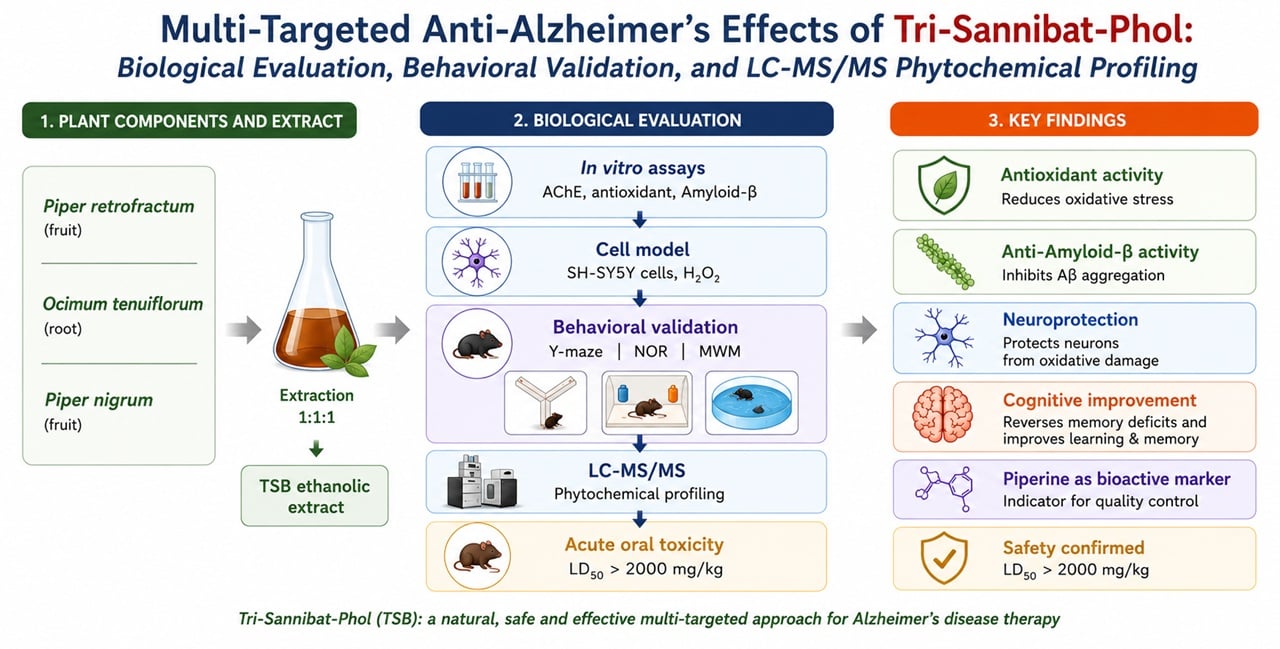
Background: Alzheimer’s disease (AD) is a progressive neurodegenerative disorder characterized by oxidative stress, cholinergic dysfunction, and amyloid-β (Aβ) aggregation. Tri-Sannibat-Phol (TSB), a classical Thai polyherbal formulation comprising Piper retrofractum fruit, Ocimum tenuiflorum root, and Piper nigrum root, has been traditionally used for its medicinal properties, yet its anti-AD potential has never been scientifically evaluated. Methods: The therapeutic potential of TSB was investigated through in vitro bioassays including antioxidant, acetylcholinesterase (AChE) inhibitory, and anti-Aβ aggregation assays, alongside neuroprotective evaluation in H2O2-induced SH-SY5Y neuroblastoma cells. Acute oral toxicity was assessed in male ICR mice in accordance with OECD Guideline 420. Cognitive-enhancing effects were evaluated using the modified Y-maze, Novel Object Recognition, and Morris Water Maze tests in a scopolamine-induced amnesic mouse model. LC-MS/MS analysis was performed for phytochemical characterization and chemical standardization of the formulation. Results: TSB demonstrated significant antioxidant activity, AChE inhibitory activity, and anti-Aβ aggregation effects, with P. nigrum and O. tenuiflorum identified as the primary contributing components. Neuroprotective effects were confirmed in H2O2-induced SH-SY5Y cells, where TSB significantly improved cell viability across concentrations of 1–100 µg/mL. Acute oral toxicity assessment revealed an LD50 exceeding 2000 mg/kg, indicating a favorable safety profile. In vivo behavioral studies demonstrated that TSB at medium-to-high doses significantly reversed scopolamine-induced cognitive deficits across all three behavioral tests. LC-MS/MS analysis identified thirteen piperidine alkaloids, with piperine as the dominant constituent at 17.61 ± 0.80% w/w, proposed as the primary bioactive driver and chemical marker for future quality standardization. Conclusions: These findings suggest that TSB exerts multi-targeted anti-AD effects through complementary mechanisms, supporting its potential as a traditional medicine-based therapeutic candidate for further preclinical and clinical investigation.
Keywords: traditional medicine; Tri-sannibat-phol; multi-target therapeutics; Piper retrofractum; Ocimum tenuiflorum L.; Piper nigrum traditional medicine; Tri-sannibat-phol; multi-target therapeutics; Piper retrofractum; Ocimum tenuiflorum L.; Piper nigrum
Graphical Abstract