Comprehensive Identification of the Chemical Components in the Classical Prescription Shashen Maidong Decoction Based on UPLC-Q-Orbitrap MS and Molecular Networking

Abstract
1. Introduction
2. Results
2.1. Identification and Structural Analysis of Saccharides
2.2. Identification and Structural Analysis of Flavonoids
2.3. Identification and Structural Analysis of Homoisoflavonoids
2.4. Identification and Structural Analysis of Organic Acids
2.5. Identification and Structural Analysis of Triterpenes
2.6. Identification and Structural Analysis of Amino Acids
2.7. Identification and Structural Analysis of Alkaloids
2.8. Identification and Structural Analysis of Other Constituents
3. Discussion
4. Materials and Methods
4.1. Medicines and Reagents
4.2. Sample Preparation for UHPLC-Q Exactive Orbitrap HRMS Analysis
4.3. Preparation of Standard Solutions
4.4. UHPLC-Q Exactive Orbitrap HRMS Analysis
4.5. Data Processing and Analysis Strategy
5. Conclusions
Author Contributions
Funding
Institutional Review Board Statement
Informed Consent Statement
Data Availability Statement
Acknowledgments
Conflicts of Interest
Abbreviations
| GNPS | Global Natural Products Social Molecular Networking |
| GSH | Glutathione |
| LC-MS | Liquid chromatography-mass spectrometry |
| MN | Molecular networking |
| NO | Nitric oxide |
| SMD | Shashen Maidong Decoction |
| SOD | Superoxide dismutase |
| TCM | Traditional Chinese Medicine |
References
- Liu, S.Y.; Song, J.; Tang, Z.; Han, W. Thinking about research on medicinal materials and decoction pieces used in traditional Chinese medicine compound preparations developed from catalogued ancient classical prescriptions. Zhongguo Zhong Yao Za Zhi 2025, 50, 2883–2887. [Google Scholar] [CrossRef] [PubMed]
- Liu, C.; Gao, P.; Liu, X.; Kuang, M.; Xu, H.; Wu, Y.; Liu, W.; Wang, S. Reunderstanding the classical prescription Banxia Xiexin Decoction: New perspectives from a comprehensive review of clinical research and pharmacological studies. Chin. Med. 2025, 20, 39. [Google Scholar] [CrossRef] [PubMed]
- Zhao, Y.; Yang, S.; Guo, Q.; Guo, Y.; Zheng, Y.; Ji, E. Shashen-Maidong Decoction improved chronic intermittent hypoxia-induced cognitive impairment through regulating glutamatergic signaling pathway. J. Ethnopharmacol. 2021, 274, 114040. [Google Scholar] [CrossRef] [PubMed]
- Lan, X.; Yan, B.; Zhang, X.; Liu, W. Research Progress of Shashen Maidong Decoction in the Treatment of Respiratory Diseases. Guangming J. Chin. Med. 2025, 40, 2061–2064. [Google Scholar]
- Wang, J.; Ma, X.; Wei, S.; Yang, T.; Tong, Y.; Jing, M.; Wen, J.; Zhao, Y. Clinical Efficacy and Safety of Shashen Maidong Decoction in the Treatment of Pediatric Mycoplasma Pneumonia: A Systematic Review and Meta-Analysis. Front. Pharmacol. 2021, 12, 765656. [Google Scholar] [CrossRef] [PubMed]
- Duan, Q.; Wang, M.; Cui, Z.; Li, R.; Ma, J. Mechanism of Shashen Maidong Decoction in the Treatment of Radiation Pneumonitis Based on Network Pharmacology and Molecular Docking. Curr. Pharm. Des. 2025, 31, 3219–3233. [Google Scholar] [CrossRef] [PubMed]
- Zhou, W.; Hu, Y.; Qiu, Y.; Zheng, H.; Jiang, J.; Luo, J.; Wu, J.; Yuan, H.; Zhou, X.; Gong, L.; et al. Shashen Maidong Decoction’s Effects on Chronic Bronchitis: A Multi-Method Approach. Curr. Pharm. Des. 2025, 31, 3074–3089. [Google Scholar] [CrossRef] [PubMed]
- Zheng, Y.; Yang, S.; Si, J.; Zhao, Y.; Zhao, M.; Ji, E. Shashen-Maidong Decoction inhibited cancer growth under intermittent hypoxia conditions by suppressing oxidative stress and inflammation. J. Ethnopharmacol. 2022, 299, 115654. [Google Scholar] [CrossRef] [PubMed]
- Cai, J.; Chen, Y.; Wang, K.; Li, Y.; Wu, J.; Yu, H.; Li, Q.; Wu, Q.; Meng, W.; Wang, H.; et al. Decoding the key compounds and mechanism of Shashen Maidong decoction in the treatment of lung cancer. BMC Complement. Med. The. 2023, 23, 158. [Google Scholar] [CrossRef]
- Zhao, F.; Zhou, X.; Chen, J.; Zhu, L.; Zhang, M. Research Progress on the classical prescription Shashen Maidong Decoction. Mod. J. Integr. Tradit. Chin. West. Med. 2025, 34, 2895–2900. [Google Scholar]
- Zhu, H.; Wu, X.; Huo, J.; Hou, J.; Long, H.; Zhang, Z.; Wang, B.; Tian, M.; Chen, K.; Guo, D.; et al. A five-dimensional data collection strategy for multicomponent discovery and characterization in Traditional Chinese Medicine: Gastrodia Rhizoma as a case study. J. Chromatogr. A 2021, 1653, 462405. [Google Scholar] [CrossRef] [PubMed]
- Yang, Y.L.; Adel Al-Mahdy, D.; Wu, M.L.; Zheng, X.T.; Piao, X.H.; Chen, A.L.; Wang, S.M.; Yang, Q.; Ge, Y.W. LC-MS-based identification and antioxidant evaluation of small molecules from the cinnamon oil extraction waste. Food Chem. 2022, 366, 130576. [Google Scholar] [CrossRef] [PubMed]
- Bouslimani, A.; Sanchez, L.M.; Garg, N.; Dorrestein, P.C. Mass spectrometry of natural products: Current, emerging and future technologies. Nat. Prod. Rep. 2014, 31, 718–729. [Google Scholar] [CrossRef] [PubMed]
- Li, Y.; Liang, J.; Gao, J.N.; Shen, Y.; Kuang, H.X.; Xia, Y.G. A novel LC-MS/MS method for complete composition analysis of polysaccharides by aldononitrile acetate and multiple reaction monitoring. Carbohydr. Polym. 2021, 272, 118478. [Google Scholar] [CrossRef] [PubMed]
- Wu, J.; Cai, K.; Chen, Z.; Hou, W.; Wang, Q.; Chen, H.; Xie, Z.; Liao, Q. Identification and screening of potential anti-pneumonia active ingredients and targets of Qing-Kai-Ling oral liquid via UHPLC-Q-Exactive Orbitrap mass spectrometry based on data post-processing. J. Chromatogr. A 2024, 1736, 465391. [Google Scholar] [CrossRef] [PubMed]
- Otsuki, K.; Zhang, M.; Tan, L.; Komaki, M.; Shimada, A.; Kikuchi, T.; Zhou, D.; Li, N.; Li, W. Isomer Differentiation by UHPLC-Q-Exactive-Orbitrap MS led to Enhanced Identification of Daphnane Diterpenoids in Daphne tangutica. Phytochem. Anal. 2025, 36, 1053–1062. [Google Scholar] [CrossRef] [PubMed]
- Yu, J.S.; Seo, H.; Kim, G.B.; Hong, J.; Yoo, H.H. MS-Based Molecular Networking of Designer Drugs as an Approach for the Detection of Unknown Derivatives for Forensic and Doping Applications: A Case of NBOMe Derivatives. Anal. Chem. 2019, 91, 5483–5488. [Google Scholar] [CrossRef] [PubMed]
- Yu, J.S.; Nothias, L.F.; Wang, M.; Kim, D.H.; Dorrestein, P.C.; Kang, K.B.; Yoo, H.H. Tandem Mass Spectrometry Molecular Networking as a Powerful and Efficient Tool for Drug Metabolism Studies. Anal. Chem. 2022, 94, 1456–1464. [Google Scholar] [CrossRef] [PubMed]
- Xu, R.; Lee, J.; Zhang, S.; Chen, L.; Zhu, J. Structure similarity and molecular networking analysis for the discovery of polyphenol biotransformation products of gut microbes. Anal. Chim. Acta. 2022, 1221, 340145. [Google Scholar] [CrossRef] [PubMed]
- Vitale, G.A.; Sciarretta, M.; Cassiano, C.; Buonocore, C.; Festa, C.; Mazzella, V.; Núñez Pons, L.; D’Auria, M.V.; de Pascale, D. Molecular Network and Culture Media Variation Reveal a Complex Metabolic Profile in Pantoea cf. eucrina D2 Associated with an Acidified Marine Sponge. Int. J. Mol. Sci. 2020, 21, 6307. [Google Scholar] [CrossRef] [PubMed]
- Shi, T.; Li, Y.J.; Wang, Z.M.; Wang, Y.F.; Wang, B.; Shi, D.Y. New Pyrroline Isolated from Antarctic Krill-Derived Actinomycetes Nocardiopsis sp. LX-1 Combining with Molecular Networking. Mar. Drugs 2023, 21, 127. [Google Scholar] [CrossRef] [PubMed]
- Wakui, V.G.; de Oliveira, V.M.; Keng Queiroz Júnior, L.H.; Alves de Oliveira, C.M.; Kato, L. Metabolic profiling of Lomatozona artemisiifolia Baker plants grown in vitro and collected from nature using molecular networking and chemometric analysis. Nat. Prod. Res. 2024, 38, 4427–4434. [Google Scholar] [PubMed]
- Shu, L.; Xiao, S.; Li, K.; Luo, H.; Li, M.; Yang, Q.; Gao, B.; Li, J.; Yan, F.; Cai, W. Systematic identification of the chemical components of leaves and roots of Didymocarpus heucherifolius Hand.-Mazz. based on UHPLC Q-Exactive Orbitrap MS technology coupled with molecular networking strategy. Sci. Rep. 2025, 15, 2617. [Google Scholar] [CrossRef] [PubMed]
- Quan, J.Y.; Fan, B.; Liu, A.; Sun, J.; Chen, P.; Wang, C.G.; Zhao, Y.L.; Zhang, C.; Deng, X.Q.; Jing, Z.W. Rapid identification of components in Wuzhuyu Decoction using UHPLC Q-Exactive Orbitrap MS~n and molecular network technology. Zhongguo Zhong Yao Za Zhi 2023, 48, 71–81. [Google Scholar] [PubMed]
- Xie, X. Optimization of the Preparation Process, Characteristic Components, and Quality Control of Shu Xin Jie Yu Granules. Master’s Thesis, Anhui University of Chinese Medicine, Hefei, China, 2024. [Google Scholar]
- Zhang, L. Isolation and Identification of Chemical Constituents from Polygonum cuspidatum and Psoraleae Fructus. Master’s Thesis, Tianjin University of Traditional Chinese Medicine, Tianjin, China, 2023. [Google Scholar]
- Zhong, F.; Zhang, Y.; Xue, T.; Zhang, M.; Li, Z.; Liao, S.; Lin, Y. Chemical Constituents of the Hmong Medicinal Roots of Hedera nepalensis and Their Anti-inflammatory Activity. Chin. Pharm. J. 2025, 60, 1688–1699. [Google Scholar]
- Wang, D.; Luo, W.; Zhang, R.; Wang, L.; Li, M.; Jiang, M. Research on the method for characterizing the anti-inflammatory active components of Huaihua Powder based on offline two-dimensional chromatography-mass spectrometry. Chin. Meas. Test. 2025, 51, 106–117. [Google Scholar]
- Ma, D.; Gao, X.; Peng, L.; Wu, S.; Wang, Q.; Hao, Z. Composition Analysis of Seed of Areca catechu L. in Deep Processing based on UHPLC-QE-Orbitrap-MS Technology. Acta Vet. Zootech. Sin. 2023, 54, 5275–5292. [Google Scholar]
- Lan, Y.; Wang, H.; Zahng, X.; Lei, H. Analysis of Main Active Components from the Leaves of Cyclocarya Paliurus by HPLC-Q-TOF-MS/MS and HPLC-DAD. Front. Pharm. Sci. 2022, 25, 966–971. [Google Scholar]
- Xiong, W. Preliminary Study on the Material Basis and Metabolismin vivo of Qisheng Wan Formula. Master’s Thesis, Southwest Jiaotong University, Chengdu, China, 2023. [Google Scholar]
- Wishart, D.S.; Knox, C.; Guo, A.C.; Eisner, R.; Young, N.; Gautam, B.; Hau, D.D.; Psychogios, N.; Dong, E.; Bouatra, S.; et al. HMDB: A knowledgebase for the human metabolome. Nucleic Acids Res. 2009, 37, D603–D610. [Google Scholar] [CrossRef] [PubMed]
- Li, Y.; Zhang, K.; Shun, J.; Zhu, B.; Xu, W.; Dong, L. Chemical compositions in Chaihu Shugan pills based on UHPLC-QExactive-Obitriap-MS. Cent. South Pharm. 2022, 20, 2758–2766. [Google Scholar]
- Guan, Y. Study on the Pharmacodynamic Material Basis and Mechanism of Action of Huanglian Houpo Decoction in the Treatment of Ulcerative Colitis. Master’s Thesis, Northeastern University, Shenyang, China, 2025. [Google Scholar]
- Su, Q.; Li, Z.; Zhang, J.; Wang, Y.; Liu, S.; Li, C.; Yao, J.; Zhang, G.; Feng, S. Study on the chemical constituents of Xintong Granules and the mechanism of action in the treatment of myocardial ischemia-reperfusion injury. Liaoning J. Tradit. Chin. Med. 2025, 1–22. Available online: https://link.cnki.net/urlid/21.1128.R.20250718.1005.004 (accessed on 4 May 2026).
- Han, Z.; Hu, E.; Zhang, L.; Cao, F.; Chen, J.; Zhou, F.; Song, W. Analysis on Chemical Components for the Leaves of the Miao Medicine Toricellia Angulata Oliv. Var.Intermedia(Harms) Hu by HPLC-HESI-HRMS. Chin. J. Mod. Appl. Pharm. 2022, 39, 1721–1730. [Google Scholar]
- Ji, S. Analysis of chemical constituents differences between Fritillaria cirrhosa D. Don and Fritillaria thunbergii and Its Metabolomics Based on UPLC-Q-TOF-MS/MS Technology. Master’s Thesis, Qinghai Normal University, Xining, China, 2022. [Google Scholar]
- Jin, M. Quality Standards and UHPLC-Q-Exactive-MS Metabolomics Study of Penis et Testis Canis Raw Products and Talcum Powder Perm Products. Master’s Thesis, Shanxi University, Taiyuan, China, 2024. [Google Scholar]
- Cao, J. Preparation, Component Analysis and Related Activities of Compound Qianliekang Capsule. Master’s Thesis, Changchun University of Chinese Medicine, Changchun, China, 2024. [Google Scholar]
- Sun, N.; Zhang, K.; Geng, W.; E, X.; Gao, W.; He, Y.; Li, P. Analysis of chemical constituents of Jiashen Tablet extract by UPLC-Q-TOF-MS. Chin. Tradit. Herb. Drugs 2018, 49, 293–304. [Google Scholar]
- Ren, D. Quality Standards of Raw Donkey Whip and Donkey Whip Processed with Talcum Powder, and Metabolomics Study Using UPLC-Q-Exactive-MS/MS. Master’s Thesis, Shanxi University, Taiyuan, China, 2024. [Google Scholar]
- Qian, H. Study on the Pharmacological Basis and Mechanism of Action of Xanthocerais lignum Against Rheumatoid Arthritis. Master’s Thesis, Inner Mongolia Medical University, Hohhot, China, 2024. [Google Scholar]
- Zhang, S.; Kong, L.; Gu, W.; Li, C.; Deng, R.; Cao, J.; Pei, L.; Guo, Y. Chemical composition analysis of Taraxacum mongolicum based on HPLC-Q-TOF -MS/MS and network pharmacology studyon its anticancer mechanism. Nat. Prod. Res. Dev. 2022, 34, 305–314. [Google Scholar] [CrossRef]
- Ba, D.; Wu, S.; Bao, B.; Liu, X.; Ao, D. Analysis of Chemical Constituents and Components Absorbed into Blood of Baidoukou Aqueous Extract Based on UPLC-Q-Exactive-Orbitrap MS/MS. Chin. J. Mod. Appl. Pharm. 2025, 42, 1492–1500. [Google Scholar]
- Fan, S. Research on the Chemical Constituents, Metabolism and Excretion Characteristics of Classical Prescription Yangwei Tang. Ph.D. Thesis, Hebei University of Chinese Medicine, Shijiazhuang, China, 2022. [Google Scholar]
- Zhang, C.; Wang, C.; Li, X.; Cheng, X.; Wang, Y.; Qi, S.; Zhang, D.; Liu, P.; Yue, P.; Liu, W. Identification of chemical compositions and rapid quantification of amygdalin and prunasin in Prunus persica by UHPLC-Q-Orbitrap high resolution mass spectrometry. Chin. J. Hosp. Pharm. 2022, 42, 347–355. [Google Scholar]
- Shi, G.; Fan, J.; Li, W.; Zhou, B.; Xiao, J.; Shi, J.; Guan, Y. Study of Chemical Constituents in Bidentis Herba from Dierent Origins Based on UPLC-Q-Exactive Orbitrap-MS Technology. Res. Pract. Chin. Med. 2025, 39, 36–42. [Google Scholar] [CrossRef]
- Shi, J. The Research on the Chemical Analysis of Guilingji Andits Improvement in Mild Cognitive Impairment. Ph.D. Thesis, Shanxi University, Taiyuan, China, 2021. [Google Scholar]
- Chen, Y.; Zhon, J.; Zhu, S.; Li, Y.; Lin, J.; Ye, Q. Comparative Study of Chemical Constituents of Cultivated and Wild Musk Based on UPLC-Q-Orbitrap HRMS. Chengdu Univ. Tradit. Chin. Med. 2025, 48, 20–32. [Google Scholar] [CrossRef]
- Ma, N. Establishment and Application of TCM ingredient Mass Spectrometry Database Based on UHPLC-Q-Exactive-Orbitrap Technology. Master’s Thesis, Tianjin University of Traditional Chinese Medicine, Tianjin, China, 2025. [Google Scholar]
- Liu, L.; Li, Y.; Su, R.; Pan, Q.; Wei, Z.; Qu, B.; Liu, M.; Liu, M.; Jia, Z. Chemical composition determination and consistency analysis of Qishen Granules based on liquid chromatography-mass spectrometry technology. Chin. Tradit. Herb. Drugs 2022, 53, 2312–2323. [Google Scholar]
- Huang, X. Study on Pharmacodynamic Material Basis and Mechanism of Qiangshu Jiangya Formula in Hypertensive Rats. Master’s Thesis, Guangdong Pharmaceutical University, Guangzhou, China, 2022. [Google Scholar]
- Luo, M.; Zhu, H.; Xu, L.; Wang, B.; Li, M.; Lu, L.; Zhang, M.; Chen, L. Analysis of blood-absorbed components of Alocasiae Cucullatae Rhizoma aqueous extract based on UPLC-QE Orbitrap MS/MS. Nat. Prod. Res. Dev. 2025, 37, 816–827. [Google Scholar]
- Yan, Z.; Xu, J.; Suo, L.; Zhang, N.; Luo, Z.; Yang, Y. Chemical composition analysis of Twenty-five Flavor Soup pills based on UPLC-LTQ-Orbitrap-MS. Cent. South Pharm. 2024, 22, 3139–3148. [Google Scholar]
- Wang, Z. Comparative Study on Chemical Constituents of Water Extracts from Cinnamomi Ramulus and Cinnamomi Cortex and Their Effects on Chronic Atrophic Gastritis. Master’s Thesis, Shanxi University, Taiyuan, China, 2022. [Google Scholar]
- Xu, M.; Gao, M.; Zhang, Y.; Li, Z.; Ding, Y.; Wang, Q.; Feng, W.; Knag, Y.; Chen, L.; Wang, Z. Qualitative and quantitative analysis of chemical components of Dracocephalum moldavica based on UPLC-Q-TOF-MS/MS and UPLC. China J. Chin. Mater. Med. 2024, 49, 6352–6367. [Google Scholar]
- Xie, J. Investigation of the Regulation of Liver Injury and Related Mechanisms by Penthorum Chinense Pursh Compound Flavonoids. Master’s Thesis, Southwest University, Chonqing, China, 2024. [Google Scholar]
- Tan, G. Chemome and Metabonomics Studies of Traditional Chinese Medicine Sini Decoction. Ph.D. Thesis, Naval Medical University, Shanghai, China, 2012. [Google Scholar]
- Geng, Y.; Jiang, L.; Li, L.; Tian, L.; Wang, Y.; Li, Y.; Li, Y. Chemical Constituents Analysis of Gerbera delavayi Based on UPLC-Q-Exactive-plus-Orbitrap-MS and Molecular Network. Chin. Pharm. J. 2025, 60, 2446–2455. [Google Scholar]
- Hou, B.; Zhang, Z.; Liu, Y.; Jia, Q.; Yun, L.; Wang, W.; Hou, J.; Peng, Y. Analysis of flavonoid constituents in the aerial parts of Glycyrrhiza inflata Batalin. by UPLC-Q-Exactive Orbitrap-MS. Northwest Pharm. J. 2023, 38, 1–14. [Google Scholar] [CrossRef]
- Zhang, Y. Study on the Chemical Composition Analysis of Different Species of Licorice and Their Protective Effects on Lung-Injured Mice. Master’s Thesis, Changchun University of Chinese Medicine, Changchun, China, 2024. [Google Scholar]
- Qu, T.; Geng, F.; Li, N.; Lu, W.; Ren, H.; Xie, W.; Chen, Z. Analysis of the constituents of Qingbai Tongbi Capsules using UHPLC-Q-Exactive Focus MS/MS. J. Chin. Med. Mater. 2025, 48, 1–9. [Google Scholar] [CrossRef]
- Zhang, X.; Zhang, X.; Li, Z.; Yang, Q. Analysis of the chemical constituents of Gan Ge San using UHPLC-Q-Orbitrap HRMS. Chin. Tradit. Pat. Med. 2025, 47, 3853–3863. [Google Scholar]
- Sun, S. Study on Pharmacodynamic Material Basis of Lingguizhugan Decoction in the Treatment of Heart Failure. Ph.D. Thesis, Hebei Medical University, Shijiazhuang, China, 2022. [Google Scholar]
- Li, W.; Wang, Y.; Zeng, L.; Zhang, G.; Lin, Y. Characterization of Flavonoids from Five Species of Ardisia Using UHPLC-Q-Orbitrap-MS/MS. Tradit. Chin. Drug Res. Clin. Pharmacol. 2022, 33, 91–96. [Google Scholar] [CrossRef]
- Cai, X. Study on the Lipid-Lowering Effect and Mechanism of Mongolian Medicine Wulan-13 Decoction. Ph.D. Thesis, Inner Mongolia Minzu University, Tongliao, China, 2024. [Google Scholar]
- Han, M. Qualitative and Quantitative Analysis of In Vivo and In Vitro Components of Ershiwuwei Shanhu Pills Based on LC-MS and Metabolomics, and Its Regulation of Endoplasmic Reticulum Stress-Mediated Apoptosis in the Treatment of Cerebral Ischemia Mechanism. Master’s Thesis, Chengdu University of Traditional Chinese Medicine, Chengdu, China, 2024. [Google Scholar]
- Yang, Y.; Meng, F.; Wang, X. Analysis of chemical constituents in Beishashen Siwei Decoction and capsule preparation based on UPLCQ-Exactive Orbitrap MS. Chin. J. Hosp. Pharm. 2025, 45, 1634–1642. [Google Scholar]
- Yang, Z. Research on the Quality Standards of Miao Medicine Clinopodii Gracilis Herba (Jiandaocao). Master’s Thesis, Chengdu University of Traditional Chinese Medicine, Chengdu, China, 2024. [Google Scholar]
- Liang, H.; Sun, J.; Jiang, Y.; Yuan, X.; Yao, J.; Guan, Y.; Zhang, G.; Li, F. Study on quality markers of Shouhui Tongbian Capsule based on GC-MS and UPLC-Q-Exactive MS technology. Chin. Tradit. Herb. Drugs 2022, 53, 6674–6685. [Google Scholar]
- Tang, M.; Zhang, F.; Tian, J.; Geng, Y.; Cai, G.; Gao, W.; Gong, J. Study on differential active components and mechanisms of antiarrhythmic effects of flavonoids from different processed products of Glycyrrhiza uralensis based on UPLC-Q-Orbitrap/MS. Drug Eval. Res. 2026, 49, 567–583. [Google Scholar]
- Zhao, X.; Su, X.; Liu, C.; Jia, Y. Simultaneous Determination of Chrysin and Tectochrysin from Alpinia oxyphylla Fruits by UPLC-MS/MS and Its Application to a Comparative Pharmacokinetic Study in Normal and Dementia Rats. Molecules 2018, 23, 1702. [Google Scholar] [CrossRef] [PubMed]
- Dai, M.; Zhang, Y.; Xiang, X.; Jin, S.; Huang, R. Study on the Material Basis and Pharmaceutical Effects of Jiawei Ganmai Dazao Decoction on Sleep-Deprived Mice. Lishizhen Med. Mater. Med. Res. 2025, 36, 266–272. [Google Scholar] [CrossRef]
- Sui, Z.; Hou, P.; Wang, P. Rapid Identification of the Components in Polygonatumordoratum Based on UPLC-Q-Orbitrap Platform. Front. Pharm. Sci. 2022, 25, 626–630. [Google Scholar]
- Qiao, Z. Study on Identification of Flavonoids and the Preparation Technology of Granules in Sunflower Receptacles (Helianthus annuus L.). Master’s Thesis, Jilin University, Changchun, China, 2021. [Google Scholar]
- Dong, X. Study on Pharmacodynamic Substances and Mechanism of Banxia Xiexin Decoction in Treating Inflammatory Colon Cancer. Ph.D. Thesis, Changchun University of Chinese Medicine, Changchun, China, 2024. [Google Scholar]
- Bi, Z.; Wang, F.; Fang, C. Analysis of chemical constituents of Qi Gui Tong luo Granules based on UHPLC-Q-Orbitrap-HRMS technology. Liaoning J. Tradit. Chin. Med. 2025, 10, 1–22. Available online: https://link.cnki.net/urlid/21.1128.R.20251024.1655.026 (accessed on 4 May 2026).
- Lin, Y.; Li, Q.; Jin, M.; Chen, Y.; Chen, Z. Identification of Chemical Constituents in Schefflera venulosa Wight. et Arn. by UPLC-Q/Exactive Obitrap MS. Chin. Pharm. J. 2025, 60, 1608–1619. [Google Scholar]
- Li, H.; Wan, L.; Wang, H.; Duan, Y.; Chen, S. Identification and Mass Spectrometric Characterization of Isomeric Isoflavone Aglycones by ESI-IT-TOF Mass Spectrometry. Chem. J. Chin. Univ. 2007, 28, 2284–2289. Available online: https://kns.cnki.net/kcms2/article/abstract?v=wTY03cmeYFoPwul_GMVzQwAg4uXCsea_dJDFBrXM11Wkkjmihws51jrB-PMpOD21RtGWISff1HhtoaR8AoDbXMChHDKc1MbnGC3TjbAYwUr0jujKHLUMzxyuWOv-gWR-bV8aT2O9JwlGQTl7ahGeDroBpmyZ76GJxcUfHoTIG104MYcvZT2_VA==&uniplatform=NZKPT&language=CHS (accessed on 4 May 2026).
- Ji, S.; Wang, X.; Zhou, Y.; Xu, Y.; Ma, Z.; Dai, Y. Comprehensive characterization of chemical components in Xie Bai San by integrating multi-point screening mass defect filtering and molecular networking. Acta Pharm. Sin. 2026, 61, 1361–1379. [Google Scholar]
- Liang, H.; Jiang, Y.; Yuan, X.; Yao, J.; Deng, R.; Yang, M.; Zhang, G.; Li, F. Chemical constituents of Jingfang Granules based on GC-MS and UPLC-Q Exactive MS. Chin. Tradit. Herb. Drugs 2022, 53, 1697–1708. [Google Scholar]
- Jing, L.; Xiao, W.; Gana, Y.; Meng, X.; Chen, X.; Deng, S. A Study on the Chemical Constituents of Processed Chuanwu and Baishao combination Using UPLC-Q-Orbitrap HRMS Technology. J. Chin. Med. Mater. 2023, 46, 911–918. [Google Scholar]
- Fna, Q.; Wu, X.; Cai, S.; Tao, C.; Zhu, D.; Chen, X.; Shen, B.; Sun, D. Analysis of chemical constituents of Maimendong Decoction in classical prescriptions by UPLC-Q-Orbitrap MS. J. Guangdong Pharm. Univ. 2023, 39, 66–78. [Google Scholar]
- Wu, X. The Tibetan Medicine Ranasampel for the Treatment of Cardiovascular and Cerebrovascular Diseases and Research on Improving Elderly Dementia. Master’s Thesis, Qinghai Normal University, Xining, China, 2025. [Google Scholar]
- Zhang, N.; Gao, X.; Zhou, Y.; Geng, T.; Yang, B.; Wang, X.; Huang, W.; Xiao, W. Rapid identification of chemical components in Xingbei Zhike Keli by UPLC-Q-TOF-MS/MS. China J. Chin. Mater. Med. 2018, 43, 4439–4449. [Google Scholar]
- Huang, J.; Huang, Z.; Chen, H.; Liu, K.; Wnag, L.; Zhi, H.; Ding, L.; Zheng, J. Analysis of polyphenols from Mesona chinensis by UPLC-Q-TOF-MS/MS. Nat. Prod. Res. Dev. 2021, 33, 758–766. [Google Scholar]
- Wu, M.; Xiong, Y.; Zhu, L.; ZeWeng, Y.; Li, R.; Zhang, J.; Wan, L. A comprehensive method for quality evaluation of Tibetan medicine Synotis solidaginea by integrating UHPLC-Q-Orbitrap MS chemical profiling and UHPLC-DAD multi-components quantification. J. Pharm. Biomed. Anal. 2024, 241, 115983. [Google Scholar] [CrossRef] [PubMed]
- Cao, L.; Guler, M.; Tagirdzhanov, A.; Lee, Y.-Y.; Gurevich, A.; Mohimani, H. MolDiscovery: Learning mass spectrometry fragmentation of small molecules. Nat. Commun. 2021, 12, 3718. [Google Scholar] [CrossRef] [PubMed]
- Wang, M.; Carver, J.J.; Phelan, V.V.; Sanchez, L.M.; Garg, N.; Peng, Y.; Nguyen, D.D.; Watrous, J.; Kapono, C.A.; Luzzatto-Knaan, T.; et al. Sharing and community curation of mass spectrometry data with Global Natural Products Social Molecular Networking. Nat. Biotechnol. 2016, 34, 828–837. [Google Scholar] [CrossRef] [PubMed]
- Luo, X.; Liao, Y.; Qing, T.; Zhao, J.; Cai, W. Rapid Analysis of the Chemical Composition of Xiaoban Kangfu Capsules Based on UHPLC-Q-Exactive Orbitrap MS/MS Combined with Molecular Networks. Pharmaceuticals 2026, 19, 459. [Google Scholar] [CrossRef] [PubMed]
- Cai, J.; Tan, X.; Hu, Q.; Pan, H.; Zhao, M.; Guo, C.; Zeng, J.; Ma, X.; Zhao, Y. Flavonoids and Gastric Cancer Therapy: From Signaling Pathway to Therapeutic Significance. Drug Des. Devel. Ther. 2024, 18, 3233–3253. [Google Scholar] [CrossRef] [PubMed]
- Rogerio, A.P.; Kanashiro, A.; Fontanari, C.; da Silva, E.V.; Lucisano-Valim, Y.M.; Soares, E.G.; Faccioli, L.H. Anti-inflammatory activity of quercetin and isoquercitrin in experimental murine allergic asthma. Inflamm. Res. 2007, 56, 402–408. [Google Scholar] [CrossRef] [PubMed]
- Chamitava, L.; Cazzoletti, L.; Ferrari, M.; Garcia-Larsen, V.; Jalil, A.; Degan, P.; Fois, A.G.; Zinellu, E.; Fois, S.S.; Fratta Pasini, A.M.; et al. Biomarkers of Oxidative Stress and Inflammation in Chronic Airway Diseases. Int. J. Mol. Sc. 2020, 21, 4339. [Google Scholar] [CrossRef]
- Bai, L.; Li, A.; Gong, C.; Ning, X.; Wang, Z. Protective effect of rutin against bleomycin induced lung fibrosis: Involvement of TGF-β1/α-SMA/Col I and III pathway. BioFactors 2020, 46, 637–644. [Google Scholar] [CrossRef] [PubMed]
- Zhao, J.; Li, Y.; Zhou, H.; Ren, K.; Xing, R. Methylophiopogonanone A reduces hypoxia-reoxygenation-induced apoptosis and oxidative damage in PC12 cells. Chin. Tradit. Pat. Med. 2020, 42, 213–216. [Google Scholar]
- Wang, L.; Zhou, Y.; Qin, Y.; Wang, Y.; Liu, B.; Fang, R.; Bai, M. Methylophiopogonanone B of Radix Ophiopogonis protects cells from H2O2-induced apoptosis through the NADPH oxidase pathway in HUVECs. Mol. Med. Rep. 2019, 20, 3691–3700. [Google Scholar] [PubMed]
- Larki-Harchegani, A.; Fayazbakhsh, F.; Nourian, A.; Nili-Ahmadabadi, A. Chlorogenic acid protective effects on paraquat-induced pulmonary oxidative damage and fibrosis in rats. J. Biochem. Mol. Toxicol. 2023, 37, e23352. [Google Scholar] [CrossRef] [PubMed]
- Liu, J.R.; Chen, B.X.; Jiang, M.T.; Cui, T.Y.; Lv, B.; Fu, Z.F.; Li, X.; Du, Y.D.; Guo, J.H.; Zhong, X.Q.; et al. Polygonatum odoratum polysaccharide attenuates lipopolysaccharide-induced lung injury in mice by regulating gut microbiota. Food Sci. Nutr. 2023, 11, 6974–6986. [Google Scholar] [CrossRef] [PubMed]
- Zhang, Y.; Jiang, S.; Cao, M.; Huang, X.; Yang, Y.; Tao, A. Extraction, structural characteristics, bioactivities, structural-activity relationships, and application prospects of the polysaccharides from Ophiopogon japonicus: A review. Carbohydr. Res. 2026, 565, 109871. [Google Scholar] [CrossRef] [PubMed]
- Kim, S.H.; Hong, J.H.; Lee, J.E.; Lee, Y.C. 18β-Glycyrrhetinic acid, the major bioactive component of Glycyrrhizae Radix, attenuates airway inflammation by modulating Th2 cytokines, GATA-3, STAT6, and Foxp3 transcription factors in an asthmatic mouse model. Environ. Toxicol. Pharmacol. 2017, 52, 99–113. [Google Scholar] [CrossRef] [PubMed]
- Luo, Y.H.; Wang, C.; Xu, W.T.; Zhang, Y.; Zhang, T.; Xue, H.; Li, Y.N.; Fu, Z.R.; Wang, Y.; Jin, C.H. 18β-Glycyrrhetinic Acid Has Anti-Cancer Effects via Inducing Apoptosis and G2/M Cell Cycle Arrest, and Inhibiting Migration of A549 Lung Cancer Cells. Onco Targets Ther. 2021, 14, 5131–5144. [Google Scholar] [CrossRef] [PubMed]
- Ma, J.; Ding, L.; Zang, X.; Wei, R.; Yang, Y.; Zhang, W.; Su, H.; Li, X.; Li, M.; Sun, J.; et al. Licoricesaponin G2 ameliorates bleomycin-induced pulmonary fibrosis via targeting TNF-α signaling pathway and inhibiting the epithelial-mesenchymal transition. Front. Pharmacol. 2024, 15, 1437231. [Google Scholar] [CrossRef] [PubMed]
- Yang, X.; Xiao, J.H.; Li, X.; Liu, R.M.; Yuan, Q. Based on network pharmacology and experiments to investigate the inhibitory effect of Licoricesaponin G2 on lung cancer tumor growth. J. Ethnopharmacol. 2026, 357, 120950. [Google Scholar] [CrossRef] [PubMed]
- Tang, Z.; Sha, T.; Wang, Y.; Xiao, Y.; Ding, Y.; Ni, R.; Qi, X. Isoliquiritigenin attenuated cognitive impairment, cerebral tau phosphorylation and oxidative stress in a streptozotocin-induced mouse model of Alzheimer’s disease. Life Sci. 2025, 376, 123759. [Google Scholar] [CrossRef] [PubMed]
- Wu, Q.; Wang, J.Y.; Han, D.Q.; Yao, Z.P. Recent advances in differentiation of isomers by ion mobility mass spectrometry. Trends Anal. Chem. 2020, 124, 115801. [Google Scholar] [CrossRef]
- Kang, T.; Dou, D.; Xu, L. Establishment of a quality marker (Q-marker) system for Chinese herbal medicines using burdock as an example. Phytomedicine 2019, 54, 339–346. [Google Scholar] [CrossRef] [PubMed]





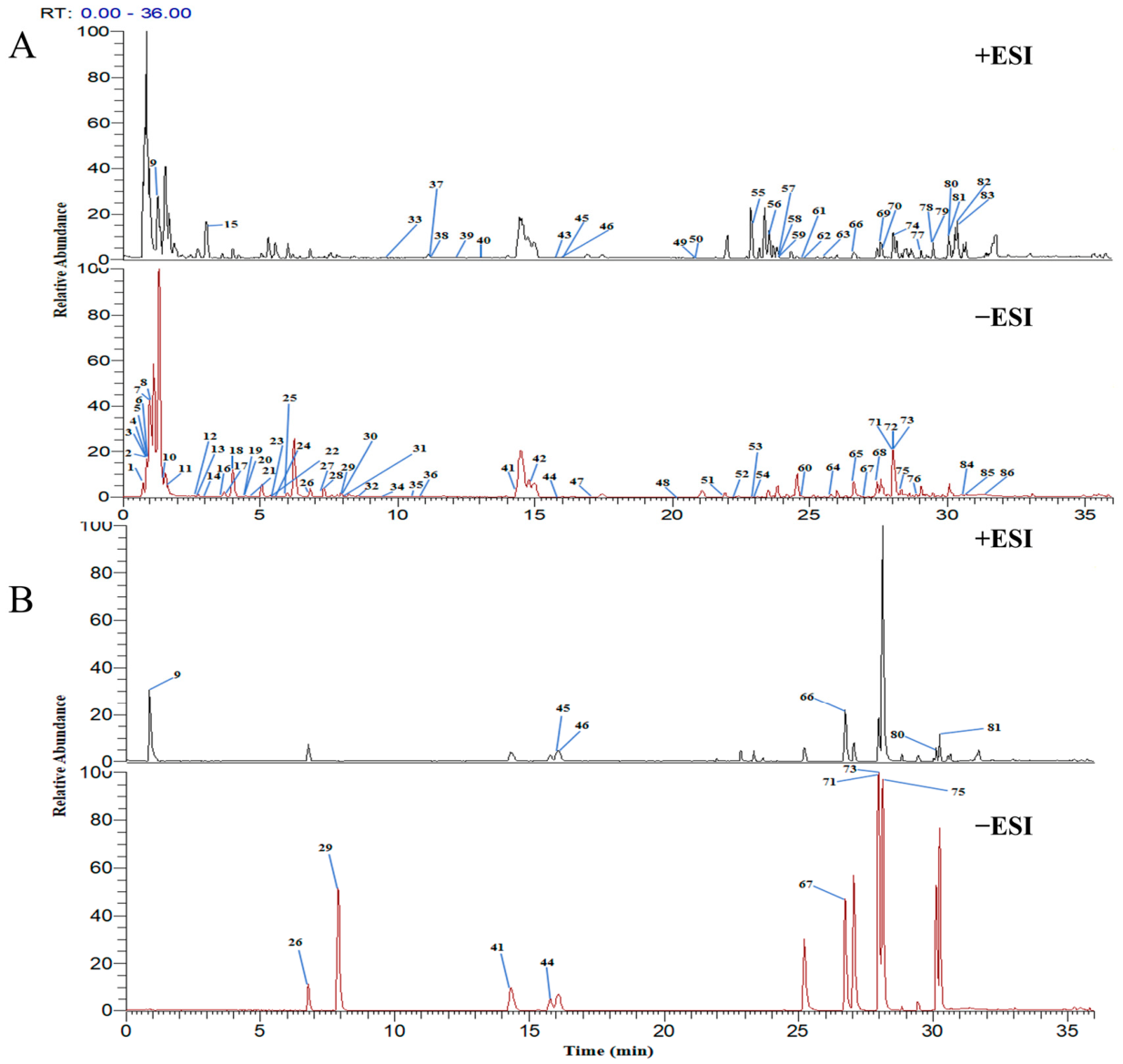
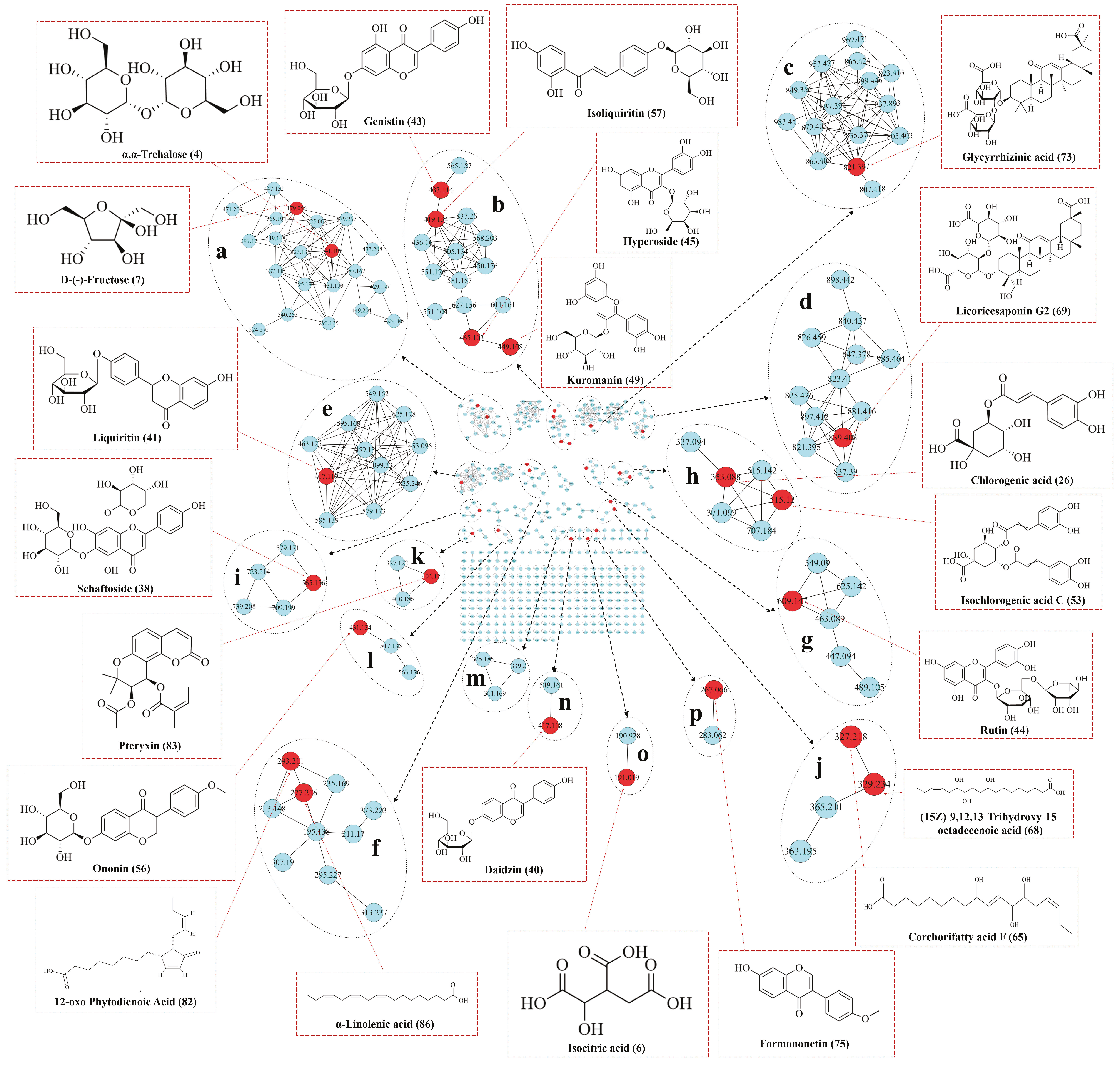
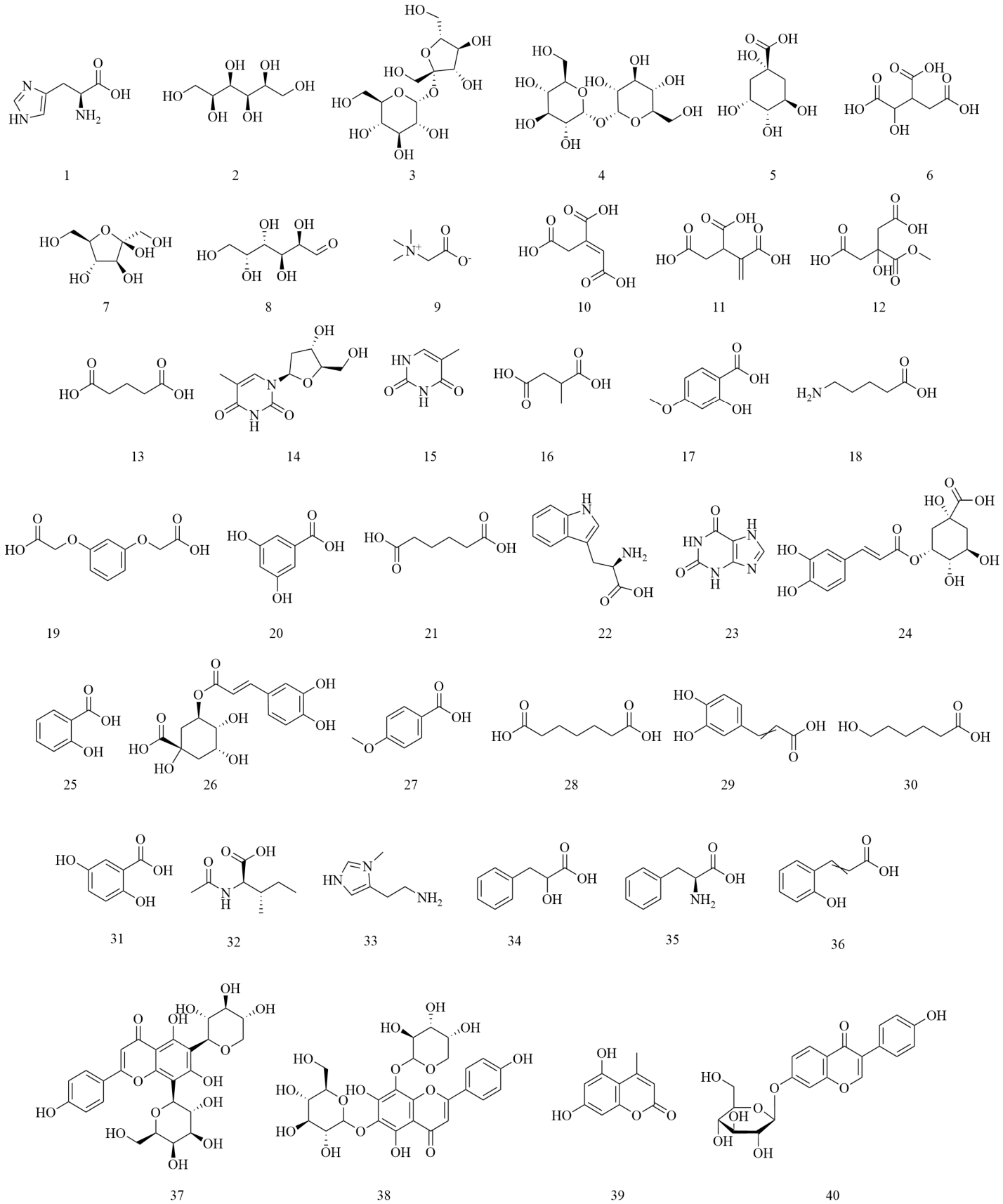
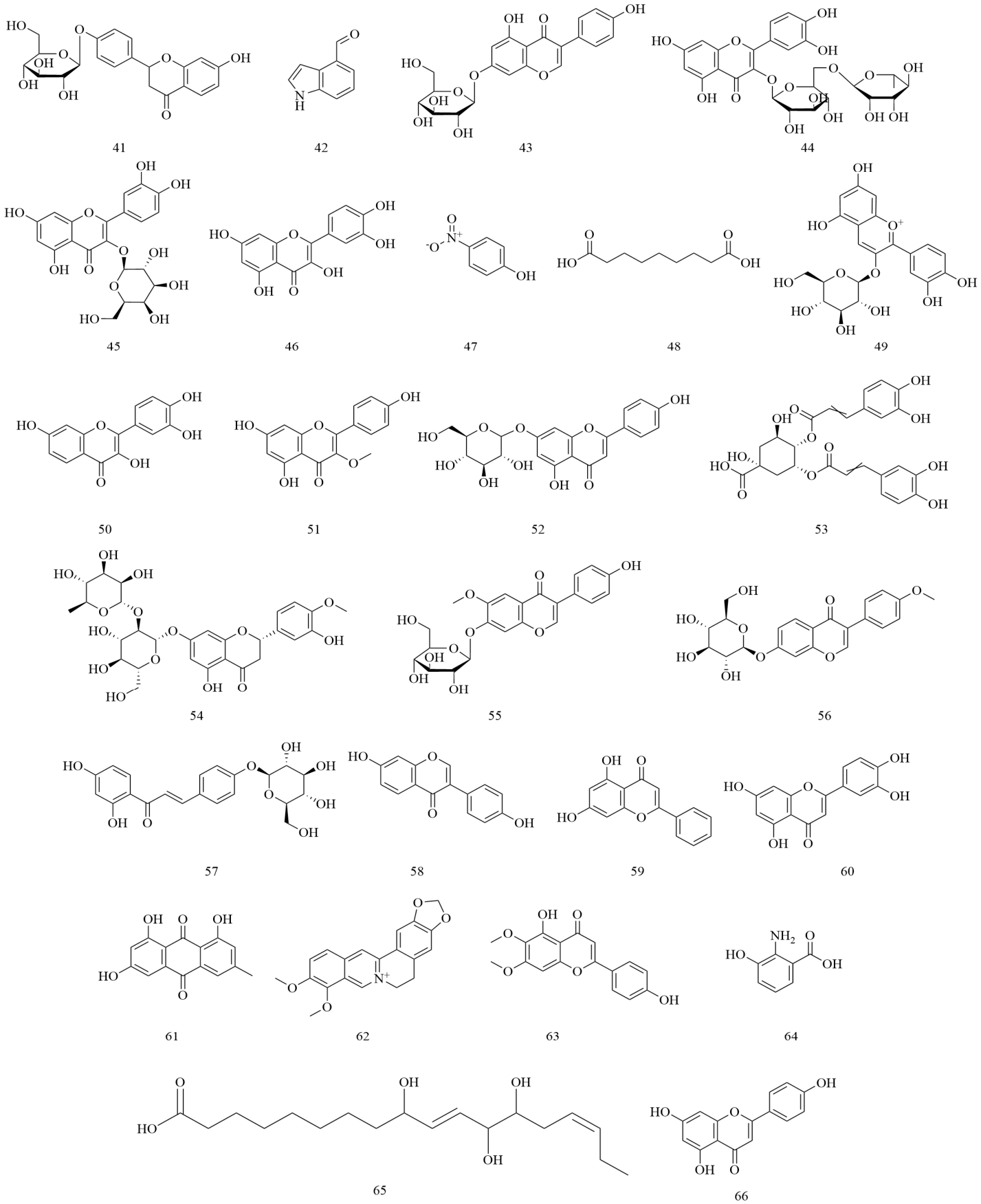
| NO | Compound Name | RT (min) | Formula | Ion Mode | Theoretical Mass m/z | Experimental Mass m/z | Error (ppm) | Major Ion Fragments MS/MS (m/z) | Compound Type | Source | Refs. |
|---|---|---|---|---|---|---|---|---|---|---|---|
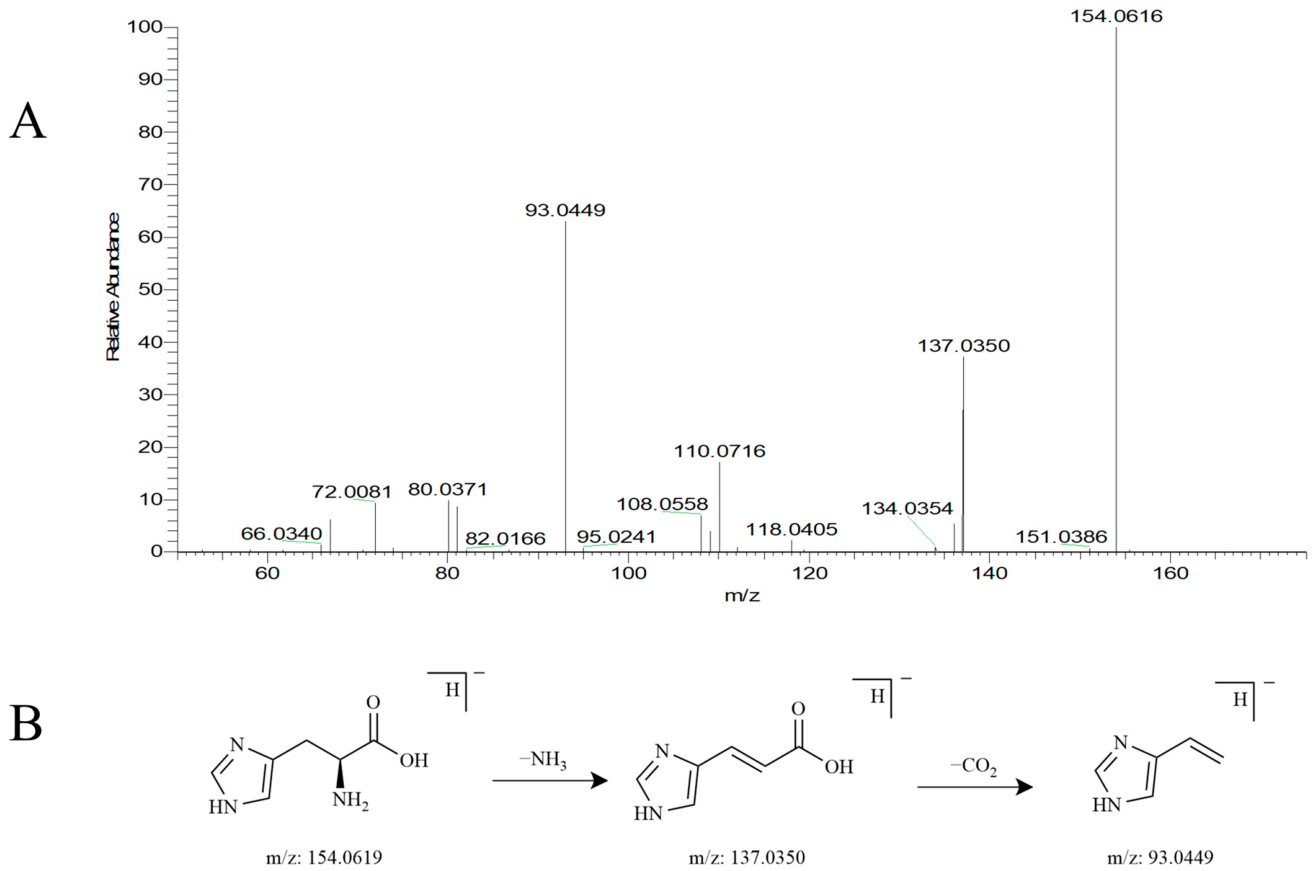
| 1 | Histidine | 0.83 | C6H9N3O2 | [M−H]− | 154.0619 | 154.0622 | −1.95 | 154.0616, 137.0350, 110.0716, 95.0241, 93.0449 | Amino acids | SS, MD, YZ, THF, BBD, GC | [25] |
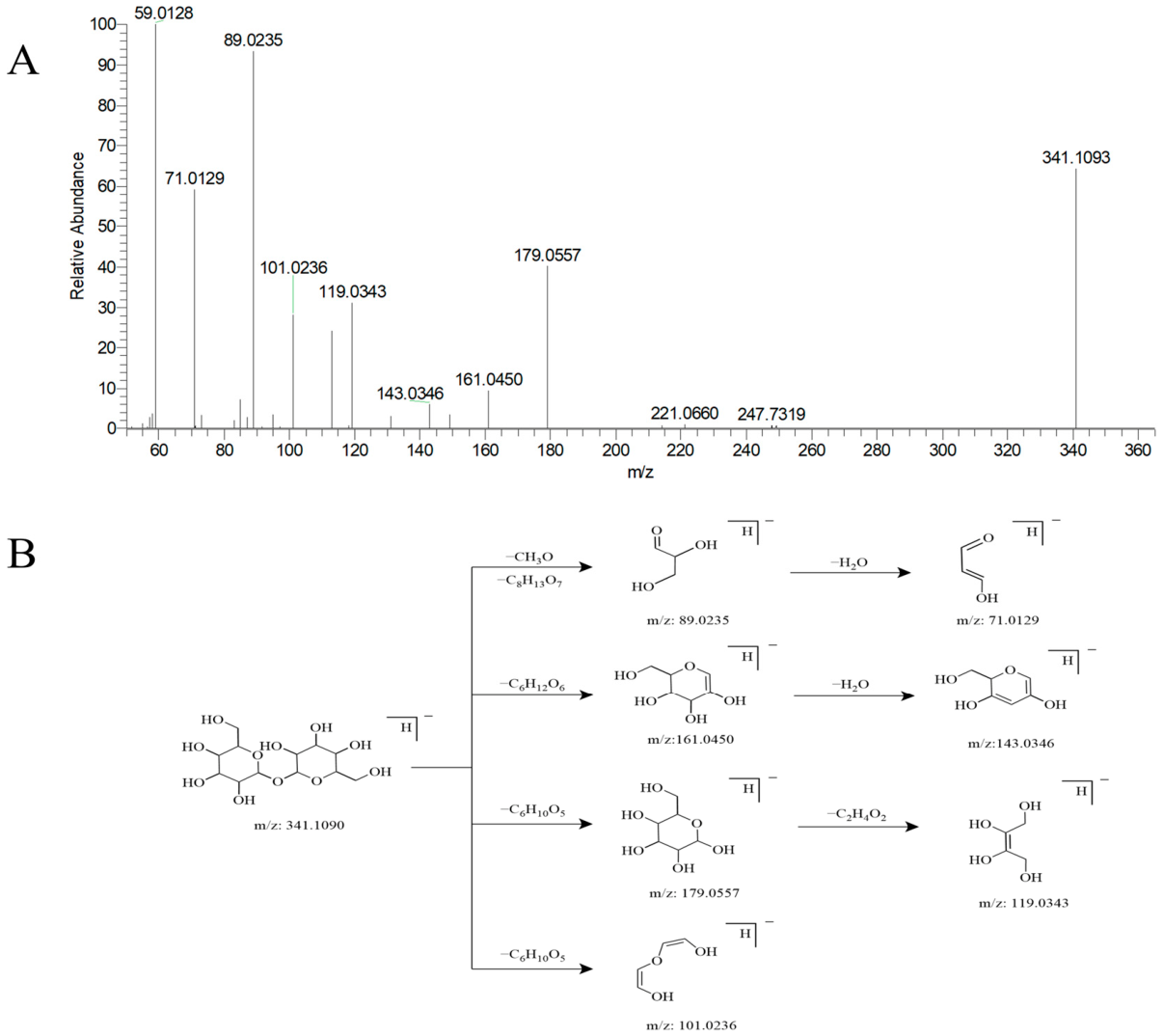
| 2 | Iditol | 0.86 | C6H14O6 | [M−H]− | 181.0714 | 181.0717 | −1.66 | 101.0236, 89.0235, 71.0129 | Saccharides | SS, YZ, THF, BBD, GC, SY | [26] |
| 3 | Sucrose | 0.89 | C12H22O11 | [M−H]− | 341.109 | 341.1089 | 0.29 | 179.0710, 119.0495, 89.0238 | Saccharides | SS, MD, YZ, BBD, GC, SY | [27] |
| 4 | α,α-Trehalose | 0.90 | C12H22O11 | [M−H]− | 341.109 | 341.1089 | 0.29 | 341.1093, 179.0557, 119.0557, 101.0236, 89.0235 | Saccharides | SS, MD, YZ, THF, BBD, GC, SY | [28,29] |
| 5 | Quinic acid | 0.92 | C7H12O6 | [M−H]− | 191.0557 | 191.0561 | −2.09 | 191.0557, 173.0086, 127.0394 | Organic acids | SS, BBD, SY | [28] |
| 6 | Isocitric acid | 0.97 | C6H8O7 | [M−H]− | 191.0194 | 191.0197 | −1.57 | 191.0557, 111.0079, 85.0285, 71.0128 | Organic acids | SS, MD, YZ, THF, BBD, GC, SY | [30] |
| 7 | Fructose | 1.04 | C6H12O6 | [M−H]− | 179.0557 | 179.0561 | −2.23 | 119.034, 113.0236, 101.0239, 89.0235 | Saccharides | SS, MD, YZ, THF, BBD, GC, SY | [31] |
| 8 | Galactose | 1.05 | C6H12O6 | [M−H]− | 179.0557 | 179.0561 | −2.23 | 89.0235, 71.0128, 85.0284, 59.0128 | Saccharides | SS, MD, YZ, THF, BBD, GC, SY | [32] |
| 9 * | Betaine | 1.26 | C5H11NO2 | [M+H]+ | 118.0962 | 118.0963 | −0.85 | 59.0785, 58.9149 | Alkaloids | SS, MD, YZ, THF, BBD, SY | [28,33] |
| 10 | trans-Aconitic acid | 1.43 | C6H6O6 | [M−H]− | 173.0087 | 173.0091 | −2.31 | 129.0186, 111.0079, 85.0285 | Organic acids | SS, MD, YZ, THF, BBD, GC, SY | [34] |
| 11 | 3-Butene-1,2,3-tricarboxylic acid | 1.63 | C7H8O6 | [M−H]− | 187.0246 | 187.0248 | −1.07 | 143.0343, 125.0969, 115.0393 | Organic acids | SS, BBD | [35] |
| 12 | 3-Hydroxy-3-(methoxycarbonyl)pentanedioic acid | 2.53 | C7H10O7 | [M−H]− | 205.0354 | 205.0353 | 0.49 | 173.0083, 129.0186, 111.0079 | Organic acids | SS | [36] |
| 13 | Glutaric acid | 2.58 | C5H8O4 | [M−H]− | 131.0344 | 131.0349 | −3.82 | 87.0443, 69.0336, 59.0127 | Organic acids | THF, BBD, GC, SY | [37] |
| 14 | Thymidine | 3.06 | C10H14N2O5 | [M−H]− | 241.0832 | 241.0829 | 1.24 | 241.0831, 151.0508, 125.0340 | Others | THF, SY | [38] |
| 15 | Thymine | 3.12 | C5H6N2O2 | [M+H]+ | 127.0497 | 127.0502 | −3.94 | 127.0495, 110.0329, 84.0518 | Alkaloids | SS, MD, YZ, THF, BBD, GC, SY | [38] |
| 16 | Methylsuccinic acid | 3.54 | C5H8O4 | [M−H]− | 131.0344 | 131.0349 | −3.82 | 131.0342, 101.0235, 87.0442, 85.0285 | Organic acids | THF, BBD, GC, SY | [39] |
| 17 | 4-Methoxysalicylic acid | 3.795 | C8H8O4 | [M−H]− | 167.0346 | 167.0349 | −1.80 | 123.0443, 108.0208 | Organic acids | SY | [40] |
| 18 | 5-Aminovaleric acid | 4.05 | C5H11NO2 | [M−H]− | 116.0712 | 116.0717 | −4.31 | 117.0549, 99.00784, 59.0127 | Organic acids | THF, BBD, GC, SY | [41] |
| 19 | (1,3-Phenylenedioxy)diacetic acid | 4.43 | C10H10O6 | [M−H]− | 225.0408 | 225.0404 | 1.78 | 135.0443, 121.0287, 59.0128 | Organic acids | GC | [42] |
| 20 | 3,5-Dihydroxybenzoic acid | 4.43 | C7H6O4 | [M−H]− | 153.0189 | 153.0193 | −2.61 | 153.0187, 109.0286 | Organic acids | SS, THF, BBD, GC, SY | [43] |
| 21 | Adipic acid | 4.67 | C6H10O4 | [M−H]− | 145.0502 | 145.0506 | −2.76 | 101.0599, 83.0493 | Organic acids | THF, GC, SY | [44] |
| 22 | Tryptophan | 5.28 | C11H12N2O2 | [M−H]− | 203.0825 | 203.0826 | −0.49 | 142.0656, 116.0498 | Amino acids | SS, MD, YZ, THF, GC, SY | [45] |
| 23 | Xanthine | 5.38 | C5H4N4O2 | [M−H]− | 151.0265 | 151.0261 | 2.65 | 108.0209, 71.0129 | Others | THF, GC | [46] |
| 24 | Neochlorogenic acid | 5.52 | C16H18O9 | [M−H]− | 353.0886 | 353.0878 | 2.27 | 353.0876, 191.0553, 179034, 135.0445 | Organic acids | SY | [47] |
| 25 | Salicylic acid | 5.97 | C7H6O3 | [M−H]− | 137.0238 | 137.0244 | −4.38 | 109.0288, 93.0337 | Organic acids | MD, YZ, THF, GC, SY | [28] |
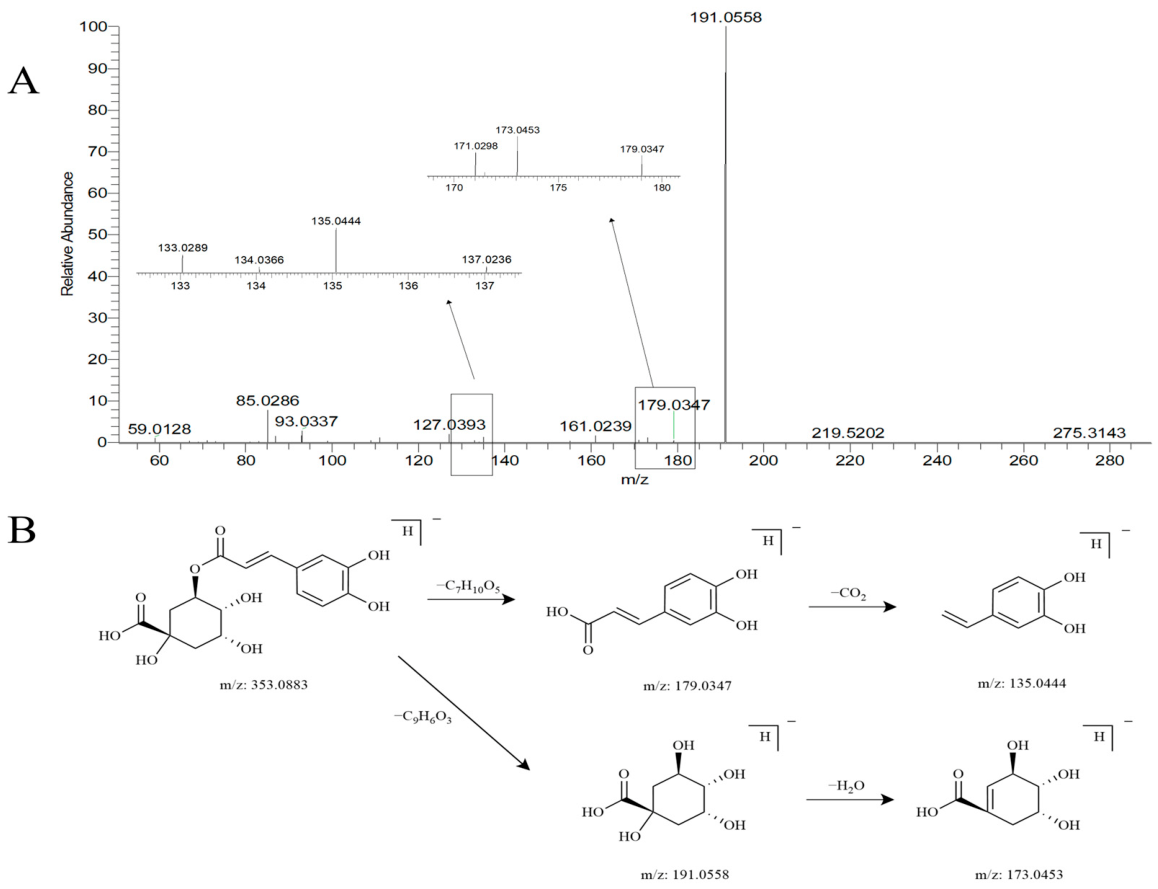
| 26 * | Chlorogenic acid | 6.76 | C16H18O9 | [M−H]− | 353.0883 | 353.0878 | 1.42 | 191.0558, 179.0347, 173.0453, 135.0444 | Organic acids | SY | [47] |
| 27 | 4-Anisic acid | 7.23 | C8H8O3 | [M−H]− | 151.0395 | 151.0401 | −3.97 | 107.0498, 109.0287 | Organic acids | GC, SY | [48,49] |
| 28 | Pimelic acid | 7.32 | C7H12O4 | [M−H]− | 159.0657 | 159.0663 | −3.77 | 115.0756, 97.0650 | Organic acids | THF, GC | [44] |
| 29 * | Caffeic acid | 7.87 | C9H8O4 | [M−H]− | 179.0348 | 179.035 | −1.12 | 135.0445, 107.0492 | Organic acids | MD, GC, SY | [50,51] |
| 30 | 6-Hydroxycaproic acid | 7.89 | C6H12O3 | [M−H]− | 131.0707 | 131.0713 | −4.58 | 85.0649, 59.0127 | Organic acids | MD, THF, BBD, GC, SY | [52] |
| 31 | Gentisic acid | 8.05 | C7H6O4 | [M−H]− | 153.0188 | 153.0193 | −3.27 | 153.0187, 109.0286, 91.0180 | Organic acids | SS, MD, YZ, THF, BBD, GC, SY | [28,53] |
| 32 | N-Acetyl-D-alloisoleucine | 8.55 | C8H15NO3 | [M−H]− | 172.0975 | 172.0979 | −2.32 | 130.0867, 172.0974, 58.0286 | Amino acids | YZ, THF, BBD, GC, SY | [31] |
| 33 | 3-Methylhistamine | 8.56 | C6H11N3 | [M+H]+ | 126.1019 | 126.1025 | −4.76 | 126.1017, 108.0535, 96.0605 | Others | SY | [32] |
| 34 | Phenylalanine | 9.46 | C9H11NO2 | [M−H]− | 164.0712 | 164.0717 | −3.05 | 147.0444, 120.0447, 103.9194 | Amino acids | SS, MD, YZ, THF, BBD, GC, SY | [54] |
| 35 | 3-Phenyllactic acid | 10.50 | C9H10O3 | [M−H]− | 165.0553 | 165.0557 | −2.42 | 165.0552, 147.0444, 119.0494 | Organic acids | SY | [55] |
| 36 | 2-Hydroxycinnamic acid | 10.84 | C9H8O3 | [M−H]− | 163.0396 | 163.0401 | −3.07 | 163.0395, 119.0494, 93.0337 | Organic acids | SS, MD, YZ, THF, BBD, GC, SY | [56] |
| 37 | Corymboside | 11.33 | C26H28O14 | [M+H]+ | 565.1556 | 565.1552 | 0.71 | 427.1022, 409.0915, 379.0779, 325.0710, 295.0603, 203.0338 | Flavonoids | GC | [57] |
| 38 | Schaftoside | 11.45 | C26H28O14 | [M+H]+ | 565.1558 | 565.1552 | 1.06 | 547.1461, 529.1334, 445.1071, 355.0822 | Flavonoids | GC | [58] |
| 39 | 5,7-Dihydroxy-4-methylcoumarin | 12.26 | C10H8O4 | [M+H]+ | 193.0497 | 193.0495 | 1.04 | 178.0301, 165.0603, 149.0683 | Coumarins | BBD, SY | [59] |
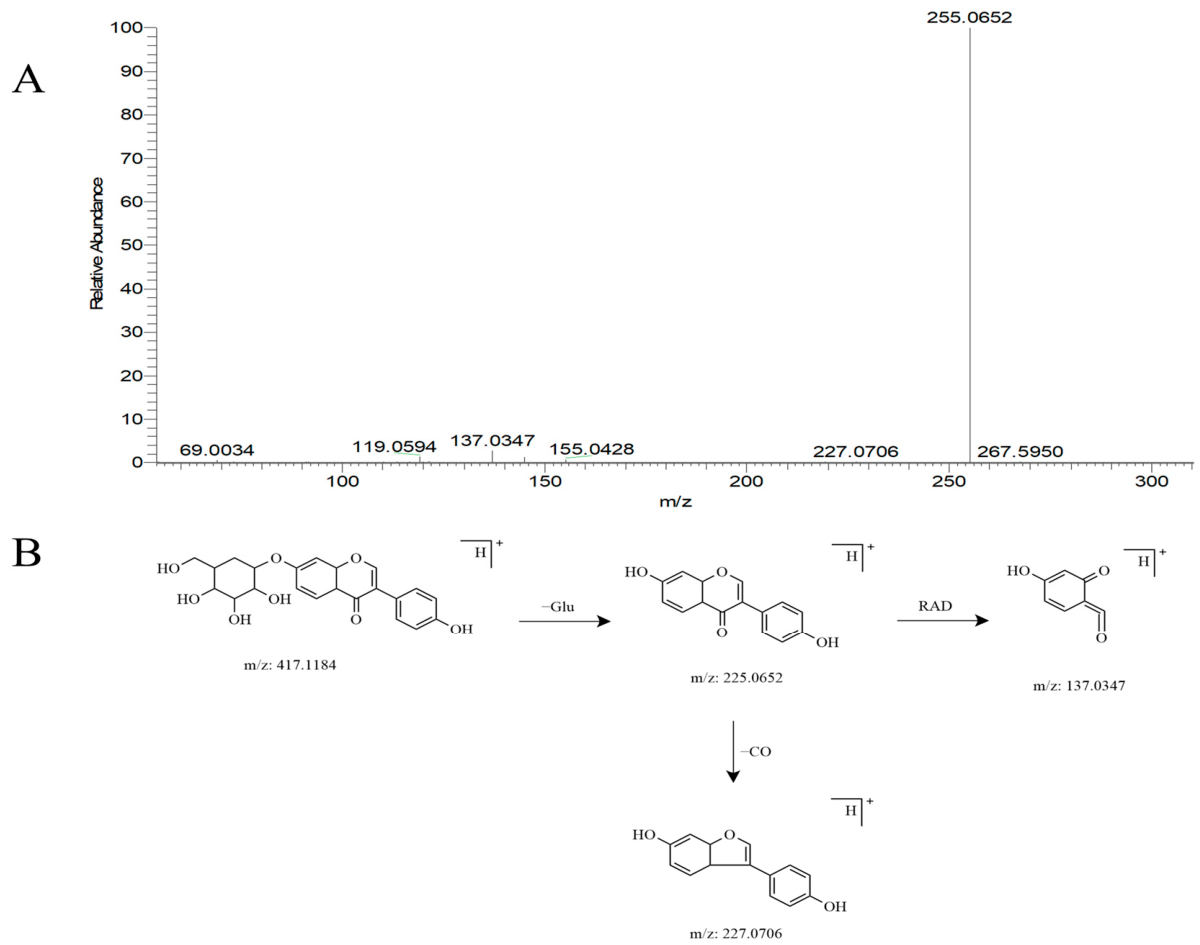
| 40 | Daidzin | 12.74 | C21H20O9 | [M+H]+ | 417.1184 | 417.118 | 0.96 | 255.0651, 227.0706, 137.0347 | Flavonoids | GC | [60] |
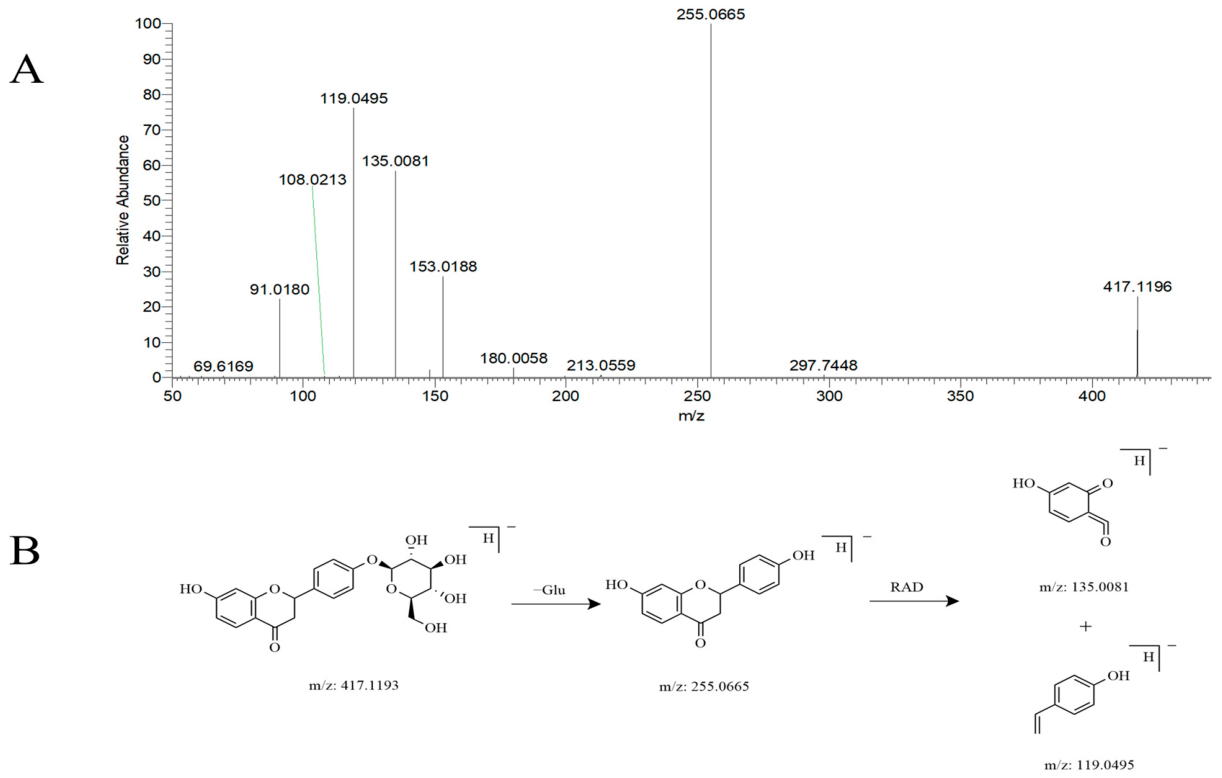
| 41 * | Liquiritin | 14.25 | C21H22O9 | [M−H]− | 417.1193 | 417.1191 | 0.48 | 255.0665, 135.0081, 119.0495 | Flavonoids | GC, SY | [61,62] |
| 42 | 4-Indolecarbaldehyde | 14.78 | C9H7NO | [M−H]− | 144.0448 | 144.0455 | −4.86 | 116.14944 | Aldehydes | THF | [42] |
| 43 | Genistin | 15.75 | C21H20O10 | [M+H]+ | 433.1135 | 433.1129 | 1.39 | 413.1137, 271.0600 | Flavonoids | GC | [60] |
| 44 * | Rutin | 15.80 | C27H30O16 | [M−H]− | 609.1473 | 609.1461 | 1.97 | 300.02777, 271.0249, 178.9975, 151.0026 | Flavonoids | SY | [60] |
| 45 * | Hyperoside | 15.99 | C21H20O12 | [M+H]+ | 465.1036 | 465.1028 | 1.72 | 303.0498, 153.0273, 85.0359 | Flavonoids | SY | [63] |
| 46 * | Quercetin | 16.09 | C15H10O7 | [M+H]+ | 303.0500 | 303.0499 | 0.33 | 303.0498, 285.0387, 257.0441, 165.0238 | Flavonoids | GC, SY | [47,60] |
| 47 | 4-Nitrophenol | 17.11 | C6H5NO3 | [M−H]− | 138.0191 | 138.0197 | −4.35 | 138.0189, 108.0208 | Phenols | THF, GC, SY | [64] |
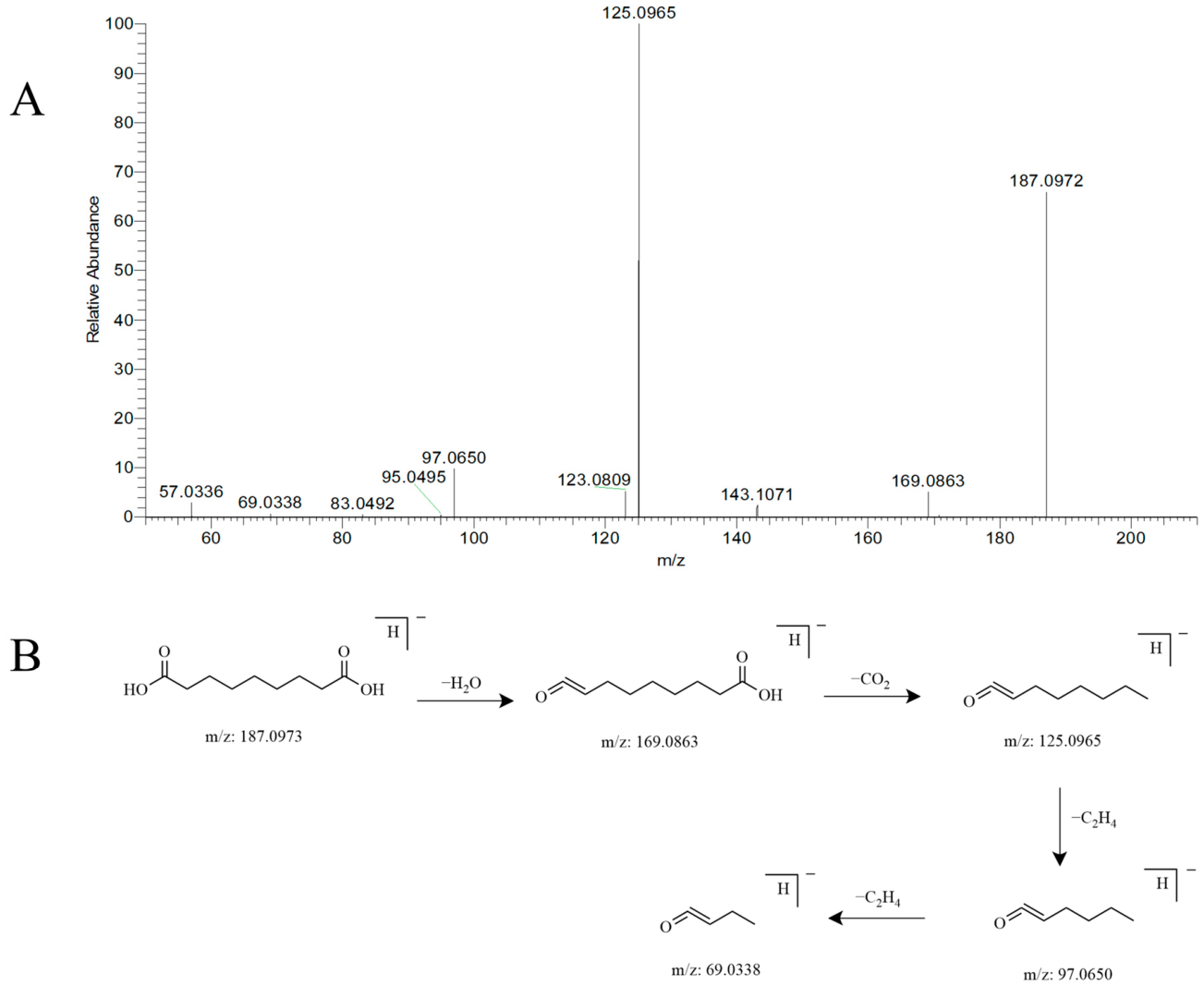
| 48 | Azelaic acid | 21.01 | C9H16O4 | [M−H]− | 187.0973 | 187.0976 | −1.60 | 169.0863, 125.0965, 97.0650, 69.0338 | Organic acids | SS, MD, YZ, THF, BBD, GC, SY | [28] |
| 49 | Kuromanin | 21.87 | C21H20O11 | [M+H]+ | 449.1081 | 449.1078 | 0.67 | 287.0547, 258.0519, 241.0691 | Flavonoids | THF, BBD, GC, SY | [65] |
| 50 | Fisetin | 21.87 | C15H10O6 | [M+H]+ | 287.0552 | 287.055 | 0.70 | 241.0502, 213.0549 | Flavonoids | SY | [66] |
| 51 | Isokaempferide | 21.93 | C16H12O6 | [M−H]− | 299.0564 | 299.0561 | 1.00 | 284.0328, 173.0233 | Flavonoids | GC | [67] |
| 52 | Apigetrin | 22.21 | C21H20O10 | [M−H]− | 431.0992 | 431.0983 | 2.09 | 268.0381, 269.0456, 151.0032 | Flavonoids | GC | [28,68] |
| 53 | Isochlorogenic acid C | 22.89 | C25H24O12 | [M−H]− | 515.1204 | 515.1195 | 1.75 | 353.0881, 191.0558, 179.0345, 135.0443 | Organic acids | SY | [69] |
| 54 | Neohesperidin | 22.95 | C28H34O15 | [M−H]− | 609.1841 | 609.1825 | 2.63 | 609.1838, 301.0721 | Flavonoids | YZ, BBD, SY | [28,70] |
| 55 | Glycitin | 23.04 | C22H22O10 | [M+H]+ | 447.129 | 447.1286 | 0.89 | 285.0756, 270.0522 | Flavonoids | GC | [50] |
| 56 | Ononin | 23.49 | C22H22O9 | [M+H]+ | 431.134 | 431.1337 | 0.70 | 267.0692, 254.0806, 137.0347 | Flavonoids | GC | [71] |
| 57 | Isoliquiritin | 23.75 | C21H22O9 | [M+H]+ | 419.1344 | 419.1337 | 1.67 | 257.0806, 163.0468 | Flavonoids | GC | [62] |
| 58 | Daidzein | 23.91 | C15H10 O4 | [M+H]+ | 255.0654 | 255.0653 | 0.39 | 255.0650, 199.0754, 181.0698, 137.0345 | Flavonoids | GC | [60] |
| 59 | 5,7-dihydroxy-2-phenyl-4H-chromen-4-one | 23.92 | C15H10O4 | [M+H]+ | 225.0654 | 255.0652 | 0.89 | 213.0556, 153.0786 | Flavonoids | GC | [72] |
| 60 | Luteolin | 24.70 | C15H10O6 | [M−H]− | 285.041 | 285.0405 | 1.75 | 257.0459, 241.0499, 151.0034, 133.0288 | Flavonoids | GC | [60] |
| 61 | Emodin | 24.79 | C15H10O5 | [M+H]+ | 271.0598 | 271.0601 | −1.11 | 271.0961, 163.0460, 137.0709 | Others | GC | [73] |
| 62 | Berberine | 24.93 | C20H17NO4 | [M+H]+ | 336.1233 | 336.123 | 0.89 | 320.0915, 278.0810 | Flavonoids | SS, MD, YZ, THF, BBD, GC, SY | [74] |
| 63 | Scrophulein | 25.58 | C17H14O6 | [M+H]+ | 315.0863 | 315.0863 | 0.00 | 315.0861, 255.0650 | Flavonoids | GC | [75] |
| 64 | 3-Hydroxyanthranilic acid | 25.76 | C7H7NO3 | [M−H]− | 152.0346 | 152.0353 | −4.60 | 152.0346, 122.0366 | Organic acids | THF, SY | [76] |
| 65 | Corchorifatty acid F | 26.51 | C18H32O5 | [M−H]− | 327.2181 | 327.2177 | 1.22 | 229.1444, 211.1337, 171.1021 | Organic acids | SS, MD, YZ, THF, BBD, GC, SY | [27] |
| 66 * | Apigenin | 26.68 | C15H10O5 | [M+H]+ | 271.0607 | 271.0601 | 2.21 | 271.0963, 119.0591 | Flavonoids | GC | [28] |
| 67 * | Kaempferol | 26.97 | C15H10O6 | [M−H]− | 285.041 | 285.0405 | 1.75 | 285.0771 | Flavonoids | GC | [28] |
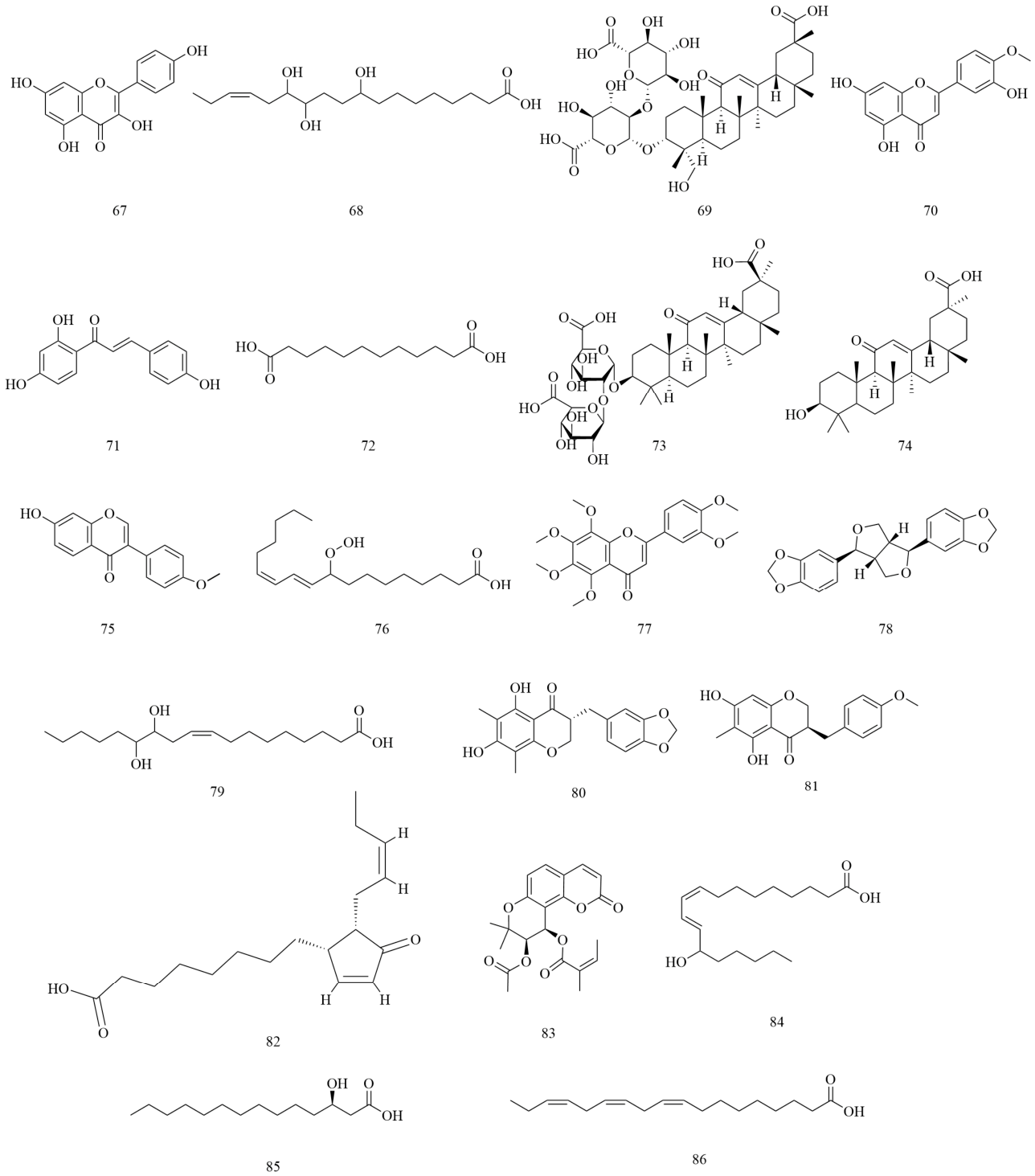
| 68 | (15Z)-9,12,13-Trihydroxy-15-octadecenoic acid | 27.44 | C18H34O5 | [M−H]− | 329.2335 | 329.2334 | 0.30 | 229.1446, 211.1337, 171.1021, 139.1121, 99.0806 | Organic acids | SS, MD, YZ, THF, BBD, GC | [44] |
| 69 | Licoricesaponin G2 | 27.57 | C42H62O17 | [M+H]+ | 839.408 | 839.406 | 2.38 | 469.3310, 451.3205 | Triterpenes | GC | [62] |
| 70 | Diosmetin | 27.67 | C16H12O6 | [M+H]+ | 301.0705 | 301.0707 | −0.66 | 286.0471, 258.0523, 153.0274 | Flavonoids | GC | [28] |
| 71 * | Isoliquiritigenin | 27.99 | C15H12O4 | [M−H]− | 255.0668 | 255.0663 | 1.96 | 255.0666, 153.0188, 135.0081, 119.0495, 91.0180 | Flavonoids | GC | [61,77] |
| 72 | Dodecanedioic acid | 28.05 | C12H22O4 | [M−H]− | 229.1447 | 229.1445 | 0.87 | 229.1445, 211.1337, 167.1435 | Organic acids | SS, THF, SY | [38] |
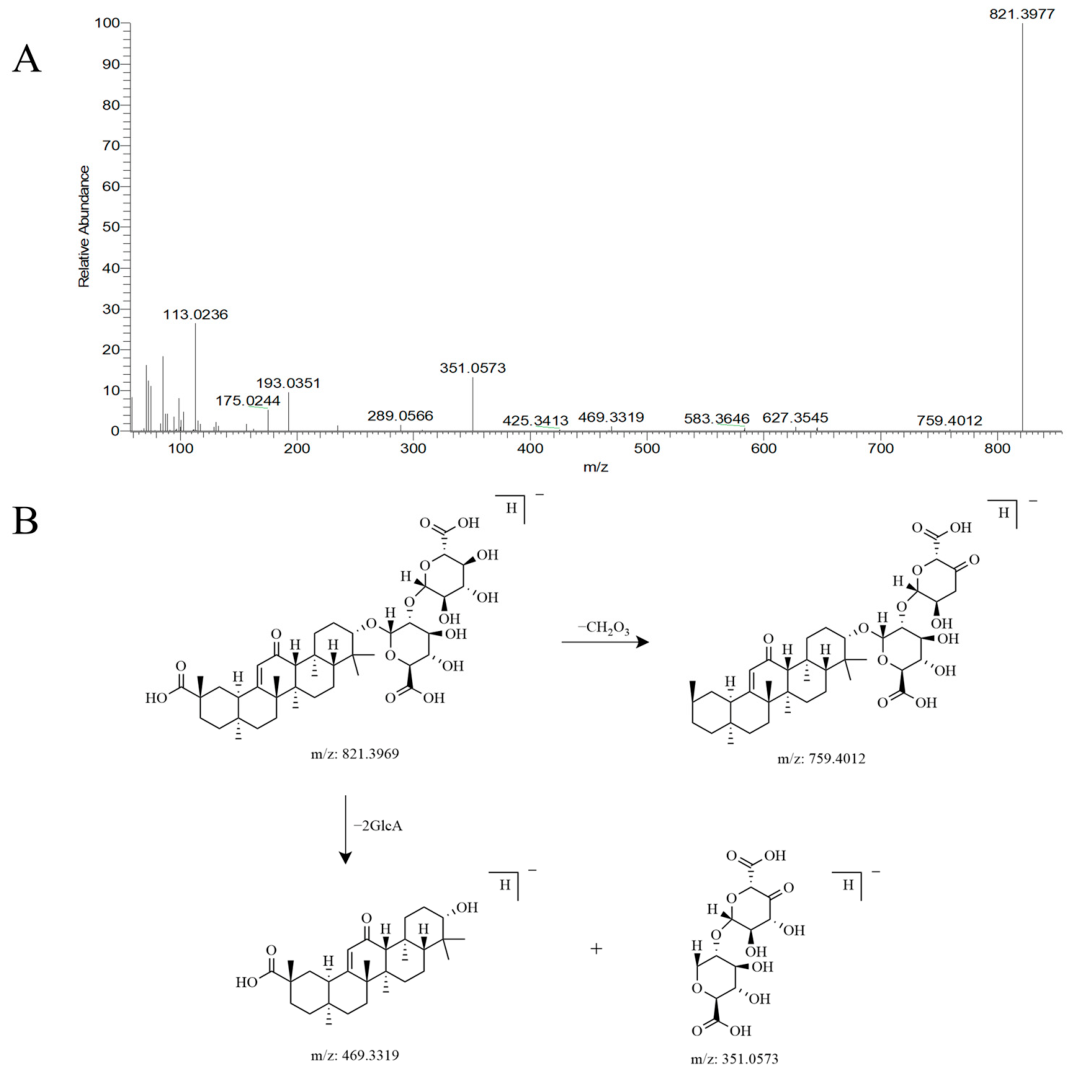
| 73 * | Glycyrrhizinic acid | 28.07 | C42H62O16 | [M−H]− | 821.3969 | 821.3965 | 0.49 | 759.4012, 469.3319, 351.0573 | Triterpenes | GC | [61] |
| 74 | 18-β-Glycyrrhetinic acid | 28.09 | C30H46O4 | [M+H]+ | 471.3463 | 471.3469 | −1.27 | 453.3360, 435.3269, 425.3409, 407.3297, 317.2117, 235.1696, 135.1278 | Triterpenes | GC | [78] |
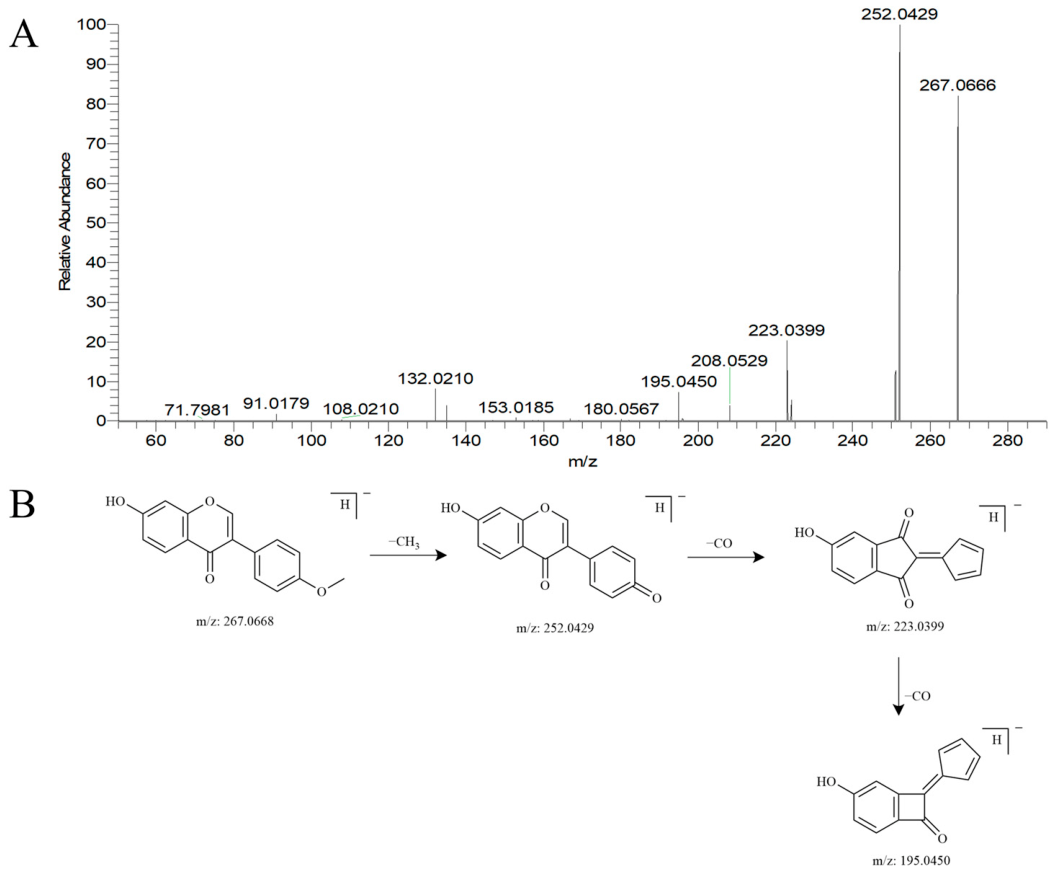
| 75 * | Formononetin | 28.14 | C16H12O4 | [M−H]− | 267.0668 | 267.0663 | 1.87 | 252.0429, 223.0399, 195.0450 | Flavonoids | BBD, GC | [28,79] |
| 76 | 9-HpODE | 28.86 | C18H32O4 | [M−H]− | 311.223 | 311.2228 | 0.64 | 293.2128, 267.1968, 223.2064 | Organic acids | SS, MD, YZ, THF, BBD, GC, SY | [80] |
| 77 | Nobiletin | 28.92 | C21H22O8 | [M+H]+ | 403.1391 | 403.1387 | 0.99 | 403.1388, 373.0918, 327.0858, 211.0234, 183.0311 | Flavonoids | SS, MD, YZ, BBD, GC | [74,81] |
| 78 | Sesamin | 29.23 | C20H18O6 | [M+H]+ | 355.1169 | 355.1176 | −1.97 | 337.0998, 135.0552 | Lignans | GC | [50] |
| 79 | 12(13)-DiHOME | 29.35 | C18H34O4 | [M+H]+ | 315.2532 | 315.253 | 0.63 | 243.0650, 201.0542 | Organic acids | GC | [82] |
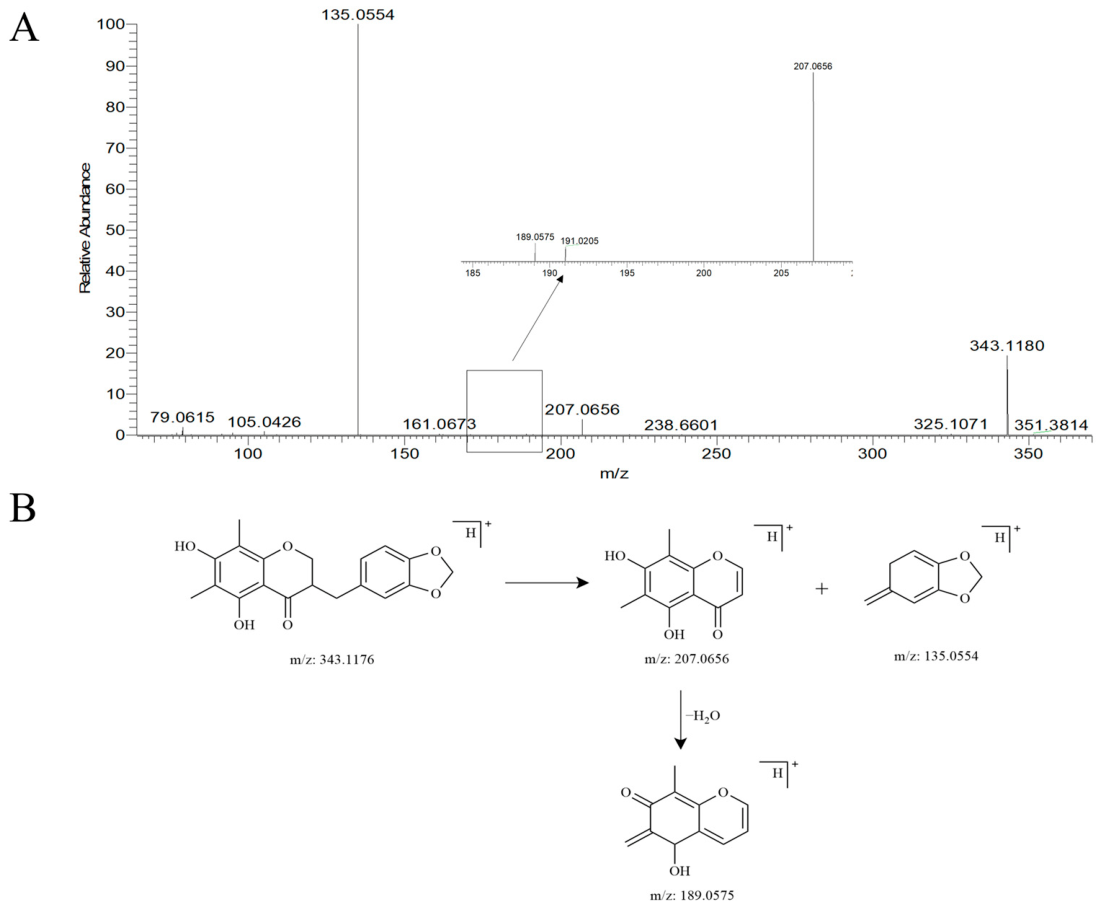
| 80 * | Methylophiopogonanone A | 30.15 | C19H18O6 | [M+H]+ | 343.1182 | 343.1176 | 1.75 | 207.0655, 189.0575, 135.0553 | Homoisoflavonoids | MD | [83] |
| 81 * | Methylophiopogonanone B | 30.18 | C19H20O5 | [M+H]+ | 327.1233 | 327.1238 | −1.53 | 207.0653, 121.0747, 107.0583, 219.0654, 237.0758 | Homoisoflavonoids | MD | [83] |
| 82 | 12-oxo Phytodienoic Acid | 30.21 | C18H28O3 | [M+H]+ | 293.2106 | 293.2111 | −1.71 | 293.2109, 275.2005, 219.1743, 121.1111, 107.0946 | Organic acids | YZ, THF, GC, SY | [26,84] |
| 83 | Pteryxin | 30.39 | C21H22O7 | [M+NH4]+ | 404.1702 | 404.1704 | −0.49 | 287.0915, 245.0804, 227.0701 | Coumarins | GC | [85] |
| 84 | 13-HODE | 30.53 | C18H32O3 | [M−H]− | 295.2281 | 295.2279 | 0.68 | 277.2175, 295.2281, 195.1386 | Organic acids | SS, MD, YZ, THF, BBD, GC, SY | [41] |
| 85 | 3-Hydroxy myristic acid | 30.65 | C14H28O3 | [M−H]− | 243.1966 | 243.1966 | 0.00 | 243.1968, 59.0128 | Organic acids | SS, YZ, GC, SY | [49] |
| 86 | α-Linolenic acid | 31.73 | C18H30O2 | [M−H]− | 277.2175 | 277.2173 | 0.72 | 277.1447, 121.0287, 91.0179 | Organic acids | SS, MD, YZ, THF, BBD, SY | [86] |
Disclaimer/Publisher’s Note: The statements, opinions and data contained in all publications are solely those of the individual author(s) and contributor(s) and not of MDPI and/or the editor(s). MDPI and/or the editor(s) disclaim responsibility for any injury to people or property resulting from any ideas, methods, instructions or products referred to in the content. |
© 2026 by the authors. Licensee MDPI, Basel, Switzerland. This article is an open access article distributed under the terms and conditions of the Creative Commons Attribution (CC BY) license.
Share and Cite
Zhang, K.; Xing, W.; Wang, Q.; He, H.; Xie, X.; Zhang, D.; Qi, Y.; Yang, M. Comprehensive Identification of the Chemical Components in the Classical Prescription Shashen Maidong Decoction Based on UPLC-Q-Orbitrap MS and Molecular Networking. Pharmaceuticals 2026, 19, 1044. https://doi.org/10.3390/ph19071044
Zhang K, Xing W, Wang Q, He H, Xie X, Zhang D, Qi Y, Yang M. Comprehensive Identification of the Chemical Components in the Classical Prescription Shashen Maidong Decoction Based on UPLC-Q-Orbitrap MS and Molecular Networking. Pharmaceuticals. 2026; 19(7):1044. https://doi.org/10.3390/ph19071044
Chicago/Turabian StyleZhang, Kun, Weide Xing, Qiang Wang, Haiyan He, Xingliang Xie, Dingkun Zhang, Yue Qi, and Ming Yang. 2026. "Comprehensive Identification of the Chemical Components in the Classical Prescription Shashen Maidong Decoction Based on UPLC-Q-Orbitrap MS and Molecular Networking" Pharmaceuticals 19, no. 7: 1044. https://doi.org/10.3390/ph19071044
APA StyleZhang, K., Xing, W., Wang, Q., He, H., Xie, X., Zhang, D., Qi, Y., & Yang, M. (2026). Comprehensive Identification of the Chemical Components in the Classical Prescription Shashen Maidong Decoction Based on UPLC-Q-Orbitrap MS and Molecular Networking. Pharmaceuticals, 19(7), 1044. https://doi.org/10.3390/ph19071044