Imidazole-Functionalized Thieno[3,2-c]Quinoline Hybrids in Aggressive Medullary Thyroid Cancer Cell Models: Biological Evaluation and in Silico Insights

 ,
,  ,
,  , , , and
Abstract
1. Introduction
2. Results and Discussion
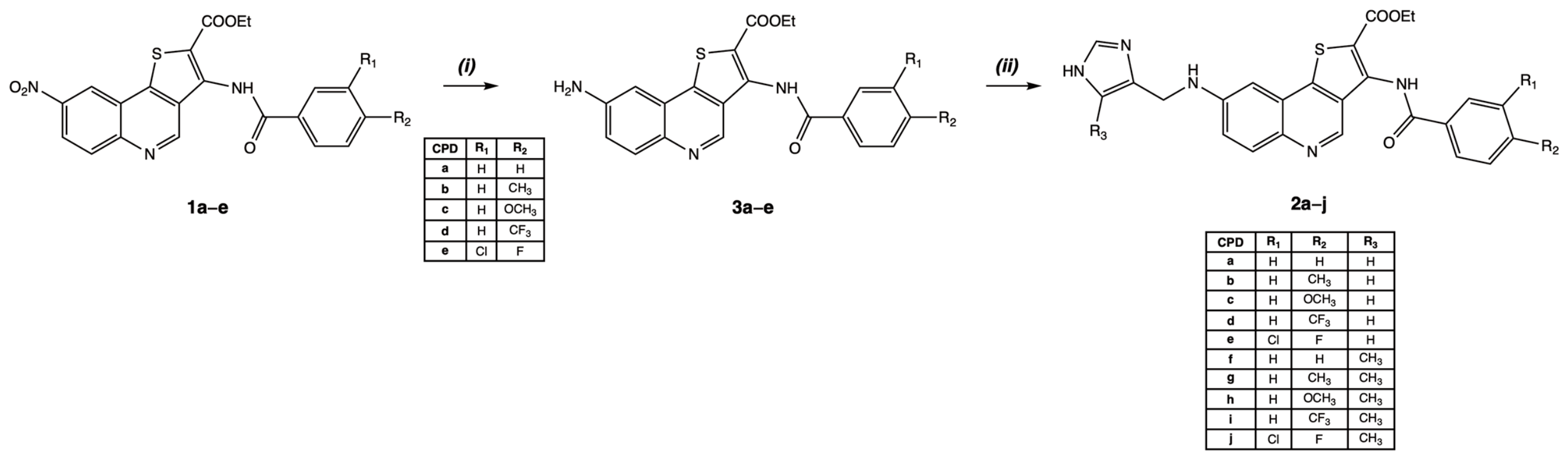
2.1. Synthesis of Thieno[3,2-c]Quinoline Derivatives 2a–j
2.2. In Vitro Antiproliferative Assays on TT(RETC634R) and MZ-CRC-1(RETM918T) MTC Cells
2.3. Preliminary Structure–Activity Relationship Analysis
2.4. In Silico Structure-Based Studies
2.4.1. Induced Fit Docking Analysis in RETWT and RETM918T
2.4.2. Induced Fit Docking Analysis in PI3Kα Catalytic Subunit
2.4.3. Prime MM-GBSA Energy Decomposition Analysis
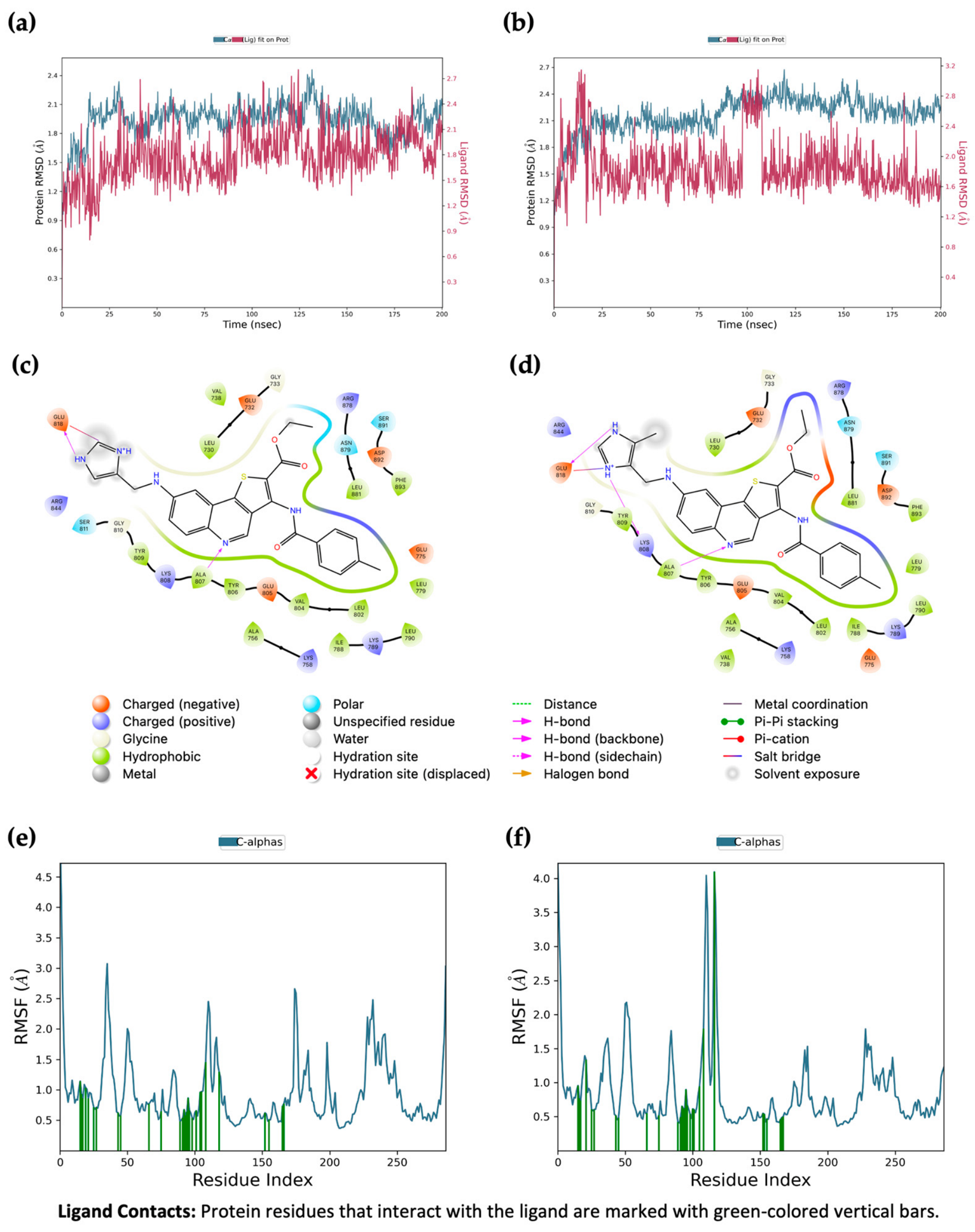
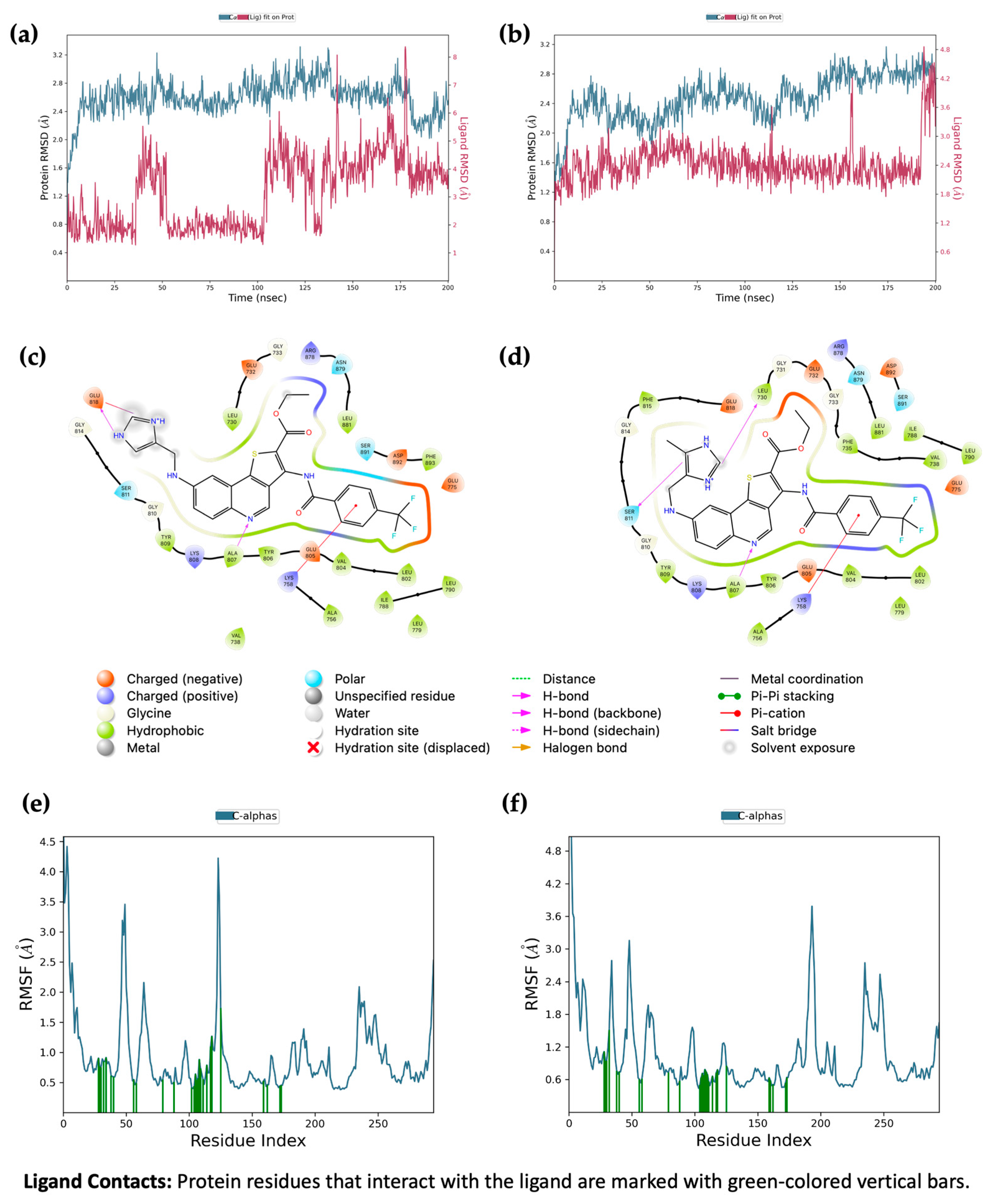
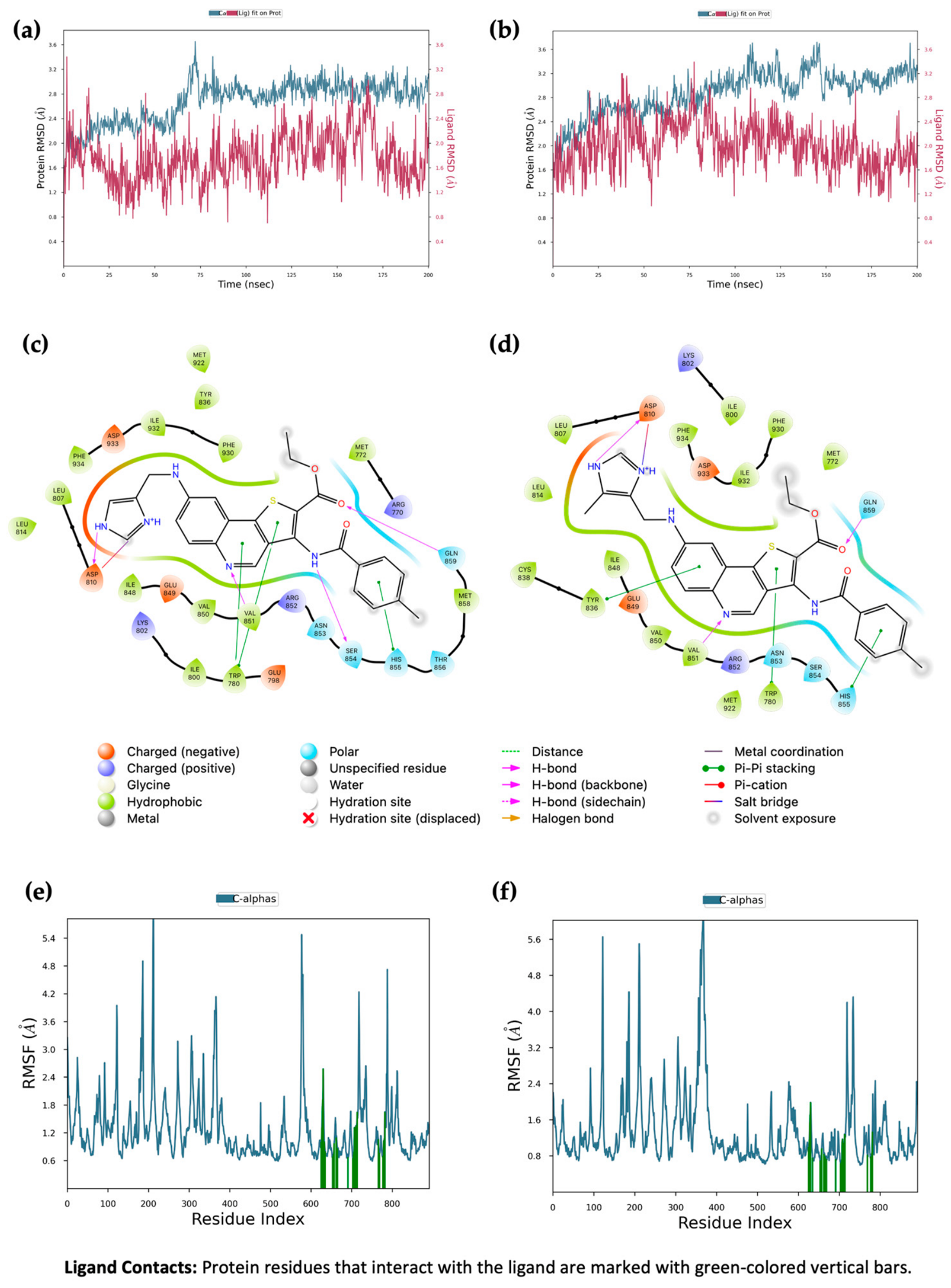
2.4.4. Molecular Dynamics Simulations and Ligand-Protein Stability Analysis
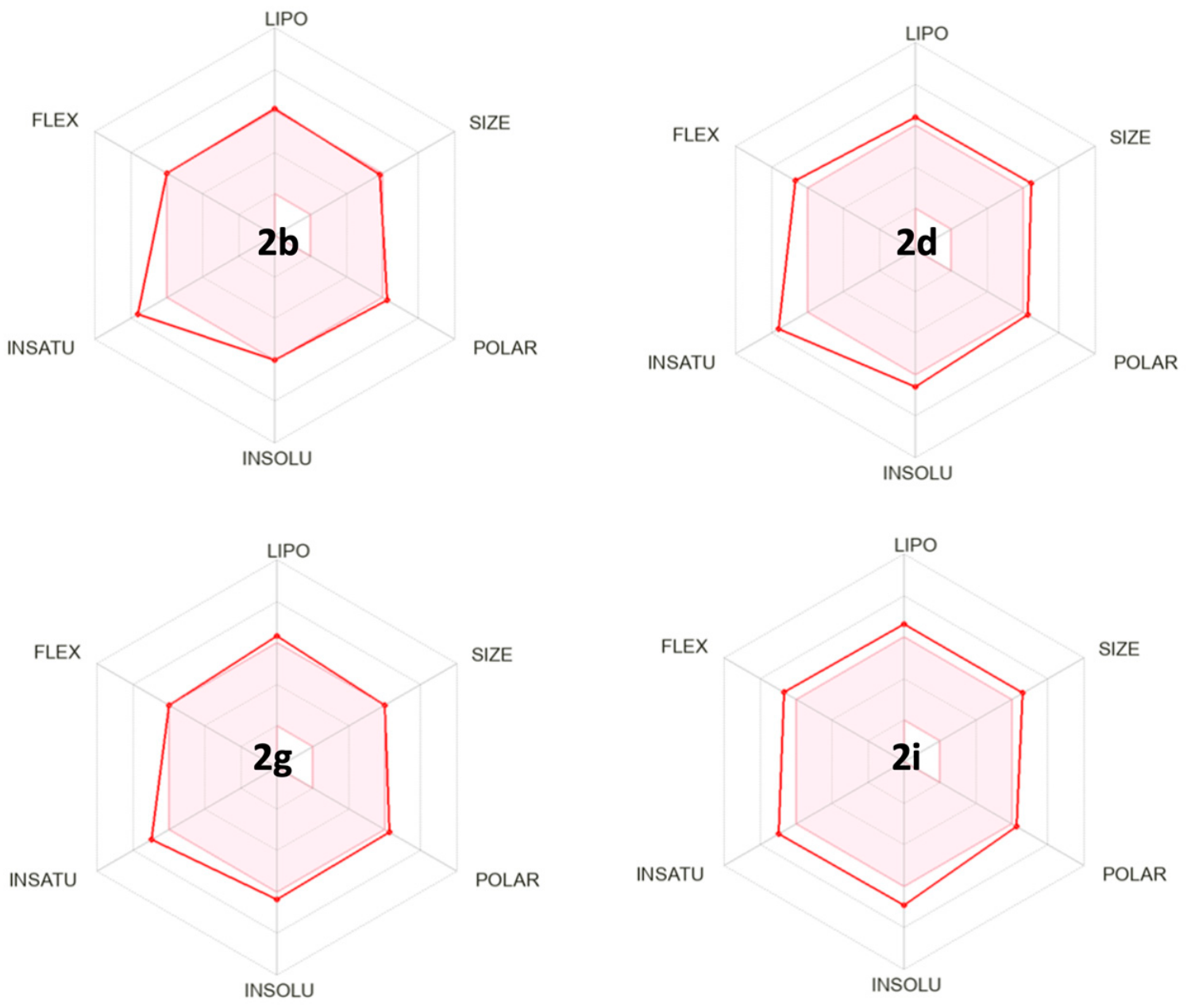
2.4.5. Predicted ADME and Toxicological Profile of Lead Compounds
3. Materials and Methods
3.1. Chemistry
3.2. Biological Assays
3.2.1. Cell Culture
3.2.2. Cytotoxicity Assay
3.2.3. Statistical Analysis
3.3. In Silico Studies
3.3.1. Ligand Preparation
3.3.2. Protein Preparation
3.3.3. Structure-Based Studies: Induced Fit Docking (IFD) Simulations on RET and PI3Kα X-Ray Structures
3.3.4. Binding Free Energy MM-GBSA Calculations
3.3.5. Molecular Dynamics (MD) Simulations
3.3.6. In Silico ADME and Toxicity Prediction
4. Conclusions
Supplementary Materials
Author Contributions
Funding
Institutional Review Board Statement
Informed Consent Statement
Data Availability Statement
Acknowledgments
Conflicts of Interest
Abbreviations
| ADME-Tox | absorption, distribution, metabolism, excretion and toxicity |
| ATP | adenosine triphosphate |
| CLD | cadherin-like domain |
| CRD | cysteine-rich domain |
| FDA | Food and Drug Administration |
| FMTC | familial medullary thyroid cancer |
| IC50 | half maximal inhibitory concentration |
| IFD | induced fit docking |
| MD | molecular dynamics |
| MEN2 | multiple endocrine neoplasia type 2 |
| MKI | multikinase inhibitor |
| MM-GBSA | molecular mechanics generalized Born surface area |
| MTC | medullary thyroid carcinoma |
| MTT | 3-(4,5-dimethylthiazol-2-yl)-2,5-diphenyltetrazolium bromide |
| PDB | Protein Data Bank |
| PI3K | phosphoinositide 3-kinase |
| RET | rearranged during transfection |
| RETC634R | RET C634R mutant |
| RETM918T | RET M918T mutant |
| RETWT | wild-type RET |
| RMSD | root mean square deviation |
| RMSF | root mean square fluctuation |
| SAR | structure–activity relationship |
| TKD | tyrosine kinase domain |
| TM | transmembrane domain |
| WT | wild type |
References
- Kitahara, C.M.; Schneider, A.B. Epidemiology of Thyroid Cancer. Cancer Epidemiol. Biomark. Prev. 2022, 31, 1284–1297. [Google Scholar] [CrossRef] [PubMed]
- Chen, D.W.; Lang, B.H.H.; McLeod, D.S.A.; Newbold, K.; Haymart, M.R. Thyroid Cancer. Lancet 2023, 401, 1531–1544. [Google Scholar] [CrossRef] [PubMed]
- Landa, I.; Cabanillas, M.E. Genomic Alterations in Thyroid Cancer: Biological and Clinical Insights. Nat. Rev. Endocrinol. 2024, 20, 93–110. [Google Scholar] [CrossRef] [PubMed]
- Fugazzola, L. Medullary Thyroid Cancer—An Update. Best Pract. Res. Clin. Endocrinol. Metab. 2023, 37, 101655. [Google Scholar] [CrossRef] [PubMed]
- Kaliszewski, K.; Ludwig, M.; Ludwig, B.; Mikuła, A.; Greniuk, M.; Rudnicki, J. Update on the Diagnosis and Management of Medullary Thyroid Cancer: What Has Changed in Recent Years? Cancers 2022, 14, 3643. [Google Scholar] [CrossRef] [PubMed]
- Gild, M.L.; Clifton-Bligh, R.J.; Wirth, L.J.; Robinson, B.G. Medullary Thyroid Cancer: Updates and Challenges. Endocr. Rev. 2023, 44, 934–946. [Google Scholar] [CrossRef] [PubMed]
- Sahakian, N.; Castinetti, F.; Romanet, P. Molecular Basis and Natural History of Medullary Thyroid Cancer: It Is (Almost) All in the RET. Cancers 2023, 15, 4865. [Google Scholar] [CrossRef] [PubMed]
- Salvatore, D.; Santoro, M.; Schlumberger, M. The Importance of the RET Gene in Thyroid Cancer and Therapeutic Implications. Nat. Rev. Endocrinol. 2021, 17, 296–306. [Google Scholar] [CrossRef] [PubMed]
- Vodopivec, D.M.; Hu, M.I. RET Kinase Inhibitors for RET-Altered Thyroid Cancers. Ther. Adv. Med. Oncol. 2022, 14, 17588359221101691. [Google Scholar] [CrossRef] [PubMed]
- Wang, T.; Jiang, W.; Yang, L.; Li, J.; Sun, Y.; Shi, J. Overcoming Resistance in RET-Altered Cancers through Rational Inhibitor Design and Combination Therapies. Bioorg. Chem. 2025, 165, 108948. [Google Scholar] [CrossRef] [PubMed]
- Wang, Z.-X.; Li, Q.-Q.; Cai, J.; Wu, J.-Z.; Wang, J.-J.; Zhang, M.-Y.; Wang, Q.-X.; Tong, Z.-J.; Yang, J.; Wei, T.-H.; et al. Unraveling the Promise of RET Inhibitors in Precision Cancer Therapy by Targeting RET Mutations. J. Med. Chem. 2024, 67, 4346–4375. [Google Scholar] [CrossRef]
- Manfredi, G.I.; Dicitore, A.; Gaudenzi, G.; Caraglia, M.; Persani, L.; Vitale, G. PI3K/Akt/MTOR Signaling in Medullary Thyroid Cancer: A Promising Molecular Target for Cancer Therapy. Endocrine 2015, 48, 363–370. [Google Scholar] [CrossRef] [PubMed]
- Pitt, S.C.; Chen, H. The Phosphatidylinositol 3-Kinase/Akt Signaling Pathway in Medullary Thyroid Cancer. Surgery 2008, 144, 721–724. [Google Scholar] [CrossRef] [PubMed]
- Román-González, A.; Califano, I.; Concepción-Zavaleta, M.; Pitoia, F.; Salgado, S.A. Systemic Therapies for Medullary Thyroid Carcinoma: State of the Art. Ther. Adv. Endocrinol. Metab. 2025, 16, 20420188251336091. [Google Scholar] [CrossRef] [PubMed]
- Regua, A.T.; Najjar, M.; Lo, H.-W. RET Signaling Pathway and RET Inhibitors in Human Cancer. Front. Oncol. 2022, 12, 932353. [Google Scholar] [CrossRef] [PubMed]
- Kooijman, J.J.; van Riel, W.E.; Dylus, J.; Prinsen, M.B.W.; Grobben, Y.; de Bitter, T.J.J.; van Doornmalen, A.M.; Melis, J.J.T.M.; Uitdehaag, J.C.M.; Narumi, Y.; et al. Comparative Kinase and Cancer Cell Panel Profiling of Kinase Inhibitors Approved for Clinical Use from 2018 to 2020. Front. Oncol. 2022, 12, 953013. [Google Scholar] [CrossRef] [PubMed]
- Matrone, A.; Elisei, R. Insights into Highly Selective RET Inhibitors in Medullary Thyroid Cancer. Curr. Opin. Endocr. Metab. Res. 2024, 35, 100521. [Google Scholar] [CrossRef]
- Abu-Hashem, A.A.; Abdelgawad, A.A.M.; Gouda, M.A. Chemistry and Biological Activity of Thieno[3,4-b]Quinoline, Thieno[3,4-c]Quinolone, Thieno[3,2-g]Quinoline and Thieno[2,3-g]Quinoline Derivatives: A Review (Part IX). Mini-Rev. Org. Chem. 2024, 21, 764–778. [Google Scholar] [CrossRef]
- Abu-Hashem, A.A.; El-Gazzar, A.B.A.; Abdelgawad, A.A.M.; Gouda, M.A. Synthesis and Chemical Reactions of Thieno[3,2-c]Quinolines from Arylamine Derivatives, Part (V): A Review. Phosphorus Sulfur Silicon Relat. Elem. 2022, 197, 665–688. [Google Scholar] [CrossRef]
- Teja, C.; Nawaz Khan, F. Recent Advances in the Synthesis of Thienoquinolines (Quinoline-fused Heterocycle). Asian J. Org. Chem. 2020, 9, 1889–1900. [Google Scholar] [CrossRef]
- Dave, B.B.; Patel, T.P.; Patel, M.A.; Patel, P.S. Exploring the Anticancer Potential of Thienoquinoline Derivatives: A Comprehensive Review. Phosphorus Sulfur Silicon Relat. Elem. 2026, 201, 349–360. [Google Scholar] [CrossRef]
- La Monica, G.; Pizzolanti, G.; Baiamonte, C.; Bono, A.; Alamia, F.; Mingoia, F.; Lauria, A.; Martorana, A. Design and Synthesis of Novel Thieno[3,2-c]Quinoline Compounds with Antiproliferative Activity on RET-Dependent Medullary Thyroid Cancer Cells. ACS Omega 2023, 8, 34640–34649. [Google Scholar] [CrossRef] [PubMed]
- La Monica, G.; Bono, A.; Alamia, F.; Tocco, D.; Lauria, A.; Martorana, A. Imidazole-Functionalized Thieno[3,2-c]Quinolines as Promising Antiproliferative Agents: Design, Synthesis, NCI-60 Screening, and Computational Analysis. ACS Omega 2026, 11, 29118–29135. [Google Scholar] [CrossRef] [PubMed]
- Harwood, S.; Ketcham, J.M.; Ivetac, A.; Smith, C.R.; Marx, M.A.; Pearson, K.E.; Lawson, J.D. Substituted Tricyclic Compounds. International Publication No. WO 2024/163707 A1, 8 August 2024. [Google Scholar]
- Reddy, E.P.; Reddy, M.V.R. 3-aminothieno[3,2-c]Quinoline Derivatives, Methods of Preparation and Uses. U.S. Patent Application No. 14/384,254, 5 March 2015. [Google Scholar]
- Landa, I.; Pozdeyev, N.; Korch, C.; Marlow, L.A.; Smallridge, R.C.; Copland, J.A.; Henderson, Y.C.; Lai, S.Y.; Clayman, G.L.; Onoda, N.; et al. Comprehensive Genetic Characterization of Human Thyroid Cancer Cell Lines: A Validated Panel for Preclinical Studies. Clin. Cancer Res. 2019, 25, 3141–3151. [Google Scholar] [CrossRef] [PubMed]
- Vitale, G.; Dicitore, A.; Pepe, D.; Gentilini, D.; Grassi, E.S.; Borghi, M.O.; Gelmini, G.; Cantone, M.C.; Gaudenzi, G.; Misso, G.; et al. Synergistic Activity of Everolimus and 5-aza-2′-deoxycytidine in Medullary Thyroid Carcinoma Cell Lines. Mol. Oncol. 2017, 11, 1007–1022. [Google Scholar] [CrossRef] [PubMed]
- Bertazza, L.; Barollo, S.; Radu, C.M.; Cavedon, E.; Simioni, P.; Faggian, D.; Plebani, M.; Pelizzo, M.R.; Rubin, B.; Boscaro, M.; et al. Synergistic Antitumour Activity of RAF265 and ZSTK474 on Human TT Medullary Thyroid Cancer Cells. J. Cell. Mol. Med. 2015, 19, 2244–2252. [Google Scholar] [CrossRef] [PubMed]
- Carra, S.; Gaudenzi, G.; Dicitore, A.; Saronni, D.; Cantone, M.C.; Plebani, A.; Ghilardi, A.; Borghi, M.O.; Hofland, L.J.; Persani, L.; et al. Vandetanib versus Cabozantinib in Medullary Thyroid Carcinoma: A Focus on Anti-Angiogenic Effects in Zebrafish Model. Int. J. Mol. Sci. 2021, 22, 3031. [Google Scholar] [CrossRef] [PubMed]
- Terzyan, S.S.; Shen, T.; Liu, X.; Huang, Q.; Teng, P.; Zhou, M.; Hilberg, F.; Cai, J.; Mooers, B.H.M.; Wu, J. Structural Basis of Resistance of Mutant RET Protein-Tyrosine Kinase to Its Inhibitors Nintedanib and Vandetanib. J. Biol. Chem. 2019, 294, 10428–10437. [Google Scholar] [CrossRef] [PubMed]
- Plaza-Menacho, I.; Barnouin, K.; Goodman, K.; Martínez-Torres, R.J.; Borg, A.; Murray-Rust, J.; Mouilleron, S.; Knowles, P.; McDonald, N.Q. Oncogenic RET Kinase Domain Mutations Perturb the Autophosphorylation Trajectory by Enhancing Substrate Presentation In Trans. Mol. Cell 2014, 53, 738–751. [Google Scholar] [CrossRef] [PubMed]
- Hanan, E.J.; Braun, M.G.; Heald, R.A.; Macleod, C.; Chan, C.; Clausen, S.; Edgar, K.A.; Eigenbrot, C.; Elliott, R.; Endres, N.; et al. Discovery of GDC-0077 (Inavolisib), a Highly Selective Inhibitor and Degrader of Mutant PI3Kα. J. Med. Chem. 2022, 65, 16589–16621. [Google Scholar] [CrossRef] [PubMed]
- Mosmann, T. Rapid Colorimetric Assay for Cellular Growth and Survival: Application to Proliferation and Cytotoxicity Assays. J. Immunol. Methods 1983, 65, 55–63. [Google Scholar] [CrossRef] [PubMed]
- Saronni, D.; Gaudenzi, G.; Dicitore, A.; Carra, S.; Cantone, M.C.; Borghi, M.O.; Barbieri, A.; Mignani, L.; Hofland, L.J.; Persani, L.; et al. Preclinical Evaluation of Novel Tyrosine-Kinase Inhibitors in Medullary Thyroid Cancer. Cancers 2022, 14, 4442. [Google Scholar] [CrossRef] [PubMed]
- Cuccuru, G.; Lanzi, C.; Cassinelli, G.; Pratesi, G.; Tortoreto, M.; Petrangolini, G.; Seregni, E.; Martinetti, A.; Laccabue, D.; Zanchi, C.; et al. Cellular Effects and Antitumor Activity of RET Inhibitor RPI-1 on MEN2A-Associated Medullary Thyroid Carcinoma. JNCI J. Natl. Cancer Inst. 2004, 96, 1006–1014. [Google Scholar] [CrossRef] [PubMed]
- Tamburrino, A.; Molinolo, A.A.; Salerno, P.; Chernock, R.D.; Raffeld, M.; Xi, L.; Gutkind, J.S.; Moley, J.F.; Wells, S.A.; Santoro, M. Activation of the MTOR Pathway in Primary Medullary Thyroid Carcinoma and Lymph Node Metastases. Clin. Cancer Res. 2012, 18, 3532–3540. [Google Scholar] [CrossRef] [PubMed]
- Dicitore, A.; Grassi, E.S.; Caraglia, M.; Borghi, M.O.; Gaudenzi, G.; Hofland, L.J.; Persani, L.; Vitale, G. The CAMP Analogs Have Potent Anti-Proliferative Effects on Medullary Thyroid Cancer Cell Lines. Endocrine 2016, 51, 101–112. [Google Scholar] [CrossRef] [PubMed]
- Hong, S.-K.; Starenki, D.; Johnson, O.T.; Gestwicki, J.E.; Park, J.-I. Analogs of the Heat Shock Protein 70 Inhibitor MKT-077 Suppress Medullary Thyroid Carcinoma Cells. Int. J. Mol. Sci. 2022, 23, 1063. [Google Scholar] [CrossRef] [PubMed]
- LigPrep, Schrödinger Release 2025–3; Schrödinger, LLC: New York, NY, USA, 2025.
- Banks, J.L.; Beard, H.S.; Cao, Y.; Cho, A.E.; Damm, W.; Farid, R.; Felts, A.K.; Halgren, T.A.; Mainz, D.T.; Maple, J.R.; et al. Integrated Modeling Program, Applied Chemical Theory (IMPACT). J. Comput. Chem. 2005, 26, 1752–1780. [Google Scholar] [CrossRef] [PubMed]
- Berman, H.M.; Westbrook, J.; Feng, Z.; Gilliland, G.; Bhat, T.N.; Weissig, H.; Shindyalov, I.N.; Bourne, P.E. The Protein Data Bank. Nucleic Acids Res. 2000, 28, 235–242. [Google Scholar] [CrossRef] [PubMed]
- RCSB PDB. Available online: https://www.Rcsb.Org (accessed on 1 June 2026).
- Protein Preparation Wizard, Schrödinger Release 2017-2; Epik; Schrödinger, LLC: New York, NY, USA, 2017; Impact. Schrödinger, LLC: New York, NY, USA, 2017; Prime. Schrödinger, LLC: New York, NY, USA, 2017.
- Madhavi Sastry, G.; Adzhigirey, M.; Day, T.; Annabhimoju, R.; Sherman, W. Protein and Ligand Preparation: Parameters, Protocols, and Influence on Virtual Screening Enrichments. J. Comput. Aided. Mol. Des. 2013, 27, 221–234. [Google Scholar] [CrossRef] [PubMed]
- Induced Fit Docking Protocol, Schrödinger Release 2017-2; Glide; Schrödinger, LLC: New York, NY, USA, 2017; Prime. Schrödinger, LLC: New York, NY, USA, 2017.
- Bono, A.; La Monica, G.; Alamia, F.; Mingoia, F.; Gentile, C.; Peri, D.; Lauria, A.; Martorana, A. In Silico Mixed Ligand/Structure-Based Design of New CDK-1/PARP-1 Dual Inhibitors as Anti-Breast Cancer Agents. Int. J. Mol. Sci. 2023, 24, 13769. [Google Scholar] [CrossRef] [PubMed]
- La Monica, G.; Lauria, A.; Bono, A.; Martorana, A. Off-Target-Based Design of Selective Hiv-1 Protease Inhibitors. Int. J. Mol. Sci. 2021, 22, 6070. [Google Scholar] [CrossRef] [PubMed]
- Zhong, H.; Tran, L.M.; Stang, J.L. Induced-Fit Docking Studies of the Active and Inactive States of Protein Tyrosine Kinases. J. Mol. Graph. Model. 2009, 28, 336–346. [Google Scholar] [CrossRef] [PubMed]
- Wang, H.; Aslanian, R.; Madison, V.S. Induced-Fit Docking of Mometasone Furoate and Further Evidence for Glucocorticoid Receptor 17α Pocket Flexibility. J. Mol. Graph. Model. 2008, 27, 512–521. [Google Scholar] [CrossRef] [PubMed]
- Prime. Schrödinger Release 2017-2. Schrödinger, LLC: New York, NY, USA, 2017.
- Desmond Molecular Dynamics System, Schrödinger Release 2023–4; D. E. Shaw Research: New York, NY, USA, 2024; Maestro-Desmond Interoperability Tools. Schrödinger: New York, NY, USA, 2023.
- Daina, A.; Michielin, O.; Zoete, V. SwissADME: A Free Web Tool to Evaluate Pharmacokinetics, Drug-Likeness and Medicinal Chemistry Friendliness of Small Molecules. Sci. Rep. 2017, 7, 42717. [Google Scholar] [CrossRef] [PubMed]
- Drwal, M.N.; Banerjee, P.; Dunkel, M.; Wettig, M.R.; Preissner, R. ProTox: A Web Server for the in Silico Prediction of Rodent Oral Toxicity. Nucleic Acids Res. 2014, 42, W53–W58. [Google Scholar] [CrossRef] [PubMed]
- Banerjee, P.; Eckert, A.O.; Schrey, A.K.; Preissner, R. ProTox-II: A Webserver for the Prediction of Toxicity of Chemicals. Nucleic Acids Res. 2018, 46, W257–W263. [Google Scholar] [CrossRef] [PubMed]
- Banerjee, P.; Kemmler, E.; Dunkel, M.; Preissner, R. ProTox 3.0: A Webserver for the Prediction of Toxicity of Chemicals. Nucleic Acids Res. 2024, 52, W513–W520. [Google Scholar] [CrossRef] [PubMed]



| Compound | R1 | R2 | R3 | TT (RETC634R) * | MZ-CRC-1 (RETM918T) * | ||
|---|---|---|---|---|---|---|---|
| 3 Days | 6 Days | 3 Days | 6 Days | ||||
| 2a | H | H | H | 1.4 ± 0.3 | 0.57 ± 0.1 | 9.33 ± 1.5 | 5.61 ± 0.6 |
| 2b | H | CH3 | H | 0.55 ± 0.3 | 0.38 ± 0.1 | >100 | 47 ± 6.3 |
| 2c | H | OCH3 | H | 1.7 ± 0.1 | 1.5 ± 0.1 | 68.3 ± 5 | 49.9 ± 0.6 |
| 2d | H | CF3 | H | N.D. | N.D. | 1.3 ± 0.5 | 0.8 ± 0.05 |
| 2e | Cl | F | H | N.D. | N.D. | >100 | >100 |
| 2f | H | H | CH3 | 1.8 ± 0.4 | 0.56 ± 0.2 | 4.1 ± 0.8 | 3.82 ± 0.5 |
| 2g | H | CH3 | CH3 | 0.64 ± 0.2 | 1.1 ± 0.1 | 4.4 ± 0.6 | 6.1 ± 1 |
| 2h | H | OCH3 | CH3 | 6.8 ± 1.1 | 4.1 ± 1 | 4.7 ± 0.7 | 5.7 ± 0.8 |
| 2i | H | CF3 | CH3 | N.D. | N.D. | 1.97 ± 0.22 | 1.44 ± 0.35 |
| 2j | Cl | F | CH3 | 7.7 ± 1.8 | 4.5 ± 0.9 | >100 | >100 |
| 1a # | H | H | - | 26.8 ± 2.7 | 24.3 ± 2.7 | - | - |
| 1b # | H | CH3 | - | 3.6 ± 0.22 | 3.01 ± 0.035 | - | - |
| 1c # | H | OCH3 | - | 19.5 ± 9.1 | 11.7 ± 4.2 | - | - |
| 1d # | H | CF3 | - | 73.2 ± 0.002 | 44.9 ± 5.2 | - | - |
| 1e # | Cl | F | - | >100 | >100 | - | - |
| RETWT (6NEC) | |||
|---|---|---|---|
| Compound | IFD Score | Prime Energy | Docking Score |
| pralsetinib | −653.59 | −12,868.5 | −10.17 |
| selpercatinib | −650.37 | −12,796.2 | −10.48 |
| 2g | −648.49 | −12,715.6 | −12.68 |
| vandetanib | −647.56 | −12,784.8 | −8.32 |
| 2b | −647.44 | −12,717.4 | −11.48 |
| ATP | −644.74 | −12,722.9 | −8.52 |
| cabozantinib | −643.89 | −12,711.7 | −8.22 |
| nintedanib (co-cryst) | −643.80 | −12,656.9 | −10.56 |
| 1b | −642.15 | −12,678.1 | −8.24 |
| RETM918T (PDB ID: 4CKI) | |||
|---|---|---|---|
| Compound | IFD Score | Prime Energy | Docking Score |
| pralsetinib | −670.98 | −13,223.7 | −9.80 |
| 2i | −667.97 | −13,099.5 | −12.97 |
| vandetanib | −667.26 | −13,160.8 | −9.22 |
| selpercatinib | −667.24 | −13,140.0 | −10.17 |
| 2d | −665.49 | −13,078.2 | −11.49 |
| ATP | −664.72 | −13,099.3 | −9.68 |
| 1b | −663.09 | −13,057.8 | −10.20 |
| cabozantinib | −662.26 | −13,077.2 | −8.32 |
| adenosine (lig-cocryst) | −659.98 | −13,011.7 | −9.39 |
| PI3Kα | |||
|---|---|---|---|
| Compound | IFD Score | Prime Energy | Docking Score |
| 2b | −2039.37 | −40,559.7 | −11.30 |
| 2g | −2038.77 | −40,551.5 | −11.16 |
| omipalisib | −2038.10 | −40,558.1 | −10.10 |
| 2d | −2037.18 | −40,516.9 | −11.25 |
| 1b | −2037.14 | −40,512.1 | −11.53 |
| 2i | −2036.16 | −40,526.8 | −9.79 |
| dactolisib | −2035.79 | −40,494.5 | −11.06 |
| taselisib (lig. co-cryst) | −2034.85 | −40,506.2 | −9.53 |
| Compound | 1b | 2b | 2d | 2g | 2i |
|---|---|---|---|---|---|
| MW * | 435.45 | 486.56 | 539.53 | 499.59 | 553.56 |
| Csp3 | 0.14 | 0.15 | 0.15 | 0.19 | 0.19 |
| RB | 7 | 9 | 10 | 9 | 10 |
| HBA | 6 | 4 | 7 | 4 | 7 |
| HBD | 1 | 4 | 4 | 4 | 4 |
| TPSA | 142 | 138 | 138 | 138 | 138 |
| LogP | 2.50 | 2.36 | 2.66 | 2.56 | 2.86 |
| rtvFG | 0 | 0 | 0 | 0 | 0 |
| PP-Caco2 | 90.11 | 162.94 | 178.56 | 212.68 | 200.17 |
| %HOA | 84.44 | 92.20 | 70.62 | 96.90 | 75.00 |
| P-gp substrate | No | No | No | No | No |
| LV | 0 | 0 | 1 | 1 | 1 |
| PAINS | 0 | 0 | 0 | 0 | 0 |
| Brenk alerts | 2 | 0 | 0 | 0 | 0 |
| Tox alerts | 9 | 4 | 6 | 4 | 6 |
Disclaimer/Publisher’s Note: The statements, opinions and data contained in all publications are solely those of the individual author(s) and contributor(s) and not of MDPI and/or the editor(s). MDPI and/or the editor(s) disclaim responsibility for any injury to people or property resulting from any ideas, methods, instructions or products referred to in the content. |
© 2026 by the authors. Licensee MDPI, Basel, Switzerland. This article is an open access article distributed under the terms and conditions of the Creative Commons Attribution (CC BY) license.
Share and Cite
La Monica, G.; Bono, A.; Alamia, F.; Tocco, D.; Pizzolanti, G.; Lauria, A.; Martorana, A. Imidazole-Functionalized Thieno[3,2-c]Quinoline Hybrids in Aggressive Medullary Thyroid Cancer Cell Models: Biological Evaluation and in Silico Insights. Pharmaceuticals 2026, 19, 1037. https://doi.org/10.3390/ph19071037
La Monica G, Bono A, Alamia F, Tocco D, Pizzolanti G, Lauria A, Martorana A. Imidazole-Functionalized Thieno[3,2-c]Quinoline Hybrids in Aggressive Medullary Thyroid Cancer Cell Models: Biological Evaluation and in Silico Insights. Pharmaceuticals. 2026; 19(7):1037. https://doi.org/10.3390/ph19071037
Chicago/Turabian StyleLa Monica, Gabriele, Alessia Bono, Federica Alamia, Dennis Tocco, Giuseppe Pizzolanti, Antonino Lauria, and Annamaria Martorana. 2026. "Imidazole-Functionalized Thieno[3,2-c]Quinoline Hybrids in Aggressive Medullary Thyroid Cancer Cell Models: Biological Evaluation and in Silico Insights" Pharmaceuticals 19, no. 7: 1037. https://doi.org/10.3390/ph19071037
APA StyleLa Monica, G., Bono, A., Alamia, F., Tocco, D., Pizzolanti, G., Lauria, A., & Martorana, A. (2026). Imidazole-Functionalized Thieno[3,2-c]Quinoline Hybrids in Aggressive Medullary Thyroid Cancer Cell Models: Biological Evaluation and in Silico Insights. Pharmaceuticals, 19(7), 1037. https://doi.org/10.3390/ph19071037