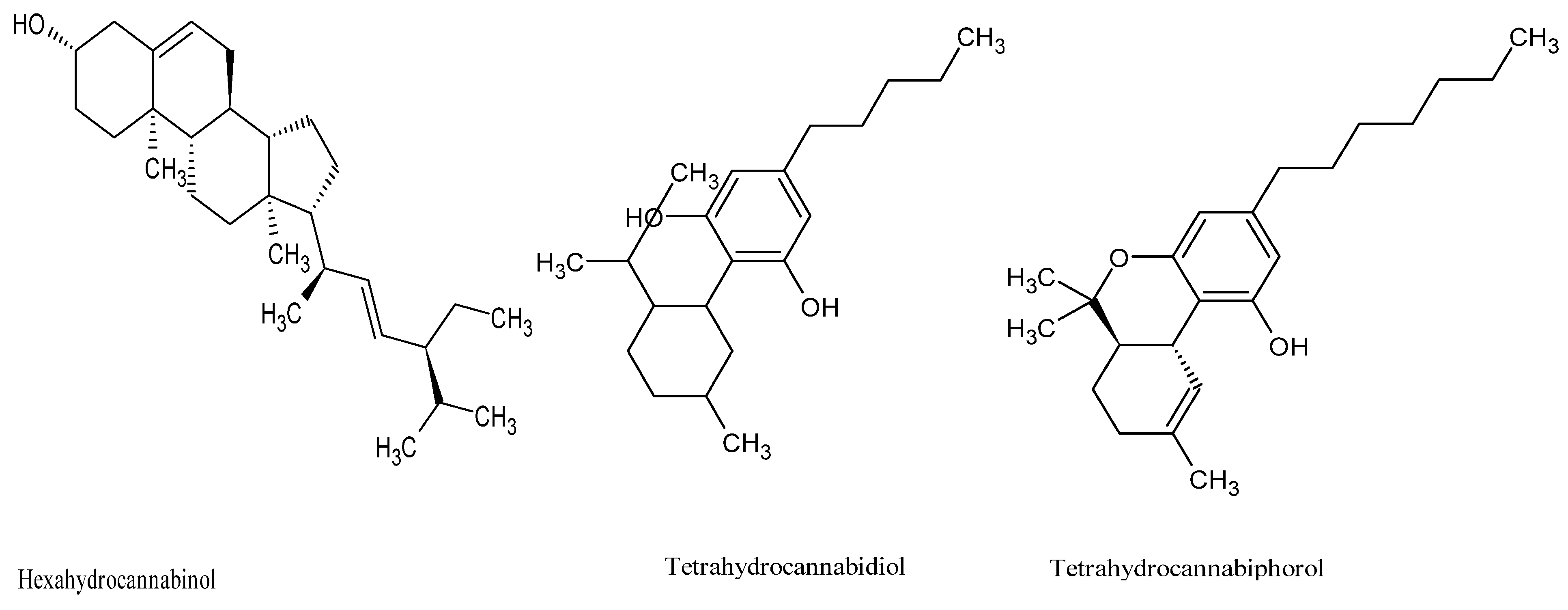


Semi-Synthetic Cannabinoids in Forensic Toxicology and Public Health: Analytical Challenges, Emerging Detection Strategies, and Regulatory Implications



Abstract
1. Introduction
2. Methodology
2.1. Study Design
2.2. Literature Search Strategy
2.3. Study Selection
2.4. Inclusion and Exclusion Criteria
2.4.1. Inclusion Criteria
2.4.2. Exclusion Criteria
2.5. Data Extraction and Thematic Synthesis
- Emergence and market distribution of SSCs.
- Pharmacology, metabolism, and toxicological effects.
- Clinical intoxication and forensic case implications.
- Public health concerns and vulnerable populations.
- Postmortem interpretation challenges.
- Legal and regulatory implications.
- Advanced analytical detection techniques and analytical limitations.
2.6. Quality Appraisal and Limitations
2.7. Ethical Considerations
3. Impact of Semi-Synthetic Cannabinoids on Forensic Toxicology
3.1. Emergence, Prevalence, and Market Complexity
3.2. Analytical Challenges of Detection and Identification
3.3. Metabolic Complexity and Biomarker Identification
3.4. Toxicological and Pharmacological Uncertainty
3.5. Clinical and Forensic Case Implications
3.6. Postmortem Interpretation and Forensic Uncertainty
3.7. Legal and Regulatory Implications
3.8. Implications for Forensic Practice
4. Impact of Semi-Synthetic Cannabinoids on Public Health
4.1. Increasing Availability, Product Diversification, and Exposure Risks
4.2. Acute Toxicity and Clinical Manifestations
4.3. Vulnerable Populations and Exposure Patterns
4.4. Public Health Surveillance and Epidemiological Challenges
4.5. Regulatory and Policy Challenges
4.6. Risk Communication and Clinical Preparedness
5. Advanced Analytical Detection Strategies Used in the Detection of Semi-Synthetic Cannabinoids
5.1. Limitations of Conventional Screening Approaches
5.2. LC–MS/MS as the Core Targeted Analytical Platform
5.3. High-Resolution Mass Spectrometry and Non-Targeted Screening
5.4. Isomer and Epimer Differentiation
5.5. Multi-Platform Analytical Strategies and Method Validation
6. Research Gaps and Limitations
7. Future Perspectives
8. Conclusions
Author Contributions
Funding
Institutional Review Board Statement
Informed Consent Statement
Data Availability Statement
Acknowledgments
Conflicts of Interest
Abbreviations
| Abbreviation | Full Term |
| SSCs | Semi-Synthetic Cannabinoids |
| CBD | Cannabidiol |
| Δ8-THC | Delta-8-Tetrahydrocannabinol |
| Δ9-THC | Delta-9-Tetrahydrocannabinol |
| Δ10-THC | Delta-10-Tetrahydrocannabinol |
| HHC | Hexahydrocannabinol |
| HHCP | Hexahydrocannabiphorol |
| HHC-O | HHC-O-Acetate |
| HHC-P | Hexahydrocannabinol-P |
| HHC-C8 | Hexahydrocannabinol-C8 Analogue |
| HHC-C9 | Hexahydrocannabinol-C9 Analogue |
| H4-CBD | Hexahydrocannabidiol |
| THCP | Tetrahydrocannabiphorol |
| CB1 | Cannabinoid Receptor Type 1 |
| CB2 | Cannabinoid Receptor Type 2 |
| SCRA | Synthetic Cannabinoid Receptor Agonist |
| LC–MS/MS | Liquid Chromatography–Tandem Mass Spectrometry |
| LC-HRMS | Liquid Chromatography–High-Resolution Mass Spectrometry |
| HRMS | High-Resolution Mass Spectrometry |
| GC–MS | Gas Chromatography–Mass Spectrometry |
| UHPLC | Ultra-High-Performance Liquid Chromatography |
| UHPLC-QTOF-MS | Ultra-High-Performance Liquid Chromatography–Quadrupole Time-of-Flight Mass Spectrometry |
| QTOF | Quadrupole Time-of-Flight |
| LC-QTOF-MS | Liquid Chromatography–Quadrupole Time-of-Flight Mass Spectrometry |
| Orbitrap | Orbitrap High-Resolution Mass Spectrometer |
| MRM | Multiple Reaction Monitoring |
| LC | Liquid Chromatography |
| GC | Gas Chromatography |
| MS | Mass Spectrometry |
| Phase I | Phase I Metabolism |
| Phase II | Phase II Metabolism |
| QDF | Qualitative Data Framework |
References
- Jørgensen, C.F.; Rasmussen, B.S.; Linnet, K.; Thomsen, R. Emergence of semi-synthetic cannabinoids in cannabis products seized in Eastern Denmark over a 6-year period. J. Forensic Sci. 2024, 69, 2009–2017. [Google Scholar] [CrossRef] [PubMed]
- Götz, M.R.; Collado, J.A.; Fernández-Ruiz, J.; Fiebich, B.L.; García-Toscano, L.; Gómez-Cañas, M.; Koch, O.; Leha, A.; Muñoz, E.; Navarrete, C.; et al. Structure-effect relationships of novel semi-synthetic cannabinoid derivatives. Front. Pharmacol. 2019, 10, 1284. [Google Scholar] [CrossRef] [PubMed]
- Christie, R.; Conlon, R.; Néfau, T.; Gallegos, A. Semi-synthetic cannabinoids: Recent developments, analytical challenges and strategic responses. Forensic Sci. Int. 2026, 381, 112823. [Google Scholar] [CrossRef] [PubMed]
- Manier, S.K.; Valdiviezo, J.A.; Vollmer, A.C.; Eckstein, N.; Meyer, M.R. Analytical toxicology of the semi-synthetic cannabinoid hexahydrocannabinol studied in human samples, pooled human liver S9 fraction, rat samples and drug products using HPLC-HRMS-MS. J. Anal. Toxicol. 2023, 47, 818–825. [Google Scholar] [CrossRef] [PubMed]
- Persson, M.; Kronstrand, R.; Evans-Brown, M.; Gréen, H. In vitro activation of the CB1 receptor by the semi-synthetic cannabinoids hexahydrocannabinol (HHC), hexahydrocannabinol acetate (HHC-O) and hexahydrocannabiphorol (HHC-P). Drug Test. Anal. 2025, 17, 487–493. [Google Scholar] [CrossRef] [PubMed]
- Meehan-Atrash, J.; Rahman, I. Cannabis vaping: Existing and emerging modalities, chemistry, and pulmonary toxicology. Chem. Res. Toxicol. 2021, 34, 2169–2179. [Google Scholar] [CrossRef] [PubMed]
- Hundertmark, M.; Besch, L.; Röhrich, J.; Germerott, T.; Wunder, C. Characterising a new cannabis trend: Extensive analysis of semi-synthetic cannabinoid-containing seizures from Germany. Drug Test. Anal. 2025, 17, 1803–1816. [Google Scholar] [CrossRef] [PubMed]
- Geci, M.; Scialdone, M.; Tishler, J. The dark side of cannabidiol: The unanticipated social and clinical implications of synthetic Δ8-THC. Cannabis Cannabinoid Res. 2023, 8, 357–364. [Google Scholar] [CrossRef] [PubMed]
- Outhous, A.E.; Holt, A.K.; Poklis, J.L.; Peace, M.R. Evaluation of cannabis product mislabeling: The development of a unified cannabinoid LC-MS/MS method to analyze e-liquids and edible products. Talanta Open 2024, 10, 100349. [Google Scholar] [CrossRef]
- Zhang, S.; Alam, M.M.; Chandler, B.D.; Lanorio, J.P.; Deskins, C.; Song, L. Potency analysis of semi-synthetic cannabinoids in vaping oils using liquid chromatography diode array detector with electrospray ionization time-of-flight mass spectrometry for confirmation of analyte identity. Molecules 2025, 30, 2597. [Google Scholar] [CrossRef] [PubMed]
- Wrzesień-Tokarczyk, W.; Masier, K.; Byrska, B.; Stanaszek, R.; Sekuła, K. Semi-synthetic cannabinoids detected in cannabis-derived products in Poland: Statistical overview, analytical challenges, and legal interpretative considerations. Drug Test. Anal. 2025, 18, 287–302. [Google Scholar] [CrossRef] [PubMed]
- Nasrallah, D.J.; Garg, N.K. Studies pertaining to the emerging cannabinoid hexahydrocannabinol (HHC). ACS Chem. Biol. 2023, 18, 2023–2029. [Google Scholar] [CrossRef] [PubMed]
- Ballotari, M.; Truver, M.T.; Sojin, N.A.; Parimoo, R.; Agliano, L.A.; Hoyer, J.L.; Goodin, A.J.; Varma, D.S.; Chronister, C.W.; Roussos-Ross, K.; et al. Analysis of cannabinoids and semi-synthetic cannabinoids in authentic breastmilk samples by liquid chromatography-tandem mass spectrometry. J. Anal. Toxicol. 2025, 49, 559–566. [Google Scholar] [CrossRef] [PubMed]
- Gameli, P.S.; Taoussi, O.; Trana, A.D.; Tronconi, L.P.; Pichini, S.; Carlier, J.; Huestis, M.A.; Busardò, F.P. Human diagnostic markers for intake of semi-synthetic cannabinoids (9R)- and (9S)-hexahydrocannabinol. Clin. Chim. Acta 2026, 578, 120480. [Google Scholar] [CrossRef] [PubMed]
- Reiter, N.; Linnet, K.; Andersen, N.O.; Rasmussen, B.S.; Nielsen, M.K.; Eriksen, K.R.; Palmqvist, D.F. Severe poisoning with semi-synthetic cannabinoids. Ugeskr. Laeger 2024, 186, V04240241. [Google Scholar] [CrossRef] [PubMed]
- Reiter, N.; Palmqvist, D.F.; Larsen, G.B.; Høi, M.E.; Rasmussen, B.S.; Thomsen, R. Long-lasting cognitive and physical impairment after recreational use of the semisynthetic cannabinoid hexahydrocannabinonyl (HHC-C9): A case report. Reports 2025, 8, 176. [Google Scholar] [CrossRef] [PubMed]
- Thomsen, R.; Axelsen, T.M.; Løkken, N.; Krogh, L.M.G.; Reiter, N.; Rasmussen, B.S.; Laursen, E.L. Prolonged sedation and unconsciousness after intoxication with the novel semisynthetic cannabinoid hexahydrocannabioctyl (HHC-C8): Two case descriptions. Toxicol. Rep. 2025, 14, 101912. [Google Scholar] [CrossRef] [PubMed]
- Radwan, M.M.; Wanas, A.S.; Chandra, S.; ElSohly, M.A. Isolation and characterization of impurities in commercially marketed Δ8-THC products. J. Nat. Prod. 2023, 86, 822–829. [Google Scholar] [CrossRef] [PubMed]
- Huang, S.; van Beek, T.A.; Claassen, F.W.; Janssen, H.G.; Ma, M.; Chen, B.; Zuilhof, H.; Salentijn, G.I.J. Comprehensive cannabinoid profiling of acid-treated CBD samples and Δ8-THC-infused edibles. Food Chem. 2024, 440, 138187. [Google Scholar] [CrossRef] [PubMed]
- Watanabe, S.; Murakami, T.; Muratsu, S.; Saito, T.; Seto, Y. In vitro metabolic profiling of 18 semi-synthetic cannabinoids—Hexahydrocannabinol (HHC) and its analogs—With identification in an authentic hexahydrocannabiphorol (HHCP) urine sample. Clin. Chem. 2025, 71, 1158–1168, Erratum in Clin. Chem. 2025, 71, 1180. https://doi.org/10.1093/clinchem/hvaf112. [Google Scholar] [CrossRef] [PubMed]
- Lindbom, K.; Norman, C.; Baginski, S.; Krebs, L.; Stalberga, D.; Rautio, T.; Wu, X.; Kronstrand, R.; Gréen, H. Human metabolism of the semi-synthetic cannabinoids hexahydrocannabinol, hexahydrocannabiphorol and their acetates using hepatocytes and urine samples. Drug Test. Anal. 2025, 17, 372–386. [Google Scholar] [CrossRef] [PubMed]
- Schirmer, W.; Auwärter, V.; Kaudewitz, J.; Schürch, S.; Weinmann, W. Identification of human hexahydrocannabinol metabolites in urine. Drug Test. Anal. 2023, 29, 1–10. [Google Scholar] [CrossRef] [PubMed]
- Pettersson-Pablo, P.; Oxelbark, J. LC-MS/MS analysis of 11-nor-9-carboxy-hexahydrocannabinol (HHC-COOH) and 11-hydroxy-hexahydrocannabinol (HHC-OH) for verification of hexahydrocannabinol intake. Scand. J. Clin. Lab. Investig. 2024, 84, 109–114. [Google Scholar] [CrossRef] [PubMed]
- Kronstrand, R.; Roman, M.; Green, H.; Truver, M.T. Quantitation of hexahydrocannabinol (HHC) and metabolites in blood from DUID cases. J. Anal. Toxicol. 2024, 48, 235–241. [Google Scholar] [CrossRef] [PubMed]
- Christinat, N.; Savoy, M.; Mottier, P. Development, validation and application of a LC-MS/MS method for quantification of 15 cannabinoids in food. Food Chem. 2020, 318, 126469. [Google Scholar] [CrossRef] [PubMed]
- Al-Matrouk, A.; Aldasem, A.; Haidar, M.; Mousawi, F. Quality assurance and quality control in forensic science: From evidence collection to laboratory analysis. In Investigative and Predictive DNA Testing; Academic Press: Cambridge, MA, USA, 2026; pp. 391–406. [Google Scholar] [CrossRef]
- Aldasem, A.F.; Hassan, S.A. Development and validation of an LC–MS/MS method for monitoring semi-synthetic cannabinoids in UK consumer products: An evidence-based analytical, regulatory, and pharmacovigilance framework. Microchem. J. 2026, 227, 118591. [Google Scholar] [CrossRef]


| Research Domain | Research Focus | Major Findings | Key References | Summary of Evidence |
|---|---|---|---|---|
| Postmortem and Forensic Toxicology | Metabolic profiling and biomarker identification | SSCs undergo extensive Phase I and II metabolism, producing hydroxylated, oxidized, and glucuronidated metabolites | [4,14,20,21,22,23] | Parent SSCs are frequently absent in urine; metabolite-focused detection is necessary for reliable interpretation |
| Epimer and stereoisomer differentiation | Distinct metabolic and pharmacological profiles exist between 9(R)- and 9(S)-HHC epimers | [5,14,23] | Enantiomer-specific analysis is critical for accurate forensic interpretation and toxicological attribution | |
| Postmortem uncertainty and toxicological interpretation | Lack of established toxic or lethal concentration ranges complicates causality assessment | [3,4,11,24] | Overlapping metabolites with Δ9-THC increase forensic uncertainty, especially in polydrug cases | |
| Severe intoxication and clinical case reports | SSCs associated with prolonged sedation, neurological impairment, unconsciousness, and cognitive dysfunction | [15,16,17] | Routine toxicology screens often fail to detect SSC exposure without advanced LC–MS/MS or HRMS approaches | |
| Product mislabeling and adulteration | Commercial products frequently contain undeclared SSCs, impurities, or inaccurate potency labelling | [1,9,18,19] | Mislabeling increases exposure risk and complicates forensic attribution | |
| Pharmacology and Public Health | CB1 receptor activation and potency variation | SSCs act as partial CB1 agonists with variable potency depending on structural modification | [2,5,12] | Acetylated and hydrogenated analogues may exhibit altered pharmacodynamic properties |
| Regulatory and legal challenges | Many SSCs remain outside conventional drug scheduling systems | [1,3,8,11] | Rapid structural modifications create regulatory loopholes and legal ambiguity | |
| Youth exposure and vaping-associated risks | SSC-containing vaping products are increasingly marketed as “legal” cannabis alternatives | [6,8,9,10] | Youth exposure and accidental overconsumption are emerging public health concerns | |
| Neonatal and vulnerable population exposure | Cannabinoids and SSCs detected in authentic breastmilk samples | [13] | Highlights risks for neonates and the need for targeted public health guidance | |
| Public health surveillance and early warning systems | Seizure analyses and forensic monitoring reveal rapid SSC market expansion | [1,3,7] | Coordinated surveillance systems are required for the timely identification of emerging analogues | |
| Advanced Analytical Methodologies | Targeted LC–MS/MS validation | Highly sensitive and validated for biological and commercial matrices | [9,13,23,24,25] | Considered the core analytical platform for routine SSC toxicology |
| HRMS/QTOF/Orbitrap methodologies | Enables untargeted detection and structural characterization of novel SSCs | [4,7,10,20,21] | Essential for emerging analogue identification and metabolomics workflows | |
| Chiral chromatography and epimer differentiation | Chiral separation improves the discrimination of stereoisomers and metabolites | [14,23] | Increasingly important for HHC-related forensic investigations | |
| GC–MS confirmatory applications | Useful for seized material characterization but limited by thermal instability | [7,11,17] | Often used as a supplementary analytical approach | |
| Multi-platform and harmonized workflows | Combined targeted and untargeted strategies improve forensic reliability | [3,7] | Integrated analytical frameworks support standardized toxicological interpretation |
| Technique | Major Strengths | Main Limitations | Major Applications in SSC Analysis | Representative References |
|---|---|---|---|---|
| LC–MS/MS | High sensitivity and specificity; excellent quantitative performance; suitable for thermolabile compounds; validated across multiple biological matrices | Limited differentiation of structural isomers and epimers without advanced chromatographic separation | Routine targeted detection and quantification of SSCs and metabolites in blood, urine, breastmilk, vaping liquids, and edible products | [4,9,13,23,24,25] |
| LC–HRMS/MS (Orbitrap/QTOF) | Accurate mass determination; non-targeted screening capability; metabolite discovery; structural elucidation | Expensive instrumentation; complex spectral interpretation; limited stereochemical discrimination | Identification of novel SSCs, metabolite profiling, untargeted toxicological screening, seizure analysis | [3,4,7,10,20,21] |
| UHPLC–QTOF-MS | High chromatographic resolution; rapid analysis; effective metabolomics workflow | Requires advanced expertise and spectral libraries; data processing complexity | Biomarker discovery, urine metabolite characterization, and forensic screening | [14,20,21] |
| GC–MS | Widely available; robust spectral databases; effective confirmatory technique | Thermal degradation of SSCs; derivatization often required; poor suitability for thermolabile compounds | Preliminary screening and confirmatory analysis of seized materials and commercial products | [7,11,17] |
| Chiral LC and Epimer-Specific Chromatography | Differentiates stereoisomers and enantiomers; improves interpretation accuracy | Limited availability of validated protocols and reference standards | Resolution of 9(R)- and 9(S)-HHC epimers; forensic interpretation of enantiomer-specific metabolism | [5,14,23] |
| Metabolomics-Based Approaches | Detects exposure through metabolite patterns even when parent compounds are absent | Requires HRMS infrastructure and advanced bioinformatics | Biomarker discovery and retrospective exposure assessment | [20,21,22] |
| Multi-Platform Analytical Strategies | Combines the strengths of targeted and untargeted approaches; improves reliability | Increased cost and analytical complexity | Comprehensive forensic workflows integrating LC–MS/MS, HRMS, and GC–MS | [3,7,17] |
Disclaimer/Publisher’s Note: The statements, opinions and data contained in all publications are solely those of the individual author(s) and contributor(s) and not of MDPI and/or the editor(s). MDPI and/or the editor(s) disclaim responsibility for any injury to people or property resulting from any ideas, methods, instructions or products referred to in the content. |
© 2026 by the authors. Licensee MDPI, Basel, Switzerland. This article is an open access article distributed under the terms and conditions of the Creative Commons Attribution (CC BY) license.
Share and Cite
Aldasem, A.F.; Ugariogu, S.N.; Al-Matrouk, A.; Al-Tannak, N.F. Semi-Synthetic Cannabinoids in Forensic Toxicology and Public Health: Analytical Challenges, Emerging Detection Strategies, and Regulatory Implications. Pharmaceuticals 2026, 19, 1022. https://doi.org/10.3390/ph19071022
Aldasem AF, Ugariogu SN, Al-Matrouk A, Al-Tannak NF. Semi-Synthetic Cannabinoids in Forensic Toxicology and Public Health: Analytical Challenges, Emerging Detection Strategies, and Regulatory Implications. Pharmaceuticals. 2026; 19(7):1022. https://doi.org/10.3390/ph19071022
Chicago/Turabian StyleAldasem, Abdullah F., Sylvester N. Ugariogu, Abdullah Al-Matrouk, and Naser F. Al-Tannak. 2026. "Semi-Synthetic Cannabinoids in Forensic Toxicology and Public Health: Analytical Challenges, Emerging Detection Strategies, and Regulatory Implications" Pharmaceuticals 19, no. 7: 1022. https://doi.org/10.3390/ph19071022
APA StyleAldasem, A. F., Ugariogu, S. N., Al-Matrouk, A., & Al-Tannak, N. F. (2026). Semi-Synthetic Cannabinoids in Forensic Toxicology and Public Health: Analytical Challenges, Emerging Detection Strategies, and Regulatory Implications. Pharmaceuticals, 19(7), 1022. https://doi.org/10.3390/ph19071022