Pharmacological Exploration of Traditional Chinese Medicine and Tujia Ethnomedicine in Rheumatoid Arthritis Therapy: From Historical Clinical Wisdom to Contemporary Scientific Inquiry
 , and
, and
Abstract
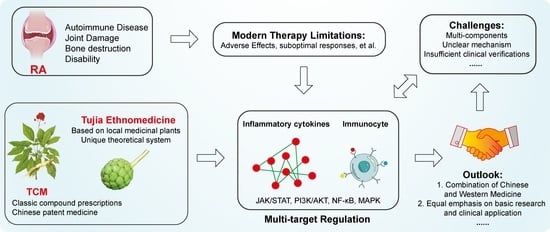
1. Introduction
2. Understanding of RA in Traditional and Modern Medical Systems
2.1. The Interpretation of RA Based on Bi Syndrome in TCM
2.2. Tujia Ethnomedical Understanding and Therapeutic Principles for RA
2.3. The Pathogenesis of RA in Modern Medicine System
3. TCM Phytomedicines and Herbal Therapies for RA
3.1. Classic Formulas for Treating RA
3.2. Chinese Patent Medicines for RA Treatment
3.3. Safety Considerations for TCM Therapies in RA Treatment

| No. | Drugs | Composition | Traditional Use | Evidence Type | Pharmacological Effect | Signal Pathway | Reference |
|---|---|---|---|---|---|---|---|
| 1 | Kunxian Capsule (昆仙胶囊) | Kunming Shanhaitang (昆明山海棠), Yingyanghuo (淫羊藿), Gouqizi (枸杞子), Tusizi (菟丝子) | Tonifying the kidney and dredging collaterals; Dispelling wind and eliminating dampness | CIA rats; Clinical observation | IL-8, γIP-10 ↓ | - | [50,51,52] |
| 2 | Tripterygium Glycosides Tablet (雷公藤多苷片) | Tripterygium Glycosides (雷公藤多苷) | Dispel wind and detoxify; Eliminate dampness and reduce swelling; Relax muscles and unblock collaterals | CIA rats; meta-analysis (40 RCTs) | TNF-α, IL-6, VEGF, TGF-β1, IL-1β ↓ | NF-κB; MAPK | [54,55] |
| 3 | Simiao Tablet (四妙片) | Huangbai (黄柏), Cangzhu (苍术), Niuxi (牛膝), Yiyiren (薏苡仁) | Clear heat and drain dampness; Free the sinews and relieve bi syndrome | CIA mice; AA rats; Clinical observation | TNF-α, IL-6, IL-1β↓ | JAK2/STAT3; TGF-β/SMAD2/3 | [58,59,60] |
| 4 | Zhengqing Fengtongning Tablet (Sustained Release Tablet) (正清风痛宁片/缓释片) | Sinomenine (青藤碱) | Dispel wind and eliminate dampness; Activate blood and dredge collaterals; Promote diuresis and reduce swelling | CIA rats meta-analysis appraisal | RANKL, MMPs ↓ | - | [66,67] |
| 5 | Biqi Capsule (痹祺胶囊) | Maqianzi (马钱子), Dilong (地龙), Dangsheng (党参), Fuling (茯苓), Gancao (甘草), Chuanxiong (川芎), Danshen (丹参), Sanqi (三七), Niuxi (牛膝) | Invigorate qi and nourish blood; Dispel wind and eliminate dampness; Activate blood circulation and relieve pain | MH7A cells; CIA rats; Clinical observation | IL-18, TNF-α, IL-6, IL-1β ↓ | JAK/STAT | [68,69,70,71] |
| 6 | Yishen Juanbi Pill (益肾蠲痹丸) | Gusuibu (骨碎补), Dihuang (地黄), Danggui (当归), Xuchangqing (徐长卿), Tubiechong (土鳖虫), Wugong (蜈蚣), Quanxie (全蝎), Fengfang (蜂房), Dilong (地龙), Wushaoshe (乌梢蛇), Yanhusuo (延胡索), Luxiancao (鹿衔草), Yingyanghuo (淫羊藿), Xungufeng (寻骨风), Laohecao (老鹳草), Jixueteng (鸡血藤), Lvcao (律草), Huzhang (虎杖) | Warm and tonify kidney Yang; Benefit kidney and strengthen governor vessel; Search for and expel wind pathogens; Relieve Bi syndrome and dredge collaterals. | Osteoclast and Treg cells; CIA rats; Clinical observation | IL-10 ↓ | JAK/STAT | [72,73,74] |
| 7 | Wangbi Tablet (Capsule) (尪痹片/胶囊) | Dihuang (地黄), Xuduan (续断), Fuzi (附子), Yingyanghuo (淫羊藿), Weilingxian (威灵仙), Zaoci (皂刺), Yangu (羊骨), Zhimu (知母), Shenjincao (伸筋草), Honghua (红花), Duhuo (独活), Baishao (白芍), Gusuibu (骨碎补), Guizhi (桂枝), Fangfeng (防风), Goujizi (枸杞子) | Nourish the liver and kidney; Strengthen the muscles and bones; Dispel wind and dampness; Dredge the meridians and collaterals | CIA rats; multicenter double-blind RCT | TNF-α, IL-6, IL-17A, IL-1α, IL-1β, IL-2, IL-12P70, IFN-γ, G-CSF ↓ | cGAS-STING; Wnt/β-catenin | [75,76,77] |
| 8 | Yuxuebi Tablet (Capsule, Granule) (瘀血痹片/胶囊/颗粒) | Ruxiang (乳香), Weilingxian (威灵仙), Honghua (红花), Danshen (丹参), Moyao (没药), Chuanniuxi (川牛膝), Chuanxiong (川芎), Danggui (当归), Jianghuang (姜黄), Xiangfu (香附), Huangqi (黄芪) | Promote blood circulation to remove blood stasis; Dredge collaterals to relieve pain | RA-FLS cells CIA rats; Clinical observation | IL-1β, IL-8, Ras, Raf-1 ↓ | Ras/Raf-1/NF-κB; SUCNR1/HIF-1α/TRPV1axis | [78,79,80] |
| 9 | Panlongqi Tablet (盘龙七片) | Wujiapi (五加皮), Panlongqi (盘龙七), Duzhong (杜仲), Zhuangjindan (壮筋丹), Zhuzishen (珠子参), Qingwaqi (青蛙七), Guoshanlong (过山龙), Qinjiao (秦艽), Muxiang (木香), Zusima (祖司麻), Luoshiteng (络石藤), Chuanwu (川乌), Baimaoqi (白毛七), Tiebangchui (铁棒锤), Caowu (草乌), Laoshuqi (老鼠七), Zhizhuliao (支柱蓼), Honghua (红花), Moyao (没药), Zhugenqi (竹根七), Xiecao (缬草), Shenjincao (伸筋草), Niuxi (牛膝), Danshen (丹参), Yangjiaoqi (羊角七), Balima (八里麻), Chonglou (重楼), Ruxiang (乳香), Danggui (当归) | Promote blood circulation to remove blood stasis; Dispel wind and eliminate dampness; Reduce swelling and relieve pain | CIA rats; AA mice; HFLS cells; Clinical observation | TNF-α, IL-6, MDA↓ IL-10, SOD ↑ | Keap1/Nrf2/HO-1; PI3K/Akt; MAPK; JAK/STAT | [81,82,83] |
| 10 | Shirebi Tablet (Capsule, Granule) (湿热痹片/胶囊/颗粒) | Cangzhu (苍术), Rendongteng (忍冬藤), Dilong (地龙), Lianqiao (连翘), Huangbo (黄柏), Yiyiren (薏苡仁), Fangfeng (防风), Chuanniuxi (川牛膝), Fenbixie (粉萆薢), Sangzhi (桑枝), Fangji (防己), Weilingxian (威灵仙) | Dispel wind and eliminate dampness; Clear heat and reduce swelling; Dredge collaterals and relieve pain | AIA rats | TNF-α, IL-6, VEGF ↓ IL-10, SOD ↑ | - | [84] |
| 11 | Xinhuang Tablet (新癀片) | Zhongjiefeng (肿节风), Sanqi (三七), Niuhuang (牛黄), Zhudanfen (猪胆粉), Xiaofantianhua (肖梵天花), Zhenzhu (珍珠), Shuiniujiao Nongsuofen (水牛角浓缩粉), Hongqu (红曲), Indometacin (吲哚美辛) | Clear heat and detoxify; Promote blood circulation to remove blood stasis; Reduce swelling and relieve pain | Inflammation Model of mice and rats; Clinical observation | IL-1α, IL-1β, HIS ↓; IL-10 ↑ | NF-κB | [85,86] |
4. Tujia Ethnomedicinal Plants and Remedies for RA
5. Special Therapeutic Approaches for RA in TCM and Tujia Ethnomedicine
6. Conclusions and Future Perspectives
Supplementary Materials
Author Contributions
Funding
Institutional Review Board Statement
Informed Consent Statement
Data Availability Statement
Conflicts of Interest
References
- Radu, A.F.; Bungau, S.G. Management of rheumatoid arthritis: An overview. Cells 2021, 10, 2857. [Google Scholar] [CrossRef]
- Otón, T.; Carmona, L. The epidemiology of established rheumatoid arthritis. Best Pract. Res. Clin. Rheumatol. 2019, 33, 101477. [Google Scholar] [CrossRef]
- Van der Woude, D.; Van der Helm-van Mil, A.H.M. Update on the epidemiology, risk factors, and disease outcomes of rheumatoid arthritis. Best Pract. Res. Clin. Rheumatol. 2018, 32, 174–187. [Google Scholar] [CrossRef] [PubMed]
- Smolen, J.S.; Aletaha, D. Rheumatoid arthritis therapy reappraisal: Strategies, opportunities and challenges. Nat. Rev. Rheumatol. 2015, 11, 276–289. [Google Scholar] [CrossRef] [PubMed]
- Roodenrijs, N.M.T.; Van der Goes, M.C.; Welsing, P.M.J.W.; Tekstra, J.; Lafeber, F.P.J.G.; Jacobs, J.W.G.; Van Laar, J.M. Difficult-to-treat rheumatoid arthritis: Contributing factors and burden of disease. Rheumatology 2020, 60, 3778–3788. [Google Scholar] [CrossRef]
- Jurgens, M.S.; Jacobs, J.W.G.; Bijlsma, J.W.J. The use of conventional disease-modifying anti-rheumatic drugs in established RA. Best Pract. Res. Clin. Rheumatol. 2011, 25, 523–533. [Google Scholar] [CrossRef] [PubMed]
- Wang, X.; Kong, Y.Q.; Li, Z.G. Advantages of Chinese herbal medicine in treating rheumatoid arthritis: A focus on its anti-inflammatory and anti-oxidative effects. Front. Med. 2024, 11, 1371461. [Google Scholar] [CrossRef]
- Wang, S.; Zhang, J.; Liu, W.; Zhang, L.; Li, R.; Wang, Y.; Li, S.; Li, L.; Li, J.; Zhou, M.; et al. Signal pathways in the treatment of rheumatoid arthritis with traditional Chinese medicine. J. Ethnopharmacol. 2025, 353, 120387. [Google Scholar] [CrossRef]
- Zhang, Y.Q.; Mao, X.; Li, W.J.; Chen, W.J.; Wang, X.Y.; Ma, Z.C.; Lin, N. Tripterygium wilfordii: An inspiring resource for rheumatoid arthritis treatment. Med. Res. Rev. 2021, 41, 1337–1374. [Google Scholar] [CrossRef]
- Tang, Y.J.; Liu, Q.P.; Feng, Y.X.; Zhang, Y.; Xu, Z.H.; Wen, C.P.; Zhang, Y. Tripterygium Ingredients for Pathogenicity Cells in Rheumatoid Arthritis. Front. Pharmacol. 2020, 11, 583171. [Google Scholar] [CrossRef]
- Shen, F.Y.; Liu, Y.; Su, W.; Huang, J.J.; Peng, C.Y.; Li, B.; Wang, W. Research on the Tujia ethnomedicine “seven” drugs. J. Hunan Univ. Chin. Med. 2015, 35, 1–6. (In Chinese) [Google Scholar]
- Long, F.X.; Tang, D.X. Discussion on the theory of disease caused by poison gas and the three-element theory of Tujia medicine. J. Jiangxi Univ. Tradit. Chin. Med. 2012, 24, 1–3. (In Chinese) [Google Scholar]
- Dashtdar, M.; Dashtdar, M.R.; Dashtdar, B.; Kardi, K.; Shirazi, M.K. The concept of wind in traditional Chinese medicine. J. Pharmacopunct. 2016, 19, 293–302. [Google Scholar] [CrossRef]
- Lü, S.W.; Wang, Q.S.; Li, G.Y.; Sun, S.; Guo, Y.Y.; Kuang, H.X. The treatment of rheumatoid arthritis using Chinese medicinal plants: From pharmacology to potential molecular mechanisms. J. Ethnopharmacol. 2015, 176, 177–206. [Google Scholar] [CrossRef]
- Liu, W.X.; Jiang, Q. Research progress on damp heat syndrome of rheumatoid arthritis. Zhonghua Zhongyi Yao Zazhi 2023, 38, 251–256. (In Chinese) [Google Scholar]
- Wang, Z.Z.; Fang, Y.F.; Wang, Y.; Mu, F.X.; Chen, J.; Zou, Q.H.; Zhong, B.; Li, J.Y.; Bo, G.P.; Zhang, R.H. Logistic regression analysis of damp-heat and cold-damp impeding syndrome of rheumatoid arthritis: A perspective in Chinese medicine. Chin. J. Integr. Med. 2012, 18, 575–581. [Google Scholar] [CrossRef] [PubMed]
- Hu, M.Z.; Su, S.Y.; Xue, C.X.; Zhang, L.; Zhang, S.G.; Yu, H. Studies on medication laws towards rheumatoid arthritis based on analysis and comparison of medicine literatures. World Sci. Technol.Mod. Tradit. Chin. Med. 2018, 20, 608–613. (In Chinese) [Google Scholar]
- Ma, Q.; Jiang, J.G. The functional components from nature-derived drugs for the treatment of rheumatoid arthritis. Curr. Drug Targets 2016, 17, 1673–1686. [Google Scholar] [CrossRef]
- Wang, J.; Zhu, F.Y.; Huang, W.; Chen, Z.Y.; Zhao, P.; Lei, Y.T.; Liu, Y.M.; Liu, X.J.; Sun, B.; Li, H.L. Therapeutic effect and mechanism of acupuncture in autoimmune diseases. Am. J. Chin. Med. 2022, 50, 639–652. [Google Scholar] [CrossRef]
- Chen, L.Q.; Zhang, J.H. Basic characteristics, research status, and development ideas of Tujia medicine. J. Hubei Minzu Univ. (Nat. Sci. Ed.) 2007, 24, 1–3. (In Chinese) [Google Scholar]
- Nan, Y.Y.; Lin, H.J.; Hao, R.X.; Yuan, L. An overview of Tujia medicine in the treatment of rheumatoid arthritis. Chin. J. Naturop. 2019, 27, 5–7. (In Chinese) [Google Scholar]
- Guo, Q.; Wang, Y.X.; Xu, D.; Nossent, J.; Pavlos, N.J.; Xu, J.K. Rheumatoid arthritis: Pathological mechanisms and modern pharmacologic therapies. Bone Res. 2018, 6, 15. [Google Scholar] [CrossRef]
- McInnes, I.B.; Schett, G. The pathogenesis of rheumatoid arthritis. N. Engl. J. Med. 2011, 365, 2205–2219. [Google Scholar] [CrossRef]
- Deane, K.D.; Holers, V.M. Rheumatoid arthritis pathogenesis, prediction, and prevention: An emerging paradigm shift. Arthritis Rheumatol. 2021, 73, 181–193. [Google Scholar] [CrossRef] [PubMed]
- Mueller, A.L.; Payandeh, Z.; Mohammadkhani, N.; Mubarak, S.M.H.; Zakeri, A.; Alagheband Bahrami, A.; Brockmueller, A.; Shakibaei, M. Recent advances in understanding the pathogenesis of rheumatoid arthritis: New treatment strategies. Cells 2021, 10, 3017. [Google Scholar] [CrossRef] [PubMed]
- Lin, Y.J.; Anzaghe, M.; Schülke, S. Update on the Pathomechanism, Diagnosis, and Treatment Options for Rheumatoid Arthritis. Cells 2020, 9, 880. [Google Scholar] [CrossRef]
- Mateen, S.; Zafar, A.; Moin, S.; Khan, A.Q.; Zubair, S. Understanding the role of cytokines in the pathogenesis of rheumatoid arthritis. Clin. Chim. Acta 2016, 455, 161–171. [Google Scholar] [CrossRef]
- Ding, Q.; Hu, W.; Wang, R.; Yang, Q.Y.; Zhu, M.L.; Li, M.; Cai, J.H.; Rose, P.; Mao, J.C.; Zhu, Y.Z. Signaling pathways in rheumatoid arthritis: Implications for targeted therapy. Signal Transduct. Target. Ther. 2023, 8, 68. [Google Scholar] [CrossRef]
- Liu, S.; Ma, H.X.; Zhang, H.X.; Deng, C.J.; Xin, P. Recent advances on signaling pathways and their inhibitors in rheumatoid arthritis. Clin. Immunol. 2021, 230, 108793. [Google Scholar] [CrossRef] [PubMed]
- Hu, L.; Liu, R.J.; Zhang, L.L. Advance in bone destruction participated by JAK/STAT in rheumatoid arthritis and therapeutic effect of JAK/STAT inhibitors. Int. Immunopharmacol. 2022, 111, 109095. [Google Scholar] [CrossRef]
- Prajapati, P.; Doshi, G. An update on the emerging role of Wnt/β-catenin, SYK, PI3K/AKT, and GM-CSF signaling pathways in rheumatoid arthritis. Curr. Drug Targets 2023, 24, 1298–1316. [Google Scholar] [CrossRef]
- Li, J.; Tang, R.S.; Shi, Z.; Li, J.Q. Nuclear factor-κB in rheumatoid arthritis. Int. J. Rheum. Dis. 2020, 23, 1627–1635. [Google Scholar] [CrossRef]
- Zheng, Y.X.; Wei, K.; Jiang, P.; Zhao, J.N.; Shan, Y.; Shi, Y.M.; Zhao, F.Y.; Chang, C.; Li, Y.S.; Zhou, M.; et al. Macrophage polarization in rheumatoid arthritis: Signaling pathways, metabolic reprogramming, and crosstalk with synovial fibroblasts. Front. Immunol. 2024, 15, 1394108. [Google Scholar] [CrossRef]
- Ralph, J.A.; Morand, E.F. MAPK phosphatases as novel targets for rheumatoid arthritis. Expert Opin. Ther. Targets 2008, 12, 795–808. [Google Scholar] [CrossRef]
- Xin, P.; Xu, X.Y.; Zhang, H.X.; Hu, Y.Z.; Deng, C.J.; Sun, S.Q.; Liu, S.; Zhou, X.G.; Ma, H.X.; Li, X.L. Mechanism investigation of Duhuo Jisheng pill against rheumatoid arthritis based on a strategy for the integration of network pharmacology, molecular docking and in vivo experimental verification. Pharm. Biol. 2023, 61, 1431–1445. [Google Scholar] [CrossRef]
- Qu, P.D.; Wang, H.Y.; Wang, W.; Du, S.Y.; Peng, Z.R.; Hu, Q.; Tang, X.H. Efficacy and safety of Duhuo-Jisheng decoction in rheumatoid arthritis: A systematic review and meta-analysis of 42 randomized controlled trials. Medicine 2023, 102, 35513. [Google Scholar] [CrossRef] [PubMed]
- Xie, Y.; Mai, C.T.; Zheng, D.C.; He, Y.F.; Feng, S.L.; Li, Y.Z.; Liu, C.X.; Zhou, H.; Liu, L. Wutou decoction ameliorates experimental rheumatoid arthritis via regulating NF-kB and Nrf2: Integrating efficacy-oriented compatibility of traditional Chinese medicine. Phytomedicine 2021, 85, 153522. [Google Scholar] [CrossRef]
- Shen, P.; Lin, W.J.; Huang, Y.; Ba, X.; Han, L.; Li, T.T.; Qin, K.; Chen, Z.; Tu, S.H. Wutou decoction attenuates rheumatoid arthritis in rats through SIRT1-mediated deacetylation of the HMGB1/NF-κB pathway. J. Ethnopharmacol. 2025, 337, 118921. [Google Scholar] [CrossRef] [PubMed]
- Han, L.; Yan, J.H.; Li, T.T.; Shen, P.; Ba, X.; Lin, W.J.; Zhang, R.Y.; Yang, Y.Y.; Li, Y.F.; Li, C.N.; et al. Wutou decoction alleviates arthritis inflammation in CIA mice by regulating Treg cell stability and Treg/Th17 balance via the JAK2/STAT3 pathway. J. Ethnopharmacol. 2024, 334, 118463. [Google Scholar] [CrossRef] [PubMed]
- Zhang, Y.M.; Jin, H.Z.; Jia, W.Y.; Liu, Y.Q.; Wang, Y.R.; Xue, S.Y.; Liu, Y.; Hao, H.Q. Ermiao San attenuating rheumatoid arthritis via PI3K/AKT/mTOR signaling activate HIF-1α induced glycolysis. J. Ethnopharmacol. 2025, 345, 119615. [Google Scholar] [CrossRef]
- Liu, H.D.; Kong, L.; Cao, D.D.; Zhan, X.N.; Gao, X.; Sun, H.; Yan, G.L.; Zhao, Q.Q.; Han, Y.; Wang, X.J. Efficacy and mechanism of the Ermiao San series of formulas for rheumatoid arthritis based on Chinmedomics strategy. Phytomedicine 2024, 132, 155903. [Google Scholar] [CrossRef] [PubMed]
- Jiao, W.; Xu, J.; Wu, D.B.; Yu, J.H.; Zhang, M.Y.; Liu, L.J.; Chen, G.X. Anti-proliferation and anti-migration effects of Yishen Tongbi decoction in experimental rheumatoid arthritis by suppressing SLC3A2/integrin β3 signaling pathways. Phytomedicine 2023, 114, 154741. [Google Scholar] [CrossRef] [PubMed]
- Hu, C.Q.; Peng, S.Q.; Zhao, L.Y.; Li, M.L.; Liu, M.Q.; Xu, Y.P.; Chen, G.X. Yishen-tongbi decoction inhibits excessive activation of B cells by activating the FcγRIIb/Lyn/SHP-1 pathway and attenuates the inflammatory response in CIA rats. Biomed. Pharmacother. 2021, 134, 111166. [Google Scholar] [CrossRef]
- Xu, J.; Zhang, L.; Xu, Y.P.; Yu, J.H.; Zhao, L.Y.; Deng, H.; Li, M.L.; Zhang, M.Y.; Lei, X.J.; Hu, C.Q.; et al. Effectiveness of Yishen Tongbi decoction versus methotrexate in patients with active rheumatoid arthritis: A double-blind, randomized, controlled, non-inferiority trial. Phytomedicine 2023, 112, 154704. [Google Scholar] [CrossRef]
- Wang, T.T.; Jia, Q.Y.; Chen, T.; Yin, H.; Tian, X.T.; Lin, X.; Liu, Y.; Zhao, Y.J.; Wang, Y.J.; Shi, Q.; et al. Alleviation of synovial inflammation of Juanbi-Tang on collagen-induced arthritis and TNF-Tg mice model. Front. Pharmacol. 2020, 11, 45. [Google Scholar] [CrossRef]
- Chen, Q.; Yang, J.M.; Chen, H.; Pan, T.; Liu, P.W.; Xu, S.J. Inhibition Ras/MEK/ERK pathway: An important mechanism of Baihu Jia Guizhi Decoction ameliorated rheumatoid arthritis. J. Ethnopharmacol. 2023, 304, 116072. [Google Scholar] [CrossRef]
- Zhang, Q.; Peng, W.; Wei, S.J.; Wei, D.N.; Li, R.L.; Liu, J.; Peng, L.Y.; Yang, S.; Gao, Y.X.; Wu, C.J.; et al. Guizhi-Shaoyao-Zhimu decoction possesses anti-arthritic effects on type II collagen-induced arthritis in rats via suppression of inflammatory reactions, inhibition of invasion & migration and induction of apoptosis in synovial fibroblasts. Biomed. Pharmacother. 2019, 118, 109367. [Google Scholar] [CrossRef]
- Zhou, L.; Chen, T.; Li, Z. Modern applications and analysis of Duhuo Jisheng Tang in the treatment of knee osteoarthritis. J. Liaoning Univ. Tradit. Chin. Med. 2025, 27, 206–212. [Google Scholar]
- Standardization Project Team of “Clinical Application Guidelines for Chinese Patent Medicines in Dominant Diseases”. Clinical Application Guidelines for Chinese Patent Medicines in the Treatment of Rheumatoid Arthritis (2022). Chin. J. Integr. Tradit. West. Med. 2023, 43, 261–273.
- Wang, X.D. Therapeutic Effects Research and Contribution on IL-8 and γIP-10 of Kunxian Capsule in Treating Rheumatoid Arthritis. Ph.D. Thesis, Guangzhou University of Chinese Medicine, Guangzhou, China, 2011. [Google Scholar]
- Lin, C.S.; Yang, X.Y.; Dai, L.; Sun, W.F.; Yang, S.F.; Shen, Y.; Xu, Q.; Wang, X.D. Multicenter clinical study on therapeutic effect of Kunxian capsule on rheumatoid arthritis. Chin. J. Integr. Med. 2011, 31, 769–774. [Google Scholar]
- Ma, R.J.; Kannan, M.; Zhuang, K.Y.; Xia, Q.; Sun, D.; Tu, P.F.; Fan, T.P.; Liu, K.C.; Zhang, Y. Pharmacological importance of Kunxian Capsule in clinical applications and its adverse effects: A review. Chin. Herb. Med. 2023, 15, 222–230. [Google Scholar] [CrossRef]
- Lin, N.; Zhang, Y.Q.; Jiang, Q.; Liu, W.; Liu, J.; Huang, Q.C.; Wu, K.Y.; Tu, S.H.; Zhou, Z.S.; Chen, W.H.; et al. Clinical practice guideline for Tripterygium glycosides/Tripterygium wilfordii tablets in the treatment of rheumatoid arthritis. Front. Pharmacol. 2021, 11, 608703. [Google Scholar] [CrossRef]
- Zhang, M.Y. Study on the Mechanism of Action of Leigongteng Polyglucoside Tablets Combined with Methotrexate in the Treatment of Rheumatoid Arthritis. Master’s Thesis, Lanzhou University, Lanzhou, China, 2025. [Google Scholar]
- Gao, Y.H. Study on the Substances and Mechanism of the Efficacy and Hepatotoxicity of Tripterygium Glycosides Tablets. Master’s Thesis, Hebei Medical University, Shijiazhuang, China, 2023. [Google Scholar]
- Zheng, W.H.; Mei, Y.F.; Chen, C.H.; Cai, L.Y.; Chen, H. The effectiveness and safety of Tripterygium wilfordii glycosides combined with disease-modifying anti-rheumatic drugs in the treatment of rheumatoid arthritis: A systematic review and meta-analysis of 40 randomized controlled trials. Phytother. Res. 2021, 35, 2902–2924. [Google Scholar] [CrossRef]
- Liu, L.L.; Tian, Y.G.; Su, X.H.; Fan, Y.F.; Li, C.; Zhu, X.X.; Cao, W.; Liu, T.; Wang, H.L.; Xu, Y.; et al. Comparative study on dose-toxicity-effect of Tripterygium Glycosides Tablets and Tripterygium wilfordii Tablets on CIA model rats. Chin. J. Chin. Mater. Med. 2019, 44, 3502–3511. [Google Scholar]
- Ba, X.; Wang, H.; Huang, Y.; Yan, J.H.; Han, L.; Lin, W.J.; Shen, P.; Huang, Y.; Yang, S.S.; Qin, K.; et al. Simiao pill attenuates collagen-induced arthritis and bleomycin-induced pulmonary fibrosis in mice by suppressing the JAK2/STAT3 and TGF-β/Smad2/3 signalling pathway. J. Ethnopharmacol. 2023, 309, 116274. [Google Scholar] [CrossRef] [PubMed]
- Wang, X.Y.; Zhang, X.L.; Zhang, L.; Li, Y.B. Effects and mechanisms of Simiao pill on adjuvant arthritis rats model. Chin. J. Chin. Mater. Med. 2010, 35, 2889–2892. [Google Scholar]
- Hu, X.H. Clinical observation on simiao pills for rheumatoid arthritis in active stage. Chin. J. Clin. Med. 2015, 7, 103–104. [Google Scholar]
- Shan, Y.; Zhao, J.; Wei, K.; Jiang, P.; Xu, L.; Chang, C.; Xu, L.; Shi, Y.; Zheng, Y.; Bian, Y.; et al. A comprehensive review of Tripterygium wilfordii Hook. f. in the treatment of rheumatic and autoimmune diseases: Bioactive compounds, mechanisms of action, and future directions. Front. Pharmacol. 2023, 14, 1282610. [Google Scholar] [CrossRef]
- Ru, Y.; Luo, Y.; Zhou, Y.; Kuai, L.; Sun, X.; Xing, M.; Liu, L.; Lu, Y.; Hong, S.; Chen, X. Adverse events associated with treatment of Tripterygium wilfordii Hook F: A quantitative evidence synthesis. Front. Pharmacol. 2019, 10, 1250. [Google Scholar] [CrossRef]
- Chan, Y.T.; Wang, N.; Feng, Y. The toxicology and detoxification of Aconitum: Traditional and modern views. Chin. Med. 2021, 16, 61. [Google Scholar] [CrossRef]
- Lippert, A.; Renner, B. Herb-drug interaction in inflammatory diseases: Review of phytomedicine and herbal supplements. J. Clin. Med. 2022, 11, 1567. [Google Scholar] [CrossRef]
- Li, S.; Chen, Q.; Zhang, Y.; Wang, D.; Hu, H.; Li, J.; Zhang, C.; Zhang, J. Hyaluronic acid dissolving microneedle patch-assisted acupoint transdermal delivery of triptolide for effective rheumatoid arthritis treatment. Sci. Rep. 2024, 14, 25256. [Google Scholar] [CrossRef]
- Liang, M.G.; Yan, L.; Mei, Z.G.; Luo, Y.N.; Hou, X.Q.; Feng, Z.T. Methodological and reporting quality evaluation of meta-analyses on the Chinese herbal preparation Zheng Qing Feng Tong Ning for the treatment of rheumatoid arthritis. BMC Complement. Med. Ther. 2020, 20, 195. [Google Scholar] [CrossRef]
- Li, C.; Yao, Y.; Wang, Y.; Sun, L.Y.; Ding, C.Z. Effects of Zhengging Fengtongning combined with methotrexate on the expression of RANKL and MMPs in the serum of collagen induced arthritis rats. J. Nanjing Univ. TCM 2012, 28, 74–76. [Google Scholar]
- Wang, K.; Zhang, D.M.; Liu, Y.; Wang, X.; Zhao, J.T.; Sun, T.T.; Jin, T.T.; Li, B.L.; Pathak, J.L. Traditional Chinese medicine formula Bi-Qi capsule alleviates rheumatoid arthritis-induced inflammation, synovial hyperplasia, and cartilage destruction in rats. Arthritis Res. Ther. 2018, 20, 43. [Google Scholar] [CrossRef]
- Wang, Z.; Wu, J.Q.; Li, D.Y.; Tang, X.; Zhao, Y.; Cai, X.; Chen, X.H.; Chen, X.M.; Huang, Q.C.; Huang, R.Y. Traditional Chinese medicine Biqi capsule compared with leflunomide in combination with methotrexate in patients with rheumatoid arthritis: A randomized controlled trial. Chin. Med. 2020, 15, 36. [Google Scholar] [CrossRef] [PubMed]
- Xu, Y.M.; Rong, X.F.; Tan, H.F.; Peng, F.F. Effects of Chinese medicine BiOi capsule on the expressions of JAK/STAT signal pathways in CIA rats. Immunol. J. 2015, 31, 1072–1076. [Google Scholar]
- Li, G.; Du, S.M.; Yan, S.Y.; Wang, Y.; Bu, R.Z.; Cheng, M.F.; Zhang, Y.; Chen, Q.; Wu, Y.Z.; Zhang, X.Q.; et al. Mechanism of Biqi capsules in the treatment of gout based on network pharmacology and experimental verification. J. Ethnopharmacol. 2025, 337, 118817. [Google Scholar] [CrossRef] [PubMed]
- Xia, Y. Study on the Mechanism of Medicated Serum Containing Yishen Juanbi Pills in Inhibiting Osteoclast Differentiation and Function Based on the JAK2/STAT3 Signaling Pathway. Master’s Thesis, Beijing University of Chinese Medicine, Beijing, China, 2021. [Google Scholar]
- Xue, H.W.; Zhao, H.Y.; Ma, G.J. Clinical effect of Yishen Juanbi Pills combined with methotrexate tablets in the treatment of rheumatoid arthritis. China Med. Her. 2022, 19, 92–95. [Google Scholar]
- Wang, J.J.; Liu, J.; Pei, T.X.; Guo, J.Y.; Guo, C.M.; Yang, D.; Zhang, Z.P.; Shen, X.P. Study on effects of Yishen Juanbi Pill on histopathologic changes in ankle joint of type II collagen induced arthritis in rats and its mechanism. Chin. Tradit. Herb Drugs 2016, 47, 3064–3069. [Google Scholar]
- Zheng, H.L. Study on the Mechanism of Wangbi Tablets Regulating the Wnt/β-catenin Pathway to Intervene in Bone Formation in Ovariectomized CIA Rats. Master’s Thesis, Beijing University of Chinese Medicine, Beijing, China, 2022. [Google Scholar]
- Wu, J.L.; Su, L.; Huang, Q.C.; Wang, W.P.; Su, X.; Wang, Y.; Zhai, F.M.; Liu, Y.W. Wangbi Capsule for active rheumatoid arthritis: A multicenter, randomized, double-blind, parallel-controlled study. Chin. J. Integr. Med. 2024, 44, 44–48. [Google Scholar]
- Shu, H.Y.; Shi, Y.J.; Li, L.; Zhao, N.; Lu, C.; Lu, A.P.; He, X.J. Dissecting the molecular mechanism of Wang-Bi Capsule in the treatment of experimental rheumatoid arthritis based on synovial tissue proteomic analysis. J. Immunol. Res. 2021, 2021, 5539008. [Google Scholar] [CrossRef]
- Yuan, B.; Su, X.H.; Guo, W.Y.; Wang, Q.; Liu, C.F.; Han, L.; Lin, N. Effect and mechanism of Yuxuebi Tablet against collagen-induced arthritis of rats. Chin. J. Exp. Tradit. Med. Formul. 2021, 27, 52–62. [Google Scholar]
- Su, X.H.; Yuan, B.; Tao, X.Y.; Guo, W.Y.; Mao, X.; Wu, A.G.; Wang, Q.; Liu, C.F.; Zhang, Y.Q.; Kong, X.Y.; et al. Anti-angiogenic effect of YuXueBi tablet in experimental rheumatoid arthritis by suppressing LOX/Ras/Raf-1 signaling. J. Ethnopharmacol. 2022, 298, 115611. [Google Scholar] [CrossRef] [PubMed]
- Chen, W.J.; Zhang, C.; Xu, M.Z.; Li, T.; Li, X.; Li, P.H.; Gong, X.; Qu, Y.; Zhou, C.L.; Mao, X.; et al. Yu-Xue-Bi capsule ameliorates aggressive synovitis and joint damage in rheumatoid arthritis via modulating the SUCNR1/HIF-1α/TRPV1 axis. Phytomedicine 2025, 136, 156354. [Google Scholar] [CrossRef]
- Xue, J.L.; Zhao, X.Y.; Jia, F.; Han, T.T.; Guo, L.L. Effect and mechanism of Panlongqi Tablet on rats with rheumatoid arthritis. Chin. J. Osteoporos. 2025, 31, 1301–1306. [Google Scholar]
- Niu, H.H.; Jiao, Y.C.; Bai, R.X. Study on the clinical efficacy of Panlongqi Tablets in treating rheumatoid arthritis with rheumatoid arthralgia syndrome. J. China Prescr. Drug 2022, 20, 134–136. [Google Scholar]
- Niu, X.F.; Yang, Y.J.; Yu, J.J.; Song, H.X.; Yu, J.B.; Huang, Q.X.; Liu, Y.; Zhang, D.Z.; Han, T.F.; Li, W.F. Panlongqi tablet suppresses adjuvant-induced rheumatoid arthritis by inhibiting the inflammatory reponse in vivo and in vitro. J. Ethnopharmacol. 2023, 308, 116250. [Google Scholar] [CrossRef] [PubMed]
- Niu, X.F.; Yang, Y.J.; Yu, J.J.; Song, H.X.; Yu, J.B.; Huang, Q.X.; Liu, Y.; Zhang, D.Z.; Han, T.F.; Li, W.F. Regulation effect of Shi-re-bi tablet on T Lymphocyte and cytokine network in the adjuvant-induced arthritis rats. Chin. J. Exp. Tradit. Med. Formul. 2009, 15, 52–55. [Google Scholar]
- Lv, X.J.; Liu, J.; Lu, J.; Wang, C.F.; Nan, S.H.; Shen, X.P. Anti-inflammatory effect and mechanism of Xinhuang tablet. Tianjin J. Tradit. Chin. Med. 2013, 30, 239–241. [Google Scholar]
- Yang, G.Q.; Wu, Y.; Kang, J.Y.; Sun, Q. Effects of Xinhuang tablets external application combined with Du Moxibustion on rheumatoid arthritis. World Clin. Drugs 2022, 43, 169–173. [Google Scholar]
- Yang, Y.P.; Hussain, N.; Zhang, L.; Jia, Y.Z.; Jian, Y.Q.; Li, B.; Iqbal Choudhary, M.; Rahman, A.u.; Wang, W. Kadsura coccinea: A rich source of structurally diverse and biologically important compounds. Chin. Herb. Med. 2020, 12, 214–223. [Google Scholar] [CrossRef]
- Yuan, H.W.; Su, W.; Wang, M.Y.; Liu, S.Q.; Yu, H.H.; Li, B.; Yang, Y.P.; Wang, W. KadsuraChem: A machine learning-powered LC–MS database for Kadsura phytochemicals and its role in compound identification of Kadsura heteroclita. J. Agric. Food. Chem. 2025, 73, 20488–20499. [Google Scholar] [CrossRef]
- Wang, M.Y.; Jiang, S.; Yuan, H.W.; Zafar, S.; Hussain, N.; Jian, Y.Q.; Li, B.; Gong, L.M.; Peng, C.Y.; Liu, C.X.; et al. A review of the phytochemistry and pharmacology of Kadsura heteroclita, an important plant in Tujia ethnomedicine. J. Ethnopharmacol. 2021, 268, 113567. [Google Scholar] [CrossRef]
- Deng, Y.S.; Chen, Y.X.; Zheng, H.; Li, B.; Liang, L.; Su, W.; Ahmad, B.; Yang, Y.P.; Yuan, H.W.; Wang, W.; et al. Xuetongsu ameliorates synovial inflammatory hyperplasia in rheumatoid arthritis by inhibiting JAK2/STAT3 and NF-κB signaling pathways. J. Ethnopharmacol. 2025, 337, 118786. [Google Scholar] [CrossRef]
- Yu, H.H.; Lin, Y.; Zeng, R.; Li, X.; Zhang, T.; Tasneem, S.; Chen, C.; Qiu, Y.X.; Li, B.; Liao, J.; et al. Analgesic and anti-inflammatory effects and molecular mechanisms of Kadsura heteroclita stems, an anti-arthritic Chinese Tujia ethnomedicinal herb. J. Ethnopharmacol. 2019, 238, 111902. [Google Scholar] [CrossRef]
- Yu, H.H.; Zeng, R.; Lin, Y.; Li, X.; Tasneem, S.; Yang, Z.; Qiu, Y.X.; Li, B.; Wang, Y.H.; Cai, X.; et al. Kadsura heteroclita stem suppresses the onset and progression of adjuvant-induced arthritis in rats. Phytomedicine 2019, 58, 152876. [Google Scholar] [CrossRef] [PubMed]
- Yang, Y.P.; Liu, Y.B.; Yu, H.H.; Xie, Q.L.; Wang, B.; Jiang, S.; Su, W.; Mao, Y.; Li, B.; Peng, C.Y.; et al. Sesquiterpenes from Kadsura coccinea attenuate rheumatoid arthritis-related inflammation by inhibiting the NF-κB and JAK2/STAT3 signal pathways. Phytochemistry 2022, 194, 113018. [Google Scholar] [CrossRef]
- Yang, Y.P.; Jian, Y.Q.; Liu, Y.B.; Ismail, M.; Xie, Q.L.; Yu, H.H.; Wang, B.; Li, B.; Peng, C.Y.; Liu, B.; et al. Triterpenoids from Kadsura coccinea with their anti-inflammatory and inhibited proliferation of rheumatoid arthritis-fibroblastoid synovial cells activities. Front. Chem. 2021, 9, 808870. [Google Scholar] [CrossRef] [PubMed]
- Zhou, K.; Yu, H.H.; Duan, H.H.; Yang, Y.P.; Sheng, W.B.; Qiu, Y.X.; Wang, W.; Li, B. Total saponins of Panax japonicus alleviate adjuvant-induced arthritis in rats by regulating macrophage polarization and intestinal microbiota. J. Ginseng Res. 2025, 49, 692–701. [Google Scholar] [CrossRef]
- Xiang, Y.; Yuan, L. Compendium of Anti-Rheumatic Tujia Ethnomedicines, 1st ed.; China Science Publishing & Media Ltd.: Beijing, China, 2021. [Google Scholar]
- Xiang, Y.; Zhang, T.T.; Yin, C.P.; Zhou, J.W.; Huang, R.; Gao, S.S.; Zheng, L.M.; Wang, X.G.; Manyande, A.; Tian, X.B.; et al. Effects of the stem extracts of Schisandra glaucescens Diels on collagen-induced arthritis in Balb/c mice. J. Ethnopharmacol. 2016, 194, 1078–1086. [Google Scholar] [CrossRef]
- Wu, W.M.; Ruan, H.L. Triterpenoids and lignans from the stems of Schisandra glaucescens. Nat. Prod. Res. 2019, 33, 328–334. [Google Scholar] [CrossRef] [PubMed]
- Qin, H.G.; Fu, Y.L.; Zhou, K.; Song, H.H.; Fang, G.; Chen, Q.; Pang, Y.Z. Toddalia asiatica extract attenuates adjuvant-induced arthritis by modulating colon Th17/Treg balance and colony homeostasis. J. Ethnopharmacol. 2023, 313, 116542. [Google Scholar] [CrossRef]
- Yan, M.Y.; Sun, Y.J.; Ding, L.; Sun, J.X.; Song, J.Z.; Zhou, W.B.; Pei, L.P. Three new triterpenoid saponins from Aralia echinocaulis. Chin. Herb. Med. 2022, 14, 337–341. [Google Scholar] [CrossRef]
- Li, Y.Z.; He, N.; Shen, L.Q.; Liu, M.D. Apoptotic effect of Aralia echinocaulis extract on fibroblast-like synoviocytes in rats with adjuvant-induced arthritis via inhibiting the Akt/Hif-1α signaling pathway in vitro. J. Pharmacol. Sci. 2019, 139, 340–345. [Google Scholar] [CrossRef]
- Wu, Z.; Xia, J.H.; Guo, Z.Y.; Lei, J.C.; Yu, J.Q. Biological activities of the extracts and compounds from the bark of Pterocarya hupehensis Skan. Nat. Prod. Res. 2021, 35, 1899–1902. [Google Scholar] [CrossRef] [PubMed]
- Zhu, J.; Wu, L.L.; Zhang, Q.S.; Wang, X.P.; Yuan, L.; Xiang, Y. Therapeutic effect of ethanol extract of Pterocarya hupehensis Skan on collagen-induced arthritis rats and its mechanism. Chin. Pharmacol. Bull. 2019, 35, 117–123. [Google Scholar]
- Sun, X.B.; Li, W.; Rao, Y.S.; Mao, C.X.; Xiang, D.X. Effect of total saponins from Clematis henryi Oliv. on the activation of synovial cells and related mechanism. Cent. South Pharm. 2023, 21, 2004–2008. [Google Scholar]
- Chen, Y.; Yang, H.; Lu, Y.X.; Zhou, C.X.; Yan, M.Y.; Li, L.J.; Hu, Z.H. Purification of total flavonoids from the leaves of llex centrochinensis and their anti-rheumatoid arthritis synovial inflammation. J. Hubei Univ. 2021, 43, 41–47. [Google Scholar]
- Liang, C.J.; Yin, J.T.; Ma, Y.L.; Zhang, X.; Zhang, L.T. Quantitative determination of characteristic components from compound of Lysionotus pauciflorus Maxim. by LC–MS/MS and its application to a pharmacokinetic study. J. Pharm. Biomed. Anal. 2020, 177, 112835. [Google Scholar] [CrossRef]
- Fu, Z.W. The Effect and Mechanism Study of Lysionotus pauciflorus Maxim in Tujia Medicine on Rat Model with Adjuvant Arthritis. Master’s Thesis, Hubei University for Nationalities, Enshi, China, 2016. [Google Scholar]
- Chen, C.X.; Zhang, P.; Pi, H.F.; Ruan, H.L.; Hu, Z.H.; Wu, J.Z. Extracts of Arisaema rhizomatum C.E.C. Fischer attenuate inflammatory response on collagen-induced arthritis in BALB/c mice. J. Ethnopharmacol. 2011, 133, 573–582. [Google Scholar] [CrossRef]
- Luo, X.; Li, L.L.; Zhang, S.S.; Lu, J.L.; Zeng, Y.; Zhang, H.Y.; Xiang, M. Therapeutic effects of total coumarins from Urtica dentata Hand on collagen-induced arthritis in Balb/c mice. J. Ethnopharmacol. 2011, 138, 523–529. [Google Scholar] [CrossRef]
- Gamus, D.; Shoenfeld, Y. Acupuncture therapy in autoimmune diseases: A narrative review. Autoimmun. Rev. 2025, 24, 103709. [Google Scholar] [CrossRef] [PubMed]
- Wan, R.; Fan, Y.; Zhao, A.; Xing, Y.; Huang, X.; Zhou, L.; Wang, Y. Comparison of efficacy of acupuncture related therapy in the treatment of rheumatoid arthritis: A network meta-analysis of randomized controlled trials. Front. Immunol. 2022, 13, 829409. [Google Scholar] [CrossRef] [PubMed]
- Liao, C.; Tao, S.; Xiong, Y.; Dai, J.; Bai, Y.; Wang, X.; Li, Y.; Wu, P. The effects and potential mechanisms of moxibustion for rheumatoid arthritis related pain: A randomized, controlled trial. J. Pain Res. 2023, 16, 1739–1749. [Google Scholar] [CrossRef]
- Ren, D.D.; Ma, X.; Wang, W.J.; Zhao, Y. Application of Chinese herbal fumigation combined with Tuina in patients with early-stage rheumatoid arthritis. Chin. Gen. Pract. Nurs. 2022, 20, 1975–1978. [Google Scholar]
- Zhang, Y.D.; Xu, J.; Yuan, D.P.; Yuan, L. Research status of Tujia ethnomedicine in the treatment of rheumatoid arthritis (RA). J. Hubei Univ. Natl. 2018, 35, 50–52. [Google Scholar]


| No. | Formula | Composition | Traditional Use | Evidence Type | Pharmacological Effect | Signal Pathway | Reference |
|---|---|---|---|---|---|---|---|
| 1 | Duhuo Jisheng Decoction (独活寄生汤) | Duhuo (独活), Xixin (细辛), Rougui (肉桂), Fangfeng (防风), Qinjiao (秦艽), Duzhong (杜仲), Niuxi (牛膝), Sangjisheng (桑寄生), Dihuang (地黄), Shaoyao (芍药), Danggui (当归), Chuanxiong (川芎), Renshen (人参), Fuling (茯苓), Gancao (甘草) | Dispelling wind-damp; Relieving Bi pain; Benefiting liver and kidney; Tonifying Qi and blood. | CIA rats; meta-analysis (42 RCTs) | IL-1β, IL-6, and TNF-α ↓ | PI3K/AKT; NF-κB | [35,36] |
| 2 | Wutou Decoction (乌头汤) | Chuanwu (川乌), Mahuang (麻黄), Huangqi (黄芪), Shaoyao (芍药), Gancao (甘草) | Warming the meridians and dispelling cold; Eliminating dampness and relieving bi syndrome. | AIA rats; CIA rats; CIA mice; Raw 264.7 cells | IL-1β, IL-6, and TNF-α ↓; IL-10 and TGF-β ↑; Regulating Treg/Th17 balance | NF-κB; JAK2/STAT3 | [37,38,39] |
| 3 | Ermiao San/Wan (二妙散/丸) | Huangbai (黄柏), Cangzhu (苍术) | Clearing heat and drying dampness | CIA rats; CFA-induced RA rats; RA-FLS | IL-1β, IL-6, IL-17, TNF-α ↓; Tissue injury factors (MMP-3, CRP) and rheumatoid factors (CCP Ab, RF) ↓; Migration and invasion of RA-FLS ↓ | PI3K/AKT/mTOR/HIF-1α; Arachidonic acid metabolism; Purine metabolism | [40,41] |
| 4 | Yishen Tongbi Decoction (益肾通痹汤) | Kunming Shanhaitang (昆明山海棠), Gouqizi (枸杞子), Nüzhenzi (女贞子), Mohanlian (墨旱莲), Duzhong (杜仲), Danshen (丹参) | Tonifying liver and kidney; Strengthening tendons and bones; Activating blood circulation; Dredging collaterals and relieving pain | HFLS/HFLS-RA cells; CIA mice; CIA rats; double-blind non-inferiority RCT | NO, ROS, TNF-α, IL-1β, IL-6, IL-17, inflammatory cell infiltration, synovial proliferation, joint destruction ↓; TGF-β, IL-10 ↑ | SLC3A2/integrinβ3/FAK/Src; JAK/STAT3/SOCS3; FcγRIIb/Lyn/SHP-1 | [42,43,44] |
| 5 | Juanbi Decoction (蠲痹汤) | Qianghuo (羌活), Duhuo (独活), Guizhi (桂枝), Qinjiao (秦艽), Danggui (当归), Chuanxiong (川芎), Baishao (白芍), Huangqi (黄芪), Fangfeng (防风), Gancao (甘草) | Dispelling wind and eliminating dampness; Relieving bi syndrome and alleviating pain | CIA mice; TNF-Tg mice; MH7A cells | IL-6, IL-8, MMP-1 ↓ | NF-κB; p38/JNK-MAPK | [45] |
| 6 | Baihu Jia Guizhi Decoction (白虎加桂枝汤) | Shigao (石膏), Zhimu (知母), Rougui (肉桂), Gancao (甘草), Jingmi (粳米) | Clearing heat; Dredging collaterals and relieving pain | AA rats | TNF-α, IL-6 ↓ | Ras/MEK/ERK | [46] |
| 7 | Guizhi Shaoyao Zhimu Decoction (桂枝芍药知母汤) | Guizhi (桂枝), Shaoyao (芍药), Zhimu (知母), Gancao (甘草), Jingmi (粳米), Mahuang (麻黄), Shengjiang (生姜), Baizhu (白术), Fangfeng (防风), Fuzi (附子) | Activating Yang and relieving Bi syndrome; Dispelling wind and expelling dampness | MH7A cells; CIA rats | IL-6, IL-8, MMP-1, MMP-2, MMP-3 ↓ | PI3K/AKT/NF-κB | [47] |
| No. | Species | Used Parts | Traditional Use | Main Constituents | Experimental | Pharmacological Effect | Signal Pathway | Reference |
|---|---|---|---|---|---|---|---|---|
| 1 | Kadsura heteroclite (血筒) | Stems | Dispelling wind and eliminating dampness; Tonifying blood and activating blood circulation; Promoting Qi flow and relieving pain | Triterpenoids, lignans, and sesquiterpenoids. | AIA rats; LPS-induced RAW 264.7; RA-FLS | TNF-α, IL-1β, IL-6, IL-23, IL-17 ↓; IL-10 ↑ | JAK2/STAT3; NF-κB | [90,91,92] |
| 2 | Kadsura coccinea (黑老虎) | Roots and Fruits | Promoting Qi and relieving pain; Dispersing stasis and dredging collaterals | Triterpenoids, lignans, and sesquiterpenoids. | LPS-induced RAW 264.7; RA-FLS cells | TNF-α, IL-6 ↓ | JAK2/STAT3; NF-κB | [93,94] |
| 3 | Panax japonicus (竹节参) | Roots | Activating blood circulation and relieving pain; Reducing swelling and dispelling stasis; Relaxing tendons and dredging collaterals | Saponins | AIA rats LPS-induced RAW 264.7 cells | NO, IL-1β, IL-6 ↓; TGF-β1 ↑ | Regulating macrophage polarization and intestinal microbiota | [95] |
| 4 | Schisandra glaucescens (香血藤) | Stems | Dispelling wind and activating blood circulation; Resolving stasis and reducing swelling | Triterpenoids and lignans, | CIA mice | TNF-α, IL-1β, IL-6 ↓ | - | [97,98] |
| 5 | Toddalia asiatica (百棒七) | Roots and bark | Dispelling wind and eliminating dampness; Activating blood circulation and relieving pain | Alkaloids and coumarins | AIA rats | IL-17A, RORC, IL-1β and IL-6 ↓ | Restore the balance of Th17/Treg immune cells | [99] |
| 6 | Aralia echinocaulis (红槐木/刺老包) | Roots | Nourishing Yin and tonifying kidney; Dispelling wind and eliminating dampness; Strengthening tendons and bones; Dispersing stasis, Reducing swelling and detoxifying | Saponins and flavonoids | AA Rats; RA-FLS cells | Hif-la, p-Akt, Bc1-2 ↓; Caspase-3, Bax ↑ | Akt/HIF-1α | [100,101] |
| 7 | Pterocarya hupehensis (湖北枫杨) | Stem bark | Relieving fever and killing parasites; Dispelling wind and eliminating dampness; Reducing swelling and relieving pain | Flavonoids and phenols | CIA rats | TNF-a, IL-1β, p-p65, Bcl-2 ↓; Caspase-3, Bax ↑ | NF-κB | [102,103] |
| 8 | Clematis henryi (单叶铁线莲) | Root | Clearing heat and detoxifying; Dispelling wind and eliminating dampness; Activating blood circulation and relieving pain | Saponins | CIA rats | NLRP3, Caspase-1, MMP2, MMP9, TNF-α, IL-1β, IL-18 ↓ | - | [104] |
| 9 | Ilex centrochinensis (华中枸骨) | Leaves | Clearing heat and detoxifying; Dispelling wind and eliminating dampness | Flavonoids | MH7A | NO, IL-6, IL-8, IL-1β ↓ | - | [105] |
| 10 | Lysionotus pauciflorus (岩泽兰) | Whole plant | Clearing heat and promoting diuresis; Eliminating phlegm and relieving cough; Activating blood circulation and regulating menstruation | Phenolic acids and flavonoids | AA rats | TNF-α, IL-17, MPP3, IL-6 ↓ | - | [106,107] |
| 11 | Arisaema rhizomatum (雪里见/半截烂) | Rhizome | Detoxifying and relieving pain; Dispelling wind and eliminating dampness | Flavonoids and steroids | CIA mice | TNF-α, IL-1, IL-6, IL-33 ↓ | - | [108] |
| 12 | Laportea bulbifera (红活麻) | Roots | Dispelling wind and eliminating dampness; Activating blood circulation and relieving pain | Coumarins | CIA mice | IFN-γ, IL-2, MHC-II CD86, IL-12 p70 ↓ IL-10 ↑ | - | [109] |
Disclaimer/Publisher’s Note: The statements, opinions and data contained in all publications are solely those of the individual author(s) and contributor(s) and not of MDPI and/or the editor(s). MDPI and/or the editor(s) disclaim responsibility for any injury to people or property resulting from any ideas, methods, instructions or products referred to in the content. |
© 2026 by the authors. Licensee MDPI, Basel, Switzerland. This article is an open access article distributed under the terms and conditions of the Creative Commons Attribution (CC BY) license.
Share and Cite
Xie, Q.; Liu, J.; Su, W.; Luo, J.; Lyu, M.; Zhao, Y.; Lan, Y.; Liang, L.; Peng, C.; Wang, W.; et al. Pharmacological Exploration of Traditional Chinese Medicine and Tujia Ethnomedicine in Rheumatoid Arthritis Therapy: From Historical Clinical Wisdom to Contemporary Scientific Inquiry. Pharmaceuticals 2026, 19, 937. https://doi.org/10.3390/ph19060937
Xie Q, Liu J, Su W, Luo J, Lyu M, Zhao Y, Lan Y, Liang L, Peng C, Wang W, et al. Pharmacological Exploration of Traditional Chinese Medicine and Tujia Ethnomedicine in Rheumatoid Arthritis Therapy: From Historical Clinical Wisdom to Contemporary Scientific Inquiry. Pharmaceuticals. 2026; 19(6):937. https://doi.org/10.3390/ph19060937
Chicago/Turabian StyleXie, Qingling, Jisheng Liu, Wei Su, Jiangyi Luo, Mengying Lyu, Yan Zhao, Yunmei Lan, Ling Liang, Caiyun Peng, Wei Wang, and et al. 2026. "Pharmacological Exploration of Traditional Chinese Medicine and Tujia Ethnomedicine in Rheumatoid Arthritis Therapy: From Historical Clinical Wisdom to Contemporary Scientific Inquiry" Pharmaceuticals 19, no. 6: 937. https://doi.org/10.3390/ph19060937
APA StyleXie, Q., Liu, J., Su, W., Luo, J., Lyu, M., Zhao, Y., Lan, Y., Liang, L., Peng, C., Wang, W., & Yuan, H. (2026). Pharmacological Exploration of Traditional Chinese Medicine and Tujia Ethnomedicine in Rheumatoid Arthritis Therapy: From Historical Clinical Wisdom to Contemporary Scientific Inquiry. Pharmaceuticals, 19(6), 937. https://doi.org/10.3390/ph19060937