Salivary Cortisol Response After Ropivacaine–Dexamethasone Administration: A Randomized Clinical Trial

 , ,
, , 
Abstract
1. Introduction
2. Results
3. Discussion
4. Materials and Methods
4.1. Study Design and Participants
4.1.1. Inclusion and Exclusion Criteria
4.1.2. Data Collection
4.1.3. Baseline Data Collection
4.1.4. Assessment of the Degree of Mandibular Third Molar Impaction
4.1.5. Saliva Sampling and Measurement of Salivary Cortisol Levels
4.1.6. Injection Techniques for Local Anesthetics and Dexamethasone
4.1.7. Surgical Procedure
4.2. Secondary Outcome
4.2.1. Assessment of Preoperative Stress
4.2.2. Duration of Conduction Anesthesia
4.2.3. Duration of Analgesia
4.2.4. Postoperative Analgesic Parameters
4.3. Determination of Sample Size
4.4. Statistical Analysis
5. Conclusions
Supplementary Materials
Author Contributions
Funding
Institutional Review Board Statement
Informed Consent Statement
Data Availability Statement
Conflicts of Interest
Abbreviations
| R+D | Ropivacaine + dexamethasone |
| R | Ropivacaine |
| B | Bupivacaine |
| NK | Natural killer |
| IL-6 | Interleukin 6 |
| IL-8 | Interleukin 8 |
| IL-1 β | Interleukin 1 β |
| TNF | Tumor necrosis factor |
| HPA | Hypothalamic–pituitary–adrenal |
| CRH | Corticotropin-releasing hormone |
| ACTH | Adrenocorticotropic hormone |
| GRES | Glucocorticoid response elements |
| PGE2 | Prostaglandin E2 |
| ASA | American Society of Anesthesiologists |
| KW | Kruskal–Wallis test |
References
- Pinto, A.C.; Francisco, H.; Marques, D.; Martins, J.N.R.; Caramês, J. Worldwide prevalence and demographi predictors of impacted third molars—Systematic review with meta-analysis. J. Clin. Med. 2024, 13, 7533. [Google Scholar] [CrossRef]
- Beilin, B.; Shavit, Y.; Trabekin, E.; Mordashev, B.; Mayburd, E.; Zeidel, A.; Bessler, H. The effects of postoperative pain management on immune response to surgery. Anesth. Analg. 2003, 97, 822–827. [Google Scholar] [CrossRef] [PubMed]
- Pethő, G.; Reeh, P.W. Sensory and signaling mechanisms of bradykinin, eicosanoids, platelet-activating factor, and nitric oxide in peripheral nociceptors. Physiol. Rev. 2012, 92, 1699–1773. [Google Scholar] [CrossRef]
- Fisher, S.E.; Frame, J.W.; Rout, P.G.; McEntegart, D.J. Factors affecting the onset and severity of pain following the surgical removal of unilateral impacted mandibular third molar teeth. Br. Dent. J. 1988, 164, 351–354. [Google Scholar] [CrossRef] [PubMed]
- Tijanić, M.; Burić, N. A randomized anesthethic potency comparison between ropivacaine and bupivacaine on the perioperative regional anesthesia in lower third molar surgery. J. Cranio-Maxillofac. Surg. 2019, 47, 1652–1660. [Google Scholar] [CrossRef] [PubMed]
- de Klaver, M.J.M.; Weingart, G.S.; Obrig, T.G.; Rich, G.F. Local anesthetic-induced protection against lipopolysaccharide-induced injury in endothelial cells: The role of mitochondrial adenosine triphosphate-sensitive potassium channels. Anesth. Analg. 2006, 102, 1108–1113. [Google Scholar] [CrossRef]
- Sinclair, R.; Eriksson, A.S.; Gretzer, C.; Cassuto, J.; Thomsen, P. Inhibitory effects of amide local anaesthetics on stimulus-induced human leukocyte metabolic activation, LTB4 release and IL-1 secretion in vitro. Acta Anaesthesiol. Scand. 1993, 37, 159–165. [Google Scholar] [CrossRef]
- Graf, B.M.; Abraham, I.; Eberbach, N.; Kunst, G.; Stowe, D.F.; Martin, E. Differences in cardiotoxicity of bupivacaine and ropivacaine are the result of physicochemical and stereoselective properties. Anesthesiology 2002, 96, 1427–1434. [Google Scholar] [CrossRef]
- Dony, P.; Dewinde, V.; Vanderick, B.; Cuignet, O.; Gautier, P.; Legrand, E.; Lavand’homme, P.; De Kock, M. The comparative toxicity of ropivacaine and bupivacaine at Equipotent Doses in Rats. Anesth. Analg. 2000, 91, 1489–1492. [Google Scholar] [CrossRef]
- Martinsson, T.; Haegerstrand, A.; Dalsgaard, C.J. Effects of ropivacaine on eicosanoid release from human granulocytes and endothelial cells in vitro. Inflamm. Res. 1997, 46, 398–403. [Google Scholar] [CrossRef]
- Martinsson, T.; Oda, T.; Fernvik, E.; Roempke, K.; Dalsgaard, C.J.; Svensjö, E. Ropivacaine inhibits leukocyte rolling, adhesion and CD11b/CD18 expression. J. Pharmacol. Exp. Ther. 1997, 283, 59–65. [Google Scholar] [CrossRef]
- Zhang, X.W.; Thorlacius, H. Inhibitory actions of ropivacaine on tumor necrosis factor-α-induced leukocyte adhesion and tissue accumulation in vivo. Eur. J. Pharmacol. 2000, 392, R1–R3. [Google Scholar] [CrossRef]
- Piper, S.L.; Kim, H.T. Comparison of ropivacaine and bupivacaine toxicity in human articular chondrocytes. J. Bone Jt. Surg. Am. 2008, 90, 986–991. [Google Scholar] [CrossRef]
- Stojanović, S.; Burić, N.; Tijanić, M.; Todorović, K.; Burić, K.; Burić, N.; Jovanović, M.; Bajagić, V. The assessment of prolonged inferior alveolar nerve blockade for postoperative analgesia in mandibular third molar surgery by a perineural addition of dexamethasone to 0.5% ropivacaine: A randomized comparison study. Int. J. Environ. Res. Public Health 2022, 19, 1324. [Google Scholar] [CrossRef] [PubMed]
- Ortiz-Domínguez, A.; Ortiz-Gómez, J.R. The impact of anaesthesia on the immune system: Understanding mechanisms and clinical implications—Part II. Anestezjol. Ratow. 2025, 19, 172–184. [Google Scholar] [CrossRef]
- Acharya, K.; Rout, D.K.; Kapadia, N.A.; Caroicar, Y.S.; Karunakaran, N.B.; Patel, P.; Thaker, H. Surgical stress response: A physiological review of the endocrine, immune, and metabolic changes. Cureus 2025, 17, e100101. [Google Scholar] [CrossRef]
- Budală, D.G.; Luchian, I.; Virveșcu, D.I.; Tudorici, T.; Constantin, V.; Surlari, Z.; Butnaru, O.; Boșînceanu, D.N.; Bîdă, C.; Hânțianu, M. Salivary biomarkers as a predictive factor in anxiety, depression, and stress. Curr. Issues Mol. Biol. 2025, 47, 488. [Google Scholar] [CrossRef]
- O’Byrne, N.A.; Yuen, F.; Butt, W.Z.; Liu, P.Y. Sleep and circadian regulation of cortisol: A short review. Curr. Opin. Endocr. Metab. Res. 2021, 18, 178–186. [Google Scholar] [CrossRef] [PubMed]
- Andreadi, A.; Andreadi, S.; Todaro, F.; Ippoliti, L.; Bellia, A.; Magrini, A.; Chrousos, G.P.; Lauro, D. Modified cortisol circadian rhythm: The hidden toll of night-shift work. Int. J. Mol. Sci. 2025, 26, 2090. [Google Scholar] [CrossRef]
- Vicković, S.; Zdravković, R.; Maričić-Prijić, S.; Nikolić, D.; Pap, D.; Čolak, E.; Jovičić, S. Salivary cortisol as a biomarker of stress in surgical patients. J. Med. Biochem. 2023, 42, 469–475. [Google Scholar] [CrossRef]
- Aardal, E.; Holm, A.C. Cortisol in saliva—Reference ranges and relation to cortisol in serum. Eur. J. Clin. Chem. Clin. Biochem. 1995, 33, 927–932. [Google Scholar] [CrossRef] [PubMed]
- Nicolaides, N.C.; Pavlaki, A.N.; Maria Alexandra, M.A.; Chrousos, G.P. Glucocorticoid Therapy and Adrenal Suppression. In Endotext [Internet]; MDText.com, Inc.: South Dartmouth, MA, USA, 2018. Available online: https://www.ncbi.nlm.nih.gov/books/NBK279156/ (accessed on 2 June 2026).
- Stahn, C.; Buttgereit, F. Genomic and nongenomic effects of glucocorticoids. Nat. Rev. Rheumatol. 2008, 4, 525–533. [Google Scholar] [CrossRef]
- Johnstone, W.M., 3rd; Honeycutt, J.L.; Deck, C.A.; Borski, R.J. Nongenomic glucocorticoid effects and their mechanisms of action in vertebrates. Int. Rev. Cell Mol. Biol. 2019, 346, 51–96. [Google Scholar] [CrossRef] [PubMed]
- Russo, D.; Fraser, R.; Kenyon, C.J. Dexamethasone therapy selectively increases the sensitivity to noradrenaline of the rat mesenteric circulation. J. Hypertens. 1989, 7, S126–S127. [Google Scholar] [CrossRef] [PubMed]
- Vinyes, D.; Muñoz-Sellart, M.; Fischer, L. Therapeutic Use of Low-Dose Local Anesthetics in Pain, Inflammation, and Other Clinical Conditions: A Systematic Scoping Review. J. Clin. Med. 2023, 12, 7221. [Google Scholar] [CrossRef]
- Friedrich, S.; Reis, S.; Meybohm, P.; Kranke, P. Preoperative anxiety. Curr. Opin. Anaesthesiol. 2022, 35, 674–678. [Google Scholar] [CrossRef]
- Brand, H.S. Anxiety and cortisol excretion correlate prior to dental treatment. Int. Dent. J. 1999, 49, 330–336. [Google Scholar] [CrossRef]
- Liau, F.L.; Kok, S.H.; Lee, J.J.; Kuo, R.C.; Hwang, C.R.; Yang, P.J.; Lin, C.P.; Kuo, Y.S.; Chang, H.H. Cardiovascular influence of dental anxiety during local anesthesia for tooth extraction. Oral Surg. Oral Med. Oral Pathol. Oral Radiol. Endodontol. 2008, 105, 16–26. [Google Scholar] [CrossRef]
- Gadicherla, S.; Shenoy, R.P.; Patel, B.; Ray, M.; Naik, B.; Pentapati, K.C. Estimation of salivary cortisol among subjects undergoing dental extraction. J. Clin. Exp. Dent. 2018, 10, e116–e119. [Google Scholar] [CrossRef]
- Miller, C.S.; Dembo, J.B.; Falace, D.A.; Kaplan, A.L. Salivary cortisol response to dental treatment of varying stress. Oral Surg. Oral Surg. Oral Med. Oral Pathol. Oral Radiol. Endodontol. 1995, 79, 436–441. [Google Scholar] [CrossRef]
- Kumari, A.; Chandra, P.; Roy, S.; Agarwal, R.; Singh, A.; Sharan, S. Evaluation of preoperative salivary cortisol level in patients undergoing major maxillofacial surgery. J. Pharm. Bioallied Sci. 2021, 13, S120–S123. [Google Scholar] [CrossRef] [PubMed]
- Kareem, D.J.; Radhi, D.H.; Hassan, D.A.F. Influence of dental extraction on patient’s stress and anxiety levels by assessing the salivary cortisol concentration at different time points during the extraction procedure. Mustansiria Dent. J. 2012, 9, 10–16. [Google Scholar] [CrossRef]
- Thayumanavan, B.; Krithika, C.; Mohideen, K.; Ranjalitha, A.V.; Twinkle, C.M.S.; Pravda, C.; Prabhu, S. Assessment of Salivary Cortisol Concentrations as a Level of Stress Indicator among Individuals Undergoing Dental Extraction Procedure. J. Pharm. Bioallied Sci. 2021, 13, S735–S740. [Google Scholar] [CrossRef]
- Opaleye, T.; Okoturo, E.; Adesina, O.A.; Oyapero, A.; Salami, Y.; Wemambu, J.C. Salivary cortisol as a stress monitor during third molar surgery. J. Maxillofac. Oral Surg. 2022, 21, 1112–1118. [Google Scholar] [CrossRef]
- Elston, M.S.; Conaglen, H.M.; Hughes, C.; Tamatea, J.A.U.; Meyer-Rochow, G.Y.; Conaglen, J.V. Duration of cortisol suppression following a single dose of dexamethasone in healthy volunteers: A randomized, double-blind, placebo-controlled trial. Anaesth. Intensive Care 2013, 41, 596–601. [Google Scholar] [CrossRef]
- Attardi, B.; Takimoto, K.; Gealy, R.; Severns, C.; Levitan, E.S. Glucocorticoid-induced up-regulation of a pituitary K+ channel mRNA in vitro and in vivo. Recept. Channels 1993, 1, 287–293. [Google Scholar] [PubMed]
- Ma, R.; Wang, X.; Lu, C.; Li, C.; Cheng, Y.; Ding, G.; Liu, L.; Ding, Z. Dexamethasone attenuated bupivacaine-induced neuron injury in vitro through a threonine–serine protein kinase B-dependent mechanism. Neuroscience 2010, 167, 329–342. [Google Scholar] [CrossRef]
- Shishido, H.; Kikuchi, S.; Heckman, H.; Myers, R.R. Dexamethasone decreases blood flow in normal nerves and dorsal root ganglia. Spine 2002, 27, 581–586. [Google Scholar] [CrossRef] [PubMed]
- Stahn, C.; Löwenberg, M.; Hommes, D.W.; Buttgereit, F. Molecular mechanisms of glucocorticoid action and selective glucocorticoid receptor agonists. Mol. Cell. Endocrinol. 2007, 275, 71–78. [Google Scholar] [CrossRef]
- Jæger, P.; Grevstad, U.; Koscielniak-Nielsen, Z.J.; Sauter, A.R.; Sørensen, J.K.; Dahl, J.B. Does dexamethasone have a perineural mechanism of action? A paired, blinded, randomized, controlled study in healthy volunteers. Br. J. Anaesth. 2016, 117, 635–641. [Google Scholar] [CrossRef]
- Schäcke, H.; Döcke, W.D.; Asadullah, K. Mechanisms involved in the side effects of glucocorticoids. Pharmacol. Ther. 2002, 96, 23–43. [Google Scholar] [CrossRef]
- Newcomer, J.W.; Selke, G.; Melson, A.K.; Hershey, T.; Craft, S.; Richards, K.; Alderson, A.L. Decreased memory performance in healthy humans induced by stress-level cortisol treatment. Arch. Gen. Psychiatry 1999, 56, 527–533. [Google Scholar] [CrossRef] [PubMed]
- Gouin, J.P.; Kiecolt-Glaser, J.K. The impact of psychological stress on wound healing: Methods and mechanisms. Immunol. Allergy Clin. N. Am. 2011, 31, 81–93. [Google Scholar] [CrossRef] [PubMed]
- Broadbent, E.; Petrie, K.J.; Alley, P.G.; Booth, R.J. Psychological stress impairs early wound repair following surgery. Psychosom. Med. 2003, 65, 865–869. [Google Scholar] [CrossRef] [PubMed]
- Chyn, Y.S.; Kream, B.E.; Raisz, L.G. Cortisol decreases bone formation by inhibiting periosteal cell proliferation. Endocrinology 1984, 114, 477–480. [Google Scholar] [CrossRef]
- Cassuto, J.; Sinclair, R.; Bonderovic, M. Anti-inflammatory properties of local anesthetics and their present and potential clinical implications. Acta Anaesthesiol. Scand. 2006, 50, 265–282. [Google Scholar] [CrossRef]
- Schulz, K.F.; Altman, D.G.; Moher, D.; For the CONSORT Group. CONSORT 2010 Statement: Updated guidelines for reporting parallel group randomised trials. BMC Med. 2010, 8, 18. [Google Scholar] [CrossRef]
- Knuf, K.M.; Maani, C.V.; Cummings, A.K. Clinical agreement in the American Society of Anesthesiologists physical status classification. Perioper. Med. 2018, 7, 14. [Google Scholar] [CrossRef]
- Gow-Gates, G.A. Mandibular conduction anesthesia: A new technique using extraoral landmarks. Oral Surg. Oral Med. Oral Pathol. 1973, 36, 321–332. [Google Scholar] [CrossRef]
- Ronis, D.L. Updating a measure of dental anxiety: Reliability, validity, and norms. J. Dent. Hyg. 1994, 68, 228–233. [Google Scholar]



| Characteristics | Ropivacaine + Dexamethasone Group (R +D) Mean ± SD | Ropivacaine Group (R) Mean ± SD | Bupivacaine Group (B) Mean ± SD | p 1 |
|---|---|---|---|---|
| Age (years) (mean ± SD) | 30.40 ± 6.32 | 26.27 ± 4.85 | 29.67 ± 9.68 | 0.067 1 |
| Gender | ||||
| Male (n; %) | 16; 53.3% | 12; 40% | 12; 40% | 0.488 2 |
| Female (n; %) | 14; 46.7% | 18; 60% | 18; 60% | |
| Surgery duration (min) | 29.82 ± 7.10 | 33.59 ± 6.32 | 34.06 ± 4.74 | 0.098 |
| Revised Norman Corah Dental Anxiety Scale | 8.80 ± 1.19 | 8.83 ± 1.44 | 8.53 ± 1.70 | 0.890 |
| Duration of anesthesia (minutes; mean ± SD) | 489.13 ± 231.67 | 273.93 ± 57.97 a | 333.13 ± 116.58 a,b | <0.001 3 |
| Number of patients who used analgesics (n; %) | 25; 83.3% | 30; 100% | 29; 96.7% | 0.044 4 |
| Duration of analgesia when analgesics were used for the first time (minutes; mean ± SD) | 544.21 ± 206.39 | 284.10 ± 77.98 a | 351.21 ± 153.84 a | <0.001 3 |
| Number of analgesics used during 24 h postoperatively (minutes; mean ± SD) | 1.96 ± 0.62 | 3.03 ± 0.67 a | 2.29 + 0.98 b | <0.001 3 |
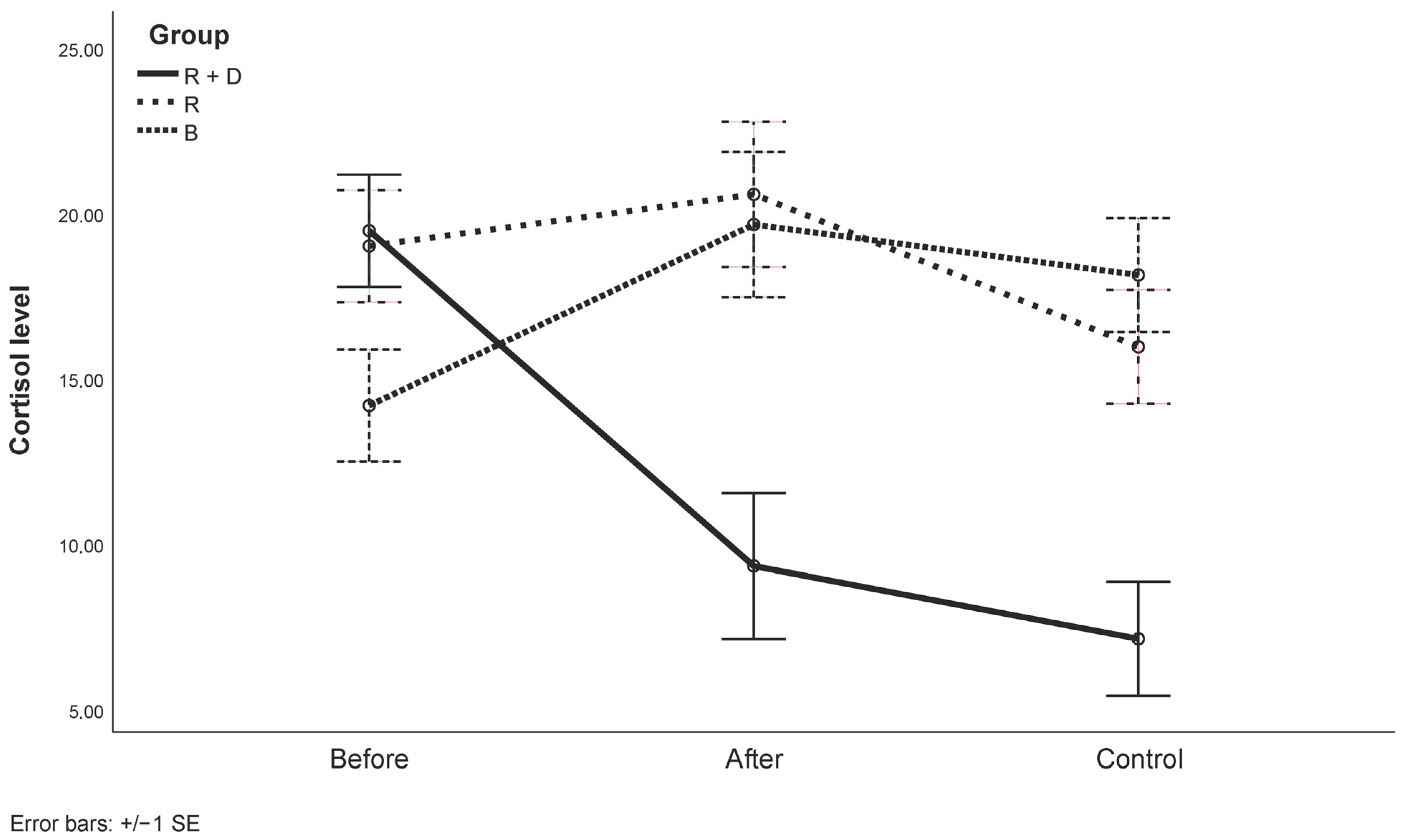
| Salivary Cortisol Level (ng/mL) | Ropivacaine + Dexamethasone Group (R +D) Mean ± SD | Ropivacaine Group (R) Mean ± SD | Bupivacaine Group (B) Mean ± SD | p 1 |
|---|---|---|---|---|
| 15 min before the surgery | 19.45 ± 8.24 ng/mL | 18.99 ± 10.19 ng/mL | 14.17 ± 9.29 ng/mL | 0.984 |
| 15 min after the surgery | 9.31 ± 7.37 ng/mL | 20.56 ± 12.39 a ng/mL | 19.64 ± 12.39 a ng/mL | 0.002 |
| 24 h after the surgery | 7.13 ± 3.92 ng/mL | 15.95 ± 11.80 a ng/mL | 18.1 ± 10.65 a ng/mL | 0.001 |
| p 2 | Time effect: 0.004 | Interaction: p < 0.001 | Group effect: 0.005 | Partial eta squared 0.200 |
Disclaimer/Publisher’s Note: The statements, opinions and data contained in all publications are solely those of the individual author(s) and contributor(s) and not of MDPI and/or the editor(s). MDPI and/or the editor(s) disclaim responsibility for any injury to people or property resulting from any ideas, methods, instructions or products referred to in the content. |
© 2026 by the authors. Licensee MDPI, Basel, Switzerland. This article is an open access article distributed under the terms and conditions of the Creative Commons Attribution (CC BY) license.
Share and Cite
Stojanović, S.M.; Burić, N.B.; Kostić, M.S.; Burić, K.N.; Stojković, B.B.; Spasić, M.S.; Tijanić, M.; Trajković, M.; Jovanović, R.; Petrović, M.S. Salivary Cortisol Response After Ropivacaine–Dexamethasone Administration: A Randomized Clinical Trial. Pharmaceuticals 2026, 19, 930. https://doi.org/10.3390/ph19060930
Stojanović SM, Burić NB, Kostić MS, Burić KN, Stojković BB, Spasić MS, Tijanić M, Trajković M, Jovanović R, Petrović MS. Salivary Cortisol Response After Ropivacaine–Dexamethasone Administration: A Randomized Clinical Trial. Pharmaceuticals. 2026; 19(6):930. https://doi.org/10.3390/ph19060930
Chicago/Turabian StyleStojanović, Simona M., Nikola B. Burić, Miloš S. Kostić, Kristina N. Burić, Branislava B. Stojković, Milan S. Spasić, Miloš Tijanić, Miloš Trajković, Rodoljub Jovanović, and Milica S. Petrović. 2026. "Salivary Cortisol Response After Ropivacaine–Dexamethasone Administration: A Randomized Clinical Trial" Pharmaceuticals 19, no. 6: 930. https://doi.org/10.3390/ph19060930
APA StyleStojanović, S. M., Burić, N. B., Kostić, M. S., Burić, K. N., Stojković, B. B., Spasić, M. S., Tijanić, M., Trajković, M., Jovanović, R., & Petrović, M. S. (2026). Salivary Cortisol Response After Ropivacaine–Dexamethasone Administration: A Randomized Clinical Trial. Pharmaceuticals, 19(6), 930. https://doi.org/10.3390/ph19060930