Immunosuppressive Pathways in Cutaneous Melanoma: Functional Integration Between PD-1 and CD73 and Therapeutic Implications

 ,
,  , , and
Abstract
1. Introduction
2. Immunogenicity, Tumor Microenvironment and Immune Escape in Cutaneous Melanoma
3. PD-1 Signaling in Cutaneous Melanoma: Functional Basis, Therapeutic Applications and Mechanisms of Resistance
4. CD73 as a Regulator of the Immunosuppressive Microenvironment in Cutaneous Melanoma
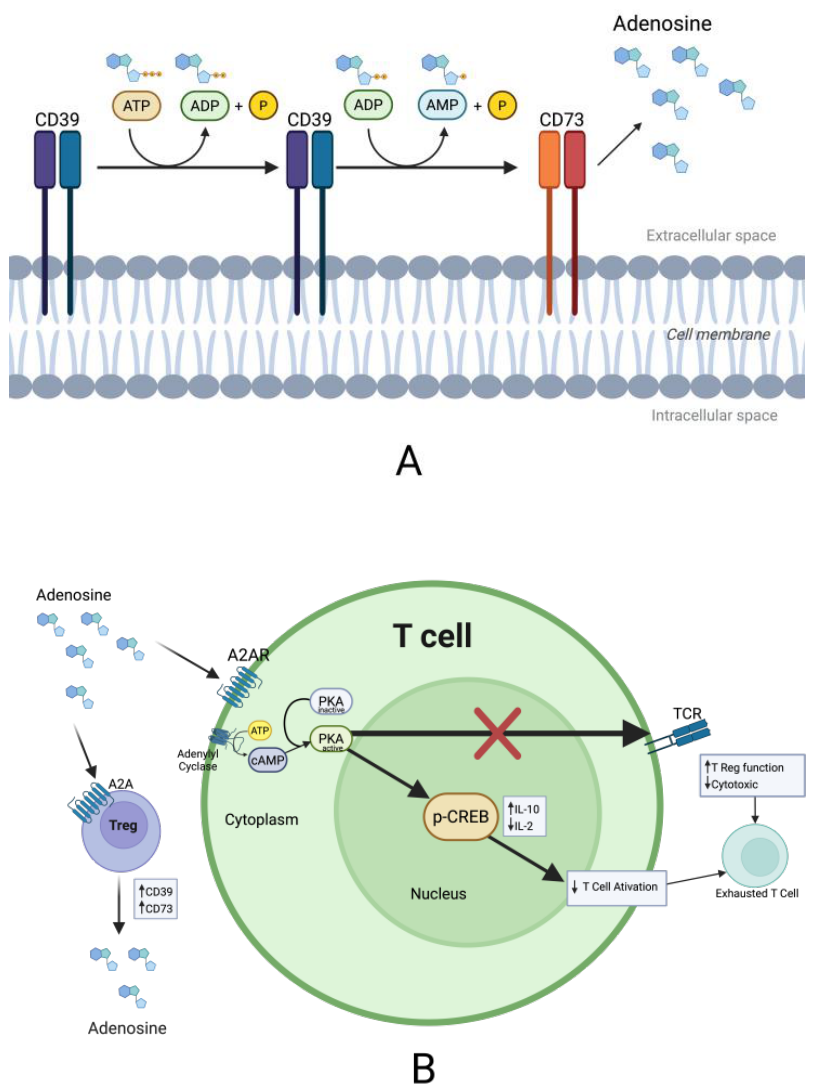
4.1. CD73 Biology and Adenosine Signaling
4.2. Immunosuppressive and Protumoral Effects of CD73
4.3. Prognostic Relevance of CD73 in Cutaneous Melanoma
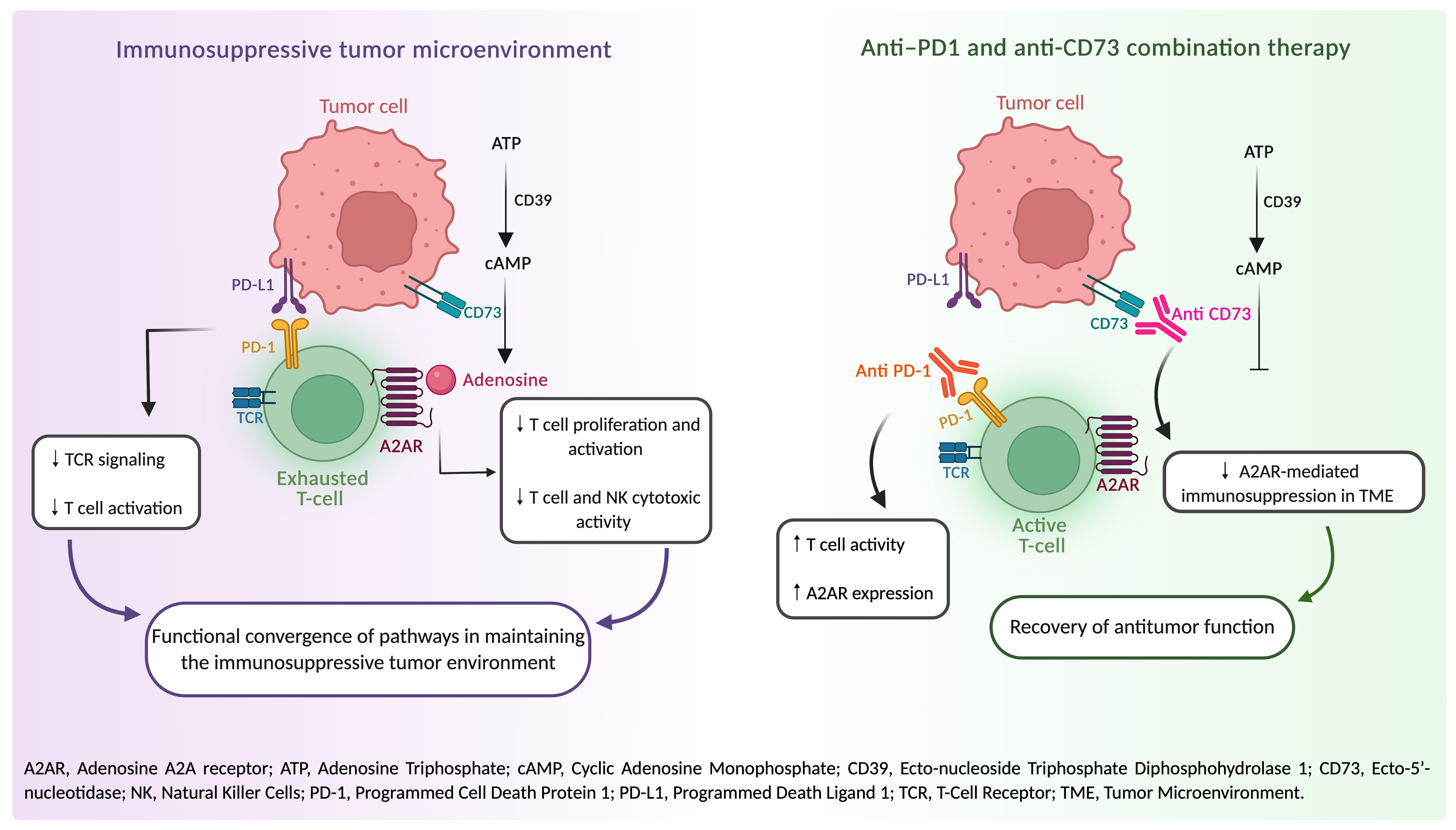
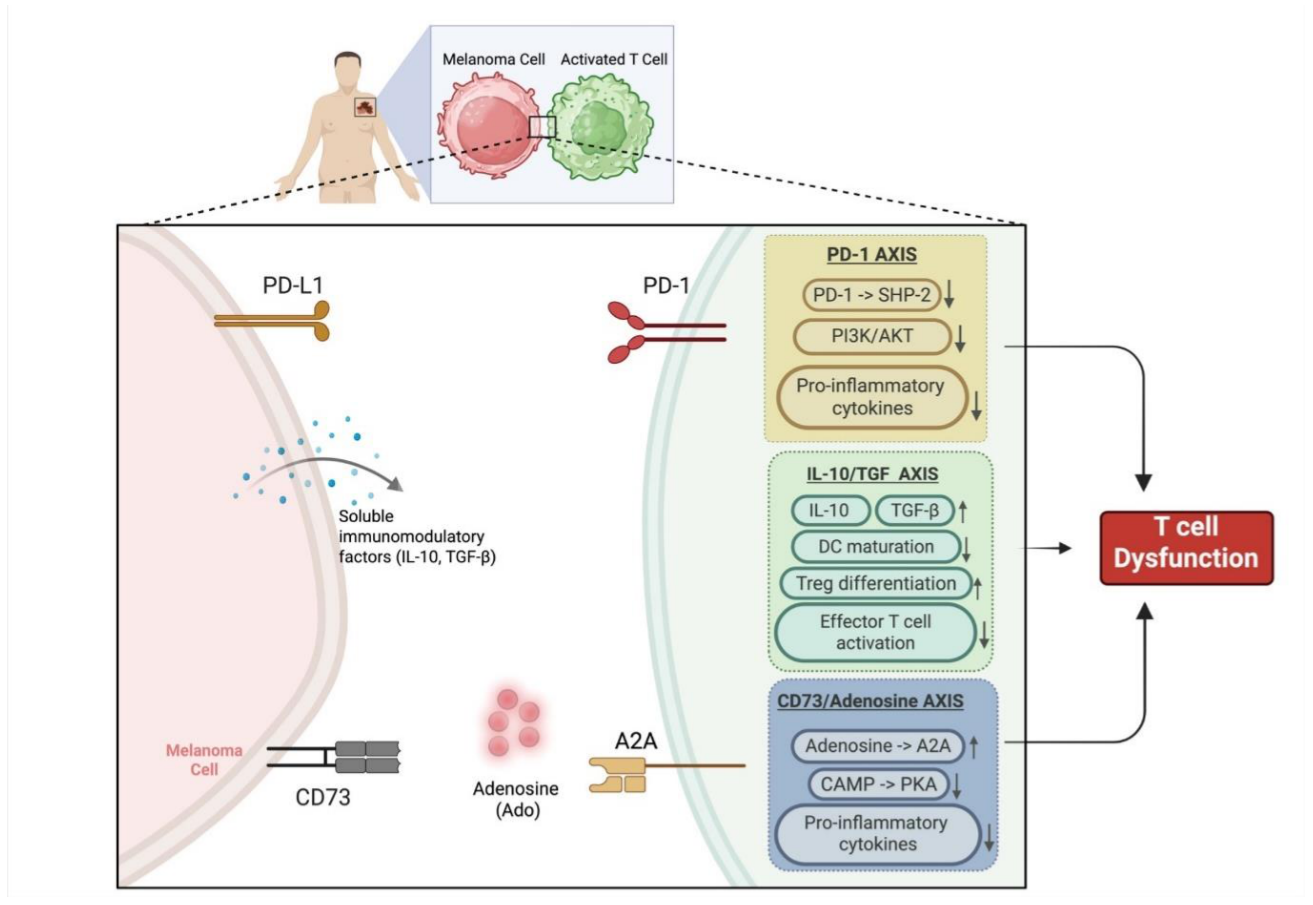
5. PD-1–CD73 Axis in Cutaneous Melanoma: Functional Convergence in T-Lymphocyte Suppression and Therapeutic Implications
6. Preclinical, Translational, and Clinical Evidence for the Combination of Anti-PD-1 Therapy and CD73 Inhibitors
6.1. Evidence Derived from Preclinical Murine Melanoma Models
6.2. Evidence Derived from Clinical and Translational Human Studies
6.3. CD73-Targeted Therapeutic Strategies
6.4. Evidence of Functional Synergy Between CD73 and PD-1 Blockade
7. Conclusions and Future Perspectives
Author Contributions
Funding
Institutional Review Board Statement
Informed Consent Statement
Data Availability Statement
Acknowledgments
Conflicts of Interest
Abbreviations
| A2AR | Adenosine A2A Receptor |
| AKT | Protein Kinase A |
| ADP | Adenosine Diphosphate |
| ALP | Alkaline Phosphatase |
| AMP | Adenosine Monophosphate |
| ATP | Adenosine Triphosphate |
| B2M | Beta-2 Microglobulin |
| CAF | Cancer-Associated Fibroblast |
| CD39 | Ecto-Nucleoside Triphosphate Diphosphohydrolase 1 |
| CD73 | Ecto-5′-nucleotidase |
| cAMP | Cyclic Adenosine Monophosphate |
| CM | Cutaneous Melanoma |
| CTLA-4 | Cytotoxic T-Lymphocyte-Associated Protein 4 |
| DC | Dendritic Cell |
| ECM | Extracellular Matrix |
| EMT | Epithelial–Mesenchymal Transition |
| GPI | Glycosylphosphatididylinositol |
| HIF-1α | Hypoxia-Inducible Factor 1-Alpha |
| ICI | Immune Checkpoint Inhibitor |
| IDO | Indoleamine 2,3-Dioxygenase |
| IFN-γ | Interferon-Gamma |
| IL-2 | Interleukin-2 |
| IL-10 | Interleukin-10 |
| IPRES | Innate Anti-PD-1 Resistance |
| IST | Istradefylline |
| JAK 1/2 | Janus Kinases 1 and 2 |
| LAG-3 | Lymphocyte Activation Gene 3 |
| MDSC | Myeloid-Derived Suppressor Cell |
| MHC | Major Histocompatibility Complex |
| mTOR | Mechanism Target Of Rapamycin |
| NFAT | Nuclear Factor of Activated T-Cells |
| NK | Natural Killer Cells |
| OS | Overall Survival |
| PD-1 | Programmed Cell Death Protein 1 |
| PD-L1 | Programmed Death Ligand 1 |
| PFS | Progression-Free Survival |
| P13K | Phosphoinositide 3-Kinase |
| PKA | Protein Kinase A |
| Rap1 | Ras-Associated protein 1 |
| sCD73 | Soluble CD73 |
| TAM | Tumor-Associated Macrophage |
| TCR | T-Cell Receptor |
| Tex | T-Cell Exhausted |
| TGF-β | Transforming Growth Factor Beta |
| TIM-3 | T-Cell Immunoglobulin and Mucin Domain-Containing 3 |
| TILs | Tumor-Infiltrating Lymphocytes |
| TMB | Tumor Mutational Burden |
| TME | Tumor Microenvironment |
| TNF-α | Tumor Necrosis Factor Alpha |
| Tregs | Regulatory T Cells |
| UV | Ultraviolet |
References
- Caraviello, C.; Nazzaro, G.; Tavoletti, G.; Boggio, F.; Denaro, N.; Murgia, G.; Passoni, E.; Benzecry Mancin, V.; Marzano, A.V. Melanoma Skin Cancer: A Comprehensive Review of Current Knowledge. Cancers 2025, 17, 2920. [Google Scholar] [CrossRef] [PubMed]
- Umansky, V.; Shevchenko, I.; Bazhin, A.V.; Utikal, J. Extracellular Adenosine Metabolism in Immune Cells in Melanoma. Cancer Immunol. Immunother. 2014, 63, 1073–1080. [Google Scholar] [CrossRef] [PubMed]
- Arnold, M.; Singh, D.; Laversanne, M.; Vignat, J.; Vaccarella, S.; Meheus, F.; Cust, A.E.; De Vries, E.; Whiteman, D.C.; Bray, F. Global Burden of Cutaneous Melanoma in 2020 and Projections to 2040. JAMA Dermatol. 2022, 158, 495–503. [Google Scholar] [CrossRef] [PubMed]
- National Institutes of Health. National Cancer Institute Cancer Stat Facts: Melanoma of the Skin; National Institutes of Health: Bethesda, MD, USA, 2026. [Google Scholar]
- Ralli, M.; Botticelli, A.; Visconti, I.C.; Angeletti, D.; Fiore, M.; Marchetti, P.; Lambiase, A.; De Vincentiis, M.; Greco, A. Immunotherapy in the Treatment of Metastatic Melanoma: Current Knowledge and Future Directions. J. Immunol. Res. 2020, 2020, 9235638. [Google Scholar] [CrossRef]
- Sommer, L. Generation of Melanocytes from Neural Crest Cells. Pigment Cell Melanoma Res. 2011, 24, 411–421. [Google Scholar] [CrossRef]
- Wang, M.; Gao, X.; Zhang, L. Recent Global Patterns in Skin Cancer Incidence, Mortality, and Prevalence. Chin. Med. J. 2025, 138, 185–192. [Google Scholar] [CrossRef]
- Haanen, J.; Ernstoff, M.S.; Wang, Y.; Menzies, A.M.; Puzanov, I.; Grivas, P.; Larkin, J.; Peters, S.; Thompson, J.A.; Obeid, M. Autoimmune Diseases and Immune-Checkpoint Inhibitors for Cancer Therapy: Review of the Literature and Personalized Risk-Based Prevention Strategy. Ann. Oncol. 2020, 31, 724–744. [Google Scholar] [CrossRef]
- Leonardi, G.; Candido, S.; Falzone, L.; Spandidos, D.; Libra, M. Cutaneous Melanoma and the Immunotherapy Revolution (Review). Int. J. Oncol. 2020, 57, 609–618. [Google Scholar] [CrossRef]
- Liu, P.; Guo, J.; Xie, Z.; Pan, Y.; Wei, B.; Peng, Y.; Hu, S.; Ding, J.; Chen, X.; Su, J.; et al. Co-Delivery of aPD-L1 and CD73 Inhibitor Using Calcium Phosphate Nanoparticles for Enhanced Melanoma Immunotherapy with Reduced Toxicity. Adv. Sci. 2025, 12, 2410545. [Google Scholar] [CrossRef]
- American Cancer Society. Survival Rates for Melanoma Skin Cancer, by Stage. 13 January 2026. Available online: https://www.cancer.org/cancer/types/melanoma-skin-cancer/detection-diagnosis-staging/survival-rates-for-melanoma-skin-cancer-by-stage.html (accessed on 27 January 2026).
- Qiao, G.; He, H.; Wang, X. CD39+PD-1+ Regulatory T Cells in Melanoma: Key Drivers of Systemic Immunosuppression and Prognostic Biomarkers. Front. Oncol. 2025, 15, 1724062. [Google Scholar] [CrossRef]
- Iwai, Y.; Hamanishi, J.; Chamoto, K.; Honjo, T. Cancer Immunotherapies Targeting the PD-1 Signaling Pathway. J. Biomed. Sci. 2017, 24, 26. [Google Scholar] [CrossRef] [PubMed]
- Piovesan, D.; Tan, J.B.L.; Becker, A.; Banuelos, J.; Narasappa, N.; DiRenzo, D.; Zhang, K.; Chen, A.; Ginn, E.; Udyavar, A.R.; et al. Targeting CD73 with AB680 (Quemliclustat), a Novel and Potent Small-Molecule CD73 Inhibitor, Restores Immune Functionality and Facilitates Antitumor Immunity. Mol. Cancer Ther. 2022, 21, 948–959. [Google Scholar] [CrossRef] [PubMed]
- Capone, M.; Fratangelo, F.; Giannarelli, D.; Sorrentino, C.; Turiello, R.; Zanotta, S.; Galati, D.; Madonna, G.; Tuffanelli, M.; Scarpato, L.; et al. Frequency of Circulating CD8+CD73+T Cells Is Associated with Survival in Nivolumab-Treated Melanoma Patients. J. Transl. Med. 2020, 18, 121. [Google Scholar] [CrossRef]
- Turiello, R.; Capone, M.; Morretta, E.; Monti, M.C.; Madonna, G.; Azzaro, R.; Del Gaudio, P.; Simeone, E.; Sorrentino, A.; Ascierto, P.A.; et al. Exosomal CD73 from Serum of Patients with Melanoma Suppresses Lymphocyte Functions and Is Associated with Therapy Resistance to Anti-PD-1 Agents. J. Immunother. Cancer 2022, 10, e004043. [Google Scholar] [CrossRef]
- Zilberg, C.; Ferguson, A.L.; Lyons, J.G.; Gupta, R.; Damian, D.L. The Tumor Immune Microenvironment in Primary Cutaneous Melanoma. Arch. Dermatol. Res. 2025, 317, 273. [Google Scholar] [CrossRef]
- Davis, E.J.; Johnson, D.B.; Sosman, J.A.; Chandra, S. Melanoma: What Do All the Mutations Mean? Cancer 2018, 124, 3490–3499. [Google Scholar] [CrossRef]
- Stylianakis, D.; Stylianakis, I.; Benjamin, H.A.; Martella, S.; Tziotis, A.; Pellegrino, B.; De Silva, P.; Giannakis, M.; Perrone, F.; Lambertini, M.; et al. Comprehensive Analysis of BRCA1/2 Mutations, “BRCAness” and PARP Inhibitors in Melanoma. Crit. Rev. Oncol./Hematol. 2025, 215, 104962. [Google Scholar] [CrossRef]
- Mukherji, B. Immunology of Melanoma. Clin. Dermatol. 2013, 31, 156–165. [Google Scholar] [CrossRef]
- Jin, S.-G.; Johnson, J.; Kim, P.Y.; Pfeifer, G.P. UVA-Induced DNA Damage and Mutations in Human Melanocytes: Relevance for Melanoma Mutations. Nucleic Acids Res. 2025, 53, gkaf905. [Google Scholar] [CrossRef]
- Trucco, L.D.; Mundra, P.A.; Hogan, K.; Garcia-Martinez, P.; Viros, A.; Mandal, A.K.; Macagno, N.; Gaudy-Marqueste, C.; Allan, D.; Baenke, F.; et al. Ultraviolet Radiation–Induced DNA Damage Is Prognostic for Outcome in Melanoma. Nat. Med. 2019, 25, 221–224. [Google Scholar] [CrossRef] [PubMed]
- Ketelaars, S.L.C.; Van Buuren, M.M.; Gangaev, A.; Van Rooij, N.; Patiwael, S.; Hoefakker, K.; Fanchi, L.F.; Baas, P.; Van Der Heijden, M.; Kok, M.; et al. Properties of CD8 T-Cell-Recognized Neoantigens in Different Tumor Types. Immuno-Oncol. Technol. 2025, 27, 101062. [Google Scholar] [CrossRef]
- Passarelli, A.; Mannavola, F.; Stucci, L.S.; Tucci, M.; Silvestris, F. Immune System and Melanoma Biology: A Balance between Immunosurveillance and Immune Escape. Oncotarget 2017, 8, 106132–106142. [Google Scholar] [CrossRef]
- Huang, Z.; Xie, N.; Illes, P.; Di Virgilio, F.; Ulrich, H.; Semyanov, A.; Verkhratsky, A.; Sperlagh, B.; Yu, S.-G.; Huang, C.; et al. From Purines to Purinergic Signalling: Molecular Functions and Human Diseases. Signal Transduct. Target. Ther. 2021, 6, 162. [Google Scholar] [CrossRef]
- Postow, M.A.; Callahan, M.K.; Wolchok, J.D. Immune Checkpoint Blockade in Cancer Therapy. J. Clin. Oncol. 2015, 33, 1974–1982. [Google Scholar] [CrossRef] [PubMed]
- Alturki, N.A. Review of the Immune Checkpoint Inhibitors in the Context of Cancer Treatment. J. Clin. Med. 2023, 12, 4301. [Google Scholar] [CrossRef] [PubMed]
- Rotte, A. Combination of CTLA-4 and PD-1 Blockers for Treatment of Cancer. J. Exp. Clin. Cancer Res. 2019, 38, 255. [Google Scholar] [CrossRef]
- Sun, S.; Liu, L.; Zhang, J.; Sun, L.; Shu, W.; Yang, Z.; Yao, H.; Zhang, Z. The Role of Neoantigens and Tumor Mutational Burden in Cancer Immunotherapy: Advances, Mechanisms, and Perspectives. J. Hematol. Oncol. 2025, 18, 84. [Google Scholar] [CrossRef]
- Ahn, R.; Cui, Y.; White, F.M. Antigen Discovery for the Development of Cancer Immunotherapy. Semin. Immunol. 2023, 66, 101733. [Google Scholar] [CrossRef]
- Arruda, L.C.M.; Karbach, J.; Kiselicki, D.; Altmannsberger, H.-M.; Sinelnikov, E.; Gustavus, D.; Hoffmeister, H.; Atmaca, A.; Jäger, E. Tumor-Infiltrating Lymphocytes-Derived CD8+ Clonotypes Infiltrate the Tumor Tissue and Mediate Tumor Regression in Glioblastoma. OncoImmunology 2025, 14, 2559784. [Google Scholar] [CrossRef]
- Zhang, C.; Li, Z.; Zhang, Y.; Zhao, C.; Wang, H.; Lin, J.; Liu, C.; Wang, X.; Wang, H. Genomic Variations and Immune-Related Features of TMB, PD-L1 Expression and CD8+ T Cell Infiltration in Chinese Pulmonary Sarcomatoid Carcinoma. Int. J. Gen. Med. 2022, 15, 4209–4220. [Google Scholar] [CrossRef]
- Kalaora, S.; Nagler, A.; Wargo, J.A.; Samuels, Y. Mechanisms of Immune Activation and Regulation: Lessons from Melanoma. Nat. Rev. Cancer 2022, 22, 195–207. [Google Scholar] [CrossRef]
- De Visser, K.E.; Joyce, J.A. The Evolving Tumor Microenvironment: From Cancer Initiation to Metastatic Outgrowth. Cancer Cell 2023, 41, 374–403. [Google Scholar] [CrossRef]
- Adamiak-Nikolouzou, K.; Słomiński, A.T.; Skalska, Z.; Inkielewicz-Stępniak, I. Therapeutic Use of Integrin Signaling in Melanoma Cells: Physical Link with the Extracellular Matrix (ECM). Cancers 2025, 17, 3037. [Google Scholar] [CrossRef]
- Pardoll, D.M.; Topalian, S.L. The Role of CD4+ T Cell Responses in Antitumor Immunity. Curr. Opin. Immunol. 1998, 10, 588–594. [Google Scholar] [CrossRef] [PubMed]
- Fujimura, T.; Kambayashi, Y.; Aiba, S. Crosstalk between Regulatory T Cells (Tregs) and Myeloid Derived Suppressor Cells (MDSCs) during Melanoma Growth. OncoImmunology 2012, 1, 1433–1434. [Google Scholar] [CrossRef]
- Demyashkin, G.; Atiakshin, D.; Silakov, K.; Shchekin, V.; Bobrov, M.; Vadyukhin, M.; Borovaya, T.; Blinova, E.; Shegay, P.; Kaprin, A. Spatial Distribution and Phenotypic Profiling of Cd68+ and Cd163+ Macrophages in Melanoma Progression: Insights into Tumor Microenvironment Dynamics. Biomedicines 2025, 13, 2178. [Google Scholar] [CrossRef]
- Mondal, A.; Jamal, F.; Das, A.; Sahoo, A.K.; Chaudhary, K.; Chowdhury, S.; Jha, A.; Singha, S. Inhibition of Melanoma Growth by Ex Vivo Expanded Tumor-Specific CD8+ T Cells Is Dependent on the Configuration of Nanoscale Artificial APCs. Eur. J. Immunol. 2025, 55, e202451676. [Google Scholar] [CrossRef]
- Leonard-Murali, S.; Kammula, U.S. Optimizing TIL Therapy for Uveal Melanoma: Lessons Learned and Unlearned from Cutaneous Melanoma. Immunotherapy 2025, 17, 283–291. [Google Scholar] [CrossRef]
- Zhang, Y.; Fu, H.; Zhao, Q. Current Status and Perspectives of Clinical Trials for Tumor-Infiltrating Lymphocyte Therapy. Clin. Transl. Oncol. 2024, 27, 466–472. [Google Scholar] [CrossRef]
- Chen, S.; Zhang, Z.; Zheng, X.; Tao, H.; Zhang, S.; Ma, J.; Liu, Z.; Wang, J.; Qian, Y.; Cui, P.; et al. Response Efficacy of PD-1 and PD-L1 Inhibitors in Clinical Trials: A Systematic Review and Meta-Analysis. Front. Oncol. 2021, 11, 562315. [Google Scholar] [CrossRef]
- Wong, P.F.; Wei, W.; Smithy, J.W.; Acs, B.; Toki, M.I.; Blenman, K.R.M.; Zelterman, D.; Kluger, H.M.; Rimm, D.L. Multiplex Quantitative Analysis of Tumor-Infiltrating Lymphocytes and Immunotherapy Outcome in Metastatic Melanoma. Clin. Cancer Res. 2019, 25, 2442–2449. [Google Scholar] [CrossRef]
- Tumeh, P.C.; Harview, C.L.; Yearley, J.H.; Shintaku, I.P.; Taylor, E.J.M.; Robert, L.; Chmielowski, B.; Spasic, M.; Henry, G.; Ciobanu, V.; et al. PD-1 Blockade Induces Responses by Inhibiting Adaptive Immune Resistance. Nature 2014, 515, 568–571. [Google Scholar] [CrossRef]
- Burn, T.N.; Schröder, J.; Gandolfo, L.C.; Osman, M.; Wainwright, E.N.; Lam, E.Y.N.; McDonald, K.M.; Evans, R.B.; Li, S.; Rawlinson, D.; et al. Antigen Reactivity Defines Tissue-Resident Memory and Exhausted T Cells in Tumors. Nat. Immunol. 2026, 27, 98–109. [Google Scholar] [CrossRef]
- Hutter-Karakoc, I.; Varypataki, E.M.; Neelakandhan, A.; Lang, S.; Kramar, V.; Varol, A.; Simons, S.; Richard, M.; Pincha, M.; Venetz, D.; et al. Chronic Antigen Stimulation in Melanoma Induces T Cell Exhaustion and Limits Efficacy of T Cell Bispecific Therapies. OncoImmunology 2025, 14, 2526444. [Google Scholar] [CrossRef]
- Bae, H.R.; Son, B.; Hwang, K.; Kim, S.; Young, H.A.; Kwon, E.-Y. Cytotoxic CD4+ T Cells Exhibit an Immunosuppressive Shift in Checkpoint Immunotherapy Resistance in Melanoma Patients. Cancer Immunol. Immunother. 2025, 74, 297. [Google Scholar] [CrossRef]
- DuPage, M.; Bluestone, J.A. Harnessing the Plasticity of CD4+ T Cells to Treat Immune-Mediated Disease. Nat. Rev. Immunol. 2016, 16, 149–163. [Google Scholar] [CrossRef] [PubMed]
- Attrill, G.H.; Ferguson, P.M.; Palendira, U.; Long, G.V.; Wilmott, J.S.; Scolyer, R.A. The Tumour Immune Landscape and Its Implications in Cutaneous Melanoma. Pigment Cell Melanoma Res. 2021, 34, 529–549. [Google Scholar] [CrossRef] [PubMed]
- Azizi, G.; Hafezi, N.; Mohammadi, H.; Yazdani, R.; Alinia, T.; Tavakol, M.; Aghamohammadi, A.; Mirshafiey, A. Abnormality of Regulatory T Cells in Common Variable Immunodeficiency. Cell. Immunol. 2017, 315, 11–17. [Google Scholar] [CrossRef]
- Kaplinsky, N.; Williams, K.; Watkins, D.; Adams, M.; Stanbery, L.; Nemunaitis, J. Regulatory Role of CD39 and CD73 in Tumor Immunity. Future Oncol. 2024, 20, 1367–1380. [Google Scholar] [CrossRef]
- Shevchenko, I.; Mathes, A.; Groth, C.; Karakhanova, S.; Müller, V.; Utikal, J.; Werner, J.; Bazhin, A.V.; Umansky, V. Enhanced Expression of CD39 and CD73 on T Cells in the Regulation of Anti-Tumor Immune Responses. OncoImmunology 2020, 9, 1744946. [Google Scholar] [CrossRef] [PubMed]
- Asai, Y.; Yanagawa, N.; Osakabe, M.; Yamada, N.; Sugimoto, R.; Sato, A.; Ito, K.; Koike, Y.; Tanji, T.; Sakuraba, M.; et al. The Clinicopathological Impact of Tumor-associated Macrophages in Patients with Cutaneous Malignant Melanoma. J. Surg. Oncol. 2024, 129, 381–391. [Google Scholar] [CrossRef]
- Lu, P.; Weaver, V.M.; Werb, Z. The Extracellular Matrix: A Dynamic Niche in Cancer Progression. J. Cell Biol. 2012, 196, 395–406. [Google Scholar] [CrossRef]
- Yuan, Z.; Li, Y.; Zhang, S.; Wang, X.; Dou, H.; Yu, X.; Zhang, Z.; Yang, S.; Xiao, M. Extracellular Matrix Remodeling in Tumor Progression and Immune Escape: From Mechanisms to Treatments. Mol. Cancer 2023, 22, 48. [Google Scholar] [CrossRef]
- Borst, R.; Meyaard, L.; Pascoal Ramos, M.I. Understanding the Matrix: Collagen Modifications in Tumors and Their Implications for Immunotherapy. J. Transl. Med. 2024, 22, 382. [Google Scholar] [CrossRef]
- Harris, A.L. Hypoxia—A Key Regulatory Factor in Tumour Growth. Nat. Rev. Cancer 2002, 2, 38–47. [Google Scholar] [CrossRef]
- Bellazzo, A.; Montico, B.; Guerrieri, R.; Colizzi, F.; Steffan, A.; Polesel, J.; Fratta, E. Unraveling the Role of Hypoxia-Inducible Factors in Cutaneous Melanoma: From Mechanisms to Therapeutic Opportunities. Cell Commun. Signal 2025, 23, 177. [Google Scholar] [CrossRef]
- Feichtinger, R.G.; Lang, R. Targeting L-Lactate Metabolism to Overcome Resistance to Immune Therapy of Melanoma and Other Tumor Entities. J. Oncol. 2019, 2019, 2084195. [Google Scholar] [CrossRef]
- Hatfield, S.M.; Kjaergaard, J.; Lukashev, D.; Belikoff, B.; Schreiber, T.H.; Sethumadhavan, S.; Abbott, R.; Philbrook, P.; Thayer, M.; Shujia, D.; et al. Systemic Oxygenation Weakens the Hypoxia and Hypoxia Inducible Factor 1α-Dependent and Extracellular Adenosine-Mediated Tumor Protection. J. Mol. Med. 2014, 92, 1283–1292. [Google Scholar] [CrossRef]
- Noman, M.Z.; Hasmim, M.; Messai, Y.; Terry, S.; Kieda, C.; Janji, B.; Chouaib, S. Hypoxia: A Key Player in Antitumor Immune Response. A Review in the Theme: Cellular Responses to Hypoxia. Am. J. Physiol.-Cell Physiol. 2015, 309, C569–C579. [Google Scholar] [CrossRef]
- Augustin, R.C.; Delgoffe, G.M.; Najjar, Y.G. Characteristics of the Tumor Microenvironment That Influence Immune Cell Functions: Hypoxia, Oxidative Stress, Metabolic Alterations. Cancers 2020, 12, 3802. [Google Scholar] [CrossRef]
- Rubinstein, J.C.; Domanskyi, S.; Sheridan, T.B.; Sanderson, B.; Park, S.; Kaster, J.; Li, H.; Anczukow, O.; Herlyn, M.; Chuang, J.H. Spatiotemporal Profiling Defines Persistence and Resistance Dynamics during Targeted Treatment of Melanoma. Cancer Res. 2025, 85, 987–1002. [Google Scholar] [CrossRef]
- Lin, X.; Kang, K.; Chen, P.; Zeng, Z.; Li, G.; Xiong, W.; Yi, M.; Xiang, B. Regulatory Mechanisms of PD-1/PD-L1 in Cancers. Mol. Cancer 2024, 23, 108. [Google Scholar] [CrossRef]
- Mandalà, M.; Merelli, B.; Massi, D. PD-L1 in Melanoma: Facts and Myths. Melanoma Manag. 2016, 3, 187–194. [Google Scholar] [CrossRef]
- Latchman, Y.; Wood, C.R.; Chernova, T.; Chaudhary, D.; Borde, M.; Chernova, I.; Iwai, Y.; Long, A.J.; Brown, J.A.; Nunes, R.; et al. PD-L2 Is a Second Ligand for PD-1 and Inhibits T Cell Activation. Nat. Immunol. 2001, 2, 261–268. [Google Scholar] [CrossRef]
- Liu, Y.; Yu, Y.; Yang, S.; Zeng, B.; Zhang, Z.; Jiao, G.; Zhang, Y.; Cai, L.; Yang, R. Regulation of Arginase I Activity and Expression by Both PD-1 and CTLA-4 on the Myeloid-Derived Suppressor Cells. Cancer Immunol. Immunother. 2009, 58, 687–697. [Google Scholar] [CrossRef]
- Petrovas, C.; Casazza, J.P.; Brenchley, J.M.; Price, D.A.; Gostick, E.; Adams, W.C.; Precopio, M.L.; Schacker, T.; Roederer, M.; Douek, D.C.; et al. PD-1 Is a Regulator of Virus-Specific CD8+ T Cell Survival in HIV Infection. J. Exp. Med. 2006, 203, 2281–2292. [Google Scholar] [CrossRef]
- Obeid, J.M.; Erdag, G.; Smolkin, M.E.; Deacon, D.H.; Patterson, J.W.; Chen, L.; Bullock, T.N.; Slingluff, C.L. PD-L1, PD-L2 and PD-1 Expression in Metastatic Melanoma: Correlation with Tumor-Infiltrating Immune Cells and Clinical Outcome. OncoImmunology 2016, 5, e1235107. [Google Scholar] [CrossRef]
- Wang, Y.; Du, J.; Gao, Z.; Sun, H.; Mei, M.; Wang, Y.; Ren, Y.; Zhou, X. Evolving Landscape of PD-L2: Bring New Light to Checkpoint Immunotherapy. Br. J. Cancer 2023, 128, 1196–1207. [Google Scholar] [CrossRef]
- Patsoukis, N.; Duke-Cohan, J.S.; Chaudhri, A.; Aksoylar, H.-I.; Wang, Q.; Council, A.; Berg, A.; Freeman, G.J.; Boussiotis, V.A. Interaction of SHP-2 SH2 Domains with PD-1 ITSM Induces PD-1 Dimerization and SHP-2 Activation. Commun. Biol. 2020, 3, 128. [Google Scholar] [CrossRef]
- Patsoukis, N.; Wang, Q.; Strauss, L.; Boussiotis, V.A. Revisiting the PD-1 Pathway. Sci. Adv. 2020, 6, eabd2712. [Google Scholar] [CrossRef]
- Lee, J.; Ahn, E.; Kissick, H.T.; Ahmed, R. Reinvigorating Exhausted T Cells by Blockade of the PD-1 Pathway. Forum Immun. Dis. Ther. 2015, 6, 7–17. [Google Scholar] [CrossRef]
- Parvez, A.; Choudhary, F.; Mudgal, P.; Khan, R.; Qureshi, K.A.; Farooqi, H.; Aspatwar, A. PD-1 and PD-L1: Architects of Immune Symphony and Immunotherapy Breakthroughs in Cancer Treatment. Front. Immunol. 2023, 14, 1296341. [Google Scholar] [CrossRef]
- Patsoukis, N.; Bardhan, K.; Chatterjee, P.; Sari, D.; Liu, B.; Bell, L.N.; Karoly, E.D.; Freeman, G.J.; Petkova, V.; Seth, P.; et al. PD-1 Alters T-Cell Metabolic Reprogramming by Inhibiting Glycolysis and Promoting Lipolysis and Fatty Acid Oxidation. Nat. Commun. 2015, 6, 6692. [Google Scholar] [CrossRef]
- Najjar, Y.G.; Menk, A.V.; Sander, C.; Rao, U.; Karunamurthy, A.; Bhatia, R.; Zhai, S.; Kirkwood, J.M.; Delgoffe, G.M. Tumor Cell Oxidative Metabolism as a Barrier to PD-1 Blockade Immunotherapy in Melanoma. JCI Insight 2019, 4, e124989. [Google Scholar] [CrossRef]
- Xing, Y.; Wu, H.T.; Rajurkar, S.; Tan, T.; Hsu, V. Immunotherapy in Melanoma. In Immunotherapies in Solid Tumors; Salgia, R., Kulkarni, P., Eds.; Cancer Treatment and Research; Springer Nature: Cham, Switzerland, 2025; Volume 129, pp. 173–186. [Google Scholar]
- Mehta, A.; Motavaf, M.; Nebo, I.; Luyten, S.; Osei-Opare, K.D.; Gru, A.A. Advancements in Melanoma Treatment: A Review of PD-1 Inhibitors, T-VEC, mRNA Vaccines, and Tumor-Infiltrating Lymphocyte Therapy in an Evolving Landscape of Immunotherapy. J. Clin. Med. 2025, 14, 1200. [Google Scholar] [CrossRef]
- Zielińska, M.K.; Ciążyńska, M.; Sulejczak, D.; Rutkowski, P.; Czarnecka, A.M. Mechanisms of Resistance to Anti-PD-1 Immunotherapy in Melanoma and Strategies to Overcome It. Biomolecules 2025, 15, 269. [Google Scholar] [CrossRef]
- Alcedo, K.P.; Bowser, J.L.; Snider, N.T. The Elegant Complexity of Mammalian Ecto-5′-Nucleotidase (CD73). Trends Cell Biol. 2021, 31, 829–842. [Google Scholar] [CrossRef]
- Shen, J.; Liao, B.; Gong, L.; Li, S.; Zhao, J.; Yang, H.; Gong, Y.; Li, Y. CD39 and CD73: Biological Functions, Diseases and Therapy. Mol. Biomed. 2025, 6, 97. [Google Scholar] [CrossRef]
- Xia, C.; Yin, S.; To, K.K.W.; Fu, L. CD39/CD73/A2AR Pathway and Cancer Immunotherapy. Mol. Cancer 2023, 22, 44. [Google Scholar] [CrossRef]
- Liu, Y.; Li, Z.; Zhao, X.; Xiao, J.; Bi, J.; Li, X.-Y.; Chen, G.; Lu, L. Review Immune Response of Targeting CD39 in Cancer. Biomark. Res. 2023, 11, 63. [Google Scholar] [CrossRef]
- Zeynali, P.; Jazi, M.S.; Asadi, J.; Jafari, S.M. A1 Adenosine Receptor Antagonist Induces Cell Apoptosis in KYSE-30 and YM-1 Esophageal Cancer Cell Lines. BioMedicine 2023, 13, 54–61. [Google Scholar] [CrossRef] [PubMed]
- Gaspar, A.; Silva, T.; Borges, F. Receptores A3 Da Adenosina: Uma Nova Abordagem Terapêutica No Câncer. Quím. Nova 2011, 34, 1417–1424. [Google Scholar] [CrossRef]
- Sun, C.; Wang, B.; Hao, S. Adenosine-A2A Receptor Pathway in Cancer Immunotherapy. Front. Immunol. 2022, 13, 837230. [Google Scholar] [CrossRef]
- Ohta, A.; Sitkovsky, M. Extracellular Adenosine-Mediated Modulation of Regulatory T Cells. Front. Immunol. 2014, 5, 304. [Google Scholar] [CrossRef]
- Wang, H.; Tan, F.; Xu, Y.; Ma, Y.; Li, Y.; Xiao, H. Adenosine Receptor A2B Antagonist Inhibits the Metastasis of Gastric Cancer Cells and Enhances the Efficacy of Cisplatin. Technol. Cancer Res. Treat. 2023, 22, 15330338221150318. [Google Scholar] [CrossRef] [PubMed]
- Kurago, Z.; Guo, G.; Shi, H.; Bollag, R.J.; Groves, M.W.; Byrd, J.K.; Cui, Y. Inhibitors of the CD73-Adenosinergic Checkpoint as Promising Combinatory Agents for Conventional and Advanced Cancer Immunotherapy. Front. Immunol. 2023, 14, 1212209. [Google Scholar] [CrossRef]
- Yu, M.; Guo, G.; Huang, L.; Deng, L.; Chang, C.-S.; Achyut, B.R.; Canning, M.; Xu, N.; Arbab, A.S.; Bollag, R.J.; et al. CD73 on Cancer-Associated Fibroblasts Enhanced by the A2B-Mediated Feedforward Circuit Enforces an Immune Checkpoint. Nat. Commun. 2020, 11, 515. [Google Scholar] [CrossRef]
- Bi, C.; Patel, J.S.; Liang, S.H. Development of CD73 Inhibitors in Tumor Immunotherapy and Opportunities in Imaging and Combination Therapy. J. Med. Chem. 2025, 68, 6860–6869. [Google Scholar] [CrossRef]
- Chen, C.; Liu, S.; Ma, Y. Comprehensive Pan-Cancer Analysis of CD73: Explore Its Association with Prognosis and Tumor Immune Microenvironment. Heliyon 2024, 10, e40329. [Google Scholar] [CrossRef]
- Bach, N.; Winzer, R.; Tolosa, E.; Fiedler, W.; Brauneck, F. The Clinical Significance of CD73 in Cancer. Int. J. Mol. Sci. 2023, 24, 11759. [Google Scholar] [CrossRef]
- Clayton, A.; Al-Taei, S.; Webber, J.; Mason, M.D.; Tabi, Z. Cancer Exosomes Express CD39 and CD73, Which Suppress T Cells through Adenosine Production. J. Immunol. 2011, 187, 676–683. [Google Scholar] [CrossRef] [PubMed]
- Allard, B.; Longhi, M.S.; Robson, S.C.; Stagg, J. The Ectonucleotidases CD 39 and CD 73: Novel Checkpoint Inhibitor Targets. Immunol. Rev. 2017, 276, 121–144. [Google Scholar] [CrossRef]
- Perez, V.A.; Borde, S.; Rishabh, K.; Matosevic, S. 196 Targeting the CD73 Immune Checkpoint for NK Cell-Based Therapy for Myeloma. In Proceedings of the Regular and Young Investigator Award Abstracts; BMJ Publishing Group Ltd.: London, UK, 2025; p. A215. [Google Scholar]
- Deng, Y.; Chen, Q.; Yang, X.; Sun, Y.; Zhang, B.; Wei, W.; Deng, S.; Meng, J.; Hu, Y.; Wang, Y.; et al. Tumor Cell Senescence-Induced Macrophage CD73 Expression Is a Critical Metabolic Immune Checkpoint in the Aging Tumor Microenvironment. Theranostics 2024, 14, 1224–1240. [Google Scholar] [CrossRef]
- Chen, S.; Wainwright, D.A.; Wu, J.D.; Wan, Y.; Matei, D.E.; Zhang, Y.; Zhang, B. Cd73: An Emerging Checkpoint for Cancer Immunotherapy. Immunotherapy 2019, 11, 983–997. [Google Scholar] [CrossRef]
- Turiello, R.; Capone, M.; Giannarelli, D.; Morretta, E.; Monti, M.C.; Madonna, G.; Mallardo, D.; Festino, L.; Azzaro, R.; Levesque, M.P.; et al. Serum CD73 Is a Prognostic Factor in Patients with Metastatic Melanoma and Is Associated with Response to Anti-PD-1 Therapy. J. Immunother. Cancer 2020, 8, e001689. [Google Scholar] [CrossRef]
- Sadej, R.; Spychala, J.; Skladanowski, A.C. Expression of Ecto-5′-Nucleotidase (eN, CD73) in Cell Lines from Various Stages of Human Melanoma. Melanoma Res. 2006, 16, 213–222. [Google Scholar] [CrossRef]
- Monteiro, I.; Vigano, S.; Faouzi, M.; Treilleux, I.; Michielin, O.; Ménétrier-Caux, C.; Caux, C.; Romero, P.; De Leval, L. CD73 Expression and Clinical Significance in Human Metastatic Melanoma. Oncotarget 2018, 9, 26659–26669. [Google Scholar] [CrossRef] [PubMed]
- Allard, B.; Pommey, S.; Smyth, M.J.; Stagg, J. Targeting CD73 Enhances the Antitumor Activity of Anti-PD-1 and Anti-CTLA-4 mAbs. Clin. Cancer Res. 2013, 19, 5626–5635. [Google Scholar] [CrossRef] [PubMed]
- Morello, S.; Capone, M.; Sorrentino, C.; Giannarelli, D.; Madonna, G.; Mallardo, D.; Grimaldi, A.M.; Pinto, A.; Ascierto, P.A. Soluble CD73 as Biomarker in Patients with Metastatic Melanoma Patients Treated with Nivolumab. J. Transl. Med. 2017, 15, 244. [Google Scholar] [CrossRef]
- Beavis, P.A.; Slaney, C.Y.; Milenkovski, N.; Henderson, M.A.; Loi, S.; Stagg, J.; Kershaw, M.H.; Darcy, P.K. CD73: A Potential Biomarker for Anti-PD-1 Therapy. OncoImmunology 2015, 4, e1046675. [Google Scholar] [CrossRef]
- Lei, Q.; Wang, D.; Sun, K.; Wang, L.; Zhang, Y. Resistance Mechanisms of Anti-PD1/PDL1 Therapy in Solid Tumors. Front. Cell Dev. Biol. 2020, 8, 672. [Google Scholar] [CrossRef]
- Zhang, T.; Liu, H.; Jiao, L.; Zhang, Z.; He, J.; Li, L.; Qiu, L.; Qian, Z.; Zhou, S.; Gong, W.; et al. Genetic Characteristics Involving the PD-1/PD-L1/L2 and CD73/A2aR Axes and the Immunosuppressive Microenvironment in DLBCL. J. Immunother. Cancer 2022, 10, e004114. [Google Scholar] [CrossRef]
- Sharma, P.; Hu-Lieskovan, S.; Wargo, J.A.; Ribas, A. Primary, Adaptive, and Acquired Resistance to Cancer Immunotherapy. Cell 2017, 168, 707–723. [Google Scholar] [CrossRef] [PubMed]
- Zaretsky, J.M.; Garcia-Diaz, A.; Shin, D.S.; Escuin-Ordinas, H.; Hugo, W.; Hu-Lieskovan, S.; Torrejon, D.Y.; Abril-Rodriguez, G.; Sandoval, S.; Barthly, L.; et al. Mutations Associated with Acquired Resistance to PD-1 Blockade in Melanoma. N. Engl. J. Med. 2016, 375, 819–829. [Google Scholar] [CrossRef] [PubMed]
- Spranger, S.; Bao, R.; Gajewski, T.F. Melanoma-Intrinsic β-Catenin Signalling Prevents Anti-Tumour Immunity. Nature 2015, 523, 231–235. [Google Scholar] [CrossRef]
- Gide, T.N.; Wilmott, J.S.; Scolyer, R.A.; Long, G.V. Primary and Acquired Resistance to Immune Checkpoint Inhibitors in Metastatic Melanoma. Clin. Cancer Res. 2018, 24, 1260–1270. [Google Scholar] [CrossRef] [PubMed]
- Ai, L.; Xu, A.; Xu, J. Roles of PD-1/PD-L1 Pathway: Signaling, Cancer, and Beyond. In Regulation of Cancer Immune Checkpoints; Xu, J., Ed.; Advances in Experimental Medicine and Biology; Springer: Singapore, 2020; Volume 1248, pp. 33–59. [Google Scholar]
- Arner, E.N.; Rathmell, J.C. Metabolic Programming and Immune Suppression in the Tumor Microenvironment. Cancer Cell 2023, 41, 421–433. [Google Scholar] [CrossRef]
- Li, C.; Chen, L.; Li, Z.; Liang, L.; Lou, B. Enzymatic and Microenvironmental Regulation in Adenosine Metabolism-Mediated Immunosuppression. Front. Immunol. 2026, 16, 1739983. [Google Scholar] [CrossRef]
- Hoskin, D.; Mader, J.; Furlong, S.; Conrad, D.; Blay, J. Inhibition of T Cell and Natural Killer Cell Function by Adenosine and Its Contribution to Immune Evasion by Tumor Cells (Review). Int. J. Oncol. 2008, 32, 527–535. [Google Scholar] [CrossRef]
- Liu, R.; Li, H.-F.; Li, S. PD-1-Mediated Inhibition of T Cell Activation: Mechanisms and Strategies for Cancer Combination Immunotherapy. Cell Insight 2024, 3, 100146. [Google Scholar] [CrossRef]
- Arasanz, H.; Gato-Cañas, M.; Zuazo, M.; Ibañez-Vea, M.; Breckpot, K.; Kochan, G.; Escors, D. PD1 Signal Transduction Pathways in T Cells. Oncotarget 2017, 8, 51936–51945. [Google Scholar] [CrossRef]
- Berry, S.; Taube, J.M. Innate vs. Adaptive: PD-L1-Mediated Immune Resistance by Melanoma. OncoImmunology 2015, 4, e1029704. [Google Scholar] [CrossRef] [PubMed]
- Wiguna, A.P.; Walden, P. Role of IL-10 and TGF-β in Melanoma. Exp. Dermatol. 2015, 24, 209–214. [Google Scholar] [CrossRef] [PubMed]
- Pasquini, S.; Contri, C.; Borea, P.A.; Vincenzi, F.; Varani, K. Adenosine and Inflammation: Here, There and Everywhere. Int. J. Mol. Sci. 2021, 22, 7685. [Google Scholar] [CrossRef] [PubMed]
- Leone, R.D.; Emens, L.A. Targeting Adenosine for Cancer Immunotherapy. J. Immunother. Cancer 2018, 6, 57. [Google Scholar] [CrossRef]
- Beavis, P.A.; Milenkovski, N.; Henderson, M.A.; John, L.B.; Allard, B.; Loi, S.; Kershaw, M.H.; Stagg, J.; Darcy, P.K. Adenosine Receptor 2A Blockade Increases the Efficacy of Anti–PD-1 through Enhanced Antitumor T-Cell Responses. Cancer Immunol. Res. 2015, 3, 506–517. [Google Scholar] [CrossRef]
- Allard, B.; Allard, D.; Buisseret, L.; Stagg, J. The Adenosine Pathway in Immuno-Oncology. Nat. Rev. Clin. Oncol. 2020, 17, 611–629. [Google Scholar] [CrossRef]
- Klinke, D.J.; Gould, A.; Pirkey, A.; Razazan, A.; Deng, W. A Functional Comparison of Two Transplantable Syngeneic Mouse Models of Melanoma: B16F0 and YUMM1.7. Biol. Open 2025, 14, bio062175. [Google Scholar] [CrossRef]
- Stagg, J.; Divisekera, U.; Duret, H.; Sparwasser, T.; Teng, M.W.L.; Darcy, P.K.; Smyth, M.J. CD73-Deficient Mice Have Increased Antitumor Immunity and Are Resistant to Experimental Metastasis. Cancer Res. 2011, 71, 2892–2900. [Google Scholar] [CrossRef]
- Da Silva, J.L.G.; Viana, A.R.; Passos, D.F.; Krause, L.M.F.; Miron, V.V.; Schetinger, M.R.C.; Pillat, M.M.; Palma, T.V.; Leal, D.B.R. Istradefylline Modulates Purinergic Enzymes and Reduces Malignancy-Associated Factors in B16F10 Melanoma Cells. Purinergic Signal. 2023, 19, 633–650. [Google Scholar] [CrossRef]
- Bendell, J.; LoRusso, P.; Overman, M.; Noonan, A.M.; Kim, D.-W.; Strickler, J.H.; Kim, S.-W.; Clarke, S.; George, T.J.; Grimison, P.S.; et al. First-in-Human Study of Oleclumab, a Potent, Selective Anti-CD73 Monoclonal Antibody, Alone or in Combination with Durvalumab in Patients with Advanced Solid Tumors. Cancer Immunol. Immunother. 2023, 72, 2443–2458. [Google Scholar] [CrossRef]
- Kutryb-Zając, B.; Kawecka, A.; Nasadiuk, K.; Braczko, A.; Stawarska, K.; Caiazzo, E.; Koszałka, P.; Cicala, C. Drugs Targeting Adenosine Signaling Pathways: A Current View. Biomed. Pharmacother. 2023, 165, 115184. [Google Scholar] [CrossRef]
- Lawson, K.V.; Kalisiak, J.; Lindsey, E.A.; Newcomb, E.T.; Leleti, M.R.; Debien, L.; Rosen, B.R.; Miles, D.H.; Sharif, E.U.; Jeffrey, J.L.; et al. Discovery of AB680: A Potent and Selective Inhibitor of CD73. J. Med. Chem. 2020, 63, 11448–11468. [Google Scholar] [CrossRef]
- Sidders, B.; Zhang, P.; Goodwin, K.; O’Connor, G.; Russell, D.L.; Borodovsky, A.; Armenia, J.; McEwen, R.; Linghu, B.; Bendell, J.C.; et al. Adenosine Signaling Is Prognostic for Cancer Outcome and Has Predictive Utility for Immunotherapeutic Response. Clin. Cancer Res. 2020, 26, 2176–2187. [Google Scholar] [CrossRef] [PubMed]
- Hugo, W.; Zaretsky, J.M.; Sun, L.; Song, C.; Moreno, B.H.; Hu-Lieskovan, S.; Berent-Maoz, B.; Pang, J.; Chmielowski, B.; Cherry, G.; et al. Genomic and Transcriptomic Features of Response to Anti-PD-1 Therapy in Metastatic Melanoma. Cell 2016, 165, 35–44. [Google Scholar] [CrossRef]
- Allard, D.; Chrobak, P.; Allard, B.; Messaoudi, N.; Stagg, J. Targeting the CD73-Adenosine Axis in Immuno-Oncology. Immunol. Lett. 2019, 205, 31–39. [Google Scholar] [CrossRef] [PubMed]
- Hay, C.M.; Sult, E.; Huang, Q.; Mulgrew, K.; Fuhrmann, S.R.; McGlinchey, K.A.; Hammond, S.A.; Rothstein, R.; Rios-Doria, J.; Poon, E.; et al. Targeting CD73 in the Tumor Microenvironment with MEDI9447. OncoImmunology 2016, 5, e1208875. [Google Scholar] [CrossRef] [PubMed]
- Herbst, R.S.; Majem, M.; Barlesi, F.; Carcereny, E.; Chu, Q.; Monnet, I.; Sanchez-Hernandez, A.; Dakhil, S.; Camidge, D.R.; Winzer, L.; et al. COAST: An Open-Label, Phase II, Multidrug Platform Study of Durvalumab Alone or in Combination with Oleclumab or Monalizumab in Patients with Unresectable, Stage III Non–Small-Cell Lung Cancer. J. Clin. Oncol. 2022, 40, 3383–3393. [Google Scholar] [CrossRef]
- Koyama, S.; Nishikawa, H. Mechanisms of Regulatory T Cell Infiltration in Tumors: Implications for Innovative Immune Precision Therapies. J. Immunother. Cancer 2021, 9, e002591. [Google Scholar] [CrossRef] [PubMed]
- Young, A.; Ngiow, S.F.; Gao, Y.; Patch, A.-M.; Barkauskas, D.S.; Messaoudene, M.; Lin, G.; Coudert, J.D.; Stannard, K.A.; Zitvogel, L.; et al. A2AR Adenosine Signaling Suppresses Natural Killer Cell Maturation in the Tumor Microenvironment. Cancer Res. 2018, 78, 1003–1016. [Google Scholar] [CrossRef]
- Leone, R.D.; Sun, I.-M.; Oh, M.-H.; Sun, I.-H.; Wen, J.; Englert, J.; Powell, J.D. Inhibition of the Adenosine A2a Receptor Modulates Expression of T Cell Coinhibitory Receptors and Improves Effector Function for Enhanced Checkpoint Blockade and ACT in Murine Cancer Models. Cancer Immunol. Immunother. 2018, 67, 1271–1284. [Google Scholar] [CrossRef]
- Gutknecht Da Silva, J.L.; Passos, D.F.; Cabral, F.L.; Miron, V.V.; Schetinger, M.R.C.; Cardoso, A.A.; Dal Piva, C.H.; Gomes, C.O.; Ebone, R.S.; Leal, D.B.R. Istradefylline Induces A2A/P2X7 Crosstalk Expression Inducing pro-Inflammatory Signal, and Reduces AKT/mTOR Signaling in Melanoma-Bearing Mice. Med. Oncol. 2023, 40, 178. [Google Scholar] [CrossRef]
- Yang, Y.; Zhu, L.; Xu, Y.; Liang, L.; Liu, L.; Chen, X.; Li, H.; Liu, H. The Progress and Prospects of Targeting the Adenosine Pathway in Cancer Immunotherapy. Biomark. Res. 2025, 13, 75. [Google Scholar] [CrossRef]
- Kaistha, B.P.; Kar, G.; Dannhorn, A.; Watkins, A.; Opoku-Ansah, G.; Ilieva, K.; Mullins, S.; Anderton, J.; Galvani, E.; Garcon, F.; et al. Efficacy and Pharmacodynamic Effect of Anti-CD73 and Anti-PD-L1 Monoclonal Antibodies in Combination with Cytotoxic Therapy: Observations from Mouse Tumor Models. Cancer Biol. Ther. 2024, 25, 2296048. [Google Scholar] [CrossRef]
- Ye, J.; Gavras, N.W.; Keeley, D.C.; Hughson, A.L.; Hannon, G.; Vrooman, T.G.; Lesch, M.L.; Johnston, C.J.; Lord, E.M.; Belt, B.A.; et al. CD73 and PD-L1 Dual Blockade Amplifies Antitumor Efficacy of SBRT in Murine PDAC Models. J. Immunother. Cancer 2023, 11, e006842. [Google Scholar] [CrossRef]
- Sek, K.; Chen, A.X.Y.; Cole, T.; Armitage, J.D.; Tong, J.; Yap, K.M.; Munoz, I.; Dunbar, P.A.; Wu, S.; Van Elsas, M.J.; et al. Tumor Site-Directed A1R Expression Enhances CAR T Cell Function and Improves Efficacy against Solid Tumors. Nat. Commun. 2025, 16, 6123. [Google Scholar] [CrossRef]



| Agent | Mechanism of Action | Combination Strategy | Current Development Status |
|---|---|---|---|
| Anti-CD73 Monoclonal antibodies | |||
| Oleclumab (MEDI9447) | Blocks CD73 enzymatic activity and reduces extracellular adenosine production in the TME | Anti-PD-1/anti-PD-L1 combinations | Phase I/II clinical trials in advanced solid tumors |
| BMS-986179 | Inhibits CD73-mediated AMP-to-adenosine conversion | Nivolumab | Early-phase clinical trials |
| Small-molecule CD73 inhibitors | |||
| Quemliclustat (AB680) | Potent and selective inhibition of CD73 catalytic activity, reducing extracellular adenosine accumulation | PD-1 blockade and chemotherapy | Early-phase clinical trials (including ARC-8) |
| A2A receptor antagonists | |||
| Istradefylline (IST) | Blocks adenosine-mediated immunosuppressive signaling downstream of CD73 | Chemotherapy and immunotherapy (experimental) | Preclinical melanoma studies |
| Ciforadenant | Inhibits A2A receptor signaling and restores T-cell activity | Anti-PD-1/PD-L1 therapies | Early clinical evaluation in solid tumors |
| Experimental strategy | |||
| CD73 Genetic Deletion/Experimental Blockade | Prevents adenosine generation in the TME | Immune checkpoint blockade | Preclinical murine melanoma models |
Disclaimer/Publisher’s Note: The statements, opinions and data contained in all publications are solely those of the individual author(s) and contributor(s) and not of MDPI and/or the editor(s). MDPI and/or the editor(s) disclaim responsibility for any injury to people or property resulting from any ideas, methods, instructions or products referred to in the content. |
© 2026 by the authors. Licensee MDPI, Basel, Switzerland. This article is an open access article distributed under the terms and conditions of the Creative Commons Attribution (CC BY) license.
Share and Cite
Bertolucci, R.V.; Klein, B.; Pase, C.C.; de Melo, V.C.; Bagatini, M.D. Immunosuppressive Pathways in Cutaneous Melanoma: Functional Integration Between PD-1 and CD73 and Therapeutic Implications. Pharmaceuticals 2026, 19, 913. https://doi.org/10.3390/ph19060913
Bertolucci RV, Klein B, Pase CC, de Melo VC, Bagatini MD. Immunosuppressive Pathways in Cutaneous Melanoma: Functional Integration Between PD-1 and CD73 and Therapeutic Implications. Pharmaceuticals. 2026; 19(6):913. https://doi.org/10.3390/ph19060913
Chicago/Turabian StyleBertolucci, Rayana Vilela, Bruna Klein, Camilla Casarin Pase, Vitória Capelli de Melo, and Margarete Dulce Bagatini. 2026. "Immunosuppressive Pathways in Cutaneous Melanoma: Functional Integration Between PD-1 and CD73 and Therapeutic Implications" Pharmaceuticals 19, no. 6: 913. https://doi.org/10.3390/ph19060913
APA StyleBertolucci, R. V., Klein, B., Pase, C. C., de Melo, V. C., & Bagatini, M. D. (2026). Immunosuppressive Pathways in Cutaneous Melanoma: Functional Integration Between PD-1 and CD73 and Therapeutic Implications. Pharmaceuticals, 19(6), 913. https://doi.org/10.3390/ph19060913