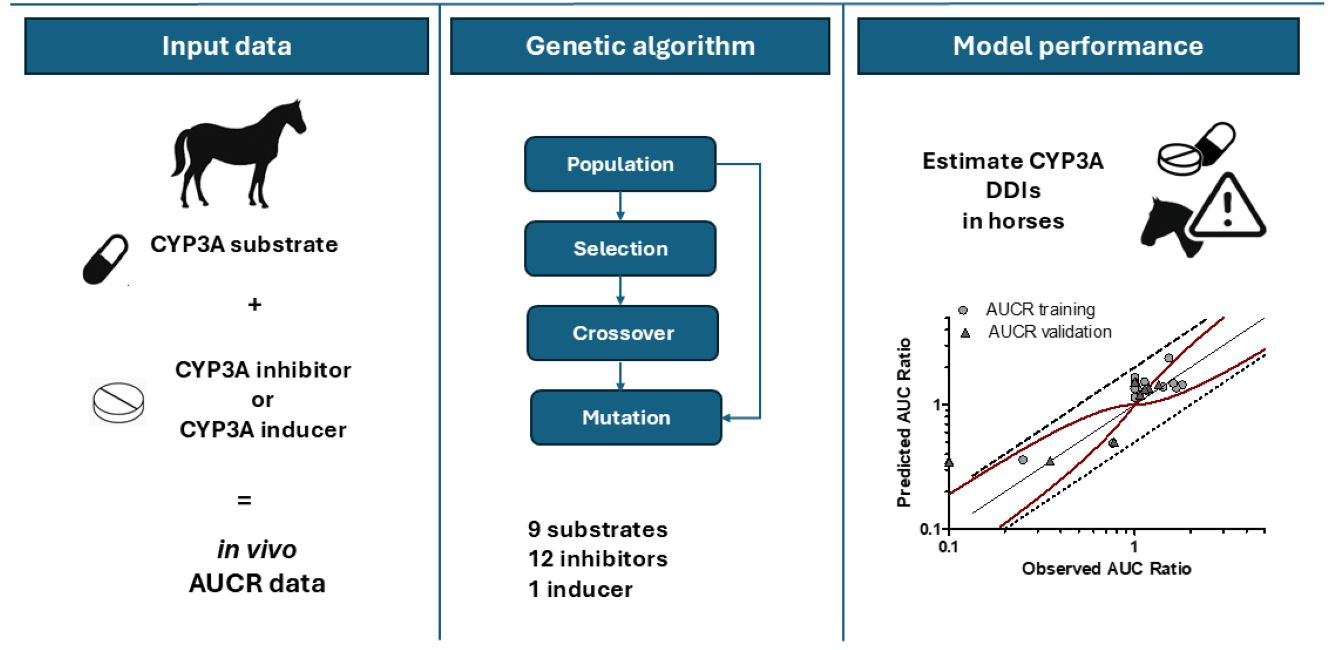
A Genetic Algorithm-Based Approach for Quantitative Prediction of Drug-Drug Interactions Caused by Cytochrome P450 3A Inhibition or Induction in Horses

 , , and
 Abstract
Share and Cite
Di Paolo, V.; Ferrari, F.M.; Poggesi, I.; Dacasto, M.; Quintieri, L.; Capolongo, F. A Genetic Algorithm-Based Approach for Quantitative Prediction of Drug-Drug Interactions Caused by Cytochrome P450 3A Inhibition or Induction in Horses. Pharmaceuticals 2026, 19, 815. https://doi.org/10.3390/ph19060815
Di Paolo V, Ferrari FM, Poggesi I, Dacasto M, Quintieri L, Capolongo F. A Genetic Algorithm-Based Approach for Quantitative Prediction of Drug-Drug Interactions Caused by Cytochrome P450 3A Inhibition or Induction in Horses. Pharmaceuticals. 2026; 19(6):815. https://doi.org/10.3390/ph19060815
Chicago/Turabian StyleDi Paolo, Veronica, Francesco Maria Ferrari, Italo Poggesi, Mauro Dacasto, Luigi Quintieri, and Francesca Capolongo. 2026. "A Genetic Algorithm-Based Approach for Quantitative Prediction of Drug-Drug Interactions Caused by Cytochrome P450 3A Inhibition or Induction in Horses" Pharmaceuticals 19, no. 6: 815. https://doi.org/10.3390/ph19060815
APA StyleDi Paolo, V., Ferrari, F. M., Poggesi, I., Dacasto, M., Quintieri, L., & Capolongo, F. (2026). A Genetic Algorithm-Based Approach for Quantitative Prediction of Drug-Drug Interactions Caused by Cytochrome P450 3A Inhibition or Induction in Horses. Pharmaceuticals, 19(6), 815. https://doi.org/10.3390/ph19060815