Advances in Biosimilars: A Systematic Review of Machine Learning Applications

Abstract
1. Introduction
2. Methods
2.1. Search Strategy
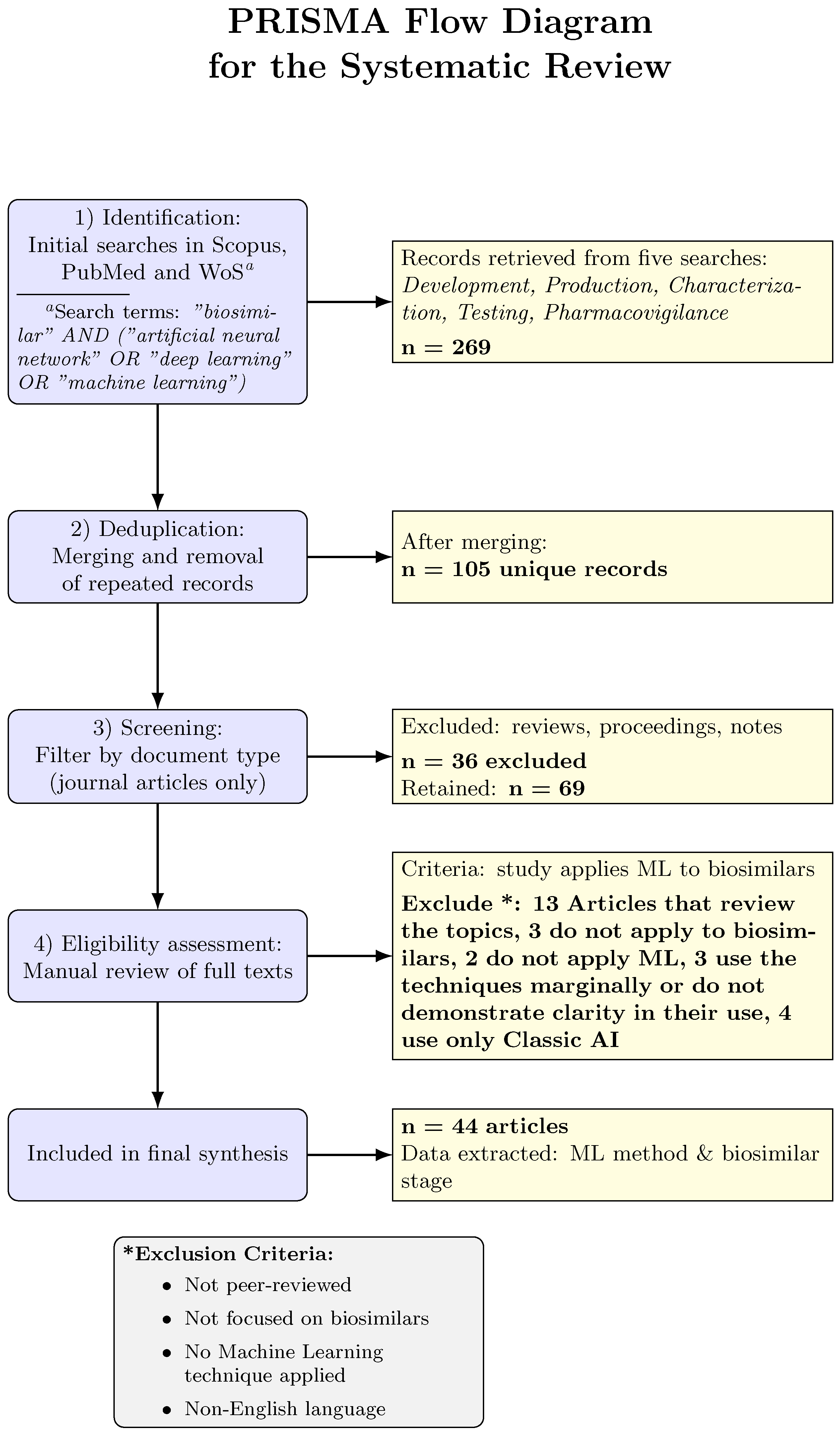
2.2. Selection of Articles for Analysis of the Results
- Inclusion criteria: (1) Studies must be articles in peer-reviewed journals presenting original research (not reviews or editorials [32,33] or notes [3,34,35]); (2) the study focuses on biosimilars (development, production, analysis, or use of biosimilar products), and (3) the study employs at least one ML or AI technique as part of its methodology or analysis.
- Exclusion criteria: Articles not written in English were excluded (to ensure that the methodology was interpreted), as were studies not focused on biosimilars (e.g., general bioprocessing studies without a biosimilar context) and studies that did not apply any ML techniques (e.g., if only mentioned conceptually). Conference proceedings, theses [36,37], and other unpublished works were also excluded to maintain consistency [38,39,40,41]. In particular, review articles were excluded to focus on empirical research [1,19,42,43,44,45,46,47,48,49,50,51,52,53,54,55,56,57,58,59,60,61,62,63]; if a review was found in the search results, it was discarded rather than included in the analysis of ML applications.
2.3. Operational Definition of Empirical ML
2.4. Data Extraction and Analysis
- Development and design: early-stage development including molecular design, in silico studies, and formulation development.
- Production and manufacturing: development of bioprocesses, optimization of manufacturing (upstream and downstream processes), and scaling up.
- Characterization and quality control: analytical characterization, comparability exercises, and quality assurance tests to establish similarity to the reference product.
- Clinical trials (efficacy and safety): preclinical studies and clinical trials that evaluate the efficacy, safety, and immunogenicity of the biosimilar.
- Pharmacovigilance and post-marketing surveillance: post-approval surveillance of the safety and efficacy of biosimilars, including real-world evidence and monitoring of adverse events.
3. Results
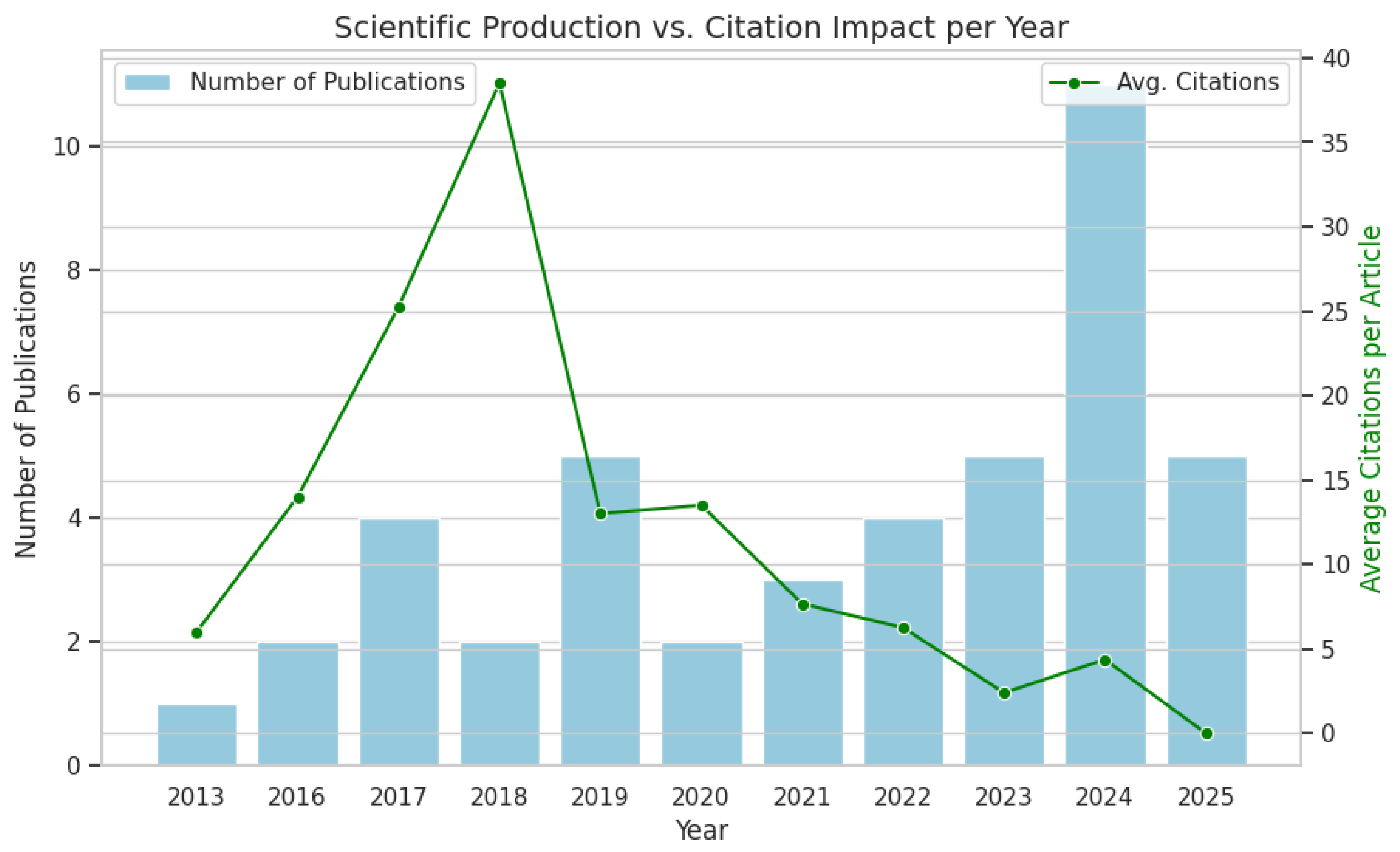
3.1. Brief Summary of the Articles Studied
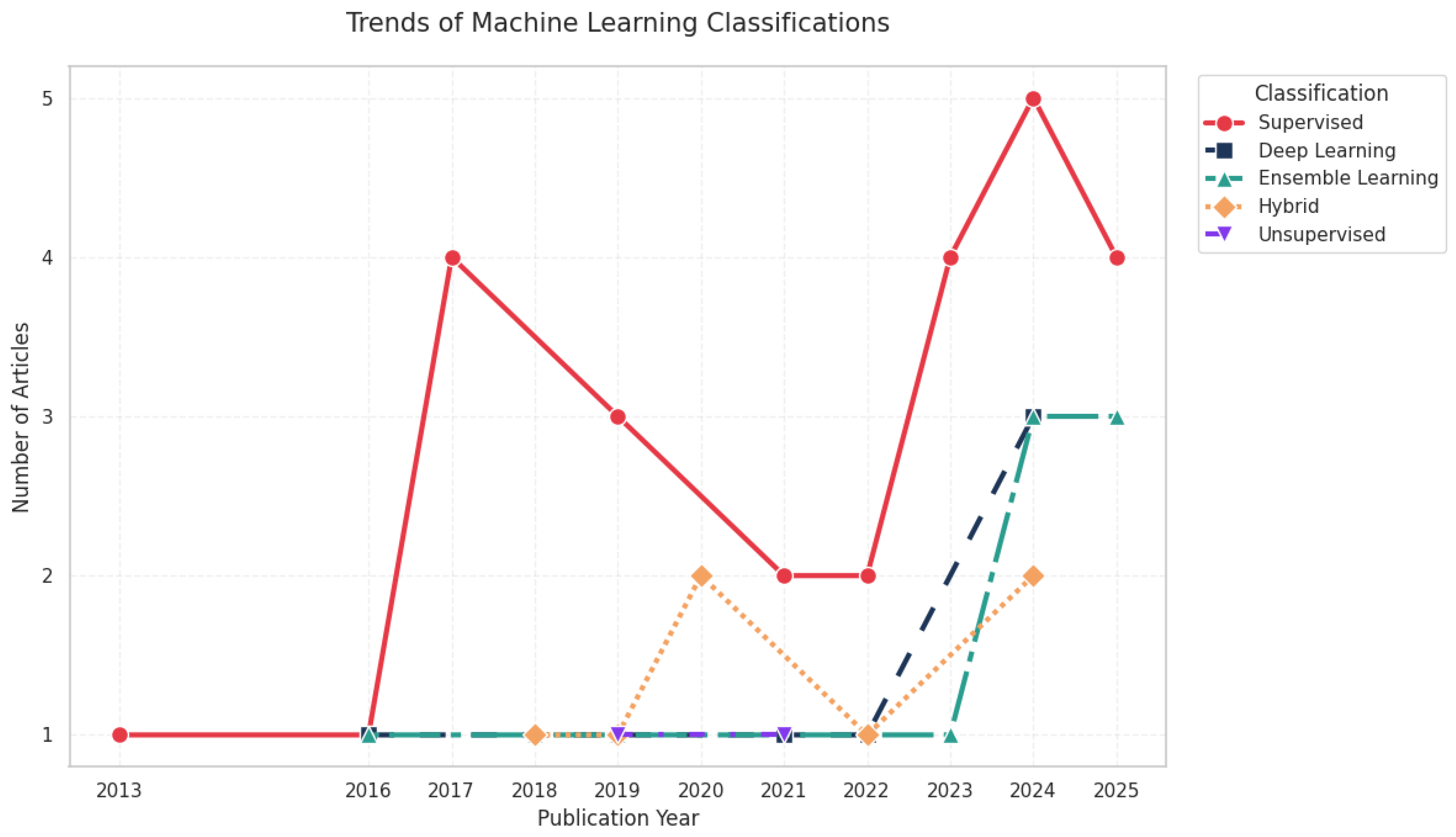
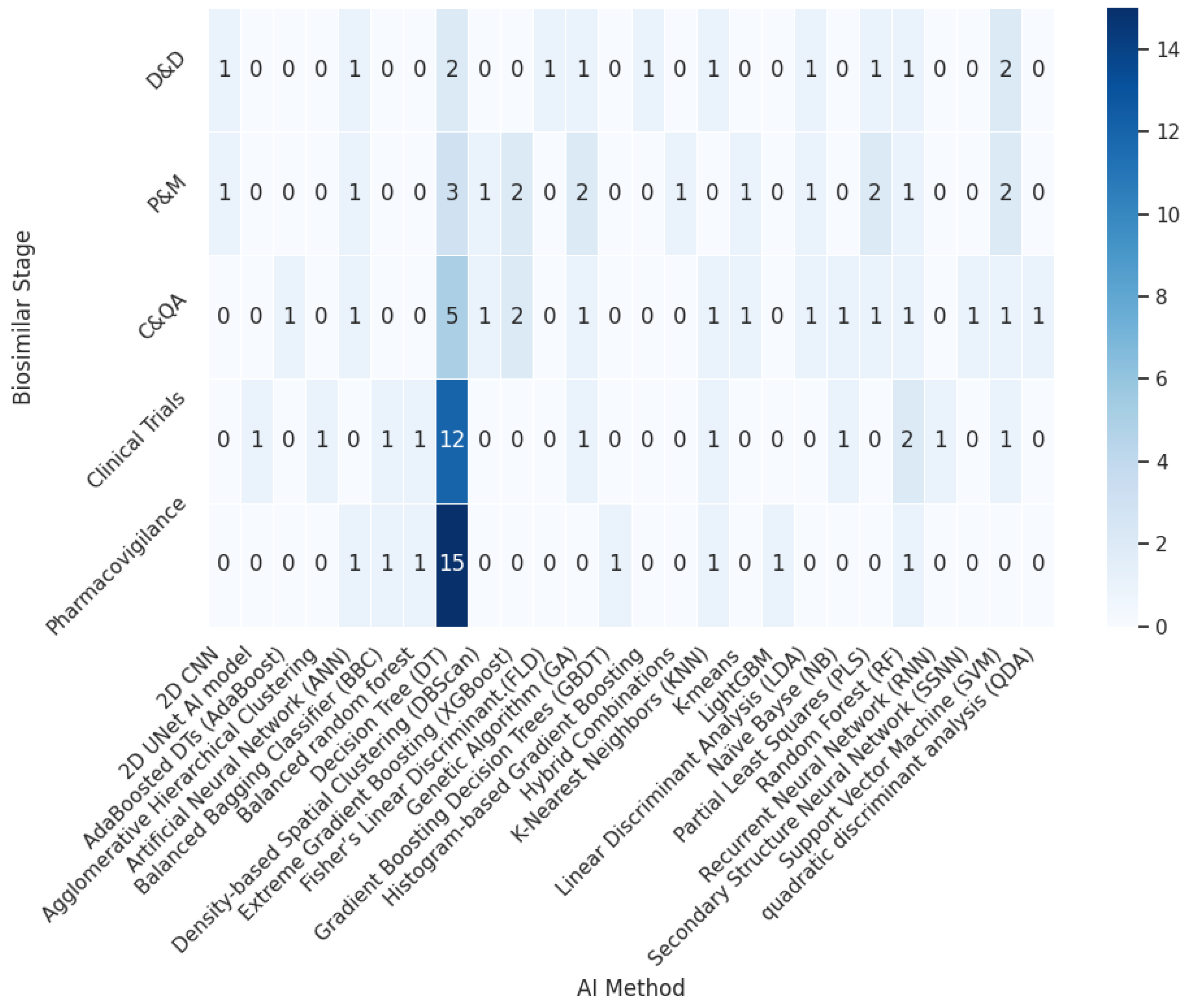
3.2. AI Techniques Used in Biosimilar Research
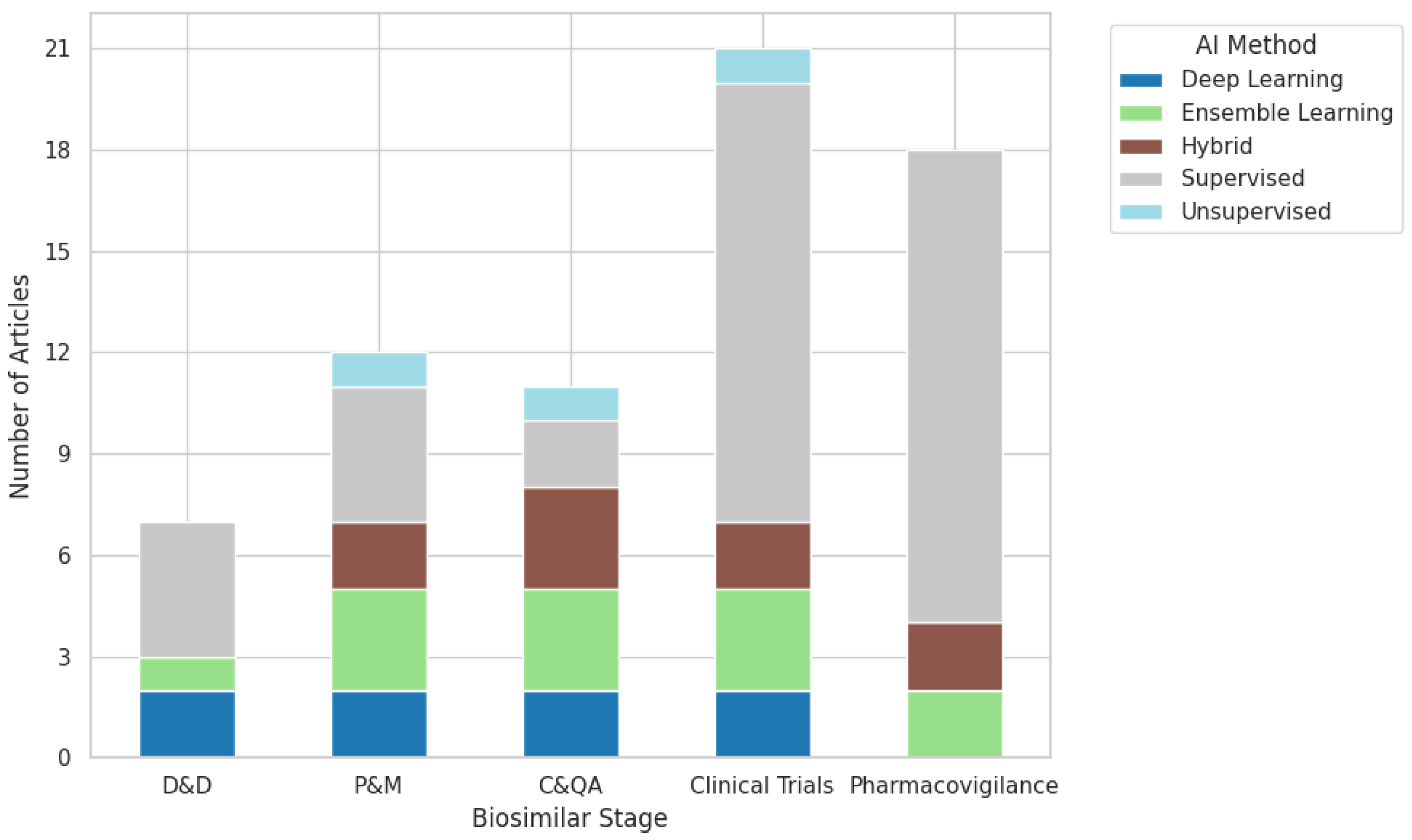
3.3. Biosimilar Stages Addressed by AI Applications
3.3.1. Design and Development (D&D)
3.3.2. Production and Manufacturing (P&M)
3.3.3. Characterization and Quality Control (C&QA)
3.3.4. Clinical Trials (Efficacy and Safety)
3.3.5. Pharmacovigilance
4. Discussion
Main Findings
5. Comparison with Other Areas
6. Challenges and Future Prospects
7. Conclusions
8. Limitations of Research
9. Future Research Opportunities
- Applying advanced ML techniques (such as reinforcement learning or more sophisticated deep learning models) to biosimilar problems that have not yet been fully explored, such as adaptive clinical trial simulations or real-time release tests with IoT data integration, is beginning to see some conceptual work in these directions, but practical implementations are still few.
- Expanding the scope of data used by the ML, for example, by incorporating omics data (genomics, cell line proteomics) to improve the development of cell lines for biosimilars, or using ML to integrate multi-attribute analytical data for a holistic similarity assessment.
- Evaluating the generalizability of ML models across products: an interesting question is whether a model trained on data from one biosimilar process could be transferred or adapted to another product with minimal retraining, providing insight into the underlying principles that ML captures; this could make development easier in the future.
Supplementary Materials
Author Contributions
Funding
Data Availability Statement
Conflicts of Interest
Appendix A. Review Matrix

| Paper | Core Algorithms/Models | Biosimilar Development Stage | Why |
|---|---|---|---|
| Alam et al., 2024 [105] | 2D CNN | Production | Interprets CNN outputs using SHAP and Bayesian optimization to match biosimilar CQAs to the reference molecule. |
| Aliyev et al., 2019 [96] | Decision Tree (DT) | Clinical/HTA | Uses decision trees to demonstrate higher effectiveness and cost-efficiency of biosimilars. |
| Alizadeh et al., 2024 [97] | Decision Tree (DT) | Preclinical/CMC | Establishes cost-effective dosing strategies and long-term biologic maintenance through clinical-economic modeling. |
| Blanken et al., 2018 [129] | Decision Tree (DT) | Econ/HTA | Validates the economic efficiency of biosimilar entry in respiratory health through probabilistic sensitivity analysis. |
| Borget et al., 2025 [135] | Decision Tree (DT) | Clinical/HTA | Implements decision-tree modeling to support clinical decision-making and cost-effectiveness in reproductive health. |
| Brühlmann et al., 2017 [94] | Decision Tree (DT) | Production | Automates culture supplement selection via multivariate analysis and decision trees to optimize protein glycosylation. |
| Castro-Corredor et al., 2023 [108] | Balanced Bagging Classifier (BBC); Balanced random forest | Clinical/RWE | Applies ML to real-world data to predict therapy discontinuation and clinical response in biosimilar users. |
| Catt et al., 2019 [109] | Decision Tree (DT) | Clinical/HTA | Models risk-benefit ratios and economic impacts of switching to infliximab biosimilars under clinical uncertainty. |
| Chakravarty et al., 2021 [103] | Recurrent Neural Network (RNN) | Preclinical/CMC | Refines physiologically-based pharmacokinetic models using ML to predict biosimilar exposure and systemic distribution. |
| Dilokthornsakul et al., 2023 [110] | Decision Tree (DT) | Clinical/HTA | Projects long-term cost-utility and clinical response quality for biosimilars compared to standard biological therapy. |
| Fenu et al., 2022 [111] | Decision Tree (DT) | Clinical/HTA | Predicts clinical remission rates and sustained therapeutic benefits for biosimilars using hybrid transition models. |
| Fischer et al., 2025 [112] | Decision Tree (DT) | Clinical/HTA | Analyzes the impact of biosimilar pricing on treatment sequences and health-economic scenarios for anti-TNF therapies. |
| Gangwar et al., 2024 [92] | Random Forest (RF); Hybrid Combinations | Production/CMC | Evaluates the impact of media components on critical charge variants using gradient boosting to ensure biosimilarity. |
| Germeni et al., 2024 [113] | Decision Tree (DT) | Clinical/HTA | Quantifies the economic and clinical consequences of switching or discontinuing biosimilar anti-C5 therapies. |
| Hamla et al., 2022 [128] | Partial Least Squares Regression (PLSR); Support Vector Machine Regression (SVMR) | CMC/Dev | Employs non-linear SVR to predict glycosylation attributes as a high-throughput alternative for analytical similarity. |
| Hernandez et al., 2020 [98] | Decision Tree (DT) | Post-approval/HTA | An economic model using a hybrid decision tree is developed to evaluate biosimilar pricing and market access scenarios. |
| Hombalimath et al. [101] | ANN (Neural Network) | Production | Optimizes enzymatic bioprocess yield and consistency through empirical neural network modeling. |
| Hou et al., 2025 [104] | Random Forest (RF); Gradient Boosting Decision Trees (GBDT); Artificial Neural Network (ANN); LightGBM; K-Nearest Neighbors (KNN) | Post-approval/Clinical | Predicts clinical flare risk following non-medical switching to infliximab biosimilars using automated ML. |
| Hudnik et al., 2023 [90] | Partial Least Squares (PLS) | Market | Forecasts market uptake and budget impacts of new biosimilar entries through data-driven sensitivity analysis. |
| Jalali et al., 2013 [134] | Genetic Algorithm (GA); Linear Discriminant Analysis (LDA); Support Vector Machine (SVM) | CMC/Characterization | Applied multiple ML classifiers to evaluate the analytical similarity and structural integrity of therapeutic proteins. |
| Karagianni et al., 2019 [93] | Agglomerative Hierarchical Clustering; Random Forest (RF) | Preclinical | Identifies molecular efficacy signatures via RF to demonstrate similarity in mechanisms of action at the systems level. |
| Kim et al., 2016 [123] | K-Nearest Neighbors (KNN); Support Vector Machine (SVM); Linear Discriminant Analysis (LDA); quadratic discriminant analysis (QDA); Naïve Bayse (NB); Decision Tree (DT); Random Forest (RF); AdaBoosted DTs (AdaBoost) | CMC/Characterization | Validates multiple ML classifiers for robust analytical comparability and decision-making in bioprocess development. |
| Lehmann et al., 2024 [114] | Decision Tree (DT) | Clinical/HTA | Develops validated models to refine clinical assumptions and dose distribution for follicle-stimulating biosimilars. |
| Olfatifar et al., 2022 [115] | Decision Tree (DT); microsimulation (MS) approach | Post-approval/HTA | Projects quality-adjusted life years (QALYs) and economic impacts for biosimilars in emerging healthcare markets. |
| Orsini et al., 2024 [106] | 2D UNet (AI) | Clinical/Monitoring | Applies deep learning for precise morphological monitoring of skin responses to biological and biosimilar therapies. |
| Osiri et al., 2021 [116] | Decision Tree (DT) | Clinical/HTA | Evaluates budget impact and resource allocation over multi-year horizons following the introduction of targeted biosimilars. |
| Pathak et al., 2022 [102] | ANN (Neural Network) | CMC/Development | Predicts mixed-mode chromatographic performance to establish operational design spaces for teriparatide biosimilars. |
| Petryszyn et al. [99] | Decision Tree (DT) | Clinical/HTA | Ranks the cost-effectiveness of therapeutic sequences under varying biosimilar pricing and discount scenarios. |
| Prabha et al., 2024 [124] | Naïve Bayse (NB); Random Forest (RF); K-Nearest Neighbors (KNN); Support Vector Machine (SVM) | CMC/Characterization | Classifies structural fidelity and molecular identity of inhibitors using ML-based chemical fingerprints. |
| Shatat et al., 2021 [91] | K-means; DBScan | Production | Employs unsupervised clustering of peptide mapping data to ensure identity and high-resolution biosimilarity. |
| Shrivastava et al., 2025 [127] | Extreme Gradient Boosting (XGBoost) | Production/Analytics | Quantifies glycan similarity indices (GIs) using gradient boosting for automated real-time quality control. |
| Shrivastava, et al., 2024 [126] | Extreme Gradient Boosting (XGBoost) | Production | Applied gradient boosting algorithms to quantify glycan similarity indices (GIs) and ensure real-time quality control during biosimilar manufacturing. |
| Sklepari et al., 2016 [107] | Secondary Structure Neural Network (SSNN) | Characterization | Deconvolves complex spectral data using neural networks to confirm higher-order structural comparability in insulin. |
| Sokolov et al., 2017 [95] | Decision Tree (DT) | Econ/HTA | Models the dynamic adoption and health system utility associated with the transition to biosimilar-based care. |
| Sokolov et al., 2018 [89] | Decision Tree (DT); Partial Least Squares (PLS); Genetic Algorithm (GA) | Production | Systematically optimizes upstream bioprocesses to improve the yield and consistency of critical quality attributes. |
| Spahn et al., 2017 [130] | Genetic Algorithm (GA) | Development/Production | Uses genetic algorithms and Markov models to design cell lines that match the specific glycan profiles of the originator. |
| Sussell et al., 2022 [100] | Decision Tree (DT) | Clinical/HTA | Used decision-tree with Markov modeling optimization to evaluate the long-term cost-effectiveness and therapeutic value of switching to biosimilars in chronic care. |
| Tarallo et al., 2019 [117] | Decision Tree (DT) | Econ/HTA | Quantifies the economic impact and resource utilization shifts following the clinical switch to etanercept biosimilars. |
| Tjakra et al., 2025 [125] | Support Vector Machine (SVM); K-Nearest Neighbors (KNN); Histogram-based Gradient Boosting; Decision Tree (DT); Random Forest (RF); Fisher’s Linear Discriminant (FLD) | Preclinical/Formulation | Classifies drug diffusion through biological barriers via ML to evaluate bioequivalence in novel delivery systems. |
| Torre et al., 2024 [118] | Decision Tree (DT) | Econ/HTA | Estimates adherence-related cost savings and utility gains for new long-acting biosimilar insulin formulations. |
| Virani et al. 2024 [119] | Decision Tree (DT) | Clinical/HTA | Evaluates incremental cost-effectiveness ratios (ICERs) of biosimilars based on vision-related clinical outcomes. |
| Wang et al., 2017 [120] | Decision Tree (DT) | Econ/HTA | Analyzes market dynamics and price competition triggered by the introduction of filgrastim biosimilars. |
| Xue et al., 2019 [121] | Decision Tree (DT) | Econ/HTA | Compares the cost per live birth of originator vs. biosimilar follitropins in assisted reproduction through decision modeling. |
| Zhang et al., 2023 [122] | Decision Tree (DT) | Clinical/HTA | Maps health-related quality of life and efficacy trade-offs for biosimilars using Bayesian network meta-analysis. |
References
- Bas, T.G.; Duarte, V. Biosimilars in the Era of Artificial Intelligence—International Regulations and the Use in Oncological Treatments. Pharmaceuticals 2024, 17, 925. [Google Scholar] [CrossRef]
- Nikitina, V.; Santi Laurini, G.; Montanaro, N.; Motola, D. Comparative Safety Profiles of Oncology Biosimilars vs. Originators in Europe: An Analysis of the EudraVigilance Database. Cancers 2023, 15, 3680. [Google Scholar] [CrossRef]
- Bas, T. Biosimilars for the next decade in Latin America: A window of opportunity. Expert Opin. Biol. Ther. 2023, 23, 659–669. [Google Scholar] [CrossRef]
- Bressler, N.M.; Kim, T.; Oh, I.; Russo, P.; Kim, M.Y.; Woo, S.J. Immunogenicity With Ranibizumab Biosimilar SB11 (Byooviz) and Reference Product Lucentis and Association With Efficacy, Safety, and Pharmacokinetics: A Post Hoc Analysis of a Phase 3 Randomized Clinical Trial. JAMA Ophthalmol. 2023, 141, 117–127. [Google Scholar] [CrossRef]
- Sayah, R.; Awada, S.; Ismaiil, L.; Hatem, G. Assessment of the differences between generic and biosimilar drugs: A brief literature review. J. Generic Med. Bus. J. Generic Med. Sect. 2023, 19, 124–129. [Google Scholar] [CrossRef]
- Lombardo, M.; Missiroli, F.; Cerri, L.; Sorge, R.P.; Cesareo, M.; Ricci, F. Real-World Use of Off-Label MVASI in the Treatment of Patients With Neovascular AMD and DME. Transl. Vis. Sci. Technol. 2024, 13, 17. [Google Scholar] [CrossRef]
- Liu, C.Y.; Hong, Z.; Dai, S.; Sheth, S.; Shah, S. Bevacizumab biosimilar (bevacizumab-awwb) is safe in the treatment of retinopathy of prematurity. Clin. Exp. Ophthalmol. 2024, 52, 1023–1024. [Google Scholar] [CrossRef]
- Singh, S.; Kumar, R.; Payra, S.; Singh, S.K. Artificial Intelligence and Machine Learning in Pharmacological Research: Bridging the Gap Between Data and Drug Discovery. Cureus 2023, 15, e44359. [Google Scholar] [CrossRef] [PubMed]
- Boopathi, L.K.; Raja, N. Artificial Intelligence and Machine Learning: Enhancing the Future of Regulatory Affairs. Int. J. Drug Regul. Aff. 2024, 12, 53–60. [Google Scholar] [CrossRef]
- Esplugues, F.J.; Andújar, I.; Esplugues, J.V. The impact of EU public procurement regulations on tenders in Spain: A study with adalimumab. Front. Pharmacol. 2024, 15, 1447324. [Google Scholar] [CrossRef] [PubMed]
- Sharma, A.; Holz, F.G.; Kumar, N.; Sarraf, D.; Ayachit, S.; Mishra, C.; Tufail, A.; Chakraborty, D.; Rachitskaya, A.; Eichenbaum, D.; et al. Biosimilar Ranibizumab (Ranieyes) Safety and Efficacy in the Real World: BRESER Study. J. VitreoRetin. Dis. 2025, 9, 330–335. [Google Scholar] [CrossRef]
- Chantzaras, A.; Yfantopoulos, J.; Koutsogianni, K. Knowledge and Attitudes of Patients with Rheumatoid Diseases towards Biosimilars. Mediterr. J. Rheumatol. 2024, 35, 608–616. [Google Scholar] [CrossRef]
- Center for Drug Evaluation and Research (CDER). Guiding Principles of Good AI Practice in Drug Development; FDA: Silver Spring, MD, USA, 2026. [Google Scholar]
- Dermawan, D.; Alotaiq, N. From Lab to Clinic: How Artificial Intelligence (AI) Is Reshaping Drug Discovery Timelines and Industry Outcomes. Pharmaceuticals 2025, 18, 981. [Google Scholar] [CrossRef] [PubMed]
- Zhixian, X.; Xiaofeng, Z.; Ali, M.; Jianfei, G.; Yingping, Z.; Chu, J.; Guo, M.; Wang, G. A machine learning-based approach for improving plasmid DNA production in Escherichia Coli Fed-batch Ferment. Biotechnol. J. 2024, 19, 2400140. [Google Scholar] [CrossRef]
- Sutthibutpong, T.; Posansee, K.; Liangruksa, M.; Termsaithong, T.; Piyayotai, S.; Phitsuwan, P.; Saparpakorn, P.; Hannongbua, S.; Laomettachit, T. Combining Deep Learning and Structural Modeling to Identify Potential Acetylcholinesterase Inhibitors from Hericium Erinaceus. ACS Omega 2024, 9, 16311–16321. [Google Scholar] [CrossRef] [PubMed]
- Raman, K.; Kumar, R.; Musante, C.J.; Madhavan, S. Integrating Model-Informed Drug Development With AI: A Synergistic Approach to Accelerating Pharmaceutical Innovation. Clin. Transl. Sci. 2025, 18, e70124. [Google Scholar] [CrossRef] [PubMed]
- Desai, D.; Kantliwala, S.V.; Vybhavi, J.; Ravi, R.; Patel, H.; Patel, J. Review of AlphaFold 3: Transformative Advances in Drug Design and Therapeutics. Cureus 2024, 16, e63646. [Google Scholar] [CrossRef]
- Askari, S.; Ghofrani, A.; Taherdoost, H. Transforming Drug Design: Innovations in Computer-Aided Discovery for Biosimilar Agents. BioMedInformatics 2023, 3, 1178–1196. [Google Scholar] [CrossRef]
- Shahin, M.H.; Barth, A.; Podichetty, J.T.; Liu, Q.; Goyal, N.; Jin, J.Y.; Ouellet, D. Artificial Intelligence: From Buzzword to Useful Tool in Clinical Pharmacology. Clin. Pharmacol. Ther. 2024, 115, 698–709. [Google Scholar] [CrossRef]
- Tiwari, P.C.; Pal, R.; Chaudhary, M.J.; Nath, R. Artificial intelligence revolutionizing drug development: Exploring opportunities and challenges. Drug Dev. Res. 2023, 84, 1652–1663. [Google Scholar] [CrossRef]
- Huang, D.; Yang, M.; Wen, X.; Xia, S.; Yuan, B. AI-Driven Drug Discovery: Accelerating the Development of Novel Therapeutics in Biopharmaceuticals. J. Knowl. Learn. Sci. Technol. 2024, 3, 206–224. [Google Scholar] [CrossRef]
- Katkar, T.J.; Kengar, M.D.; Aiwale, P.P.; Kamble, S.K.; Jagtap, R.S.; Patil, A.A. Impact of Artificial Intelligence in Drug Discovery and Development. Int. J. Adv. Res. Sci. Commun. Technol. 2024, 4, 27–31. [Google Scholar] [CrossRef]
- Mohammadi, G.; Azizmohammad Looha, M.; Pourhoseingholi, M.A.; Rezaei Tavirani, M.; Sohrabi, S.; Zareie Shab Khaneh, A.; Piri, H.; Alaei, T.; Parvani, N.; Vakilzadeh, I.; et al. Classification and Diagnostic Prediction of Colorectal Cancer Mortality Based on Machine Learning Algorithms: A Multicenter National Study. Asian Pac. J. Cancer Prev. 2024, 25, 333–342. [Google Scholar] [CrossRef] [PubMed]
- Ma, G.; You, S.; Xie, Y.; Gu, B.; Liu, C.; Hu, X.; Song, S.; Wang, B.; Yang, Z. Pretreatment 18F-FDG uptake heterogeneity may predict treatment outcome of combined Trastuzumab and Pertuzumab therapy in patients with metastatic HER2 positive breast cancer. Cancer Imaging 2023, 23, 90. [Google Scholar] [CrossRef]
- Gouma, A.G.A.; Alhaj, A.A.K.; Karar, O.M.F.A.; Mahgoub, M.A.I.; Saleh, A.N.A. The convergence of AI and pharmaceutics a new era of data-driven drug development. Int. J. Sci. Res. Arch. 2025, 14, 947–960. [Google Scholar] [CrossRef]
- Cui, Y.R.; Liang, X.L.; Li, Y. Machine-learning-derived prediction models of outcomes for patients with pseudomyxoma peritonei: Development and validation in two retrospective cohorts. Holist. Integr. Oncol. 2025, 4, 43. [Google Scholar] [CrossRef]
- Maniaci, A.; Lavalle, S.; Gagliano, C.; Lentini, M.; Masiello, E.; Parisi, F.; Iannella, G.; Cilia, N.D.; Salerno, V.; Cusumano, G.; et al. The Integration of Radiomics and Artificial Intelligence in Modern Medicine. Life 2024, 14, 1248. [Google Scholar] [CrossRef]
- Achieng M, N. The Use of AI in Predicting Patient Outcomes. Res. Output J. Public Health Med. 2024, 3, 38–41. [Google Scholar] [CrossRef]
- Dawana, I.R.; Prahani, B.K.; Hariyono, E.; Ghofur, M.A.; Wibowo, F.C.; Bunyamin, M.A.H. Utilisation of augmented reality technology in physics education: A bibliometric analysis and its impact on Sustainable Development Goals (SDGs). E3S Web Conf. 2024, 513, 04006. [Google Scholar] [CrossRef]
- Hernández-Vásquez, A.; Alarcon-Ruiz, C.A.; Bendezu-Quispe, G.; Comandé, D.; Rosselli, D. A bibliometric analysis of the global research on biosimilars. J. Pharm. Policy Pract. 2018, 11, 6. [Google Scholar] [CrossRef]
- Memisoglu, M. Changing biotechnology dynamics—A blessing or a curse? Drug Discov. Today 2020, 25, 470–472. [Google Scholar] [CrossRef] [PubMed]
- Turner, J. Our Annual Meeting Is Fast Approaching: Chicago Here We Come! Ther. Innov. Regul. Sci. 2017, 51, 272–273. [Google Scholar] [CrossRef] [PubMed][Green Version]
- Goktas, P.; Karakaya, G.; Kalyoncu, A.; Damadoglu, E. Reply to “Artificial intelligence’s potential in tailoring prescription of biological therapy for chronic rhinosinusitis”. J. Allergy Clin. Immunol. Pract. 2023, 11, 3286–3287. [Google Scholar] [CrossRef] [PubMed]
- Simpson, I. Therapeutic Delivery–Industry Update covering February 2024. Ther. Deliv. 2024, 15, 481–488. [Google Scholar] [CrossRef]
- Padma, S. Industrial and Biopharmaceutical Research in Bioinformatics. In Bioinformatics and Computational Biology; Chapman and Hall/CRC: Boca Raton, FL, USA, 2023; pp. 327–337. [Google Scholar] [CrossRef]
- Xia, F.; Zhang, L.; Niu, F.; Liu, L.; Ren, J.; Xie, Z. Research on Chinese Biosimilars Based on LDA Thematic Modeling. In Proceedings of the 2024 International Conference on Mathematics and Machine Learning; Association for Computing Machinery: New York, NY, USA, 2025; pp. 160–168. [Google Scholar] [CrossRef]
- Tiwold, E.; Gyorgypal, A.; Chundawat, S. Recent Advances in Biologic Therapeutic N-Glycan Preparation Techniques and Analytical Methods for Facilitating Biomanufacturing Automation. J. Pharm. Sci. 2023, 112, 1485–1491. [Google Scholar] [CrossRef]
- Chen, F.C. China: The Next Pharmacy of the World? Trends Pharmacol. Sci. 2018, 39, 843–848. [Google Scholar] [CrossRef]
- Suresh, B. Reimagining Indian Pharma: Tariffs, Technology, and the AI Tectonic Shift. Indian Drugs 2025, 62, 5–6. [Google Scholar] [CrossRef]
- Schuhmacher, A.; Brieke, C.; Gassmann, O.; Hinder, M.; Hartl, D. Systematic risk identification and assessment using a new risk map in pharmaceutical R&D. Drug Discov. Today 2021, 26, 2786–2793. [Google Scholar] [CrossRef]
- Niazi, S.K. Continuous Manufacturing of Recombinant Drugs: Comprehensive Analysis of Cost Reduction Strategies, Regulatory Pathways, and Global Implementation. Pharmaceuticals 2025, 18, 1157. [Google Scholar] [CrossRef]
- McGonigle, P. How Biologics Have Changed the Drug Discovery Landscape. Annu. Rev. Pharmacol. Toxicol. 2025, 65, 29–46. [Google Scholar] [CrossRef]
- Cunha, D.R.; Quinaz, M.B.; Segundo, M.A. Biopharmaceutical analysis—Current analytical challenges, limitations, and perspectives. Anal. Bioanal. Chem. 2026, 418, 373–394. [Google Scholar] [CrossRef] [PubMed]
- Ranbhor, R.S. Advancing Monoclonal Antibody Manufacturing: Process Optimization, Cost Reduction Strategies, and Emerging Technologies. Biol. Targets Ther. 2025, 19, 177–187. [Google Scholar] [CrossRef]
- Zia, S.; Pizzuti, V.; Paris, F.; Alviano, F.; Bonsi, L.; Zattoni, A.; Reschiglian, P.; Roda, B.; Marassi, V. Emerging technologies for quality control of cell-based, advanced therapy medicinal products. J. Pharm. Biomed. Anal. 2024, 246, 116182. [Google Scholar] [CrossRef]
- Rathore, A.; Sarin, D. What should next-generation analytical platforms for biopharmaceutical production look like? Trends Biotechnol. 2024, 42, 282–292. [Google Scholar] [CrossRef]
- Malheiro, V.; Duarte, J.; Veiga, F.; Mascarenhas-Melo, F. Exploiting Pharma 4.0 Technologies in the Non-Biological Complex Drugs Manufacturing: Innovations and Implications. Pharmaceutics 2023, 15, 2545. [Google Scholar] [CrossRef]
- Demetzos, C.N. Nanosimilars: A Scientific or A Regulatory Debate? AAPS J. 2024, 26, 74. [Google Scholar] [CrossRef]
- Niazi, S.K. Molecular Biosimilarity—An AI-Driven Paradigm Shift. Int. J. Mol. Sci. 2022, 23, 10690. [Google Scholar] [CrossRef]
- Yeshi, K.; Jamtsho, T.; Wangchuk, P. Current Treatments, Emerging Therapeutics, and Natural Remedies for Inflammatory Bowel Disease. Molecules 2024, 29, 3954. [Google Scholar] [CrossRef] [PubMed]
- Papaioannou, C. Advancements in the treatment of age-related macular degeneration: A comprehensive review. Postgrad. Med. J. 2024, 100, 445–450. [Google Scholar] [CrossRef]
- Capurso, G.; Pedica, F.; Palumbo, D.; Della-Torre, E. IgG4-related autoimmune liver disease. Minerva Gastroenterol. 2023, 69, 23–49. [Google Scholar] [CrossRef] [PubMed]
- Ghanchi, F.; Bourne, R.; Downes, S.; Gale, R.; Rennie, C.; Tapply, I.; Sivaprasad, S. An update on long-acting therapies in chronic sight-threatening eye diseases of the posterior segment: AMD, DMO, RVO, uveitis and glaucoma. Eye 2022, 36, 1154–1167. [Google Scholar] [CrossRef]
- Padula, W.; Steinberg, I. What current and missing data can teach us about medication errors. BMJ Qual. Saf. 2021, 30, 89–91. [Google Scholar] [CrossRef]
- Eghbali-Zarch, M.; Masoud, S. Application of machine learning in affordable and accessible insulin management for type 1 and 2 diabetes: A comprehensive review. Artif. Intell. Med. 2024, 151, 102868. [Google Scholar] [CrossRef]
- Mieczkowski, C. The Evolution of Commercial Antibody Formulations. J. Pharm. Sci. 2023, 112, 1801–1810. [Google Scholar] [CrossRef]
- Azzano, P.; Dufresne, É.; Poder, T.; Bégin, P. Economic considerations on the usage of biologics in the allergy clinic. Allergy Eur. J. Allergy Clin. Immunol. 2021, 76, 191–209. [Google Scholar] [CrossRef]
- Linial, M.; Rappoport, N.; Ofer, D. Overlooked Short Toxin-Like Proteins: A Shortcut to Drug Design. Toxins 2017, 9, 350. [Google Scholar] [CrossRef]
- Sunil, V.; Mohit, K.; Akondi, B.R. The Increasing Demand for Skilled Professionals in the Field of Pharmacovigilance. Asian J. Pharm. Res. Health Care 2024, 16, 109–112. [Google Scholar] [CrossRef]
- Ozudogru, E.; Kurt, T.; Arslan, Y.E. Decellularized tumor matrices as biomimetic cancer niche: A new perspective on cancer research and therapy. Biomed. Mater. 2025, 20, 062003. [Google Scholar] [CrossRef]
- He, Q.; Chen, J.q.; Yu, X.b.; Liao, J.h.; Huang, Z.w.; Yang, J.y.; Wu, T.H.; Song, W.j.; Luo, J.; Tao, Q.w. Knowledge mapping of biological disease-modifying anti-rheumatic drugs for axial spondyloarthritis: A bibliometric study. Clin. Rheumatol. 2023, 42, 1999–2011. [Google Scholar] [CrossRef]
- Perpoil, A.; Grimandi, G.; Birklé, S.; Simonet, J.F.; Chiffoleau, A.; Bocquet, F. Public health impact of using biosimilars, is automated follow up relevant? Int. J. Environ. Res. Public Health 2021, 18, 186. [Google Scholar] [CrossRef]
- Iqbal, Z.; Sadaf, S. Biosimilars: A Comparative Study of Regulatory, Safety and Pharmacovigilance Monograph in the Developed and Developing Economies. J. Pharm. Pharm. Sci. 2022, 25, 149–182. [Google Scholar] [CrossRef]
- Honap, S.; Jairath, V.; Danese, S.; Peyrin-Biroulet, L. Navigating the complexities of drug development for inflammatory bowel disease. Nat. Rev. Drug Discov. 2024, 23, 546–562. [Google Scholar] [CrossRef]
- Krysanov, I.; Krysanova, V.; Ermakova, V. Clinical and Economic Aspects of the First Biosimilar Eculizumab use in Patients with Rare Diseases. Curr. Trends Biotechnol. Pharm. 2022, 16, 223–234. [Google Scholar]
- Niazi, S. Biosimilars Adoption: Recognizing and Removing the RoadBlocks. Clin. Outcomes Res. 2023, 15, 281–294. [Google Scholar] [CrossRef]
- Shafiulla, S.; Dhaneshwar, S. Recent Advancements in Antipsoriatic Therapy: An Update. Fabad J. Pharm. Sci. 2022, 1, 83–108. [Google Scholar] [CrossRef]
- Sheth, S.; Vashishta, L.; Goyal, R.; Rathore, A.; Chirmule, N. On the Manufacturers of Biosimilars in Asia. Clin. Pharmacol. Ther. 2023, 113, 23–26. [Google Scholar] [CrossRef]
- Singh, B.; Sharma, T.; Saini, S.; Kaur, R.; Jain, A.; Raza, K.; Beg, S. Systematic development of drug nanocargos using formulation by design (FbD): An updated overview. Crit. Rev. Ther. Drug Carr. Syst. 2020, 37, 229–269. [Google Scholar] [CrossRef]
- Singh, R.; Chandley, P.; Rohatgi, S. Recent Advances in the Development of Monoclonal Antibodies and Next-Generation Antibodies. ImmunoHorizons 2023, 7, 886–897. [Google Scholar] [CrossRef]
- Velichkovsky, B.M.; Osipov, G.S.; Nosovets, Z.A.; Velichkovsky, B.B. Personal Meaning and Solving Creative Tasks: Contemporary Neurocognitive Studies. Sci. Tech. Inf. Process. 2021, 48, 406–414. [Google Scholar] [CrossRef]
- Nag, A.; Singh, M.; Thomas, J.; Ravichandran, R.; Gupta, L.; Panjiyar, B.K. Role of Biologic Therapies in the Rheumatic Manifestations of Inflammatory Bowel Disease: A Systematic Analysis. Cureus 2023, 15, e45195. [Google Scholar] [CrossRef]
- Omar, M.; Bechman, K.; Russell, M.; Galloway, J. Rheumatology 2050: How our specialty is changing. Future Healthc. J. 2025, 12, 100485. [Google Scholar] [CrossRef]
- Shipa, M.; Heyer, N.; Mansoor, R.; Deakin, C.; Madenidou, A.V.; Bouraioui, A.; Fisher, C.; Leandro, M.; Ciurtin, C.; Sen, D. Adalimumab or etanercept as first line biologic therapy in enthesitis related arthritis (ERA)—A drug-survival single centre study spanning 10 years. Semin. Arthritis Rheum. 2022, 55, 152038. [Google Scholar] [CrossRef]
- LaVange, L. Statistics at FDA: Reflections on the Past Six Years. Stat. Biopharm. Res. 2019, 11, 1–12. [Google Scholar] [CrossRef]
- Chatterjee, S.; Chakraborty, S. Consensus on contentious issues relevant for breast cancer management for the Indian scenario: Statements following a multicentre expert group meeting. Indian J. Med. Res. 2021, 154, 180–188. [Google Scholar] [CrossRef]
- Hennessy, M. Reimagining Progress: Partnering for the Future of Bio/Pharma. BioPharm Int. 2025, 38, 1–5. [Google Scholar]
- Zhang, Y.; Chen, D.; Fu, M.; Shi, L.; Naci, H.; Wagner, A.K.; Ross, J.S.; Guan, X. Strength of evidence supporting cancer drug approvals in China between 2017 and 2021: A retrospective analysis. Lancet Oncol. 2025, 26, 1252–1260. [Google Scholar] [CrossRef]
- Liu Chen Kiow, J.; Hoang, T.; Bedi, H.K.; Majdzadeh Ardekani, Z.; Rosenfeld, D.; Reise-Filteau, M.; Bressler, B.; Leung, Y.; Rosenfeld, G. Real-world experience and long-term outcomes of a mandatory non-medical switch of adalimumab originator to biosimilars in inflammatory bowel disease. World J. Gastroenterol. 2024, 30, 4904–4913. [Google Scholar] [CrossRef]
- Tounekti, O.; Shubow, S.; Wassmer, S.; Van Tuyl, A.; Yang, L.; Gong, B.; Abhari, M.R.; Kalina, W.; Myler, H.; DelCarpini, J.; et al. 2025 White Paper on Recent Issues in Bioanalysis: Redosing Patients with AAV Gene Therapy; CRS Immunogenicity Risk; Shedding Assays; NHP Studies Immunogenicity; CMC vs Bioanalytical Assays; Artificial Intelligence-Powered Genomic Pipelines for NGS (PART 3A—Recommendations on Gene, Cell, and Vaccine Therapies Immunogenicity & Technologies; Biotherapeutics & Biosimilars Immunogenicity Assessment & Clinical Relevance PART 3B—Regulatory Agencies’ Input on Immunogenicity/Technologies of Biotherapeutics, Gene, Cell & Vaccine Therapies). Bioanalysis 2025, 17, 1365–1409. [Google Scholar] [CrossRef]
- Randhawa, I.S.; Groshenkov, K.; Sigalov, G. Food anaphylaxis diagnostic marker compilation in machine learning design and validation. PLoS ONE 2023, 18, e0283141. [Google Scholar] [CrossRef]
- Ciura, K. Modeling of small molecule’s affinity to phospholipids using IAM-HPLC and QSRR approach enhanced by similarity-based machine algorithms. J. Chromatogr. A 2024, 1714, 464549. [Google Scholar] [CrossRef]
- Il’yasov, A.I.; Emel’yanov, A.V.; Nikirui, K.E.; Minnekhanov, A.A.; Kukueva, E.V.; Surazhevskii, I.A.; Sitnikov, A.V.; Ryl’kov, V.V.; Demin, V.A. Frequency-Coded Control of the Conductance of Memristors Based on Nanoscale Layers of LiNbO3 and (Co40Fe40B20)x(LiNbO3)100−x Composite in Trained Spiking Neural Networks. Tech. Phys. Lett. 2021, 47, 656–660. [Google Scholar] [CrossRef]
- Minion, L.; Bai, J.; Monk, B.; Robin Keller, L.; Ramez, E.; Forde, G.; Chan, J.; Tewari, K. A Markov model to evaluate cost-effectiveness of antiangiogenesis therapy using bevacizumab in advanced cervical cancer. Gynecol. Oncol. 2015, 137, 490–496. [Google Scholar] [CrossRef]
- Leung, J.; Tai, Y.S.; Wang, S.Y.; Yip Fion, H.T.; Tsung-chin, H.; Chan, A. Cost-effectiveness of trastuzumab biosimilar combination therapy and drug wastage as first-line treatment for HER2-positive metastatic breast cancer. Breast 2022, 65, 91–97. [Google Scholar] [CrossRef]
- Goeree, R.; Chiva-Razavi, S.; Gunda, P.; Jain, M.; Jugl, S. Cost-effectiveness analysis of secukinumab in ankylosing spondylitis from the Canadian perspective. J. Med. Econ. 2019, 22, 45–52. [Google Scholar] [CrossRef]
- Trnka, H.; Wu, J.X.; Van De Weert, M.; Grohganz, H.; Rantanen, J. Fuzzy Logic-Based Expert System for Evaluating Cake Quality of Freeze-Dried Formulations. J. Pharm. Sci. 2013, 102, 4364–4374. [Google Scholar] [CrossRef]
- Sokolov, M.; Morbidelli, M.; Butté, A.; Souquet, J.; Broly, H. Sequential Multivariate Cell Culture Modeling at Multiple Scales Supports Systematic Shaping of a Monoclonal Antibody Toward a Quality Target. Biotechnol. J. 2018, 13, 1700461. [Google Scholar] [CrossRef]
- Hudnik, D.; Bohanec, N.; Drobnak, I.; Ernst, P.; Hanke, A.; Horvat, M.; Innerbichler, F.; Mikelj, M.; Praper, T.; Progar, V.; et al. Automatic peak annotation and area estimation of glycan map peaks directly from chromatograms. J. Chemom. 2023, 37, e3521. [Google Scholar] [CrossRef]
- Shatat, S.M.; Al-Ghobashy, M.A.; Fathalla, F.A.; Abbas, S.S.; Eltanany, B.M. Coupling of Trastuzumab chromatographic profiling with machine learning tools: A complementary approach for biosimilarity and stability assessment. J. Chromatogr. B 2021, 1184, 122976. [Google Scholar] [CrossRef]
- Gangwar, N.; Balraj, K.; Rathore, A.S. Explainable AI for CHO cell culture media optimization and prediction of critical quality attribute. Appl. Microbiol. Biotechnol. 2024, 108, 308. [Google Scholar] [CrossRef]
- Karagianni, N.; Kranidioti, K.; Fikas, N.; Tsochatzidou, M.; Chouvardas, P.; Denis, M.; Kollias, G.; Nikolaou, C. An integrative transcriptome analysis framework for drug efficacy and similarity reveals drug-specific signatures of anti-TNF treatment in a mouse model of inflammatory polyarthritis. PLoS Comput. Biol. 2019, 15, e1006933. [Google Scholar] [CrossRef]
- Brühlmann, D.; Sokolov, M.; Butté, A.; Sauer, M.; Hemberger, J.; Souquet, J.; Broly, H.; Jordan, M. Parallel experimental design and multivariate analysis provides efficient screening of cell culture media supplements to improve biosimilar product quality. Biotechnol. Bioeng. 2017, 114, 1448–1458. [Google Scholar] [CrossRef]
- Sokolov, M.; Ritscher, J.; MacKinnon, N.; Bielser, J.M.; Brühlmann, D.; Rothenhäusler, D.; Thanei, G.; Soos, M.; Stettler, M.; Souquet, J.; et al. Robust factor selection in early cell culture process development for the production of a biosimilar monoclonal antibody. Biotechnol. Prog. 2017, 33, 181–191. [Google Scholar] [CrossRef] [PubMed]
- Aliyev, E.; Hay, J.; Hwang, C. Cost-Effectiveness Comparison of Ustekinumab, Infliximab, or Adalimumab for the Treatment of Moderate-Severe Crohn’s Disease in Biologic-Naïve Patients. Pharmacotherapy 2019, 39, 118–128. [Google Scholar] [CrossRef] [PubMed]
- Alizadeh, E.R.; Dervieux, T.; Vermeire, S.; Dubinsky, M.; D’Haens, G.; Laharie, D.; Shim, A.; Vaughn, B.P. Simulated cost-effectiveness of a novel precision-guided dosing strategy in adult patients with Crohn’s disease initiating infliximab maintenance therapy. Pharmacother. J. Hum. Pharmacol. Drug Ther. 2024, 44, 331–342. [Google Scholar] [CrossRef]
- Hernandez, L.; Kuwabara, H.; Shah, A.; Yamabe, K.; Burnett, H.; Fahrbach, K.; Koufopoulou, M.; Iwakiri, R. Cost-Effectiveness Analysis of Vedolizumab Compared with Other Biologics in Anti-TNF-Naïve Patients with Moderate-to-Severe Ulcerative Colitis in Japan. PharmacoEconomics 2020, 38, 69–84. [Google Scholar] [CrossRef]
- Petryszyn, P.; Ekk-Cierniakowski, P.; Zurakowski, G. Infliximab, adalimumab, golimumab, vedolizumab and tofacitinib in moderate to severe ulcerative colitis: Comparative cost-effectiveness study in Poland. Ther. Adv. Gastroenterol. 2020, 13, 1756284820941179. [Google Scholar] [CrossRef]
- Sussell, J.A.; Roth, J.A.; Meyer, C.S.; Fung, A.; Hansen, S.A. Assessment of the Cost-Effectiveness of HER2-Targeted Treatment Pathways in the Neoadjuvant Treatment of High-Risk HER2-Positive Early-Stage Breast Cancer. Adv. Ther. 2022, 39, 1375–1392. [Google Scholar] [CrossRef]
- Hombalimath, V.S.; Gurumurthy, D.M. Response surface methodology (RSM) and artificial neural network (ANN) integrated optimization for lipase production by Bacillus holotolerans. Syst. Microbiol. Biomanuf. 2024, 4, 1140–1149. [Google Scholar] [CrossRef]
- Pathak, M.; Pokhriyal, P.; Gandhi, I.; Khambhampaty, S. Implementation of chemometrics, design of experiments, and neural network analysis for prior process knowledge assessment, failure modes and effect analysis, scale-down model development, and process characterization for a chromatographic purification of Teriparatide. Biotechnol. Prog. 2022, 38, e3252. [Google Scholar] [CrossRef]
- Chakravarty, K.; Antontsev, V.; Khotimchenko, M.; Gupta, N.; Jagarapu, A.; Bundey, Y.; Hou, H.; Maharao, N.; Varshney, J. Accelerated repurposing and drug development of pulmonary hypertension therapies for COVID-19 treatment using an ai-integrated biosimulation platform. Molecules 2021, 26, 1912. [Google Scholar] [CrossRef] [PubMed]
- Hou, J.K.; Tang, T.M.; Sansgiry, S.; Van, T.; Richardson, P.A.; Pham, C.; Cunningham, F.; Baker, J.A.; Zhu, J.; Waljee, A.K. Using machine learning algorithms to optimize treatment with high-cost biologics in a national cohort of patients with inflammatory bowel disease. JAMIA Open 2025, 8, ooaf162. [Google Scholar] [CrossRef] [PubMed]
- Alam, M.N.; Anupa, A.; Kodamana, H.; Rathore, A.S. A deep learning-aided multi-objective optimization of a downstream process for production of monoclonal antibody products. Biochem. Eng. J. 2024, 208, 109357. [Google Scholar] [CrossRef]
- Orsini, C.; Trovato, E.; Cortonesi, G.; Pedrazzani, M.; Suppa, M.; Rubegni, P.; Tognetti, L.; Cinotti, E. Line-field confocal optical coherence tomography: New insights for psoriasis treatment monitoring. J. Eur. Acad. Dermatol. Venereol. 2024, 38, 325–331. [Google Scholar] [CrossRef]
- Sklepari, M.; Rodger, A.; Reason, A.; Jamshidi, S.; Prokes, I.; Blindauer, C.A. Biophysical characterization of a protein for structure comparison: Methods for identifying insulin structural changes. Anal. Methods 2016, 8, 7460–7471. [Google Scholar] [CrossRef]
- Castro Corredor, D.; Calvo Pascual, L. Imbalanced machine learning classification models for removal biosimilar drugs and increased activity in patients with rheumatic diseases. PLoS ONE 2023, 18, e0291891. [Google Scholar] [CrossRef]
- Catt, H.; Bodger, K.; Kirkham, J.; Hughes, D. Value Assessment and Quantitative Benefit-Risk Modelling of Biosimilar Infliximab for Crohn’s Disease. PharmacoEconomics 2019, 37, 1509–1523. [Google Scholar] [CrossRef]
- Dilokthornsakul, P.; Sawangjit, R.; Osiri, M.; Chiowchanwisawakit, P.; Louthrenoo, W.; Permsuwan, U. Cost-Utility Analysis of Biologic Disease-Modifying Antirheumatic Drugs for Patients With Psoriatic Arthritis in Thailand. Value Health Reg. Issues 2023, 34, 40–47. [Google Scholar] [CrossRef]
- Fenu, E.; Lukyanov, V.; Acs, A.; Radu, X.; Stypa, S.; Fischer, A.; Marshall, J.; Oppe, M. Cost Effectiveness of Subcutaneous Vedolizumab for Maintenance Treatment of Ulcerative Colitis in Canada. PharmacoEconomics—Open 2022, 6, 519–537. [Google Scholar] [CrossRef] [PubMed]
- Fischer, A.; Mac, S.; Freiman, E.S.; Marshall, J.K.; Rand, K.; Ramos-Goñi, J.M. Cost Effectiveness of Sequencing Vedolizumab as First-Line Biologic in Ulcerative Colitis and Crohn’s Disease in Canada: An Analysis Using Real-World Evidence from the EVOLVE Study. PharmacoEconomics—Open 2025, 9, 41–56. [Google Scholar] [CrossRef]
- Germeni, E.; Cooper, J.; Briggs, A.; Laurence, J. Treatment discontinuation in adults with atypical hemolytic uremic syndrome (aHUS): A qualitative study of international experts’ perspectives with associated cost-consequence analysis. BMC Nephrol. 2024, 25, 411. [Google Scholar] [CrossRef]
- Lehmann, M.; Arbo, E.; Pouly, J.L.; Barriére, P.; Boland, L.A.; Bean, S.G.; Jenkins, J.M. Determining the cost-effectiveness of follitropin alfa biosimilar compared to follitropin alfa originator in women undergoing fertility treatment in France. Eur. J. Obstet. Gynecol. Reprod. Biol. X 2024, 22, 100311. [Google Scholar] [CrossRef] [PubMed]
- Olfatifar, M.; Aghdaei, H.A.; Dehkordi, A.H.; Shahrokh, S.; Pourhoseingholi, M.A.; Balaii, H.; Rajabnia, M.; Ivanchuk, M.; Ivanchuk, P.; Nazari, S.H.; et al. Cost-effectiveness analysis of infliximab versus CinnoRA in the treatment of moderate to severe ulcerative colitis in Iranian patients. Immunopathol. Persa 2022, 9, 29293. [Google Scholar] [CrossRef]
- Osiri, M.; Dilokthornsakul, P.; Chokboonpium, S.; Suthipinijtham, P.; Koolvisoot, A. Budget Impact of Sequential Treatment with Biologics, Biosimilars, and Targeted Synthetic Disease-Modifying Antirheumatic Drugs in Thai Patients with Rheumatoid Arthritis. Adv. Ther. 2021, 38, 4885–4899. [Google Scholar] [CrossRef]
- Tarallo, M.; Onishchenko, K.; Alexopoulos, S.T. Costs associated with non-medical switching from originator to biosimilar etanercept in patients with rheumatoid arthritis in the UK. J. Med. Econ. 2019, 22, 1162–1170. [Google Scholar] [CrossRef]
- Torre, E.M.; Di Matteo, S.; Bruno, G.M.; Martinotti, C.; Bottaro, L.C.; Colombo, G.L. Economic Evaluation of Once-Weekly Insulin Icodec from Italian NHS Perspective. Clin. Outcomes Res. 2024, 16, 799–811. [Google Scholar] [CrossRef] [PubMed]
- Virani, S.; Bhatiwal, A.; Rewri, P. Efficacy, safety, and cost-effectiveness of biosimilars of bevacizumab in näive patients with diabetic macular edema. Indian J. Pharmacol. 2024, 56, 248–252. [Google Scholar] [CrossRef]
- Wang, X.J.; Tong, W.X.; Chan, A. Therapeutic Use of Filgrastim for Established Febrile Neutropenia Is Cost Effective Among Patients With Solid Tumors and Lymphomas. Clin. Ther. 2017, 39, 1161–1170. [Google Scholar] [CrossRef]
- Xue, W.; Lloyd, A.; Falla, E.; Roeder, C.; Papsch, R.; Bühler, K. A cost-effectiveness evaluation of the originator follitropin alpha compared to the biosimilars for assisted reproduction in Germany. Int. J. Women’s Health 2019, 11, 319–331. [Google Scholar] [CrossRef]
- Zhang, J.; Xia, Z.; Guo, W.; Ren, X.; Liu, F.; Ratnaparkhi, G.; Pagada, A.; Subramanian, S.; Hu, M.; Chen, W. Cost-Effectiveness of Secukinumab Versus Other Biologics in the Treatment of Moderate-to-Severe Plaque Psoriasis: The Chinese Healthcare System Perspective. Dermatol. Ther. 2023, 13, 2681–2696. [Google Scholar] [CrossRef]
- Kim, J.; Joshi, S.; Tolbert, T.; Middaugh, C.; Volkin, D.; Smalter Hall, A. Biosimilarity Assessments of Model IgG1-Fc Glycoforms Using a Machine Learning Approach. J. Pharm. Sci. 2016, 105, 602–612. [Google Scholar] [CrossRef]
- Prabha, N.K.; Sharma, A.; Sandhu, H.; Garg, P. TNFipred: A classification model to predict TNF-α inhibitors. Mol. Divers. 2024, 28, 1697–1707. [Google Scholar] [CrossRef] [PubMed]
- Tjakra, M.; Lidayova, K.; Avenel, C.; Bergström, C.A.; Hossain, S. Machine learning framework for investigating nano- and micro-scale particle diffusion in colonic mucus. J. Nanobiotechnol. 2025, 23, 583. [Google Scholar] [CrossRef] [PubMed]
- Shrivastava, A.; Nikita, S.; Rathore, A.S. Machine learning tool as an enabler for rapid quantification of monoclonal antibodies N-glycans using fluorescence detector. Int. J. Biol. Macromol. 2024, 271, 132694. [Google Scholar] [CrossRef] [PubMed]
- Shrivastava, A.; Patil, S.S.; Shah, R.L.; Rathore, A.S. An Automated Tool for Glycosimilarity Assessment of mAb Therapeutic Biosimilars: Trastuzumab and Bevacizumab as Case Studies. BioDrugs 2025, 39, 333–345. [Google Scholar] [CrossRef]
- Hamla, S.; Sacré, P.Y.; Derenne, A.; Derfoufi, K.M.; Cowper, B.; Butré, C.I.; Delobel, A.; Goormaghtigh, E.; Hubert, P.; Ziemons, E. A new alternative tool to analyse glycosylation in pharmaceutical proteins based on infrared spectroscopy combined with nonlinear support vector regression. Analyst 2022, 147, 1086–1098. [Google Scholar] [CrossRef]
- Blanken, M.O.; Frederix, G.W.; Nibbelke, E.E.; Koffijberg, H.; Sanders, E.A.M.; Rovers, M.M.; Bont, L. Cost-effectiveness of rule-based immunoprophylaxis against respiratory syncytial virus infections in preterm infants. Eur. J. Pediatr. 2018, 177, 133–144. [Google Scholar] [CrossRef]
- Spahn, P.N.; Hansen, A.H.; Kol, S.; Voldborg, B.G.; Lewis, N.E. Predictive glycoengineering of biosimilars using a Markov chain glycosylation model. Biotechnol. J. 2017, 12, 1600489. [Google Scholar] [CrossRef]
- Cordeiro, M.A.; Vitorino, C.; Sinogas, C.; Sousa, J.J. A Regulatory Perspective on Biosimilar Medicines. Pharmaceutics 2024, 16, 321. [Google Scholar] [CrossRef]
- Bouget, V.; Duquesne, J.; Hassler, S.; Cournède, P.H.; Fautrel, B.; Guillemin, F.; Pallardy, M.; Broët, P.; Mariette, X.; Bitoun, S. Machine learning predicts response to TNF inhibitors in rheumatoid arthritis: Results on the ESPOIR and ABIRISK cohorts. RMD Open 2022, 8, e002442. [Google Scholar] [CrossRef]
- Feldman, S.R.; Kay, R.; Reznichenko, N.; Sobierska, J.; Dias, R.; Otto, H.; Haliduola, H.N.; Sattar, A.; Ruffieux, R.; Stroissnig, H.; et al. Assessing the Interchangeability of AVT02 and Humira® in Participants with Moderate-to-Severe Chronic Plaque Psoriasis: Pharmacokinetics, Efficacy, Safety, and Immunogenicity Results from a Multicenter, Double-Blind, Randomized, Parallel-Group Study. BioDrugs 2023, 37, 551–567. [Google Scholar] [CrossRef]
- Jalali-Heravi, M.; Mani-Varnosfaderani, A.; Valadkhani, A. Integrated One-Against-One Classifiers as Tools for Virtual Screening of Compound Databases: A Case Study with CNS Inhibitors. Mol. Inform. 2013, 32, 742–753. [Google Scholar] [CrossRef]
- Borget, I.; Benchaïb, M.; Poignant, P.; Rey, L.; Harty, G.T.; Chaudhari, V.S.; D’Hooghe, T.M.; Schwarze, J.E.; Cédrin-Durnerin, I.; Roeder, C. A Cost-Effectiveness Analysis of Gonadotropins Used for Ovarian Stimulation during Assisted Reproductive Technology Based on Data from the French Nationwide Claims Database (SNDS). Gynecol. Obstet. Investig. 2025, 90, 211–225. [Google Scholar] [CrossRef]


| Database | Advanced Search |
|---|---|
| Scopus | TITLE-ABS-KEY (biosimilar* OR “follow-on biologic*”) AND TITLE-ABS-KEY (development OR design OR formulation OR optimization OR manufacturing OR production OR “process optimization” OR bioprocess* OR “quality control” OR comparability OR characterization OR analytics OR “clinical trial*” OR efficacy OR safety OR immunogenicity) |
| WoS | TS = (biosimilar* OR “follow-on biologic*”) AND (development OR design OR formulation OR optimization OR manufacturing OR production OR “process optimization” OR bioprocess* OR “quality control” OR comparability OR characterization OR analytics OR “clinical trial*” OR efficacy OR safety OR immunogenicity) |
| PubMed | (“Biosimilar Pharmaceuticals”[Mesh] OR biosimilar*[tiab] OR “follow-on biologic*”[tiab]) AND (“Drug Development”[Mesh] OR “Biological Products”[Mesh] OR development[tiab] OR design[tiab] OR formulation[tiab] OR optimization[tiab] OR manufacturing[tiab] OR production[tiab] OR “process optimization”[tiab] OR bioprocess*[tiab] OR “quality control”[tiab] OR comparability[tiab] OR characterization[tiab] OR analytics[tiab] OR “clinical trial*”[tiab] OR efficacy[tiab] OR safety[tiab] OR immunogenicity[tiab]) |
Disclaimer/Publisher’s Note: The statements, opinions and data contained in all publications are solely those of the individual author(s) and contributor(s) and not of MDPI and/or the editor(s). MDPI and/or the editor(s) disclaim responsibility for any injury to people or property resulting from any ideas, methods, instructions or products referred to in the content. |
© 2026 by the authors. Licensee MDPI, Basel, Switzerland. This article is an open access article distributed under the terms and conditions of the Creative Commons Attribution (CC BY) license.
Share and Cite
Duarte, V.; Bas, T.G. Advances in Biosimilars: A Systematic Review of Machine Learning Applications. Pharmaceuticals 2026, 19, 745. https://doi.org/10.3390/ph19050745
Duarte V, Bas TG. Advances in Biosimilars: A Systematic Review of Machine Learning Applications. Pharmaceuticals. 2026; 19(5):745. https://doi.org/10.3390/ph19050745
Chicago/Turabian StyleDuarte, Vannessa, and Tomas Gabriel Bas. 2026. "Advances in Biosimilars: A Systematic Review of Machine Learning Applications" Pharmaceuticals 19, no. 5: 745. https://doi.org/10.3390/ph19050745
APA StyleDuarte, V., & Bas, T. G. (2026). Advances in Biosimilars: A Systematic Review of Machine Learning Applications. Pharmaceuticals, 19(5), 745. https://doi.org/10.3390/ph19050745