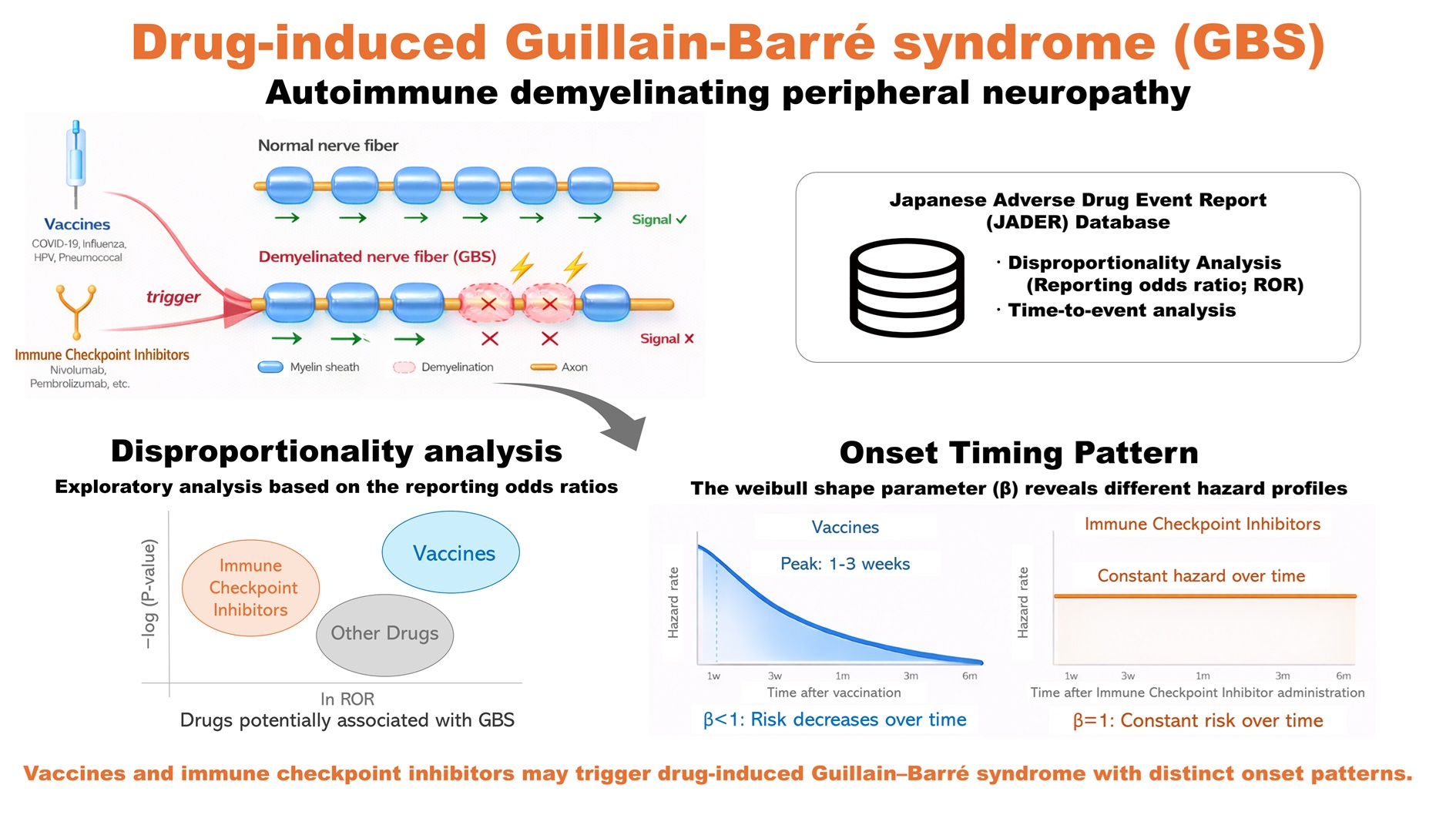
Disproportionality Analysis and Timing of Drug-Associated Guillain–Barré Syndrome Onset Based on the Japanese Adverse Drug Event Report Database
 , and
, and 
Abstract
1. Introduction
2. Results
2.1. JADER Analysis Dataset
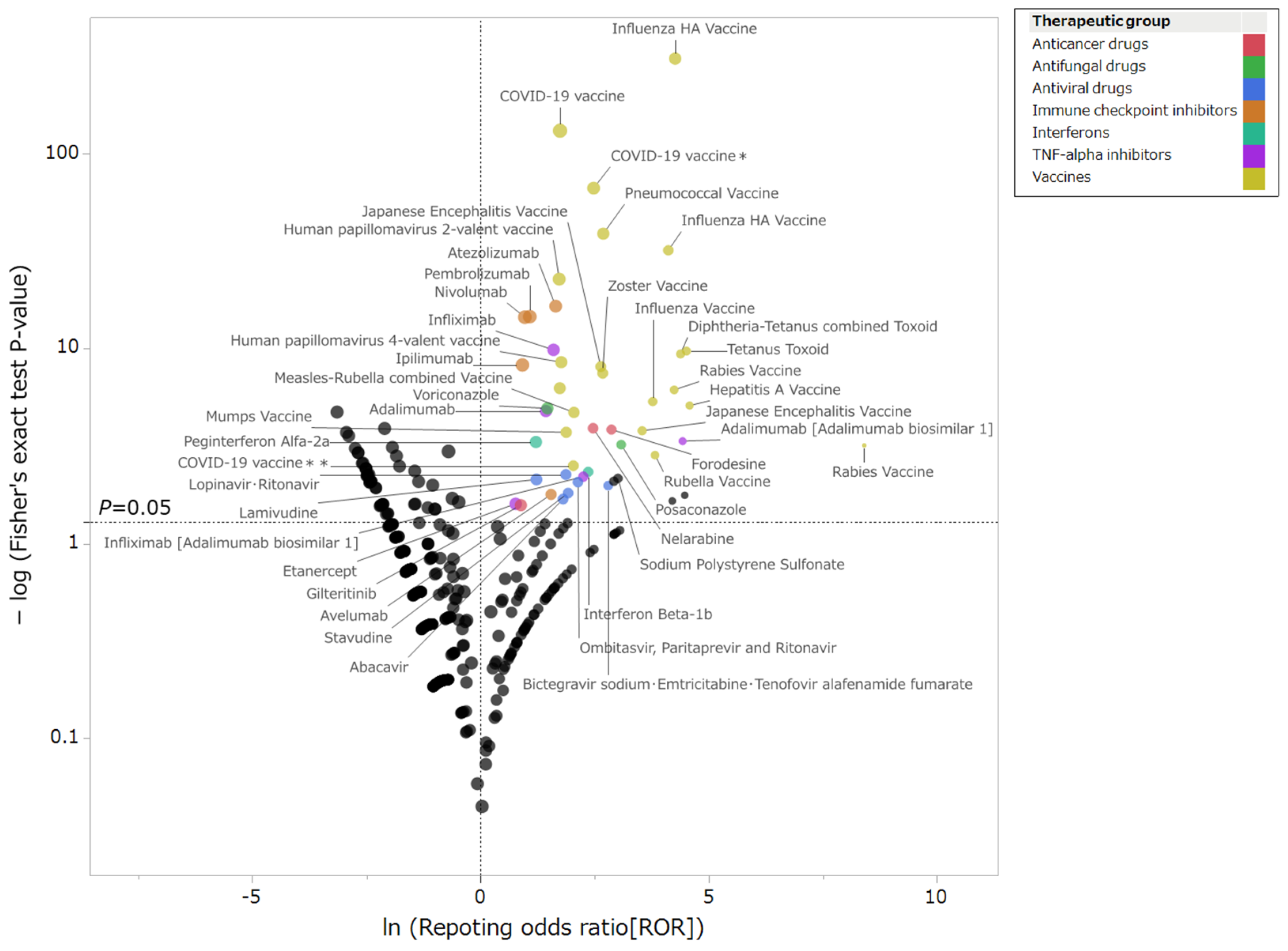
2.2. Drugs Showing Disproportionality Signals for GBS and Patient Characteristics
2.3. Time-to-Event Analysis and Weibull Distribution
3. Discussion
3.1. Drugs Showing Disproportionality Signals for GBS
3.2. Timing of Vaccine- and Immune Checkpoint Inhibitor-Associated GBS Onset
3.3. Limitations
4. Materials and Methods
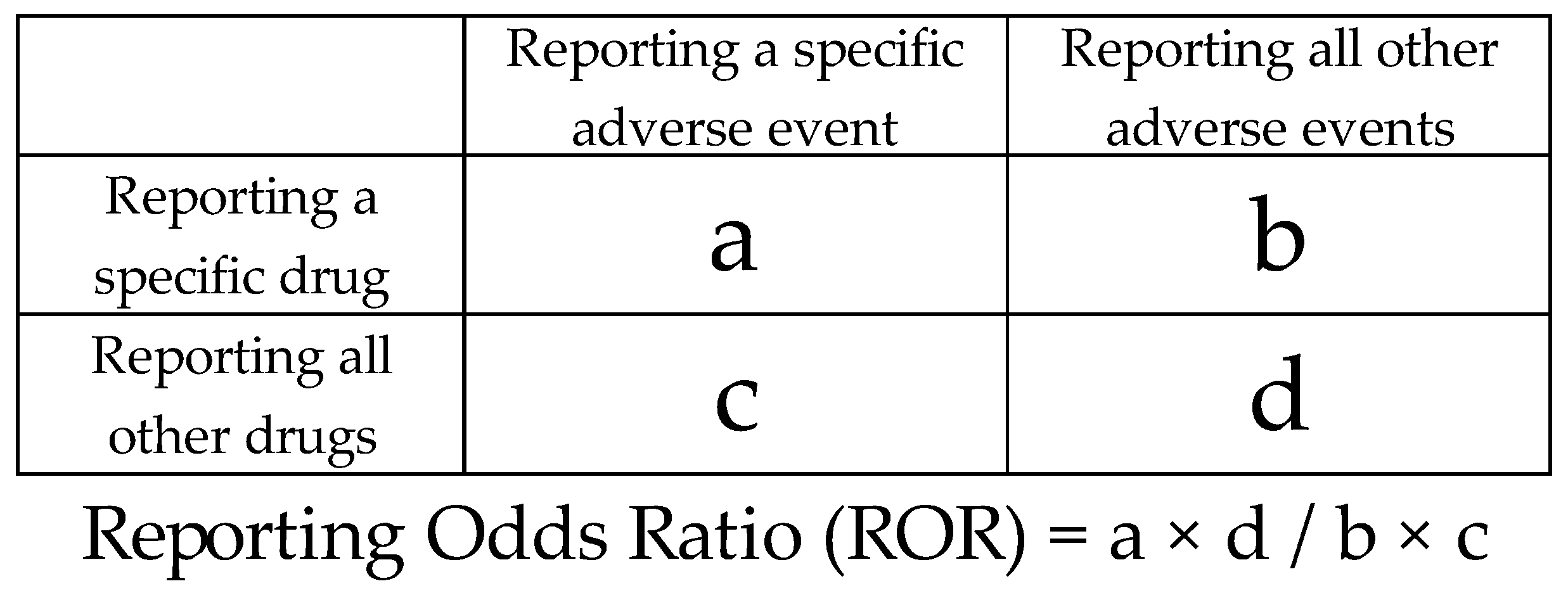
4.1. Detection of Disproportionality Signals for GBS
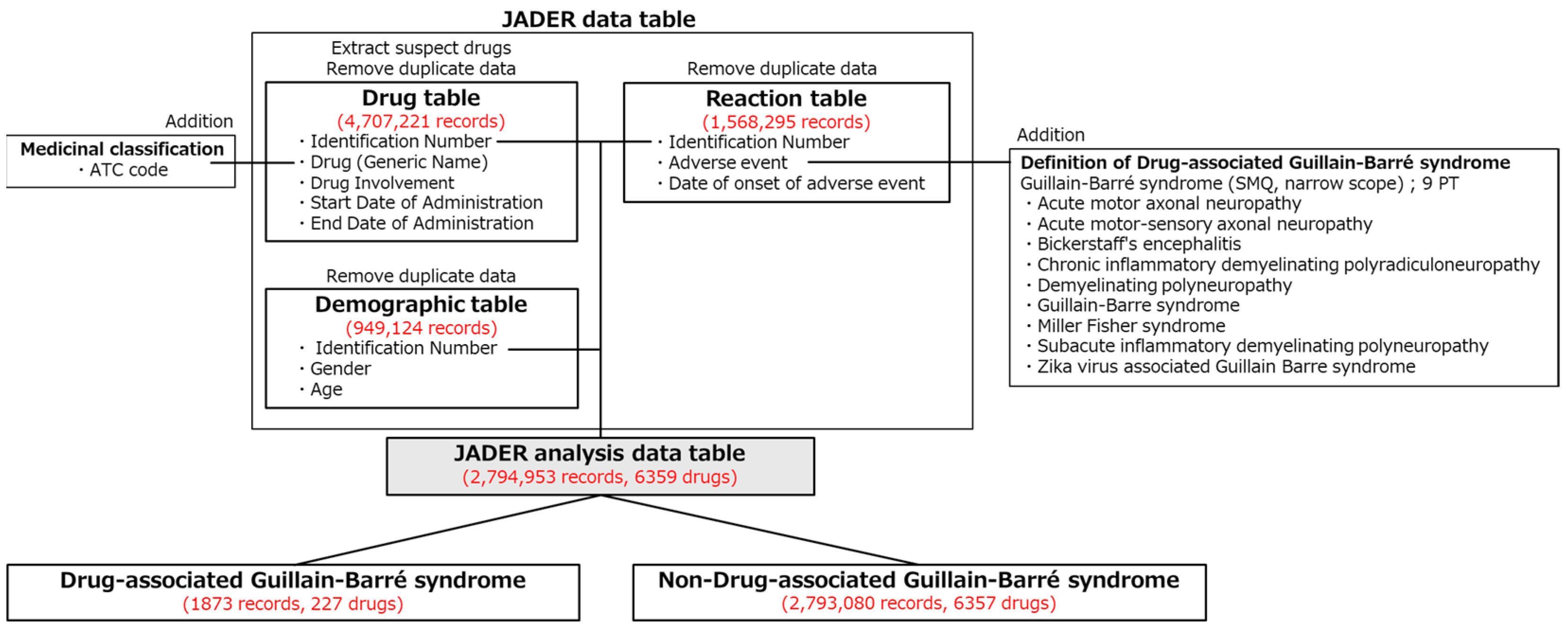
4.1.1. Construction of the JADER Analysis Data Table
4.1.2. Drugs Showing Disproportionate Reporting of Drug-Associated GBS and Patient Characteristics
4.2. Onset Timing of Drug-Associated GBS
4.2.1. Construction of a Data Table for Time-to-Onset Analysis
4.2.2. Evaluation of Adverse Event Onset Profiles
4.3. Statistical Analysis
5. Conclusions
Supplementary Materials
Author Contributions
Funding
Institutional Review Board Statement
Informed Consent Statement
Data Availability Statement
Acknowledgments
Conflicts of Interest
Abbreviations
| ATC | Anatomical Therapeutic Chemical Classification System |
| COVID-19 vaccine | Coronavirus disease 2019 vaccine |
| CTLA-4 | Cytotoxic T lymphocyte-associated protein 4 |
| GBS | Guillain–Barré syndrome |
| ID | Identification number |
| irAEs | Immune-related adverse events |
| JADER | Japanese Adverse Drug Event Report |
| MedDRA/J | Medical Dictionary for Regulatory Activities/Japanese version |
| PD-1 | Programmed death-1 |
| PD-L1 | Programmed death-ligand 1 |
| PMDA | Pharmaceuticals and Medical Devices Agency |
| ROR | Reporting odds ratio |
| RSV | Respiratory syncytial virus |
| SMQ | Standardized MedDRA Query |
| TNF-α | Tumor necrosis factor alpha |
| WHO | World Health Organization |
References
- van Doorn, P.A.; Van den Bergh, P.Y.K.; Hadden, R.D.M.; Avau, B.; Vankrunkelsven, P.; Attarian, S.; Blomkwist-Markens, P.H.; Cornblath, D.R.; Goedee, H.S.; Harbo, T.; et al. European Academy of Neurology/Peripheral Nerve Society Guideline on diagnosis and treatment of Guillain-Barré syndrome. Eur. J. Neurol. 2023, 30, 3646–3674. [Google Scholar] [CrossRef]
- Shahrizaila, N.; Lehmann, H.C.; Kuwabara, S. Guillain-Barré syndrome. Lancet 2021, 397, 1214–1228. [Google Scholar] [CrossRef]
- Yuki, N.; Hartung, H.P. Guillain-Barré syndrome. N. Engl. J. Med. 2012, 366, 2294–2304. [Google Scholar] [CrossRef]
- Yuki, N.; Taki, T.; Inagaki, F.; Kasama, T.; Takahashi, M.; Saito, K.; Handa, S.; Miyatake, T. A bacterium lipopolysaccharide that elicits Guillain-Barré syndrome has a GM1 ganglioside-like structure. J. Exp. Med. 1993, 178, 1771–1775. [Google Scholar] [CrossRef]
- Hahn, A.F. Guillain-Barré syndrome. Lancet 1998, 352, 635–641. [Google Scholar] [CrossRef]
- Xu, L.; Zhao, C.; Bao, Y.; Liu, Y.; Liang, Y.; Wei, J.; Liu, G.; Wang, J.; Zhan, S.; Wang, S.; et al. Variation in worldwide incidence of Guillain-Barré syndrome: A population-based study in urban China and existing global evidence. Front. Immunol. 2024, 15, 1415986. [Google Scholar] [CrossRef] [PubMed]
- van den Berg, B.; Walgaard, C.; Drenthen, J.; Fokke, C.; Jacobs, B.C.; van Doorn, P.A. Guillain-Barré syndrome: Pathogenesis, diagnosis, treatment and prognosis. Nat. Rev. Neurol. 2014, 10, 469–482. [Google Scholar] [CrossRef] [PubMed]
- Haber, P.; Sejvar, J.; Mikaeloff, Y.; DeStefano, F. Vaccines and Guillain-Barré syndrome. Drug Saf. 2009, 32, 309–323. [Google Scholar] [CrossRef] [PubMed]
- Schneiderbauer, R.; Schneiderbauer, M.; Wick, W.; Enk, A.H.; Haenssle, H.A.; Hassel, J.C. PD-1 Antibody-induced Guillain-Barré Syndrome in a Patient with Metastatic Melanoma. Acta Derm.-Venereol. 2017, 97, 395–396. [Google Scholar] [CrossRef]
- Fusaroli, M.; Salvo, F.; Begaud, B.; AlShammari, T.M.; Bate, A.; Battini, V.; Brueckner, A.; Candore, G.; Carnovale, C.; Crisafulli, S.; et al. The Reporting of a Disproportionality Analysis for Drug Safety Signal Detection Using Individual Case Safety Reports in PharmacoVigilance (READUS-PV): Development and Statement. Drug Saf. 2024, 47, 575–584. [Google Scholar] [CrossRef]
- Fusaroli, M.; Salvo, F.; Begaud, B.; AlShammari, T.M.; Bate, A.; Battini, V.; Brueckner, A.; Candore, G.; Carnovale, C.; Crisafulli, S.; et al. The Reporting of A Disproportionality Analysis for DrUg Safety Signal Detection Using Individual Case Safety Reports in PharmacoVigilance (READUS-PV): Explanation and Elaboration. Drug Saf. 2024, 47, 585–599. [Google Scholar] [CrossRef]
- Nomura, K.; Takahashi, K.; Hinomura, Y.; Kawaguchi, G.; Matsushita, Y.; Marui, H.; Anzai, T.; Hashiguchi, M.; Mochizuki, M. Effect of database profile variation on drug safety assessment: An analysis of spontaneous adverse event reports of Japanese cases. Drug Des. Dev. Ther. 2015, 9, 3031–3041. [Google Scholar] [CrossRef]
- Watanabe, A.; Uesawa, Y. Steroid-Induced Thrombosis: A Comprehensive Analysis Using the FAERS Database. Pharmaceuticals 2025, 18, 1463. [Google Scholar] [CrossRef]
- Yamaoka, K.; Masago, S.; Uchida, M.; Uesawa, Y.; Muroi, N.; Shimizu, T. Adverse events of antibody-drug conjugates: Comparative analysis of agents with a common payload using the adverse event spontaneous reporting database. Oncologist 2025, 30, oyaf298. [Google Scholar] [CrossRef]
- Toriumi, S.; Kobayashi, A.; Sueki, H.; Yamamoto, M.; Uesawa, Y. Exploring the Mechanisms Underlying Drug-Induced Fractures Using the Japanese Adverse Drug Event Reporting Database. Pharmaceuticals 2021, 14, 1299. [Google Scholar] [CrossRef]
- Pharmaceutical and Medical Devices Agency. Available online: https://www.pmda.go.jp/safety/info-services/drugs/adr-info/suspected-adr/0005.html (accessed on 16 March 2025).
- Toriumi, S.; Mimori, R.; Sakamoto, H.; Sueki, H.; Yamamoto, M.; Uesawa, Y. Examination of Risk Factors and Expression Patterns of Atypical Femoral Fractures Using the Japanese Adverse Drug Event Report Database: A Retrospective Pharmacovigilance Study. Pharmaceuticals 2023, 16, 626. [Google Scholar] [CrossRef] [PubMed]
- Pulendran, B.; Ahmed, R. Immunological mechanisms of vaccination. Nat. Immunol. 2011, 12, 509–517. [Google Scholar] [CrossRef]
- Censi, S.; Bisaccia, G.; Gallina, S.; Tomassini, V.; Uncini, A. Guillain-Barré syndrome and COVID-19 vaccination: A systematic review and meta-analysis. J. Neurol. 2024, 271, 1063–1071. [Google Scholar] [CrossRef] [PubMed]
- Patone, M.; Handunnetthi, L.; Saatci, D.; Pan, J.; Katikireddi, S.V.; Razvi, S.; Hunt, D.; Mei, X.W.; Dixon, S.; Zaccardi, F.; et al. Neurological complications after first dose of COVID-19 vaccines and SARS-CoV-2 infection. Nat. Med. 2021, 12, 2144–2153. [Google Scholar] [CrossRef] [PubMed]
- Martín Arias, L.H.; Sanz, R.; Sáinz, M.; Treceño, C.; Carvajal, A. Guillain-Barré syndrome and influenza vaccines: A meta-analysis. Vaccine 2015, 33, 3773–3778. [Google Scholar] [CrossRef]
- Nachamkin, I.; Shadomy, S.V.; Moran, A.P.; Cox, N.; Fitzgerald, C.; Ung, H.; Corcoran, A.T.; Iskander, J.K.; Schonberger, L.B.; Chen, R.T. Anti-ganglioside antibody induction by swine (A/NJ/1976/H1N1) and other influenza vaccines: Insights into vaccine-associated Guillain-Barré syndrome. J. Infect. Dis. 2008, 198, 226–233. [Google Scholar] [CrossRef] [PubMed]
- Sato, S.; Katsuta, T.; Kawazoe, Y.; Takahashi, M.; Murata, F.; Maeda, M.; Fukuda, H.; Kamidani, S. Immune thrombocytopenic purpura and Guillain-Barré syndrome after 23-valent pneumococcal polysaccharide vaccination in Japan: The vaccine effectiveness, networking, and universal safety (VENUS) study. Vaccine 2024, 42, 4–7. [Google Scholar] [CrossRef]
- Mbata, O.E.; Atiku, P.M. Rapid Onset of Guillain Barré Syndrome following Quadrivalent Human Papilloma Virus Vaccination in a Young Female: A Case Report. Ann. Vaccines Immun. 2025, 9, 1026. [Google Scholar]
- Hegde, N.R.; Gore, M.M. Japanese encephalitis vaccines: Immunogenicity, protective efficacy, effectiveness, and impact on the burden of disease. Hum. Vaccin. Immunother. 2017, 13, 1320–1337. [Google Scholar] [CrossRef]
- Nelson, J.C.; Ulloa-Pérez, E.; Yu, O.; Cook, A.J.; Jackson, M.L.; Belongia, E.A.; Daley, M.F.; Harpaz, R.; Kharbanda, E.O.; Klein, N.P.; et al. Active Postlicensure Safety Surveillance for Recombinant Zoster Vaccine Using Electronic Health Record Data. Am. J. Epidemiol. 2023, 192, 205–216. [Google Scholar] [CrossRef]
- Di Pietrantonj, C.; Rivetti, A.; Marchione, P.; Debalini, M.G.; Demicheli, V. Vaccines for measles, mumps, rubella, and varicella in children. Cochrane Database Syst. Rev. 2021, 11, CD004407. [Google Scholar] [CrossRef]
- Pan, M.; Sun, T.; Zhu, W.; Liu, H.; Dong, H. Guillain Barré syndrome after combined diphtheria, tetanus, and acellular pertussis (DTaP) vaccine: A rare pediatric case report and review of literature. Hum. Vaccin. Immunother. 2023, 19, 2261199. [Google Scholar] [CrossRef]
- Souayah, N.; Nasar, A.; Suri, M.F.; Qureshi, A.I. Guillain-Barré syndrome after vaccination in United States: Data from the Centers for Disease Control and Prevention/Food and Drug Administration Vaccine Adverse Event Reporting System (1990–2005). J. Clin. Neuromuscul. Dis. 2009, 11, 1–6. [Google Scholar] [CrossRef]
- Trusinska, D.; Lee, B.; Ferdous, S.; Lansbury, L.; Burden, C.; Anand, A.; Stowe, J.; Mensah, A.; Lim, W.; Marsh, K.; et al. Real-world evidence on RSV vaccine uptake, effectiveness, and safety in older adults: A systematic review and meta-analysis. Lancet Reg. Health Eur. 2026, 64, 101623. [Google Scholar] [CrossRef]
- Principi, N.; Esposito, S. Vaccine-preventable diseases, vaccines and Guillain-Barre’ syndrome. Vaccine 2019, 37, 5544–5550. [Google Scholar] [CrossRef] [PubMed]
- Leach, D.R.; Krummel, M.F.; Allison, J.P. Enhancement of antitumor immunity by CTLA-4 blockade. Science 1996, 271, 1734–1736. [Google Scholar] [CrossRef]
- Ishida, Y.; Agata, Y.; Shibahara, K.; Honjo, T. Induced expression of PD-1, a novel member of the immunoglobulin gene superfamily, upon programmed cell death. EMBO J. 1992, 11, 3887–3895. [Google Scholar] [CrossRef]
- Sonpavde, G.P.; Grivas, P.; Lin, Y.; Hennessy, D.; Hunt, J.D. Immune-related adverse events with PD-1 versus PD-L1 inhibitors: A meta-analysis of 8730 patients from clinical trials. Future Oncol. 2021, 17, 2545–2558. [Google Scholar] [CrossRef]
- Salim, A.; Tapia Rico, G.; Shaikh, A.; Brown, M.P. A systematic review of immune checkpoint inhibitor-related neurological adverse events and association with anti-neuronal autoantibodies. Expert Opin. Biol. Ther. 2021, 21, 1237–1251. [Google Scholar] [CrossRef]
- Möhn, N.; Beutel, G.; Gutzmer, R.; Ivanyi, P.; Satzger, I.; Skripuletz, T. Neurological Immune Related Adverse Events Associated with Nivolumab, Ipilimumab, and Pembrolizumab Therapy-Review of the Literature and Future Outlook. J. Clin. Med. 2019, 8, 1777. [Google Scholar] [CrossRef]
- Cuzzubbo, S.; Javeri, F.; Tissier, M.; Roumi, A.; Barlog, C.; Doridam, J.; Lebbe, C.; Belin, C.; Ursu, R.; Carpentier, A.F. Neurological adverse events associated with immune checkpoint inhibitors: Review of the literature. Eur. J. Cancer 2017, 73, 1–8. [Google Scholar] [CrossRef] [PubMed]
- Kyriazoglou, A.; Liontos, M.; Papadopoulos, C.; Bilali, A.; Kostouros, E.; Pagoni, S.; Doumas, K.; Dimopoulos, M.A.; Bamias, A. Guillain-Barré Syndrome Related to Nivolumab: Case Report of a Patient With Urothelial Cancer and Review of the Literature. Clin. Genitourin. Cancer 2019, 17, e360–e364. [Google Scholar] [CrossRef] [PubMed]
- Oguri, T.; Sasada, S.; Shimizu, S.; Shigematsu, R.; Tsuchiya, Y.; Ishioka, K.; Takahashi, S.; Oki, K.; Kimura, Y.; Seki, R.; et al. A Case of Guillain-Barré Syndrome and Stevens-Johnson Syndrome/Toxic Epidermal Necrosis Overlap After Pembrolizumab Treatment. J. Investig. Med. High Impact Case Rep. 2021, 9, 23247096211037462. [Google Scholar] [CrossRef] [PubMed]
- Kelly Wu, W.; Broman, K.K.; Brownie, E.R.; Kauffmann, R.M. Ipilimumab-induced Guillain-Barré Syndrome Presenting as Dysautonomia: An Unusual Presentation of a Rare Complication of Immunotherapy. J. Immunother. 2017, 40, 196–199. [Google Scholar] [CrossRef]
- Yamanaka, N.; Oishi, M.; Shimizu, F.; Koga, M.; Kanda, T. Atezolizumab-induced Guillain-Barré syndrome-like acute demyelinating polyneuropathy responsive to steroid therapy: A case report. Rinsho Shinkeigaku 2021, 61, 653–657. [Google Scholar] [CrossRef]
- Abrahao, A.; Tenório, P.H.M.; Rodrigues, M.; Mello, M.; Nascimento, O.J.M. Guillain-Barré syndrome and checkpoint inhibitor therapy: Insights from pharmacovigilance data. BMJ Neurol. Open 2024, 6, e000544. [Google Scholar] [CrossRef]
- Johnson, D.B.; Manouchehri, A.; Haugh, A.M.; Quach, H.T.; Balko, J.M.; Lebrun-Vignes, B.; Mammen, A.; Moslehi, J.J.; Salem, J.E. Neurologic toxicity associated with immune checkpoint inhibitors: A pharmacovigilance study. J. Immunother. Cancer 2019, 7, 134. [Google Scholar] [CrossRef]
- Freeman, G.J.; Long, A.J.; Iwai, Y.; Bourque, K.; Chernova, T.; Nishimura, H.; Fitz, L.J.; Malenkovich, N.; Okazaki, T.; Byrne, M.C.; et al. Engagement of the PD-1 immunoinhibitory receptor by a novel B7 family member leads to negative regulation of lymphocyte activation. J. Exp. Med. 2000, 192, 1027–1034. [Google Scholar] [CrossRef]
- Buchbinder, E.I.; Desai, A. CTLA-4 and PD-1 Pathways: Similarities, Differences, and Implications of Their Inhibition. Am. J. Clin. Oncol. 2016, 39, 98–106. [Google Scholar] [CrossRef] [PubMed]
- Zhang, H.; Shi, N.; Diao, Z.; Chen, Y.; Zhang, Y. Therapeutic potential of TNFα inhibitors in chronic inflammatory disorders: Past and future. Genes. Dis. 2020, 8, 38–47. [Google Scholar] [CrossRef] [PubMed]
- Mohan, N.; Edwards, E.T.; Cupps, T.R.; Oliverio, P.J.; Sandberg, G.; Crayton, H.; Richert, J.R.; Siegel, J.N. Demyelination occurring during anti-tumor necrosis factor alpha therapy for inflammatory arthritides. Arthritis Rheum. 2001, 44, 2862–2869. [Google Scholar] [CrossRef]
- Silburn, S.; McIvor, E.; McEntegart, A.; Wilson, H. Guillain-Barré syndrome in a patient receiving anti-tumour necrosis factor alpha for rheumatoid arthritis: A case report and discussion of literature. Ann. Rheum. Dis. 2008, 67, 575–576. [Google Scholar] [CrossRef] [PubMed]
- Natividade, N.B.; Felix, P.A.O.; Lerer, C. Guillain-Barré syndrome in a patient on adalimumab for the treatment of psoriasis. An. Bras. Dermatol. 2017, 92, 85–87. [Google Scholar] [CrossRef]
- Ferreira, S.D.C.; Vasconcelos, J.R.O.; Rezende, R.E.F.; Aprile, L.R.O.; Troncon, L.E.A. Guillain-Barré Syndrome in a Patient Receiving Anti-Tumor Necrosis Factor for Crohn Disease: Coincidence or Consequence? Am. J. Case Rep. 2024, 25, e943709. [Google Scholar] [CrossRef]
- Doden, M.H.; Manasra, M.R.; AbuIrayyeh, B.M.; Al-Ihribat, A.R.; Albandak, M. Guillain-Barrè syndrome after treatment with anti-tumour necrosis factor α (etanercept) in a rheumatoid arthritis patient: Case report and literature review. Sci. Prog. 2024, 107, 368504241304203. [Google Scholar] [CrossRef]
- Billmeier, U.; Dieterich, W.; Neurath, M.F.; Atreya, R. Molecular mechanism of action of anti-tumor necrosis factor antibodies in inflammatory bowel diseases. World J. Gastroenterol. 2016, 22, 9300–9313. [Google Scholar] [CrossRef]
- Beigel, F.; Schnitzler, F.; Paul Laubender, R.; Pfennig, S.; Weidinger, M.; Göke, B.; Seiderer, J.; Ochsenkühn, T.; Brand, S. Formation of antinuclear and double-strand DNA antibodies and frequency of lupus-like syndrome in anti-TNF-α antibody-treated patients with inflammatory bowel disease. Inflamm. Bowel Dis. 2011, 17, 91–98. [Google Scholar] [CrossRef]
- Kunchok, A.; Aksamit, A.J., Jr.; Davis, J.M., 3rd; Kantarci, O.H.; Keegan, B.M.; Pittock, S.J.; Weinshenker, B.G.; McKeon, A. Association Between Tumor Necrosis Factor Inhibitor Exposure and Inflammatory Central Nervous System Events. JAMA Neurol. 2020, 77, 937–946. [Google Scholar] [CrossRef]
- Girgin, N.K.; İşçimen, R.; Yılmaz, E.; Kahveci, Ş.F.; Kutlay, O. Guillain-Barré Syndrome and Human Immunodeficiency Virus. Turk. J. Anaesthesiol. Reanim. 2014, 42, 100–102. [Google Scholar] [CrossRef]
- Piliero, P.J.; Fish, D.G.; Preston, S.; Cunningham, D.; Kinchelow, T.; Salgo, M.; Qian, J.; Drusano, G.L. Guillain-Barré syndrome associated with immune reconstitution. Clin. Infect. Dis. 2003, 36, e111–e114. [Google Scholar] [CrossRef] [PubMed]
- Braish, J.S.; Kugler, E.; Jabbour, E.; Woodman, K.; Ravandi, F.; Nicholas, S.; Jain, N.; Kantarjian, H.; Sasaki, K. Incidence and Clinical Presentation of Severe Neurotoxicity from Nelarabine in Patients with T-Cell Acute Lymphoblastic Leukemia. Clin. Lymphoma Myeloma Leuk. 2024, 24, 783–788. [Google Scholar] [CrossRef]
- Tsiodras, S.; Zafiropoulou, R.; Kanta, E.; Demponeras, C.; Karandreas, N.; Manesis, E.K. Painful peripheral neuropathy associated with voriconazole use. Arch. Neurol. 2005, 62, 144–146. [Google Scholar] [CrossRef] [PubMed]
- Benitez, L.L.; Carver, P.L. Adverse Effects Associated with Long-Term Administration of Azole Antifungal Agents. Drugs 2019, 79, 833–853. [Google Scholar] [CrossRef] [PubMed]
- Niazi, M.A.; Azhar, A.; Tufail, K.; Feyssa, E.L.; Penny, S.F.; McGregory, M.; Araya, V.; Ortiz, J.A. Guillain-Barre syndrome associated with peginterferon alfa-2a for chronic hepatitis C: A case report. World J. Hepatol. 2010, 2, 162–166. [Google Scholar] [CrossRef]
- Ogunjimi, O.B.; Tsalamandris, G.; Paladini, A.; Varrassi, G.; Zis, P. Guillain-Barré Syndrome Induced by Vaccination Against COVID-19: A Systematic Review and Meta-Analysis. Cureus 2023, 15, e37578. [Google Scholar] [CrossRef] [PubMed]
- Chalela, J.A.; Andrews, C.; Bashmakov, A.; Kapoor, N.; Snelgrove, D. Reports of Guillain-Barre Syndrome Following COVID-19 Vaccination in the USA: An Analysis of the VAERS Database. J. Clin. Neurol. 2023, 19, 179–185. [Google Scholar] [CrossRef]
- Schonberger, L.B.; Bregman, D.J.; Sullivan-Bolyai, J.Z.; Keenlyside, R.A.; Ziegler, D.W.; Retailliau, H.F.; Eddins, D.L.; Bryan, J.A. Guillain-Barre syndrome following vaccination in the National Influenza Immunization Program, United States, 1976–1977. Am. J. Epidemiol. 1979, 110, 105–123. [Google Scholar] [CrossRef] [PubMed]
- Lasky, T.; Terracciano, G.J.; Magder, L.; Koski, C.L.; Ballesteros, M.; Nash, D.; Clark, S.; Haber, P.; Stolley, P.D.; Schonberger, L.B.; et al. The Guillain-Barré syndrome and the 1992-1993 and 1993-1994 influenza vaccines. N. Engl. J. Med. 1998, 339, 1797–1802. [Google Scholar] [CrossRef]
- Kwong, J.C.; Vasa, P.P.; Campitelli, M.A.; Hawken, S.; Wilson, K.; Rosella, L.C.; Stukel, T.A.; Crowcroft, N.S.; McGeer, A.J.; Zinman, L.; et al. Risk of Guillain-Barré syndrome after seasonal influenza vaccination and influenza health-care encounters: A self-controlled study. Lancet Infect. Dis. 2013, 13, 769–776. [Google Scholar] [CrossRef] [PubMed]
- Kaneda, Y.; Hashimoto, T.; Kaneda, U.; Higuchi, Y.; Murakami, J.; Inada, M.; Senoo, Y.; Fujieda, T.; Murata, Y.; Tanimoto, T. Guillain-Barre Syndrome After COVID-19 Vaccination: A Secondary Analysis of Domestic Safety Data by the Japanese Government. Cureus 2022, 14, e30905. [Google Scholar] [CrossRef]
- Ravishankar, N. Guillain-Barre Syndrome Following PCV Vaccine. Clin. Surg. 2017, 2, 1413. [Google Scholar]
- Oliveira, M.; Marquez, P.; Ennulat, C.; Blanc, P.; Welsh, K.; Nair, N.; Taminato, M.; Moro, P.L. Post-licensure Safety Surveillance of 20-Valent Pneumococcal Conjugate Vaccine (PCV20) Among US Adults in the Vaccine Adverse Event Reporting System (VAERS). Drug Saf. 2025, 48, 279–286. [Google Scholar] [CrossRef]
- Boender, T.S.; Bartmeyer, B.; Coole, L.; Wichmann, O.; Harder, T. Risk of Guillain-Barré syndrome after vaccination against human papillomavirus: A systematic review and meta-analysis, 1 January 2000 to 4 April 2020. Eurosurveillance 2022, 27, 2001619. [Google Scholar] [CrossRef] [PubMed]
- Roodbol, J.; de Wit, M.C.; Walgaard, C.; de Hoog, M.; Catsman-Berrevoets, C.E.; Jacobs, B.C. Recognizing Guillain-Barre syndrome in preschool children. Neurology 2011, 76, 807–810. [Google Scholar] [CrossRef]
- Hagen, K.M.; Ousman, S.S. The Neuroimmunology of Guillain-Barré Syndrome and the Potential Role of an Aging Immune System. Front. Aging Neurosci. 2021, 12, 613628. [Google Scholar] [CrossRef]
- Sejvar, J.J.; Baughman, A.L.; Wise, M.; Morgan, O.W. Population incidence of Guillain-Barré syndrome: A systematic review and meta-analysis. Neuroepidemiology 2011, 36, 123–133. [Google Scholar] [CrossRef]
- O’Hare, M.; Guidon, A.C. Peripheral nervous system immune-related adverse events due to checkpoint inhibition. Nat. Rev. Neurol. 2024, 20, 509–525. [Google Scholar] [CrossRef]
- Albarrán, V.; Chamorro, J.; Rosero, D.I.; Saavedra, C.; Soria, A.; Carrato, A.; Gajate, P. Neurologic Toxicity of Immune Checkpoint Inhibitors: A Review of Literature. Front. Pharmacol. 2022, 13, 774170. [Google Scholar] [CrossRef]
- Fan, Q.; Hu, Y.; Wang, X.; Zhao, B. Guillain-Barré syndrome in patients treated with immune checkpoint inhibitors. J. Neurol. 2021, 268, 2169–2174. [Google Scholar] [CrossRef] [PubMed]
- Li, Y.; Zhang, X.; Zhao, C. Guillain-Barré Syndrome-Like Polyneuropathy Associated with Immune Checkpoint Inhibitors: A Systematic Review of 33 Cases. Biomed. Res. Int. 2021, 2021, 9800488. [Google Scholar] [CrossRef]
- Sun, X.; Roudi, R.; Dai, T.; Chen, S.; Fan, B.; Li, H.; Zhou, Y.; Zhou, M.; Zhu, B.; Yin, C.; et al. Immune-related adverse events associated with programmed cell death protein-1 and programmed cell death ligand 1 inhibitors for non-small cell lung cancer: A PRISMA systematic review and meta-analysis. BMC Cancer 2019, 19, 558. [Google Scholar] [CrossRef]
- Kanaoka, K.; Matsumoto, K.; Shiroyama, T.; Tsukaguchi, A.; Shoshihara, N.; Moritomo, K.; Kinehara, Y.; Mihashi, Y.; Kuge, T.; Yoneda, M.; et al. A Multicenter, Retrospective, Real-World Study of Atezolizumab Plus Chemotherapy and Pembrolizumab Plus Chemotherapy for Older Patients With NSCLC. JTO Clin. Res. Rep. 2025, 6, 100891. [Google Scholar] [CrossRef] [PubMed]
- Chen, D.S.; Irving, B.A.; Hodi, F.S. Molecular pathways: Next-generation immunotherapy--inhibiting programmed death-ligand 1 and programmed death-1. Clin. Cancer Res. 2012, 18, 6580–6587. [Google Scholar] [CrossRef]
- Paterson, A.M.; Brown, K.E.; Keir, M.E.; Vanguri, V.K.; Riella, L.V.; Chandraker, A.; Sayegh, M.H.; Blazar, B.R.; Freeman, G.J.; Sharpe, A.H. The programmed death-1 ligand 1: B7-1 pathway restrains diabetogenic effector T cells in vivo. J. Immunol. 2011, 187, 1097–1105. [Google Scholar] [CrossRef]
- Yang, J.; Riella, L.V.; Chock, S.; Liu, T.; Zhao, X.; Yuan, X.; Paterson, A.M.; Watanabe, T.; Vanguri, V.; Yagita, H.; et al. The novel costimulatory programmed death ligand 1/B7.1 pathway is functional in inhibiting alloimmune responses in vivo. J. Immunol. 2011, 187, 1113–1119. [Google Scholar] [CrossRef] [PubMed]
- Alemayehu, D. Evaluation of Reporting Bias in Postmarketing Risk Assessment Based on Spontaneous Reporting Systems. Pharm. Med. 2009, 23, 195–200. [Google Scholar] [CrossRef]
- Matsuda, S.; Aoki, K.; Kawamata, T.; Kimotsuki, T.; Kobayashi, T.; Kuriki, H.; Nakayama, T.; Okugawa, S.; Sugimura, Y.; Tomita, M.; et al. Bias in spontaneous reporting of adverse drug reactions in Japan. PLoS ONE 2015, 10, e0126413. [Google Scholar] [CrossRef]
- Pariente, A.; Avillach, P.; Salvo, F.; Thiessard, F.; Miremont-Salamé, G.; Fourrier-Reglat, A.; Haramburu, F.; Bégaud, B.; Moore, N. Effect of competition bias in safety signal generation: Analysis of a research database of spontaneous reports in France. Drug Saf. 2012, 35, 855–864. [Google Scholar] [CrossRef]
- García-Abeijon, P.; Costa, C.; Taracido, M.; Herdeiro, M.T.; Torre, C.; Figueiras, A. Factors Associated with Underreporting of Adverse Drug Reactions by Health Care Professionals: A Systematic Review Update. Drug Saf. 2023, 46, 625–636. [Google Scholar] [CrossRef]
- Caster, O.; Aoki, Y.; Gattepaille, L.M.; Grundmark, B. Disproportionality Analysis for Pharmacovigilance Signal Detection in Small Databases or Subsets: Recommendations for Limiting False-Positive Associations. Drug Saf. 2020, 43, 479–487. [Google Scholar] [CrossRef]
- Noguchi, Y.; Tachi, T.; Teramachi, H. Review of Statistical Methodologies for Detecting Drug-Drug Interactions Using Spontaneous Reporting Systems. Front. Pharmacol. 2019, 10, 1319. [Google Scholar] [CrossRef]
- Hazell, L.; Shakir, S.A. Under-reporting of adverse drug reactions: A systematic review. Drug Saf. 2006, 29, 385–396. [Google Scholar] [CrossRef] [PubMed]
- Bate, A.; Evans, S.J. Quantitative signal detection using spontaneous ADR reporting. Pharmacoepidemiol. Drug Saf. 2009, 6, 427–436. [Google Scholar] [CrossRef] [PubMed]
- ATC/DDD Index. Available online: https://atcddd.fhi.no/atc_ddd_index/ (accessed on 3 March 2025).
- MedDRA Japanese Maintenance Organization. Available online: https://www.pmrj.jp/jmo/php/indexj.php (accessed on 16 February 2025).
- Medical Dictionary for Regulatory Activities. Available online: https://www.meddra.org/standardised-meddra-queries (accessed on 10 February 2025).
- Hirooka, T.; Yamada, M. Evaluation of AEs Risk Using the “Japanese Adverse Drug Event Report Database” of PMDA. In Proceedings of the SAS User General Assembly, Tokyo, Japan, 1–3 December 2012; pp. 263–270. [Google Scholar]
- Hosoya, R.; Ishii-Nozawa, R.; Kurosaki, K.; Uesawa, Y. Analysis of Factors Associated with Hiccups Using the FAERS Database. Pharmaceuticals 2021, 15, 27. [Google Scholar] [CrossRef] [PubMed]
- Ruxton, G.D.; Neuhäuser, M. Review of alternative approaches to calculation of a confidence interval for the odds ratio of a 2 × 2 contingency table. Methods Ecol. Evol. 2013, 4, 9–13. [Google Scholar] [CrossRef]
- Yajima, A.; Uesawa, Y. A Comprehensive Analysis of Adverse Events Associated with HER2 Inhibitors Approved for Breast Cancer Using the FDA Adverse Event Report System (FAERS). Pharmaceuticals 2025, 18, 1510. [Google Scholar] [CrossRef]
- van Puijenbroek, E.P.; Bate, A.; Leufkens, H.G.; Lindquist, M.; Orre, R.; Egberts, A.C. A comparison of measures of disproportionality for signal detection in spontaneous reporting systems for adverse drug reactions. Pharmacoepidemiol. Drug Saf. 2002, 11, 3–10. [Google Scholar] [CrossRef]
- Rothman, K.J.; Lanes, S.; Sacks, S.T. The reporting odds ratio and its advantages over the proportional reporting ratio. Pharmacoepidemiol. Drug Saf. 2004, 13, 519–523. [Google Scholar] [CrossRef]
- Harpaz, R.; DuMouchel, W.; LePendu, P.; Bauer-Mehren, A.; Ryan, P.; Shah, N.H. Performance of pharmacovigilance signal-detection algorithms for the FDA adverse event reporting system. Clin. Pharmacol. Ther. 2013, 93, 539–546. [Google Scholar] [CrossRef] [PubMed]
- European Medicines Agency. Guideline on the Use of Statistical Signal Detection Methods in the Eudravigilance Data Analysis System. Available online: https://www.ema.europa.eu/en/documents/regulatory-procedural-guideline/draft-guideline-use-statistical-signal-detection-methods-eudravigilance-data-analysis-system_en.pdf (accessed on 5 March 2025).
- Kurosaki, K.; Uesawa, Y. Molecular Initiating Events Associated with Drug-Induced Liver Malignant Tumors: An Integrated Study of the FDA Adverse Event Reporting System and Toxicity Predictions. Biomolecules 2021, 11, 944. [Google Scholar] [CrossRef]
- Toriumi, S.; Shimokawa, K.; Yamamoto, M.; Uesawa, Y. Development of a Medication-Related Osteonecrosis of the Jaw Prediction Model Using the FDA Adverse Event Reporting System Database and Machine Learning. Pharmaceuticals 2025, 18, 423. [Google Scholar] [CrossRef]
- Toriumi, S.; Kobayashi, A.; Uesawa, Y. Comprehensive Study of the Risk Factors for Medication-Related Osteonecrosis of the Jaw Based on the Japanese Adverse Drug Event Report Database. Pharmaceuticals 2020, 13, 467. [Google Scholar] [CrossRef] [PubMed]
- Kan, Y.; Doi, M.; Uesawa, Y. Investigation of the total anticholinergic load of reported anticholinergic drug-related adverse events using the Japanese adverse drug event report database: A retrospective pharmacovigilance study. J. Pharm. Health Care Sci. 2025, 11, 8. [Google Scholar] [CrossRef] [PubMed]
- Kan, Y.; Nagai, J.; Uesawa, Y. Evaluation of antibiotic-induced taste and smell disorders using the FDA adverse event reporting system database. Sci. Rep. 2021, 11, 9625. [Google Scholar] [CrossRef]
- Nakao, S.; Hasegawa, S.; Umetsu, R.; Shimada, K.; Mukai, R.; Tanaka, M.; Matsumoto, K.; Yoshida, Y.; Inoue, M.; Satake, R.; et al. Pharmacovigilance study of anti-infective-related acute kidney injury using the Japanese adverse drug event report database. BMC Pharmacol. Toxicol. 2021, 22, 47. [Google Scholar] [CrossRef]
- Hasegawa, S.; Ikesue, H.; Satake, R.; Inoue, M.; Yoshida, Y.; Tanaka, M.; Matsumoto, K.; Wakabayashi, W.; Oura, K.; Muroi, N.; et al. Osteonecrosis of the Jaw Caused by Denosumab in Treatment-Naïve and Pre-Treatment with Zoledronic Acid Groups: A Time-to-Onset Study Using the Japanese Adverse Drug Event Report (JADER) Database. Drugs-Real World Outcomes 2022, 9, 659–665. [Google Scholar] [CrossRef]
- Sauzet, O.; Carvajal, A.; Escudero, A.; Molokhia, M.; Cornelius, V.R. Illustration of the weibull shape parameter signal detection tool using electronic healthcare record data. Drug Saf. 2013, 36, 995–1006. [Google Scholar] [CrossRef] [PubMed]



| Drug | N | Gender Male/Female/Unknown and Not Reported | Age Median (Min–Max) |
|---|---|---|---|
| Vaccines | |||
| COVID-19 vaccine | 354 | 165/185/4 | 55 (5–95) |
| COVID-19 vaccine * | 98 | 56/42/0 | 45 (15–85) |
| Influenza HA vaccine | 250 | 131/115/4 | 55 (5–85) |
| Influenza HA vaccine (A/H1N1) | 23 | 13/10/0 | 65 (5–75) |
| Human papillomavirus 2-valent vaccine | 56 | 0/56/0 | 15 (15–35) |
| Human papillomavirus 4-valent vaccine | 19 | 0/19/0 | 15 (15–45) |
| Pneumococcal vaccine | 50 | 28/15/7 | 75 (45–85) |
| Hepatitis B vaccine | 14 | 7/7/0 | 25 (5–35) |
| Japanese encephalitis vaccine | 10 | 5/5/0 | 10 (5–15) |
| Zoster vaccine | 9 | 4/5/0 | 65 (55–75) |
| Measles-rubella combined vaccine | 8 | 7/1/0 | 15 (5–55) |
| Mumps vaccine | 7 | 0/7/0 | 15 (5–15) |
| Diphtheria-tetanus combined toxoid | 6 | 2/4/0 | 15 (15–15) |
| Tetanus toxoid | 6 | 6/0/0 | 30 (25–45) |
| Immune checkpoint inhibitors | |||
| Nivolumab | 91 | 62/26/3 | 65 (35–85) |
| Pembrolizumab | 76 | 44/27/5 | 75 (25–85) |
| Ipilimumab | 54 | 37/17/0 | 65 (45–85) |
| Atezolizumab | 43 | 26/14/3 | 75 (45–95) |
| Avelumab | 4 | 3/0/1 | 75 (75–75) |
| Others | |||
| Infliximab | 26 | 22/4/0 | 65 (15–75) |
| Drug | Time to Onset (Days) | Weibull Distribution | N | ||
|---|---|---|---|---|---|
| Median (Min–Max) | Scale Parameter α (95% CI) | Shape Parameter β (95% CI) | Failure Pattern | ||
| Vaccines | |||||
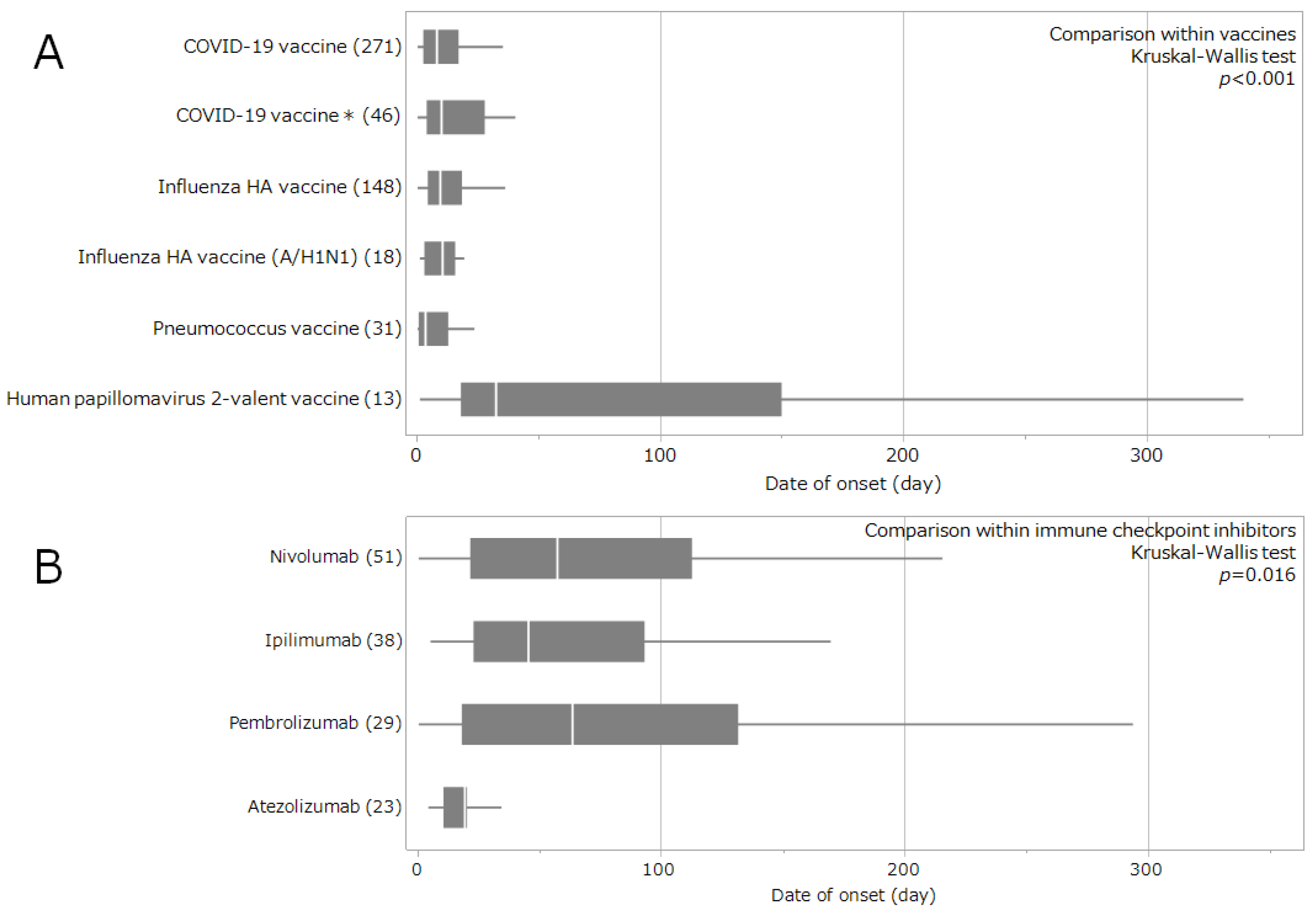
| COVID-19 vaccine | 8.5 (0.5–225.5) | 13.41 (11.21–16.00) | 0.71 (0.65–0.77) | Early failure type | 271 |
| COVID-19 vaccine * | 10.5 (0.5–347.5) | 27.43 (16.27–45.28) | 0.61 (0.49–0.75) | Early failure type | 46 |
| Influenza HA vaccine | 10.5 (0.5–212.5) | 15.44 (12.66–18.76) | 0.87 (0.77–0.98) | Early failure type | 148 |
| Influenza HA vaccine (A/H1N1) | 10.5 (1.5–51.5) | 13.36 (8.23–21.12) | 1.09 (0.74–1.51) | Random failure type | 18 |
| Pneumococcal vaccine | 4.5 (0.5–212.5) | 10.83 (5.44–20.94) | 0.57 (0.43–0.72) | Early failure type | 31 |
| Human papillomavirus 2-valent vaccine | 32.5 (1.5–352.5) | 81.92 (35.55–179.17) | 0.77 (0.48–1.13) | Random failure type | 13 |
| Immune checkpoint inhibitors | |||||
| Nivolumab | 57.5 (0.5–359.5) | 83.75 (62.50–110.90) | 1.03 (0.82–1.27) | Random failure type | 51 |
| Ipilimumab | 45.5 (5.5–169.5) | 65.52 (50.42–84.10) | 1.35 (1.03–1.71) | Wear-out failure type | 38 |
| Pembrolizumab | 63.5 (0.5–314.5) | 92.13 (57.51–144.19) | 0.86 (0.63–1.14) | Random failure type | 29 |
| Atezolizumab | 19.5 (4.5–147.5) | 33.68 (21.36–51.90) | 1.02 (0.74–1.33) | Random failure type | 23 |
| Drug | Gender | Time to Onset (Days) | Weibull Distribution | N | p Value # | |
|---|---|---|---|---|---|---|
| Median (Min–Max) | Scale Parameter α (95% CI) | Shape Parameter β (95% CI) | ||||
| Vaccines | ||||||
| COVID-19 vaccine | 0.432 | |||||
| Male | 8.5 (0.5–175.5) | 13.64 (10.77–17.18) | 0.81 (0.71–0.92) | 122 | ||
| Female | 8 (0.5–242.5) | 13.44 (10.28–17.48) | 0.66 (0.58–0.74) | 144 | ||
| COVID-19 vaccine * | 0.005 | |||||
| Male | 16.5 (1.5–287.5) | 40.01 (22.62–68.82) | 0.70 (0.53–0.90) | 30 | ||
| Female | 4.5 (0.5–347.5) | 11.49 (4.04–31.15) | 0.53 (0.37–0.72) | 16 | ||
| Influenza HA vaccine | 0.416 | |||||
| Male | 9.5 (0.5–71.5) | 13.71 (10.74–17.36) | 0.98 (0.83–1.15) | 79 | ||
| Female | 10 (0.5–108.5) | 16.20 (12.11–21.46) | 0.89 (0.74–1.06) | 68 | ||
| Influenza HA vaccine (A/H1N1) | 0.032 | |||||
| Male | 14.5 (2.5–51.5) | 19.65 (11.20–33.32) | 1.33 (0.77–2.03) | 10 | ||
| Female | 5.5 (1.5–16.5) | 7.03 (3.57–13.24) | 1.28 (0.68–2.11) | 8 | ||
| Human papillomavirus 2-valent vaccine | — | |||||
| Male | — | — | — | — | ||
| Female | 32.5 (1.5–352.5) | 81.92 (35.55–179.17) | 0.77 (0.48–1.13) | 13 | ||
| Pneumococcal vaccine | 0.496 | |||||
| Male | 3 (0.5–23.5) | 6.07 (3.09–11.39) | 0.80 (0.53–1.12) | 18 | ||
| Female | 4.5 (0.5–31.5) | 8.23 (3.98–16.23) | 0.98 (0.58–1.47) | 11 | ||
| Immune checkpoint inhibitors | ||||||
| Nivolumab | 0.422 | |||||
| Male | 57.5 (0.5–359.5) | 76.83 (53.49–108.62) | 1.01 (0.77–1.29) | 35 | ||
| Female | 67 (7.5–215.5) | 99.97 (59.12–163.25) | 1.09 (0.71–1.59) | 16 | ||
| Ipilimumab | 0.649 | |||||
| Male | 46.5 (5.5–112.5) | 59.91 (45.95–76.97) | 1.64 (1.17–2.20) | 26 | ||
| Female | 44.5 (7.5–169.5) | 77.04 (42.21–135.01) | 1.13 (0.68–1.71) | 12 | ||
| Pembrolizumab | 0.853 | |||||
| Male | 63.5 (1.5–314.5) | 104.55 (55.05–191.02) | 0.89 (0.57–1.28) | 16 | ||
| Female | 97 (0.5–293.5) | 81.32 (35.13–179.83) | 0.85 (0.49–1.33) | 11 | ||
| Atezolizumab | 0.203 | |||||
| Male | 20.5 (4.5–147.5) | 46.27 (23.87–85.81) | 0.97 (0.61–1.43) | 13 | ||
| Female | 15.5 (8.5–20.5) | 16.97 (14.36–19.85) | 4.85 (2.63–7.91) | 9 | ||
| Drug | Age | Time to Onset (Days) | Weibull Distribution | N | p Value # | |
|---|---|---|---|---|---|---|
| Median (Min–Max) | Scale Parameter α (95% CI) | Shape Parameter β (95% CI) | ||||
| Vaccines | ||||||
| COVID-19 vaccine | 0.610 | |||||
| <20 y | 9.5 (0.5–153.5) | 14.96 (7.54–28.65) | 0.75 (0.52–1.00) | 19 | ||
| ≥20 y | 7.5 (0.5–242.5) | 13.41 (11.12–16.12) | 0.71 (0.65–0.77) | 250 | ||
| COVID-19 vaccine * | 0.524 | |||||
| <20 y | 347.5 (347.5–347.5) | — | — | 1 | ||
| ≥20 y | 9.5 (0.5–287.5) | 24.57 (14.81–39.98) | 0.64 (0.51–0.78) | 45 | ||
| Influenza HA vaccine | 0.311 | |||||
| <20 y | 12.5 (1.5–108.5) | 18.52 (12.42–27.18) | 0.98 (0.75–1.23) | 31 | ||
| ≥20 y | 9.5 (0.5–90.5) | 13.94 (11.27–17.15) | 0.92 (0.80–1.06) | 116 | ||
| Influenza HA vaccine (A/H1N1) | 0.333 | |||||
| <20 y | 16.5 (16.5–16.5) | — | — | 1 | ||
| ≥20 y | 10.5 (1.5–51.5) | 12.98 (7.73–21.16) | 1.06 (0.71–1.47) | 17 | ||
| Human papillomavirus 2-valent vaccine | 0.894 | |||||
| <20 y | 32.5 (1.5–352.5) | 82.62 (33.25–193.62) | 0.74 (0.45–1.11) | 12 | ||
| ≥20 y | 52.5 (52.5–52.5) | — | — | 1 | ||
| Pneumococcal vaccine | — | |||||
| <20 y | — | — | — | 0 | ||
| ≥20 y | 3.5 (0.5–31.5) | 6.86 (4.25–10.79) | 0.86 (0.63–1.12) | 29 | ||
| Immune checkpoint inhibitors | ||||||
| Nivolumab | — | |||||
| <20 y | — | — | — | 0 | ||
| ≥20 y | 57.5 (0.5–359.5) | 83.75 (62.50–110.90) | 1.03 (0.82–1.27) | 51 | ||
| Ipilimumab | — | |||||
| <20 y | — | — | — | 0 | ||
| ≥20 y | 45.5 (5.5–169.5) | 65.52 (50.42–84.10) | 1.35 (1.03–1.71) | 38 | ||
| Pembrolizumab | — | |||||
| <20 y | — | — | — | 0 | ||
| ≥20 y | 63.5 (0.5–314.5) | 90.05 (55.02–143.74) | 0.84 (0.61–1.12) | 28 | ||
| Atezolizumab | — | |||||
| <20 y | — | — | — | 0 | ||
| ≥20 y | 19.5 (4.5–147.5) | 33.68 (21.36–51.90) | 1.02 (0.74–1.33) | 23 | ||
Disclaimer/Publisher’s Note: The statements, opinions and data contained in all publications are solely those of the individual author(s) and contributor(s) and not of MDPI and/or the editor(s). MDPI and/or the editor(s) disclaim responsibility for any injury to people or property resulting from any ideas, methods, instructions or products referred to in the content. |
© 2026 by the authors. Licensee MDPI, Basel, Switzerland. This article is an open access article distributed under the terms and conditions of the Creative Commons Attribution (CC BY) license.
Share and Cite
Toriumi, S.; Kurihara, Y.; Shimokawa, K.; Tanaka, A.; Araki, N.; Kawai, O.; Sugiura, Y.; Uesawa, Y. Disproportionality Analysis and Timing of Drug-Associated Guillain–Barré Syndrome Onset Based on the Japanese Adverse Drug Event Report Database. Pharmaceuticals 2026, 19, 688. https://doi.org/10.3390/ph19050688
Toriumi S, Kurihara Y, Shimokawa K, Tanaka A, Araki N, Kawai O, Sugiura Y, Uesawa Y. Disproportionality Analysis and Timing of Drug-Associated Guillain–Barré Syndrome Onset Based on the Japanese Adverse Drug Event Report Database. Pharmaceuticals. 2026; 19(5):688. https://doi.org/10.3390/ph19050688
Chicago/Turabian StyleToriumi, Shinya, Yousuke Kurihara, Komei Shimokawa, Arihito Tanaka, Norito Araki, Osamu Kawai, Yasoo Sugiura, and Yoshihiro Uesawa. 2026. "Disproportionality Analysis and Timing of Drug-Associated Guillain–Barré Syndrome Onset Based on the Japanese Adverse Drug Event Report Database" Pharmaceuticals 19, no. 5: 688. https://doi.org/10.3390/ph19050688
APA StyleToriumi, S., Kurihara, Y., Shimokawa, K., Tanaka, A., Araki, N., Kawai, O., Sugiura, Y., & Uesawa, Y. (2026). Disproportionality Analysis and Timing of Drug-Associated Guillain–Barré Syndrome Onset Based on the Japanese Adverse Drug Event Report Database. Pharmaceuticals, 19(5), 688. https://doi.org/10.3390/ph19050688