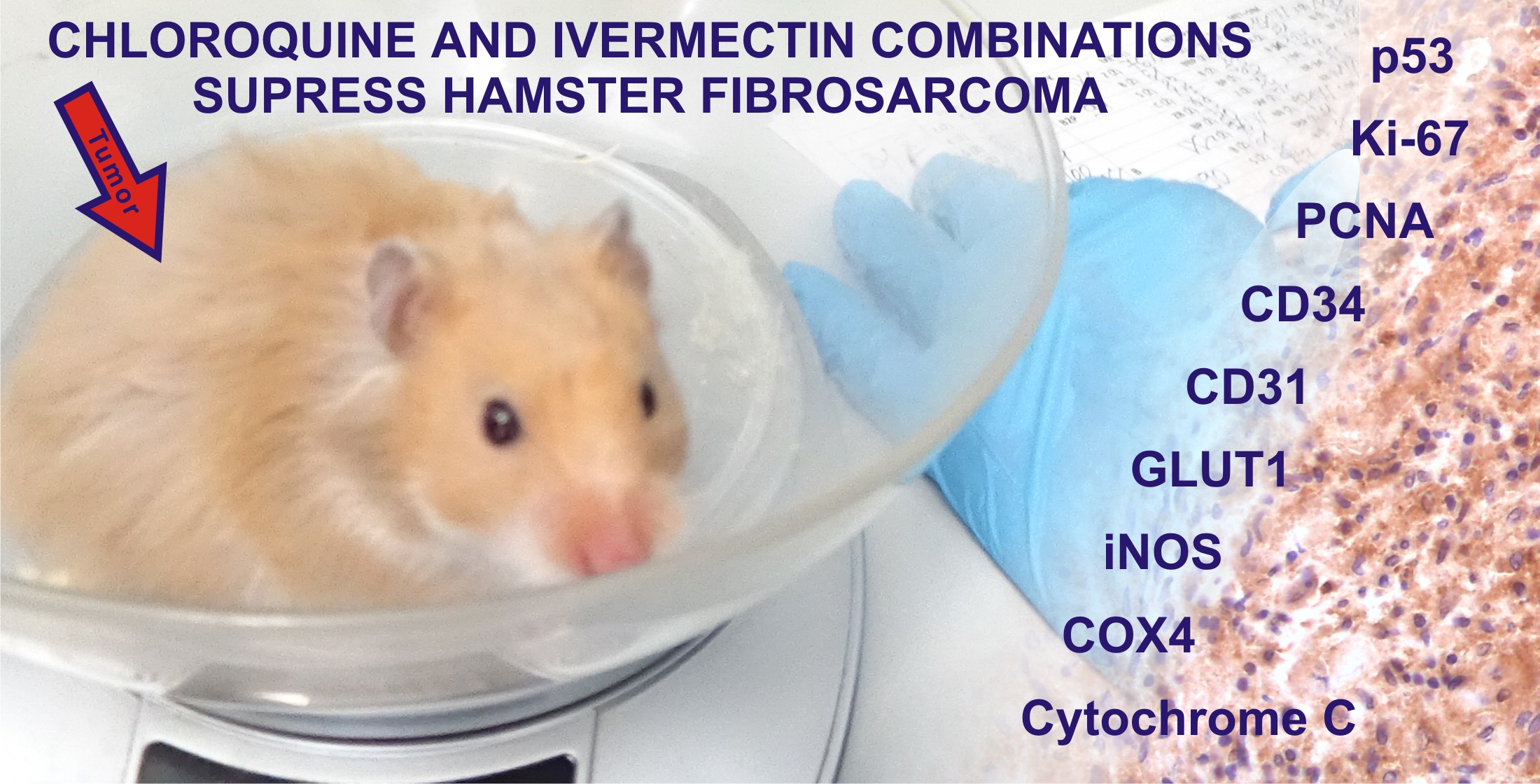
Captivating Synergistic, Dose-Dependent Anticancer Effects of Tumor-Regulation Modulators Chloroquine and Ivermectin Completely Abolished by an Opposing Modulator, Deoxycholic Acid, in Hamster Fibrosarcoma: In Vivo, In Vitro, and Literature Review

 ,
,  ,
,  ,
,  ,
,  ,
,
Abstract
1. Introduction
2. Results
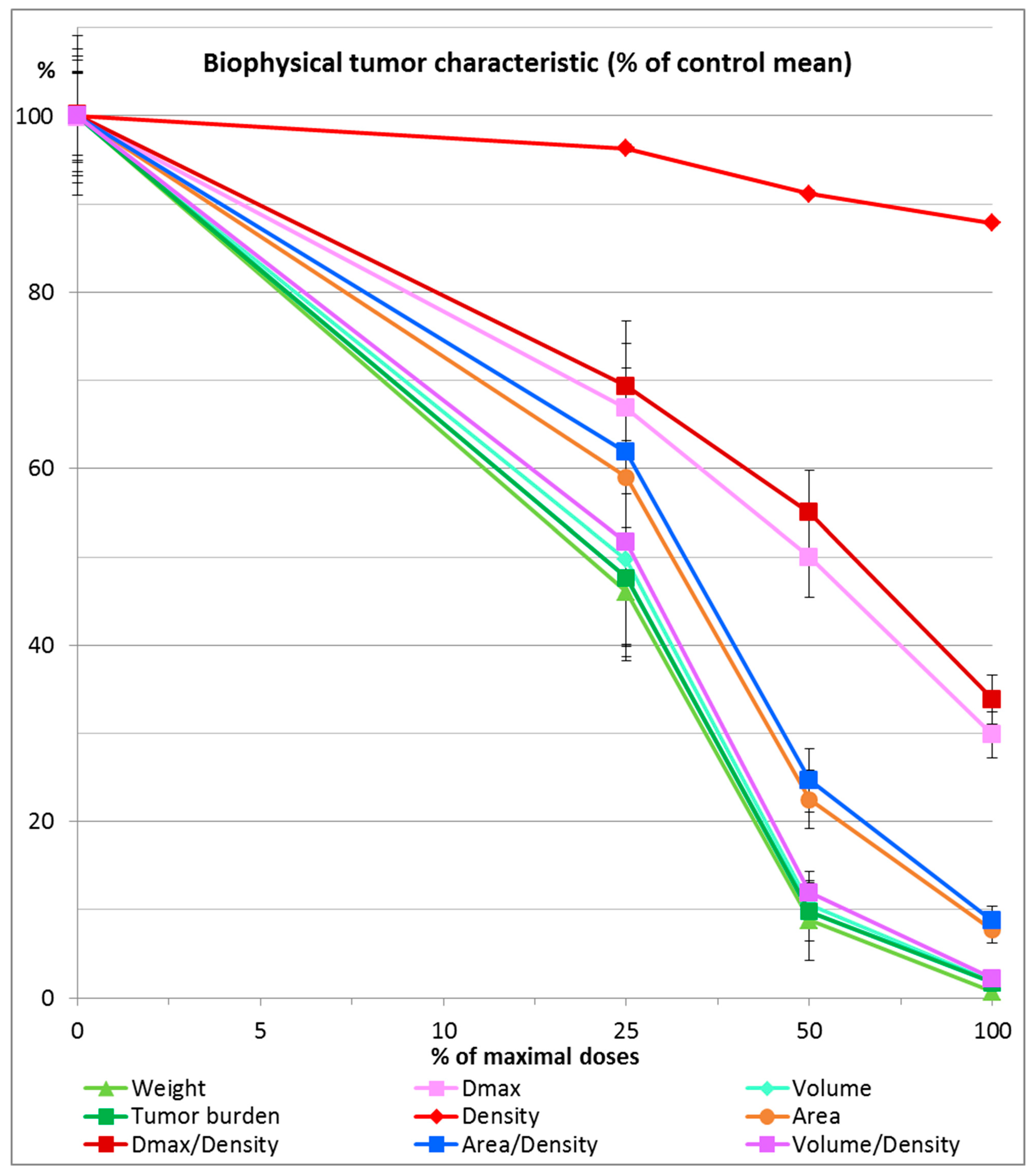
2.1. Biophysical Evaluation of Hamster Fibrosarcoma Characteristics
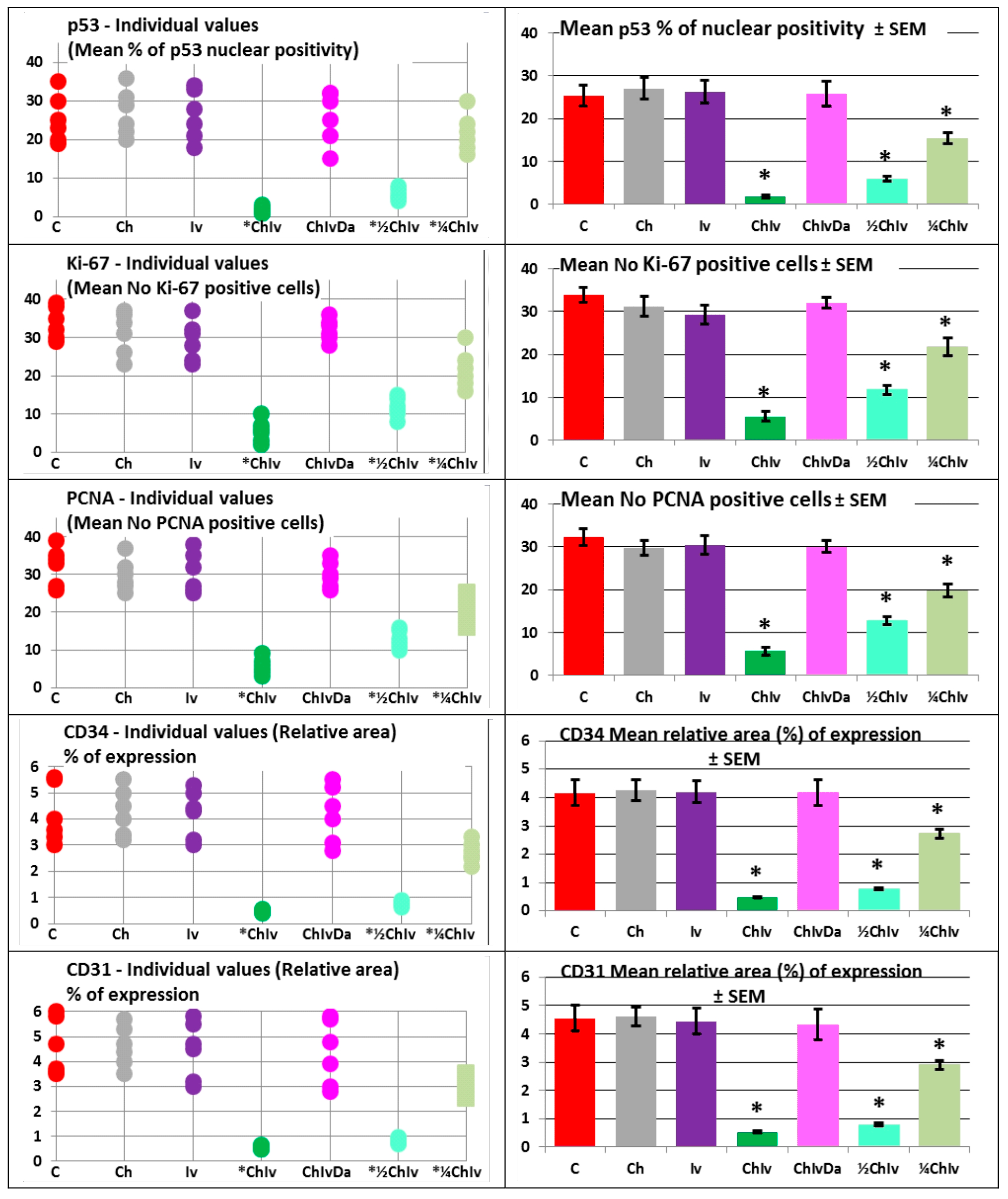
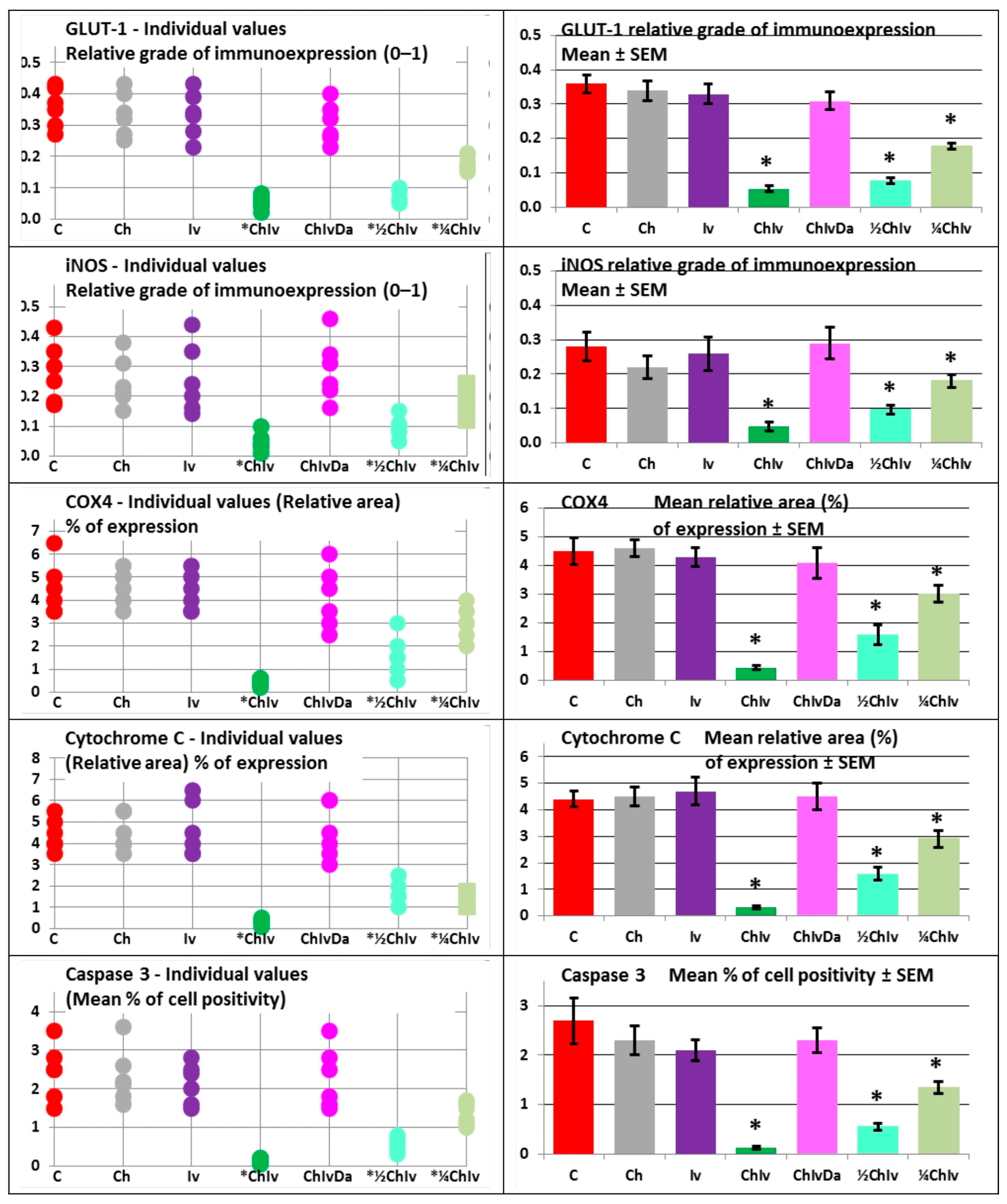
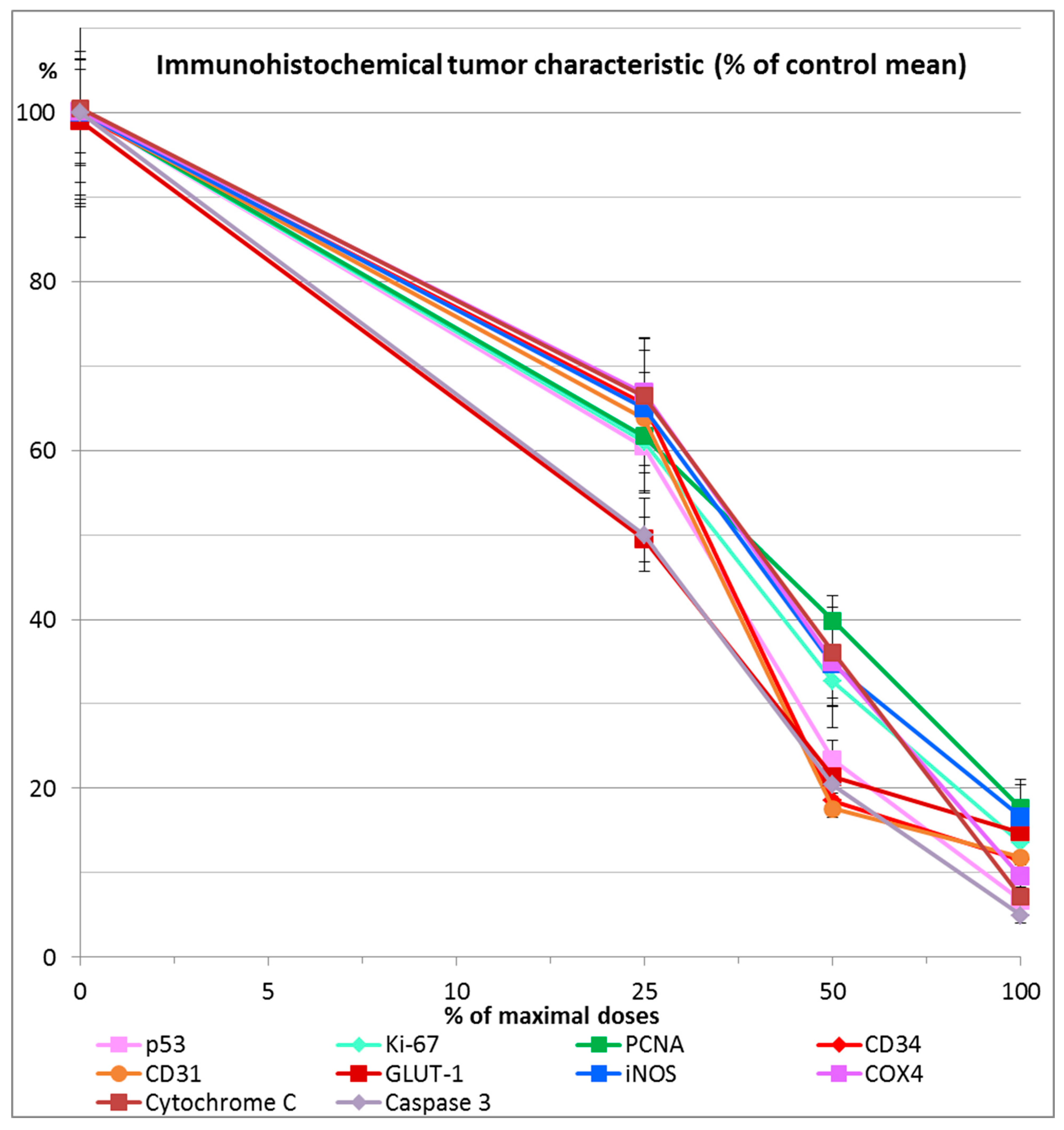
2.2. Immunohistochemical Evaluation of Hamster Fibrosarcoma Characteristics
2.3. Combination Index Analysis
2.4. Dose–Response Experiment
2.5. Co-Treatment with Chloroquine and Ivermectin Antiproliferative Effects in Cancer Cell Lines
3. Discussion
- (1)
- Combination of chloroquine 12.5 mg/kg and ivermectin 1.25 mg/kg
- (2)
- Combination of chloroquine 50 mg/kg, ivermectin 5 mg/kg, and deoxycholic acid 100 mg/kg
4. Materials and Methods
4.1. Animal Model
- (1)
- Biophysical tumor parameters, including tumor diameters, tumor density, tumor surface area, tumor Dmax/density ratio, tumor area/density ratio, and tumor volume/density ratio;
- (2)
- Immunohistochemical (IHC) parameters p53, Ki-67, PCNA, CD34, CD31, GLUT1, iNOS, COX4, Cytochrome C, and caspase 3.
4.2. Histological Staining Procedures
4.3. Blood Hematological Analyses and Biochemical Tests
4.4. In Vitro Antiproliferative Assay
4.5. Statistical Analysis
5. Conclusions
Supplementary Materials
Author Contributions
Funding
Institutional Review Board Statement
Informed Consent Statement
Data Availability Statement
Acknowledgments
Conflicts of Interest
References
- Lashgari, N.A.; Roudsari, N.M.; Ahmadvand, D.; Amirlou, D.; Darban Khales, S.; Ahmadian, D.; Momtaz, S.; Abdolghaffari, A.H.; Jamialahmadi, T.; Sahebkar, A. Chapter 9—Repurposing antiparasitic drugs for the treatment of other diseases. In Advances in Antiparasitic Therapies and Drug Delivery; Kesharwani, P., Gupta, N., Eds.; Academic Press: Cambridge, MA, USA, 2024; pp. 161–261. [Google Scholar] [CrossRef]
- Fauzi, Y.R.; Nakahata, S.; Chilmi, S.; Ichikawa, T.; Nueangphuet, P.; Yamaguchi, R.; Nakamura, T.; Shimoda, K.; Morishita, K. Antitumor effects of chloroquine/hydroxychloroquine mediated by inhibition of the NF-κB signaling pathway through abrogation of autophagic p47 degradation in adult T-cell leukemia/lymphoma cells. PLoS ONE 2021, 16, e0256320. [Google Scholar] [CrossRef] [PubMed]
- Khan, M.U.A.; Akhtar, T.; Naseem, N.; Aftab, U.; Hussain, S.; Shahzad, M. Evaluation of therapeutic potential of ivermectin against complete Freund’s adjuvant-induced arthritis in rats: Involvement of inflammatory mediators. Fundam. Clin. Pharmacol. 2023, 37, 971–982. [Google Scholar] [CrossRef] [PubMed]
- Gao, X.; Xuan, Y.; Zhou, Z.; Chen, C.; Wen Wang, D.; Wen, Z. Ivermectin ameliorates acute myocarditis via the inhibition of importin-mediated nuclear translocation of NF-κB/p65. Int. Immunopharmacol. 2024, 133, 112073. [Google Scholar] [CrossRef]
- Bernstein, H.; Bernstein, C.; Holubec, H.; Dvorakova, B.; Garewal, H. Deoxycholate induces mitochondrial oxidative stress and activates NF-kappaB through multiple mechanisms in HCT-116 colon epithelial cells. Carcinogenesis 2007, 28, 215–222. [Google Scholar] [CrossRef]
- Huo, X.; Juergens, S.; Zhang, X.; Rezaei, D.; Yu, C.; Strauch, E.D.; Wang, J.Y.; Cheng, E.; Meyer, F.; Wang, D.H.; et al. Deoxycholic acid causes DNA damage while inducing apoptotic resistance through NF-κB activation in benign Barrett’s epithelial cells. Am. J. Physiol. Gastrointest. Liver Physiol. 2011, 301, G278–G286. [Google Scholar] [CrossRef]
- Shivakumar, S.; Panigrahi, T.; Shetty, R.; Subramani, M.; Ghosh, A.; Jeyabalan, N. Chloroquine Protects Human Corneal Epithelial Cells from Desiccation Stress Induced Inflammation without Altering the Autophagy Flux. BioMed Res. Int. 2018, 2018, 7627329. [Google Scholar] [CrossRef]
- Mai, A.; Heba, G.; Enas, G.; Kawkab, A.; Maha, A. Suppression of NLRP3 inflammasome by ivermectin ameliorates bleomycin-induced pulmonary fibrosis. J. Zhejiang Univ.-Sci. B 2023, 24, 723–733. [Google Scholar] [CrossRef]
- Gil, D.; Laidler, P.; Zarzycka, M.; Dulińska-Litewka, J. Inhibition Effect of Chloroquine and Integrin-Linked Kinase Knockdown on Translation in Melanoma Cells. Int. J. Mol. Sci. 2021, 22, 3682. [Google Scholar] [CrossRef]
- Jiang, L.; Sun, Y.J.; Song, X.H.; Sun, Y.Y.; Yang, W.Y.; Li, J.; Wu, Y.J. Ivermectin inhibits tumor metastasis by regulating the Wnt/β-catenin/integrin β1/FAK signaling pathway. Am. J. Cancer Res. 2022, 12, 4502–4519. [Google Scholar] [PubMed] [PubMed Central]
- Jenkins, G.J.; Harries, K.; Doak, S.H.; Wilmes, A.; Griffiths, A.P.; Baxter, J.N.; Parry, J.M. The bile acid deoxycholic acid (DCA) at neutral pH activates NF-kappaB and induces IL-8 expression in oesophageal cells in vitro. Carcinogenesis 2004, 25, 317–323. [Google Scholar] [CrossRef]
- Chen, C.; Zhang, H.; Yu, Y.; Huang, Q.; Wang, W.; Niu, J.; Lou, J.; Ren, T.; Huang, Y.; Guo, W. Chloroquine suppresses proliferation and invasion and induces apoptosis of osteosarcoma cells associated with inhibition of phosphorylation of STAT3. Aging 2021, 13, 17901–17913. [Google Scholar] [CrossRef]
- Zaidi, A.K.; Dehgani-Mobaraki, P. The mechanisms of action of ivermectin against SARS-CoV-2—An extensive review. J. Antibiot. 2022, 75, 60–71. [Google Scholar] [CrossRef] [PubMed]
- Kaur, B.; Blavo, C.; Parmar, M.S. Ivermectin: A Multifaceted Drug with a Potential Beyond Anti-parasitic Therapy. Cureus 2024, 16, e56025. [Google Scholar] [CrossRef]
- Lotfalizadeh, N.; Gharib, A.; Hajjafari, A.; Borji, H.; Bayat, Z. The Anticancer Potential of Ivermectin: Mechanisms of Action and Therapeutic Implications. J. Lab. Anim. Res. 2022, 1, 52–59. [Google Scholar] [CrossRef]
- Jin, D.; Huang, K.; Xu, M.; Hua, H.; Ye, F.; Yan, J.; Zhang, G.; Wang, Y. Deoxycholic acid induces gastric intestinal metaplasia by activating STAT3 signaling and disturbing gastric bile acids metabolism and microbiota. Gut Microbes 2022, 14, 2120744. [Google Scholar] [CrossRef]
- Duleh, S.; Wang, X.; Komirenko, A.; Margeta, M. Activation of the Keap1/Nrf2 stress response pathway in autophagic vacuolar myopathies. Acta Neuropathol. Commun. 2016, 4, 115. [Google Scholar] [CrossRef]
- Jiang, L.; Wang, P.; Sun, Y.J.; Wu, Y.J. Ivermectin reverses the drug resistance in cancer cells through EGFR/ERK/Akt/NF-κB pathway. J. Exp. Clin. Cancer Res. 2019, 38, 265. [Google Scholar] [CrossRef]
- Liu, J.; Zhang, Y.; Song, M.; Guo, X.; Fan, J.; Tao, S. Taurodeoxycholic acid alleviates diquat-induced intestinal barrier function injury in mice through the upregulation of Nrf2-mediated signaling pathway. Anim. Dis. 2024, 4, 34. [Google Scholar] [CrossRef]
- Yue, D.; Zhang, D.; Shi, X.; Liu, S.; Li, A.; Wang, D.; Qin, G.; Ping, Y.; Qiao, Y.; Chen, X.; et al. Chloroquine Inhibits Stemness of Esophageal Squamous Cell Carcinoma Cells Through Targeting CXCR4-STAT3 Pathway. Front. Oncol. 2020, 10, 311. [Google Scholar] [CrossRef] [PubMed]
- Dominguez-Gomez, G.; Chavez-Blanco, A.; Medina-Franco, J.L.; Saldivar-Gonzalez, F.; Flores-Torrontegui, Y.; Juarez, M.; Díaz-Chávez, J.; Gonzalez-Fierro, A.; Dueñas-González, A. Ivermectin as an inhibitor of cancer stem-like cells. Mol. Med. Rep. 2018, 17, 3397–3403. [Google Scholar] [CrossRef]
- Chen, M.; Ye, A.; Wei, J.; Wang, R.; Poon, K. Deoxycholic Acid Upregulates the Reprogramming Factors KFL4 and OCT4 Through the IL-6/STAT3 Pathway in Esophageal Adenocarcinoma Cells. Technol. Cancer Res. Treat. 2020, 19, 1533033820945302. [Google Scholar] [CrossRef]
- Sun, L.; Beggs, K.; Borude, P.; Edwards, G.; Bhushan, B.; Walesky, C.; Roy, N.; Manley, M.W., Jr.; Gunewardena, S.; O’Neil, M.; et al. Bile acids promote diethylnitrosamine-induced hepatocellular carcinoma via increased inflammatory signaling. Am. J. Physiol. Gastrointest. Liver Physiol. 2016, 311, G91–G104. [Google Scholar] [CrossRef]
- Razani, B.; Feng, C.; Semenkovich, C.F. p53 is required for chloroquine-induced atheroprotection but not insulin sensitization. J. Lipid Res. 2010, 51, 1738–1746. [Google Scholar] [CrossRef][Green Version]
- Ma, Y.; Xu, X.; Wu, H.; Li, C.; Zhong, P.; Liu, Z.; Ma, C.; Liu, W.; Wang, C.; Zhang, Y.; et al. Ivermectin contributes to attenuating the severity of acute lung injury in mice. Biomed. Pharmacother. 2022, 155, 113706. [Google Scholar] [CrossRef]
- Gupta, S.; Natarajan, R.; Payne, S.G.; Studer, E.J.; Spiegel, S.; Dent, P.; Hylemon, P.B. Deoxycholic acid activates the c-Jun N-terminal kinase pathway via FAS receptor activation in primary hepatocytes. Role of acidic sphingomyelinase-mediated ceramide generation in FAS receptor activation. J. Biol. Chem. 2004, 279, 5821–5828. [Google Scholar] [CrossRef]
- Lin, Y.; Zhu, X.; Li, Y.; Dou, Y.; Wang, J.; Qi, R.; Ma, L. LY294002 ameliorates psoriatic skin inflammation in mice via blocking the Notch1/Hes1-PTEN/AKT/IL-17A feedback loop. Clin. Exp. Immunol. 2023, 213, 114–124. [Google Scholar] [CrossRef]
- Rani, A.; Greenlaw, R.; Smith, R.A.; Galustian, C. HES1 in immunity and cancer. Cytokine Growth Factor Rev. 2016, 30, 113–117. [Google Scholar] [CrossRef]
- Wang, W.G.; Jiang, X.F.; Zhang, C.; Zhan, X.P.; Cheng, J.G.; Tao, L.M.; Xu, W.P.; Li, Z.; Zhang, Y. Avermectin induced vascular damage in zebrafish larvae: Association with mitochondria-mediated apoptosis and VEGF/Notch signaling pathway. J. Hazard. Mater. 2024, 477, 135376. [Google Scholar] [CrossRef] [PubMed]
- Wang, Y.C.; Wang, Z.Q.; Yuan, Y.; Ren, T.; Ni, P.Z.; Chen, L.Q. Notch Signaling Pathway Is Inhibited in the Development of Barrett’s Esophagus: An In Vivo and In Vitro Study. Can. J. Gastroenterol. Hepatol. 2018, 2018, 4149317. [Google Scholar] [CrossRef] [PubMed]
- Espina, V.A.; Yeon, S.; VanHouten, J.N.; Wysolmerski, J.; Liotta, L.A. Chloroquine and vitamin D3 modulate proliferation in early stage breast cancer models. [abstract]. In Proceedings of the 107th Annual Meeting of the American Association for Cancer Research, New Orleans, LA, USA, 16–20 April 2016; AACR: Philadelphia, PA, USA, 2016. [Google Scholar]
- Mathachan, S.R.; Sardana, K.; Khurana, A. Current Use of Ivermectin in Dermatology, Tropical Medicine, and COVID-19: An Update on Pharmacology, Uses, Proven and Varied Proposed Mechanistic Action. Indian Dermatol. Online J. 2021, 12, 500–514. [Google Scholar] [CrossRef] [PubMed]
- Thompson, B.; Lu, S.; Revilla, J.; Uddin, M.J.; Oakland, D.N.; Brovero, S.; Keles, S.; Bresnick, E.H.; Petri, W.A.; Burgess, S.L. Secondary bile acids function through the vitamin D receptor in myeloid progenitors to promote myelopoiesis. Blood Adv. 2023, 7, 4970–4982. [Google Scholar] [CrossRef] [PubMed]
- Yuan, P.; Hu, Q.; He, X.; Long, Y.; Song, X.; Wu, F.; He, Y.; Zhou, X. Laminar flow inhibits the Hippo/YAP pathway via autophagy and SIRT1-mediated deacetylation against atherosclerosis. Cell Death Dis. 2020, 11, 141. [Google Scholar] [CrossRef]
- Li, B.; Du, Y.; He, J.; Lv, X.; Liu, S.; Zhang, X.; Zhang, Y. Chloroquine inhibited Helicobacter pylori-related gastric carcinogenesis by YAP-β-catenin-autophagy axis. Microb. Pathog. 2023, 184, 106388. [Google Scholar] [CrossRef]
- Nishio, M.; Sugimachi, K.; Goto, H.; Wang, J.; Morikawa, T.; Miyachi, Y.; Takano, Y.; Hikasa, H.; Itoh, T.; Suzuki, S.O.; et al. Dysregulated YAP1/TAZ and TGF-β signaling mediate hepatocarcinogenesis in Mob1a/1b-deficient mice. PNAS Med. Sci. 2015, 113, E71–E80. [Google Scholar] [CrossRef] [PubMed]
- Anakk, S.; Bhosale, M.; Schmidt, V.A.; Johnson, R.L.; Finegold, M.J.; Moore, D.D. Bile acids activate YAP to promote liver carcinogenesis. Cell Rep. 2013, 5, 1060–1069. [Google Scholar] [CrossRef] [PubMed]
- Datta, S.; Choudhury, D.; Das, A.; Mukherjee, D.D.; Dasgupta, M.; Bandopadhyay, S.; Chakrabarti, G. Autophagy inhibition with chloroquine reverts paclitaxel resistance and attenuates metastatic potential in human nonsmall lung adenocarcinoma A549 cells via ROS mediated modulation of β-catenin pathway. Apoptosis 2019, 24, 434. [Google Scholar] [CrossRef]
- Song, P.; Gao, Z.; Bao, Y.; Chen, L.; Huang, Y.; Liu, Y.; Dong, Q.; Wei, X. Wnt/β-catenin signaling pathway in carcinogenesis and cancer therapy. J. Hematol. Oncol. 2024, 17, 46. [Google Scholar] [CrossRef]
- Melotti, A.; Mas, C.; Kuciak, M.; Lorente-Trigos, A.; Borges, I.; Ruiz i Altaba, A. The river blindness drug Ivermectin and related macrocyclic lactones inhibit WNT-TCF pathway responses in human cancer. EMBO Mol. Med. 2014, 6, 1263–1278. [Google Scholar] [CrossRef]
- Pai, R.; Tarnawski, A.S.; Tran, T. Deoxycholic acid activates β-catenin signaling pathway and increases colon cell cancer growth and invasiveness. Mol. Biol. Cell 2004, 15, 2156–2163. [Google Scholar] [CrossRef]
- Dettmar, P.W.; Strugala, V.; Tselepis, C. The effect of alginates on deoxycholic-acid-induced changes in oesophageal mucosal biology at pH 4. J. Biomater. Sci. Polym. Ed. 2007, 18, 317–333. [Google Scholar] [CrossRef]
- Zhang, S.; Zhu, C.; Liu, Q.; Wang, W. Effects of chloroquine on GFAP, PCNA and cyclin D1 in hippocampus and cerebral cortex of rats with seizures induced by pentylenetetrazole. J. Huazhong Univ. Sci. Technol. Med. Sci. 2005, 25, 625–628. [Google Scholar] [CrossRef]
- Choi, J.-H.; Yoon, J.S.; Won, Y.W.; Park, B.B.; Lee, Y.Y. Chloroquine enhances the chemotherapeutic activity of 5-fluorouracil in a colon cancer cell line via cell cycle alteration. APMIS 2012, 120, 597–604. [Google Scholar] [CrossRef]
- Jang, J.Y.; Im, E.; Choi, Y.H.; Kim, N.D. Mechanism of Bile Acid-Induced Programmed Cell Death and Drug Discovery against Cancer: A Review. Int. J. Mol. Sci. 2022, 23, 7184. [Google Scholar] [CrossRef]
- Hwang, J.R.; Kim, W.Y.; Cho, Y.J.; Ryu, J.Y.; Choi, J.J.; Jeong, S.Y.; Kim, M.S.; Kim, J.H.; Paik, E.S.; Lee, Y.Y.; et al. Chloroquine reverses chemoresistance via upregulation of p21WAF1/CIP1 and autophagy inhibition in ovarian cancer. Cell Death Dis. 2020, 11, 1034. [Google Scholar] [CrossRef] [PubMed]
- Sasaki, K.; Tsuno, N.H.; Sunami, E.; Tsurita, G.; Kawai, K.; Okaji, Y.; Nishikawa, T.; Shuno, Y.; Hongo, K.; Hiyoshi, M.; et al. Chloroquine potentiates the anti-cancer effect of 5-fluorouracil on colon cancer cells. BMC Cancer 2010, 10, 370. [Google Scholar] [CrossRef]
- Tung, C.L.; Chao, W.Y.; Li, Y.Z.; Shen, C.H.; Zhao, P.W.; Chen, S.H.; Wu, T.Y.; Lee, Y.R. Ivermectin induces cell cycle arrest and caspase-dependent apoptosis in human urothelial carcinoma cells. Int. J. Med. Sci. 2022, 19, 1567–1575. [Google Scholar] [CrossRef] [PubMed]
- Kodama, M.; Kodama, T.; Newberg, J.Y.; Katayama, H.; Kobayashi, M.; Hanash, S.M.; Yoshihara, K.; Wei, Z.; Tien, J.C.; Rangel, R.; et al. In vivo loss-of-function screens identify KPNB1 as a new druggable oncogene in epithelial ovarian cancer. PNAS Biol. Sci. 2017, 114, E7301–E7310. [Google Scholar] [CrossRef] [PubMed]
- Qiao, L.; McKinstry, R.; Gupta, S.; Gilfor, D.; Windle, J.J.; Hylemon, P.B.; Grant, S.; Fisher, P.B.; Dent, P. Cyclin kinase inhibitor p21 potentiates bile acid-induced apoptosis in hepatocytes that is dependent on p53. Hepatology 2002, 36, 39–48. [Google Scholar] [CrossRef]
- Zhang, G.; Park, M.A.; Mitchell, C.; Walker, T.; Hamed, H.; Studer, E.; Graf, M.; Rahmani, M.; Gupta, S.; Hylemon, P.B.; et al. Multiple cyclin kinase inhibitors promote bile acid-induced apoptosis and autophagy in primary hepatocytes via p53-CD95-dependent signaling. J. Biol. Chem. 2008, 283, 24343–24358. [Google Scholar] [CrossRef]
- Müller, A.; Weyerhäuser, P.; Berte, N.; Jonin, F.; Lyubarskyy, B.; Sprang, B.; Kantelhardt, S.R.; Salinas, G.; Opitz, L.; Schulz-Schaeffer, W.; et al. Concurrent Activation of Both Survival-Promoting and Death-Inducing Signaling by Chloroquine in Glioblastoma Stem Cells: Implications for Potential Risks and Benefits of Using Chloroquine as Radiosensitizer. Cells 2023, 12, 1290. [Google Scholar] [CrossRef]
- Agalakova, N.I. Chloroquine and Chemotherapeutic Compounds in Experimental Cancer Treatment. Int. J. Mol. Sci. 2024, 25, 945. [Google Scholar] [CrossRef]
- Xu, N.; Lu, M.; Wang, J.; Li, Y.; Yang, X.; Wei, X.; Si, J.; Han, J.; Yao, X.; Zhang, J.; et al. Ivermectin induces apoptosis of esophageal squamous cell carcinoma via mitochondrial pathway. BMC Cancer 2021, 21, 1307. [Google Scholar] [CrossRef] [PubMed]
- Dong, W.; Liu, L.; Dou, Y.; Xu, M.; Liu, T.; Wang, S.; Zhang, Y.; Deng, B.; Wang, B.; Cao, H. Deoxycholic acid activates epidermal growth factor receptor and promotes intestinal carcinogenesis by ADAM17-dependent ligand release. J. Cell. Mol. Med. 2018, 22, 4263–4273. [Google Scholar] [CrossRef] [PubMed]
- Ochsenkühn, T.; Bayerdörffer, E.; Meining, A.; Schinkel, M.; Thiede, C.; Nüssler, V.; Sackmann, M.; Hatz, R.; Neubauer, A.; Paumgartner, G. Colonic mucosal proliferation is related to serum deoxycholic acid levels. Cancer 1999, 85, 1664–1669. [Google Scholar] [CrossRef]
- Liu, L.; Han, C.; Yu, H.; Zhu, W.; Cui, H.; Zheng, L.; Zhang, C.; Yue, L. Chloroquine inhibits cell growth in human A549 lung cancer cells by blocking autophagy and inducing mitochondrial-mediated apoptosis. Oncol. Rep. 2018, 39, 2807–2816. [Google Scholar] [CrossRef] [PubMed]
- Lim, S.C.; Duong, H.Q.; Parajuli, K.R.; Han, S.I. Pro-apoptotic role of the MEK/ERK pathway in ursodeoxycholic acid-induced apoptosis in SNU601 gastric cancer cells. Oncol. Rep. 2012, 28, 1429–1434. [Google Scholar] [CrossRef]
- Fedele, A.O.; Proud, C.G. Chloroquine and bafilomycin A mimic lysosomal storage disorders and impair mTORC1 signalling. Biosci. Rep. 2020, 40, BSR20200905. [Google Scholar] [CrossRef]
- Tang, M.; Hu, X.; Wang, Y.; Yao, X.; Zhang, W.; Yu, C.; Cheng, F.; Li, J.; Fang, Q. Ivermectin, a potential anticancer drug derived from an antiparasitic drug. Pharmacol. Res. 2021, 163, 105207. [Google Scholar] [CrossRef]
- Marin, J.J.; Hernandez, A.; Revuelta, I.E.; Gonzalez-Sanchez, E.; Gonzalez-Buitrago, J.M.; Perez, M.J. Mitochondrial genome depletion in human liver cells abolishes bile acid-induced apoptosis: Role of the Akt/mTOR survival pathway and Bcl-2 family proteins. Free Radic. Biol. Med. 2013, 61, 218–228. [Google Scholar] [CrossRef]
- Kim, J.H.; Choi, H.S.; Lee, D.S. Primaquine Inhibits the Endosomal Trafficking and Nuclear Localization of EGFR and Induces the Apoptosis of Breast Cancer Cells by Nuclear EGFR/Stat3-Mediated c-Myc Downregulation. Int. J. Mol. Sci. 2021, 22, 12961. [Google Scholar] [CrossRef]
- Caliceti, C.; Punzo, A.; Silla, A.; Simoni, P.; Roda, G.; Hrelia, S. New Insights into Bile Acids Related Signaling Pathways in the Onset of Colorectal Cancer. Nutrients 2022, 14, 2964. [Google Scholar] [CrossRef]
- Morgan, M.J.; Gamez, G.; Menke, C.; Hernandez, A.; Thorburn, J.; Gidan, F.; Staskiewicz, L.; Morgan, S.; Cummings, C.; Maycotte, P.; et al. Regulation of autophagy and chloroquine sensitivity by oncogenic RAS in vitro is context-dependent. Autophagy 2014, 10, 1814–1826. [Google Scholar] [CrossRef]
- McCubrey, J.A.; Abrams, S.L.; Follo, M.Y.; Manzoli, L.; Ratti, S.; Martelli, A.M.; Cervello, M. Effects of chloroquine and hydroxychloroquine on the sensitivity of pancreatic cancer cells to targeted therapies. Adv. Biol. Regul. 2023, 87, 100917. [Google Scholar] [CrossRef] [PubMed]
- Zhang, Y.; Sun, T.; Li, M.; Lin, Y.; Liu, Y.; Tang, S.; Dai, C. Ivermectin-Induced Apoptotic Cell Death in Human SH-SY5Y Cells Involves the Activation of Oxidative Stress and Mitochondrial Pathway and Akt/mTOR-Pathway-Mediated Autophagy. Antioxidants 2022, 11, 908. [Google Scholar] [CrossRef] [PubMed]
- Rust, C.; Karnitz, L.M.; Paya, C.V.; Moscat, J.; Simari, R.D.; Gores, G.J. The bile acid taurochenodeoxycholate activates a phosphatidylinositol 3-kinase-dependent survival signaling cascade. J. Biol. Chem. 2000, 275, 20210–20216. [Google Scholar] [CrossRef] [PubMed]
- Mühlbauer, M.; Allard, B.; Bosserhoff, A.K.; Kiessling, S.; Herfarth, H.; Rogler, G.; Schölmerich, J.; Jobin, C.; Hellerbrand, C. Differential effects of deoxycholic acid and taurodeoxycholic acid on NF-kappa B signal transduction and IL-8 gene expression in colonic epithelial cells. Am. J. Physiol. Gastrointest. Liver Physiol. 2004, 286, G1000–G1008. [Google Scholar] [CrossRef]
- Dey, S.; Reddy, K.V.V.S.N.; Wadhwani, A. Doxorubicin and chloroquine: A combination therapy to overcome the multi drug resistance in cancer—A review. Int. J. Pharm. Sci. Res. 2019, 4, 5266–5273. [Google Scholar] [CrossRef]
- Inokuchi, A.; Hinoshita, E.; Iwamoto, Y.; Kohno, K.; Kuwano, M.; Uchiumi, T. Enhanced expression of the human multidrug resistance protein 3 by bile salt in human enterocytes. A transcriptional control of a plausible bile acid transporter. J. Biol. Chem. 2001, 276, 46822–46829. [Google Scholar] [CrossRef]
- Kong, Y.; Bai, P.S.; Sun, H.; Nan, K.J.; Chen, N.Z.; Qi, X.G. The deoxycholic acid targets miRNA-dependent CAC1 gene expression in multidrug resistance of human colorectal cancer. Int. J. Biochem. Cell Biol. 2012, 44, 2321–2332. [Google Scholar] [CrossRef]
- Balic, A.; Sørensen, M.D.; Trabulo, S.M.; Sainz, B., Jr.; Cioffi, M.; Vieira, C.R.; Miranda-Lorenzo, I.; Hidalgo, M.; Kleeff, J.; Erkan, M.; et al. Chloroquine targets pancreatic cancer stem cells via inhibition of CXCR4 and hedgehog signaling. Mol. Cancer Ther. 2014, 13, 1758–1771. [Google Scholar] [CrossRef]
- James, C.E.; Davey, M.W. Increased expression of ABC transport proteins is associated with ivermectin resistance in the model nematode Caenorhabditis elegans. Int. J. Parasitol. 2009, 39, 213–220. [Google Scholar] [CrossRef]
- Lespine, A.; Dupuy, J.; Orlowski, S.; Nagy, T.; Glavinas, H.; Krajcsi, P.; Alvinerie, M. Interaction of ivermectin with multidrug resistance proteins (MRP1, 2 and 3). Chem. Biol. Interact. 2006, 159, 169–179. [Google Scholar] [CrossRef]
- Chewchuk, S.; Boorman, T.; Edwardson, D.; Parissenti, A.M. Bile Acids Increase Doxorubicin Sensitivity in ABCC1-expressing Tumour Cells. Sci. Rep. 2018, 8, 5413. [Google Scholar] [CrossRef]
- Sharma, A.; Biswas, S. Stage-specific cytosolic protein kinase C-like activity in human malarial parasite Plasmodium falciparum. Indian J. Biochem. Biophys. 2005, 42, 145–151. [Google Scholar]
- Ellis, C.; Nathwani, B.; Morrice, N.; Parker, P.; Evans, F.J.; Aitken, A. Ivermectin: An Inhibitor of Protein Kinase C—A Potential Target Enzyme for Onchocerciasis Chemotherapy. J. Pharm. Pharmacol. 1985, 37, 22. [Google Scholar] [CrossRef]
- Quilty, F.; Freeley, M.; Gargan, S.; Gilmer, J.; Long, A. Deoxycholic acid induces proinflammatory cytokine production by model oesophageal cells via lipid rafts. J. Steroid Biochem. Mol. Biol. 2021, 214, 105987. [Google Scholar] [CrossRef] [PubMed]
- Choi, D.S.; Blanco, E.; Kim, Y.S.; Rodriguez, A.A.; Zhao, H.; Huang, T.H.; Chen, C.L.; Jin, G.; Landis, M.D.; Burey, L.A.; et al. Chloroquine eliminates cancer stem cells through deregulation of Jak2 and DNMT1. Stem Cells 2014, 32, 2309–2323. [Google Scholar] [CrossRef] [PubMed]
- Manic, G.; Obrist, F.; Kroemer, G.; Vitale, I.; Galluzzi, L. Chloroquine and hydroxychloroquine for cancer therapy. Mol. Cell Oncol. 2014, 1, e29911. [Google Scholar] [CrossRef]
- Feng, Y.; Wang, J.; Cai, B.; Bai, X.; Zhu, Y. Ivermectin accelerates autophagic death of glioma cells by inhibiting glycolysis through blocking GLUT4 mediated JAK/STAT signaling pathway activation. Environ. Toxicol. 2022, 37, 754–764. [Google Scholar] [CrossRef]
- Pérez-Plasencia, C.; López-Urrutia, E.; García-Castillo, V.; Trujano-Camacho, S.; López-Camarillo, C.; Campos-Parra, A.D. Interplay Between Autophagy and Wnt/β-Catenin Signaling in Cancer: Therapeutic Potential Through Drug Repositioning. Front. Oncol. 2020, 10, 1037. [Google Scholar] [CrossRef] [PubMed]
- Jang, C.H.; Choi, J.H.; Byun, M.S.; Jue, D.M. Chloroquine inhibits production of TNF-alpha, IL-1beta and IL-6 from lipopolysaccharide-stimulated human monocytes/macrophages by different modes. Rheumatology 2006, 45, 703–710. [Google Scholar] [CrossRef] [PubMed]
- Thibaut de Ménonville, S.; Rosignoli, C.; Soares, E.; Roquet, M.; Bertino, B.; Chappuis, J.P.; Defoin-Platel/Chaussade, C.; Piwnica, D. Topical Treatment of Rosacea with Ivermectin Inhibits Gene Expression of Cathelicidin Innate Immune Mediators, LL-37 and KLK5, in Reconstructed and Ex Vivo Skin Models. Dermatol. Ther. 2017, 7, 213–225. [Google Scholar] [CrossRef] [PubMed]
- Almudaris, S.A.; Gatea, F.K. Effects of topical Ivermectin on imiquimod-induced Psoriasis in mouse model—Novel findings. Pharmacia 2024, 71, 1–14. [Google Scholar] [CrossRef]
- Lee, D.K.; Park, S.Y.; Baik, S.K.; Kwon, S.O.; Chung, J.M.; Oh, E.S.; Kim, H.S. Deoxycholic acid-induced signal transduction in HT-29 cells: Role of NF-kappa B and interleukin-8. Korean J. Gastroenterol. 2004, 43, 176–185. (In Korean) [Google Scholar] [PubMed]
- Fawcett, J.; Rabkin, R. The processing of insulin-like growth factor-I (IGF-I) by a cultured kidney cell line is altered by IGF-binding protein-3. Endocrinology 1995, 136, 1340–1347. [Google Scholar] [CrossRef]
- Stankiewicz, M.; Cabaj, W.; Jonas, W.E.; Moore, L.G.; Millar, K.; Ng Chie, W. Influence of ivermectin on cellular and humoral immune responses of lambs. Vet. Immunol. Immunopathol. 1995, 44, 347–358. [Google Scholar] [CrossRef]
- Morgan, S.S. The Bile Acid, Deoxycholic Acid, Modulates IGF-IR Function in Colon Cancer Cells. Ph.D. Thesis, The University of Arizona, Tucson, AZ, USA, 2009. Available online: https://repository.arizona.edu/handle/10150/194122 (accessed on 31 January 2026).
- Zheng, S.; Wang, S.; Zhang, Q.; Zhang, Z.; Xu, S. Avermectin inhibits neutrophil extracellular traps release by activating PTEN demethylation to negatively regulate the PI3K-ERK pathway and reducing respiratory burst in carp. J. Hazard. Mater. 2020, 389, 121885. [Google Scholar] [CrossRef]
- Yuan, T.; Ni, Z.; Han, C.; Min, Y.; Sun, N.; Liu, C.; Shi, M.; Lu, W.; Wang, N.; Du, F.; et al. SOX2 interferes with the function of CDX2 in bile acid-induced gastric intestinal metaplasia. Cancer Cell Int. 2019, 19, 24. [Google Scholar] [CrossRef]
- Nguyen, T.T.; Ung, T.T.; Li, S.; Sah, D.K.; Park, S.Y.; Lian, S.; Jung, Y.D. Lithocholic Acid Induces miR21, Promoting PTEN Inhibition via STAT3 and ERK-1/2 Signaling in Colorectal Cancer Cells. Int. J. Mol. Sci. 2021, 22, 10209. [Google Scholar] [CrossRef]
- Sharma, A.; Mishra, N.C. Inhibition of a protein tyrosine kinase activity in Plasmodium falciparum by chloroquine. Indian J. Biochem. Biophys. 1999, 36, 299–304. [Google Scholar]
- Wang, J.; Xu, Y.; Wan, H.; Hu, J. Antibiotic ivermectin selectively induces apoptosis in chronic myeloid leukemia through inducing mitochondrial dysfunction and oxidative stress. Biochem. Biophys. Res. Commun. 2018, 497, 241–247. [Google Scholar] [CrossRef]
- Khare, S.; Holgren, C.; Samarel, A.M. Deoxycholic acid differentially regulates focal adhesion kinase phosphorylation: Role of tyrosine phosphatase ShP2. Am. J. Physiol. Gastrointest. Liver Physiol. 2006, 291, G1100–G1112. [Google Scholar] [CrossRef]
- Zaidi, A.U.; McDonough, J.S.; Klocke, B.J.; Latham, C.B.; Korsmeyer, S.J.; Flavell, R.A.; Schmidt, R.E.; Roth, K.A. Chloroquine-induced neuronal cell death is p53 and Bcl-2 family-dependent but caspase-independent. J. Neuropathol. Exp. Neurol. 2001, 60, 937–945. [Google Scholar] [CrossRef]
- LaRue, J.M.; Stratagoules, E.D.; Martinez, J.D. Deoxycholic acid-induced apoptosis is switched to necrosis by bcl-2 and calphostin C. Cancer Lett. 2000, 152, 107–113. [Google Scholar] [CrossRef] [PubMed]
- Yui, S.; Kanamoto, R.; Saeki, T. Deoxycholic acid can induce apoptosis in the human colon cancer cell line HCT116 in the absence of Bax. Nutr. Cancer 2008, 60, 91–96. [Google Scholar] [CrossRef] [PubMed]
- Schmukler, E.; Wolfson, E.; Haklai, R.; Elad-Sfadia, G.; Kloog, Y.; Pinkas-Kramarski, R. Chloroquine synergizes with FTS to enhance cell growth inhibition and cell death. Oncotarget 2014, 5, 173–184. [Google Scholar] [CrossRef] [PubMed]
- Chen, L.; Bi, S.; Wei, Q.; Zhao, Z.; Wang, C.; Xie, S. Ivermectin suppresses tumour growth and metastasis through degradation of PAK1 in oesophageal squamous cell carcinoma. J. Cell. Mol. Med. 2020, 24, 5387–5401. [Google Scholar] [CrossRef]
- Eloranta, K.; Cairo, S.; Liljeström, E.; Soini, T.; Kyrönlahti, A.; Judde, J.G.; Wilson, D.B.; Heikinheimo, M.; Pihlajoki, M. Chloroquine Triggers Cell Death and Inhibits PARPs in Cell Models of Aggressive Hepatoblastoma. Front. Oncol. 2020, 10, 1138. [Google Scholar] [CrossRef]
- Zhang, P.; Zhang, Y.; Liu, K.; Liu, B.; Xu, W.; Gao, J.; Ding, L.; Tao, L. Ivermectin induces cell cycle arrest and apoptosis of HeLa cells via mitochondrial pathway. Cell Prolif. 2019, 52, e12543. [Google Scholar] [CrossRef]
- Szántó, M.; Gupte, R.; Kraus, W.L.; Pacher, P.; Bai, P. PARPs in lipid metabolism and related diseases. Prog. Lipid Res. 2021, 84, 101117. [Google Scholar] [CrossRef]
- Plantone, D.; Koudriavtseva, T. Current and Future Use of Chloroquine and Hydroxychloroquine in Infectious, Immune, Neoplastic, and Neurological Diseases: A Mini-Review. Clin. Drug Investig. 2018, 38, 653–671. [Google Scholar] [CrossRef]
- Juarez, M.; Schcolnik-Cabrera, A.; Dominguez-Gomez, G.; Chavez-Blanco, A.; Diaz-Chavez, J.; Duenas-Gonzalez, A. Antitumor effects of ivermectin at clinically feasible concentrations support its clinical development as a repositioned cancer drug. Cancer Chemother. Pharmacol. 2020, 85, 1153–1163. [Google Scholar] [CrossRef]
- Qiao, D.; Gaitonde, S.V.; Qi, W.; Martinez, J.D. Deoxycholic acid suppresses p53 by stimulating proteasome-mediated p53 protein degradation. Carcinogenesis 2001, 22, 957–964. [Google Scholar] [CrossRef]
- Rahman, M.A.; Park, M.N.; Rahman, M.H.; Rashid, M.M.; Islam, R.; Uddin, M.J.; Hannan, M.A.; Kim, B. p53 Modulation of Autophagy Signaling in Cancer Therapies: Perspectives Mechanism and Therapeutic Targets. Front. Cell Dev. Biol. 2022, 10, 761080. [Google Scholar] [CrossRef]
- Song, D.; Liang, H.; Qu, B.; Li, Y.; Liu, J.; Zhang, Y.; Li, L.; Hu, L.; Zhang, X.; Gao, A. Ivermectin inhibits the growth of glioma cells by inducing cell cycle arrest and apoptosis in vitro and in vivo. J. Cell. Biochem. 2019, 120, 622–633. [Google Scholar] [CrossRef] [PubMed]
- Roman, S.; Pétré, A.; Thépot, A.; Hautefeuille, A.; Scoazec, J.Y.; Mion, F.; Hainaut, P. Downregulation of p63 upon exposure to bile salts and acid in normal and cancer esophageal cells in culture. Am. J. Physiol. Gastrointest. Liver Physiol. 2007, 293, G45–G53. [Google Scholar] [CrossRef]
- Yan, T.; Yan, N.; Wang, H.; Yagai, T.; Luo, Y.; Takahashi, S.; Zhao, M.; Krausz, K.W.; Wang, G.; Hao, H.; et al. FXR-Deoxycholic Acid-TNF-α Axis Modulates Acetaminophen-Induced Hepatotoxicity. Toxicol. Sci. 2021, 181, 273–284. [Google Scholar] [CrossRef] [PubMed]
- Kim, E.L.; Wüstenberg, R.; Rübsam, A.; Schmitz-Salue, C.; Warnecke, G.; Bücker, E.M.; Pettkus, N.; Speidel, D.; Rohde, V.; Schulz-Schaeffer, W.; et al. Chloroquine activates the p53 pathway and induces apoptosis in human glioma cells. Neuro Oncol. 2010, 12, 389–400. [Google Scholar] [CrossRef] [PubMed]
- Zhou, S.; Wu, H.; Ning, W.; Wu, X.; Xu, X.; Ma, Y.; Li, X.; Hu, J.; Wang, C.; Wang, J. Ivermectin has New Application in Inhibiting Colorectal Cancer Cell Growth. Front. Pharmacol. 2021, 12, 717529. [Google Scholar] [CrossRef]
- Jawad, M.J.; Richardson, A. Ivermectin Augments the Anti-Cancer Activity of Pitavastatin in Ovarian Cancer Cells. Diseases 2023, 11, 49. [Google Scholar] [CrossRef]
- Sulik, M.; Otto-Ślusarczyk, D.; Antoszczak, M.; Struga, M.; Huczyński, A. Ivermectin and its synthetic derivatives—A new class of anticancer agents. Eur. J. Med. Chem. Rep. 2024, 12, 100176. [Google Scholar] [CrossRef]
- Qiao, L.; Studer, E.; Leach, K.; McKinstry, R.; Gupta, S.; Decker, R.; Kukreja, R.; Valerie, K.; Nagarkatti, P.; El Deiry, W.; et al. Deoxycholic acid (DCA) causes ligand-independent activation of epidermal growth factor receptor (EGFR) and FAS receptor in primary hepatocytes: Inhibition of EGFR/mitogen-activated protein kinase-signaling module enhances DCA-induced apoptosis. Mol. Biol. Cell 2001, 12, 2629–2645. [Google Scholar] [CrossRef]
- Yang, M.; Huang, L.; Li, X.; Kuang, E. Chloroquine inhibits lytic replication of Kaposi’s sarcoma-associated herpesvirus by disrupting mTOR and p38-MAPK activation. Antivir. Res. 2016, 133, 223–233. [Google Scholar] [CrossRef]
- Fang, H.; Liu, A.; Dahmen, U.; Dirsch, O. Dual role of chloroquine in liver ischemia reperfusion injury: Reduction of liver damage in early phase, but aggravation in late phase. Cell Death Dis. 2013, 4, e694. [Google Scholar] [CrossRef]
- Shan, J.; Oshima, T.; Fukui, H.; Watari, J.; Miwa, H. Acidic deoxycholic acid and chenodeoxycholic acid induce interleukin-8 production through p38 mitogen-activated protein kinase and protein kinase A in a squamous epithelial model. J. Gastroenterol. Hepatol. 2013, 28, 823–828. [Google Scholar] [CrossRef]
- Looby, E.; Abdel-Latif, M.M.; Athié-Morales, V.; Duggan, S.; Long, A.; Kelleher, D. Deoxycholate induces COX-2 expression via Erk1/2-, p38-MAPK and AP-1-dependent mechanisms in esophageal cancer cells. BMC Cancer 2009, 9, 190. [Google Scholar] [CrossRef] [PubMed]
- Chiou, J.T.; Lee, Y.C.; Chang, L.S. Hydroquinone-selected chronic myelogenous leukemia cells are sensitive to chloroquine-induced cytotoxicity via MCL1 suppression and glycolysis inhibition. Biochem. Pharmacol. 2023, 218, 115934. [Google Scholar] [CrossRef] [PubMed]
- Lee, D.E.; Kang, H.W.; Kim, S.Y.; Kim, M.J.; Jeong, J.W.; Hong, W.C.; Fang, S.; Kim, H.S.; Lee, Y.S.; Kim, H.J.; et al. Ivermectin and gemcitabine combination treatment induces apoptosis of pancreatic cancer cells via mitochondrial dysfunction. Front. Pharmacol. 2022, 13, 934746. [Google Scholar] [CrossRef]
- Liao, M.; Zhao, J.; Wang, T.; Duan, J.; Zhang, Y.; Deng, X. Role of bile salt in regulating Mcl-1 phosphorylation and chemoresistance in hepatocellular carcinoma cells. Mol. Cancer 2011, 10, 44. [Google Scholar] [CrossRef]
- Weber, S.M.; Chen, J.M.; Levitz, S.M. Inhibition of mitogen-activated protein kinase signaling by chloroquine. J. Immunol. 2002, 168, 5303–5309. [Google Scholar] [CrossRef] [PubMed]
- Park, E.J.; Min, K.J.; Choi, K.S.; Kubatka, P.; Kruzliak, P.; Kim, D.E.; Kwon, T.K. Chloroquine enhances TRAIL-mediated apoptosis through up-regulation of DR5 by stabilization of mRNA and protein in cancer cells. Sci. Rep. 2016, 6, 22921. [Google Scholar] [CrossRef] [PubMed]
- Monma, H.; Iida, Y.; Moritani, T.; Okimoto, T.; Tanino, R.; Tajima, Y.; Harada, M. Chloroquine augments TRAIL-induced apoptosis and induces G2/M phase arrest in human pancreatic cancer cells. PLoS ONE 2018, 13, e0193990. [Google Scholar] [CrossRef] [PubMed]
- Helmy, S.A.; El-Mesery, M.; El-Karef, A.; Eissa, L.A.; El Gayar, A.M. Chloroquine upregulates TRAIL/TRAILR2 expression and potentiates doxorubicin anti-tumor activity in thioacetamide-induced hepatocellular carcinoma model. Chem. Biol. Interact. 2018, 279, 84–94. [Google Scholar] [CrossRef]
- Jia, B.; Xue, Y.; Yan, X.; Li, J.; Wu, Y.; Guo, R.; Zhang, J.; Zhang, L.; Li, Y.; Liu, Y.; et al. Autophagy inhibitor chloroquine induces apoptosis of cholangiocarcinoma cells via endoplasmic reticulum stress. Oncol. Let. 2018, 16, 3509–3516. [Google Scholar] [CrossRef]
- Higuchi, H.; Grambihler, A.; Canbay, A.; Bronk, S.F.; Gores, G.J. Bile acids up-regulate death receptor 5/TRAIL-receptor 2 expression via a c-Jun N-terminal kinase-dependent pathway involving Sp1. J. Biol. Chem. 2004, 279, 51–60. [Google Scholar] [CrossRef]
- Mauthe, M.; Orhon, I.; Rocchi, C.; Zhou, X.; Luhr, M.; Hijlkema, K.J.; Coppes, R.P.; Engedal, N.; Mari, M.; Reggiori, F. Chloroquine inhibits autophagic flux by decreasing autophagosome-lysosome fusion. Autophagy 2018, 14, 1435–1455. [Google Scholar] [CrossRef]
- Ye, H.; Chen, M.; Cao, F.; Huang, H.; Zhan, R.; Zheng, X. Chloroquine, an autophagy inhibitor, potentiates the radiosensitivity of glioma initiating cells by inhibiting autophagy and activating apoptosis. BMC Neurol. 2016, 16, 178. [Google Scholar] [CrossRef]
- Redmann, M.; Benavides, G.A.; Berryhill, T.F.; Wani, W.Y.; Ouyang, X.; Johnson, M.S.; Ravi, S.; Barnes, S.; Darley-Usmar, V.M.; Zhang, J. Inhibition of autophagy with bafilomycin and chloroquine decreases mitochondrial quality and bioenergetic function in primary neurons. Redox Biol. 2017, 11, 73–81. [Google Scholar] [CrossRef]
- Li, M.Y.; Zhang, J.; Lu, X.; Zhou, D.; Deng, X.F.; Liu, Q.X.; Dai, J.G.; Zheng, H. Ivermectin induces nonprotective autophagy by downregulating PAK1 and apoptosis in lung adenocarcinoma cells. Cancer Chemother. Pharmacol. 2024, 93, 41–54. [Google Scholar] [CrossRef]
- Dalle Pezze, P.; Karanasios, E.; Kandia, V.; Manifava, M.; Walker, S.A.; Gambardella Le Novère, N.; Ktistakis, N.T. ATG13 dynamics in nonselective autophagy and mitophagy: Insights from live imaging studies and mathematical modeling. Autophagy 2021, 17, 1131–1141. [Google Scholar] [CrossRef] [PubMed]
- Payne, C.M.; Crowley-Skillicorn, C.; Holubec, H.; Dvorak, K.; Bernstein, C.; Moyer, M.P.; Garewal, H.; Bernstein, H. Deoxycholate, an endogenous cytotoxin/genotoxin, induces the autophagic stress-survival pathway: Implications for colon carcinogenesis. J. Toxicol. 2009, 2009, 785907. [Google Scholar] [CrossRef]
- Panzitt, K.; Fickert, P.; Wagner, M. Regulation of autophagy by bile acids and in cholestasis—CholestoPHAGY or CholeSTOPagy. Biochim. Biophys. Acta (BBA)-Mol. Basis Dis. 2021, 1867, 166017. [Google Scholar] [CrossRef]
- Qu, X.; Sheng, J.; Shen, L.; Su, J.; Xu, Y.; Xie, Q.; Wu, Y.; Zhang, X.; Sun, L. Autophagy inhibitor chloroquine increases sensitivity to cisplatin in QBC939 cholangiocarcinoma cells by mitochondrial ROS. PLoS ONE 2017, 12, e0173712. [Google Scholar] [CrossRef]
- Zhang, P.; Ni, H.; Zhang, Y.; Xu, W.; Gao, J.; Cheng, J.; Tao, L. Ivermectin confers its cytotoxic effects by inducing AMPK/mTOR-mediated autophagy and DNA damage. Chemosphere 2020, 259, 127448. [Google Scholar] [CrossRef]
- Roesly, H.B.; Khan, M.R.; Chen, H.D.; Hill, K.A.; Narendran, N.; Watts, G.S.; Chen, X.; Dvorak, K. The decreased expression of Beclin-1 correlates with progression to esophageal adenocarcinoma: The role of deoxycholic acid. Am. J. Physiol. Gastrointest. Liver Physiol. 2012, 302, G864–G872. [Google Scholar] [CrossRef]
- Grimaldi, A.; Santini, D.; Zappavigna, S.; Lombardi, A.; Misso, G.; Boccellino, M.; Desiderio, V.; Vitiello, P.P.; Di Lorenzo, G.; Zoccoli, A.; et al. Antagonistic effects of chloroquine on autophagy occurrence potentiate the anticancer effects of everolimus on renal cancer cells. Cancer Biol. Ther. 2015, 16, 567–579. [Google Scholar] [CrossRef]
- Silva, R.C.M.C.; Tan, L.; Rodrigues, D.A.; Prestes, E.B.; Gomes, C.P.; Gama, A.M.; Oliveira, P.L.; Paiva, C.N.; Manoury, B.; Bozza, M.T. Chloroquine inhibits pro-inflammatory effects of heme on macrophages and in vivo. Free Radic. Biol. Med. 2021, 173, 104–116. [Google Scholar] [CrossRef] [PubMed]
- Iglesias-Corral, D.; García-Valles, P.; Arroyo-Garrapucho, N.; Bueno-Martínez, E.; Ruiz-Robles, J.M.; Ovejero-Sánchez, M.; González-Sarmiento, R.; Herrero, A.B. Chloroquine-induced DNA damage synergizes with DNA repair inhibitors causing cancer cell death. Front. Oncol. 2024, 14, 1390518. [Google Scholar] [CrossRef]
- Fan, N.; Zhang, L.; Wang, Z.; Ding, H.; Yue, Z. Ivermectin Inhibits Bladder Cancer Cell Growth and Induces Oxidative Stress and DNA Damage. Anticancer Agents Med. Chem. 2024, 24, 348–357. [Google Scholar] [CrossRef] [PubMed]
- Fang, Y.; Han, S.I.; Mitchell, C.; Gupta, S.; Studer, E.; Grant, S.; Hylemon, P.B.; Dent, P. Bile acids induce mitochondrial ROS, which promote activation of receptor tyrosine kinases and signaling pathways in rat hepatocytes. Hepatology 2004, 40, 961–971. [Google Scholar] [CrossRef] [PubMed]
- Jenkins, G.J.; Cronin, J.; Alhamdani, A.; Rawat, N.; D’Souza, F.; Thomas, T.; Eltahir, Z.; Griffiths, A.P.; Baxter, J.N. The bile acid deoxycholic acid has a non-linear dose response for DNA damage and possibly NF-kappaB activation in oesophageal cells, with a mechanism of action involving ROS. Mutagenesis 2008, 23, 399–405. [Google Scholar] [CrossRef]
- Schwarcz, S.; Kovács, P.; Kovács, T.; Ujlaki, G.; Nyerges, P.; Uray, K.; Bai, P.; Mikó, E. The pro- and antineoplastic effects of deoxycholic acid in pancreatic adenocarcinoma cell models. Mol. Biol. Rep. 2023, 50, 5273–5282. [Google Scholar] [CrossRef]
- Zhang, Y.; Li, Y.; Li, Y.; Li, R.; Ma, Y.; Wang, H.; Wang, Y. Chloroquine inhibits MGC803 gastric cancer cell migration via the Toll-like receptor 9/nuclear factor kappa B signaling pathway. Mol. Med. Rep. 2015, 11, 1366–1371. [Google Scholar] [CrossRef] [PubMed]
- Bouchard, G.; Therriault, H.; Geha, S.; Bérubé-Lauzière, Y.; Bujold, R.; Saucier, C.; Paquette, B. Stimulation of triple negative breast cancer cell migration and metastases formation is prevented by chloroquine in a pre-irradiated mouse model. BMC Cancer 2016, 16, 361. [Google Scholar] [CrossRef]
- Zhang, X.; Song, Y.; Xiong, H.; Ci, X.; Li, H.; Yu, L.; Zhang, L.; Deng, X. Inhibitory effects of ivermectin on nitric oxide and prostaglandin E2 production in LPS-stimulated RAW 264.7 macrophages. Int. Immunopharmacol. 2009, 9, 354–359. [Google Scholar] [CrossRef] [PubMed]
- Aryannejad, A.; Tabary, M.; Noroozi, N.; Mashinchi, B.; Iranshahi, S.; Tavangar, S.M.; Mohammad Jafari, R.; Rashidian, A.; Dehpour, A.R. Anti-inflammatory Effects of Ivermectin in the Treatment of Acetic Acid-Induced Colitis in Rats: Involvement of GABAB Receptors. Dig. Dis. Sci. 2022, 67, 3672–3682. [Google Scholar] [CrossRef]
- Yoon, J.H.; Higuchi, H.; Werneburg, N.W.; Kaufmann, S.H.; Gores, G.J. Bile acids induce cyclooxygenase-2 expression via the epidermal growth factor receptor in a human cholangiocarcinoma cell line. Gastroenterology 2002, 122, 985–993. [Google Scholar] [CrossRef]
- Zhu, Y.; Zhu, M.; Lance, P. Stromal COX-2 signaling activated by deoxycholic acid mediates proliferation and invasiveness of colorectal epithelial cancer cells. Biochem. Biophys. Res. Commun. 2012, 425, 607–612. [Google Scholar] [CrossRef]
- Sheng, J.; Sun, H.; Yu, F.B.; Li, B.; Zhang, Y.; Zhu, Y.T. The Role of Cyclooxygenase-2 in Colorectal Cancer. Int. J. Med. Sci. 2020, 17, 1095–1101. [Google Scholar] [CrossRef] [PubMed]
- Park, Y.C.; Pae, H.O.; Yoo, J.C.; Choi, B.M.; Jue, D.M.; Chung, H.T. Chloroquine inhibits inducible nitric oxide synthase expression in murine peritoneal macrophages. Pharmacol. Toxicol. 1999, 85, 188–191. [Google Scholar] [CrossRef]
- McAdam, E.; Haboubi, H.N.; Forrester, G.; Eltahir, Z.; Spencer-Harty, S.; Davies, C.; Griffiths, A.P.; Baxter, J.N.; Jenkins, G.J. Inducible nitric oxide synthase (iNOS) and nitric oxide (NO) are important mediators of reflux-induced cell signalling in esophageal cells. Carcinogenesis 2012, 33, 2035–2043. [Google Scholar] [CrossRef]
- Ertel, W.; Morrison, M.H.; Ayala, A.; Chaudry, I.H. Chloroquine attenuates hemorrhagic shock-induced suppression of Kupffer cell antigen presentation and major histocompatibility complex class II antigen expression through blockade of tumor necrosis factor and prostaglandin release. Blood 1991, 78, 1781–1788. [Google Scholar] [CrossRef]
- Manku, M.S.; Horrobin, D.F. Chloroquine, quinine, procaine, quinidine and clomipramine are prostaglandin agonists and antagonists. Prostaglandins 1976, 12, 789–801. [Google Scholar] [CrossRef]
- Zhu, Y.; Hua, P.; Rafiq, S.; Waffner, E.J.; Duffey, M.E.; Lance, P. Ca2+- and PKC-dependent stimulation of PGE2 synthesis by deoxycholic acid in human colonic fibroblasts. Am. J. Physiol. Gastrointest. Liver Physiol. 2002, 283, G503–G510. [Google Scholar] [CrossRef] [PubMed]
- Liu, Y.; Meng, Y.; Zhang, J.; Gu, L.; Shen, S.; Zhu, Y.; Wang, J. Pharmacology Progresses and Applications of Chloroquine in Cancer Therapy. Int. J. Nanomed. 2024, 19, 6777–6809. [Google Scholar] [CrossRef]
- Liu, Y.; Fang, S.; Sun, Q.; Liu, B. Anthelmintic drug ivermectin inhibits angiogenesis, growth and survival of glioblastoma through inducing mitochondrial dysfunction and oxidative stress. Biochem. Biophys. Res. Commun. 2016, 480, 415–421. [Google Scholar] [CrossRef]
- Song, X.; An, Y.; Chen, D.; Zhang, W.; Wu, X.; Li, C.; Wang, S.; Dong, W.; Wang, B.; Liu, T.; et al. Microbial metabolite deoxycholic acid promotes vasculogenic mimicry formation in intestinal carcinogenesis. Cancer Sci. 2022, 113, 459–477. [Google Scholar] [CrossRef]
- Kang, C.; Ju, S.; Kim, J.; Jung, Y. Chloroquine prevents hypoxic accumulation of HIF-1α by inhibiting ATR kinase: Implication in chloroquine-mediated chemosensitization of colon carcinoma cells under hypoxia. Pharmacol. Rep. 2023, 75, 211–221. [Google Scholar] [CrossRef] [PubMed]
- Kosyna, F.K.; Nagel, M.; Kluxen, L.; Kraushaar, K.; Depping, R. The importin α/β-specific inhibitor Ivermectin affects HIF-dependent hypoxia response pathways. Biol. Chem. 2015, 396, 1357–1367. [Google Scholar] [CrossRef]
- Wang, C.; Chu, Q.; Dong, W.; Wang, X.; Zhao, W.; Dai, X.; Liu, W.; Wang, B.; Liu, T.; Zhong, W.; et al. Microbial metabolite deoxycholic acid-mediated ferroptosis exacerbates high-fat diet-induced colonic inflammation. Mol. Metab. 2024, 84, 101944. [Google Scholar] [CrossRef] [PubMed]
- Lee, S.Y.; Kim, S.J.; Park, K.H.; Lee, G.; Oh, Y.; Ryu, J.-H.; Huh, Y.H. Differential but complementary roles of HIF-1α and HIF-2α in the regulation of bone homeostasis. Commun. Biol. 2024, 7, 892. [Google Scholar] [CrossRef]
- Lesiak, A.; Narbutt, J.; Kobos, J.; Kordek, R.; Sysa-Jedrzejowska, A.; Norval, M.; Wozniacka, A. Systematic administration of chloroquine in discoid lupus erythematosus reduces skin lesions via inhibition of angiogenesis. Clin. Exp. Dermatol. 2009, 34, 570–575. [Google Scholar] [CrossRef]
- Liu, J.; Zhang, K.; Cheng, L.; Zhu, H.; Xu, T. Progress in Understanding the Molecular Mechanisms Underlying the Antitumour Effects of Ivermectin. Drug Des. Dev. Ther. 2020, 14, 285–296. [Google Scholar] [CrossRef]
- Siddiqui, A.J.; Khan, M.F.; Hamadou, W.S.; Goyal, M.; Jahan, S.; Jamal, A.; Ashraf, S.A.; Sharma, P.; Sachidanandan, M.; Badraoui, R.; et al. Molecular Docking and Dynamics Simulation Revealed Ivermectin as Potential Drug against Schistosoma-Associated Bladder Cancer Targeting Protein Signaling: Computational Drug Repositioning Approach. Medicina 2021, 57, 1058. [Google Scholar] [CrossRef]
- Mahmoud, M.A.A.; Saleh, D.O.; Safar, M.M.; Agha, A.M.; Khattab, M.M. Chloroquine ameliorates bone loss induced by d-galactose in male rats via inhibition of ERK associated osteoclastogenesis and antioxidant effect. Toxicol. Rep. 2021, 8, 366–375. [Google Scholar] [CrossRef]
- Draganov, D.; Han, Z.; Rana, A.; Bennett, N.; Irvine, D.J.; Lee, P.P. Ivermectin converts cold tumors hot and synergizes with immune checkpoint blockade for treatment of breast cancer. npj Breast Cancer 2021, 7, 22. [Google Scholar] [CrossRef]
- Chen, X.; Mellon, R.D.; Yang, L.; Dong, H.; Oppenheim, J.J.; Howard, O.M. Regulatory effects of deoxycholic acid, a component of the anti-inflammatory traditional Chinese medicine Niuhuang, on human leukocyte response to chemoattractants. Biochem. Pharmacol. 2002, 63, 533–541. [Google Scholar] [CrossRef] [PubMed][Green Version]
- Zhou, Q.; Yang, X.; Xiong, M.; Xu, X.; Zhen, L.; Chen, W.; Wang, Y.; Shen, J.; Zhao, P.; Liu, Q.H. Chloroquine Increases Glucose Uptake via Enhancing GLUT4 Translocation and Fusion with the Plasma Membrane in L6 Cells. Cell Physiol. Biochem. 2016, 38, 2030–2040. [Google Scholar] [CrossRef] [PubMed]
- Byrne, A.M.; Sharma, R.; Duggan, G.; Kelleher, D.; Long, A. Deoxycholic acid impairs glycosylation and fucosylation processes in esophageal epithelial cells. Glycobiology 2012, 22, 638–648. [Google Scholar] [CrossRef]
- Wahlström, A.; Brumbaugh, A.; Sjöland, W.; Olsson, L.; Wu, H.; Henricsson, M.; Lundqvist, A.; Makki, K.; Hazen, S.L.; Bergström, G.; et al. Production of deoxycholic acid by low-abundant microbial species is associated with impaired glucose metabolism. Nat. Commun. 2024, 15, 4276. [Google Scholar] [CrossRef] [PubMed]
- Kuznik, A.; Bencina, M.; Svajger, U.; Jeras, M.; Rozman, B.; Jerala, R. Mechanism of endosomal TLR inhibition by antimalarial drugs and imidazoquinolines. J. Immunol. 2011, 186, 4794–4804. [Google Scholar] [CrossRef]
- Zhu, X.; Pan, Y.; Li, Y.; Jiang, Y.; Shang, H.; Gowda, D.C.; Cui, L.; Cao, Y. Targeting Toll-like receptors by chloroquine protects mice from experimental cerebral malaria. Int. Immunopharmacol. 2012, 13, 392–397. [Google Scholar] [CrossRef]
- Gergen, A.K.; Jarrett, M.J.; Li, A.; Meng, X.; Pratap, A.; Fullerton, D.A.; Weyant, M.J. Toll-like Receptor 4 Mediates Reflux-Induced Inflammation in a Murine Reflux Model. Semin. Thorac. Cardiovasc. Surg. 2022, 34, 1324–1335. [Google Scholar] [CrossRef]
- Trelford, C.B.; Dagnino, L.; Di Guglielmo, G.M. Transforming growth factor-β in tumour development. Front. Mol. Biosci. 2022, 9, 991612. [Google Scholar] [CrossRef]
- Tian, S.; Zheng, Y.; Xiao, S.; Luo, P.; Sun, R.; Liu, J.; Xia, Z. Ivermectin inhibits cell proliferation and the expression levels of type I collagen, α-SMA and CCN2 in hypertrophic scar fibroblasts. Mol. Med. Rep. 2021, 24, 488. [Google Scholar] [CrossRef]
- Hazel, K. The Role of Bile Acids in Regulating Inflammation and Fibrosis in Inflammatory Bowel Disease. Ph.D. Thesis, Royal College of Surgeons in Ireland, Dublin, Ireland, 2022. [Google Scholar] [CrossRef]
- Güiza, J.; Arriagada, J.; Rodríguez, L.; Gutiérrez, C.; Duarte, Y.; Sáez, J.C.; Vega, J.L. Anti-parasitic drugs modulate the non-selective channels formed by connexins or pannexins. Biochim. Biophys. Acta Mol. Basis Dis. 2021, 1867, 166188. [Google Scholar] [CrossRef] [PubMed]
- Iglesias, R.; Locovei, S.; Roque, A.; Alberto, A.P.; Dahl, G.; Spray, D.C.; Scemes, E. P2X7 receptor-Pannexin1 complex: Pharmacology and signaling. Am. J. Physiol. Cell Physiol. 2008, 295, C752–C760. [Google Scholar] [CrossRef]
- Stokes, L.; Surprenant, A. Dynamic regulation of the P2X4 receptor in alveolar macrophages by phagocytosis and classical activation. Eur. J. Immunol. 2009, 39, 986–995. [Google Scholar] [CrossRef] [PubMed]
- Hounjet, J.; Habets, R.; Schaaf, M.B.; Hendrickx, T.C.; Barbeau, L.M.O.; Yahyanejad, S.; Rouschop, K.M.; Groot, A.J.; Vooijs, M. The anti-malarial drug chloroquine sensitizes oncogenic NOTCH1 driven human T-ALL to γ-secretase inhibition. Oncogene 2019, 38, 5457–5468. [Google Scholar] [CrossRef]
- Li, N.; Zhan, X. Anti-parasite drug ivermectin can suppress ovarian cancer by regulating lncRNA-EIF4A3-mRNA axes. EPMA J. 2020, 11, 289–309. [Google Scholar] [CrossRef] [PubMed]
- Morrow, D.J.; Avissar, N.E.; Toia, L.; Redmond, E.M.; Watson, T.J.; Jones, C.; Raymond, D.P.; Litle, V.; Peters, J.H. Pathogenesis of Barrett’s esophagus: Bile acids inhibit the Notch signaling pathway with induction of CDX2 gene expression in human esophageal cells. Surgery 2009, 146, 714–722. [Google Scholar] [CrossRef] [PubMed]
- Dang, C.V. Antimalarial therapy prevents Myc-induced lymphoma. J. Clin. Investig. 2008, 118, 15–17. [Google Scholar] [CrossRef]
- Nappi, L.; Aguda, A.H.; Nakouzi, N.A.; Lelj-Garolla, B.; Beraldi, E.; Lallous, N.; Thi, M.; Moore, S.; Fazli, L.; Battsogt, D.; et al. Ivermectin inhibits HSP27 and potentiates efficacy of oncogene targeting in tumor models. J. Clin. Investig. 2020, 130, 699–714. [Google Scholar] [CrossRef]
- Tselepis, C.; Morris, C.D.; Wakelin, D.; Hardy, R.; Perry, I.; Luong, Q.T.; Harper, E.; Harrison, R.; Attwood, S.E.; Jankowski, J.A. Upregulation of the oncogene c-myc in Barrett’s adenocarcinoma: Induction of c-myc by acidified bile acid in vitro. Gut 2003, 52, 174–180. [Google Scholar] [CrossRef] [PubMed]
- Ishibashi, Y.; Nakamura, O.; Yamagami, Y.; Nishimura, H.; Fukuoka, N.; Yamamoto, T. Chloroquine Enhances Rapamycin-induced Apoptosis in MG63 Cells. Anticancer Res. 2019, 39, 649–654. [Google Scholar] [CrossRef]
- Fu, B.; Lou, Y.; Wu, P.; Lu, X.; Xu, C. Emerging role of necroptosis, pyroptosis, and ferroptosis in breast cancer: New dawn for overcoming therapy resistance. Neoplasia 2024, 55, 101017. [Google Scholar] [CrossRef]
- Li, Q.; Yuan, D.M.; Ma, L.H.; Ma, C.H.; Liu, Y.F.; Lv, T.F.; Song, Y. Chloroquine inhibits tumor growth and angiogenesis in malignant pleural effusion. Tumour Biol. 2016, 37, 16249–16258. [Google Scholar] [CrossRef] [PubMed]
- Gurel-Gurevin, E.; Kiyan, H.T.; Esener, O.B.B.; Aydinlik, S.; Uvez, A.; Ulukaya, E.; Dimas, K.; Armutak, E.I. Chloroquine Used in Combination with Chemotherapy Synergistically Suppresses Growth and Angiogenesis In Vitro and In Vivo. Anticancer Res. 2018, 38, 4011–4020. [Google Scholar] [CrossRef]
- Ferreira, P.M.P.; Sousa, R.W.R.; Ferreira, J.R.O.; Militão, G.C.G.; Bezerra, D.P. Chloroquine and hydroxychloroquine in antitumor therapies based on autophagy-related mechanisms. Pharmacol. Res. 2021, 168, 105582. [Google Scholar] [CrossRef]
- Huang, H.; He, Q.; Guo, B.; Xu, X.; Wu, Y.; Li, X. Progress in Redirecting Antiparasitic Drugs for Cancer Treatment. Drug Des. Dev. Ther. 2021, 15, 2747–2767. [Google Scholar] [CrossRef]
- Yang, X.; Jin, Z.; Chen, G.; Hu, G. Chloroquine inhibits salinomycin-induced autophagy for collaborative anticancer effect in breast cancer. Bioimpacts 2025, 15, 30821. [Google Scholar] [CrossRef]
- Dou, Q.; Chen, H.N.; Wang, K.; Yuan, K.; Lei, Y.; Li, K.; Lan, J.; Chen, Y.; Huang, Z.; Xie, N.; et al. Ivermectin Induces Cytostatic Autophagy by Blocking the PAK1/Akt Axis in Breast Cancer. Cancer Res. 2016, 76, 4457–4469. [Google Scholar] [CrossRef]
- Wang, X.; Wang, J.; Zhang, P.; Zhang, C.; Wang, W.; Wu, M.; Xu, W.; Tao, L.; Li, Z.; Zhang, Y. Cytotoxicity and Autophagy Induced by Ivermectin via AMPK/mTOR Signaling Pathway in RAW264.7 Cells. Molecules 2023, 28, 2201. [Google Scholar] [CrossRef]
- Liu, H.; Chai, Z.; Gao, Y.; Wang, Y.; Lu, M. Ivermectin inhibits the growth of ESCC by activating the ATF4-mediated endoplasmic reticulum stress-autophagy pathway. Acta Biochim. Biophys. Sin. 2024, 57, 995–1005. [Google Scholar] [CrossRef]
- Maruta, H.; He, H. PAK1-blockers: Potential Therapeutics against COVID-19. Med. Drug Discov. 2020, 6, 100039. [Google Scholar] [CrossRef]
- Zhao, L.; Au, J.L.; Wientjes, M.G. Comparison of methods for evaluating drug-drug interaction. Front. Biosci. 2010, 2, 241–249. [Google Scholar] [CrossRef] [PubMed]
- Feng, H.; He, L.; Umar, T.; Wang, X.; Li, W.; Zhang, B.; Zhu, X.; Deng, G.; Qiu, C. Synergistic Antitumor Effects of Ivermectin and Metformin in Canine Breast Cancer via PI3K/AKT/mTOR Pathway Inhibition. Curr. Issues Mol. Biol. 2025, 47, 403. [Google Scholar] [CrossRef]
- Parks, S.E.; Yustein, J.T. PAK1 and PAK4 as therapeutic targets for Ewing sarcoma: A commentary. J. Cancer Biol. 2021, 2, 94–97. [Google Scholar] [CrossRef] [PubMed]
- Li, C.F.; Chan, T.C.; Fang, F.M.; Yu, S.C.; Huang, H.Y. PAK1 overexpression promotes myxofibrosarcoma angiogenesis through STAT5B-mediated CSF2 transactivation: Clinical and therapeutic relevance of amplification and nuclear entry. Int. J. Biol. Sci. 2023, 19, 3920–3936. [Google Scholar] [CrossRef] [PubMed]
- Mei, L.; Chen, Y.; Wang, Z.; Wang, J.; Wan, J.; Yu, C.; Liu, X.; Li, W. Synergistic anti-tumour effects of tetrandrine and chloroquine combination therapy in human cancer: A potential antagonistic role for p21. Br. J. Pharmacol. 2015, 172, 2232–2245. [Google Scholar] [CrossRef]
- Bano, N.; Ansari, M.I.; Kainat, K.M.; Singh, V.K.; Sharma, P.K. Chloroquine synergizes doxorubicin efficacy in cervical cancer cells through flux impairment and down regulation of proteins involved in the fusion of autophagosomes to lysosomes. Biochem. Biophys. Res. Commun. 2023, 656, 131–138. [Google Scholar] [CrossRef]
- Abdel-Aziz, A.K.; Shouman, S.; El-Demerdash, E.; Elgendy, M.; Abdel-Naim, A.B. Chloroquine synergizes sunitinib cytotoxicity via modulating autophagic, apoptotic and angiogenic machineries. Chem. Biol. Interact. 2014, 217, 28–40. [Google Scholar] [CrossRef]
- Xie, F.; Zhang, S.; Liu, J.; Gong, Z.; Yang, K.; Zhang, H.; Lu, Y.; Zou, H.; Yu, Y.; Chen, Y.; et al. Codelivery of salinomycin and chloroquine by liposomes enables synergistic antitumor activity in vitro. Nanomedicine 2016, 11, 1831–1846. [Google Scholar] [CrossRef] [PubMed]
- Liang, A.L.; Zhang, J.; Du, S.L.; Zhang, B.; Ma, X.; Wu, C.Y.; Liu, Y.J. Chloroquine increases the anti-cancer activity of epirubicin in A549 lung cancer cells. Oncol. Lett. 2020, 20, 53–60. [Google Scholar] [CrossRef] [PubMed]
- Duarte, D.; Vale, N. New Trends for Antimalarial Drugs: Synergism between Antineoplastics and Antimalarials on Breast Cancer Cells. Biomolecules 2020, 10, 1623. [Google Scholar] [CrossRef]
- Wang, G.; Chen, S.; Edwards, H.; Cui, X.; Cui, L.; Ge, Y. Combination of chloroquine and GX15-070 (obatoclax) results in synergistic cytotoxicity against pancreatic cancer cells. Oncol. Rep. 2014, 32, 2789–2794. [Google Scholar] [CrossRef]
- Li, M.L.; Xu, Y.Z.; Lu, W.J.; Li, Y.H.; Tan, S.S.; Lin, H.J.; Wu, T.M.; Li, Y.; Wang, S.Y.; Zhao, Y.L. Chloroquine potentiates the anticancer effect of sunitinib on renal cell carcinoma by inhibiting autophagy and inducing apoptosis. Oncol. Lett. 2018, 15, 2839–2846, Erratum in Oncol. Lett. 2024, 27, 270. https://doi.org/10.3892/ol.2024.14403. [Google Scholar] [CrossRef] [PubMed]
- Ryabaya, O.O.; Inshakov, A.N.; Egorova, A.V.; Emelyanova, M.A.; Nasedkina, T.V.; Zasedatelev, A.S.; Khochenkov, D.A.; Stepanova, E.V. Autophagy inhibitors chloroquine and LY294002 enhance temozolomide cytotoxicity on cutaneous melanoma cell lines in vitro. Anticancer Drugs 2017, 28, 307–315. [Google Scholar] [CrossRef]
- Kang, M.; Lee, K.H.; Lee, H.S.; Wook Jeong, C.; Kwak, C.; Kim, H.H.; Ku, J.H. Concurrent autophagy inhibition overcomes the resistance of epidermal growth factor receptor tyrosine kinase inhibitors in human bladder cancer cells. Int. J. Mol. Sci. 2017, 18, 321. [Google Scholar] [CrossRef]
- Quan, Y.; Lei, H.; Wahafu, W.; Liu, Y.; Ping, H.; Zhang, X. Inhibition of autophagy enhances the anticancer effect of enzalutamide on bladder cancer. Biomed. Pharmacother. 2019, 120, 109490. [Google Scholar] [CrossRef]
- Liang, L.; Hui, K.; Hu, C.; Wen, Y.; Yang, S.; Zhu, P.; Wang, L.; Xia, Y.; Qiao, Y.; Sun, W.; et al. Autophagy inhibition potentiates the anti-angiogenic property of multikinase inhibitor anlotinib through JAK2/STAT3/VEGFA signaling in non-small cell lung cancer cells. J. Exp. Clin. Cancer Res. 2019, 38, 71. [Google Scholar] [CrossRef]
- Peng, J.; Zhou, J.; Sun, R.; Chen, Y.; Pan, D.; Wang, Q.; Chen, Y.; Gong, Z.; Du, Q. Dual-targeting of artesunate and chloroquine to tumor cells and tumor-associated macrophages by a biomimetic PLGA nanoparticle for colorectal cancer treatment. Int. J. Biol. Macromol. 2023, 244, 125163. [Google Scholar] [CrossRef]
- Grasso, S.; Pereira, G.J.S.; Palmeira-Dos-Santos, C.; Calgarotto, A.K.; Martínez-Lacaci, I.; Ferragut, J.A.; Smaili, S.S.; Bincoletto, C. Autophagy regulates Selumetinib (AZD6244) induced-apoptosis in colorectal cancer cells. Eur. J. Med. Chem. 2016, 122, 611–618. [Google Scholar] [CrossRef] [PubMed]
- Ovejero-Sánchez, M.; González-Sarmiento, R.; Herrero, A.B. Synergistic effect of Chloroquine and Panobinostat in ovarian cancer through induction of DNA damage and inhibition of DNA repair. Neoplasia 2021, 23, 515–528. [Google Scholar] [CrossRef]
- Santiago-O’Farrill, J.M.; Weroha, S.J.; Hou, X.; Oberg, A.L.; Heinzen, E.P.; Maurer, M.J.; Pang, L.; Rask, P.; Amaravadi, R.K.; Becker, S.E.; et al. Poly(adenosine diphosphate ribose) polymerase inhibitors induce autophagy-mediated drug resistance in ovarian cancer cells, xenografts, and patient-derived xenograft models. Cancer 2020, 126, 894–907. [Google Scholar] [CrossRef]
- Ovejero-Sánchez, M.; Rubio-Heras, J.; Vicente de la Peña, M.D.C.; San-Segundo, L.; Pérez-Losada, J.; González-Sarmiento, R.; Herrero, A.B. Chloroquine-Induced DNA Damage Synergizes with Nonhomologous End Joining Inhibition to Cause Ovarian Cancer Cell Cytotoxicity. Int. J. Mol. Sci. 2022, 23, 7518. [Google Scholar] [CrossRef]
- Nunes, M.; Duarte, D.; Vale, N.; Ricardo, S. Pitavastatin and Ivermectin Enhance the Efficacy of Paclitaxel in Chemoresistant High-Grade Serous Carcinoma. Cancers 2022, 14, 4357. [Google Scholar] [CrossRef]
- Gallardo, F.; Teiti, I.; Rochaix, P.; Demilly, E.; Jullien, D.; Mariamé, B.; Tilkin-Mariamé, A.F. Development and Potentiate Activity of Anti–BRAF V600 Inhibitors. Clin. Skin Cancer 2016, 1, 4–14.e3. [Google Scholar] [CrossRef]
- Aloss, K.; Leroy Viana, P.H.; Bokhari, S.M.Z.; Giunashvili, N.; Schvarcz, C.A.; Bócsi, D.; Koós, Z.; Benyó, Z.; Hamar, P. Ivermectin Synergizes with Modulated Electro-hyperthermia and Improves Its Anticancer Effects in a Triple-Negative Breast Cancer Mouse Model. ACS Pharmacol. Transl. Sci. 2024, 7, 2496–2506. [Google Scholar] [CrossRef] [PubMed]
- Luo, H.; Feng, Y.; Wang, F.; Lin, Z.; Huang, J.; Li, Q.; Wang, X.; Liu, X.; Zhai, X.; Gao, Q.; et al. Combinations of ivermectin with proteasome inhibitors induce synergistic lethality in multiple myeloma. Cancer Lett. 2023, 565, 216218. [Google Scholar] [CrossRef]
- Popović, K.J.; Popović, D.J.; Miljković, D.; Popović, J.K.; Lalošević, D.; Čapo, I. Co-treatment with nitroglycerin and metformin exhibits physicochemically and pathohistologically detectable anticancer effects on fibrosarcoma in hamsters. Biomed. Pharmacother. 2020, 130, 110510. [Google Scholar] [CrossRef]
- Popović, K.J.; Popović, D.J.; Miljković, D.; Popović, J.K.; Lalošević, D.; Poša, M.; Čapo, I. Disulfiram and metformin combination anticancer effect reversible partly by antioxidant nitroglycerin and completely by NF-κB activator mebendazole in hamster fibrosarcoma. Biomed. Pharmacother. 2021, 143, 112168. [Google Scholar] [CrossRef]
- Toffoli, G.; Doglioni, C.; Cernigoi, C.; Frustaci, S.; Perin, T.; Canal, B.; Boiocchi, M. P53 overexpression in human soft tissue sarcomas: Relation to biological aggressiveness. Ann. Oncol. 1994, 5, 167–172. [Google Scholar] [CrossRef]
- Hwang, H.J.; Nam, S.K.; Park, H.; Park, Y.; Koh, J.; Na, H.Y.; Kwak, Y.; Kim, W.H.; Lee, H.S. Prediction of TP53 mutations by p53 immunohistochemistry and their prognostic significance in gastric cancer. J. Pathol. Transl. Med. 2020, 54, 378–386. [Google Scholar] [CrossRef]
- Das, P.; Kotilingam, D.; Korchin, B.; Liu, J.; Yu, D.; Lazar, A.J.; Pollock, R.E.; Lev, D. High prevalence of p53 exon 4 mutations in soft tissue sarcoma. Cancer 2007, 109, 2323–2333. [Google Scholar] [CrossRef]
- Park, E.; Han, H.; Choi, S.E.; Park, H.; Woo, H.Y.; Jang, M.; Shim, H.S.; Hwang, S.; Kang, H.; Cho, N.H. p53 Immunohistochemistry and Mutation Types Mismatching in High-Grade Serous Ovarian Cancer. Diagnostics 2022, 12, 579. [Google Scholar] [CrossRef] [PubMed]
- Flanagan, L.; Meyer, M.; Fay, J.; Curry, S.; Bacon, O.; Duessmann, H.; John, K.; Boland, K.C.; McNamara, D.A.; Kay, E.W.; et al. Low levels of Caspase-3 predict favourable response to 5FU-based chemotherapy in advanced colorectal cancer: Caspase-3 inhibition as a therapeutic approach. Cell Death Dis. 2016, 7, e2087. [Google Scholar] [CrossRef] [PubMed]
- O’Donovan, N.; Crown, J.; Stunell, H.; Hill, A.D.; McDermott, E.; O’Higgins, N.; Duffy, M.J. Caspase 3 in breast cancer. Clin. Cancer Res. 2003, 9, 738–742. [Google Scholar] [PubMed]
- Nakopoulou, L.; Alexandrou, P.; Stefanaki, K.; Panayotopoulou, E.; Lazaris, A.C.; Davaris, P.S. Immunohistochemical expression of caspase-3 as an adverse indicator of the clinical outcome in human breast cancer. Pathobiology 2001, 69, 266–273. [Google Scholar] [CrossRef]
- Nassar, A.; Lawson, D.; Cotsonis, G.; Cohen, C. Survivin and caspase-3 expression in breast cancer: Correlation with prognostic parameters, proliferation, angiogenesis, and outcome. Appl. Immunohistochem. Mol. Morphol. 2008, 16, 113–120. [Google Scholar] [CrossRef]
- Silva, F.F.V.E.; Padín-Iruegas, M.E.; Caponio, V.C.A.; Lorenzo-Pouso, A.I.; Saavedra-Nieves, P.; Chamorro-Petronacci, C.M.; Suaréz-Peñaranda, J.; Pérez-Sayáns, M. Caspase 3 and Cleaved Caspase 3 Expression in Tumorogenesis and Its Correlations with Prognosis in Head and Neck Cancer: A Systematic Review and Meta-Analysis. Int. J. Mol. Sci. 2022, 23, 11937. [Google Scholar] [CrossRef] [PubMed]
- Rendic, S.; Guengerich, F.P. Metabolism and Interactions of Chloroquine and Hydroxychloroquine with Human Cytochrome P450 Enzymes and Drug Transporters. Curr. Drug Metab. 2020, 21, 1127–1135. [Google Scholar] [CrossRef]
- Rendic, S.P. Metabolism and interactions of Ivermectin with human cytochrome P450 enzymes and drug transporters, possible adverse and toxic effects. Arch. Toxicol. 2021, 95, 1535–1546. [Google Scholar] [CrossRef]
- Vanachayangkul, P.; Kodchakorn, C.; Ta-Aksorn, W.; Im-Erbsin, R.; Tungtaeng, A.; Tipthara, P.; Tarning, J.; Lugo-Roman, L.A.; Wojnarski, M.; Vesely, B.A.; et al. Safety, pharmacokinetics, and potential neurological interactions of ivermectin, tafenoquine, and chloroquine in Rhesus macaques. Antimicrob. Agents Chemother. 2024, 68, e0018124. [Google Scholar] [CrossRef]
- Vanachayangkul, P.; Im-Erbsin, R.; Tungtaeng, A.; Kodchakorn, C.; Roth, A.; Adams, J.; Chaisatit, C.; Saingam, P.; Sciotti, R.J.; Reichard, G.A.; et al. Safety, Pharmacokinetics, and Activity of High-Dose Ivermectin and Chloroquine against the Liver Stage of Plasmodium cynomolgi Infection in Rhesus Macaques. Antimicrob. Agents Chemother. 2020, 64, e00741-20. [Google Scholar] [CrossRef]
- Moore, B.R.; Page-Sharp, M.; Stoney, J.R.; Ilett, K.F.; Jago, J.D.; Batty, K.T. Pharmacokinetics, pharmacodynamics, and allometric scaling of chloroquine in a murine malaria model. Antimicrob. Agents Chemother. 2011, 55, 3899–3907. [Google Scholar] [CrossRef]
- Mustapha, K.B.; Bakara-Odunola, B.T.; Magaji, G.; Obodozie-Ofoegbu, O.O.; Akumka, D.D. Pharmacokinetics of Chloroquine and Metronidazole in Rats. J. Appl. Pharm. Sci. 2015, 5, 90–94. [Google Scholar] [CrossRef]
- de Vries, P.J.; Oosterhuis, B.; van Boxtel, C.J. Single-Dose Pharmacokinetics of Chloroquine and its Main Metabolite in Healthy Volunteers. Drug Investig. 1994, 8, 143–149. [Google Scholar] [CrossRef]
- Doeppner, T.R.; Coman, C.; Burdusel, D.; Ancuta, D.L.; Brockmeier, U.; Pirici, D.N.; Yaoyun, K.; Hermann, D.M.; Popa-Wagner, A. Long-term treatment with chloroquine increases lifespan in middle-aged male mice possibly via autophagy modulation, proteasome inhibition and glycogen metabolism. Aging 2022, 14, 4195–4210. [Google Scholar] [CrossRef] [PubMed]
- Mendes, A.M.; Albuquerque, I.S.; Machado, M.; Pissarra, J.; Meireles, P.; Prudêncio, M. Inhibition of Plasmodium Liver Infection by Ivermectin. Antimicrob. Agents Chemother. 2017, 61, e02005-16. [Google Scholar] [CrossRef]
- Chiu, S.H.L.; Green, M.L.; Baylis, F.P.; Eline, D.; Rosegay, A.; Meriwether, H.; Jacob, T.A. Absorption, tissue distribution, and excretion of tritium-labeled ivermectin in cattle, sheep, and rat. J. Agric. Food Chem. 1990, 38, 2072–2078. [Google Scholar] [CrossRef]
- Lo, P.K.; Fink, D.W.; Williams, J.B.; Blodinger, J. Pharmacokinetic studies of ivermectin: Effects of formulation. Vet. Res. Commun. 1985, 9, 251–268. [Google Scholar] [CrossRef]
- Chaccour, C.; Hammann, F.; Rabinovich, N.R. Ivermectin to reduce malaria transmission I. Pharmacokinetic and pharmacodynamic considerations regarding efficacy and safety. Malar. J. 2017, 16, 161. [Google Scholar] [CrossRef]
- Juarez, M.; Schcolnik-Cabrera, A.; Dueñas-Gonzalez, A. The multitargeted drug ivermectin: From an antiparasitic agent to a repositioned cancer drug. Am. J. Cancer Res. 2018, 8, 317–331. [Google Scholar]
- Rainsford, K.D.; Parke, A.L.; Clifford-Rashotte, M.; Kean, W.F. Therapy and pharmacological properties of hydroxychloroquine and chloroquine in treatment of systemic lupus erythematosus, rheumatoid arthritis and related diseases. Inflammopharmacology 2015, 23, 231–269. [Google Scholar] [CrossRef]
- Schrezenmeier, E.; Dörner, T. Mechanisms of action of hydroxychloroquine and chloroquine: Implications for rheumatology. Nat. Rev. Rheumatol. 2020, 16, 155–166. [Google Scholar] [CrossRef] [PubMed]
- Smit, M.R.; Ochomo, E.; Aljayyoussi, G.; Kwambai, T.; Abong’o, B.; Bayoh, N.; Gimnig, J.; Samuels, A.; Desai, M.; Phillips-Howard, P.A.; et al. Efficacy and Safety of High-Dose Ivermectin for Reducing Malaria Transmission (IVERMAL): Protocol for a Double-Blind, Randomized, Placebo-Controlled, Dose-Finding Trial in Western Kenya. JMIR Res. Protoc. 2016, 5, e213. [Google Scholar] [CrossRef] [PubMed]
- Guzzo, C.A.; Furtek, C.I.; Porras, A.G.; Chen, C.; Tipping, R.; Clineschmidt, C.M.; Sciberras, D.G.; Hsieh, J.Y.; Lasseter, K.C. Safety, tolerability, and pharmacokinetics of escalating high doses of ivermectin in healthy adult subjects. J. Clin. Pharmacol. 2002, 42, 1122–1133. [Google Scholar] [CrossRef] [PubMed]
- Duncan, D.; Rotunda, A.M. Injectable therapies for localized fat loss: State of the art. Clin. Plast. Surg. 2011, 38, 489–501. [Google Scholar] [CrossRef]
- Kast, R.E.; Alfieri, A.; Assi, H.I.; Burns, T.C.; Elyamany, A.M.; Gonzalez-Cao, M.; Karpel-Massler, G.; Marosi, C.; Salacz, M.E.; Sardi, I.; et al. MDACT: A New Principle of Adjunctive Cancer Treatment Using Combinations of Multiple Repurposed Drugs, with an Example Regimen. Cancers 2022, 14, 2563. [Google Scholar] [CrossRef]
- Quesada, J.; Amato, R. The Molecular Biology of Soft-Tissue Sarcomas and Current Trends in Therapy. Sarcoma 2012, 12, 849456. [Google Scholar] [CrossRef]
- Anderson, J.L.; Denny, C.T.; Tap, W.D.; Federman, N. Pediatric sarcomas: Translating molecular pathogenesis of disease to novel therapeutic possibilities. Pediatr. Res. 2012, 72, 112–121. [Google Scholar] [CrossRef] [PubMed]
- Issaq, S.H.; Teicher, B.A.; Monks, A. Bioenergetic properties of human sarcoma cells help define sensitivity to metabolic inhibitors. Cell Cycle 2014, 13, 1152–1161. [Google Scholar] [CrossRef]
- Hoang, N.T.; Acevedo, L.A.; Mann, M.J.; Tolani, B. A review of soft-tissue sarcomas: Translation of biological advances into treatment measures. Cancer Manag. Res. 2018, 10, 1089–1114. [Google Scholar] [CrossRef]
- Burningham, Z.; Hashibe, M.; Spector, L.; Schiffman, J.D. The epidemiology of sarcoma. Clin. Sarcoma Res. 2012, 2, 14. [Google Scholar] [CrossRef]
- Lakhter, A.J.; Sahu, R.P.; Sun, Y.; Kaufmann, W.K.; Androphy, E.J.; Travers, J.B.; Naidu, S.R. Chloroquine promotes apoptosis in melanoma cells by inhibiting BH3 domain-mediated PUMA degradation. J. Investig. Dermatol. 2013, 133, 2247–2254. [Google Scholar] [CrossRef]
- Molejon, M.I.; Swayden, M.; Fanale, D.; Bintz, J.; Gayet, O.; Soubeyran, P.; Iovanna, J. Chloroquine plays a cell-dependent role in the response to treatment of pancreatic adenocarcinoma. Oncotarget 2018, 9, 30837–30846. [Google Scholar] [CrossRef]
- Masud Alam, M.; Kariya, R.; Kawaguchi, A.; Matsuda, K.; Kudo, E.; Okada, S. Inhibition of autophagy by chloroquine induces apoptosis in primary effusion lymphoma in vitro and in vivo through induction of endoplasmic reticulum stress. Apoptosis 2016, 21, 1191–1201. [Google Scholar] [CrossRef] [PubMed]
- Folkerts, H.; Hilgendorf, S.; Wierenga, A.T.J.; Jaques, J.; Mulder, A.B.; Coffer, P.J.; Schuringa, J.J.; Vellenga, E. Inhibition of autophagy as a treatment strategy for p53 wild-type acute myeloid leukemia. Cell Death Dis. 2017, 8, e2927. [Google Scholar] [CrossRef] [PubMed]
- Burikhanov, R.; Hebbar, N.; Noothi, S.K.; Shukla, N.; Sledziona, J.; Araujo, N.; Kudrimoti, M.; Wang, Q.J.; Watt, D.S.; Welch, D.R.; et al. Chloroquine-Inducible Par-4 Secretion Is Essential for Tumor Cell Apoptosis and Inhibition of Metastasis. Cell Rep. 2017, 18, 508–519. [Google Scholar] [CrossRef]
- Weyerhäuser, P.; Kantelhardt, S.R.; Kim, E.L. Re-purposing Chloroquine for Glioblastoma: Potential Merits and Confounding Variables. Front. Oncol. 2018, 8, 335. [Google Scholar] [CrossRef] [PubMed]
- Alghamdi, H.A.; Al-Zharani, M.; Aljarba, N.H.; Alghamdi, A.A.; Alghamdi, A.A.; Aldahmash, B.A.; Elnagar, D.M.; Alkahtani, S. Efficacy of ivermectin against colon cancer induced by dimethylhydrazine in male wistar rats. Saudi Pharm. J. 2022, 30, 1273–1282. [Google Scholar] [CrossRef]
- Sharmeen, S.; Skrtic, M.; Sukhai, M.A.; Hurren, R.; Gronda, M.; Wang, X.; Fonseca, S.B.; Sun, H.; Wood, T.E.; Ward, R.; et al. The antiparasitic agent ivermectin induces chloride-dependent membrane hyperpolarization and cell death in leukemia cells. Blood 2010, 116, 3593–3603. [Google Scholar] [CrossRef]
- de Castro, C.G., Jr.; Gregianin, L.J.; Burger, J.A. Continuous high-dose ivermectin appears to be safe in patients with acute myelogenous leukemia and could inform clinical repurposing for COVID-19 infection. Leuk. Lymphoma 2020, 61, 2536–2537. [Google Scholar] [CrossRef]
- Mohi-Ud-Din, R.; Chawla, A.; Sharma, P.; Mir, P.A.; Potoo, F.H.; Reiner, Ž.; Reiner, I.; Ateşşahin, D.A.; Sharifi-Rad, J.; Mir, R.H.; et al. Repurposing approved non-oncology drugs for cancer therapy: A comprehensive review of mechanisms, efficacy, and clinical prospects. Eur. J. Med. Res. 2023, 28, 345. [Google Scholar] [CrossRef]
- Hijazi, M.A.; Gessner, A.; El-Najjar, N. Repurposing of Chronically Used Drugs in Cancer Therapy: A Chance to Grasp. Cancers 2023, 15, 3199. [Google Scholar] [CrossRef] [PubMed]
- Stoker, M.; Macpherson, I. Syrian hamster fibroblast cell line BHK21 and its derivatives. Nature 1964, 203, 1355–1357. [Google Scholar] [CrossRef]
- Lalosević, D.; Stankov, S.; Lazarević-Ivanc, L.; Lalosević, V.; Knezević, I. Immunogenicity of BHK-rabies vaccine in human volunteers. Med. Pregl. 1998, 51, 17–19. [Google Scholar]
- Shipman, C.; Vander Weide, G.C.; Ma, B.I. Prevalence of type R virus-like particles in clones of BHK-21 cells. Virology 1969, 38, 707–710. [Google Scholar] [CrossRef] [PubMed][Green Version]
- Walker, T.A.; Wilson, B.A.; Lewis, A.M.; Cook, J.L. E1A oncogene induction of cytolytic susceptibility eliminates sarcoma cell tumorigenicity. Proc. Natl. Acad. Sci. USA 1991, 88, 6491–6495. [Google Scholar] [CrossRef]
- Mayo, J.; Lombardo, J.L.; Klein-Szanto, A.J.P.; Conti, C.J.; Moreira, J.L. An Oncogenic Virus Carried by Hamster Kidney Cells. Cancer Res. 1973, 33, 2273–2277. [Google Scholar]
- Johnson, T.S.; Scholfield, C.I.; Parry, J.; Griffin, M. Induction of tissue transglutaminase by dexamethasone: Its correlation to receptor number and transglutaminase-mediated cell death in a series of malignant hamster fibrosarcomas. Biochem. J. 1998, 331, 105–112. [Google Scholar] [CrossRef]
- Traykovich, V. A Transplantable Hamster Sarcoma Produced by Spontaneously Transformed Kidney Cell Line of Baby Hamster. J. Natl. Cancer Inst. 1968, 41, 1039–1050. [Google Scholar] [CrossRef]
- Marshall, R. Karyotype of the BHK 21 C13 cell line of the syrian hamster determined with the aid of quinacrine staining. Chromosoma 1972, 37, 395–404. [Google Scholar] [CrossRef] [PubMed]
- Di Mayorca, G.; Greenblatt, M.; Trauthen, T.; Soller, A.; Giordano, R. Malignant transformation of BHK21 clone 13 cells in vitro by nitrosamines--a conditional state. Proc. Natl. Acad. Sci. USA 1973, 70, 46–49. [Google Scholar] [CrossRef] [PubMed] [PubMed Central]
- Shin, J.W.; Seol, I.C.; Son, C.G. Interpretation of Animal Dose and Human Equivalent Dose for Drug Development. J. Korean Med. 2010, 31, 1–7. [Google Scholar]
- Nair, A.B.; Jacob, S. A simple practice guide for dose conversion between animals and human. J. Basic Clin. Pharm. 2016, 7, 27–31. [Google Scholar] [CrossRef] [PubMed]
- Blanchard, O.L.; Smoliga, J.M. Translating dosages from animal models to human clinical trials—Revisiting body surface area scaling. FASEB J. 2015, 29, 1629–1634. [Google Scholar] [CrossRef] [PubMed]
- LaRusso, N.F.; Szczepanik, P.A.; Hofmann, A.F. Effect of deoxycholic acid ingestion on bile acid metabolism and biliary lipid secretion in normal subjects. Gastroenterology 1977, 72, 132–140. [Google Scholar] [CrossRef] [PubMed]
- Liu, L.; Dong, W.; Wang, S.; Zhang, Y.; Liu, T.; Xie, R.; Wang, B.; Cao, H. Deoxycholic acid disrupts the intestinal mucosal barrier and promotes intestinal tumorigenesis. Food Funct. 2018, 9, 5588–5597. [Google Scholar] [CrossRef]
- Ju, J.; Zhang, C.; Yang, J.; Yang, Q.; Yin, P.; Sun, X. Deoxycholic acid exacerbates intestinal inflammation by modulating interleukin-1β expression and tuft cell proportion in dextran sulfate sodium-induced murine colitis. PeerJ 2023, 11, e14842. [Google Scholar] [CrossRef]
- Sousa, A.T.O.; de Vasconcelos, J.M.B.; Soares, M.J.G.O. Software Image Tool 3.0 as an Instrument for Measuring Wounds. J. Nurs. UFPE On Line 2012, 6, 2569–2573. [Google Scholar] [CrossRef]
- Scudiero, D.A.; Shoemaker, R.H.; Paull, K.D.; Monks, A.; Tierney, S.; Nofziger, T.H.; Currens, M.J.; Seniff, D.; Boyd, M.R. Evaluation of a soluble tetrazolium/formazan assay for cell growth and drug sensitivity in culture using human and other tumor cell lines. Cancer Res. 1988, 48, 4827–4833. [Google Scholar] [PubMed]



| Anticancer Therapy Targets Tumor Promoters (P) Tumor Suppressors (S) | Chloroquine Effect: Ref. No. | Ivermectin Effect: Ref. No. | Deoxycholic Acid Effect: Ref. No. |
|---|---|---|---|
| (1) Transcription factors | |||
| NF-κB (P) | Inhibition: [2] | Inhibition: [3,4] | Stimulation: [5,6] |
| p65 (Rel A) (P) | Inhibition: [7] | Inhibition: [8] | Stimulation: [6] |
| Integrins (P) | Inhibition: [9] | Inhibition: [10] | Stimulation: [11] |
| STATs (P) | Inhibition: [12] | Inhibition: [13,14,15] | Stimulation: [16] |
| Nrf2 (S) | Stimulation: [17] | Modulation: [18] | Modulation: [19] |
| Nanog, KFL4, Sox2, Oct4 (P) | Inhibition: [20] | Inhibition [21] | Stimulation: [22,23] |
| JNKs (P) | Inhibition: [24] | Inhibition: [25] | Stimulation: [26] |
| HES1, K13, MUC2 (P) | Modulation: [27] | Modulation: [28,29] | Modulation: [30] |
| VDR (S) | Inhibition: [31] | Inhibition: [32] | Stimulation: [33] |
| Hippo\YAP (P) | Inhibition: [34,35] | Inhibition: [36] | Stimulation: [37] |
| TCFs, LEFs (P) | Modulation: [38,39] | Inhibition: [40] | Stimulation: [41,42] |
| (2) Cell cycle proteins | |||
| Cyclin D1, CDKs (P) | Inhibition: [43,44] | Inhibition: [40] | Modulation: [45] |
| p21, p27 (S) | Stimulation: [46,47] | Stimulation: [48,49] | Inhibition: [50] Modulation: [51] |
| Ki-67 (P) | Inhibition: [52,53] | Inhibition: [54] | Stimulation: [55] |
| PCNA (P) | Inhibition: [43] | Inhibition: [3] | Stimulation: [56] |
| Akt (P) | Inhibition: [57] | Inhibition: [18] | Stimulation: [58] |
| mTOR (P) | Inhibition: [59] | Inhibition: [60] | Stimulation: [61] |
| EGFR (P) | Inhibition: [62] | Inhibition: [18] | Stimulation: [63] |
| Raf, RAS, MAPK (P) | Inhibition: [64,65] | Inhibition: [60] | Stimulation: [26] |
| PI3K (P) | Inhibition: [57] | Inhibition: [66] | Stimulation: [67,68] |
| (3) Cell signaling cascades proteins | |||
| MDR (P) | Inhibition: [69] | Inhibition: [60] | Stimulation: [70,71] |
| p65: see (1) | |||
| IκB (P) | Inhibition: [2] | Inhibition: [54] | Stimulation: [6] |
| Hedgehog (P) | Inhibition: [72] | Inhibition: [15] | Stimulation: [22] |
| ABC (P) | Inhibition: [69] | Inhibition: [73,74] | Modulation: [75] |
| PKC (P, S) | Inhibition: [76] | Inhibition: [77] | Stimulation: [78] |
| JAKs (P) | Inhibition: [79,80] | Inhibition: [81] | Stimulation: [22] |
| Wnt/β-catenin (P) | Inhibition: [35,82] | Inhibition: [82] | Stimulation: [41] |
| ILs (P) | Inhibition: [83] | Inhibition: [84,85] | Stimulation: [78,86] |
| IGF-1, IGF-2 (P) | Inhibition: [87] | Inhibition: [88] | Stimulation: [89] |
| PTEN (S) | Stimulation: [80] | Stimulation: [90] | Modulation: [91] Inhibition: [92] |
| Eps8 (P) | Inhibition: [93] | Inhibition: [10,94] | Stimulation: [78] Modulation: [95] |
| (4) Apoptosis and/or necroptosis associated proteins: | |||
| Bcl-2 (P) | Inhibition: [57,96] | Inhibition: [15] | Stimulation: [97] |
| Bax (S) | Stimulation: [57] | Stimulation: [15] | Inhibition: [98] |
| Cytochrome C (S, P) | Modulation: [99] | Modulation: [100] | Modulation: [45] |
| PARPs (P) | Inhibition: [101] | Inhibition: [102] | Modulation: [103] |
| p53 (S) | Modulation: [104] | Inhibition: [105] | Inhibition: [106] |
| p63 (S) | Modulation: [107] | Stimulation: [108] | Inhibition: [109] |
| p73 (P, S) | Inhibition: [83] | Inhibition: [85] | Stimulation: [110] |
| caspase 3, 7, 8, 9, 10, 12 (S) | Stimulation: [12,111] | Stimulation: [48,108,112,113,114] | Inhibition: [115] |
| p38MAPK (P, S) | Inhibition: [116,117] | Inhibition: [25] | Stimulation: [118,119] |
| Mcl-1 (P) | Inhibition: [120] | Inhibition: [121] | Stimulation: [122] |
| p65: see (1) | |||
| Nrf2: see (1) | |||
| (5) Death receptors on the cell surface | |||
| FAS (S) | Stimulation: [123] | Stimulation: [15] | Stimulation: [26] Modulation: [115] |
| TRAIL (S) | Stimulation: [124,125,126,127] | Stimulation: [15] | Modulation: [128] |
| (6) Autophagy (ATG) related proteins | |||
| PI3K: see (2) | |||
| ATG (S) | Inhibition: [46,129,130,131] | Stimulation: [132] Modulation: [133] | Stimulation: [51,134,135] |
| LC3 (S) | Inhibition: [136] | Modulation: [137] | Stimulation (acute exposure) or Inhibition (chronic exposure): [138] |
| Beclin1 (P, S) | Inhibition: [139] | Modulation: [137] | Stimulation (acute exposure) or Inhibition (chronic exposure): [138] |
| p62 (P) | Inhibition: [136] | Modulation: [137] | Stimulation (acute exposure) or Inhibition (chronic exposure): [138] |
| (7) Antioxidant defense proteins and other targets/markers | |||
| ROS (P, S) | Inhibition: [140] Stimulation: [141] | Stimulation: [114,142] | Stimulation: [143,144,145] |
| COX-2 (P) | Inhibition: [146,147] | Inhibition: [148,149] | Stimulation: [119,150,151,152] |
| iNOS/NO (P) | Inhibition: [153] | Inhibition: [148] | Stimulation: [154] |
| TNF-α (P) | Inhibition: [83] | Inhibition: [85] | Stimulation: [110] |
| PGE2 (P) | Inhibition: [155,156] | Inhibition: [148] | Stimulation: [157] |
| (8) Angiogenesis and tumor microenvironment associated proteins | |||
| CD31 (=PECAM1), CD34 (P) | Inhibition: [158] | Inhibition: [159] | Stimulation: [160] |
| HIFs (1α, 1β, 2α, 2β) (P) | Inhibition: [161] | Inhibition: [162] | Stimulation: [163,164] |
| VEGF (P) | Inhibition: [165] | Inhibition: [166,167] | Stimulation: [160] |
| MEK/ERK (P) | Inhibition: [123,168] | Inhibition: [18] | Stimulation: [58] |
| p38MAPK see: (4) | |||
| CXC, CXCL12 (=SDF1), CXCR4 (P) | Inhibition: [20] | Modulation: [169] | Inhibition: [170] |
| FAK (P) | Inhibition: [93] | Inhibition: [10] | Modulation: [95] |
| (9) Cellular metabolism and metabolic reprogramming associated proteins | |||
| GLUTs (P) | Stimulation: [171] | Inhibition: [81] | Modulation: [172,173] |
| TLRs (TLR1-24) (P) | Inhibition: [174,175] | Inhibition: [3] | Stimulation: [176] |
| (10) Embryonic development associated proteins | |||
| TGF-β/SMAD(P) | Inhibition: [177] | Inhibition: [178] | Modulation: [179] |
| FAK: see (8) | |||
| (11) Cancer stem cells (CSC) associated proteins | |||
| STATs: see (1) | |||
| Nanog/KFL4/Sox2/Oct4: see (1) | |||
| JAK: see (3) | |||
| FAK: see (8) | |||
| (12) Membrane receptors | |||
| PANX1 (P) | Modulation: [180] | Modulation: [169] | Stimulation: [78] Modulation: [181] |
| P2X4, P2X7 (P) | Stimulation: [182] | Stimulation: [182] Modulation: [169] | Stimulation: [78] Modulation: [181] |
| CXCR4 (P) | Inhibition: [20] | Modulation: [169] | Inhibition: [170] |
| (13) Membrane bound proteins (transcription factors) shuttling between the cytoplasm and nucleus: | |||
| Notch (P) | Inhibition: [183] | Inhibition: [184] | Inhibition: [30,185] |
| EGFR: see (2) | |||
| Wnt/β-catenin: see (3) | |||
| IGF-1/IGF-1R: see (3) | |||
| (14) Oncogen addiction targets | |||
| PTKs (P) | Inhibition: [93] | Inhibition: [10] | Modulation: [95] |
| MYC (C-, N-, L-MYC) (P) | Inhibition: [186] | Inhibition: [187] | Stimulation: [188] |
| cABL (P) | Inhibition: [93] | Inhibition: [10,94] | Modulation: [78,95] |
| Raf-1/RAS: see (2) | |||
| MEK/ERK: see (8) | |||
| PI3K: see (2) | |||
| Akt: see (2) | |||
| mTOR: see (2) | |||
| (15) Tumor suppressor rescue targets/markers | |||
| cABL: see (14) | |||
| PTEN: see: (3) | |||
| (16) Some special cancer related processes (integrally evaluated) | |||
| Apoptosis (S) | Stimulation: [111,127,189] | Stimulation: [48,66] | Inhibition: [6,58] |
| Necroptosis/pyroptosis/ferroptosis (S) | Stimulation: [158] | Stimulation: [190] | Inhibition: [58] |
| Neoangiogenesis (P) | Inhibition: [191,192] | Inhibition: [159] | Stimulation: [160] |
| Autophagy (S): see also (6) | Inhibition: [193,194,195] | Stimulation: [132,196,197,198] | Stimulation: [51,134,135] Stimulation (acute exposure) or Inhibition (chronic exposure): [138] |
| PAK1 (P) | Inhibition: [199] | Inhibition: [199] | |
| Hamster | Tumor | ||||||||||
|---|---|---|---|---|---|---|---|---|---|---|---|
| No | Weight at Start (g) | Weight at End (g) | Tumor Weight (g) | Dmax (cm) a | Volume (cm3) | Tumor Burden (%) | Density (g/cm3) | Area (cm2) | Dmax/Density (cm4/g) | Area/Density (cm5/g) | Volume/Density (cm6/g) |
| Control group | |||||||||||
| 1 | 67 | 95 | 4.14 | 2.7 | 3.6 | 4.4 | 1.150 | 11.91 | 2.35 | 10.36 | 3.13 |
| 2 | 69 | 97 | 5.57 | 2.9 | 4.8 | 5.7 | 1.161 | 14.54 | 2.50 | 12.52 | 4.13 |
| 3 | 70 | 105 | 7.51 | 3.4 | 6.3 | 7.1 | 1.192 | 17.67 | 2.85 | 14.80 | 5.29 |
| 4 | 68 | 94 | 6.65 | 3.1 | 5.7 | 7.1 | 1.166 | 16.36 | 2.66 | 14.03 | 4.89 |
| 5 | 70 | 108 | 7.77 | 3.3 | 6.5 | 7.2 | 1.195 | 17.75 | 2.76 | 14.85 | 5.44 |
| 6 | 61 | 85 | 4.61 | 2.4 | 4.0 | 5.4 | 1.152 | 12.50 | 2.08 | 10.85 | 3.47 |
| Mean | 6.04 | 2.97 | 5.15 | 6.15 | 1.169 | 15.12 | 2.53 | 12.90 | 4.39 | ||
| ±SD | 1.38 | 0.38 | 1.21 | 1.16 | 0.020 | 2.55 | 0.28 | 1.97 | 0.97 | ||
| Group treated with chloroquine | |||||||||||
| 1 | 60 | 78 | 3.95 | 2.1 | 3.4 | 5.1 | 1.132 | 12.14 | 1.81 | 10.45 | 2.93 |
| 2 | 62 | 74 | 5.30 | 2.5 | 4.5 | 7.2 | 1.178 | 15.64 | 2.12 | 13.28 | 3.82 |
| 3 | 66 | 91 | 5.55 | 2.5 | 4.7 | 6.1 | 1.180 | 15.64 | 2.12 | 1325 | 3.98 |
| 4 | 71 | 87 | 4.67 | 2.2 | 4.0 | 5.4 | 1.168 | 13.41 | 1.88 | 11.48 | 3.42 |
| 5 | 70 | 90 | 4.42 | 2.1 | 3.8 | 4.9 | 1.164 | 12.99 | 1.80 | 11.16 | 3.26 |
| 6 | 64 | 80 | 1.62 | 1.7 | 1.4 | 2.0 | 1.155 | 7.70 | 1.47 | 6.67 | 1.21 |
| Mean | 4.25 | 2.18 | 3.63 | 5.12 | 1.167 | 12.92 | 1.87 | 11.05 | 3.10 | ||
| ±SD | 1.41 | 0.30 | 1.19 | 1.74 | 0.010 | 2.93 | 0.24 | 2.43 | 1.00 | ||
| Group treated with ivermectin | |||||||||||
| 1 | 61 | 82 | 2.83 | 1.9 | 2.5 | 3.4 | 1.130 | 9.06 | 1.68 | 8.02 | 2.21 |
| 2 | 66 | 87 | 6.32 | 2.6 | 5.4 | 7.3 | 1.170 | 15.14 | 2.22 | 12.94 | 4.62 |
| 3 | 69 | 91 | 6.80 | 2.5 | 5.8 | 7.5 | 1.173 | 15.64 | 2.13 | 13.33 | 4.94 |
| 4 | 71 | 100 | 5.37 | 2.2 | 4.6 | 5.4 | 1.168 | 13.41 | 1.88 | 11.48 | 3.94 |
| 5 | 66 | 92 | 5.62 | 2.3 | 4.8 | 6.1 | 1.170 | 13.84 | 1.97 | 11.83 | 4.10 |
| 6 | 68 | 81 | 1.24 | 1.5 | 1.1 | 1.5 | 1.125 | 5.29 | 1.33 | 4.70 | 0.98 |
| Mean | 4.70 | 2.17 | 4.03 | 5.20 | 1.156 | 12.05 | 1.87 | 10.38 | 3.47 | ||
| ±SD | 1.99 | 0.41 | 1.84 | 2.34 | 0.022 | 4.07 | 0.32 | 3.36 | 1.54 | ||
| Group treated with chloroquine and ivermectin | |||||||||||
| 1 | 70 | 96 | 0.134 | 1.0 | 0.13 | 0.14 | 1.031 | 1.35 | 0.97 | 1.31 | 0.126 |
| 2 | 63 | 85 | 0.051 | 0.8 | 0.05 | 0.06 | 1.022 | 0.89 | 0.78 | 0.87 | 0.049 |
| 3 | 65 | 93 | 0.092 | 1.0 | 0.09 | 0.10 | 1.027 | 1.21 | 0.97 | 1.18 | 0.088 |
| 4 | 60 | 87 | 0.031 | 0.8 | 0.03 | 0.04 | 1.020 | 0.80 | 0.78 | 0.78 | 0.029 |
| 5 | 74 | 101 | 0.269 | 1.1 | 0.26 | 0.27 | 1.035 | 2.16 | 1.06 | 2.09 | 0.251 |
| 6 | 65 | 90 | 0.031 | 0.6 | 0.03 | 0.03 | 1.021 | 0.59 | 0.59 | 0.58 | 0.029 |
| Mean | 0.101 | 0.883 | 0.098 | 0.107 | 1.026 | 1.193 | 0.86 | 1.135 | 0.0953 | ||
| ±SD | 0.083 | 0.183 | 0.088 | 0.090 | 0.006 | 0.515 | 0.17 | 0.538 | 0.0685 | ||
| Group treated with chloroquine, ivermectin and deoxycholic acid | |||||||||||
| 1 | 61 | 79 | 2.24 | 2.3 | 1.9 | 2.83 | 1.182 | 7.81 | 1.95 | 6.61 | 1.61 |
| 2 | 63 | 84 | 4.54 | 2.0 | 4.0 | 5.40 | 1.135 | 10.17 | 1.76 | 8.96 | 3.52 |
| 3 | 70 | 80 | 3.06 | 1.8 | 2.7 | 3.82 | 1.133 | 9.44 | 1.59 | 8.33 | 2.38 |
| 4 | 73 | 109 | 9.67 | 3.5 | 8.6 | 8.87 | 1.125 | 22.64 | 3.11 | 20.12 | 7.64 |
| 5 | 67 | 94 | 6.46 | 2.5 | 5.5 | 6.87 | 1.175 | 15.17 | 2.13 | 12.91 | 4.68 |
| 6 | 63 | 88 | 4.68 | 2.2 | 4.0 | 5.32 | 1.170 | 12.91 | 1.88 | 11.03 | 3.42 |
| Mean | 5.11 | 2.38 | 4.45 | 5.52 | 1.153 | 13.02 | 2.07 | 11.33 | 3.88 | ||
| ±SD | 2.43 | 0.60 | 2.37 | 2.16 | 0.025 | 5.39 | 0.54 | 4.83 | 2.12 | ||
| Group treated with 1/2 doses of chloroquine and ivermectin | |||||||||||
| 1 | 75 | 100 | 0.95 | 1.9 | 0.88 | 0.95 | 1.080 | 4.86 | 1.76 | 4.50 | 0.815 |
| 2 | 67 | 96 | 0.72 | 1.6 | 0.67 | 0.75 | 1.078 | 3.94 | 1.48 | 3.65 | 0.622 |
| 3 | 64 | 92 | 0.52 | 1.5 | 0.49 | 0.56 | 1.063 | 3.26 | 1.41 | 3.07 | 0.461 |
| 4 | 72 | 102 | 0.84 | 1.7 | 0.78 | 0.82 | 1.071 | 4.42 | 1.59 | 4.13 | 0.728 |
| 5 | 62 | 86 | 0.23 | 1.2 | 0.22 | 0.27 | 1.050 | 1.94 | 1.14 | 1.85 | 0.210 |
| 6 | 64 | 80 | 0.26 | 1.0 | 0.25 | 0.32 | 1.054 | 2.00 | 0.95 | 1.90 | 0.237 |
| Mean | 0.59 | 1.48 | 0.55 | 0.612 | 1.066 | 3.40 | 1.39 | 3.18 | 0.512 | ||
| ±SD | 0.27 | 0.33 | 0.28 | 0.276 | 0.012 | 1.23 | 0.30 | 1.12 | 0.253 | ||
| Group treated with 1/4 doses of chloroquine and ivermectin | |||||||||||
| 1 | 74 | 99 | 3.20 | 2.0 | 2.85 | 3.23 | 1.124 | 9.79 | 1.78 | 8.71 | 2.54 |
| 2 | 65 | 94 | 1.93 | 1.8 | 1.72 | 2.05 | 1.120 | 7.03 | 1.61 | 6.28 | 1.54 |
| 3 | 62 | 87 | 1.48 | 1.5 | 1.33 | 1.70 | 1.115 | 5.86 | 1.34 | 5.26 | 1.19 |
| 4 | 73 | 105 | 4.12 | 2.4 | 3.63 | 3.92 | 1.135 | 11.65 | 2.11 | 10.26 | 3.20 |
| 5 | 77 | 102 | 5.35 | 2.8 | 4.69 | 5.24 | 1.140 | 14.11 | 2.46 | 12.38 | 4.11 |
| 6 | 65 | 90 | 1.26 | 1.4 | 1.13 | 1.40 | 1.119 | 5.30 | 1.25 | 4.74 | 1.01 |
| Mean | 2.89 | 1.98 | 2.56 | 2.92 | 1.126 | 8.96 | 1.76 | 7.94 | 2.27 | ||
| ±SD | 1.48 | 0.54 | 1.42 | 1.48 | 0.0098 | 3.50 | 0.46 | 3.03 | 2.04 | ||
| Groups Comparison | Weight | Length (Dmax) | Volume | Tumor Burden | Density | Surface Area | Length/Density | Surface/Density | Volume/Density |
|---|---|---|---|---|---|---|---|---|---|
| CO/CH | 0.050489 | 0.002531 a | 0.052985 | 0.255392 | 0.830979 | 0.195459 | 0.001369 a | 0.178069 | 0.046721 a |
| CO/IV | 0.205111 | 0.005675 a | 0.241235 | 0.393862 | 0.309337 | 0.143891 | 0.003474 a | 0.144095 | 0.243922 |
| CO/CHIV | 0.000002 a | 0.000001 a | 0.000001 a | 0.000001 a | 0.000001 a | 0.000001 a | 0.000001 a | 0.000000 a | 0.000001 a |
| CO/CHIVDA | 0.433944 | 0.069235 | 0.533818 | 0.543198 | 0.248971 | 0.408515 | 0.093676 | 0.477941 | 0.603809 |
| CO/½CHIV | 0.000001 a | 0.000028 a | 0.000001 a | 0.000001 a | 0.000001 a | 0.000001 a | 0.000047 a | 0.000000 a | 0.000001 a |
| CO/¼CHIV | 0.003412 a | 0.004299 a | 0.006764 a | 0.001807 a | 0.000805 a | 0.005878 a | 0.005704 a | 0.007222 a | 0.044337 a |
| CHIV/CHIVDA | 0.000501 a | 0.000163 a | 0.001152 a | 0.000111 a | 0.000001 a | 0.000323 a | 0.000381 a | 0.000439 a | 0.001398 a |
| CHIV/½CHIV | 0.001715 a | 0.003082 a | 0.003650 a | 0.001660 a | 0.000026 a | 0.002308 a | 0.003692 a | 0.002393 a | 0.002989 a |
| CHIV/¼CHIV | 0.000967 a | 0.000825 a | 0.001720 a | 0.000912 a | 0.000001 a | 0.000311 a | 0.001151 a | 0.000294 a | 0.026050 a |
| ½CHIV/¼CHIV | 0.003816 a | 0.081714 | 0.006752 a | 0.003752 a | 0.000001 a | 0.004309 a | 0.129894 | 0.004773 a | 0.062622 |
| CH/CHIV | 0.000029 a | 0.000001 a | 0.000028 a | 0.000035 a | 0.000001 a | 0.000001 a | 0.000001 a | 0.000001 a | 0.000025 a |
| CH/½CHIV | 0.000096 a | 0.003241 a | 0.000105 a | 0.000093 a | 0.000001 a | 0.000025 a | 0.012036 a | 0.000029 a | 0.000109 a |
| CH/¼CHIV | 0.134220 | 0.446129 | 0.187531 | 0.040015 a | 0.000030 a | 0.059510 | 0.614850 | 0.078267 | 0.391871 |
| IV/CHIV | 0.000211 a | 0.000036 a | 0.000385 a | 0.000367 a | 0.000001 a | 0.000071 a | 0.000046 a | 0.000001 a | 0.000318 a |
| IV/½CHIV | 0.000527 a | 0.009311 a | 0.001011 a | 0.000758 a | 0.000001 a | 0.000551 a | 0.023073 a | 0.000554 a | 0.000918 a |
| IV/¼CHIV | 0.104116 | 0.508063 | 0.152376 | 0.071325 | 0.012227 a | 0.188876 | 0.641004 | 0.215931 | 0.276903 |
| CH/IV | 0.660915 | 0.963827 | 0.664331 | 0.947747 | 0.290929 | 0.679907 | 1.000000 | 0.700565 | 0.632249 |
| CHIVDA/½CHIV | 0.001094 a | 0.009184 a | 0.002506 a | 0.000254 a | 0.000017 a | 0.001657 a | 0.022452 a | 0.002413 a | 0.003140 a |
| CHIVDA/¼CHIV | 0.085036 | 0.252713 | 0.124713 | 0.035311 a | 0.033504 a | 0.152806 | 0.309551 | 0.175412 | 0.209772 |
| Groups Comparison | p53 | Ki-67 | PCNA | CD34 | CD31 | GLUT-1 | iNOS | COX4 | Cytochrome C | Caspase 3 |
|---|---|---|---|---|---|---|---|---|---|---|
| CO/CH | 0.640250 | 0.383128 | 0.371571 | 0.868017 | 0.931537 | 0.619430 | 0.277847 | 0.860595 | 0.831207 | 0.481381 |
| CO/IV | 0.789362 | 0.124534 | 0.558146 | 0.960718 | 0.882287 | 0.463198 | 0.760268 | 0.734399 | 0.631908 | 0.264739 |
| CO/CHIV | 0.000000 a | 0.000000 a | 0.000000 a | 0.000011 a | 0.000001 a | 0.000000 a | 0.000278 a | 0.000001 a | 0.000000 a | 0.000240 a |
| CO/CHIVDA | 0.896832 | 0.405691 | 0.374129 | 0.987783 | 0.761818 | 0.202540 | 0.872385 | 0.568347 | 0.870239 | 0.464681 |
| CO/½CHIV | 0.000020 a | 0.000000 a | 0.000001 a | 0.000023 a | 0.000001 a | 0.000000 a | 0.001671 a | 0.000530 a | 0.000025 a | 0.000986 a |
| CO/¼CHIV | 0.005514 a | 0.001029 a | 0.000485 a | 0.013945 a | 0.006682 a | 0.000064 a | 0.050970 | 0.020983 a | 0.005623 a | 0.017715 a |
| CHIV/CHIVDA | 0.000001 a | 0.000000 a | 0.000000 a | 0.000001 a | 0.000033 a | 0.000000 a | 0.000397 a | 0.000052 a | 0.000001 a | 0.000001 a |
| CHIV/½CHIV | 0.000122 a | 0.002831 a | 0.000258 a | 0.000047 a | 0.000548 a | 0.076252 | 0.022123 a | 0.009172 a | 0.000409 a | 0.000423 a |
| CHIV/¼CHIV | 0.000000 a | 0.000042 a | 0.000001 a | 0.000000 a | 0.000000 a | 0.000000 a | 0.000176 a | 0.000001 a | 0.000001 a | 0.000000 a |
| ½CHIV/¼CHIV | 0.000060 a | 0.001390 a | 0.002010 a | 0.000000 a | 0.000000 a | 0.000001 a | 0.005355 a | 0.010894 a | 0.006343 a | 0.000212 a |
| CH/CHIV | 0.000000 a | 0.000000 a | 0.000000 a | 0.000000 a | 0.000000 a | 0.000000 a | 0.000588 a | 0.000000 a | 0.000000 a | 0.000024 a |
| CH/½CHIV | 0.000001 a | 0.000016 a | 0.000001 a | 0.000000 a | 0.000000 a | 0.000001 a | 0.005906 a | 0.000067 a | 0.000037 a | 0.000184 a |
| CH/¼CHIV | 0.001931 a | 0.011337 a | 0.001181 a | 0.003234 a | 0.000844 a | 0.000339 a | 0.314943 | 0.003365 a | 0.005718 a | 0.013392 a |
| IV/CHIV | 0.000000 a | 0.000000 a | 0.000000 a | 0.000000 a | 0.000001 a | 0.000000 a | 0.001801 a | 0.000000 a | 0.000000 a | 0.000000 a |
| IV/½CHIV | 0.000019 a | 0.000026 a | 0.000021 a | 0.000001 a | 0.000016 a | 0.000001 a | 0.009362 a | 0.000225 a | 0.000300 a | 0.000044 a |
| IV/¼CHIV | 0.003958 a | 0.029560 a | 0.002010 a | 0.005092 a | 0.010321 a | 0.000600 a | 0.159354 | 0.014892 a | 0.014174 a | 0.011532 a |
| CH/IV | 0.850594 | 0.539873 | 0.806445 | 0.897217 | 0.801714 | 0.813520 | 0.512303 | 0.520907 | 0.756879 | 0.593333 |
| CHIVDA/½CHIV | 0.000001 a | 0.000000 a | 0.000000 a | 0.000018 a | 0.000001 a | 0.000001 a | 0.002089 a | 0.003024 a | 0.000428 a | 0.000060 a |
| CHIVDA/¼CHIV | 0.006862 a | 0.001368 a | 0.000450 a | 0.011881 a | 0.027496 a | 0.000701 a | 0.047976 a | 0.108025 | 0.023010 a | 0.006774 a |
| Drug | Normal Fetal Lung MRC-5 | Lung Carcinoma A549 | Colon Carcinoma HT-29 | Cervix Carcinoma HeLa | Hamster Fibrosarcoma BHK-21/C13 | ||||
|---|---|---|---|---|---|---|---|---|---|
| IC50 | IC50 | SI | IC50 | SI | IC50 | SI | IC50 | SI | |
| Chloroquine (μM) | 40 ± 2.35 | 23 ± 0.90 | 1.7 | 115 ± 6.76 | 0.3 | 45 ± 3.53 | 0.9 | 63 ± 3.70 | 0.6 |
| Ivermectin (μM) | 5.1 ± 0.20 | 5.6 ± 0.33 | 0.9 | 3.22 ± 0.19 | 1.6 | 6.6 ± 0.39 | 0.8 | 9.6 ± 0.47 | 0.5 |
| Chloroquine + ivermectin 10:1 (μM) | 39 ± 2.29 | 12 ± 0.82 | 3.3 | 6.3 ± 0.43 | 6.2 | 24 ± 1.65 | 1.6 | 19 ± 1.49 | 2.1 |
Disclaimer/Publisher’s Note: The statements, opinions and data contained in all publications are solely those of the individual author(s) and contributor(s) and not of MDPI and/or the editor(s). MDPI and/or the editor(s) disclaim responsibility for any injury to people or property resulting from any ideas, methods, instructions or products referred to in the content. |
© 2026 by the authors. Licensee MDPI, Basel, Switzerland. This article is an open access article distributed under the terms and conditions of the Creative Commons Attribution (CC BY) license.
Share and Cite
Popović, K.J.; Popović, D.J.; Miljković, D.; Popović, J.K.; Poša, M.; Drljača Lero, J.; Dolićanin, Z. Captivating Synergistic, Dose-Dependent Anticancer Effects of Tumor-Regulation Modulators Chloroquine and Ivermectin Completely Abolished by an Opposing Modulator, Deoxycholic Acid, in Hamster Fibrosarcoma: In Vivo, In Vitro, and Literature Review. Pharmaceuticals 2026, 19, 407. https://doi.org/10.3390/ph19030407
Popović KJ, Popović DJ, Miljković D, Popović JK, Poša M, Drljača Lero J, Dolićanin Z. Captivating Synergistic, Dose-Dependent Anticancer Effects of Tumor-Regulation Modulators Chloroquine and Ivermectin Completely Abolished by an Opposing Modulator, Deoxycholic Acid, in Hamster Fibrosarcoma: In Vivo, In Vitro, and Literature Review. Pharmaceuticals. 2026; 19(3):407. https://doi.org/10.3390/ph19030407
Chicago/Turabian StylePopović, Kosta J., Dušica J. Popović, Dejan Miljković, Jovan K. Popović, Mihalj Poša, Jovana Drljača Lero, and Zana Dolićanin. 2026. "Captivating Synergistic, Dose-Dependent Anticancer Effects of Tumor-Regulation Modulators Chloroquine and Ivermectin Completely Abolished by an Opposing Modulator, Deoxycholic Acid, in Hamster Fibrosarcoma: In Vivo, In Vitro, and Literature Review" Pharmaceuticals 19, no. 3: 407. https://doi.org/10.3390/ph19030407
APA StylePopović, K. J., Popović, D. J., Miljković, D., Popović, J. K., Poša, M., Drljača Lero, J., & Dolićanin, Z. (2026). Captivating Synergistic, Dose-Dependent Anticancer Effects of Tumor-Regulation Modulators Chloroquine and Ivermectin Completely Abolished by an Opposing Modulator, Deoxycholic Acid, in Hamster Fibrosarcoma: In Vivo, In Vitro, and Literature Review. Pharmaceuticals, 19(3), 407. https://doi.org/10.3390/ph19030407