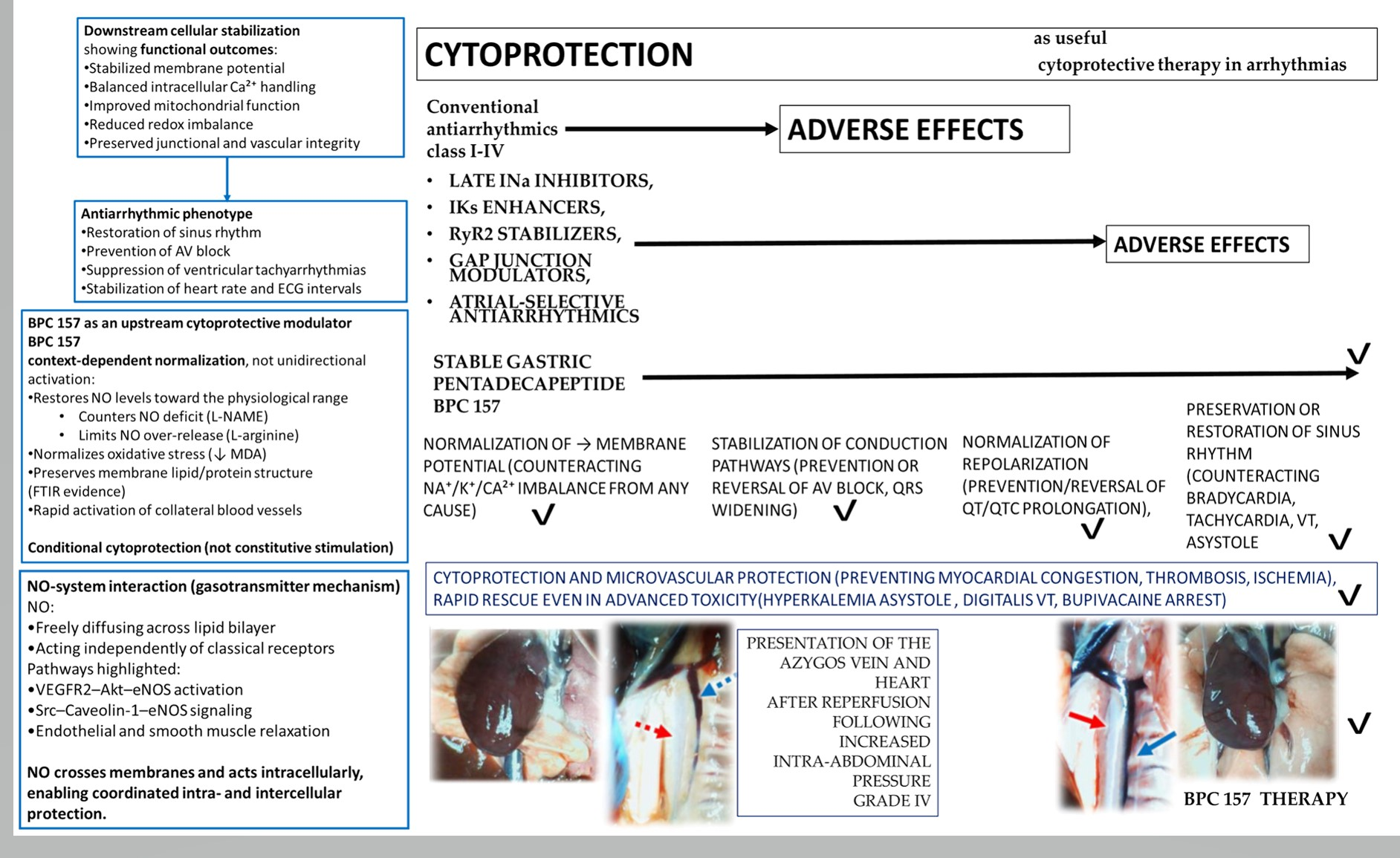
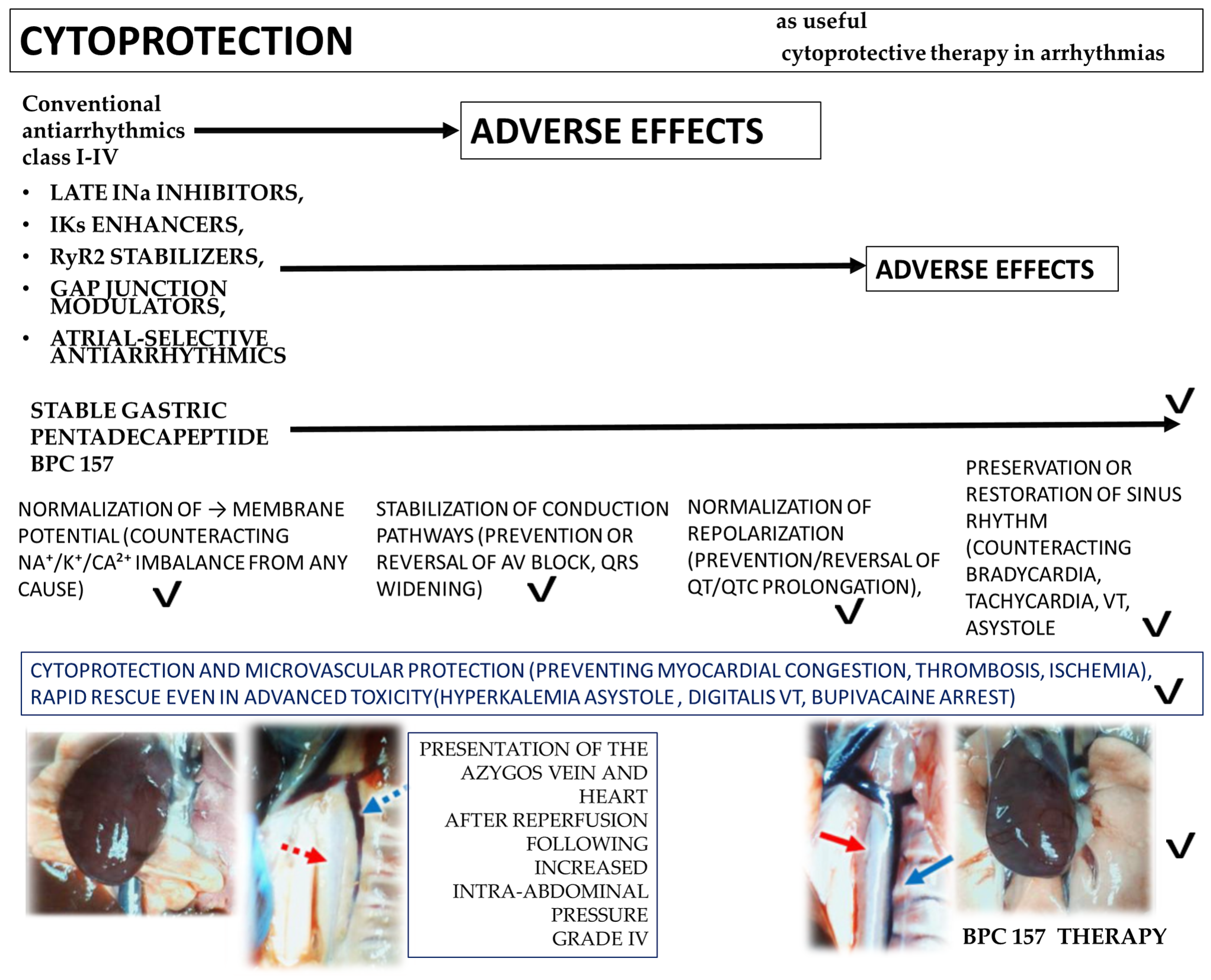
Conventional Antiarrhythmics Class I–IV, Late INa Inhibitors, IKs Enhancers, RyR2 Stabilizers, Gap Junction Modulators, Atrial-Selective Antiarrhythmics, and Stable Gastric Pentadecapeptide BPC 157 as Useful Cytoprotective Therapy in Arrhythmias

 , , ,
, , ,  , ,
, ,  , , add
Show full author list
, , add
Show full author list
Abstract
1. Introduction
2. Ion-Channel Design
2.1. Traditional Antiarrhythmics (Class I–IV) vs. “Ideal Antiarrhythmic”
2.1.1. History as an Insight
2.1.2. Ion Channel Design—Traditional Antiarrhythmics (Class I–IV)
2.2. Late INa Inhibitors, IKs Enhancers, RyR2 Stabilizers, Gap Junction Modulators, and Atrial-Selective Antiarrhythmics vs. “Ideal Antiarrhythmic”
2.2.1. INa-Late Inhibitors
2.2.2. Cardiac Potassium Channel Boosters (IKs Enhancers)
2.2.3. Selective RyR2 Stabilizers (“Calcium Leak Blockers”)
2.2.4. Gap Junction Modulation (Connexin-43 Stabilizers)
2.2.5. Atrial-Selective Antiarrhythmic
- IKur (Kv1.5) is a voltage-gated potassium channel that mediates the ultrarapid delayed rectifier K+ current, which is predominantly expressed in atrial myocytes and largely absent in ventricular tissue expressed predominantly in atrial myocytes. Pharmacologic blockade prolongs atrial refractory periods without affecting ventricular action potentials [145,146,147,148].
- TASK-1 (atrial K2P channel) is highly atrial-selective, and its modulation alters atrial repolarization with minimal impact on ventricles [154,155,156,157]. Thus, the reduced risk of proarrhythmic events in the ventricles as the therapy benefit of targeting these atrial-specific channels is combined with the effective suppression of AF without significantly affecting ventricular repolarization [154,155,156,157].
3. Cytoprotection Concept
3.1. Cytoprotection—General
3.2. Cytoprotection—Cytoprotective Agent
3.3. Cytoprotection Failure—Arrhythmias
3.4. Antiarrhythmics—Cytoprotective Agents
4. Stable Gastric Pentadecapeptide BPC 157 as a Useful Cytoprotective Peptide Therapy in Arrhythmias
4.1. BPC 157 Significance as a Cytoprotection Mediator and Cytoprotective Agent
4.2. BPC 157 Cytoprotection Significance in Cardiac Disturbances
4.3. BPC 157 Cytoprotection Significance in Arrhythmias
4.3.1. BPC 157 Cytoprotection Significance in Arrhythmias with Specific Pro-Arrhythmogenic Agents
BPC 157 Multi-Trigger, Single-Effect Profile, Hypokalemia vs. Hyperkalemia
4.3.2. BPC 157 Cytoprotection Significance in Arrhythmias with Pro-Arrhythmogenic Procedures
4.3.3. BPC 157 Cytoprotection Significance in Arrhythmias with Local Anesthetics
4.3.4. BPC 157 Cytoprotection Significance in Arrhythmias with Hypokalemia, Hyperkalemia, Hypermagnesemia, and Local Anesthetics In Vitro
4.4. Limitations and Future Directions
5. Conclusions
Author Contributions
Funding
Institutional Review Board Statement
Informed Consent Statement
Data Availability Statement
Conflicts of Interest
References
- Huang, C.L.-H.; Wu, L.; Jeevaratnam, K.; Lei, M. Update on antiarrhythmic drug pharmacology. J. Cardiovasc. Electrophysiol. 2020, 31, 579–592. [Google Scholar] [CrossRef] [PubMed]
- Mankad, P.; Kalahasty, G. Antiarrhythmic drugs: Risks and benefits. Med. Clin. N. Am. 2019, 103, 821–834. [Google Scholar] [CrossRef] [PubMed]
- Saljic, A.; Heijman, J.; Dobrev, D. Recent advances in antiarrhythmic drug therapy. Drugs 2023, 83, 1147–1160. [Google Scholar] [CrossRef] [PubMed]
- Kowey, P.R.; Naccarelli, G.V. Antiarrhythmic drug therapy: Where do we go from here? Circulation 2024, 149, 801–803. [Google Scholar] [CrossRef] [PubMed]
- Robert, A. Cytoprotection by prostaglandins. Gastroenterology 1979, 77, 761–767. [Google Scholar] [CrossRef] [PubMed]
- Robert, A. Current history of cytoprotection. Prostaglandins 1981, 21, 89–96. [Google Scholar] [CrossRef] [PubMed]
- Robert, A.; Nezamis, J.E.; Lancaster, C.; Davis, J.P.; Field, S.O.; Hanchar, A.J. Mild irritants prevent gastric necrosis through “adaptive cytoprotection” mediated by prostaglandins. Am. J. Physiol. 1983, 245, G113–G121. [Google Scholar] [CrossRef] [PubMed]
- Szabo, S. Role of sulfhydryls and early vascular lesions in gastric mucosal injury. Acta Physiol. Hung. 1984, 64, 203–214. [Google Scholar] [PubMed]
- Trier, J.S.; Szabo, S.; Allan, C.H. Ethanol-induced damage to mucosal capillaries of rat stomach. Ultrastructural features and effects of prostaglandin F2β and cysteamine. Gastroenterology 1987, 92, 13–22. [Google Scholar] [CrossRef] [PubMed]
- Pihan, G.; Majzoubi, D.; Haudenschild, C.; Trier, J.S.; Szabo, S. Early microcirculatory stasis in acute gastric mucosal injury in the rat and prevention by 16,16-dimethyl prostaglandin E2 or sodium thiosulfate. Gastroenterology 1986, 91, 1415–1426. [Google Scholar] [CrossRef] [PubMed]
- Szabo, S.; Trier, J.S.; Brown, A.; Schnoor, J. Early vascular injury and increased vascular permeability in gastric mucosal injury caused by ethanol in the rat. Gastroenterology 1985, 88, 228–236. [Google Scholar] [CrossRef] [PubMed]
- Szabo, S. Experimental basis for a role for sulfhydryls and dopamine in ulcerogenesis: A primer for cytoprotection-organoprotection. Klin. Wochenschr. 1986, 64, 116–122. [Google Scholar] [PubMed]
- Szabo, S.; Usadel, K.H. Cytoprotection-organoprotection by somatostatin: Gastric and hepatic lesions. Experientia 1982, 38, 254–256. [Google Scholar] [CrossRef] [PubMed]
- Sikiric, P.; Seiwerth, S.; Skrtic, A.; Staresinic, M.; Strbe, S.; Vuksic, A.; Sikiric, S.; Bekic, D.; Soldo, D.; Grizelj, B.; et al. Stable gastric pentadecapeptide BPC 157 as a therapy and safety key: A special beneficial pleiotropic effect controlling and modulating angiogenesis and the NO-system. Pharmaceuticals 2025, 18, 928. [Google Scholar] [CrossRef] [PubMed]
- Sikiric, P.; Seiwerth, S.; Skrtic, A.; Staresinic, M.; Strbe, S.; Vuksic, A.; Sikiric, S.; Bekic, D.; Penovic, T.; Drazenovic, D.; et al. Acute compartment syndrome and intra-abdominal hypertension, decompression, current pharmacotherapy, and stable gastric pentadecapeptide BPC 157 solution. Pharmaceuticals 2025, 18, 866. [Google Scholar] [CrossRef] [PubMed]
- Sikiric, P.; Sever, M.; Krezic, I.; Vranes, H.; Kalogjera, L.; Smoday, I.M.; Vukovic, V.; Oroz, K.; Coric, L.; Skoro, M.; et al. New studies with stable gastric pentadecapeptide protecting gastrointestinal tract. Significance of counteraction of vascular and multiorgan failure of occlusion/occlusion-like syndrome in cytoprotection/organoprotection. Inflammopharmacology 2024, 32, 3119–3161. [Google Scholar] [CrossRef] [PubMed]
- Sikiric, P.; Boban Blagaic, A.; Strbe, S.; Beketic Oreskovic, L.; Oreskovic, I.; Sikiric, S.; Staresinic, M.; Sever, M.; Kokot, A.; Jurjevic, I.; et al. The stable gastric pentadecapeptide BPC 157 pleiotropic beneficial activity and its possible relations with neurotransmitter activity. Pharmaceuticals 2024, 17, 461. [Google Scholar] [CrossRef] [PubMed]
- Sikiric, P.; Gojkovic, S.; Knezevic, M.; Tepes, M.; Strbe, S.; Vukojevic, J.; Duzel, A.; Kralj, T.; Krezic, I.; Zizek, H.; et al. Stable gastric pentadecapeptide BPC 157: Prompt particular activation of collateral pathways. Curr. Med. Chem. 2023, 30, 1568–1573. [Google Scholar] [CrossRef] [PubMed]
- Sikiric, P.; Kokot, A.; Kralj, T.; Zlatar, M.; Masnec, S.; Lazic, R.; Loncaric, K.; Oroz, K.; Sablic, M.; Boljesic, M.; et al. Stable gastric pentadecapeptide BPC 157—Possible novel therapy of glaucoma and other ocular conditions. Pharmaceuticals 2023, 16, 1052. [Google Scholar] [CrossRef] [PubMed]
- Staresinic, M.; Japjec, M.; Vranes, H.; Prtoric, A.; Zizek, H.; Krezic, I.; Gojkovic, S.; Smoday, I.M.; Oroz, K.; Staresinic, E.; et al. Stable gastric pentadecapeptide BPC 157 and striated, smooth, and heart muscle. Biomedicines 2022, 10, 3221. [Google Scholar] [CrossRef] [PubMed]
- Sikiric, P.; Udovicic, M.; Barisic, I.; Balenovic, D.; Zivanovic Posilovic, G.; Strinic, D.; Uzun, S.; Sikiric, S.; Krezic, I.; Zizek, H.; et al. Stable gastric pentadecapeptide BPC 157 as useful cytoprotective peptide therapy in the heart disturbances, myocardial infarction, heart failure, pulmonary hypertension, arrhythmias, and thrombosis presentation. Biomedicines 2022, 10, 2696. [Google Scholar] [CrossRef] [PubMed]
- Sikiric, P.; Skrtic, A.; Gojkovic, S.; Krezic, I.; Zizek, H.; Lovric, E.; Sikiric, S.; Knezevic, M.; Strbe, S.; Milavic, M.; et al. Cytoprotective gastric pentadecapeptide BPC 157 resolves major vessel occlusion disturbances, ischemia-reperfusion injury following Pringle maneuver, and Budd-Chiari syndrome. World J. Gastroenterol. 2022, 28, 23–46. [Google Scholar] [CrossRef] [PubMed]
- Sikiric, P.; Seiwerth, S.; Skrtic, A.; Staresinic, M.; Strbe, S.; Vuksic, A.; Sikiric, S.; Bekic, D.; Soldo, D.; Grizelj, B.; et al. BPC 157 Therapy: Targeting angiogenesis and nitric oxide’s cytotoxic and damaging actions, but maintaining, promoting, or recovering their essential protective functions. Comment on Józwiak et al. Multifunctionality and Possible Medical Application of the BPC 157 Peptide—Literature and Patent Review. Pharmaceuticals 2025, 18, 1450. [Google Scholar] [CrossRef] [PubMed]
- Masnec, S.; Kokot, A.; Kralj, T.; Zlatar, M.; Loncaric, K.; Sablic, M.; Kalauz, M.; Beslic, I.; Oroz, K.; Mrvelj, B.; et al. Challenge of corneal ulcer healing: A novel conceptual framework, the “triad” of corneal ulcer healing/corneal neovascularization/intraocular pressure, and avascular tendon healing, for evaluation of corneal ulcer therapy, therapy of neovascularization, glaucoma therapy, and pentadecapeptide BPC 157 efficacy. Pharmaceuticals 2025, 18, 1822. [Google Scholar] [CrossRef]
- Balenovic, D.; Bencic, M.L.; Udovicic, M.; Simonji, K.; Hanzevacki, J.S.; Barisic, I.; Kranjcevic, S.; Prkacin, I.; Coric, V.; Brcic, L.; et al. Inhibition of methyldigoxin-induced arrhythmias by pentadecapeptide BPC 157: A relation with NO-system. Regul. Pept. 2009, 156, 83–89. [Google Scholar] [CrossRef] [PubMed]
- Barisic, I.; Balenovic, D.; Klicek, R.; Radic, B.; Nikitovic, B.; Drmic, D.; Udovicic, M.; Strinic, D.; Bardak, D.; Berkopic, L.; et al. Mortal hyperkalemia disturbances in rats are NO-system related: The life saving effect of pentadecapeptide BPC 157. Regul. Pept. 2013, 181, 50–66. [Google Scholar] [CrossRef] [PubMed]
- Balenovic, D.; Barisic, I.; Prkacin, I.; Horvat, I.; Udovicic, M.; Uzun, S.; Strinic, D.; Pevec, D.; Drmic, D.; Radic, B.; et al. Mortal furosemide-hypokalemia-disturbances in rats NO-system related shorten survival by L-NAME. Therapy benefit with BPC 157 peptide more than with L-arginine. J. Clin. Exp. Cardiolog. 2012, 3, 7. [Google Scholar] [CrossRef]
- Lozic, M.; Stambolija, V.; Krezic, I.; Dugandzic, A.; Zivanovic-Posilovic, G.; Gojkovic, S.; Kovacevic, J.; Vrdoljak, L.; Mirkovic, I.; Kokot, A.; et al. In relation to NO-system, stable pentadecapeptide BPC 157 counteracts lidocaine-induced adverse effects in rats and depolarisation in vitro. Emerg. Med. Int. 2020, 2020, 6805354. [Google Scholar] [CrossRef] [PubMed] [PubMed Central]
- Zivanovic-Posilovic, G.; Balenovic, D.; Barisic, I.; Strinic, D.; Stambolija, V.; Udovicic, M.; Uzun, S.; Drmic, D.; Vlainic, J.; Bencic, M.L.; et al. Stable gastric pentadecapeptide BPC 157 and bupivacaine. Eur. J. Pharmacol. 2016, 793, 56–65. [Google Scholar] [CrossRef] [PubMed]
- Stambolija, V.; Perleta Stambolija, T.; Katancic Holjevac, J.; Murselovic, T.; Radonic, J.; Duzel, V.; Duplancic, B.; Uzun, S.; Zivanovic-Posilovic, G.; Kolenc, D.; et al. BPC 157: The counteraction of succinylcholine, hyperkalemia, and arrhythmias. Eur. J. Pharmacol. 2016, 781, 83–91. [Google Scholar] [CrossRef] [PubMed]
- Strinić, D.; Belosić Halle, Ž.; Luetić, K.; Nedić, A.; Petrović, I.; Sucić, M.; Živanović Posilović, G.; Balenović, D.; Strbe, S.; Udovičić, M.; et al. BPC 157 counteracts QTc prolongation induced by haloperidol, fluphenazine, clozapine, olanzapine, quetiapine, sulpiride, and metoclopramide in rats. Life Sci. 2017, 186, 66–79. [Google Scholar] [CrossRef] [PubMed]
- Strbe, S.; Smoday, I.M.; Krezic, I.; Kalogjera, L.; Vukovic, V.; Zizek, H.; Gojkovic, S.; Vranes, H.; Barisic, I.; Sikiric, S.; et al. Innate vascular failure by application of neuroleptics, amphetamine, and domperidone rapidly induced severe occlusion/occlusion-like syndromes in rats and stable gastric pentadecapeptide BPC 157 as therapy. Pharmaceuticals 2023, 16, 788. [Google Scholar] [CrossRef] [PubMed] [PubMed Central]
- Premuzic Mestrovic, I.; Smoday, I.M.; Kalogjera, L.; Krezic, I.; Zizek, H.; Vranes, H.; Vukovic, V.; Oroz, K.; Skorak, I.; Brizic, I.; et al. Antiarrhythmic sotalol, occlusion/occlusion-like syndrome in rats, and stable gastric pentadecapeptide BPC 157 therapy. Pharmaceuticals 2023, 16, 977. [Google Scholar] [CrossRef] [PubMed] [PubMed Central]
- Barisic, I.; Balenovic, D.; Udovicic, M.; Bardak, D.; Strinic, D.; Vlainić, J.; Vranes, H.; Smoday, I.M.; Krezic, I.; Milavic, M.; et al. Stable gastric pentadecapeptide BPC 157 may counteract myocardial infarction induced by isoprenaline in rats. Biomedicines 2022, 10, 265. [Google Scholar] [CrossRef] [PubMed] [PubMed Central]
- Smoday, I.M.; Krezic, I.; Kalogjera, L.; Vukovic, V.; Zizek, H.; Skoro, M.; Kasnik Kovac, K.; Vranes, H.; Barisic, I.; Sikiric, S.; et al. Pentadecapeptide BPC 157 as therapy for inferior caval vein embolization: Recovery of sodium laurate-post-embolization syndrome in rats. Pharmaceuticals 2023, 16, 1507. [Google Scholar] [CrossRef] [PubMed] [PubMed Central]
- Gojkovic, S.; Krezic, I.; Vranes, H.; Zizek, H.; Drmic, D.; Batelja Vuletic, L.; Milavic, M.; Sikiric, S.; Stilinovic, I.; Simeon, P.; et al. Robert’s intragastric alcohol-induced gastric lesion model as an escalated general peripheral and central syndrome, counteracted by the stable gastric pentadecapeptide BPC 157. Biomedicines 2021, 9, 1300. [Google Scholar] [CrossRef] [PubMed] [PubMed Central]
- Udovicic, M.; Sever, M.; Kavur, L.; Loncaric, K.; Barisic, I.; Balenovic, D.; Zivanovic Posilovic, G.; Strinic, D.; Uzun, S.; Batelja Vuletic, L.; et al. Stable gastric pentadecapeptide BPC 157 therapy for monocrotaline-induced pulmonary hypertension in rats leads to prevention and reversal. Biomedicines 2021, 9, 822. [Google Scholar] [CrossRef] [PubMed]
- Strbe, S.; Gojkovic, S.; Krezic, I.; Zizek, H.; Vranes, H.; Barisic, I.; Strinic, D.; Orct, T.; Vukojevic, J.; Ilic, S.; et al. Over-dose lithium toxicity as an occlusive-like syndrome in rats and gastric pentadecapeptide BPC 157. Biomedicines 2021, 9, 1506. [Google Scholar] [CrossRef] [PubMed]
- Vukojevic, J.; Siroglavic, M.; Kasnik, K.; Kralj, T.; Stancic, D.; Kokot, A.; Kolaric, D.; Drmic, D.; Zenko Sever, A.; Barisic, I.; et al. Rat inferior caval vein (ICV) ligature and particular new insights with the stable gastric pentadecapeptide BPC 157. Vascul. Pharmacol. 2018, 106, 54–66. [Google Scholar] [CrossRef] [PubMed]
- Knezevic, M.; Gojkovic, S.; Krezic, I.; Zizek, H.; Vranes, H.; Malekinusic, D.; Vrdoljak, B.; Knezevic, T.; Horvat Pavlov, K.; Drmic, D.; et al. Complex syndrome of the complete occlusion of the end of the superior mesenteric vein, opposed with the stable gastric pentadecapeptide BPC 157 in rats. Biomedicines 2021, 9, 1029. [Google Scholar] [CrossRef] [PubMed] [PubMed Central]
- Knezevic, M.; Gojkovic, S.; Krezic, I.; Zizek, H.; Malekinusic, D.; Vrdoljak, B.; Knezevic, T.; Vranes, H.; Drmic, D.; Staroveski, M.; et al. Occluded superior mesenteric artery and vein. Therapy with the stable gastric pentadecapeptide BPC 157. Biomedicines 2021, 9, 792. [Google Scholar] [CrossRef] [PubMed] [PubMed Central]
- Knezevic, M.; Gojkovic, S.; Krezic, I.; Zizek, H.; Malekinusic, D.; Vrdoljak, B.; Vranes, H.; Knezevic, T.; Barisic, I.; Horvat Pavlov, K.; et al. Occlusion of the superior mesenteric artery in rats reversed by collateral pathways activation: Gastric pentadecapeptide BPC 157 therapy counteracts multiple organ dysfunction syndrome; intracranial, portal, and caval hypertension; and aortal hypotension. Biomedicines 2021, 9, 609. [Google Scholar] [CrossRef] [PubMed] [PubMed Central]
- Gojkovic, S.; Krezic, I.; Vranes, H.; Zizek, H.; Drmic, D.; Horvat Pavlov, K.; Petrovic, A.; Batelja Vuletic, L.; Milavic, M.; Sikiric, S.; et al. BPC 157 therapy and the permanent occlusion of the superior sagittal sinus in rat: Vascular recruitment. Biomedicines 2021, 9, 744. [Google Scholar] [CrossRef] [PubMed] [PubMed Central]
- Tepes, M.; Gojkovic, S.; Krezic, I.; Zizek, H.; Vranes, H.; Madzar, Z.; Santak, G.; Batelja, L.; Milavic, M.; Sikiric, S.; et al. Stable gastric pentadecapeptide BPC 157 therapy for primary abdominal compartment syndrome in rats. Front. Pharmacol. 2021, 12, 718147. [Google Scholar] [CrossRef] [PubMed] [PubMed Central]
- Tepes, M.; Krezic, I.; Vranes, H.; Smoday, I.M.; Kalogjera, L.; Zizek, H.; Vukovic, V.; Oroz, K.; Kasnik Kovac, K.; Madzar, Z.; et al. Stable gastric pentadecapeptide BPC 157 therapy: Effect on reperfusion following maintained intra-abdominal hypertension (grade III and IV) in rats. Pharmaceuticals 2023, 16, 1554. [Google Scholar] [CrossRef] [PubMed] [PubMed Central]
- Smoday, I.M.; Petrovic, I.; Kalogjera, L.; Vranes, H.; Zizek, H.; Krezic, I.; Gojkovic, S.; Skorak, I.; Hriberski, K.; Brizic, I.; et al. Therapy effect of the stable gastric pentadecapeptide BPC 157 on acute pancreatitis as vascular failure-induced severe peripheral and central syndrome in rats. Biomedicines 2022, 10, 1299. [Google Scholar] [CrossRef] [PubMed] [PubMed Central]
- Kalogjera, L.; Krezic, I.; Smoday, I.M.; Vranes, H.; Zizek, H.; Yago, H.; Oroz, K.; Vukovic, V.; Kavelj, I.; Novosel, L.; et al. Stomach perforation-induced general occlusion/occlusion-like syndrome and stable gastric pentadecapeptide BPC 157 therapy effect. World J. Gastroenterol. 2023, 29, 4289–4316. [Google Scholar] [CrossRef] [PubMed] [PubMed Central]
- Bosnjak, Z.J.; Graf, B.M.; Sikiric, P.; Stowe, D.F. Protective effects of newly isolated gastric peptide following hypoxic and reoxygenation injury in the isolated guinea pig heart. FASEB J. 1994, 8, A12. [Google Scholar]
- Lovric-Bencic, M.; Sikiric, P.; Hanzevacki, J.S.; Seiwerth, S.; Rogic, D.; Kusec, V.; Aralica, G.; Konjevoda, P.; Batelja, L.; Blagaic, A.B.; et al. Doxorubicine-congestive heart failure-increased big endothelin-1 plasma concentration: Reversal by amlodipine, losartan, and gastric pentadecapeptide BPC 157 in rat and mouse. J. Pharmacol. Sci. 2004, 95, 19–26. [Google Scholar] [CrossRef] [PubMed]
- Ruenzi, M.; Stolte, M.; Veljaca, M.; Oreskovic, K.; Peterson, J.; Ulcerative Colitis Study Group. A multicenter, randomized, double blind, placebo-controlled phase II study of PL 14736 enema in the treatment of mild-to-moderate ulcerative colitis. Gastroenterology 2005, 128, A584. [Google Scholar] [CrossRef]
- Veljaca, M.; Pavic-Sladoljev, D.; Mildner, B.; Brajsa, K.; Bubenik, M.; Stipanicic, S.; Parnham, M. Safety, tolerability and pharmacokinetics of PL14736, a novel agent for treatment of ulcerative colitis, in healthy male volunteers. Gut 2003, 51, A309. [Google Scholar] [CrossRef]
- Lee, E.; Padgett, B. Intra-articular injection of BPC 157 for multiple types of knee pain. Altern. Ther. Health Med. 2021, 27, 8–13. [Google Scholar] [PubMed]
- Lee, E.; Walker, C.; Ayadi, B. Effect of BPC-157 on symptoms in patients with interstitial cystitis: A pilot study. Altern. Ther. Health Med. 2024, 30, 12–17. [Google Scholar] [PubMed]
- Medvidovic-Grubisic, M.; Stambolija, V.; Kolenc, D.; Katancic, J.; Murselovic, T.; Plestina-Borjan, I.; Strbe, S.; Drmic, D.; Barisic, I.; Sindic, A.; et al. Hypermagnesemia disturbances in rats, NO-related: Pentadecapeptide BPC 157 abrogates, L-NAME and L-arginine worsen. Inflammopharmacology 2017, 25, 439–449. [Google Scholar] [CrossRef] [PubMed]
- Szekeres, L.; Papp, J.G. The discovery of antiarrhythmics. In Discoveries in Pharmacology. Hemodynamics, Hormones & Inflammation, Volume 2; Parnham, M.J., Bruinvels, J., Eds.; Elsevier: Oxford, UK, 1984; pp. 185–218. [Google Scholar]
- Harris, A.S.; Kokernot, R.H. Effects of diphenylhydantoin sodium (Dilantin sodium) and phenobarbital sodium upon ectopic ventricular tachycardia in acute myocardial infarction. Am. J. Physiol. 1950, 163, 505–516. [Google Scholar] [CrossRef] [PubMed]
- Koppe, H.G. Pharmacology of mexiletine: Early clinical development in antiarrhythmic therapy. Postgrad. Med. J. 1977, 53, 22–24. [Google Scholar] [PubMed]
- Chew, C.Y.; Collett, J.; Singh, B.N. Mexiletine: A review of its pharmacological properties and therapeutic efficacy in arrhythmias. Drugs 1979, 17, 161–181. [Google Scholar] [CrossRef] [PubMed]
- Vastesaeger, M.; Gillot, P.; Rasson, P. Étude clinique d’une nouvelle médication anti-angoreuse. Acta Cardiol. 1967, 22, 483–490. [Google Scholar]
- Charlier, R. Antianginal Drugs; Springer: Berlin/Heidelberg, Germany, 1971. [Google Scholar]
- Singh, B.N.; Vaughan Williams, E.M. The effect of amiodarone, a new anti-anginal drug, on cardiac muscle. Br. J. Pharmacol. 1970, 39, 657–667. [Google Scholar] [CrossRef]
- Varró, A.; Virág, L.; Papp, J.G. Comparison of the chronic and acute effects of amiodarone on the calcium and potassium currents in rabbit isolated cardiac myocytes. Br. J. Pharmacol. 1996, 117, 1181–1186. [Google Scholar] [CrossRef] [PubMed]
- Rosenbaum, M.B.; Chiale, P.A.; Halpern, M.S.; Nau, G.J.; Przybylski, J.; Levi, R.J.; Lazzari, J.O.; Elizari, M.V. Clinical efficacy of amiodarone as an antiarrhythmic agent. Am. J. Cardiol. 1976, 38, 934–942. [Google Scholar] [CrossRef] [PubMed]
- Rosenbaum, M.B.; Chiale, P.A.; Ryba, D.; Elizari, M.V. Control of tachyarrhythmias associated with Wolff-Parkinson-White syndrome by amiodarone hydrochloride. Am. J. Cardiol. 1974, 34, 215–223. [Google Scholar] [CrossRef] [PubMed]
- Singh, B.N.; Jewitt, D.E.; Downey, J.M.; Kirk, E.S.; Sonnenblick, E.H. Effects of amiodarone and L8040, novel antianginal and antiarrhythmic drugs, on cardiac and coronary haemodynamics and on cardiac intracellular potentials. Clin. Exp. Pharmacol. Physiol. 1976, 3, 427–442. [Google Scholar] [CrossRef] [PubMed]
- Haas, H.; Haertfelder, G. [(N-methyl-N-homoveratryl)-gamma-aminopropyl]-3,4-dimethoxyphenyl-acetonitrile, a substance with coronary vasodilating properties. Arzneim. Forsch. 1962, 12, 549–558. [Google Scholar] [PubMed]
- Sandler, G.; Clayton, G.A.; Thornicroft, S.G. Clinical evaluation of verapamil in angina pectoris. Br. Med. J. 1968, 3, 224–227. [Google Scholar] [CrossRef] [PubMed] [PubMed Central]
- Sandler, G. Verapamil in angina. Br. Med. J. 1968, 3, 5609. [Google Scholar] [CrossRef] [PubMed][Green Version]
- Fleckenstein, A.; Fleckenstein-Grün, G. Effects of and the mechanism of action of calcium antagonists and other antianginal agents. In Physiology and Pathophysiology of the Heart; Chapter 22, Developments in Cardiovascular Medicine; Sperelakis, N., Ed.; Springer: Boston, MA, USA, 1989; Volume 90. [Google Scholar] [CrossRef]
- Melville, K.I.; Shister, H.E.; Huq, S. Iproveratril: Experimental data on coronary dilatation and antiarrhythmic action. Can. Med. Assoc. J. 1964, 90, 761–770. [Google Scholar] [PubMed] [PubMed Central]
- Schmid, J.R.; Hanna, C. Antiarrhythmic actions of a new coronary vasodilator agent, iproveratril. J. Ark. Med. Soc. 1967, 63, 455. [Google Scholar] [PubMed]
- Singh, B.N.; Vaughan Williams, E.M. A fourth class of anti-dysrhythmic action? Effect of verapamil on ouabain toxicity, on atrial and ventricular intracellular potentials, and on other features of cardiac function. Cardiovasc. Res. 1972, 6, 109–119. [Google Scholar] [CrossRef] [PubMed]
- Singh, B.N.; Ellrodt, G.; Peter, C.T. Verapamil: A review of its pharmacological properties and therapeutic use. Drugs 1978, 15, 169–197. [Google Scholar] [CrossRef] [PubMed]
- Schamroth, L.; Krikler, D.M.; Garrett, C. Immediate effects of intravenous verapamil in cardiac arrhythmias. Br. Med. J. 1972, 1, 660–662. [Google Scholar] [CrossRef] [PubMed] [PubMed Central]
- Fleckenstein, A.; Tritthart, H.; Flackenstein, B.; Herbst, A.; Grün, G. A new group of competitive divalent Ca-antagonists (iproveratril, D 600, prenylamine) with potent inhibitory effects on electromechanical coupling in mammalian myocardium. Pflug. Arch. 1969, 307, R25. (In German) [Google Scholar] [PubMed]
- Fleckenstein, A.; Tritthart, H.; Döring, H.J.; Byon, K.Y. BAY a 1040—A highly potent Ca2+-antagonistic inhibitor of electro-mechanical coupling processes in mammalian myocardium. Arzneimittelforschung 1972, 22, 22–33. (In German) [Google Scholar] [PubMed]
- Fleckenstein, A. Specific pharmacology of calcium in myocardium, cardiac pacemakers, and vascular smooth muscle. Annu. Rev. Pharmacol. Toxicol. 1977, 17, 149–166. [Google Scholar] [CrossRef] [PubMed]
- Sikiric, P.; Seiwerth, S.; Rucman, R.; Turkovic, B.; Stancic Rokotov, D.; Brcic, L.; Sever, M.; Klicek, R.; Radic, B.; Drmic, D.; et al. Toxicity by NSAIDs. Counteraction by stable gastric pentadecapeptide BPC 157. Curr. Pharm. Des. 2013, 19, 76–83. [Google Scholar] [CrossRef] [PubMed]
- Park, S.Y.; Choi, S.R.; Kim, J.H.; Lee, S.C.; Jeong, J.H.; Lee, T.Y. Antinociceptive effect of BPC-157 in the formalin-induced pain model. Kosin Med. J. 2021, 36, 1–13. [Google Scholar] [CrossRef]
- Jung, Y.H.; Kim, H.; Kim, H.; Kim, E.; Baik, J.; Kang, H. The anti-nociceptive effect of BPC-157 on the incisional pain model in rats. J. Dent. Anesth. Pain Med. 2022, 22, 97–105. [Google Scholar] [CrossRef] [PubMed] [PubMed Central]
- Sikirić, P.; Gyires, K.; Seiwerth, S.; Grabarević, Z.; Ručman, R.; Petek, M.; Rotkvić, I.; Turković, B.; Udovič, I.; Jagić, V.; et al. The effect of pentadecapeptide BPC 157 on inflammatory, non-inflammatory, direct and indirect pain and capsaicin neurotoxicity. Inflammopharmacology 1993, 2, 121–127. [Google Scholar] [CrossRef]
- Sikiric, P.; Seiwerth, S.; Grabarevic, Z.; Rucman, R.; Petek, M.; Jagic, V.; Turkovic, B.; Rotkvic, I.; Mise, S.; Zoricic, I.; et al. Pentadecapeptide BPC 157 positively affects both non-steroidal anti-inflammatory agent-induced gastrointestinal lesions and adjuvant arthritis in rats. J. Physiol. Paris 1997, 91, 113–122. [Google Scholar] [CrossRef] [PubMed]
- Sikiric, P.; Petek, M.; Rucman, R.; Seiwerth, S.; Grabarevic, Z.; Rotkvic, I.; Turkovic, B.; Jagic, V.; Mildner, B.; Duvnjak, M.; et al. A new gastric juice peptide, BPC. An overview of the stomach–stress–organoprotection hypothesis and beneficial effects of BPC. J. Physiol. Paris 1993, 87, 313–327. [Google Scholar] [CrossRef] [PubMed]
- Mirković, I.; Kralj, T.; Lozić, M.; Stambolija, V.; Kovačević, J.; Vrdoljak, L.; Zlatar, M.; Milanović, K.; Drmić, D.; Predović, J.; et al. Pentadecapeptide BPC 157 shortens duration of tetracaine- and oxybuprocaine-induced corneal anesthesia in rats. Acta Clin. Croat. 2020, 59, 394–406. [Google Scholar] [CrossRef] [PubMed]
- Ilic, S.; Drmić, D.; Zarkovic, K.; Kolenc, D.; Coric, M.; Brcic, L.; Klicek, R.; Radic, B.; Sever, M.; Djuzel, V.; et al. High hepatotoxic dose of paracetamol produces generalized convulsions and brain damage in rats: Counteraction with the stable gastric pentadecapeptide BPC 157 (PL 14736). J. Physiol. Pharmacol. 2010, 61, 241–250. [Google Scholar] [PubMed]
- Ilic, S.; Brcic, I.; Mester, M.; Filipovic, M.; Sever, M.; Klicek, R.; Barisic, I.; Radic, B.; Zoricic, Z.; Bilic, V.; et al. Over-dose insulin and stable gastric pentadecapeptide BPC 157: Attenuated gastric ulcers, seizures, brain lesions, and metabolic disturbances in rats. J. Physiol. Pharmacol. 2009, 60, 107–114. [Google Scholar] [PubMed]
- Boban-Blagaic, A.; Blagaic, V.; Romic, Z.; Jelovac, N.; Dodig, G.; Rucman, R.; Petek, M.; Turkovic, B.; Seiwerth, S.; Sikiric, P. The influence of gastric pentadecapeptide BPC 157 on acute and chronic ethanol administration in mice: The effect of N(G)-nitro-L-arginine methyl ester and L-arginine. Med. Sci. Monit. 2006, 12, BR36-45. [Google Scholar] [PubMed]
- Boban Blagaic, A.; Blagaic, V.; Romic, Z.; Sikiric, P. The influence of gastric pentadecapeptide BPC 157 on acute and chronic ethanol administration in mice. Eur. J. Pharmacol. 2004, 499, 285–290. [Google Scholar] [CrossRef] [PubMed]
- Jelovac, N.; Sikiric, P.; Rucman, R.; Petek, M.; Perovic, D.; Marovic, A.; Anic, T.; Seiwerth, S.; Mise, S.; Pigac, B.; et al. The effect of a novel pentadecapeptide BPC 157 on development of tolerance and physical dependence following repeated administration of diazepam. Chin. J. Physiol. 1999, 42, 171–179. [Google Scholar] [PubMed]
- Toischer, K.; Hartmann, N.; Wagner, S.; Fischer, T.H.; Herting, J.; Danner, B.C.; Sag, C.M.; Hund, T.J.; Mohler, P.J.; Belardinelli, L.; et al. Role of late sodium current as a potential arrhythmogenic mechanism in the progression of pressure-induced heart disease. J. Mol. Cell. Cardiol. 2013, 61, 111–122. [Google Scholar] [CrossRef] [PubMed]
- Coppini, R.; Ferrantini, C.; Yao, L.; Fan, P.; Del Lungo, M.; Stillitano, F.; Sartiani, L.; Tosi, B.; Suffredini, S.; Tesi, C.; et al. Late sodium current inhibition reverses electromechanical dysfunction in human hypertrophic cardiomyopathy. Circulation 2013, 127, 575–584. [Google Scholar] [CrossRef] [PubMed]
- Horváth, B.; Hézső, T.; Kiss, D.; Kistamás, K.; Magyar, J.; Nánási, P.P.; Bányász, T. Late sodium current inhibitors as potential antiarrhythmic agents. Front. Pharmacol. 2020, 11, 413. [Google Scholar] [CrossRef] [PubMed]
- Naveed, M.; Mohammed, A.S.A.; Topal, L.; Kovács, Z.M.; Dienes, C.; Ovári, J.; Szentandrássy, N.; Magyar, J.; Bányász, T.; Prorok, J.; et al. Selective inhibition of cardiac late Na+ current is based on fast offset kinetics of the inhibitor. Biomedicines 2023, 11, 2383. [Google Scholar] [CrossRef] [PubMed]
- Undrovinas, A.I.; Belardinelli, L.; Undrovinas, N.A.; Sabbah, H.N. Ranolazine improves abnormal repolarization and contraction in left ventricular myocytes of dogs with heart failure by inhibiting late sodium current. J. Cardiovasc. Electrophysiol. 2006, 17, S169–S177. [Google Scholar] [CrossRef] [PubMed] [PubMed Central]
- Yu, S.; Li, G.; Huang, C.L.-H.; Lei, M.; Wu, L. Late sodium current associated cardiac electrophysiological and mechanical dysfunction. Pflüg. Arch. Eur. J. Physiol. 2018, 470, 461–469. [Google Scholar] [CrossRef] [PubMed]
- Rouhana, S.; Virsolvy, A.; Fares, N.; Richard, S.; Thireau, J. Ranolazine: An old drug with emerging potential; lessons from pre-clinical and clinical investigations for possible repositioning. Pharmaceuticals 2022, 15, 31. [Google Scholar] [CrossRef] [PubMed] [PubMed Central]
- Sossalla, S.; Maier, L.S. Role of ranolazine in angina, heart failure, arrhythmias, and diabetes. Pharmacol. Ther. 2012, 133, 311–323. [Google Scholar] [CrossRef] [PubMed]
- Sicouri, S.; Belardinelli, L.; Antzelevitch, C. Antiarrhythmic effects of the highly selective late sodium channel current blocker GS-458967. Heart Rhythm 2013, 10, 1036–1043. [Google Scholar] [CrossRef] [PubMed] [PubMed Central]
- Gupta, T.; Khera, S.; Kolte, D.; Aronow, W.S.; Iwai, S. Antiarrhythmic properties of ranolazine: A review of the current evidence. Int. J. Cardiol. 2015, 187, 66–74. [Google Scholar] [CrossRef] [PubMed]
- Dvir, M.; Peretz, A.; Haitin, Y.; Attali, B. Recent molecular insights from mutated IKS channels in cardiac arrhythmia. Curr. Opin. Pharmacol. 2014, 15, 74–82. [Google Scholar] [CrossRef] [PubMed]
- Bohannon, B.M.; Jowais, J.J.; Nyberg, L.; Olivier-Meo, V.; Corradi, V.; Tieleman, D.P.; Liin, S.I.; Larsson, H.P. Mechanistic insights into robust cardiac IKs potassium channel activation by aromatic polyunsaturated fatty acid analogues. eLife 2023, 12, e85773. [Google Scholar] [CrossRef] [PubMed]
- Golluscio, A.; Eldstrom, J.; Jowais, J.J.; Perez, M.E.; Cunningham, K.P.; De La Cruz, A.; Wu, X.; Corradi, V.; Tieleman, D.P.; Fedida, D.; et al. PUFA stabilizes a conductive state of the selectivity filter in IKs channels. eLife 2024, 13, RP95852. [Google Scholar] [CrossRef] [PubMed]
- Moreno, C.; de la Cruz, A.; Oliveras, A.; Kharche, S.R.; Guizy, M.; Comes, N.; Starý, T.; Ronchi, C.; Rocchetti, M.; Baró, I.; et al. Marine n-3 PUFAs modulate IKs gating, channel expression, and location in membrane microdomains. Cardiovasc. Res. 2015, 105, 223–232. [Google Scholar] [CrossRef] [PubMed]
- van Bavel, J.J.A.; Beekman, H.D.M.; Smoczyńska, A.; van der Heyden, M.A.G.; Vos, M.A. IKs activator ML277 mildly affects repolarization and arrhythmic outcome in the CAVB dog model. Biomedicines 2023, 11, 1147. [Google Scholar] [CrossRef]
- Willegems, K.; Eldstrom, J.; Kyriakis, E.; Ataei, F.; Sahakyan, H.; Dou, Y.; Russo, S.; Van Petegem, F.; Fedida, D. Structural and electrophysiological basis for the modulation of KCNQ1 channel currents by ML277. Nat. Commun. 2022, 13, 3760. [Google Scholar] [CrossRef] [PubMed] [PubMed Central]
- Liin, S.I.; Silverå Ejneby, M.; Barro-Soria, R.; Skarsfeldt, M.A.; Larsson, J.E.; Starck Härlin, F.; Parkkari, T.; Bentzen, B.H.; Schmitt, N.; Larsson, H.P.; et al. Polyunsaturated fatty acid analogs act antiarrhythmically on the cardiac IKs channel. Proc. Natl. Acad. Sci. USA 2015, 112, 5714–5719. [Google Scholar] [CrossRef] [PubMed] [PubMed Central]
- Wu, X.; Larsson, H.P. Insights into cardiac IKs (KCNQ1/KCNE1) channels regulation. Int. J. Mol. Sci. 2020, 21, 9440. [Google Scholar] [CrossRef] [PubMed] [PubMed Central]
- Hou, P.; Zhao, L.; Zhong, L.; Shi, J.; Wang, H.Z.; Gao, J.; Liu, H.; Zuckerman, J.; Cohen, I.S.; Cui, J. The fully activated open state of KCNQ1 controls the cardiac “fight-or-flight” response. PNAS Nexus 2024, 3, pgae452. [Google Scholar] [CrossRef] [PubMed]
- Lehnart, S.E.; Mongillo, M.; Bellinger, A.; Lindegger, N.; Chen, B.-X.; Hsueh, W.; Reiken, S.; Wronska, A.; Drew, L.J.; Ward, C.W.; et al. Leaky Ca2+ release channel/ryanodine receptor 2 causes seizures and sudden cardiac death in mice. J. Clin. Investig. 2008, 118, 2230–2245. [Google Scholar] [CrossRef] [PubMed] [PubMed Central]
- Shan, J.; Xie, W.; Betzenhauser, M.; Reiken, S.; Chen, B.X.; Wronska, A.; Marks, A.R. Calcium leak through ryanodine receptors leads to atrial fibrillation in 3 mouse models of catecholaminergic polymorphic ventricular tachycardia. Circ. Res. 2012, 111, 708–717. [Google Scholar] [CrossRef] [PubMed]
- Bround, M.J.; Wambolt, R.; Luciani, D.S.; Kulpa, J.E.; Rodrigues, B.; Brownsey, R.W.; Allard, M.F.; Johnson, J.D. Cardiomyocyte ATP production, metabolic flexibility, and survival require calcium flux through cardiac ryanodine receptors in vivo. J. Biol. Chem. 2013, 288, 18975–18986. [Google Scholar] [CrossRef] [PubMed]
- Dobrev, D.; Wehrens, X.H.T. Role of RyR2 phosphorylation in heart failure and arrhythmias: Controversies around ryanodine receptor phosphorylation in cardiac disease. Circ. Res. 2014, 114, 1311–1319. [Google Scholar] [CrossRef] [PubMed] [PubMed Central]
- Do, T.Q.; Knollmann, B.C. Inhibitors of intracellular RyR2 calcium release channels as therapeutic agents in arrhythmogenic heart diseases. Annu. Rev. Pharmacol. Toxicol. 2025, 65, 443–463. [Google Scholar] [CrossRef] [PubMed]
- Miotto, M.C.; Reiken, S.; Wronska, A.; Yuan, Q.; Dridi, H.; Liu, Y.; Weninger, G.; Tchagou, C.; Marks, A.R. Structural basis for ryanodine receptor type 2 leak in heart failure and arrhythmogenic disorders. Nat. Commun. 2024, 15, 8080. [Google Scholar] [CrossRef] [PubMed] [PubMed Central]
- Acimovic, I.; Refaat, M.M.; Moreau, A.; Salykin, A.; Reiken, S.; Sleiman, Y.; Souidi, M.; Přibyl, J.; Kajava, A.V.; Richard, S.; et al. Post-translational modifications and diastolic calcium leak associated to the novel RyR2-D3638A mutation lead to CPVT in patient-specific hiPSC-derived cardiomyocytes. J. Clin. Med. 2018, 7, 423. [Google Scholar] [CrossRef] [PubMed]
- Dal Cortivo, G.; Marino, V.; Bianconi, S.; Dell’Orco, D. Calmodulin variants associated with congenital arrhythmia impair selectivity for ryanodine receptors. Front. Mol. Biosci. 2023, 9, 1100992. [Google Scholar] [CrossRef] [PubMed] [PubMed Central]
- Andersson, D.C.; Marks, A.R. Fixing ryanodine receptor Ca2+ leak—A novel therapeutic strategy for contractile failure in heart and skeletal muscle. Drug Discov. Today Dis. Mech. 2010, 7, e151–e157. [Google Scholar] [CrossRef] [PubMed] [PubMed Central]
- Kryshtal, D.O.; Blackwell, D.J.; Egly, C.L.; Smith, A.N.; Batiste, S.M.; Johnston, J.N.; Laver, D.R.; Knollmann, B.C. RYR2 channel inhibition is the principal mechanism of flecainide action in CPVT. Circ. Res. 2021, 128, 321–331. [Google Scholar] [CrossRef] [PubMed] [PubMed Central]
- Hilliard, F.A.; Steele, D.S.; Laver, D.R.; Yang, Z.; Le Marchand, S.J.; Chopra, N.; Piston, D.W.; Huke, S.; Knollmann, B.C. Flecainide inhibits arrhythmogenic Ca2+ waves by open state block of ryanodine receptor Ca2+ release channels and reduction of Ca2+ spark mass. J. Mol. Cell. Cardiol. 2010, 48, 293–301. [Google Scholar] [CrossRef] [PubMed]
- Steele, D.S.; Hwang, H.S.; Knollmann, B.C. Triple mode of action of flecainide in catecholaminergic polymorphic ventricular tachycardia. Cardiovasc. Res. 2013, 98, 326–327. [Google Scholar] [CrossRef] [PubMed] [PubMed Central][Green Version]
- Schmeckpeper, J.; Kim, K.; George, S.A.; Blackwell, D.J.; Brennan, J.A.; Efimov, I.R.; Knollmann, B.C. RyR2 inhibition with dantrolene is antiarrhythmic, prevents further pathological remodeling, and improves cardiac function in chronic ischemic heart disease. J. Mol. Cell. Cardiol. 2023, 181, 67–78. [Google Scholar] [CrossRef]
- Kobayashi, S.; Yamamoto, T.; Yano, M. RyR2-stabilization therapy with dantrolene against left ventricular remodeling and lethal arrhythmia in heart failure. J. Mol. Cell. Cardiol. 2023, 182, 25–27. [Google Scholar] [CrossRef] [PubMed]
- Walweel, K.; Oo, Y.W.; Laver, D.R. The emerging role of calmodulin regulation of RyR2 in controlling heart rhythm, the progression of heart failure and the antiarrhythmic action of dantrolene. Clin. Exp. Pharmacol. Physiol. 2017, 44, 135–142. [Google Scholar] [CrossRef] [PubMed]
- Takenaka, M.; Kodama, M.; Murayama, T.; Ishigami-Yuasa, M.; Mori, S.; Ishida, R.; Suzuki, J.; Kanemaru, K.; Sugihara, M.; Iino, M.; et al. Screening for novel type 2 ryanodine receptor inhibitors by endoplasmic reticulum Ca2+ monitoring. Mol. Pharmacol. 2023, 104, 275–286. [Google Scholar] [CrossRef] [PubMed]
- Blackwell, D.J.; Knollmann, B.C. Finding the right balance of RyR2 phosphorylation for arrhythmia prevention. Nat. Cardiovasc. Res. 2025, 4, 962–963. [Google Scholar] [CrossRef] [PubMed]
- Jansen, J.A.; van Veen, T.A.B.; de Jong, S.; van der Nagel, R.; van Stuijvenberg, L.; Driessen, H.; Labzowski, R.; Oefner, C.M.; Bosch, A.A.; Nguyen, T.Q.; et al. Reduced Cx43 expression triggers increased fibrosis due to enhanced fibroblast activity. Circ. Arrhythm. Electrophysiol. 2012, 5, 380–390. [Google Scholar] [CrossRef] [PubMed]
- Amino, M.; Yoshioka, K.; Tanabe, T.; Tanaka, E.; Mori, H.; Furusawa, Y.; Zareba, W.; Yamazaki, M.; Nakagawa, H.; Honjo, H.; et al. Heavy ion radiation up-regulates Cx43 and ameliorates arrhythmogenic substrates in hearts after myocardial infarction. Cardiovasc. Res. 2006, 72, 412–421. [Google Scholar] [CrossRef] [PubMed]
- Fontes, M.S.; van Veen, T.A.; de Bakker, J.M.; van Rijen, H.V. Functional consequences of abnormal Cx43 expression in the heart. Biochim. Biophys. Acta 2012, 1818, 2020–2029. [Google Scholar] [CrossRef] [PubMed]
- George, S.A.; Poelzing, S. Cardiac conduction in isolated hearts of genetically modified mice—Connexin43 and salts. Prog. Biophys. Mol. Biol. 2016, 120, 189–198. [Google Scholar] [CrossRef] [PubMed]
- Hsieh, Y.C.; Lin, J.C.; Hung, C.Y.; Li, C.H.; Lin, S.F.; Yeh, H.I.; Huang, J.L.; Lo, C.P.; Haugan, K.; Larsen, B.D.; et al. Gap junction modifier rotigaptide decreases the susceptibility to ventricular arrhythmia by enhancing conduction velocity and suppressing discordant alternans during therapeutic hypothermia in isolated rabbit hearts. Heart Rhythm 2016, 13, 251–261. [Google Scholar] [CrossRef] [PubMed]
- Ghiasi, S.M.; Hansen, J.B.; Christensen, D.P.; Tyrberg, B.; Mandrup-Poulsen, T. The Connexin 43 regulator rotigaptide reduces cytokine-induced cell death in human islets. Int. J. Mol. Sci. 2020, 21, 4311. [Google Scholar] [CrossRef] [PubMed]
- Chowdhury, R.A.; Debney, M.T.; Protti, A.; Handa, B.S.; Patel, K.H.K.; Lyon, A.R.; Shah, A.M.; Ng, F.S.; Peters, N.S. Rotigaptide infusion for the first 7 days after myocardial infarction-reperfusion reduced late complexity of myocardial architecture of the healing border-zone and arrhythmia inducibility. J. Am. Heart Assoc. 2021, 10, e020006. [Google Scholar] [CrossRef] [PubMed]
- Su, G.Y.; Wang, J.; Xu, Z.X.; Qiao, X.J.; Zhong, J.Q.; Zhang, Y. Effects of rotigaptide (ZP123) on connexin43 remodeling in canine ventricular fibrillation. Mol. Med. Rep. 2015, 12, 5746–5752. [Google Scholar] [CrossRef] [PubMed]
- Liu, Y.; Li, H.; Xia, W.; Yu, S.; Huang, C.; Huang, H. Electrophysiological effect of rotigaptide in rabbits with heart failure. Arch. Med. Sci. 2014, 10, 374–380. [Google Scholar] [CrossRef] [PubMed]
- Macia, E.; Dolmatova, E.; Cabo, C.; Sosinsky, A.Z.; Dun, W.; Coromilas, J.; Ciaccio, E.J.; Boyden, P.A.; Wit, A.L.; Duffy, H.S. Characterization of gap junction remodeling in epicardial border zone of healing canine infarcts and electrophysiological effects of partial reversal by rotigaptide. Circ. Arrhythm. Electrophysiol. 2011, 4, 344–351. [Google Scholar] [CrossRef] [PubMed]
- Li, J.S.; Zhong, J.Q.; Zeng, Q.X.; Liu, H.Z.; Su, G.Y.; Zhang, Y. Effect of ZP123, a gap junction modifier, on prolonged ventricular fibrillation in swine. Cardiology 2011, 118, 147–152. [Google Scholar] [CrossRef] [PubMed]
- DeLalio, L.J.; Isakson, B.E. ZP1609/danegaptide and mitochondrial connexin hemichannels: A harbinger for peptide drug design. Br. J. Pharmacol. 2017, 174, 2606–2607. [Google Scholar] [CrossRef] [PubMed]
- Engstrøm, T.; Nepper-Christensen, L.; Helqvist, S.; Kløvgaard, L.; Holmvang, L.; Jørgensen, E.; Pedersen, F.; Saunamaki, K.; Tilsted, H.H.; Steensberg, A.; et al. Danegaptide for primary percutaneous coronary intervention in acute myocardial infarction patients: A phase 2 randomised clinical trial. Heart 2018, 104, 1593–1599. [Google Scholar] [CrossRef] [PubMed]
- Skyschally, A.; Walter, B.; Schultz Hansen, R.; Heusch, G. The antiarrhythmic dipeptide ZP1609 (danegaptide) when given at reperfusion reduces myocardial infarct size in pigs. Naunyn Schmiedebergs Arch. Pharmacol. 2013, 386, 383–391. [Google Scholar] [CrossRef] [PubMed]
- Burashnikov, A.; Antzelevitch, C. How do atrial-selective drugs differ from antiarrhythmic drugs currently used in the treatment of atrial fibrillation? J. Atr. Fibrillation 2008, 1, 98–107. [Google Scholar] [CrossRef] [PubMed] [PubMed Central][Green Version]
- Wang, Z.; Fermini, B.; Nattel, S. Sustained depolarization-induced outward current in human atrial myocytes. Evidence for a novel delayed rectifier K+ current similar to Kv1.5 cloned channel currents. Circ. Res. 1993, 73, 1061–1076. [Google Scholar] [CrossRef] [PubMed]
- Nattel, S.; Carlsson, L. Innovative approaches to anti-arrhythmic drug therapy. Nat. Rev. Drug Discov. 2006, 5, 1034–1049. [Google Scholar] [CrossRef] [PubMed]
- Dobrev, D.; Graf, E.; Wettwer, E.; Himmel, H.M.; Hála, O.; Doerfel, C.; Christ, T.; Schüler, S.; Ravens, U. Molecular basis of downregulation of G-protein-coupled inward rectifying K+ current (I(K,ACh)) in chronic human atrial fibrillation: Decrease in GIRK4 mRNA correlates with reduced I(K,ACh) and muscarinic receptor-mediated shortening of action potentials. Circulation 2001, 104, 2551–2557. [Google Scholar] [CrossRef] [PubMed]
- Ehrlich, J.R.; Biliczki, P.; Hohnloser, S.H.; Nattel, S. Atrial-selective approaches for the treatment of atrial fibrillation. J. Am. Coll. Cardiol. 2008, 51, 787–792. [Google Scholar] [CrossRef] [PubMed]
- Diness, J.G.; Skibsbye, L.; Simó-Vicens, R.; Larupa Santos, J.; Lundegaard, P.; Citerni, C.; Sauter, D.R.P.; Hammami Bomholtz, S.; Svendsen, J.H.; Olesen, S.-P.; et al. Termination of vernakalant-resistant atrial fibrillation by inhibition of small-conductance Ca2+-activated K+ channels in pigs. Circ. Arrhythm. Electrophysiol. 2017, 10, e005125. [Google Scholar] [CrossRef] [PubMed] [PubMed Central]
- Diness, J.G.; Kirchhoff, J.E.; Speerschneider, T.; Abildgaard, L.; Edvardsson, N.; Sørensen, U.S.; Grunnet, M.; Bentzen, B.H. The KCa2 channel inhibitor AP30663 selectively increases atrial refractoriness, converts vernakalant-resistant atrial fibrillation and prevents its reinduction in conscious pigs. Front. Pharmacol. 2020, 11, 159. [Google Scholar] [CrossRef] [PubMed] [PubMed Central]
- Hancox, J.C.; James, A.F.; Marrion, N.V.; Zhang, H.; Thomas, D. Novel ion channel targets in atrial fibrillation. Expert Opin. Ther. Targets 2016, 20, 947–958. [Google Scholar] [CrossRef] [PubMed]
- Gal, P.; Klaassen, E.S.; Bergmann, K.R.; Saghari, M.; Burggraaf, J.; Kemme, M.J.B.; Sylvest, C.; Sørensen, U.; Bentzen, B.H.; Grunnet, M.; et al. First clinical study with AP30663—A KCa2 channel inhibitor in development for conversion of atrial fibrillation. Clin. Transl. Sci. 2020, 13, 1336–1344. [Google Scholar] [CrossRef] [PubMed]
- Skibsbye, L.; Wang, X.; Axelsen, L.N.; Bomholtz, S.H.; Nielsen, M.S.; Grunnet, M.; Bentzen, B.H.; Jespersen, T. Antiarrhythmic mechanisms of SK channel inhibition in the rat atrium. J. Cardiovasc. Pharmacol. 2015, 66, 165–176. [Google Scholar] [CrossRef] [PubMed]
- Kirchhoff, J.E.; Diness, J.G.; Abildgaard, L.; Sheykhzade, M.; Grunnet, M.; Jespersen, T. Antiarrhythmic effect of the Ca2+-activated K+ (SK) channel inhibitor ICA combined with either amiodarone or dofetilide in an isolated heart model of atrial fibrillation. Pflug. Arch. 2016, 468, 1853–1863. [Google Scholar] [CrossRef] [PubMed]
- Diness, J.G.; Sørensen, U.S.; Nissen, J.D.; Al-Shahib, B.; Jespersen, T.; Grunnet, M.; Hansen, R.S. Inhibition of small-conductance Ca2+-activated K+ channels terminates and protects against atrial fibrillation. Circ. Arrhythm. Electrophysiol. 2010, 3, 380–390. [Google Scholar] [CrossRef] [PubMed]
- Burashnikov, A.; Barajas-Martinez, H.; Hu, D.; Robinson, V.M.; Grunnet, M.; Antzelevitch, C. The small conductance calcium-activated potassium channel inhibitors NS8593 and UCL1684 prevent the development of atrial fibrillation through atrial-selective inhibition of sodium channel activity. J. Cardiovasc. Pharmacol. 2020, 76, 164–172. [Google Scholar] [CrossRef] [PubMed]
- Ravens, U. Atrial-selective K+ channel blockers: Potential antiarrhythmic drugs in atrial fibrillation? Can. J. Physiol. Pharmacol. 2017, 95, 1313–1318. [Google Scholar] [CrossRef] [PubMed]
- Limberg, S.H.; Netter, M.F.; Rolfes, C.; Rinné, S.; Schlichthörl, G.; Zuzarte, M.; Vassiliou, T.; Moosdorf, R.; Wulf, H.; Daut, J.; et al. TASK-1 channels may modulate action potential duration of human atrial cardiomyocytes. Cell. Physiol. Biochem. 2011, 28, 613–624. [Google Scholar] [CrossRef] [PubMed] [PubMed Central]
- Wiedmann, F.; Beyersdorf, C.; Zhou, X.-B.; Kraft, M.; Foerster, K.I.; El-Battrawy, I.; Lang, S.; Borggrefe, M.; Haefeli, W.E.; Frey, N.; et al. The experimental TASK-1 potassium channel inhibitor A293 can be employed for rhythm control of persistent atrial fibrillation in a translational large animal model. Front. Physiol. 2021, 11, 629421. [Google Scholar] [CrossRef] [PubMed] [PubMed Central]
- Le Ribeuz, H.; Montani, D.; Antigny, F. The experimental TASK-1 potassium channel inhibitor A293 can be employed for rhythm control of persistent atrial fibrillation in a translational large animal model. Front. Physiol. 2021, 12, 668267. [Google Scholar] [CrossRef] [PubMed] [PubMed Central]
- Schmidt, C.; Wiedmann, F.; Beyersdorf, C.; Zhao, Z.; El-Battrawy, I.; Lan, H.; Szabo, G.; Li, X.; Lang, S.; Korkmaz-Icöz, S.; et al. Genetic ablation of TASK-1 (tandem of P domains in a weak inward rectifying K+ channel–related acid-sensitive K+ channel-1) (K2P3.1) K+ channels suppresses atrial fibrillation and prevents electrical remodeling. Circ. Arrhythm. Electrophysiol. 2019, 12, e007465. [Google Scholar] [CrossRef] [PubMed]
- Chaitman, B.R.; Pepine, C.J.; Parker, J.O.; Skopal, J.; Chumakova, G.; Kuch, J.; Wang, W.; Skettino, S.L.; Wolff, A.A. Effects of ranolazine with atenolol, amlodipine, or diltiazem on exercise tolerance and angina frequency in patients with severe chronic angina: A randomized controlled trial. JAMA 2004, 291, 309–316. [Google Scholar] [CrossRef] [PubMed]
- Chaitman, B.R.; Skettino, S.L.; Parker, J.O.; Hanley, P.; Meluzin, J.; Kuch, J.; Pepine, C.J.; Wang, W.; Nelson, J.J.; Hebert, D.A.; et al. Anti-ischemic effects and long-term survival during ranolazine monotherapy in patients with chronic severe angina. J. Am. Coll. Cardiol. 2004, 43, 1375–1382. [Google Scholar] [CrossRef] [PubMed]
- Morrow, D.A.; Scirica, B.M.; Karwatowska-Prokopczuk, E.; Murphy, S.A.; Budaj, A.; Varshavsky, S.; Wolff, A.A.; Skene, A.; McCabe, C.H.; Braunwald, E.; et al. Effects of ranolazine on recurrent cardiovascular events in patients with non-ST-elevation acute coronary syndromes: The MERLIN-TIMI 36 randomized trial. JAMA 2007, 297, 1775–1783. [Google Scholar] [CrossRef] [PubMed]
- Antzelevitch, C.; Burashnikov, A. Atrial-selective sodium channel block as a novel strategy for the management of atrial fibrillation. Ann. N. Y. Acad. Sci. 2010, 1188, 78–86. [Google Scholar] [CrossRef] [PubMed]
- Sicouri, S.; Burashnikov, A.; Belardinelli, L.; Antzelevitch, C. Synergistic electrophysiologic and antiarrhythmic effects of the combination of ranolazine and chronic amiodarone in canine atria. Circ. Arrhythm. Electrophysiol. 2010, 3, 88–95. [Google Scholar] [CrossRef] [PubMed]
- Antzelevitch, C.; Burashnikov, A. Atrial-selective sodium channel block as a novel strategy for the management of atrial fibrillation. J. Electrocardiol. 2009, 42, 543–548. [Google Scholar] [CrossRef] [PubMed]
- Burashnikov, A.; Antzelevitch, C. Atrial-selective sodium channel blockers: Do they exist? J. Cardiovasc. Pharmacol. 2008, 52, 121–128. [Google Scholar] [CrossRef] [PubMed]
- Wen, Z.; Liu, X.; Yi, Y.; Lin, G.; Liu, P.; Zhang, T. The real-world safety profile of ranolazine: Pharmacovigilance analysis of the FAERS database. Front. Pharmacol. 2025, 16, 1702875. [Google Scholar] [CrossRef] [PubMed] [PubMed Central]
- Belardinelli, L.; Shryock, J.C.; Fraser, H. Inhibition of the late sodium current as a potential cardioprotective principle: Effects of the late sodium current inhibitor ranolazine. Heart 2006, 92, iv6–iv14. [Google Scholar] [CrossRef] [PubMed] [PubMed Central]
- Antzelevitch, C.; Nesterenko, V.; Shryock, J.C.; Rajamani, S.; Song, Y.; Belardinelli, L. The role of late/Na in development of cardiac arrhythmias. In Handbook of Experimental Pharmacology; Springer: Berlin/Heidelberg, Germany, 2014; Volume 221, pp. 137–168. [Google Scholar] [CrossRef] [PubMed] [PubMed Central]
- Shryock, J.C.; Song, Y.; Rajamani, S.; Antzelevitch, C.; Belardinelli, L. The arrhythmogenic consequences of increasing late/Na in the cardiomyocyte. Cardiovasc. Res. 2013, 99, 600–611. [Google Scholar] [CrossRef] [PubMed] [PubMed Central]
- El-Bizri, N.; Li, C.H.; Liu, G.X.; Rajamani, S.; Belardinelli, L. Selective inhibition of physiological late Na+ current stabilizes ventricular repolarization. Am. J. Physiol. Heart Circ. Physiol. 2018, 314, H236–H245. [Google Scholar] [CrossRef] [PubMed]
- Soliman, D.; Wang, L.; Hamming, K.S.C.; Light, P.E.; Yang, W.; Fatehi, M.; Carter, C.C.; Clanachan, A.S. Late sodium current inhibition alone with ranolazine is sufficient to reduce ischemia- and cardiac glycoside-induced calcium overload and contractile dysfunction mediated by reverse-mode sodium/calcium exchange. J. Pharmacol. Exp. Ther. 2012, 343, 325–332. [Google Scholar] [CrossRef] [PubMed]
- Liu, M.; Liu, H.; Dudley, S.C., Jr. Reactive oxygen species originating from mitochondria regulate the cardiac sodium channel. Circ. Res. 2010, 107, 967–974. [Google Scholar] [CrossRef] [PubMed] [PubMed Central]
- Matasic, D.S.; Yoon, J.Y.; McLendon, J.M.; Mehdi, H.; Schmidt, M.S.; Greiner, A.M.; Quinones, P.; Morgan, G.M.; Boudreau, R.L.; Irani, K.; et al. Modulation of the cardiac sodium channel NaV1.5 peak and late currents by NAD+ precursors. J. Mol. Cell. Cardiol. 2020, 141, 70–81. [Google Scholar] [CrossRef] [PubMed]
- Fischer, T.H.; Herting, J.; Mason, F.E.; Hartmann, N.; Watanabe, S.; Nikolaev, V.O.; Sprenger, J.U.; Fan, P.; Yao, L.; Popov, A.F.; et al. Late/Na increases diastolic SR-Ca2+-leak in atrial myocardium by activating PKA and CaMKII. Cardiovasc. Res. 2015, 107, 184–196. [Google Scholar] [CrossRef] [PubMed] [PubMed Central]
- Deng, J.; Jiang, Y.; Chen, Z.B.; Rhee, J.W.; Deng, Y.; Wang, Z.V. Mitochondrial dysfunction in cardiac arrhythmias. Cells 2023, 12, 679. [Google Scholar] [CrossRef] [PubMed] [PubMed Central]
- Federico, M.; Valverde, C.A.; Mattiazzi, A.; Palomeque, J. Unbalance between sarcoplasmic reticulum Ca2+ uptake and release: A first step toward Ca2+-triggered arrhythmias and cardiac damage. Front. Physiol. 2020, 10, 1630. [Google Scholar] [CrossRef] [PubMed] [PubMed Central]
- Gutstein, D.E.; Morley, G.E.; Tamaddon, H.; Vaidya, D.; Schneider, M.D.; Chen, J.; Chien, K.R.; Stuhlmann, H.; Fishman, G.I. Conduction slowing and sudden arrhythmic death in mice with cardiac-restricted inactivation of connexin43. Circ. Res. 2001, 88, 333–339. [Google Scholar] [CrossRef] [PubMed] [PubMed Central]
- Zhao, B.H.; Ruze, A.; Zhao, L.; Li, Q.L.; Tang, J.; Xiefukaiti, N.; Gai, M.T.; Deng, A.X.; Shan, X.F.; Gao, X.M. The role and mechanisms of microvascular damage in the ischemic myocardium. Cell. Mol. Life Sci. 2023, 80, 341. [Google Scholar] [CrossRef] [PubMed]
- Heusch, G.; Gersh, B.J. The pathophysiology of acute myocardial infarction and strategies of protection beyond reperfusion: A continual challenge. Eur. Heart J. 2017, 38, 774–784. [Google Scholar] [CrossRef] [PubMed]
- Szabó, S.; Yoshida, M.; Filakovszky, J.; Juhász, G. Stress is 80 years old: From Hans Selye’s original paper in 1936 to recent advances in gastrointestinal ulceration. Curr. Pharm. Des. 2017, 23, 4029–4041. [Google Scholar] [CrossRef] [PubMed]
- Sikiric, P.; Seiwerth, S.; Rucman, R.; Drmic, D.; Stupnisek, M.; Kokot, A.; Sever, M.; Zoricic, I.; Zoricic, Z.; Batelja, L.; et al. Stress in gastrointestinal tract and stable gastric pentadecapeptide BPC 157: Finally, do we have a solution? Curr. Pharm. Des. 2017, 23, 4012–4028. [Google Scholar] [CrossRef] [PubMed]
- Selye, H. A syndrome produced by diverse nocuous agents. Nature 1936, 138, 32. [Google Scholar] [CrossRef]
- Masson, G.; Selye, H. Reaction generale d’adaptation: Ses indications pratiques. Can. J. Comp. Med. 1938, 2, 282–285. [Google Scholar] [PubMed] [PubMed Central]
- Bkaily, G.; Jacques, D. Calcium homeostasis, transporters, and blockers in health and diseases of the cardiovascular system. Int. J. Mol. Sci. 2023, 24, 8803. [Google Scholar] [CrossRef] [PubMed] [PubMed Central]
- Koskinas, K.C.; Fragakis, N.; Katritsis, D.; Skeberis, V.; Vassilikos, V. Ranolazine enhances the efficacy of amiodarone for conversion of recent-onset atrial fibrillation. Europace 2014, 16, 973–979. [Google Scholar] [CrossRef] [PubMed]
- Nasoufidou, A.; Bantidos, M.G.; Fyntanidou, B.; Kofos, C.; Stachteas, P.; Arvanitaki, A.; Karakasis, P.; Sagris, M.; Kassimis, G.; Fragakis, N.; et al. Cardioprotective mechanisms of beta-blockers in myocardial ischemia and reperfusion: From molecular targets to clinical implications. Int. J. Mol. Sci. 2025, 26, 9843. [Google Scholar] [CrossRef] [PubMed]
- Bețiu, A.M.; Noveanu, L.; Hâncu, I.M.; Lascu, A.; Petrescu, L.; Maack, C.; Elmér, E.; Muntean, D.M. Mitochondrial effects of common cardiovascular medications: The good, the bad and the mixed. Int. J. Mol. Sci. 2022, 23, 13653. [Google Scholar] [CrossRef] [PubMed]
- Tsetskhladze, E.; Khintibidze, I. The safety and efficacy of amiodarone and carvedilol combination in treatment of patients with severe cardiac rhythm disorders. Georg. Med. 2017, 267, 53–57. [Google Scholar] [PubMed]
- Khoshnavay Foumani, M.; Amirshahrokhi, K.; Namjoo, Z.; Niapour, A. Carvedilol attenuates inflammatory reactions of lipopolysaccharide-stimulated BV2 cells and modulates M1/M2 polarization of microglia via regulating NLRP3, Notch, and PPAR-γ signaling pathways. Naunyn Schmiedebergs Arch. Pharmacol. 2024, 397, 4727–4736. [Google Scholar] [CrossRef] [PubMed]
- Zhao, Y.; Huang, W.; Liu, F.; Sun, Q.; Shen, D.; Fan, W.; Huang, D.; Zhang, Y.; Gao, F.; Wang, B. Verapamil attenuates myocardial ischemia/reperfusion injury by inhibiting apoptosis via activating the JAK2/STAT3 signaling pathway. Biomed. Pharmacother. 2024, 180, 117568. [Google Scholar] [CrossRef] [PubMed]
- Józwiak, M.; Bauer, M.; Kamysz, W.; Kleczkowska, P. Multifunctionality and possible medical application of the BPC 157 peptide—Literature and patent review. Pharmaceuticals 2025, 18, 185. [Google Scholar] [CrossRef] [PubMed]
- Gwyer, D.; Wragg, N.M.; Wilson, S.L. Gastric pentadecapeptide body protection compound BPC 157 and its role in accelerating musculoskeletal soft tissue healing. Cell Tissue Res. 2019, 377, 153–159. [Google Scholar] [CrossRef] [PubMed]
- Gyires, K.; Fehér, A. Stress, neuropeptides and gastric mucosa. Curr. Pharm. Des. 2017, 23, 3928–3940. [Google Scholar] [CrossRef] [PubMed]
- Mózsik, G.; Szabó, I.L.; Czimmer, J. Approaches to gastrointestinal cytoprotection: From isolated cells, via animal experiments to healthy human subjects and patients with different gastrointestinal disorders. Curr. Pharm. Des. 2011, 17, 1556–1572. [Google Scholar] [CrossRef] [PubMed]
- Mózsik, G. Gastric cytoprotection 30 years after its discovery by André Robert: A personal perspective. Inflammopharmacology 2010, 18, 209–221. [Google Scholar] [CrossRef] [PubMed]
- Mózsik, G.; Dömötör, A.; Rumi, G.; Szekeres, G. Gastrointestinal cytoprotection: From basic science to clinical perspectives. Inflammopharmacology 2007, 15, 49–60. [Google Scholar] [CrossRef] [PubMed]
- Wood, J.D. The first Nobel prize for integrated systems physiology: Ivan Petrovich Pavlov, 1904. Physiology 2004, 19, 326–330. [Google Scholar] [CrossRef] [PubMed]
- Deek, S.A. BPC 157 as potential treatment for COVID-19. Med. Hypotheses 2021, 158, 110736. [Google Scholar] [CrossRef] [PubMed] [PubMed Central]
- Giandonato, J.A.; Tringali, V. Pentadecapeptide BPC 157: Panacea or overhyped peptide? Eur. J. Phys. Educ. Sport Sci. 2025, 12, 1–14. [Google Scholar] [CrossRef]
- McGuire, F.P.; Martinez, R.; Lenz, A.; Skinner, L.; Cushman, D.M. Regeneration or risk? A narrative review of BPC-157 for musculoskeletal healing. Curr. Rev. Musculoskelet. Med. 2025, 18, 611–619. [Google Scholar] [CrossRef] [PubMed] [PubMed Central]
- Dekker, T.J. Editorial commentary: Testosterone, growth hormone, and vitamin D supplementation is not routinely indicated for orthopaedic surgery patients. Arthroscopy 2025, 41, 3151–3152. [Google Scholar] [CrossRef] [PubMed]
- Vasireddi, N.; Hahamyan, H.; Salata, M.J.; Karns, M.; Calcei, J.G.; Voos, J.E.; Apostolakos, J.M. Emerging use of BPC-157 in orthopaedic sports medicine: A systematic review. HSS J. 2025, 21, 485–495. [Google Scholar] [CrossRef] [PubMed]
- DeFoor, M.T.; Dekker, T.J. Injectable therapeutic peptides—An adjunct to regenerative medicine and sports performance? Arthroscopy 2025, 41, 150–152. [Google Scholar] [CrossRef] [PubMed]
- DiStefano, M.J.; Dardouri, M.; Moore, G.D.; Saseen, J.J.; Nair, K.V. Compounded glucagon-like peptide-1 receptor agonists for weight loss: The direct-to-consumer market in Colorado. J. Pharm. Policy Pract. 2024, 18, 2441220. [Google Scholar] [CrossRef] [PubMed]
- Chan, M.K.S.; Wong, M.B.F.; Chernykh, V.; Iemeliyanova, M.; Alvin, G.; Nishkumai, O.; Lakey, J.R.T.; Klokol, D. Emerging anabolic and regenerative peptides in athletic body re-composition and bodybuilding: Mechanisms of action, dosing strategies, and evidence review. J. Stem Cell Res. 2025, 6, 1–28. [Google Scholar] [CrossRef]
- Whitehouse, M. Concerning BPC-157, a natural pentadecapeptide, that acts as a cytoprotectant and is believed to protect the gastro-intestinal tract (GIT). Inflammopharmacology 2025, 33, 4879–4881. [Google Scholar] [CrossRef] [PubMed] [PubMed Central]
- Kim, G.; Fang, W.; Chung, J.; Dunn, E.; Lin, R.; Mo, K.; Bascharon, R.; McGee, R. Application of peptide therapy for ligaments and tendons: A narrative review. J. Orthop. Rep. 2025, 100791. [Google Scholar] [CrossRef]
- Cushman, C.J.; Ibrahim, A.F.; Smith, A.D.; Hernandez, E.J.; MacKay, B.; Zumwalt, M. Local and systemic peptide therapies for soft tissue regeneration: A narrative review. Yale J. Biol. Med. 2024, 97, 399–413. [Google Scholar] [CrossRef] [PubMed]
- Stupnisek, M.; Franjic, S.; Drmic, D.; Hrelec, M.; Kolenc, D.; Radic, B.; Bojic, D.; Vcev, A.; Seiwerth, S.; Sikiric, P. Pentadecapeptide BPC 157 reduces bleeding time and thrombocytopenia after amputation in rats treated with heparin, warfarin or aspirin. Thromb. Res. 2012, 129, 652–659. [Google Scholar] [CrossRef] [PubMed]
- Konosic, S.; Petricevic, M.; Ivancan, V.; Konosic, L.; Goluza, E.; Krtalic, B.; Drmic, D.; Stupnisek, M.; Seiwerth, S.; Sikiric, P. Intragastric application of aspirin, clopidogrel, cilostazol, and BPC 157 in rats: Platelet aggregation and blood clot. Oxidative Med. Cell. Longev. 2019, 2019, 9084643. [Google Scholar] [CrossRef] [PubMed]
- Stupnisek, M.; Kokot, A.; Drmic, D.; Hrelec Patrlj, M.; Zenko Sever, A.; Kolenc, D.; Radic, B.; Suran, J.; Bojic, D.; Vcev, A.; et al. Pentadecapeptide BPC 157 reduces bleeding and thrombocytopenia after amputation in rats treated with heparin, warfarin, L-NAME and L-arginine. PLoS ONE 2015, 10, e0123454. [Google Scholar] [CrossRef] [PubMed] [PubMed Central]
- Kang, E.A.; Han, Y.M.; An, J.M.; Park, Y.J.; Sikiric, P.; Kim, D.H.; Kwon, K.A.; Kim, Y.J.; Yang, D.; Tchah, H.; et al. BPC157 as potential agent rescuing from cancer cachexia. Curr. Pharm. Des. 2018, 24, 1947–1956. [Google Scholar] [CrossRef] [PubMed]
- Park, J.M.; Lee, H.J.; Sikiric, P.; Hahm, K.B. BPC157 rescued NSAID-cytotoxicity via stabilizing intestinal permeability and enhancing cytoprotection. Curr. Pharm. Des. 2020, 26, 2971–2981. [Google Scholar] [CrossRef] [PubMed]
- Wu, H.; Wei, M.; Li, N.; Lu, Q.; Shrestha, S.M.; Tan, J.; Zhang, Z.; Wu, G.; Shi, R. Clopidogrel-induced gastric injury in rats is attenuated by stable gastric pentadecapeptide BPC 157. Drug Des. Dev. Ther. 2020, 14, 5599–5610. [Google Scholar] [CrossRef] [PubMed]
- Hsieh, M.J.; Lee, C.H.; Chueh, H.Y.; Chang, G.J.; Huang, H.Y.; Lin, Y.; Pang, J.H.S. Modulatory effects of BPC 157 on vasomotor tone and the activation of Src–caveolin-1–endothelial nitric oxide synthase pathway. Sci. Rep. 2020, 10, 17078. [Google Scholar] [CrossRef] [PubMed]
- Hsieh, M.J.; Liu, H.T.; Wang, C.N.; Huang, H.Y.; Lin, Y.; Ko, Y.S.; Wang, J.S.; Chang, V.H.S.; Pang, J.H.S. Therapeutic potential of pro-angiogenic BPC157 is associated with VEGFR2 activation and up-regulation. J. Mol. Med. 2017, 95, 323–333. [Google Scholar] [CrossRef] [PubMed]
- Huang, B.S.; Huang, S.C.; Chen, F.H.; Chang, Y.; Mei, H.F.; Huang, H.Y.; Chen, W.Y.; Pang, J.S. Pentadecapeptide BPC 157 efficiently reduces radiation-induced liver injury and lipid accumulation through Kruppel-like factor 4 upregulation both in vivo and in vitro. Life Sci. 2022, 310, 121072. [Google Scholar] [CrossRef] [PubMed]
- Wang, X.Y.; Qu, M.; Duan, R.; Shi, D.; Jin, L.; Gao, J.; Wood, J.D.; Li, J.; Wang, G.D. Cytoprotective mechanism of the novel gastric peptide BPC157 in gastrointestinal tract and cultured enteric neurons and glial cells. Neurosci. Bull. 2019, 35, 167–170. [Google Scholar] [CrossRef] [PubMed]
- Chang, C.H.; Tsai, W.C.; Hsu, Y.H.; Pang, J.H.S. Pentadecapeptide BPC 157 enhances the growth hormone receptor expression in tendon fibroblasts. Molecules 2014, 19, 19066–19077. [Google Scholar] [CrossRef] [PubMed]
- Chang, C.H.; Tsai, W.C.; Lin, M.S.; Hsu, Y.H.; Pang, J.H.S. The promoting effect of pentadecapeptide BPC 157 on tendon healing involves tendon outgrowth, cell survival, and cell migration. J. Appl. Physiol. 2011, 110, 774–780. [Google Scholar] [CrossRef] [PubMed]
- Radeljak, S.; Seiwerth, S.; Sikiric, P. BPC 157 inhibits cell growth and VEGF signalling via the MAPK kinase pathway in the human melanoma cell line. Melanoma Res. 2004, 14, A14–A15. [Google Scholar] [CrossRef]
- Ivetić Tkalcević, V.; Cuzić, S.; Brajsa, K.; Mildner, B.; Bokulić, A.; Situm, K.; Perović, D.; Glojnarić, I.; Parnham, M.J. Enhancement by PL 14736 of granulation and collagen organization in healing wounds and the potential role of egr-1 expression. Eur. J. Pharmacol. 2007, 570, 212–221. [Google Scholar] [CrossRef] [PubMed]
- Sikirić, P.; Seiwerth, S.; Grabarević, Z.; Rucman, R.; Petek, M.; Jagić, V.; Turković, B.; Rotkvić, I.; Miše, S.; Zoričić, I.; et al. The influence of a novel pentadecapeptide, BPC 157, on N(G)-nitro-L-arginine methyl ester- and L-arginine-induced effects on stomach mucosa integrity and blood pressure. Eur. J. Pharmacol. 1997, 332, 23–33. [Google Scholar] [CrossRef] [PubMed][Green Version]
- Turković, B.; Sikirić, P.; Seiwerth, S.; Miše, S.; Aničić, T.; Petek, M. Stable gastric pentadecapeptide BPC 157 studied for inflammatory bowel disease (PLD-116, PL-14736, Pliva) induces nitric oxide synthesis. Gastroenterology 2004, 126, 287. [Google Scholar] [CrossRef] [PubMed]
- Sikiric, P.; Drmic, D.; Boban Blagaic, A.; Tvrdeic, A.; Krezic, I.; Gojkovic, S.; Zizek, H.; Sikiric, S.; Strbe, S.; Smoday, I.M.; et al. Stable gastric pentadecapeptide BPC 157 and the nitric oxide system. In Nitric Oxide: From Research to Therapeutics; Advances in Biochemistry in Health and Disease; Ray, A., Gulati, K., Eds.; Springer Nature: Cham, Switzerland, 2023; Volume 22, pp. 349–375. [Google Scholar]
- Kolovrat, M.; Gojković, S.; Krezić, I.; Malekinušić, D.; Vrdoljak, B.; Kašnik Kovač, K.; Kralj, T.; Drmić, D.; Barišić, I.; Horvat Pavlov, K.; et al. Pentadecapeptide BPC 157 resolves Pringle maneuver in rats, both ischemia and reperfusion. World J. Hepatol. 2020, 12, 184–206. [Google Scholar] [CrossRef] [PubMed]
- Gojković, S.; Krezić, I.; Vrdoljak, B.; Malekinušić, D.; Barišić, I.; Petrović, A.; Horvat Pavlov, K.; Kolovrat, M.; Duzel, A.; Knežević, M.; et al. Pentadecapeptide BPC 157 resolves suprahepatic occlusion of the inferior caval vein, Budd–Chiari syndrome model in rats. World J. Gastrointest. Pathophysiol. 2020, 11, 1–19. [Google Scholar] [CrossRef] [PubMed]
- Gamulin, O.; Oroz, K.; Coric, L.; Krajacic, M.; Skrabic, M.; Dretar, V.; Strbe, S.; Talapko, J.; Juzbasic, M.; Krezic, I.; et al. Fourier transform infrared spectroscopy reveals molecular changes in blood vessels of rats treated with pentadecapeptide BPC 157. Biomedicines 2022, 10, 3130. [Google Scholar] [CrossRef] [PubMed] [PubMed Central]
- Mustafa, A.K.; Gadalla, M.M.; Snyder, S.H. Signaling by gasotransmitters. Sci. Signal. 2009, 2, re2. [Google Scholar] [CrossRef] [PubMed] [PubMed Central]
- Seiwerth, S.; Rucman, R.; Turkovic, B.; Sever, M.; Klicek, R.; Radic, B.; Drmic, D.; Stupnisek, M.; Misic, M.; Vuletic, L.B.; et al. BPC 157 and standard angiogenic growth factors. Gastrointestinal tract healing, lessons from tendon, ligament, muscle and bone healing. Curr. Pharm. Des. 2018, 24, 1972–1989. [Google Scholar] [CrossRef] [PubMed]
- Xue, X.C.; Wu, Y.J.; Gao, M.T.; Li, W.G.; Zhao, N.; Wang, Z.L.; Bao, C.J.; Yan, Z.; Zhang, Y.Q. Protective effects of pentadecapeptide BPC 157 on gastric ulcer in rats. World J. Gastroenterol. 2004, 10, 1032–1036. [Google Scholar] [CrossRef] [PubMed]
- Demirtaş, H.; Özer, A.; Yıldırım, A.K.; Dursun, A.D.; Sezen, Ş.C.; Arslan, M. Protective effects of BPC 157 on liver, kidney, and lung distant organ damage in rats with experimental lower-extremity ischemia–reperfusion injury. Medicina 2025, 61, 291. [Google Scholar] [CrossRef] [PubMed]
- Kalogjera, L.; Ries, M.; Baudoin, T.; Ferencic, Z.; Trotic, R.; Pegan, B. Dose-dependent protective effect of BPC 157 on capsaicin-induced rhinitis in rats. Eur. Arch. Otorhinolaryngol. 1997, 254, S9–S11. [Google Scholar] [CrossRef] [PubMed]
- Veljaca, M.; Lesch, C.A.; Pllana, R.; Sanchez, B.; Chan, K.; Guglietta, A. BPC-15 reduces trinitrobenzene sulfonic acid-induced colonic damage in rats. J. Pharmacol. Exp. Ther. 1995, 272, 417–422. [Google Scholar] [CrossRef] [PubMed]
- Bódis, B.; Karádi, O.; Németh, P.; Dohoczky, C.; Kolega, M.; Mózsik, G. Evidence for direct cellular protective effect of PL-10 substances (synthesized parts of body protection compound, BPC) and their specificity to gastric mucosal cells. Life Sci. 1997, 61, PL243–PL248. [Google Scholar] [CrossRef] [PubMed]
- Seveljević-Jaran, D.; Cuzić, S.; Dominis-Kramarić, M.; Glojnarić, I.; Ivetić, V.; Radosević, S.; Parnham, M.J. Accelerated healing of excisional skin wounds by PL 14736 in alloxan-hyperglycemic rats. Skin Pharmacol. Physiol. 2006, 19, 266–274. [Google Scholar] [CrossRef] [PubMed]
- Sandor, Z.S.; Vincze, A.; Jadus, M.R.; Dohoczky, C.; Erceg, D.; Brajsa, K.; Kolega, M.; Szabo, S. The protective effect of newly isolated peptide PL-10 in the iodoacetamide colitis model in rats. Gastroenterology 1997, 112, A400. [Google Scholar]
- Sandor, Z.; Vincze, A.; Szabo, S. The protective effect of a recently isolated gastric peptide in acute and chronic gastric injury. FASEB J. 1996, 10, A171. [Google Scholar]
- Huang, T.; Zhang, K.; Sun, L.; Xue, X.; Zhang, C.; Shu, Z.; Mu, N.; Gu, J.; Zhang, W.; Wang, Y.; et al. Body protective compound-157 enhances alkali-burn wound healing in vivo and promotes proliferation, migration, and angiogenesis in vitro. Drug Des. Devel. Ther. 2015, 9, 2485–2499. [Google Scholar] [CrossRef] [PubMed]
- He, L.; Feng, D.; Guo, H.; Zhou, Y.; Li, Z.; Zhang, K.; Zhang, W.; Wang, S.; Wang, Z.; Hao, Q.; et al. Pharmacokinetics, distribution, metabolism, and excretion of body-protective compound 157, a potential drug for treating various wounds, in rats and dogs. Front. Pharmacol. 2022, 13, 1026182. [Google Scholar] [CrossRef] [PubMed]
- Miyake, T.; Kung, C.K.H.; Goldwasser, E. Purification of human erythropoietin. J. Biol. Chem. 1977, 252, 5558–5564. [Google Scholar] [CrossRef] [PubMed]
- Goldwasser, E. Erythropoietin and the differentiation of red blood cells. Fed. Proc. 1975, 34, 2285–2292. [Google Scholar] [PubMed]
- Nauck, M.A.; Bartels, E.; Ørskov, C.; Ebert, R.; Creutzfeldt, W. Additive insulinotropic effects of GIP and GLP-1 in humans. J. Clin. Endocrinol. Metab. 1993, 76, 912–917. [Google Scholar] [CrossRef] [PubMed]
- Holst, J.J. The physiology of glucagon-like peptide 1. Physiol. Rev. 2007, 87, 1409–1439. [Google Scholar] [CrossRef] [PubMed]
- Drucker, D.J. The biology of incretin hormones. Cell Metab. 2006, 3, 153–165. [Google Scholar] [CrossRef] [PubMed]
- Miyata, A.; Arimura, A.; Dahl, R.R.; Minamino, N.; Uehara, A.; Jiang, L.; Culler, M.D.; Coy, D.H. Isolation of a novel 38-residue hypothalamic peptide. Biochem. Biophys. Res. Commun. 1989, 164, 567–574. [Google Scholar] [CrossRef] [PubMed]
- Said, S.I. Vasoactive intestinal polypeptide: Biologic role in health and disease. Trends Endocrinol. Metab. 1991, 2, 107–112. [Google Scholar] [CrossRef] [PubMed]
- Harmar, A.J.; Fahrenkrug, J.; Gozes, I.; Laburthe, M.; May, V.; Pisegna, J.R.; Vaudry, D.; Vaudry, H.; Waschek, J.A.; Said, S.I. Pharmacology and functions of receptors for vasoactive intestinal peptide and pituitary adenylate cyclase-activating polypeptide: IUPHAR Review 1. Br. J. Pharmacol. 2012, 166, 4–17. [Google Scholar] [CrossRef] [PubMed]
- Lee, E.; Burgess, K. Safety of intravenous infusion of BPC157 in humans: A pilot study. Altern. Ther. Health Med. 2025, 31, 20–24. [Google Scholar] [PubMed]



| Target/Mechanism | Potential Benefits | Limitations/Context-Dependence | Evidence Status |
|---|---|---|---|
| Late INa inhibition | May suppress early and delayed afterdepolarizations (EADs/DADs) and reduce diastolic Ca2+ | Effects are substrate- and dose-dependent; conduction may still be affected in diseased tissue | Preclinical and early clinical studies |
| IKs activation | Could enhance repolarization reserve and reduce risk of action potential prolongation, potentially lowering proarrhythmic tendency | Effects are context-dependent; may not prevent arrhythmias in all patients; risk of excessive APD shortening in some conditions; disease- or species-dependent | Mostly preclinical |
| RyR2 stabilization | May reduce spontaneous SR Ca2+ release and trigger activity in susceptible myocytes | Limited human data; effect may vary with structural heart disease; off-target effects unknown | Preclinical/early clinical studies |
| Connexin-43 modulation | Potential to improve conduction uniformity and reduce arrhythmogenic conduction heterogeneity | Tissue-specific effects; human data limited; long-term safety unknown; may not fully prevent arrhythmias | Preclinical |
| Atrial-selective channels (IKur, SK, TASK-1) | May allow for more targeted atrial fibrillation control with reduced ventricular impact | Incomplete atrial selectivity possible; species- and disease-dependent channel expression; limited clinical validation | Preclinical/early clinical trials |
| Ideal Profile Characteristic | Ideal Drug | Amiodarone | Dronedarone | Sotalol | Flecainide | Ranolazine |
|---|---|---|---|---|---|---|
| Tissue Selectivity (pathology-selective) | High | Moderate (broad action) | Moderate | Low | Low (affects normal tissue strongly) | Moderate |
| Proarrhythmic Risk | Minimal | Low (despite QT prolongation) | Low–moderate | High (torsades) | High (esp. in structural heart disease) | Very low |
| Multichannel Modulation | Balanced | Yes (Na+/K+/Ca2+) | Partial | Mainly K+ | Mainly Na+ (strong) | Mild Na+/late INa block (beneficial) |
| Hemodynamic Effects | Neutral | Mild vasodilation; generally neutral | Neutral | Can cause bradycardia and hypotension | Negative inotrope (can worsen HF) | Neutral |
| Toxicity/Organ Accumulation | None | Major (thyroid, lung, liver, ocular) | Reduced vs. amiodarone but still present | Moderate (renal elimination issues) | Minimal organ toxicity | Minimal |
| PK Predictability | High | Poor (very long half-life, variable levels) | Better than amiodarone | Predictable | Predictable | Predictable |
| CNS/GI Side Effects | None | Some (neuropathy, tremor) | GI issues common | Some (fatigue, dizziness) | Mild | Very few |
| Safe in Structural Heart Disease | Yes | Yes | Yes (but not in severe HF) | Caution | No (contraindicated post-MI) | Yes |
| Anti-remodeling Effects | Yes | Some evidence (anti-fibrotic) | Weak | None | None | Some (via late INa reduction) |
| Immunologic Reactions | None | Rare but possible | Rare | Rare | Rare | Rare |
| Ease of Use/Monitoring | Easy | Requires monitoring (thyroid, liver, lungs) | Moderate | ECG and QT monitoring needed | ECG monitoring needed | Easy |
| Reference | Arrhythmias and BPC 157 Effects |
|---|---|
| Inhibition of methyldigoxin- induced arrhythmias by pentadecapeptide BPC 157: a relation with NO-system. Regul. Pept. 2009, 156, 83–89. [25] | (i) BPC 157 prophylactic effect. Development of cumulative intravenous digitalis toxicity, BPC 157 (50 µg, 10 µg, 10 ng/kg applied intravenously immediately before a methyldigoxin increment regimen (2.0/1.5/1.5/1.0 mg/kg at 15 min intervals, total dose 6.0 mg/kg/45 min)) reduced the number of ventricular premature beats, prolonged the time before onset of ventricular tachycardia, reduced ventricular tachycardia and AV block duration (µg-regimes), or mainly reduced the AV block duration (ng-regimen). (ii) BPC 157 therapy. Advanced methyldigoxin toxicity (6.0 mg/kg i.v. bolus). BPC 157 applied at the 20th second of the grade 3 shortened AV blocks mitigated a further digitalis toxicity course. Ventricular tachycardias were either avoided (50 µg) or markedly reduced (10 µg, 10 ng). Fatal outcome was either avoided (50 µg), reduced (10 µg), or only delayed (10 ng). |
| Mortal furosemide-hypokalemia-disturbances in rats NO-system related shorten survival by L-NAME. Therapy benefit with BPC 157 peptide more than with L-arginine. J. Clin. Exp. Cardiolog. 2012, 3, 7. [27] | BPC 157 (10 µg, 10 ng/kg intraperitoneally/intragastrically). Specifically, BPC 157 showed the most complete benefit and counteracted mortality. i. BPC 157 given 15 min before furosemide (100 mg/kg intraperitoneally). All BPC 157 regimens maintained sinus rhythm, had no ventricular premature beats, ventricular tachycardia, AV block, no prolongation of intervals and waves without reduction in amplitude. ii. BPC 157 given 90 min after furosemide (with hypokalemia, 3rd grade AV block and/or ventricular tachycardia being present). Within 5–10 min, BPC 157 regimens normalized P, R, S, and T waves, PR, RR, QRS and QT interval duration, R, S and T wave amplitude, and total AV block and terminated ventricular tachycardia. |
| Mortal hyperkalemia disturbances in rats are NO-system related: the life saving effect of pentadecapeptide BPC 157. Regul. Pept. 2013, 181, 50–66. [26] | BPC 157 completely counteracted the otherwise regular downhill course starting at 5 min with peaked T waves; at 10 min, the absence of P waves, widening of the QRS complex; at 15 min, progressing bradycardia with asystolic pauses; and at 30 min a lethal outcome appeared. Also the severe hyperkalemia course was turned down to normal presentation in all rats when BPC 157 was given at a later stage in already advanced hyperkalemia disturbances (i.e., regularly, 1 h after potassium chloride administration, normal sinus rhythm was completely restored). |
| The counteraction of succinylcholine, hyperkalemia, and arrhythmias. Eur. J. Pharmacol. 2016, 781, 83–91. [30] | Shortly after the intramuscular succinylcholine, rats became hyperkalemic with brisk arrhythmias (peaked T waves, widening of PR and QRS complexes, culminating in intermittent AV block and asystolic pauses (at 4–5 min period)). In contrast, after intramuscular succinylcholine, rats that had been treated with BPC 157 (microgram and nanogram doses, intraperitoneal and peroral regimen) exhibited normokalemia and no arrhythmias. Intermittent AV block and asystolic were completely absent, and the rats continuously maintained sinus rhythm. |
| In relation to NO-system, stable pentadecapeptide BPC 157 counteracts lidocaine-induced adverse effects in rats and depolarisation in vitro. Emerg. Med. Int. 2020, 2020, 6805354. [28] | Intraperitoneal application of lidocaine (80 mg/kg) induced significant bradycardia within minutes. Application of BPC 157 (10 μg/kg or 10 μg/kg) counteracted the development of lidocaine-induced bradycardia (given 30 min before the application of lidocaine) and reversed (given immediately after lidocaine) the already established lidocaine-induced bradycardia. |
| Stable gastric pentadecapeptide BPC 157 and bupivacaine. Eur. J. Pharmacol. 2016, 793, 56–65. [29] | Rats injected with bupivacaine (100 mg/kg IP) exhibited bradycardia, AV block, ventricular ectopies, ventricular tachycardia, T-wave elevation, and asystole. All of the fatalities had developed T-wave elevation, high-degree AV block, respiratory arrest, and asystole. These were largely counteracted by BPC 157 administration (50 µg/kg, 10 µg/kg, 10 ng/kg, or 10 pg/kg IP) given 30 min before or 1 min after the bupivacaine injection. When BPC 157 was given 6 min after bupivacaine administration, and after the development of prolonged QRS intervals (20 ms), the fatal outcome was markedly postponed. |
| BPC 157 counteracts QTc prolongation induced by haloperidol, fluphenazine, clozapine, olanzapine, quetiapine, sulpiride, and metoclopramide in rats. Life Sci. 2017, 186, 66–79. [31] | Very early on, a prolonged QTc interval has been consistently noted with haloperidol, fluphenazine, clozapine, olanzapine, quetiapine, sulpiride, and metoclopramide in rats, as a central common effect not observed with domperidone. Consistent counteraction appears with the stable gastric pentadecapeptide BPC 157. Thus, BPC 157 rapidly and permanently counteracts the QTc prolongation induced by neuroleptics and prokinetics. |
| Antiarrhythmic sotalol, occlusion/occlusion-like syndrome in rats, and stable gastric pentadecapeptide BPC 157 therapy. Pharmaceuticals 2023, 16, 977. [33] | Commonly, the sotalol procedure induced continuous bradycardia, while the expected prolongation of the PQ and QTc intervals was absent. With BPC 157 therapy, the counteraction of sotalol-induced bradycardia appears to be a particularly important point. BPC 157 therapy counteracted bradycardia when administered either early or late in the course of the syndrome; however, attenuated bradycardia still persisted. The counteracting effect—producing short-lasting bradycardia when BPC 157 was given 5 min after sotalol administration and long-lasting bradycardia when given 90 min after sotalol—occurred in parallel with the attenuation of myocardial congestion, myocardial dilation, and the progression of thrombosis. |
| Pentadecapeptide BPC 157 as therapy for inferior caval vein embolization: recovery of sodium laurate-post-embolization syndrome in rats. Pharmaceuticals 2023, 16, 1507. [35] | Commonly, the sotalol procedure induced continuous bradycardia, whereas the expected prolongation of the PQ and QTc intervals was absent. With BPC 157 therapy, the counteraction of sotalol-induced bradycardia appears to be a particularly important effect. BPC 157 counteracted the bradycardia whether given early or late; however, the bradycardia remained attenuated rather than fully abolished. This counteracting effect—manifested as short-lasting bradycardia when BPC 157 was administered 5 min after sotalol, and long-lasting bradycardia when administered 90 min after sotalol—occurred in parallel with the attenuation of myocardial congestion. |
| Innate vascular failure by application of neuroleptics, amphetamine, and domperidone rapidly induced severe occlusion/occlusion-like syndromes in rats and stable gastric pentadecapeptide BPC 157 as therapy. Pharmaceuticals 2023, 16, 788. [32] | Commonly, treatment with haloperidol, fluphenazine, clozapine, risperidone, olanzapine, quetiapine, aripiprazole, and domperidone resulted in continuous tachycardia accompanied by prolonged PQ and QTc intervals. In contrast, amphetamine treatment produced tachycardia with prolonged PQ intervals but shortened QTc intervals. On the other hand, the counteracting effect demonstrated that in all BPC-157-treated rats, tachycardia, QTc prolongation, and PQ interval disturbances were consistently attenuated or entirely absent. This improvement occurred together with a marked counteraction of myocardial congestion. |
| Stable gastric pentadecapeptide BPC 157 may counteract myocardial infarction induced by isoprenaline in rats. Biomedicines 2022, 10, 265. [34] | Isoprenaline: severe tachycardia, prolonged PQ interval, prolonged QTc interval, ST-segment elevation, ST-segment depression (variable, depending on stage), inverted or biphasic T-waves, ventricular extrasystoles/premature ventricular beats, episodes of ventricular tachyarrhythmia (less sustained but present). Administration of BPC 157 (both 10 µg/kg and 10 ng/kg, given immediately or 1 h after ISO) markedly counteracted nearly all isoprenaline-induced ECG abnormalities. Tachycardia was substantially attenuated. PQ interval returned toward normal. QTc shortening toward physiologic range/normalization. ST-segment elevation markedly reduced. T-wave abnormalities were diminished or absent. Ventricular extrasystoles were suppressed. Arrhythmias prevented or shortened in duration. |
| Stable gastric pentadecapeptide BPC 157 therapy for monocrotaline-induced pulmonary hypertension in rats leads to prevention and reversal. Biomedicines 2021, 9, 822. [37] | All controls showed significantly lower heartbeat frequencies, prolonged QT intervals, and marked deviations in the QRS axis to the right by day 14, all of which progressed until day 30. All BPC 157 groups presented undisturbed heart frequencies and QT intervals, and no deviation in the QRS axis to the right, as of day 30. |
| Over-dose lithium toxicity as an occlusive-like syndrome in rats and gastric pentadecapeptide BPC 157. Biomedicines 2021, 9, 1506. [38] | ECG recordings in the rats administered lithium, without concomitant BPC 157 therapy, regularly showed significant ST elevation, prolonged QTc intervals, and atrioventricular conduction disturbances (i.e., total AV block), in addition to marked bradycardia. By comparison, in BPC 157-treated rats, there were no repolarization changes noted in the control group. Additionally, the conduction system of the heart functioned normally, and the heart frequency was normal at all time checkpoints, without any atrioventricular conduction disturbances |
| Robert’s intragastric alcohol-induced gastric lesion model as an escalated general peripheral and central syndrome, counteracted by the stable gastric pentadecapeptide BPC 157. Biomedicines 2021, 9, 1300. [36] | One minute after the introduction of intragastric, ECG recordings showed marked tachycardia with prolonged PQ and QTc intervals. Furthermore, along with the rapid appearance of heart lesions, the rats presented ST elevation that was highest at the earliest time point (1.3 ± 0.1 at 1 min) and remained high (0.7 ± 0.1) until the end of the experiment (30 min). Treatment with BPC 157 completely counteracted the ST elevation (p < 0.05 compared with saline-treated rats). The only abnormality was peaked T waves in the third limb lead at all time points. |
| Condition | Problem | BPC 157 Effect |
|---|---|---|
| Hypokalemia [27] | Delayed repolarization → QT prolongation → torsades | Stabilizes repolarization, prevents triggered activity, and maintains sinus rhythm |
| Hyperkalemia [26] | Accelerated repolarization + conduction block → bradycardia, asystole | Restores conduction velocity, prevents AV block, and maintains coordinated depolarization |
| Reference | Arrhythmias and BPC 157 Effects |
|---|---|
| Stable gastric pentadecapeptide BPC 157: effect on reperfusion following maintained intra-abdominal hypertension (grade III and grade IV) in rats. Pharmaceuticals 2023, 16, 1554. [45] | Ischemia–reperfusion regular course. In the further reperfusion course following the prime acute abdominal compartment and the nodal rhythm, dominant ST elevation, bradycardia, temporary rescue, and a sinus rhythm occurred following decompression. Then, with 2 min reperfusion times, there were nodal rhythms, significant ST elevation, shortened QTc interval, and bradycardia. Extreme bradycardia and asystole appeared as the ultimate outcomes at the end of the investigation period. In BPC 157-treated rats, these disturbances were largely absent during the whole reperfusion period. In the BPC 157-treated rats, these disturbances were largely absent during the whole reperfusion period. |
| Stomach perforation-induced general occlusion/occlusion-like syndrome and stable gastric pentadecapeptide BPC 157 therapy effect. World J. Gastroenterol. 2023, 29, 4289–4316. [47] | Commonly, in the procedure with the stomach perforation, BPC 157 therapy counteracted the whole noxious chain of events (i.e., continuous tachycardia along with prolonged PQ prolonged and QTc intervals). Tachycardia and QTc interval or PQ interval disturbances were regularly attenuated or absent in all BPC 157-treated rats. |
| Therapy effect of the stable gastric pentadecapeptide BPC 157 on acute pancreatitis as vascular failure-induced severe peripheral and central syndrome in rats. Biomedicines 2022, 10, 1299. [46] | Commonly, the ligation of the bile duct was continuously timely along with the prolonged QTc intervals. However, the evidence shows that despite continuously maintained ligation of the bile duct, in all BPC 157-treated rats, QTc interval prolongation was regularly absent. This occurred along with the counteraction of the myocardial congestion. |
| Stable gastric pentadecapeptide BPC 157 therapy for primary abdominal compartment syndrome. Front. Pharmacol. 2021, 12, 718147. [44] | Commonly, high intra-abdominal pressures were accompanied by nodal rhythm, marked ST-segment elevation, and bradycardia. Extreme bradycardia and asystole appeared as the final outcome in control rats under thiopental anesthesia at 20 ± 2 min (50 mmHg), 25 ± 5 min and 28 ± 2 min (30 mmHg and 40 mmHg), 55 ± 8 min (25 mmHg), and 110 ± 25 min in esketamine-anesthetized control rats. However, despite continuously elevated intra-abdominal pressure, all BPC 157-treated rats maintained stable cardiac function, with markedly fewer ECG disturbances. Sinus rhythm was preserved, with only occasional first-degree AV block and no ST-segment elevation. Extreme bradycardia and asystole did not occur. This cardiac stability was accompanied by a normal microscopic heart presentation, in contrast to the myocardial congestion and subendocardial infarction consistently observed in control animals. |
| Complex syndrome of complete occlusion of the end of the superior mesenteric vein, opposed with the stable gastric pentadecapeptide BPC 157 in rats. Biomedicines 2021, 9, 1029. [40] | Regularly, ECG recordings showed severe tachycardia and peaked P waves, along with prolonged PQ and QTc intervals, all of which were markedly counteracted by the BPC 157 regimens. Likewise, control rats with occlusion of the superior mesenteric vein consistently exhibited ST elevation throughout the experiment, whereas ST elevation was absent in BPC 157-treated rats. |
| Occluded superior mesenteric artery and vein: therapy with the stable gastric pentadecapeptide BPC 157. Biomedicines 2021, 9, 792. [41] | BPC 157 counteracted the ECG disturbances observed in rats with simultaneous occlusion of the superior mesenteric vein and artery—namely, severe tachycardia and peaked P waves, prolonged PQ and QTc intervals, and ST elevation. In addition, heart sections showed normal histology, in contrast to the subendocardial infarction noted in the control rats. |
| Occlusion of the superior mesenteric artery in rats reversed by collateral pathways activation: Gastric pentadecapeptide BPC 157 therapy counteracts multiple organ dysfunction syndrome, intracranial, portal and caval hypertension, and aortal hypotension. Biomedicines 2021, 9, 609. [42] | Tachycardia, increased P wave amplitude, prolonged QT intervals, and significant ST elevation appeared rapidly in rats with occluded superior mesenteric arteries, which were markedly counteracted by the BPC 157 regimens. |
| BPC 157 therapy and permanent occlusion of the superior sagittal sinus in rats: vascular recruitment. Biomedicines 2021, 9, 744. [43] | Regularly, ECG recordings show severe tachycardia and prolonged QT interval at 15 min, 24 h, or 48 h ligation-time, which were markedly counteracted by BPC 157 regimens. |
| Pentadecapeptide BPC 157 resolves Pringle maneuver in rats, both ischemia and reperfusion. World J. Hepatol. 2020, 12, 184–206. [224] | Moreover, controls presented with immediately peaked p values, tachycardia, and a RBBB pattern of QRS complexes as the identifiers of the right heart failure (and thereby, congested azygos vein and lung congestion). This failure contrasts with the ECG disturbances completely abrogated (and thereby, non-congested azygos vein) and less lung congestion in BPC 157 rats. |
| Pentadecapeptide BPC 157 resolves suprahepatic occlusion of the inferior caval vein, Budd–Chiari syndrome model in rats. World J. Gastrointest. Pathophysiol. 2020, 11, 1–19. [225] | Controls presented with immediately peaked P values, significant ST elevation, and tachycardia, as identifiers of acute thrombotic coronary occlusion and right heart failure, which rapidly disappeared under all the BPC 157 regimens. |
| Rat inferior caval vein (ICV) ligature and particular new insights with the stable gastric pentadecapeptide BPC 157. Vascul. Pharmacol. 2018, 106, 54–66. [39] | Heart rate was assessed at the end of 20 min recording of blood pressure. In correlation with clot counteraction, and the evidence that blood pressure was brought to normal values in both the inferior caval vein (counteracted hypertension) and abdominal aorta (counteracted hypotension), a consistent effect leading to normalized tachycardia was noted. |
Disclaimer/Publisher’s Note: The statements, opinions and data contained in all publications are solely those of the individual author(s) and contributor(s) and not of MDPI and/or the editor(s). MDPI and/or the editor(s) disclaim responsibility for any injury to people or property resulting from any ideas, methods, instructions or products referred to in the content. |
© 2026 by the authors. Licensee MDPI, Basel, Switzerland. This article is an open access article distributed under the terms and conditions of the Creative Commons Attribution (CC BY) license.
Share and Cite
Sikiric, P.; Barisic, I.; Udovicic, M.; Lovric Bencic, M.; Balenovic, D.; Strinic, D.; Zivanovic Posilovic, G.; Uzun, S.; Vranes, H.; Krezic, I.; et al. Conventional Antiarrhythmics Class I–IV, Late INa Inhibitors, IKs Enhancers, RyR2 Stabilizers, Gap Junction Modulators, Atrial-Selective Antiarrhythmics, and Stable Gastric Pentadecapeptide BPC 157 as Useful Cytoprotective Therapy in Arrhythmias. Pharmaceuticals 2026, 19, 235. https://doi.org/10.3390/ph19020235
Sikiric P, Barisic I, Udovicic M, Lovric Bencic M, Balenovic D, Strinic D, Zivanovic Posilovic G, Uzun S, Vranes H, Krezic I, et al. Conventional Antiarrhythmics Class I–IV, Late INa Inhibitors, IKs Enhancers, RyR2 Stabilizers, Gap Junction Modulators, Atrial-Selective Antiarrhythmics, and Stable Gastric Pentadecapeptide BPC 157 as Useful Cytoprotective Therapy in Arrhythmias. Pharmaceuticals. 2026; 19(2):235. https://doi.org/10.3390/ph19020235
Chicago/Turabian StyleSikiric, Predrag, Ivan Barisic, Mario Udovicic, Martina Lovric Bencic, Diana Balenovic, Dean Strinic, Gordana Zivanovic Posilovic, Sandra Uzun, Hrvoje Vranes, Ivan Krezic, and et al. 2026. "Conventional Antiarrhythmics Class I–IV, Late INa Inhibitors, IKs Enhancers, RyR2 Stabilizers, Gap Junction Modulators, Atrial-Selective Antiarrhythmics, and Stable Gastric Pentadecapeptide BPC 157 as Useful Cytoprotective Therapy in Arrhythmias" Pharmaceuticals 19, no. 2: 235. https://doi.org/10.3390/ph19020235
APA StyleSikiric, P., Barisic, I., Udovicic, M., Lovric Bencic, M., Balenovic, D., Strinic, D., Zivanovic Posilovic, G., Uzun, S., Vranes, H., Krezic, I., Lozic, M., Stambolija, V., Premuzic Mestrovic, I., Beketic Oreskovic, L., Oreskovic, I., Strbe, S., Sikiric, S., Tomic, L., Kordic, M., ... Skrtic, A. (2026). Conventional Antiarrhythmics Class I–IV, Late INa Inhibitors, IKs Enhancers, RyR2 Stabilizers, Gap Junction Modulators, Atrial-Selective Antiarrhythmics, and Stable Gastric Pentadecapeptide BPC 157 as Useful Cytoprotective Therapy in Arrhythmias. Pharmaceuticals, 19(2), 235. https://doi.org/10.3390/ph19020235