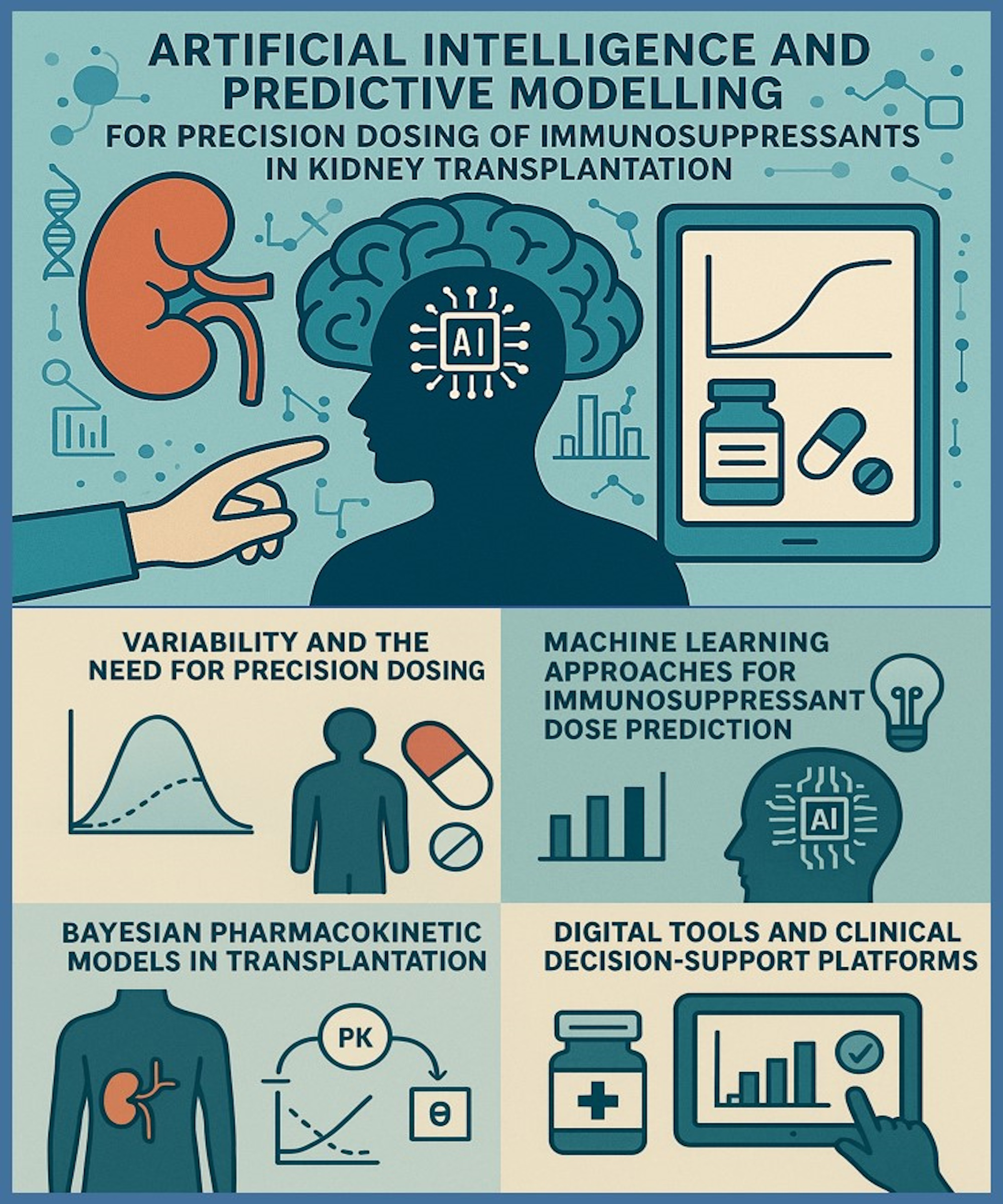
Artificial Intelligence and Predictive Modelling for Precision Dosing of Immunosuppressants in Kidney Transplantation
 , ,
, ,
Abstract
1. Introduction
2. Review Methodology
3. Variability and the Need for Precision Dosing
4. Machine Learning Approaches for Immunosuppressant Dose Prediction
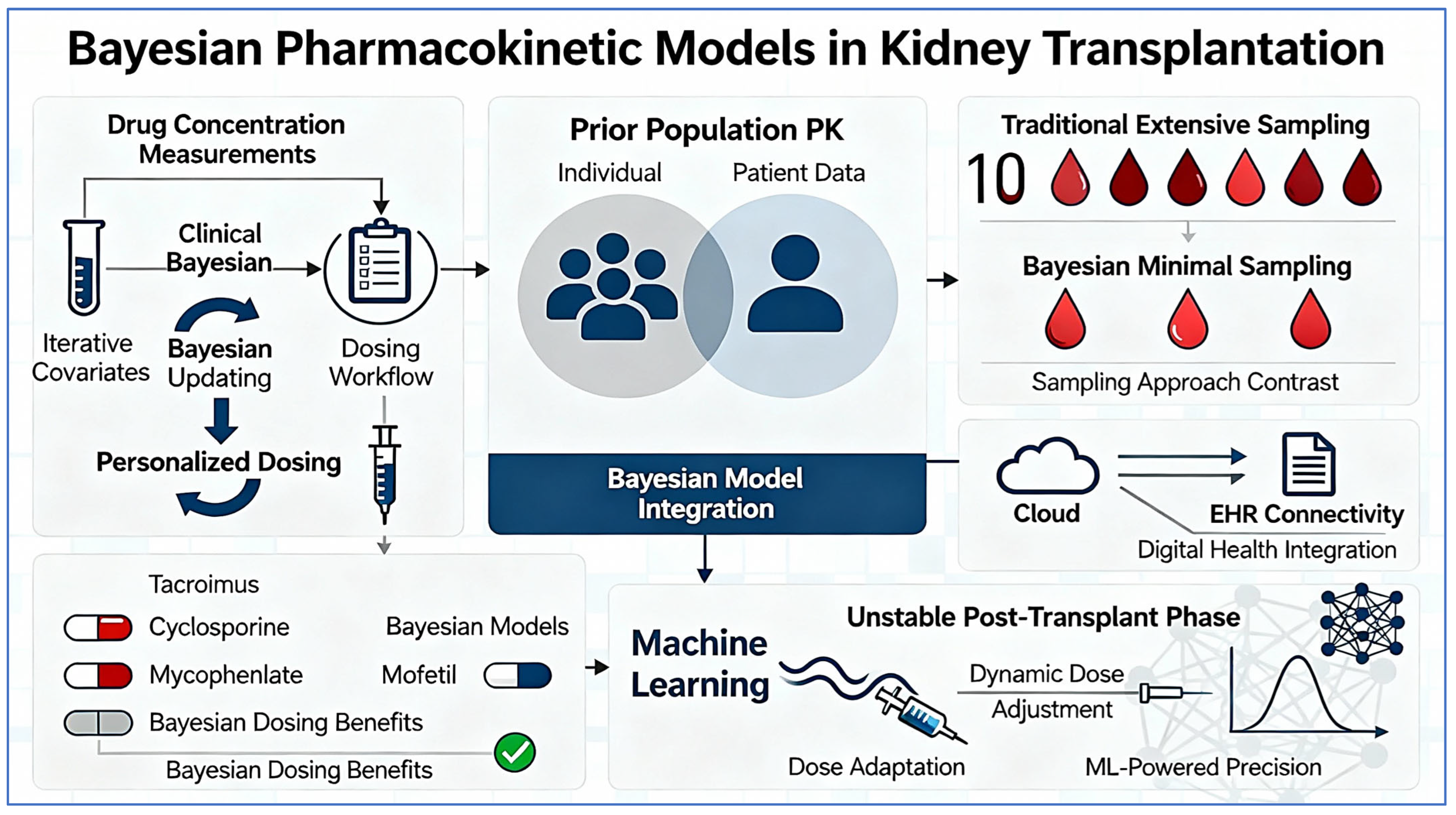
5. Bayesian and Hybrid AI-Pharmacokinetic Modelling for Precision Dosing
6. Digital Tools and Clinical Decision-Support Platforms
7. Challenges, Limitations, and Future Perspectives
8. Translational Research and Actionable Clinical Guidance
9. Conclusions
Author Contributions
Funding
Institutional Review Board Statement
Informed Consent Statement
Data Availability Statement
Acknowledgments
Conflicts of Interest
References
- Soni, M.M.; Mamdouh, H.M.; Cochinard, S.; Rosselli, D. Cost-Effectiveness of the Kidney Transplant Compared with Hemodialysis in End-Stage Renal Disease in Dubai, the United Arab Emirates: A Cost-Utility Study. Value Health Reg. Issues 2025, 48, 101109. [Google Scholar] [CrossRef] [Scilit]
- Sharma, V.; Roy, R.; Piscoran, O.; Summers, A.; van Dellen, D.; Augustine, T. Living donor kidney transplantation: Let’s talk about it. Clin. Med. 2020, 20, 346–348. [Google Scholar] [CrossRef] [Scilit]
- Kuttymuratov, G.; Saliev, T.; Ainakulov, A.; Ayaganov, A.; Oshakbayev, K.; Zharassov, D.; Tuleuzhan, A.; Uderbayev, N. Kidney and Bladder Transplantation: Advances, Barriers, and Emerging Solutions. Medicina 2025, 61, 1045. [Google Scholar] [CrossRef] [Scilit]
- Semenova, Y.; Bayanova, M.; Rakhimzhanova, S.; Altynova, S.; Sailybayeva, A.; Asanova, A.; Pya, Y. Understanding Pediatric Kidney Transplant Rejection: Its Pathophysiology, Biomarkers, and Management Strategies. Curr. Med. Chem. 2025, 32, 3571–3590. [Google Scholar] [CrossRef] [Scilit]
- Saparbay, J.; Assykbayev, M.; Abdugafarov, S.; Zhakhina, G.; Abisheva, Z.; Kuttymuratov, G. Kidney Transplantation in Kazakhstan: 10-Year Single Center Experience. Transplant. Rep. 2021, 6, 100073. [Google Scholar] [CrossRef] [Scilit]
- Massoglia, G.; Schuh, M.J. Tacrolimus Therapeutic Drug Monitoring in Kidney Transplant Patients Before and After Pharmacist Post-transplant Consults. Innov. Pharm. 2021, 12, 18. [Google Scholar] [CrossRef] [Scilit]
- Chang, Y.-L.; Hsiao, T.-H.; Chen, Y.-M.; Lin, C.-H.; Liao, Y.-J.; Hsu, C.-Y.; Liaw, Y.; Chen, C.-H. Refining tacrolimus dosing through CYP3A5 pharmacogenetics in Taiwanese renal transplant recipients. Ren. Fail. 2025, 47, 2523567. [Google Scholar] [CrossRef] [Scilit] [PubMed]
- Udomkarnjananun, S.; Schagen, M.R.; Hesselink, D.A. A review of landmark studies on maintenance immunosuppressive regimens in kidney transplantation. Asian Biomed. 2024, 18, 92–108. [Google Scholar] [CrossRef] [Scilit] [PubMed]
- Krall, P.; Yañez, D.; Rojo, A.; Delucchi, Á.; Córdova, M.; Morales, J.; Boza, P.; de la Rivera, A.; Espinoza, N.; Armijo, N.; et al. CYP3A5 and UGT1A9 Polymorphisms Influence Immunosuppressive Therapy in Pediatric Kidney Transplant Recipients. Front. Pharmacol. 2021, 12, 653525. [Google Scholar] [CrossRef] [Scilit]
- Bayanova, M.; Zhenissova, A.; Nazarova, L.; Abdikadirova, A.; Sapargalieyva, M.; Malik, D.; Bolatov, A.; Abdugafarov, S.; Assykbayev, M.; Altynova, S.; et al. Influence of Genetic Polymorphisms in CYP3A5, CYP3A4, and MDR1 on Tacrolimus Metabolism after kidney transplantation. J. Clin. Med. Kazakhstan 2024, 21, 11–17. [Google Scholar] [CrossRef] [Scilit] [PubMed]
- van Gelder, T.; Gelinck, A.; Meziyerh, S.; de Vries, A.P.J.; Moes, D.J.A.R. Therapeutic drug monitoring of tacrolimus after kidney transplantation: Trough concentration or area under curve-based monitoring? Br. J. Clin. Pharmacol. 2024, 91, 1600–1606. [Google Scholar] [CrossRef] [Scilit]
- Francke, M.I.; Sassen, S.D.T.; Lloberas, N.; Colom, H.; Elens, L.; Moudio, S.; de Vries, A.P.J.; Moes, D.J.A.R.; van Schaik, R.H.N.; Hesselink, D.A.; et al. A Population Pharmacokinetic Model and Dosing Algorithm to Guide the Tacrolimus Starting and Follow-Up Dose in Living and Deceased Donor Kidney Transplant Recipients. Clin. Pharmacokinet. 2025, 64, 1379–1394. [Google Scholar] [CrossRef] [Scilit]
- Serrano, D.R.; Luciano, F.C.; Anaya, B.J.; Ongoren, B.; Kara, A.; Molina, G.; Ramirez, B.I.; Sánchez-Guirales, S.A.; Simon, J.A.; Tomietto, G.; et al. Artificial Intelligence (AI) Applications in Drug Discovery and Drug Delivery: Revolutionizing Personalized Medicine. Pharmaceutics 2024, 16, 1328. [Google Scholar] [CrossRef] [Scilit]
- Sanghavi, K.; Ribbing, J.; Rogers, J.A.; Ahmed, M.A.; Karlsson, M.O.; Holford, N.; Chasseloup, E.; Ahamadi, M.; Kowalski, K.G.; Cole, S.; et al. Covariate modeling in pharmacometrics: General points for consideration. CPT Pharmacomet. Syst. Pharmacol. 2024, 13, 710–728. [Google Scholar] [CrossRef] [Scilit]
- Del Valle-Moreno, P.; Suarez-Casillas, P.; Mejías-Trueba, M.; Ciudad-Gutiérrez, P.; Guisado-Gil, A.B.; Gil-Navarro, M.V.; Herrera-Hidalgo, L. Model-Informed Precision Dosing Software Tools for Dosage Regimen Individualization: A Scoping Review. Pharmaceutics 2023, 15, 1859. [Google Scholar] [CrossRef] [Scilit]
- Lloberas, N.; Fernández-Alarcón, B.; Vidal-Alabró, A.; Colom, H. State of Art of Dose Individualization to Support tacrolimus drug monitoring: What’s Next? Transpl. Int. 2025, 38, 14201. [Google Scholar] [CrossRef] [Scilit]
- Asanova, A.; Bolatov, A.; Suleimenova, D.; Daniyarova, G.; Sailybayeva, A.; Altynova, S.; Pya, Y. The Determinants of Psychological Well-Being Among Kidney Transplant Recipients in Kazakhstan: A Cross-Sectional Study. J. Clin. Med. 2025, 14, 2894. [Google Scholar] [CrossRef] [Scilit]
- Megías-Vericat, J.E.; Palanques-Pastor, T.; Fernández-Sánchez, M.; Guerrero-Hurtado, E.; Gil-Candel, M.; Solana-Altabella, A.; Ballesta-López, O.; Centelles-Oria, M.; García-Pellicer, J.; Poveda-Andrés, J.L. Systematic Review of Pharmacogenetics of Immunosuppressants in Heart Transplantation. Cardiogenetics 2025, 15, 18. [Google Scholar] [CrossRef] [Scilit]
- Brunet, M.; Pastor-Anglada, M. Insights into the Pharmacogenetics of Tacrolimus Pharmacokinetics and Pharmacodynamics. Pharmaceutics 2022, 14, 1755. [Google Scholar] [CrossRef] [Scilit] [PubMed]
- Xajil-Ramos, L.Y.; Gándara-Mireles, J.A.; Rosales, R.J.V.; García, O.K.S.; Toledo, A.M.R.; de la Cruz, A.K.A.; Lares-Asseff, I.; Patrón-Romero, L.; Almanza-Reyes, H.; Lou-Meda, R. Impact of CYP3A5 1* and 3* single nucleotide variants on tacrolimus pharmacokinetics and graft rejection risk in pediatric kidney transplant patients. Front. Pharmacol. 2025, 16, 1592134. [Google Scholar] [CrossRef] [Scilit] [PubMed]
- Al Nasser, M.S.; Ahmad, M.A.A.A.S.; Edris, S.; Abdelfattah, E.; Ali, A.S.; Zaitoun, M.F.; Alharbi, F.H.; Al Mahdi, H.B.; Damanhouri, Z. Impact of CYP3A4 and CYP3A5 polymorphisms on tacrolimus dose requirements in Saudi kidney transplant patients. Saudi Pharm. J. 2025, 33, 30. [Google Scholar] [CrossRef] [Scilit]
- Santos, M.; Lima, L.; Carvalho, S.; Brandão, A.; Barroso, F.; Cruz, A.; Medeiros, R. ABCB1 C1236T, G2677TA and C3435T Genetic Polymorphisms and Antidepressant Response Phenotypes: Results from a Portuguese Major Depressive Disorder Cohort. Int. J. Mol. Sci. 2024, 25, 5112. [Google Scholar] [CrossRef] [Scilit]
- Brancati, V.U.; Scarpignato, C.; Minutoli, L.; Pallio, G. Use of Pharmacogenetics to Optimize Immunosuppressant Therapy in Kidney-Transplanted Patients. Biomedicines 2022, 10, 1798. [Google Scholar] [CrossRef] [Scilit]
- Wolf, U. A Drug Safety Briefing (II) in Transplantation from Real-World Individual Pharmacotherapy Management to Prevent Patient and Graft from Polypharmacy Risks at the Very Earliest Stage. Pharmaceuticals 2024, 17, 294. [Google Scholar] [CrossRef] [Scilit]
- Concha, J.; Sangüesa, E.; Saez-Benito, A.M.; Aznar, I.; Berenguer, N.; Saez-Benito, L.; Ribate, M.P.; García, C.B. Importance of Pharmacogenetics and Drug–Drug Interactions in a Kidney Transplanted Patient. Life 2023, 13, 1627. [Google Scholar] [CrossRef] [Scilit] [PubMed]
- Derejie, M.N.; Dereje, E.N.; Alemu, D.M.; Tesfay, Y.G.; Hunduma, F.; Temie, N.M. Medication non-adherence and its associated factors among kidney transplant patients in a large teaching hospital in Ethiopia. BMC Nephrol. 2024, 25, 187. [Google Scholar] [CrossRef] [Scilit] [PubMed]
- Leino, A.D.; Magee, J.C.; Kershaw, D.B.; Pai, M.P.; Park, J.M. A Comprehensive Mixed-Method Approach to Characterize the Source of Diurnal Tacrolimus Exposure Variability in Children: Systematic Review, Meta-analysis, and Application to an Existing Data Set. J. Clin. Pharmacol. 2023, 64, 334–344. [Google Scholar] [CrossRef] [Scilit]
- Koi, A.N.; Johnson, J.C.; Engebretsen, T.L.; Mujtaba, M.A.; Lea, A.S.; Stevenson, H.L.; Kueht, M.L. Precision in Immune Management: Balancing Steroid Exposure, Rejection Risk, and Infectious Outcomes in Adult Kidney Transplant Recipients. J. Pers. Med. 2024, 14, 1106. [Google Scholar] [CrossRef] [Scilit] [PubMed]
- Ragavanandam, L.; Sudha, K.M.; Yadav, S. Prescribing Pattern and Safety of Immunosuppressants in Renal Transplant Patients: An Observational Study. Cureus 2023, 15, e46200. [Google Scholar] [CrossRef] [Scilit]
- Joshi, S.; Sheth, S. Artificial Intelligence (AI) in Pharmaceutical Formulation and Dosage Calculations. Pharmaceutics 2025, 17, 1440. [Google Scholar] [CrossRef] [Scilit]
- Danieli, M.G.; Brunetto, S.; Gammeri, L.; Palmeri, D.; Claudi, I.; Shoenfeld, Y.; Gangemi, S. Machine learning application in autoimmune diseases: State of art and future prospectives. Autoimmun. Rev. 2024, 23, 103496. [Google Scholar] [CrossRef] [Scilit]
- Li, Q.; Tang, B.; Wu, Y.; Yao, B.; Zhang, W.; Zheng, Y.; Zhou, Y.; van den Anker, J.; Hao, G.; Zhao, W. Machine Learning: A New Approach for Dose Individualization. Clin. Pharmacol. Ther. 2023, 115, 727–744. [Google Scholar] [CrossRef] [Scilit]
- Park, D.J.; Kim, M.; Cho, H.; Kim, J.S.; Hwang, J.; Lee, J. Machine Learning-Based Algorithm for Tacrolimus Dose Optimization in Hospitalized Kidney Transplant Patients. Diagnostics 2025, 15, 2948. [Google Scholar] [CrossRef] [Scilit]
- Wang, Y.-P.; Lu, X.-L.; Shao, K.; Shi, H.-Q.; Zhou, P.-J.; Chen, B. Improving prediction of tacrolimus concentration using a combination of population pharmacokinetic modeling and machine learning in chinese renal transplant recipients. Front. Pharmacol. 2024, 15, 1389271. [Google Scholar] [CrossRef] [Scilit] [PubMed]
- Gim, J.-A.; Kwon, Y.; A Lee, H.; Lee, K.-R.; Kim, S.; Choi, Y.; Kim, Y.K.; Lee, H. A Machine Learning-Based Identification of Genes Affecting the Pharmacokinetics of Tacrolimus Using the DMETTM Plus Platform. Int. J. Mol. Sci. 2020, 21, 2517. [Google Scholar] [CrossRef] [Scilit] [PubMed]
- Zhu, X.; Peng, B.; Yi, Q.; Liu, J.; Yan, J. Prediction Model of Immunosuppressive Medication Non-adherence for Renal Transplant Patients Based on Machine Learning Technology. Front. Med. 2022, 9, 796424. [Google Scholar] [CrossRef] [Scilit]
- Poweleit, E.A.B.; Vinks, A.A.P.; Mizuno, T. Artificial Intelligence and Machine Learning Approaches to Facilitate Therapeutic Drug Management and Model-Informed Precision Dosing. Ther. Drug Monit. 2023, 45, 143–150. [Google Scholar] [CrossRef] [Scilit]
- Jayaraman, P.; Vasudev, I.; Bhardwaj, A.; Nadkarni, G.; Sakhuja, A.; Meena, P. Artificial Intelligence in Nephrology: Pioneering Precision with Multimodal Intelligence. Indian J. Nephrol. 2025, 35, 470–479. [Google Scholar] [CrossRef] [Scilit] [PubMed]
- Arjmandmazidi, S.; Heidari, H.R.; Ghasemnejad, T.; Mori, Z.; Molavi, L.; Meraji, A.; Kaghazchi, S.; Aghdam, E.M.; Montazersaheb, S. An In-depth overview of artificial intelligence (AI) tool utilization across diverse phases of organ transplantation. J. Transl. Med. 2025, 23, 678. [Google Scholar] [CrossRef] [Scilit]
- Mizera, J.; Pondel, M.; Kepinska, M.; Jerzak, P.; Banasik, M. Advancements in Artificial Intelligence for Kidney Transplantology: A Comprehensive Review of Current Applications and Predictive Models. J. Clin. Med. 2025, 14, 975. [Google Scholar] [CrossRef] [Scilit]
- Min, J.; Li, Q.; Lai, W.; Lu, Y.; Wang, X.; Chen, G. Clinical-oriented tacrolimus dosing algorithms in kidney transplant based on genetic algorithm and deep forest. Front. Pharmacol. 2025, 16, 1656197. [Google Scholar] [CrossRef] [Scilit]
- Boldini, D.; Grisoni, F.; Kuhn, D.; Friedrich, L.; Sieber, S.A. Practical guidelines for the use of gradient boosting for molecular property prediction. J. Cheminform. 2023, 15, 73. [Google Scholar] [CrossRef] [Scilit]
- Javid, S.; Rahmanulla, A.; Ahmed, M.G.; Sultana, R.; Kumar, B.P. Machine learning & deep learning tools in pharmaceutical sciences: A comprehensive review. Intell. Pharm. 2025, 3, 167–180. [Google Scholar] [CrossRef] [Scilit]
- Zhang, Q.; Tian, X.; Chen, G.; Yu, Z.; Zhang, X.; Lu, J.; Zhang, J.; Wang, P.; Hao, X.; Huang, Y.; et al. A Prediction Model for Tacrolimus Daily Dose in Kidney Transplant Recipients with Machine Learning and Deep Learning Techniques. Front. Med. 2022, 9, 813117. [Google Scholar] [CrossRef] [Scilit] [PubMed]
- Bhat, M.; Rabindranath, M.; Chara, B.S.; Simonetto, D.A. Artificial intelligence, machine learning, and deep learning in liver transplantation. J. Hepatol. 2023, 78, 1216–1233. [Google Scholar] [CrossRef] [Scilit]
- Banumathi, K.; Venkatesan, L.; Benjamin, L.S.; K, V.; Satchi, N.S.; Iv, N.S.S. Reinforcement Learning in Personalized Medicine: A Comprehensive Review of Treatment Optimization Strategies. Cureus 2025, 17, e82756. [Google Scholar] [CrossRef] [Scilit]
- Tosca, E.M.; De Carlo, A.; Ronchi, D.; Magni, P. Model-Informed Reinforcement Learning for Enabling Precision Dosing Via Adaptive Dosing. Clin. Pharmacol. Ther. 2024, 116, 619–636. [Google Scholar] [CrossRef] [Scilit] [PubMed]
- Irie, K.; Minar, P.; Reifenberg, J.; Boyle, B.M.; Noe, J.D.; Hyams, J.S.; Mizuno, T. Hybrid Population Pharmacokinetic–Machine Learning Modeling to Predict Infliximab Pharmacokinetics in Pediatric and Young Adult Patients with Crohn’s Disease. Clin. Pharmacokinet. 2025, 64, 1669–1679. [Google Scholar] [CrossRef] [Scilit] [PubMed]
- Huang, S.; Xu, Q.; Yang, G.; Ding, J.; Pei, Q. Machine Learning for Prediction of Drug Concentrations: Application and Challenges. Clin. Pharmacol. Ther. 2025, 117, 1236–1247. [Google Scholar] [CrossRef] [Scilit]
- Hughes, J.H.; Keizer, R.J. A hybrid machine learning/pharmacokinetic approach outperforms maximum a posteriori Bayesian estimation by selectively flattening model priors. CPT: Pharmacomet. Syst. Pharmacol. 2021, 10, 1150–1160. [Google Scholar] [CrossRef] [Scilit]
- Hughes, J.H.; Tong, D.M.H.; Lucas, S.S.; Faldasz, J.D.; Goswami, S.; Keizer, R.J. Continuous Learning in Model-Informed Precision Dosing: A Case Study in Pediatric Dosing of Vancomycin. CPT 2020, 109, 233–242. [Google Scholar] [CrossRef] [Scilit] [PubMed]
- Tang, B.-H.; Zhang, J.-Y.; Allegaert, K.; Hao, G.-X.; Yao, B.-F.; Leroux, S.; Thomson, A.H.; Yu, Z.; Gao, F.; Zheng, Y.; et al. Use of Machine Learning for Dosage Individualization of Vancomycin in Neonates. Clin. Pharmacokinet. 2023, 62, 1105–1116. [Google Scholar] [CrossRef] [Scilit] [PubMed]
- Naemi, A.; Tashk, A.; Azar, A.S.; Samimi, T.; Tavassoli, G.; Mohasefi, A.B.; Khanshan, E.N.; Najafabad, M.H.; Tarighi, V.; Wiil, U.K.; et al. Applications of Artificial Intelligence for Metastatic Gastrointestinal Cancer: A Systematic Literature Review. Cancers 2025, 17, 558. [Google Scholar] [CrossRef] [Scilit] [PubMed]
- Clusmann, J.; Balaguer-Montero, M.; Bassegoda, O.; Schneider, C.V.; Seraphin, T.; Paintsil, E.; Luedde, T.; Lopez, R.P.; Calderaro, J.; Gilbert, S.; et al. The barriers to uptake of artificial intelligence in hepatology and how to overcome them. J. Hepatol. 2025, 83, 1410–1426. [Google Scholar] [CrossRef] [Scilit] [PubMed]
- Fan, B.; Schürch, M.; Tian, Y.; Mallone, A.; Frischknecht, L.; Koller, M.; Van Delden, C.; Leichtle, A.; Golshayan, D.; Villard, J.; et al. Enhancing post-kidney transplant prognostication: An interpretable machine learning approach for longitudinal outcome prediction. npj Digit. Med. 2025, 8, 684. [Google Scholar] [CrossRef] [Scilit] [PubMed]
- Saarela, M.; Podgorelec, V. Recent Applications of Explainable AI (XAI): A Systematic Literature Review. Appl. Sci. 2024, 14, 8884. [Google Scholar] [CrossRef] [Scilit]
- Vani, M.S.; Sudhakar, R.V.; Mahendar, A.; Ledalla, S.; Radha, M.; Sunitha, M. Personalized health monitoring using explainable AI: Bridging trust in predictive healthcare. Sci. Rep. 2025, 15, 31892. [Google Scholar] [CrossRef] [Scilit]
- Alowais, S.A.; Alghamdi, S.S.; Alsuhebany, N.; Alqahtani, T.; Alshaya, A.I.; Almohareb, S.N.; Aldairem, A.; Alrashed, M.; Bin Saleh, K.; Badreldin, H.A.; et al. Revolutionizing healthcare: The role of artificial intelligence in clinical practice. BMC Med. Educ. 2023, 23, 689. [Google Scholar] [CrossRef] [Scilit]
- Downes, K.J.; Sharova, A.; Malone, J.B.; John, A.R.O.; Zuppa, A.F.; Neely, M.N. Multiple Model Optimal Sampling Promotes Accurate Vancomycin Area-Under-the-Curve Estimation Using a Single Sample in Critically Ill Children. Ther. Drug Monit. 2025, 47, 512–519. [Google Scholar] [CrossRef] [Scilit]
- Kantasiripitak, W.; Van Daele, R.; Gijsen, M.; Ferrante, M.; Spriet, I.; Dreesen, E. Software Tools for Model-Informed Precision Dosing: How Well Do They Satisfy the Needs? Front. Pharmacol. 2020, 11, 620. [Google Scholar] [CrossRef] [Scilit]
- Marquet, P.; Destère, A.; Monchaud, C.; Rérolle, J.-P.; Buchler, M.; Mazouz, H.; Etienne, I.; Thierry, A.; Picard, N.; Woillard, J.-B.; et al. Clinical Pharmacokinetics and Bayesian Estimators for the Individual Dose Adjustment of a Generic Formulation of Tacrolimus in Adult Kidney Transplant Recipients. Clin. Pharmacokinet. 2020, 60, 611–622. [Google Scholar] [CrossRef] [Scilit]
- Baldy, N.; Simon, N.; Jirsa, V.K.; Hashemi, M. Hierarchical Bayesian pharmacometrics analysis of Baclofen for alcohol use disorder. Mach. Learn. Sci. Technol. 2023, 4, 035048. [Google Scholar] [CrossRef] [Scilit]
- Ruberg, S.J.; Beckers, F.; Hemmings, R.; Honig, P.; Irony, T.; LaVange, L.; Lieberman, G.; Mayne, J.; Moscicki, R. Application of Bayesian approaches in drug development: Starting a virtuous cycle. Nat. Rev. Drug Discov. 2023, 22, 235–250. [Google Scholar] [CrossRef] [Scilit] [PubMed]
- Bhavatharini, P.A.; Deepalakshmi, M.; Arun, K.P. Pharmacometrics: The science applied from bench to bedside. J. Appl. Pharm. Sci. 2022, 12, 55–64. [Google Scholar] [CrossRef] [Scilit]
- Zwart, T.C.; Guchelaar, H.-J.; van der Boog, P.J.; Swen, J.J.; van Gelder, T.; de Fijter, J.W.; Moes, D.J.A. Model-informed precision dosing to optimise immunosuppressive therapy in renal transplantation. Drug Discov. Today 2021, 26, 2527–2546. [Google Scholar] [CrossRef] [Scilit] [PubMed]
- Alnezary, F.S.; Almutairi, M.S.; Gonzales-Luna, A.J.; Thabit, A.K. The Significance of Bayesian Pharmacokinetics in Dosing for Critically Ill Patients: A Primer for Clinicians Using Vancomycin as an Example. Antibiotics 2023, 12, 1441. [Google Scholar] [CrossRef] [Scilit]
- Labriffe, M.; Sayadi, H.; Woillard, J.-B.; Micallef, L.; Saint-Marcoux, F.; Destere, A.; Marquet, P.; Monchaud, C. Large-Scale Real-World Monitoring of Mycophenolic Acid Exposure in Liver Transplantation: Impact of Bayesian Dose Adjustment. Ther. Drug Monit. 2025. [Google Scholar] [CrossRef] [Scilit]
- Khatri, D.; Felmingham, B.; Moore, C.; Lazaraki, S.; Stenta, T.; Collier, L.; Elliott, D.A.; Metz, D.; Conyers, R. Evaluating the evidence for genotype-informed Bayesian dosing of tacrolimus in children undergoing solid organ transplantation: A systematic literature review. Br. J. Clin. Pharmacol. 2024, 90, 2724–2741. [Google Scholar] [CrossRef] [Scilit]
- Kamp, J.; Zwart, T.C.; Meziyerh, S.; van der Boog, P.J.M.; Nijgh, E.E.; van Duin, K.; de Vries, A.P.J.; Moes, D.J.A.R. Meltdose Tacrolimus Population Pharmacokinetics and Limited Sampling Strategy Evaluation in Elderly Kidney Transplant Recipients. Pharmaceutics 2023, 16, 17. [Google Scholar] [CrossRef] [Scilit] [PubMed]
- Yogesh, N.; Shrinivasacharya, P.; Naik, N. Novel statistically equivalent signature-based hybrid feature selection and ensemble deep learning LSTM and GRU for chronic kidney disease classification. PeerJ Comput. Sci. 2024, 10, e2467. [Google Scholar] [CrossRef] [Scilit]
- Greppmair, S.; Brinkmann, A.; Roehr, A.; Frey, O.; Hagel, S.; Dorn, C.; Marsot, A.; El-Haffaf, I.; Zoller, M.; Saller, T.; et al. Towards model-informed precision dosing of piperacillin: Multicenter systematic external evaluation of pharmacokinetic models in critically ill adults with a focus on Bayesian forecasting. Intensiv. Care Med. 2023, 49, 966–976. [Google Scholar] [CrossRef] [Scilit]
- Ravix, A.; Cathignol, A.E.; Buclin, T.; Csajka, C.; Guidi, M.; Thoma, Y. Numerical Verification of Tucuxi, a Promising Bayesian Adaptation Tool for Model-Informed Precision Dosing. CPT Pharmacomet. Syst. Pharmacol. 2025, 14, 1616–1624. [Google Scholar] [CrossRef] [Scilit]
- König, C.; Kuti, J.L.; Fratoni, A.J. Predictive performance of population pharmacokinetic models in InsightRX® for model-informed precision dosing for Cefepime. Pharmacother. J. Hum. Pharmacol. Drug Ther. 2025, 45, 403–413. [Google Scholar] [CrossRef] [Scilit]
- Kirubakaran, R.; Uster, D.W.; Hennig, S.; Carland, J.E.; Day, R.O.; Wicha, S.G.; Stocker, S.L. Adaptation of a population pharmacokinetic model to inform tacrolimus therapy in heart transplant recipients. Br. J. Clin. Pharmacol. 2022, 89, 1162–1175. [Google Scholar] [CrossRef] [Scilit] [PubMed]
- Sánchez-Herrero, S.; Calvet, L.; Juan, A.A. Machine Learning Models for Predicting Personalized Tacrolimus Stable Dosages in Pediatric Renal Transplant Patients. BioMedInformatics 2023, 3, 926–947. [Google Scholar] [CrossRef] [Scilit]
- Lloberas, N.; Grinyó, J.M.; Colom, H.; Vidal-Alabró, A.; Fontova, P.; Rigo-Bonnin, R.; Padró, A.; Bestard, O.; Melilli, E.; Montero, N.; et al. A prospective controlled, randomized clinical trial of kidney transplant recipients developed personalized tacrolimus dosing using model-based Bayesian Prediction. Kidney Int. 2023, 104, 840–850. [Google Scholar] [CrossRef] [Scilit] [PubMed]
- Nguyen, T.D.; Smith, N.M.; Attwood, K.; Gundroo, A.; Chang, S.; Yonis, M.; Murray, B.; Tornatore, K.M. Bayesian optimization of tacrolimus exposure in stable kidney transplant patients. Pharmacother. J. Hum. Pharmacol. Drug Ther. 2023, 43, 1032–1042. [Google Scholar] [CrossRef] [Scilit]
- Li, C.; Jiang, W.; Shen, A.; Li, Y.; Wu, J.; Tao, H.; Tang, Y.; Yue, X.; Hao, A.; Zhao, Z. International expert consensus on hospital intelligent pharmacy. Intell. Pharm. 2025, 3, 378–386. [Google Scholar] [CrossRef] [Scilit]
- Jayachandran, P.; Desikan, R.; Krishnaswami, S.; Hennig, S. Role of pharmacometrics and systems pharmacology in facilitating efficient dose optimization in oncology. CPT: Pharmacomet. Syst. Pharmacol. 2023, 12, 1569–1572. [Google Scholar] [CrossRef] [Scilit]
- Yamamoto, P.A.; Rodriguez-Vera, L.; Telles, J.P.; Moreira, F.L.; Roy, S.; Korn, O.B.; Coelho, D.J.M.; Migotto, K.C.; de Carvalho, F.R.T.; Caruso, P.; et al. A Bayesian Framework for Optimizing Amikacin Therapy in Critically Ill Patients with Cancer. Ther. Drug Monit. 2025, 47, 721–729. [Google Scholar] [CrossRef] [Scilit]
- Chen, A.; Gupta, A.; Do, D.H.; Nazer, L.H. Bayesian method application: Integrating mathematical modeling into clinical pharmacy through vancomycin therapeutic monitoring. Pharmacol. Res. Perspect. 2022, 10, e01026. [Google Scholar] [CrossRef] [Scilit] [PubMed]
- Huo, M.; Perez, S.; Awdishu, L.; Kerr, J.S.; Xie, P.; Khan, A.; Mekeel, K.; Nemati, S. AI-Driven Tacrolimus Dosing in Transplant Care: Cohort Study. JMIR AI 2025, 4, e67302. [Google Scholar] [CrossRef] [Scilit] [PubMed]
- Arshed, M.; Mahmud, A.B.; Minhat, H.S.; Ying, L.P.; Umer, M.F. Effectiveness of mHealth Interventions in Medication Adherence among Patients with Cardiovascular Diseases: A Systematic Review. Diseases 2023, 11, 41. [Google Scholar] [CrossRef] [Scilit]
- Firuzpour, F.; Pasha, A.A.; Oliaei, F.; Nasirimehr, K.; Khosravi, M.; Rostami, G.; Saeidnia, H.R. Artificial intelligence–driven kidney organ allocation: Systematic review of clinical outcome prediction, ethical frameworks, and decision-making algorithms. BMC Nephrol. 2025, 26, 639. [Google Scholar] [CrossRef] [Scilit] [PubMed]
- Falevai, I.; Hassandoust, F. Enhancing Transplantation Care with eHealth: Benefits, Challenges, and Key Considerations for the Future. Future Internet 2025, 17, 177. [Google Scholar] [CrossRef] [Scilit]
- Roller, R.; Mayrdorfer, M.; Duettmann, W.; Naik, M.G.; Schmidt, D.; Halleck, F.; Hummel, P.; Burchardt, A.; Möller, S.; Dabrock, P.; et al. Evaluation of a clinical decision support system for detection of patients at risk after kidney transplantation. Front. Public Health 2022, 10, 979448. [Google Scholar] [CrossRef] [Scilit] [PubMed]
- Marinescu, Ș.A.; Oncioiu, I.; Ghibanu, A.-I. The Digital Transformation of Healthcare Through Intelligent Technologies: A Path Dependence-Augmented–Unified Theory of Acceptance and Use of Technology Model for Clinical Decision Support Systems. Healthcare 2025, 13, 1222. [Google Scholar] [CrossRef] [Scilit]
- Séroussi, B.; Hollis, K.F.; Soualmia, L.F. Transparency of Health Informatics Processes as the Condition of Healthcare Professionals’ and Patients’ Trust and Adoption: The Rise of Ethical Requirements. Yearb. Med. Inform. 2020, 29, 7–10. [Google Scholar] [CrossRef] [Scilit]
- Embo, M.; Wasiak, C.; Verschaeve, S.; Van Acker, L.; Timmers, M.; Lievens, E. EU protection requirements for ePortfolios in clinical healthcare education. BMC Med. Educ. 2025, 25, 1640. [Google Scholar] [CrossRef] [Scilit]
- Oskrochi, Y.; Roy-Highley, E.; Grimes, K.; Shah, S. Digital Health Technology Compliance with Clinical Safety Standards In the National Health Service in England: National Cross-Sectional Study. J. Med. Internet Res. 2025, 27, e80076. [Google Scholar] [CrossRef] [Scilit]
- Abbas, Q.; Jeong, W.; Lee, S.W. Explainable AI in Clinical Decision Support Systems: A Meta-Analysis of Methods, Applications, and Usability Challenges. Healthcare 2025, 13, 2154. [Google Scholar] [CrossRef] [Scilit]
- de Hond, A.A.H.; Shah, V.B.; Kant, I.M.J.; Van Calster, B.; Steyerberg, E.W.; Hernandez-Boussard, T. Perspectives on validation of clinical predictive algorithms. npj Digit. Med. 2023, 6, 86. [Google Scholar] [CrossRef] [Scilit] [PubMed]
- Santos, C.S.; Amorim-Lopes, M. Externally validated and clinically useful machine learning algorithms to support patient-related decision-making in oncology: A scoping review. BMC Med. Res. Methodol. 2025, 25, 45. [Google Scholar] [CrossRef] [Scilit]
- Mennella, C.; Maniscalco, U.; De Pietro, G.; Esposito, M. Ethical and regulatory challenges of AI technologies in healthcare: A narrative review. Heliyon 2024, 10, e26297. [Google Scholar] [CrossRef] [Scilit] [PubMed]
- Taherdoost, H.; Ghofrani, A. AI’s role in revolutionizing personalized medicine by reshaping pharmacogenomics and drug therapy. Intell. Pharm. 2024, 2, 643–650. [Google Scholar] [CrossRef] [Scilit]
- Yi, S.; Yam, E.L.Y.; Cheruvettolil, K.; Linos, E.; Gupta, A.; Palaniappan, L.; Rajeshuni, N.; Vaska, K.G.; Schulman, K.; Eggleston, K.N. Perspectives of Digital Health Innovations in Low- and Middle-Income Health Care Systems from South and Southeast Asia. J. Med. Internet Res. 2024, 26, e57612. [Google Scholar] [CrossRef] [Scilit] [PubMed]
- Allam, H. Prescribing the Future: The Role of Artificial Intelligence in Pharmacy. Information 2025, 16, 131. [Google Scholar] [CrossRef] [Scilit]
- Olawade, D.B.; Fidelis, S.C.; Marinze, S.; Egbon, E.; Osunmakinde, A.; Osborne, A. Artificial intelligence in clinical trials: A comprehensive review of opportunities, challenges, and future directions. Int. J. Med. Inform. 2026, 206, 106141. [Google Scholar] [CrossRef] [Scilit] [PubMed]
- Askin, S.; Burkhalter, D.; Calado, G.; El Dakrouni, S. Artificial Intelligence Applied to clinical trials: Opportunities and challenges. Health Technol. 2023, 13, 203–213. [Google Scholar] [CrossRef] [Scilit]


| Category of Variability | Key Contributing Factors | Impact on Drug Pharmacokinetics (PK)/ Pharmacodynamics (PD) | Clinical Consequence |
|---|---|---|---|
| Pharmacogenomic | CYP3A5 Polymorphisms: *1 carriers (rapid metabolizers) vs. *3/*3 (poor metabolizers). | Significant inter-patient differences in drug metabolism and clearance. Highly variable systemic exposure from identical doses. | High risk of subtherapeutic exposure (rejection) or supratherapeutic exposure (toxicity) with standard dosing. |
| ABCB1 (P-glycoprotein) Variants: Alters drug transport (absorption, distribution). | |||
| UGT1A9 and SLCO1B1 Polymorphisms: Affects mycophenolate metabolism. | |||
| CYP3A4 Variants: Influences mTOR inhibitor clearance. | |||
| Physiological and Clinical | Demographics: Age (pediatric/elderly), body composition. | Dynamic, time-dependent changes in drug distribution, protein binding, and clearance, especially post-transplant. | Unstable drug levels; constant dose adjustments are required to maintain the therapeutic window. |
| Organ Function: Fluctuating renal/hepatic function, haematocrit, albumin. | |||
| Drug–Drug Interactions: CYP3A inhibitors/inducers. | |||
| Clinical State: Inflammation, infection. | |||
| Behavioural and Environmental | Medication Non-Adherence: Due to complex regimens. | Unpredictable and variable drug absorption and bioavailability. Altered enzyme activity. | Erratic drug exposure; complicates dose optimization and is a leading cause of late graft loss. |
| Diet and Timing: Food intake (e.g., high-fat meals), circadian rhythm. | |||
| Lifestyle: Herbal supplements, smoking. | |||
| Analytical and Methodological (TDM Limitations) | Trough (C0) Monitoring: A single, static data point. | Incomplete picture of total drug exposure over time. Potential for inaccurate PK parameter estimation. | Dose adjustments based on incomplete or potentially misleading information, increasing the risk of incorrect dosing. |
| AUC Monitoring: Logistically challenging (multiple samples). | |||
| Assay Differences: Immunoassay vs. LC-MS/MS discrepancies. |
| Aspect | Population Pharmacokinetics (PopPK) | Bayesian Modelling | Machine Learning (ML) | Explainable Artificial Intelligence (XAI) |
|---|---|---|---|---|
| Primary purpose | Describe drug PK behaviour at the population level | Individualize predictions using prior knowledge and patient data | Predict outcomes or dose requirements from data | Improve transparency and interpretability of ML models |
| Modelling paradigm | Mechanistic or semi-mechanistic statistical modelling | Probabilistic inference framework applied to PopPK | Data-driven, algorithmic modelling | Interpretability layer, not a standalone model |
| Use of prior knowledge | Yes (fixed structural and variability parameters) | Yes (explicit priors updated with individual data) | No explicit priors required | Not applicable |
| Individualization | Limited (population averages with covariates) | High (posterior individual estimates) | High (learned from individual-level data patterns) | Not applicable |
| Data requirements | Moderate (PK samples, covariates) | Moderate (PopPK model + TDM data) | High (large, diverse datasets) | Depends on underlying ML model |
| Interpretability | High (physiological meaning of parameters) | High (clinically transparent updating process) | Often low (“black-box” models) | High (methods to explain ML predictions) |
| Handling nonlinearity and complex interactions | Limited | Moderate | High | Not applicable |
| Typical clinical use | Model development, simulation, dose guidelines | Therapeutic drug monitoring and adaptive dosing | Dose prediction, risk stratification, outcome forecasting | Supporting trust and adoption of ML systems |
| Examples in transplantation | Tacrolimus PopPK models | Bayesian forecasting in InsightRx Nova™ | ML-based tacrolimus dose prediction models | SHAP, feature importance for ML dosing tools |
| Regulatory acceptance | Well established | Well established | Emerging | Emerging |
| ML Approach/ Category | Key Examples | Principle and Strengths | Application in Immunosuppressant Dosing | Representative Performance Outcomes | Limitations |
|---|---|---|---|---|---|
| Ensemble Learning | Random Forests | Combines multiple decision trees to capture nonlinear relationships and complex feature interactions; robust to noise and missing data | Widely applied to tacrolimus trough concentration and dose prediction using demographic, laboratory, and pharmacogenomic variables (e.g., CYP3A5 genotype) | RMSE typically 1.8–2.5 ng/mL for tacrolimus trough prediction; ~15–30% reduction in prediction error compared with linear regression when genotype data included (where reported) | Quantitative comparison across studies is limited by heterogeneous target variables (dose vs. concentration), differing sampling times, and centre-specific datasets |
| Gradient Boosting | XGBoost, LightGBM | Sequentially builds weak learners to minimize prediction error; performs well with imbalanced datasets and outliers | Prediction of tacrolimus dose requirements and trough levels, particularly in early post-transplant period | Frequently reported to outperform random forests and linear models in internal validation; RMSE values comparable or slightly lower than RF models in single-centre studies | Performance metrics often reported only in internal validation; lack of standardized external validation prevents robust cross-study comparison |
| Deep Learning | Artificial Neural Networks (ANNs) | Learns hierarchical representations of complex nonlinear relationships without explicit feature engineering | Used for predicting tacrolimus concentrations from high-dimensional clinical and laboratory data | Improved predictive accuracy over regression models in several studies; quantitative metrics vary widely depending on network architecture and input features | Limited interpretability; substantial heterogeneity in model design and reporting makes quantitative comparison across studies infeasible |
| Recurrent Neural Networks | RNNs | Models sequential dependencies in time-series data | Applied to longitudinal TDM data to predict future tacrolimus concentrations | Demonstrated improved temporal prediction compared with static models in pilot studies | Mostly evaluated in small datasets; lack of standardized outcome metrics and prospective validation |
| Long Short-Term Memory Networks | LSTMs | Specialized RNNs capable of learning long-term temporal dependencies | Particularly useful in early post-transplant phase with rapidly changing pharmacokinetics | Shown to better capture time-dependent changes in drug exposure than non-temporal models | Quantitative performance varies widely; direct comparison limited by different prediction horizons and sampling schemes |
| Reinforcement Learning (RL) | N/A (custom implementations) | Learns optimal dosing policies through interaction with simulated or real patient data | Adaptive dose titration based on sequential feedback from TDM results | Pilot studies report faster achievement of therapeutic range and reduced variability | Early-stage research; small cohorts, simulated environments, and lack of standardized metrics preclude quantitative comparison |
| Hybrid Models | Population PK + ML | Combines mechanistic PK structure with ML modelling of residual variability | Tacrolimus and cyclosporine dose prediction using sparse sampling | Reported improvements in predictive accuracy and generalizability over standalone PK or ML models | Performance gains vary by implementation; limited number of studies and inconsistent reporting of quantitative metrics |
| Bayesian + ML | Bayesian PK with ML-enhanced priors | ML informs or adapts Bayesian priors while preserving interpretability | Individualized dosing with dynamic updating as new data accrue | Improved stability of predictions and reduced uncertainty reported qualitatively | Quantitative comparison difficult due to diverse Bayesian structures and ML components |
| Explainable AI (XAI) | SHAP, LIME | Provides interpretability by quantifying feature contributions to predictions | Enhances clinician trust by explaining ML-based dosing recommendations | Does not directly improve predictive performance; supports clinical adoption | Not a predictive model itself; quantitative performance metrics not applicable |
| Challenge Category | Description | Clinical Impact | Technical/Operational Issues | Future Directions |
|---|---|---|---|---|
| Data Quality and Availability | Incomplete, fragmented, and heterogeneous therapeutic drug monitoring data. Lack of standardised formats and sampling variability. Retrospective, single-centre datasets limit generalizability. | Limits model accuracy and predictive reliability; may produce biased dosing recommendations. | Data fragmentation across systems; assay variability; missing or inconsistent data. | Development of multinational, ethnically diverse real-world databases; standardized TDM protocols; data sharing networks. |
| Model Interpretability | Machine learning often forms “black boxes” lacking transparency; Bayesian models provide probabilistic but complex outputs. | Reduced clinician trust and adoption; ethical concerns over accountability. | Need for specialized training to interpret uncertainty estimates in Bayesian outputs. | Training programmes; development of intuitive interfaces; explainable AI approaches to enhance transparency. |
| Regulatory and Ethical Issues | Lack of harmonized regulatory frameworks for AI/PK models; concerns about liability, certification, privacy, and genomic data handling. | Barriers to clinical approval and integration; potential legal and ethical risks. | Diverse regulatory environments; complex liability and data governance issues; genomic data sensitivity. | Establishment of international regulatory standards; robust audit trails and ethical oversight mechanisms. |
| Clinical Integration | Difficulty embedding tools into existing workflows; infrastructure gaps and costs; shortage of trained personnel. | Delayed adoption; fragmented clinical workflows; suboptimal use of models. | Interoperability challenges across EHR, labs, and pharmacies; resource constraints especially in low-income settings. | Investment in interoperable digital platforms; multidisciplinary training including AI and pharmacogenomics literacy. |
| Evidence Base and Trials | Limited prospective randomized trials validating clinical efficacy and cost-effectiveness of AI-based dosing methods. | Slower regulatory acceptance and guideline incorporation; lack of clinician confidence. | Need for large multicentre adaptive clinical trials integrating real-time data analysis. | Conducting prospective, multicentre, adaptive clinical trials; real-world evidence generation. |
| Technological Advancement | Need for integrative models synthesizing multimodal data, including digital biomarkers and physiologic states. | Potential for more precise, real-time dose adjustment aligned with patient status. | Technical complexity in data integration; need for high computational power and data standards. | Development of “digital twin” patient models; adoption of adaptive, autonomous AI dosing systems. |
| Collaborative Intelligence | Synergizing human clinical expertise with computational model outputs for enhanced decision-making. | Improved clinical decisions without replacing physician judgement. | Cultural and educational barriers to technology adoption; need for trust-building and iterative model refinement. | Promote clinician-AI collaboration, foster trust and transparency, and enhance continuous learning in healthcare settings. |
| Global Data Sharing | Need for open-access pharmacometric and pharmacogenomic data repositories to enhance model training and applicability. | Broader applicability and equity in precision dosing globally. | Data privacy concerns; cross-border legal and ethical complexities. | Develop global data-sharing frameworks, promote international collaboration and standardization. |
| Domain | Areas of Consensus (Supported by Current Evidence) | Key Evidence Gaps | Unresolved Controversies and Research Priorities |
|---|---|---|---|
| Bayesian PopPK Modelling | Bayesian PopPK-guided dosing improves target exposure attainment compared with trough-based monitoring in observational cohorts; enables reliable AUC estimation from sparse sampling; provides mechanistic interpretability and uncertainty quantification. | Limited number of prospective randomized controlled trials; heterogeneity in outcome definitions (AUC vs. C0); lack of pooled effect estimates and standardized reporting. | Whether Bayesian-guided dosing translates into improved graft survival, rejection rates, or cost-effectiveness; optimal endpoints for regulatory approval. |
| Machine Learning-Based Models | ML models can reduce prediction error for tacrolimus concentrations in retrospective datasets; nonlinear and high-dimensional relationships are better captured than with linear regression. | Small sample sizes; inconsistent validation strategies; limited external and prospective validation; poor reproducibility due to incomplete reporting of model specifications. | Whether ML models provide clinically meaningful benefit beyond Bayesian PopPK models when evaluated head-to-head in pragmatic trials. |
| Hybrid Bayesian–AI Approaches | Conceptual synergy between mechanistic PK models and data-driven learning is well established; hybrid models may improve prior specification and stability. | Lack of reproducible clinical implementations; absence of open code, standardized benchmarks, and external validation datasets. | Whether hybrid models meaningfully improve clinical outcomes or primarily increase technical complexity without added benefit. |
| Pharmacogenomics Integration | Strong biological rationale for genotype-informed dosing (e.g., CYP3A5 for tacrolimus); incorporation into Bayesian priors is methodologically feasible. | Limited population-specific allele frequency synthesis; unclear how to dynamically adjust priors across ethnically diverse cohorts. | Whether genotype-guided priors should be static, adaptive, or population-stratified in global transplant settings. |
| Digital Decision-Support Platforms | Integration with EHRs enables real-time dosing recommendations and standardized workflows; platforms operationalize Bayesian dosing at the bedside. | Limited transparency of proprietary algorithms; unclear regulatory status; scarce independent clinical outcome evaluations. | Balancing automation with clinician oversight; defining liability and certification pathways for AI-driven dosing systems. |
| Explainable AI (XAI) | XAI tools enhance interpretability and clinician trust in ML-based predictions; useful for identifying influential covariates. | Limited evaluation of clinical utility in transplant-specific decisions; predominantly local, not global, interpretability. | Whether explainability improves decision quality or adoption, and how to standardize interpretability reporting. |
| Clinical Outcomes | Improved exposure metrics (AUC attainment, reduced variability) are consistently reported. | Sparse evidence linking predictive dosing to hard outcomes (rejection, graft survival, mortality). | Determining which intermediate outcomes are sufficient surrogates for long-term clinical benefit. |
| Ethics, Regulation, and Data Governance | Ethical concerns around transparency, accountability, and genomic data privacy are widely recognized. | Lack of concrete consent models and harmonized regulatory frameworks for AI-based dosing tools. | Defining scalable, cross-border governance models for genomic and algorithmic decision-support systems. |
| Implementation and Equity | Workforce training and interoperability are critical for adoption; low-resource settings face additional barriers. | Few studies report implementation metrics, costs, or training requirements. | Developing simplified, resource-appropriate dosing tools without exacerbating health inequities. |
Disclaimer/Publisher’s Note: The statements, opinions and data contained in all publications are solely those of the individual author(s) and contributor(s) and not of MDPI and/or the editor(s). MDPI and/or the editor(s) disclaim responsibility for any injury to people or property resulting from any ideas, methods, instructions or products referred to in the content. |
© 2026 by the authors. Licensee MDPI, Basel, Switzerland. This article is an open access article distributed under the terms and conditions of the Creative Commons Attribution (CC BY) license.
Share and Cite
Altynova, S.; Saliev, T.; Asanova, A.; Kozybayeva, Z.; Rakhimzhanova, S.; Bolatov, A. Artificial Intelligence and Predictive Modelling for Precision Dosing of Immunosuppressants in Kidney Transplantation. Pharmaceuticals 2026, 19, 165. https://doi.org/10.3390/ph19010165
Altynova S, Saliev T, Asanova A, Kozybayeva Z, Rakhimzhanova S, Bolatov A. Artificial Intelligence and Predictive Modelling for Precision Dosing of Immunosuppressants in Kidney Transplantation. Pharmaceuticals. 2026; 19(1):165. https://doi.org/10.3390/ph19010165
Chicago/Turabian StyleAltynova, Sholpan, Timur Saliev, Aruzhan Asanova, Zhanna Kozybayeva, Saltanat Rakhimzhanova, and Aidos Bolatov. 2026. "Artificial Intelligence and Predictive Modelling for Precision Dosing of Immunosuppressants in Kidney Transplantation" Pharmaceuticals 19, no. 1: 165. https://doi.org/10.3390/ph19010165
APA StyleAltynova, S., Saliev, T., Asanova, A., Kozybayeva, Z., Rakhimzhanova, S., & Bolatov, A. (2026). Artificial Intelligence and Predictive Modelling for Precision Dosing of Immunosuppressants in Kidney Transplantation. Pharmaceuticals, 19(1), 165. https://doi.org/10.3390/ph19010165