



The Impact of Maternal BMI on the Efficacy and Safety of Oral Misoprostol for Labor Induction

 ,
,  , , and
Abstract
1. Introduction
2. Results
3. Discussion
4. Materials and Methods
4.1. Study Design
4.2. Study Population
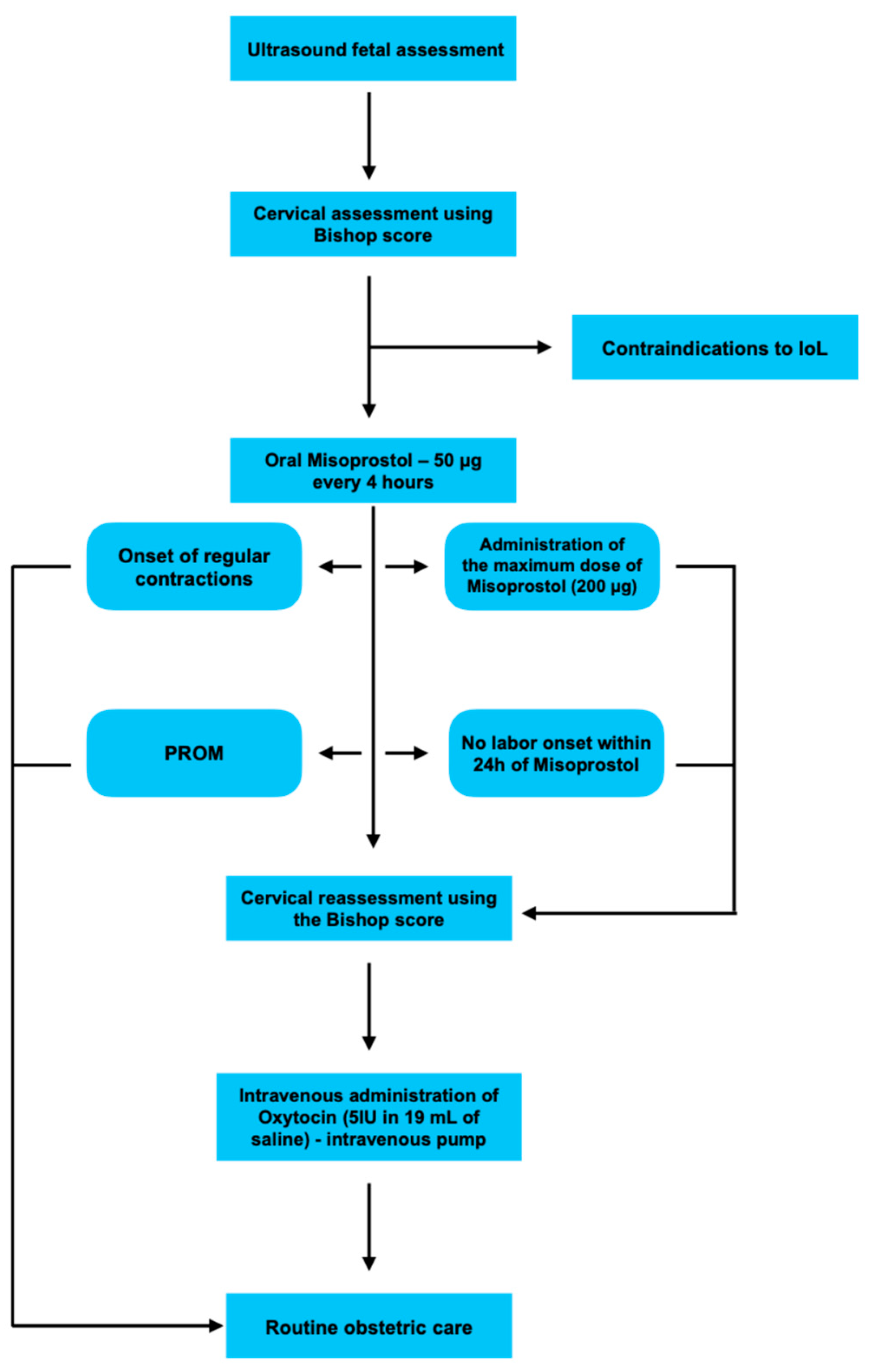
4.3. Interventions
- Onset of regular uterine contractions;
- PROM;
- Administration of the maximum total dose (200 μg).
- Class I (BMI 30.0–34.9);
- Class II (BMI 35.0–39.9);
- Class III (morbid obesity, BMI ≥ 40).
4.4. Outcomes
4.5. Statistical Analysis
5. Conclusions
Author Contributions
Funding
Institutional Review Board Statement
Informed Consent Statement
Data Availability Statement
Acknowledgments
Conflicts of Interest
References
- Langley-Evans, S.C.; Pearce, J.; Ellis, S. Overweight, Obesity and Excessive Weight Gain in Pregnancy as Risk Factors for Adverse Pregnancy Outcomes: A Narrative Review. J. Hum. Nutr. Diet. 2022, 35, 250–264. [Google Scholar] [CrossRef]
- Obesity and Overweight. Available online: https://www.who.int/en/news-room/fact-sheets/detail/obesity-and-overweight (accessed on 1 December 2025).
- AlAnnaz, W.A.A.; Gouda, A.D.K.; Abou El-Soud, F.A.; Alanazi, M.R. Obesity Prevalence and Its Impact on Maternal and Neonatal Outcomes among Pregnant Women: A Retrospective Cross-Sectional Study Design. Nurs. Rep. 2024, 14, 1236–1250. [Google Scholar] [CrossRef]
- Orós, M.; Lorenzo, M.; Serna, M.C.; Siscart, J.; Perejón, D.; Salinas-Roca, B. Obesity in Pregnancy as a Risk Factor in Maternal and Child Health—A Retrospective Cohort Study. Metabolites 2024, 14, 56. [Google Scholar] [CrossRef]
- Catalano, P.M.; Shankar, K. Obesity and Pregnancy: Mechanisms of Short Term and Long Term Adverse Consequences for Mother and Child. BMJ 2017, 356, j1. [Google Scholar] [CrossRef]
- ACOG Practice Bulletin No. 107: Induction of Labor. Obstet. Gynecol. 2009, 114, 386–397. [CrossRef] [PubMed]
- Sanchez-Ramos, L.; Levine, L.D.; Sciscione, A.C.; Mozurkewich, E.L.; Ramsey, P.S.; Adair, C.D.; Kaunitz, A.M.; McKinney, J.A. Methods for the Induction of Labor: Efficacy and Safety. Am. J. Obstet. Gynecol. 2024, 230, S669–S695. [Google Scholar] [CrossRef] [PubMed]
- Dong, S.; Bapoo, S.; Shukla, M.; Abbasi, N.; Horn, D.; D’Souza, R. Induction of Labour in Low-Risk Pregnancies before 40 Weeks of Gestation: A Systematic Review and Meta-Analysis of Randomized Trials. Best Pract. Res. Clin. Obstet. Gynaecol. 2022, 79, 107–125. [Google Scholar] [CrossRef] [PubMed]
- Young, D.C.; Delaney, T.; Anthony Armson, B.; Fanning, C. Oral Misoprostol, Low Dose Vaginal Misoprostol, and Vaginal Dinoprostone for Labor Induction: Randomized Controlled Trial. PLoS ONE 2020, 15, e0304233. [Google Scholar] [CrossRef]
- Austin, S.C.; Sanchez-Ramos, L.; Adair, C.D. Labor Induction with Intravaginal Misoprostol Compared with the Dinoprostone Vaginal Insert: A Systematic Review and Metaanalysis. Am. J. Obstet. Gynecol. 2010, 202, 624.e1–624.e9. [Google Scholar] [CrossRef]
- Chatsis, V.; Frey, N. Misoprostol for Cervical Ripening and Induction of Labour: A Review of Clinical Effectiveness, Cost-Effectiveness and Guidelines [Internet]; CADTH: Ottawa, ON, Canada, 2018; pp. 1–61. [Google Scholar]
- Wing, D.A.; Rahall, A.; Jones, M.M.; Goodwin, T.M.; Paul, R.H. Misoprostol: An Effective Agent for Cervical Ripening and Labor Induction. Am. J. Obstet. Gynecol. 1995, 172, 1811–1816. [Google Scholar] [CrossRef]
- Alfirevic, Z.; Aflaifel, N.; Weeks, A. Oral Misoprostol for Induction of Labour. Cochrane Database Syst. Rev. 2014, 2014, CD001338. [Google Scholar] [CrossRef]
- Deshmukh, V.L.; Rajamanya, A.V.; Yelikar, K.A. Oral Misoprostol Solution for Induction of Labour. J. Obstet. Gynaecol. India 2017, 67, 98–103. [Google Scholar] [CrossRef]
- Aduloju, O.P.; Ipinnimo, O.M.; Aduloju, T. Oral Misoprostol for Induction of Labor at Term: A Randomized Controlled Trial of Hourly Titrated and 2 Hourly Static Oral Misoprostol Solution. J. Matern.-Fetal Neonatal Med. 2021, 34, 493–499. [Google Scholar] [CrossRef]
- Carlhäll, S.; Källén, K.; Blomberg, M. Maternal Body Mass Index and Duration of Labor. Eur. J. Obstet. Gynecol. Reprod. Biol. 2013, 171, 49–53. [Google Scholar] [CrossRef]
- Zhang, J.; Troendle, J.F. Maternal Prepregnancy Overweight and Obesity and the Pattern of Labor Progression in Term Nulliparous Women. Obstet. Gynecol. 2004, 104, 943–951. [Google Scholar] [CrossRef] [PubMed]
- Bomba-Opoń, D.; Drews, K.; Huras, H.; Laudański, P.; Paszkowski, T.; Wielgoś, M. Polish Gynecological Society Recommendations for Labor Induction. Ginekol. Pol. 2017, 88, 224–234. [Google Scholar] [CrossRef]
- Kuba, K.; Kirby, M.A.; Hughes, F.; Yellon, S.M. Reassessing the Bishop Score in Clinical Practice for Induction of Labor Leading to Vaginal Delivery and for Evaluation of Cervix Ripening. Placenta Reprod. Med. 2023, 2, 8. [Google Scholar] [CrossRef]
- Lee, D.S.; Tandel, M.D.; Kwan, L.; Francoeur, A.A.; Duong, H.L.; Negi, M. Favorable Simplified Bishop Score after Cervical Ripening Associated with Decreased Cesarean Birth Rate. Am. J. Obstet. Gynecol. MFM 2022, 4, 100534. [Google Scholar] [CrossRef]
- Michail, A.; Fasoulakis, Z.; Domali, E.; Daskalakis, G.; Antsaklis, P. Role of the Bishop Score in Predicting Successful Induction of Vaginal Delivery: A Systematic Review of Current Evidence. Cureus 2025, 17, e87467. [Google Scholar] [CrossRef] [PubMed]
- Kolkman, D.G.E.; Verhoeven, C.J.M.; Brinkhorst, S.J.; Van Der Post, J.A.M.; Pajkrt, E.; Opmeer, B.C.; Mol, B.J. The Bishop Score as a Predictor of Labor Induction Success: A Systematic Review. Am. J. Perinatol. 2013, 30, 625–630. [Google Scholar] [CrossRef] [PubMed]
- WHO. WHO Recommendations on Induction of Labour, at or Beyond Term; WHO: Geneva, Switzerland, 2022; p. 36. [Google Scholar]
- Kerr, R.S.; Kumar, N.; Williams, M.J.; Cuthbert, A.; Aflaifel, N.; Haas, D.M.; Weeks, A.D. Low-Dose Oral Misoprostol for Induction of Labour. Cochrane Database Syst. Rev. 2021, 2021, CD014484. [Google Scholar] [CrossRef]
- Ten Eikelder, M.L.G.; Oude Rengerink, K.; Jozwiak, M.; De Leeuw, J.W.; De Graaf, I.M.; Van Pampus, M.G.; Holswilder, M.; Oudijk, M.A.; Van Baaren, G.J.; Pernet, P.J.M.; et al. Induction of Labour at Term with Oral Misoprostol versus a Foley Catheter (PROBAAT-II): A Multicentre Randomised Controlled Non-Inferiority Trial. Lancet 2016, 387, 1619–1628. [Google Scholar] [CrossRef] [PubMed]
- Ramadan, M.; Bashour, G.; Eldokmery, E.; Alkhawajah, A.; Alsalhi, K.; Badr, Y.; Emad, A.; Labieb, F. The Efficacy and Safety of Oral and Vaginal Misoprostol versus Dinoprostone on Women Experiencing Labor: A Systematic Review and Updated Meta-Analysis of 53 Randomized Controlled Trials. Medicine 2024, 103, e39861. [Google Scholar] [CrossRef]
- Yenuberi, H.; Mathews, J.; George, A.; Benjamin, S.; Rathore, S.; Tirkey, R.; Tharyan, P. The Efficacy and Safety of 25 Μg or 50 Μg Oral Misoprostol versus 25 Μg Vaginal Misoprostol given at 4- or 6-Hourly Intervals for Induction of Labour in Women at or beyond Term with Live Singleton Pregnancies: A Systematic Review and Meta-Analysis. Int. J. Gynecol. Obstet. 2024, 164, 482–498. [Google Scholar] [CrossRef]
- Angolile, C.M.; Max, B.L.; Mushemba, J.; Mashauri, H.L. Global Increased Cesarean Section Rates and Public Health Implications: A Call to Action. Health Sci. Rep. 2023, 6, e1274. [Google Scholar] [CrossRef] [PubMed]
- Nace, M.C.; Delotte, J.; Gauci, P.A. Comparative Study of Second-Line Labor Induction Methods in Patients with Unfavorable Cervix after First-Line Low-Dose Oral Misoprostol. Int. J. Gynecol. Obstet. 2024, 167, 313–321. [Google Scholar] [CrossRef]
- Szczesny, W.; Kjøllesdal, M.; Karlsson, B.; Nielsen, S. Bishop Score and the Outcome of Labor Induction with Misoprostol. Acta Obstet. Gynecol. Scand. 2006, 85, 579–582. [Google Scholar] [CrossRef]
- Bakker, R.; Pierce, S.; Myers, D. The Role of Prostaglandins E1 and E2, Dinoprostone, and Misoprostol in Cervical Ripening and the Induction of Labor: A Mechanistic Approach. Arch. Gynecol. Obstet. 2017, 296, 167–179. [Google Scholar] [CrossRef]
- Hallén, N.; Amini, M.; Wide-Swensson, D.; Herbst, A. Outpatient vs Inpatient Induction of Labor with Oral Misoprostol: A Retrospective Study. Acta Obstet. Gynecol. Scand. 2023, 102, 605–611. [Google Scholar] [CrossRef]
- Adhikari, E.H.; McGuire, J.; Lo, J.; McIntire, D.D.; Spong, C.Y.; Nelson, D.B. Vaginal Compared with Oral Misoprostol Induction at Term: A Cluster Randomized Controlled Trial. Obstet. Gynecol. 2024, 143, 256–264. [Google Scholar] [CrossRef]
- Zamboni, W.C.; Charlab, R.; Burckart, G.J.; Stewart, C.F. Effect of Obesity on the Pharmacokinetics and Pharmacodynamics of Anticancer Agents. J. Clin. Pharmacol. 2023, 63, S85–S102. [Google Scholar] [CrossRef]
- Helmig, R.B.; Brogaard, L.; Hvidman, L. Women’s Body Mass Index and Oral Administration of Misoprostol for Induction of Labor—A Retrospective Cohort Study. Obes. Res. Clin. Pract. 2021, 15, 509–511. [Google Scholar] [CrossRef]
- Berton, M.; Bettonte, S.; Stader, F.; Battegay, M.; Marzolini, C. Physiologically Based Pharmacokinetic Modelling to Identify Physiological and Drug Parameters Driving Pharmacokinetics in Obese Individuals. Clin. Pharmacokinet. 2023, 62, 277–295. [Google Scholar] [CrossRef]
- Deepika, D.; Kumar, V. The Role of “Physiologically Based Pharmacokinetic Model (PBPK)” New Approach Methodology (NAM) in Pharmaceuticals and Environmental Chemical Risk Assessment. Int. J. Environ. Res. Public Health 2023, 20, 3473. [Google Scholar] [CrossRef]
- Hofmeyr, G.J.; Bernitz, S.; Bonet, M.; Bucagu, M.; Dao, B.; Downe, S.; Galadanci, H.; Homer, C.S.E.; Hundley, V.; Lavender, T.; et al. WHO Next-Generation Partograph: Revolutionary Steps towards Individualised Labour Care. BJOG: Int. J. Obstet. Gynaecol. 2021, 128, 1658–1662. [Google Scholar] [CrossRef]
- Nelson, D.B.; McIntire, D.D.; Leveno, K.J. Relationship of the Length of the First Stage of Labor to the Length of the Second Stage. Obstet. Gynecol. 2013, 122, 27–32. [Google Scholar] [CrossRef]
- Ameri, A.; Jafari-Azar, Z.; Anabi, M.; Davari Dolatabadi, M. Effect of Misoprostol versus Oxytocin on Delivery Outcomes after Labour Induction in Pregnant Women: A Systematic Review and Meta-Analysis of Randomized Controlled Trials. Eur. J. Obstet. Gynecol. Reprod. Biol. 2024, 292, 75–88. [Google Scholar] [CrossRef] [PubMed]
- Druenne, J.; Semay, T.; Giraud, A.; Chauleur, C.; Raia-Barjat, T. Pain and Satisfaction in Women Induced by Vaginal Dinoprostone, Double Balloon Catheter and Oral Misoprostol. J. Gynecol. Obstet. Hum. Reprod. 2022, 51, 102484. [Google Scholar] [CrossRef] [PubMed]
- Kemper, J.I.; Li, W.; Goni, S.; Flanagan, M.; Weeks, A.; Alfirevic, Z.; Bracken, H.; Mundle, S.; Goonewardene, M.; ten Eikelder, M.; et al. Foley Catheter vs Oral Misoprostol for Induction of Labor: Individual Participant Data Meta-Analysis. Ultrasound Obstet. Gynecol. 2021, 57, 215–223. [Google Scholar] [CrossRef] [PubMed]
- Al-Wahaibi, S.; Czuzoj-Shulman, N.; Abenhaim, H. Induction of Labor and Risk of Third- and Fourth-Degree Perineal Tears. J. Obstet. Gynaecol. Can. 2020, 42, 665. [Google Scholar] [CrossRef]
- Jansson, M.H.; Franzén, K.; Hiyoshi, A.; Tegerstedt, G.; Dahlgren, H.; Nilsson, K. Risk Factors for Perineal and Vaginal Tears in Primiparous Women—The Prospective POPRACT-Cohort Study. BMC Pregnancy Childbirth 2020, 20, 749. [Google Scholar] [CrossRef] [PubMed]
- Morris, M.; Bolnga, J.W.; Verave, O.; Aipit, J.; Rero, A.; Laman, M. Safety and Effectiveness of Oral Misoprostol for Induction of Labour in a Resource-Limited Setting: A Dose Escalation Study. BMC Pregnancy Childbirth 2017, 17, 298. [Google Scholar] [CrossRef] [PubMed]
- Michel, A.; Harris-Haman, P.A. Review of the Reliability and Validity of the Apgar Score. Adv. Neonatal. Care 2022, 22, 28–34. [Google Scholar] [CrossRef] [PubMed]

| Study Group (n = 291) | ||
|---|---|---|
| Age (years) | ||
| Mean | 30.4 | |
| Range | 18.0–46.0 | |
| median (IRQ) | 31.0 (6.0) | |
| 95%CI | [29.9; 30.9] | |
| Weight (kg) | ||
| Mean | 81.2 | |
| Range | 59.4–140.0 | |
| median (IRQ) | 80.0 (17.0) | |
| 95%CI | [79.6; 82.7] | |
| Age of gestation (weeks) | ||
| 37 | 11 (3.8%) | |
| 38 | 32 (11.0%) | |
| 39 | 77 (26.5%) | |
| 40 | 63 (21.6%) | |
| 41 | 81 (27.8%) | |
| 42 | 27 (9.3%) | |
| Parity | ||
| Nulliparous | 209 (71.8%) | |
| Multiparous | 82 (28.2%) | |
| BMI (kg/m2) | ||
| Normal weight | 18.5–25 | 49 (16.8%) |
| Overweight | 25–30 | 125 (43.0%) |
| Obesity class I | 30–34.9 | 96 (33.0%) |
| Obesity class II | 35–39.9 | 16 (5.5%) |
| Obesity class III | >40 | 5 (1.7%) |
| BMI (kg/m2) | ||
| Mean | 29.3 | |
| Range | 20.5–51.4 | |
| median (IRQ) | 29.0 (5.8) | |
| 95%CI | [28.8; 29.8] | |
| Indications for IoL | ||
| Post-term pregnancy | 102 (35.1%) | |
| Large for gestational age (LGA) | 62 (21.3%) | |
| Pregnancy induced hypertension (PIH) | 37 (12.2%) | |
| Fetal growth restriction (FGR) | 24 (8.2%) | |
| Oligohydramnios | 22 (7.7%) | |
| Gestational diabetes mellitus type 2 (GDM G2) | 18 (6.3%) | |
| Gestational diabetes mellitus type 1 (GDM G1) | 15 (5.4%) | |
| Intrahepatic cholestasis of pregnancy (ICP) | 4 (1.4%) | |
| Polyhydramnios | 4 (1.4%) | |
| Maternal Age > 40 Years | 2 (0.7%) | |
| Small for gestational age (SGA) | 1 (0.3%) | |
| Group (n = 291) | p-Value | |
|---|---|---|
| Initial BS | 0.704 1 | |
| mean (SD) | 2.3 (1.1) | |
| range | 0.0–5.0 | |
| median (IRQ) | 2.0 (1.0) | |
| 95%CI | [2.2; 2.5] | |
| BS after oral Misoprostol | <0.0001 1 | |
| mean (SD) | 6.2 (2.3) | |
| range | 1.0–12.0 | |
| median (IRQ) | 6.0 (3.0) | |
| 95%CI | [6.0; 6.5] |
| Group (n = 291) | |
|---|---|
| Overall | |
| mean (SD) | 3.1 (1.1) |
| range | 1.0–4.0 |
| median (IRQ) | 3.0 (2.0) |
| 95%CI | [2.9; 3.2] |
| Misoprostol doses | |
| 1 | 9 (3.1%) |
| 2 | 13 (4.5%) |
| 3 | 116 (39.8%) |
| 4 | 153 (52.6%) |
| Reason for discontinuation | |
| Uterine contractions | 126 (43.4%) |
| PROM | 12 (4.1%) |
| Type of Delivery | Group (n = 291) |
|---|---|
| Vaginal delivery (VD) | 225 (77.3%) |
| Cesarean section (CS) | 66 (22.7%) |
| Delivery (Vaginal and Cesarean) | Group (n = 291) |
|---|---|
| 24 h | |
| 181 (62.2%) | |
| >24–48 h | |
| 100 (34.4%) | |
| >48 h | |
| 10 (3.4%) |
| VD (n = 225) | CS (n = 66) | Total (n = 291) | |
|---|---|---|---|
| 24 h | |||
| 145 (64.4%) | 36 (54.5%) | 181 | |
| >24–48 h | |||
| 74 (32.9%) | 26 (39.4%) | 100 | |
| >48 h | |||
| 6 (2.7%) | 4 (6.1%) | 10 |
| Group (n = 12) | |
|---|---|
| 24 h | n = 11 |
| Obstetrical forceps (F) | 0 (0.0%) |
| Vacuum extractor (VE) | 11 (100.0%) |
| >24–48 h | n = 1 |
| Obstetrical forceps (F) | 1 (100.0%) |
| Vacuum extractor (VE) | 0 (0.0%) |
| >48 h | n = 0 |
| Obstetrical forceps (F) | 0 (0.0%) |
| Vacuum extractor (VE) | 0 (0.0%) |
| Group (n = 66) | |
|---|---|
| 24 h | n = 36 |
| Fetal asphyxia | 35 (97.2%) |
| Lack of labor progression | 1 (2.8%) |
| >24–48 h | n = 26 |
| Fetal asphyxia | 22 (84.6%) |
| Lack of labor progression | 4 (15.4%) |
| >48 h | n = 4 |
| Fetal asphyxia | 1 (25.0%) |
| Lack of labor progression | 3 (75.0%) |
| BMI | 18.5–25 (n = 49) | 25.5–30 (n = 125) | 30–35 (n = 96) | 35–40 (n = 16) | >40 (n = 5) | p-Value 1 |
|---|---|---|---|---|---|---|
| VD/CS 24 h | 35 (71.4%) | 79 (63.2%) | 58 (60.4%) | 7 (43.8%) | 2 (40.0%) | 0.255 |
| VD/CS > 24–48 h | 13 (26.5%) | 42 (33.6%) | 34 (35.4%) | 8 (50.0%) | 3 (60.0%) | 0.330 |
| VD/CS > 48 h | 1 (2.0%) | 4 (3.2%) | 4 (4.2%) | 1 (6.3%) | 0 (0.0%) | 0.906 |
| VD 24 h | 30 (71.4%) | 63 (63.6%) | 48 (66.7%) | 3 (37.5%) | 1 (25.0%) | 0.0325 |
| VD 24–48 h | 11 (26.2%) | 33 (33.3%) | 22 (30.6%) | 5 (62.5%) | 3 (75.0%) | 0.3995 |
| VD > 48 h | 1 (2.4%) | 3 (3.0%) | 2 (2.8%) | 0 (0.0%) | 0 (0.0%) | 0.9722 |
| CS 24 h | 5 (71.4%) | 16 (61.5%) | 10 (41.7%) | 4 (50.0%) | 1 (100.0%) | 0.525 |
| CS 24–48 h | 2 (28.6%) | 9 (34.6%) | 12 (50.0%) | 3 (37.5%) | 0 (0.0%) | 0.217 |
| CS > 48 h | 0 (0.0%) | 1 (3.8%) | 2 (8.3%) | 1 (12.5%) | 0 (0.0%) | 0.377 |
| Oxytocin | 14 (28.6%) | 46 (36.8%) | 38 (39.6%) | 9 (56.3%) | 3 (60.0%) | 0.255 |
| First stage (h) | 0.189 | |||||
| range | 1.0–10.0 | 1.0–16.0 | 0.5–12.0 | 1.0–12.0 | 0.5–7.5 | |
| median (IRQ) | 3.0 (2.5) | 4.0 (3.5) | 3.5 (3.0) | 4.0 (3.0) | 6.5 (5.0) | |
| Second stage (h) | 0.426 | |||||
| range | 0.5–2.5 | 0.5–2.5 | 0.5–3.0 | 0.5–2.0 | 0.5–6.0 | |
| median (IRQ) | 0.8 (0.5) | 1.0 (0.8) | 0.5 (0.6) | 1.0 (1.1) | 1.0 (2.8) | |
| Analgesia | ||||||
| Remifentanil | 12 (24.5%) | 38 (30.4%) | 24 (25.0%) | 7 (43.8%) | 1 (20%) | 0.5256 |
| Epidural analgesia | 18 (36.7%) | 31 (24.8%) | 28 (29.2%) | 3 (18.8%) | 3 (60.0%) | 0.2252 |
| Tachysystole | 0 (0.0%) | 2 (1.6%) | 1 (1.0%) | 2 (12.5%) | 0 (0.0%) | 0.0157 |
| BMI | 18.5–25 (n = 49) | 25.5–30 (n = 125) | 30–35 (n = 96) | 35–40 (n = 16) | >40 (n = 5) | p-Value 1,2 |
|---|---|---|---|---|---|---|
| TRC (h) | 0.087 | |||||
| mean (SD) | 15.0 (12.3) | 16.8 (11.1) | 16.3 (11.2) | 21.5 (13.5) | 25.1 (10.1) | |
| range | 1.0–61.5 | 0.5–52.0 | 0.5–57.5 | 1.0–55.0 | 15.5–39.0 | |
| median (IRQ) | 10.0 (20.5) | 14.0 (16.0) | 14.0 (16.0) | 22.5 (18.3) | 22.0 (15.0) | |
| 95%CI | [11.4; 18.5] | [14.8; 18.8] | [14.1; 18.6] | [14.3; 28.7] | [12.6; 37.6] | |
| TPO (h) | 0.077 | |||||
| mean (SD) | 14.9 (12.4) | 16.9 (11.1) | 16.4 (11.2) | 21.8 (13.7) | 25.1 (10.1) | |
| range | 1.0–61.5 | 0.5–52.0 | 0.5–58.0 | 1,0–55,0 | 15.5–39.0 | |
| median (IRQ) | 10.0 (20.0) | 14.5 (16.0) | 14.0 (16.0) | 23.0 (18.3) | 22.0 (15.0) | |
| 95%CI | [11.4; 18.5] | [14.9; 18.8] | [14.1; 18.7] | [14.5; 29.1] | [12.6; 37.6] | |
| TD (h) | 0.058 | |||||
| mean (SD) | 19.3 (13.4) | 21.9 (11.9) | 21.5 (12.4) | 26.4 (15.3) | 31.5 (9.2) | |
| range | 1.5–70.0 | 4.0–58.0 | 2.5–68.0 | 2.0–59.0 | 22.0–42.0 | |
| median (IRQ) | 14.5 (19.0) | 19.0 (17.5) | 19.0 (15.3) | 28.0 (23.0) | 30.0 (16.5) | |
| 95%CI | [15.4; 23.2] | [19.8; 24.0] | [19.0; 24.0] | [18.3; 34.5] | [20.1; 42.9] | |
| BL (mL) | 0.708 | |||||
| mean (SD) | 289.8 (137.7) | 314.0 (176.6) | 308.3 (118.0) | 340.6 (146.3) | 320.0 (103.7) | |
| range | 150.0–1 000.0 | 150.0–1 500.0 | 150.0–700.0 | 150.0–700.0 | 200.0–450.0 | |
| median (IRQ) | 250.0 (100.0) | 250.0 (150.0) | 250.0 (175.0) | 300.0 (225.0) | 300.0 (150.0) | |
| 95%CI | [250.2; 329.3] | [282.6; 345.4] | [284.4; 332.2] | [262.7; 418.6] | [191.3; 448.7] | |
| PI | 0.670 | |||||
| 1 | 17 (51.5%) | 33 (42.3%) | 17 (30.9%) | 4 (44.4%) | 0 (0.0%) | |
| 2 | 15 (45.5%) | 43 (55.1%) | 36 (65.5%) | 5 (55.6%) | 2 (100.0%) | |
| 3 | 1 (3.0%) | 2 (2.6%) | 2 (3.6%) | 0 (0.0%) | 0 (0.0%) |
| 18.5–25 (n = 49) | 25.5–30 (n = 125) | 30–35 (n = 96) | 35–40 (n = 16) | >40 (n = 5) | p-Value 1 | |
|---|---|---|---|---|---|---|
| 1 min. | 0.088 | |||||
| range | 6.0–10.0 | 6.0–10.0 | 6.0–10.0 | 8.0–10.0 | 9.0–10.0 | |
| median (IRQ) | 10.0 (0.0) | 10.0 (0.0) | 10.0 (0.0) | 10.0 (0.5) | 10.0 (0.0) | |
| 5 min. | 0.715 | |||||
| range | 7.0–10.0 | 8.0–10.0 | 8.0–10.0 | 9.0–10.0 | 10.0–10.0 | |
| median (IRQ) | 10.0 (0.0) | 10.0 (0.0) | 10.0 (0.0) | 10.0 (0.0) | 10.0 (0.0) | |
| 10 min. | 0.623 | |||||
| range | 7.0–10.0 | 10.0–10.0 | 8.0–10.0 | 10.0–10.0 | 10.0–10.0 | |
| median (IRQ) | 10.0 (0.0) | 10.0 (0.0) | 10.0 (0.0) | 10.0 (0.0) | 10.0 (0.0) | |
| UA (pH) | 0.567 | |||||
| mean (SD) | 7.2 (0.1) | 7.3 (0.1) | 7.3 (0.1) | 7.3 (0.1) | 7.2 (0.1) | |
| range | 7.0–7.5 | 7.1–7.5 | 7.1–7.5 | 7.1–7.4 | 7.1–7.3 | |
| median (IRQ) | 7.2 (0.2) | 7.2 (0.1) | 7.3 (0.1) | 7.3 (0.2) | 7.3 (0.1) | |
| 95%CI | [7.2; 7.3] | [7.2; 7.3] | [7.2; 7.3] | [7.2; 7.3] | [7.1; 7.4] | |
| UV (pH) | 0.544 | |||||
| mean (SD) | 7.3 (0.1) | 7.3 (0.1) | 7.3 (0.1) | 7.3 (0.1) | 7.3 (0.1) | |
| range | 7.0–7.5 | 7.1–7.5 | 7.1–7.6 | 7.1–7.4 | 7.2–7.4 | |
| median (IRQ) | 7.3 (0.1) | 7.3 (0.1) | 7.3 (0.1) | 7.3 (0.1) | 7.3 (0.1) | |
| 95%CI | [7.2; 7.3] | [7.3; 7.3] | [7.3; 7.3] | [7.3; 7.4] | [7.2; 7.4] |
| R | p-Value 1 | |
|---|---|---|
| First stage of labor | 0.08 | 0.189 |
| Second stage of labor | −0.03 | 0.652 |
| Time to regular uterine contractions | 0.13 | 0.025 |
| Time to pain onset | 0.14 | 0.019 |
| Time to delivery | 0.15 | 0.013 |
| Blood loss | 0.07 | 0.203 |
| APGAR score at 1 min | 0.01 | 0.874 |
| APGAR score at 5 min | 0.03 | 0.596 |
| APGAR score at 10 min | 0.04 | 0.513 |
| pH UA | 0.10 | 0.095 |
| pH UV | 0.20 | 0.0005 |
| Initial Bishop score | −0.07 | 0.241 |
| Number of Misoprostol doses | 0.15 | 0.013 |
| Bishop score after Misoprostol administration | −0.17 | 0.005 |
Disclaimer/Publisher’s Note: The statements, opinions and data contained in all publications are solely those of the individual author(s) and contributor(s) and not of MDPI and/or the editor(s). MDPI and/or the editor(s) disclaim responsibility for any injury to people or property resulting from any ideas, methods, instructions or products referred to in the content. |
© 2025 by the authors. Licensee MDPI, Basel, Switzerland. This article is an open access article distributed under the terms and conditions of the Creative Commons Attribution (CC BY) license (https://creativecommons.org/licenses/by/4.0/).
Share and Cite
Socha, M.W.; Flis, W.; Sowińska, J.; Stankiewicz, M.; Kazdepka-Ziemińska, A. The Impact of Maternal BMI on the Efficacy and Safety of Oral Misoprostol for Labor Induction. Pharmaceuticals 2025, 18, 1888. https://doi.org/10.3390/ph18121888
Socha MW, Flis W, Sowińska J, Stankiewicz M, Kazdepka-Ziemińska A. The Impact of Maternal BMI on the Efficacy and Safety of Oral Misoprostol for Labor Induction. Pharmaceuticals. 2025; 18(12):1888. https://doi.org/10.3390/ph18121888
Chicago/Turabian StyleSocha, Maciej W., Wojciech Flis, Julia Sowińska, Martyna Stankiewicz, and Anita Kazdepka-Ziemińska. 2025. "The Impact of Maternal BMI on the Efficacy and Safety of Oral Misoprostol for Labor Induction" Pharmaceuticals 18, no. 12: 1888. https://doi.org/10.3390/ph18121888
APA StyleSocha, M. W., Flis, W., Sowińska, J., Stankiewicz, M., & Kazdepka-Ziemińska, A. (2025). The Impact of Maternal BMI on the Efficacy and Safety of Oral Misoprostol for Labor Induction. Pharmaceuticals, 18(12), 1888. https://doi.org/10.3390/ph18121888

