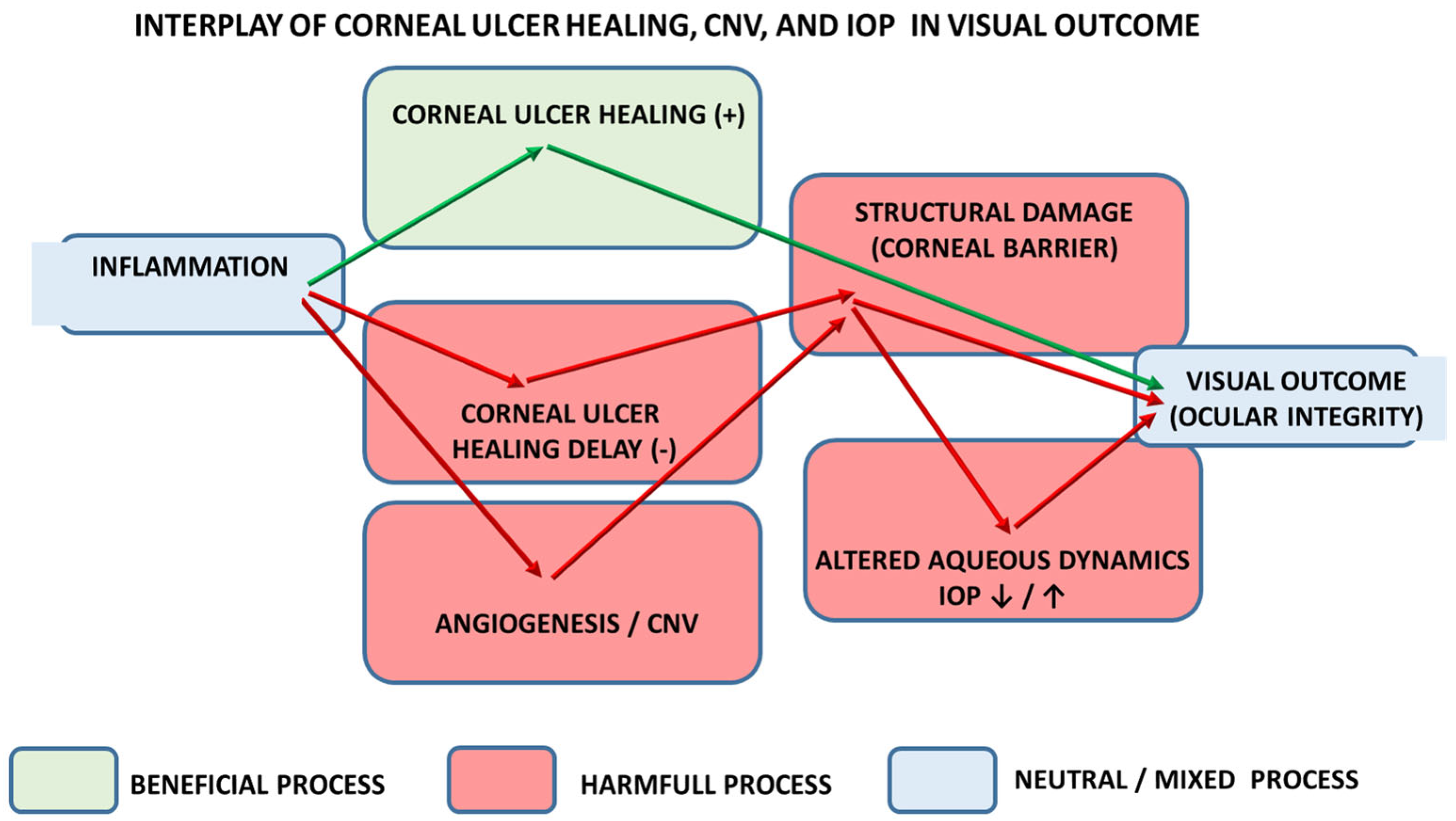
Challenge of Corneal Ulcer Healing: A Novel Conceptual Framework, the “Triad” of Corneal Ulcer Healing/Corneal Neovascularization/Intraocular Pressure, and Avascular Tendon Healing, for Evaluation of Corneal Ulcer Therapy, Therapy of Neovascularization, Glaucoma Therapy, and Pentadecapeptide BPC 157 Efficacy

 , , , , ,
  , , and
Abstract
1. Introduction
2. Corneal Ulcer Healing Therapy in Terms of “Triad” Approach (Corneal Ulcer Healing↔Corneal Neovascularization↔Intraocular Pressure)
2.1. Ascorbate
2.2. Fibronectin
2.3. Sodium Hyaluronan, Hyaluronic Acid
2.4. MMP Inhibitors
2.5. EGF
2.6. FGF
2.7. NGF
2.8. Insulin (and the IGF Axis)
2.9. Summary of Corneal Ulcer Healing Therapy in Terms of “Triad” Approach (Corneal Ulcer Healing↔Corneal Neovascularization↔Intraocular Pressure)
3. Corneal Neovascularization
3.1. The Antiangiogenic Agents in Terms of the “Triad” Approach (Corneal Ulcer Healing↔Corneal Neovascularization↔Intraocular Pressure)
3.1.1. Endostatin
3.1.2. PAI-1
3.1.3. PEDF
3.1.4. Angiostatin
3.1.5. TSP-1, TSP-2
3.1.6. IFN-α
3.2. Summary of the Antiangiogenic Agents in Terms of the “Triad” Approach (Corneal Ulcer Healing↔Corneal Neovascularization↔Intraocular Pressure)
3.3. Treatment of Corneal Neovascularization in Terms of the “Triad” Approach (Corneal Ulcer Healing↔Corneal Neovascularization↔Intraocular Pressure)
3.3.1. Corticosteroids
3.3.2. NSAIDs
3.3.3. Cyclosporine A
3.3.4. Anti-VEGF Drugs
3.3.5. Summary of Treatment of Corneal Neovascularization in Terms of the “Triad” Approach (Corneal Ulcer Healing↔Corneal Neovascularization↔Intraocular Pressure)
4. Treatment of Glaucoma in Terms of the “Triad” Approach (Corneal Ulcer Healing↔Corneal Neovascularization↔Intraocular Pressure)
4.1. Alpha 2-Agonists
4.2. Beta-Blockers
4.3. Carbonic Anhydrase Inhibitors
4.4. Muscarinic Agents (Including Pilocarpine)
4.5. Rho-Kinase Inhibitors
4.6. Latanoprost
4.7. Summary of Treatment of Glaucoma in Terms of the “Triad” Approach (Corneal Ulcer Healing↔Corneal Neovascularization↔Intraocular Pressure)
5. Summary of Corneal Ulcer Therapy, Angiostatic Factors, Neovascularization Therapy, and Glaucoma Therapy in Terms of the “Triad” Approach (Corneal Ulcer Healing↔Corneal Neovascularization↔Intraocular Pressure)
6. Conclusions
Funding
Data Availability Statement
Conflicts of Interest
References
- Ljubimov, A.V.; Saghizadeh, M. Progress in corneal wound healing. Prog. Retin. Eye Res. 2015, 49, 17–45. [Google Scholar] [CrossRef] [PubMed]
- Sharif, Z.; Sharif, W. Corneal neovascularization: Updates on pathophysiology, investigations & management. Rom. J. Ophthalmol. 2019, 63, 119–127. [Google Scholar] [CrossRef] [PubMed] [PubMed Central]
- Masnec, S.; Kokot, A.; Zlatar, M.; Kalauz, M.; Kunjko, K.; Radić, B.; Kliček, R.; Drmić, D.; Lazić, R.; Brcic, L.; et al. Perforating corneal injury in rat and pentadecapeptide BPC 157. Exp. Eye Res. 2015, 136, 9–15. [Google Scholar] [CrossRef] [PubMed]
- Sikiric, P.; Seiwerth, S.; Skrtic, A.; Staresinic, M.; Strbe, S.; Vuksic, A.; Sikiric, S.; Bekic, D.; Soldo, D.; Grizelj, B.; et al. Stable gastric pentadecapeptide BPC 157 as a therapy and safety key: A special beneficial pleiotropic effect controlling and modulating angiogenesis and the NO-system. Pharmaceuticals 2025, 18, 928. [Google Scholar] [CrossRef] [PubMed]
- Sikiric, P.; Seiwerth, S.; Skrtic, A.; Staresinic, M.; Strbe, S.; Vuksic, A.; Sikiric, S.; Bekic, D.; Penovic, T.; Drazenovic, D.; et al. Acute compartment syndrome and intra-abdominal hypertension, decompression, current pharmacotherapy, and stable gastric pentadecapeptide BPC 157 solution. Pharmaceuticals 2025, 18, 866. [Google Scholar] [CrossRef] [PubMed]
- Sikiric, P.; Sever, M.; Krezic, I.; Vranes, H.; Kalogjera, L.; Smoday, I.M.; Vukovic, V.; Oroz, K.; Coric, L.; Skoro, M.; et al. New studies with stable gastric pentadecapeptide protecting gastrointestinal tract. Significance of counteraction of vascular and multiorgan failure of occlusion/occlusion-like syndrome in cytoprotection/organoprotection. Inflammopharmacology 2024, 32, 3119–3161. [Google Scholar] [CrossRef] [PubMed]
- Sikiric, P.; Boban Blagaic, A.; Strbe, S.; Beketic Oreskovic, L.; Oreskovic, I.; Sikiric, S.; Staresinic, M.; Sever, M.; Kokot, A.; Jurjevic, I.; et al. The stable gastric pentadecapeptide BPC 157 pleiotropic beneficial activity and its possible relations with neurotransmitter activity. Pharmaceuticals 2024, 17, 461. [Google Scholar] [CrossRef] [PubMed]
- Sikiric, P.; Gojkovic, S.; Knezevic, M.; Tepes, M.; Strbe, S.; Vukojevic, J.; Duzel, A.; Kralj, T.; Krezic, I.; Zizek, H.; et al. Stable gastric pentadecapeptide BPC 157: Prompt particular activation of collateral pathways. Curr. Med. Chem. 2023, 30, 1568–1573. [Google Scholar] [CrossRef] [PubMed]
- Sikiric, P.; Kokot, A.; Kralj, T.; Zlatar, M.; Masnec, S.; Lazic, R.; Loncaric, K.; Oroz, K.; Sablic, M.; Boljesic, M.; et al. Stable gastric pentadecapeptide BPC 157—Possible novel therapy of glaucoma and other ocular conditions. Pharmaceuticals 2023, 16, 1052. [Google Scholar] [CrossRef] [PubMed]
- Staresinic, M.; Japjec, M.; Vranes, H.; Prtoric, A.; Zizek, H.; Krezic, I.; Gojkovic, S.; Smoday, I.M.; Oroz, K.; Staresinic, E.; et al. Stable gastric pentadecapeptide BPC 157 and striated, smooth, and heart muscle. Biomedicines 2022, 10, 3221. [Google Scholar] [CrossRef] [PubMed]
- Sikiric, P.; Udovicic, M.; Barisic, I.; Balenovic, D.; Zivanovic Posilovic, G.; Strinic, D.; Uzun, S.; Sikiric, S.; Krezic, I.; Zizek, H.; et al. Stable gastric pentadecapeptide BPC 157 as useful cytoprotective peptide therapy in the heart disturbances, myocardial infarction, heart failure, pulmonary hypertension, arrhythmias, and thrombosis presentation. Biomedicines 2022, 10, 2696. [Google Scholar] [CrossRef] [PubMed]
- Sikiric, P.; Skrtic, A.; Gojkovic, S.; Krezic, I.; Zizek, H.; Lovric, E.; Sikiric, S.; Knezevic, M.; Strbe, S.; Milavic, M.; et al. Cytoprotective gastric pentadecapeptide BPC 157 resolves major vessel occlusion disturbances, ischemia-reperfusion injury following Pringle maneuver, and Budd-Chiari syndrome. World J. Gastroenterol. 2022, 28, 23–46. [Google Scholar] [CrossRef] [PubMed]
- Robert, A. Cytoprotection by prostaglandins. Gastroenterology 1979, 77, 761–767. [Google Scholar] [CrossRef] [PubMed]
- Robert, A. Current history of cytoprotection. Prostaglandins 1981, 21 (Suppl. S1), 89–96. [Google Scholar] [CrossRef] [PubMed]
- Robert, A.; Nezamis, J.E.; Lancaster, C.; Davis, J.P.; Field, S.O.; Hanchar, A.J. Mild irritants prevent gastric necrosis through “adaptive cytoprotection” mediated by prostaglandins. Am. J. Physiol. 1983, 245, G113–G121. [Google Scholar] [CrossRef] [PubMed]
- Szabo, S. Role of sulfhydryls and early vascular lesions in gastric mucosal injury. Acta Physiol. Hung. 1984, 64, 203–214. [Google Scholar] [PubMed]
- Trier, J.S.; Szabo, S.; Allan, C.H. Ethanol-induced damage to mucosal capillaries of rat stomach. Ultrastructural features and effects of prostaglandin F2β and cysteamine. Gastroenterology 1987, 92, 13–22. [Google Scholar] [CrossRef] [PubMed]
- Pihan, G.; Majzoubi, D.; Haudenschild, C.; Trier, J.S.; Szabo, S. Early microcirculatory stasis in acute gastric mucosal injury in the rat and prevention by 16,16-dimethyl prostaglandin E2 or sodium thiosulfate. Gastroenterology 1986, 91, 1415–1426. [Google Scholar] [CrossRef] [PubMed]
- Szabo, S.; Trier, J.S.; Brown, A.; Schnoor, J. Early vascular injury and increased vascular permeability in gastric mucosal injury caused by ethanol in the rat. Gastroenterology 1985, 88 (Suppl. S1), 228–236. [Google Scholar] [CrossRef] [PubMed]
- Szabo, S. Experimental basis for a role for sulfhydryls and dopamine in ulcerogenesis: A primer for cytoprotection–organoprotection. Klin. Wochenschr. 1986, 64 (Suppl. S7), 116–122. [Google Scholar] [PubMed]
- Szabo, S.; Usadel, K.H. Cytoprotection-organoprotection by somatostatin: Gastric and hepatic lesions. Experientia 1982, 38, 254–256. [Google Scholar] [CrossRef] [PubMed]
- Seiwerth, S.; Milavic, M.; Vukojevic, J.; Gojkovic, S.; Krezic, I.; Vuletic, L.B.; Pavlov, K.H.; Petrovic, A.; Sikiric, S.; Vranes, H.; et al. Stable gastric pentadecapeptide BPC 157 and wound healing. Front. Pharmacol. 2021, 12, 627533. [Google Scholar] [CrossRef] [PubMed]
- Seiwerth, S.; Rucman, R.; Turkovic, B.; Sever, M.; Klicek, R.; Radic, B.; Drmic, D.; Stupnisek, M.; Misic, M.; Vuletic, L.B.; et al. BPC 157 and standard angiogenic growth factors. Gastrointestinal tract healing, lessons from tendon, ligament, muscle and bone healing. Curr. Pharm. Des. 2018, 24, 1972–1989. [Google Scholar] [CrossRef] [PubMed]
- Sikiric, P.; Drmic, D.; Sever, M.; Klicek, R.; Blagaic, A.B.; Tvrdeic, A.; Kralj, T.; Kovac, K.K.; Vukojevic, J.; Siroglavic, M.; et al. Fistulas healing. Stable gastric pentadecapeptide BPC 157 therapy. Curr. Pharm. Des. 2020, 26, 2991–3000. [Google Scholar] [CrossRef] [PubMed]
- Bajramagic, S.; Sever, M.; Rasic, F.; Staresinic, M.; Skrtic, A.; Beketic Oreskovic, L.; Oreskovic, I.; Strbe, S.; Loga Zec, S.; Hrabar, J.; et al. Stable gastric pentadecapeptide BPC 157 and intestinal anastomoses therapy in rats—A review. Pharmaceuticals 2024, 17, 1081. [Google Scholar] [CrossRef] [PubMed]
- Cheng, J.-W.; Cheng, S.-W.; Wei, R.-L.; Lu, G.-C. Anti-vascular endothelial growth factor for control of wound healing in glaucoma surgery. Cochrane Database Syst. Rev. 2016, 1, CD009782. [Google Scholar] [CrossRef] [PubMed]
- Tripathi, R.C.; Parapuram, S.K.; Tripathi, B.J.; Zhong, Y.; Chalam, K.V. Corticosteroids and glaucoma risk. Drugs Aging 1999, 15, 439–450. [Google Scholar] [CrossRef] [PubMed]
- Pleyer, U.; Ursell, P.G.; Rama, P. Intraocular pressure effects of common topical steroids for post-cataract inflammation: Are they all the same? Ophthalmol. Ther. 2013, 2, 55–72. [Google Scholar] [CrossRef] [PubMed]
- Zarei-Ghanavati, S.; Baghdasaryan, E.; Ramirez-Miranda, A.; Nguyen, M.; Yu, F.; Lee, G.J.; Deng, S.X. Elevated intraocular pressure is a common complication during active microbial keratitis. Am. J. Ophthalmol. 2011, 152, 575–581.e1. [Google Scholar] [CrossRef] [PubMed]
- Sakiyalak, D.; Chattagoon, Y. Incidence of and risk factors for secondary ocular hypertension in moderate to severe infectious ulcerative keratitis. Clin. Ophthalmol. 2018, 12, 2121–2128. [Google Scholar] [CrossRef] [PubMed]
- Williams, D.L.; Burg, P. Comparison of intraocular pressure and tear production in healthy eyes and in eyes with corneal ulceration in dogs. Vet. Ophthalmol. 2017, 20, 206–211. [Google Scholar] [CrossRef] [PubMed]
- Wilson, S.E. Corneal wound healing. Exp. Eye Res. 2020, 197, 108089. [Google Scholar] [CrossRef] [PubMed]
- Baldwin, H.C.; Marshall, J. Growth factors in corneal wound healing following refractive surgery: A review. Acta Ophthalmol. Scand. 2002, 80, 238–247. [Google Scholar] [CrossRef] [PubMed]
- Nentwich, M.M.; Ulbig, M.W. Diabetic retinopathy—Ocular complications of diabetes mellitus. World J. Diabetes 2015, 6, 489–499. [Google Scholar] [CrossRef] [PubMed]
- Kralj, T.; Kokot, A.; Zlatar, M.; Masnec, S.; Kasnik Kovac, K.; Milkovic Perisa, M.; Batelja Vuletic, L.; Giljanovic, A.; Strbe, S.; Sikiric, S.; et al. Stable gastric pentadecapeptide BPC 157 therapy of rat glaucoma. Biomedicines 2021, 10, 89. [Google Scholar] [CrossRef] [PubMed]
- Kokot, A.; Zlatar, M.; Stupnisek, M.; Drmic, D.; Radic, R.; Vcev, A.; Seiwerth, S.; Sikiric, P. NO system dependence of atropine-induced mydriasis and L-NAME- and L-arginine-induced miosis: Reversal by the pentadecapeptide BPC 157 in rats and guinea pigs. Eur. J. Pharmacol. 2016, 771, 211–219. [Google Scholar] [CrossRef] [PubMed]
- Zlatar, M.; Kokot, A.; Vuletic, L.B.; Masnec, S.; Kralj, T.; Perisa, M.M.; Barisic, I.; Radic, B.; Milanovic, K.; Drmic, D.; et al. BPC 157 as a therapy for retinal ischemia induced by retrobulbar application of L-NAME in rats. Front. Pharmacol. 2021, 12, 632295. [Google Scholar] [CrossRef] [PubMed] [PubMed Central]
- Lazić, R.; Gabrić, N.; Dekaris, I.; Bosnar, D.; Boban-Blagaić, A.; Sikiric, P. Gastric pentadecapeptide BPC 157 promotes corneal epithelial defects healing in rats. Coll. Antropol. 2005, 29, 321–325. [Google Scholar] [PubMed]
- Kralj, T.; Kokot, A.; Kasnik, K.; Drmic, D.; Zlatar, M.; Seiwerth, S.; Sikiric, P. Effects of pentadecapeptide BPC 157 on experimental rat model of dry eye. FASEB J. 2017, 31 (Suppl. S1), 993.3. [Google Scholar] [CrossRef]
- Mirković, I.; Kralj, T.; Lozić, M.; Stambolija, V.; Kovačević, J.; Vrdoljak, L.; Zlatar, M.; Milanović, K.; Drmić, D.; Predović, J.; et al. Pentadecapeptide BPC 157 shortens duration of tetracaine- and oxybuprocaine-induced corneal anesthesia in rats. Acta Clin. Croat. 2020, 59, 394–406. [Google Scholar] [CrossRef] [PubMed]
- Stjernschantz, J.W. From PGF2α-isopropyl ester to latanoprost: A review of the development of Xalatan—The Proctor Lecture. Investig. Ophthalmol. Vis. Sci. 2001, 42, 1134–1145. [Google Scholar] [PubMed]
- Sikiric, P.; Buljan, M.; Vnuk, D.; Krstonijevic, Z.; Sever, M.; Lojo, N.; Drmić, D.; Zenko Sever, A.; Barić, M.; Starčević, N.; et al. Effect of pentadecapeptide BPC 157 on rotator cuff tear injury in rat. FASEB J. 2014, 28 (Suppl. S1), 844.9. [Google Scholar] [CrossRef]
- Krivic, A.; Anic, T.; Seiwerth, S.; Huljev, D.; Sikiric, P. Achilles detachment in rat and stable gastric pentadecapeptide BPC 157: Promoted tendon-to-bone healing and opposed corticosteroid aggravation. J. Orthop. Res. 2006, 24, 982–989. [Google Scholar] [CrossRef] [PubMed]
- Staresinic, M.; Sebecic, B.; Patrlj, L.; Jadrijevic, S.; Suknaic, S.; Perovic, D.; Aralica, G.; Zarkovic, N.; Borovic, S.; Srdjak, M.; et al. Gastric pentadecapeptide BPC 157 accelerates healing of transected rat Achilles tendon and in vitro stimulates tendocytes growth. J. Orthop. Res. 2003, 21, 976–983. [Google Scholar] [CrossRef] [PubMed]
- Krivic, A.; Majerovic, M.; Jelic, I.; Seiwerth, S.; Sikiric, P. Modulation of early functional recovery of Achilles tendon-to-bone unit after transection by BPC 157 and methylprednisolone. Inflamm. Res. 2008, 57, 205–210. [Google Scholar] [CrossRef] [PubMed]
- Japjec, M.; Horvat Pavlov, K.; Petrovic, A.; Staresinic, M.; Sebecic, B.; Buljan, M.; Vranes, H.; Giljanovic, A.; Drmic, D.; Japjec, M.; et al. Stable gastric pentadecapeptide BPC 157 as a therapy for the disable myotendinous junctions in rats. Biomedicines 2021, 9, 1547. [Google Scholar] [CrossRef] [PubMed] [PubMed Central]
- Matek, D.; Matek, I.; Staresinic, E.; Japjec, M.; Bojanic, I.; Boban Blagaic, A.; Beketic Oreskovic, L.; Oreskovic, I.; Ziger, T.; Novinscak, T.; et al. Stable gastric pentadecapeptide BPC 157 as therapy after surgical detachment of the quadriceps muscle from its attachments for muscle-to-bone reattachment in rats. Pharmaceutics 2025, 17, 119. [Google Scholar] [CrossRef] [PubMed] [PubMed Central]
- Cerovecki, T.; Bojanic, I.; Brcic, L.; Radic, B.; Vukoja, I.; Seiwerth, S.; Sikiric, P. Pentadecapeptide BPC 157 (PL 14736) improves ligament healing in the rat. J. Orthop. Res. 2010, 28, 1155–1161. [Google Scholar] [CrossRef] [PubMed]
- Brcic, L.; Brcic, I.; Staresinic, M.; Novinscak, T.; Sikiric, P.; Seiwerth, S. Modulatory effect of gastric pentadecapeptide BPC 157 on angiogenesis in muscle and tendon healing. J. Physiol. Pharmacol. 2009, 60 (Suppl. S7), 191–196. [Google Scholar] [PubMed]
- Feizi, S. Corneal endothelial cell dysfunction: Etiologies and management. Ther. Adv. Ophthalmol. 2018, 10, 2515841418815802. [Google Scholar] [CrossRef] [PubMed]
- Aloe, L.; Tirassa, P.; Lambiase, A. The topical application of nerve growth factor as a pharmacological tool for human corneal and skin ulcers. Pharmacol. Res. 2008, 57, 253–258. [Google Scholar] [CrossRef] [PubMed]
- Lambiase, A.; Manni, L.; Bonini, S.; Rama, P.; Micera, A.; Aloe, L. Nerve growth factor promotes corneal healing: Structural, biochemical, and molecular analyses of rat and human corneas. Investig. Ophthalmol. Vis. Sci. 2000, 41, 1063–1069. [Google Scholar] [PubMed]
- Bentley, E.; Murphy, C.J. Topical therapeutic agents that modulate corneal wound healing. Vet. Clin. N. Am. Small Anim. Pract. 2004, 34, 623–638. [Google Scholar] [CrossRef]
- Gong, J.; Ding, G.; Hao, Z.; Li, Y.; Deng, A.; Zhang, C. Elucidating the mechanism of corneal epithelial cell repair: Unraveling the impact of growth factors. Front. Med. 2024, 11, 1384500. [Google Scholar] [CrossRef]
- Schultz, G.S.; Chegini, N.; Grant, M.; Khaw, P.T.; MacKay, S.L.D. Effect of growth factors on corneal wound healing. Acta Ophthalmol. 1992, 70, 60–66. [Google Scholar] [CrossRef]
- Drzyzga, Ł.; Spiewak, D.; Dorecka, M.; Wygledowska-Promienska, D. Available therapeutic options for corneal neovascularization: A review. Int. J. Mol. Sci. 2024, 25, 5479. [Google Scholar] [CrossRef]
- Maddula, S.; Davis, D.K.; Maddula, S.; Burrow, M.K.; Ambati, B.K. Horizons in therapy for corneal angiogenesis. Ophthalmology 2011, 118, 591–599. [Google Scholar] [CrossRef] [PubMed]
- Ellenberg, D.; Azar, D.T.; Hallak, J.A.; Tobaigy, F.; Han, K.Y.; Jain, S.; Zhou, Z.; Chang, J.-H. Novel aspects of corneal angiogenic and lymphangiogenic privilege. Prog. Retin. Eye Res. 2010, 29, 208–248. [Google Scholar] [CrossRef]
- Nicholas, M.P.; Mysore, N. Corneal neovascularization. Exp. Eye Res. 2021, 202, 108363. [Google Scholar] [CrossRef]
- Ung, L.; Chodosh, J. Urgent unmet needs in the care of bacterial keratitis: An evidence-based synthesis. Ocul. Surf. 2023, 28, 378–400. [Google Scholar] [CrossRef] [PubMed]
- Heinz, C.; Bograd, N.; Koch, J.; Heiligenhaus, A. Ocular hypertension and glaucoma incidence in patients with scleritis. Graefes Arch. Clin. Exp. Ophthalmol. 2013, 251, 139–142. [Google Scholar] [CrossRef] [PubMed]
- Ruenzi, M.; Stolte, M.; Veljaca, M.; Oreskovic, K.; Peterson, J.; Ulcerative Colitis Study Group. A multicenter, randomized, double blind, placebo-controlled phase II study of PL 14736 enema in the treatment of mild-to-moderate ulcerative colitis. Gastroenterology 2005, 128, A584. [Google Scholar] [CrossRef]
- Veljaca, M.; Pavic-Sladoljev, D.; Mildner, B.; Brajsa, K.; Bubenik, M.; Stipanicic, S.; Parnham, M. Safety, tolerability and pharmacokinetics of PL14736, a novel agent for treatment of ulcerative colitis, in healthy male volunteers. Gut 2003, 51 (Suppl. SIII), A309. [Google Scholar] [CrossRef]
- Lee, E.; Padgett, B. Intra-articular injection of BPC 157 for multiple types of knee pain. Altern. Ther. Health Med. 2021, 27, 8–13. [Google Scholar]
- Lee, E.; Walker, C.; Ayadi, B. Effect of BPC-157 on symptoms in patients with interstitial cystitis: A pilot study. Altern. Ther. Health Med. 2024, 30, 12–17. [Google Scholar] [PubMed]
- Vasireddi, N.; Hahamyan, H.; Salata, M.J.; Karns, M.; Calcei, J.G.; Voos, J.E.; Apostolakos, J.M. Emerging use of BPC-157 in orthopaedic sports medicine: A systematic review. HSS J. 2025; in press. [Google Scholar] [CrossRef] [PubMed]
- McGuire, F.P.; Martinez, R.; Lenz, A.; Skinner, L.; Cushman, D.M. Regeneration or risk? A narrative review of BPC-157 for musculoskeletal healing. Curr. Rev. Musculoskelet. Med. 2025; in press. [Google Scholar] [CrossRef] [PubMed]
- Veljaca, M.; Chan, K.; Guglietta, A. Digestion of h-EGF, h-TGF alpha, and BPC-15 in human gastric juice. Gastroenterology 1995, 108, 761. [Google Scholar] [CrossRef]
- Tkalcević, V.I.; Cuzić, S.; Brajsa, K.; Mildner, B.; Bokulić, A.; Situm, K.; Perović, D.; Glojnarić, I.; Parnham, M.J. Enhancement by PL 14736 of granulation and collagen organization in healing wounds and the potential role of egr-1 expression. Eur. J. Pharmacol. 2007, 570, 212–221. [Google Scholar] [CrossRef]
- Wu, H.; Wei, M.; Li, N.; Lu, Q.; Shrestha, S.M.; Tan, J.; Zhang, Z.; Wu, G.; Shi, R. Clopidogrel-induced gastric injury in rats is attenuated by stable gastric pentadecapeptide BPC 157. Drug Des. Devel. Ther. 2020, 14, 5599–5610. [Google Scholar] [CrossRef]
- Hsieh, M.J.; Lee, C.H.; Chueh, H.Y.; Chang, G.J.; Huang, H.Y.; Lin, Y.; Pang, J.S. Modulatory effects of BPC 157 on vasomotor tone and the activation of Src-Caveolin-1-endothelial nitric oxide synthase pathway. Sci. Rep. 2020, 10, 17078. [Google Scholar] [CrossRef]
- Hsieh, M.J.; Liu, H.T.; Wang, C.N.; Huang, H.Y.; Lin, Y.; Ko, Y.S.; Wang, J.S.; Chang, V.H.; Pang, J.S. Therapeutic potential of pro-angiogenic BPC 157 is associated with VEGFR2 activation and up-regulation. J. Mol. Med. 2017, 95, 323–333. [Google Scholar] [CrossRef]
- Radeljak, S.; Seiwerth, S.; Sikiric, P. BPC 157 inhibits cell growth and VEGF signalling via the MAPK kinase pathway in the human melanoma cell line. Melanoma Res. 2004, 14, A14–A15. [Google Scholar] [CrossRef]
- Huang, B.S.; Huang, S.C.; Chen, F.H.; Chang, Y.; Mei, H.F.; Huang, H.Y.; Chen, W.Y.; Pang, J.S. Pentadecapeptide BPC 157 efficiently reduces radiation-induced liver injury and lipid accumulation through Kruppel-like factor 4 upregulation both in vivo and in vitro. Life Sci. 2022, 310, 121072. [Google Scholar] [CrossRef]
- Wang, X.Y.; Qu, M.; Duan, R.; Shi, D.; Jin, L.; Gao, J.; Wood, J.D.; Li, J.; Wang, G.D. Cytoprotective mechanism of the novel gastric peptide in gastrointestinal tract and cultured enteric neurons and glial cells. Neurosci. Bull. 2019, 35, 167–170. [Google Scholar] [CrossRef]
- Chang, C.H.; Tsai, W.C.; Hsu, Y.H.; Pang, J.H.S. Pentadecapeptide BPC 157 enhances the growth hormone receptor expression in tendon fibroblasts. Molecules 2014, 19, 19066–19077. [Google Scholar] [CrossRef] [PubMed]
- Chang, C.H.; Tsai, W.C.; Lin, M.S.; Hsu, Y.H.; Pang, J.H.S. The promoting effect of pentadecapeptide BPC 157 on tendon healing involves tendon outgrowth, cell survival, and cell migration. J. Appl. Physiol. 2011, 110, 774–780. [Google Scholar] [CrossRef] [PubMed]
- Park, J.M.; Lee, H.J.; Sikiric, P.; Hahm, K.B. BPC 157 rescued NSAID-cytotoxicity via stabilizing intestinal permeability and enhancing cytoprotection. Curr. Pharm. Des. 2020, 26, 2971–2981. [Google Scholar] [CrossRef]
- Kang, E.A.; Han, Y.M.; An, J.M.; Park, Y.J.; Sikiric, P.; Kim, D.H.; Kwon, K.A.; Kim, Y.J.; Yang, D.; Tchah, H.; et al. BPC 157 as potential agent rescuing from cancer cachexia. Curr. Pharm. Des. 2018, 24, 1947–1956. [Google Scholar] [CrossRef]
- Huang, T.; Zhang, K.; Sun, L.; Xue, X.; Zhang, C.; Shu, Z.; Mu, N.; Gu, J.; Zhang, W.; Wang, Y.; et al. Body protective compound-157 enhances alkali-burn wound healing in vivo and promotes proliferation, migration, and angiogenesis in vitro. Drug Des. Devel. Ther. 2015, 9, 2485–2499. [Google Scholar] [CrossRef] [PubMed]
- Sikirić, P.; Seiwerth, S.; Grabarević, Z.; Rucman, R.; Petek, M.; Jagić, V.; Turković, B.; Rotkvić, I.; Mise, S.; Zoricić, I.; et al. The influence of a novel pentadecapeptide, BPC 157, on N(G)-nitro-L-arginine methylester and L-arginine effects on stomach mucosa integrity and blood pressure. Eur. J. Pharmacol. 1997, 332, 23–33. [Google Scholar] [CrossRef] [PubMed]
- Turkovic, B.; Sikiric, P.; Seiwerth, S.; Mise, S.; Anic, T.; Petek, M. Stable gastric pentadecapeptide BPC 157 studied for inflammatory bowel disease (PLD-116, PL14736, Pliva) induces nitric oxide synthesis. Gastroenterology 2004, 126, 287. [Google Scholar] [CrossRef]
- Stupnisek, M.; Kokot, A.; Drmic, D.; Hrelec-Patrlj, M.; Zenko-Sever, A.; Kolenc, D.; Radic, B.; Suran, J.; Bojic, D.; Vcev, A.; et al. Pentadecapeptide BPC 157 reduces bleeding and thrombocytopenia after amputation in rats treated with heparin, warfarin, L-NAME and L-arginine. PLoS ONE 2015, 10, e0123454. [Google Scholar] [CrossRef] [PubMed]
- Sikiric, P.; Drmic, D.; Boban-Blagaic, A.; Tvrdeic, A.; Krezic, I.; Gojkovic, S.; Zizek, H.; Sikiric, S.; Strbe, S.; Smoday, I.M.; et al. Stable gastric pentadecapeptide BPC 157 and NO-system. In Nitric Oxide: From Research to Therapeutics, Advances in Biochemistry in Health and Disease; Ray, A., Gulati, K., Eds.; Springer Nature: Cham, Switzerland, 2023; pp. 349–375. [Google Scholar]
- Sikiric, P.; Seiwerth, S.; Rucman, R.; Turkovic, B.; Rokotov, D.S.; Brcic, L.; Sever, M.; Klicek, R.; Radic, B.; Drmic, D.; et al. Stable gastric pentadecapeptide BPC 157-NO-system relation. Curr. Pharm. Des. 2014, 20, 1126–1135. [Google Scholar] [CrossRef]
- Mohan, M.; Natarajan, R.; Kaur, K.; Gurnani, B. Treatment approach to corneal ulcer. TNOA J. Ophthalmic Sci. Res. 2023, 61, 396–407. [Google Scholar] [CrossRef]
- Pfister, R.R.; Paterson, C.A.; Hayes, S.A. Topical ascorbate decreases the incidence of corneal ulceration after experimental alkali burns. Investig. Ophthalmol. Vis. Sci. 1978, 17, 1019–1024. [Google Scholar]
- Pfister, R.R.; Paterson, C.A. Ascorbic acid in the treatment of alkali burns of the eye. Ophthalmology 1980, 87, 1050–1057. [Google Scholar] [CrossRef]
- Pfister, R.R.; Paterson, C.A.; Hayes, S.A. Effects of topical 10% ascorbate solution on established corneal ulcers after severe alkali burns. Investig. Ophthalmol. Vis. Sci. 1982, 22, 382–385. [Google Scholar]
- Petroutsos, G.; Pouliquen, Y. Effect of ascorbic acid on ulceration in alkali-burned corneas. Ophthalmic Res. 1984, 16, 185–189. [Google Scholar] [CrossRef] [PubMed]
- Kasetsuwan, N.; Wu, F.M.; Hsieh, F.; Sanchez, D.; McDonnell, P.J. Effect of topical ascorbic acid on free radical tissue damage and inflammatory cell influx in the cornea after excimer laser corneal surgery. Arch. Ophthalmol. 1999, 117, 649–652. [Google Scholar] [CrossRef]
- Phan, T.M.M.; Zelt, R.P.; Kenyon, K.R.; Chakrabarti, B.; Foster, C.S. Ascorbic acid therapy in a thermal burn model of corneal ulceration in rabbits. Am. J. Ophthalmol. 1985, 99, 74–82. [Google Scholar] [CrossRef]
- Chen, J.; Lan, J.; Liu, D.; Backman, L.J.; Zhang, W.; Zhou, Q.; Danielson, P. Ascorbic acid promotes the stemness of corneal epithelial stem/progenitor cells and accelerates epithelial wound healing in the cornea. Stem Cells Transl. Med. 2017, 6, 1356–1365. [Google Scholar] [CrossRef]
- Li, M.; Chen, Z.; Liu, L.; Ma, X.; Zou, J. Topical vitamin C promotes the recovery of corneal alkali burns in mice. J. Ophthalmol. 2021, 2021, 2406646. [Google Scholar] [CrossRef]
- Hsueh, Y.-J.; Meir, Y.-J.J.; Yeh, L.-K.; Chen, W.-L.; Chen, S.-Y.; Wang, I.-J.; Hu, F.-R.; Chen, P.-L. Topical ascorbic acid ameliorates oxidative stress-induced corneal endothelial damage via suppression of apoptosis and autophagic flux blockage. Cells 2020, 9, 943. [Google Scholar] [CrossRef] [PubMed]
- Csorba, A.; Katona, G.; Budai-Szűcs, M.; Kovács, K.; Pál, S.; Fenyvesi, F.; Váradi, J.; Szente, L.; Fehér, P.; Vecsernyés, M.; et al. Effect of liposomal formulation of ascorbic acid on corneal permeability. Sci. Rep. 2023, 13, 3448. [Google Scholar] [CrossRef] [PubMed]
- Omeroğlu, S.; Peker, T.; Türközkan, N.; Omeroğlu, H. High-dose vitamin C supplementation accelerates the Achilles tendon healing in healthy rats. Arch. Orthop. Trauma Surg. 2009, 129, 281–286. [Google Scholar] [CrossRef]
- Noriega-González, D.C.; Drobnic, F.; Caballero-García, A.; Roche, E.; Perez-Valdecantos, D.; Córdova, A. Effect of vitamin C on tendinopathy recovery: A scoping review. Nutrients 2022, 14, 2663. [Google Scholar] [CrossRef] [PubMed]
- Oliva, F.; Maffulli, N.; Gissi, C.; Veronesi, F.; Calciano, L.; Fini, M.; Brogini, S.; Gallorini, M.; Passeri, C.A.L.; Bernardini, R.; et al. Combined ascorbic acid and T3 produce better healing compared to bone marrow mesenchymal stem cells in an Achilles tendon injury rat model: A proof of concept study. J. Orthop. Surg. Res. 2019, 14, 54. [Google Scholar] [CrossRef]
- Evrova, O.; Kellenberger, D.; Calcagni, M.; Vogel, V.; Buschmann, J. Supporting cell-based tendon therapy: Effect of PDGF-BB and ascorbic acid on rabbit Achilles tenocytes in vitro. Int. J. Mol. Sci. 2020, 21, 458. [Google Scholar] [CrossRef]
- Çelik, M.; Bayrak, A.; Duramaz, A.; Başaran, S.H.; Kızılkaya, C.; Kural, C.; Büyükkurt, C.D.; Erçin, E.; Erdil, M.; Aydın, B.K.; et al. The effect of fibrin clot and C vitamin on the surgical treatment of Achilles tendon injury in the rat model. Foot Ankle Surg. 2021, 27, 681–687. [Google Scholar] [CrossRef]
- Lui, P.P.Y.; Wong, O.T.; Lee, Y.W.; Tsui, A.Y.; Yung, P.S.; Chan, K.M. Transplantation of tendon-derived stem cells pre-treated with connective tissue growth factor and ascorbic acid in vitro promoted better tendon repair in a patellar tendon window injury rat model. Cytotherapy 2016, 18, 99–112. [Google Scholar] [CrossRef]
- Hung, L.K.; Fu, S.C.; Lee, Y.W.; Mok, T.Y.; Chan, K.M. Local vitamin C injection reduced tendon adhesion in a chicken model of flexor digitorum profundus tendon injury. J. Bone Jt. Surg. Am. 2013, 95, e41. [Google Scholar] [CrossRef]
- Phan, T.M.; Foster, C.S.; Shaw, C.D.; Zagachin, L.M.; Colvin, R.B. Topical fibronectin in an alkali burn model of corneal ulceration in rabbits. Arch. Ophthalmol. 1991, 109, 414–419. [Google Scholar] [CrossRef] [PubMed]
- Nishida, T. The role of fibronectin in corneal wound healing explored by a physician-scientist. Jpn. J. Ophthalmol. 2012, 56, 417–431. [Google Scholar] [CrossRef] [PubMed]
- Nakamura, M.; Nishida, T. Synergistic effects of hyaluronan and fibronectin on epithelial migration in rabbit cornea in vitro. Cornea 1999, 18, 686–692. [Google Scholar] [CrossRef] [PubMed]
- Nakamura, M.; Sato, N.; Chikama, T.; Hasegawa, Y.; Nishida, T. Fibronectin facilitates corneal epithelial wound healing in diabetic rats. Exp. Eye Res. 1997, 64, 355–359. [Google Scholar] [CrossRef] [PubMed]
- Phan, T.M.; Foster, C.S.; Zagachin, L.M.; Colvin, R.B. Role of fibronectin in the healing of superficial keratectomies in vitro. Investig. Ophthalmol. Vis. Sci. 1989, 30, 386–391. [Google Scholar] [PubMed]
- Phan, T.M.; Foster, C.S.; Wasson, P.J.; Fujikawa, L.S.; Zagachin, L.M.; Colvin, R.B. Role of fibronectin and fibrinogen in healing of corneal epithelial scrape wounds. Investig. Ophthalmol. Vis. Sci. 1989, 30, 377–385. [Google Scholar] [PubMed]
- Kim, K.S.; Oh, J.S.; Kim, I.S.; Jo, J.S. Topical fibronectin treatment in persistent corneal epithelial defects and corneal ulcers. Korean J. Ophthalmol. 1990, 4, 5–11. [Google Scholar] [CrossRef] [PubMed]
- Nishida, T.; Nakagawa, S.; Nishibayashi, C.; Tanaka, H.; Manabe, R. Fibronectin enhancement of corneal epithelial wound healing of rabbits in vivo. Arch. Ophthalmol. 1984, 102, 455–456. [Google Scholar] [CrossRef] [PubMed]
- Phan, T.M.; Foster, C.S.; Boruchoff, S.A.; Zagachin, L.M.; Colvin, R.B. Topical fibronectin in the treatment of persistent corneal epithelial defects and trophic ulcers. Am. J. Ophthalmol. 1987, 104, 494–501. [Google Scholar] [CrossRef] [PubMed]
- Frangieh, G.T.; Hayashi, K.; Teekhasaenee, C.; Wolf, G.; Colvin, R.B.; Gipson, I.K.; Kenyon, K.R. Fibronectin and corneal epithelial wound healing in the vitamin A-deficient rat. Arch. Ophthalmol. 1989, 107, 567–571. [Google Scholar] [CrossRef] [PubMed]
- Watanabe, K.; Frangieh, G.; Reddy, C.V.; Kenyon, K.R. Effect of fibronectin on corneal epithelial wound healing in the vitamin A-deficient rat. Investig. Ophthalmol. Vis. Sci. 1991, 32, 2159–2162. [Google Scholar] [PubMed]
- Spigelman, A.V.; Deutsch, T.A.; Sugar, J. Application of homologous fibronectin to persistent human corneal epithelial defects. Cornea 1987, 6, 128–130. [Google Scholar] [CrossRef] [PubMed]
- McCulley, J.P.; Horowitz, B.; Husseini, Z.M.; Horowitz, M. Fibronectin Study Group. Topical fibronectin therapy of persistent corneal epithelial defects. Trans. Am. Ophthalmol. Soc. 1993, 91, 367–386. [Google Scholar] [PubMed] [PubMed Central]
- Gordon, J.F.; Johnson, P.; Musch, D.C. Chiron Vision Fibronectin Study Group. Topical fibronectin ophthalmic solution in the treatment of persistent defects of the corneal epithelium. Am. J. Ophthalmol. 1995, 119, 281–287. [Google Scholar] [CrossRef] [PubMed]
- Muether, P.S.; Dell, S.; Kociok, N.; Zahn, G.; Stragies, R.; Vossmeyer, D.; Joussen, A.M. The role of integrin α5β1 in the regulation of corneal neovascularization. Exp. Eye Res. 2007, 85, 356–365. [Google Scholar] [CrossRef] [PubMed]
- Birchler, M.; Viti, F.; Zardi, L.; Spiess, B.; Neri, D. Selective targeting and photocoagulation of ocular angiogenesis mediated by a phage-derived human antibody fragment. Nat. Biotechnol. 1999, 17, 984–988. [Google Scholar] [CrossRef] [PubMed]
- Grant, M.B.; Caballero, S.; Bush, D.M.; Spoerri, P.E. Fibronectin fragments modulate human retinal capillary cell proliferation and migration. Diabetes 1998, 47, 1335–1340. [Google Scholar] [CrossRef] [PubMed]
- Barbariga, M.; Vallone, F.; Mosca, E.; Bignami, F.; Magagnotti, C.; Fonteyne, P.; Chiappori, F.; Milanesi, L.; Rama, P.; Andolfo, A.; et al. The role of extracellular matrix in mouse and human corneal neovascularization. Sci. Rep. 2019, 9, 14272. [Google Scholar] [CrossRef]
- Faralli, J.A.; Filla, M.S.; Peters, D.M. Role of fibronectin in primary open angle glaucoma. Cells 2019, 8, 1518. [Google Scholar] [CrossRef] [PubMed]
- Roberts, A.L.; Mavlyutov, T.; Perlmutter, T.E.; Curry, S.M.; Harris, S.L.; Chauhan, A.K.; McDowell, C.M. Fibronectin extra domain A (FN-EDA) elevates intraocular pressure through Toll-like receptor 4 signaling. Sci. Rep. 2020, 10, 9815. [Google Scholar] [CrossRef] [PubMed] [PubMed Central]
- Faralli, J.A.; Filla, M.S.; McDowell, C.M.; Peters, D.M. Disruption of fibronectin fibrillogenesis affects intraocular pressure (IOP) in BALB/cJ mice. PLoS ONE 2020, 15, e0237932. [Google Scholar] [CrossRef] [PubMed] [PubMed Central]
- Mavlyutov, T.A.; Myrah, J.J.; Chauhan, A.K.; Liu, Y.; McDowell, C.M. Fibronectin extra domain A (FN-EDA) causes glaucomatous trabecular meshwork, retina, and optic nerve damage in mice. Cell Biosci. 2022, 12, 72. [Google Scholar] [CrossRef] [PubMed] [PubMed Central]
- Medina-Ortiz, W.E.; Belmares, R.; Neubauer, S.; Wordinger, R.J.; Clark, A.F. Cellular fibronectin expression in human trabecular meshwork and induction by transforming growth factor-β2. Investig. Ophthalmol. Vis. Sci. 2013, 54, 6779–6788. [Google Scholar] [CrossRef] [PubMed] [PubMed Central]
- Dismuke, W.M.; Klingeborn, M.; Stamer, W.D. Mechanism of fibronectin binding to human trabecular meshwork exosomes and its modulation by dexamethasone. PLoS ONE 2016, 11, e0165326. [Google Scholar] [CrossRef] [PubMed]
- Kasetti, R.B.; Maddineni, P.; Millar, J.C.; Clark, A.F.; Zode, G.S. Increased synthesis and deposition of extracellular matrix proteins leads to endoplasmic reticulum stress in the trabecular meshwork. Sci. Rep. 2017, 7, 14951. [Google Scholar] [CrossRef] [PubMed] [PubMed Central]
- Munuera, I.; Aragon-Navas, A.; Villacampa, P.; Gonzalez-Cela, M.A.; Subías, M.; Pablo, L.E.; Garcia-Feijoo, J.; Herrero-Vanrell, R.; Garcia-Martin, E.; Bravo-Osuna, I.; et al. Chronic glaucoma induced in rats by a single injection of fibronectin-loaded PLGA microspheres: IOP-dependent and IOP-independent neurodegeneration. Int. J. Mol. Sci. 2023, 25, 9. [Google Scholar] [CrossRef] [PubMed]
- Docheva, D.; Müller, S.A.; Majewski, M.; Evans, C.H. Biologics for tendon repair. Adv. Drug Deliv. Rev. 2015, 84, 222–239. [Google Scholar] [CrossRef] [PubMed] [PubMed Central]
- Fraser, J.R.E.; Laurent, T.C.; Laurent, U.B. Hyaluronan: Its nature, distribution, functions and turnover. J. Intern. Med. 1997, 242, 27–33. [Google Scholar] [CrossRef] [PubMed]
- Shaharudin, A.; Aziz, Z. Effectiveness of hyaluronic acid and its derivatives on chronic wounds: A systematic review. J. Wound Care 2016, 25, 585–592. [Google Scholar] [CrossRef] [PubMed]
- Carlson, E.C.; Ousler, G.W., 3rd; Hepworth, L.A.; Semba, C.P. Impact of hyaluronic acid–containing artificial tear products on reepithelialization in an in vivo corneal wound model. Cornea 2018, 37, 893–897. [Google Scholar] [CrossRef] [PubMed]
- Chung, J.-H.; Park, Y.-K.; Paek, S.-M.; Chong, Y.-H.; Kim, W.-K. Effect of Na-hyaluronan on stromal and endothelial healing in experimental corneal alkali wounds. Ophthalmic Res. 1999, 31, 432–439. [Google Scholar] [CrossRef] [PubMed]
- Chang, W.H.; Liu, P.Y.; Lin, M.H.; Lu, C.J.; Chou, H.Y.; Nian, C.Y.; Jiang, Y.T.; Hsu, Y.H. Applications of hyaluronic acid in ophthalmology and contact lenses. Molecules 2021, 26, 2485. [Google Scholar] [CrossRef] [PubMed]
- Lin, T.; Gong, L. Sodium hyaluronate eye drops treatment for superficial corneal abrasion caused by mechanical damage: A randomized clinical trial in the People’s Republic of China. Drug Des. Dev. Ther. 2015, 9, 687–694. [Google Scholar] [CrossRef] [PubMed]
- Ho, W.T.; Chiang, T.H.; Chang, S.W.; Chen, Y.H.; Hu, F.R.; Wang, I.J. Enhanced corneal wound healing with hyaluronic acid and high-potassium artificial tears. Clin. Exp. Optom. 2013, 96, 536–541. [Google Scholar] [CrossRef] [PubMed]
- Nakamura, M.; Sato, N.; Chikama, T.I.; Hasegawa, Y.; Nishida, T. Hyaluronan facilitates corneal epithelial wound healing in diabetic rats. Exp. Eye Res. 1997, 64, 1043–1050. [Google Scholar] [CrossRef] [PubMed]
- Turley, E.A.; Noble, P.W.; Bourguignon, L.Y. Signaling properties of hyaluronan receptors. J. Biol. Chem. 2002, 277, 4589–4592. [Google Scholar] [CrossRef] [PubMed]
- Yang, G.; Espandar, L.; Mamalis, N.; Prestwich, G.D. A cross-linked hyaluronan gel accelerates healing of corneal epithelial abrasion and alkali burn injuries in rabbits. Vet. Ophthalmol. 2010, 13, 144–150. [Google Scholar] [CrossRef] [PubMed]
- Camillieri, G.; Bucolo, C.; Rossi, S.; Drago, F. Hyaluronan-induced stimulation of corneal wound healing is a pure pharmacological effect. J. Ocul. Pharmacol. Ther. 2004, 20, 548–553. [Google Scholar] [CrossRef] [PubMed]
- Chaidaroon, W.; Satayawut, N.; Tananuvat, N. Effect of 2% hyaluronic acid on the rate of healing of corneal epithelial defect after pterygium surgery: A randomized controlled trial. Drug Des. Dev. Ther. 2021, 15, 4435–4443. [Google Scholar] [CrossRef] [PubMed]
- Ciccone, V.; Zazzetta, M.; Morbidelli, L. Comparison of the effect of two hyaluronic acid preparations on fibroblast and endothelial cell functions related to angiogenesis. Cells 2019, 8, 1479. [Google Scholar] [CrossRef] [PubMed]
- Park, S.K.; Ha, M.; Kim, E.J.; Seo, Y.A.; Lee, H.J.; Myung, D.; Kim, H.S.; Na, K.S. Hyaluronic acid hydrogels crosslinked via blue light-induced thiol-ene reaction for the treatment of rat corneal alkali burn. Regen. Ther. 2022, 20, 51–60. [Google Scholar] [CrossRef] [PubMed]
- Kaux, J.F.; Samson, A.; Crielaard, J.M. Hyaluronic acid and tendon lesions. Muscles Ligaments Tendons J. 2016, 5, 264–269. [Google Scholar] [CrossRef] [PubMed]
- Gaughan, E.M.; Nixon, A.J.; Krook, L.P.; Yeager, A.E.; Mann, K.A.; Mohammed, H.; Bartel, D.J. Effects of sodium hyaluronate on tendon healing and adhesion formation in horses. Am. J. Vet. Res. 1991, 52, 764–773. [Google Scholar] [CrossRef] [PubMed]
- Dincel, Y.M.; Adanir, O.; Arikan, Y.; Caglar, A.K.; Dogru, S.C.; Arslan, Y.Z. Effects of high-dose vitamin C and hyaluronic acid on tendon healing. Acta Ortop. Bras. 2018, 26, 82–85. [Google Scholar] [CrossRef] [PubMed]
- Hsu, C.-H.; Chen, P.; Yang, C.-P.; Chuang, C.-A.; Chan, Y.-S.; Chiu, J.C.-H. The results of preventing postoperative Achilles tendon adhesion using cross-linked and non-cross-linked hyaluronic acid, a study with rat model. J. Orthop. Surg. Res. 2024, 19, 457. [Google Scholar] [CrossRef] [PubMed]
- Kang, H.J.; Subramanian, S.A.; Song, S.Y.; Hwang, J.; Lee, C.; Kim, S.J. Epigallocatechin-3-gallate (EGCG)-loaded hyaluronic acid hydrogel seems to be effective in a rat model of collagenase-induced Achilles tendinopathy. J. Funct. Biomater. 2025, 16, 55. [Google Scholar] [CrossRef] [PubMed]
- Benozzi, J.; Nahum, L.P.; Campanelli, J.L.; Rosenstein, R.E. Effect of hyaluronic acid on intraocular pressure in rats. Investig. Ophthalmol. Vis. Sci. 2002, 43, 2196–2200. [Google Scholar] [PubMed]
- Noailles, A.; Kutsyr, O.; Mayordomo-Febrer, A.; Lax, P.; López-Murcia, M.; Sanz-González, S.M.; Pinazo-Durán, M.D.; Cuenca, N. Sodium hyaluronate-induced ocular hypertension in rats damages the direction-selective circuit and inner/outer retinal plexiform layers. Investig. Ophthalmol. Vis. Sci. 2022, 63, 2. [Google Scholar] [CrossRef] [PubMed]
- Rainer, G.; Menapace, R.; Schmid, K.E.; Sacu, S.; Kiss, B.; Heinze, G.; Findl, O. Natural course of intraocular pressure after cataract surgery with sodium chondroitin sulfate 4%-sodium hyaluronate 3% (Viscoat). Ophthalmology 2005, 112, 1714–1718. [Google Scholar] [CrossRef] [PubMed]
- García-López, C.; Rodríguez-Calvo-de-Mora, M.; Borroni, D.; Sánchez-González, J.M.; Romano, V.; Rocha-de-Lossada, C. The role of matrix metalloproteinases in infectious corneal ulcers. Surv. Ophthalmol. 2023, 68, 929–939. [Google Scholar] [CrossRef]
- Nishida, T.; Sugioka, K.; Fukuda, K.; Murakami, J. Pivotal role of corneal fibroblasts in progression to corneal ulcer in bacterial keratitis. Int. J. Mol. Sci. 2021, 22, 8979. [Google Scholar] [CrossRef] [PubMed]
- Austin, A.; Lietman, T.; Rose-Nussbaumer, J. Update on the management of infectious keratitis. Ophthalmology 2017, 124, 1678–1689. [Google Scholar] [CrossRef] [PubMed]
- Kato, T.; Saika, S.; Ohnishi, Y. Effects of the matrix metalloproteinase inhibitor GM6001 on the destruction and alteration of epithelial basement membrane during the healing of post-alkali burn in rabbit cornea. Jpn. J. Ophthalmol. 2006, 50, 90–95. [Google Scholar] [CrossRef] [PubMed]
- Saika, S.; Miyamoto, T.; Yamanaka, O.; Kato, T.; Ohnishi, Y.; Flanders, K.C.; Ikeda, K.; Nakajima, Y.; Kao, W.W.; Sato, M.; et al. Therapeutic effect of topical administration of SN50, an inhibitor of nuclear factor-kappaB, in treatment of corneal alkali burns in mice. Am. J. Pathol. 2005, 166, 1393–1403. [Google Scholar] [CrossRef]
- Wentworth, J.S.; Paterson, C.A.; Gray, R.D. Effect of a metalloproteinase inhibitor on established corneal ulcers after an alkali burn. Investig. Ophthalmol. Vis. Sci. 1992, 33, 2174–2179. [Google Scholar]
- Brooks, D.E.; Ollivier, F.J. Matrix metalloproteinase inhibition in corneal ulceration. Vet. Clin. N. Am. Small Anim. Pract. 2004, 34, 611–622. [Google Scholar] [CrossRef]
- Wolf, M.; Clay, S.M.; Zheng, S.; Pan, P.; Chan, M.F. MMP12 inhibits corneal neovascularization and inflammation through regulation of CCL2. Sci. Rep. 2019, 9, 11579. [Google Scholar] [CrossRef]
- Del Buono, A.; Oliva, F.; Osti, L.; Maffulli, N. Metalloproteases and tendinopathy. Muscles Ligaments Tendons J. 2013, 3, 51–57. [Google Scholar] [CrossRef]
- Weinreb, R.N.; Robinson, M.R.; Dibas, M.; Stamer, W.D. Matrix metalloproteinases and glaucoma treatment. J. Ocul. Pharmacol. Ther. 2020, 36, 208–228. [Google Scholar] [CrossRef]
- Atanasovska Velkovska, M.; Goričar, K.; Blagus, T.; Dolžan, V.; Cvenkel, B. Association of matrix metalloproteinases polymorphisms with glaucoma risk, glaucoma phenotype, and response to treatment with selective laser trabeculoplasty or latanoprost. Int. J. Mol. Sci. 2024, 25, 13464. [Google Scholar] [CrossRef]
- De Groef, L.; Van Hove, I.; Dekeyster, E.; Stalmans, I.; Moons, L. MMPs in the neuroretina and optic nerve: Modulators of glaucoma pathogenesis and repair? Investig. Ophthalmol. Vis. Sci. 2014, 55, 1953–1964. [Google Scholar] [CrossRef]
- De Groef, L.; Van Hove, I.; Dekeyster, E.; Stalmans, I.; Moons, L. MMPs in the trabecular meshwork: Promising targets for future glaucoma therapies? Investig. Ophthalmol. Vis. Sci. 2013, 54, 7756–7763. [Google Scholar] [CrossRef] [PubMed]
- van Setten, G.B.; Tervo, T.; Viinikka, L.; Perheentupa, J.; Tarkkanen, A. Epidermal growth factor in human tear fluid: A minireview. Int. Ophthalmol. 1991, 15, 359–362. [Google Scholar] [CrossRef] [PubMed]
- Peterson, J.L.; Ceresa, B.P. Epidermal growth factor receptor expression in the corneal epithelium. Cells 2021, 10, 2409. [Google Scholar] [CrossRef] [PubMed]
- Szabo, S.; Vincze, A. Growth factors in ulcer healing: Lessons from recent studies. J. Physiol. 2000, 94, 77–81. [Google Scholar] [CrossRef] [PubMed]
- Szabo, S.; Deng, X.; Tolstanova, G.; Khomenko, T.; Paunovic, B.; Chen, L.; Jadus, M.; Sandor, Z. Angiogenic and anti-angiogenic therapy for gastrointestinal ulcers: New challenges for rational therapeutic predictions and drug design. Curr. Pharm. Des. 2011, 17, 1633–1642. [Google Scholar] [CrossRef] [PubMed]
- Szabo, S.; Gombos, Z.; Sandor, Z. Growth factors in gastrointestinal diseases. BioDrugs 1999, 12, 27–41. [Google Scholar] [CrossRef] [PubMed]
- Elliott, J.H. Epidermal growth factor: In vivo ocular studies. Trans. Am. Ophthalmol. Soc. 1980, 78, 629–656. [Google Scholar] [PubMed]
- Dartt, D.A. Interaction of EGF family growth factors and neurotransmitters in regulating lacrimal gland secretion. Exp. Eye Res. 2004, 78, 337–345. [Google Scholar] [CrossRef] [PubMed]
- Tepavcevic, V.; Hodges, R.R.; Zoukhri, D.; Dartt, D.A. Signal transduction pathways used by EGF to stimulate protein secretion in rat lacrimal gland. Investig. Ophthalmol. Vis. Sci. 2003, 44, 1075–1081. [Google Scholar] [CrossRef] [PubMed]
- Kim, M.J.; Jun, R.M.; Kim, W.K.; Hann, H.J.; Chong, Y.H.; Park, H.Y.; Chung, J.H. Optimal concentration of human epidermal growth factor (hEGF) for epithelial healing in experimental corneal alkali wounds. Curr. Eye Res. 2001, 22, 272–279. [Google Scholar] [CrossRef] [PubMed]
- Ho, P.C.; Elliott, J.H. Kinetics of corneal epithelial regeneration. II. Epidermal growth factor and topical corticosteroids. Investig. Ophthalmol. 1975, 14, 630–633. [Google Scholar] [PubMed]
- Ho, P.C.; Davis, W.H.; Elliott, J.H.; Cohen, S. Kinetics of corneal epithelial regeneration and epidermal growth factor. Investig. Ophthalmol. 1974, 13, 804–809. [Google Scholar] [PubMed]
- Lim, M.; Goldstein, M.; Tuli, S.; Schultz, G. Growth factor, cytokine and protease interactions during corneal wound healing. Ocul. Surf. 2003, 2, 253–265. [Google Scholar] [CrossRef]
- Tripathi, R.; Raja, S.; Tripathi, B. Prospects for epidermal growth factor in the management of corneal disorders. Surv. Ophthalmol. 1990, 34, 457–462. [Google Scholar] [CrossRef]
- Sheardown, H.; Wedge, C.; Chou, L.; Apel, R.; Rootman, D.; Cheng, Y. Continuous epidermal growth factor delivery in corneal epithelial wound healing. Investig. Ophthalmol. Vis. Sci. 1993, 34, 3593–3600. [Google Scholar]
- Kirschner, S.; Brazzell, R.; Stern, M.; Baird, L. The use of topical epidermal growth factor for the treatment of nonhealing corneal erosions in dogs. J. Am. Anim. Hosp. Assoc. 1991, 27, 449–452. [Google Scholar]
- Daniele, S.; Frati, L.; Santoni, G. The effect of epidermal growth factor (EGF) on the corneal epithelium in humans. Graefes Arch. Clin. Exp. Ophthalmol. 1979, 210, 159–165. [Google Scholar] [CrossRef]
- Ganem, S.; Mondon, H.; De Felice, G.P. Local treatment by epidermal growth factor after epikeratoplasty: A double-blind clinical trial. J. Fr. Ophtalmol. 1992, 15, 443–447. [Google Scholar] [PubMed]
- Scardovi, C.; De Felice, G.; Gazzaniga, A. Epidermal growth factor in the topical treatment of traumatic corneal ulcers. Ophthalmologica 1993, 206, 119–124. [Google Scholar] [CrossRef]
- Dellaert, M.; Casey, T.; Wiffen, S.; Gordon, J.; Johnson, P.; Geerards, A.J.; Rijneveld, W.J.; Remeijer, L.; Mulder, P.G.; Beekhuis, W.H. Influence of topical epidermal growth factor on postkeratoplasty re-epithelialization. Br. J. Ophthalmol. 1997, 81, 391–395. [Google Scholar] [CrossRef][Green Version]
- Calel, B.; Fagerholm, P. Human epidermal growth factor: The influence on the healing of surgically closed corneal wounds. Acta Ophthalmol. Scand. Suppl. 1987, 182, 58–61. [Google Scholar] [CrossRef]
- Nezu, E.; Ohashi, Y.; Kinoshita, S.; Manabe, R. Recombinant human epidermal growth factor and corneal neovascularization. Jpn. J. Ophthalmol. 1992, 36, 401–406. [Google Scholar] [PubMed]
- Taniguchi, E.; Nagae, Y.; Watanabe, H.; Ohashi, Y.; Kinoshita, S.; Manabe, R. The effect of recombinant epidermal growth factor in corneal angiogenesis. Nippon. Ganka Gakkai Zasshi 1991, 95, 52–58. [Google Scholar] [PubMed]
- Burling, K.; Seguin, M.A.; Marsh, P.; Brinkman, K.; Madigan, J.; Thurmond, M.; Moon-Massat, P.; Mannis, M.; Murphy, C.J. Effect of topical administration of epidermal growth factor on healing of corneal epithelial defects in horses. Am. J. Vet. Res. 2000, 61, 1150–1155. [Google Scholar] [CrossRef] [PubMed]
- Bikbov, M.M.; Khalimov, T.A.; Cerrada-Gimenez, M.; Ragauskas, S.; Kalesnykas, G.; Jonas, J.B. Compatibility of intravitreally applied epidermal growth factor and amphiregulin. Int. Ophthalmol. 2021, 41, 2053–2063. [Google Scholar] [CrossRef] [PubMed]
- Fernández-Albarral, J.A.; Ramírez, A.I.; de Hoz, R.; Matamoros, J.A.; Salobrar-García, E.; Elvira-Hurtado, L.; López-Cuenca, I.; Sánchez-Puebla, L.; Salazar, J.J.; Ramírez, J.M. Glaucoma: From pathogenic mechanisms to retinal glial cell response to damage. Front. Cell Neurosci. 2024, 18, 1354569. [Google Scholar] [CrossRef] [PubMed]
- Park, J.W.; Hwang, S.R.; Yoon, I.S. Advanced growth factor delivery systems in wound management and skin regeneration. Molecules 2017, 22, 1259. [Google Scholar] [CrossRef] [PubMed]
- Kim, H.; Kong, W.H.; Seong, K.Y.; Sung, D.K.; Jeong, H.; Kim, J.K.; Yang, S.Y.; Hahn, S.K. Hyaluronate–epidermal growth factor conjugate for skin wound healing and regeneration. Biomacromolecules 2016, 17, 3694–3705. [Google Scholar] [CrossRef] [PubMed]
- Son, S.U.; Jang, S.; Choi, Y.; Park, M.; Son, H.Y.; Huh, Y.M.; Yeom, S.J.; Ham, M.S.; Lee, D.K.; Kim, H.N.; et al. Distinctive nanogels as high-efficiency transdermal carriers for skin wound healing. J. Biomed. Nanotechnol. 2020, 16, 304–314. [Google Scholar] [CrossRef] [PubMed]
- Legrand, J.M.D.; Martino, M.M. Growth factor and cytokine delivery systems for wound healing. Cold Spring Harb. Perspect. Biol. 2022, 14, a041234. [Google Scholar] [CrossRef]
- Sarıkaya, B.; Yumuşak, N.; Yigin, A.; Sipahioğlu, S.; Yavuz, Ü.; Altay, M.A. Comparison of the effects of human recombinant epidermal growth factor and platelet-rich plasma on healing of rabbit patellar tendon. Eklem Hastalik Cerrahisi 2017, 28, 92–99. [Google Scholar] [CrossRef] [PubMed]
- Gülcü, A.; Turhan, E.; Aslan, A.; Çaylı, S.; Alimoğulları, E.; Akcan, G. Investigation of the effect of human recombinant epidermal growth factor on rotator cuff healing: An experimental model. Rev. Bras. Ortop. 2022, 58, 271–278. [Google Scholar] [CrossRef] [PubMed] [PubMed Central]
- Liu, Y.; Liu, Y.; Deng, J.; Li, W.; Nie, X. Fibroblast Growth Factor in Diabetic Foot Ulcer: Progress and Therapeutic Prospects. Front. Endocrinol. 2021, 12, 744868. [Google Scholar] [CrossRef]
- Li, L.; Wang, H.; Pang, S.; Wang, L.; Fan, Z.; Ma, C.; Yang, S.; Banda, J.; Hui, Q.; Lv, F.; et al. rhFGF-21 Accelerates Corneal Epithelial Wound Healing through the Attenuation of Oxidative Stress and Inflammatory Mediators in Diabetic Mice. J. Biol. Chem. 2023, 299, 105127. [Google Scholar] [CrossRef]
- Ergen, K.S.; Subaşı, S.; Rencber, S.F.; Duruksu, G.; Yazır, Y. Evaluation of Clinical and Histological Effects of KGF-2 and NGF on Corneal Wound Healing in an Experimental Alkali Burn Rabbit Model. Exp. Eye Res. 2022, 223, 109190. [Google Scholar] [CrossRef]
- Xiang, X.; Lin, W.; Guan, X.; Zhou, B.; Yuan, Y.; Silva, D.; Wang, Y. Corneal Ulcer Development Due to Sintilimab-Anlotinib Combination Therapy-Induced Dry Eye: A Case Report. Transl. Cancer Res. 2024, 13, 2571–2579. [Google Scholar] [CrossRef]
- Yamakawa, S.; Hayashida, K. Advances in Surgical Applications of Growth Factors for Wound Healing. Burn. Trauma 2019, 7, 10. [Google Scholar] [CrossRef] [PubMed]
- Scalinci, S.Z.; Scorolli, L.; Meduri, A.; Grenga, P.L.; Corradetti, G.; Metrangolo, C. Effect of Basic Fibroblast Growth Factor and Cytochrome C Peroxidase Combination in Transgenic Mice Corneal Epithelial Healing Process after Excimer Laser Photoablation. Clin. Ophthalmol. 2011, 5, 215–221. [Google Scholar] [CrossRef]
- Yan, L.; Wu, W.; Wang, Z.; Li, C.; Lu, X.; Duan, H.; Zhou, J.; Wang, X.; Wan, P.; Song, Y.; et al. Comparative Study of the Effects of Recombinant Human Epidermal Growth Factor and Basic Fibroblast Growth Factor on Corneal Epithelial Wound Healing and Neovascularization In Vivo and In Vitro. Ophthalmic Res. 2013, 49, 150–160. [Google Scholar] [CrossRef]
- Yang, Y.; Zhong, J.; Cui, D.; Jensen, L.D. Up-to-Date Molecular Medicine Strategies for Management of Ocular Surface Neovascularization. Adv. Drug Deliv. Rev. 2023, 201, 115084. [Google Scholar] [CrossRef]
- Chang, L.K.; Garcia-Cardena, G.; Farnebo, F.; Fannon, M.; Chen, E.J.; Butterfield, C.; Moses, M.A.; Mulligan, R.C.; Folkman, J.; Kaipanen, A. Dose-Dependent Response of FGF-2 for Lymphangiogenesis. Proc. Natl. Acad. Sci. USA 2004, 101, 11658–11663. [Google Scholar] [CrossRef]
- Quian, J.; Yu, J.; Zhu, X.; Liang, S. MiR-335 Promotes Corneal Neovascularization by Targeting EGFR. BMC Ophthalmol. 2022, 22, 267. [Google Scholar] [CrossRef] [PubMed]
- Gurung, H.R.; Carr, M.M.; Bryant, K.; Chucair-Elliott, A.J.; Carr, D.J.J. Fibroblast Growth Factor-2 Drives and Maintains Progressive Corneal Neovascularization Following HSV-1 Infection. Mucosal Immunol. 2017, 11, 172–185. [Google Scholar] [CrossRef] [PubMed]
- Ritchey, E.R.; Zelinka, C.P.; Tang, J.; Liu, J.; Fischer, A.J. The Combination of IGF1 and FGF2 and the Induction of Excessive Ocular Growth and Extreme Myopia. Exp. Eye Res. 2012, 99, 1–16. [Google Scholar] [CrossRef] [PubMed]
- Fujikawa, Y.; Nishimura, A.; Senga, Y.; Sudo, A. The Effects of Fibroblast Growth Factor-2 (FGF-2) on Achilles Tendon Injury. Foot Ankle Orthop. 2023, 8, 2473011423S00202. [Google Scholar] [CrossRef]
- Turgut, N.; Cengiz Çallıoğlu, F.; Bayraktar, A.; Savran, M.; Aşcı, H.; Gülle, K.; Ünal, M. FGF-2 Enriched Nanofiber Scaffold for Advancing Achilles Tendon Healing: A Comparative Experimental Investigation. Front. Surg. 2024, 11, 1424734. [Google Scholar] [CrossRef]
- Ali, J.; Pulatkan, A.; Kara, D.; Tezgel, O.; Misir, A.; Ucan, V.; Bozdag, E.; Yildirim, A.N.; Yildiz, F.; Tuncay, I.; et al. Fibroblast Growth Factor Soaked Collagen Membrane Shows No Biomechanical or Histological Advantages in the Treatment of Chronic Rotator Cuff Tears in a Rabbit Model. Arthroscopy 2024, 40, 683–691. [Google Scholar] [CrossRef]
- Zhou, Z.; Song, W.; Zhang, G.; Zhan, S.; Cai, Z.; Yu, W.; He, Y. The Recombinant Human Fibroblast Growth Factor-18 (Sprifermin) Improves Tendon-to-Bone Healing by Promoting Chondrogenesis in a Rat Rotator Cuff Repair Model. J. Shoulder Elb. Surg. 2022, 31, 1617–1627. [Google Scholar] [CrossRef]
- Halper, J. Advances in the use of growth factors for treatment of disorders of soft tissues. Adv. Exp. Med. Biol. 2014, 802, 59–76. [Google Scholar] [CrossRef] [PubMed]
- Yonemitsu, R.; Tokunaga, T.; Shukunami, C.; Ideo, K.; Arimura, H.; Karasugi, T.; Nakamura, E.; Ide, J.; Hiraki, Y.; Mizuta, H. Fibroblast Growth Factor 2 Enhances Tendon-to-Bone Healing in a Rat Rotator Cuff Repair of Chronic Tears. Am. J. Sports Med. 2019, 47, 1701–1712. [Google Scholar] [CrossRef]
- Tang, J.B.; Wu, Y.F.; Cao, Y.; Chen, C.H.; Zhou, Y.L.; Avanessian, B.; Shimada, M.; Wang, X.T.; Liu, P.Y. Basic FGF or VEGF Gene Therapy Corrects Insufficiency in the Intrinsic Healing Capacity of Tendons. Sci. Rep. 2016, 6, 20643. [Google Scholar] [CrossRef] [PubMed]
- Roberts, J.H.; Halper, J. Growth Factor Roles in Soft Tissue Physiology and Pathophysiology. Adv. Exp. Med. Biol. 2021, 1348, 139–159. [Google Scholar] [CrossRef]
- Blanco-Mezquita, T.; Martinez-Garcia, C.; Proença, R.; Zieske, J.D.; Bonini, S.; Lambiase, A.; Merayo-Lloves, J. Nerve Growth Factor Promotes Corneal Epithelial Migration by Enhancing Expression of Matrix Metalloprotease-9. Investig. Ophthalmol. Vis. Sci. 2013, 54, 3880–3890. [Google Scholar] [CrossRef]
- Aloe, L. Nerve growth factor, human skin ulcers and vascularization: Our experience. Prog. Brain Res. 2004, 146, 515–522. [Google Scholar] [CrossRef] [PubMed]
- Lambiase, A.; Manni, L.; Rama, P.; Bonini, S. Clinical application of nerve growth factor on human corneal ulcer. Arch. Ital. Biol. 2003, 141, 141–148. [Google Scholar] [PubMed]
- Lambiase, A.; Coassin, M.; Sposato, V.; Micera, A.; Sacchetti, M.; Bonini, S.; Aloe, L. NGF topical application in patients with corneal ulcer does not generate circulating NGF antibodies. Pharmacol. Res. 2007, 56, 65–69. [Google Scholar] [CrossRef] [PubMed]
- Bruscolini, A.; Marenco, M.; Albanese, G.M.; Lambiase, A.; Sacchetti, M. Long-term clinical efficacy of topical treatment with recombinant human nerve growth factor in neurotrophic keratopathy: A novel cure for a rare degenerative corneal disease? Orphanet J. Rare Dis. 2022, 17, 57. [Google Scholar] [CrossRef] [PubMed]
- Roszkowska, A.M.; Spinella, R.; Calderone, A.; Sindoni, M.; Wowra, B.H.; Kozak, M.; Sajak-Hydzik, K.; Aliò, J. The use of rh-NGF in the management of neurotrophic keratopathy. Front. Ophthalmol. 2024, 4, 1408587. [Google Scholar] [CrossRef] [PubMed]
- Kahuam-López, N.; Hosseini, A.; Ling, J.Y.M.; Chiang, J.; Iovieno, A.; Yeung, S.N. The Role of Nerve Growth Factor on the Ocular Surface: A Review of the Current Experimental Research and Clinical Practices. Int. J. Mol. Sci. 2025, 26, 6012. [Google Scholar] [CrossRef] [PubMed]
- Liu, Z.; Wu, H.; Huang, S. Role of NGF and its receptors in wound healing (Review). Exp. Ther. Med. 2021, 21, 599. [Google Scholar] [CrossRef] [PubMed]
- Lambiase, A.; Centofanti, M.; Micera, A.; Manni, G.L.; Mattei, E.; De Gregorio, A.; de Feo, G.; Bucci, M.G.; Aloe, L. Nerve growth factor (NGF) reduces and NGF antibody exacerbates retinal damage induced in rabbit by experimental ocular hypertension. Graefes Arch. Clin. Exp. Ophthalmol. 1997, 235, 780–785. [Google Scholar] [CrossRef] [PubMed]
- Colafrancesco, V.; Parisi, V.; Sposato, V.; Rossi, S.; Russo, M.A.; Coassin, M.; Lambiase, A.; Aloe, L. Ocular application of nerve growth factor protects degenerating retinal ganglion cells in a rat model of glaucoma. J. Glaucoma 2011, 20, 100–108. [Google Scholar] [CrossRef] [PubMed]
- Lambiase, A.; Aloe, L.; Centofanti, M.; Parisi, V.; Nair Báo, S.; Mantelli, F.; Colafrancesco, V.; Manni, G.; Bucci, M.G.; Bonini, S.; et al. Experimental and clinical evidence of neuroprotection by nerve growth factor eye drops: Implications for glaucoma. Proc. Natl. Acad. Sci. USA 2009, 106, 13469–13474. [Google Scholar] [CrossRef] [PubMed] [PubMed Central]
- Guo, L.; Davis, B.M.; Ravindran, N.; Galvao, J.; Kapoor, N.; Haamedi, N.; Shamsher, E.; Luong, V.; Fico, E.; Cordeiro, M.F. Topical recombinant human nerve growth factor (rh-NGF) is neuroprotective to retinal ganglion cells by targeting secondary degeneration. Sci. Rep. 2020, 10, 60427. [Google Scholar] [CrossRef] [PubMed]
- Beykin, G.; Stell, L.; Halim, M.S.; Nuñez, M.; Popova, L.; Nguyen, B.T.; Groth, S.L.; Dennis, A.; Li, Z.; Atkins, M.; et al. Phase 1b randomized controlled study of short-course topical recombinant human nerve growth factor (rhNGF) for neuroenhancement in glaucoma: Safety, tolerability, and efficacy measure outcomes. Am. J. Ophthalmol. 2022, 234, 223–234. [Google Scholar] [CrossRef] [PubMed] [PubMed Central]
- Sposato, V.; Bucci, M.G.; Coassin, M.; Russo, M.A.; Lambiase, A.; Aloe, L. Reduced NGF level and TrkA protein and TrkA gene expression in the optic nerve of rats with experimentally induced glaucoma. Neurosci. Lett. 2008, 446, 20–24. [Google Scholar] [CrossRef] [PubMed]
- Mallone, F.; Sacchetti, M.; Bruscolini, A.; Scuderi, L.; Marenco, M.; Lambiase, A. Neurotrophic Factors in Glaucoma and Innovative Delivery Systems. Appl. Sci. 2020, 10, 9015. [Google Scholar] [CrossRef]
- Cellini, M.; Bendo, E.; Bravetti, G.O.; Campos, E.C. The use of nerve growth factor in surgical wound healing of the cornea. Ophthalmic Res. 2006, 38, 177–181. [Google Scholar] [CrossRef] [PubMed]
- Cherief, M.; Xu, J.; Li, Z.; Tower, R.J.; Ramesh, S.; Qin, Q.; Gomez-Salazar, M.; Yea, J.H.; Lee, S.; Negri, S.; et al. TrkA-mediated sensory innervation of injured mouse tendon supports tendon sheath progenitor cell expansion and tendon repair. Sci. Transl. Med. 2023, 15, eade4619. [Google Scholar] [CrossRef] [PubMed]
- Mammoto, T.; Seerattan, R.A.; Paulson, K.D.; Leonard, C.A.; Bray, R.C.; Salo, P.T. Nerve growth factor improves ligament healing. J. Orthop. Res. 2008, 26, 957–964. [Google Scholar] [CrossRef] [PubMed]
- Izumi, K.; Kurosaka, D.; Iwata, T.; Oguchi, Y.; Tanaka, Y.; Mashima, Y.; Tsubota, K. Involvement of insulin-like growth factor-I and insulin-like growth factor binding protein-3 in corneal fibroblasts during corneal wound healing. Investig. Ophthalmol. Vis. Sci. 2006, 47, 591–598. [Google Scholar] [CrossRef] [PubMed]
- Stuard, W.L.; Titone, R.; Robertson, D.M. The IGF/Insulin-IGFBP axis in corneal development, wound healing, and disease. Front. Endocrinol. 2020, 11, 24. [Google Scholar] [CrossRef] [PubMed]
- Peterson, C.; Chandler, H.L. Insulin facilitates corneal wound healing in the diabetic environment through the RTK-PI3K/Akt/mTOR axis in vitro. Mol. Cell. Endocrinol. 2022, 548, 111611. [Google Scholar] [CrossRef] [PubMed]
- Chen, S.; Song, W.; Cheng, Y.; Gao, Y.; Xie, L.; Huang, M.; Yan, X. Insulin eye drops improve corneal wound healing in STZ-induced diabetic mice by regulating corneal inflammation and neuropeptide release. BMC Ophthalmol. 2024, 24, 155. [Google Scholar] [CrossRef] [PubMed]
- Bastion, M.L.; Ling, K.P. Topical insulin for healing of diabetic epithelial defects?: A retrospective review of corneal debridement during vitreoretinal surgery in Malaysian patients. Med. J. Malays. 2013, 68, 208–216. [Google Scholar] [PubMed]
- Tong, C.M.; Iovieno, A.; Yeung, S.N. Topical insulin for neurotrophic corneal ulcers. Can. J. Ophthalmol. 2020, 55, e170–e172. [Google Scholar] [CrossRef] [PubMed]
- Leong, C.Y.; Naffi, A.A.; Halim, W.H.W.A.; Bastion, M.L.C. Usage of topical insulin for the treatment of diabetic keratopathy, including corneal epithelial defects. World J. Diabetes 2023, 14, 930–938. [Google Scholar] [CrossRef] [PubMed]
- Dasrilsyah, A.M.; Halim, W.H.W.A.; Mustapha, M.; Tang, S.F.; Kaur, B.; Ong, E.Y.; Bastion, M.L.C. Randomized clinical trial of topical insulin versus artificial tears for healing rates of iatrogenic corneal epithelial defects induced during vitreoretinal surgery in diabetics. Cornea 2023, 42, 1395–1403. [Google Scholar] [CrossRef] [PubMed]
- Abdi, P.; Ghaffari, R.; Azad, N.; Alshaheeb, A.; Latifi, G.; Soltani Shahgoli, S.; Fakhredin, H. Topical insulin for refractory persistent corneal epithelial defects. Sci. Rep. 2024, 14, 12459. [Google Scholar] [CrossRef] [PubMed]
- Díaz-Valle, D.; Burgos-Blasco, B.; Gegúndez-Fernández, J.A.; García-Caride, S.; Puebla-García, V.; Peña-Urbina, P.; Benítez-del-Castillo, J.M. Topical insulin for refractory persistent corneal epithelial defects. Eur. J. Ophthalmol. 2021, 31, 2280–2286. [Google Scholar] [CrossRef] [PubMed]
- Krolo, I.; Behaegel, J.; Termote, K.; de Bruyn, B.; De Schepper, M.; Oellerich, S.; Ní Dhubhghaill, S. The role of topical insulin in ocular surface restoration: A review. Surv. Ophthalmol. 2024, 69, 805–817. [Google Scholar] [CrossRef] [PubMed]
- Yang, S.; Zhang, Y.; Zhang, Z.; Dan, J.; Zhou, Q.; Wang, X.; Li, W.; Zhou, L.; Yang, L.; Xie, L. Insulin promotes corneal nerve repair and wound healing in type 1 diabetic mice by enhancing Wnt/β-catenin signaling. Am. J. Pathol. 2020, 190, 2237–2250. [Google Scholar] [CrossRef] [PubMed]
- Zhang, Y.; Du, Y.; Zhou, S.; Liu, Z.; Li, P.; Du, Z. Topical application of insulin encapsulated by chitosan-modified PLGA nanoparticles to alleviate alkali burn-induced corneal neovascularization. Nanoscale 2025, 17, 12323–12339. [Google Scholar] [CrossRef] [PubMed]
- Yu, T.; Gao, M.; Yang, P.; Pei, Q.; Liu, D.; Wang, D.; Zhang, X.; Liu, Y. Topical insulin accelerates cutaneous wound healing in insulin-resistant diabetic rats. Am. J. Transl. Res. 2017, 9, 4682–4693. [Google Scholar] [PubMed]
- Durgam, S.S.; Altmann, N.N.; Coughlin, H.E.; Rollins, A.; Hostnik, L.D. Insulin enhances the in vitro osteogenic capacity of flexor tendon-derived progenitor cells. Stem Cells Int. 2019, 2019, 1602751. [Google Scholar] [CrossRef] [PubMed]
- Fai, S.; Ahem, A.; Mustapha, M.; Noh, U.K.M.; Bastion, M.L.C. Randomized controlled trial of topical insulin for healing corneal epithelial defects induced during vitreoretinal surgery in diabetics. Asia Pac. J. Ophthalmol. 2017, 6, 418–424. [Google Scholar] [CrossRef] [PubMed]
- Zagon, I.S.; Klocek, M.S.; Sassani, J.W.; McLaughlin, P.J. Use of topical insulin to normalize corneal epithelial healing in diabetes mellitus. Arch. Ophthalmol. 2007, 125, 1082–1088. [Google Scholar] [CrossRef] [PubMed]
- Zhao, Y.X.; Chen, X.W. Diabetes and risk of glaucoma: Systematic review and a meta-analysis of prospective cohort studies. Int. J. Ophthalmol. 2017, 10, 1430–1435. [Google Scholar] [CrossRef]
- Nakamura, M.; Ofuji, K.; Chikama, T.; Nishida, T. Combined effects of substance P and insulin-like growth factor-1 on corneal epithelial wound closure of rabbit in vivo. Curr. Eye Res. 1997, 16, 275–278. [Google Scholar] [CrossRef] [PubMed]
- Nishida, T.; Nakamura, M.; Ofuji, K.; Reid, T.W.; Mannis, M.J.; Murphy, C.J. Synergistic effects of substance P with insulin-like growth factor-1 on epithelial migration of the cornea. J. Cell. Physiol. 1996, 169, 159–166. [Google Scholar] [CrossRef] [PubMed]
- van Beijnum, J.R.; Pieters, W.; Nowak-Sliwinska, P.; Griffioen, A.W. Insulin-like growth factor axis targeting in cancer and tumour angiogenesis—The missing link. Biol. Rev. 2017, 92, 1755–1768. [Google Scholar] [CrossRef] [PubMed]
- Chen, Y.; Zhu, Y.; Song, S.; Hu, Y. Contribution Of Insulin-Like Growth Factor-1 To Tendon Repair (Review). Int. J. Mol. Med. 2025, 56, 195. [Google Scholar] [CrossRef] [PubMed]
- Miescher, I.; Rieber, J.; Calcagni, M.; Buschmann, J. In vitro and in vivo effects of IGF-1 delivery strategies on tendon healing: A review. Int. J. Mol. Sci. 2023, 24, 2370. [Google Scholar] [CrossRef] [PubMed]
- Kurtz, C.A.; Loebig, T.G.; Anderson, D.D.; DeMeo, P.J.; Campbell, P.G. Insulin-like growth factor I accelerates functional recovery from Achilles tendon injury in a rat model. Am. J. Sports Med. 1999, 27, 363–369. [Google Scholar] [CrossRef] [PubMed]
- Li, J.; Weber, E.; Guth-Gundel, S.; Schuleit, M.; Kuttler, A.; Halleux, C.; Accart, N.; Doelemeyer, A.; Basler, A.; Tigani, B.; et al. Tough composite hydrogels with high loading and local release of biological drugs. Adv. Healthc. Mater. 2018, 7, 1701393. [Google Scholar] [CrossRef] [PubMed]
- Dahlgren, L.A.; van der Meulen, M.C.; Bertram, J.E.; Starrak, G.S.; Nixon, A.J. Insulin-like growth factor-I improves cellular and molecular aspects of healing in a collagenase-induced model of flexor tendinitis. J. Orthop. Res. 2002, 20, 910–919. [Google Scholar] [CrossRef] [PubMed]
- Witte, T.H.; Yeager, A.E.; Nixon, A.J. Intralesional injection of insulin-like growth factor-I for treatment of superficial digital flexor tendonitis in Thoroughbred racehorses: 40 cases (2000–2004). J. Am. Vet. Med. Assoc. 2011, 239, 992–997. [Google Scholar] [CrossRef] [PubMed]
- Hansen, M.; Boesen, A.; Holm, L.; Flyvbjerg, A.; Langberg, H.; Kjaer, M. Local administration of insulin-like growth factor-I (IGF-I) stimulates tendon collagen synthesis in humans. Scand. J. Med. Sci. Sports 2013, 23, 614–619. [Google Scholar] [CrossRef] [PubMed]
- Olesen, J.L.; Hansen, M.; Turtumoygard, I.F.; Hoffner, R.; Schjerling, P.; Christensen, J.; Mencodias, C.L.; Magnusson, P.S.; Kjaer, M. No treatment benefits of local administration of insulin-like growth factor-1 in addition to heavy slow resistance training in tendinopathic human patellar tendons: A randomized, double-blind, placebo-controlled trial with 1-year follow-up. Am. J. Sports Med. 2021, 49, 2361–2370. [Google Scholar] [CrossRef] [PubMed]
- Boisjoly, H.M.; Beaulieu, A.; Brunette, I.; Bazin, R.; Laughrea, P.A.; Chamberland, G.; Heon, E.; Dubé, I. Topical autologous fibronectin in patients with recurrent corneal epithelial defects. Cornea 1991, 10, 483–488. [Google Scholar] [CrossRef] [PubMed]
- Brooks, D.E. Matrix metalloproteinase inhibition in corneal ulceration. Ophthalmol. Clin. N. Am. 2004, 17, 33–43. [Google Scholar] [CrossRef] [PubMed]
- Yu, F.-S.; Yin, J.; Xu, K.; Huang, J. Growth factors and corneal epithelial wound healing. Brain Res. Bull. 2009, 81, 229–235. [Google Scholar] [CrossRef] [PubMed]
- Pflugfelder, S.C.; Massaro-Giordano, M.; Perez, V.L.; Hamrah, P.; Deng, S.X.; Espandar, L.; Foster, C.S.; Affatato, B.; Ng, D.; Cunningham, D.; et al. Topical recombinant human nerve growth factor (cenegermin) for neurotrophic keratopathy: A multicenter randomized vehicle-controlled pivotal trial. Ophthalmology 2020, 127, 14–26. [Google Scholar] [CrossRef] [PubMed]
- Pastor, J.C.; Calonge, M. Epidermal growth factor and corneal wound healing: A multicenter study. Cornea 1992, 11, 311–314. [Google Scholar] [CrossRef] [PubMed]
- Cho, Y.W.; Yoo, W.S.; Kim, S.J.; Chung, I.Y.; Seo, S.W.; Yoo, J.M. Efficacy of systemic vitamin C supplementation in reducing corneal opacity resulting from infectious keratitis. Medicine 2014, 93, e125. [Google Scholar] [CrossRef] [PubMed]
- Meduri, A.; Scorolli, L.; Scalinci, S.Z.; Grenga, P.L.; Lupo, S.; Rechichi, M.; Meduri, E. Effect of the combination of basic fibroblast growth factor and cysteine on corneal epithelial healing after photorefractive keratectomy in patients affected by myopia. Indian J. Ophthalmol. 2014, 62, 424–428. [Google Scholar] [CrossRef] [PubMed] [PubMed Central]
- Petek, M.; Sikiric, P.; Anic, T.; Buljat, G.; Separovic, J.; Stancic-Rokotov, D.; Seiwerth, S.; Grabarevic, Z.; Rucman, R.; Mikus, D.; et al. Pentadecapeptide BPC 157 attenuates gastric lesions induced by alloxan in rats and mice. J. Physiol. Paris 1999, 93, 207–212. [Google Scholar] [CrossRef] [PubMed]
- Seveljević-Jaran, D.; Cuzić, S.; Dominis-Kramarić, M.; Glojnarić, I.; Ivetić, V.; Radosević, S.; Parnham, M.J. Accelerated healing of excisional skin wounds by PL 14736 in alloxan-hyperglycemic rats. Skin Pharmacol. Physiol. 2006, 19, 266–274. [Google Scholar] [CrossRef] [PubMed]
- Gwyer, D.; Wragg, N.M.; Wilson, S.L. Gastric pentadecapeptide body protection compound BPC 157 and its role in accelerating musculoskeletal soft tissue healing. Cell Tissue Res. 2019, 377, 153–159. [Google Scholar] [CrossRef] [PubMed]
- Li, Z.N.; Yuan, Z.F.; Mu, G.Y.; Hu, M.; Cao, L.J.; Zhang, Y.L.; Ge, M.X. Augmented anti-angiogenesis activity of polysulfated heparin-endostatin and polyethylene glycol-endostatin in alkali burn-induced corneal ulcers in rabbits. Exp. Ther. Med. 2015, 10, 889–894. [Google Scholar] [CrossRef] [PubMed][Green Version]
- Yoshida, J.; Wicks, R.T.; Zambrano, A.I.; Tyler, B.M.; Javaherian, K.; Grossman, R.; Daoud, Y.J.; Gehlbach, P.; Brem, H.; Stark, W.J. Inhibition of corneal neovascularization by subconjunctival injection of Fc-Endostatin, a novel inhibitor of angiogenesis. J. Ophthalmol. 2015, 2015, 137136. [Google Scholar] [CrossRef] [PubMed]
- Ge, H.Y.; Xiao, N.; Yin, X.L.; Fu, S.B.; Ge, J.Y.; Shi, Y.; Liu, P. Comparison of the antiangiogenic activity of modified RGDRGD-endostatin to endostatin delivered by gene transfer in vivo (rabbit alkaline-burn CNV model). Mol. Vis. 2011, 17, 1918–1928. [Google Scholar] [PubMed]
- Zhang, P.; Wu, D.; Ge, J.; Zhu, Z.; Feng, G.; Yue, T.; Lin, J.; Zheng, H. Experimental inhibition of corneal neovascularization by endostatin gene transfection in vivo. Chin. Med. J. 2003, 116, 1869–1874. [Google Scholar] [PubMed]
- Lai, L.J.; Xiao, X.; Wu, J.H. Inhibition of corneal neovascularization with endostatin delivered by adeno-associated viral (AAV) vector in a mouse corneal injury model. J. Biomed. Sci. 2007, 14, 313–322. [Google Scholar] [CrossRef] [PubMed]
- Campochiaro, P.A.; Lauer, A.K.; Sohn, E.H.; Mir, T.A.; Naylor, S.; Anderton, M.C.; Kelleher, M.; Harrop, R.; Ellis, S.; Mitrophanous, K.A. Lentiviral vector gene transfer of endostatin/angiostatin for macular degeneration (GEM) study. Hum. Gene Ther. 2017, 28, 99–111. [Google Scholar] [CrossRef] [PubMed] [PubMed Central]
- Binley, K.; Widdowson, P.S.; Kelleher, M.; de Belin, J.; Loader, J.; Ferrige, G.; Carlucci, M.; Esapa, M.; Chipchase, D.; Angell-Manning, D.; et al. Safety and biodistribution of an equine infectious anemia virus-based gene therapy, RetinoStat®, for age-related macular degeneration. Hum. Gene Ther. 2012, 23, 980–991. [Google Scholar] [CrossRef] [PubMed]
- Kachi, S.; Binley, K.; Yokoi, K.; Umeda, N.; Akiyama, H.; Muramatsu, D.; Iqball, S.; Kan, O.; Naylor, S.; Campochiaro, P.A. Equine infectious anemia viral vector-mediated codelivery of endostatin and angiostatin driven by retinal pigmented epithelium-specific VMD2 promoter inhibits choroidal neovascularization. Hum. Gene Ther. 2009, 20, 31–39. [Google Scholar] [CrossRef] [PubMed]
- Balaggan, K.S.; Binley, K.; Esapa, M.; MacLaren, R.E.; Iqball, S.; Duran, Y.; Pearson, R.A.; Kan, O.; Barker, S.E.; Smith, A.J.; et al. EIAV vector-mediated delivery of endostatin or angiostatin inhibits angiogenesis and vascular hyperpermeability in experimental CNV. Gene Ther. 2006, 13, 1153–1165. [Google Scholar] [CrossRef] [PubMed][Green Version]
- Seppinen, L.; Sormunen, R.; Soini, Y.; Elamaa, H.; Heljasvaara, R.; Pihlajaniemi, T. Lack of collagen XVIII accelerates cutaneous wound healing, while overexpression of its endostatin domain leads to delayed healing. Matrix Biol. 2008, 27, 535–546. [Google Scholar] [CrossRef] [PubMed]
- Bloch, W.; Huggel, K.; Sasaki, T.; Grose, R.; Bugnon, P.; Addicks, K.; Timpl, R.; Werner, S. The angiogenesis inhibitor endostatin impairs blood vessel maturation during wound healing. FASEB J. 2000, 14, 2373–2376. [Google Scholar] [CrossRef] [PubMed]
- Pufe, T.; Petersen, W.; Kurz, B.; Tsokos, M.; Tillmann, B.; Mentlein, R. Mechanical factors influence the expression of endostatin—An inhibitor of angiogenesis—In tendons. J. Orthop. Res. 2003, 21, 610–616. [Google Scholar] [CrossRef] [PubMed]
- Lambert, V.; Munaut, C.; Carmeliet, P.; Gesrard, R.D.; Declerck, P.J.; Gils, A.; Claes, C.; Foidart, J.M.; Noël, A.; Rakic, J.M. Dose-dependent modulation of choroidal neovascularization by plasminogen activator inhibitor type I: Implications for clinical trials. Investig. Ophthalmol. Vis. Sci. 2003, 44, 2791–2797. [Google Scholar] [CrossRef] [PubMed]
- Devy, L.; Blacher, S.; Grignet-Debrus, C.; Bajou, K.; Masson, V.; Gerard, R.D.; Gils, A.; Carmeliet, G.; Carmeliet, P.; Declerck, P.J.; et al. The pro- or antiangiogenic effect of plasminogen activator inhibitor 1 is dose dependent. FASEB J. 2002, 16, 147–154. [Google Scholar] [CrossRef] [PubMed]
- Basu, A.; Menicucci, G.; Maestas, J.; Das, A.; McGuire, P. Plasminogen activator inhibitor-1 (PAI-1) facilitates retinal angiogenesis in a model of oxygen-induced retinopathy. Investig. Ophthalmol. Vis. Sci. 2009, 50, 4974–4981. [Google Scholar] [CrossRef] [PubMed]
- Berman, M.B. Evidence for a role of the plasminogen activator–plasmin system in corneal ulceration. Investig. Ophthalmol. Vis. Sci. 1980, 19, 1204–1221. [Google Scholar] [PubMed]
- Sun, H.; Mi, X.; Gao, N.; Yan, C.; Yu, F.S. Hyperglycemia-suppressed expression of Serpine1 contributes to delayed epithelial wound healing in diabetic mouse corneas. Investig. Ophthalmol. Vis. Sci. 2015, 56, 3383–3392. [Google Scholar] [CrossRef] [PubMed]
- Wang, Z.; Sosne, G.; Kurpakus-Wheater, M. Plasminogen activator inhibitor-1 (PAI-1) stimulates human corneal epithelial cell adhesion and migration in vitro. Exp. Eye Res. 2005, 80, 1–8. [Google Scholar] [CrossRef] [PubMed]
- Providence, K.M.; Higgins, S.P.; Mullen, A.; Battista, A.; Samarakoon, R.; Higgins, C.E.; Wilkins-Port, C.E.; Higgins, P.J. SERPINE1 (PAI-1) is deposited into keratinocyte migration “trails” and required for optimal monolayer wound repair. Arch. Dermatol. Res. 2008, 300, 303–310. [Google Scholar] [CrossRef] [PubMed]
- Dan, J.; Belyea, D.; Gertner, G.; Leshem, I.; Lusky, M.; Miskin, R. Plasminogen activator inhibitor-1 in the aqueous humor of patients with and without glaucoma. Arch. Ophthalmol. 2005, 123, 220–224. [Google Scholar] [CrossRef] [PubMed]
- Masos, T.; Dan, J.A.; Miskin, R. Plasminogen activator inhibitor-1 mRNA is localized in the ciliary epithelium of the rodent eye. Investig. Ophthalmol. Vis. Sci. 2000, 41, 1006–1011. [Google Scholar] [PubMed]
- Fuchshofer, R.; Welge-Lüssen, U.; Lütjen-Drecoll, E. The effect of TGF-β2 on the human trabecular meshwork extracellular proteolytic system. Exp. Eye Res. 2003, 77, 757–765. [Google Scholar] [CrossRef] [PubMed]
- Gerometta, R.; Kumar, S.; Shah, S.; Alvarez, L.; Candia, O.; Danias, J. Reduction of steroid-induced intraocular pressure elevation in sheep by tissue plasminogen activator. Investig. Ophthalmol. Vis. Sci. 2013, 54, 7903–7909. [Google Scholar] [CrossRef] [PubMed]
- Freeberg, M.A.T.; Farhat, Y.M.; Easa, A.; Kallenbach, J.G.; Malcolm, D.W.; Buckley, M.R.; Benoit, D.S.W.; Awad, H.A. Serpine1 knockdown enhances MMP activity after flexor tendon injury in mice: Implications for adhesions therapy. Sci. Rep. 2018, 8, 5810. [Google Scholar] [CrossRef] [PubMed]
- Farhat, Y.M.; Al-Maliki, A.A.; Easa, A.; O’Keefe, R.J.; Schwarz, E.M.; Awad, H.A. TGF-β1 suppresses plasmin and MMP activity in flexor tendon cells via PAI-1: Implications for scarless flexor tendon repair. J. Cell. Physiol. 2015, 230, 318–326. [Google Scholar] [CrossRef] [PubMed]
- Freeberg, M.A.T.; Easa, A.; Lillis, J.A.; Benoit, D.S.W.; van Wijnen, A.J.; Awad, H.A. Transcriptomic analysis of cellular pathways in healing flexor tendons of plasminogen activator inhibitor-1 (PAI-1/Serpine1) null mice. J. Orthop. Res. 2020, 38, 43–58. [Google Scholar] [CrossRef] [PubMed]
- Ho, T.C.; Chen, S.L.; Wu, J.Y.; Ho, M.Y.; Chen, L.J.; Hsieh, J.W.; Cheng, H.C.; Tsao, Y.P. PEDF promotes self-renewal of limbal stem cell and accelerates corneal epithelial wound healing. Stem Cells 2013, 31, 1775–1784. [Google Scholar] [CrossRef] [PubMed]
- Jin, J.; Ma, J.X.; Guan, M.; Yao, K. Inhibition of chemical cautery-induced corneal neovascularization by topical pigment epithelium-derived factor eyedrops. Cornea 2010, 29, 1055–1061. [Google Scholar] [CrossRef] [PubMed]
- Matsui, T.; Nishino, Y.; Maeda, S.; Yamagishi, S. PEDF-derived peptide inhibits corneal angiogenesis by suppressing VEGF expression. Microvasc. Res. 2012, 84, 105–108. [Google Scholar] [CrossRef] [PubMed]
- Kuo, C.N.; Yang, L.C.; Yang, C.T.; Lai, C.H.; Chen, M.F.; Chen, C.Y.; Chen, C.H.; Wu, P.C.; Kou, H.K.; Chen, Y.J.; et al. Inhibition of corneal neovascularization with plasmid pigment epithelium-derived factor (p-PEDF) delivered by synthetic amphiphile INTeraction-18 (SAINT-18) vector in an experimental model of rat corneal angiogenesis. Exp. Eye Res. 2009, 89, 678–685. [Google Scholar] [CrossRef] [PubMed]
- Yeh, S.I.; Ho, T.C.; Chen, S.L.; Chen, C.P.; Cheng, H.C.; Lan, Y.W.; Hsieh, J.W.; Wang, C.T.; Tsao, Y.P. Pigment epithelial-derived factor peptide regenerated limbus serves as regeneration source for limbal regeneration in rabbit limbal deficiency. Investig. Ophthalmol. Vis. Sci. 2016, 57, 2629–2636. [Google Scholar] [CrossRef] [PubMed]
- Rogers, M.E.; Navarro, I.D.; Perkumas, K.M.; Niere, S.M.; Allingham, R.R.; Crosson, C.E.; Stamer, W.D. Pigment epithelium-derived factor decreases outflow facility. Investig. Ophthalmol. Vis. Sci. 2013, 54, 6655–6661. [Google Scholar] [CrossRef] [PubMed] [PubMed Central]
- Yoshida, Y.; Yamagishi, S.; Matsui, T.; Nakamura, K.; Imaizumi, T.; Yoshimura, K.; Yamakawa, R. Increased levels of pigment epithelium-derived factor in the aqueous humor of patients with uveitis. Br. J. Ophthalmol. 2007, 91, 149–150. [Google Scholar] [CrossRef] [PubMed]
- Kaeslin, M.A.; Killer, H.E.; Fuhrer, C.A.; Zeleny, N.; Huber, A.R.; Neutzner, A. Changes to the aqueous humor proteome during glaucoma. PLoS ONE 2016, 11, e0165314. [Google Scholar] [CrossRef] [PubMed]
- Sharma, S.; Bollinger, K.E.; Kodeboyina, S.K.; Zhi, W.; Patton, J.; Bai, S.; Edwards, B.; Ulrich, L.; Bogorad, D.; Sharma, A. Proteomic alterations in aqueous humor from patients with primary open angle glaucoma. Investig. Ophthalmol. Vis. Sci. 2018, 59, 2635–2643. [Google Scholar] [CrossRef] [PubMed]
- Ho, T.C.; Tsai, S.H.; Yeh, S.I.; Chen, S.L.; Tung, K.Y.; Chien, H.Y.; Lu, Y.C.; Huang, C.H.; Tsao, Y.P. PEDF-derived peptide promotes tendon regeneration through its mitogenic effect on tendon stem/progenitor cells. Stem Cell Res. Ther. 2019, 10, 2. [Google Scholar] [CrossRef] [PubMed]
- Ho, T.C.; Chiang, Y.P.; Chuang, C.K.; Chen, S.L.; Hsieh, J.W.; Lan, Y.W.; Tsao, Y.P. PEDF-derived peptide promotes skeletal muscle regeneration through its mitogenic effect on muscle progenitor cells. Am. J. Physiol. Cell Physiol. 2015, 309, C159–C168. [Google Scholar] [CrossRef] [PubMed]
- Shih, S.C.; Ho, T.C.; Chen, S.L.; Tsao, Y.P. Pigment epithelium-derived factor (PEDF) peptide promotes the expansion of hepatic stem/progenitor cells via ERK and STAT3-dependent signaling. Am. J. Transl. Res. 2017, 9, 1114–1126. [Google Scholar] [PubMed]
- Ambati, B.K.; Joussen, A.M.; Ambati, J.; Moromizato, Y.; Guha, C.; Javaherian, K.; Gillies, S.; O’Reilly, M.S.; Adamis, A.P. Angiostatin inhibits and regresses corneal neovascularization. Arch. Ophthalmol. 2002, 120, 1063–1068. [Google Scholar] [CrossRef] [PubMed]
- Gabison, E.E.; Chang, J.H.; Hernández-Quintela, E.; Javier, J.; Lu, P.C.; Ye, H.; Kure, T.; Kato, T.; Azar, D.T. Anti-angiogenic role of angiostatin during corneal wound healing. Exp. Eye Res. 2004, 78, 579–589. [Google Scholar] [CrossRef] [PubMed]
- Cheng, H.C.; Yeh, S.I.; Tsao, Y.P.; Kuo, P.C. Subconjunctival injection of recombinant AAV-angiostatin ameliorates alkali burn induced corneal angiogenesis. Mol. Vis. 2007, 13, 2344–2352. [Google Scholar] [PubMed]
- Chesnokova, N.B.; Aĭsina, R.B.; Mukhametova, L.I.; Pavlenko, T.A.; Gulin, D.A.; Beznos, O.V. Fibrinolysis components and angiogenesis regulation by example of burn-induced corneal neovascularization in rabbits. Vestn. Oftalmol. 2012, 128, 62–65. [Google Scholar] [PubMed]
- Helgeland, E.; Pedersen, T.O.; Rashad, A.; Johannessen, A.C.; Mustafa, K.; Rosén, A. Angiostatin-functionalized collagen scaffolds suppress angiogenesis but do not induce chondrogenesis by mesenchymal stromal cells in vivo. J. Oral Sci. 2020, 62, 371–376. [Google Scholar] [CrossRef] [PubMed]
- Foulsham, W.; Dohlman, T.H.; Mittal, S.K.; Taketani, Y.; Singh, R.B.; Masli, S.; Dana, R. Thrombospondin-1 in ocular surface health and disease. Ocul. Surf. 2019, 17, 374–383. [Google Scholar] [CrossRef] [PubMed]
- Uno, K.; Hayashi, H.; Kuroki, M.; Uchida, H.; Yamauchi, Y.; Kuroki, M.; Oshima, K. Thrombospondin-1 accelerates wound healing of corneal epithelia. Biochem. Biophys. Res. Commun. 2004, 315, 928–934. [Google Scholar] [CrossRef] [PubMed]
- Tan, X.; Chen, Y.; Foulsham, W.; Amouzegar, A.; Inomata, T.; Liu, Y.; Chauhan, S.K.; Dana, R. The immunoregulatory role of corneal epithelium-derived thrombospondin-1 in dry eye disease. Ocul. Surf. 2018, 16, 470–477. [Google Scholar] [CrossRef] [PubMed]
- Lai, Y.H.; Lee, P.Y.; Lu, C.Y.; Liu, Y.R.; Wang, S.C.; Liu, C.C.; Chang, Y.C.; Chen, Y.H.; Su, C.C.; Li, C.Y.; et al. Thrombospondin 1-induced exosomal proteins attenuate hypoxia-induced paraptosis in corneal epithelial cells and promote wound healing. FASEB J. 2021, 35, e21200. [Google Scholar] [CrossRef] [PubMed]
- Haddadin, R.I.; Oh, D.J.; Kang, M.H.; Villarreal, G., Jr.; Kang, J.H.; Jin, R.; Gong, H.; Rhee, D.J. Thrombospondin-1 (TSP1)–null and TSP2-null mice exhibit lower intraocular pressures. Investig. Ophthalmol. Vis. Sci. 2012, 53, 6708–6717. [Google Scholar] [CrossRef] [PubMed]
- Fu, H.; Siggs, O.M.; Knight, S.L.; Staffieri, S.E.; Ruddle, J.B.; Birsner, A.E.; Collantes, E.R.; Craig, J.E.; Wiggs, J.L.; D’Amato, R.J. Thrombospondin 1 missense alleles induce extracellular matrix protein aggregation and TM dysfunction in congenital glaucoma. J. Clin. Investig. 2022, 132, e156967. [Google Scholar] [CrossRef] [PubMed]
- Kennedy, S.M.; Sheridan, C.; Kearns, V.R.; Bilir, E.K.; Fan, X.; Grierson, I.; Choudhary, A. Thrombospondin-2 is up-regulated by TGFβ2 and increases fibronectin expression in human trabecular meshwork cells. Exp. Eye Res. 2019, 189, 107820. [Google Scholar] [CrossRef] [PubMed]
- Murphy-Ullrich, J.E. Thrombospondin-1 signaling through the calreticulin/LDL receptor related protein 1 axis: Functions and possible roles in glaucoma. Front. Cell Dev. Biol. 2022, 10, 898772. [Google Scholar] [CrossRef] [PubMed]
- Kyriakides, T.R.; Zhu, Y.H.; Smith, L.T.; Bain, S.D.; Yang, Z.; Lin, M.T.; Danielson, K.G.; Iozzo, R.V.; LaMarca, M.; McKinney, C.E.; et al. Mice that lack thrombospondin 2 display connective tissue abnormalities that are associated with disordered collagen fibrillogenesis, an increased vascular density, and a bleeding diathesis. J. Cell Biol. 1998, 140, 419–430. [Google Scholar] [CrossRef] [PubMed]
- Streit, M.; Velasco, P.; Riccardi, L.; Spencer, L.; Brown, L.F.; Janes, L.; Lange-Asschenfeldt, B.; Yano, K.; Hawighorst, T.; Iruela-Arispe, M.L.; et al. Thrombospondin-1 suppresses wound healing and granulation tissue formation in the skin of transgenic mice. EMBO J. 2000, 19, 3272–3282. [Google Scholar] [CrossRef] [PubMed]
- Kunkemoeller, B.L.; Bancroft, T.; Xing, H.; Morris, A.H.; Luciano, A.K.; Wu, J.; Fernández-Hernando, C.; Kyriakides, T.R. Elevated thrombospondin-2 contributes to delayed wound healing in diabetes. Diabetes 2019, 68, 2016–2023. [Google Scholar] [CrossRef] [PubMed] [PubMed Central]
- Rosini, S.; Pugh, N.; Bonna, A.M.; Hulmes, D.J.S.; Farndale, R.W.; Adams, J.C. Thrombospondin-1 promotes matrix homeostasis by interacting with collagen and lysyl oxidase precursors and collagen cross-linking sites. Sci. Signal. 2018, 11, eaar2566. [Google Scholar] [CrossRef] [PubMed]
- Soto-Pantoja, D.R.; Shih, H.B.; Maxhimer, J.B.; Cook, K.L.; Ghosh, A.; Isenberg, J.S.; Roberts, D.D. Thrombospondin-1 and CD47 signaling regulate healing of thermal injury in mice. Matrix Biol. 2014, 37, 25–34. [Google Scholar] [CrossRef] [PubMed]
- Moazami, G.; Auran, J.D.; Florakis, G.J.; Wilson, S.E.; Srinivasan, D.B. Interferon treatment of Mooren’s ulcers associated with hepatitis C. Am. J. Ophthalmol. 1995, 119, 365–366. [Google Scholar] [CrossRef] [PubMed]
- Minkovitz, J.B.; Pepose, J.S. Topical interferon alpha-2a treatment of herpes simplex keratitis resistant to multiple antiviral medications in an immunosuppressed patient. Cornea 1995, 14, 326–330. [Google Scholar] [CrossRef] [PubMed]
- Erdem, U.; Kerimoglu, H.; Cakir Gundogan, F.; Dagli, S. Treatment of Mooren’s ulcer with topical administration of interferon alfa-2a. Ophthalmology 2007, 114, 446–449. [Google Scholar] [CrossRef] [PubMed]
- Aaltonen, V.; Alavesa, M.; Pirilä, L.; Vesti, E.; Al-Juhaish, M. Case report: Bilateral Mooren ulcer in association with hepatitis C. BMC Ophthalmol. 2017, 17, 239. [Google Scholar] [CrossRef] [PubMed]
- Zarei-Ghanavati, S.; Alizadeh, R.; Deng, S.X. Topical interferon alpha-2b for treatment of noninvasive ocular surface squamous neoplasia with 360° limbal involvement. J. Ophthalmic Vis. Res. 2014, 9, 423–426. [Google Scholar] [CrossRef] [PubMed]
- Miller, J.W.; Stinson, W.G.; Folkman, J. Regression of experimental iris neovascularization with systemic alpha-interferon. Ophthalmology 1993, 100, 9–14. [Google Scholar] [CrossRef] [PubMed]
- Nguyen, N.; Goldberg, M.; Pico, J.; Kim, W.; Abbott, R.L.; Levy, B. Topical and subcutaneous alpha-interferon fails to suppress corneal neovascularization. Cornea 1995, 14, 147–151. [Google Scholar] [CrossRef] [PubMed]
- Bilgin, S. Comparison of the effects of subconjunctival injections of bevacizumab and interferon alpha-2a on corneal angiogenesis in a rat model. Medicina 2018, 54, 16. [Google Scholar] [CrossRef] [PubMed]
- Ayaki, M. Development of neovascular glaucoma in the course of interferon alfa therapy for hepatitis type C. Br. J. Ophthalmol. 1994, 78, 238. [Google Scholar] [CrossRef] [PubMed][Green Version]
- Kwon, Y.S.; Choe, Y.H.; Chin, H.S. Development of glaucoma in the course of interferon alpha therapy for chronic hepatitis B. Yonsei Med. J. 2001, 42, 134–136. [Google Scholar] [CrossRef] [PubMed]
- Rachitskaya, A.V.; Lee, R.K.; Dubovy, S.R.; Schiff, E.R. Combined central retinal vein and central retinal artery occlusions and neovascular glaucoma associated with interferon treatment. Eur. J. Ophthalmol. 2012, 22, 284–287. [Google Scholar] [CrossRef] [PubMed]
- Ilyas, F.; Singh, H.; Anand, N.; Ahmed, I.I.K. Intraocular pressure rise in the course of peginterferon alpha-2a, ribavirin, and boceprevir therapy for hepatitis C. Can. J. Ophthalmol. 2015, 50, e112–e114. [Google Scholar] [CrossRef] [PubMed]
- Fatemi, M.J.; Shirani, S.; Sobhani, R.; Lebaschi, A.H.; Gharegozlou, M.J.; Bagheri, T.; Pedram, M.; Saberi, M.; Araghi, S.; Fatemi, M.A. Prevention of peritendinous adhesion formation after the flexor tendon surgery in rabbits: A comparative study between use of local interferon-α, interferon-β, and 5-fluorouracil. Ann. Plast. Surg. 2018, 80, 171–175. [Google Scholar] [CrossRef] [PubMed]
- Nedelec, B.; Shen, Y.J.; Ghahary, A.; Scott, P.G.; Tredget, E.E. The effect of interferon alpha 2b on the expression of cytoskeletal proteins in an in vitro model of wound contraction. J. Lab. Clin. Med. 1995, 126, 474–484. [Google Scholar] [PubMed]
- Sahara, K.; Kucukcelebi, A.; Ko, F.; Phillips, L.; Robson, M. Suppression of in vitro proliferative scar fibroblast contraction by interferon alfa-2b. Wound Repair Regen. 1993, 1, 22–27. [Google Scholar] [CrossRef] [PubMed]
- Nedelec, B.; Dodd, C.M.; Scott, P.G.; Ghahary, A.; Tredget, E.E. Effect of interferon-alpha2b on guinea pig wound closure and the expression of cytoskeletal proteins in vivo. Wound Repair Regen. 1998, 6, 202–212. [Google Scholar] [CrossRef] [PubMed]
- Ryu, J.S.; Ko, J.H.; Kim, M.K.; Wee, W.R.; Oh, J.Y. Prednisolone induces apoptosis in corneal epithelial cells through the intrinsic pathway. Sci. Rep. 2017, 7, 4135. [Google Scholar] [CrossRef] [PubMed]
- Araki-Sasaki, K.; Katsuta, O.; Mano, H.; Nagano, T.; Nakamura, M. The effects of oral and topical corticosteroid in rabbit corneas. BMC Ophthalmol. 2016, 16, 160. [Google Scholar] [CrossRef]
- Nakagawa, H.; Koike, N.; Ehara, T.; Hattori, T.; Narimatsu, A.; Kumakura, S.; Goto, H. Corticosteroid eye-drop instillation aggravates the development of Acanthamoeba keratitis in rabbit corneas inoculated with Acanthamoeba and bacteria. Sci. Rep. 2019, 9, 12821. [Google Scholar] [CrossRef]
- Cho, C.H.; Lee, S.B. Clinical analysis of microbiologically proven fungal keratitis according to prior topical steroid use: A retrospective study in South Korea. BMC Ophthalmol. 2019, 19, 207. [Google Scholar] [CrossRef]
- Knutsson, K.A.; Iovieno, A.; Matuska, S.; Fontana, L.; Rama, P. Topical corticosteroids and fungal keratitis: A review of the literature and case series. J. Clin. Med. 2021, 10, 1178. [Google Scholar] [CrossRef]
- Wilhelmus, K.R. Indecision about corticosteroids for bacterial keratitis: An evidence-based update. Ophthalmology 2002, 109, 1021–1028. [Google Scholar] [CrossRef]
- Li, W.W.; Casey, R.; Gonzalez, E.M.; Folkman, J. Angiostatic steroids potentiated by sulfated cyclodextrins inhibit corneal neovascularization. Investig. Ophthalmol. Vis. Sci. 1991, 32, 2898–2905. [Google Scholar]
- Proia, A.D.; Hirakata, A.; McInnes, J.S.; Scroggs, M.W.; Parikh, I. The effect of angiostatic steroids and beta-cyclodextrin tetradecasulfate on corneal neovascularization in the rat. Exp. Eye Res. 1993, 57, 693–698. [Google Scholar] [CrossRef] [PubMed]
- BenEzra, D.; Griffin, B.W.; Maftzir, G.; Sharif, N.A.; Clark, A.F. Topical formulations of novel angiostatic steroids inhibit rabbit corneal neovascularization. Invest. Ophthalmol. Vis. Sci. 1997, 38, 1954–1962. [Google Scholar] [PubMed]
- Murata, M.; Shimizu, S.; Horiuchi, S.; Taira, M. Inhibitory effect of triamcinolone acetonide on corneal neovascularization. Graefes Arch. Clin. Exp. Ophthalmol. 2006, 244, 205–209. [Google Scholar] [CrossRef]
- Nakao, S.; Hata, Y.; Miura, M.; Noda, K.; Kimura, Y.N.; Kawahara, S.; Kita, T.; Hisatomi, T.; Nakazawa, T.; Jin, Y.; et al. Dexamethasone inhibits interleukin-1β-induced corneal neovascularization: Role of nuclear factor-κB-activated stromal cells in inflammatory angiogenesis. Am. J. Pathol. 2007, 171, 1058–1065. [Google Scholar] [CrossRef]
- Hos, D.; Saban, D.R.; Bock, F.; Regenfuss, B.; Onderka, J.; Masli, S.; Cursiefen, C. Suppression of inflammatory corneal lymphangiogenesis by application of topical corticosteroids. Arch. Ophthalmol. 2011, 129, 445–452. [Google Scholar] [CrossRef]
- Gordon, D.M.; McLean, J.M.; Koteen, H. Present status of corticotropin; ACTH, cortisone, and hydrocortisone in ophthalmology. Br. J. Ophthalmol. 1953, 37, 85–98. [Google Scholar] [CrossRef] [PubMed][Green Version]
- Armaly, M.F. Effect of corticosteroids on intraocular pressure and fluid dynamics. I. The effect of dexamethasone in the normal eye. Arch. Ophthalmol. 1963, 70, 482–491. [Google Scholar] [CrossRef]
- Armaly, M.F. Effect of corticosteroids on intraocular pressure and fluid dynamics. II. The effect of dexamethasone in the glaucomatous eye. Arch. Ophthalmol. 1963, 70, 492–499. [Google Scholar] [CrossRef]
- Becker, B. Intraocular pressure response to topical corticosteroids. Investig. Ophthalmol. 1965, 4, 198–205. [Google Scholar]
- Kitazawa, Y. Increased intraocular pressure induced by corticosteroids. Am. J. Ophthalmol. 1976, 82, 492–495. [Google Scholar] [CrossRef]
- Fingert, J.H.; Clark, A.F.; Craig, J.E.; Alward, W.L.; Snibson, G.R.; McLaughlin, M.; Tuttle, L.; Mackey, D.A.; Sheffield, V.C.; Stone, E.M. Evaluation of the myocilin (MYOC) glaucoma gene in monkey and human steroid-induced ocular hypertension. Investig. Ophthalmol. Vis. Sci. 2001, 42, 145–152. [Google Scholar] [PubMed]
- Garbe, E.; LeLorier, J.; Boivin, J.F.; Suissa, S. Risk of ocular hypertension or open-angle glaucoma in elderly patients on oral glucocorticoids. Lancet 1997, 350, 979–982. [Google Scholar] [CrossRef] [PubMed]
- Kersey, J.P.; Broadway, D.C. Corticosteroid-induced glaucoma: A review of the literature. Eye 2006, 20, 407–416. [Google Scholar] [CrossRef]
- Phulke, S.; Kaushik, S.; Kaur, S.; Pandav, S.S. Steroid-induced glaucoma: An avoidable irreversible blindness. J. Curr. Glaucoma Pract. 2017, 11, 67–72. [Google Scholar] [CrossRef]
- Wrenn, R.N.; Goldner, J.L.; Markee, J.L. An experimental study of the effect of cortisone on the healing process and tensile strength of tendons. J. Bone Jt. Surg. Am. 1954, 36-A, 588–601. [Google Scholar] [CrossRef] [PubMed]
- Phelps, D.; Sonstegard, D.A.; Matthews, L.S. Corticosteroid injection effects on the biomechanical properties of rabbit patellar tendons. Clin. Orthop. Relat. Res. 1974, 100, 345–348. [Google Scholar] [CrossRef] [PubMed]
- Matthews, L.S.; Sonstegard, D.A.; Phelps, D.B. A biomechanical study of rabbit patellar tendon: Effects of steroid injection. Am. J. Sports Med. 1974, 2, 349–357. [Google Scholar] [CrossRef]
- Kapetanos, G. The effect of the local corticosteroids on the healing and biomechanical properties of the partially injured tendon. Clin. Orthop. Relat. Res. 1982, 163, 170–179. [Google Scholar] [CrossRef] [PubMed]
- Tillander, B.; Franzén, L.E.; Karlsson, M.H.; Norlin, R. Effect of steroid injections on the rotator cuff: An experimental study in rats. J. Shoulder Elb. Surg. 1999, 8, 271–274. [Google Scholar] [CrossRef] [PubMed]
- Tatari, H.; Kosay, C.; Baran, O.; Ozcan, O.; Ozer, E. Deleterious effects of local corticosteroid injections on the Achilles tendon of rats. Arch. Orthop. Trauma Surg. 2001, 121, 333–337. [Google Scholar] [CrossRef]
- Akpinar, S.; Hersekli, M.A.; Demirörs, H.; Tandogan, R.N.; Kayaselçuk, F. Effects of methylprednisolone and betamethasone injections on the rotator cuff: An experimental study in rats. Adv. Ther. 2002, 19, 194–201. [Google Scholar] [CrossRef]
- Mikolyzk, D.K.; Wei, A.S.; Tonino, P.; Marra, G.; Williams, D.A.; Himes, R.D.; Wezeman, F.H.; Callaci, J.J. Effect of corticosteroids on the biomechanical strength of rat rotator cuff tendon. J. Bone Jt. Surg. Am. 2009, 91, 1172–1180. [Google Scholar] [CrossRef] [PubMed]
- Jost, H.E.; Keenan, A.V.; Keys, D.A.; Myrna, K.E.; Diehl, K.A. Effect of topical non-steroidal anti-inflammatory drugs on healing times and complications in dogs with spontaneous chronic corneal epithelial defects. Vet. Rec. 2022, 190, e1118. [Google Scholar] [CrossRef] [PubMed]
- Iwamoto, S.; Koga, T.; Ohba, M.; Okuno, T.; Koike, M.; Murakami, A.; Matsuda, A.; Yokomizo, T. Non-steroidal anti-inflammatory drug delays corneal wound healing by reducing production of 12-hydroxyheptadecatrienoic acid, a ligand for leukotriene B4 receptor 2. Sci. Rep. 2017, 7, 13267. [Google Scholar] [CrossRef] [PubMed]
- Lima, T.B.; Ribeiro, A.P.; da Conceição, L.F.; Bandarra, M.; Manrique, W.G.; Laus, J.L. Ketorolac eye drops reduce inflammation and delay re-epithelization in response to corneal alkali burn in rabbits, without affecting iNOS or MMP-9. Arq. Bras. Oftalmol. 2015, 78, 67–72. [Google Scholar] [CrossRef] [PubMed][Green Version]
- Miller, D.; Gruenberg, P.; Miller, R.; Bergamini, M.V. Topical flurbiprofen or prednisolone: Effect on corneal wound healing in rabbits. Arch. Ophthalmol. 1981, 99, 681–682. [Google Scholar] [CrossRef] [PubMed]
- Schechter, B.A.; Trattler, W. Efficacy and safety of bromfenac for the treatment of corneal ulcer pain. Adv. Ther. 2010, 27, 756–761. [Google Scholar] [CrossRef] [PubMed]
- Yani, E.V.; Golikova, V.A. Features of anti-inflammatory therapy of bacterial corneal ulcers. Vestn. Oftalmol. 2020, 136, 41–45. [Google Scholar] [CrossRef] [PubMed]
- Cooper, C.A.; Bergamini, M.V.; Leopold, I.H. Use of flurbiprofen to inhibit corneal neovascularization. Arch. Ophthalmol. 1980, 98, 1102–1105. [Google Scholar] [CrossRef] [PubMed]
- Duffin, R.M.; Weissmann, B.A.; Glasser, D.B.; Pettit, T.H. Flurbiprofen in the treatment of corneal neovascularization induced by contact lenses. Am. J. Ophthalmol. 1982, 93, 607–614. [Google Scholar] [CrossRef] [PubMed]
- Frucht, J.; Zauberman, H. Topical indomethacin: Effect on neovascularisation of the cornea and on prostaglandin E2 levels. Br. J. Ophthalmol. 1984, 68, 656–659. [Google Scholar] [CrossRef] [PubMed]
- Haynes, W.L.; Proia, A.D.; Klintworth, G.K. Effect of inhibitors of arachidonic acid metabolism on corneal neovascularization in the rat. Investig. Ophthalmol. Vis. Sci. 1989, 30, 1588–1593. [Google Scholar] [PubMed]
- Song, L.; Liu, X.; Chen, N.; Liu, J.; Nie, A.; Li, W. The effect of bromfenac sodium nanopolymer used in anterior segment of the eye on corneal neovascularization. Cell Mol. Biol. 2022, 68, 330–338. [Google Scholar] [CrossRef] [PubMed]
- Kashiwagi, K.; Tsukahara, S. Effect of non-steroidal anti-inflammatory ophthalmic solution on intraocular pressure reduction by latanoprost. Br. J. Ophthalmol. 2003, 87, 297–301. [Google Scholar] [CrossRef] [PubMed]
- Chiba, T.; Kashiwagi, K.; Chiba, N.; Tsukahara, S. Effect of non-steroidal anti-inflammatory ophthalmic solution on intraocular pressure reduction by latanoprost in patients with primary open angle glaucoma or ocular hypertension. Br. J. Ophthalmol. 2006, 90, 314–317. [Google Scholar] [CrossRef] [PubMed] [PubMed Central][Green Version]
- Costagliola, C.; Campa, C.; Perri, P.; Parmeggiani, F.; Romano, M.R.; Incorvaia, C. Topical and oral ketorolac administration increases the intraocular pressure-lowering effect of latanoprost. Curr. Eye Res. 2008, 33, 477–482. [Google Scholar] [CrossRef] [PubMed]
- Costagliola, C.; Parmeggiani, F.; Antinozzi, P.P.; Caccavale, A.; Cotticelli, L.; Sebastiani, A. The influence of diclofenac ophthalmic solution on the intraocular pressure-lowering effect of topical 0.5% timolol and 0.005% latanoprost in primary open-angle glaucoma patients. Exp. Eye Res. 2005, 81, 610–615. [Google Scholar] [CrossRef] [PubMed]
- Turan-Vural, E.; Torun-Acar, B.; Acar, S. Effect of ketorolac add-on treatment on intra-ocular pressure in glaucoma patients receiving prostaglandin analogues. Ophthalmologica 2012, 227, 205–209. [Google Scholar] [CrossRef] [PubMed]
- Lo, K.J.; Ko, Y.C.; Hwang, D.K.; Liu, C.J. The influence of topical non-steroidal anti-inflammatory drugs on the intraocular pressure lowering effect of topical prostaglandin analogues—A systematic review and meta-analysis. PLoS ONE 2020, 15, e0239233. [Google Scholar] [CrossRef] [PubMed]
- Cohen, D.B.; Kawamura, S.; Ehteshami, J.R.; Rodeo, S.A. Indomethacin and celecoxib impair rotator cuff tendon-to-bone healing. Am. J. Sports Med. 2006, 34, 362–369. [Google Scholar] [CrossRef] [PubMed]
- Ferry, S.T.; Dahners, L.E.; Afshari, H.M.; Weinhold, P.S. The effects of common anti-inflammatory drugs on the healing rat patellar tendon. Am. J. Sports Med. 2007, 35, 1326–1333. [Google Scholar] [CrossRef] [PubMed]
- Dimmen, S.; Engebretsen, L.; Nordsletten, L.; Madsen, J.E. Negative effects of parecoxib and indomethacin on tendon healing: An experimental study in rats. Knee Surg. Sports Traumatol. Arthrosc. 2009, 17, 835–839. [Google Scholar] [CrossRef] [PubMed]
- Dimmen, S.; Nordsletten, L.; Engebretsen, L.; Steen, H.; Madsen, J.E. The effect of parecoxib and indometacin on tendon-to-bone healing in a bone tunnel: An experimental study in rats. J. Bone Jt. Surg. Br. 2009, 91, 259–263. [Google Scholar] [CrossRef] [PubMed]
- Connizzo, B.K.; Yannascoli, S.M.; Tucker, J.J.; Caro, A.C.; Riggin, C.N.; Mauck, R.L.; Soslowsky, L.J.; Steinberg, D.R.; Bernstein, J. The detrimental effects of systemic ibuprofen delivery on tendon healing are time-dependent. Clin. Orthop. Relat. Res. 2014, 472, 2433–2439. [Google Scholar] [CrossRef] [PubMed]
- Hill, J.C.; Potter, P. Treatment of Mooren’s ulcer with cyclosporin A: Report of three cases. Br. J. Ophthalmol. 1987, 71, 11–15. [Google Scholar] [CrossRef] [PubMed]
- Zierhut, M.; Thiel, H.J.; Weidle, E.G.; Waetjen, R.; Pleyer, U.P. Topical treatment of severe corneal ulcers with cyclosporin A. Graefes. Arch. Clin. Exp. Ophthalmol. 1989, 227, 30–35. [Google Scholar] [CrossRef] [PubMed]
- Gottsch, J.D.; Akpek, E.K. Topical cyclosporin stimulates neovascularization in resolving sterile rheumatoid central corneal ulcers. Trans. Am. Ophthalmol. Soc. 2000, 98, 81–90. [Google Scholar] [PubMed]
- Zhao, J.C.; Jin, X.Y. Treatment of severe Mooren’s ulcer with cyclosporin A eyedrops. Chin. Med. J. 1992, 105, 406–409. [Google Scholar] [PubMed]
- Tandon, R.; Chawla, B.; Verma, K.; Sharma, N.; Titiyal, J.S. Outcome of treatment of Mooren ulcer with topical cyclosporine A 2%. Cornea 2008, 27, 859–861. [Google Scholar] [CrossRef] [PubMed]
- Liao, R.; Li, J.; Su, Y.; Tao, Y.; Su, R.; Tan, X. Topical application of 0.05% cyclosporine for the treatment of neurotrophic keratopathy secondary to herpes simplex keratitis. Clin. Ther. 2024, 46, 900–904. [Google Scholar] [CrossRef] [PubMed]
- Lipman, R.M.; Epstein, R.J.; Hendricks, R.L. Suppression of corneal neovascularization with cyclosporine. Arch. Ophthalmol. 1992, 110, 405–407. [Google Scholar] [CrossRef] [PubMed]
- Benelli, U.; Ross, J.R.; Nardi, M.; Klintworth, G.K. Corneal neovascularization induced by xenografts or chemical cautery. Inhibition by cyclosporin A. Investig. Ophthalmol. Vis. Sci. 1997, 38, 274–282. [Google Scholar] [PubMed]
- Bucak, Y.Y.; Erdurmus, M.; Terzi, E.H.; Kükner, A.; Çelebi, S. Inhibitory effects of topical cyclosporine A 0.05% on immune-mediated corneal neovascularization in rabbits. Graefes. Arch. Clin. Exp. Ophthalmol. 2013, 251, 2555–2561. [Google Scholar] [CrossRef] [PubMed]
- Ulusoy, D.M.; Kahraman, N.; Balcıoğlu, E.; Duru, Z. Comparison of the inhibitory effect of topical cyclosporine A 0.1% and topical anti-VEGF application in an experimental model of corneal neovascularization. Arq. Bras. Oftalmol. 2022, 85, 19–24. [Google Scholar] [CrossRef] [PubMed]
- Cejkova, J.; Cejka, C.; Trosan, P.; Zajicova, A.; Sykova, E.; Holan, V. Treatment of alkali-injured cornea by cyclosporine A-loaded electrospun nanofibers—An alternative mode of therapy. Exp. Eye Res. 2016, 147, 128–137. [Google Scholar] [CrossRef] [PubMed]
- Perry, H.D.; Donnenfeld, E.D.; Kanellopoulos, A.J.; Grossman, G.A. Topical cyclosporin A in the management of postkeratoplasty glaucoma. Cornea 1997, 16, 284–288. [Google Scholar] [CrossRef] [PubMed]
- Perry, H.D.; Donnenfeld, E.D.; Acheampong, A.; Kanellopoulos, A.J.; Sforza, P.D.; D’Aversa, G.; Wallerstein, A.; Stern, M. Topical cyclosporine A in the management of postkeratoplasty glaucoma and corticosteroid-induced ocular hypertension and the penetration of topical 0.5% cyclosporine A into the cornea and anterior chamber. CLAO J. 1998, 24, 159–165. [Google Scholar] [PubMed]
- Okumuş, S.; Coşkun, E.; Tatar, M.G.; Kaydu, E.; Yayuspayi, R.; Comez, A.; Erbagci, I.; Gurler, B. Cyclosporine A 0.05% eye drops for the treatment of subepithelial infiltrates after epidemic keratoconjunctivitis. BMC Ophthalmol. 2012, 12, 42. [Google Scholar] [CrossRef] [PubMed]
- Steinmann, B.; Bruckner, P.; Superti-Furga, A. Cyclosporin A slows collagen triple-helix formation in vivo: Indirect evidence for a physiologic role of peptidyl-prolyl cis-trans-isomerase. J. Biol. Chem. 1991, 266, 1299–1303. [Google Scholar] [CrossRef] [PubMed]
- Fishel, R.; Barbul, A.; Wasserkrug, H.L.; Penberthy, L.T.; Rettura, G.; Efron, G. Cyclosporine A impairs wound healing in rats. J. Surg. Res. 1983, 34, 572–575. [Google Scholar] [CrossRef] [PubMed]
- Nemlander, A.; Ahonen, J.; Wiktorowicz, K.; von Willebrand, E.; Hekali, R.; Lalla, M.; Häyry, P. Effect of cyclosporine on wound healing. Transplantation 1983, 36, 1–5. [Google Scholar] [CrossRef] [PubMed]
- Recker, F.; Marquardt, K.; Redha, F.; Uhlschmid, G.; Largiadèr, F. Cyclosporine A impairs wound healing of ureterocystoneostomy in rats: Scanning electron microscopic examination. Urol. Res. 1989, 17, 21–26. [Google Scholar] [CrossRef] [PubMed]
- Petri, J.B.; Schurk, S.; Gebauer, S.; Haustein, U.F. Cyclosporine A delays wound healing and apoptosis and suppresses activin beta-A expression in rats. Eur. J. Dermatol. 1998, 8, 104–113. [Google Scholar] [PubMed]
- Aktaş, R.G.; Aktaş, S.; Yazgan, O.; Altaner, S. The effects of long-term low-dose cyclosporin A treatment on muscles and tendons: An experimental study. Ulus. Travma. Acil. Cerrahi. Derg. 2009, 15, 317–323. [Google Scholar] [PubMed]
- Lee, S.H.; Leem, H.S.; Jeong, S.M.; Lee, K. Bevacizumab accelerates corneal wound healing by inhibiting TGF-β2 expression in alkali-burned mouse cornea. BMB Rep. 2009, 42, 800–805. [Google Scholar] [CrossRef] [PubMed]
- Lee, K.J.; Lee, J.Y.; Lee, S.H.; Choi, T.H. Accelerating repaired basement membrane after bevacizumab treatment on alkali-burned mouse cornea. BMB Rep. 2013, 46, 195–200. [Google Scholar] [CrossRef] [PubMed] [PubMed Central]
- Kim, T.I.; Chung, J.L.; Hong, J.P.; Min, K.; Seo, K.Y.; Kim, E.K. Bevacizumab application delays epithelial healing in rabbit cornea. Investig. Ophthalmol. Vis. Sci. 2009, 50, 4653–4659. [Google Scholar] [CrossRef] [PubMed]
- Kim, E.C.; Ryu, H.W.; Lee, H.J.; Kim, M.S. Bevacizumab eye drops delay corneal epithelial wound healing and increase the stromal response to epithelial injury in rats. Clin. Exp. Ophthalmol. 2013, 41, 694–701. [Google Scholar] [CrossRef] [PubMed]
- Al-Debasi, T.; Al-Bekairy, A.; Al-Katheri, A.; Al Harbi, S.; Mansour, M. Topical versus subconjunctival anti-vascular endothelial growth factor therapy (bevacizumab, ranibizumab and aflibercept) for treatment of corneal neovascularization. Saudi J. Ophthalmol. 2017, 31, 99–105. [Google Scholar] [CrossRef] [PubMed]
- Lai, S.C.; Loh, E.W.; Chiou, D.I.; Hong, C.T. Efficacy and safety of anti-vascular endothelial growth factor agents on corneal neovascularization: A meta-analysis. World J. Clin. Cases 2023, 11, 7337–7349. [Google Scholar] [CrossRef] [PubMed]
- Stevenson, W.; Cheng, S.F.; Dastjerdi, M.H.; Ferrari, G.; Dana, R. Corneal neovascularization and the utility of topical VEGF inhibition: Ranibizumab (Lucentis) vs bevacizumab (Avastin). Ocul. Surf. 2012, 10, 67–83. [Google Scholar] [CrossRef] [PubMed]
- Chang, J.H.; Garg, N.K.; Lunde, E.; Han, K.Y.; Jain, S.; Azar, D.T. Corneal neovascularization: An anti-VEGF therapy review. Surv. Ophthalmol. 2012, 57, 415–429. [Google Scholar] [CrossRef] [PubMed]
- Dastjerdi, M.H.; Al-Arfaj, K.; Nallasamy, N.; Hamrah, P.; Jurkunas, U.V.; Pineda, R., II; Pavan-Langston, D.; Dana, R. Topical bevacizumab in the treatment of corneal neovascularization: Results of a prospective, open-label, noncomparative study. Arch. Ophthalmol. 2009, 127, 381–389. [Google Scholar] [CrossRef] [PubMed]
- Kim, S.W.; Ha, B.J.; Kim, E.K.; Tchah, H.; Kim, T.I. The effect of topical bevacizumab on corneal neovascularization. Ophthalmology 2008, 115, e33–e38. [Google Scholar] [CrossRef] [PubMed]
- Bahar, I.; Kaiserman, I.; McAllum, P.; Rootman, D.; Slomovic, A. Subconjunctival bevacizumab injection for corneal neovascularization. Cornea 2008, 27, 142–147. [Google Scholar] [CrossRef] [PubMed]
- Chen, W.L.; Lin, C.T.; Lin, N.T.; Tu, I.H.; Li, J.W.; Chow, L.P.; Liu, K.R.; Hu, F.R. Subconjunctival injection of bevacizumab (Avastin) on corneal neovascularization in different rabbit models of corneal angiogenesis. Investig. Ophthalmol. Vis. Sci. 2009, 50, 1659–1665. [Google Scholar] [CrossRef] [PubMed]
- Park, Y.R.; Chung, S.K. Inhibitory effect of topical aflibercept on corneal neovascularization in rabbits. Cornea 2015, 34, 1303–1307. [Google Scholar] [CrossRef] [PubMed]
- Yoon, C.H.; Ko, J.H.; Lee, H.J.; Song, H.B.; Oh, J.Y. Subconjunctival aflibercept inhibits corneal angiogenesis and VEGFR-3+CD11b+ cells. Graefes. Arch. Clin. Exp. Ophthalmol. 2024, 262, 3881–3888. [Google Scholar] [CrossRef] [PubMed]
- Ferrari, G.; Dastjerdi, M.H.; Okanobo, A.; Cheng, S.F.; Amparo, F.; Nallasamy, N.; Dana, R. Topical ranibizumab as a treatment of corneal neovascularization. Cornea 2013, 32, 992–997. [Google Scholar] [CrossRef] [PubMed]
- Bucher, F.; Parthasarathy, A.; Bergua, A.; Onderka, J.; Regenfuss, B.; Cursiefen, C.; Bock, F. Topical ranibizumab inhibits inflammatory corneal hem- and lymphangiogenesis. Acta Ophthalmol. 2014, 92, 143–148. [Google Scholar] [CrossRef] [PubMed]
- Good, T.J.; Kimura, A.E.; Mandava, N.; Kahook, M.Y. Sustained elevation of intraocular pressure after intravitreal injections of anti-VEGF agents. Br. J. Ophthalmol. 2011, 95, 1111–1114. [Google Scholar] [CrossRef] [PubMed]
- Choi, D.Y.; Ortube, M.C.; McCannel, C.A.; Sarraf, D.; Hubschman, J.P.; McCannel, T.A.; Gorin, M.B. Sustained elevated intraocular pressures after intravitreal injection of bevacizumab, ranibizumab, and pegaptanib. Retina 2011, 31, 1028–1035. [Google Scholar] [CrossRef] [PubMed]
- Bakri, S.J.; McCannel, C.A.; Edwards, A.O.; Moshfeghi, D.M. Persistent ocular hypertension following intravitreal ranibizumab. Graefes. Arch. Clin. Exp. Ophthalmol. 2008, 246, 955–958. [Google Scholar] [CrossRef] [PubMed]
- Adelman, R.A.; Zheng, Q.; Mayer, H.R. Persistent ocular hypertension following intravitreal bevacizumab and ranibizumab injections. J. Ocul. Pharmacol. Ther. 2010, 26, 105–110. [Google Scholar] [CrossRef] [PubMed]
- Tseng, J.J.; Vance, S.K.; Della Torre, K.E.; Mendonca, L.S.; Cooney, M.J.; Klancnik, J.M.; Sorenson, J.A.; Freund, K.B. Sustained increased intraocular pressure related to intravitreal anti-vascular endothelial growth factor therapy for neovascular age-related macular degeneration. J. Glaucoma. 2012, 21, 241–247. [Google Scholar] [CrossRef] [PubMed]
- Mathalone, N.; Arodi-Golan, A.; Sar, S.; Wolfson, Y.; Shalem, M.; Lavi, I.; Geyer, O. Sustained elevation of intraocular pressure after intravitreal injections of bevacizumab in eyes with neovascular age-related macular degeneration. Graefes. Arch. Clin. Exp. Ophthalmol. 2012, 250, 1435–1440. [Google Scholar] [CrossRef] [PubMed]
- Hoang, Q.V.; Tsuang, A.J.; Gelman, R.; Mendonca, L.S.; Della Torre, K.E.; Jung, J.J.; Freund, K.B. Clinical predictors of sustained intraocular pressure elevation due to intravitreal anti-vascular endothelial growth factor therapy. Retina 2013, 33, 179–187. [Google Scholar] [CrossRef] [PubMed]
- Sniegowski, M.; Mandava, N.; Kahook, M.Y. Sustained intraocular pressure elevation after intravitreal injection of bevacizumab and ranibizumab associated with trabeculitis. Open Ophthalmol. J. 2010, 4, 28–29. [Google Scholar] [CrossRef] [PubMed] [PubMed Central]
- Sahin, H.; Tholema, N.; Petersen, W.; Raschke, M.J.; Stange, R. Impaired biomechanical properties correlate with neoangiogenesis as well as VEGF and MMP-3 expression during rat patellar tendon healing. J. Orthop. Res. 2012, 30, 1952–1957. [Google Scholar] [CrossRef] [PubMed]
- Tempfer, H.; Kaser-Eichberger, A.; Lehner, C.; Gehwolf, R.; Korntner, S.; Kunkel, N.; Wagner, A.; Gruetz, M.; Heindl, L.M.; Schroedl, F.; et al. Bevacizumab improves Achilles tendon repair in a rat model. Cell. Physiol. Biochem. 2018, 46, 1148–1158. [Google Scholar] [CrossRef] [PubMed]
- Kusaba, Y.; Kumagai, K.; Ishikawa, K.; Choe, H.; Ike, H.; Kobayashi, N.; Inaba, Y. Bevacizumab promotes tenogenic differentiation and maturation of rat tendon-derived cells in vitro. PLoS ONE 2023, 18, e0293463. [Google Scholar] [CrossRef] [PubMed]
- Dallaudière, B.; Lempicki, M.; Pesquer, L.; Louedec, L.; Preux, P.M.; Meyer, P.; Hess, A.; Moreau-Durieux, M.H.; Hummel, V.; Larbi, A.; et al. Acceleration of tendon healing using US-guided intratendinous injection of bevacizumab: First pre-clinical study on a murine model. Eur. J. Radiol. 2013, 82, e823–e828. [Google Scholar] [CrossRef] [PubMed]
- Riggin, C.N.; Rodriguez, A.B.; Weiss, S.N.; Raja, H.A.; Chen, M.; Schultz, S.M.; Sehgal, C.M.; Soslowsky, L.J. Modulation of vascular response after injury in the rat Achilles tendon alters healing capacity. J. Orthop. Res. 2021, 39, 2000–2016. [Google Scholar] [CrossRef] [PubMed]
- Sikiric, P.; Seiwerth, S.; Rucman, R.; Turkovic, B.; Rokotov, D.S.; Brcic, L.; Sever, M.; Klicek, R.; Radic, B.; Drmic, D.; et al. Toxicity by NSAIDs. Counteraction by stable gastric pentadecapeptide BPC 157. Curr. Pharm. Des. 2013, 19, 76–83. [Google Scholar] [CrossRef] [PubMed]
- Folkman, J. Angiogenesis in cancer, vascular, rheumatoid and other disease. Nat. Med. 1995, 1, 27–31. [Google Scholar] [CrossRef] [PubMed]
- Klagsbrun, M.; Moses, M.A.M. Judah Folkman (1933–2008). Nature 2008, 451, 781. [Google Scholar] [CrossRef] [PubMed]
- Brower, V. Judah Folkman leaves expanding legacy. J. Natl. Cancer Inst. 2008, 100, 380–381. [Google Scholar] [CrossRef] [PubMed]
- Hanahan, D.; Weinberg, R.A. Retrospective: Judah Folkman (1933–2008). Science 2008, 319, 1055. [Google Scholar] [CrossRef] [PubMed]
- Folkman, J. Tumor angiogenesis: Therapeutic implications. N. Engl. J. Med. 1971, 285, 1182–1186. [Google Scholar] [CrossRef] [PubMed]
- Tsujinaka, A.; Takai, Y.; Inoue, Y.; Tanito, M. A case of bilateral deep stromal corneal opacity and vascularization after use of multiple antiglaucoma medications including brimonidine tartrate ophthalmic solution. Acta Ophthalmol. 2019, 97, e948–e949. [Google Scholar] [CrossRef] [PubMed]
- Lusthaus, J.A.; Goldberg, I. Brimonidine and brinzolamide for treating glaucoma and ocular hypertension: A safety evaluation. Expert Opin. Drug Saf. 2017, 16, 1071–1078. [Google Scholar] [CrossRef] [PubMed]
- Moshirfar, M.; Ziari, M.; Payne, C.J.; Stapley, S.R.; Ply, B.K.; Ronquillo, Y.C.; Hoopes, P.C. Bilateral lipid keratopathy in the setting of brimonidine tartrate use. Case Rep. Ophthalmol. Med. 2023, 2023, 8115622. [Google Scholar] [CrossRef] [PubMed]
- Purgert, R.J.; Meghpara, B.; Kolomeyer, N.N. Corneal subepithelial infiltrates associated with brimonidine use. Can. J. Ophthalmol. 2020, 55, e172–e174. [Google Scholar] [CrossRef] [PubMed]
- Chang, H.-L.; Kuo, B.-I.; Wu, J.-H.; Huang, W.-L.; Su, C.-C.; Chen, W.-L. Anti-glaucoma agents-induced pseudodendritic keratitis presumed to be herpetic simplex keratitis: A clinical case series. Sci. Rep. 2021, 11, 21443. [Google Scholar] [CrossRef] [PubMed]
- Hashimoto, Y.; Yokoo, S.; Usui, T.; Tsubota, Y.; Yamagami, S. High permeability and intercellular space widening with brimonidine tartrate eye drops in cultured stratified human corneal epithelial sheets. Cornea 2018, 37, 242–247. [Google Scholar] [CrossRef] [PubMed]
- Al Asmi, M.; Al Busaidi, A. Nummular keratitis: A rare manifestation of brimonidine allergy. Oman J. Ophthalmol. 2023, 17, 113–116. [Google Scholar] [CrossRef] [PubMed]
- Derick, R.J.; Robin, A.L.; Walters, T.R.; Barnebey, H.S.; Choplin, N.; Schuman, J.; Kelley, E.P.; Chen, K.; Stoecker, J.F. Brimonidine tartrate: A one-month dose response study. Ophthalmology 1997, 104, 131–136. [Google Scholar] [CrossRef] [PubMed]
- Schuman, J.S.; Horwitz, B.; Choplin, N.T.; David, R.; Albracht, D.; Chen, K.; Chronic Brimonidine Study Group. A 1-year study of brimonidine twice daily in glaucoma and ocular hypertension: A controlled, randomized, multicenter clinical trial. Arch. Ophthalmol. 1997, 115, 847–852. [Google Scholar] [CrossRef] [PubMed]
- Walters, T.R. Development and use of brimonidine in treating acute and chronic elevations of intraocular pressure: A review of safety, efficacy, dose response, and dosing studies. Surv. Ophthalmol. 1996, 41 (Suppl. S1), S19–S26. [Google Scholar] [CrossRef] [PubMed]
- Cantor, L.B. Brimonidine in the treatment of glaucoma and ocular hypertension. Ther. Clin. Risk Manag. 2006, 2, 337–346. [Google Scholar] [CrossRef] [PubMed]
- Stewart, W.C.; Ritch, R.; Shin, D.H.; Lehmann, R.P.; Shrader, C.E.; van Buskirk, E.M. Apraclonidine Adjunctive Therapy Study Group. The efficacy of apraclonidine as an adjunct to timolol therapy. Arch. Ophthalmol. 1995, 113, 287–292. [Google Scholar] [CrossRef] [PubMed]
- Stewart, W.C.; Laibovitz, R.; Horwitz, B.; Stewart, R.H.; Ritch, R.; Kottler, M. Apraclonidine Primary Therapy Study Group. A 90-day study of the efficacy and side effects of 0.25% and 0.5% apraclonidine vs. 0.5% timolol. Arch. Ophthalmol. 1996, 114, 938–942. [Google Scholar] [CrossRef] [PubMed]
- Stamer, W.D.; Huang, Y.; Seftor, R.E.; Svensson, S.S.; Snyder, R.W.; Regan, J.W. Cultured human trabecular meshwork cells express functional alpha 2A adrenergic receptors. Investig. Ophthalmol. Vis. Sci. 1996, 37, 2426–2433. [Google Scholar] [PubMed]
- Ooi, Y.H.; Oh, D.J.; Rhee, D.J. Analysis of alpha2-adrenergic receptors and effect of brimonidine on matrix metalloproteinases and their inhibitors in human ciliary body. Investig. Ophthalmol. Vis. Sci. 2009, 50, 4237–4243. [Google Scholar] [CrossRef] [PubMed]
- Prokosch, V.; Panagis, L.; Volk, G.F.; Dermon, C.; Thanos, S. Alpha2-adrenergic receptors and their core involvement in the process of axonal growth in retinal explants. Investig. Ophthalmol. Vis. Sci. 2010, 51, 6688–6699. [Google Scholar] [CrossRef] [PubMed]
- Reitsamer, H.A.; Posey, M.; Kiel, J.W. Effects of a topical alpha2 adrenergic agonist on ciliary blood flow and aqueous production in rabbits. Exp. Eye Res. 2006, 82, 405–415. [Google Scholar] [CrossRef] [PubMed]
- Danielson, P.; Alfredson, H.; Forsgren, S. In situ hybridization studies confirming recent findings of the existence of a local nonneuronal catecholamine production in human patellar tendinosis. Microsc. Res. Tech. 2007, 70, 908–911. [Google Scholar] [CrossRef]
- Romana-Souza, B.; Nascimento, A.P.; Brum, P.C.; Monte-Alto-Costa, A. Deletion of the α2A/α2C-adrenoceptors accelerates cutaneous wound healing in mice. Int. J. Exp. Pathol. 2014, 95, 330–341. [Google Scholar] [CrossRef] [PubMed]
- Backman, L.J.; Andersson, G.; Fong, G.; Alfredson, H.; Scott, A.; Danielson, P. Alpha-2 adrenergic stimulation triggers Achilles tenocyte hypercellularity: Comparison between two model systems. Scand. J. Med. Sci. Sports 2013, 23, 687–696. [Google Scholar] [CrossRef] [PubMed]
- Danielson, P.; Alfredson, H.; Forsgren, S. Studies on the importance of sympathetic innervation, adrenergic receptors, and a possible local catecholamine production in the development of patellar tendinopathy (tendinosis) in man. Microsc. Res. Tech. 2007, 70, 310–324. [Google Scholar] [CrossRef] [PubMed]
- Bjur, D.; Danielson, P.; Alfredson, H.; Forsgren, S. Immunohistochemical and in situ hybridization observations favor a local catecholamine production in the human Achilles tendon. Histol. Histopathol. 2008, 23, 197–208. [Google Scholar] [CrossRef] [PubMed]
- Jewson, J.L.; Lambert, G.W.; Storr, M.; Gaida, J.E. The sympathetic nervous system and tendinopathy: A systematic review. Sports Med. 2015, 45, 727–743. [Google Scholar] [CrossRef] [PubMed]
- Reidy, J.J.; Zarzour, J.; Thompson, H.W.; Beuerman, R.W. Effect of topical beta blockers on corneal epithelial wound healing in the rabbit. Br. J. Ophthalmol. 1994, 78, 377–380. [Google Scholar] [CrossRef] [PubMed]
- Pullar, C.E.; Zhao, M.; Song, B.; Pu, J.; Reid, B.; Ghoghawala, S.; McCaig, C.; Isseroff, R.R. Beta-adrenergic receptor agonists delay while antagonists accelerate epithelial wound healing: Evidence of an endogenous adrenergic network within the corneal epithelium. J. Cell. Physiol. 2007, 211, 261–272. [Google Scholar] [CrossRef] [PubMed]
- Ghoghawala, S.Y.; Mannis, M.J.; Pullar, C.E.; Rosenblatt, M.I.; Isseroff, R.R. Beta2-adrenergic receptor signaling mediates corneal epithelial wound repair. Investig. Ophthalmol. Vis. Sci. 2008, 49, 1857–1863. [Google Scholar] [CrossRef] [PubMed] [PubMed Central]
- Kasiri, A.; Ghomi, M.R.; Feghhi, M.; Farrahi, F.; Mirdehghan, M.S.; Hedayati, H. Topical Timolol Inhibits Corneal Neovascularization in Rabbits. Med. Hypothesis Discov. Innov. Ophthalmol. 2017, 6, 39–43. [Google Scholar] [PubMed] [PubMed Central]
- Kasiri, A.; Mirdehghan, M.S.; Farrahi, F.; Ostadian, F.; Feghhi, M.; Ghomi, M.R.; Jafari, A.M.; Rad, A.M.; Kasiri, N. Prevention of Corneal Neovascularization: A Preliminary Experimental Study in Rabbits. Med. Hypothesis Discov. Innov. Ophthalmol. 2020, 9, 47–55. [Google Scholar] [PubMed] [PubMed Central]
- Filippi, L.; de Libero, C.; Zamma Gallarati, B.; Fortunato, P.; Piozzi, E. Propranolol eye drops in patients with corneal neovascularization. Medicine 2018, 97, e13002. [Google Scholar] [CrossRef] [PubMed] [PubMed Central]
- Ornek, F.; Turgut, B.; Doganay, S.; Daglioglu, M.C.; Demir, T.; Celiker, U.; Oner, A.O. Topical propranolol inhibits corneal neovascularization in experimental model of alkali burn in rats. Curr. Eye Res. 2011, 36, 312–318. [Google Scholar] [CrossRef] [PubMed]
- Turgut, B.; Ornek, F.; Doganay, S.; Daglioglu, M.C.; Demir, T.; Celiker, U.; Oner, A.O. Topical timolol inhibits corneal neovascularization in experimental model of alkali burn in rats. Curr. Eye Res. 2011, 36, 942–949. [Google Scholar] [CrossRef] [PubMed]
- Katz, I.M.; Hubbard, W.A.; Getson, A.J.; Gould, A.L. Intraocular pressure decrease in normal volunteers following timolol ophthalmic solution. Investig. Ophthalmol. 1976, 15, 489–492. [Google Scholar] [PubMed]
- Zimmerman, T.J.; Kaufman, H.E. Timolol. A β-adrenergic blocking agent for the treatment of glaucoma. Arch. Ophthalmol. 1977, 95, 601–604. [Google Scholar] [CrossRef] [PubMed]
- Zimmerman, T.J.; Kaufman, H.E. Timolol—Dose response and duration of action. Arch. Ophthalmol. 1977, 95, 605–607. [Google Scholar] [CrossRef] [PubMed]
- Dunham, C.N.; Spaide, R.F.; Dunham, G. The contralateral reduction of intraocular pressure by timolol. Br. J. Ophthalmol. 1994, 78, 38–40. [Google Scholar] [CrossRef] [PubMed] [PubMed Central]
- Lee, S.; Remark, L.H.; Buchalter, D.B.; Josephson, A.M.; Wong, M.Z.; Litwa, H.P.; Ihejirika, R.; Leclerc, K.; Markus, D.; Yim, N.L.; et al. Propranolol reverses impaired fracture healing response observed with selective serotonin reuptake inhibitor treatment. J. Bone Miner. Res. 2020, 35, 932–941. [Google Scholar] [CrossRef] [PubMed]
- Mohammadi, A.A.; Bakhshaeekia, A.; Alibeigi, P.; Hasheminasab, M.J.; Tolide-ei, H.R.; Tavakkolian, A.R.; Mohammadi, M.K. Efficacy of propranolol in wound healing for hospitalized burn patients. J. Burn Care Res. 2009, 30, 1013–1017. [Google Scholar] [CrossRef] [PubMed]
- Romana-Souza, B.; Nascimento, A.P.; Monte-Alto-Costa, A. Low-dose propranolol improves cutaneous wound healing of burn-injured rats. Plast. Reconstr. Surg. 2008, 122, 1690–1699. [Google Scholar] [CrossRef] [PubMed]
- Al-Subaie, A.E.; Laurenti, M.; Abdallah, M.N.; Tamimi, I.; Yaghoubi, F.; Eimar, H.; Makhoul, N.; Tamimi, F. Propranolol enhances bone healing and implant osseointegration in rats’ tibiae. J. Clin. Periodontol. 2016, 43, 1160–1170. [Google Scholar] [CrossRef] [PubMed]
- Ali, A.; Herndon, D.N.; Mamachen, A.; Hasan, S.; Andersen, C.R.; Grogans, R.J.; Brewer, J.L.; Lee, J.O.; Heffernan, J.; Suman, O.E.; et al. Propranolol attenuates hemorrhage and accelerates wound healing in severely burned adults. Crit. Care 2015, 19, 217. [Google Scholar] [CrossRef] [PubMed] [PubMed Central]
- Cahn, B.A.; Kaur, R.; Hirt, P.; Tchanque-Fossuo, C.; Dahle, S.E.; Kirsner, R.S.; Isseroff, R.R.; Lev-Tov, H. Use of topical timolol maleate as re-epithelialization agent for treatment of recalcitrant wounds of varying etiologies. J. Drugs Dermatol. 2020, 19, 1252–1256. [Google Scholar] [CrossRef] [PubMed]
- Dabiri, G.; Tiger, J.; Goreshi, R.; Fischer, A.; Iwamoto, S. Topical timolol may improve overall scar cosmesis in acute surgical wounds. Cutis 2017, 100, E27–E28. [Google Scholar] [PubMed]
- Konowal, A.; Morrison, J.C.; Brown, S.V.L.; Cooke, D.L.; Maguire, L.J.; Verdier, D.V.; Fraunfelder, F.T.; Dennis, R.F.; Epstein, R.J. Irreversible corneal decompensation in patients treated with topical dorzolamide. Am. J. Ophthalmol. 1999, 127, 403–406. [Google Scholar] [CrossRef] [PubMed]
- Zhao, J.C.; Chen, T. Brinzolamide induced reversible corneal decompensation. Br. J. Ophthalmol. 2005, 89, 389–390. [Google Scholar] [CrossRef] [PubMed]
- Kwak, J.; Jun, J.H. Reversible corneal decompensation caused by a topical dorzolamide/timolol fixed combination after Descemet stripping automated endothelial keratoplasty. Cornea 2022, 41, 1171–1173. [Google Scholar] [CrossRef] [PubMed]
- Giasson, C.J.; Nguyen, T.Q.; Boisjoly, H.M.; Lesk, M.R.; Amyot, M.; Charest, M. Dorzolamide and corneal recovery from edema in patients with glaucoma or ocular hypertension. Am. J. Ophthalmol. 2000, 129, 144–150. [Google Scholar] [CrossRef] [PubMed]
- Wirtitsch, M.G.; Findl, O.; Kiss, B.; Petternel, V.; Heinzl, H.; Drexler, W. Short-term effect of dorzolamide hydrochloride on central corneal thickness in humans with cornea guttata. Arch. Ophthalmol. 2003, 121, 621–625. [Google Scholar] [CrossRef] [PubMed][Green Version]
- Agrawal, V. First aid for complications of infectious keratitis. Indian J. Ophthalmol. 2008, 56, 221–222. [Google Scholar] [CrossRef] [PubMed]
- Manabe, Y.; Sawada, A.; Mochizuki, K. Corneal sterile infiltration induced by topical use of ocular hypotensive agent. Eur. J. Ophthalmol. 2020, 30, NP23–NP25. [Google Scholar] [CrossRef] [PubMed]
- Kasuya, Y.; Sano, I.; Makino, S.; Kawashima, H. Corneal opacity induced by antiglaucoma agents other than brimonidine tartrate. Case Rep. Ophthalmol. Med. 2020, 2020, 4803651. [Google Scholar] [CrossRef] [PubMed] [PubMed Central]
- Maruyama, Y.; Ikeda, Y.; Yokoi, N.; Mori, K.; Kato, H.; Ueno, M.; Kinoshita, S.; Sotozono, C. Severe corneal disorders developed after brimonidine tartrate ophthalmic solution use. Cornea 2017, 36, 1567–1569. [Google Scholar] [CrossRef] [PubMed]
- Balfour, J.A.; Wilde, M.I. Dorzolamide. A review of its pharmacology and therapeutic potential in the management of glaucoma and ocular hypertension. Drugs Aging 1997, 10, 384–403. [Google Scholar] [CrossRef] [PubMed]
- Barker, H.L.; Aaltonen, M.; Pan, P.; Vähätupa, M.; Kaipiainen, P.; May, U.; Prince, S.; Uusitalo-Järvinen, H.; Waheed, A.; Pastoreková, S.; et al. Role of carbonic anhydrases in skin wound healing. Exp. Mol. Med. 2017, 49, e334. [Google Scholar] [CrossRef] [PubMed]
- Gallorini, M.; Berardi, A.C.; Ricci, A.; Antonetti Lamorgese Passeri, C.; Zara, S.; Oliva, F.; Cataldi, A.; Carta, F.; Carradori, S. Dual Acting Carbon Monoxide Releasing Molecules and Carbonic Anhydrase Inhibitors Differentially Modulate Inflammation in Human Tenocytes. Biomedicines 2021, 9, 141. [Google Scholar] [CrossRef] [PubMed]
- Er, H. The effect of topical parasympathomimetics on corneal epithelial healing in rabbits. Doc. Ophthalmol. 1997, 93, 327–335. [Google Scholar] [CrossRef] [PubMed]
- Oztürk, F.; Kurt, E.; Inan, U.U.; Emiroğlu, L.; Ilker, S.S. The effects of acetylcholine and propolis extract on corneal epithelial wound healing in rats. Cornea 1999, 18, 466–471. [Google Scholar] [CrossRef] [PubMed]
- Robin, J.B.; Kash, R.L.; Azen, S.P.; Schanzlin, D.J. Lack of effect of pilocarpine on corneal epithelial wound healing. Curr. Eye Res. 1984, 3, 403–406. [Google Scholar] [CrossRef] [PubMed]
- Yuan, X.L.; Wen, Q.; Zhang, M.Y.; Fan, T.J. Cytotoxicity of pilocarpine to human corneal stromal cells and its underlying cytotoxic mechanisms. Int. J. Ophthalmol. 2016, 9, 505–511. [Google Scholar] [CrossRef]
- Coles, W.H. Pilocarpine toxicity. Effects on the rabbit corneal endothelium. Arch. Ophthalmol. 1975, 93, 36–41. [Google Scholar] [CrossRef] [PubMed]
- Liu, G.S.; Trope, G.E.; Basu, P.K. The toxic effects of pilocarpine gel and drops on rabbit cornea. Curr. Eye Res. 1989, 8, 637–648. [Google Scholar] [CrossRef] [PubMed]
- Jay, J.L.; MacDonald, M. Effects of intraocular miotics on cultured bovine corneal endothelium. Br. J. Ophthalmol. 1978, 62, 815–820. [Google Scholar] [CrossRef] [PubMed] [PubMed Central]
- Massry, G.G.; Assil, K.K. Pilocarpine-associated allograft rejection in postkeratoplasty patients. Cornea 1995, 14, 202–205. [Google Scholar] [CrossRef] [PubMed]
- Li, S.; Ding, G.; Sun, Y.; Zhang, C. Impact of different oxygen supply methods on the healing of corneal epithelial wound and the level of acetylcholine. J. Ophthalmol. 2021, 2021, 4737479. [Google Scholar] [CrossRef] [PubMed]
- Seibold, L.K.; Wagner, B.D.; Lynch, A.M.; Kahook, M.Y. The diurnal and nocturnal effects of pilocarpine on intraocular pressure in patients receiving prostaglandin analog monotherapy. J. Ocul. Pharmacol. Ther. 2018, 34, 590–595. [Google Scholar] [CrossRef] [PubMed] [PubMed Central]
- Kannarr, S.; El-Harazi, S.M.; Moshirfar, M.; Lievens, C.; Kim, J.L.; Peace, J.H.; Safyan, E.; Liu, H.; Zheng, S.; Robinson, M.R. Safety and efficacy of twice-daily pilocarpine HCl in presbyopia: The VIRGO Phase 3, randomized, double-masked, controlled study. Am. J. Ophthalmol. 2023, 253, 189–200. [Google Scholar] [CrossRef] [PubMed]
- Brown, S.V.; Thomas, J.V.; Belcher, C.D., 3rd; Simmons, R.J. Effect of pilocarpine in treatment of intraocular-pressure elevation following neodymium: YAG laser posterior capsulotomy. Am. J. Ophthalmol. 1985, 92, 354–359. [Google Scholar] [CrossRef] [PubMed]
- Zimmer, A.; Mutschler, E.; Lambrecht, G.; Mayer, D.; Kreuter, J. Pharmacokinetic and pharmacodynamic aspects of an ophthalmic pilocarpine nanoparticle-delivery-system. Pharm. Res. 1994, 11, 1435–1442. [Google Scholar] [CrossRef] [PubMed]
- Wang, Z.; Chen, Y.; Xiao, H.; Li, S.; Zhang, T.; Hu, J.; Lu, H.; Xie, H. The enhancement effect of acetylcholine and pyridostigmine on bone-tendon interface healing in a murine rotator cuff model. Am. J. Sports Med. 2021, 49, 909–917. [Google Scholar] [CrossRef] [PubMed]
- Fong, G.; Backman, L.J.; Andersson, G.; Scott, A.; Danielson, P. Human tenocytes are stimulated to proliferate by acetylcholine through an EGFR signalling pathway. Cell Tissue Res. 2013, 351, 465–475. [Google Scholar] [CrossRef] [PubMed] [PubMed Central]
- Takada, Y.; Yasuda, S.; Sumioka, T.; Okada, Y.; Tamura, T.; Yamanaka, O.; Saika, S. Effects of Ripasudil Hydrochloride on Epithelial Repair in a Mouse Cornea. Curr. Eye Res. 2024, 49, 1215–1222. [Google Scholar] [CrossRef] [PubMed]
- Okumura, N.; Okazaki, Y.; Inoue, R.; Kakutani, K.; Nakano, S.; Kinoshita, S.; Koizumi, N. Effect of the Rho-Associated Kinase Inhibitor Eye Drop (Ripasudil) on Corneal Endothelial Wound Healing. Investig. Ophthalmol. Vis. Sci. 2016, 57, 1284–1292. [Google Scholar] [CrossRef] [PubMed]
- Bronner, A.W. Case Report: Topical Netarsudil in the Treatment of a Neurotrophic Corneal Ulcer. Optom. Vis. Sci. 2022, 99, 589–592. [Google Scholar] [CrossRef] [PubMed]
- Chen, S.L.; LoBue, S.A.; Goyal, H. Case Report: The Use of Netarsudil to Improve Corneal Edema after Laser Peripheral Iridotomy and Descemet’s Membrane Endothelial Keratoplasty. Am. J. Ophthalmol. Case Rep. 2021, 22, 101087. [Google Scholar] [CrossRef] [PubMed]
- Inomata, T.; Fujimoto, K.; Okumura, Y.; Zhu, J.; Fujio, K.; Shokirova, H.; Miura, M.; Okano, M.; Funaki, T.; Sung, J.; et al. Novel Immunotherapeutic Effects of Topically Administered Ripasudil (K-115) on Corneal Allograft Survival. Sci. Rep. 2020, 10, 19817. [Google Scholar] [CrossRef] [PubMed]
- Zeng, P.; Pi, R.B.; Li, P.; Chen, R.X.; Lin, L.M.; He, H.; Zhou, S.Y. Fasudil Hydrochloride, a Potent ROCK Inhibitor, Inhibits Corneal Neovascularization after Alkali Burns in Mice. Mol. Vis. 2015, 21, 688–698. [Google Scholar] [PubMed] [PubMed Central]
- Sood, T.; Chauhan, N.; Shree, A. Corneal Vascularisation and Haemorrhage Associated with Netarsudil Drops. Clin. Exp. Optom. 2025, 108, 643–644. [Google Scholar] [CrossRef] [PubMed]
- Kusuhara, S.; Nakamura, M. Ripasudil Hydrochloride Hydrate in the Treatment of Glaucoma: Safety, Efficacy, and Patient Selection. Clin. Ophthalmol. 2020, 14, 1229–1236. [Google Scholar] [CrossRef] [PubMed]
- Kiderlen, S.; Polzer, C.; Rädler, J.O.; Docheva, D.; Clausen-Schaumann, H.; Sudhop, S. Age Related Changes in Cell Stiffness of Tendon Stem/Progenitor Cells and a Rejuvenating Effect of ROCK-Inhibition. Biochem. Biophys. Res. Commun. 2019, 509, 839–844. [Google Scholar] [CrossRef] [PubMed]
- Melzer, M.; Schubert, S.; Müller, S.F.; Geyer, J.; Hagen, A.; Niebert, S.; Burk, J.R. Rho/ROCK Inhibition Promotes TGF-β3-Induced Tenogenic Differentiation in Mesenchymal Stromal Cells. Stem Cells Int. 2021, 2021, 8284690. [Google Scholar] [CrossRef] [PubMed]
- Liang, H.; Baudouin, C.; Daull, P.; Garrigue, J.-S.; Buggage, R.; Brignole-Baudouin, F. In Vitro and In Vivo Evaluation of a Preservative-Free Cationic Emulsion of Latanoprost in Corneal Wound Healing Models. Cornea 2012, 31, 1319–1329. [Google Scholar] [CrossRef] [PubMed]
- Daull, P.; Buggage, R.; Lambert, G.; Faure, M.-O.; Serle, J.; Wang, R.-F.; Garrigue, J.-S. A Comparative Study of a Preservative-Free Latanoprost Cationic Emulsion (Catioprost) and a BAK-Preserved Latanoprost Solution in Animal Models. J. Ocul. Pharmacol. Ther. 2012, 28, 515–523. [Google Scholar] [CrossRef] [PubMed]
- Pauly, A.; Roubeix, C.; Liang, H.; Brignole-Baudouin, F.; Baudouin, C. In Vitro and In Vivo Comparative Toxicological Study of a New Preservative-Free Latanoprost Formulation. Investig. Ophthalmol. Vis. Sci. 2012, 53, 8172–8180. [Google Scholar] [CrossRef] [PubMed]
- Daull, P.; Feraille, L.; Elena, P.-P.; Garrigue, J.-S. Comparison of the Anti-Inflammatory Effects of Artificial Tears in a Rat Model of Corneal Scraping. J. Ocul. Pharmacol. Ther. 2016, 32, 109–118. [Google Scholar] [CrossRef] [PubMed]
- Nagai, N.; Murao, T.; Okamoto, N.; Ito, Y. Comparison of Corneal Wound Healing Rates after Instillation of Commercially Available Latanoprost and Travoprost in Rat Debrided Corneal Epithelium. J. Oleo Sci. 2010, 59, 135–141. [Google Scholar] [CrossRef] [PubMed]
- Daull, P.; Garrigue, J.-S.; Liang, H.; Baudouin, C. Use of a Cationic Emulsion of Latanoprost to Treat Glaucoma Patients with Ocular Surface Disease: A Preclinical Review. J. Ocul. Pharmacol. Ther. 2023, 39, 240–251. [Google Scholar] [CrossRef] [PubMed]
- Dutca, L.M.; Rudd, D.; Robles, V.; Galor, A.; Garvin, M.K.; Anderson, M.G. Effects of Sustained Daily Latanoprost Application on Anterior Chamber Anatomy and Physiology in Mice. Sci. Rep. 2018, 8, 13088. [Google Scholar] [CrossRef] [PubMed] [PubMed Central]
- Sudesh, S.; Cohen, E.J.; Rapuano, C.J.; Wilson, R.P. Corneal Toxicity Associated with Latanoprost. Arch. Ophthalmol. 1999, 117, 539–540. [Google Scholar] [CrossRef] [PubMed]
- Wand, M.; Gilbert, C.M.; Liesegang, T.J. Latanoprost and Herpes Simplex Keratitis. Am. J. Ophthalmol. 1999, 127, 602–604. [Google Scholar] [CrossRef] [PubMed]
- Kaufman, H.E.; Varnell, E.D.; Thompson, H.W.; Bazan, N.G. Latanoprost Increases the Severity and Recurrence of Herpetic Keratitis in the Rabbit. Am. J. Ophthalmol. 1999, 127, 531–536. [Google Scholar] [CrossRef] [PubMed]
- Orhan, M.; Kerimoğlu, H.; Irkeç, M. Corneal Neovascularization Possibly Associated with Latanoprost Therapy. Eur. J. Ophthalmol. 2003, 13, 88–90. [Google Scholar] [CrossRef] [PubMed]
- Gibran, S.K. Unilateral Drug-Induced Ocular Pseudopemphigoid. Eye 2004, 18, 1270. [Google Scholar] [CrossRef] [PubMed][Green Version]
- Watanabe, K.; Hayasaka, S.; Hayasaka, Y.; Nagaki, Y.; Watanabe, K. Cystoid macular edema associated with latanoprost use in a pseudophakic eye with a history of surgical complications. Jpn. J. Ophthalmol. 2003, 47, 110–112. [Google Scholar] [CrossRef] [PubMed]
- Chen, W.; Dong, N.; Huang, C.; Zhang, Z.; Hu, J.; Xie, H.; Pan, J.; Liu, Z. Corneal Alterations Induced by Topical Application of Commercial Latanoprost, Travoprost and Bimatoprost in Rabbit. PLoS ONE 2014, 9, e89205. [Google Scholar] [CrossRef] [PubMed] [PubMed Central]
- Schwartz, S.; George, J.; Ben-Shoshan, J.; Luboshits, G.; Avni, I.; Levkovitch-Verbin, H.; Ziv, H.; Rosner, M. Drug Modification of Angiogenesis in a Rat Cornea Model. Investig. Ophthalmol. Vis. Sci. 2008, 49, 250–254. [Google Scholar] [CrossRef] [PubMed]
- Larsson, L.I. Intraocular Pressure over 24 Hours after Single-Dose Administration of Latanoprost 0.005% in Healthy Volunteers: A Randomized, Double-Masked, Placebo-Controlled, Cross-Over Single-Center Study. Acta Ophthalmol. Scand. 2001, 79, 567–571. [Google Scholar] [CrossRef] [PubMed]
- Ferry, S.T.; Weinhold, P.S.; Afshari, H.M.; Kerns, J.M.; Simpson, L.A.; Corona, B.T.; Vanderburgh, P.M.; Godges, J.J.; Wilkins, B.; Lieber, R.L.; et al. Effect of Prostaglandin E2 Injection on the Structural Properties of the Rat Patellar Tendon. J. Appl. Physiol. 2012, 113, 1613–1621. [Google Scholar] [CrossRef] [PubMed]
- Zhang, J.; Wang, J.H.-C. Prostaglandin E2 (PGE2) Exerts Biphasic Effects on Human Tendon Stem Cells. PLoS ONE 2014, 9, e87706. [Google Scholar] [CrossRef] [PubMed] [PubMed Central]
- Sharif, N.A. Degeneration of retina-brain components and connections in glaucoma: Disease causation and treatment options for eyesight preservation. Curr. Res. Neurobiol. 2022, 3, 100037. [Google Scholar] [CrossRef] [PubMed]
- Nathan, J. Hippocrates to Duke-Elder: An overview of the history of glaucoma. Clin. Exp. Optom. 2000, 83, 116–118. [Google Scholar] [CrossRef] [PubMed][Green Version]
- Klimko, P.G.; Sharif, N.A. Discovery, characterization and clinical utility of prostaglandin agonists for the treatment of glaucoma. Br. J. Pharmacol. 2019, 176, 1051–1058. [Google Scholar] [CrossRef] [PubMed]
- Bartels, S.P.; Roth, H.O.; Jumblatt, M.M.; Neufeld, A.H. Pharmacological effects of topical timolol in the rabbit eye. Investig. Ophthalmol. Vis. Sci. 1980, 19, 1189–1197. [Google Scholar] [PubMed]
- Katz, I.M. Beta-blockers and the eye: An overview. Ann. Ophthalmol. 1978, 10, 847–850. [Google Scholar] [PubMed]
- Knezevic, M.; Gojkovic, S.; Krezic, I.; Zizek, H.; Malekinusic, D.; Vrdoljak, B.; Vranes, H.; Knezevic, T.; Barisic, I.; Horvat Pavlov, K.; et al. Occlusion of the superior mesenteric artery in rats reversed by collateral pathways activation: Gastric pentadecapeptide BPC 157 therapy counteracts multiple organ dysfunction syndrome; intracranial, portal and caval hypertension; and aortal hypotension. Biomedicines 2021, 9, 609. [Google Scholar] [CrossRef] [PubMed]
- Knezevic, M.; Gojkovic, S.; Krezic, I.; Zizek, H.; Malekinusic, D.; Vrdoljak, B.; Knezevic, T.; Vranes, H.; Drmic, D.; Staroveski, M.; et al. Occluded superior mesenteric artery and vein. Therapy with the stable gastric pentadecapeptide BPC 157. Biomedicines 2021, 9, 792. [Google Scholar] [CrossRef] [PubMed]
- Knezevic, M.; Gojkovic, S.; Krezic, I.; Zizek, H.; Vranes, H.; Malekinusic, D.; Vrdoljak, B.; Knezevic, T.; Pavlov, K.H.; Drmic, D.; et al. Complex syndrome of the complete occlusion of the end of the superior mesenteric vein, opposed with the stable gastric pentadecapeptide BPC 157 in rats. Biomedicines 2021, 9, 1029. [Google Scholar] [CrossRef] [PubMed]
- Kolovrat, M.; Gojkovic, S.; Krezic, I.; Malekinusic, D.; Vrdoljak, B.; Kasnik Kovac, K.; Kralj, T.; Drmic, D.; Barisic, I.; Horvat Pavlov, K.; et al. Pentadecapeptide BPC 157 resolves Pringle maneuver in rats, both ischemia and reperfusion. World J. Hepatol. 2020, 12, 184–206. [Google Scholar] [CrossRef] [PubMed]
- Gojkovic, S.; Krezic, I.; Vrdoljak, B.; Malekinusic, D.; Barisic, I.; Petrovic, A.; Horvat Pavlov, K.; Kolovrat, M.; Duzel, A.; Knezevic, M.; et al. Pentadecapeptide BPC 157 resolves suprahepatic occlusion of the inferior caval vein, Budd-Chiari syndrome model in rats. World J. Gastrointest. Pathophysiol. 2020, 11, 1–19. [Google Scholar] [CrossRef] [PubMed]
- Vukojevic, J.; Siroglavic, M.; Kasnik, K.; Kralj, T.; Stancic, D.; Kokot, A.; Kolaric, D.; Drmic, D.; Sever, A.Z.; Barisic, I.; et al. Rat inferior caval vein (ICV) ligature and particular new insights with the stable gastric pentadecapeptide BPC 157. Vasc. Pharmacol. 2018, 106, 54–66. [Google Scholar] [CrossRef] [PubMed]
- Gojkovic, S.; Krezic, I.; Vranes, H.; Zizek, H.; Drmic, D.; Pavlov, K.H.; Petrovic, A.; Batelja, L.; Milavic, M.; Sikiric, S.; et al. BPC 157 therapy and the permanent occlusion of the superior sagittal sinus in rat. Vascular recruitment. Biomedicines 2021, 9, 744. [Google Scholar] [CrossRef] [PubMed]
- Vukojevic, J.; Vrdoljak, B.; Malekinusic, D.; Siroglavic, M.; Milavic, M.; Kolenc, D.; Boban Blagaic, A.; Batelja, L.; Drmic, D.; Seiwerth, S.; et al. The effect of pentadecapeptide BPC 157 on hippocampal ischemia/reperfusion injuries in rats. Brain Behav. 2020, 10, e01726. [Google Scholar] [CrossRef] [PubMed]
- Tepes, M.; Gojkovic, S.; Krezic, I.; Zizek, H.; Vranes, H.; Madzar, Z.; Santak, G.; Batelja, L.; Milavic, M.; Sikiric, S.; et al. Stable gastric pentadecapeptide BPC 157 therapy for primary abdominal compartment syndrome. Front. Pharmacol. 2021, 12, 718147. [Google Scholar] [CrossRef] [PubMed]
- Tepes, M.; Krezic, I.; Vranes, H.; Smoday, I.M.; Kalogjera, L.; Zizek, H.; Vukovic, V.; Oroz, K.; Kovac, K.K.; Madzar, Z.; et al. Stable gastric pentadecapeptide BPC 157: Effect on reperfusion following maintained intra-abdominal hypertension (grade III and grade IV) in rats. Pharmaceuticals 2023, 16, 1554. [Google Scholar] [CrossRef] [PubMed]
- Smoday, I.M.; Petrovic, I.; Kalogjera, L.; Vranes, H.; Zizek, H.; Krezic, I.; Gojkovic, S.; Skorak, I.; Hriberski, K.; Brizic, I.; et al. Therapy effect of the stable gastric pentadecapeptide BPC 157 on acute pancreatitis as vascular failure-induced severe peripheral and central syndrome in rats. Biomedicines 2022, 10, 1299. [Google Scholar] [CrossRef] [PubMed]
- Kalogjera, L.; Krezic, I.; Smoday, I.M.; Vranes, H.; Zizek, H.; Yago, H.; Oroz, K.; Vukovic, V.; Kavelj, I.; Novosel, L.; et al. Stomach perforation-induced general occlusion/occlusion-like syndrome and stable gastric pentadecapeptide BPC 157 therapy effect. World J. Gastroenterol. 2023, 29, 4289–4316. [Google Scholar] [CrossRef] [PubMed]
- Strbe, S.; Gojkovic, S.; Krezic, I.; Zizek, H.; Vranes, H.; Barisic, I.; Strinic, D.; Orct, T.; Vukojevic, J.; Ilic, S.; et al. Over-dose lithium toxicity as an occlusive-like syndrome in rats and gastric pentadecapeptide BPC 157. Biomedicines 2021, 9, 1506. [Google Scholar] [CrossRef] [PubMed]
- Gojkovic, S.; Krezic, I.; Vranes, H.; Zizek, H.; Drmic, D.; Batelja Vuletic, L.; Milavic, M.; Sikiric, S.; Stilinovic, I.; Simeon, P.; et al. Robert’s intragastric alcohol-induced gastric lesion model as an escalated general peripheral and central syndrome, counteracted by the stable gastric pentadecapeptide BPC 157. Biomedicines 2021, 9, 1300. [Google Scholar] [CrossRef] [PubMed]
- Smoday, I.M.; Krezic, I.; Kalogjera, L.; Vukovic, V.; Zizek, H.; Skoro, M.; Kovac, K.K.; Vranes, H.; Barisic, I.; Sikiric, S.; et al. Pentadecapeptide BPC 157 as therapy for inferior caval vein embolization: Recovery of sodium laurate-post-embolization syndrome in rats. Pharmaceuticals 2023, 16, 1507. [Google Scholar] [CrossRef] [PubMed]
- Premuzic Mestrovic, I.; Smoday, I.M.; Kalogjera, L.; Krezic, I.; Zizek, H.; Vranes, H.; Vukovic, V.; Oroz, K.; Skorak, I.; Brizic, I.; et al. Antiarrhythmic sotalol, occlusion/occlusion-like syndrome in rats, and stable gastric pentadecapeptide BPC 157 therapy. Pharmaceuticals 2023, 16, 977. [Google Scholar] [CrossRef] [PubMed]
- Strbe, S.; Smoday, I.M.; Krezic, I.; Kalogjera, L.; Vukovic, V.; Zizek, H.; Gojkovic, S.; Vranes, H.; Barisic, I.; Sikiric, S.; et al. Innate vascular failure by application of neuroleptics, amphetamine, and domperidone rapidly induced severe occlusion/occlusion-like syndromes in rats and stable gastric pentadecapeptide BPC 157 as therapy. Pharmaceuticals 2023, 16, 788. [Google Scholar] [CrossRef] [PubMed]
- Barisic, I.; Balenovic, D.; Udovicic, M.; Bardak, D.; Strinic, D.; Vlainic, J.; Vranes, H.; Smoday, I.M.; Krezic, I.; Milavic, M.; et al. Stable gastric pentadecapeptide BPC 157 may counteract myocardial infarction induced by isoprenaline in rats. Biomedicines 2022, 10, 265. [Google Scholar] [CrossRef] [PubMed]
- Gamulin, O.; Oroz, K.; Coric, L.; Krajacic, M.; Skrabic, M.; Dretar, V.; Strbe, S.; Talapko, J.; Juzbasic, M.; Krezic, I.; et al. Fourier transform infrared spectroscopy reveals molecular changes in blood vessels of rats treated with pentadecapeptide BPC 157. Biomedicines 2022, 10, 3130. [Google Scholar] [CrossRef] [PubMed]
- Sugioka, K.; Fukuda, K.; Nishida, T.; Kusaka, S. The fibrinolytic system in the cornea: A key regulator of corneal wound healing and biological defense. Exp. Eye Res. 2021, 204, 108459. [Google Scholar] [CrossRef] [PubMed]
- Haney, A.F.; Doty, E. The formation of coalescing peritoneal adhesions requires injury to both contacting peritoneal surfaces. Fertil. Steril. 1994, 61, 767–775. [Google Scholar] [CrossRef] [PubMed]
- Cesar, L.B.; Gojkovic, S.; Krezic, I.; Malekinusic, D.; Zizek, H.; Vuletic, L.B.; Petrovic, A.; Pavlov, K.H.; Drmic, D.; Kokot, A.; et al. Bowel adhesion and therapy with the stable gastric pentadecapeptide BPC 157, L-NAME and L-arginine in rats. World J. Gastrointest. Pharmacol. Ther. 2020, 11, 93–109. [Google Scholar] [CrossRef] [PubMed]
- Davey, A.K.; Maher, P.J. Surgical adhesions: A timely update, a great challenge for the future. J. Minim. Invasive Gynecol. 2007, 14, 15–22. [Google Scholar] [CrossRef] [PubMed]
- Collen, D. On the regulation and control of fibrinolysis. Thromb. Haemost. 1980, 43, 77–89. [Google Scholar] [CrossRef] [PubMed]
- Raftery, A.T. Effect of peritoneal trauma on peritoneal fibrinolytic activity and intraperitoneal adhesion formation. Eur. Surg. Res. 1981, 13, 397–401. [Google Scholar] [CrossRef] [PubMed]
- Stupnisek, M.; Franjic, S.; Drmic, D.; Hrelec, M.; Kolenc, D.; Radic, B.; Bojic, D.; Vcev, A.; Seiwerth, S.; Sikiric, P. Pentadecapeptide BPC 157 reduces bleeding time and thrombocytopenia after amputation in rats treated with heparin, warfarin or aspirin. Thromb. Res. 2012, 129, 652–659. [Google Scholar] [CrossRef] [PubMed]
- Hrelec, M.; Klicek, R.; Brcic, L.; Brcic, I.; Cvjetko, I.; Seiwerth, S.; Sikiric, P. Abdominal aorta anastomosis in rats and stable gastric pentadecapeptide BPC 157, prophylaxis and therapy. J. Physiol. Pharmacol. 2009, 60 (Suppl. S7), 161–165. [Google Scholar] [PubMed]
- Konosic, S.; Petricevic, M.; Ivancan, V.; Konosic, L.; Goluza, E.; Krtalic, B.; Drmic, D.; Stupnisek, M.; Seiwerth, S.; Sikiric, P. Intragastric application of aspirin, clopidogrel, cilostazol, and BPC 157 in rats: Platelet aggregation and blood clot. Oxid. Med. Cell. Longev. 2019, 2019, 9084643. [Google Scholar] [CrossRef] [PubMed]
- Ilić, S.; Brčić, I.; Mester, M.; Filipović, M.; Sever, M.; Kliček, R.; Barišić, I.; Radić, B.; Zoričić, Z.; Bilić, V.; et al. Over-dose insulin and stable gastric pentadecapeptide BPC 157. Attenuated gastric ulcers, seizures, brain lesions, hepatomegaly, fatty liver, breakdown of liver glycogen, profound hypoglycemia and calcification in rats. J. Physiol. Pharmacol. 2009, 60 (Suppl. S7), 107–114. [Google Scholar] [PubMed]
- Xu, C.; Sun, L.; Ren, F.; Huang, P.; Tian, Z.; Cui, J.; Zhang, W.; Wang, S.; Zhang, K.; He, L.; et al. Preclinical safety evaluation of body protective compound-157, a potential drug for treating various wounds. Regul. Toxicol. Pharmacol. 2020, 114, 104665. [Google Scholar] [CrossRef] [PubMed]
- Lee, E.; Burgess, K. Safety of intravenous infusion of BPC157 in humans: A pilot study. Altern. Ther. Health Med. 2025, 31, 20–24. [Google Scholar] [PubMed]


| Condition/Model | Therapeutic Effect of BPC 157 | Reference |
|---|---|---|
| Glaucoma (rats) | Rapidly lowers elevated intraocular pressure to normal levels; preserves retinal structure | [9,35] |
| Pupil function disturbances (atropine-induced mydriasis, L-NAME/L-arginine-induced miosis) (rats, guinea pigs) | Restores normal pupil function; effect dependent on NO system interaction | [36] |
| Retinal ischemia (L-NAME retrobulbar application, rats) | Recovers retinal function and integrity; prevents ischemic damage | [37] |
| Corneal abrasion (complete epithelial defect, rats) | Promotes rapid healing; maintains corneal transparency | [38] |
| Corneal ulceration/perforating corneal injury (rats) | Facilitates healing of perforated corneal injury; prevents ulcer progression; counteracts corneal neovascularization | [3] |
| Dry eye (lacrimal gland removal, rats) | Counteracts tear deficiency and associated damage | [39] |
| Corneal insensitivity (local anesthetic-induced, rats) | Shortens duration of tetracaine- and oxybuprocaine-induced corneal anesthesia | [40] |
| Agent | Mechanism/Therapeutic Role | Representative Reference | Evidence Level |
|---|---|---|---|
| Ascorbic acid (vitamin C) | Antioxidant; promotes collagen synthesis and stromal repair after chemical injuries | [269] | Preclinical (animal) + small clinical series |
| Fibronectin (autologous) | ECM adhesive protein; supports epithelial migration and adhesion | [264] | Small uncontrolled clinical series |
| Hyaluronic acid | Hydration; enhances epithelial migration and wound closure | [133] | Controlled clinical trials |
| MMP inhibitors (e.g., doxycycline) | Inhibit stromal matrix degradation; reduce corneal melting and perforation risk | [265] | Mechanistic + retrospective clinical use |
| EGF | Stimulates epithelial proliferation and migration | [268] | Randomized clinical trial (historical) |
| FGF/bFGF | Promotes epithelial and stromal repair; used in post-refractive surgery | [270] | Small clinical studies |
| NGF (cenegermin) | Promotes nerve regeneration and corneal healing; approved for neurotrophic ulcers | [267] | Pivotal randomized controlled trial (RCT); clinical approval |
| Insulin/IGF-1 (topical) | Stimulates epithelial proliferation; potential in diabetic/persistent epithelial defects | [242] | Emerging RCTs and pilot clinical data |
| Agent | Corneal Ulcer Healing | Corneal Neovascularization | Intraocular Pressure | Tendon Healing (or Other Avascular Tissue) | Notes |
|---|---|---|---|---|---|
| BPC 157 | ↑ | ↓ | ↓ | ↑ | Most favorable profile, cytoprotection-consistent |
| Ascorbate | ↑ | ↓ | ↓ | ↑ | Similar to BPC 157 |
| Hyaluronic acid | ↑ | ↓ | ↑ | ↑ | Favorable, cytoprotection-consistent |
| Insulin | ↑ | 0/↓ | 0 | ↑ | Close to BPC 157 pattern |
| Fibronectin | ↑ | ↑ | ↑ | ? (no direct evidence) | Limited data on tendon healing |
| MMP inhibitors | ↑ | ↓ | ↑ | ↓ | Mixed, less favorable |
| EGF | ↑ | ↑ | 0 | ↑ | Divergent ocular vs. tendon effects |
| FGF | ↑ | ↑ | ↑ | ↑ | Increased neovascularization/IOP |
| NGF | ↑ | 0 | 0 | ↑ (ligament evidence) | Partial, indirect tendon support |
| IGF-1 | (Unclear/weak ↑) | ↑ | ↑ | ↑ | Problematic, lacks clear corneal evidence |
| Agent | Corneal Ulcer Healing | Corneal Neovascularization | Intraocular Pressure (IOP) | Other Avascular Tissues (e.g., Tendon, Skin) |
|---|---|---|---|---|
| Endostatin | Effect on ulcer healing not determined | ↓ (anti-angiogenic) | 0 (no clear effect) | ↓ (delays in skin/tendon repair reported) |
| PAI-1 | ↑ | ↑ ↓ (pro-angiogenic at physiological levels; anti-angiogenic at higher levels) | 0 or ↑ (implicated in glaucoma pathogenesis) | ↓ (impairs tendon/skin healing) |
| PEDF | ↑ | ↓ (anti-angiogenic) | ↑ (raises IOP in some models) | ↑ (supports tendon/skin healing) |
| Angiostatin | ↑ | ↓ (anti-angiogenic) | 0 (no clear effect) | 0/↑ (angiostatin-functionalized scaffolds may enhance tendon repair) |
| TSP-1/2 | ↑ | ↓ (anti-angiogenic) | 0 or ↑ (genetic studies suggest possible IOP elevation) | 0/↓ (profibrotic, ECM remodeling, anti-angiogenic; may impair tendon healing) |
| IFN-α | ↑ | ↓ (anti-angiogenic) | 0 (no clear effect) | 0 (not determined) |
| Agent | Corneal Ulcer Healing | Corneal Neovascularization (CNV) | Intraocular Pressure (IOP) | Other Avascular Tissues (e.g., Tendon Healing) | Notes |
|---|---|---|---|---|---|
| Corticosteroids | ↓ (impairs healing) | ↓ (suppresses CNV) | ↑ (raises IOP) | ↓ (delays tendon healing) | Effective for CNV but adverse for ulcer healing, IOP, tendon |
| NSAIDs | ↓ (impairs healing) | ↓ (suppresses CNV) | ↑ (raises IOP) | ↓ (delays tendon healing) | Similar detrimental chain to corticosteroids |
| Cyclosporine A | ↑ (promotes healing) | ↓ (suppresses CNV) | ↓ (reduces IOP) | ↓ (impairs tendon healing) | More favorable for eye, but tendon effects remain negative |
| Anti-VEGF drops | ↑ (via reduced CNV/ inflammation) ↓ (via impaired VEGF-dependent repair) | ↓ (suppresses CNV) | ↑ (raises IOP) | ↓ (early inhibition) ↑ (later recovery) | Dual and context-dependent: beneficial for CNV control but may compromise repair |
| Drug Class/Agent | Corneal Ulcer Healing | Corneal Neovascularization | Intraocular Pressure (IOP) Effect | Linked Avascular Tissue Healing (e.g., Tendon) | Notes/ Mechanistic Insight |
|---|---|---|---|---|---|
| Alpha 2-agonists | ↓ | ↑ | ↓ | ↓ | Counteracts IOP but may impair corneal and tendon healing; suggests detrimental cytoprotective profile. |
| Beta-blockers | ↑ | ↓ | ↓ | ↑ | Reduces IOP and supports healing; aligns well with cytoprotection concept. |
| Carbonic Anhydrase (CA) Inhibitors | ↓ | ↑ | ↓ | ↑ | Lowers IOP; corneal healing impaired but tendon healing supported, possibly via broader CA-related pathways. |
| Muscarinic Agonists (e.g., Pilocarpine) | ↑/↓ | ↑ | ↓ | ↑ | Dual effect on corneal healing; supports tendon proliferation; complex cytoprotective profile. |
| Rho-kinase Inhibitors (e.g., Ripasudil, Fasudil, Netarsudil) | ↑ | ↓/↑ (agent-dependent) | ↓ | ↑ | Reduces IOP, improves corneal healing, supports tendon stem/progenitor mechanics; generally cytoprotective. |
| Prostaglandin Analogues (Latanoprost) | ↑/↓ (preservative-dependent) | ↓/↑ (preservative-dependent) | ↓ | ↑ (low PGE2), ↓ (high PGE2) | Effects variable depending on preservative; dual effects make cytoprotection assessment complex. |
| Shared Profile | Agents | Corneal Ulcer Healing | CNV | IOP | Tendon/Skin Healing | Cytoprotection Alignment |
|---|---|---|---|---|---|---|
| Optimal profile (full triad alignment) | BPC 157, Ascorbate, Insulin | ↑ | ↓ | ↓ | ↑ | Strong; consistent with cytoprotection |
| Healing +, CNV –, IOP –, Tendon + | β-blockers, Rho-kinase inhibitors | ↑ | ↓ | ↓ | ↑ | Favorable; close to optimal |
| Healing +, CNV 0, IOP 0, Tendon + | NGF | ↑ | 0 | 0 | ↑ | Partial; focused on repair side |
| Healing +, CNV –, IOP ↑, Tendon + | Hyaluronic acid, PEDF | ↑ | ↓ | ↑ | ↑ | Mixed; tendon support but IOP concern (PEDF IOP elevation model-dependent) |
| Healing +, CNV –, IOP 0/↑, Tendon – | Cyclosporine A, MMP inhibitors | ↑ | ↓ | 0/↑ | ↓ | Partial; corneal support but tendon adverse |
| Healing +, CNV +, IOP ↑, Tendon +/? | EGF, FGF, IGF-1 | ↑ | ↑ | ↑ | ↑ | Pro-angiogenic bias; not cytoprotection-consistent |
| Healing +, CNV +, IOP ↑, Tendon ↑ | Fibronectin | ↑ | ↑ | ↑ | ↑ (no direct evidence) | Pro-angiogenic; tendon repair unclear |
| Healing +, CNV –, IOP 0, Tendon 0/– | Angiostatin, Thrombospondin-1/2, IFN-α | ↑ | ↓ | 0 | 0/↓ | Anti-angiogenic but repair-impaired |
| Healing –, CNV –, IOP ↑, Tendon – | Corticosteroids, NSAIDs, Anti-VEGF | ↓ | ↓ | ↑ | ↓ | Anti-CNV but globally adverse |
| Healing 0, CNV –, IOP 0, Tendon– | Endostatin, PAI-1 (high levels) | 0 | ↓ | 0 | ↓ | Anti-CNV, impairs repair |
Disclaimer/Publisher’s Note: The statements, opinions and data contained in all publications are solely those of the individual author(s) and contributor(s) and not of MDPI and/or the editor(s). MDPI and/or the editor(s) disclaim responsibility for any injury to people or property resulting from any ideas, methods, instructions or products referred to in the content. |
© 2025 by the authors. Licensee MDPI, Basel, Switzerland. This article is an open access article distributed under the terms and conditions of the Creative Commons Attribution (CC BY) license (https://creativecommons.org/licenses/by/4.0/).
Share and Cite
Masnec, S.; Kokot, A.; Kralj, T.; Zlatar, M.; Loncaric, K.; Sablic, M.; Kalauz, M.; Beslic, I.; Oroz, K.; Mrvelj, B.; et al. Challenge of Corneal Ulcer Healing: A Novel Conceptual Framework, the “Triad” of Corneal Ulcer Healing/Corneal Neovascularization/Intraocular Pressure, and Avascular Tendon Healing, for Evaluation of Corneal Ulcer Therapy, Therapy of Neovascularization, Glaucoma Therapy, and Pentadecapeptide BPC 157 Efficacy. Pharmaceuticals 2025, 18, 1822. https://doi.org/10.3390/ph18121822
Masnec S, Kokot A, Kralj T, Zlatar M, Loncaric K, Sablic M, Kalauz M, Beslic I, Oroz K, Mrvelj B, et al. Challenge of Corneal Ulcer Healing: A Novel Conceptual Framework, the “Triad” of Corneal Ulcer Healing/Corneal Neovascularization/Intraocular Pressure, and Avascular Tendon Healing, for Evaluation of Corneal Ulcer Therapy, Therapy of Neovascularization, Glaucoma Therapy, and Pentadecapeptide BPC 157 Efficacy. Pharmaceuticals. 2025; 18(12):1822. https://doi.org/10.3390/ph18121822
Chicago/Turabian StyleMasnec, Sanja, Antonio Kokot, Tamara Kralj, Mirna Zlatar, Kristina Loncaric, Marko Sablic, Miro Kalauz, Iva Beslic, Katarina Oroz, Bozana Mrvelj, and et al. 2025. "Challenge of Corneal Ulcer Healing: A Novel Conceptual Framework, the “Triad” of Corneal Ulcer Healing/Corneal Neovascularization/Intraocular Pressure, and Avascular Tendon Healing, for Evaluation of Corneal Ulcer Therapy, Therapy of Neovascularization, Glaucoma Therapy, and Pentadecapeptide BPC 157 Efficacy" Pharmaceuticals 18, no. 12: 1822. https://doi.org/10.3390/ph18121822
APA StyleMasnec, S., Kokot, A., Kralj, T., Zlatar, M., Loncaric, K., Sablic, M., Kalauz, M., Beslic, I., Oroz, K., Mrvelj, B., Beketic Oreskovic, L., Oreskovic, I., Strbe, S., Staresinic, B., Slivsek, G., Boban Blagaic, A., Seiwerth, S., Skrtic, A., & Sikiric, P. (2025). Challenge of Corneal Ulcer Healing: A Novel Conceptual Framework, the “Triad” of Corneal Ulcer Healing/Corneal Neovascularization/Intraocular Pressure, and Avascular Tendon Healing, for Evaluation of Corneal Ulcer Therapy, Therapy of Neovascularization, Glaucoma Therapy, and Pentadecapeptide BPC 157 Efficacy. Pharmaceuticals, 18(12), 1822. https://doi.org/10.3390/ph18121822