3.1. Equipment
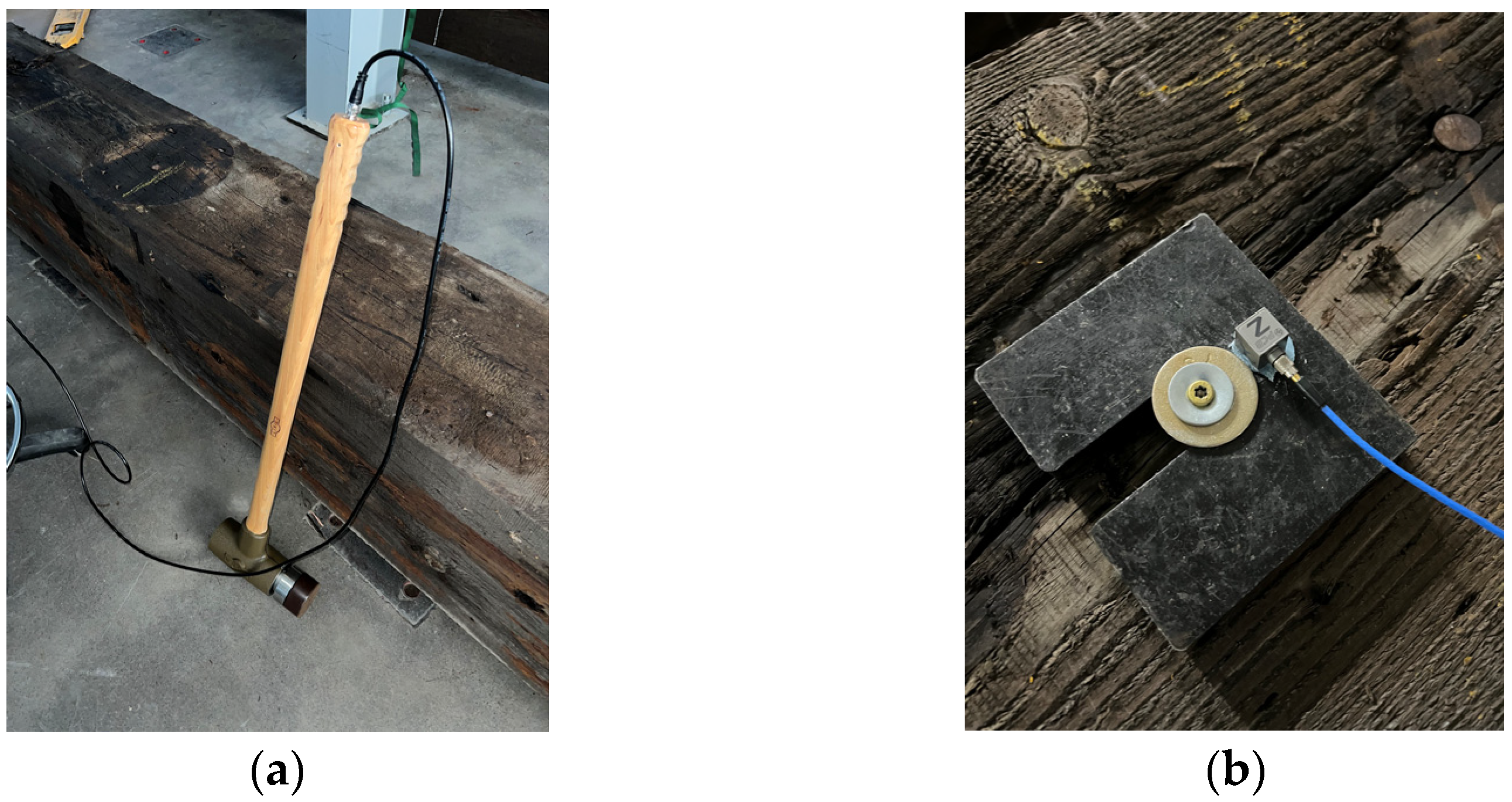
The hammer used in this research was the PCB Piezotronics (Depew, NY, USA) Model 086D50 Impulse Force Hammer equipped with the soft brown tip (
Figure 1a). Tip hardness influences both contact duration and impact force, with harder tips resulting in shorter contact times and higher force amplitudes, generating broader high-frequency excitation. The softer tip was selected to better excite the lower frequency response of the heavy timber specimens. Tip choice entails another trade-off: because increased contact duration reduces high-frequency content, the excitation mechanism of nonlinear behavior may be altered as well. While this trade-off is recognized, its implications were not further explored in this testing.
The hammer has a sensitivity of 0.227 mV/N which was verified in a calibration validation test. It is considerably larger than other models, with a mass of 5.5 kg, and is well suited for larger structures in civil engineering applications where a larger excitation is necessary.
The accelerometer used was the PCB Piezotronics Model 356A32 with a sensitivity of 102.6 mV/g, which can be seen in
Figure 1b.
Throughout testing, the accelerometer provided consistent, reliable measurements, and the frequency content of the response appeared as expected, with no sudden flattening indicative of overload. In this experiment, the accelerometer was mounted exclusively at the center of the simply supported beam’s span. This location was deliberately chosen because it corresponds to the antinodes of flexural modes 1 and 3, where the response is most pronounced. However, it is not sensitive to mode 2, as a simply supported beam has a node at the center in this mode, resulting in minimal or zero response at that point. This decision was made to understand the effects of nonlinearity between a lower and higher mode of interest and to maximize consistency and signal quality for the target modes of interest.
A goal of the work was to develop a highly portable system to facilitate field studies. Thus, the hammer and accelerometer were connected to a two-channel PCB Piezotronics 485B39 Signal Conditioner, which interfaced with an Apple (Cupertino, CA, USA) iPhone 13 Pro running the Vibration Pro app version 4.14 [
24]. Signal processing and analysis were performed in GNU Octave version 10.1.0.
3.2. Timber Stringer Specimens and Concrete Bridge
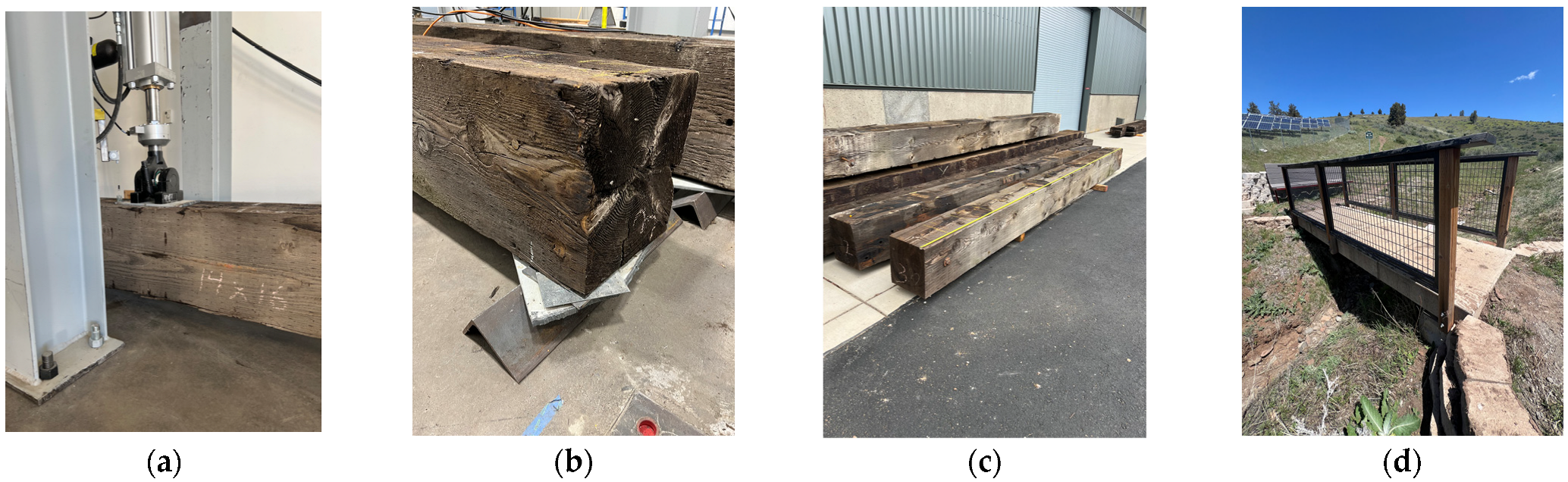
The testing for this experiment utilized three Douglas fir timber bent caps removed from a bridge repair project in Klamath County, OR (
Figure 2a), and a concrete bridge on the Oregon Institute of Technology, Klamath Falls campus (
Figure 2b). The timbers had varying degrees of damage and wood-decay fungus from over 60 years of service and exposure. The timbers were simply supported with minimal overhang. Due to uneven support conditions caused by factors such as protruding original hardware and damaged or non-planar timber, shims were inserted between the beam and vertical supports, as shown in
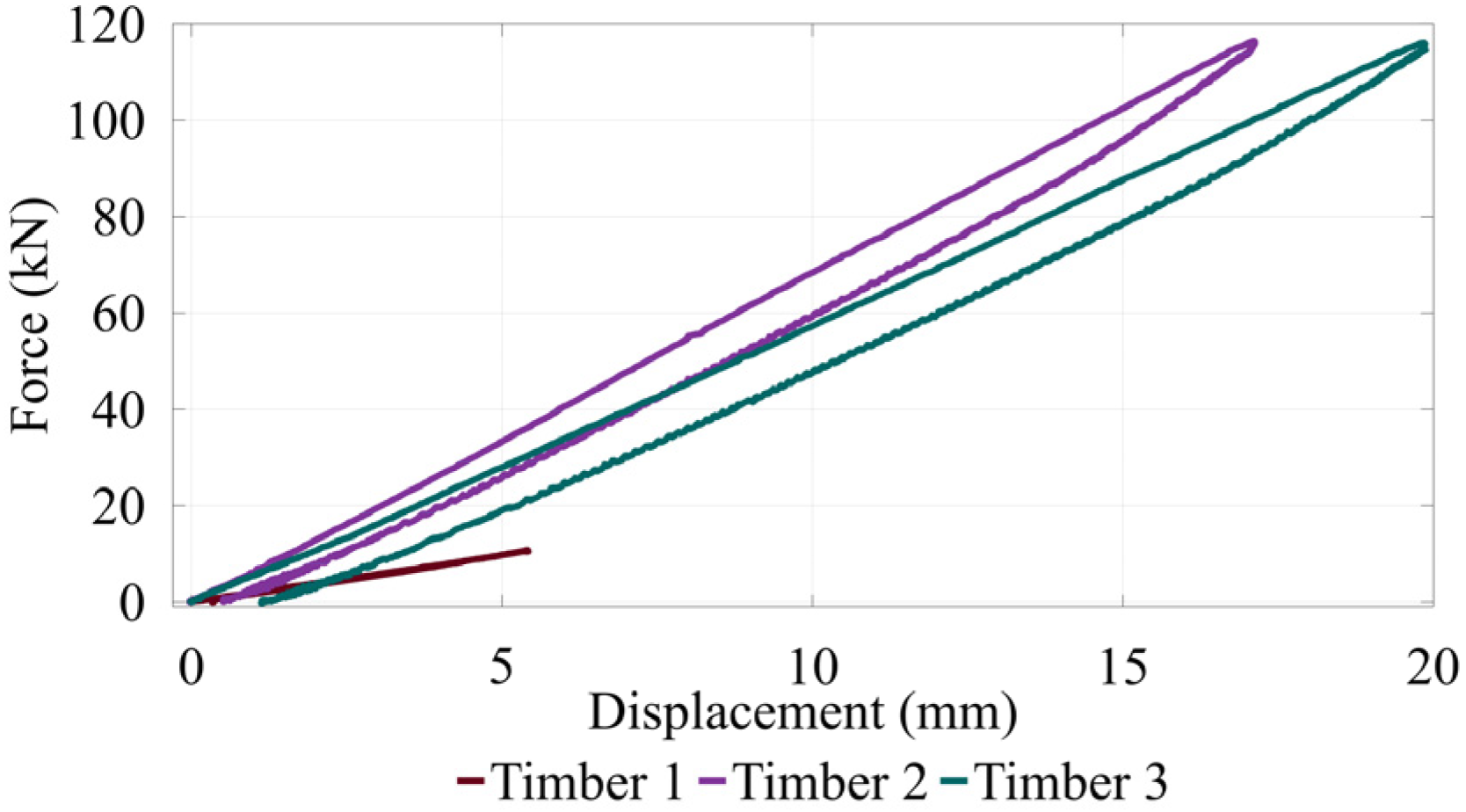
Figure 2c, to ensure good bearing contact, mitigate rocking, and prevent undesired torsional motion under excitation and static loading (
Figure 2d). It is acknowledged that the shimmed support conditions may introduce boundary-related nonlinearities that are not isolated from material nonlinearity in this study. The proposed VIHIT methodology intentionally characterizes the combined effect of material degradation and support behavior through excitation-conditioned modal properties, rather than attempting to decompose individual nonlinear contributions.
The timbers were nearly 5.5 m in length but spanned 5.2 m between supports. The cross-sectional properties of the timbers are approximate, as their condition was affected by rot, damage, warping, and cracking, which introduced considerable uncertainty. The timbers were measured to have a width (
b) of 343 mm and a depth (
d) of 397 mm, resulting in an ideal moment of inertia (
I) of 1.79 ×
. Since the timbers were degraded uniquely, there was no feasible way of developing the correct moment of inertia. Timbers 1, 2, and 3 had masses of approximately 577 kg, 513 kg, and 488 kg, respectively. Timber 1 initiated the removal of the bent caps from the bridge, as it was found to be significantly rotted, and of major concern to Klamath County engineers, but Timber 2 and 3 were determined to be more competent, based on resistograph testing. A significantly more competent reinforced concrete slab pedestrian bridge was also evaluated, providing a comparison to a system that behaved more consistently with linear predictions. The properties of the timbers and concrete bridge are reported in
Table 1.
3.3. Proposed Experimental Method
The process for the proposed experimental method used in this study is as follows:
- 1.
Impulse Testing and Data Acquisition
At each designated test location, 10 to 20 variable impulse tests are performed, slightly more than suggested for averaging methods [
8,
9], to ensure data quality and capture the full impulse range. To capture the full dynamic range of the structure’s response, impulses of varying magnitudes, from light taps (~10 N·s) to heavy strikes (~60 N·s), are applied at each location to ensure the input APSD spans a broad range and reveals both low and high impulse behavior. Consistency of the strikes across this range is impossible to control, given the test equipment, so the goal is to span the range to inform an impulse-dependent response, rather than reproduce a specific impulse value consistently.
- 2.
Frequency Domain Processing
The recorded signals are transformed using Fast Fourier Transform (FFT). From this, the input APSD and the crosspower spectral density (CPSD) between input and output are calculated. The FRF is obtained by dividing the CPSD by the input APSD. More detail is provided in the Signal Processing sections that follow.
- 3.
Imaginary FRF Trend Extraction
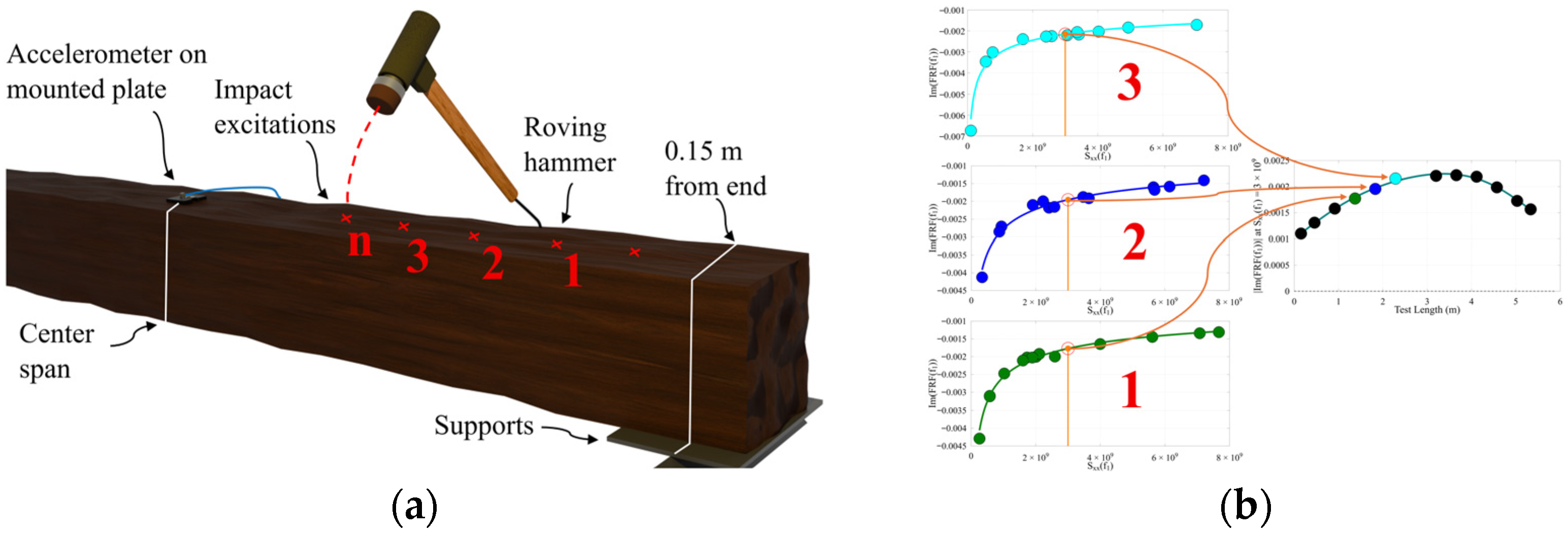
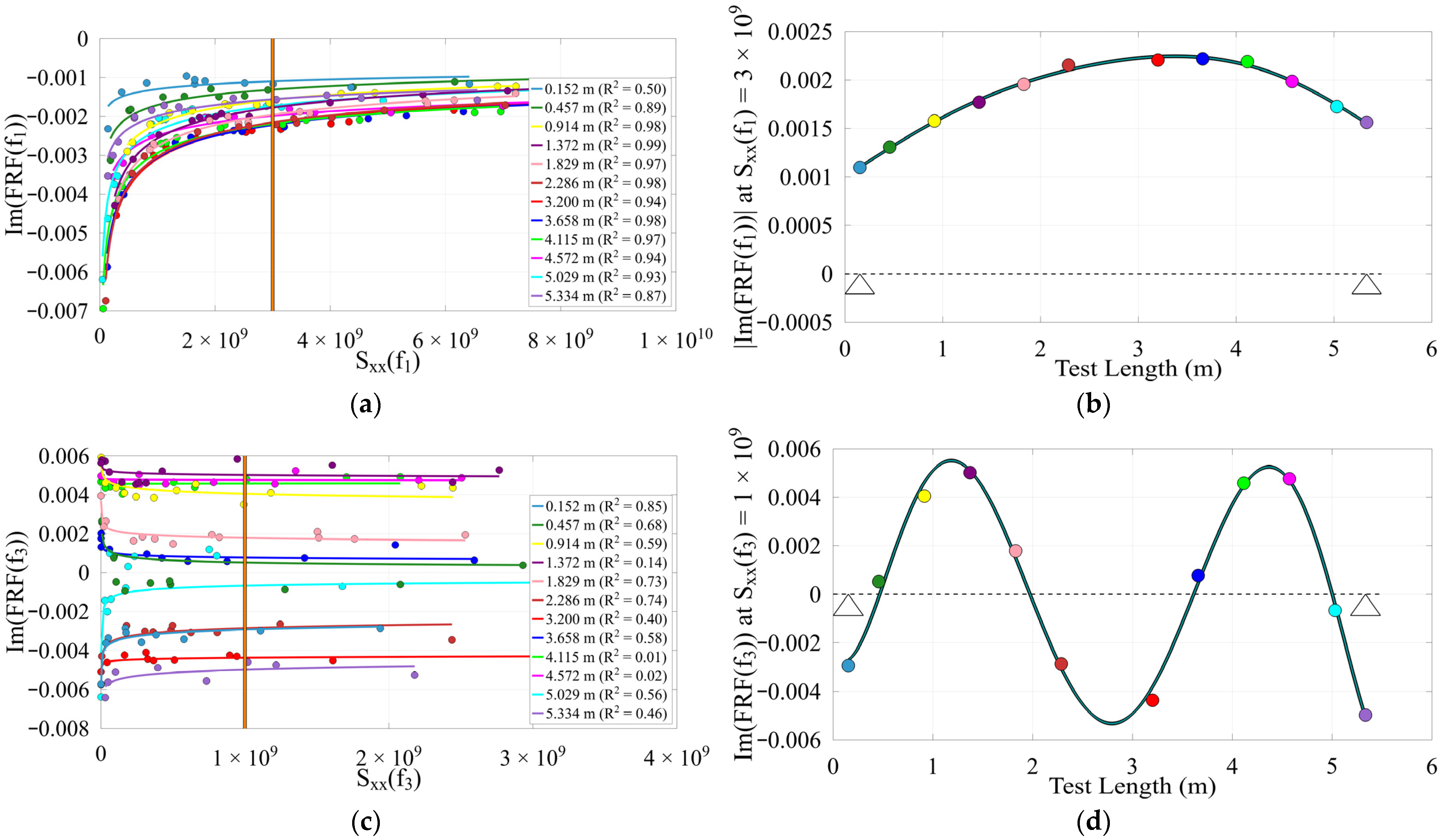
For each test at each location, the APSD of the input signal, , is plotted as a function of the imaginary component of the FRF, , at the modal frequency of interest, , where n is the mode number. The tests at each location collectively form a set of curves that typically follow an inverse power-law relationship of the form . The shape of these curves provides insight into the system’s impulse-dependent dynamics at the mode and location of interest. Additionally, this inverse power relationship is consistent with nonlinear energy balance principles for structures exhibiting amplitude-dependent dissipation. At resonance, the imaginary component of the FRF is inversely proportional to the effective modal damping, which governs irreversible energy loss per cycle. In nonlinear dissipative systems such as degraded timber, effective damping increases with response amplitude due to hysteretic and frictional mechanisms. Increasing the input APSD at the modal frequency, , increases the energy delivered to the mode and, consequently, the response amplitude, which in turn elevates the effective damping and suppresses the imaginary FRF component. Under an equivalent linearization conditioned on a fixed excitation level, this interaction leads naturally to an inverse power-law scaling between and the input APSD, . The observed scaling is therefore interpreted as a physically meaningful consequence of amplitude-dependent energy dissipation rather than a purely empirical correlation.
- 4.
Impulse Range and Reference Input APSD Selection
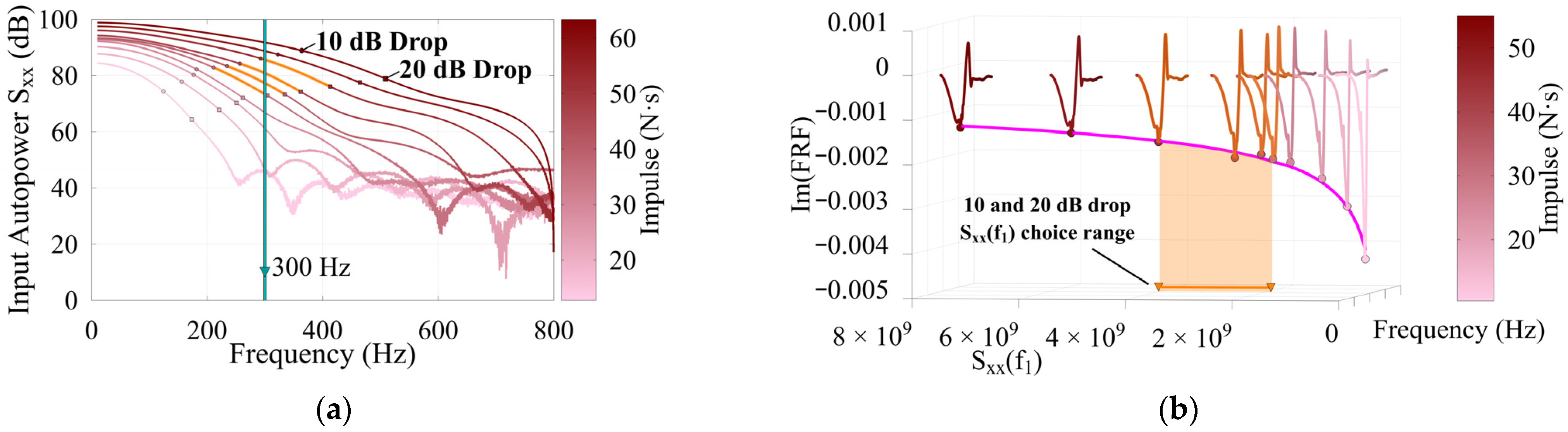
The selected impulse range should align with the specific testing objectives. This study adopts a 10 to 20 dB drop in input APSD at the maximum frequency of interest to guide the selection of a reference value of the input APSD for evaluating
, which represents the mode shape amplitude at each location.
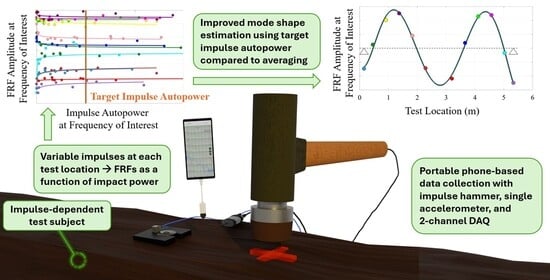
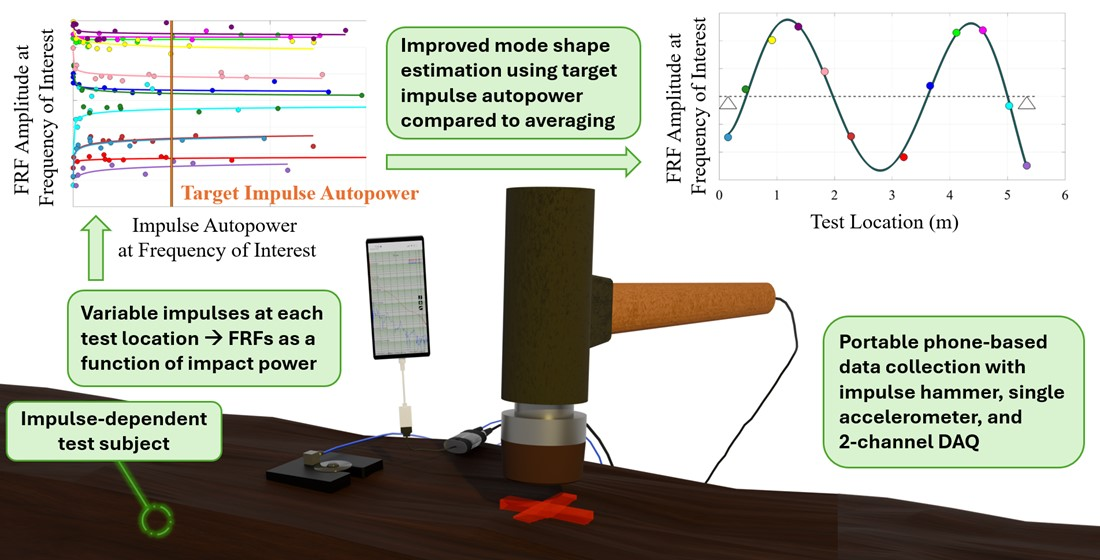
Figure 3 illustrates the test configuration and post-processing.
The 10–20 dB criterion is not intended to define a unique or globally optimal reference excitation, but rather to identify a stable operating range in which the equivalent linearized response is well-defined, and the inverse power trends are robust. Sensitivity checks indicated that moderate variation within this range produces negligible changes in reconstructed operating shapes, supporting the robustness of the selected reference input APSD. The application of this selection method is outlined in
Section 4.4.
3.4. Signal Processing Theory
Dynamic testing involves recording the input force from the hammer and the corresponding acceleration response of the structure using an accelerometer, both in the time domain [
25]. These time series signals are then transformed into the frequency domain using the FFT. From the FFT results, spectral densities are calculated, specifically, the CPSD between the input and output signals (
), and the APSD of the input signal (
). The autopower spectrum is determined by multiplying the input spectrum with its complex conjugate
The crosspower spectrum is obtained by taking the complex conjugate of the input spectrum and multiplying it by the output spectrum
where
is the frequency of interest,
is the input spectrum,
is the output spectrum, and the asterisk (*) indicates complex conjugation. Finally,
and
are used to generate the FRF, or accelerance,
H:
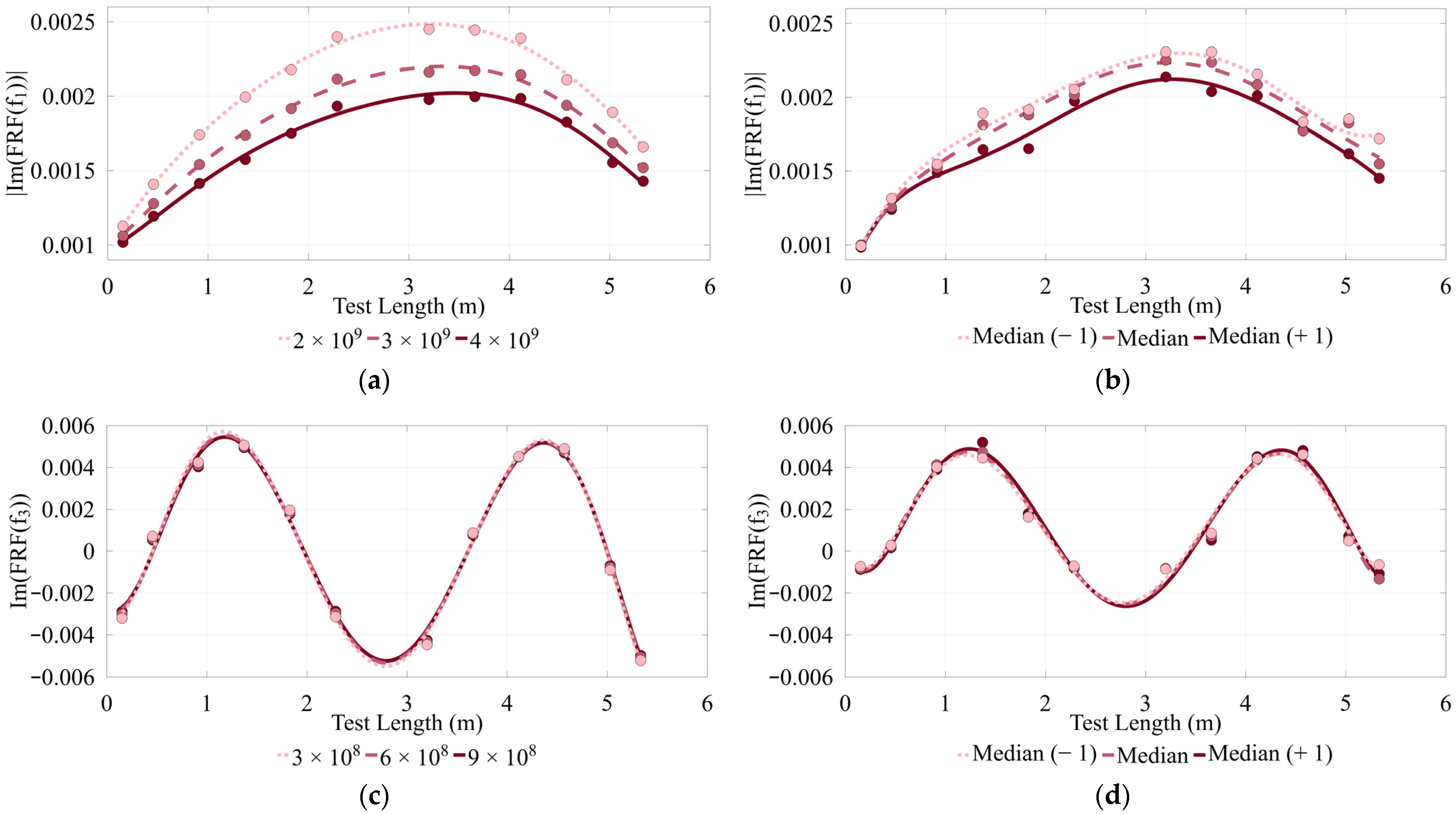
The FRF defines the system’s frequency domain transfer function, relating input force to output response. At resonance, the imaginary component of the FRF reflects the local dissipative response associated with the dominant deformation pattern. In the present study, is not interpreted as an invariant linear mode shape amplitude, but rather as an excitation-conditioned operating response metric evaluated at a fixed input power level. The reconstructed shapes therefore represent effective operating deflection shapes (ODS) corresponding to the selected reference excitation, rather than global linear normal modes.
The effective
ODS can be reconstructed by plotting the magnitude of the imaginary component of the FRF at each impact location on the structure. The equation for the effective
ODS is [
26]
where
is the FRF at the location of interest. By combining all the imaginary components of the FRF with respect to their location, the effective
ODS for the structure can be reconstructed.
The SISO roving hammer method utilizes the FRF at each measurement location, relying on the principle of reciprocity. This principle states that the FRF remains the same when the excitation and response locations are swapped. In other words, in an ideal linear-elastic system, impacting at location one and measuring the response at location two yields the same FRF as impacting at location two and measuring at location one. However, in nonlinear systems, variations in impulse magnitude can lead to discrepancies in response, indicating a breakdown in reciprocity as nonlinearity increases. In nonlinear systems, strict global reciprocity may be violated as modal properties evolve with excitation level. However, under a prescribed excitation condition, the system can be interpreted through an equivalent linear representation. The present study therefore assumes conditional reciprocity at a target input power level, enabling the use of a SISO roving hammer approach to extract excitation-conditioned operating mode shapes rather than invariant linear modes.
The theoretical basis for the inverse power relationship between the imaginary component of the FRF and the input APSD that is observed in this study can be supported by considering how observations violate linear systems theory and function consistently with nonlinear energy balance principles. For a structure excited by an impact force, the frequency domain response is
where
is the accelerance frequency response function (FRF) and
is the force input. For a linear, time-invariant system with viscous damping, the imaginary component of the FRF at resonance
is [
14]
which depends only on stiffness
and damping ratio
, and is therefore independent of excitation magnitude. In linear theory, varying the input autopower spectral density
changes the response energy, but cannot change
. Consequently, any systematic dependence of
on
violates linear modal assumptions.
At resonance, the imaginary component of the accelerance FRF is directly related to energy dissipation. Using the energy definition of equivalent viscous damping [
14],
where
is the energy dissipated per cycle and
is the stored modal energy. Generalizing (6), we can say that the imaginary component of the accelerance FRF is proportional to the inverse of the damping ratio
Thus, reductions in directly indicate increased effective modal dissipation.
Timber structures commonly exhibit amplitude-dependent dissipation due to hysteresis, micro-slip, crack friction, and support interactions [
1]. For such mechanisms, the energy dissipated per cycle scales with response amplitude
as
while the stored modal energy scales as
. The parameter
p quantifies how strongly energy dissipation increases with vibration amplitude beyond the quadratic scaling of stored elastic energy; it governs how damping increases with amplitude of vibration. Substituting
and
into (7) yields an amplitude-dependent equivalent damping ratio,
At resonance, the response amplitude is related to the input APSD by
Substituting (8) into (11) and considering amplitude-dependent damping (10) yields
leading to
Finally, solving for the imaginary component of the accelerance FRF using (8), (10), and (13) yields
This expression predicts an inverse power-law relationship between the imaginary component of the FRF and the input autopower spectral density at the modal frequency, consistent with the experimentally observed trends. Such behavior cannot be produced by linear modal theory, but arises naturally from nonlinear energy balance when dissipation increases with response amplitude.
3.5. Signal Processing and Testing Details
In the testing described here, time series data from the hammer and accelerometer were imported, where the hammer signal was processed by zeroing negative values caused by rebound effects following impact and isolating the impulse region using a low threshold to exclude noise outside the main excitation. An exponential window is generally recommended for responses that do not fully decay [
27]. However, in this study, windowing was deemed unnecessary, as the timber beam responses decayed sufficiently within the sampling duration, resulting in minimal leakage. For systems exhibiting slower decay or stronger nonlinearity, windowing may be required. Other window types were tested but introduced undesirable effects, such as amplified noise in the frequency domain. Zero-padding was applied to the time-domain data to effectively interpolate the frequency resolution, increasing the number of frequency bins, thus enhancing the detail in the frequency domain without adding new information. Following this, the FFT was performed, the autopower and crosspower spectra were computed, and the FRF was obtained as the ratio of crosspower to input autopower. This study used a sampling rate of 1600 Hz, 8192 frequency bins, and a spectral resolution (Δ
f) of 0.0977 Hz.
To assess the effective bandwidth of each test and filter out inadequate impacts, the drop in input APSD should be considered. This study uses the 10 to 20 dB drop guideline [
2,
20], which states if the drop in input APSD at the maximum frequency of interest is less than 10 dB, the impact may be too strong or hammer tip too stiff, potentially exciting out-of-band modes and losing wanted energy in the modes of interest. If the drop exceeds 20 dB, the impulse is likely too weak or hammer tip too soft, failing to adequately excite the modes of interest. Setting a lower frequency limit was unnecessary, since low-frequency modes are always excited due to the uncontrollable lower bound of the force spectrum in impulse testing. The methodology here incorporates this guideline by evaluating
at
from a range of tests in which the maximum frequency of interest falls within a 10 to 20 dB drop in
to adequately excite all modes of interest. While this study chooses the 10 and 20 dB drop values as a guideline, other methods for impact validity are available and the reference input APSD could be chosen differently for other use cases or goals.
3.7. Coherence
The coherence function measures the quality of the frequency domain data by quantifying the linear relationship between input and output signals. It ranges from 0 to 1.0, with 1.0 indicating a perfect linear relationship and 0 representing unrelated signals. In practice, coherence values are typically lower due to noise, system nonlinearity, or multiple excitations affecting the output. Calculating coherence helps assess the accuracy and reliability of the measured data [
30].
Traditional coherence methods are calculated using an averaging equation that is not applicable for single impact testing because it results in a coherence of 1.0 for every test [
9]. To evaluate nonlinear test validity without averaging, a coherence function developed by Zheng et al. [
5], called the Segmentation Method (SM), was specifically designed for individual impact hammer testing without requiring averaging over a dataset. Additionally, coherence will appear poorer in the presence of structural nonlinearity. While the original SM uses two segments, this study uses eight overlapping segments (
to improve accuracy and reduce sensitivity to noise which can artificially reduce coherence. Overlapping segments increase statistical averaging, reducing the effect of random noise while reinforcing consistent structural signals. However, this comes at the cost of lower frequency resolution, as shorter segments result in wider frequency bins. SM coherence is defined as [
5]
where
and
where the overline denotes averaging over the segments, the asterisk (*) represents complex conjugation,
is the total number of segments, and
and
represent the FFT of the input and output, respectively, during the
sampling period. The use of eight overlapping segments represents a practical compromise between statistical stability and frequency resolution; while not formally optimized, this choice balanced adequate resolution for the low-frequency modes of interest with reduced noise.
Coherence can serve as an indicator of whether the input spectrum is adequate for each test. If the input does not sufficiently excite all modes of interest, the power spectrum will “roll-off”, indicating the highest frequency adequately excited [
4]. This helps determine whether the impulse was strong enough to capture the structural modes of interest. The coherence plot reveals roll-off where coherence stays near 1.0 within the adequately excited frequency range, then begins to sporadically dip at higher frequencies where excitation is insufficient. This transition is a cue that higher frequencies are no longer being adequately excited, as reflected by increasingly erratic FRF behavior beyond the effective excitation range, indicating the upper limit of adequate excitation. The impulse is determined by swing strength, tip choice of the hammer, mass of the hammer, angle of impact, and contact time, which is often most influenced by the tip choice and test subject material. Importantly, roll-off is not inherently problematic; as long as the mode of interest lies within a portion of the spectrum that is adequately excited, it is acceptable.
3.8. Damping
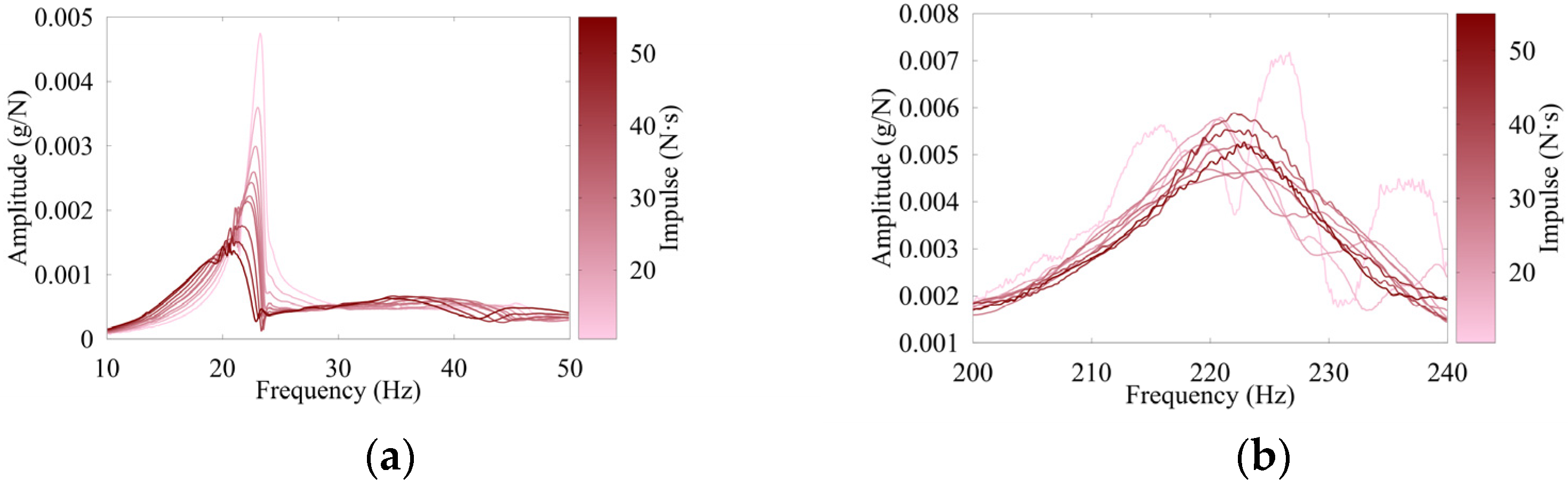
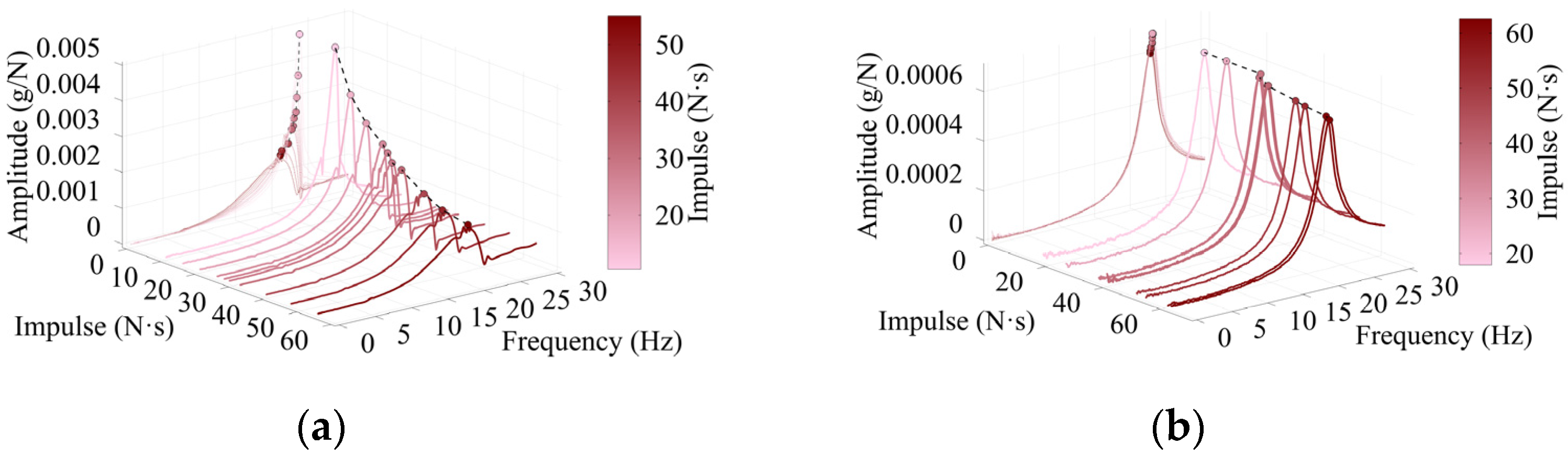
In linear systems, damping is typically modeled as viscous damping and estimated using the logarithmic decrement method, which assumes a constant damping ratio independent of excitation. In contrast, nonlinear systems exhibit damping that varies with input conditions such as impulse magnitude. As impact force increases, damping correspondingly increases, as demonstrated by Blaschke et al. [
12] and confirmed in this study. This variation leads to higher damping coefficients and increased damping ratios at larger impulse magnitudes. Nonlinear damping mechanisms often extend beyond viscous effects to include hysteretic damping and Coulomb friction. At low frequencies, hysteretic damping caused by structural anelasticity is typically the dominant energy dissipation mechanism [
31]. To accurately capture nonlinear damping effects, this study adopts the instantaneous damping coefficient, a metric recognized as suitable for assessing nonlinear damping behavior [
32].
To better understand the physical basis of the FRF and its relation to damping and resonance, it is helpful to consider the system’s dynamics in the frequency domain. The equation of motion (EOM) for a single degree-of-freedom (SDOF) system as a function of angular frequency,
, is [
33]
where
is the force applied to the system, and
is the imaginary unit. Rearranging the EOM to divide input by output, differentiating the displacement,
once to obtain velocity,
and evaluating the frequency at the resonant frequency,
, the damping coefficient of the system,
(N·s/m), is realized. This is detailed in Equations (21) and (22) [
33]:
then
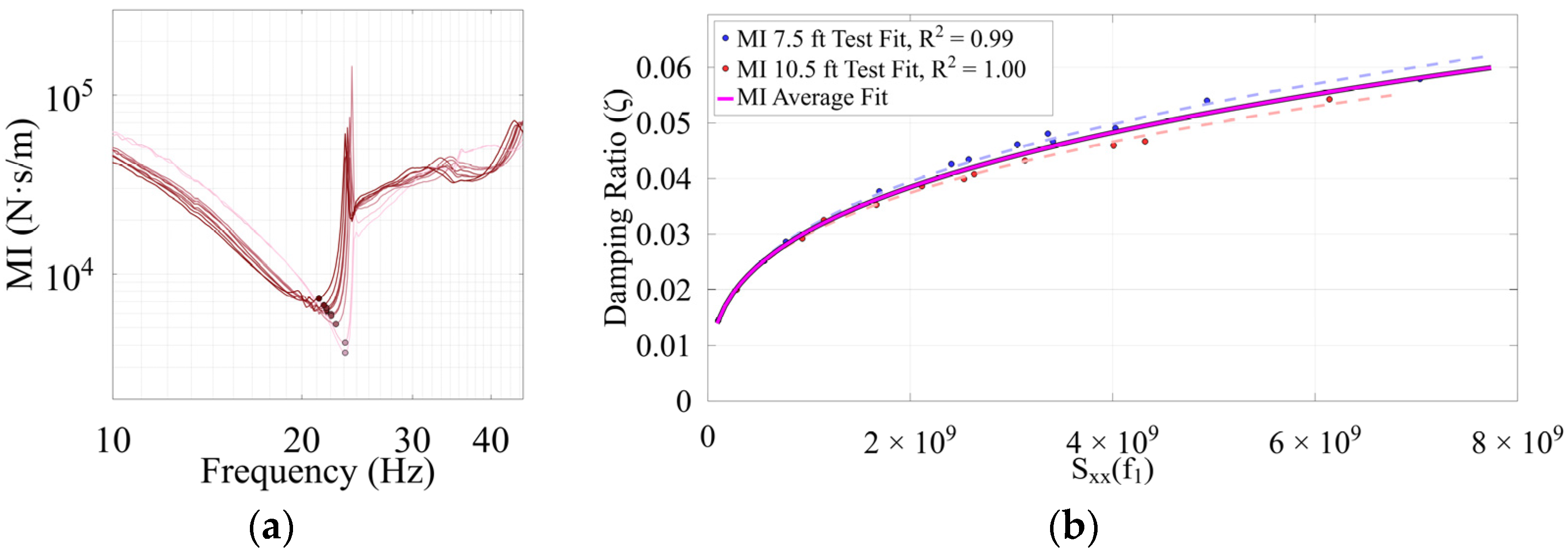
Acceleration data recorded by the accelerometer was integrated to obtain velocity, enabling the generation of the mechanical impedance (MI) plot, defined as the inverse velocity FRF. Prior to integration, the acceleration signals were band-limited around the modal frequency of interest and zero-mean corrected to mitigate low-frequency drift and numerical bias. The instantaneous damping coefficient was extracted directly at the natural frequency determined by
CoMIF from the mechanical impedance plot corresponding to the applied impulse level. The damping ratio for each test was then calculated using the natural frequency, the known structural mass, and the instantaneous damping coefficients extracted from the mechanical impedance FRF: