A Lightweight Certificateless Identity Authentication Protocol Using SM2 Algorithm and Self-Secured PUF for IoT



Abstract
1. Introduction
- Analyze the security challenges faced by IoT terminal identity authentication and the limitations of existing solutions.
- Design a new authentication architecture that uses PUF as the hardware root of trust and deeply integrates it with SM2 uncertified cryptography.
- Elaborate on the initialization, key generation, registration, and authentication protocol process of the mechanism.
- Analyze and evaluate the proposed mechanism from the perspectives of security and performance and demonstrate its ability to effectively resist various known attacks while also being suitable for resource-constrained IoT environments in terms of computational and communication overhead.
2. Background
2.1. Certificateless Public Key Mechanisms
- CL.Setup (): Given the security parameter , this function initializes the uncertified password system and generates the system’s master public key and master private key (). This function is executed by KGC.
- CL.Set-User-Key (): This function generates the user’s partial public key and partial private key ().
- CL.Extract-Partial-Key (): This function is executed by KGC and generates the parts for the users’ public key and partial private key (; ).
- CL.Set-Public-Key (, , , ): This function generates the public key (implicit certificate password) declared by the user, also known as public key restoration data in the system.
- CL.Encrypt (, , , ): This function encrypts message to generate ciphertext .
- CL.Decrypt (, , , , ): This function decrypts ciphertext and outputs or a terminator .
2.2. PUF Technology
- PUF Security Chip Registration Stage:
- Key Reconstruction/Verification Phase:
3. System Model and Security Model
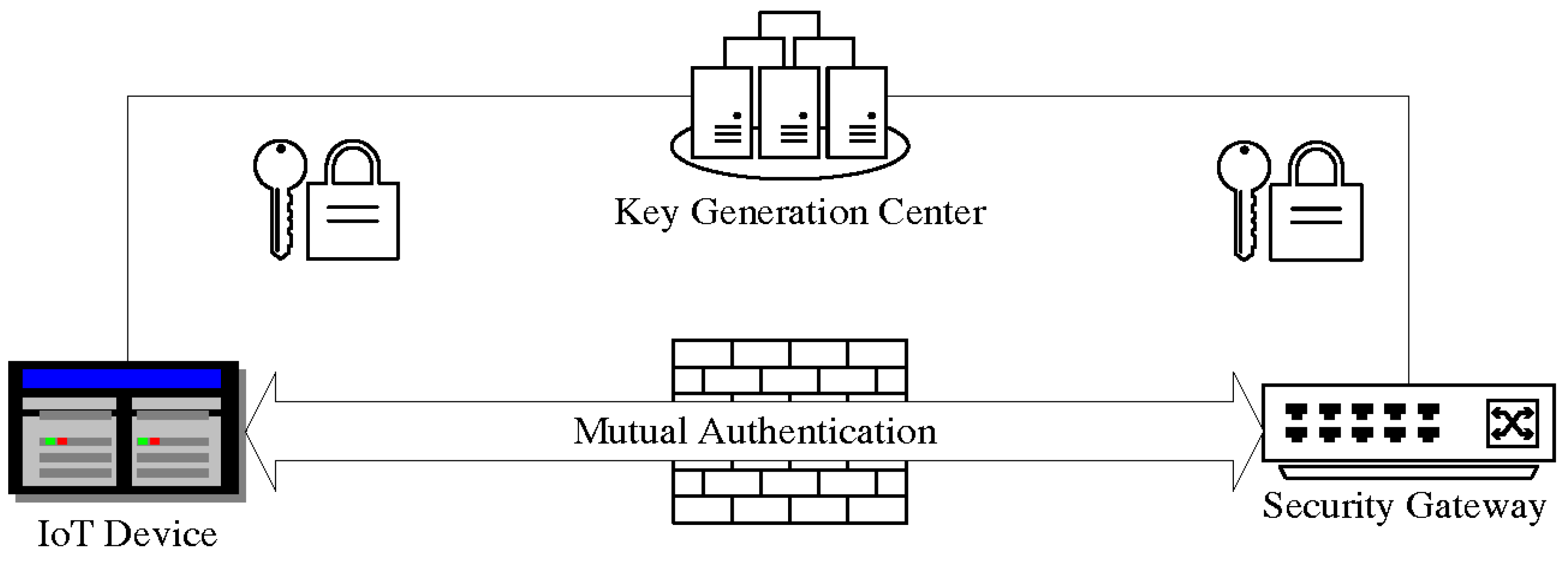
3.1. System Model
3.2. Security Model
4. PUF + SM2 Certificateless Identity Authentication Mechanism
4.1. System Initialization
4.2. Terminal Private Key Setting
4.3. KGC Setting Private Keys
4.4. Mutual Authentication
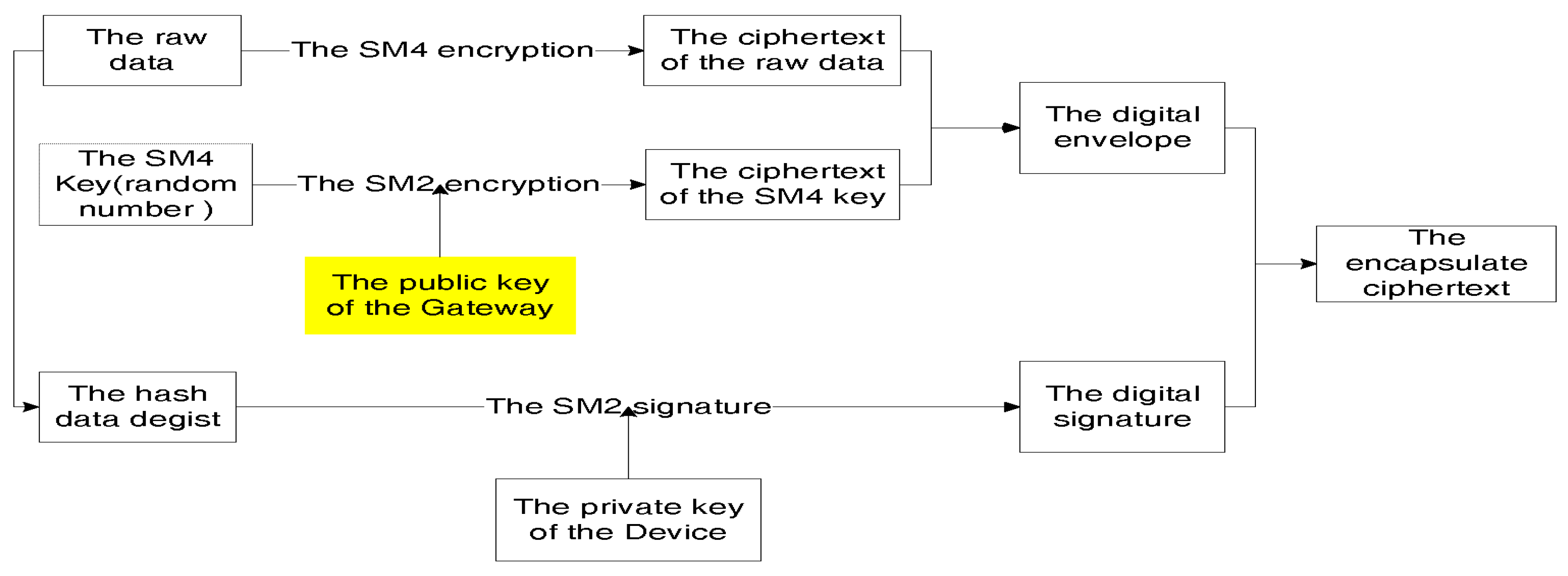
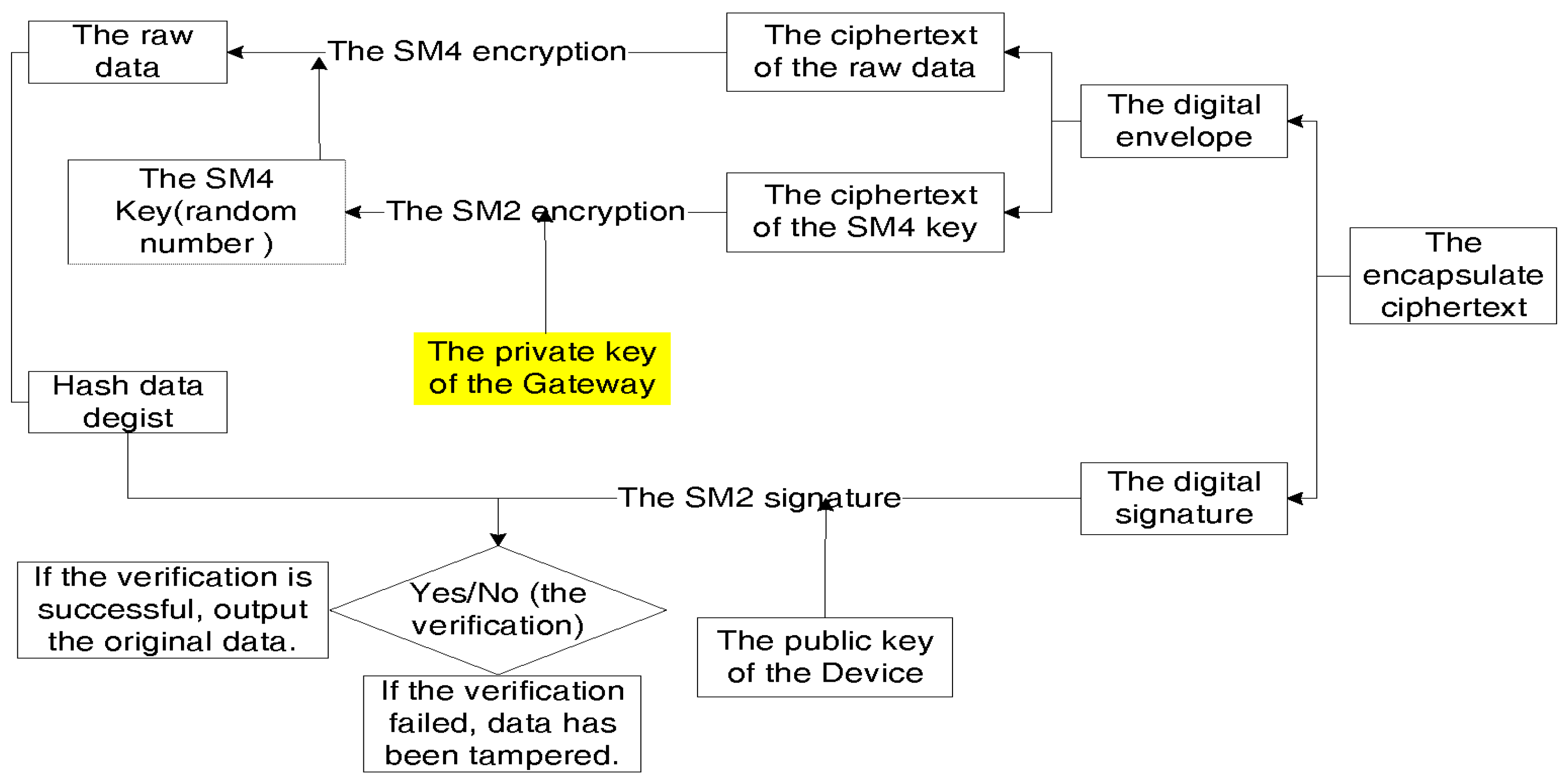
4.5. Signed Enveloped Data
5. Discussion
5.1. Security Analysis
5.1.1. The Formal Security Proof
5.1.2. Signature Non-Forgeability
5.1.3. Identity Authentication
5.1.4. Data Integrity
5.1.5. Resist Physical Attacks
5.2. Performance Analysis
6. Conclusions
Author Contributions
Funding
Institutional Review Board Statement
Informed Consent Statement
Data Availability Statement
Acknowledgments
Conflicts of Interest
Abbreviations
| PUF | Physical Unclonable Function |
| CL-PKC | Certificateless Public Key Cryptography |
| IBC | Identity-Based Cryptography |
| ECC | Elliptic Curve Cryptography |
| KGC | Key Generation Center |
| SED | Signed Enveloped Data |
References
- TS 33.501; Security Architecture and Procedures for 5G System. 3GPP: Sophia Antipolis, France, 2022.
- Al-Fuqaha, A.; Guizani, M.; Mohammadi, M.; Aledhari, M.; Ayyash, M. Internet of Things: A Survey on Enabling Technologies, Protocols, and Applications. IEEE Commun. Surv. Tutor. 2015, 17, 2347–2376. [Google Scholar] [CrossRef]
- Felcia, B.H.J.; Sabeen, S. A Survey on IoT Security: Attacks, Challenges and Countermeasures. Webology 2022, 19, 3741–3763. [Google Scholar] [CrossRef]
- Melki, R.; Noura, H.N.; Chehab, A. Lightweight multi-factor mutual authentication protocol for IoT devices: R. Melki et al. Int. J. Inf. Secur. 2020, 19, 679–694. [Google Scholar] [CrossRef]
- Samanta, S.; Sarkar, A.; Bulo, Y. Secure 6G Communication in Smart City Using Blockchain. In Emerging Technologies in Data Mining and Information Security, Proceedings of IEMIS; Lecture Notes in Networks and Systems; Springer: Berlin/Heidelberg, Germany, 2023; pp. 487–496. [Google Scholar]
- Höglund, J.; Lindemer, S.; Furuhed, M.; Raza, S. PKI4IoT: Towards Public Key Infrastructure for the Internet of Things. Comput. Secur. 2020, 89, 101658. [Google Scholar] [CrossRef]
- Marino, F.; Moiso, C.; Petracca, M. PKIoT: A Public Key Infrastructure for the Internet of Things. Trans. Emerg. Telecommun. Technol. 2019, 30, e3681. [Google Scholar] [CrossRef]
- Shamir, A. Identity-Based Cryptosystems and Signature Schemes. In Advances in Cryptology—CRYPTO′84; Springer: Berlin/Heidelberg, Germany, 1984. [Google Scholar]
- Boneh, D.; Franklin, M. Identity-Based Encryption from the Weil Pairing. SIAM J. Comput. 2003, 32, 586–615. [Google Scholar] [CrossRef]
- Goyal, V. Reducing Trust in the PKG in Identity Based Cryptosystems. In Proceedings of the 27th Annual International Cryptology Conference, Santa Barbara, CA, USA, 19–23 August 2007; Springer: Berlin/Heidelberg, Germany, 2007; pp. 430–447. [Google Scholar]
- Al-Riyami, S.; Paterson, K. Certificateless Public Key Cryptography. In Advances in Cryptology—ASIACRYPT 2003; Lecture Notes in Computer Science; Springer: Berlin/Heidelberg, Germany, 2003; Volume 2894, pp. 452–473. [Google Scholar]
- Jia, X.; He, D.; Liu, Q.; Choo, K.-K.R. An Efficient Provably-Secure Certificateless Signature Scheme for Internet-of-Things Deployment. Ad Hoc Netw. 2018, 71, 78–87. [Google Scholar] [CrossRef]
- Hong, N.; Zheng, X. A Security Framework for Internet of Things Based on SM2 Cipher Algorithm. In Proceedings of the 2013 International Conference on Computational and Information Sciences, Shiyang, China, 21–23 June 2013; IEEE: Piscataway, NJ, USA, 2013. [Google Scholar] [CrossRef]
- Ma, Z. Design of Hardware/Software Cooperative System Based on SM2/3/4 Hybrid Encryption Algorithm. In Proceedings of the 2024 5th International Seminar on Artificial Intelligence, Networking and Information Technology (AINIT), Nanjing, China, 29–31 March 2024; pp. 405–411. [Google Scholar]
- Liao, H.; Wang, D.; Wang, J.; Li, L.; Wang, H. Research and Application of SM9 in the Ubiquitous Electric IoT. In Proceedings of the 2020 IEEE 5th Information Technology and Mechatronics Engineering Conference (ITOEC), Chongqing, China, 12–14 June 2020; IEEE: Piscataway, NJ, USA, 2020. [Google Scholar]
- Suh, G.E.; Devadas, S. Physical Unclonable Functions for Device Authentication and Secret Key Generation. In Proceedings of the 44th Annual Design Automation Conference (DAC′07), San Diego, CA, USA, 4–8 June 2007; IEEE: Piscataway, NJ, USA, 2007. [Google Scholar]
- Rührmair, U.; Sehnke, F.; Sölter, J.; Dror, G.; Devadas, S.; Schmidhuber, J. Modeling Attacks on Physical Unclonable Functions. In Proceedings of the 2010 ACM SIGSAC Conference on Computer and Communications Security (CCS′10), Chicago, IL, USA, 4–8 October 2010; ACM: New York, NY, USA, 2010; pp. 237–249. [Google Scholar]
- Helder, C.; Yu, M.-D.; Koushanfar, F.; Devadas, S. Physical Unclonable Functions and Applications: A Tutorial. Proc. IEEE 2014, 102, 1126–1141. [Google Scholar] [CrossRef]
- He, D.; Chen, J.; Zhang, R. An efficient and provably-secure certificateless signature scheme without bilinear pairings. Int. J. Commun. Syst. 2012, 25, 1432–1444. [Google Scholar] [CrossRef]
- Ma, K.; Zhou, Y.; Wang, Y.; Dong, C.; Xia, Z.; Yang, B.; Zhang, M. An Efficient Certificateless Signature Scheme with Provably Security and Its Applications. IEEE Syst. J. 2023, 17, 5636–5647. [Google Scholar] [CrossRef]
- Peng, C.; Luo, M.; He, D.; Huang, X. Adapter Signature Scheme Based on SM2 Digital Signature Algorithm. Comput. Res. Dev. 2021, 58, 2278–2286. [Google Scholar] [CrossRef]
- Pappu, R.; Recht, B.; Taylor, J.; Gershenfeld, N. Physical One-Way Functions. Science 2002, 297, 2026–2030. [Google Scholar] [CrossRef] [PubMed]
- Gassend, B.; Clarke, D.; Van Dijk, M.; Devadas, S. Silicon physical unknown functions. In Proceedings of the 9th ACM Conference on Computer and Communications Security (CCS′02), Washington, DC, USA, 18–22 November 2002; ACM: New York, NY, USA, 2002; pp. 148–160. [Google Scholar]
- Guajardo, J.; Kumar, S.S.; Schrijen, G.-J.; Tuyls, P. FPGA Intrinsic PUFs and Their Use for IP Protection. In Cryptographic Hardware and Embedded Systems—CHES 2007: 9th International Workshop, Vienna, Austria, 10–13 September 2007; Springer: Berlin/Heidelberg, Germany, 2007; pp. 63–80. [Google Scholar]
- Sadeghi, A.-R.; Visconti, I.; Wachsmann, C. Enhancing RFID Security and Privacy by Physically Unclonable Functions. In Towards Hardware-Intrinsic Security: Foundations and Practice; Springer: Berlin/Heidelberg, Germany, 2010; pp. 281–305. [Google Scholar]
- Kulseng, L.; Yu, Z.; Wei, Y.; Guan, Y. Lightweight Mutual Authentication and Ownership Transfer for RFID Systems. In Proceedings of the 2010 IEEE International Conference on Computer Communications (INFOCOM); IEEE: Piscataway, NJ, USA, 2010; pp. 1–5. [Google Scholar]
- Chatterjee, U.; Govindan, V.; Sadhukhan, R.; Mukhopadhyay, D.; Chakraborty, R.S.; Mahata, D.; Prabhu, M.M. Building PUF Based Authentication and Key Exchange Protocol for IoT Without Explicit CRPs in Verifier Database. IEEE Trans. Dependable Secur. Comput. 2018, 16, 424–437. [Google Scholar] [CrossRef]
- Helfmeier, C.; Boit, C.; Nedospasov, D.; Seifert, J.-P. Cloning Physically Unclonable Functions. In Proceedings of the 2013 IEEE International Symposium on Hardware-Oriented Security and Trust (HOST); IEEE: Piscataway, NJ, USA, 2013; pp. 1–6. [Google Scholar]
- Delvaux, J.; Robshaw, M. Efficient Fuzzy Extractors for Double Arbiter PUFs. In Cryptographic Hardware and Embedded Systems—CHES 2014; Springer: Berlin/Heidelberg, Germany, 2014. [Google Scholar]
- Cheng, Z.; Chen, L. Certificateless Public Key Signature Schemes from Standard Algorithms. IACR Cryptol. ePrint Arch. 2018, 386, 179–197. [Google Scholar]
- GM/T 0005-2021; Randomness Testing Standards. National Cryptography Administration: Beijing, China, 2021.
- Xiang, D.; Li, X.; Gao, J.; Zhang, X. A Secure and Efficient Certificateless Signature Scheme for Internet of Things. Ad Hoc Netw. 2022, 124, 02702. [Google Scholar] [CrossRef]
- Wang, L.; Chen, K.; Long, Y.; Wang, H. An Efficient Pairing-Free Certificateless Signature Scheme for Resource-Limited Systems. Sci. China Inf. Sci. 2017, 60, 119102. [Google Scholar] [CrossRef]



| Symbol | The Mathematical Operations |
|---|---|
| Modular inversion computation | |
| Modular exponentiation operation | |
| Scalar multiplication on elliptic curve | |
| Point addition on elliptic curve |
Disclaimer/Publisher’s Note: The statements, opinions and data contained in all publications are solely those of the individual author(s) and contributor(s) and not of MDPI and/or the editor(s). MDPI and/or the editor(s) disclaim responsibility for any injury to people or property resulting from any ideas, methods, instructions or products referred to in the content. |
© 2026 by the authors. Licensee MDPI, Basel, Switzerland. This article is an open access article distributed under the terms and conditions of the Creative Commons Attribution (CC BY) license.
Share and Cite
Zhang, M.; Zhao, Q.; Li, C.; Fang, W.; Tong, Z. A Lightweight Certificateless Identity Authentication Protocol Using SM2 Algorithm and Self-Secured PUF for IoT. Sensors 2026, 26, 2640. https://doi.org/10.3390/s26092640
Zhang M, Zhao Q, Li C, Fang W, Tong Z. A Lightweight Certificateless Identity Authentication Protocol Using SM2 Algorithm and Self-Secured PUF for IoT. Sensors. 2026; 26(9):2640. https://doi.org/10.3390/s26092640
Chicago/Turabian StyleZhang, Meili, Qianqian Zhao, Chao Li, Weidong Fang, and Zhong Tong. 2026. "A Lightweight Certificateless Identity Authentication Protocol Using SM2 Algorithm and Self-Secured PUF for IoT" Sensors 26, no. 9: 2640. https://doi.org/10.3390/s26092640
APA StyleZhang, M., Zhao, Q., Li, C., Fang, W., & Tong, Z. (2026). A Lightweight Certificateless Identity Authentication Protocol Using SM2 Algorithm and Self-Secured PUF for IoT. Sensors, 26(9), 2640. https://doi.org/10.3390/s26092640