Novel Multi-Target Tracking Method: PMBM Filter Combined SVD-SCKF with GP-Driven Measurements
Highlights
- Singular value decomposition (SVD)-based square-root cubature Kalman filter (SCKF) prediction with innovation-driven fading factor is embedded in the Poisson multi-Bernoulli mixture (PMBM) recursion. Numerical stability under nonlinear dynamics and target maneuvers is improved, ill-conditioned covariance propagation is avoided, and more reliable state prediction is obtained.
- The measurement mapping and state-dependent uncertainty are learned via a Gaussian process (GP). Then, GP-driven adaptive gating and an in-gate Bayesian measurement-origin test are applied. As a result, clutter-induced misassociations and spurious births are suppressed, multi-target state and cardinality estimates in dense-clutter scenarios are improved.
- Numerically stable prediction from square-root nonlinear filtering and GP-based measurement mapping and uncertainty modeling are jointly incorporated within the same PMBM recursion, and robust multi-target tracking results are obtained under measurement-model mismatch and high-clutter conditions.
- A practical pathway for scalable tracking in complex environments is indicated: adaptive gating reduces the effective number of measurements entering association, Bayesian origin discrimination improves association quality, and the applicability to high-clutter, closely spaced, maneuvering-target settings is broadened without prohibitive computational complexity.
Abstract
1. Introduction
- (1)
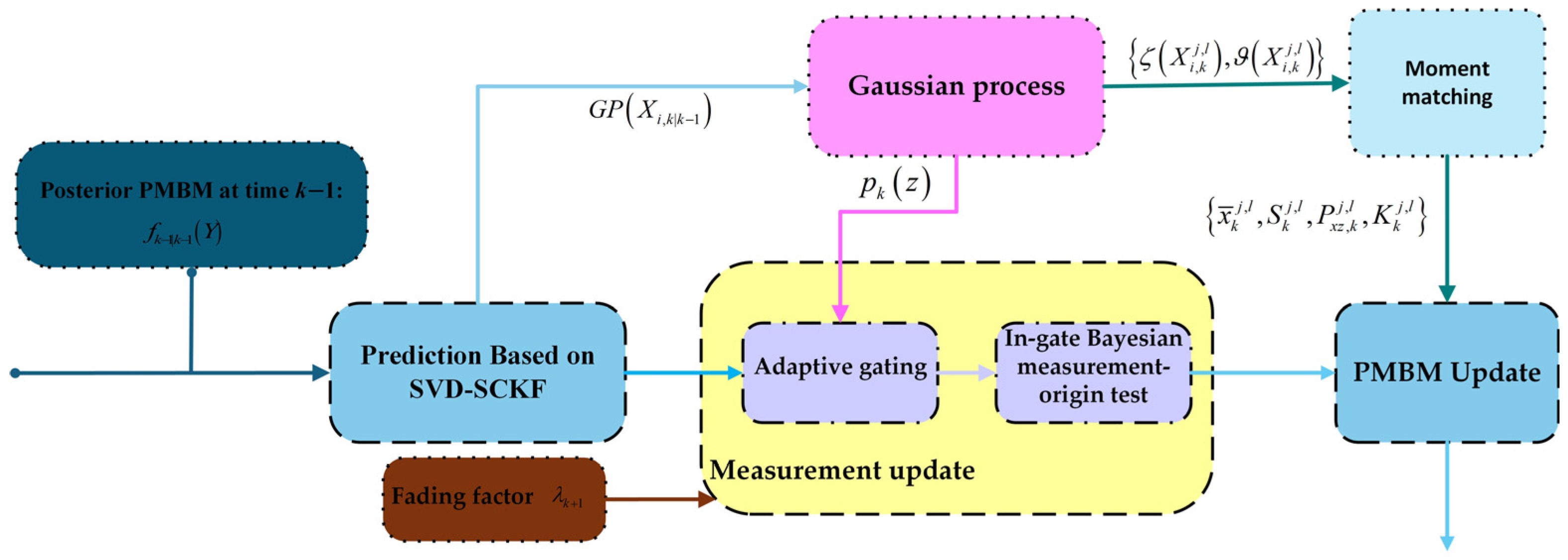
- In the PMBM recursion, each Gaussian component in the PPP and Bernoulli parts is predicted by converting its covariance into a stable square-root using the singular value decomposition (SVD), generating cubature points under SCKF and propagating them through state transition, obtaining the predicted mean and covariance by weighted regression, inflating the predicted covariance using a fading factor under target maneuvers and model mismatch.
- (2)
- In the update stage, the GP is trained using historical state-measurement samples to learn the measurement mapping and provide state-dependent uncertainty, from which a more reliable measurement likelihood is formed for generating update hypotheses and computing their association weights.
- (3)
- The cubature-point approximation of the prior from the prediction stage is combined with the GP-based conditional measurement distributions to yield a predictive measurement distribution. The gating threshold is determined and the resulting region is fitted by an equivalent ellipsoidal gate to remain compatible with PMBM association. The Bayesian measurement test is conducted inside the gate so that the posterior probability that a measurement is target-originated is used as a weight in association and update, reducing the low-credibility measurements on state updating.
2. Preliminaries
2.1. System Model
2.2. PMBM Filter
2.3. SVD Implementation of SCKF
2.3.1. Prediction
2.3.2. Update
2.4. GP Learning of Measurement Function
3. Proposed Filter
3.1. Overall Architecture
3.2. Prediction Based on SVD-SCKF
3.3. Measurement Gating and Classification
3.3.1. GP-Driven Gating Region Construction
3.3.2. Probabilistic Clutter Assessment Inside the Gate
3.4. GP-Based Update
3.5. Algorithm Summary and Complexity
3.5.1. Computational Cost of GP-Based Measurement Processing
3.5.2. Data Association Complexity with and Without Gating
4. Simulation Experiments
4.1. Simulation Settings
4.2. GP Regression Settings
4.3. Simulation Results
4.4. Tracking Simulation Results Under Highly Maneuvering Scenarios
5. Discussion
6. Conclusions
Author Contributions
Funding
Institutional Review Board Statement
Informed Consent Statement
Data Availability Statement
Conflicts of Interest
Abbreviations
| target state vector | |
| measurement vector | |
| state-transition function | |
| measurement function | |
| process noise | |
| measurement noise | |
| process-noise covariance | |
| measurement-noise covariance | |
| multi-target state set | |
| measurement set | |
| Poisson RFS density | |
| multi-Bernoulli mixture (MBM) RFS density | |
| clutter intensity function | |
| Bernoulli existence probability | |
| single-target state density | |
| weight of global hypothesis j | |
| index set of Bernoulli components in hypothesis j | |
| i-th cubature point | |
| propagated cubature point through the state-transition function | |
| covariance matrix in expectation form | |
| state covariance matrix | |
| fading factor | |
| Kalman gain | |
| GP kernel matrix | |
| GP hyperparameter set | |
| GM birth intensity for newborn targets | |
| number of Gaussian components in the birth intensity | |
| weight of the m-th Gaussian component in the birth intensity | |
| mean of the m-th Gaussian component in the birth intensity | |
| covariance matrix of the m-th Gaussian component in the birth intensity | |
| gating region | |
| gating threshold | |
| Poisson clutter rate | |
| normalized predictive density | |
| CPHD | Cardinalized Probability Hypothesis Density |
| GOSPA | Generalized Optimal Subpattern Assignment |
| GLMB | Generalized Labeled Multi-Bernoulli |
| GP | Gaussian Process |
| KLD | Kullback–Leibler Divergence |
| LMB | Labeled Multi-Bernoulli |
| OSPA | Optimal Subpattern Assignment |
| SCKF | Square-Root Cubature Kalman Filter |
| SMC | Sequential Monte Carlo |
| SVD | Singular Value Decomposition |
Appendix A. Robustness of SVD Implementation
Appendix B. Pseudocode
| Algorithm A1: Prediction based on SVD-SCKF in GM-PMBM filter |
| Input: Birth PPP intensity ; prior PPP intensity ; Bernoulli components survival probability ; process-noise covariance . //PPP prediction (each GM component): for do Compute SVD square-root via (6)–(7), then form cubature points via (48) Propagate cubature points and compute via (49)–(51). Compute according to (46) end for //Bernoulli prediction (each component): for all Bernoulli components do Compute the predicted existence probability according to (53). Compute the predicted Bernoulli component weight according to (54). Compute SVD square-root via (6) and (7), then form cubature points via (57). Propagate cubature points and compute via (55) and (56). Compute according to (52). end for Output: Predicted PPP intensity and Bernoulli component . |
Appendix C. Pseudocode
| Algorithm A2: GP-aided cubature update for GM-PMBM filter with sliding-window training set |
| Input: Predicted PMBM parameters at k: PPP GM ; Bernoulli set ; measurement set ; clutter intensity ; cubature directions ; window length L; previous GP training set . //Sliding-window update of GP training set Append new training pairs into to form; discard the oldest pairs if . //Pre-compute GP matrices Compute and . //GP prediction at cubature points and moment matching for PPP GM component do points . For each , compute and , then obtain the GP posterior prediction (cf. (59) and (60)): and Moment matching yields , , and . end for for Bernoulli component (j,l) do: Generate cubature points ; Compute , , , , and obtain , , , by the same moment-matching formulas. end for Output: Updated PMBM posterior at k. |
References
- Vo, B.-N.; Vo, B.-T.; Nguyen, T.T.D.; Shim, C. An overview of multi-object estimation via labeled random finite set. IEEE Trans. Signal Process. 2024, 72, 4888–4917. [Google Scholar] [CrossRef]
- Trezza, A.; Bucci, D.J.; Varshney, P.K. Multi-sensor joint adaptive birth sampler for labeled random finite set tracking. IEEE Trans. Signal Process. 2022, 70, 1010–1025. [Google Scholar] [CrossRef]
- García-Fernández, Á.F.; Williams, J.L.; Svensson, L.; Xia, Y. Poisson multi-Bernoulli mixture filter with general target-generated measurements and arbitrary clutter. IEEE Trans. Signal Process. 2023, 71, 1895–1906. [Google Scholar] [CrossRef]
- Zhu, H.; Zhang, G.; Li, Y.; Leung, H. A novel robust Kalman filter with unknown non-stationary heavy-tailed noise. Automatica 2021, 127, 109511. [Google Scholar] [CrossRef]
- Li, S.; Battistelli, G.; Chisci, L.; Yi, W.; Wang, B.; Kong, L. Computationally efficient multi-agent multi-object tracking with labeled random finite sets. IEEE Trans. Signal Process. 2019, 67, 260–275. [Google Scholar] [CrossRef]
- García-Fernández, Á.F.; Svensson, L. Trajectory PHD and CPHD filters. IEEE Trans. Signal Process. 2019, 67, 5702–5714. [Google Scholar] [CrossRef]
- Yu, B.; Li, T.; Gu, H. Robust CPHD fusion for distributed multitarget tracking using asynchronous sensors. IEEE Sens. J. 2022, 22, 1030–1040. [Google Scholar] [CrossRef]
- Wei, S.; García-Fernández, Á.F.; Yi, W. The Trajectory PHD filter for coexisting point and extended target tracking. IEEE Trans. Aerosp. Electron. Syst. 2025, 61, 5669–5685. [Google Scholar] [CrossRef]
- García-Fernández, Á.F.; Svensson, L.; Williams, J.L.; Xia, Y.; Granström, K. Trajectory Poisson Multi-Bernoulli filters. IEEE Trans. Signal Process. 2020, 68, 4933–4945. [Google Scholar] [CrossRef]
- Li, T.; Wang, X.; Liang, Y.; Pan, Q. On arithmetic average fusion and its application for distributed multi-Bernoulli multitarget tracking. IEEE Trans. Signal Process. 2020, 68, 2883–2896. [Google Scholar] [CrossRef]
- Davies, E.S.; García-Fernández, Á.F. Information exchange track-before-detect multi-Bernoulli filter for superpositional sensors. IEEE Trans. Signal Process. 2024, 72, 607–621. [Google Scholar] [CrossRef]
- Wei, J.; Luo, F.; Qi, J.; Luo, X. Distributed fusion of labeled multi-Bernoulli filters based on arithmetic average. IEEE Signal Process. Lett. 2024, 31, 656–660. [Google Scholar] [CrossRef]
- Vo, B.-N.; Vo, B.-T.; Hoang, H.G. An efficient implementation of the generalized labeled multi-Bernoulli filter. IEEE Trans. Signal Process. 2017, 65, 1975–1987. [Google Scholar] [CrossRef]
- García-Fernández, Á.F.; Williams, J.L.; Granström, K.; Svensson, L. Poisson multi-Bernoulli mixture filter: Direct derivation and implementation. IEEE Trans. Aerosp. Electron. Syst. 2018, 54, 1883–1901. [Google Scholar] [CrossRef]
- García-Fernández, Á.F.; Williams, J.L.; Svensson, L.; Xia, Y. A Poisson multi-Bernoulli mixture filter for coexisting point and extended targets. IEEE Trans. Signal Process. 2021, 69, 2600–2610. [Google Scholar] [CrossRef]
- Li, G.; Li, G.; He, Y. PMBM-based unresolved-group object tracking. IEEE Trans. Aerosp. Electron. Syst. 2024, 60, 4229–4240. [Google Scholar] [CrossRef]
- Naesseth, C.A.; Lindsten, F.; Schön, T.B. High-dimensional filtering using nested sequential Monte Carlo. IEEE Trans. Signal Process. 2019, 67, 4177–4188. [Google Scholar] [CrossRef]
- Li, J.; Wang, Z.; Hu, J.; Dong, H.; Liu, H. Cubature Kalman fusion filtering under amplify-and-forward relays with randomly varying channel parameters. IEEE CAA J. Autom. Sin. 2025, 12, 356–368. [Google Scholar] [CrossRef]
- Zhao, J.; Mili, L. A robust generalized-maximum likelihood unscented Kalman filter for power system dynamic state estimation. IEEE J. Sel. Top. Signal Process. 2018, 12, 578–592. [Google Scholar] [CrossRef]
- Shen, C.; Zhang, Y.; Guo, X.; Chen, X.; Cao, H.; Tang, J.; Li, J.; Liu, J. Seamless GPS/Inertial navigation system based on self-learning square-root cubature Kalman filter. IEEE Trans. Ind. Electron. 2021, 68, 499–508. [Google Scholar] [CrossRef]
- Kulikov, G.Y.; Kulikova, M.V. Square-root high-degree cubature Kalman filters for state estimation in nonlinear continuous-discrete stochastic systems. Eur. J. Control 2021, 59, 58–68. [Google Scholar] [CrossRef]
- Qi, J.; Sun, K.; Wang, J.; Liu, H. Dynamic state estimation for multi-machine power system by unscented Kalman filter with enhanced numerical stability. IEEE Trans. Smart Grid 2018, 9, 1184–1196. [Google Scholar] [CrossRef]
- Kulikova, M.V.; Kulikov, G.Y. SVD-based factored-form cubature Kalman filtering for continuous-time stochastic systems with discrete measurements. Automatica 2020, 120, 109110. [Google Scholar] [CrossRef]
- Kulikov, M.V.; Kulikova, G.Y. Square-root filtering via covariance SVD factors in the accurate continuous-discrete extended-cubature Kalman filter. Appl. Numer. Math. 2022, 171, 32–44. [Google Scholar] [CrossRef]
- Wahlström, N.; Özkan, E. Extended target tracking using Gaussian processes. IEEE Trans. Signal Process. 2015, 63, 4165–4178. [Google Scholar] [CrossRef]
- Yang, Z.; Li, X.; Yao, X.; Sun, J.; Shan, T. Gaussian process Gaussian mixture PHD filter for 3D multiple extended target tracking. Remote Sens. 2023, 15, 3224. [Google Scholar] [CrossRef]
- Zhao, Z.; Chen, H.; Lian, F.; Zhang, G.; Zhang, W. Gaussian process cognitive learning multiple maneuvering target Poisson multi-Bernoulli mixture filter. J. Electron. Inf. Technol. 2025, 47, 2724–2735. [Google Scholar] [CrossRef]
- Al-Ali, M.H.; Ho, K.C. Objective Bayesian approach for binary hypothesis testing of multivariate Gaussian observations. IEEE Trans. Inf. Theory 2023, 69, 1337–1354. [Google Scholar] [CrossRef]
- Miller, M.L.; Stone, H.S.; Cox, I.J. Optimizing Murty’s ranked assignment method. IEEE Trans. Aerosp. Electron. Syst. 1997, 33, 851–862. [Google Scholar] [CrossRef]
- Schuhmacher, D.; Vo, B.-T.; Vo, B.-N. A consistent metric for performance evaluation of multi-object filters. IEEE Trans. Signal Process. 2008, 56, 3447–3457. [Google Scholar] [CrossRef]
- Li, G.; Kong, L.; Zhou, T.; Tian, T.; Yi, W. Robust Poisson multi-Bernoulli mixture filter with unknown detection probability. arXiv 2019, arXiv:1907.01599v3. [Google Scholar] [CrossRef]
- Chen, S.; Li, B.; Zhang, L. Algorithm of multi-model Poisson multi-Bernoulli mixture filter for nonlinear MTT. J. Chin. Comput. Syst. 2024, 45, 629–635. [Google Scholar] [CrossRef]





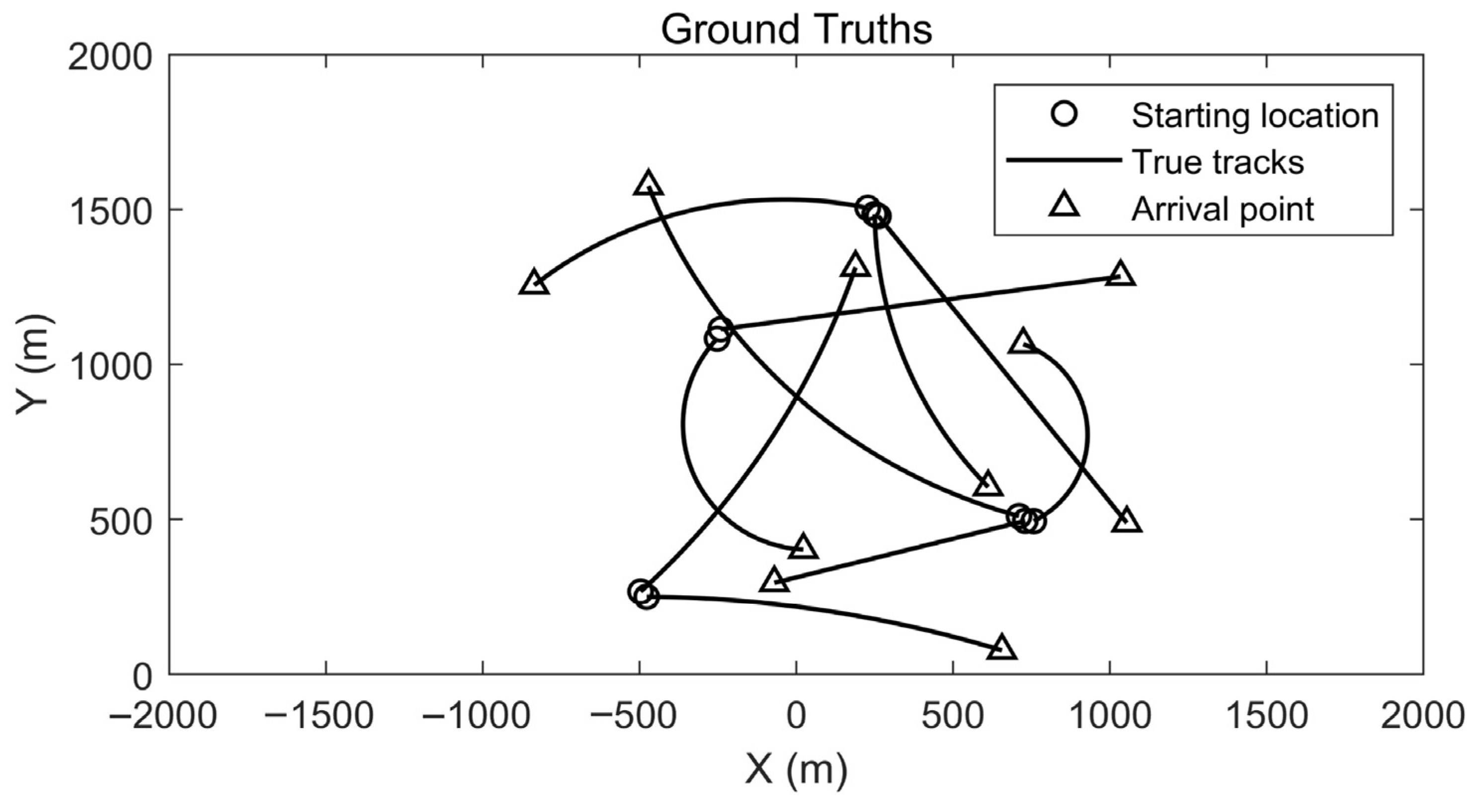
| Target Label | Initial State (m, m/s) | Angular Velocity (rad/s) | Starting and Ending Time (s) |
|---|---|---|---|
| 1 | [253, 10, 1488, −10]T | 0 | (1, 101) |
| 2 | [−255, 15, 1111, 2]T | 0 | (15, 101) |
| 3 | [507, 11, 257, 10]T | ωturn/6 | (15, 101) |
| 4 | [500, 23, 250, 0]T | ωturn/6 | (20, 70) |
| 5 | [746, 11, 489, 5]T | 9ωturn/10 | (20, 80) |
| 6 | [−243, 10, 1094, −10]T | ωturn/1 | (35, 101) |
| 7 | [250, 0, 1500, −15]T | ωturn/3 | (35, 101) |
| 8 | [750, −40, 500, 10]T | −3ωturn/2 | (40, 80) |
| 9 | [250, −22, 1500, −15]T | ωturn/2 | (50, 101) |
| 10 | [750, −20, 500, −5]T | 0 | (60, 101) |
| GM-PMBM Filter | GM-PMBM-SCKF | GP-GM-PMBM-SCKF | Proposed Filter | |
|---|---|---|---|---|
| 10 | 4.71 | 5.45 | 5.31 | 5.22 |
| 20 | 7.17 | 8.26 | 8.42 | 7.31 |
| () | M0-PMBM | M1-PMBM | ||||||
|---|---|---|---|---|---|---|---|---|
| GOSPA | LE | ME | FE | GOSPA | LE | ME | FE | |
| (0.98, 10) | 2.7493 | 1.7756 | 1.9282 | 0.8281 | 2.6971 | 1.7242 | 1.9122 | 0.8040 |
| (0.98, 15) | 2.7908 | 1.7963 | 1.9581 | 0.8532 | 2.7587 | 1.7391 | 1.9671 | 0.8463 |
| (0.98, 20) | 2.8238 | 1.8011 | 1.9691 | 0.9234 | 2.7898 | 1.7562 | 1.9732 | 0.8971 |
| (0.90, 10) | 2.7940 | 1.7967 | 1.9671 | 0.8417 | 2.7778 | 1.7762 | 1.9632 | 0.8406 |
| (0.90, 20) | 2.8732 | 1.8011 | 2.0120 | 0.9817 | 2.8422 | 1.7983 | 1.9875 | 0.9456 |
| (0.68, 10) | 3.8715 | 2.2153 | 2.9391 | 1.2011 | 3.8219 | 2.1214 | 2.8431 | 1.1261 |
| (0.68, 20) | 4.2987 | 2.2431 | 3.4104 | 1.3475 | 4.1371 | 2.1435 | 3.3015 | 1.2731 |
| () | M2-PMBM | M3-PMBM | ||||||
|---|---|---|---|---|---|---|---|---|
| GOSPA | LE | ME | FE | GOSPA | LE | ME | FE | |
| (0.98, 10) | 2.6155 | 1.7613 | 1.7932 | 0.7234 | 2.5397 | 1.7525 | 1.7241 | 0.6374 |
| (0.98, 15) | 2.6701 | 1.7883 | 1.8163 | 0.7952 | 2.5756 | 1.7762 | 1.7431 | 0.6633 |
| (0.98, 20) | 2.7323 | 1.8156 | 1.8576 | 0.8477 | 2.6483 | 1.8021 | 1.7972 | 0.7322 |
| (0.90, 10) | 2.7389 | 1.8457 | 1.8542 | 0.8105 | 2.6661 | 1.8331 | 1.8011 | 0.7102 |
| (0.90, 20) | 2.8045 | 1.8721 | 1.8932 | 0.8812 | 2.7417 | 1.8930 | 1.8261 | 0.7738 |
| (0.68, 10) | 3.7322 | 2.2362 | 2.7806 | 1.0941 | 3.5658 | 2.2147 | 2.6231 | 0.9642 |
| (0.68, 20) | 4.0416 | 2.2561 | 3.1435 | 1.1678 | 3.9652 | 2.3011 | 3.0452 | 1.0744 |
Disclaimer/Publisher’s Note: The statements, opinions and data contained in all publications are solely those of the individual author(s) and contributor(s) and not of MDPI and/or the editor(s). MDPI and/or the editor(s) disclaim responsibility for any injury to people or property resulting from any ideas, methods, instructions or products referred to in the content. |
© 2026 by the authors. Licensee MDPI, Basel, Switzerland. This article is an open access article distributed under the terms and conditions of the Creative Commons Attribution (CC BY) license.
Share and Cite
Jia, W.; Li, B.; Zhang, J.; Zhou, Y. Novel Multi-Target Tracking Method: PMBM Filter Combined SVD-SCKF with GP-Driven Measurements. Sensors 2026, 26, 2613. https://doi.org/10.3390/s26092613
Jia W, Li B, Zhang J, Zhou Y. Novel Multi-Target Tracking Method: PMBM Filter Combined SVD-SCKF with GP-Driven Measurements. Sensors. 2026; 26(9):2613. https://doi.org/10.3390/s26092613
Chicago/Turabian StyleJia, Wentao, Bo Li, Jinyu Zhang, and Yubin Zhou. 2026. "Novel Multi-Target Tracking Method: PMBM Filter Combined SVD-SCKF with GP-Driven Measurements" Sensors 26, no. 9: 2613. https://doi.org/10.3390/s26092613
APA StyleJia, W., Li, B., Zhang, J., & Zhou, Y. (2026). Novel Multi-Target Tracking Method: PMBM Filter Combined SVD-SCKF with GP-Driven Measurements. Sensors, 26(9), 2613. https://doi.org/10.3390/s26092613