Two-Signal Set and Adaptive Spectral Decomposition Algorithm for Estimating the Phase Velocity of Dispersive Lamb Wave Mode

Abstract
1. Introduction
2. Algorithm for the Phase Velocity Evaluation
2.1. The Filtering of the Signals
- The filtering is conducted using the spectrum decomposition technique:
- Two signals u1 (t), u2 (t) are fixed.
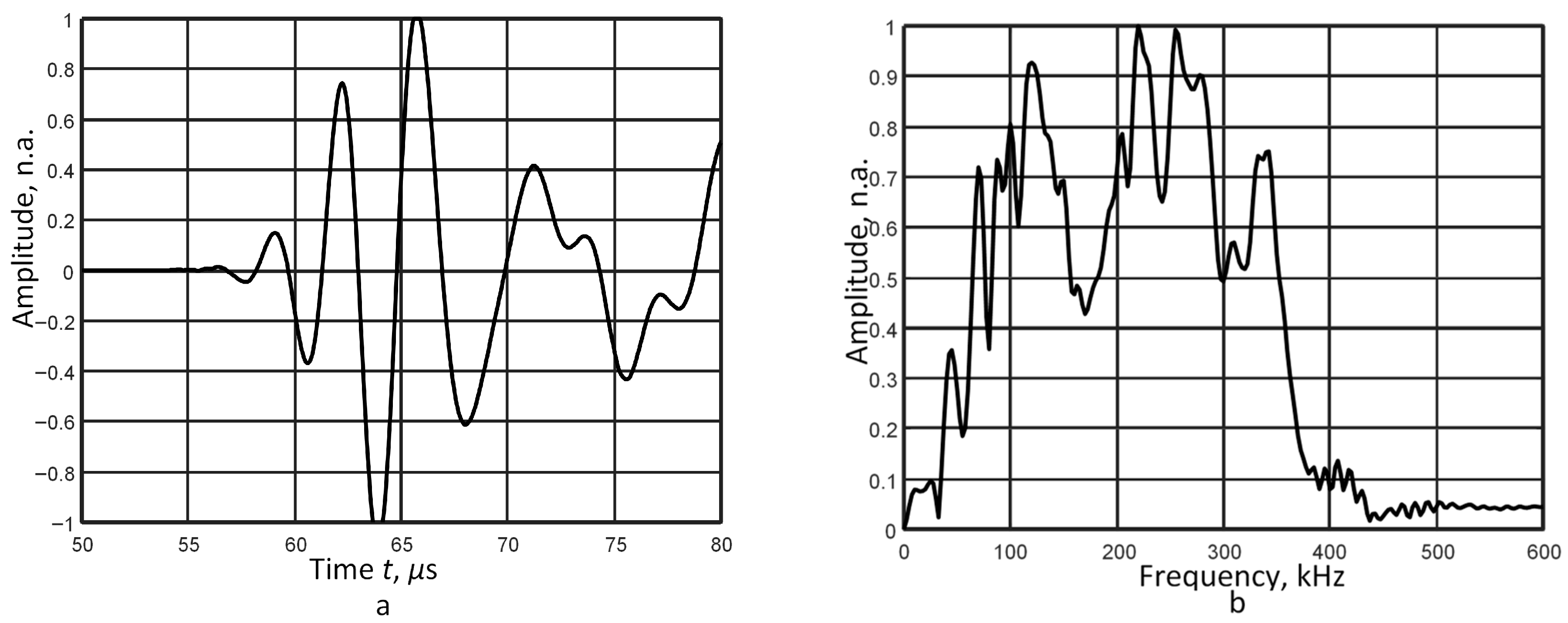
- The frequency spectra for both acquired signals are computed using the Fourier transform.
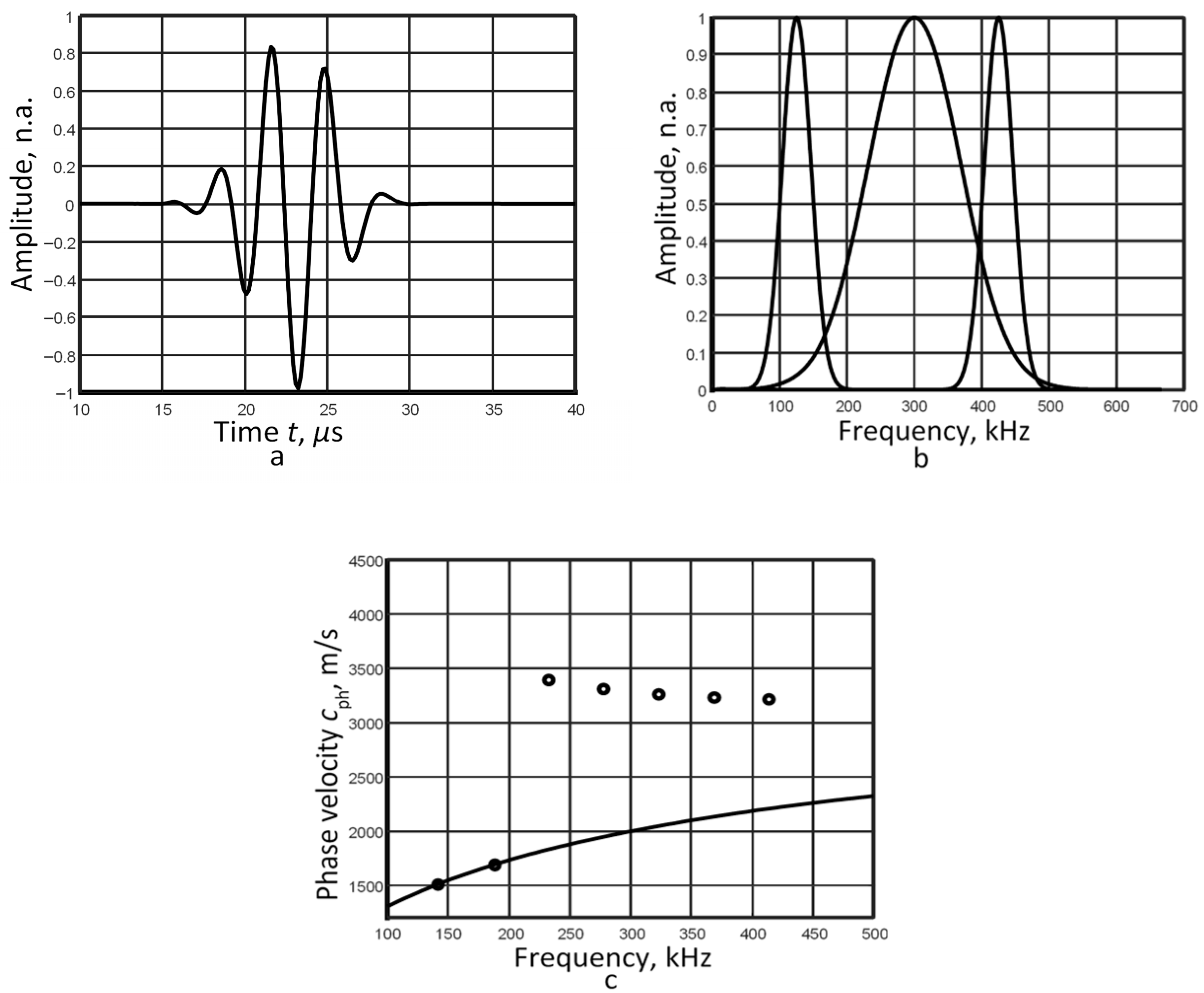
- The filtering is performed using Gaussian filters [20]. Based on the obtained frequency spectra, the frequency ranges in which filtering is performed are determined, the central frequencies of the filters are selected, and the filter bandwidth is determined. The number of filtering operations is calculated according to the expression presented by He [20]:where fL and fH define the frequency ranges in which the central frequencies of the filters are varied; B is the filter bandwidth.
- The filtered signals are restored using the Inverse Fourier transform.
- The zero-crossing technique is employed to calculate a point of the phase velocity dispersion curve:
- The threshold level L is determined.
- The phase velocity value (cph) is calculated using the time instants at which both signals cross the zero-amplitude line and :
- The equivalent frequency value, which corresponds to the calculated duration of half-period of the second signal, is estimated using the time instants at which the signal crosses the zero-amplitude line , by:
- The frequency value () is determined:
- The point of the phase velocity dispersion curve is determined, which is described by creating a set of pairs of frequency and determined phase velocity values:
2.2. Modified Algorithm
- Once the two signals are selected, the maximum distance between them is determined based on the object geometry, material properties, and frequency range of the study. The performed study shows that this distance can be determined from the dispersion curves of the phase and group velocities at the central frequency accordingly [13]:where is the group velocity at the central frequency, and is the phase velocity at the central frequency.
- The central frequencies are determined. Depending on how wide the phase velocity dispersion curve should be reproduced and how many points are needed to determine its nature, the number of central frequencies is selected.
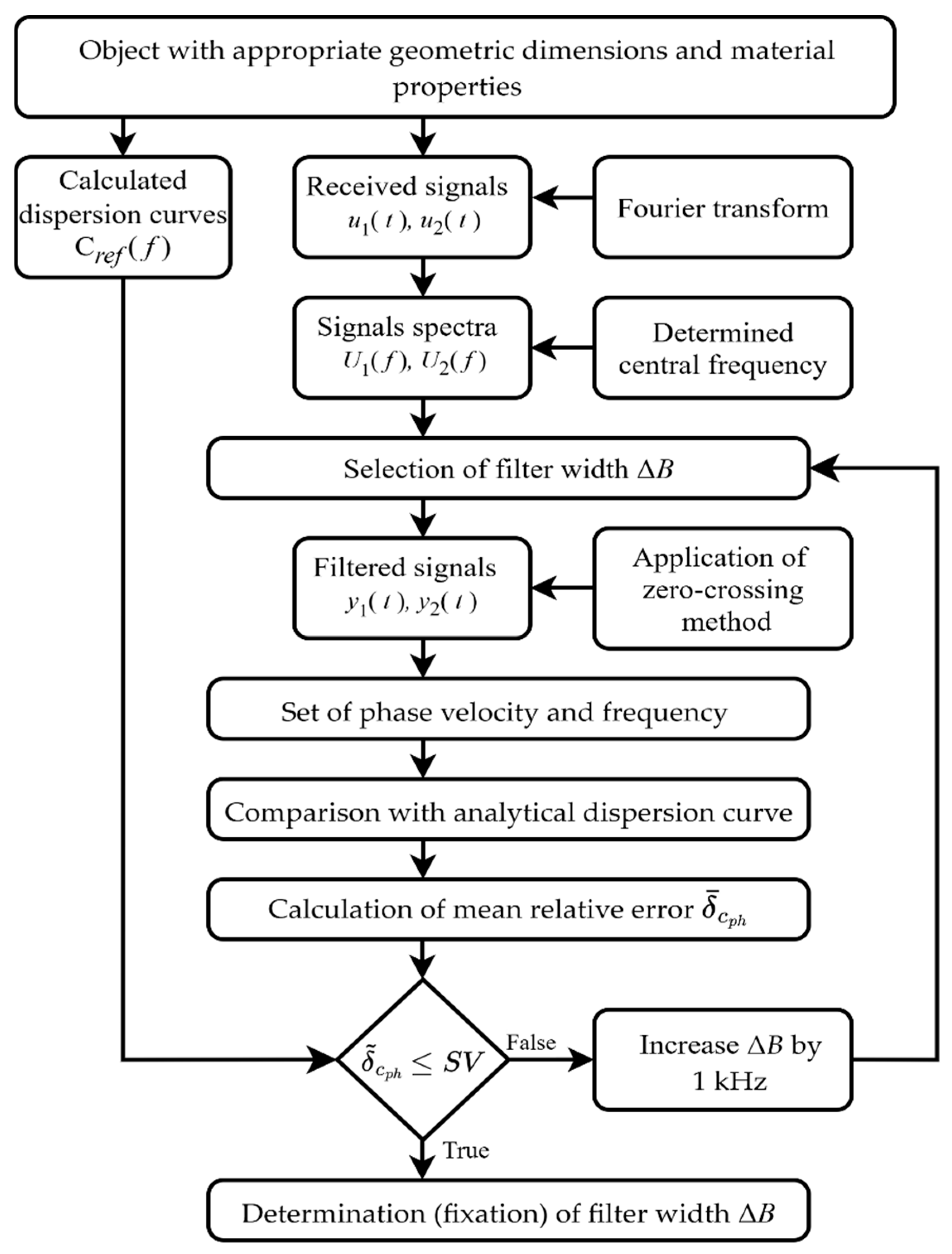
- The width of the filter bandwidth is set. According to the presented algorithm (Figure 2), the width of the filter bandwidth is determined for each selected central frequency using the same set of two signals.
- The filtered signals are restored using the Inverse Fourier transform.
- The zero-crossing technique is applied to obtain a set of phase velocities and frequencies.
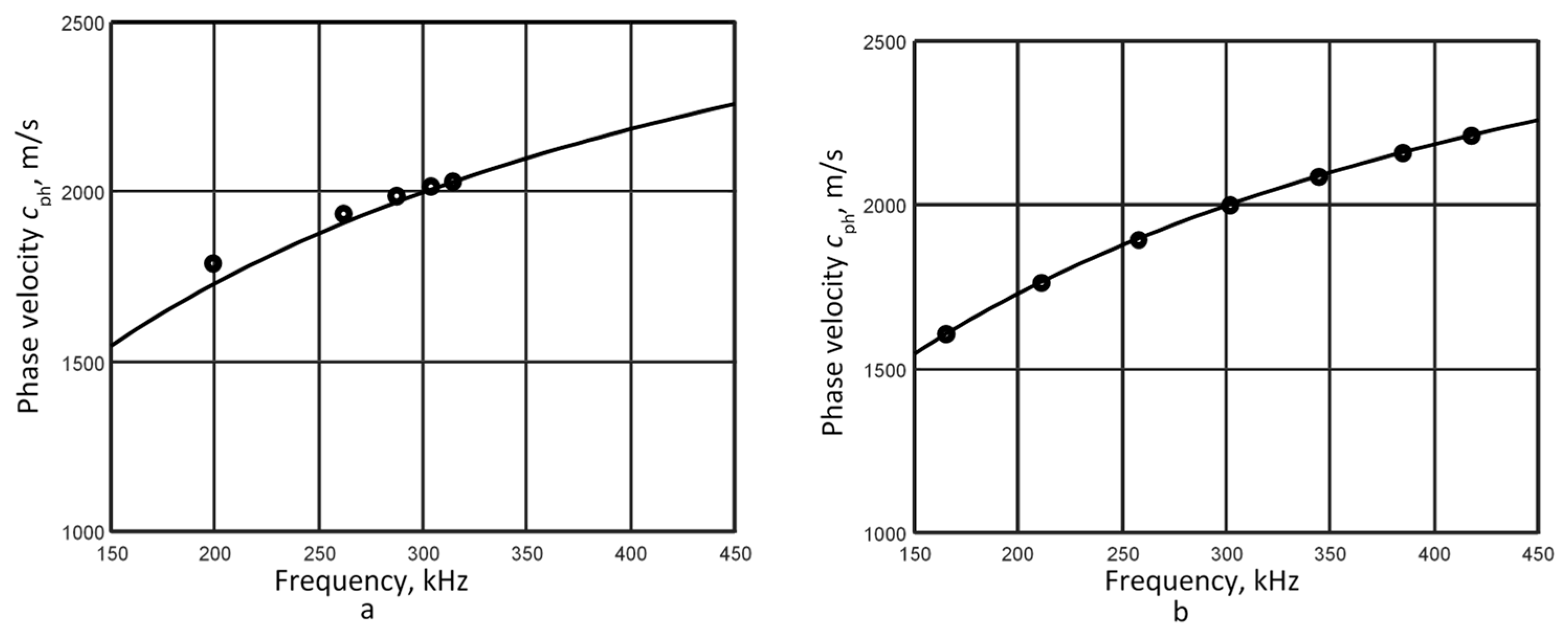
- Each time, the result obtained using a different width of the filter bandwidth at the selected central frequency is compared with the calculated analytical dispersion curve. This comparison of the obtained values shows whether the phase velocity is calculated correctly [20]. If the result deviates from the analytical value, the algorithm iterates through the sequence using a modified bandwidth until a match is achieved.
- The calculated average relative error indicates whether the selected filter width is appropriate. Therefore, it is essential to first establish a maximum permissible error and then select the filter according to that limit. In this theoretical context, a maximum relative error of 1% is used. After obtaining a set of phase velocity and frequency values that meet the criterion SV, the calculation of the remaining values is performed according to the described algorithm.
- The algorithm is repeated for each specified central frequency.
3. Theoretical Study
- -
- The equivalent frequencies are estimated based on the calculated durations of the selected half-periods of the second signal. The duration of the second signal, with selected half-periods , , …, , is calculated:The frequency values () for the dispersion curve reconstruction are determined:
- -
- The phase velocity dispersion curve segment is obtained, which is described by creating sets of pairs of frequencies and determining the phase velocities:
4. Experimental Verification
5. Evaluation of Method Reliability Characteristics
6. Conclusions
Author Contributions
Funding
Data Availability Statement
Conflicts of Interest
References
- Gorgin, R.; Luo, Y.; Wu, Z. Environmental and operational conditions effects on Lamb wave based structural health monitoring systems: A review. Ultrasonics 2020, 105, 106114. [Google Scholar] [CrossRef]
- Chia, C.C.; Lee, S.Y.; Harmin, M.Y.; Choi, Y.; Lee, J.-R. Guided ultrasonic waves propagation imaging: A review. Meas. Sci. Technol. 2023, 34, 052001. [Google Scholar] [CrossRef]
- Wang, M.; Pau, A.; Zhang, G.; Kundu, T. Monitoring prestress in plates by sideband peak count-index (SPC-I) and nonlinear higher harmonics techniques. Nonlinear Dyn. 2023, 111, 15749–15766. [Google Scholar] [CrossRef]
- Ghavamian, A.; Mustapha, F.; Baharudin, B.T.H.T.; Yidris, N. Detection, Localisation and Assessment of Defects in Pipes Using Guided Wave Techniques: A Review. Sensors 2018, 18, 4470. [Google Scholar] [CrossRef]
- Rose, J.L. Ultrasonic Guided Waves in Solid Media; Cambridge University Press: Cambridge, UK, 2014. [Google Scholar] [CrossRef]
- Galán-Pinilla, C.A.; E-Quiroga, J.; Peña-Ballesteros, D.Y.; Acosta-Minoli, C.A.; González-Estrada, O.A. Comparative Study of Dispersion Curves for LAMB Waves Using Analytical Solutions and Semi-Analytical Methods. Appl. Sci. 2023, 13, 1706. [Google Scholar] [CrossRef]
- Sorohan, Ş.; Constantin, N.; Gǎvan, M.; Anghel, V. Extraction of dispersion curves for waves propagating in free complex waveguides by standard finite element codes. Ultrasonics 2011, 51, 503–515. [Google Scholar] [CrossRef] [PubMed]
- Draudviliene, L.; Meskuotiene, A. The methodology for the reliability evaluation of the signal processing methods used for the dispersion estimation of Lamb waves. IEEE Trans. Instrum. Meas. 2021, 71, 1–7. [Google Scholar] [CrossRef]
- Alleyne, D.; Cawley, P. A two-dimensional Fourier transform method for the measurement of propagating multimode signals. J. Acoust. Soc. Am. 1991, 89, 1159–1168. [Google Scholar] [CrossRef]
- Su, Z.; Ye, L.; Lu, Y. Guided Lamb waves for identification of damage in composite structures: A review. J. Sound Vib. 2006, 295, 753–780. [Google Scholar] [CrossRef]
- Schöpfer, F.; Binder, F.; Wöstehoff, A.; Schuster, T.; von Ende, S.; Föll, S.; Lammering, R. Accurate determination of dispersion curves of guided waves in plates by applying the matrix pencil method to laser vibrometer measurement data. CEAS Aeronaut. J. 2013, 4, 61–68. [Google Scholar] [CrossRef]
- Moreno, E.; Galarza, N.; Rubio, B.; Otero, J.A. Phase Velocity Method for Guided Wave Measurements in Composite Plates. Phys. Procedia 2015, 63, 54–60. [Google Scholar] [CrossRef]
- Draudvilienė, L.; Meškuotienė, A. A Tool to Estimate the Phase Velocity Dispersion of Different Lamb Wave Modes Using Datasets of Two Signals Measured at Identical Distances. IEEE Trans. Instrum. Meas. 2025, 74, 1–9. [Google Scholar] [CrossRef]
- Zabbal, P.; Ribay, G.; Chapuis, B.; Jumel, J. Multichannel Multiple Signal Classification for dispersion curves extraction of ultrasonic guided waves. J. Acoust. Soc. Am. 2018, 143, EL87–EL92. [Google Scholar] [CrossRef] [PubMed]
- Olisa, S.C.; Khan, M.A.; Starr, A. Review of Current Guided Wave Ultrasonic Testing (GWUT) Limitations and Future Directions. Sensors 2021, 21, 811. [Google Scholar] [CrossRef] [PubMed]
- Zeng, L.; Cao, X.; Huang, L.; Luo, Z. The measurement of Lamb wave phase velocity using analytic cross-correlation method. Mech. Syst. Signal Process. 2021, 151, 107387. [Google Scholar] [CrossRef]
- Crespo, B.H.; Courtney, C.; Engineer, B. Calculation of Guided Wave Dispersion Characteristics Using a Three-Transducer Measurement System. Appl. Sci. 2018, 8, 1253. [Google Scholar] [CrossRef]
- Hu, Y.; Zhu, Y.; Tu, X.; Lu, J.; Li, F. Dispersion curve analysis method for Lamb wave mode separation. Struct. Health Monit. 2020, 19, 1590–1601. [Google Scholar] [CrossRef]
- Draudviliene, L.; Tumsys, O.; Mazeika, L.; Zukauskas, E. Estimation of the Lamb wave phase velocity dispersion curves using only two adjacent signals. Compos. Struct. 2021, 258, 113174. [Google Scholar] [CrossRef]
- He, P. Simulation of ultrasound pulse propagation in lossy media obeying a frequency power law. IEEE Trans. Ultrason. Ferroelectr. Freq. Control 1998, 45, 114–125. [Google Scholar] [CrossRef]
- Vladišauskas, A.; Šliteris, R.; Raišutis, R.; Seni, G. Contact ultrasonic transducers for mechanical scanning systems. Ultragarsas/Ultrasound 2010, 65, 30–35. [Google Scholar]
- Özdamar, Ö.; Bohórquez, J. Signal-to-noise ratio and frequency analysis of continuous loop averaging deconvolution (CLAD) of overlapping evoked potentials. J. Acoust. Soc. Am. 2006, 119, 429–438. [Google Scholar] [CrossRef] [PubMed]
- Gao, X.; Tian, Y.; Jiao, J.; Li, C.; Gao, J. Non-destructive measurements of thickness and elastic constants of plate structures based on Lamb waves and particle swarm optimization. Measurement 2022, 204, 111981. [Google Scholar] [CrossRef]



| Distance Between the Signals (x1–x2), mm | Central Frequencies of the Filter, kHz | ||||||
|---|---|---|---|---|---|---|---|
| 150 | 200 | 250 | 300 | 350 | 400 | 450 | |
| Bandwidth of the Filter ΔB, kHz | |||||||
| 25–43 | 50 | 50 | 56 | 57 | 66 | 68 | 73 |
| 48–66 | 50 | 50 | 58 | 59 | 70 | 72 | 83 |
| 95–113 | 50 | 52 | 64 | 65 | 79 | 83 | 110 |
| Selected Pairs of Two Signals (x1–x2), mm | Threshold L | Frequency Range f, kHz | Frequency Difference cph, kHz | Mean Relative Error , % |
|---|---|---|---|---|
| 25–43 | 0.1 | 263–311 | 48 | 0.56 |
| 48–66 | 0.16 | 199–320 | 121 | 1.2 |
| 95–113 | 0.35 | 117–329 | 212 | 2.36 |
| Selected Pairs of Two Signals (x1–x2), mm | Frequency Range | Frequency Difference | Mean Relative Error , % | Standard Deviation of the Measurement Model , m/s |
|---|---|---|---|---|
| 25–43 | 164–424 | 260 | 0.1 | 1.3 |
| 48–66 | 165–418 | 253 | 0.12 | 1.7 |
| 95–113 | 167–405 | 238 | 0.13 | 1.3 |
| Distance Between the Signals (x1–x2), mm | Central Frequencies of the Filter, kHz | |||||
|---|---|---|---|---|---|---|
| 100 | 150 | 200 | 250 | 300 | 350 | |
| Bandwidth of the Filter ΔB, kHz | ||||||
| 69–87 | 50 | 50 | 50 | 90 | 120 | 127 |
| 70–85 | 50 | 50 | 50 | 50 | 60 | 115 |
| 96–112 | 50 | 50 | 55 | 55 | 70 | 70 |
| 120–135 | 40 | 48 | 55 | 55 | 75 | 86 |
| 165–182 | 45 | 48 | 60 | 60 | 50 | 100 |
| Selected Pairs of Two Signals (x1–x2), mm | Threshold L | Frequency Range , kHz | Reconstructed Frequency Difference , kHz | Mean Relative Error % | Standard Deviation of the Velocity (Dispersion Curve) , m/s |
|---|---|---|---|---|---|
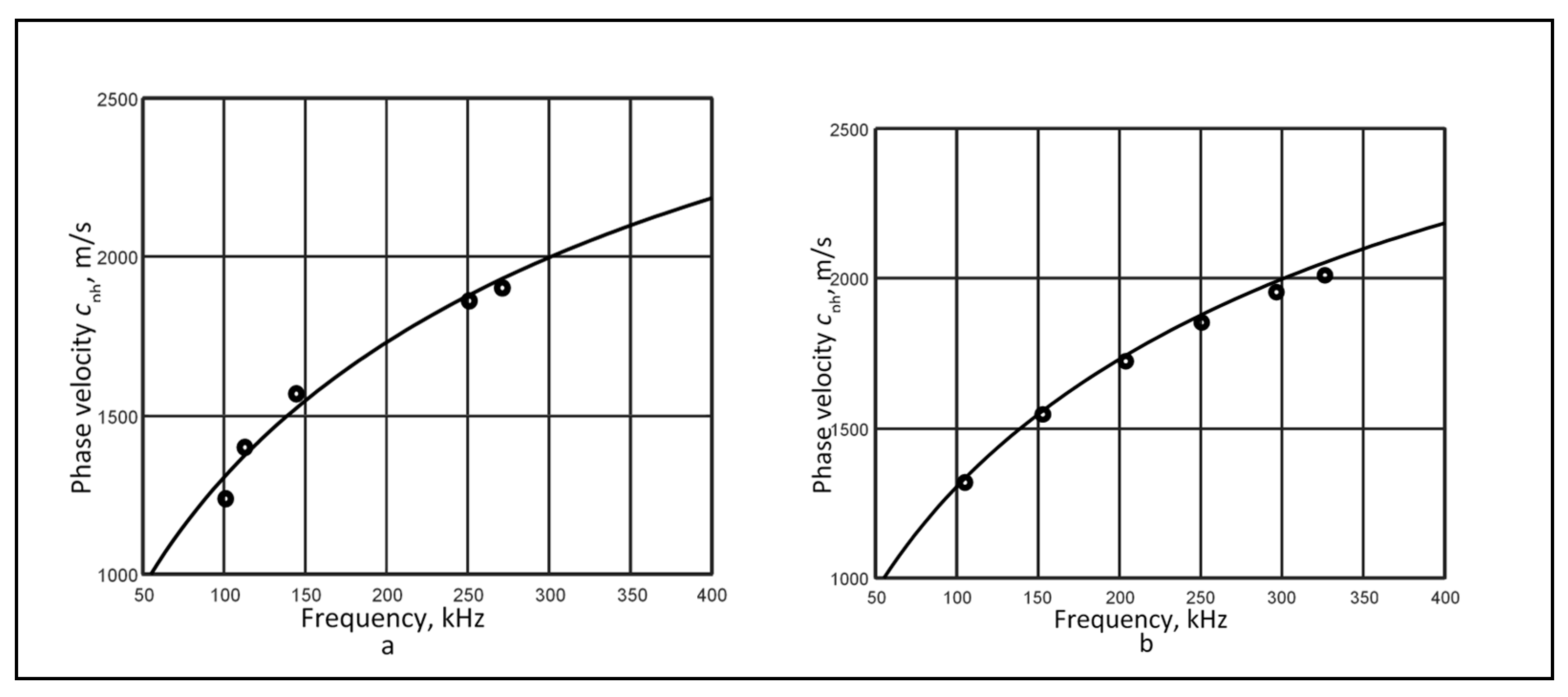
| 69–87 | 0.22 | 114–269 | 155 | 3.28 | 31.7 |
| 70–85 | 0.22 | 101–271 | 170 | 2.63 | 21.8 |
| 96–112 | 0.34 | 112–269 | 157 | 2.37 | 33.8 |
| 120–135 | 0.07 | 145–307 | 162 | 1.20 | 8.5 |
| 165–182 | 0.14 | 166–303 | 137 | 1.55 | 15.2 |
| Selected Pairs of Two Signals (x1–x2), mm | Frequency Range , kHz | Reconstructed Frequency Difference , kHz | Mean Relative Error , % | Standard Deviation of the Velocity (Dispersion Curve) , m/s |
|---|---|---|---|---|
| 69–87 | 105–323 | 218 | 1.50 | 10.5 |
| 70–85 | 105–335 | 230 | 1.33 | 12.3 |
| 96–112 | 104–341 | 237 | 0.41 | 2.00 |
| 120–135 | 107–336 | 229 | 0.40 | 6.2 |
| 165–182 | 106–333 | 227 | 0.26 | 1.3 |
| Sources of Combined Standard Uncertainty | Standard Uncertainty , m/s | Distribution | Sensitivity Coefficient W | Uncertainty Contribution , m/s |
|---|---|---|---|---|
| Mathematical model | 1.4 | Gaussian | 1 | 1.4 |
| Velocity (dispersion curve) | 6.5 | Gaussian | 1 | 6.5 |
| Fluctuations of the Lamb wave’s frequency f | 7.8 | Gaussian | 1 | 9.8 |
| Distance between two points | m | Rectangular | s | 2.9 |
| Combined standard uncertainty | uc = 0.6% | |||
Disclaimer/Publisher’s Note: The statements, opinions and data contained in all publications are solely those of the individual author(s) and contributor(s) and not of MDPI and/or the editor(s). MDPI and/or the editor(s) disclaim responsibility for any injury to people or property resulting from any ideas, methods, instructions or products referred to in the content. |
© 2026 by the authors. Licensee MDPI, Basel, Switzerland. This article is an open access article distributed under the terms and conditions of the Creative Commons Attribution (CC BY) license.
Share and Cite
Draudvilienė, L.; Meškuotienė, A.; Gadeikytė, A.; Lapienis, P. Two-Signal Set and Adaptive Spectral Decomposition Algorithm for Estimating the Phase Velocity of Dispersive Lamb Wave Mode. Sensors 2026, 26, 2190. https://doi.org/10.3390/s26072190
Draudvilienė L, Meškuotienė A, Gadeikytė A, Lapienis P. Two-Signal Set and Adaptive Spectral Decomposition Algorithm for Estimating the Phase Velocity of Dispersive Lamb Wave Mode. Sensors. 2026; 26(7):2190. https://doi.org/10.3390/s26072190
Chicago/Turabian StyleDraudvilienė, Lina, Asta Meškuotienė, Aušra Gadeikytė, and Paulius Lapienis. 2026. "Two-Signal Set and Adaptive Spectral Decomposition Algorithm for Estimating the Phase Velocity of Dispersive Lamb Wave Mode" Sensors 26, no. 7: 2190. https://doi.org/10.3390/s26072190
APA StyleDraudvilienė, L., Meškuotienė, A., Gadeikytė, A., & Lapienis, P. (2026). Two-Signal Set and Adaptive Spectral Decomposition Algorithm for Estimating the Phase Velocity of Dispersive Lamb Wave Mode. Sensors, 26(7), 2190. https://doi.org/10.3390/s26072190