We evaluated BEATSCORE on three public long-term sports assessment benchmarks—FS1000 [
2], Fis-V [
1], and Rhythmic Gymnastics (RG) [
4]—following the standard splits, score normalization, and reporting protocols used in prior work. We report Spearman correlation (SRCC) and mean squared error (MSE). In all comparison tables, we summarize each method’s input modality and backbone in the Features column.
4.3. Implementation Details
All experiments were conducted on four RTX 4090 GPUs using PyTorch. For fair comparison with prior works, we followed the benchmark-standard feature settings: on Fis-V and RG, we extracted visual features with a Video Swin Transformer (VST) pre-trained on Kinetics-600 and audio features with an Audio Spectrogram Transformer (AST) pre-trained on AudioSet; on FS1000, we used the TimeSformer (TF) and AST features released in prior work to match its established protocol. We normalized the scores to per target by , where is the maximum training-set score, and rescaled the predictions back when reporting MSE. Beat timestamps were obtained with the same off-the-shelf beat tracker for all datasets, and both modalities were tokenized on the beat axis. For beat-level contrastive alignment, we constructed near-offset hard negatives by shifting along the beat index with an offset set (). Event-centric grading selects N salient peaks via motion-saliency peak picking with NMS (radius in beats) and forms local windows of radius L beats; unless otherwise specified, we used , , and . Each event window was encoded by a shallow Transformer event encoder and aggregated by MIL pooling to produce the routine-level score. We optimized the objective using AdamW with weight decay and a cosine learning-rate schedule (final ratio ); the batch size was 64 and the learning rate was for FS1000/Fis-V/RG, respectively. To mitigate overfitting, we used dropout on FS1000/Fis-V/RG, respectively, and trained for different epochs per benchmark following common practice, selecting the best checkpoint on the validation split.
4.4. Comparison with State of the Art
FS1000: Table 1 compares BEATSCORE with representative visual-only approaches and recent audio–visual models on FS1000 across seven judge scores (TES, PCS, SS, TR, PE, CO, IN). Two high-level observations emerge: First, strong visual encoders already provide a competitive foundation for long-term assessment: Transformer-based visual-only methods (e.g., TF-based baselines) substantially outperform earlier C3D-style pipelines on both SRCC and MSE, especially on TES and PCS. Second, incorporating audio is helpful but not automatically decisive. Compared with visual-only Transformers, naive late fusion may improve some components yet remain inconsistent across score types, suggesting that “audio-action” cues in real routines are weak and highly structured, and are not easily captured by dense cross-modal fusion.
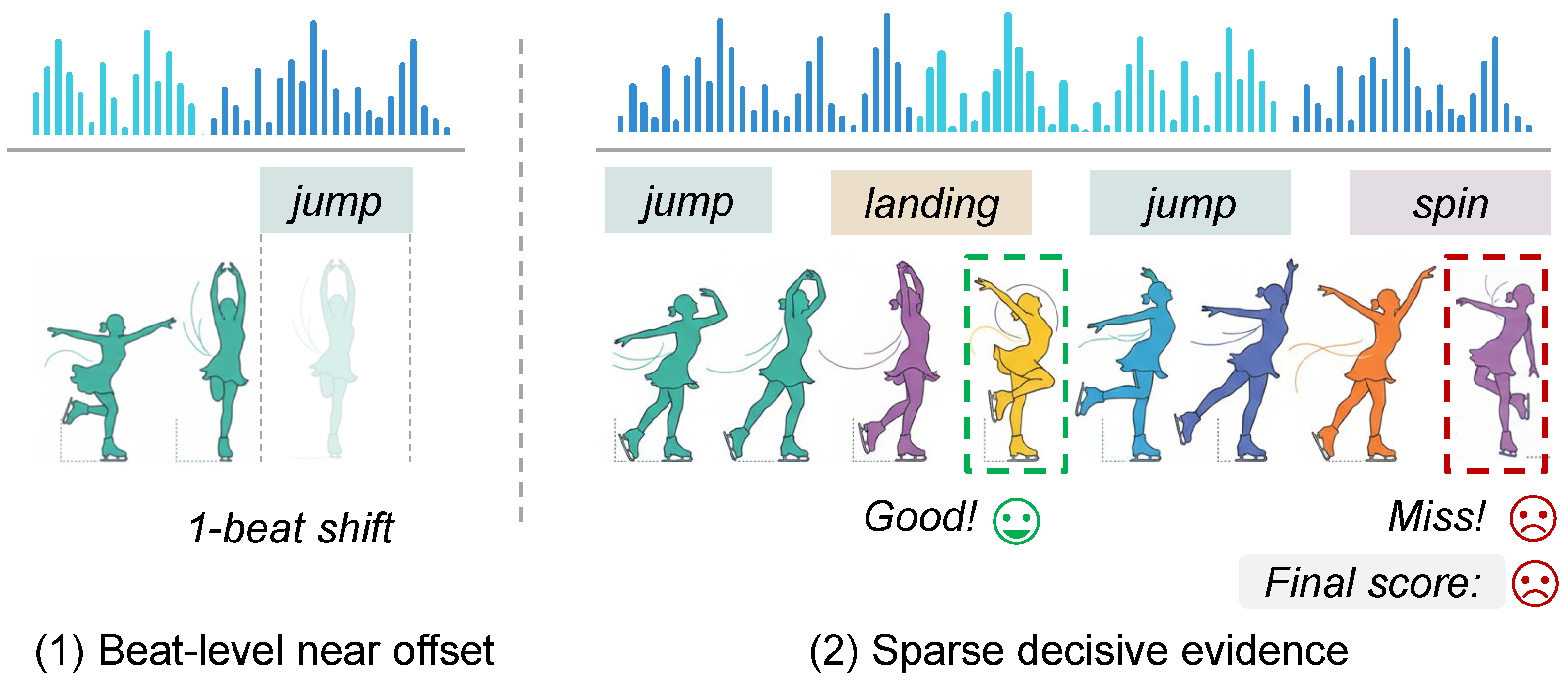
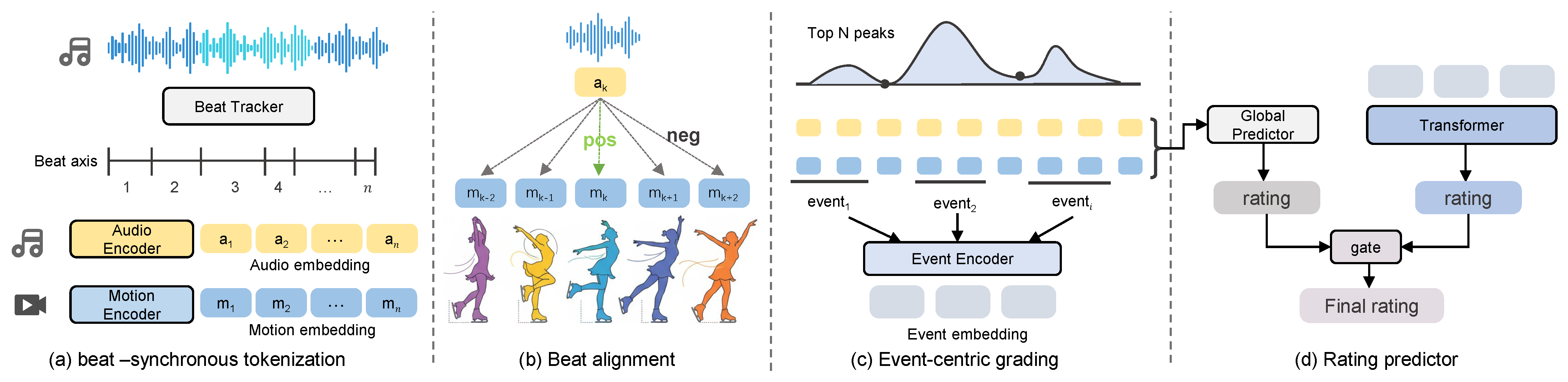
BEATSCORE improves over prior audio–visual methods under the same TF+AST settings, achieving stronger rank consistency (Avg. SRCC) while reducing numerical error (Avg. MSE). Beyond the overall average, the gains are typically more pronounced on components that are sensitive to choreography and music coordination, such as Interpretation (IN), Composition (CO), and Transitions (TR), where temporal structure and near-offset deviations matter more than coarse action semantics. This aligns with our design choices: beat-synchronous tokenization reduces ambiguity about the comparison granularity, beat-level contrastive alignment explicitly trains sensitivity to near-beat mismatches, and event-centric grading focuses learning on decisive segments rather than uniformly aggregating long sequences.
Fis-V: Table 2 reports results on Fis-V, which predicts TES and PCS on short programs and provides a complementary setting to FS1000. Fis-V has fewer videos and typically exhibits higher variance across athletes and music tracks, which makes robust learning of audio–motion cues challenging. Despite this, BEATSCORE achieves improved SRCC and reduced MSE over prior methods, indicating that the proposed beat-guided alignment does not rely on extremely long sequences to be effective. We also find that the relative improvement is often larger for PCS than TES. This is expected, since PCS emphasizes components like performance interpretation and composition, which are more likely to be affected by action–music coordination patterns than purely technical execution.
From a practical perspective,
Table 2 also reports complexity (Params/FLOPs). BEATSCORE attains better accuracy with a small overhead compared with the underlying TF + AST feature setting. This is important for long-term assessment, where the computational budget is dominated by processing long sequences; our design improves prediction quality without requiring substantially larger backbones or multi-stage refinement.
RG: Table 3 summarizes performance on RG across four apparatus types. RG exhibits substantial diversity in movement patterns and accompanying music, and judging is often dominated by a handful of highlighted transitions and peak moments. This makes it a good testbed for our event-centric formulation. BEATSCORE improves the averaged SRCC and MSE across apparatus, with gains typically consistent across ball, clubs, hoop, and ribbon. We additionally observe that visual-only models can be competitive on some apparatus, yet audio–visual methods that explicitly model coordination can yield higher average performance, which supports our view that alignment cues exist but must be extracted at the right temporal granularity.
4.5. Ablation on Core Components
Table 8 reports a compact ablation of BEATSCORE on FS1000 and RG under the same feature settings. Each row removes one core component from the full model, allowing us to quantify its contribution while keeping the rest of the pipeline unchanged.
Effect of Beat-Level Alignment: Removing the beat-level contrastive alignment loss () leads to a clear drop in SRCC and a corresponding increase in MSE. This indicates that simply fusing audio and motion on beat-synchronous tokens is not sufficient: the model benefits from an explicit objective that discriminates the aligned pair from near-offset candidates around neighboring beats. In practice, this encourages the representation to be sensitive to small timing deviations that are visually subtle but score-relevant, which then propagates to the final grading head.
Effect of Event Proposal: Replacing event-centric proposal with uniform-N windows also degrades performance. Importantly, this variant still computes the same number of window-level predictions and uses the same MIL pooling, but it loses the ability to prioritize salient moments. The drop suggests that the gain of BEATSCORE is not merely from reducing the temporal length but from selecting informative windows whose local evidence better correlates with the routine-level score.
Effect of MIL Pooling: Finally, replacing MIL pooling with mean pooling causes a noticeable performance decrease. This is consistent with the scoring mechanism in long routines, where different events contribute unequally to the final assessment. A learnable pooling module can assign higher weights to decisive windows and downweight less informative segments, whereas uniform averaging tends to dilute these key signals and yields less accurate predictions.
Overall, the three ablations show that , event proposal, and MIL pooling are complementary: alignment improves the quality of audio–motion comparisons, proposal improves the relevance of the evidence being graded, and MIL improves how this sparse evidence is aggregated into a single score.
Impact of Different Beat Trackers on BEATSCORE: As shown in
Table 4, BEATSCORE remains consistently effective across different beat trackers. While the default tracker, librosa, achieves the best overall performance, Essentia yields highly comparable results on both FS1000 and RG, and aubio also maintains competitive performance, with only a moderate drop. These results suggest that our method does not rely on a specific beat detection tool, although the quality of beat boundary estimation still affects the final grading accuracy.
Effects of Different Event Proposal Strategies: Table 5 compares different event proposal strategies. Audio-only proposal consistently underperforms motion-based variants, indicating that rhythm cues alone are insufficient for identifying decisive scoring moments. In contrast, incorporating audio cues into motion-based proposal yields competitive, but not consistently better, performance. This suggests that audio rhythm is best used as a complementary signal rather than as a standalone event selector.
Effect of Decomposing Action Quality and Action–Music Coordination Signals in Event-Centric Grading: We further analyzed whether the gains of BEATSCORE mainly come from action quality cues or from action–music coordination. To this end, we compared three variants: (1) quality-only scoring, which uses only motion/visual information; (2) coordination-only scoring, which relies on audio–motion interaction cues; and (3) the full model that combines both quality and coordination signals. All other settings were kept unchanged.
As shown in
Table 6, quality-only scoring already provides a strong baseline, while coordination-only scoring performs worse, indicating that motion quality remains the primary cue for long-term sports assessment. However, combining quality and coordination yields the best overall performance on both datasets, showing that action–music coordination provides complementary evidence beyond pure motion quality.
Robustness of BEATSCORE under Noisy Audio Conditions: We further evaluated the robustness of BEATSCORE under noisy audio conditions. To simulate realistic deployment scenarios, we injected mixed audio noise before beat extraction and audio feature encoding, such that both beat-synchronous segmentation and downstream grading were affected. We compared three settings: (1) clean audio; (2) noisy-test, where the model was trained on clean audio but evaluated on noisy audio; and (3) noise augmentation, where noisy audio was used in both training and inference. All other settings were kept unchanged.
As shown in
Table 7, BEATSCORE shows a clear but moderate performance drop when evaluated on noisy audio, confirming that degraded audio quality can affect beat-synchronous segmentation and final score prediction. Nevertheless, the model remains reasonably robust under the noisy-test setting. Moreover, applying noise augmentation during training consistently improves the results over noisy-test, suggesting that the proposed framework can better adapt to realistic noisy conditions when exposed to such perturbations during training.
4.6. Analysis of Key Design Choices
Table 8 analyzes several key design choices that control the supervision granularity and the sparsity of grading.
Hard Negatives for Near-Offset Discrimination: Using only in-batch negatives provides limited pressure to distinguish aligned pairs from temporally adjacent candidates, because most random negatives are already easy. Adding hard negatives at beat improves performance, and extending the pool to typically yields additional gains. This pattern matches the empirical nature of miscoordination in real routines, where visible “off-beat” errors often correspond to half-beat or one-beat deviations rather than large shifts.
Event Selection and Window Size: For event selection, a moderate top-N works best in practice. Too few events may miss decisive segments, while too many can introduce low-saliency windows that dilute the learning signal and reduce the benefit of sparse grading. A similar trade-off appears for event window size. Small windows can truncate the temporal context needed to judge transitions, whereas overly large windows reintroduce the averaging effect that event-centric grading is designed to avoid. We therefore used an intermediate N and L as defaults, and the ablation verified that BEATSCORE is not overly sensitive within a reasonable range.
Pooling Strategy: MIL pooling consistently improves over mean pooling, indicating that the model benefits from learning instance weights that emphasize decisive events and downweight irrelevant segments. This is particularly important when the routine contains long stretches of low-difficulty or repetitive motion, where uniform aggregation can blur the evidence that separates close scores.
Fusion Strategies: We further compared different fusion strategies for combining global and event-centric grading signals. The results show that both single-branch variants underperform the fusion-based approaches, while the adaptive gate achieves the best overall performance, indicating that input-dependent fusion better balances routine-level and event-level evidence.
4.8. Event Evidence Visualization
To better understand
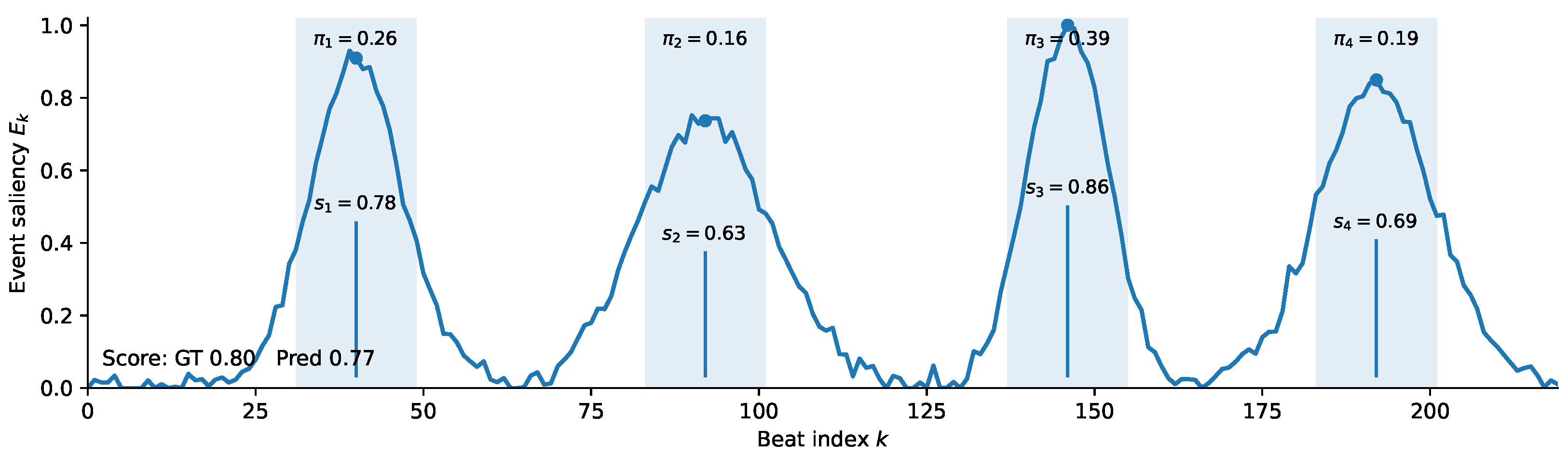
why BEATSCORE improves long-term assessment, we visualized the event-centric evidence used to form the final prediction in
Figure 3. Given a beat-synchronous sequence, the event proposer produces a scalar saliency curve
over beats
k (higher means more likely to be a decisive moment). We then select the top-
N peaks as event centers
. For each center
, we extract a local window of radius
L on the beat axis, i.e., beats in
(shown as shaded regions), and encode the corresponding audio–motion tokens into an event representation. An event-level regression head outputs an event score
(annotated near each peak), which captures the local quality and coordination evidence inside that window. Finally, the MIL aggregator assigns a non-negative weight
to each event (annotated above each window) and produces the routine-level prediction as a weighted aggregation of event scores. (We omit the explicit formula in the figure for compactness; the aggregation is implemented as a normalized weighting over
.)
Figure 3 shows that the prediction is dominated by a small subset of high-saliency windows: the selected peaks align with local maxima of
, and the learned weights
concentrate on a few events with strong evidence rather than spreading uniformly over the entire routine. This behavior is consistent with the event-driven nature of judging, where a handful of decisive transitions or landings can disproportionately affect the final score. Compared with dense temporal averaging, BEATSCORE provides interpretable attribution by indicating
which windows contribute most to the predicted score, and this qualitative pattern complements the quantitative gains from event-centric grading and MIL pooling in
Table 8.
4.9. Controlled Perturbations for Synchrony Verification
To verify that the gain of BEATSCORE indeed comes from learning action–music synchrony, we conducted controlled perturbations on the
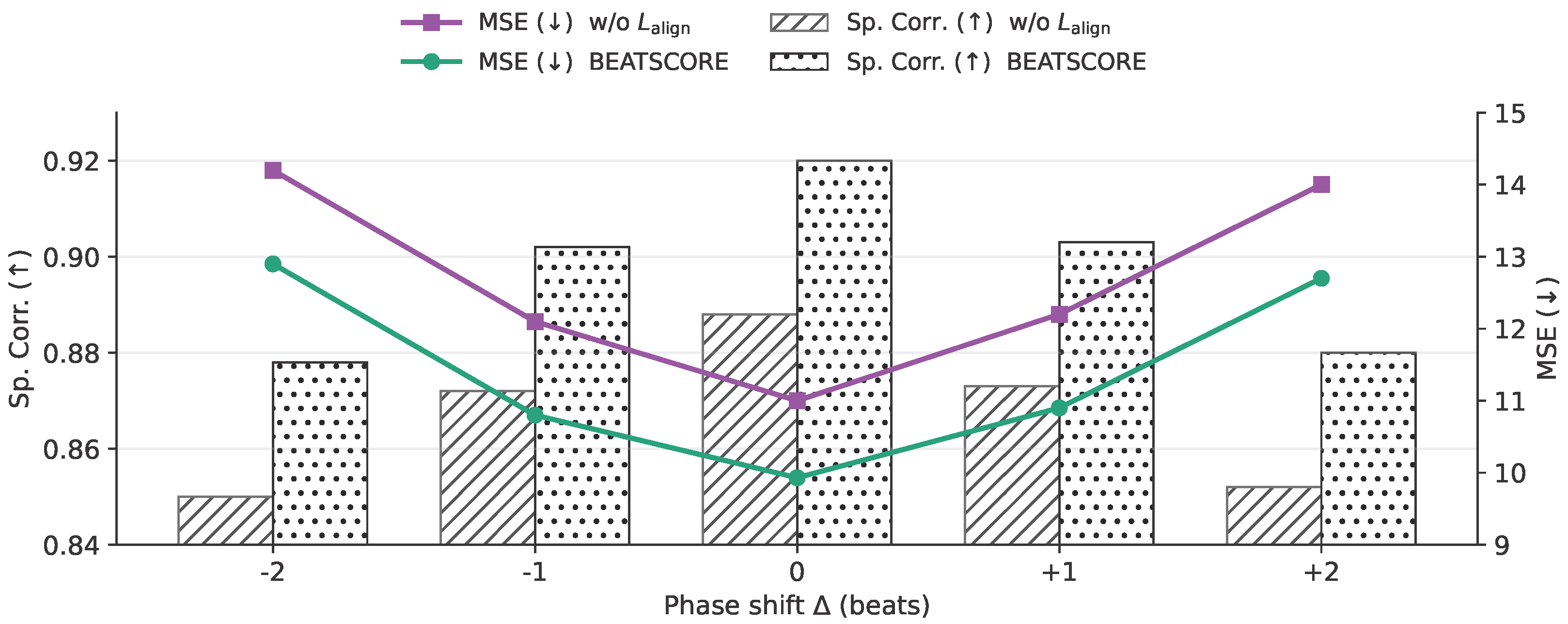
audio stream only while keeping the video unchanged, and then evaluated with the original ground-truth scores. In
Figure 4, we apply a global phase shift by
beats, where
, and report both Avg Spearman correlation (bars, higher is better) and Avg MSE (lines, lower is better). Performance peaks at
and degrades as
increases, indicating that the learned predictor is sensitive to rhythmic misalignment instead of being invariant to it. More importantly, BEATSCORE consistently outperforms the variant without beat-level alignment loss (
) at all shifts, and the gap is most visible around small offsets (e.g.,
beat), which matches our design where
explicitly contrasts the aligned pair
against near-offset candidates
for small
.
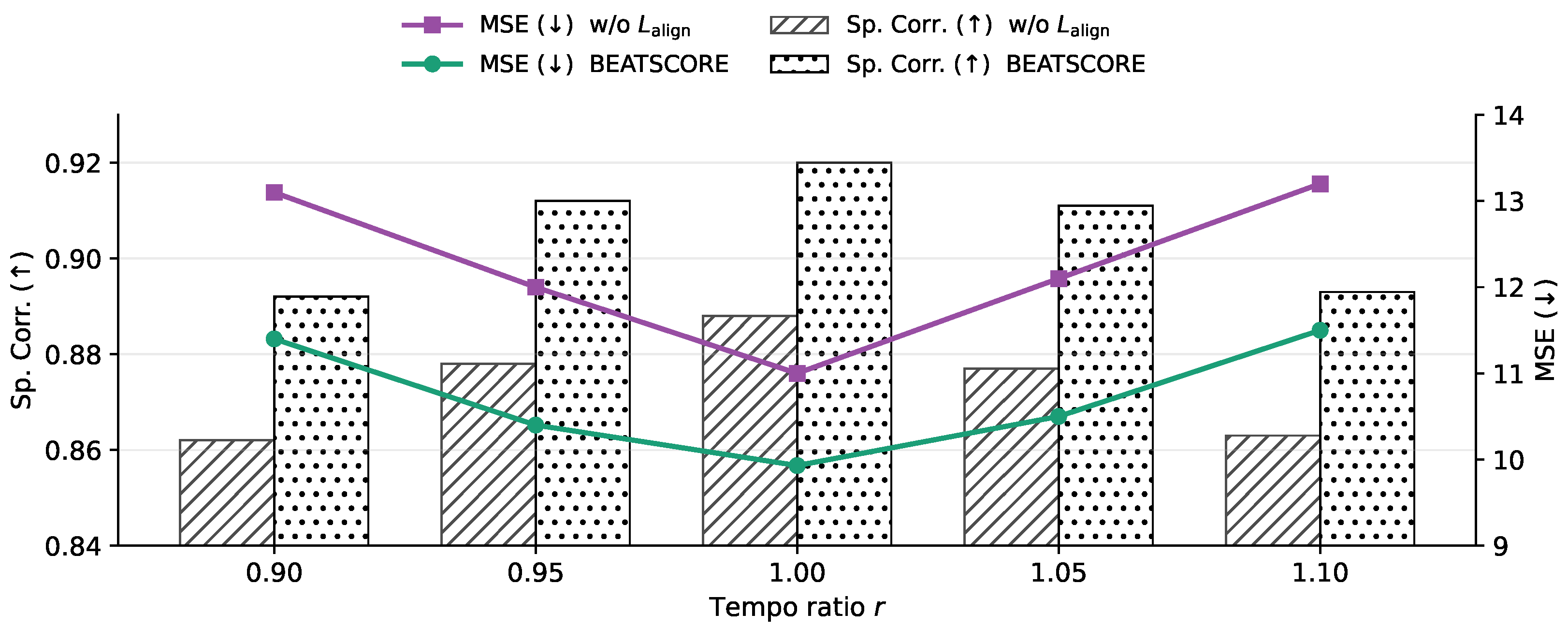
We further tested tempo perturbations by time-stretching the audio with ratio
(
Figure 5). Compared to phase shifts, mild tempo changes (e.g.,
) lead to smaller accuracy drops, while larger scaling (e.g.,
) causes a clearer degradation, consistent with the intuition that global tempo drift perturbs synchrony more gradually than a discrete beat-level phase mismatch. Across all ratios, BEATSCORE maintains higher Avg SRCC and lower Avg MSE than w/o
, suggesting that explicit beat-level discrimination provides a better inductive bias for long-term scoring under weak audio–motion correlation.
4.10. Sensitivity to Beat-Axis Quality
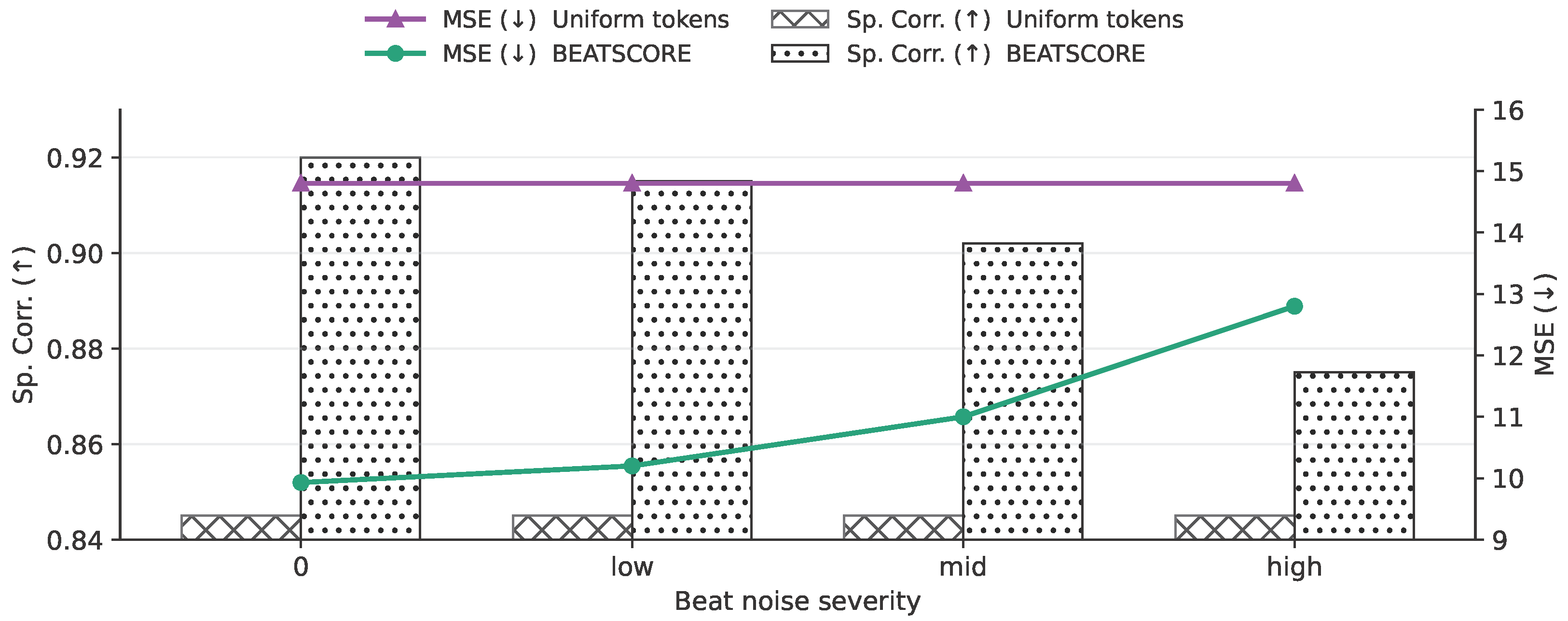
BEATSCORE relies on an off-the-shelf beat tracker to define the beat axis for beat-synchronous tokenization. We therefore analyze sensitivity to beat quality by injecting controlled noise into the detected beat timestamps before tokenization (
Figure 6). We consider three noise types: (i)
jitter, which adds i.i.d. temporal noise
to each beat time; (ii)
drop, which removes each beat independently with probability
p; and (iii)
insert, which adds spurious beats uniformly between neighboring beats with probability
p. We map these perturbations to a unified severity level (from 0 to high) for compact visualization. As severity increases, performance decreases smoothly, and BEATSCORE remains above a uniform-token baseline that does not use beat information, indicating that the model benefits from a beat axis without collapsing under moderate beat imperfections. This sensitivity analysis complements our main ablations by directly addressing the practical question of beat-tracking errors in real routines.
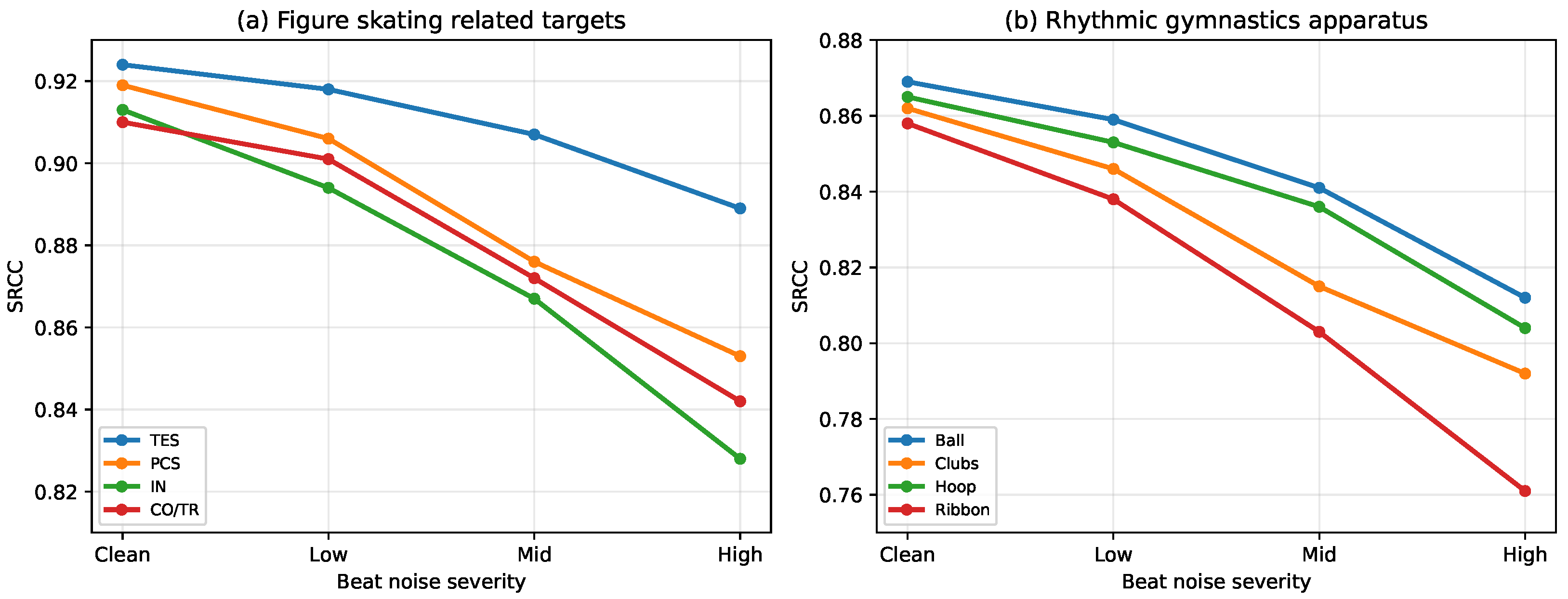
Figure 7 extends
Figure 6 by reporting beat-noise sensitivity separately for different scoring dimensions and sub-events. We can observe that the performance drop is not uniform across targets. In figure skating, coordination-sensitive components generally show a larger degradation than technical scores as beat noise increases. In rhythmic gymnastics, different apparatus categories also exhibit distinct sensitivity patterns. These results suggest that beat-aware alignment is particularly beneficial for evaluation targets that depend more strongly on rhythm consistency and action–music coordination.