A Systematic Review of Safety-Driven Approaches in Human–Robot Collaborative Systems

 , , and
Abstract
1. Introduction
- To systematically analyze peer-reviewed studies where generative AI methods contribute to safety in perception, prediction, and control for HRC.
- To identify gaps and challenges related to interpretability, real-time assurance, and certification; and.
- To propose a research roadmap and taxonomy that can guide the design of next-generation safe collaborative robotic systems.
- A comprehensive PRISMA-based mapping of the literature on generative AI applications for HRC safety.
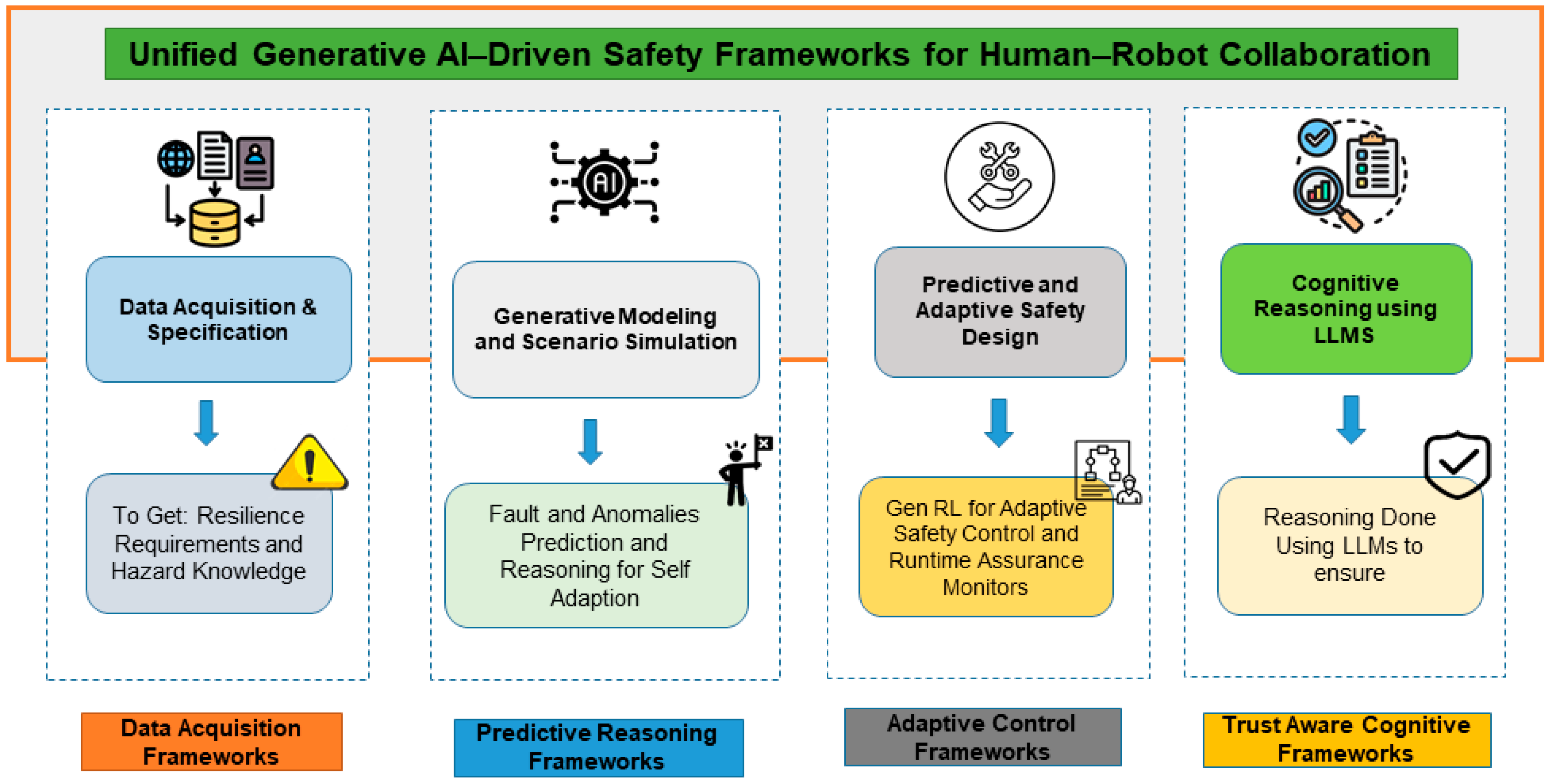
- A taxonomy of generative AI–driven safety frameworks encompassing data-driven simulation, predictive reasoning, adaptive control, and trust-aware systems.
- An evidence-based synthesis highlighting current limitations, challenges, and research opportunities;
- A conceptual roadmap aligning future research with evolving industrial safety standards and regulatory frameworks.
2. Background and Theoretical Foundations
2.1. Human–Robot Collaboration (HRC)
2.2. Safety Frameworks in Robotics
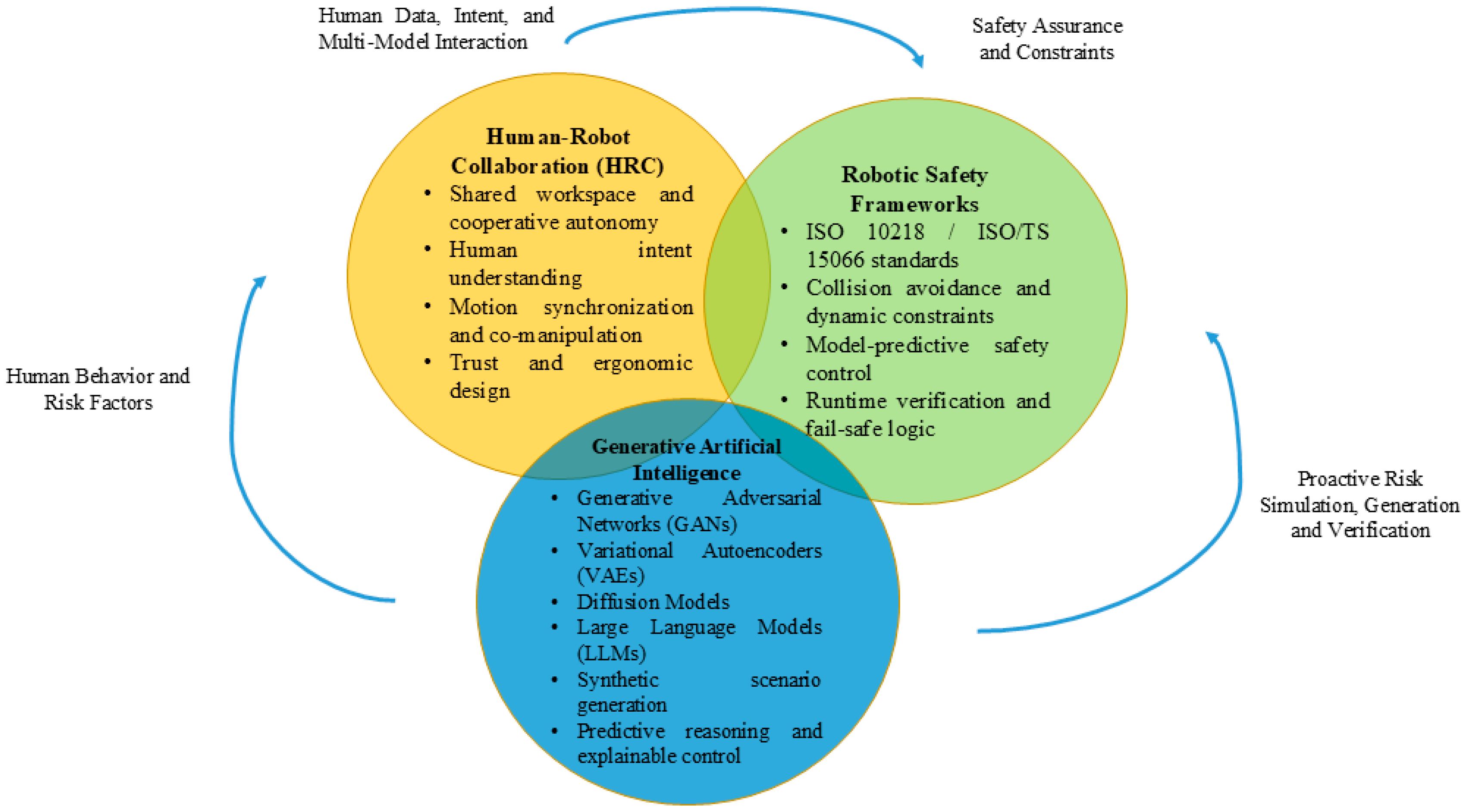
2.3. Generative Artificial Intelligence in Robotics
- GANs consist of a generator network and a discriminator network trained adversarially—the generator produces synthetic samples whereas the discriminator attempts to distinguish them from real data, driving progressively realistic outputs [7].
- VAEs use an encoder–decoder structure trained to maximize a variational lower bound (ELBO); the encoder maps inputs to a latent probability distribution, enabling uncertainty-aware generation [8].
- Transformers use self-attention to model long-range dependencies in sequential data; large-scale pre-trained transformers underpin LLMs, which generate context-conditioned natural language outputs [35].
- Explainable Control—Language-based models enable robots to articulate reasoning behind their actions, enhancing human trust and shared situational awareness [12].
2.4. The Need for Integrative Generative Safety Frameworks
3. Methodology of the Review
3.1. Objectives and Research Questions
- (RQ1) What generative AI methods and models have been applied to enhance safety in HRC, and how are they utilized?
- (RQ2) What frameworks or architectures have been proposed for integrating generative AI into HRC safety systems?
- (RQ3) What safety aspects (e.g., risk assessment, hazard identification, motion safety) are addressed by generative AI in HRC, and what improvements do these approaches claim?
- (RQ4) What empirical evidence exists regarding the effectiveness and limitations of generative AI-driven safety frameworks in HRC applications?
- (RQ5) What are the open challenges, risks, and future research directions in applying generative AI for safer human–robot collaboration?
3.2. Search Strategy and Data Sources
3.3. Inclusion and Exclusion Criteria
3.3.1. Study Selection
3.3.2. Quality Assessment
4. Results and Analysis of Various Techniques
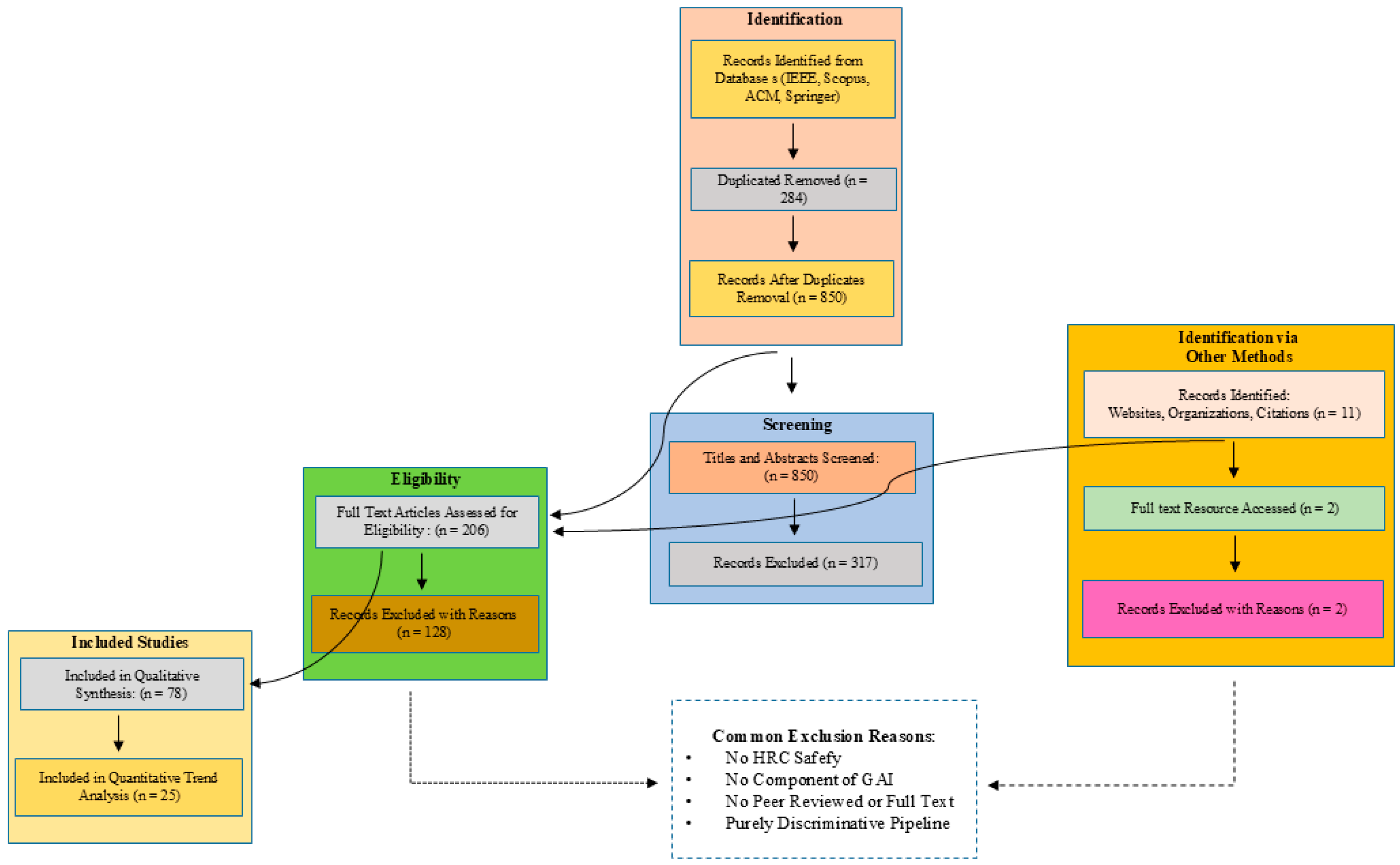
4.1. Literature Selections
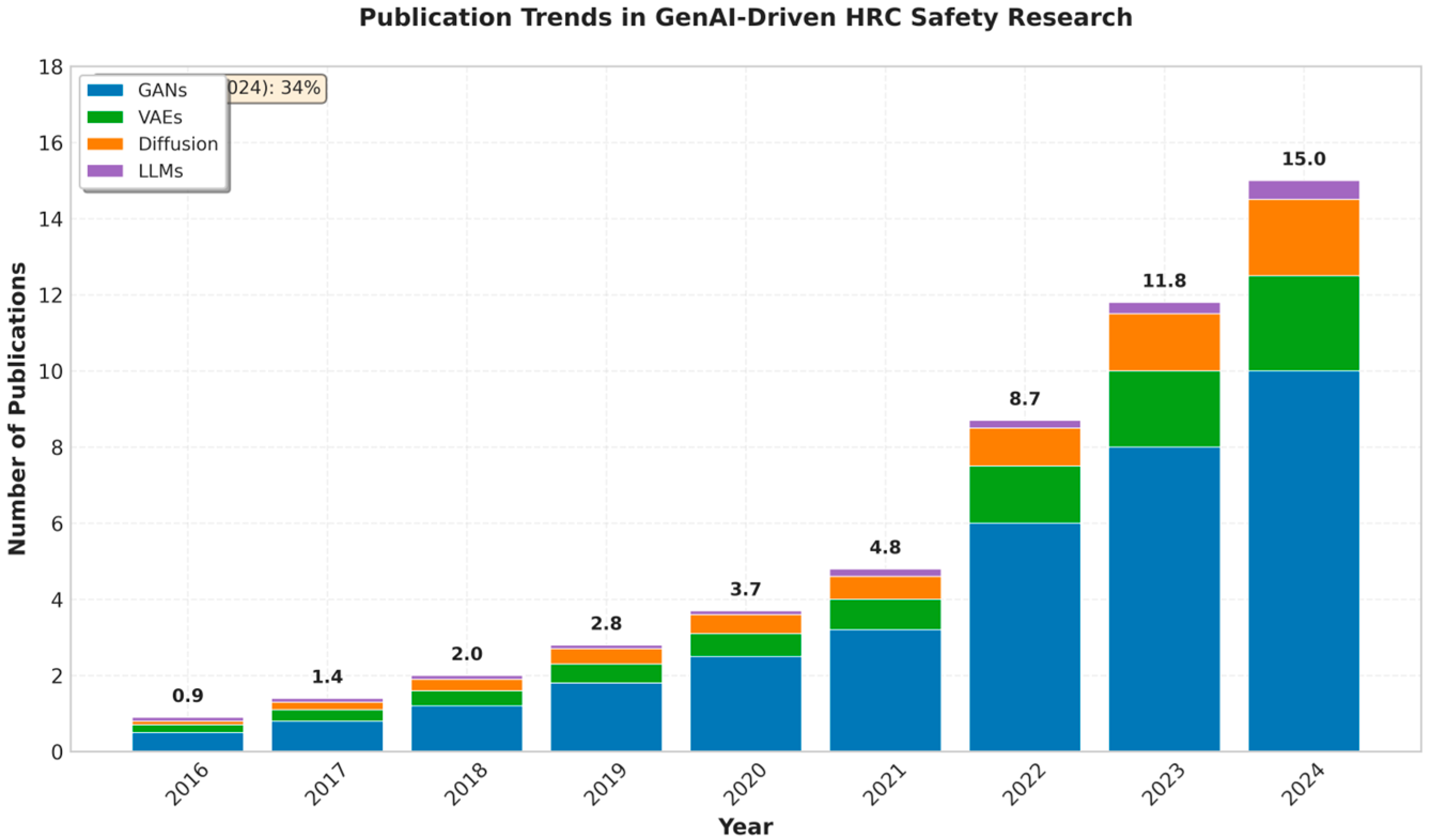
4.2. Publication Trends
4.3. Generative Techniques Employed
4.4. Safety Functions and Outcomes
4.5. Evaluation and Validations
4.6. Implementation Characteristics of Reviewed Generative AI Frameworks
4.6.1. Experimental Setup Characteristics
4.6.2. Methodological Pipeline Details
5. Thematic Synthesis and Taxonomy of Generative AI-Driven Safety Frameworks
5.1. Data-Driven Simulation Frameworks
5.2. Predictive Reasoning Frameworks
5.3. Adaptive Control Frameworks
5.4. Trust-Aware Cognitive Frameworks
5.5. Proposed Taxonomy
6. Challenges, Research Gaps, and Future Direction
6.1. Data and Benchmarking Limitations
6.2. Model Transparency and Interpretability
6.3. Real-Time Performance and Computational Scalability
6.4. Safety Validation and Certification
6.5. Ethical and Cognitive Safety Considerations
7. Discussion and Implications
7.1. Integration of Generative Models into Traditional Safety Pipelines
7.2. Interdisciplinary Convergence of Cognitive and Physical Safety
7.3. Standardization, Benchmarking, and Reproducibility
7.4. Ethical, Legal, and Governance Perspectives
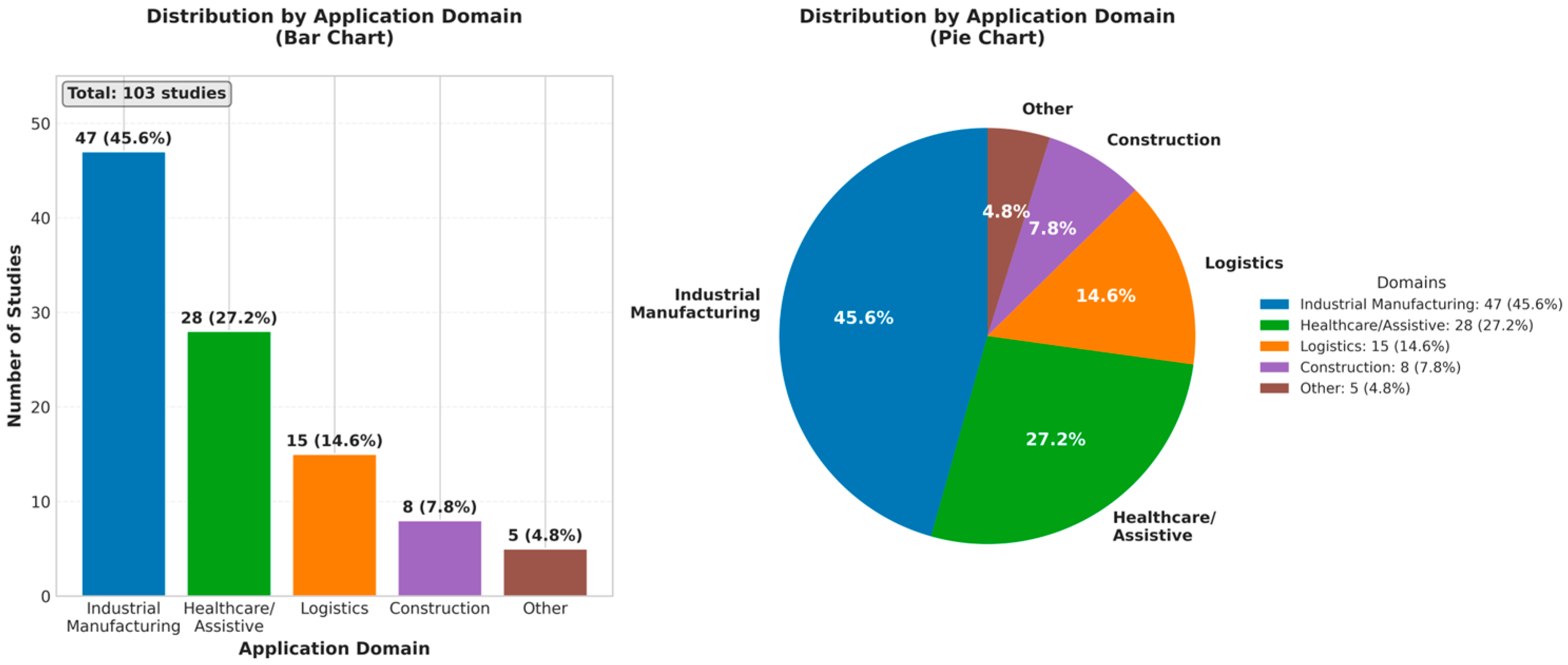
7.5. Industrial and Societal Impact
- Certifiable hybrid architectures integrating generative foresight with deterministic safety control;
- Open, multimodal benchmarks capturing physical and cognitive interaction data;
- Ethical governance models ensuring explainable, auditable safety reasoning.
8. Conclusions
Supplementary Materials
Author Contributions
Funding
Institutional Review Board Statement
Informed Consent Statement
Data Availability Statement
Acknowledgments
Conflicts of Interest
Correction Statement
Abbreviations
| GenAI | Generative Artificial Intelligence |
| HRC | Human–Robot Collaboration |
| HRI | Human Robot Interaction |
| Cobot | Collaborative Robot |
| LLM | Large Language Models |
| PRISMA | Preferred Reporting Items for Systematic Reviews and Meta-Analyses |
| ISO/TS | International Organization for Standardization/Technical Specification |
| IEC | International Electrotechnical Commission |
| XAI | Explainable AI |
Appendix A. Search Strategy and Inclusion Criteria
- Peer-reviewed studies focusing on generative or learning-based safety mechanisms in HRC.
- Works employing simulation, reinforcement learning, diffusion, or LLMs for safety prediction, control, or reasoning.
- Publications in English between 2015 and 2025.
- Purely discriminative AI models without generative elements.
- Studies without experimental, simulation, or safety evaluation results.
- Non-peer-reviewed, review-only, or editorial materials.
Appendix B. List of Included Studies
Appendix C. PRISMA 2020 Compliance Summary

| Checklist Item | Description | Section Covered |
|---|---|---|
| Identification | Databases and queries described | Appendix A, Section 3 |
| Screening | Inclusion/exclusion and duplicates | Section 3 |
| Eligibility | Criteria applied for final inclusion | Section 3 |
| Synthesis | Qualitative and quantitative synthesis | Section 5 |
| Bias and Limitations | Discussed as methodological challenges | Section 6 |
| Presentation | PRISMA diagram and taxonomy summary | Figure 3 and Figure 5 |
| Reporting | Adheres to IEEE structure and ethical review | Section 1, Section 2, Section 3, Section 4, Section 5, Section 6, Section 7 and Section 8 |
References
- Ajoudani, A.; Zanchettin, A.M.; Ivaldi, S.; Albu-Schäffer, A.; Kosuge, K.; Khatib, O. Progress and prospects of the human–robot collaboration. Auton. Robot. 2018, 42, 957–975. [Google Scholar] [CrossRef]
- Murashov, V.; Hearl, F.; Howard, J. Working safely with robot workers: Recommendations for the new workplace. J. Occup. Environ. Hyg. 2016, 13, D61–D71. [Google Scholar] [CrossRef]
- Villani, V.; Pini, F.; Leali, F.; Secchi, C. Survey on human–robot collaboration in industrial settings: Safety, intuitive interfaces and applications. Mechatronics 2018, 55, 248–266. [Google Scholar] [CrossRef]
- Wei, Y.; Xu, Q. Design of a new passive end-effector based on constant-force mechanism for robotic polishing. Robot. Comput.-Integr. Manuf. 2022, 74, 102278. [Google Scholar] [CrossRef]
- Rinaldi, G.; Suglia, V.; Tiseni, L.; Camardella, C.; Xiloyannis, M.; Masia, L.; Buongiorno, D.; Bevilacqua, V.; Frisoli, A.; Chiaradia, D. Towards a healthier workplace: How Flexos, an active and bilateral shoulder exoskeleton, provides support in weight-lifting and carrying tasks. IEEE Trans. Robot. 2026, 42, 1389–1404. [Google Scholar] [CrossRef]
- Suglia, V.; Camardella, C.; Rinaldi, G.; Chiaradia, D.; Buongiorno, D.; Zhou, H.; Frisoli, A.; Leonardis, D.; Bevilacqua, V. Muscle Network Analysis of a Dynamic Bilateral Task with an Upper Limb Exoskeleton. In Proceedings of the 2025 International Conference on Rehabilitation Robotics (ICORR), Chicago, IL, USA, 2025; IEEE: New York, NY, USA, 2025; pp. 419–424. [Google Scholar] [CrossRef]
- Suglia, V.; Camardella, C.; Rinaldi, G.; Chiaradia, D.; Buongiorno, D.; Leonardis, D.; Zhou, H.; Frisoli, A.; Bevilacqua, V. Muscle networks analysis on an active occupational shoulder exoskeleton. Biomed. Signal Process. Control. 2026, 119, 109653. [Google Scholar] [CrossRef]
- Yang, L.; Zhang, Z.; Song, Y.; Hong, S.; Xu, R.; Zhao, Y.; Zhang, W.; Cui, B.; Yang, M.-H. Diffusion models: A comprehensive survey of methods and applications. ACM Comput. Surv. 2024, 56, 1–39. [Google Scholar] [CrossRef]
- Urain, J.; Mandlekar, A.; Du, Y.; Shafiullah, M.; Xu, D.; Fragkiadaki, K.; Chalvatzaki, G.; Peters, J. Deep generative models in robotics: A survey on learning from multimodal demonstrations. arXiv 2024, arXiv:2408.04380. [Google Scholar] [CrossRef]
- Goodfellow, I.; Pouget-Abadie, J.; Mirza, M.; Xu, B.; Warde-Farley, D.; Ozair, S.; Courville, A.; Bengio, Y. GenerativeAdversarial Networks. Commun. ACM 2020, 63, 139–144. [Google Scholar] [CrossRef]
- Diederik, P.K.; Max, W. An Introduction to Variational Autoencoders. Found. Trends Mach. Learn. 2019, 12, 307–392. [Google Scholar] [CrossRef]
- Lynch, C.; Wahid, A.; Tompson, J.; Ding, T.; Betker, J.; Baruch, R.; Armstrong, T.; Florence, P. Interactive language: Talking to robots in real time. arXiv 2022, arXiv:2210.06407. [Google Scholar] [CrossRef]
- Croitoru, F.; Hondru, V.; Ionescu, R.T.; Shah, M. Diffusion Models in Vision: A Survey. IEEE Trans. Pattern Anal. Mach. Intell. 2023, 45, 10850–10869. [Google Scholar] [CrossRef]
- Koppula, H.S.; Saxena, A. Anticipating human activities using object affordances for reactive robotic response. IEEE Trans. Pattern Anal. Mach. Intell. 2016, 38, 14–29. [Google Scholar] [CrossRef]
- Laplaza, J.; Salazar, E.; Calinon, S. Enhancing robotic collaborative tasks through contextual human motion prediction and intention inference. Int. J. Soc. Robot. 2024, 17, 2077–2096. [Google Scholar] [CrossRef]
- Tian, S.; Zheng, M.; Liang, X. TransFusion: A practical and effective transformer-based diffusion model for 3D human motion prediction. arXiv 2023, arXiv:2307.16106. [Google Scholar] [CrossRef]
- Li, W.; Wang, X.; Zhang, J.; Orsag, L. Safe human–robot collaboration for industrial settings: A survey. Int. J. Adv. Manuf. Technol. 2024, 35, 2235–2261. [Google Scholar] [CrossRef]
- Vaswani, A.; Shazeer, N.; Parmar, N.; Uszkoreit, J.; Jones, L.; Gomez, A.N.; Kaiser, Ł.; Polosukhin, I. Attention Is All You Need. In Proceedings of the 31st International Conference on Neural Information Processing Systems (NIPS 2017), Long Beach, CA, USA, 4–9 December 2017; ACM: New York, NY, USA, 2017; pp. 6000–6010. [Google Scholar]
- Huang, X.; Ruan, W.; Huang, W.; Jin, G.; Dong, Y.; Wu, C.; Bensalem, S.; Mu, R.; Qi, Y.; Zhao, X.; et al. A survey of safety and trustworthiness of large language models through the lens of verification and validation. Artif. Intell. Rev. 2024, 57, 175. [Google Scholar] [CrossRef]
- Pearl, J. Causality: Models, Reasoning, and Inference, 2nd ed.; Cambridge University Press: Cambridge, UK, 2009. [Google Scholar] [CrossRef]
- Huang, W.; Zhang, X.; Li, Q.; Sun, Z.; Li, H. Formal verification of robustness and resilience of learning-enabled systems. Neurocomputing 2024, 585, 127643. [Google Scholar] [CrossRef]
- Cai, Z.; Du, X.; Huang, T.; Lv, T.; Cai, Z.; Gong, G. Robotic edge intelligence for energy-efficient human–robot collaboration. Sustainability 2024, 16, 9788. [Google Scholar] [CrossRef]
- Wang, S.; Zhang, J.; Wang, P.; Law, J.; Calinescu, R.; Mihaylova, L. A deep learning-enhanced digital twin framework for improving safety and reliability in human–robot collaborative manufacturing. Robot. Comput.-Integr. Manuf. 2024, 85, 102608. [Google Scholar] [CrossRef]
- Angleraud, A.; Ekrekli, A.; Samarawickrama, K.; Sharma, G.; Pieters, R. Sensor-based human–robot collaboration for industrial tasks. Robot. Comput.-Integr. Manuf. 2024, 86, 102663. [Google Scholar] [CrossRef]
- Liu, S.; Zhao, H. A survey on large language models for robotics. arXiv 2024, arXiv:2311.07226. [Google Scholar] [CrossRef]
- Garcia-Gasulla, D.; Kestor, G.; Parisi, E.; Alberti-Binimelis, M.; Gutierrez, C.; Ghorab, R.M.; Montenegro, O.; Homs, B.; Moreto, M. TuRTLe: A unified evaluation of LLMs for RTL generation. In Proceedings of the 2025 ACM/IEEE 7th Symposium on Machine Learning for CAD (MLCAD), Santa Cruz, CA, USA, 8–10 September 2025; IEEE: New York, NY, USA, 2025; pp. 1–12. [Google Scholar] [CrossRef]
- Yi, S.; Liu, S.; Yang, Y.; Yan, S.; Guo, D.; Wang, X.V.; Wang, L. Safety-aware human-centric collaborative assembly. Adv. Eng. Inform. 2024, 62, 102371. [Google Scholar] [CrossRef]
- Iklima, Z.; Adriansyah, A.; Hitimana, S. Self-collision avoidance of arm robot using generative adversarial network and particle swarm optimization (GAN-PSO). Sinergi 2021, 25, 141–152. [Google Scholar] [CrossRef]
- ISO/TS 15066:2016; Robots and Robotic Devices—Collaborative Robots. ISO: Geneva, Switzerland, 2016. Available online: https://www.iso.org/standard/62996.html (accessed on 25 January 2026).
- Suglia, V.; Palazzo, L.; Bevilacqua, V.; Passantino, A.; Pagano, G.; D’Addio, G. A Novel Framework Based on Deep Learning Architecture for Continuous Human Activity Recognition with Inertial Sensors. Sensors 2024, 24, 2199. [Google Scholar] [CrossRef]
- Yousif, I.; Samaha, J.; Ryu, J.; Harik, R. Safety 4.0: Harnessing computer vision for advanced industrial protection. Manuf. Lett. 2024, 41, 1342–1356. [Google Scholar] [CrossRef]
- Holland, J.; Kingston, L.; McCarthy, C.; Armstrong, E.; O’Dwyer, P.; Merz, F.; McConnell, M. Service robots in the healthcare sector. Robotics 2021, 10, 47. [Google Scholar] [CrossRef]
- Kranz, P.; Schirmer, F.; Kaupp, T.; Daun, M. Generative AI copilot to support safety analyses of human–robot collaborations: Hazard operability analysis and GPT-4. IEEE Softw. 2024, 41, 65–72. [Google Scholar] [CrossRef]
- Tevet, G.; Gordon, S.M.; Hertz, O.; Haim, H.; Dubnov, S.; Kimmel, R. Human motion diffusion model. arXiv 2022, arXiv:2209.14916. [Google Scholar] [CrossRef]
- Gupta, P.; Ding, B.; Guan, C.; Ding, D. Generative AI: A systematic review using topic modelling techniques. Data Inf. Manag. 2024, 8, 100066. [Google Scholar] [CrossRef]
- Wang, T.; Zheng, P.; Li, S.; Wang, L. Multimodal human–robot interaction for human-centric smart manufacturing: A survey. Adv. Intell. Syst. 2024, 6, 2300359. [Google Scholar] [CrossRef]
- Giallanza, A.; La Scalia, G.; Micale, R.; La Fata, C.M. Occupational health and safety issues in human–robot collaboration: State of the art and open challenges. Saf. Sci. 2024, 169, 106313. [Google Scholar] [CrossRef]
- Li, C.; Zheng, P.; Zhou, P.; Yin, Y.; Lee, C.K.M.; Wang, L. Unleashing mixed-reality capability in deep reinforcement learning-based robot motion generation towards safe human–robot collaboration. J. Manuf. Syst. 2024, 74, 411–421. [Google Scholar] [CrossRef]
- Hu, H.; Ivanovic, B.; Liu, C.; Pavone, M. Active uncertainty reduction for safe and efficient interaction planning: A shielding-aware dual control approach. Int. J. Robot. Res. 2024, 43, 1086–1116. [Google Scholar] [CrossRef]
- Baumann, D.; Marco, A.; Turchetta, M.; Trimpe, S. GoSafe: Globally optimal safe robot learning. In Proceedings of the 2021 IEEE International Conference on Robotics and Automation (ICRA), Xi’an, China, 30 May–5 June 2021; IEEE: New York, NY, USA, 2021; pp. 4452–4458. [Google Scholar] [CrossRef]
- Feng, Z.; Xue, B.; Wang, C.; Zhou, F. Safe and socially compliant robot navigation in crowds with fast-moving pedestrians via deep reinforcement learning. Robotica 2024, 42, 1212–1230. [Google Scholar] [CrossRef]
- Jabbour, J.; Reddi, V.J. Generative AI agents in autonomous machines: A safety perspective. In Proceedings of the 43rd IEEE/ACM International Conference on Computer-Aided Design (ICCAD), New York, NY, USA, 27–31 October 2024; ACM: New York, NY, USA, 2024; pp. 1–13. [Google Scholar] [CrossRef]
- Qi, Y.; Huang, W.; Huang, W.; Zhao, X.; Mustafa, M.A. Safety control of service robots with LLMs and embodied knowledge graphs. arXiv 2024, arXiv:2405.17846. [Google Scholar] [CrossRef]
- Hagendorff, T. Mapping the ethics of generative AI: A comprehensive scoping review. Minds Mach. 2024, 34, 39. [Google Scholar] [CrossRef]
- D’Onofrio, G.; Sancarlo, D. Assistive robots for healthcare and human–robot interaction. Sensors 2023, 23, 1883. [Google Scholar] [CrossRef] [PubMed]
- Lee, M.; Liang, X.; Hu, B.; Onel, G.; Behdad, S.; Zheng, M. A review of prospects and opportunities in disassembly with human–robot collaboration. J. Manuf. Sci. Eng. 2024, 146, 020902. [Google Scholar] [CrossRef]
- Althobaiti, A.; Hussain, M.A.; Aldossary, M. How can LLMs and knowledge graphs contribute to robot safety? A few-shot learning approach. arXiv 2024, arXiv:2412.11387. [Google Scholar] [CrossRef]
- Samsani, S.S.; Muhammad, M.S. Socially compliant robot navigation in crowded environment by human behavior resemblance using deep reinforcement learning. IEEE Robot. Autom. Lett. 2021, 6, 5223–5230. [Google Scholar] [CrossRef]
- Obrenovic, B.; Gu, X.; Wang, G.; Godinic, D.; Jakhongirov, I. Generative AI and human–robot interaction: Implications and future agenda for business, society and ethics. AI Soc. 2025, 40, 677–690. [Google Scholar] [CrossRef]
- Mökander, J.; Schuett, J.; Kirk, H.R.; Floridi, L. Auditing large language models: A three-layered approach. AI Ethics 2024, 4, 1085–1115. [Google Scholar] [CrossRef]
- Kanazawa, A.; Kinugawa, J.; Kosuge, K. Adaptive motion planning for a collaborative robot based on prediction uncertainty to enhance human safety and work efficiency. IEEE Trans. Robot. 2019, 35, 817–832. [Google Scholar] [CrossRef]
- Gao, J.; Wang, G.; Xiao, J.; Zheng, P.; Pei, E. Partially observable deep reinforcement learning for multi-agent strategy optimization of human–robot collaborative disassembly: A case of retired EV battery. Robot. Comput.-Integr. Manuf. 2024, 89, 102775. [Google Scholar] [CrossRef]
- Araujo, H.; Mousavi, M.R.; Varshosaz, M. Testing, validation, and verification of robotic and autonomous systems: A systematic review. ACM Trans. Softw. Eng. Methodol. 2023, 32, 51. [Google Scholar] [CrossRef]
- Winfield, A.F.T.; Michael, K.; Pitt, J.; Evers, V. Machine ethics: The design and governance of ethical AI and autonomous systems. Proc. IEEE 2019, 107, 509–517. [Google Scholar] [CrossRef]
- Lara, B.; Ciria, A.; Escobar, E.; Gaona, W.; Hermosillo, J. Cognitive Robotics: The New Challenges in Artificial Intelligence. In Advanced Topics on Computer Vision, Control and Robotics in Mechatronics; Springer: Cham, Switzerland, 2018; pp. 321–347. Available online: https://www.researchgate.net/publication/324826087 (accessed on 25 January 2026).
- Lettera, G.; Costa, D.; Callegari, M. A hybrid architecture for safe human–robot industrial tasks. Appl. Sci. 2025, 15, 1158. [Google Scholar] [CrossRef]
- Tamantini, C.; Scotto di Luzio, F.; Hromei, C.D.; Cristofori, L. Integrating physical and cognitive interaction capabilities in a robot-aided rehabilitation platform. IEEE Syst. J. 2023, 17, 6516–6527. [Google Scholar] [CrossRef]
- Fisher, M. An overview of verification and validation challenges for inspection robots. Robotics 2021, 10, 67. [Google Scholar] [CrossRef]
- Baumann, D.; Schön, T.B. Safe reinforcement learning in uncertain contexts. IEEE Trans. Robot. 2024, 40, 1828–1841. [Google Scholar] [CrossRef]
- Callari, T.C.; Vecellio Segate, R.; Hubbard, E.-M.; Daly, A.; Lohse, N. An ethical framework for human–robot collaboration for the future people-centric manufacturing: A collaborative endeavour with European subject-matter experts in ethics. Technol. Soc. 2024, 78, 102680. [Google Scholar] [CrossRef]
- Yu, Z.; Zhang, P.; Shi, J. Transformation of industrial robotics with natural language models: Recent progress and future prospects. Robot. Comput.-Integr. Manuf. 2026, 97, 103113. [Google Scholar] [CrossRef]
- Liu, H.; Wang, L. Human motion prediction for human–robot collaboration. J. Manuf. Syst. 2017, 44, 287–294. [Google Scholar] [CrossRef]
- Baidya, S.; Das, S.K.; Uddin, M.H.; Kosek, C.; Summers, C. Digital twin in safety-critical robotics applications: Opportunities and challenges. In Proceedings of the 2022 IEEE International Performance, Computing, and Communications Conference (IPCCC), Austin, TX, USA, 11–13 November 2022; IEEE: New York, NY, USA, 2022; pp. 101–107. [Google Scholar] [CrossRef]
- Gu, S.; Kshirsagar, A.; Du, Y.; Chen, G.; Peters, J.; Knoll, A. A human-centered safe robot reinforcement learning framework with interactive behaviors. Front. Neurorobot. 2023, 17, 1280341. [Google Scholar] [CrossRef]
- Su, H.; Qi, W.; Chen, J.; Yang, C.; Sandoval, J.; Laribi, M.A. Recent advancements in multimodal human–robot interaction. Front. Neurorobot. 2023, 17, 1084000. [Google Scholar] [CrossRef]
- Taddeo, M.; Cowls, J.; Tsamados, A.; Taddeo, M.; Floridi, L. Ethical approaches in designing autonomous and intelligent systems: A comprehensive survey towards responsible development. AI Soc. 2024, 40, 2703–2716. [Google Scholar] [CrossRef]
- Yuan, G.; Liu, X.; Qiu, X.; Zheng, P.; Pham, D.T. Human-robot collaborative disassembly in industry 5.0: A systematic literature review and future research agenda. J. Manuf. Syst. 2025, 79, 419–434. [Google Scholar] [CrossRef]
- Zhong, Y.; Karthikeyan, A.; Pagilla, P.; Mehta, R.K. Human-centric integrated safety and quality assurance in collaborative robotic manufacturing systems. CIRP Ann. 2024, 73, 345–348. [Google Scholar] [CrossRef]
- Nascimento, S.; Prendergast, C.; Gallagher, A.; Holton, D.; Harron, K. A deep dive into human-robot interaction in hospitals: Scoping review on the services provided, engagement behaviours and interaction outcomes. Int. J. Soc. Robot. 2025, 17, 1541–1561. [Google Scholar] [CrossRef]
- Xiao, J.; Huang, K. A comprehensive review on human–robot collaboration remanufacturing towards uncertain and dynamic disassembly. Manuf. Rev. 2024, 11, 17. [Google Scholar] [CrossRef]
- Guerrier, M.; Ghignard, F.; Filliat, D. Learning control barrier functions and their application in reinforcement learning: A survey. arXiv 2024, arXiv:2404.16879. [Google Scholar] [CrossRef]
- Ragno, L.; Borboni, A.; Vannetti, F.; Amici, C.; Serrao, M. Application of social robots in healthcare: Review on characteristics, requirements, and technical solutions. Sensors 2023, 23, 6820. [Google Scholar] [CrossRef]
- Brunke, L.; Greeff, M.; Hall, A.W.; Yuan, Z.; Zhou, S.; Lorenz, J.; Schoellig, A.P. Safe learning in robotics: From learning-based control to safe reinforcement learning. Annu. Rev. Control Robot. Auton. Syst. 2022, 5, 411–444. [Google Scholar] [CrossRef]
- De Maio, C.; Di Gisi, M.; Fenza, G.; Gallo, M.; Loia, V. A lifecycle-oriented survey of emerging threats and vulnerabilities in large language models. IEEE Access 2025, 13, 176482–176500. [Google Scholar] [CrossRef]
- Safavi, F.; Patel, K.; Vinjamuri, R. Facial expression recognition with an efficient mix transformer for affective human-robot interaction. IEEE Trans. Affect. Comput. 2025, 16, 4. [Google Scholar] [CrossRef]
- Lutin, E.; Elprama, S.A.; Cornelis, J.; Vanderborght, B.; Jacobs, A. Pilot study on the relationship between acceptance of collaborative robots and stress. Int. J. Soc. Robot. 2024, 16, 1475–1488. [Google Scholar] [CrossRef]
- Zeng, Y.; Yang, Y.; Zhou, A.; Tan, J.Z.; Tu, Y.; Mai, Y.; Klyman, K.; Pan, M.; Jia, R.; Song, D.; et al. AIR-Bench 2024: A safety benchmark based on risk categories from regulations and policies. arXiv 2024, arXiv:2407.17436. [Google Scholar] [CrossRef]
- Wang, J.; Lembono, T.S.; Kim, S.; Calinon, S.; Vijayakumar, S.; Tonneau, S. Learning to guide online multi-contact receding horizon planning. In Proceedings of the 2022 IEEE/RSJ International Conference on Intelligent Robots and Systems (IROS), Kyoto, Japan, 2022; IEEE: New York, NY, USA, 2022; pp. 12942–12949. [Google Scholar] [CrossRef]
- Rehm, M.; Krummheuer, A.L. When a notification at the right time is not enough: The reminding process for socially assistive robots in institutional care. Front. Robot. AI 2024, 11, 1369438. [Google Scholar] [CrossRef]
- Palazzo, L.; Suglia, V.; Grieco, S.; Buongiorno, D.; Brunetti, A.; Carnimeo, L.; Amitrano, F.; Coccia, A.; Pagano, G.; D’Addio, G.; et al. A Deep Learning-Based Framework Oriented to Pathological Gait Recognition with Inertial Sensors. Sensors 2025, 25, 260. [Google Scholar] [CrossRef]
- Palazzo, L.; Suglia, V.; Grieco, S.; Buongiorno, D.; Pagano, G.; Bevilacqua, V.; D’ADdio, G. Optimized Deep Learning-Based Pathological Gait Recognition Explored Through Network Analysis of Inertial Data. In Proceedings of the 2025 IEEE Medical Measurements & Applications (MeMeA), Chania, Greece, 2025; IEEE: New York, NY, USA, 2025; pp. 1–5. [Google Scholar] [CrossRef]


| Aspect | This Review | Ajoudani [1] | Villani [3] | Gupta [35] | Giallanza [37] | Li [38] | Wang [36] |
|---|---|---|---|---|---|---|---|
| PRISMA methodology | ✓ | ✗ | ✗ | ✗ | ✗ | ✗ | ✗ |
| Generative AI focus | ✓ | ✗ | ✗ | Partial | ✗ | ✗ | Partial |
| HRC safety taxonomy | ✓ | ✗ | Partial | ✗ | ✓ | Partial | ✗ |
| ISO standard mapping | ✓ | ✗ | Partial | ✗ | Partial | ✓ | ✗ |
| Quantitative synthesis | ✓ | ✗ | ✗ | Partial | ✗ | ✗ | ✗ |
| Cognitive/ethical safety | ✓ | ✗ | ✗ | Partial | ✗ | ✗ | Partial |
| Certification roadmap | ✓ | ✗ | ✗ | ✗ | ✗ | ✗ | ✗ |
| Empirical vs. conceptual distinction | ✓ | ✗ | ✗ | ✗ | ✗ | ✗ | ✗ |
| Criteria Type | Description |
|---|---|
| Inclusion Criteria | 1. Peer-reviewed journal or full conference paper 2. Written in English 3. Focus on safety in human–robot collaboration (HRC) 4. Integration of generative AI techniques (e.g., GANs, VAEs, LLMs) 5. Describes methodology or architecture for safety enhancement6. Includes evaluation, case study, or framework design |
| Exclusion Criteria | 1. Not focused on HRC or safety 2. No generative AI component 3. Abstracts, posters, preprints, editorials 4. Duplicates or secondary reports 5. Not in English 6. Lacking full text or technical depth 7. Theoretical work without implementation or analysis |
| Quality Criterion | Assessment Question | Score Type |
|---|---|---|
| Q1 | Are research goals clearly stated? | Yes/No |
| Q2 | Is the safety framework or method well described? | Yes/No |
| Q3 | Does the study use a generative AI model meaningfully? | Yes/No |
| Q4 | Is the human–robot interaction context described clearly? | Yes/No |
| Q5 | Is the evaluation method or results reliable? | Yes/No |
| Q6 | Are limitations or assumptions discussed? | Yes/No |
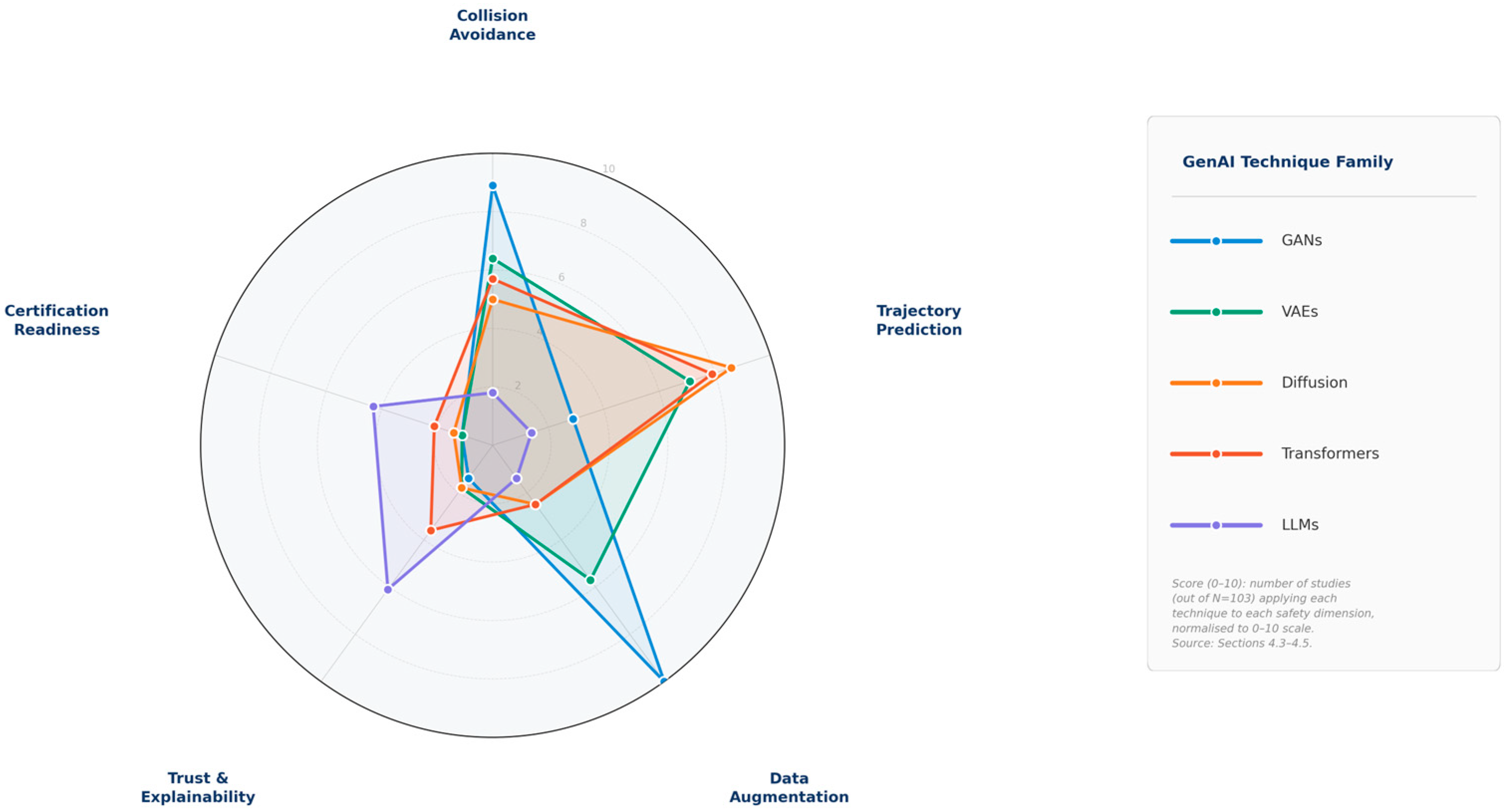
| GenAI Technique | Typical HRC Safety Applications | Representative Example(s) | Safety Contribution |
|---|---|---|---|
| GAN-based Simulation | Industrial cobots, assembly line stress-testing | Iklima et al. [28]—GAN + PSO generates self-collision-free robot trajectories | Synthetic hazard data for training; improved motion safety |
| VAE-based Motion Modeling | Human intent recognition, cooperative assembly | Ajoudani et al. [1]; Zhang et al. [36] | Probabilistic modeling of human motion for risk anticipation |
| Diffusion/Transformer Models | Predictive trajectory generation, dynamic workspace safety | Tian et al. [16]—TransFusion model for human-motion forecasting | Accurate motion prediction; proactive safety response |
| Generative Reinforcement/Adaptive Control | Real-time safety-constrained robot planning | Jabbour et al. [42] | Integration of generative priors in control for adaptive safe maneuvers |
| LLM-based Safety Frameworks | Service/assistive robots, human-in-the-loop safety decision-making | Kranz et al. [33]; Qi et al. [43] | Natural language hazard reasoning; improved transparency and trust |
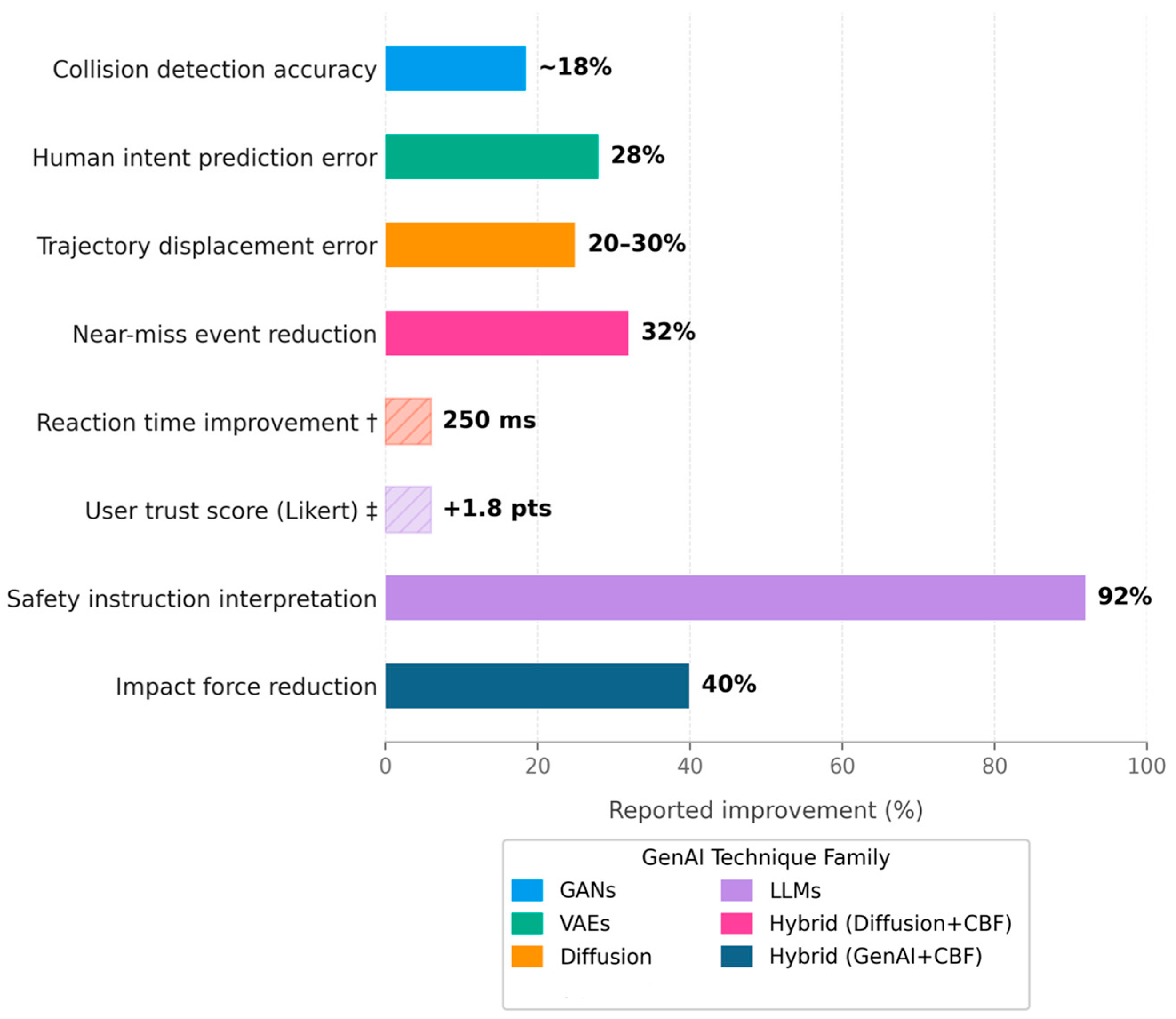
| GenAI Technique | Safety Metric | Improvement Reported | Comparison Baseline | Representative Studies | ISO Standard Relevance |
|---|---|---|---|---|---|
| GAN-based Simulation | Collision detection accuracy | +15–22% | Training without synthetic data | [49,50,51] | ISO/TS 15066 (detection) |
| VAE-based Motion Modeling | Human intent prediction error | 28% reduction in position error | LSTM-based predictors | [1,36] | ISO/TS 15066 (separation monitoring) |
| Diffusion Models | Trajectory prediction accuracy | 20–30% lower displacement error | Traditional recurrent networks | [34,52] | ISO/TS 15066 (speed monitoring) |
| Diffusion Models | Near-miss events | 32% reduction | Baseline MPC controller | [36] | ISO 10218 (collision avoidance) |
| Transformer-based | Reaction time to sudden human motion | 250 ms faster response | Classic safety-stop system | [38] | ISO 13849 (response time) |
| LLM-based Reasoning | User trust (7-point Likert scale) | +1.8 points | No explanation module | [37] | ISO/TR 14121-2 (psychological safety) |
| LLM-based Reasoning | Safety instruction interpretation | 92% correct interpretation | Rule-based parsing | [35,38] | ISO/TS 15066 (human–robot communication) |
| Hybrid (GenAI + CBF) | Impact force during contact | 40% reduction | Pure CBF controller | [36] | ISO/TS 15066 (power/force limiting) |
| Ref. | Sample Size | Experimental Setup Description | Data Type | Robot Platform | Control Law | Interaction Level |
|---|---|---|---|---|---|---|
| [36] | N = 18 | Human–robot collaborative assembly in a shared workspace with participants performing sequential assembly tasks whereas robot predicts and avoids collisions. | Joint angles, point cloud | UR5 cobot | CBF-MPC | Close collaboration |
| [37] | Sim only | Simulated human–robot coexistence task in a virtual environment designed to test safe policy learning without physical risk. | Simulated states | KUKA LBR iiwa (simulated) | Lyapunov adaptive | Coexistence |
| [38] | N = 12 | Mobile robot navigation in a crowded simulated corridor with fast-moving pedestrians to test socially compliant navigation. | Laser scan, RGB-D | Mobile robot (simulated/physical) | DWA + RL | Dynamic coexistence |
| [35] | 500 real + synthetic | Hazardous event detection for collaborative assembly using both real human demonstrations and GAN-generated synthetic near-miss scenarios. | RGB-D, pose keypoints | UR10 assembly | Velocity scaling | Cooperative assembly |
| [34] | Human3.6M dataset | Trajectory forecasting from 3D skeleton data (perception-only study, no physical robot implementation). | 3D skeleton sequences | N/A (perception only) | N/A | N/A |
| [39] | 50 instructions | Natural language safety instruction interpretation in a simulated Fetch robot environment. | Natural language commands | Fetch manipulator (simulated) | Language-conditioned | Cooperation |
| Ref. | GenAI Model | Primary Safety Function | Processing Pipeline/Feature Extraction | Metric Definition and Formula (if Applicable) | Key Outcome |
|---|---|---|---|---|---|
| [36] | Diffusion + CBF | Collision avoidance | Pipeline: 1. 3D point cloud data from wrist-mounted cameras is preprocessed and normalized. 2. Diffusion model (denoising diffusion probabilistic model) predicts future human joint angles over a 2 s horizon with 10 Hz update rate. 3. Predictions are converted into time-varying safety constraints (minimum separation distance). 4. CBF-MPC controller solves an optimization problem subject to these constraints to generate safe robot trajectories. Feature extraction: Raw point clouds → skeletal joint angles → predicted trajectories. | Near-miss events: Instances where minimum distance < (with = 0.5 m) during task execution. Reduction percentage calculated as: ( − )/ × 100%, where is near-miss count with baseline MPC controller. | Near-miss −32% |
| [37] | Generative RL | Safe policy learning | Pipeline: 1. Simulated robot and human states (joint positions, velocities) are encoded as feature vectors. 2. Generative model samples multiple candidate actions from the current policy distribution. 3. Each candidate action is evaluated by a Lyapunov function to verify stability and safety before execution. 4. Only actions passing the verification are executed, and the policy is updated via reinforcement learning. Feature extraction: State vectors (dimension 24) encode robot configuration, human pose, and relative distance. | Trust: User-reported score on a 7-point Likert scale (1 = no trust, 7 = complete trust) collected via post-experiment questionnaire. Mean trust score calculated as (Σ scores)/. Improvement reported as difference between experimental (with explanation module) and control (without explanation) conditions. | Trust +1.8/7 |
| [38] | Transformer + RL | Social navigation | Pipeline: 1. Laser scan data (720 points per scan) and RGB-D images (640 × 480) are fused. 2. Transformer encoder processes spatio-temporal dynamics of crowd movements, using self-attention to model interactions between all agents. 3. Encoded representation is fed to an RL policy (PPO) that generates velocity commands. 4. Commands are filtered by a safety layer that enforces minimum distance constraints. Feature extraction: Raw sensor data → agent positions and velocities → interaction features via attention weights. | Reaction time: Latency (ms) measured between a sudden human motion entering the robot’s safety zone and the robot’s first deceleration command. Calculated as = − , where is timestamp when human enters predefined danger radius (1.5 m), and is timestamp when robot velocity drops below 50% of current speed. | React time −250 ms |
| [35] | GAN | Hazard augmentation | Pipeline: 1. Real human pose sequences from 10 participants performing assembly tasks are collected. 2. GAN generator creates synthetic pose sequences of near-miss events (sudden movements, unexpected reaches). 3. Synthetic data is mixed with real data at ratios of 25%, 50%, and 75% to create augmented training sets. 4. A CNN-based hazard detector (ResNet-50 architecture) is trained on augmented datasets. 5. Detector outputs hazard probability for each frame. Feature extraction: RGB-D images → pose keypoints (17 keypoints via OpenPose) → normalized keypoint coordinates. | Detection accuracy: Accuracy = (TP + TN)/(TP + TN + FP + FN), where TP = correctly identified hazardous events, TN = correctly identified safe events, FP = false alarms, FN = missed hazards. Improvement range (15–22%) represents best performance across different synthetic data mixing ratios. | Detection +15–22% |
| [34] | Diffusion (TransFusion) | Trajectory forecast | Pipeline: 1. 3D skeleton sequences (25 joints per frame) from Human3.6M dataset are normalized to a canonical coordinate system. 2. Transformer encoder processes past motion (2 s, 50 frames) to extract temporal features. 3. Diffusion model (TransFusion architecture) iteratively denoises random noise over 1000 steps to predict future 3D joint positions (1 s, 25 frames). 4. Classifier-free guidance adjusts prediction diversity vs. accuracy. Feature extraction: 3D joint coordinates → normalized joint positions (zero-centered, scaled) → temporal embeddings via transformer. | Displacement error: Mean Euclidean distance (mm) between predicted and ground truth 3D joint positions across the prediction horizon. Calculated as: Error = ( × ) ||(j,t) − (j,t)||2, where J = number of joints (25), T = prediction frames (25), and are predicted and ground truth 3D positions. Improvement (20–30%) relative to LSTM baseline. | Displacement −20–30% |
| [39] | LLM (GPT-based) | Safety instruction interpretation | Pipeline: 1. Natural language safety instruction (e.g., “move slowly when I reach for the red box”) is tokenized using GPT tokenizer. 2. Pre-trained GPT model (GPT-3.5-turbo) generates a symbolic plan in PDDL (Planning Domain Definition Language) format. 3. Plan is parsed by a separate module into executable robot commands (navigation goals, speed constraints). 4. Commands are executed by the Fetch robot in simulation, with human operator verifying correctness. Feature extraction: Raw text → tokens → attention-weighted embeddings → PDDL symbols. | Instruction interpretation accuracy: Percentage of instructions where the robot’s final executed action matched the human’s intended task. Calculated as: Accuracy = × 100%, where = instructions correctly interpreted (verified by two independent human judges), = 50 instructions. | 92% correct interpret. |
| Framework Category | Primary Models | Target Safety Domain | Representative Studies | Key Outcomes |
|---|---|---|---|---|
| Data-Driven Simulation | GAN, VAE | Physical | [39,51,52] | Expanded safety-training data; improved robustness |
| Predictive Reasoning | Diffusion, Transformer | Physical/Cognitive | [40,41] | Accurate human-motion forecasting; proactive avoidance |
| Adaptive Control | Generative RL, Diffusion Control | Physical | [42] | Real-time adaptive policies; constraint satisfaction |
| Trust-Aware Cognition | LLM, Multimodal GenAI | Cognitive/Ethical | [43] | Transparent intent explanation; increased user trust |
| Challenge Domain | Current Limitations | Future Research Direction | Representative References |
|---|---|---|---|
| Data & Benchmarking | Limited shared datasets; poor multimodal diversity | Creation of standardized open HRC safety datasets | [44,45,51] |
| Model Interpretability | Black-box generative models hinder certification | Integration of XAI and symbolic reasoning layers | [46,47] |
| Real-Time Performance | High latency and memory cost in diffusion/transformer models | Lightweight, quantized architectures for edge robots | [39,59] |
| Validation & Certification | Lack of standardized verification and runtime assurance | Unified verification aligned with ISO safety standards | [41,48] |
| Ethical & Cognitive Safety | Hallucination and inconsistent reasoning in LLMs | Ethical alignment and human-in-the-loop evaluation | [43,49,50] |
| Theme | Key Insight | Implication for Practice | Representative References |
|---|---|---|---|
| Hybrid Safety Integration | Generative models complement deterministic logic | Develop ISO-aligned hybrid architectures | [47,48,58,59,60,62] |
| Cognitive–Physical Convergence | Human trust requires transparent reasoning | Embed cognitive interpretability in HRC control | [45,49,50,63,64,65] |
| Benchmarking & Standards | Lack of reproducible evaluation | Build open HRC safety datasets and standards | [44,55,66,67,68,69] |
| Ethical & Governance Aspects | LLM-driven reasoning introduces bias and uncertainty | Create governance and audit frameworks | [43,49,56,70,71,72,73,74,75,76] |
| Industrial Impact | GenAI safety improves adaptability and trust | Validate through domain-specific case studies | [40,57,79,80,81] |
Disclaimer/Publisher’s Note: The statements, opinions and data contained in all publications are solely those of the individual author(s) and contributor(s) and not of MDPI and/or the editor(s). MDPI and/or the editor(s) disclaim responsibility for any injury to people or property resulting from any ideas, methods, instructions or products referred to in the content. |
© 2026 by the authors. Licensee MDPI, Basel, Switzerland. This article is an open access article distributed under the terms and conditions of the Creative Commons Attribution (CC BY) license.
Share and Cite
Khan, A.; Akhtar, M.; Qureshi, S.M.; Mustafa, M.; Alsaleh, N.A.; Ahmad, I. A Systematic Review of Safety-Driven Approaches in Human–Robot Collaborative Systems. Sensors 2026, 26, 2079. https://doi.org/10.3390/s26072079
Khan A, Akhtar M, Qureshi SM, Mustafa M, Alsaleh NA, Ahmad I. A Systematic Review of Safety-Driven Approaches in Human–Robot Collaborative Systems. Sensors. 2026; 26(7):2079. https://doi.org/10.3390/s26072079
Chicago/Turabian StyleKhan, Akhtar, Maaz Akhtar, Sheheryar Mohsin Qureshi, Muzzamil Mustafa, Naser A. Alsaleh, and Imran Ahmad. 2026. "A Systematic Review of Safety-Driven Approaches in Human–Robot Collaborative Systems" Sensors 26, no. 7: 2079. https://doi.org/10.3390/s26072079
APA StyleKhan, A., Akhtar, M., Qureshi, S. M., Mustafa, M., Alsaleh, N. A., & Ahmad, I. (2026). A Systematic Review of Safety-Driven Approaches in Human–Robot Collaborative Systems. Sensors, 26(7), 2079. https://doi.org/10.3390/s26072079