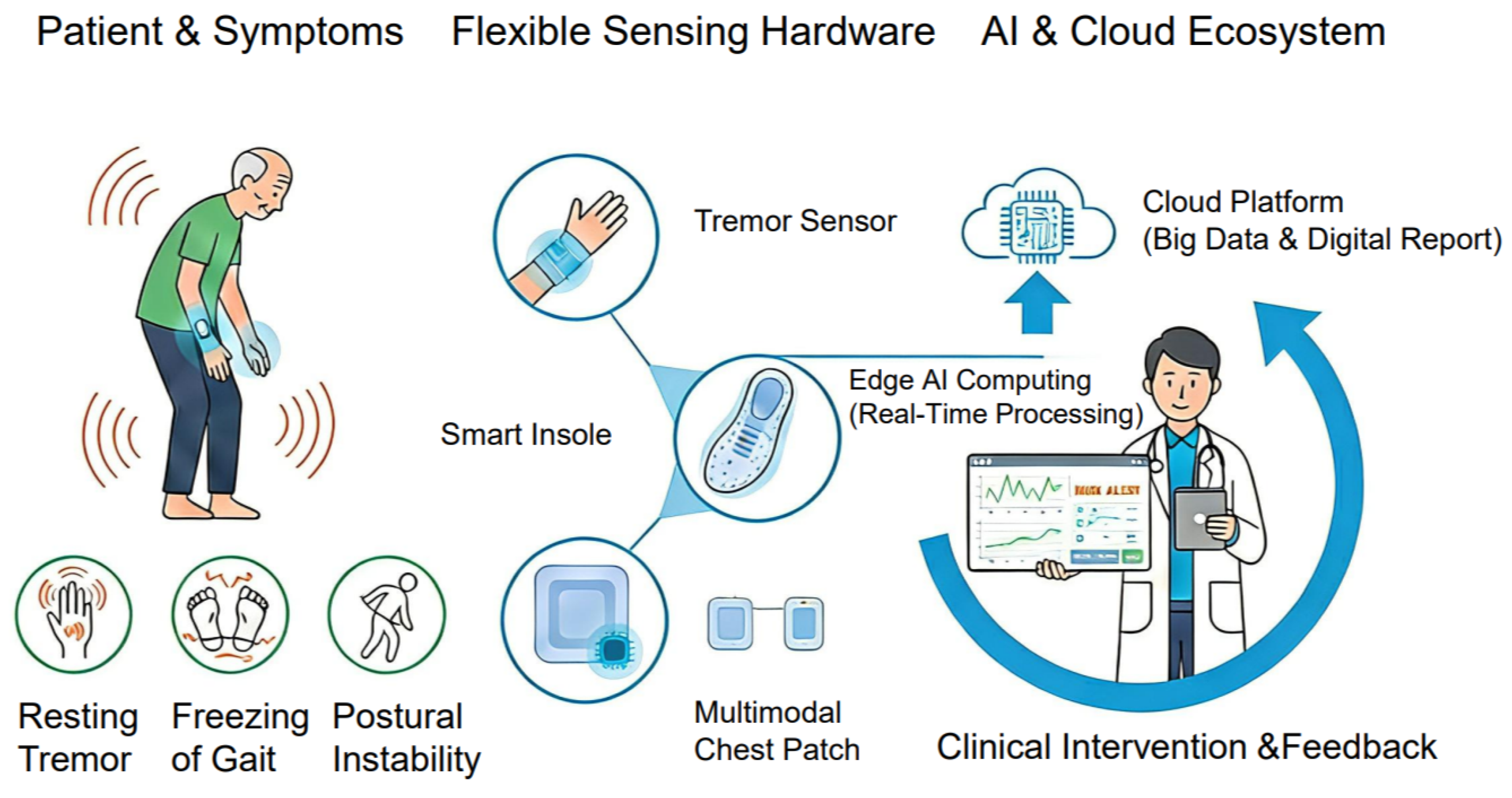
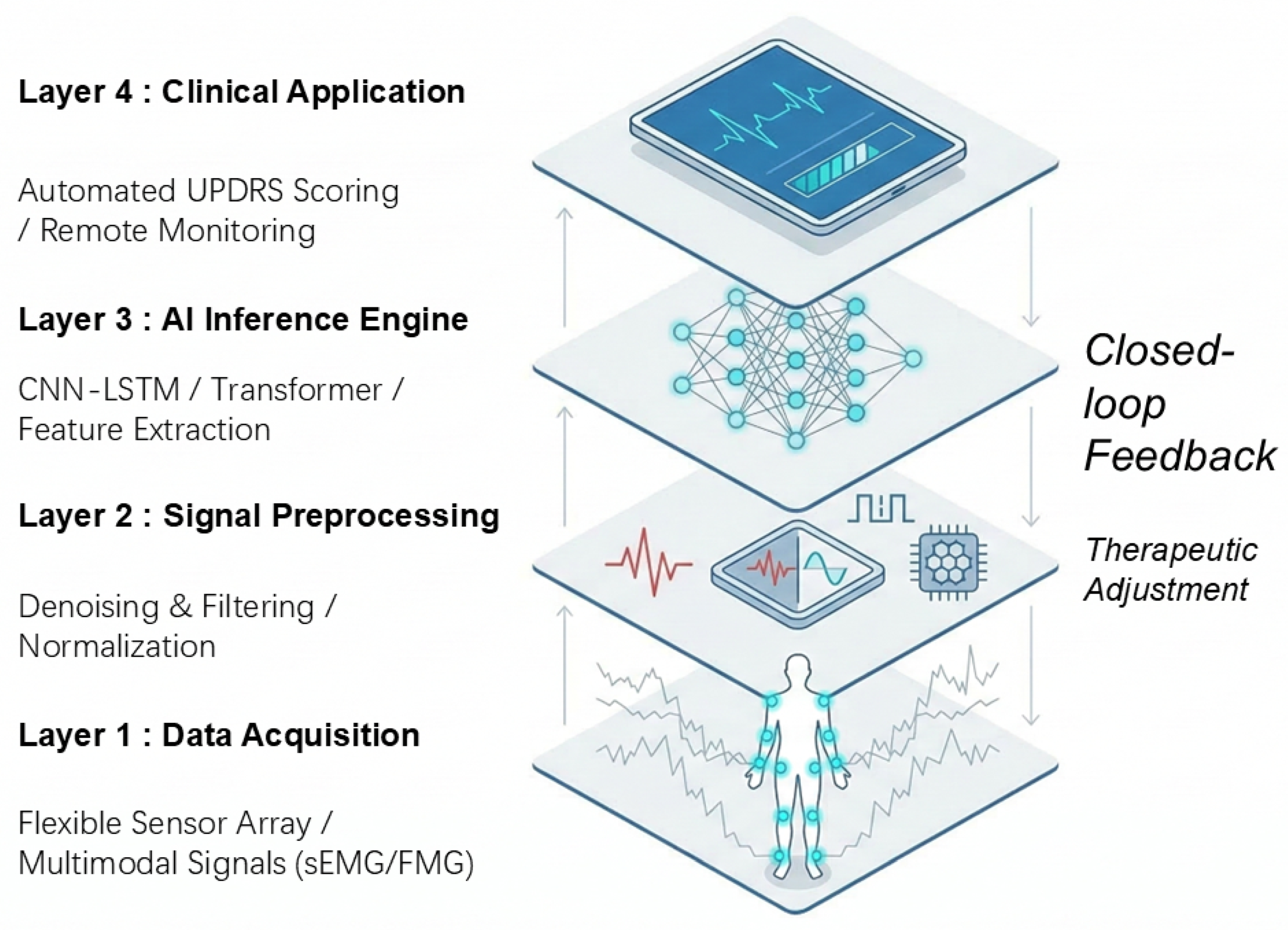
AI-Enabled Flexible Sensing Ecosystems for Parkinson’s Disease: Advancing Digital Biomarkers and Closed-Loop Interventions


 ,
, 
Abstract
1. Introduction
1.1. Clinical Background: Symptom Volatility and the Urgency of Continuous Home Monitoring
1.2. Research Status and Technical Evolution: From Clinical Scales to Flexible Sensing
1.3. Synergy Between Flexible Sensing and AI: A New Paradigm for Digital Biomarkers
1.4. Core Contributions of This Review
1.5. Literature Search Strategy and Inclusion Criteria
- demonstrated innovative flexible sensing mechanisms for PD symptoms;
- integrated AI-driven analytical frameworks for real-time or offline monitoring;
- provided clinical validation or discussed technical maturity (TRL) to distinguish between proof-of-concept and clinical-ready systems.
2. From PD Clinical Symptoms to Flexible Sensing Mechanisms
2.1. Core Motor Symptoms of PD and Sensor Performance Requirements
2.2. Flexible Sensing Mechanisms and Advanced Material Systems
2.2.1. Piezoresistive Sensors
2.2.2. Capacitive and Ionic Sensors
2.2.3. Self-Powered Sensors: Triboelectric and Piezoelectric Mechanisms
2.2.4. Multimodal Sensing Integration
2.3. Flexible Bioelectronics for Non-Motor Symptom Monitoring
2.4. Advanced Manufacturing Processes and System Reliability Assessment
2.4.1. Individualized Customization and Additive Manufacturing
2.4.2. Signal Integrity and Electromagnetic Environment Adaptability
2.4.3. Long-Term Monitoring Robustness and Patient Adherence
3. Artificial Intelligence-Driven Decision Support Systems: From Raw Sensing to Clinical Insights
3.1. Core Motor Feature Extraction and Signal Preprocessing
3.1.1. Signal Cleaning and Artifact Suppression
3.1.2. Digital Biomarkers and Feature Extraction
- 1.
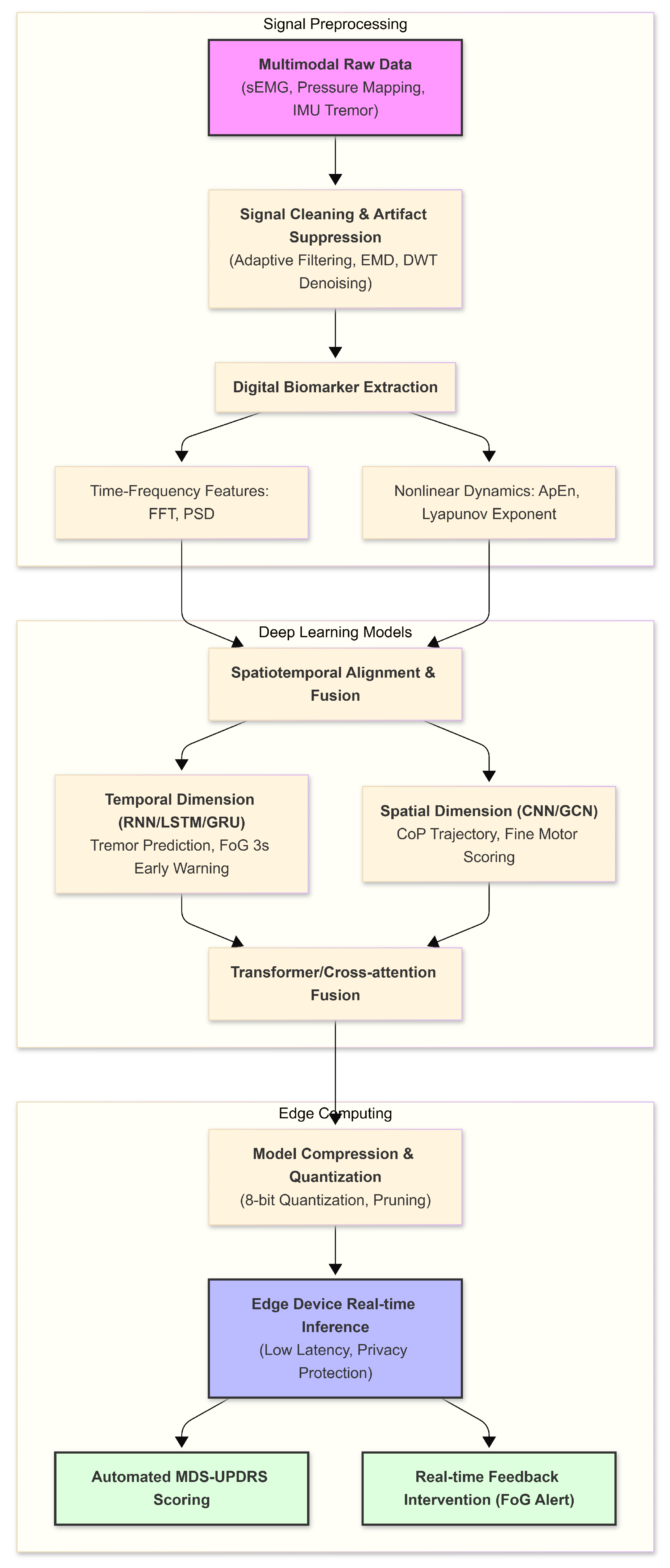
- Time-Frequency Domain Features: Morinan et al. demonstrated the central role of Fast Fourier Transform (FFT) in tremor quantification [55]. By extracting the Power Spectral Density (PSD) energy ratio within the 4–6 Hz band, precise identification of resting tremors can be achieved [56,57]. Li et al. focused on the morphological features of time-domain waveforms, utilizing the inter-tap interval to quantify the rhythmicity and degree of bradykinesia during finger-tapping tasks [30].
- 2.
- Nonlinear Dynamic Features: Huo et al. suggested that relying solely on linear features is insufficient to describe the complexity of PD gait [58]. This study introduced Approximate Entropy (ApEn) and the Lyapunov Exponent to quantify gait stability and chaotic behavior. Such nonlinear analyses can sensitively capture subtle rhythmic fluctuations preceding FoG episodes, providing a digital basis for high-sensitivity early warning.
3.1.3. Multimodal Fusion and Clinical Alignment
3.2. Deep Learning Models and Pathological State Classification
3.2.1. Time-Series Modeling and Freezing of Gait Prediction
3.2.2. Spatio-Temporal Feature Fusion and Graph Convolutional Networks
3.2.3. Edge-Side Lightweight Models and Real-Time Monitoring Optimization
3.3. Edge Computing and the Telemedicine Ecosystem
4. Clinical Application Status, Cross-Domain Fusion, and System-Level Challenges
4.1. Clinical Validation and Benchmarking
4.1.1. Automated Scoring and Clinical Gold Standard Alignment
4.1.2. Simplified Scales and Computational Search in Remote Monitoring
4.1.3. Standardization of Digital Biomarkers
4.2. From Physical to Biochemical Multimodal Sensing
4.2.1. Neurotransmitter Monitoring in Sweat and Tears
4.2.2. Pharmacodynamic Assessment and Dyskinesia Monitoring
4.2.3. Spatiotemporal Fusion of Multimodal Data
4.3. Closed-Loop “Sense-and-Treat” Frameworks
4.3.1. Instantaneous Feedback Intervention for FoG
4.3.2. Neural Reprogramming and Precision Electrical Stimulation
4.4. System-Level Challenges in Real-World Settings
4.4.1. Data Privacy and Ethics
4.4.2. Adherence and Wearability for Long-Term Monitoring
4.4.3. Data Scarcity and Generalization
4.4.4. Power Management and Low-Power Architectures
5. Conclusions and Outlook
5.1. Summary of Core Achievements
- 1.
- Hardware Level: Through the introduction of advanced materials such as MXene, liquid metal, and self-healing hydrogels, sensors have achieved a critical balance between sensitivity and mechanical robustness, satisfying the hardware requirements for long-term continuous monitoring.
- 2.
- Software Level: Deep learning models—such as the GRU architecture by Moore and the lightweight Transformer by Yi—have successfully pushed the early warning window for FoG to 3 s prior to onset. Furthermore, by leveraging edge computing technologies (e.g., Chen), inference latency has been compressed to millisecond levels, addressing the real-time processing bottlenecks of wearable devices [31,32,63].
5.2. Future Evolution Trajectories and Predictions
- 1.
- Deep Integration of AGI and Large Multimodal Models (LMMs): Future systems will transcend single-task classification. Instead, they will utilize AGI or medical-specific large models to perform semantic interpretation of long-term, multidimensional sensing data (kinematic, electrophysiological, biochemical, and acoustic). AI will directly generate diagnostically interpretable clinical recommendations rather than merely providing numerical scores [72,73,74,75].
- 2.
- Integrated “Sense-and-Treat” Synergetic Systems of Invasive and Wearable Devices: Building upon the neural reprogramming concept proposed by Kim, future closed-loop systems will feature synergy between flexible skin-surface patches and miniaturized implantable stimulators [36]. When wearable sensors capture specific pathological signatures, they will trigger precise Deep Brain Stimulation (DBS) or micro-adjustments of drug pumps via synchronized internal-external data, achieving true “precision dosing.”
- 3.
- Standardized Global Digital Biomarker Repositories and Federated Learning: To overcome the small-sample data bottleneck (a challenge noted by Twala in 2025), standardized global sensor protocols will gradually be established [67]. Through Federated Learning, models across different institutions can be collaboratively trained without sharing raw patient data, thereby constructing highly generalizable “Digital Parkinsonian Portraits” for universal precision monitoring across diverse ethnicities and age groups.
5.3. Barriers to Clinical Translation
5.4. Final Conclusions
Funding
Institutional Review Board Statement
Informed Consent Statement
Data Availability Statement
Acknowledgments
Conflicts of Interest
References
- Moreau, C.; Rouaud, T.; Grabli, D.; Benatru, I.; Remy, P.; Marques, A.R.; Drapier, S.; Mariani, L.L.; Roze, E.; Devos, D.; et al. Overview on wearable sensors for the management of Parkinson’s disease. npj Park. Dis. 2023, 9, 153. [Google Scholar] [CrossRef]
- Li, S.; Liu, Y.; Lu, S.; Xu, J.; Liu, X.; Yang, D.; Yang, Y.; Hou, L.; Li, N. A crazy trio in Parkinson’s disease: Metabolism alteration, α-synuclein aggregation, and oxidative stress. Mol. Cell. Biochem. 2024, 480, 139–157. [Google Scholar] [CrossRef]
- Mursyid, F.; Hasan, A.; Owkwulu, T.; Wilson, M.; Huang, Y.F.; Sastranagara, H. Prenatal Exposure to Maternal Stress and Neurodevelopmental Outcomes in Children: A Longitudinal Study with Epigenetic Analysis in Jakarta, Indonesia. Sriwij. J. Neurol. 2023, 2, 14–27. [Google Scholar] [CrossRef]
- Adam, H.; Gopinath, S.C.B.; Md Arshad, M.K.; Adam, T.; Parmin, N.A.; Husein, I.; Hashim, U. An update on pathogenesis and clinical scenario for Parkinson’s disease: Diagnosis and treatment. 3 Biotech 2023, 13, 142. [Google Scholar] [CrossRef] [PubMed]
- Ziemssen, T.; Reichmann, H. Non-motor dysfunction in Parkinson’s disease. Park. Relat. Disord. 2007, 13, 323–332. [Google Scholar] [CrossRef]
- Lu, R.; Xu, Y.; Li, X.; Fan, Y.; Zeng, W.; Tan, Y.; Ren, K.; Chen, W.; Cao, X. Evaluation of Wearable Sensor Devices in Parkinson’s Disease: A Review of Current Status and Future Prospects. Park. Dis. 2020, 2020, 4693019. [Google Scholar] [CrossRef]
- Luo, L. An Overview of Freezing of Gait in Neurodegenerative Diseases. In Encyclopedia of Behavioral Neuroscience, 2nd ed.; Elsevier: Amsterdam, The Netherlands, 2022; pp. 313–317. [Google Scholar] [CrossRef]
- Johnson, S.; Kantartjis, M.; Severson, J.; Dorsey, R.; Adams, J.L.; Kangarloo, T.; Kostrzebski, M.A.; Best, A.; Merickel, M.; Amato, D.; et al. Wearable Sensor-Based Assessments for Remotely Screening Early-Stage Parkinson’s Disease. Sensors 2024, 24, 5637. [Google Scholar] [CrossRef]
- Snijders, A.H.; Nijkrake, M.J.; Bakker, M.; Munneke, M.; Wind, C.; Bloem, B.R. Clinimetrics of freezing of gait. Mov. Disord. 2008, 23, S468–S474. [Google Scholar] [CrossRef]
- Wu, X.; Ma, L.; Wei, P.; Shan, Y.; Chan, P.; Wang, K.; Zhao, G. Wearable sensor devices can automatically identify the ON-OFF status of patients with Parkinson’s disease through an interpretable machine learning model. Front. Neurol. 2024, 15, 1387477. [Google Scholar] [CrossRef]
- Al-Adhaileh, M.H.; Wadood, A.; Aldhyani, T.H.H.; Khan, S.; Uddin, M.I.; Al-Nefaie, A.H. Deep learning techniques for detecting freezing of gait episodes in Parkinson’s disease using wearable sensors. Front. Physiol. 2025, 16, 1581699. [Google Scholar] [CrossRef] [PubMed]
- Qadri, Y.A.; Ahmad, K.; Kim, S.W. Artificial General Intelligence for the Detection of Neurodegenerative Disorders. Sensors 2024, 24, 6658. [Google Scholar] [CrossRef]
- Zhu, Z.; Wang, H.; Zhang, L.; Zeng, L.; Gan, L.; Jia, B. Advances in flexible sensor monitoring technology for neurodegenerative diseases in the elderly. Nanotechnology 2025, 36, 242002. [Google Scholar] [CrossRef]
- Safarpour, D.; Dale, M.L.; Shah, V.V.; Talman, L.; Carlson-Kuhta, P.; Horak, F.B.; Mancini, M. Surrogates for rigidity and PIGD MDS-UPDRS subscores using wearable sensors. Gait Posture 2022, 91, 186–191. [Google Scholar] [CrossRef] [PubMed]
- Habets, J.G.V.; Heijmans, M.; Leentjens, A.F.G.; Simons, C.J.P.; Temel, Y.; Kuijf, M.L.; Kubben, P.L.; Herff, C. A Long-Term, Real-Life Parkinson Monitoring Database Combining Unscripted Objective and Subjective Recordings. Data 2021, 6, 22. [Google Scholar] [CrossRef]
- Virameteekul, S.; Revesz, T.; Jaunmuktane, Z.; Warner, T.T.; De Pablo-Fernández, E. Clinical Diagnostic Accuracy of Parkinson’s Disease: Where Do We Stand? Mov. Disords 2023, 38, 558–566. [Google Scholar] [CrossRef]
- Rodríguez-Martín, D.; Pérez-López, C. Commercial symptom monitoring devices in Parkinson’s disease: Benefits, limitations, and trends. Front. Neurol. 2024, 15, 1470928. [Google Scholar] [CrossRef] [PubMed]
- Jiang, Z. Study on Flexible Wearable Sensors for Motion Detection and Health Monitoring. Adv. Eng. Technol. Res. 2025, 14, 858. [Google Scholar] [CrossRef]
- Ho, A.; Bavli, I.; Mahal, R.; McKeown, M.J. Multi-Level Ethical Considerations of Artificial Intelligence Health Monitoring for People Living with Parkinson’s Disease. AJOB Empir. Bioeth. 2024, 15, 178–191. [Google Scholar] [CrossRef] [PubMed]
- Lee, S.; Ho, D.; Jekal, J.; Cho, S.Y.; Choi, Y.J.; Oh, S.; Choi, Y.; Lee, T.; Jang, K.I.; Cho, J. Fabric-based lamina emergent MXene-based electrode for electrophysiological monitoring. Nat. Commun. 2024, 15, 5974. [Google Scholar] [CrossRef]
- Paul, S.S.; Mancini, M. Wearables for diagnosis and predicting clinical milestones. In Handbook of Digital Technologies in Movement Disorders; Academic Press: Cambridge, MA, USA, 2024; pp. 149–166. [Google Scholar]
- Zeng, T.; Wu, Y.; Lei, M. Review: Developments and challenges of advanced flexible electronic materials for medical monitoring applications. Adv. Compos. Hybrid Mater. 2024, 7, 141. [Google Scholar] [CrossRef]
- Xie, Q.; Han, L.; Liu, J.; Zhang, W.; Zhao, L.; Liu, Y.; Chen, Y.; Li, Y.; Zhou, Q.; Dong, Y.; et al. Kirigami-Inspired Stretchable Piezoelectret Sensor for Analysis and Assessment of Parkinson’s Tremor. Adv. Healthc. Mater. 2025, 14, 2402010. [Google Scholar] [CrossRef] [PubMed]
- Hu, X.; Zhao, Y.; Qiu, S.; Nie, J.; Liu, H.; Wang, T.; Zhang, S.; Zhou, S.; Xu, W. Bifunctional Flexible Eutectogel: Zinc Cell Dendrite Inhibition and Machine Learning-Assisted Parkinson’s Disease Monitoring. Small 2025, 21, e08361. [Google Scholar] [CrossRef]
- Hou, Y.; Ji, J.; Zhu, Y.; Dell, T.; Liu, X. Flexible Gel-Free Multi-Modal Wireless Sensors with Edge Deep Learning for Detecting and Alerting Freezing of Gait Symptom. IEEE Trans. Biomed. Circuits Syst. 2023, 17, 1010–1021. [Google Scholar] [CrossRef]
- Khan, M.; Ayyob, F. Wearable Parkinson’s Tremor Monitoring Using a PNC Based Flexible Capacitive Sensor with an AC Bridge and Two-Step Calibration. Front. Eng. 2025, 1, 63. [Google Scholar] [CrossRef]
- Guo, Y.; Guo, Z.; Zhong, M.; Wan, P.; Zhang, W.; Zhang, L. A Flexible Wearable Pressure Sensor with Bioinspired Microcrack and Interlocking for Full-Range Human–Machine Interfacing. Small 2018, 14, 1803018. [Google Scholar] [CrossRef]
- Samarentsis, A.G.; Makris, G.; Spinthaki, S.; Christodoulakis, G.; Tsiknakis, M.; Pantazis, A.K. A 3D-Printed Capacitive Smart Insole for Plantar Pressure Monitoring. Sensors 2022, 22, 9725. [Google Scholar] [CrossRef]
- Zhang, X.; Pan, W.; Wu, Z.; Liu, X.; Sun, Y.; Fan, B.; Cai, M.; Li, T.; Liu, T. Evaluation of Parkinson’s Disease Motor Symptoms via Wearable Inertial Measurements Units and Surface Electromyography Sensors. Bioengineering 2025, 12, 1116. [Google Scholar] [CrossRef] [PubMed]
- Li, Y.; Yin, J.; Liu, S.; Xue, B.; Shokoohi, C.; Ge, G.; Hu, M.; Li, T.; Tao, X.; Rao, Z.; et al. Learning Hand Kinematics for Parkinson’s Disease Assessment Using a Multimodal Sensor Glove. Adv. Sci. 2023, 10, 2206982. [Google Scholar] [CrossRef]
- Moore, A.; Li, J.; Contag, C.H.; Currano, L.J.; Pyles, C.O.; Hinkle, D.A.; Patil, V.S. Wearable Surface Electromyography System to Predict Freeze of Gait in Parkinson’s Disease Patients. Sensors 2024, 24, 7853. [Google Scholar] [CrossRef]
- Chen, Q.; Zhang, F.; Chen, Z.; Ren, K.; Chen, S.; Zhao, J. Shallow multi-view network for sensor-based recognition of Parkinson’s freezing of gait. Biomed. Signal Process. Control 2026, 112, 108473. [Google Scholar] [CrossRef]
- Onorati, C.R.; Sengupta, D.; Gomes, N.M.; Kottapalli, A.G.P. On-Foot Gait Lab: A Hybrid Wearable Sensor Platform for Spatiotemporal Gait Analysis Using Electrospun Piezocapacitive Insoles and IMUs. ACS Appl. Eng. Mater. 2026, 4, 107–118. [Google Scholar] [CrossRef]
- Liu, X.; Zhang, X.; Li, J.; Pan, W.; Sun, Y.; Lin, S.; Liu, T. Automated UPDRS Gait Scoring Using Wearable Sensor Fusion and Deep Learning. Bioengineering 2025, 12, 686. [Google Scholar] [CrossRef]
- Zheng, X.; Li, Y.; Zhou, Q.; Yu, Z.; Liu, X.; Xu, R.; Sung, H.K.; Chernogor, L.; Sun, T.; Yao, Z.; et al. Biocompatible, biodegradable, and high-performance flexible pressure sensors for severity grading and rehabilitation assessment in Parkinson’s disease management. Nano Energy 2025, 140, 111030. [Google Scholar] [CrossRef]
- Kim, J.; Kim, S.; Hwang, Y.; An, S.; Park, J.; Kwon, Y.B.; Cho, B.; Kwon, D.; Kim, Y.; Kang, S.; et al. Electromagnetized MXenes Enhance the Efficient Direct Reprogramming of Dopamine Neurons for Parkinson’s Disease Therapy. ACS Nano 2025, 19, 16744–16759. [Google Scholar] [CrossRef]
- Kang, M.; Choi, H.; Park, K.; Pyo, S. Additively Manufactured 3D Auxetic Metamaterials for Structurally Guided Capacitive and Resistive Tactile Sensing. Adv. Funct. Mater. 2025, 35, e09704. [Google Scholar] [CrossRef]
- Hu, T.; Pan, T.; Guo, D.; Xiao, Y.; Li, F.; Gao, M.; Huang, Z.; Zhu, J.; Cheng, T.; Lin, Y. Omnidirectional Configuration of Stretchable Strain Sensor Enabled by the Strain Engineering with Chiral Auxetic Metamaterial. ACS Nano 2023, 17, 22035–22045. [Google Scholar] [CrossRef]
- Zheng, X.; Liu, C.; Huang, X.; Wang, Y.; Huang, Q.; Huang, Z.; Duan, Z.; Li, T.; Yuan, Z.; Jiang, Y.; et al. Daily carbon ink functionalized conductive fabric for simple, low-cost, and wide range flexible pressure sensor with multifunctional applications. Diam. Relat. Mater. 2025, 158, 112661. [Google Scholar] [CrossRef]
- Bhattacharjee, M.; Bandyopadhyay, D. Flexible Paper Touchpad for Parkinson’s Hand Tremor Detection. Sens. Actuators A Phys. 2019, 294, 164–172. [Google Scholar] [CrossRef]
- Kantarak, E.; Rucman, S.; Kumpika, T.; Sroila, W.; Tippo, P.; Panthawan, A.; Sanmuangmoon, P.; Sriboonruang, A.; Jhuntama, N.; Wiranwetchayan, O.; et al. Fabrication, Design and Application of Stretchable Strain Sensors for Tremor Detection in Parkinson Patient. Appl. Compos. Mater. 2020, 27, 955–968. [Google Scholar] [CrossRef]
- Vera A, D.F.; He, T.; Redoute, J.M.; Lee, C.; Yuce, M.R. Flexible Forearm Triboelectric Sensors for Parkinson’s Disease Diagnosing and Monitoring. In Proceedings of the 2022 44th Annual International Conference of the IEEE Engineering in Medicine & Biology Society (EMBC), Glasgow, UK, 11–15 July 2022; pp. 4909–4912. [Google Scholar] [CrossRef]
- Vera Anaya, D.; Yuce, M.R. Stretchable triboelectric sensor for measurement of the forearm muscles movements and fingers motion for Parkinson’s disease assessment and assisting technologies. Med. Devices Sens. 2021, 4, e10154. [Google Scholar] [CrossRef]
- Wang, Z.; Bu, M.; Xiu, K.; Sun, J.; Hu, N.; Zhao, L.; Gao, L.; Kong, F.; Zhu, H.; Song, J.; et al. A flexible, stretchable and triboelectric smart sensor based on graphene oxide and polyacrylamide hydrogel for high precision gait recognition in Parkinsonian and hemiplegic patients. Nano Energy 2022, 104, 107978. [Google Scholar] [CrossRef]
- Latsch, B.; Schäfer, N.; Grimmer, M.; Dali, O.B.; Mohseni, O.; Bleichner, N.; Altmann, A.A.; Schaumann, S.; Wolf, S.I.; Seyfarth, A.; et al. 3D-Printed Piezoelectric PLA-Based Insole for Event Detection in Gait Analysis. IEEE Sens. J. 2024, 24, 26472–26486. [Google Scholar] [CrossRef]
- Sarkar, P.K.; Kamilya, T.; Acharya, S. Introduction of Triboelectric Positive Bioplastic for Powering Portable Electronics and Self-Powered Gait Sensor. ACS Appl. Energy Mater. 2019, 2, 5507–5514. [Google Scholar] [CrossRef]
- Ren, K.; Chen, Z.; Ling, Y.; Zhao, J. Recognition of freezing of gait in Parkinson’s disease based on combined wearable sensors. BMC Neurol. 2022, 22, 229. [Google Scholar] [CrossRef]
- Ghayvat, H.; Awais, M.; Geddam, R.; Quasim, M.T.; Khowaja, S.A.; Dev, K. AiCareGaitRehabilitation: Multi-modalities sensor data fusion for AI-IoT enabled realtime electrical stimulation device for pre-Fog and post-Fog to person with Parkinson’s Disease. Inf. Fusion 2025, 122, 103155. [Google Scholar] [CrossRef]
- Rizvi, S.Z.H.; Palimar, V.; Gupta, C.; Andrade, L.S. Spectrum of Non-Motor Symptoms in Parkinson’s Disease—A Review. Ann. Clin. Exp. Neurol. 2024, 18, 72–80. [Google Scholar] [CrossRef]
- Park, M.; Yang, W.; Kim, J.W.; Choi, Y.; Kim, S.; Lee, Y.; Kim, D.S.; Kim, J.; Lim, D.; Ha, J.S. A Fully Self-Healing Patch of Integrated Bio-Signal Monitoring Sensors with Self-Healing Microporous Foam and Au Nanosheet Electrodes. Adv. Funct. Mater. 2024, 34, 2402508. [Google Scholar] [CrossRef]
- Lan, L.; Ping, J.; Li, H.; Wang, C.; Li, G.; Song, J.; Ying, Y. Skin-Inspired All-Natural Biogel for Bioadhesive Interface. Adv. Mater. 2024, 36, 2401151. [Google Scholar] [CrossRef] [PubMed]
- Sharma, A.; Agarwal, A.; Kalenga, M.K.W.; Gupta, V.; Srivastava, V. AI in Parkinson’s Disease: A Short Review of Machine Learning Approaches for Diagnosis. Processes 2026, 14, 199. [Google Scholar] [CrossRef]
- Chakraborty, J.; Nandy, A. Discrete wavelet transform based data representation in deep neural network for gait abnormality detection. Biomed. Signal Process. Control 2020, 62, 102076. [Google Scholar] [CrossRef]
- Liu, W.; Hu, J.; Lv, F.; Tang, Z. A new method for long-term temperature compensation of structural health monitoring by ultrasonic guided wave. Measurement 2025, 252, 117310. [Google Scholar] [CrossRef]
- Morinan, G.; Hauser, R.A.; Schrag, A.; Tang, J.; O’Keeffe, J.; Mds-Nms Scale Development Study Group. Abbreviated MDS-UPDRS for Remote Monitoring in PD Identified Using Exhaustive Computational Search. Park. Dis. 2022, 2022, 2920255. [Google Scholar] [CrossRef]
- Muñoz-Mata, B.G.; Dorantes-Méndez, G.; Rodríguez-Leyva, I.; Piña-Ramírez, O. Leveraging wavelet scattering transform on accelerometry data for classification of Parkinson’s tremor. Eur. Phys. J. Spec. Top. 2025, 234, 4799–4811. [Google Scholar] [CrossRef]
- Tang, L.; Hu, Q.; Wang, X.; Liu, L.; Zheng, H.; Yu, W.; Luo, N.; Liu, J.; Song, C. A multimodal fusion network based on a cross-attention mechanism for the classification of Parkinsonian tremor and essential tremor. Sci. Rep. 2024, 14, 28050. [Google Scholar] [CrossRef]
- Huo, H.; Zhang, C.; Liu, W.; Zhao, C.; Ma, L.; Wang, J.; Xu, N. Early detection of Parkinson’s disease using a multi area graph convolutional network. Sci. Rep. 2025, 15, 5561. [Google Scholar] [CrossRef]
- Ferreira, R.G.; Silva, A.P.; Nunes-Pereira, J. Current On-Skin Flexible Sensors, Materials, Manufacturing Approaches, and Study Trends for Health Monitoring: A Review. ACS Sens. 2024, 9, 1104–1133. [Google Scholar] [CrossRef] [PubMed]
- Qi, W.; Shen, S.; Zhu, X.; Li, J.; Wang, B.; Shi, Y.; Dong, Y.; Shen, H.; Kang, J.; Lu, X.; et al. Digital Biomarkers for Parkinson Disease: Bibliometric Analysis and a Scoping Review of Deep Learning for Freezing of Gait. J. Med. Internet Res. 2025, 27, e71560. [Google Scholar] [CrossRef]
- Sigcha, L.; Borzì, L.; Amato, F.; Rechichi, I.; Ramos-Romero, C.; Cárdenas, A.; Gascó, L.; Olmo, G. Deep learning and wearable sensors for the diagnosis and monitoring of Parkinson’s disease: A systematic review. Expert Syst. Appl. 2023, 229, 120541. [Google Scholar] [CrossRef]
- Ji, M.; Dong, H.; Guo, L.; Li, W. Diagnosis and Severity Rating of Parkinson’s Disease Based on Multimodal Gait Signal Analysis With GLRT and ST-CNN-Transformer Networks. IEEE J. Transl. Eng. Health Med. 2025, 13, 450–460. [Google Scholar] [CrossRef]
- Yi, M.K.; Hwang, S.O. A new lightweight deep learning model optimized with pruning and dynamic quantization to detect freezing gait on wearable devices. Comput. Biol. Med. 2025, 191, 110138. [Google Scholar] [CrossRef]
- He, Y.; Yang, T.; Yang, C.; Zhou, H. Integrated Equipment for Parkinson’s Disease Early Detection Using Graph Convolution Network. Electronics 2022, 11, 1154. [Google Scholar] [CrossRef]
- Ozkoc, E.; Zech, T.S.; Pfeiffer, N.; Göb, S.; Frickel, J. Compressed and Lightweight CNN for Real-Time Parkinson’s Tremor Detection from Wearable IMU Data. In Proceedings of the 2025 IEEE 35th International Workshop on Machine Learning for Signal Processing (MLSP), Istanbul, Turkey, 31 August–3 September 2025; pp. 1–6. [Google Scholar] [CrossRef]
- Borzì, L.; Sigcha, L.; Firouzi, F.; Olmo, G.; Demrozi, F. Edge-based freezing of gait recognition in Parkinson’s disease. Comput. Electr. Eng. 2025, 127, 110530. [Google Scholar] [CrossRef]
- Twala, B. AI-driven precision diagnosis and treatment in Parkinson’s disease: A comprehensive review and experimental analysis. Front. Aging Neurosci. 2025, 17, 1638340. [Google Scholar] [CrossRef] [PubMed]
- Zhou, Z.D.; Yi, L.X.; Wang, D.Q.; Lim, T.M.; Tan, E.K. Role of dopamine in the pathophysiology of Parkinson’s disease. Transl. Neurodegener. 2023, 12, 44. [Google Scholar] [CrossRef] [PubMed]
- Ramesh, S.; Arachchige, A.S.P.M. Depletion of dopamine in Parkinson’s disease and relevant therapeutic options: A review of the literature. AIMS Neurosci. 2023, 10, 200–231. [Google Scholar] [CrossRef] [PubMed]
- Khadem, A.H.; Anik, H.R.; Limon, M.G.M.; Rabbani, M.; Rafi, A.S.; Mim, I.K.; Rahman, M.H.; Alam, F.B.; Islam, M.K.; Munira, S.S.; et al. Review of MXene-Based Electrospun Nanocomposites for Flexible and Wearable Sensors. ACS Appl. Nano Mater. 2025, 8, 16231–16259. [Google Scholar] [CrossRef]
- Slemenšek, J.; Geršak, J.; Bratina, B.; Van Midden, V.M.; Pirtošek, Z.; Šafarič, R. Wearable Online Freezing of Gait Detection and Cueing System. Bioengineering 2024, 11, 1048. [Google Scholar] [CrossRef]
- Elbatanouny, H.; Kleanthous, N.; Dahrouj, H.; Alusi, S.; Almajali, E.; Mahmoud, S.; Hussain, A. Insights into Parkinson’s Disease-Related Freezing of Gait Detection and Prediction Approaches: A Meta Analysis. Sensors 2024, 24, 3959. [Google Scholar] [CrossRef]
- Chen, Y.; Esmaeilzadeh, P. Generative AI in Medical Practice: In-Depth Exploration of Privacy and Security Challenges. J. Med. Internet Res. 2024, 26, e53008. [Google Scholar] [CrossRef]
- Rabbani, S.A.; El-Tanani, M.; Sharma, S.; Rabbani, S.S.; El-Tanani, Y.; Kumar, R.; Saini, M. Generative Artificial Intelligence in Healthcare: Applications, Implementation Challenges, and Future Directions. BioMedInformatics 2025, 5, 37. [Google Scholar] [CrossRef]
- Ratnam, K.K.Y. Generative artificial intelligence in public health research and scientific communication: A narrative review of real applications and future directions. Digit. Health 2025, 11, 1–10. [Google Scholar] [CrossRef] [PubMed]



| Symptom | Clinical Endpoint | Key Sensor Requirements & Metrics | n | Environment | Rep. Ref. & Performance |
|---|---|---|---|---|---|
| Resting Tremor | Freq. (4–6 Hz) & Amplitude (MDS-UPDRS III) | LOD < 50 mg; ms-level response; High SNR. | 1 | Lab (Healthy) | Guo [27]: 25 mg LOD. |
| 3 | Lab (Healthy) | Xie [23]: 2.5 ms response. | |||
| - | Lab (Bench) | Khan [26]: pF resolution. | |||
| Bradykinesia | Tapping speed, range, and rhythmicity. | Linearity (); IMU + sEMG multi-modal fusion. | 40 | Clinical Lab | Li [30]: Kappa 0.833. |
| High-fidelity signal capture; low hysteresis. | 28 | Clinical Lab | Zhang [29]: Multi-modal. | ||
| Gait/FoG | Prediction lead time (>3 s); FoG frequency. | Electrophysiological precursor capture; Low latency (<200 ms). | 10 | Controlled | Moore [31]: sEMG capture. |
| Wide linear range (MPa); Dynamic pressure mapping. | 177 | Database | Chen [32]: 97.1% F1-score. | ||
| Postural Instability | COP migration; Gait variability. | Pressure range > 800 kPa; Precise COP tracking. | - | Lab (Healthy) | Onorati [33]: Hybrid platform. |
| High durability (>10,000 cycles); Baseline stability. | 21 | Clinic/Home | Liu [34]: Scoring accuracy. | ||
| Rigidity & NMS | Muscle stiffness; Sleep (RBD); Cognition. | Bio-compatibility; Low Young’s modulus; Self-healing. | 1 | Lab (Healthy) | Zheng [35]: Biodegradable. |
| High SNR; Sensitivity to subtle physiological changes. | - | Animal Model | Kim [36]: MXene-mediated. |
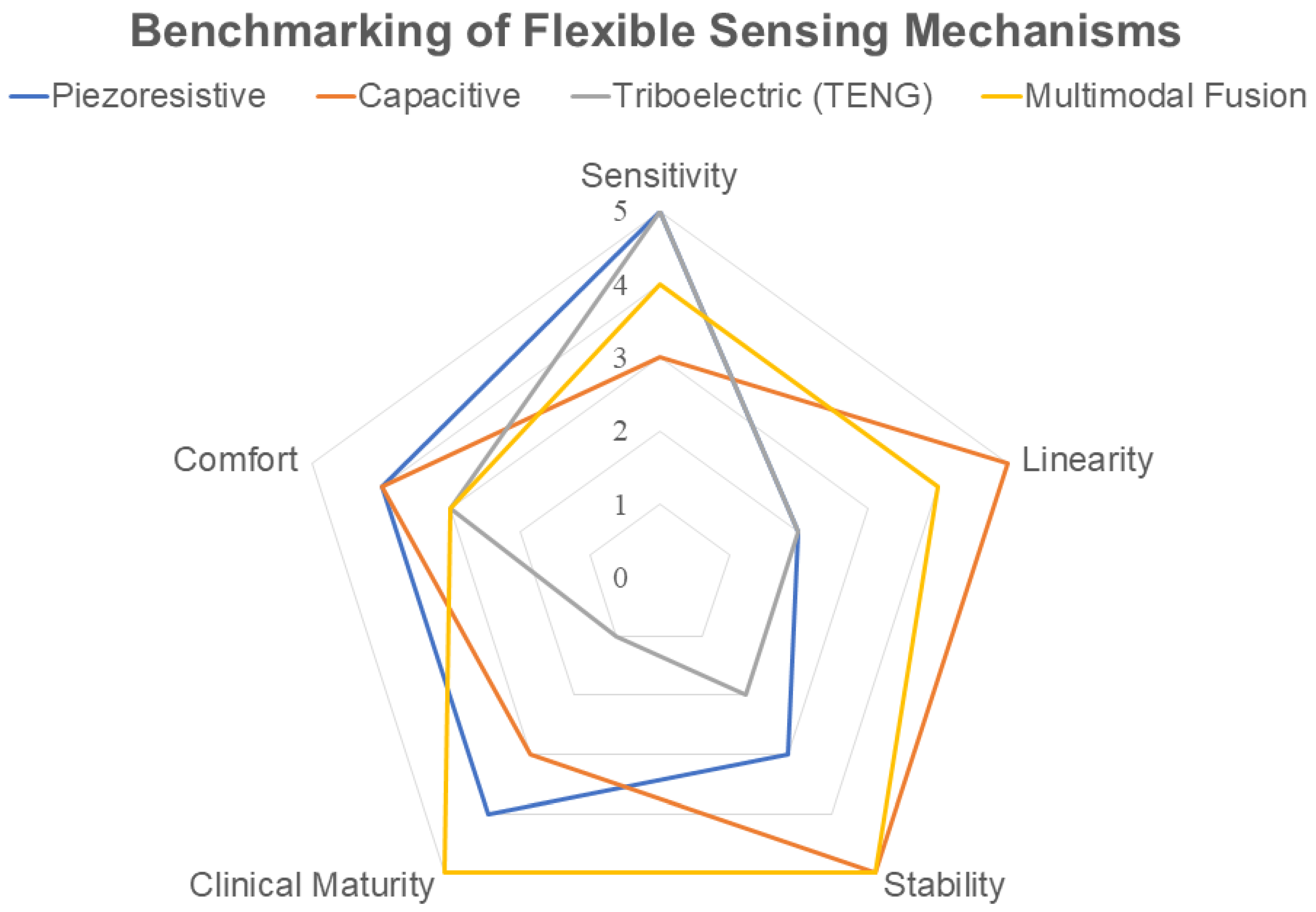
| Mechanism | Material Strategy | Primary Advantage | Critical Limitation | Ref. |
|---|---|---|---|---|
| Piezoresistive | Microcrack/Auxetic AMMs | Ultra-high sensitivity for capturing subtle resting tremors. | Significant hysteresis and non-linearity during dynamic movements. | [27,37] |
| Capacitive | Ionic/Eutectogel | High linearity and baseline stability; excellent biocompatibility. | Parasitic capacitance interference and lower sensitivity ranges. | [24,39] |
| Piezoelectret | Kirigami/Porous Gaps | Fast dynamic response (2.5 ms); ideal for high-frequency vibration. | Vulnerable to environmental humidity and long-term charge decay. | [23] |
| Triboelectric | Hydrogel/TENG | Self-powered capability; reduces system standby power consumption. | Signal instability caused by sweat and moisture interference. | [43,44] |
| Multimodal | IMU + sEMG + Array | Highest diagnostic precision via motor-muscle data correlation. | High computational load and complex data fusion requirements. | [30,34] |
Disclaimer/Publisher’s Note: The statements, opinions and data contained in all publications are solely those of the individual author(s) and contributor(s) and not of MDPI and/or the editor(s). MDPI and/or the editor(s) disclaim responsibility for any injury to people or property resulting from any ideas, methods, instructions or products referred to in the content. |
© 2026 by the authors. Licensee MDPI, Basel, Switzerland. This article is an open access article distributed under the terms and conditions of the Creative Commons Attribution (CC BY) license.
Share and Cite
Jin, J.; Jiang, Y.; Zhou, Y.; Zhu, W.; Hua, J.; Cheng, W.; Shi, Y.; Pan, L. AI-Enabled Flexible Sensing Ecosystems for Parkinson’s Disease: Advancing Digital Biomarkers and Closed-Loop Interventions. Sensors 2026, 26, 2071. https://doi.org/10.3390/s26072071
Jin J, Jiang Y, Zhou Y, Zhu W, Hua J, Cheng W, Shi Y, Pan L. AI-Enabled Flexible Sensing Ecosystems for Parkinson’s Disease: Advancing Digital Biomarkers and Closed-Loop Interventions. Sensors. 2026; 26(7):2071. https://doi.org/10.3390/s26072071
Chicago/Turabian StyleJin, Jiadong, Yongchang Jiang, Yukai Zhou, Wenkai Zhu, Jiangbo Hua, Wen Cheng, Yi Shi, and Lijia Pan. 2026. "AI-Enabled Flexible Sensing Ecosystems for Parkinson’s Disease: Advancing Digital Biomarkers and Closed-Loop Interventions" Sensors 26, no. 7: 2071. https://doi.org/10.3390/s26072071
APA StyleJin, J., Jiang, Y., Zhou, Y., Zhu, W., Hua, J., Cheng, W., Shi, Y., & Pan, L. (2026). AI-Enabled Flexible Sensing Ecosystems for Parkinson’s Disease: Advancing Digital Biomarkers and Closed-Loop Interventions. Sensors, 26(7), 2071. https://doi.org/10.3390/s26072071