An Unscented Kalman Filter Based on the Adams–Bashforth Method with Applications to the State Estimation of Osprey-Type Drones Composed of Tiltable Rotor Mechanisms


Abstract
1. Introduction
2. Continuous-Discrete System and Problem Formulation
2.1. Continuous-Discrete System
2.2. Discrete–Discrete Unscented Kalman Filter
3. Unscented Transform and Discretization Methods
3.1. Discrete-Time State–Space Model
3.2. Integration of UT and the Runge–Kutta Method
3.3. Integration of UT and the Adams–Bashforth Method
- 2nd-order Adams–Bashforth method:
- 3rd-order Adams–Bashforth method:
- 4th-order Adams–Bashforth method:
- 5th-order Adams–Bashforth method:
- 6th-order Adams–Bashforth method:
3.4. Comparison of Computational Complexity: Runge–Kutta Method vs. Adams–Bashforth Method
3.4.1. Computational Complexity Comparison Based on “Number of Stages”
3.4.2. Computational Complexity Comparison Based on “Number of Elements in the Sigma Point Set”
4. Modeling of the Osprey-Type Drone
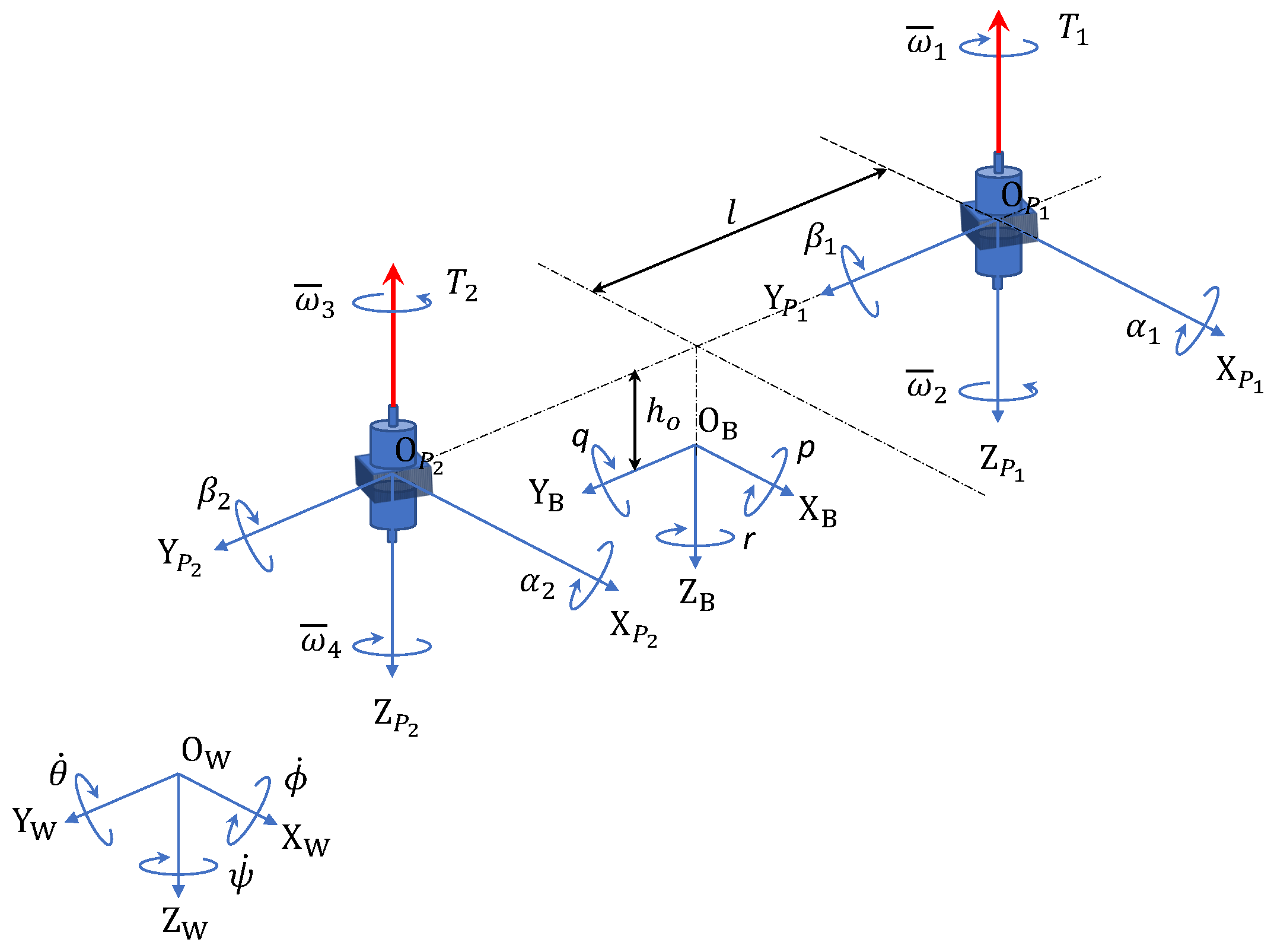
4.1. Definition of Coordinate Systems
4.2. Rotational Motion
4.2.1. Rotational Torque Generated by Rotor Thrust
4.2.2. Reaction Torque Generated by Rotor Rotation
4.2.3. Vehicle Coriolis Force
4.2.4. Vehicle Angular Acceleration
4.3. Translational Motion
5. Controller Design and Control Allocation
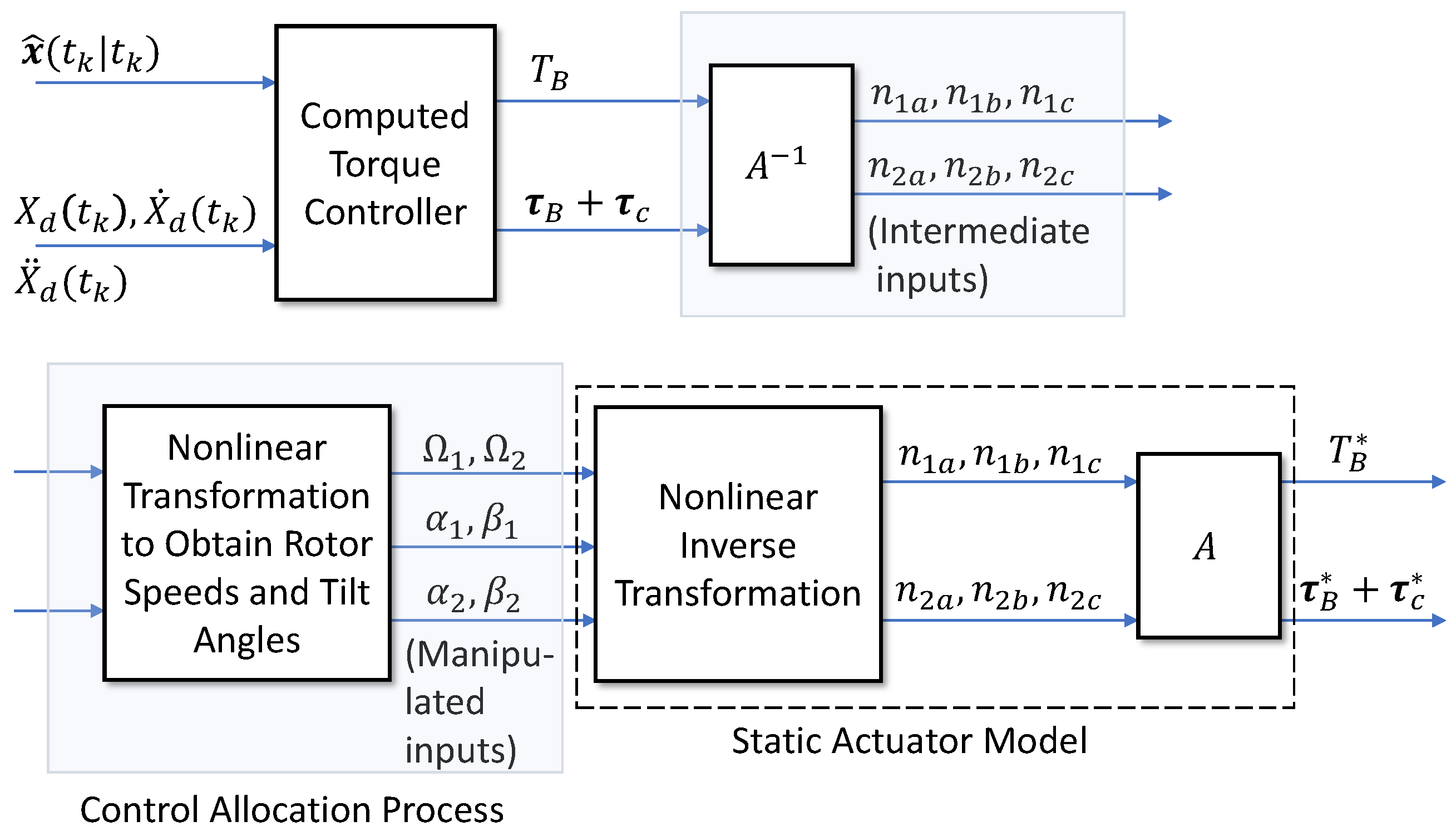
5.1. Computed Torque Method
5.2. Control Input Allocation Problem

6. Preliminary Simulation: Application to the Falling Body Model
6.1. Model Overview (Falling Body)
6.2. Estimation Algorithms (Falling Body)
6.2.1. Euler-UKF (Falling Body)
6.2.2. RK-UKF (Falling Body)
6.2.3. AB-UKF (Falling Body)
6.3. Estimation Conditions (Falling Body)
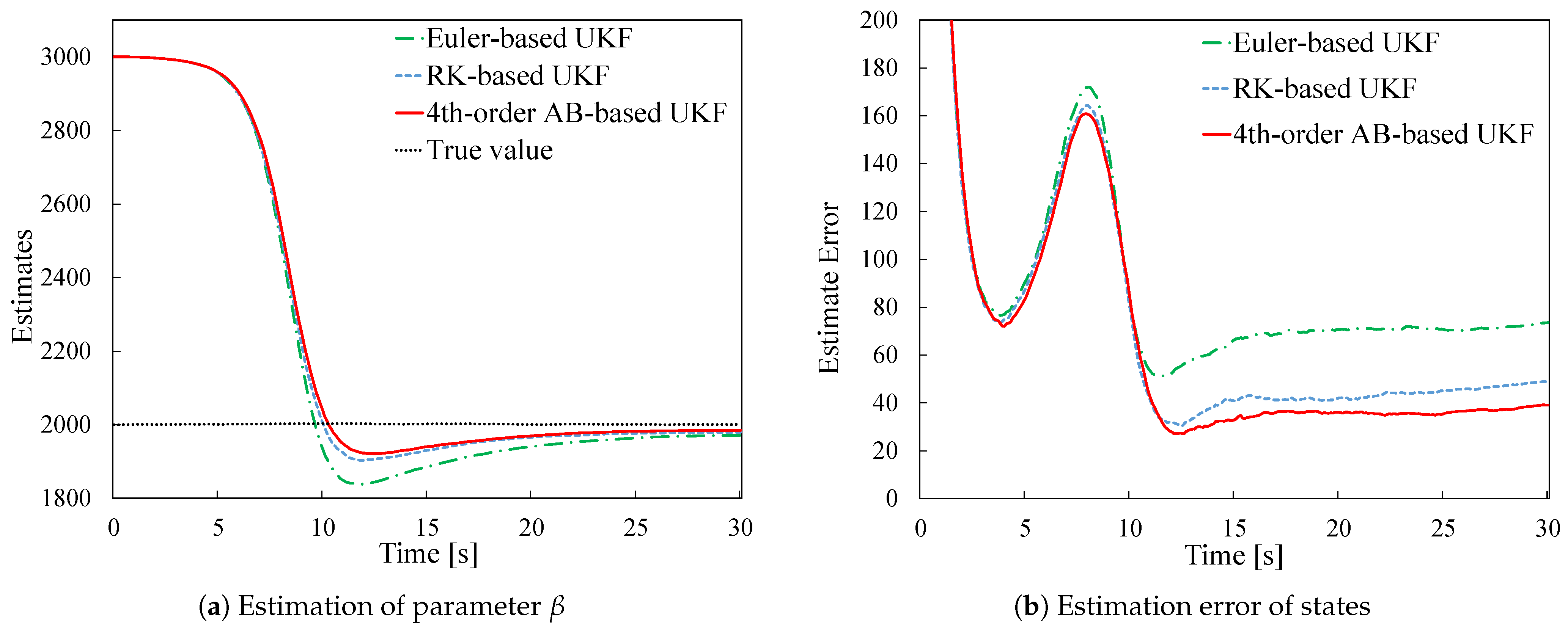
6.4. Simulation Results
6.4.1. State Estimation Accuracy
6.4.2. Computation Time
6.5. Discussion
- Small number of state variables: The falling body model has three state variables, with representing a parameter estimation problem. Consequently, as is evident from the sigma point time-update equations, the discretization formulas are actually applied only to the state variables and , making this a model where differences between the RK and AB methods are less likely to manifest.
- Small proportion of UT within the overall UKF algorithm: The falling body model has a relatively small number of state variables and simple discretization equations, making it difficult for differences in computational load to become pronounced. As a result, the time spent on UT constitutes a small proportion of the overall UKF estimation algorithm, and the differences in computation time due to the discretization method are less noticeable.
7. Application to the Osprey-Type Drone
7.1. Model Overview (Drone)
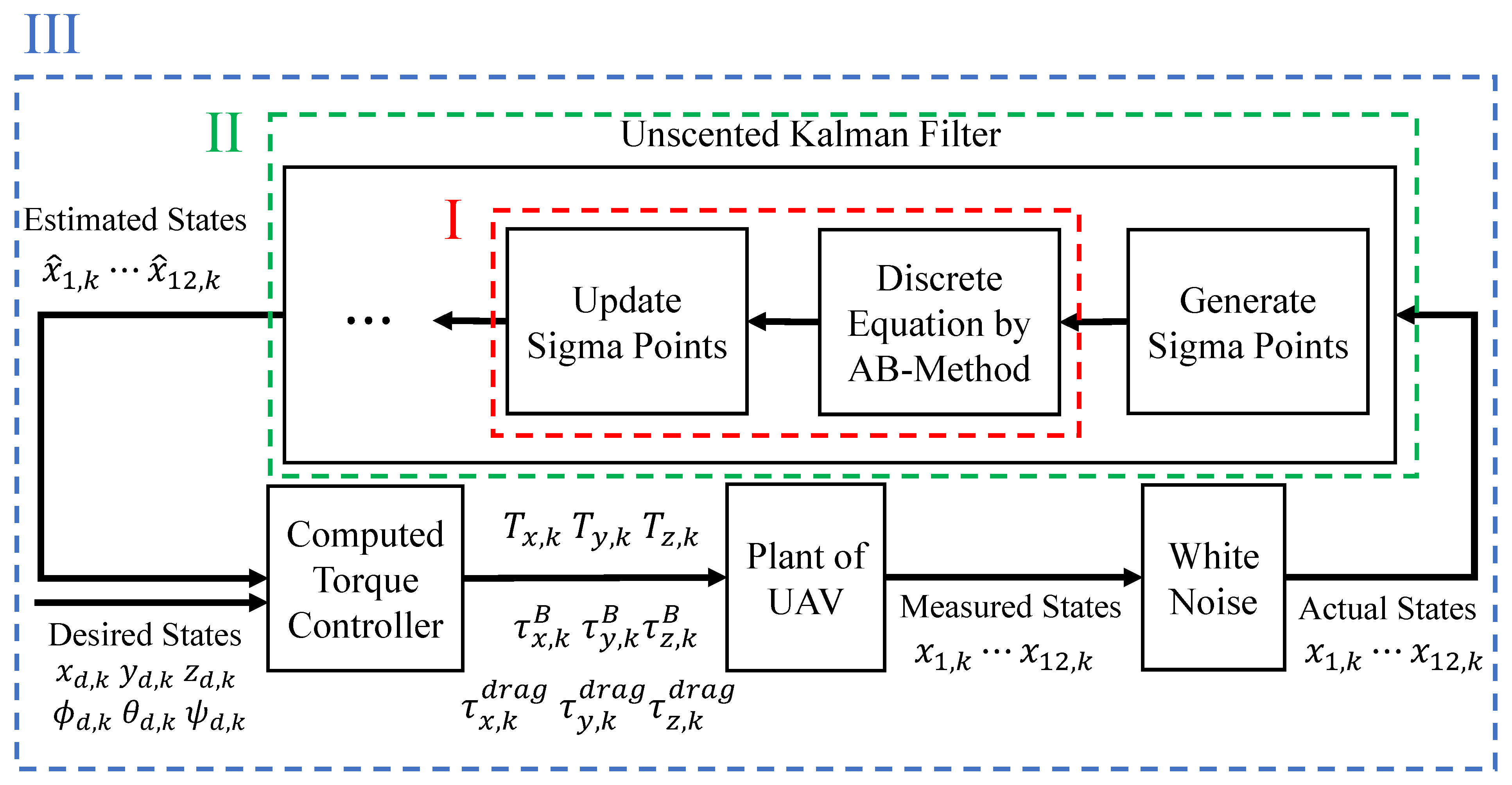
7.2. Estimation Algorithms (Drone)
7.2.1. Euler-UKF (Drone)
7.2.2. RK-UKF (Drone)
7.2.3. AB-UKF (Drone)
7.3. Estimation Conditions (Drone)
7.3.1. Parameter Settings for the UAV Model
7.3.2. Determination of System Noise
7.3.3. Determination of Observation Noise
Remark
7.4. Target Trajectory
7.5. Description of Comparative Experiments
7.5.1. Estimation Accuracy Comparison Experiment
7.5.2. Computational Efficiency Comparison Experiment
- Measurement Time I: Computation time for sigma point time update (computation of Equation (A9)).
- Measurement Time III: Total computation time of the state estimation program for the UAV model.
- Measurement Time I: Since one simulation yields N measurement data points due to the total number of sampling points N, the average of all these is taken to calculate the average computation time per loop. However, due to the nature of the AB method, the average is taken over data points for 2nd order, for 3rd order, for 4th order, for 5th order, and for 6th order.
- Measurement Time II: Similar to Measurement Time I, the average computation time per loop is calculated, and the total computation time for N loops is also calculated.
- Measurement Time III: This is the total program computation time, so one simulation yields a single measurement data point.
Remark
- Elimination of Hardware Dependence: MATLAB simulations eliminate hardware-dependent factors such as CPU architecture, memory bandwidth, and cache size, enabling a pure evaluation of the relative computational load differences between the proposed numerical integration method (the AB method) and the conventional method (the RK method).
- Indicator of Computational Amount: In an onboard environment (flight control computer), the sampling frequency is high and computing resources are limited, making it important to reduce the number of floating-point operations and execution time to achieve the same accuracy. The reduction in computation time measured in MATLAB serves as a basic indicator of the effectiveness of processing speed improvement on an actual aircraft.
7.6. Results and Discussion of Estimation Accuracy
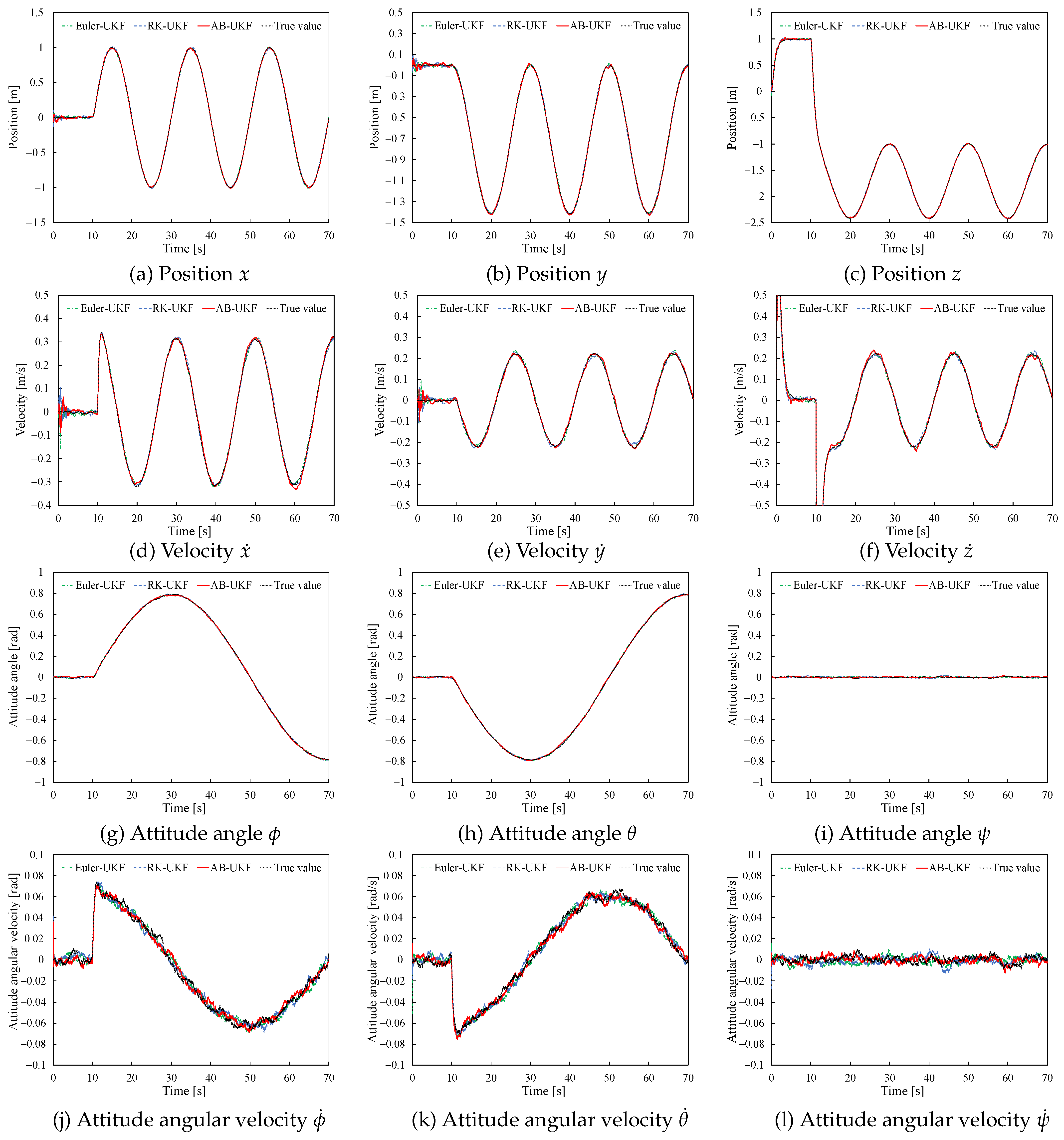
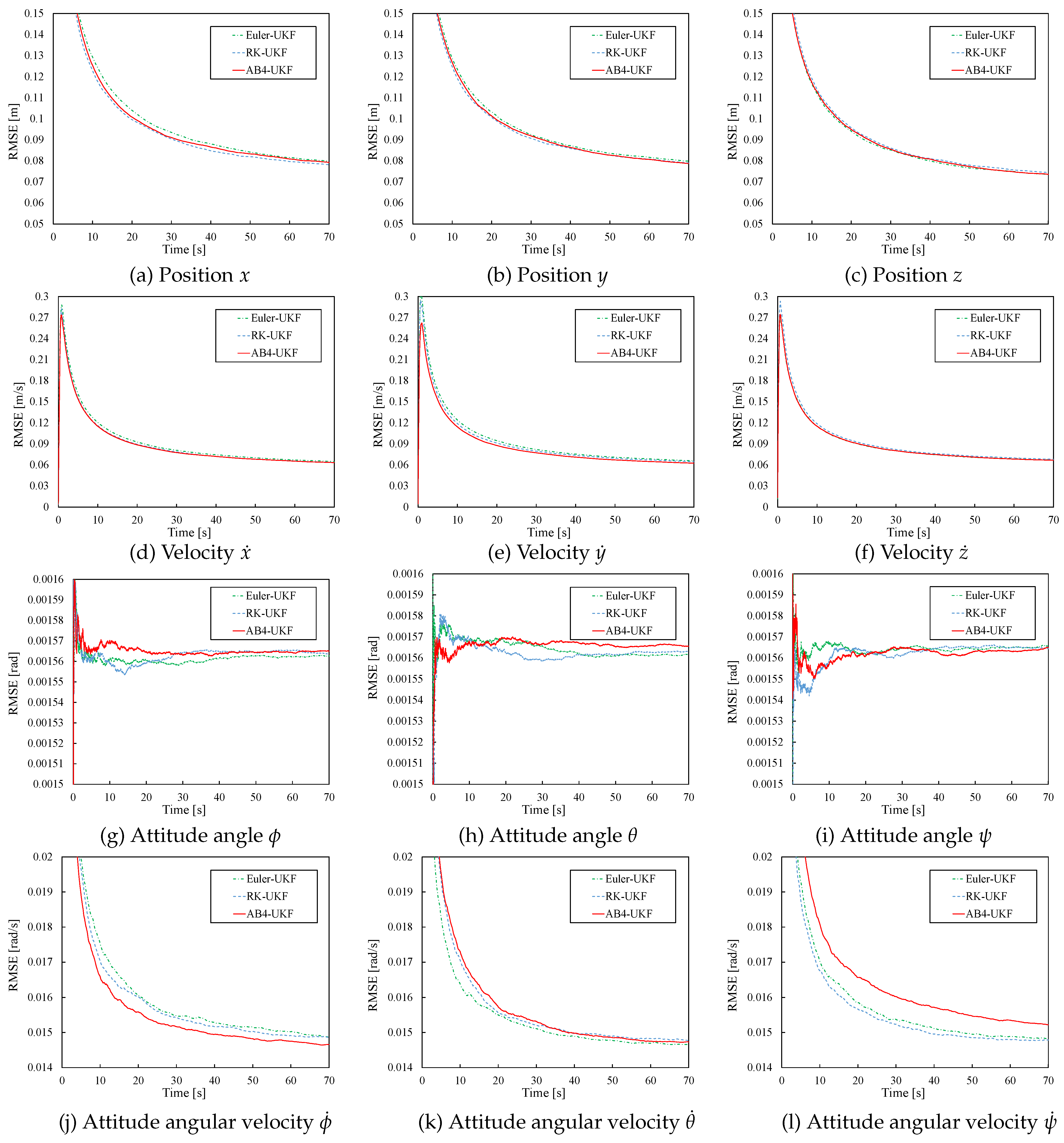
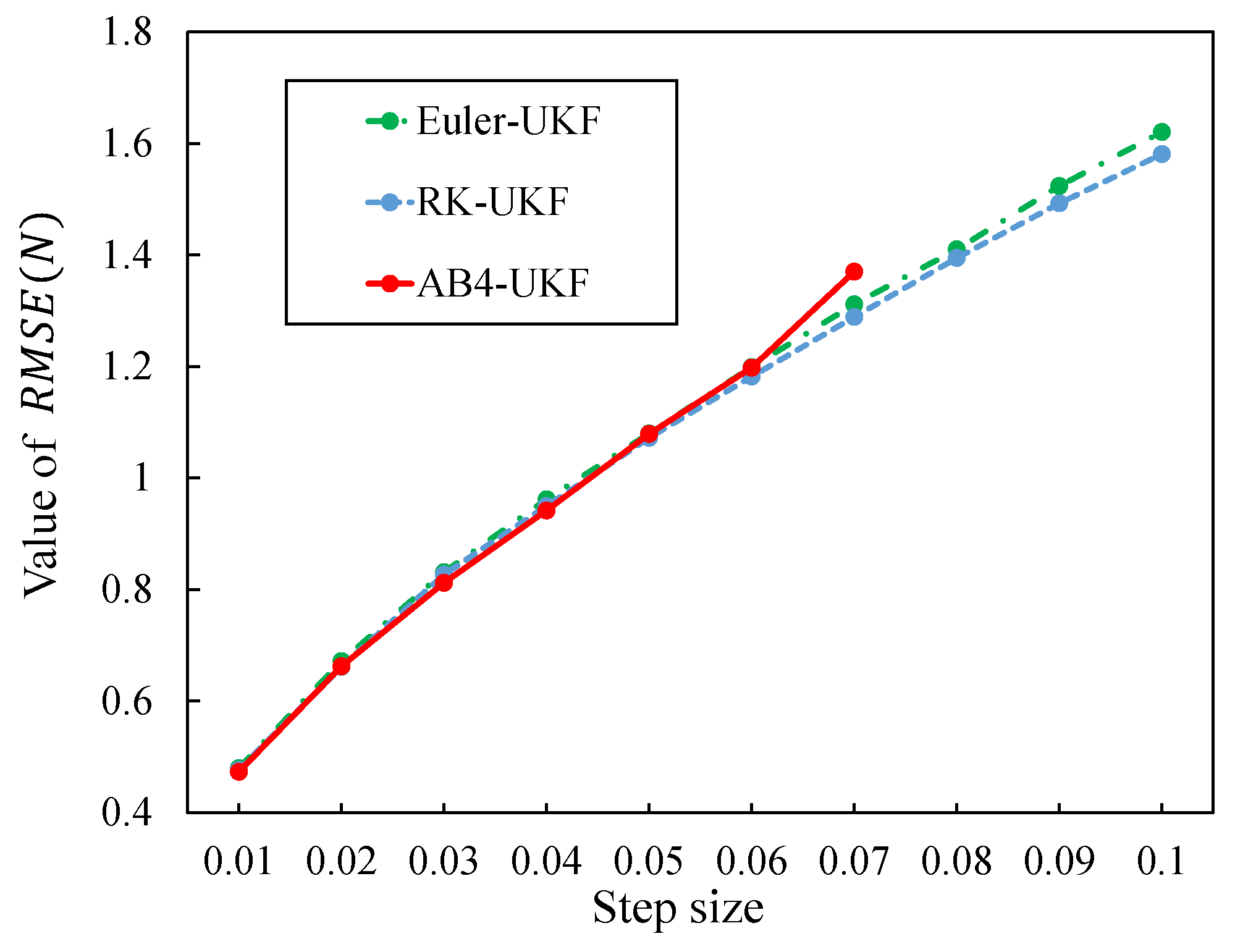
7.6.1. Comparison of Three Methods in Estimation Accuracy: Euler, RK4, and AB4
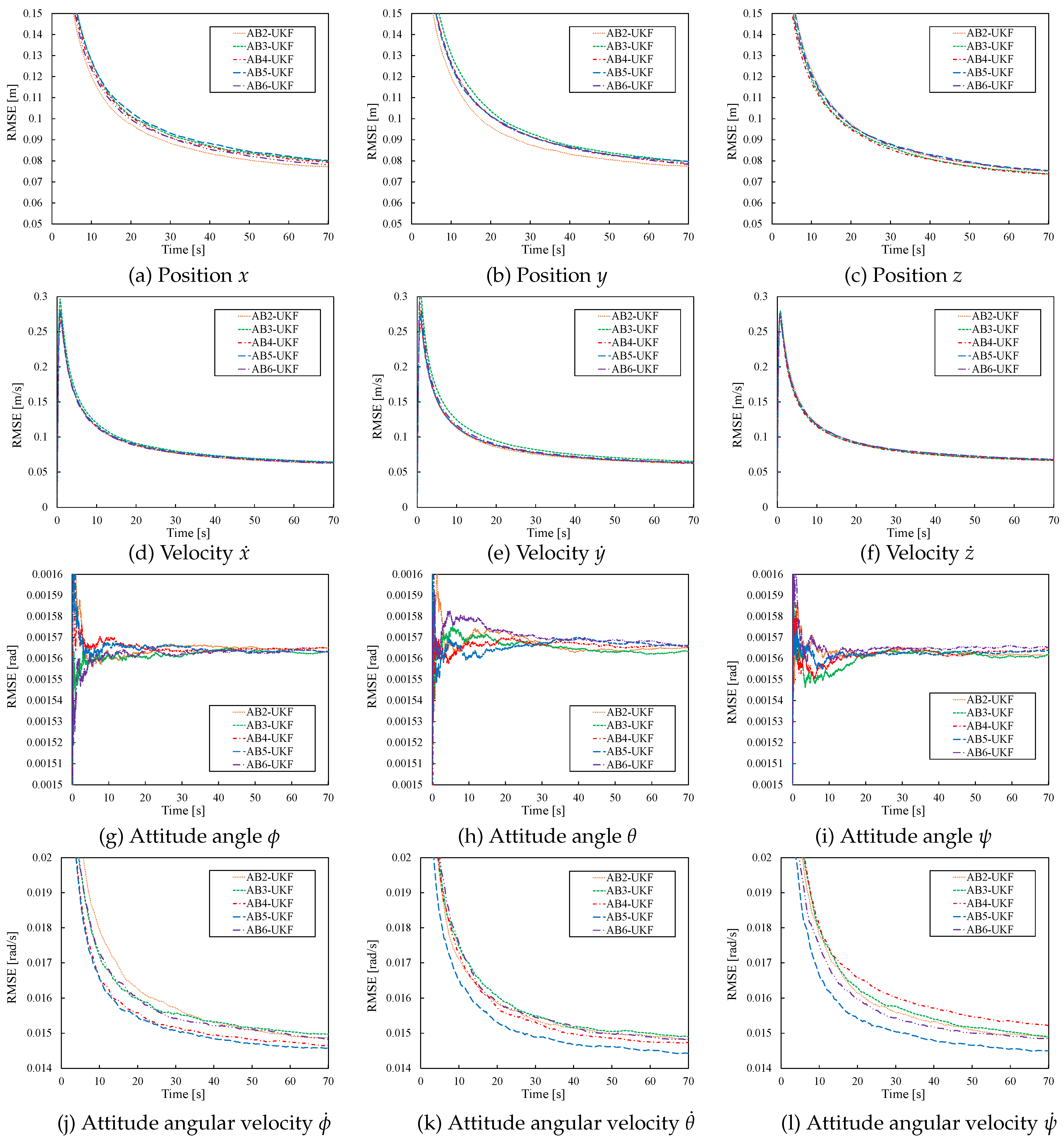
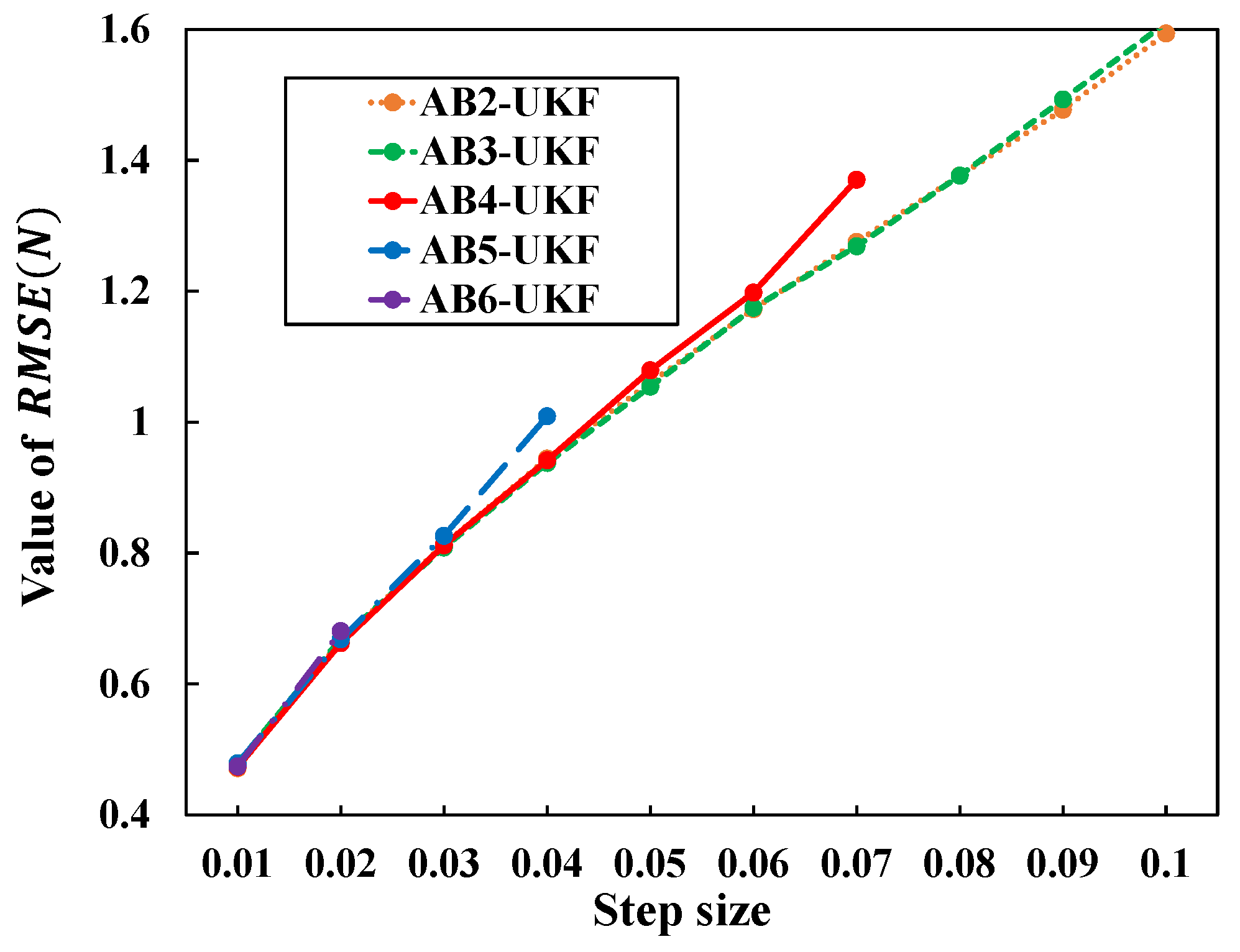
7.6.2. RMSE Comparison of AB Methods with Different Orders of Accuracy
- 2nd-order AB method: Stable up to (verified by additional experiments up to ). Divergence occurs at .
- 3rd-order AB method: Stable up to . Divergence occurs at .
- 4th-order AB method: Stable up to . Divergence occurs at .
- 5th-order AB method: Stable up to . Divergence occurs at .
- 6th-order AB method: Stable up to . Divergence occurs at .
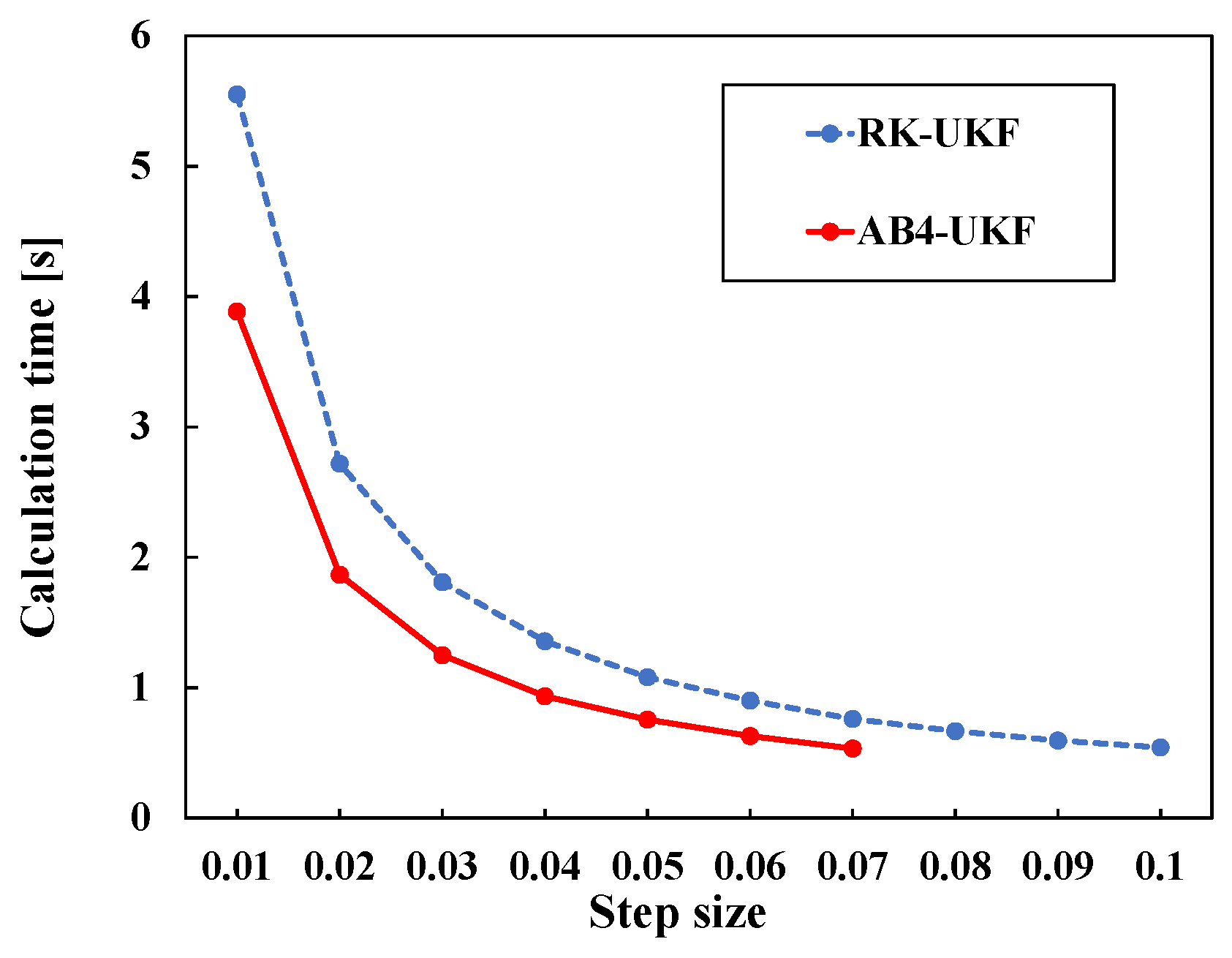
7.6.3. Comparative Analysis: RK Method vs. AB Method
- Accuracy Difference Between the RK and AB Methods: At the same step size (e.g., ), the RMSE of the RK4-UKF (UAV: 0.47646) is nearly identical to the RMSE of the AB4-UKF (UAV: 0.47304), indicating no significant difference in accuracy between the two. This indicates that the RK method achieves high-order accuracy through multiple evaluations within a single step, while the AB method achieves similar accuracy with fewer function evaluations by utilizing past information.
- Relationship between Order and Stability: For both problems, the higher the order of the AB algorithm, the smaller the upper limit of the step size for stable estimation. This is due to the theoretical property of numerical analysis that the absolute stability region shrinks as the order of the linear multi-step algorithm increases.
- Problem Complexity and Computational Efficiency: For the simple 3D reentry vehicle problem (Table 2), the computational time of the AB4-based UKF increased by approximately 2.9% compared to the Euler-based UKF, while for the complex 12D UAV model (Table 6), it was reduced by approximately 5.1%. This reversal phenomenon is thought to be due to the characteristics of matrix operations in high-dimensional models (regularity of memory access patterns, cache efficiency).
7.7. Results and Discussion of Computational Efficiency
7.7.1. Comparison of Three Methods in Computational Efficiency: Euler, RK4, and AB4
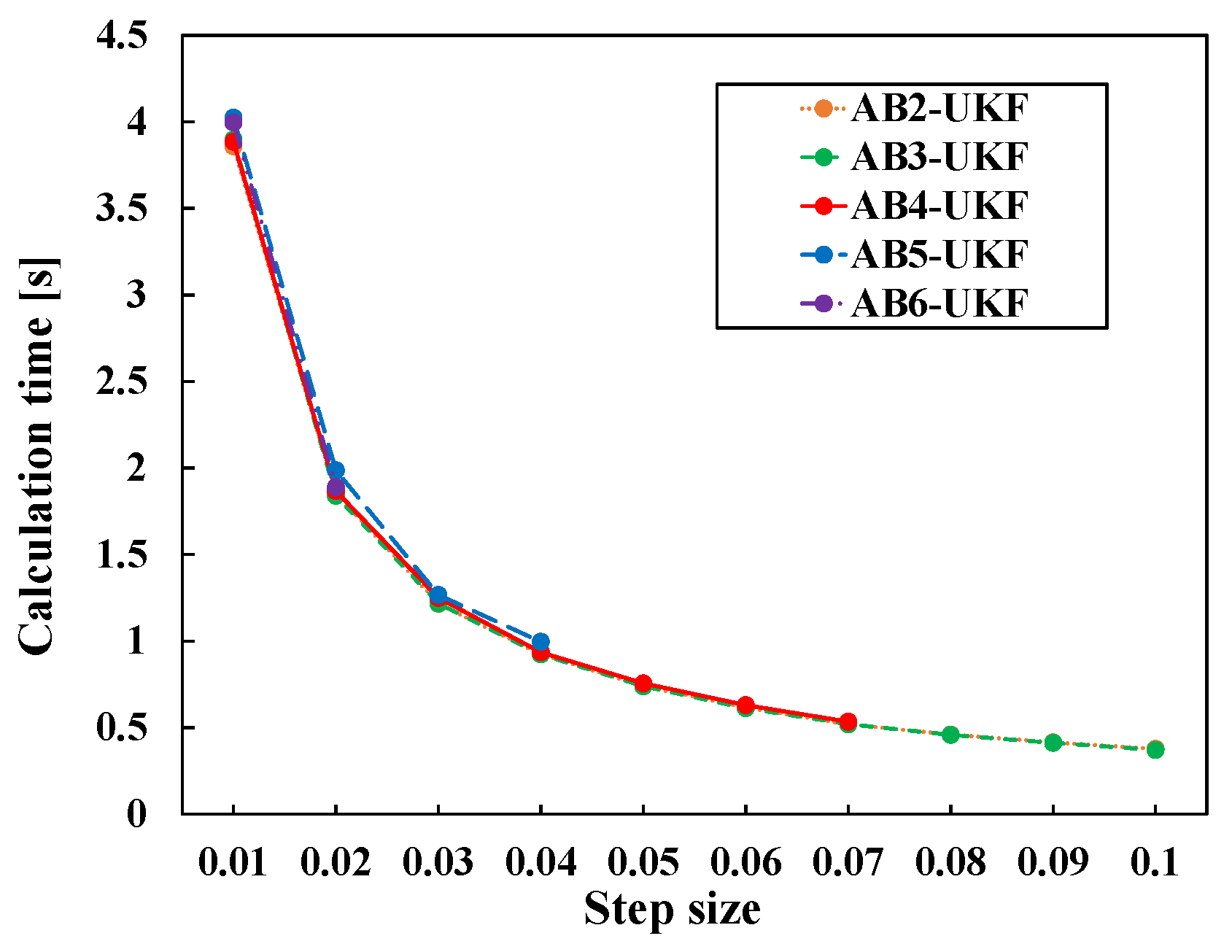
7.7.2. Computational Time Comparison of AB Methods with Different Orders of Accuracy
8. Conclusions
- Maintenance of estimation accuracy: For both models, AB-UKF achieved estimation accuracy comparable to RK-UKF. For the UAV model (), no significant difference was observed between the RMSE of AB4-UKF (0.47304) and that of RK4-UKF (0.47646).
- Comparison of computational efficiency: Comparison of total computation time relative to the Euler-based UKF confirmed the effectiveness of the proposed method.
- –
- For the simple three-dimensional reentry vehicle problem (Table 2), the computation time of AB4-based UKF was approximately 2.9% longer than Euler-based UKF (slower than Euler), whereas RK4-based UKF was approximately 9.4% longer.
- –
- For the complex 12-dimensional UAV model (Table 6), the computation time of AB4-based UKF was approximately 5.1% shorter than Euler-based UKF (faster than Euler). In contrast, RK4-based UKF exhibited a more pronounced slowdown, with an approximately 20.0% increase.
These results demonstrate that the computational time reduction effect achieved by the proposed AB method integration becomes more pronounced for models with more complex state equations and higher dimensions. - Relationship between order and stability: Verification using the UAV model quantitatively showed that higher-order AB methods have a smaller upper limit on the step size that allows stable estimation. The maximum stable step sizes for each order are: AB2: , AB3: , AB4: , AB5: , and AB6: . Divergence occurs at step sizes exceeding these limits.
8.1. Limitations of This Study
- Linearity of observations: The observations in the UAV model are linear (direct observation of position and attitude angles), and the advantages of nonlinear filtering are not fully utilized. In actual UAV navigation, nonlinear observations such as radar observations in GPS-denied environments are common.
- Simulation environment: The evaluation of computational efficiency is based on MATLAB simulations and has not been verified for real-time operation on actual hardware (flight control computers).
- Application to specific models: The effectiveness of this method has been verified on two models (the falling body model and the UAV model), but additional verification is required for generalization to other nonlinear systems.
8.2. Future Work
- Extension to nonlinear observations: Verify the effectiveness of the proposed method under nonlinear observations using only range and azimuth. Specifically, we will tackle the problem of estimating a 12-dimensional state vector using only range and azimuth information from one or two radars, and verify whether AB-UKF can maintain its advantage in terms of computational efficiency even under nonlinear observations.
- Reduction of the number of sigma points: While the standard UKF uses sigma points, the number can be reduced to or by using the Spherical Simplex Unscented Transformation [15,43,44,45] or the Simplex Unscented Transformation [46]. Combining these methods with the AB method is expected to further improve computational efficiency.
- Implementation on actual hardware: Implement the proposed algorithm on a microcontroller (e.g., Pixhawk) for the UAV model used in this simulation, and verify the degree of improvement in estimation accuracy and computational efficiency in actual flight environments.
- Adaptive step size control: Integrate the adaptive step size control based on the degree of nonlinearity proposed by Wang et al. [25] into AB-UKF to further optimize estimation accuracy and computational efficiency.
Author Contributions
Funding
Data Availability Statement
Conflicts of Interest
Appendix A. Unscented Kalman Filter Algorithm
Appendix A.1. Problem Formulation
Appendix A.2. UKF Algorithm
Appendix A.2.1. Prediction Step
Appendix A.2.2. Update Step
Appendix B. Details of the Runge–Kutta Method
Appendix B.1. General Form of the 4th-Order Runge–Kutta Method
Appendix B.2. Extension to the Sigma Point Matrix
Appendix C. Details of Time-Update Equations for the Falling Body Model
Appendix C.1. Time-Update Equations for Euler-UKF (Falling Body)
Appendix C.2. Time-Update Equations for RK-UKF (Falling Body)
Appendix C.3. Time-Update Equations for AB-UKF (Falling Body)
Appendix D. Details of Time-Update Equations for the UAV Model
Appendix D.1. Time-Update Equations for Euler-UKF (UAV)
Appendix D.2. Time-Update Equations for RK-UKF (UAV)
Appendix D.3. Time-Update Equations for AB-UKF (UAV)
References
- Bar-Shalom, Y.; Li, X.R.; Kirubarajan, T. Estimation with Applications to Tracking and Navigation: Theory, Algorithms and Software; Wiley: Hoboken, NJ, USA, 2004. [Google Scholar]
- Liptser, R.S.; Shiryaev, A.N. Statistics of Random Processes II: Applications; Springer: Berlin/Heidelberg, Germany, 2001. [Google Scholar]
- Kalman, R.E. A New Approach to Linear Filtering and Prediction Problems. J. Basic Eng. 1960, 82, 35–45. [Google Scholar] [CrossRef]
- Jazwinski, A.H. Stochastic Processes and Filtering Theory; Academic Press: New York, NY, USA, 1970. [Google Scholar]
- Frogerais, P.; Bellanger, J.J.; Senhadji, L. Various Ways to Compute the Continuous-Discrete Extended Kalman Filter. IEEE Trans. Autom. Control 2012, 57, 1000–1004. [Google Scholar] [CrossRef]
- Kulikova, M.V. Accurate Numerical Implementation of the Continuous-Discrete Extended Kalman Filter. IEEE Trans. Autom. Control 2014, 59, 273–279. [Google Scholar] [CrossRef]
- Kulikov, G.Y.; Kulikova, M.V. The Accurate Continuous-Discrete Extended Kalman Filter for Radar Tracking. IEEE Trans. Signal Process. 2016, 64, 948–958. [Google Scholar] [CrossRef]
- Kulikova, M.V.; Kulikov, G.Y. On Derivative-Free Extended Kalman Filtering and Its MATLAB-Oriented Square-Root Implementations for State Estimation in Continuous-Discrete Nonlinear Stochastic Systems. Eur. J. Control 2023, 73, 100885. [Google Scholar] [CrossRef]
- Julier, S.J.; Uhlmann, J.K. A New Extension of the Kalman Filter to Nonlinear Systems. Proc. SPIE 1997, 3068, 182–193. [Google Scholar]
- Julier, S.J.; Uhlmann, J.K. Unscented Filtering and Nonlinear Estimation. Proc. IEEE 2004, 92, 401–421. [Google Scholar] [CrossRef]
- Julier, S.J.; Uhlmann, J.K.; Durrant-Whyte, H.F. A New Method for the Nonlinear Transformation of Means and Covariances in Filters and Estimators. IEEE Trans. Autom. Control 2000, 45, 477–482. [Google Scholar] [CrossRef]
- Särkkä, S. On Unscented Kalman Filtering for State Estimation of Continuous-Time Nonlinear Systems. IEEE Trans. Autom. Control 2007, 52, 1631–1641. [Google Scholar] [CrossRef]
- van der Merwe, R. Sigma-Point Kalman Filters for Probabilistic Inference in Dynamic State-Space Models. Ph.D. Thesis, OGI School of Science & Engineering at Oregon Health & Science University, Beaverton, OR, USA, 2004. [Google Scholar] [CrossRef]
- Ito, K.; Xiong, K. Gaussian Filters for Nonlinear Filtering Problems. IEEE Trans. Autom. Control 2000, 45, 910–927. [Google Scholar] [CrossRef]
- Julier, S.J. The Spherical Simplex Unscented Transformation. In Proceedings of the 2003 American Control Conference, Denver, CO, USA, 4–6 June 2003; pp. 2430–2434. [Google Scholar]
- Haykin, S. (Ed.) Kalman Filtering and Neural Networks; Wiley: New York, NY, USA, 2001. [Google Scholar]
- Elliott, R.J.; Aggoun, L.; Moore, J.B. Hidden Markov Models: Estimation and Control; Springer: New York, NY, USA, 1995. [Google Scholar]
- Singh, A.K. Major Development Under Gaussian Filtering Since Unscented Kalman Filter. IEEE/CAA J. Autom. Sinica 2022, 9, 1304–1325. [Google Scholar] [CrossRef]
- Gao, B.; Ma, P.; Hu, G.; Zhong, Y.; Liu, Z. Dual-event-triggering ANFIS-based unscented Kalman filter for cluster cooperative navigation with measurement anomalies. Chin. J. Aeronaut. 2025; in press. [Google Scholar] [CrossRef]
- Takeno, M.; Katayama, T. State and Parameter Estimation for Dynamical Systems by Using Unscented Kalman Filter. Trans. Inst. Syst. Control Inf. Eng. 2011, 24, 231–239. (In Japanese) [Google Scholar]
- Takeno, M.; Katayama, T. A Numerical Method for Continuous Discrete Unscented Kalman Filter. Int. J. Innov. Comput. Inf. Control 2012, 8, 2261–2274. [Google Scholar]
- Kulikov, G.Y.; Kulikova, M.V. Accurate Continuous–Discrete Unscented Kalman Filtering for Estimation of Nonlinear Continuous-Time Stochastic Models in Radar Tracking. Signal Process. 2017, 139, 25–35. [Google Scholar] [CrossRef]
- Kulikova, M.V.; Kulikov, G.Y. Continuous–Discrete Unscented Kalman Filtering Framework by MATLAB ODE Solvers and Square-Root Methods. Automatica 2022, 142, 110396. [Google Scholar] [CrossRef]
- Knudsen, T.; Leth, J. A New Continuous Discrete Unscented Kalman Filter. IEEE Trans. Autom. Control 2019, 64, 2198–2205. [Google Scholar] [CrossRef]
- Wang, A.; Zhang, H.; Huang, X.; Yang, Z. Adaptive unscented Kalman filter for nonlinear continuous-discrete systems based on the degree of nonlinearity. Phys. Scr. 2025, 100, 087001. [Google Scholar] [CrossRef]
- Wang, C.; Dai, H.; Yang, W.; Yue, X. High-efficiency unscented Kalman filter for multi-target trajectory estimation. Aerosp. Sci. Technol. 2025, 159, 109962. [Google Scholar] [CrossRef]
- Tobaly, L.; Yaniv, E.; Zalevsky, Z. Integrating GAN-based machine learning with nonlinear Kalman filtering for enhanced state estimation. Sci. Rep. 2025, 15, 42361. [Google Scholar] [CrossRef]
- Kulikova, M.V.; Kulikov, G.Y. Square-root information-type methods for continuous–discrete extended Kalman filtering. Eur. J. Control 2025, 85, 101358. [Google Scholar] [CrossRef]
- Al Ahdab, M.; Leth, J.; Tan, Z. Optimal Sensor Scheduling and Selection for Continuous-Discrete Kalman Filtering with Auxiliary Dynamics. arXiv 2025, arXiv:2507.11240. [Google Scholar] [CrossRef]
- Thieu, T.; Melnik, R. Estimation of 3D facial dynamics with nonlinear filters for position tracking. Appl. Math. Sci. Eng. 2025, 32, 2546793. [Google Scholar] [CrossRef]
- Chang, Y.; Cheng, Y.; Manzoor, U.; Murray, J. A Review of UAV Autonomous Navigation in GPS-Denied Environments. Robot. Auton. Syst. 2023, 170, 104533. [Google Scholar] [CrossRef]
- Jiang, C.; Zhou, X.; Chen, H.; Liu, T. UAV Positioning Using GNSS: A Review of the Current Status. Drones 2026, 10, 91. [Google Scholar] [CrossRef]
- Liu, H.; Long, Q.; Yi, B.; Jiang, W. A Survey of Sensor Based Autonomous Unmanned Aerial Vehicle (UAV) Localization Techniques. Complex Intell. Syst. 2025, 11, 371. [Google Scholar] [CrossRef]
- He, R.; Chen, S.; Wu, H.; Zhang, F.; Chen, K. Efficient Extended Cubature Kalman Filtering for Nonlinear Target Tracking. Int. J. Syst. Sci. 2021, 52, 392–406. [Google Scholar] [CrossRef]
- Kloeden, P.E.; Platen, E. Numerical Solution of Stochastic Differential Equations; Springer: Berlin/Heidelberg, Germany, 1999. [Google Scholar]
- Cellier, F.E.; Kofman, E. Continuous System Simulation; Springer: New York, NY, USA, 2006. [Google Scholar]
- Butcher, J.C. Numerical Methods for Ordinary Differential Equations; John Wiley & Sons: Hoboken, NJ, USA, 2016. [Google Scholar]
- Alderete, T.S. Simulator Aero Model Implementation; NASA Ames Research Center: Moffett Field, CA, USA, 1997.
- Luukkonen, T. Modelling and Control of Quadrotor; Aalto University: Espoo, Finland, 2011. [Google Scholar]
- Itakura, T.; Watanabe, K.; Nagai, I.; Shibanoki, T. Design and Production of an Osprey-Type Drone with 2-DOF Tiltable Mechanisms. In Proceedings of the JSME Annual Conference on Robotics and Mechatronics (Robomec), Sapporo, Japan, 1–4 June 2022; Session ID 1A1-J03. (In Japanese) [Google Scholar]
- Gelb, A. Applied Optimal Estimation; MIT Press: Cambridge, MA, USA, 1974. [Google Scholar]
- Yoshiwaki, N.; Watanabe, K.; Shibanoki, T.; Nagai, I. Research on a Fully Actuated UAV with Two 2-DOF Tiltable Rotors. In Proceedings of the JSME Annual Conference on Robotics and Mechatronics (Robomec), Sapporo, Japan, 1–4 June 2022; Session ID 1A1-J02. (In Japanese) [Google Scholar]
- Julier, S.J.; Uhlmann, J.K. Reduced Sigma Point Filters for the Propagation of Means and Covariances Through Nonlinear Transformations. In Proceedings of the 2002 American Control Conference (IEEE Cat. No. CH37301), Anchorage, AK, USA, 8–10 May 2002; pp. 887–892. [Google Scholar]
- Lozano, J.G.C.; Carrillo, L.R.G.; Dzul, A.; Lozano, R. Spherical Simplex Sigma-Point Kalman Filters: A Comparison in the Inertial Navigation of a Terrestrial Vehicle. In Proceedings of the 2008 American Control Conference, Seattle, WA, USA, 11–13 June 2008; pp. 4857–4862. [Google Scholar]
- Fu, K.; Zhao, G.; Li, X.; Tang, Z.-L.; He, W. Iterative Spherical Simplex Unscented Particle Filter for CNS/Redshift Integrated Navigation System. Sci. China Inf. Sci. 2017, 60, 042201. [Google Scholar] [CrossRef]
- Li, W.-C.; Wei, P.; Xiao, X.-C. A Novel Simplex Unscented Transform and Filter. In Proceedings of the 2007 International Symposium on Communications and Information Technologies, Sydney, NSW, Australia, 17–19 October 2007; pp. 926–931. [Google Scholar]



| Method | |||
|---|---|---|---|
| Euler-UKF | RK-UKF | AB4-UKF | |
| RMSE | 125.585 | 116.826 | 115.537 |
| Method | |||
|---|---|---|---|
| Euler-UKF | RK-UKF | AB4-UKF | |
| Alg. total time () [s] | 8.4612 | 9.2542 | 8.7108 |
| Pred. time only () [s] | 58.3842 | 77.8698 | 70.6750 |
| Variable | Definition | Value |
|---|---|---|
| m [kg] | Mass of UAV | 1.5 |
| g [m/s2] | Acceleration of gravity | 9.81 |
| [kg·m2] | Moment of inertia around axis | 0.01 |
| [kg·m2] | Moment of inertia around axis | 0.01 |
| [kg·m2] | Moment of inertia around axis | 0.006 |
| l [m] | axis distance between and | 0.24 |
| [m] | axis distance between and | 0.045 |
| [Ns2/rad2] | Thrust coefficient of the propeller | |
| [Nms2/rad2] | Drag coefficient of the propeller |
| Method | |||
|---|---|---|---|
| Euler | RK4 | AB4 | |
| 0.47961 | 0.47646 | 0.47304 | |
| 0.67167 | 0.66121 | 0.66235 | |
| 0.83102 | 0.82695 | 0.81186 | |
| 0.96179 | 0.94971 | 0.94171 | |
| 1.07992 | 1.07212 | 1.07913 | |
| 1.19891 | 1.18197 | 1.19785 | |
| 1.31153 | 1.28889 | 1.37018 | |
| 1.41016 | 1.39465 | N/A | |
| 1.52378 | 1.49280 | N/A | |
| 1.62067 | 1.58091 | N/A | |
| AB Method with Different Order | |||||
|---|---|---|---|---|---|
| AB2 | AB3 | AB4 | AB5 | AB6 | |
| 0.47140 | 0.47891 | 0.47304 | 0.47878 | 0.47409 | |
| 0.66619 | 0.66920 | 0.66235 | 0.66816 | 0.68082 | |
| 0.81327 | 0.80840 | 0.81186 | 0.82628 | N/A | |
| 0.94432 | 0.93755 | 0.94171 | 1.00880 | N/A | |
| 1.06020 | 1.05421 | 1.07913 | N/A | N/A | |
| 1.17243 | 1.17460 | 1.19785 | N/A | N/A | |
| 1.27515 | 1.26857 | 1.37018 | N/A | N/A | |
| 1.37661 | 1.37650 | N/A | N/A | N/A | |
| 1.47709 | 1.49280 | N/A | N/A | N/A | |
| 1.59363 | 1.60998 | N/A | N/A | N/A | |
| Method | |||
|---|---|---|---|
| Euler | RK4 | AB4 | |
| Time I () [s] | 3.7593 | 5.6078 | 3.2978 |
| Time II () [s] | 6.0411 | 8.0064 | 5.6144 |
| Time III [s] | 6.3785 | 7.6520 | 6.0550 |
| AB Method with Different Order | |||||
|---|---|---|---|---|---|
| AB2 | AB3 | AB4 | AB5 | AB6 | |
| Time I () [s] | 3.2125 | 3.2839 | 3.3212 | 3.3478 | 3.4263 |
| Time II () [s] | 5.5107 | 5.6166 | 5.6353 | 5.6081 | 5.7562 |
| Time III [s] | 6.1799 | 6.2990 | 6.1856 | 6.1427 | 6.3341 |
Disclaimer/Publisher’s Note: The statements, opinions and data contained in all publications are solely those of the individual author(s) and contributor(s) and not of MDPI and/or the editor(s). MDPI and/or the editor(s) disclaim responsibility for any injury to people or property resulting from any ideas, methods, instructions or products referred to in the content. |
© 2026 by the authors. Licensee MDPI, Basel, Switzerland. This article is an open access article distributed under the terms and conditions of the Creative Commons Attribution (CC BY) license.
Share and Cite
Watanabe, K.; Takeda, S.; Nagai, I. An Unscented Kalman Filter Based on the Adams–Bashforth Method with Applications to the State Estimation of Osprey-Type Drones Composed of Tiltable Rotor Mechanisms. Sensors 2026, 26, 2009. https://doi.org/10.3390/s26062009
Watanabe K, Takeda S, Nagai I. An Unscented Kalman Filter Based on the Adams–Bashforth Method with Applications to the State Estimation of Osprey-Type Drones Composed of Tiltable Rotor Mechanisms. Sensors. 2026; 26(6):2009. https://doi.org/10.3390/s26062009
Chicago/Turabian StyleWatanabe, Keigo, Soma Takeda, and Isaku Nagai. 2026. "An Unscented Kalman Filter Based on the Adams–Bashforth Method with Applications to the State Estimation of Osprey-Type Drones Composed of Tiltable Rotor Mechanisms" Sensors 26, no. 6: 2009. https://doi.org/10.3390/s26062009
APA StyleWatanabe, K., Takeda, S., & Nagai, I. (2026). An Unscented Kalman Filter Based on the Adams–Bashforth Method with Applications to the State Estimation of Osprey-Type Drones Composed of Tiltable Rotor Mechanisms. Sensors, 26(6), 2009. https://doi.org/10.3390/s26062009