1. Introduction
Underground corridors and logistics tunnels are a natural fit for single-anchor ultra-wideband (UWB) localization: infrastructure inspection, safety monitoring, and emergency response all benefit from deploying only one fixed node. The chief difficulty is multipath. Waveguide-like propagation in these elongated spaces produces dense specular and diffuse reflections. The strongest or earliest resolvable channel impulse response (CIR) component can therefore be a reflected path rather than the direct line-of-sight (LOS). In the single-anchor CIR-tap-based implementations used here, the compared baselines rely on selecting a single dominant CIR component that is presumed to correspond to the LOS, typically the earliest detectable peak or the strongest CIR tap. A single erroneous selection yields an angular bias on the order of degrees, and the error distribution develops heavy tails that worsen with increasing range.
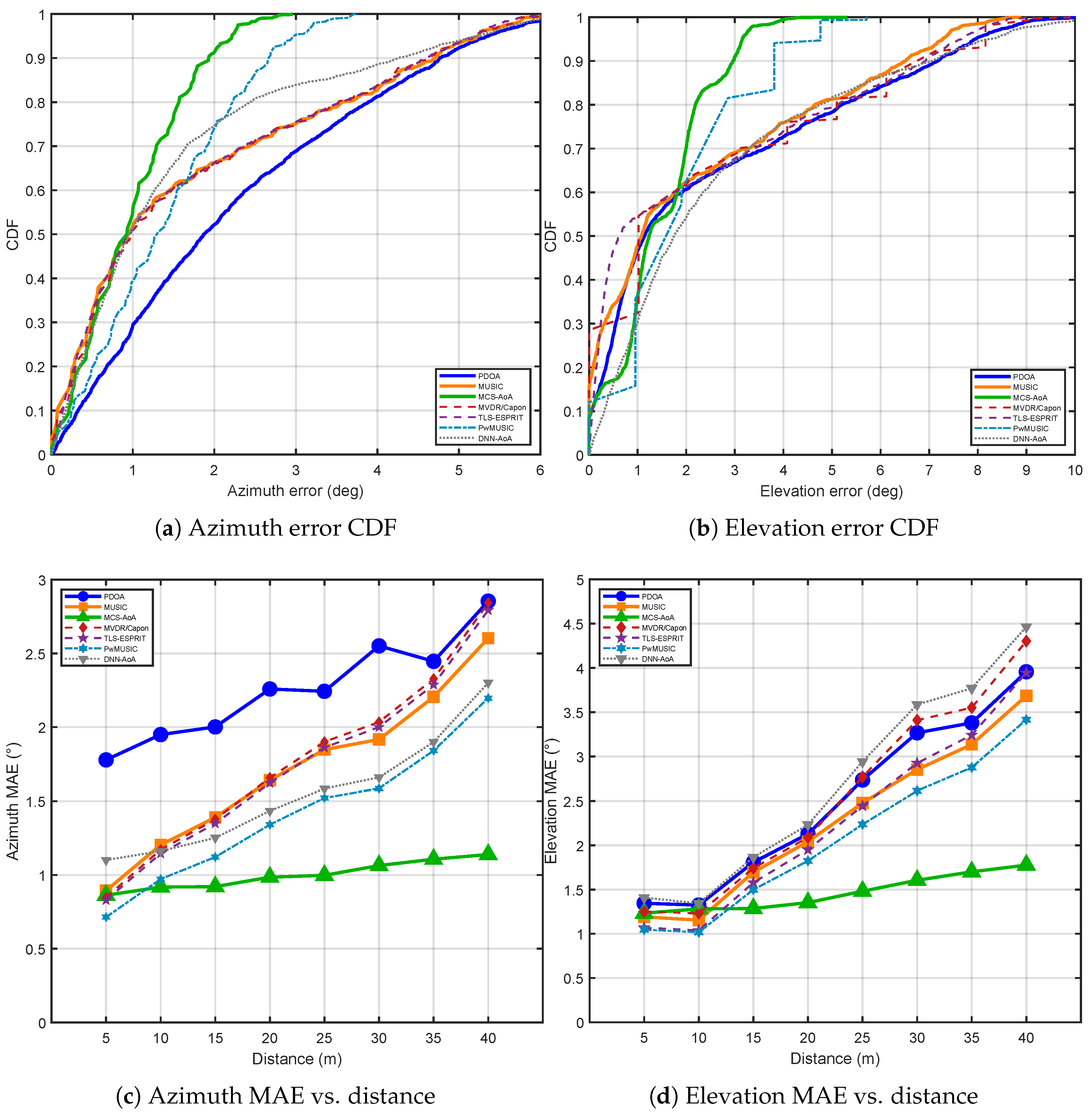
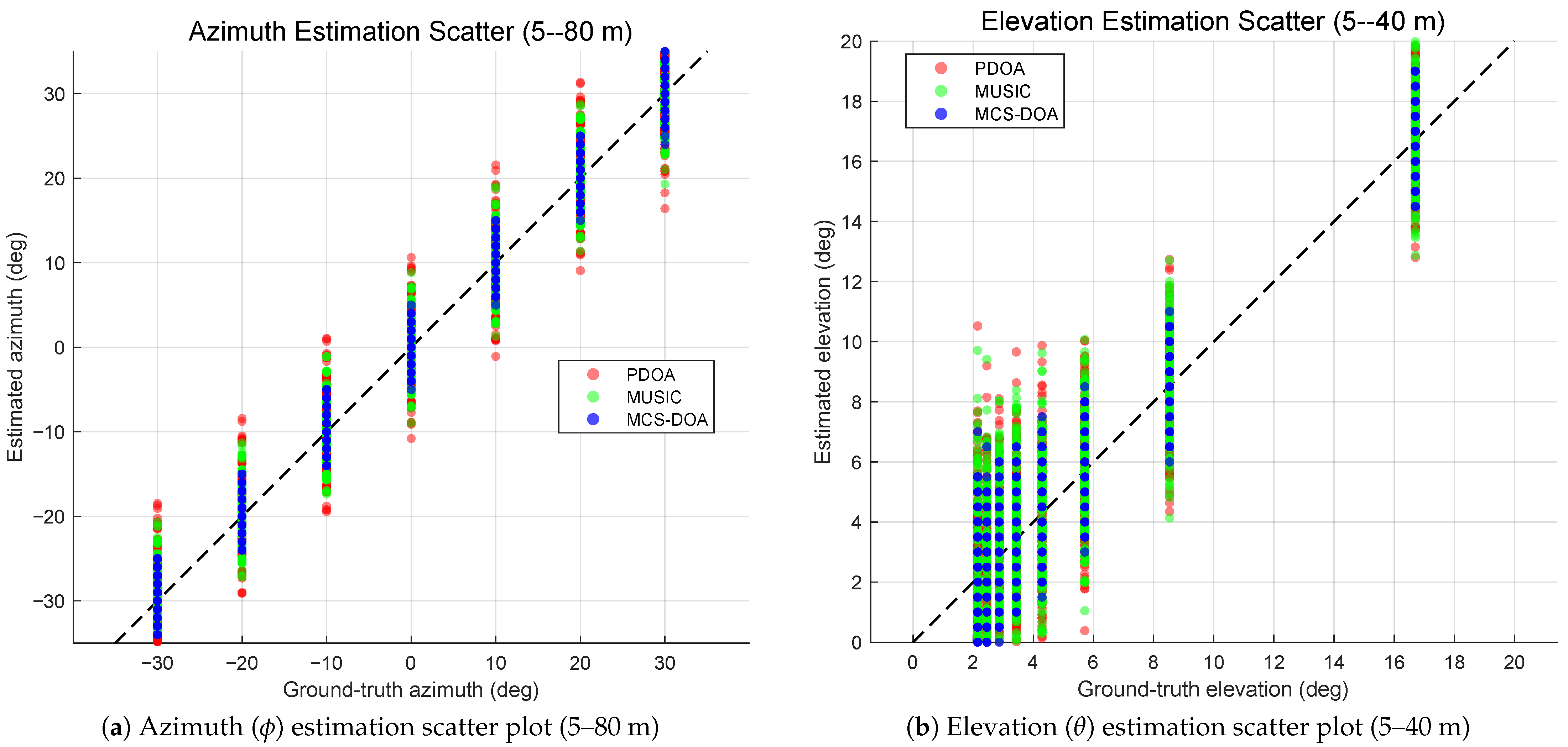
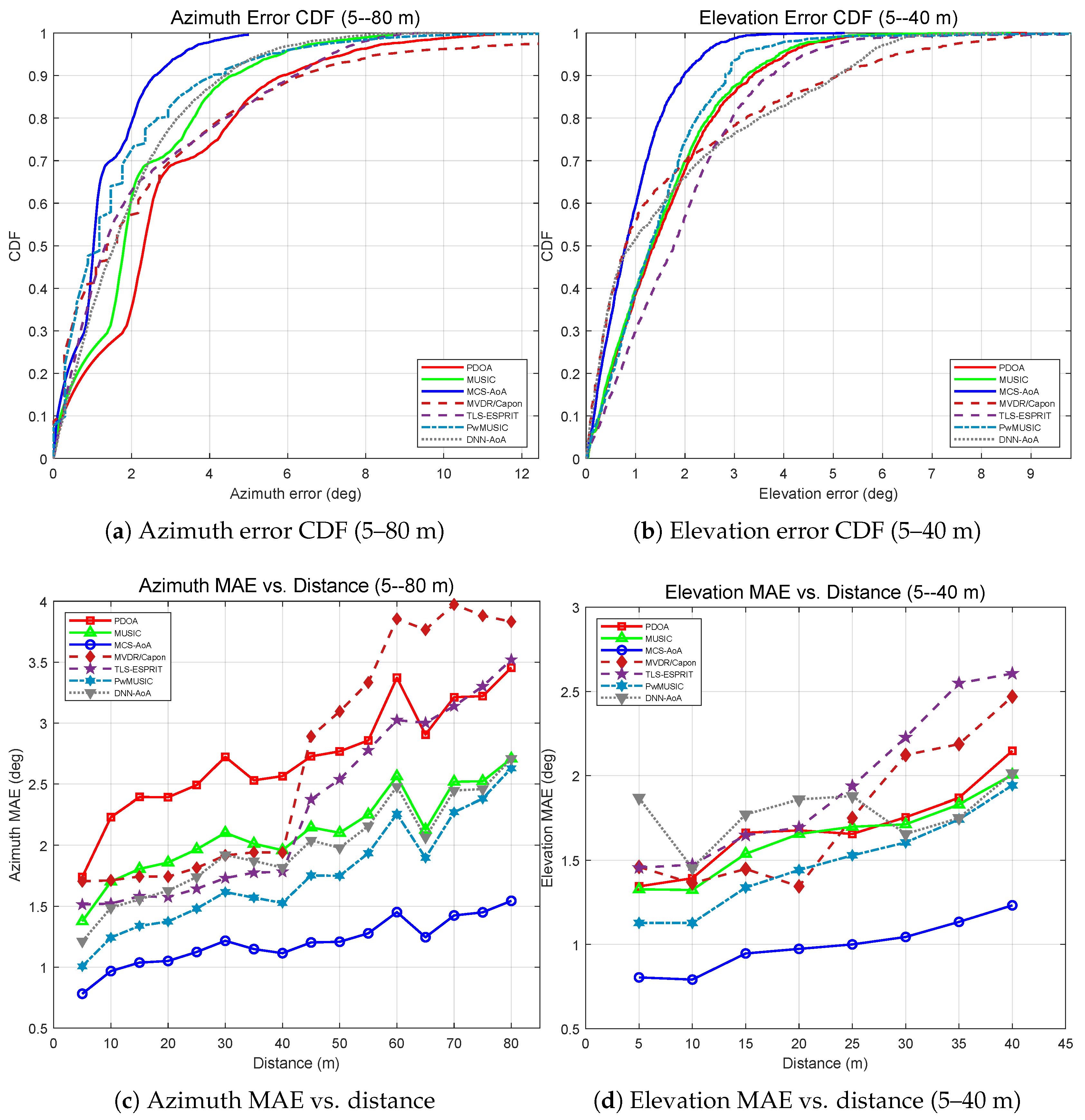
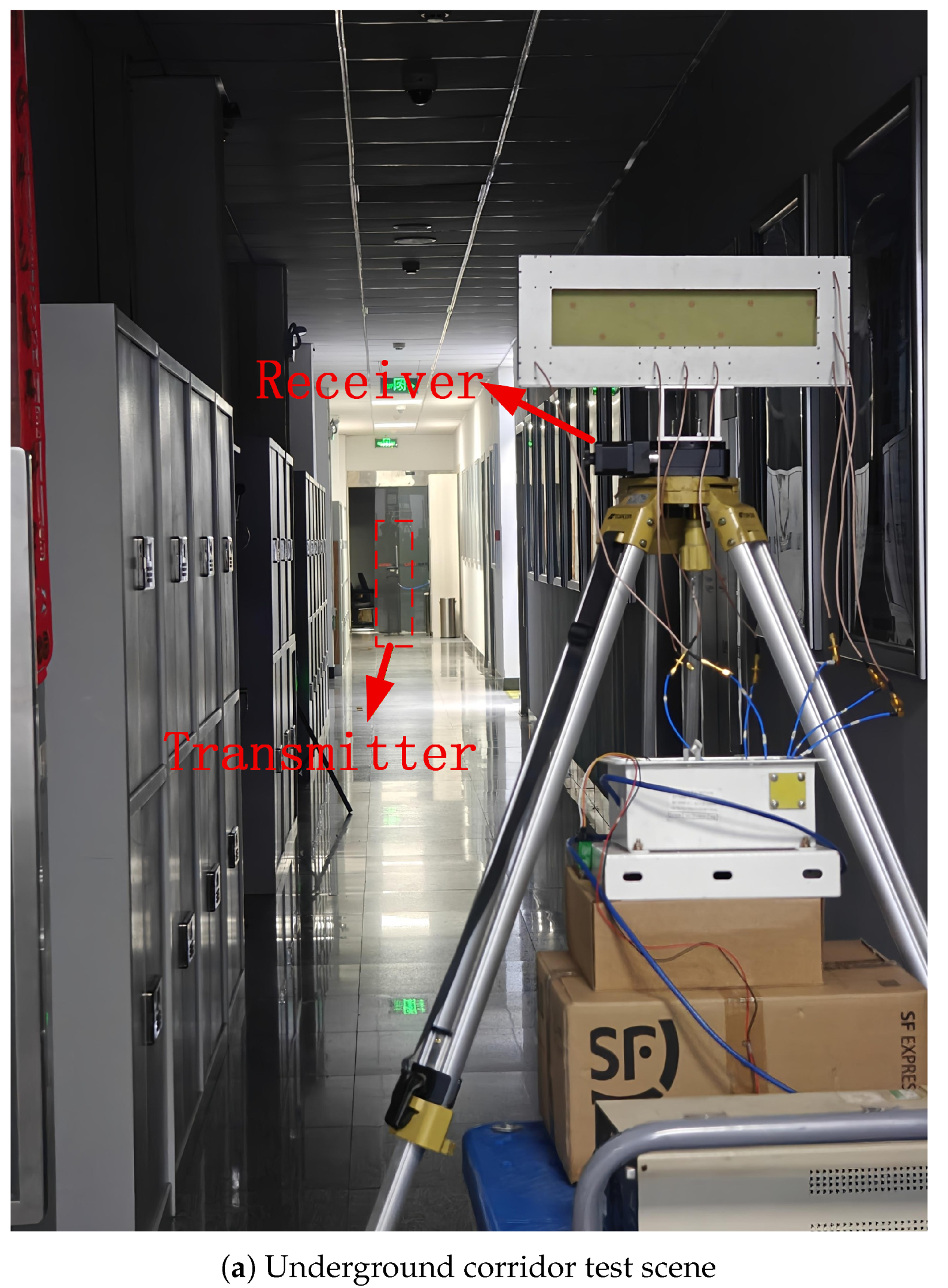
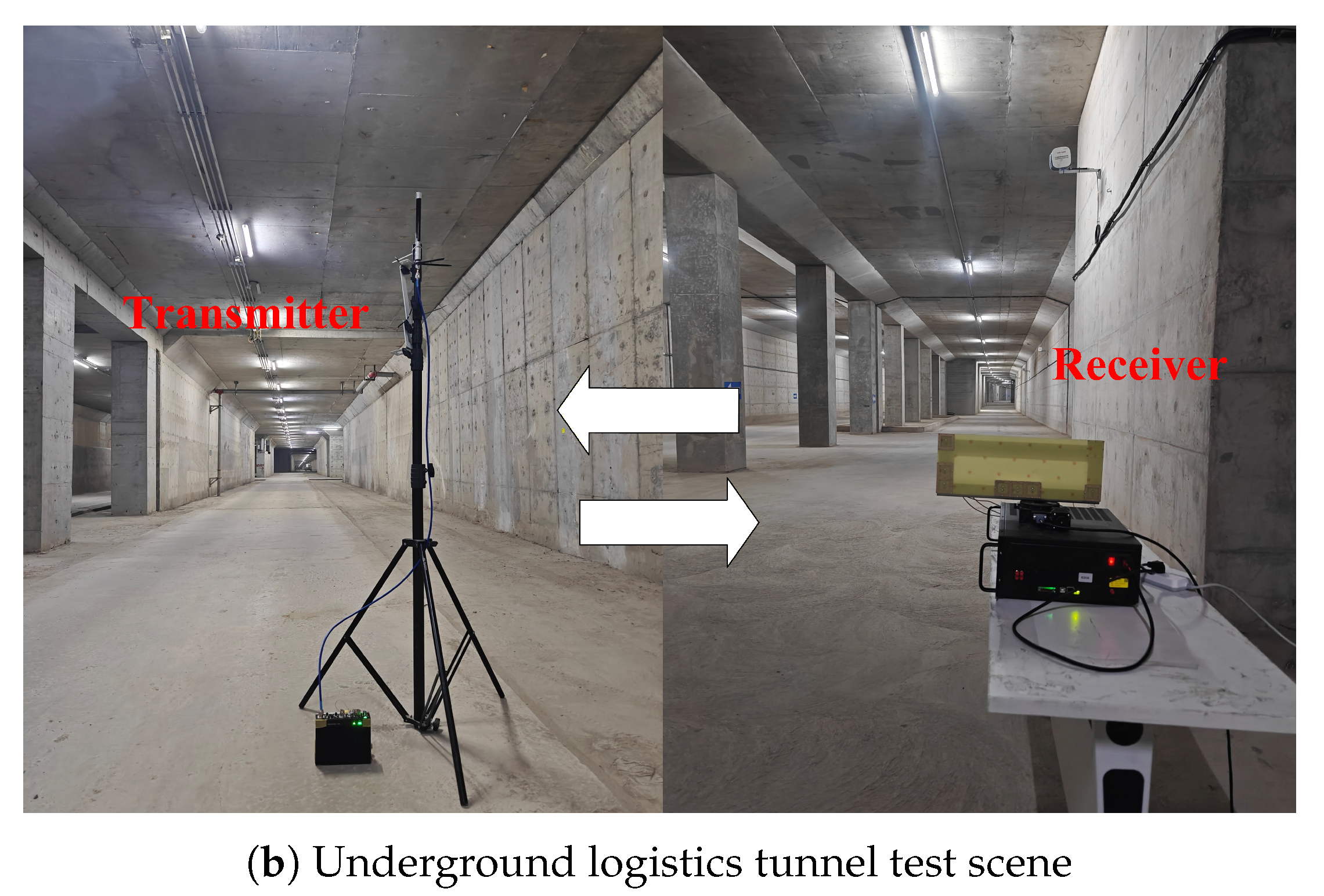
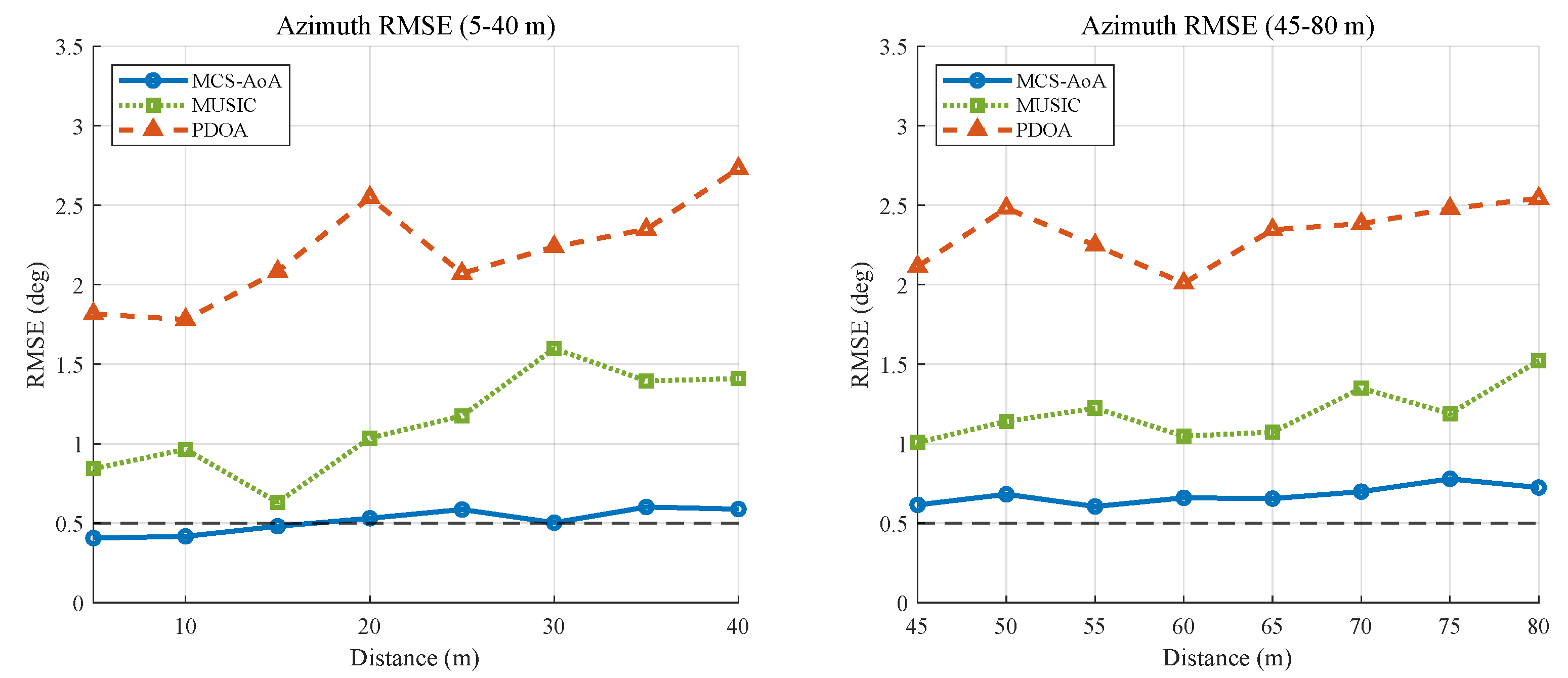
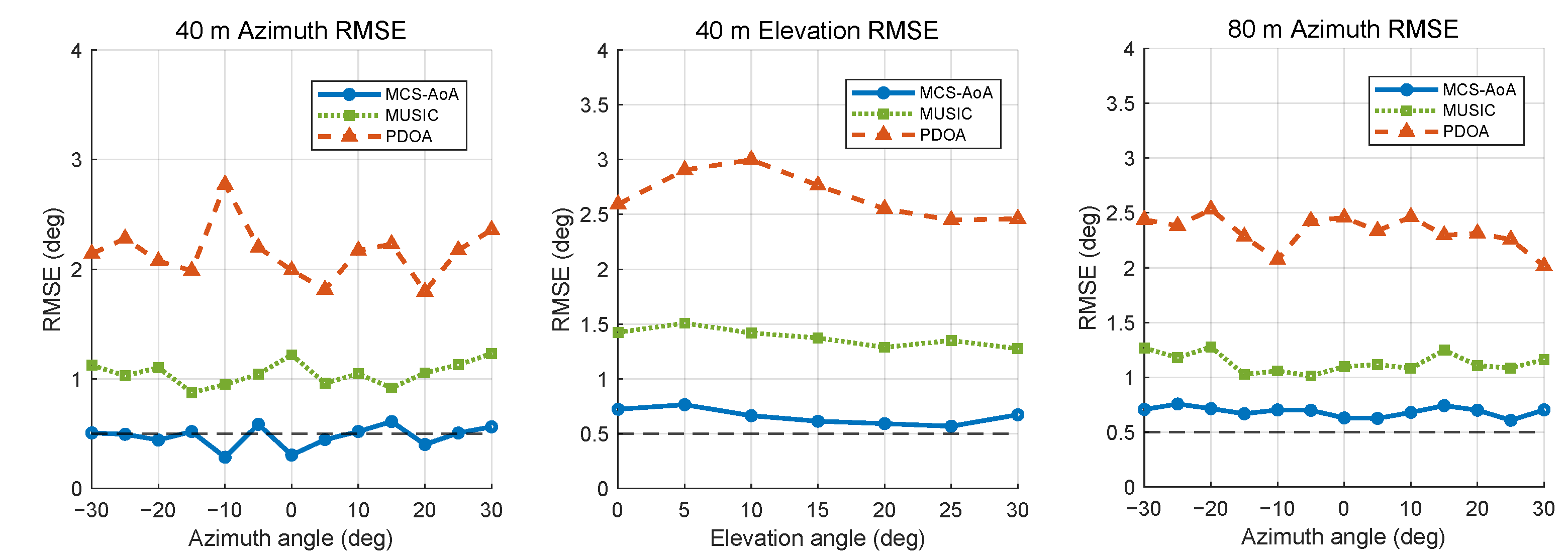
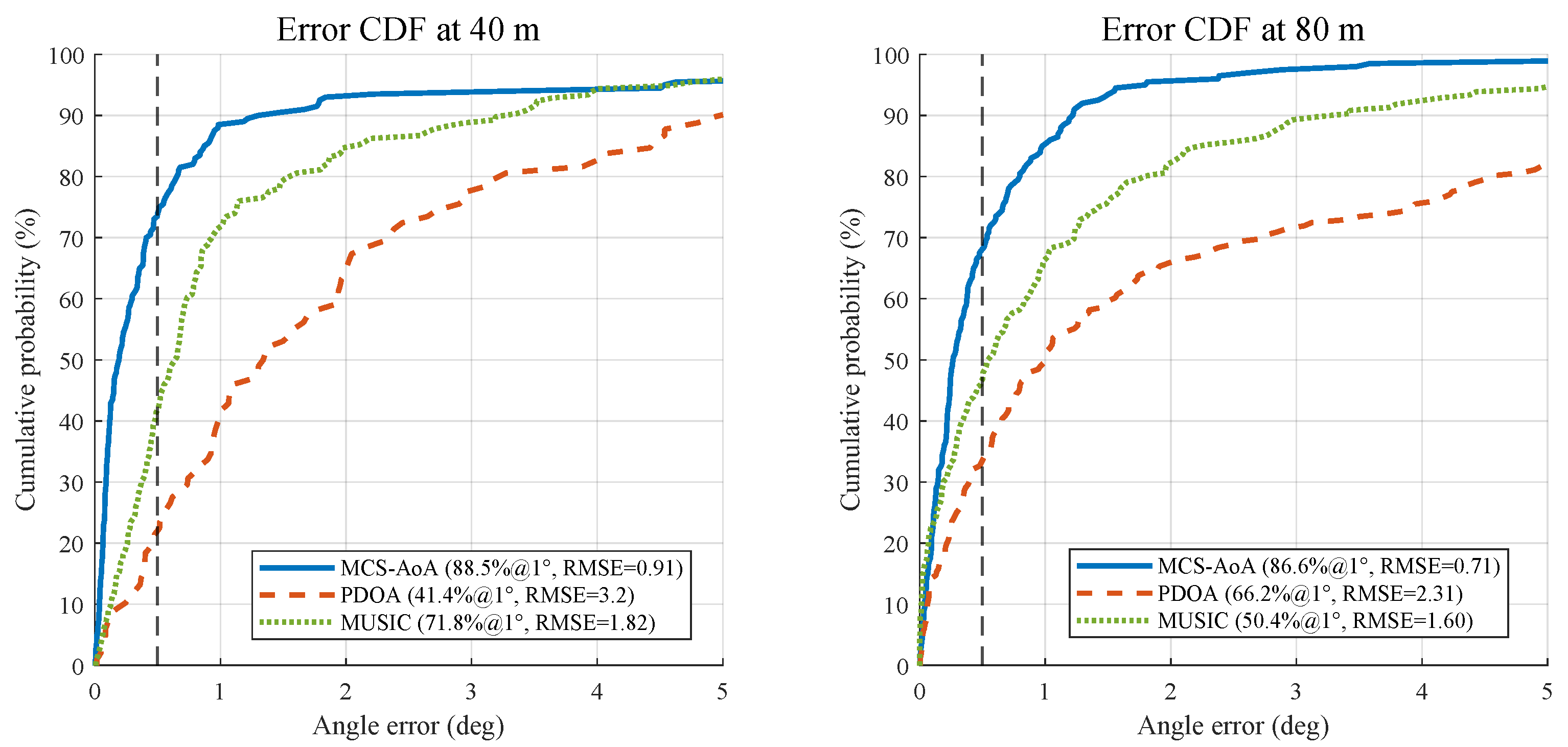
This paper takes a different approach: rather than committing to one path, it treats every resolvable CIR component as a candidate observation and assigns each a data-driven weight. The resulting algorithm, multipath credibility selection AoA (MCS-AoA), scores candidates with a four-dimensional credibility metric, assembles a credibility-weighted spatial covariance matrix, and resolves azimuth and elevation via a 2D MUSIC search. Simulation and field measurements in a utility corridor (5–40 m) and a logistics tunnel (5–80 m) show that MCS-AoA reduces the MAE by 41–56% relative to PDOA and 36–43% relative to MUSIC across both sites.
2. Related Work
The propagation environment targeted by this work differs from typical indoor channels in two measurable respects: excess delay and relative multipath amplitude. Zhou et al. [
1] showed through physics-based deterministic UWB channel models that waveguide-like tunnel propagation generates multipath structures with low excess delay and high relative amplitude—characteristics that violate the assumptions underlying most indoor-oriented algorithms. Experimental confirmation comes from Nkakanou et al. [
2], who measured UWB channel parameters in underground mine galleries and characterized path loss, coherence bandwidth, and delay spread under both LOS and NLOS conditions. Hrovat et al. [
3] surveyed the broader landscape of tunnel propagation modeling, spanning numerical, waveguide/modal, ray-tracing, and empirical approaches, while Bashir [
4] examined the influence of antenna position and polarization on UWB signals in mine tunnels.
Against this propagation backdrop, AoA estimation has traditionally relied on two families of algorithms. Phase-based methods such as PDOA require minimal computation but break down when multipath perturbs the inter-channel phase by more than a fraction of a wavelength. Subspace methods achieve finer angular resolution: the MUSIC algorithm proposed by Schmidt [
5] exploits signal–noise subspace orthogonality for super-resolution DOA estimation, ESPRIT [
6] avoids explicit spectral search through a rotation-invariance formulation, and the MVDR beamformer [
7] provides a constrained spatial–spectrum estimate. Joint azimuth–elevation estimation has been demonstrated with L-shaped arrays by Porozantzidou and Chryssomallis [
8]. Yet, subspace methods remain vulnerable when multipath contaminates the sample covariance matrix, as is common in confined underground spaces. Deng et al. [
9] addressed the computational cost of 2D MUSIC by decomposing the joint peak search into two sequential 1D searches, but the underlying sensitivity to covariance corruption remains. An alternative paradigm was explored by Ledergerber and D’Andrea [
10], who estimated AoA from the angle-dependent antenna transfer function of a single UWB element, augmenting TOF systems with angular information without a multi-element array.
How to handle multipath is the central open question. Existing strategies span four categories: (i) heuristic LOS detection via TOF or amplitude thresholds; (ii) model-based multipath parameter estimation; (iii) multipath-assisted localization that treats reflections as useful information; and (iv) robust covariance construction with weighted fusion. The SALMA framework [
11] exemplifies category (iii), mapping specular multipath components to virtual anchors for single-anchor positioning even under obstructed LOS. Wielandt and De Strycker [
12] pursued a related idea, using ray tracing to generate multipath-assisted AoA fingerprints. Nguyen et al. [
13] combined geometry-based features with Gaussian-process regression to model resolvable specular paths from UWB CIR data, while Hu et al. [
14] fused NLOS delay and angular measurements through ray tracing and iterative reweighted least squares for underground parking scenarios.
A parallel research thread focuses on distinguishing LOS from NLOS propagation before estimation. Marano et al. [
15] pioneered learning-based NLOS classifiers from large-scale UWB campaigns; Zeng et al. [
16] used hand-crafted CIR features for the same purpose. Deep learning variants followed: Stahlke et al. [
17] applied convolutional networks directly to raw CIR waveforms, and Jiang et al. [
18] trained classifiers on CIR features in complex indoor settings. Guvenc and Chong [
19] provide a comprehensive survey of TOA-based NLOS mitigation. These classifiers improve ranging but do not directly address AoA bias introduced when a non-LOS component dominates the covariance.
Foundational analyses of wideband localization accuracy by Shen and Win [
20], Gezici et al. [
21], and Dardari et al. [
22] highlight multipath interference and NLOS bias as dominant error sources. Physical-layer principles were laid out by Win and Scholtz [
23]; channel modeling aspects were surveyed by Molisch [
24]. Practical PDOA-based AoA estimation with commercial Decawave DW1000 hardware was demonstrated by Dotlic et al. [
25], and Smaoui et al. [
26] explored concurrent AoA/ranging architectures. Compact UWB arrays for AoA-aided relative localization were reported by Mathew et al. [
27], and cooperative strategies were studied by Wymeersch et al. [
28].
In elongated underground spaces, the bottleneck is not multipath per se but the inability to decide which path to trust. The present work addresses this gap by assigning every candidate a credibility score derived from array geometry and TOF constraints; the weighted covariance construction then emphasizes reliable paths automatically, without a LOS detector or offline training data.
3. Materials and Methods
3.1. Signal Model and Virtual Array Interpretation
In a confined underground environment, specular reflections frequently produce resolvable multipath components that maintain stable phase relationships across the antenna array. These components can be interpreted as observations originating from a set of multipath-induced virtual array (MIVA) elements. For a physical array whose element positions are
, each specular multipath component can be modeled as an equivalent virtual displacement
along the direction of incidence, where
and
c is the speed of light and
is the corresponding excess delay.
For a candidate path
ℓ with incident direction parameterized by azimuth/elevation
, the array steering vector is
where
is the free-space wavenumber and
is the unit direction vector. When multiple resolvable multipath components are present, the received signal can be interpreted as an extended (virtual) array response obtained by stacking the steering vectors of the individual virtual elements:
where
K is the number of resolvable candidate paths and
denotes the steering vector associated with the
k-th virtual element.
For a linear baseline, the phase at the ℓ-th virtual element on the m-th antenna reduces to the classical form , underscoring that resolvable multipath components can serve as additional “virtual sensors” that effectively extend the array aperture.
3.1.1. Virtual-Array Resolvability
For a virtual element to contribute non-degenerate angular information, a necessary condition is that its steering vector remains linearly independent of the physical array steering vector over the angular region of interest, i.e.,
For uniform linear arrays with element spacing
d and
M elements, a heuristic sufficient condition can be derived as follows. The additional phase shift introduced by the
ℓ-th virtual element relative to the physical array reference is
, where
is the elevation angle of incidence. Steering-vector degeneracy occurs when this phase shift equals an integer multiple of
, i.e.,
for some
. To avoid degeneracy, the residual phase must exceed the array’s angular resolution limit. For an
M-element ULA with total aperture
, the Rayleigh-like angular resolution is
, which corresponds to a minimum distinguishable phase separation of
, or equivalently a path-length margin of
when normalized by the number of independent baselines. This yields the condition
which ensures that the virtual element’s contribution remains distinguishable from integer-wavelength phase aliases within the array’s resolution capability.
In practice, however, not all resolvable components in underground environments satisfy the geometric and phase relations required by the MIVA interpretation. Such components act as “false virtual elements” that corrupt the estimated covariance matrix. This contamination can be captured by a low-rank bias term,
which violates the signal–noise subspace orthogonality upon which subspace estimators rely. MCS-AoA counteracts this effect by assigning low credibility scores to candidates that violate phase–geometry and coherence constraints, thereby suppressing their contribution to the weighted covariance matrix.
3.1.2. Validity Under Diffuse Multipath Conditions
The virtual array model assumes specular reflection, i.e., each multipath component arrives from a well-defined direction with a coherent wavefront. In practice, underground environments also exhibit diffuse scattering from rough surfaces, cabling, and ventilation infrastructure. A diffuse component lacks a stable arrival angle and therefore violates the plane-wave assumption underlying the steering vector .
The MCS credibility framework handles such components without requiring an explicit specular/diffuse classifier. Diffuse arrivals typically exhibit (i) low inter-baseline phase consistency, because the wavefront curvature varies across the array aperture, producing a low phase–geometry score ; (ii) low cross-baseline coherence , because the scattered field decorrelates across spatially separated baselines; and (iii) temporally spread energy that reduces the peak amplitude relative to the noise floor, lowering . Consequently, diffuse components receive low composite credibility and are effectively suppressed by the adaptive threshold . The method therefore does not rely on a strictly specular propagation environment; rather, it degrades gracefully as the diffuse-to-specular ratio increases, retaining only those components whose physical consistency survives the four-dimensional credibility test.
3.2. Resolvable Condition and Soft-Decision Fusion
To retain only resolvable and physically consistent candidates, we adopt a soft-decision fusion strategy in lieu of hard LOS selection. In conventional estimators, the total AoA error decomposes into a path-selection term and an estimation term,
where
can become a catastrophic outlier once an incorrect path is chosen. MCS-AoA instead constructs a credibility-weighted covariance matrix from multiple candidate snapshots and estimates AoA via a MUSIC spectrum search:
where
is evaluated on the credibility-weighted covariance matrix formed from the retained candidate set
(detailed in the following subsections).
From an information-fusion perspective, the credibility weighting acts as a soft decision that down-weights unreliable candidates while emphasizing those exhibiting physical consistency.
3.3. Array Observation and Multipath Candidates
In confined underground spaces, the received CIR typically comprises multiple reflections of comparable energy. Let the CIR matrix be , where N denotes the number of delay taps and M the number of array elements. At each delay index k, the corresponding array snapshot is .
Rather than committing to a single presumed LOS tap, we first extract a compact set of candidate paths through peak detection on a reference channel. Let denote the magnitude sequence of the reference-channel CIR. Peaks are identified on using a relative amplitude threshold of , and at most candidates are retained. If no peak exceeds the threshold, the global-maximum tap is used as the sole candidate.
3.4. Multipath Credibility Selection (MCS)
We adopt a Bayesian-inspired heuristic to assess the credibility of each candidate path. For each candidate
at delay index
, let
indicate whether it is a “usable” (physically consistent) virtual element and let
collect the observed features—phase residual, excess delay, amplitude score, and coherence score. Under a naive-Bayes-style conditional independence assumption, the posterior would factorize as
This factored form motivates a multiplicative heuristic score that combines four physically grounded terms:
Taking the logarithm and substituting the exponential forms of
and
yields
where
prevents numerical underflow when a factor vanishes. The additive log-domain decomposition shows that each credibility dimension contributes an independent surrogate log-likelihood term. Arithmetic averaging or maximum selection would break this factored structure and discard complementary information; the ablation study in
Section 5.1 confirms that the multiplicative rule outperforms both alternatives by 25–26%.
Each factor captures a distinct physical consistency dimension. We extract the array snapshot and compute:
Amplitude significance. The relative strength of candidate
ℓ with respect to the strongest detected component:
TOF proximity. An earliest-arrival prior penalizing late arrivals relative to the first detected peak at delay index
:
with
.
Phase–geometry consistency. A residual measuring how well inter-baseline phase differences obey the integer-multiple relationships imposed by array geometry. For a uniform sub-baseline with equally spaced elements, the phase difference to the
b-th element should satisfy
. The residual is
where
is the wrapped phase difference between the reference antenna and the
b-th element for candidate
ℓ, and
is a per-baseline reliability weight. In the general formulation,
can be set to the normalized cross-correlation magnitude of adjacent antenna pairs,
; in the present implementation, uniform weighting
is used. For the L-shaped array (
Figure 1b), the integer-multiple check is applied independently to each arm. Let the horizontal sub-array consist of three equally spaced receive elements
and the vertical sub-array of
, with
and
sharing the corner element. The per-arm residuals are
and
, giving
. We define
for notational convenience.
Cross-baseline coherence. The mean resultant length of the phase differences across all baselines, rewarding candidates with self-consistent spatial signatures:
For the L-shaped array,
is computed per-arm as the normalized magnitude of adjacent-pair cross-correlations,
, and averaged over the horizontal and vertical arms:
. When phase progressions across consecutive elements are consistent, the cross-correlations add coherently and
; when phases are incoherent, cancellation drives
.
The composite credibility
(equivalently,
) is normalized to produce the fusion weight
.
Table 1 summarizes the four credibility factors.
An adaptive credibility threshold
is further applied to suppress low-credibility candidates. Let
and
. We define
and select
where
governs the miss-versus-false-alarm trade-off. In practice, we perform a discrete search over the candidate credibility values and set
, with the constraint that at least one candidate is always retained.
The normalized credibility weight is
3.5. Credibility-Weighted Covariance and 2D MUSIC Search
The credibility-weighted spatial covariance matrix is constructed from the retained candidate snapshots as
An eigendecomposition
yields the noise subspace
, spanned by the eigenvectors corresponding to the smallest eigenvalues. A single-source model (
) is assumed when partitioning the eigenspace, i.e.,
comprises the
eigenvectors with the smallest eigenvalues. This assumption is justified by two observations: (i) the credibility thresholding retains only candidates whose phase–geometry and coherence scores are mutually consistent, so the surviving snapshots approximate observations of the same dominant arrival direction; and (ii) even when a secondary direction contributes residual energy, the credibility weighting concentrates most of
’s energy along the primary eigenvector, ensuring that the MUSIC null-steering remains well-directed. The 2D MUSIC pseudo-spectrum is then evaluated as
and the AoA estimate is obtained via grid search:
At longer ranges where the elevation estimation becomes ill-conditioned, the search can be reduced to a 1D azimuth scan by fixing
or applying a 2D-to-1D dimensionality reduction.
3.6. Algorithm Flow
Table 2 summarizes the complete MCS-AoA processing pipeline.
3.7. Implementation Details and Parameter Settings
For reproducibility, we summarize the key parameter settings of our implementation. Candidate extraction relies on peak detection applied to the reference-channel magnitude
with a relative threshold of
; at most,
candidates are retained, with the global-maximum tap serving as a fallback when no peak exceeds the threshold. An earliest-arrival prior is imposed via
where
is the delay index of the earliest detected peak and
. The phase wrapping operator
maps its argument to
. In the 2D MUSIC step, all available receive channels are used and a single-source model is assumed. Crucially, the same parameter configuration (
Table 3) is applied across all simulation and experimental scenarios without per-environment tuning, ensuring that the reported results reflect generalization capability rather than scenario-specific overfitting.
3.8. Computational Complexity
Let
M denote the number of receive channels,
L the number of retained candidates, and
G the total number of grid points in the 2D scan. Constructing the credibility-weighted covariance
requires
operations, the eigendecomposition costs
, and evaluating the MUSIC pseudo-spectrum over the scan grid costs
. With the grid specified in
Table 3,
, so the spectral evaluation dominates the overall computational burden.
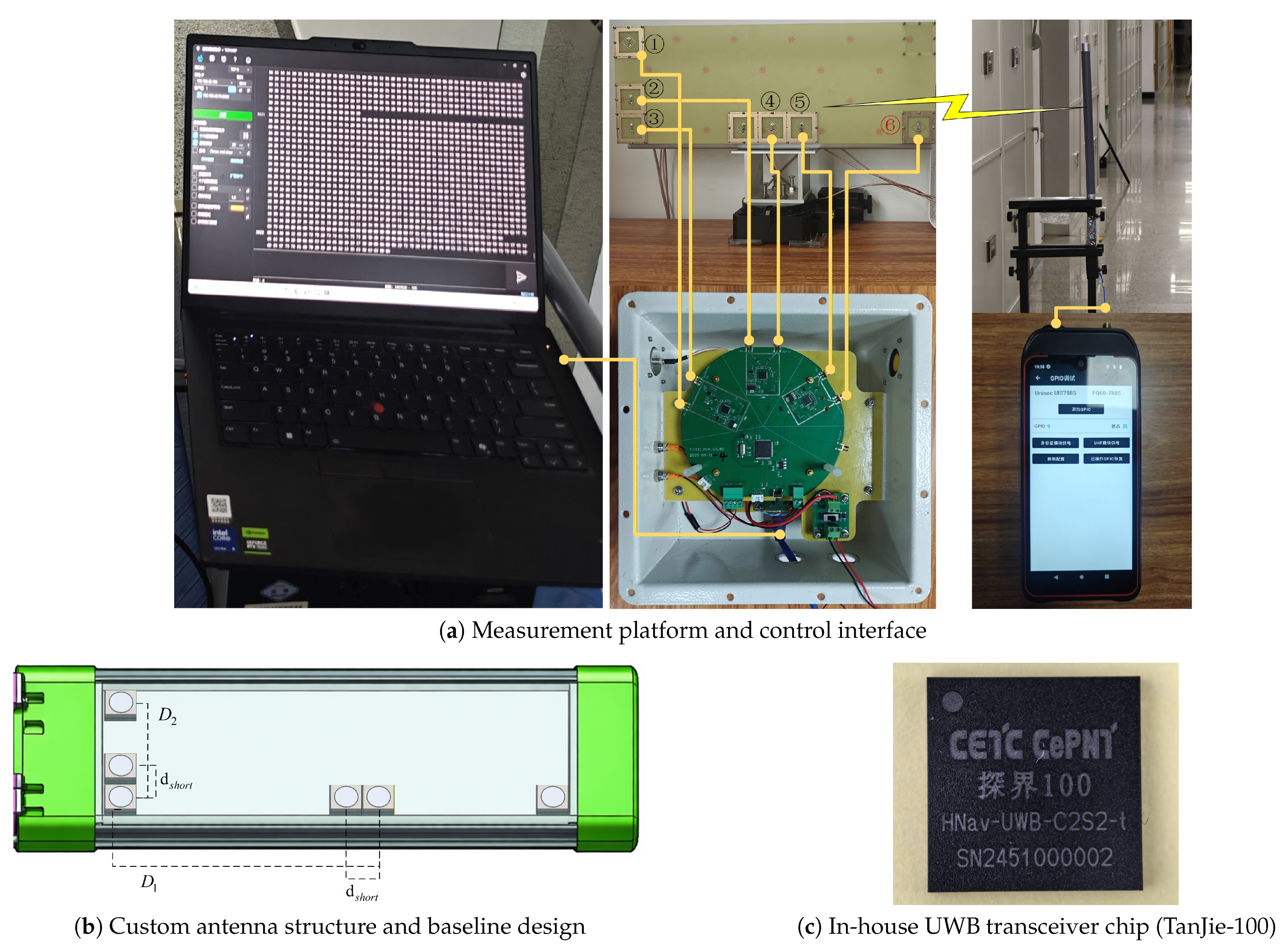
Measured execution time. On a desktop PC (Intel Core i7-12700, 2.1 GHz, 32 GB RAM) running unoptimized MATLAB (R2023a), a single MCS-AoA estimation cycle—including peak detection, four-dimensional credibility evaluation, covariance construction, eigendecomposition, and full 2D grid search—completes in approximately 12 ms per CIR snapshot. This is well within the 100 ms budget imposed by the 10 Hz AoA update rate of the measurement platform described in
Section 4.1, confirming real-time feasibility even without code optimization.
Acceleration strategies. For deployment on resource-constrained embedded platforms, the computational cost can be reduced through several strategies: (i) a coarse-to-fine grid search that first evaluates a sparse grid (e.g., steps) and then refines around the coarse peak with resolution, reducing G by roughly an order of magnitude; (ii) restricting the candidate count to when prior position information is available; and (iii) exploiting the Hermitian structure of to halve the number of complex multiplications in the spectrum evaluation. A combination of these techniques is expected to bring the per-cycle latency below 2 ms on an ARM Cortex-A class processor, enabling integration into real-time UWB localization stacks.
6. Discussion
Across both test environments, classical subspace variants—MVDR/Capon and ESPRIT—fail to improve upon conventional MUSIC, despite well-established theoretical advantages under idealized conditions. Dense, closely spaced multipath corrupts the sample covariance matrix, and neither method can distinguish reliable from unreliable path contributions. PwMUSIC introduces amplitude weighting and does narrow the azimuth gap ( versus for MUSIC), yet its elevation MAE () is higher than that of MCS-AoA (). In waveguide-like channels, reflected components routinely match or exceed the LOS in power, so amplitude alone cannot separate a reliable path from a misleading one. MCS-AoA avoids this pitfall by incorporating three additional consistency dimensions (TOF, phase–geometry, coherence) that are sensitive to geometric plausibility rather than signal strength alone.
The DNN-AoA results tell a complementary story. A azimuth MAE in the corridor shows that data-driven approaches can learn useful CIR-to-angle mappings, yet the elevation MAE—worst among all seven methods—exposes the generalization ceiling of a two-layer MLP trained on samples with leave-one-distance-out splits. Underground corridors present distance-dependent CIR variations that small datasets cannot cover adequately, a limitation that physics-guided credibility scoring avoids by design.
The three classical subspace/beamforming methods—MUSIC, TLS-ESPRIT, and MVDR/Capon—cluster tightly at
–
azimuth MAE in the corridor (
Table 9), an expected outcome when all three share the same sample covariance matrix and covariance estimation quality is the dominant bottleneck.
Compared with robust covariance techniques such as diagonal loading or shrinkage estimation, the credibility-weighted formulation (Equation (
20)) operates at a different level: the former address ill-conditioning of the covariance matrix globally, whereas the latter discriminates among individual path contributions before constructing the covariance. The two strategies are complementary rather than competing.
Sparse reconstruction and compressive-sensing (CS)-based DOA methods offer an attractive alternative when the number of sources is small relative to a densely sampled spatial dictionary. However, their applicability to the present scenario is limited by two factors: (i) the physical array has only elements, which severely restricts the dictionary size and the achievable sparse-recovery performance; and (ii) the underground multipath environment produces a continuum of closely spaced arrivals rather than a few well-separated point sources, violating the sparsity assumption that underpins -minimization and greedy pursuit algorithms. MCS-AoA circumvents these limitations by operating directly on per-tap CIR snapshots rather than requiring a spatial dictionary, and by leveraging physics-based credibility scoring to discriminate among candidate paths without relying on sparsity.
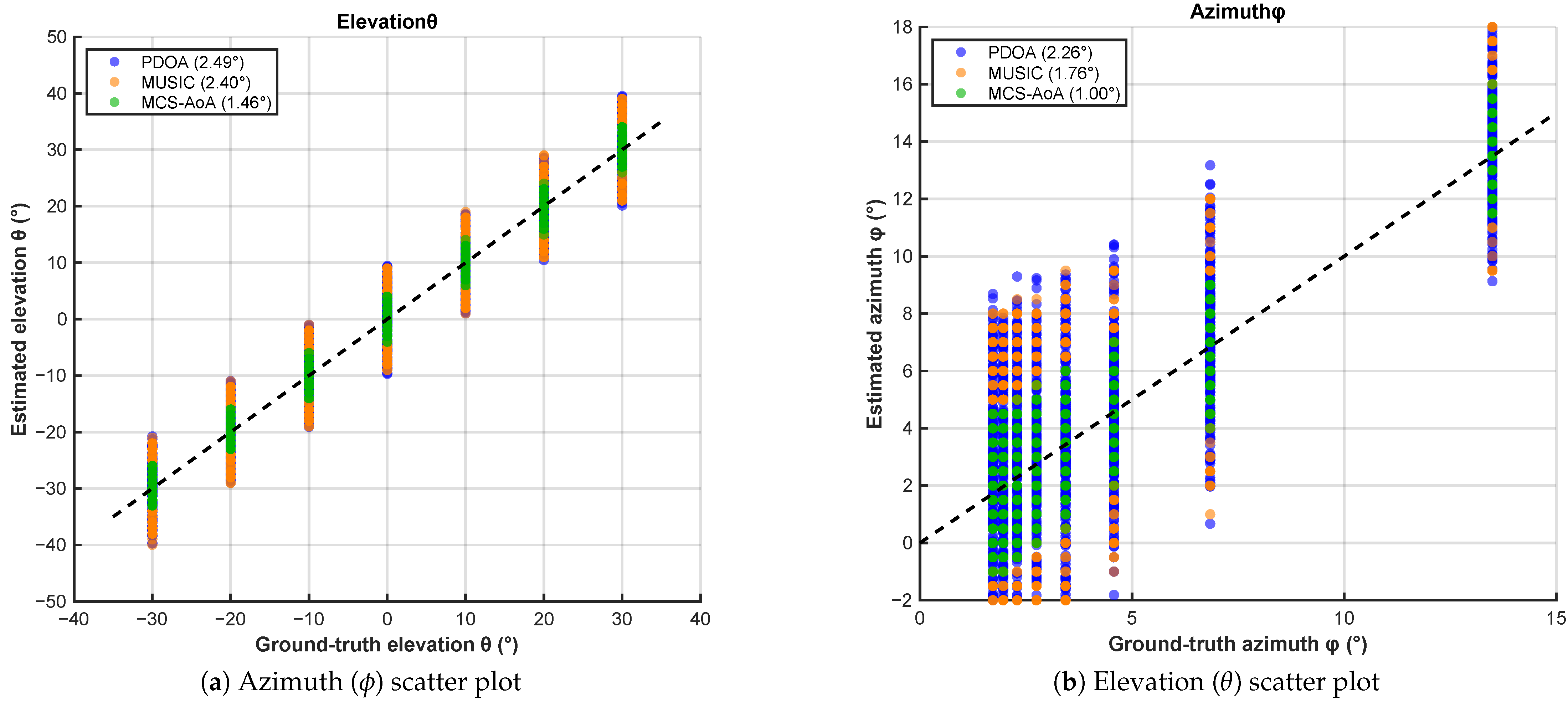
Simulation and field results agree qualitatively but differ in absolute magnitude. Three factors account for the gap: (i) channel non-stationarity and motion-induced CIR fluctuations absent from the parametric model; (ii) residual array calibration errors—sub-millimeter position deviations and 1–2° attitude misalignment—that perturb the phase–geometry consistency score; and (iii) hardware non-idealities including ADC quantization noise, clock jitter, and oscillator phase noise. Closing this gap motivates future work on online channel tracking, array self-calibration, and hardware-aware modeling. Despite this gap, MCS-AoA delivers the lowest MAE in both test environments (1.00°/1.46° in the corridor; 1.19° azimuth over 5–80 m in the logistics tunnel), and its 90th-percentile error is approximately half that of the next-best method.
The absolute accuracy levels can be contextualized against published UWB AoA benchmarks. Commercial dual-antenna systems based on the Qorvo DW3000 family typically achieve PDOA accuracies in the range of
–
at short range (≤5 m) under indoor LOS conditions [
29]; recent work by Martinelli et al. [
30] reports an MAE of
at 3 m with a DW3220-based sensor node. Our PDOA baseline yields
(corridor) and
(tunnel), which is approximately
better and is physically attributable to the
increase in independent baselines (
versus 1), coherent multi-channel sampling (<50 ps inter-channel jitter), and full 1016-tap CIR access. This comparison confirms that the baseline accuracy observed in our experiments is consistent with the hardware specifications rather than anomalous.
MCS-AoA is designed for the specific propagation regime found in narrow, elongated underground spaces—corridors, tunnels, utility galleries—where dense multipath with low excess delay and high relative amplitude is the dominant impairment. The approach should generalize to other confined settings with similar multipath profiles (e.g., indoor hallways, mine shafts), but in open environments where the LOS path is well separated from reflections, conventional subspace methods already perform adequately and the additional credibility machinery offers diminishing returns. The principal computational overhead is the 2D MUSIC spectrum search, which can be managed by limiting the candidate count L and employing a coarse-to-fine grid strategy.