Accelerated Full Waveform Inversion by Deep Compressed Learning

Abstract
1. Introduction
2. Theoretical Background
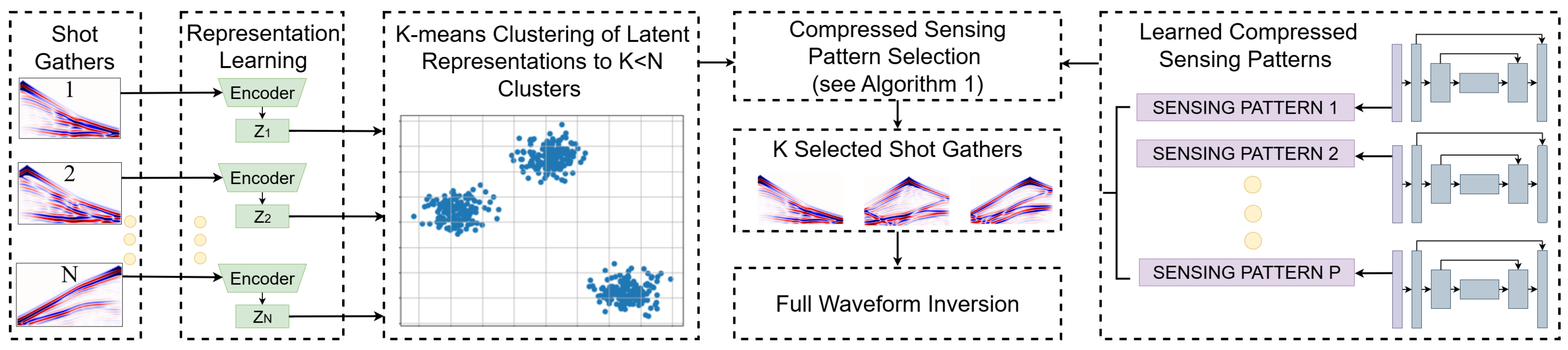
3. Deep Compressed Learning and Representation Learning in FWI
| Algorithm 1: Shots Sensing Pattern Selection. |
 |
3.1. Dataset Preparation
3.2. Deep Learning Architectures and Training
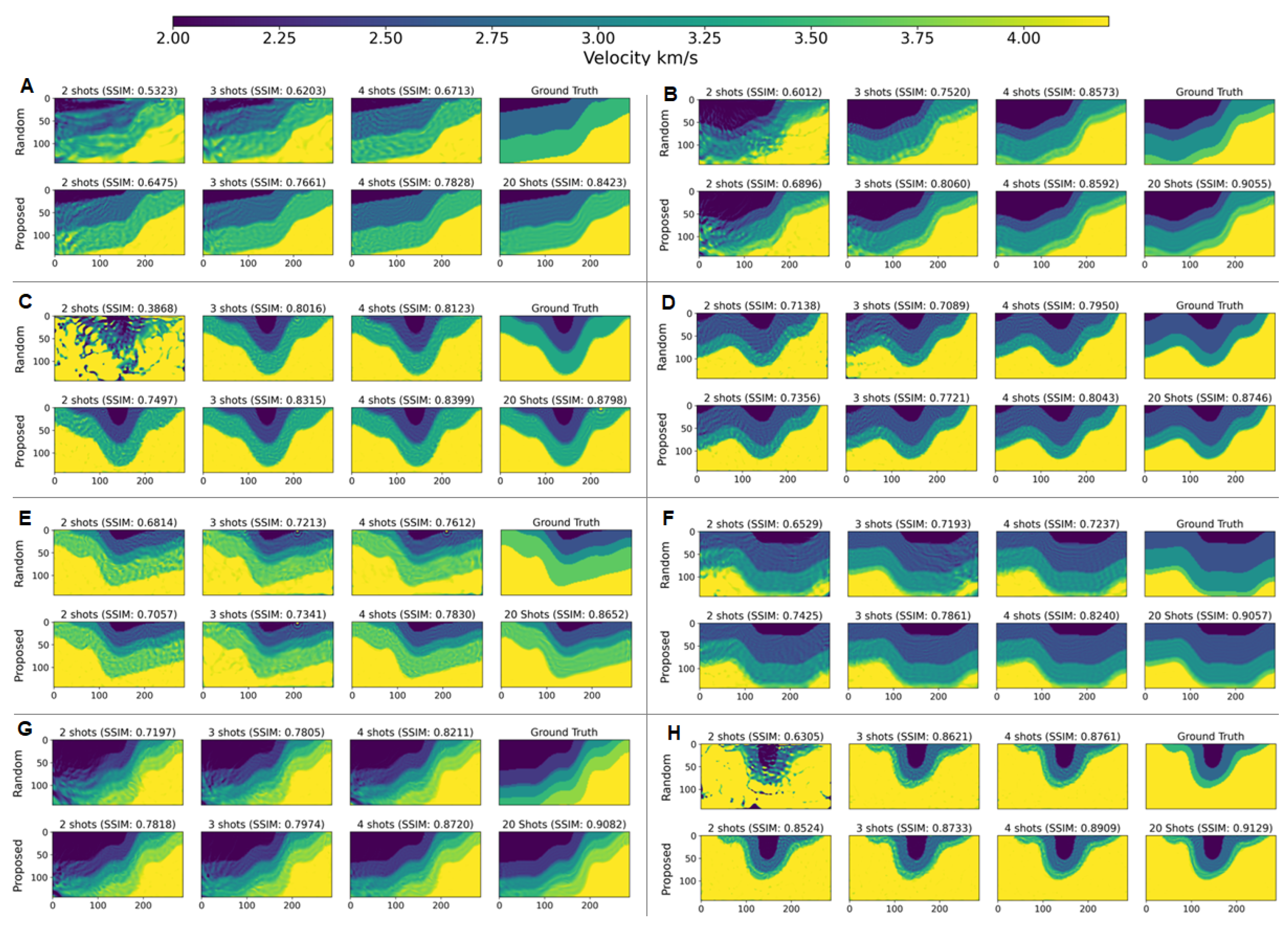
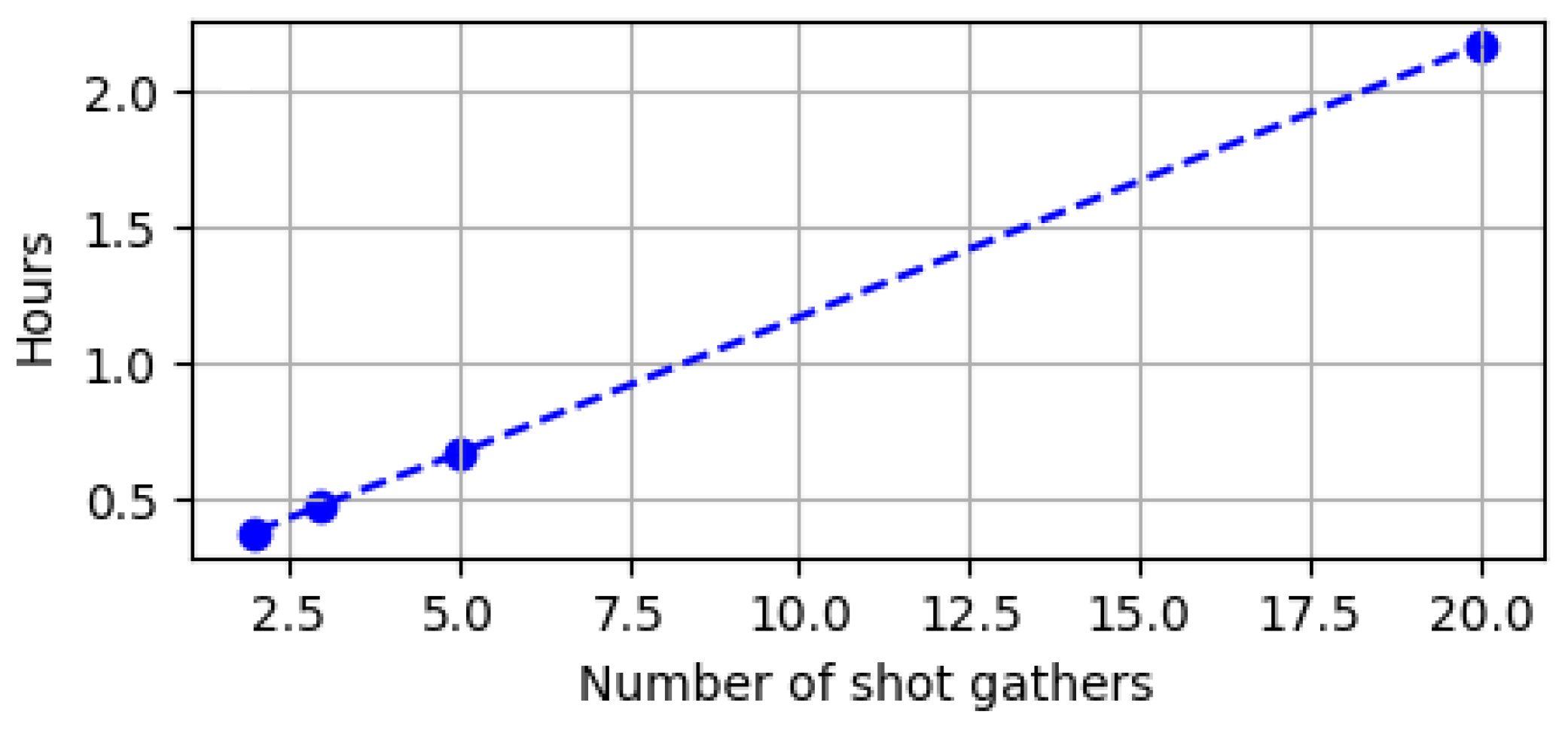
4. Performance Evaluation
5. Conclusions
Author Contributions
Funding
Data Availability Statement
Acknowledgments
Conflicts of Interest
References
- Virieux, J.; Operto, S. An overview of full-waveform inversion in exploration geophysics. Geophysics 2009, 74, WCC1–WCC26. [Google Scholar] [CrossRef]
- Wang, X.; Wang, Z.; Lei, X.; Zhu, C.; Gao, J. Seis-PDDN: Seismic Undersampling Design and Reconstruction Using Prior Distribution and Diffusion Null-Space Iteration. IEEE Trans. Geosci. Remote Sens. 2024, 62, 5932313. [Google Scholar] [CrossRef]
- Xu, Y.; Yu, S. Active sampling design for seismic data based on dynamic matching distance. In Proceedings of the SEG International Exposition and Annual Meeting; SEG: Houston, TX, USA, 2024; p. SEG-2024. [Google Scholar]
- Titova, A.; Wakin, M.B.; Tura, A.C. Achieving robust compressive sensing seismic acquisition with a two-step sampling approach. Sensors 2023, 23, 9519. [Google Scholar] [CrossRef] [PubMed]
- Verschuren, M.; Araya-Polo, M. Directional Full-Wave Scatter Source Modelling and Dip-Sensitive Target-Oriented RTM. Annu. Eage Meet. Proc. 2017, 2017, 1–5. [Google Scholar] [CrossRef]
- Hubara, I.; Courbariaux, M.; Soudry, D.; El-Yaniv, R.; Bengio, Y. Binarized neural networks. Adv. Neural Inf. Process. Syst. 2016, 29. [Google Scholar]
- Hernandez-Rojas, A.; Arguello, H. Design of Undersampled Seismic Acquisition Geometries via End-to-End Optimization. IEEE Trans. Geosci. Remote Sens. 2024, 62, 5901413. [Google Scholar] [CrossRef]
- Zhang, X.; Zhang, S.; Lin, J.; Sun, F.; Zhu, X.; Yang, Y.; Tong, X.; Yang, H. An Efficient Seismic Data Acquisition Based on Compressed Sensing Architecture with Generative Adversarial Networks. IEEE Access 2019, 7, 105948–105961. [Google Scholar] [CrossRef]
- Jiang, Y.; Chen, H.; Huang, P.; Guo, L.; Liu, Y. Research on Active Obstacle Avoidance in Seismic Acquisition Using Compressed Sensing and Deep Learning Reconstruction Technology. IEEE Access 2024, 12, 177634–177646. [Google Scholar] [CrossRef]
- Dong, X.; Yuan, Z.; Lin, J.; Dong, S.; Tong, X.; Li, Y. Bidirectional physics-constrained full-waveform inversion: Reducing seismic data dependence in velocity model building. Geophys. J. Int. 2026, 244, ggaf466. [Google Scholar] [CrossRef]
- Chen, G. Accurate background velocity model building method based on iterative deep learning in sparse transform domain. arXiv 2024, arXiv:2407.19419. [Google Scholar] [CrossRef]
- Zheng, Q.; Li, M.; Wu, B. Physics-Guided Self-Supervised Learning Full Waveform Inversion with Pretraining on Simultaneous Source. J. Mar. Sci. Eng. 2025, 13, 1193. [Google Scholar] [CrossRef]
- Díaz, E.; Guitton, A. Fast full waveform inversion with random shot decimation. In Proceedings of the SEG International Exposition and Annual Meeting; SEG: Houston, TX, USA, 2011; p. SEG-2011. [Google Scholar]
- Kuldeep; Shekar, B. Full waveform inversion with random shot selection using adaptive gradient descent. J. Earth Syst. Sci. 2021, 130, 183. [Google Scholar] [CrossRef]
- Gao, F.; Yao, G.; Liu, Z. Seismic waveform inversion with Fourier-based gradient shaping. J. Geophys. Eng. 2025, 22, 1822–1836. [Google Scholar] [CrossRef]
- Calderbank, R. Compressed Learning: Universal Sparse Dimensionality Reduction and Learning in the Measurement Domain. Preprint 2009. Available online: https://www.academia.edu/2791697/Compressed_learning_Universal_sparse_dimensionality_reduction_and_learning_in_the_measurement_domain (accessed on 10 March 2026).
- Gelboim, M.; Adler, A.; Sun, Y.; Araya-Polo, M. Deep compressed learning for 3D seismic inversion. In Proceedings of the Third International Meeting for Applied Geoscience & Energy Expanded Abstracts; SEG International Exposition and Annual Meeting; SEG: Houston, TX, USA, 2023; Volume 1, p. SEG–2023–3898594. [Google Scholar] [CrossRef]
- Fard, M.M.; Thonet, T.; Gaussier, E. Deep K-means: Jointly clustering with k-means and learning representations. Pattern Recognit. Lett. 2020, 138, 185–192. [Google Scholar] [CrossRef]
- Lafabregue, B.; Weber, J.; Gançarski, P.; Forestier, G. End-to-end deep representation learning for time series clustering: A comparative study. Data Min. Knowl. Discov. 2022, 36, 29–81. [Google Scholar] [CrossRef]
- Carthy, J.; Rey-Devesa, P.; Titos, M.; Benitez, C. Volcano-Seismic Event Detection and Clustering. IEEE J. Sel. Top. Appl. Earth Obs. Remote Sens. 2025, 18, 11276–11289. [Google Scholar] [CrossRef]
- Tarantola, A. Inversion of seismic reflection data in the acoustic approximation. Geophysics 1984, 49, 1259–1266. [Google Scholar] [CrossRef]
- Donoho, D. Compressed sensing. IEEE Trans. Inf. Theory 2006, 52, 1289–1306. [Google Scholar] [CrossRef]
- Lu, W.; Dai, T.; Xia, S.T. Binary Matrices for Compressed Sensing. IEEE Trans. Signal Process. 2018, 66, 77–85. [Google Scholar] [CrossRef]
- Adler, A.; Zisselman, E.; Elad, M. Compressed Learning: A Deep Neural Network Approach. In Proceedings of the Signal Processing with Adaptive Sparse Structured Representations (SPARS17); HAL: Paris, France, 2017. [Google Scholar]
- Zisselman, E.; Adler, A.; Elad, M. Compressed learning for image classification: A deep neural network approach. In Handbook of Numerical Analysis; Elsevier: Amsterdam, The Netherlands, 2018; Volume 19, pp. 3–17. [Google Scholar]
- Bengio, Y.; Courville, A.; Vincent, P. Representation Learning: A Review and New Perspectives. IEEE Trans. Pattern Anal. Mach. Intell. 2013, 35, 1798–1828. [Google Scholar] [CrossRef] [PubMed]
- Yang, Z.; Li, H.; Tuo, X.; Li, L.; Wen, J. Unsupervised Clustering of Microseismic Signals Using a Contrastive Learning Model. IEEE Trans. Geosci. Remote Sens. 2023, 61, 5903212. [Google Scholar] [CrossRef]
- de la Varga, M.; Schaaf, A.; Wellmann, F. GemPy 1.0: Open-source stochastic geological modeling and inversion. Geosci. Model Dev. 2019, 12, 1–32. [Google Scholar] [CrossRef]



| Block | Layer | Unit | Comments |
|---|---|---|---|
| Input | 0 | 20 shot gathers | 20 × 864 × 144 |
| grid points | |||
| Sensing | 1 | Binarized Sensing Layer | 20 learnable |
| parameters | |||
| Enc1 | 2 | Conv2D (32, (5 × 5)) | +IN* |
| 3 | Conv2D (32, (5 × 5)) | +IN* | |
| 4 | MaxPool2D (2 × 2) | +Dropout (0.2) | |
| Enc2 | 5–7 | Enc1 (64) | |
| Enc3 | 8–10 | Enc1 (128) | |
| Enc4 | 11–13 | Enc1 (256) | |
| Enc5 | 14–15 | Enc1* (512) | |
| Dec1 | 16 | ConvTrans2D (256, (2 × 2)) | +IN* |
| 17 | Conv2D (256, (2 × 2)) | +IN* | |
| 18 | Conv2D (256, (2 × 2)) | +IN* | |
| Dec2 | 19–21 | Dec1 (128) | |
| Dec3 | 22–24 | Dec1 (64) | |
| Dec4 | 25–27 | Dec1 (32) | |
| 28 | Conv2D (1, (1 × 6)) | stride = (1 × 6) | |
| dilation = (1 × 1) | |||
| output | 29 | Velocity Model | 288 × 144 grid points |
| Block | Layer | Unit |
|---|---|---|
| Input | 0 | Shot gather |
| Enc1 | 1 | Conv2D (16, (3 × 3), ReLU) |
| 2 | MaxPool2D | |
| Enc2 | 3–4 | Enc1 (8) |
| Enc3 | 5–6 | Enc1 (8) |
| Enc4 | 7–8 | Enc1 (8) |
| Dec1 | 9 | Conv2D (8, (3 × 3), ReLU) |
| 10 | UpSampling2d | |
| Dec2 | 11–12 | Dec1 (8) |
| Dec3 | 13–14 | Dec1 (8) |
| Dec4 | 15–16 | Dec1 (16) |
| Dec5 | 17 | Conv2D (1, (3 × 3), Tanh) |
| Output | 18 | Reconstructed Shot Gather |
| Shots (Rate) | Selection | MAE | SSIM | PSNR [dB] |
|---|---|---|---|---|
| 2 (10%) | DCL-RL | 0.08698 | 0.69406 | 30.265 |
| 2 | DCL | 0.12850 | 0.63556 | 27.590 |
| 2 | Random | 0.12872 | 0.64132 | 27.559 |
| 3 (15%) | DCL-RL | 0.06928 | 0.75678 | 32.654 |
| 3 | DCL | 0.07670 | 0.74249 | 32.141 |
| 3 | Random | 0.09110 | 0.70532 | 30.402 |
| 4 (20%) | DCL-RL | 0.06306 | 0.76140 | 32.862 |
| 4 | DCL | 0.06387 | 0.76695 | 33.021 |
| 4 | Random | 0.07548 | 0.74934 | 31.925 |
| 5 (25%) | DCL-RL | 0.05076 | 0.79774 | 34.355 |
| 5 | DCL | 0.06718 | 0.77216 | 33.004 |
| 5 | Random | 0.05776 | 0.78548 | 33.506 |
| 20 (100%) | All | 0.03306 | 0.86592 | 36.597 |
| Shots (Rate) | Selection | MAE | SSIM | PSNR [dB] |
|---|---|---|---|---|
| 2 (10%) | DCL-RL | 0.10964 | 0.61794 | 28.089 |
| 2 | DCL | 0.14988 | 0.56901 | 25.805 |
| 2 | Random | 0.15164 | 0.57876 | 25.688 |
| 3 (15%) | DCL-RL | 0.08712 | 0.68144 | 30.211 |
| 3 | DCL | 0.09642 | 0.66771 | 29.681 |
| 3 | Random | 0.10930 | 0.64128 | 28.358 |
| 4 (20%) | DCL-RL | 0.07962 | 0.69448 | 30.592 |
| 4 | DCL | 0.08043 | 0.70024 | 30.769 |
| 4 | Random | 0.08802 | 0.68682 | 29.935 |
| 5 (25%) | DCL-RL | 0.06642 | 0.73792 | 32.168 |
| 5 | DCL | 0.08214 | 0.71129 | 30.868 |
| 5 | Random | 0.07758 | 0.71844 | 31.222 |
| 20 (100%) | All | 0.04572 | 0.83075 | 34.920 |
Disclaimer/Publisher’s Note: The statements, opinions and data contained in all publications are solely those of the individual author(s) and contributor(s) and not of MDPI and/or the editor(s). MDPI and/or the editor(s) disclaim responsibility for any injury to people or property resulting from any ideas, methods, instructions or products referred to in the content. |
© 2026 by the authors. Licensee MDPI, Basel, Switzerland. This article is an open access article distributed under the terms and conditions of the Creative Commons Attribution (CC BY) license.
Share and Cite
Gelboim, M.; Adler, A.; Araya-Polo, M. Accelerated Full Waveform Inversion by Deep Compressed Learning. Sensors 2026, 26, 1832. https://doi.org/10.3390/s26061832
Gelboim M, Adler A, Araya-Polo M. Accelerated Full Waveform Inversion by Deep Compressed Learning. Sensors. 2026; 26(6):1832. https://doi.org/10.3390/s26061832
Chicago/Turabian StyleGelboim, Maayan, Amir Adler, and Mauricio Araya-Polo. 2026. "Accelerated Full Waveform Inversion by Deep Compressed Learning" Sensors 26, no. 6: 1832. https://doi.org/10.3390/s26061832
APA StyleGelboim, M., Adler, A., & Araya-Polo, M. (2026). Accelerated Full Waveform Inversion by Deep Compressed Learning. Sensors, 26(6), 1832. https://doi.org/10.3390/s26061832