Wearing Lower-Body Compression Tights to Bed After Cycling Exercise Does Not Affect Subsequent Sleep in Healthy Male Adults

 , , , , , , , ,
Highlights
- Wearing lower-body compression tights during sleep following a bout of moderate-intensity cycling exercise does not improve objective sleep quantity or quality.
- Wearing lower-body compression tights during sleep following a bout of moderate-intensity cycling exercise does not affect subjective sleep quality or perceptions of comfort or pain during sleep.
- Athletes who wear lower-body compression tights to bed for the perceived benefits of recovery from moderate-intensity exercise can do so without any undue effects on sleep.
Abstract
1. Introduction
2. Materials and Methods
2.1. Participants
2.2. Study Design
2.3. Study Conditions
2.4. Procedure
2.5. Lower-Body Compression Garment
2.6. Polysomnography
2.7. Subjective Ratings of Sleepiness, Sleep Quality, Total Sleep Time, Ease of Falling Asleep, Comfort, Temperature, Pain and Ease of Waking
- “How easy was it for you to fall asleep last night?”—anchored with “not easy at all” and “very easy”;
- “How comfortable were you during your sleep last night?”—anchored with “not comfortable at all” and “very comfortable”;
- “How hot did you feel during your sleep last night?”—anchored with “not hot at all” and “very hot”;
- “How cold did you feel during your sleep last night?”—anchored with “not cold at all” and “very cold”;
- “Did you experience any pain during your sleep last night?”—anchored with “no pain at all” and “a lot of pain”;
- “How easy was it for you to wake up this morning?”—anchored with “not easy at all” and “very easy”.
2.8. Heart Rate and Perceived Exertion
2.9. Submaximal Graded Exercise Test
2.10. Moderate-Intensity Exercise Session
2.11. Statistical Analyses
3. Results
3.1. Moderate-Intensity Exercise Sessions
3.2. Sleep
3.3. Subjective Ratings
4. Discussion
5. Conclusions
Supplementary Materials
Author Contributions
Funding
Institutional Review Board Statement
Informed Consent Statement
Data Availability Statement
Conflicts of Interest
Abbreviations
| AU | Arbitrary units |
| CI | Confidence interval |
| HR | Heart rate |
| KSS | Karolinska Sleepiness Scale |
| REM | Rapid eye movement |
| REV | Revolutions |
| RPE | Rating of perceived exertion |
| SEM | Standard error of the mean |
| VAS | Visual analogue scale |
References
- Barnett, A. Using recovery modalities between training sessions in elite athletes. Does it help? Sports Med. 2006, 36, 781–796. [Google Scholar] [CrossRef]
- Halson, S.L.; Bartram, J.; West, N.; Stephens, J.; Argus, C.K.; Driller, M.W.; Sargent, C.; Lastella, M.; Hopkins, W.G.; Martin, D.T. Does hydrotherapy help or hinder adaptation to training in competitive cyclists? Med. Sci. Sports Exerc. 2014, 46, 1631–1639. [Google Scholar] [CrossRef] [PubMed]
- Banfi, G.; Melegati, G.; Barassi, A.; Dogliotti, G.; Melzi d’Eril, G.; Dugué, B.; Corsi, M.M. Effects of whole-body cryotherapy on serum mediators of inflammation and serum muscle enzymes in athletes. J. Therm. Biol. 2009, 34, 55–59. [Google Scholar] [CrossRef]
- Dawson, L.G.; Dawson, K.A.; Tidus, P.M. Evaluating the influence of massage on leg strength, swelling, and pain following a half-marathon. J. Sports Sci. Med. 2004, 3, 37–43. [Google Scholar]
- Ivy, J.L.; Goforth, H.W., Jr.; Damon, B.M.; McCauley, T.R.; Parsons, E.C.; Price, T.B. Early postexercise muscle glycogen recovery is enhanced with a carbohydrate-protein supplement. J. Appl. Physiol. 2002, 93, 1337–1344. [Google Scholar] [CrossRef] [PubMed]
- Weakley, J.; Broatch, J.; O’Riordan, S.; Morrison, M.; Maniar, N.; Halson, S.L. Putting the squeeze on compression garments: Current evidence and recommendations for future research: A systematic scoping review. Sports Med. 2021, 52, 1141–1160. [Google Scholar] [CrossRef] [PubMed]
- Duffield, R.; Cannon, J.; King, M. The effects of compression garments on recovery of muscle performance following high intensity sprint and plyometric exercise. J. Sci. Med. Sport 2010, 13, 136–140. [Google Scholar] [CrossRef]
- Goto, K.; Mizuno, S.; Mori, A. Efficacy of wearing compression garments during post-exercise period after two repeated bouts of strenuous exercise: A randomized crossover design in healthy, active males. Sports Med. Open 2017, 3, 25. [Google Scholar] [CrossRef]
- Montgomery, P.G.; Pyne, D.P.; Cox, A.J.; Hopkins, W.G.; Minahan, C.L.; Hunt, P.H. Muscle damage, inflammation, and recovery interventions during a 3-day basketball tournament. Eur. J. Sport Sci. 2008, 8, 241–250. [Google Scholar] [CrossRef]
- Atkins, R.; Lam, W.; Scanlan, A.T.; Beaven, C.M.; Driller, M. Lower-body compression garments worn following exercise improves perceived recovery but not subsequent performance in basketball athletes. J. Sports Sci. 2020, 38, 961–969. [Google Scholar] [CrossRef]
- O’Riordan, S.F.; Bishop, D.J.; Halson, S.L.; Broatch, J.R. Compression-induced improvements in post-exercise recovery are associated with enhanced blood flow, and are not due to the placebo effect. Sci. Rep. 2022, 12, 16762. [Google Scholar] [CrossRef] [PubMed]
- O’Riordan, S.F.; McGregor, R.; Bishop, D.J.; Halson, S.L.; Broatch, J.R. Sports compression garments improve resting markers of venous return and muscle blood flow in male basketball players. J. Sport Health Sci. 2023, 12, 513–522. [Google Scholar] [CrossRef]
- Brown, F.C.W.; Hill, J.A.; van Someren, K.; Howatson, G.; Pedlar, C.R. The effect of custom-fitted compression garments worn overnight for recovery from judo training in elite athletes. Eur. J. Sport Sci. 2021, 22, 521–529. [Google Scholar] [CrossRef] [PubMed]
- Duffield, R.; Edge, J.; Merrells, R.; Hawke, E.; Barnes, M.; Simcock, D.; Gill, N. The effects of compression garments on intermittent exercise performance and recovery on consecutive days. Int. J. Sports Physiol. Perform. 2008, 3, 454–468. [Google Scholar] [CrossRef]
- Hamlin, M.J.; Mitchell, C.J.; Ward, F.D.; Draper, N.; Shearman, J.P.; Kimber, N.E. Effect of compression garments on short-term recovery of repeated sprint and 3-km running performance in rugby union players. J. Strength Cond. Res. 2012, 26, 2975–2982. [Google Scholar] [CrossRef]
- Shimokochi, Y.; Kuwano, S.; Yamaguchi, T.; Abutani, H.; Shima, N. Effects of wearing a compression garment during night sleep on recovery from high-intensity eccentric-concentric quadriceps muscle fatigue. J. Strength Cond. Res. 2017, 31, 2816–2824. [Google Scholar] [CrossRef]
- Driller, M.W.; Brophy-Williams, N. The use of compression garments in elite Australian athletes: A survey. J. Athl. Enhanc. 2016, 5, 1–4. [Google Scholar] [CrossRef]
- Morin, C.M.; Gibson, D.; Wade, J. Self-reported sleep and mood disturbance in chronic pain patients. Clin. J. Pain 1998, 14, 311–314. [Google Scholar] [CrossRef]
- Lavigne, G.; Brousseua, M.; Kato, T.; Mayer, P.; Manzini, C.; Guitard, F.; Monplaisir, J. Experimental pain perception remains equally active over all sleep stages. Pain 2004, 110, 646–655. [Google Scholar] [CrossRef]
- Leys, L.J.; Chu, K.L.; Xu, J.; Pai, M.; Yang, H.S.; Robb, H.M.; Jarvis, M.F.; Radek, R.J.; McGaraughty, S. Disturbances in slow-wave sleep are induced by models of bilateral inflammation, neuropathic, and postoperative pain, but not osteoarthritic pain in rats. Pain 2013, 154, 1092–1102. [Google Scholar] [CrossRef] [PubMed]
- Landis, C.A.; Levine, J.D.; Robinson, C.R. Decreased slow-wave and paradoxical sleep in a rat chronic pain model. Sleep 1989, 12, 167–177. [Google Scholar] [CrossRef]
- Kraemer, W.J.; Flanagan, S.D.; Comstock, B.A.; Fragala, M.S.; Earp, J.E.; Dunn-Lewis, C.; Ho, J.Y.; Thomas, G.A.; Solomon-Hill, G.; Penwell, Z.R.; et al. Effects of a whole body compression garment on markers of recovery after a heavy resistance workout in men and women. J. Strength Cond. Res. 2010, 24, 804–814. [Google Scholar] [CrossRef]
- Kosmadopoulos, A.; Sargent, C.; Darwent, D.; Zhou, X.; Roach, G.D. Alternatives to polysomnography (PSG): A validation of wrist actigraphy and a partial-PSG system. Behav. Res. Methods 2014, 46, 1032–1041. [Google Scholar] [CrossRef] [PubMed]
- Schyvens, A.; Peters, B.; Van Oost, N.C.; Aerts, J.M.; Masci, F.; Neven, A.; Dirix, H.; Wets, G.; Ross, V.; Verbraecken, J. A performance validation of six commercial wrist-worn wearable sleep-tracking devices for sleep stage scoring compared to polysomnography. Sleep Adv. 2025, 6, zpaf021. [Google Scholar] [CrossRef]
- Sargent, C.; Lastella, M.; Halson, S.L.; Roach, G.D. The validity of activity monitors for measuring sleep in elite athletes. J. Sci. Med. Sport 2016, 19, 848–853. [Google Scholar] [CrossRef]
- Keenan, S.; Hirshkowitz, M. Monitoring and staging human sleep. In Principles and Practice of Sleep Medicine, 5th ed.; Kryger, M.H., Roth, T., Dement, W.C., Eds.; Elselvier Saunders: St. Louis, MO, USA, 2011; pp. 1602–1609. [Google Scholar] [CrossRef]
- Iber, C.; Ancoli-Israel, S.; Chesson, A.; Quan, S.F. The AASM Manual for the Scoring of Sleep and Associated Events: Rules, Terminology and Technical Specifications, 1st ed.; American Academy of Sleep Medicine: Westchester, NY, USA, 2007; pp. 24–47. [Google Scholar]
- Kolten, K.F. Exercise-induced hypoalgesia and intensity of exercise. Sports Med. 2002, 32, 477–487. [Google Scholar] [CrossRef]
- Morrison, M.; Weakley, J.; Roach, G.G.; Sargent, C.; Miller, D.J.; Gardiner, C.; Halson, S.L. Quantifying the effect of afternoon moderate-intensity exercise on sleep quality and quantity in healthy adult males using polysomnography. J. Sci. Med. Sport 2025, 28, 740–747. [Google Scholar] [CrossRef]
- McKay, A.K.A.; Stellingwerff, T.; Smith, E.S.; Martin, D.T.; Mujika, I.; Goosey-Tolfrey, V.L.; Sheppard, J.; Burke, L.M. Defining training and performance caliber: A participant classification framework. Int. J. Sports Physiol. Perform. 2022, 17, 317–331. [Google Scholar] [CrossRef] [PubMed]
- Gardiner, C.; Weakley, J.; Burke, L.M.; Roach, G.D.; Sargent, C.; Maniar, N.; Huynh, M.; Miller, D.J.; Townshend, A.; Halson, S.L. The effect of caffeine on subsequent sleep: A systematic review and meta-analysis. Sleep Med. Rev. 2023, 69, 101764. [Google Scholar] [CrossRef] [PubMed]
- Gardiner, C.; Weakley, J.; Burke, L.M.; Roach, G.D.; Sargent, C.; Maniar, N.; Huynh, M.; Miller, D.J.; Townshend, A.; Halson, S.L. The effect of alcohol on subsequent sleep in healthy adults: A systematic review and meta-analysis. Sleep Med. Rev. 2025, 80, 102030. [Google Scholar] [CrossRef]
- Äkerstedt, T.; Gillberg, M. Subjective and objective sleepiness in the active individual. Int. J. Neurosci. 1990, 52, 29–37. [Google Scholar] [CrossRef]
- Noble, B.J.; Borg, G.A.; Jacobs, I.; Ceci, R.; Kaiser, P. A category-ratio perceived exertion scale: Relationship to blood and muscle lactates and heart rate. Med. Sci. Sports Exerc. 1983, 15, 523–528. [Google Scholar] [CrossRef] [PubMed]
- Tanaka, H.; Monahan, K.D.; Seals, D.R. Age-predicted maximal heart rate revisited. J. Am. Coll. Cardiol. 2001, 37, 153–156. [Google Scholar] [CrossRef]
- Cohen, J. Statistical Power Analysis for the Behavioral Sciences; Routledge Academic: New York, NY, USA, 1988. [Google Scholar]
- Ohayon, M.M.; Carskadon, M.A.; Guilleminault, C.; Vitiello, M.V. Meta-analysis of quantitative sleep parameters from childhood to old age in healthy individuals: Developing normative sleep values across the human lifespan. Sleep 2004, 27, 1255–1273. [Google Scholar] [CrossRef] [PubMed]
- Driver, H.S.; Taylor, S.R. Exercise and sleep. Sleep Med. Rev. 2000, 4, 387–402. [Google Scholar] [CrossRef] [PubMed]
- Sperlich, B.; Haegele, M.; Achtzehn, S.; Linville, J.; Holmberg, H.C.; Mester, J. Different types of compression clothing do not increase sub-maximal and maximal endurance performance in well-trained athletes. J. Sports Sci. 2010, 28, 609–614. [Google Scholar] [CrossRef]
- Driller, M.W.; Halson, S.L. The effects of wearing lower body compression garments during a cycling performance test. Int. J. Sports Physiol. Perform. 2013, 8, 300–306. [Google Scholar] [CrossRef]
- Ali, A.; Creasy, R.H.; Edge, J.A. Physiological effects of wearing graduated compression stockings during running. Eur. J. Appl. Physiol. 2010, 109, 1017–1025. [Google Scholar] [CrossRef]
- Kerhervé, H.A.; Samozino, P.; Descombe, F.; Pinay, M.; Millet, G.Y.; Pasqualini, M.; Rupp, T. Calf compression sleeves change biomechanics but not performance and physiological responses in trail running. Front. Physiol. 2017, 8, 247. [Google Scholar] [CrossRef]
- Govus, A.D.; Andersson, E.P.; Shannon, O.M.; Provis, H.; Karlsson, M.; Mcgawley, K. Commercially available compression garments or electrical stimulation do not enhance recovery following a sprint competition in elite cross-country skiers. Eur. J. Sport Sci. 2018, 18, 1299–1308. [Google Scholar] [CrossRef]
- Ravier, G.; Bouzigon, R.; Beliard, S.; Tordi, N.; Grappe, F. Benefits of compression garments worn during handball-specific circuit on short-term fatigue in professional players. J. Strength Cond. Res. 2018, 32, 3519–3527. [Google Scholar] [CrossRef] [PubMed]
- Armstrong, R.B.; Warren, G.L., III. Strain-induced skeletal muscle fibre injury. In Intermittent High Intensity Exercise: Preparation, Stresses and Damage Limitation; Macleod, D., Ed.; E & FN Spon: London, UK, 1993; pp. 275–285. [Google Scholar]
- Kim, J.; Kim, J.; Lee, J. Effect of compression garments on delayed-onset muscle soreness and blood inflammatory markers after eccentric exercise: A randomized controlled trial. J. Exerc. Rehabil. 2017, 13, 541–545. [Google Scholar] [CrossRef] [PubMed]
- Powers, S.K.; Howley, E.T. Exercise Physiology: Theory and Application to Fitness and Performance, 3rd ed.; Williams & Waverly: Baltimore, MD, USA, 1996. [Google Scholar]
- Edgar, D.T.; Beaven, C.M.; Gill, N.D.; Driller, M.W. Under Pressure: The chronic effects of lower-body compression garment use during a 6-week military training course. Int. J. Environ. Res. Public Health 2022, 19, 3912. [Google Scholar] [CrossRef]
- Dickinson, D.L.; Drummond, S.P.A.; McElroy, T. The viability of an ecologically valid chronic sleep restriction and circadian timing protocol: An examination of sample attrition, compliance, and effectiveness at impacting sleepiness and mood. PLoS ONE 2017, 12, e0174367. [Google Scholar] [CrossRef] [PubMed]



| Variable | Statistic | p Value | Effect Size (95% CI) |
|---|---|---|---|
| Relative HR (%) | Z = −0.764 | 0.445 | −0.226 r (−0.751 to 0.454) |
| Absolute HR (beats·min−1) | t11 = −0.939 | 0.368 | −0.262 h (−0.813 to 0.301) |
| Power output (W) | t11 = −0.485 | 0.637 | −0.135 h (−0.681 to 0.417) |
| RPE (units) | t11 = −0.458 | 0.656 | −0.128 h (−0.674 to 0.424) |
| Variable | Statistic | p Value | Effect Size (95% CI) |
|---|---|---|---|
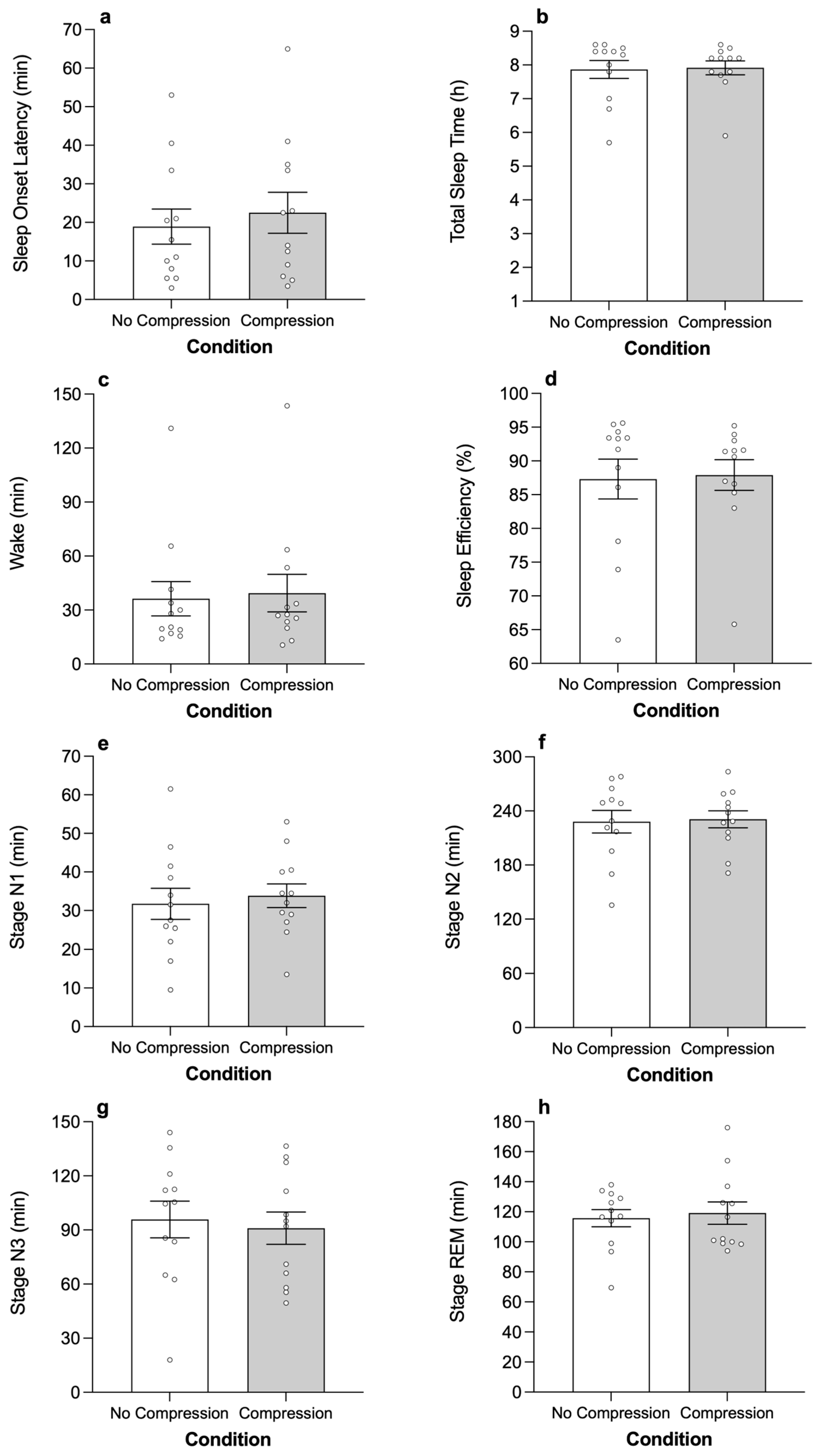
| Sleep onset latency (min) | t11 = 0.582 | 0.572 | 0.162 h (−0.392 to 0.709) |
| Total sleep time (h) | Z = 0.059 | 0.953 | 0.020 r (−0.750 to 0.647) |
| Wake (min) | Z = 0.941 | 0.347 | 0.124 r (−0.476 to 0.638) |
| Sleep efficiency (%) | Z = 0.314 | 0.754 | 0.091 r (−0.456 to 0.681) |
| Arousals (count) | t11 = −0.293 | 0.775 | −0.082 h (−0.627 to 0.467) |
| Stage N1 sleep (min) | t11 = 0.534 | 0.604 | 0.149 h (−0.404 to 0.695) |
| Stage N2 sleep (min) | t11 = 0.188 | 0.854 | 0.052 h (−0.496 to 0.598) |
| Stage N3 sleep (min) | t11 = −0.927 | 0.374 | −0.258 h (−0.809 to 0.304) |
| Stage REM sleep (min) | Z = 0.471 | 0.638 | 0.136 r (−0.413 to 0.690) |
| Variable | Statistic | p Value | Effect Size (95% CI) |
|---|---|---|---|
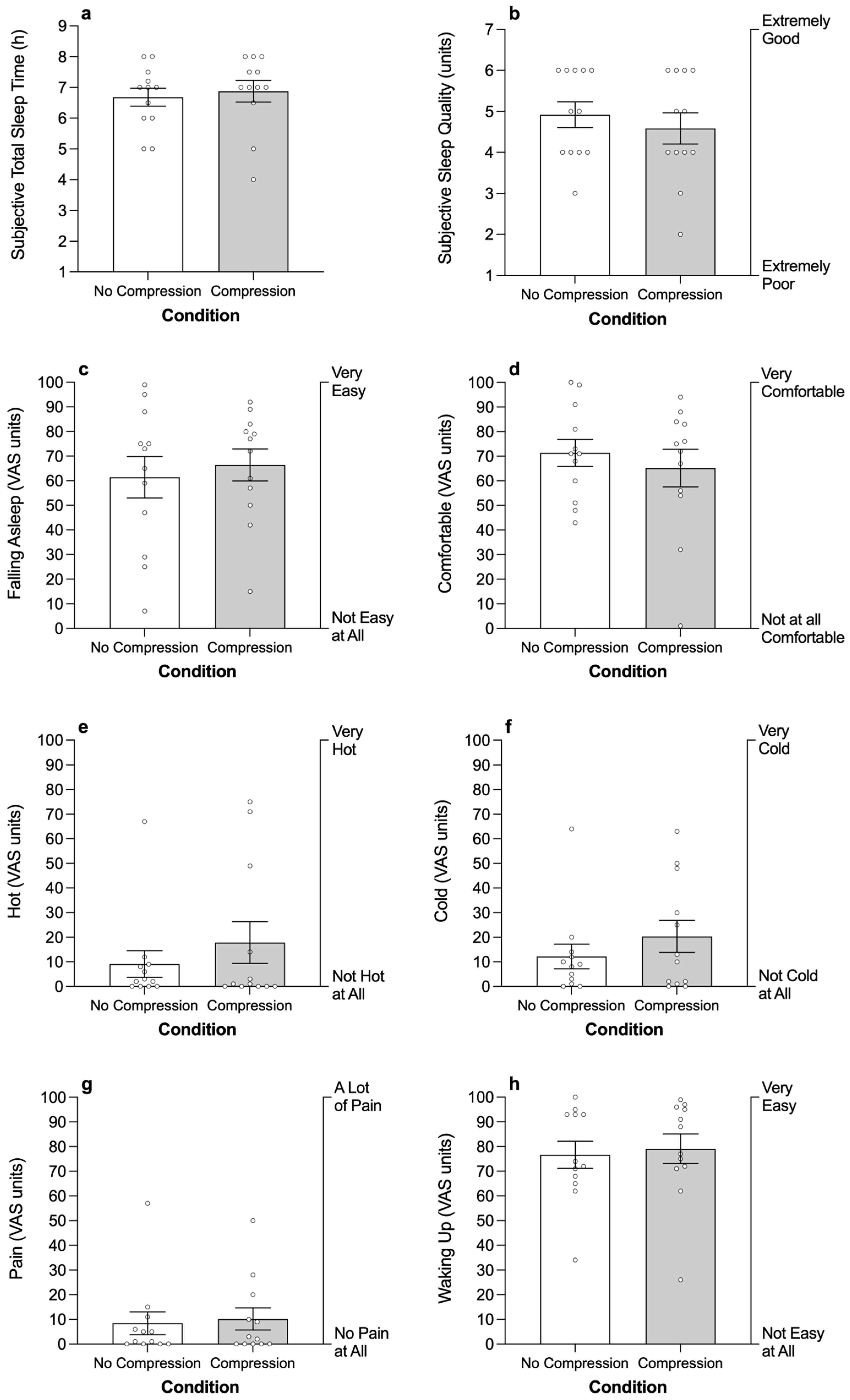
| Subjective sleepiness (AU) | t11 = 1.101 | 0.295 | 0.307 h (−0.261 to 0.861) |
| Subjective sleep quality (AU) | Z = −0.600 | 0.549 | −0.200 r (−0.801 to 0.502) |
| Subjective total sleep time (h) | Z = 0.448 | 0.654 | 0.135 r (−0.473 to 0.693) |
| VAS falling asleep (AU) | t11 = 0.466 | 0.664 | 0.124 h (−0.427 to 0.670) |
| VAS comfort (AU) | t11 = −0.620 | 0.548 | −0.173 h (−0.720 to 0.382) |
| VAS hot (AU) | Z = 1.053 | 0.292 | 0.371 r (−0.457 to 0.835) |
| VAS cold (AU) | Z = 0.845 | 0.398 | 0.254 r (−0.347 to 0.797) |
| VAS pain (AU) | Z = 0.204 | 0.838 | 0.065 r (−0.598 to 0.648) |
| VAS waking up (AU) | Z = 0.864 | 0.387 | 0.249 r (−0.320 to 0.777) |
Disclaimer/Publisher’s Note: The statements, opinions and data contained in all publications are solely those of the individual author(s) and contributor(s) and not of MDPI and/or the editor(s). MDPI and/or the editor(s) disclaim responsibility for any injury to people or property resulting from any ideas, methods, instructions or products referred to in the content. |
© 2026 by the authors. Licensee MDPI, Basel, Switzerland. This article is an open access article distributed under the terms and conditions of the Creative Commons Attribution (CC BY) license.
Share and Cite
Sargent, C.; Halson, S.L.; Morrison, M.; Gardiner, C.L.; Miller, D.J.; Elliott, B.L.; Nguyen, K.; Broatch, J.R.; Weakley, J.; Roach, G.D. Wearing Lower-Body Compression Tights to Bed After Cycling Exercise Does Not Affect Subsequent Sleep in Healthy Male Adults. Sensors 2026, 26, 1625. https://doi.org/10.3390/s26051625
Sargent C, Halson SL, Morrison M, Gardiner CL, Miller DJ, Elliott BL, Nguyen K, Broatch JR, Weakley J, Roach GD. Wearing Lower-Body Compression Tights to Bed After Cycling Exercise Does Not Affect Subsequent Sleep in Healthy Male Adults. Sensors. 2026; 26(5):1625. https://doi.org/10.3390/s26051625
Chicago/Turabian StyleSargent, Charli, Shona L. Halson, Matthew Morrison, Carissa L. Gardiner, Dean J. Miller, Bree L. Elliott, Katrina Nguyen, James R. Broatch, Jonathon Weakley, and Gregory D. Roach. 2026. "Wearing Lower-Body Compression Tights to Bed After Cycling Exercise Does Not Affect Subsequent Sleep in Healthy Male Adults" Sensors 26, no. 5: 1625. https://doi.org/10.3390/s26051625
APA StyleSargent, C., Halson, S. L., Morrison, M., Gardiner, C. L., Miller, D. J., Elliott, B. L., Nguyen, K., Broatch, J. R., Weakley, J., & Roach, G. D. (2026). Wearing Lower-Body Compression Tights to Bed After Cycling Exercise Does Not Affect Subsequent Sleep in Healthy Male Adults. Sensors, 26(5), 1625. https://doi.org/10.3390/s26051625