Semantic–Physical Sensor Fusion for Safe Physical Human–Robot Interaction in Dual-Arm Rehabilitation



Abstract
1. Introduction
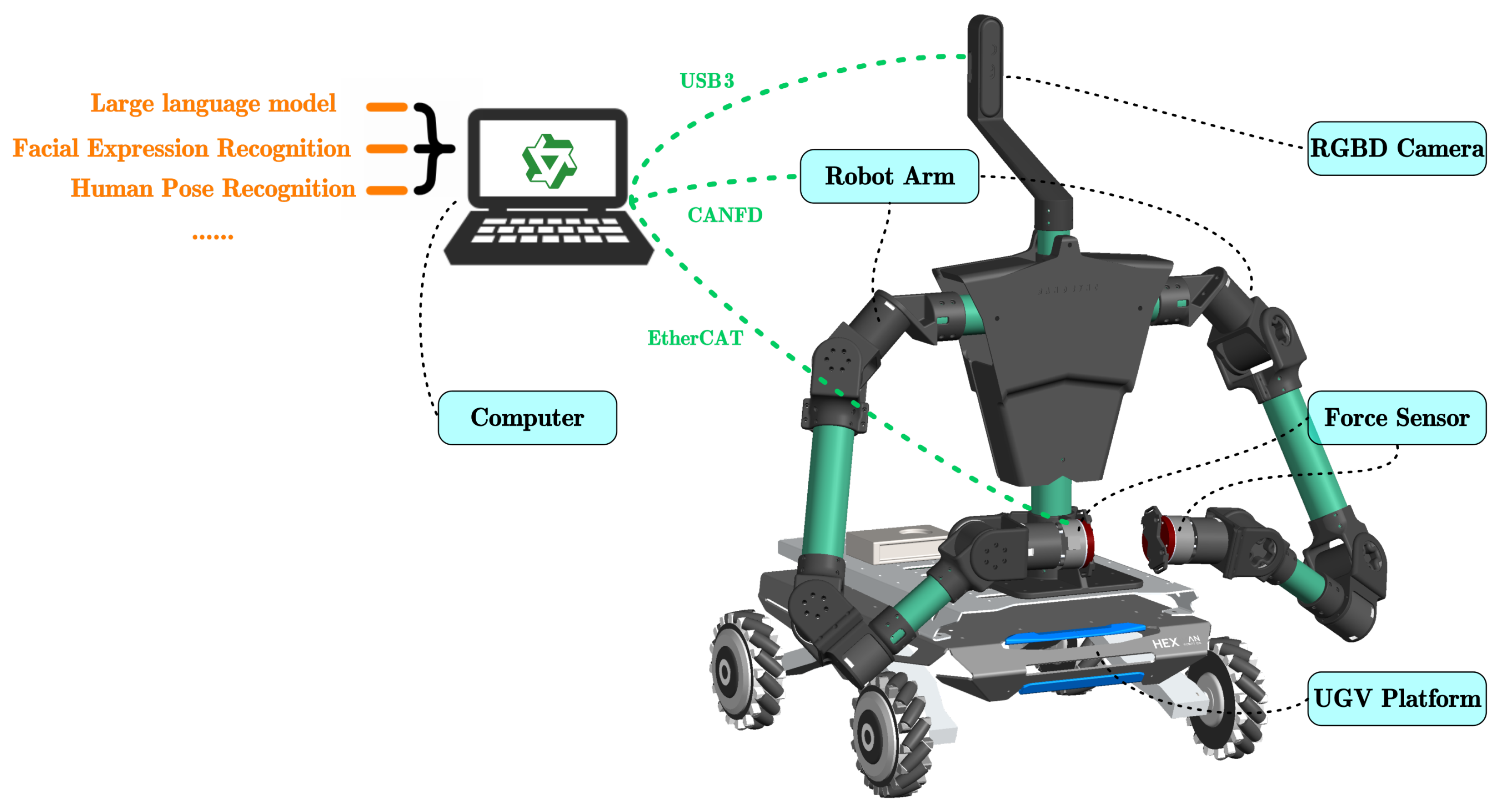
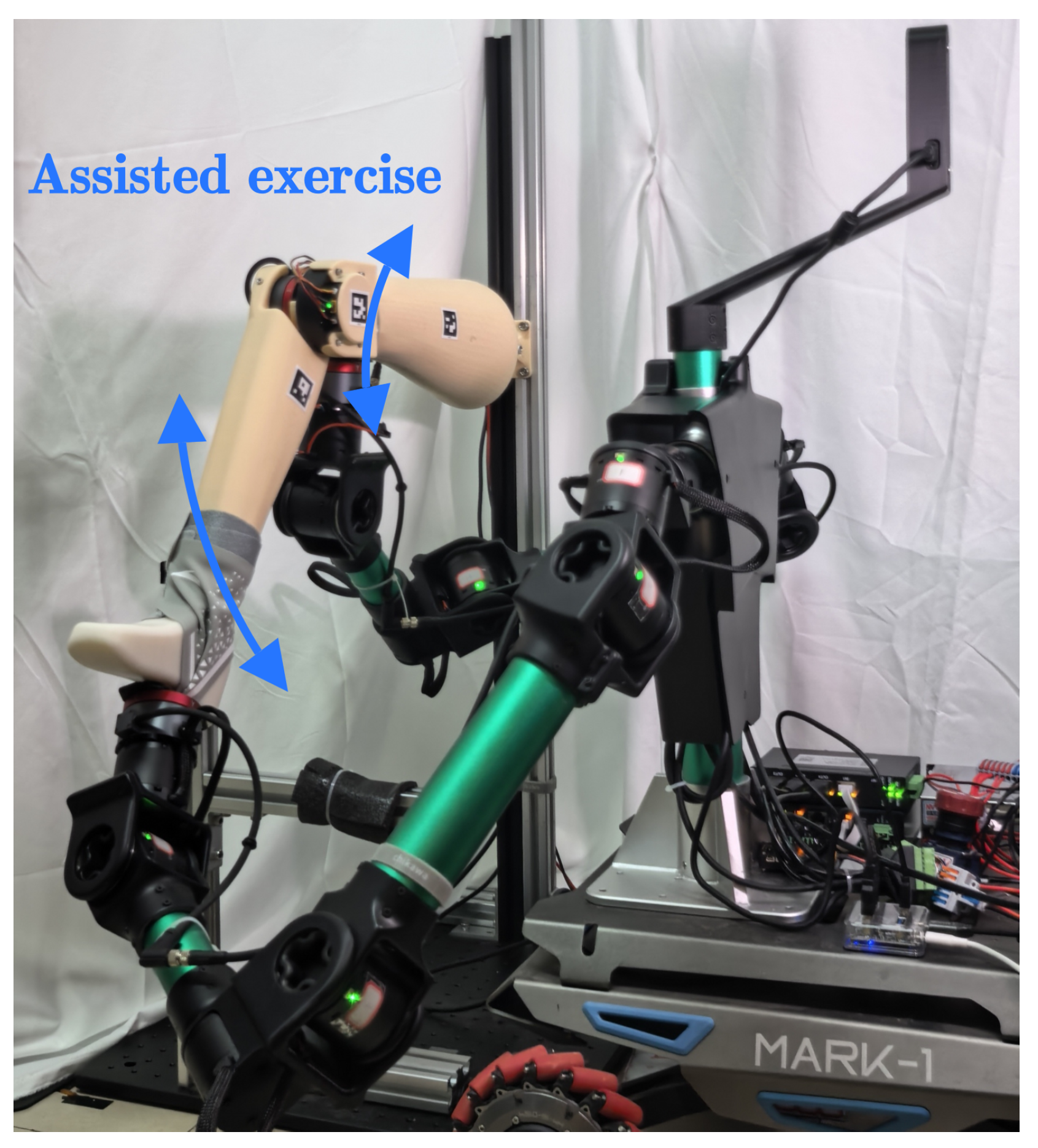
2. System Architecture and Implementation
- 1.
- Visual System: An Orbbec 336L RGB-D depth camera (Orbbec, Shenzhen, China) is mounted on the robot’s head to capture environmental context. It streams video at a resolution of (30 fps), with depth data synchronized via USB to the host for real-time skeletal tracking using YOLO-POSE.
- 2.
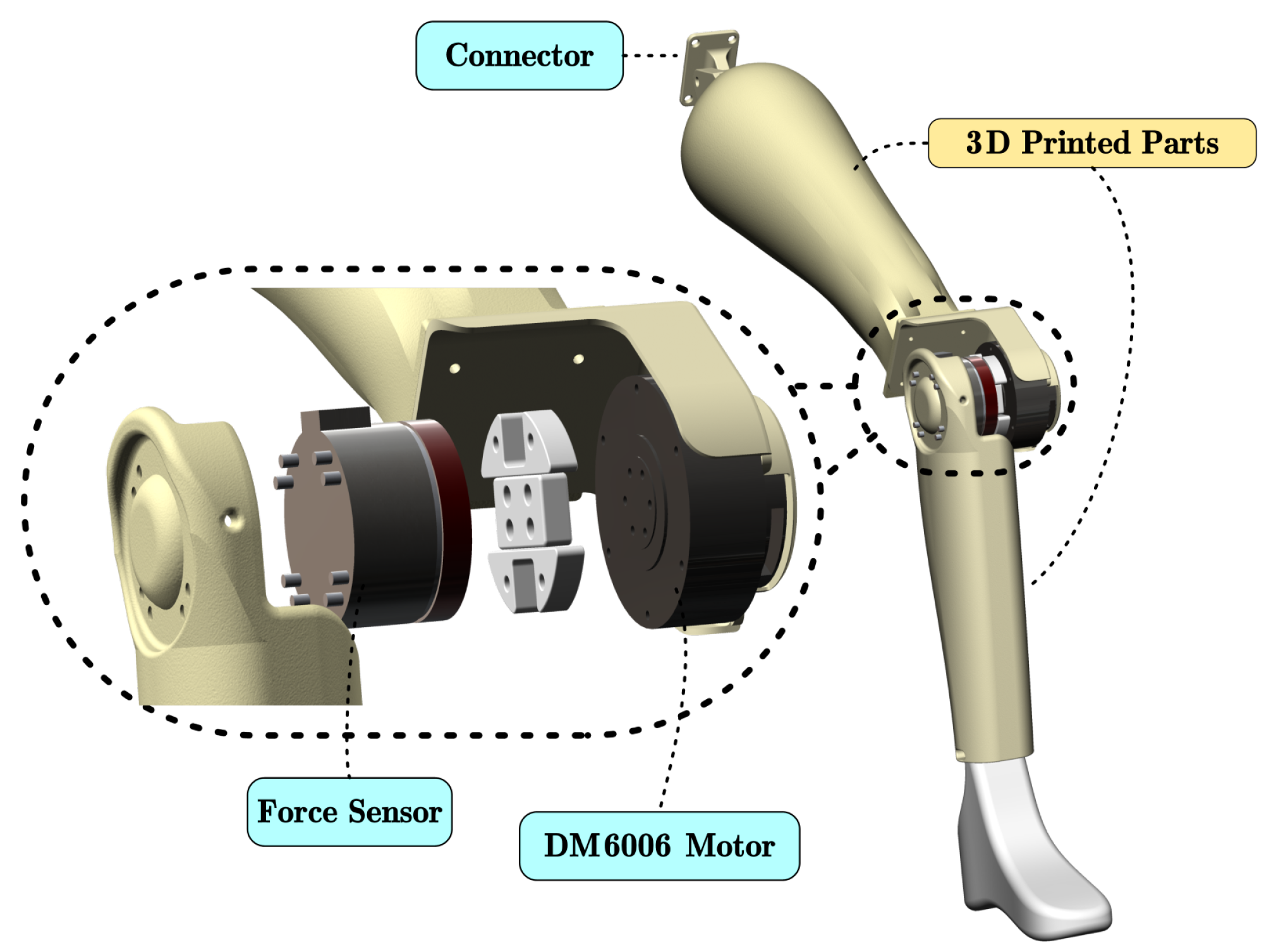
- Haptic System: Two XJC-XD60EC 6-DoF force/torque sensors (XJC Electronics, Shenzhen, China) are installed at the end-effectors to capture interaction forces. Crucially, these sensors communicate via an EtherCAT bus (EtherCAT Technology Group, Nuremberg, Germany) with a dedicated master station (ZMC60E), ensuring strictly deterministic data acquisition at 1 kHz with minimal jitter.
- 3.
- Computing Core: The central processing unit is a mobile workstation equipped with an NVIDIA GeForce RTX 5060 Laptop GPU. This platform acts as the sensor fusion hub, aggregating data from heterogeneous interfaces, including USB (vision), UDP (force sensors via EtherCAT bridge), CAN (mobile base), and CAN FD (robotic arms). The system architecture adopts a hybrid computing strategy; the CPU handles high-frequency dynamics and control tasks, while the GPU provides sufficient CUDA cores to support the real-time inference of the fine-tuned Large Language Model (LLM) alongside other lightweight networks such as YOLO-POSE.
3. Physical Fusion Layer: Dynamics-Based Torque Observation
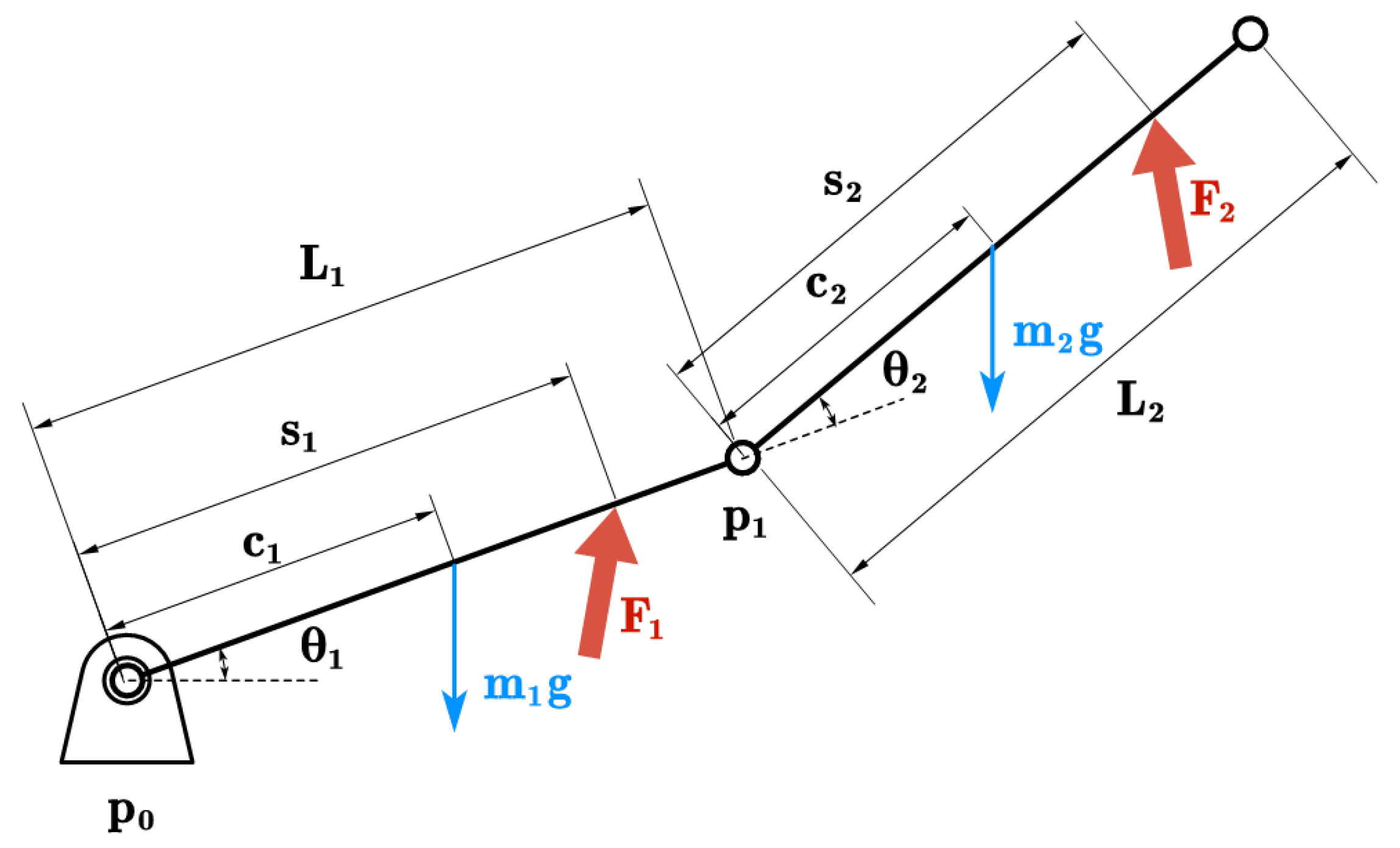
3.1. Dynamics of the Coupled System
3.2. Synthesizing the Internal Torque Observer
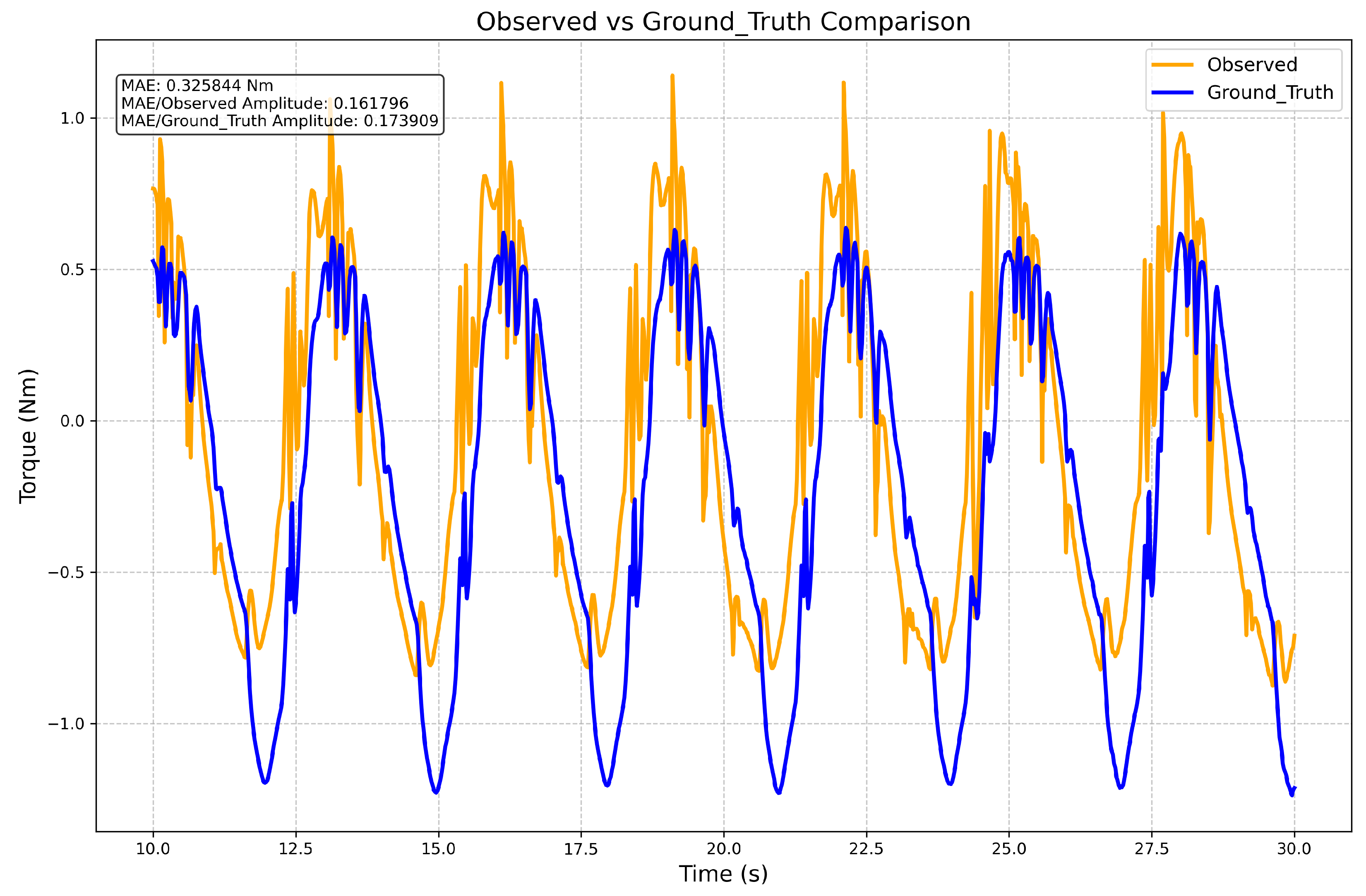
Quantitative Accuracy Analysis
- 1.
- Unmodeled Actuator Friction: The simplified dynamic model does not fully capture non-linear actuator characteristics, such as dry friction and stiction in the motor and gearbox.
- 2.
- Kinematic Calibration Residuals: The kinematic parameters of the dual-arm robot have finite calibration accuracy. This introduces errors in the geometric Jacobian and gravity compensation terms.
- 3.
- Contact Instability: Non-rigid contact and micro-slippage at the robot–prosthesis contact point cause transient deviations in the estimated force application point. This leads to errors in the lever arm calculation.
- 4.
- Localization and Calibration Uncertainties: Leg tracking uses ArUco markers. Precise alignment is affected by cumulative errors: noise in visual pose estimation (approx. 0.036 rad MAE), calibration inaccuracies in the robot base frame, and geometric differences between the marker’s theoretical position and its actual placement.
4. Semantic-Physical Fusion and Intelligent Decision
4.1. Asynchronous Semantic State Pool
- 1.
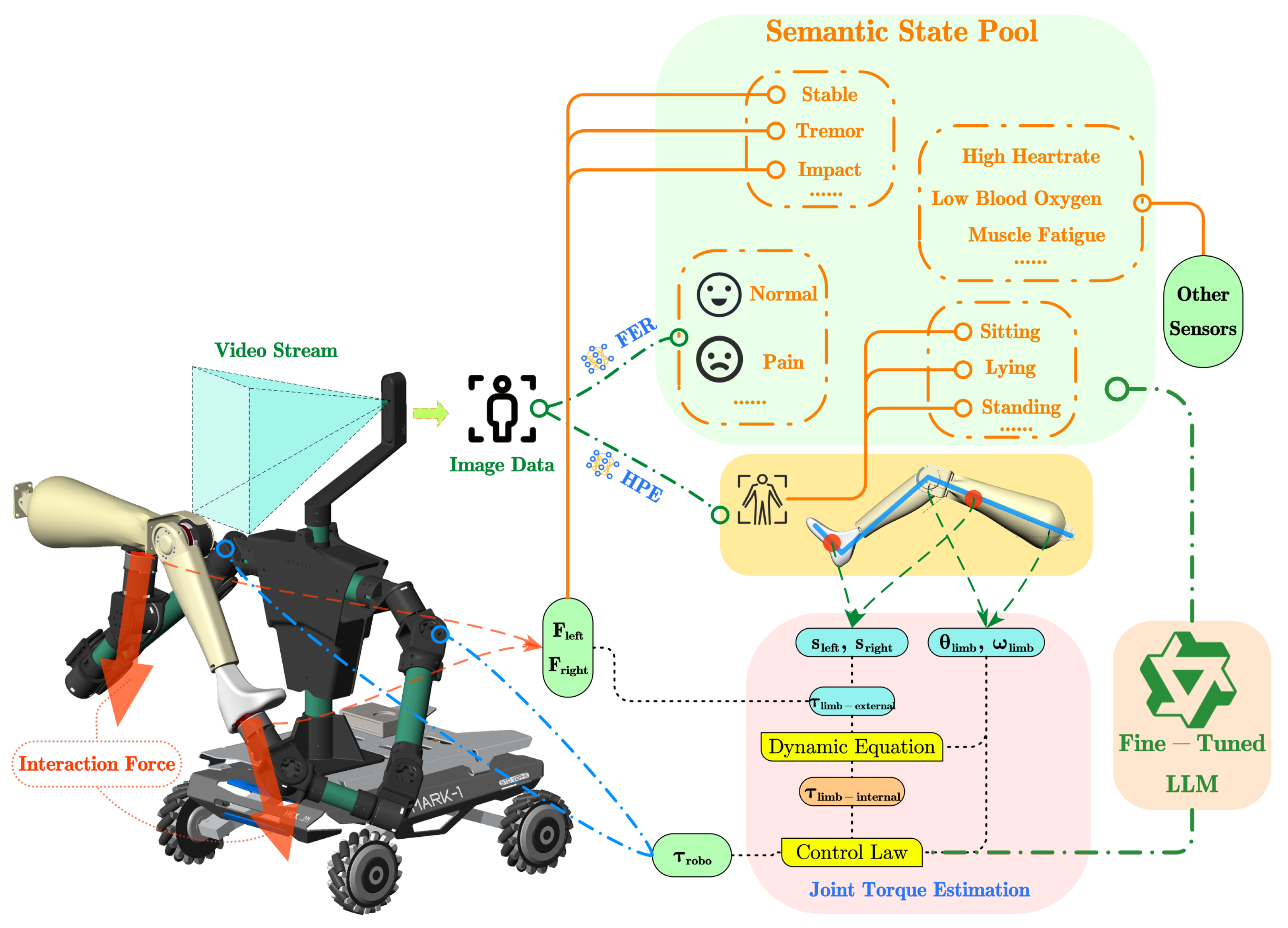
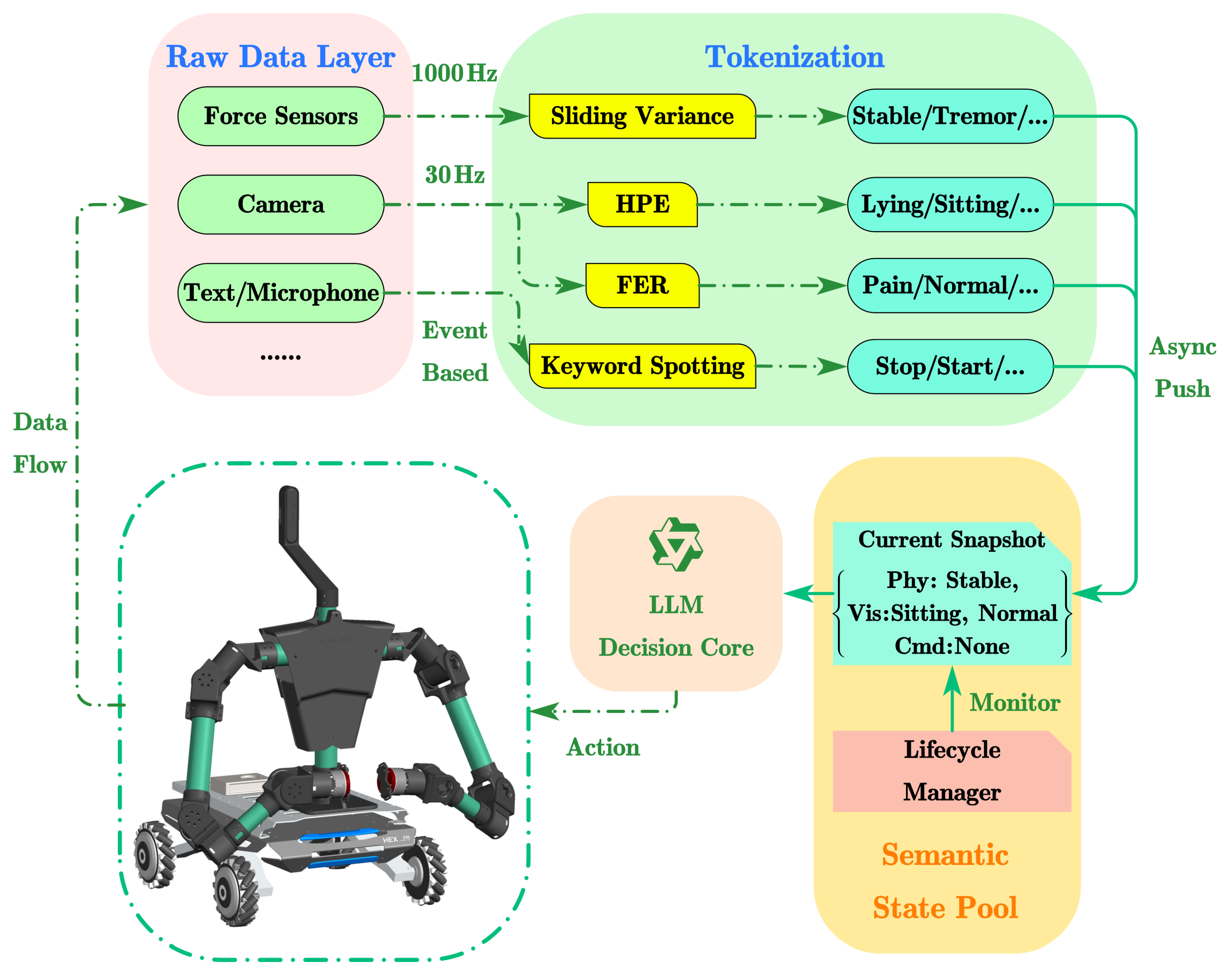
- Signal Discretization and Tokenization: Raw sensor data are continuous and high-frequency, which is unsuitable for direct LLM ingestion. We employ a sliding-window statistical method to convert these signals into semantic tokens:
- Physical Tokens (from Section 3): The internal torque derived in Equation (3) is processed to quantify interaction stability. We calculate the sliding variance over a window ms:where is the window size, and represents the moving average of the internal torque within this window. The variance is mapped to discrete tokens based on thresholds calibrated on a 30-trial pilot dataset:Specifically, is set to (3-sigma rule) to filter baseline noise, where and are the mean and standard deviation of the sensor noise measured during static calibration. is selected to maximize the margin between oscillatory tremors and high-energy impact spikes.
- Human Pose Tokens: Keypoint coordinates from YOLO-POSE are analyzed for geometric anomalies. For instance, when the vertical difference between the hip and head keypoints falls below a calibrated threshold indicative of a supine posture, the token Visual: USER_LYING_DOWN is pushed to the pool.
- Facial Expression Tokens: The vision system runs a lightweight FER module to classify user emotions. When the confidence score for a critical state (e.g., ‘Pain’ or ‘Fatigue’) exceeds a threshold of , a corresponding semantic token (e.g., Face: PAIN) is generated and updated in the state pool.
- Instruction Tokens: User commands (via voice or text interface) are parsed into intent tokens. For example, the command “Stop moving” immediately triggers a high-priority Cmd: STOP token, overriding other behaviors.
- 2.
- Asynchronous Update: Each sensor module pushes updates to the pool independently. The LLM acts as a consumer, querying the current snapshot of the pool for inference.
- 3.
- Lifecycle Management: To prevent stale data from influencing decisions (e.g., if the camera is occluded), a time-to-live (TTL) mechanism is implemented. Any state token not updated within 5.0 s is automatically invalidated and removed from the pool.
4.2. Edge-Native Instruction-Tuned Model
- 1.
- Structured Output Reliability: General LLMs typically produce verbose “chain-of-thought” narratives. Through fine-tuning, our model is constrained to output only the control action codes (“0”, “1”, or “2”), eliminating the need for complex post-processing regex parsing and ensuring machine-readable stability.
- 2.
- Low-Latency Inference: By optimizing the model scale (1.7B parameters) and executing locally, we achieved an average inference latency of approximately 223 ms on the laptop. Including sensor acquisition and bus communication, the total control loop latency is controlled within 240 ms. Since rehabilitation scenarios primarily involve physical human–robot interaction frequencies below 1 Hz (period s), this response speed falls well within the safety margins for smooth control.
4.3. Data Augmentation and Training Pipeline
4.3.1. Dataset Construction
- 1.
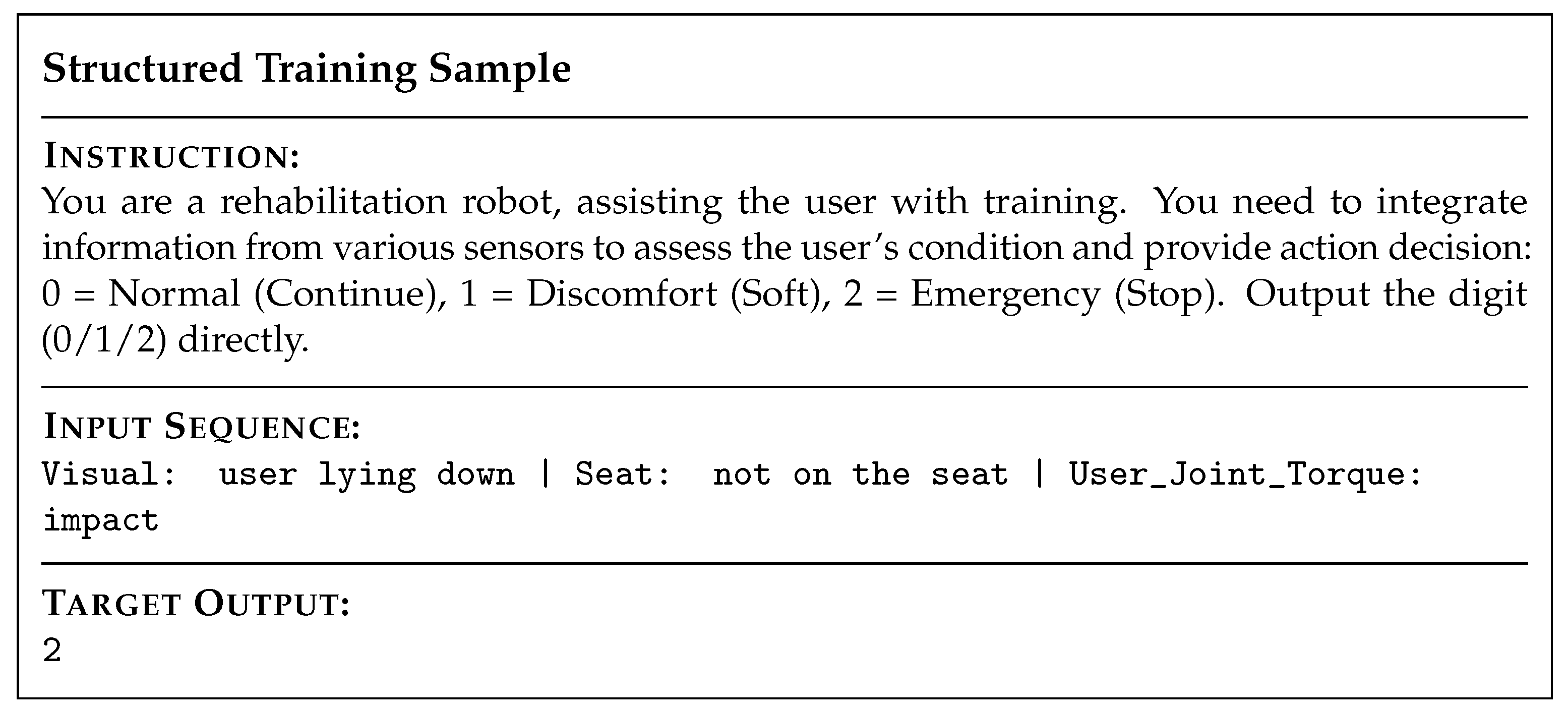
- Expert Seed Creation: We manually curated a small set of approximately 20 “Instruction-Input-Output” seed samples covering typical rehabilitation scenarios (e.g., normal training, fatigue indications, sudden impacts, falls).
- 2.
- LLM-Driven Augmentation: Using a large-scale foundation model (QWEN3-MAX), we generated 2000 diverse training samples based on the seed patterns. The prompt constrained the generator to introduce variations in semantic phrasing (e.g., rephrasing “Seat: not detected” to “Seat: user stood up”) while maintaining strict logical consistency with the safety protocols.
- 3.
- Standardization: The augmented data was formatted into a strict JSON structure for Supervised Fine-Tuning (SFT).
4.3.2. Fine-Tuning Implementation
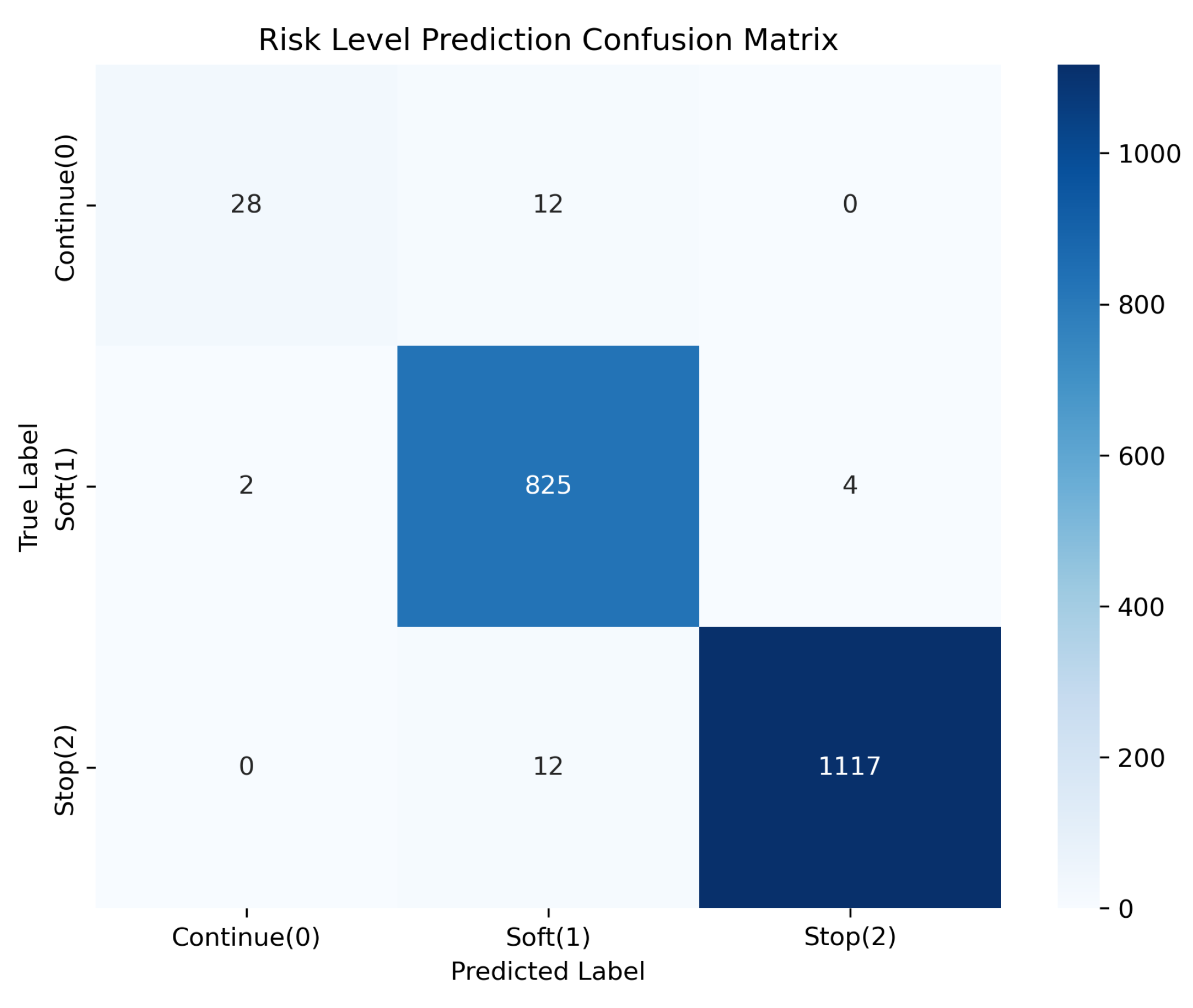
4.3.3. Quantitative Evaluation
- False Positives: Out of 1121 samples predicted as “Stop”, 4 were actually “Soft” cases.
- False Negatives: Out of 1129 actual “Stop” cases, 12 were misclassified. All 12 were labeled as “Soft” (Action 1), and none were labeled as “Continue” (Action 0).
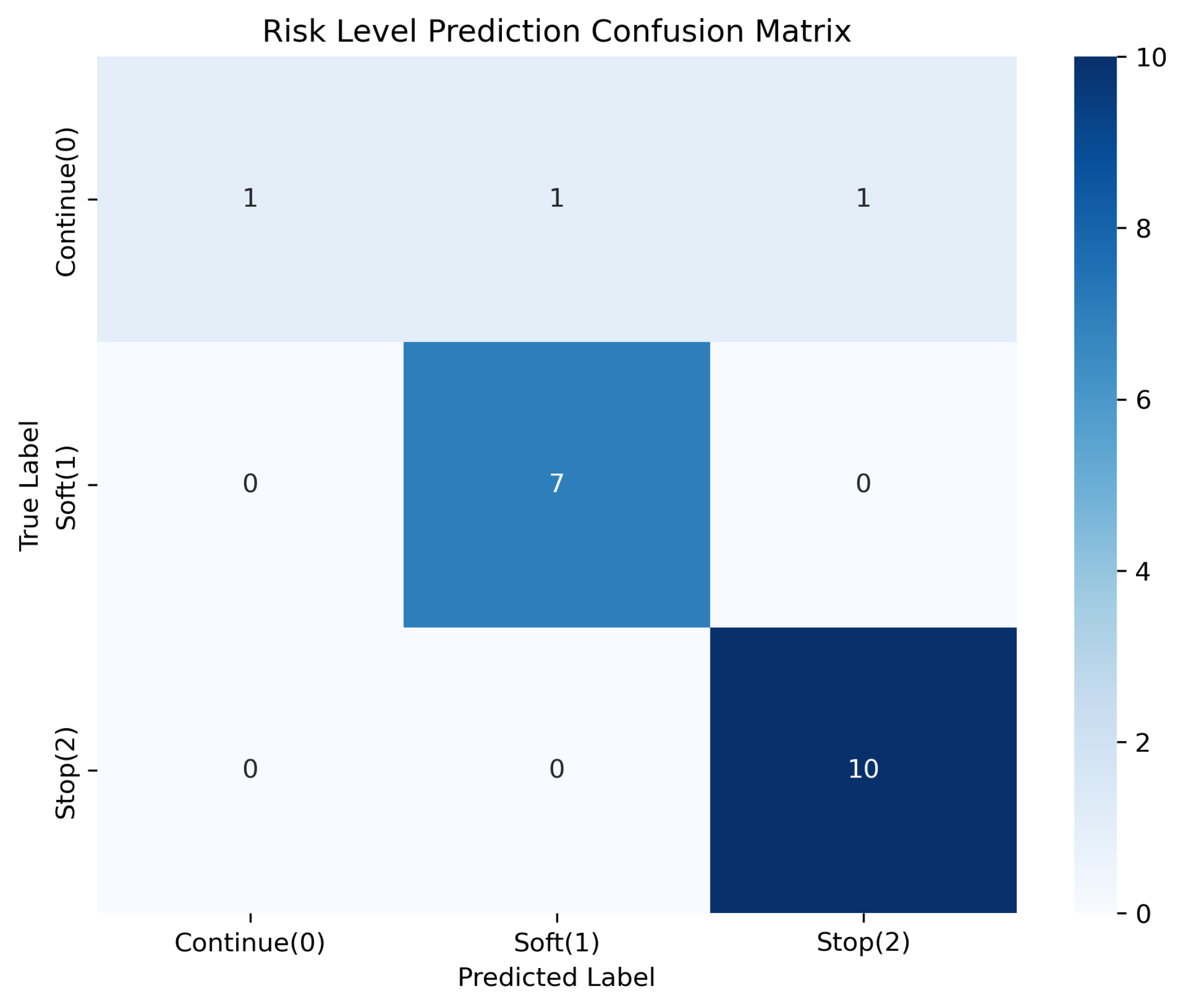
4.3.4. Supplementary Experiments on Small-Sample Data
- 1.
- Expert Seed Data (N = 20)
- The 2 errors were: one “Continue” classified as “Soft”, and one “Continue” classified as “Stop”.
- In this specific set, all 10 actual “Stop” samples were correctly classified.
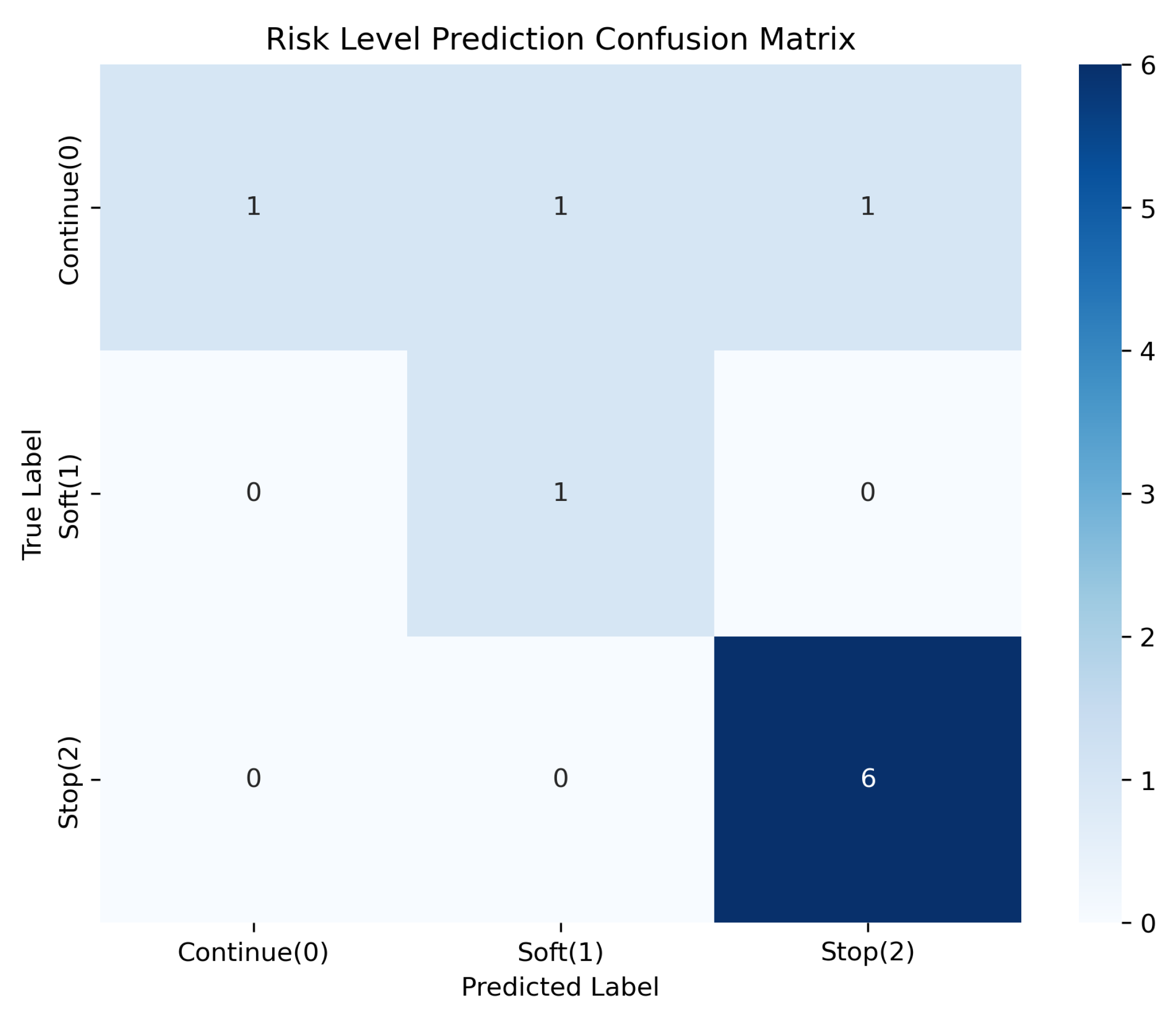
- 2.
- Unseen Vocabulary (N = 10)
- The two errors were conservative (Continue classified as Soft or Soft classified as Stop).
- High-risk terms such as blooding and scared were mapped to the “Stop” action in these instances.
5. Semantic–Physical Fusion Interactive Control
5.1. Action Space Definition
- Action 0 (Continue Training): The robot executes the standard rehabilitation protocol.where and are the standard amplitude and period parameters preset for the rehabilitation session. The robot maintains a standard rhythm (e.g., s) and full range of motion.
- Action 1 (Soft Mitigation): Triggered when the LLM determines that the situation is not dangerous but the user requires lower training intensity based on comprehensive semantic understanding. The objective is to dampen the interaction energy without stopping the training.In our experiments, we set and . This results in a smaller and slower motion profile, allowing the user to recover control and reducing the risk of resonance with tremors.
- Action 2 (Emergency Stop): Triggered when the LLM determines that the user has an emergency risk requiring immediate cessation. The system immediately prioritizes safety by freezing the motion at the current position:By resetting the bias to the current angle () while zeroing the amplitude, the trajectory is effectively flattened at the exact moment of the event, preventing the robot from dragging the user back to the center or causing secondary injury.
5.2. Experimental Setup
- Integrated Robot Platform: A dual-arm upper limb rehabilitation robot integrated with 6-axis Force/Torque sensors and a built-in RGB-D camera for capturing multi-modal user states (Force, Facial, Posture).
- Computational Unit (Laptop): A laptop serving as the central processing station. It executes the visual recognition algorithms and hosts the fine-tuned LLM to perform real-time semantic reasoning and decision generation.
- Seat Sensor: A binary pressure switch put on the seat, providing definitive “On-Seat” or “Off-Seat” signals.
5.3. Results and Analysis
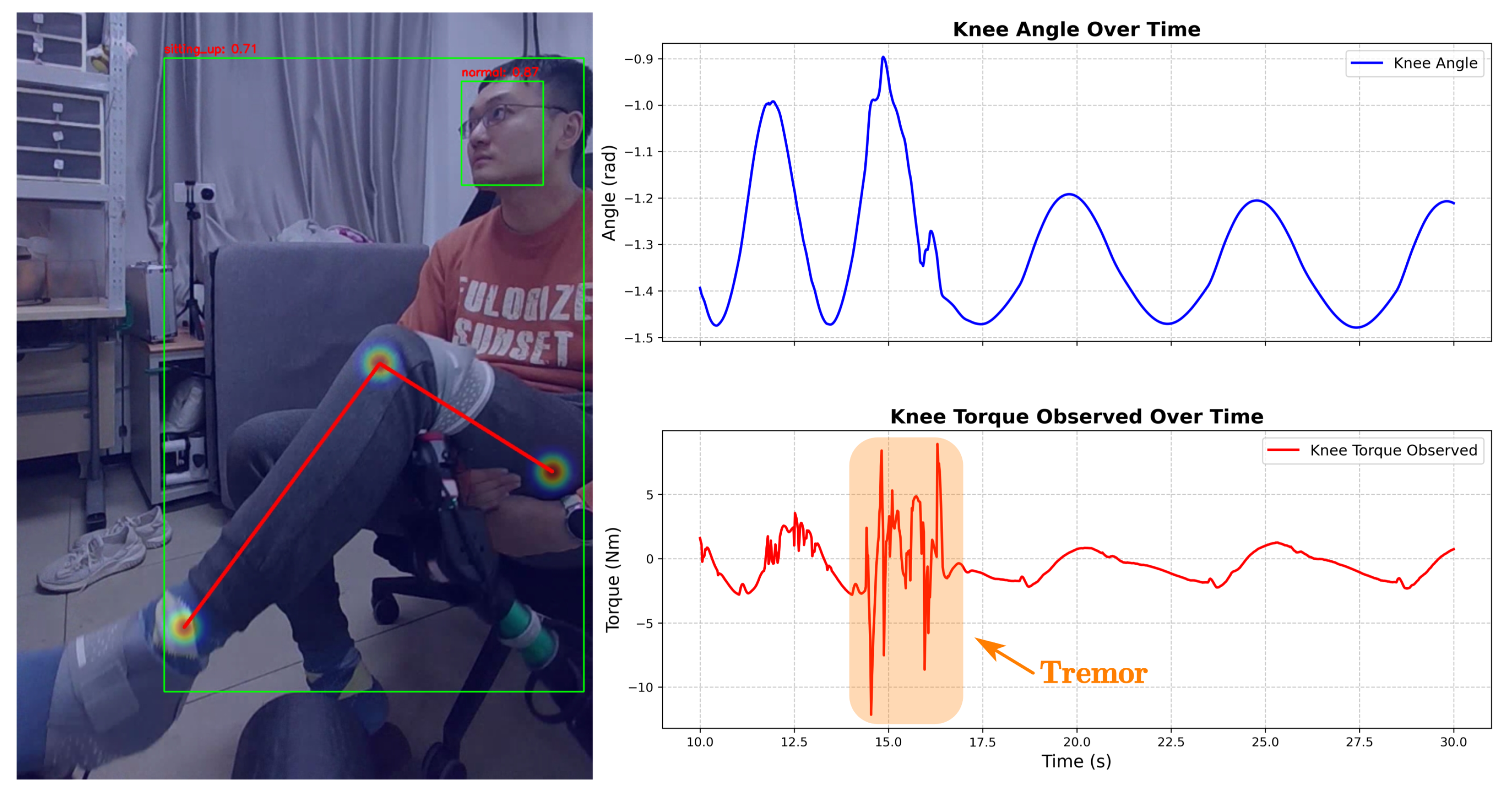
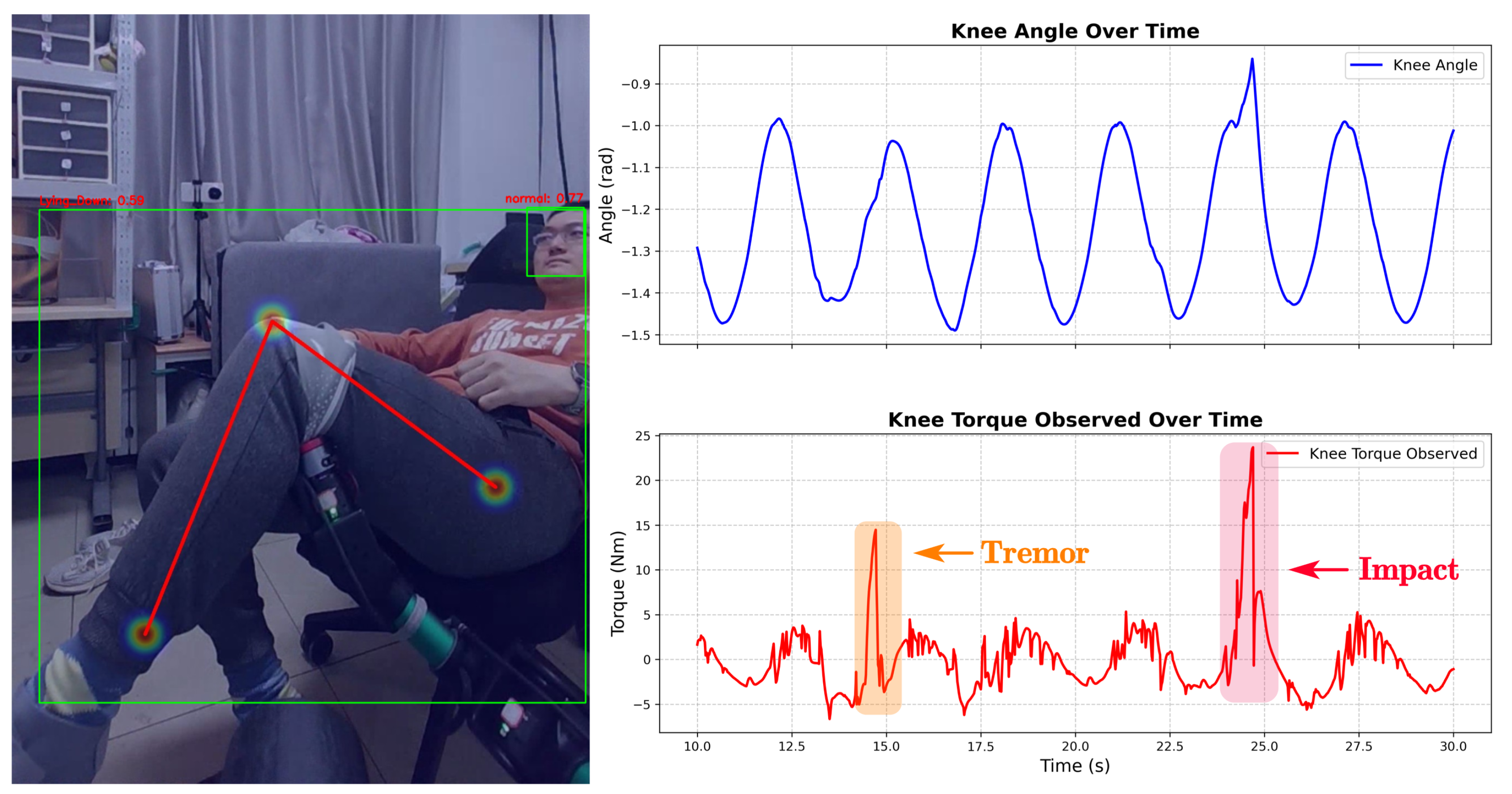
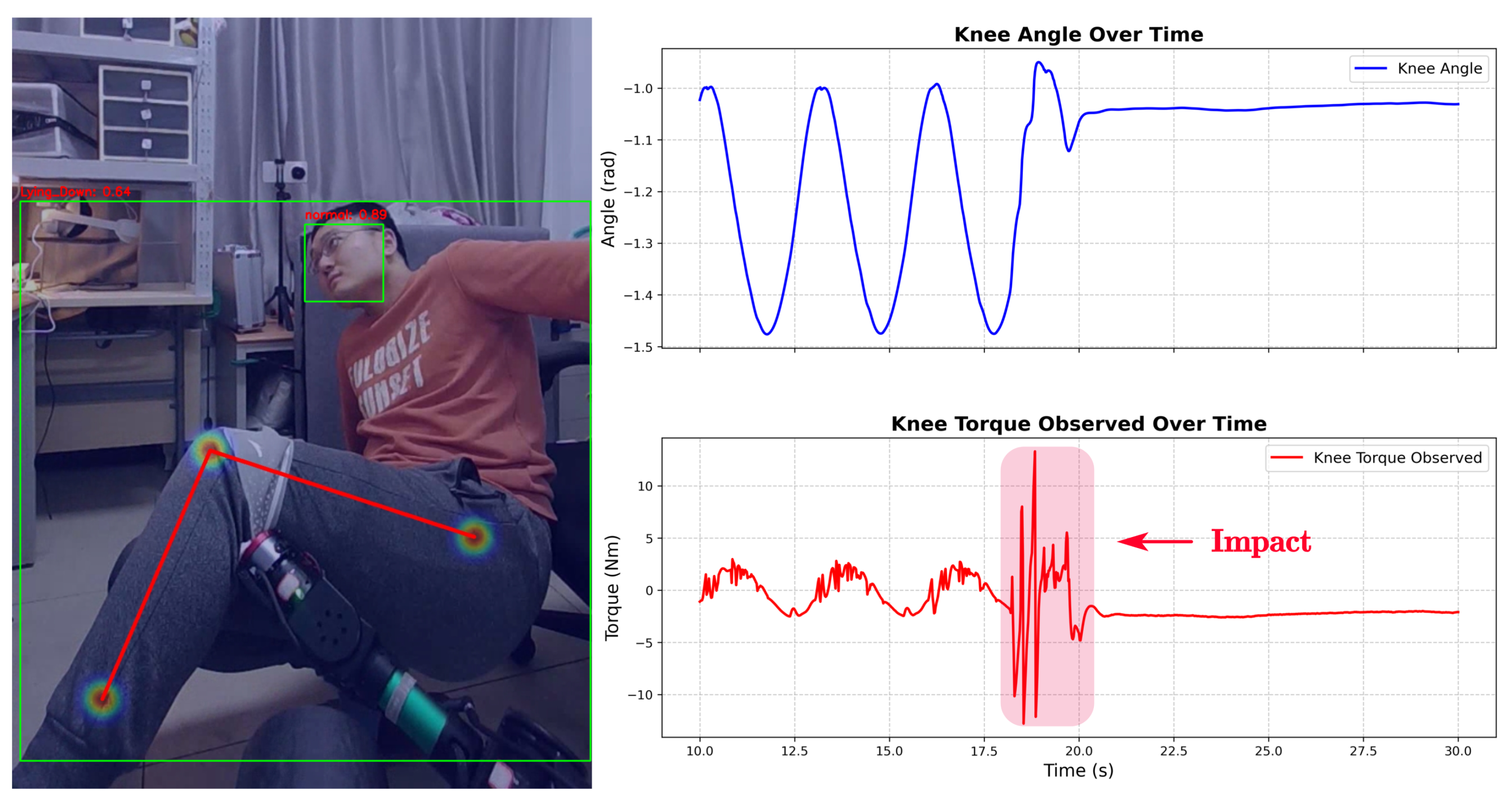
5.3.1. Adaptive Control and Ambiguity Resolution (Cases A and B)
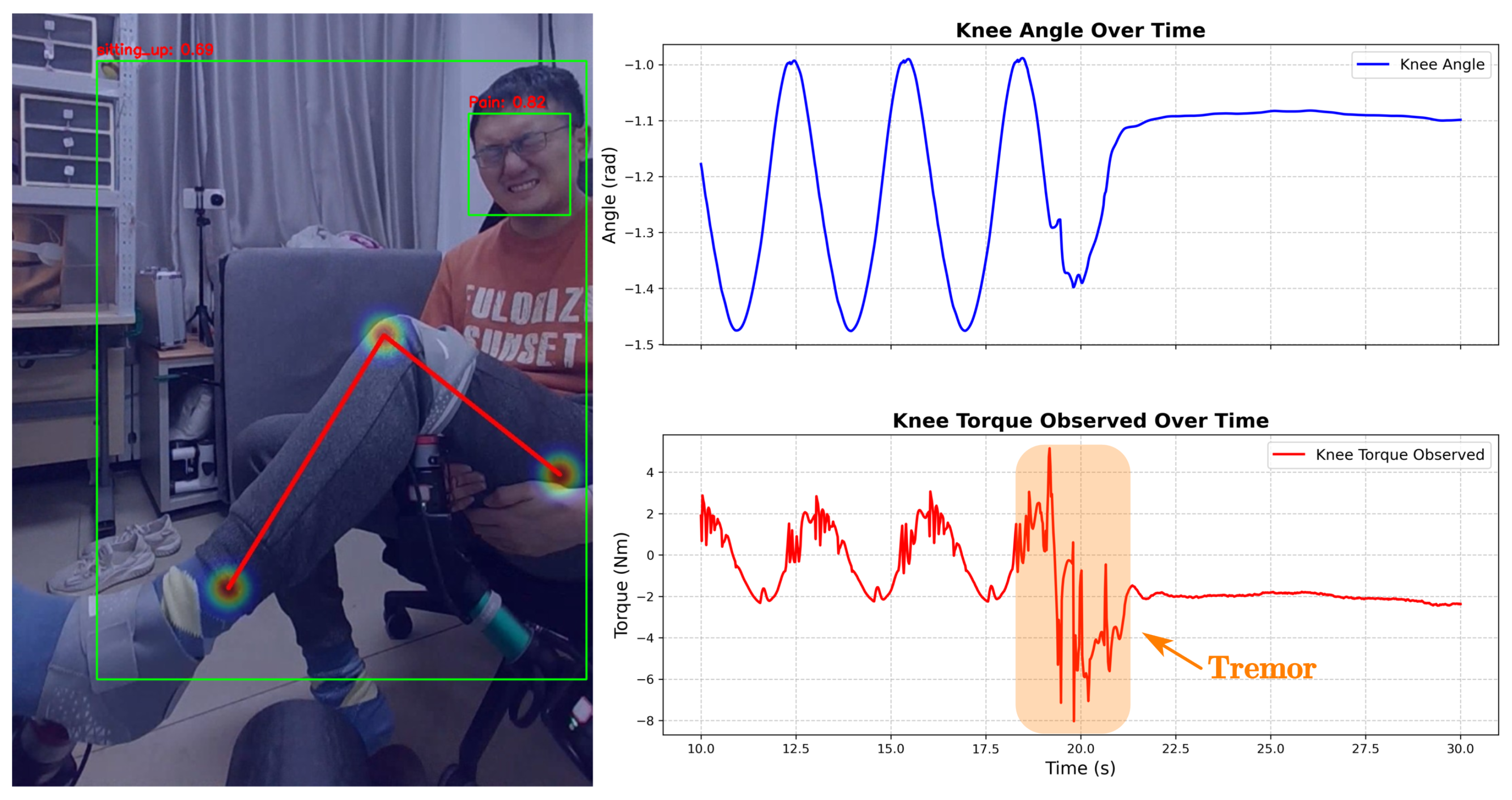
5.3.2. Critical Safety Interventions (Cases C and D)
5.4. Discussion: Contextual Reasoning and Safety Prioritization
6. Conclusions and Future Work
- 1.
- Dynamics Calibration: While the current observer effectively detects relative anomalies (e.g., collisions), the absolute accuracy of torque estimation needs improvement through more rigorous parameter identification.
- 2.
- Continuous Modulation: We aim to move beyond the current discrete action space (Action 0/1/2) to continuous modulation coefficients. This would allow the LLM to generate smoother, non-binary assistance strategies based on the context.
- 3.
- Hierarchical Architecture: To balance reasoning depth with reaction speed, we plan to investigate a “Fast-Slow” architecture: employing Vision-Language-Action (VLA) models for complex, low-frequency reasoning, while retaining a lightweight Edge-LLM for high-frequency safety reflexes.
Author Contributions
Funding
Institutional Review Board Statement
Informed Consent Statement
Data Availability Statement
Acknowledgments
Conflicts of Interest
References
- Wang, H.; Li, X.; Zhang, X. Multimodal Human-robot Interaction on Service Robot. In 2021 IEEE 5th Advanced Information Technology, Electronic and Automation Control Conference (IAEAC); IEEE: New York, NY, USA, 2021; Volume 5, pp. 2290–2295. [Google Scholar] [CrossRef]
- Zhang, Y.; Tian, J.; Xiong, Q. A review of embodied intelligence systems: A three-layer framework integrating multimodal perception, world modeling, and structured strategies. Front. Robot. AI 2025, 12, 1668910. [Google Scholar] [CrossRef]
- Laudante, G.; Mirto, M.; Pennacchio, O.; Pirozzi, S. A multi-modal sensing system for human-robot interaction through tactile and proximity data. Front. Robot. AI 2025, 12, 1581154. [Google Scholar] [CrossRef]
- Tirulo, A.; Yadav, M.; Lolamo, M.; Chauhan, S.; Siano, P.; Shafie-khah, M. Beyond automation: Unveiling the potential of agentic intelligence. Renew. Sustain. Energy Rev. 2026, 226, 116218. [Google Scholar] [CrossRef]
- Zhao, W.; Gangaraju, K.; Yuan, F. Multimodal perception-driven decision-making for human-robot interaction: A survey. Front. Robot. AI 2025, 12, 1604472. [Google Scholar] [CrossRef]
- Liu, Z.; Wang, X.; Cai, Y.; Xu, W.; Liu, Q.; Zhou, Z.; Pham, D.T. Dynamic risk assessment and active response strategy for industrial human-robot collaboration. Comput. Ind. Eng. 2020, 141, 106302. [Google Scholar] [CrossRef]
- Gao, J.; Sarkar, B.; Xia, F.; Xiao, T.; Wu, J.; Ichter, B.; Majumdar, A.; Sadigh, D. Physically Grounded Vision-Language Models for Robotic Manipulation. In 2024 IEEE International Conference on Robotics and Automation (ICRA); IEEE: New York, NY, USA, 2024. [Google Scholar]
- Vianello, L.; Short, M.; Manczurowsky, J.; Küçüktabak, E.B.; Di Tommaso, F.; Noccaro, A.; Bandini, L.; Clark, S.; Fiorenza, A.; Lunardini, F. Robot-Mediated Physical Human–Human Interaction in Rehabilitation: A Position Paper. IEEE Rev. Biomed. Eng. 2025, 19, 267–282. [Google Scholar] [CrossRef] [PubMed]
- Arora, R.; Prajod, P.; Nicora, M.L.; Panzeri, D.; Tauro, G.; Vertechy, R.; Malosio, M.; André, E.; Gebhard, P. Socially interactive agents for robotic neurorehabilitation training: Conceptualization and proof-of-concept study. Front. Artif. Intell. 2024, 7, 1441955. [Google Scholar] [CrossRef] [PubMed]
- Beckerle, P.; Salvietti, G.; Unal, R.; Prattichizzo, D.; Rossi, S.; Castellini, C.; Hirche, S.; Endo, S.; Amor, H.B.; Ciocarlie, M. A Human–Robot Interaction Perspective on Assistive and Rehabilitation Robotics. Front. Neurorobot. 2017, 11, 24. [Google Scholar] [CrossRef]
- Gasperina, S.D.; Roveda, L.; Pedrocchi, A.; Braghin, F.; Gandolla, M. Review on Patient-Cooperative Control Strategies for Upper-Limb Rehabilitation Exoskeletons. Front. Robot. AI 2021, 8, 745018. [Google Scholar] [CrossRef] [PubMed]
- Dilip, G.; Guttula, R.; Rajeyyagari, S.; S, H.; Pandey, R.R.; Bora, A.; Kshirsagar, P.R.; M, K.M.; Sundramurthy, V.P. Artificial Intelligence-Based Smart Comrade Robot for Elders Healthcare with Strait Rescue System. J. Healthc. Eng. 2022, 2022, 9904870. [Google Scholar] [CrossRef]
- Sumner, J.; Lim, H.W.; Chong, L.S.; Bundele, A.; Mukhopadhyay, A.; Kayambu, G. Artificial intelligence in physical rehabilitation: A systematic review. Artif. Intell. Med. 2023, 146, 102693. [Google Scholar] [CrossRef]
- Kobayashi, T. Robotic Assisted Rehabilitation for Musculoskeletal Disorders. Jpn. J. Rehabil. Med. 2020, 57, 404–408. [Google Scholar] [CrossRef]
- Ong, M.T.Y.; Chan, J.S.Y.; Man, G.C.W.; Qiu, J.; He, X.; Wang, Q.; Yung, P.S.H. Effect of eccentric isokinetic exercise on muscle strength and functional recovery after anterior cruciate ligament reconstruction. Asia-Pac. J. Sport. Med. Arthrosc. Rehabil. Technol. 2024, 35, 20–26. [Google Scholar] [CrossRef]
- Plaza, A.; Hernandez, M.; Puyuelo, G.; Garces, E.; Garcia, E. Lower-Limb Medical and Rehabilitation Exoskeletons: A Review of the Current Designs. IEEE Rev. Biomed. Eng. 2023, 16, 278–291. [Google Scholar] [CrossRef]
- Zhang, X.; Yin, G.; Li, H.; Dong, R.; Hu, H. An adaptive seamless assist-as-needed control scheme for lower extremity rehabilitation robots. Proc. Inst. Mech. Eng. Part J. Syst. Control Eng. 2020, 235, 723–734. [Google Scholar] [CrossRef]
- Gong, R.; Li, R.; Zuo, S. Design and Control of Lower Limb Rehabilitation Exoskeleton Based on Simulink. Acad. J. Eng. Technol. Sci. 2024, 7, 53–64. [Google Scholar] [CrossRef]
- Yang, K.; Jiang, Q.F.; Wang, X.L.; Chen, Y.W.; Ma, X.Y. Structural design and modal analysis of exoskeleton robot for rehabilitation of lower limb. J. Phys. Conf. Ser. 2018, 1087, 062004. [Google Scholar] [CrossRef]
- Li, G.; Liang, X.; Lu, H.; Su, T.; Hou, Z.G. Development and Validation of a Self-Aligning Knee Exoskeleton With Hip Rotation Capability. IEEE Trans. Neural Syst. Rehabil. Eng. 2024, 32, 472–481. [Google Scholar] [CrossRef]
- Jamwal, P.K.; Dauletbayev, S.; Sagidoldin, D.; Keikibayev, D.; Niyetkaliyev, A.; Hussain, S.; Agrawal, S.K. Design and Transparency Assessment of a Gait Rehabilitation Robot With Biomimetic Knee Joints. IEEE Trans. Med. Robot. Bionics 2025, 7, 290–302. [Google Scholar] [CrossRef]
- Niu, Y.; Song, Z.; Dai, J. Kinematic analysis and optimization of a planar parallel compliant mechanism for self-alignment knee exoskeleton. Mech. Sci. 2018, 9, 405–416. [Google Scholar] [CrossRef]
- Mitra, M.; Kumar, G.; Chakrabarti, P.P.; Biswas, P. Enhanced Human-Robot Collaboration with Intent Prediction using Deep Inverse Reinforcement Learning. In 2024 IEEE International Conference on Robotics and Automation (ICRA); IEEE: New York, NY, USA, 2024; pp. 7880–7887. [Google Scholar] [CrossRef]
- Kedia, K.; Bhardwaj, A.; Dan, P.; Choudhury, S. InteRACT: Transformer Models for Human Intent Prediction Conditioned on Robot Actions. In 2024 IEEE International Conference on Robotics and Automation (ICRA); IEEE: New York, NY, USA, 2024; pp. 621–628. [Google Scholar] [CrossRef]
- Zhang, Y.; Doyle, T. Integrating intention-based systems in human-robot interaction: A scoping review of sensors, algorithms, and trust. Front. Robot. AI 2023, 10, 1233328. [Google Scholar] [CrossRef]
- Liu, N.; Xie, Y.; Su, Z.; Zhao, Z.; Wang, W. Adaptive Kalman Filter-Integrated navigation measurement using inertial sensor for vehicle motion state recognition. Measurement 2025, 248, 116907. [Google Scholar] [CrossRef]
- Bai, Y.; Yan, B.; Zhou, C.; Su, T.; Jin, X. State of art on state estimation: Kalman filter driven by machine learning. Annu. Rev. Control 2023, 56, 100909. [Google Scholar] [CrossRef]
- Wang, B.; Li, B.; Gao, T.; Li, L.; Wang, H.; Zhao, C.; Yi, Z. DAMF: A semantic-guided dynamic attention framework for visual-haptic-textual multimodal fusion. Knowl.-Based Syst. 2025, 328, 114244. [Google Scholar] [CrossRef]
- Wu, Z.; Zhao, Y.; Luo, S. ConViTac: Aligning Visual-Tactile Fusion with Contrastive Representations. In 2025 IEEE/RSJ International Conference on Intelligent Robots and Systems (IROS); IEEE: New York, NY, USA, 2025; pp. 8545–8552. [Google Scholar] [CrossRef]
- Liu, F.; Shao, R.; Zhao, Y.; Li, C.; Wang, Y. Multimodal tactile sensing fused with vision for object recognition. Chem. Eng. J. 2025, 524, 169249. [Google Scholar] [CrossRef]
- Akhtar, A.; Sombeck, J.; Boyce, B.; Bretl, T. Controlling sensation intensity for electrotactile stimulation in human-machine interfaces. Sci. Robot. 2018, 3, eaap9770. [Google Scholar] [CrossRef]
- Febrer-Nafría, M.; Nasr, A.; Ezati, M.; Brown, P.; Font-Llagunes, J.M.; McPhee, J. Predictive multibody dynamic simulation of human neuromusculoskeletal systems: A review. Multibody Syst. Dyn. 2022, 58, 299–339. [Google Scholar] [CrossRef]
- Gasperina, S.D.; Longatelli, V.; Braghin, F.; Pedrocchi, A.; Gandolla, M. Development and Electromyographic Validation of a Compliant Human-Robot Interaction Controller for Cooperative and Personalized Neurorehabilitation. Front. Neurorobot. 2022, 15, 734130. [Google Scholar] [CrossRef]
- Tesfazgi, S.; Sangouard, R.; Endo, S.; Hirche, S. Uncertainty-aware automated assessment of the arm impedance with upper-limb exoskeletons. Front. Neurorobot. 2023, 17, 1167604. [Google Scholar] [CrossRef]
- Hatze, H. The inverse dynamics problem of neuromuscular control. Biol. Cybern. 2000, 82, 0133–0141. [Google Scholar] [CrossRef]
- Bailly, F.; Ceglia, A.; Michaud, B.; Rouleau, D.M.; Begon, M. Real-Time and Dynamically Consistent Estimation of Muscle Forces Using a Moving Horizon EMG-Marker Tracking Algorithm—Application to Upper Limb Biomechanics. Front. Bioeng. Biotechnol. 2021, 9, 642742. [Google Scholar] [CrossRef]
- Manjotho, A.A.; Tewolde, T.T.; Duma, R.A.; Niu, Z. LLM-guided fuzzy kinematic modeling for resolving kinematic uncertainties and linguistic ambiguities in text-to-motion generation. Expert Syst. Appl. 2025, 279, 127283. [Google Scholar] [CrossRef]
- Shen, J.; Barbera, J.; Shapiro, C.M. Distinguishing sleepiness and fatigue: Focus on definition and measurement. Sleep Med. Rev. 2006, 10, 63–76. [Google Scholar] [CrossRef]
- Khan, S.S.; Hoey, J. Review of fall detection techniques: A data availability perspective. Med. Eng. Phys. 2017, 39, 12–22. [Google Scholar] [CrossRef]
- Sun, Z.; Wang, Y.; Held, D.; Erickson, Z. Force-Constrained Visual Policy: Safe Robot-Assisted Dressing via Multi-Modal Sensing. IEEE Robot. Autom. Lett. 2024, 9, 4178–4185. [Google Scholar] [CrossRef]
- Xu, W.; Zhou, G.; Zhou, Y.; Zou, Z.; Wang, J.; Wu, W.; Li, X. A Vision-Based Tactile Sensing System for Multimodal Contact Information Perception via Neural Network. IEEE Trans. Instrum. Meas. 2024, 73, 5026411. [Google Scholar] [CrossRef]
- Maletti, A. Survey: Finite-state technology in natural language processing. Theor. Comput. Sci. 2017, 679, 2–17. [Google Scholar] [CrossRef]
- Zhang, P.; Zhang, H.; Wang, X.; Zhang, F.; Yu, F. A Brief Survey on Temporal Reasoning Based on Large Language Models. In 2024 8th Asian Conference on Artificial Intelligence Technology (ACAIT); IEEE: New York, NY, USA, 2024; pp. 7–11. [Google Scholar] [CrossRef]
- Chen, K.; Shen, Z.; Zhang, Y.; Chen, L.; Wu, F.; Bing, Z.; Haddadin, S.; Knoll, A. LEMMo-Plan: LLM-Enhanced Learning from Multi-Modal Demonstration for Planning Sequential Contact-Rich Manipulation Tasks. In 2025 IEEE International Conference on Robotics and Automation (ICRA); IEEE: New York, NY, USA, 2025. [Google Scholar]
- Zhang, D.; Li, Z.Z.; Zhang, M.L.; Zhang, J.; Liu, Z.; Yao, Y.; Xu, H.; Zheng, J.; Chen, X.; Zhang, Y. From System 1 to System 2: A Survey of Reasoning Large Language Models. IEEE Trans. Pattern Anal. Mach. Intell. 2025, 48, 3335–3354. [Google Scholar] [CrossRef]
- Szot, A.; Mazoure, B.; Attia, O.; Timofeev, A.; Agrawal, H.; Hjelm, D.; Gan, Z.; Kira, Z.; Toshev, A. From Multimodal LLMs to Generalist Embodied Agents: Methods and Lessons. In Proceedings of the IEEE/CVF Conference on Computer Vision and Pattern Recognition (CVPR); Computer Vision Foundation (CVF): New York, NY, USA, 2024. [Google Scholar]
- Lai, Y.; Yuan, S.; Nassar, Y.; Fan, M.; Gopal, A.; Yorita, A.; Kubota, N.; Rätsch, M. Natural Multimodal Fusion-Based Human–Robot Interaction: Application With Voice and Deictic Posture via Large Language Model. IEEE Robot. Autom. Mag. 2025, 2–11. [Google Scholar] [CrossRef]
- Aggarwal, J.; Wang, Y. Sensor Data Fusion in Robotic Systems. In Advances in Robotic Systems, Part 1 of 2; Leondes, C., Ed.; Control and Dynamic Systems; Academic Press: Cambridge, MA, USA, 1991; Volume 39, pp. 435–462. [Google Scholar] [CrossRef]
- Pearl, O.; Shin, S.; Godura, A.; Bergbreiter, S.; Halilaj, E. Fusion of video and inertial sensing data via dynamic optimization of a biomechanical model. J. Biomech. 2023, 155, 111617. [Google Scholar] [CrossRef]
- Gravina, R.; Alinia, P.; Ghasemzadeh, H.; Fortino, G. Multi-sensor fusion in body sensor networks: State-of-the-art and research challenges. Inf. Fusion 2017, 35, 68–80. [Google Scholar] [CrossRef]
- Sheng, B.; Xie, S.; Tang, L.; Deng, C.; Zhang, Y. An Industrial Robot-Based Rehabilitation System for Bilateral Exercises. IEEE Access 2019, 7, 151282–151294. [Google Scholar] [CrossRef]
- Lim, J.H.; He, K.; Yi, Z.; Hou, C.; Zhang, C.; Sui, Y.; Li, L. Adaptive Learning based Upper-Limb Rehabilitation Training System with Collaborative Robot. In 2023 45th Annual International Conference of the IEEE Engineering in Medicine & Biology Society (EMBC); IEEE: New York, NY, USA, 2023; Volume 2023, pp. 1–5. [Google Scholar] [CrossRef]
- Abdullahi, A.M.; Chaichaowarat, R. Sensorless Estimation of Human Joint Torque for Robust Tracking Control of Lower-Limb Exoskeleton Assistive Gait Rehabilitation. J. Sens. Actuator Netw. 2023, 12, 53. [Google Scholar] [CrossRef]
- Jin, Y.; Alvarez, J.T.; Suitor, E.L.; Swaminathan, K.; Chin, A.; Civici, U.S.; Nuckols, R.W.; Howe, R.D.; Walsh, C.J. Estimation of joint torque in dynamic activities using wearable A-mode ultrasound. Nat. Commun. 2024, 15, 5756. [Google Scholar] [CrossRef] [PubMed]
- Caldwell, D.J.; Cronin, J.A.; Wu, J.; Weaver, K.E.; Ko, A.L.; Rao, R.P.N.; Ojemann, J.G. Direct stimulation of somatosensory cortex results in slower reaction times compared to peripheral touch in humans. Sci. Rep. 2019, 9, 3292. [Google Scholar] [CrossRef] [PubMed]



| Parameter | Value |
|---|---|
| Base Model | Qwen3-1.7B |
| LoRA Rank (r) | 8 |
| LoRA Alpha () | 32 |
| Target Modules | |
| Dropout | 0.1 |
| Learning Rate | |
| Batch Size | 16 |
| Class | Precision | Recall | F1-Score | Support |
|---|---|---|---|---|
| 0 (Continue) | 0.93 | 0.70 | 0.80 | 40 |
| 1 (Soft) | 0.97 | 0.99 | 0.98 | 831 |
| 2 (Stop) | 1.00 | 0.99 | 0.99 | 1129 |
| Case | HPE | FER | Seat | Torque Disturbance | Action |
|---|---|---|---|---|---|
| A | Sitting | Normal | On | Yes (Tremor) | 1 (Soft) |
| B | Lying | Normal | On | Yes (Impact) | 0 (Continue) |
| C | Lying | Normal | Off | Yes (Impact) | 2 (Stop) |
| D | Sitting | Pain | On | Yes (Tremor) | 2 (Stop) |
Disclaimer/Publisher’s Note: The statements, opinions and data contained in all publications are solely those of the individual author(s) and contributor(s) and not of MDPI and/or the editor(s). MDPI and/or the editor(s) disclaim responsibility for any injury to people or property resulting from any ideas, methods, instructions or products referred to in the content. |
© 2026 by the authors. Licensee MDPI, Basel, Switzerland. This article is an open access article distributed under the terms and conditions of the Creative Commons Attribution (CC BY) license.
Share and Cite
Zhu, D.; Wang, X.; Shang, S. Semantic–Physical Sensor Fusion for Safe Physical Human–Robot Interaction in Dual-Arm Rehabilitation. Sensors 2026, 26, 1510. https://doi.org/10.3390/s26051510
Zhu D, Wang X, Shang S. Semantic–Physical Sensor Fusion for Safe Physical Human–Robot Interaction in Dual-Arm Rehabilitation. Sensors. 2026; 26(5):1510. https://doi.org/10.3390/s26051510
Chicago/Turabian StyleZhu, Disha, Xuefeng Wang, and Shaomei Shang. 2026. "Semantic–Physical Sensor Fusion for Safe Physical Human–Robot Interaction in Dual-Arm Rehabilitation" Sensors 26, no. 5: 1510. https://doi.org/10.3390/s26051510
APA StyleZhu, D., Wang, X., & Shang, S. (2026). Semantic–Physical Sensor Fusion for Safe Physical Human–Robot Interaction in Dual-Arm Rehabilitation. Sensors, 26(5), 1510. https://doi.org/10.3390/s26051510