Data-Driven Remaining Useful Life Prediction for Pt–Rh Thermocouples Using an Extended Kalman Filter

Abstract
1. Introduction
- (1)
- To address the degradation characteristics of thermocouple instruments, an EKF–BPNN RUL prediction algorithm is proposed, which builds upon the model-based EKF method and employs a BPNN for bias compensation. The model-based component provides interpretability, while the data-driven compensation helps correct errors introduced during the linearization of the nonlinear model, thereby improving prediction accuracy.
- (2)
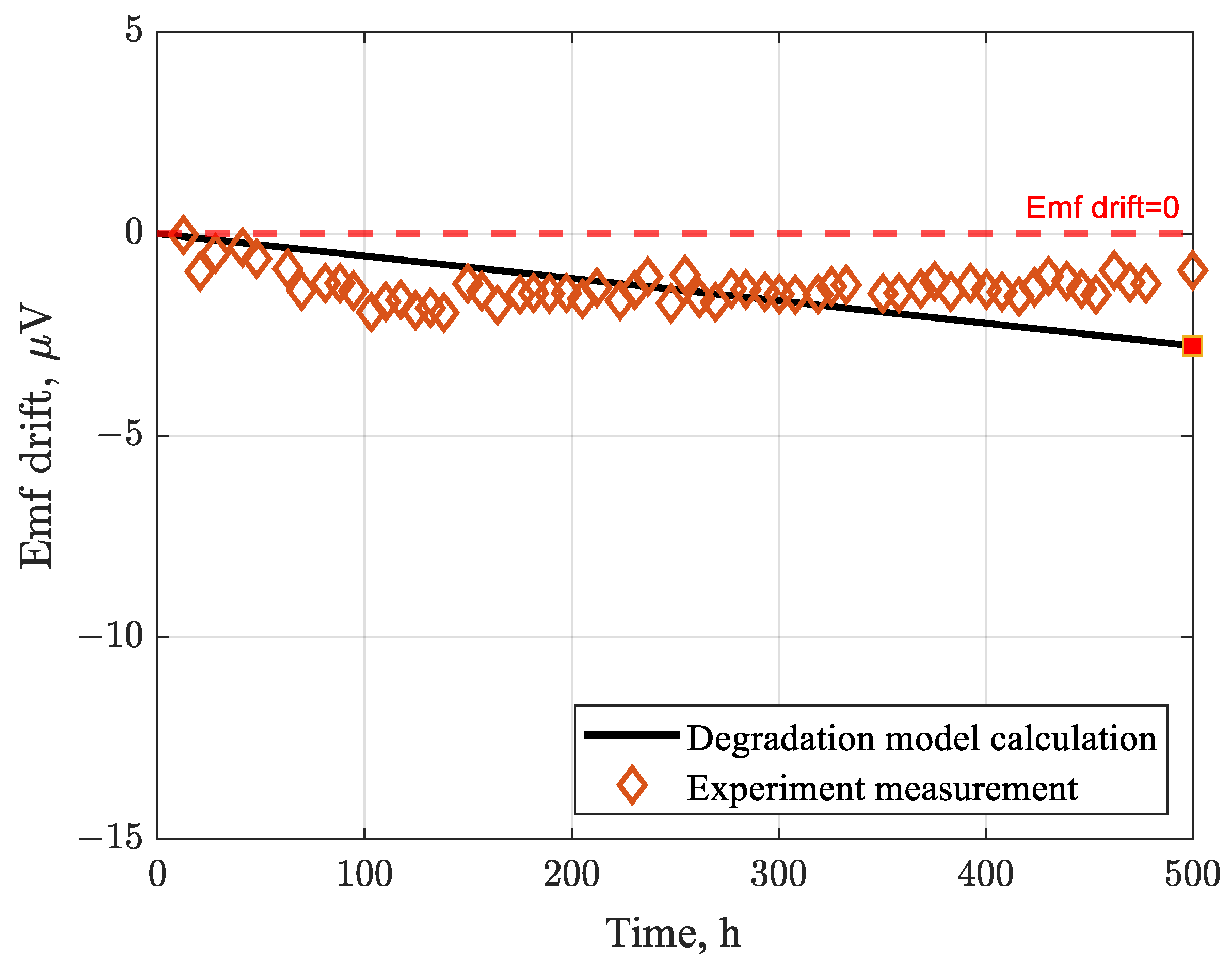
- A physical degradation model for type B Pt–Rh thermocouples was developed based on the Seebeck effect and vapor transport theory. The numerical simulation results from this degradation model align with experimental degradation data obtained from laboratory tests on type B Pt–Rh thermocouples aged at 1324 °C for 500 h, thereby validating the model. The simulated degradation curve is subsequently used as a reference for RUL prediction.
- (3)
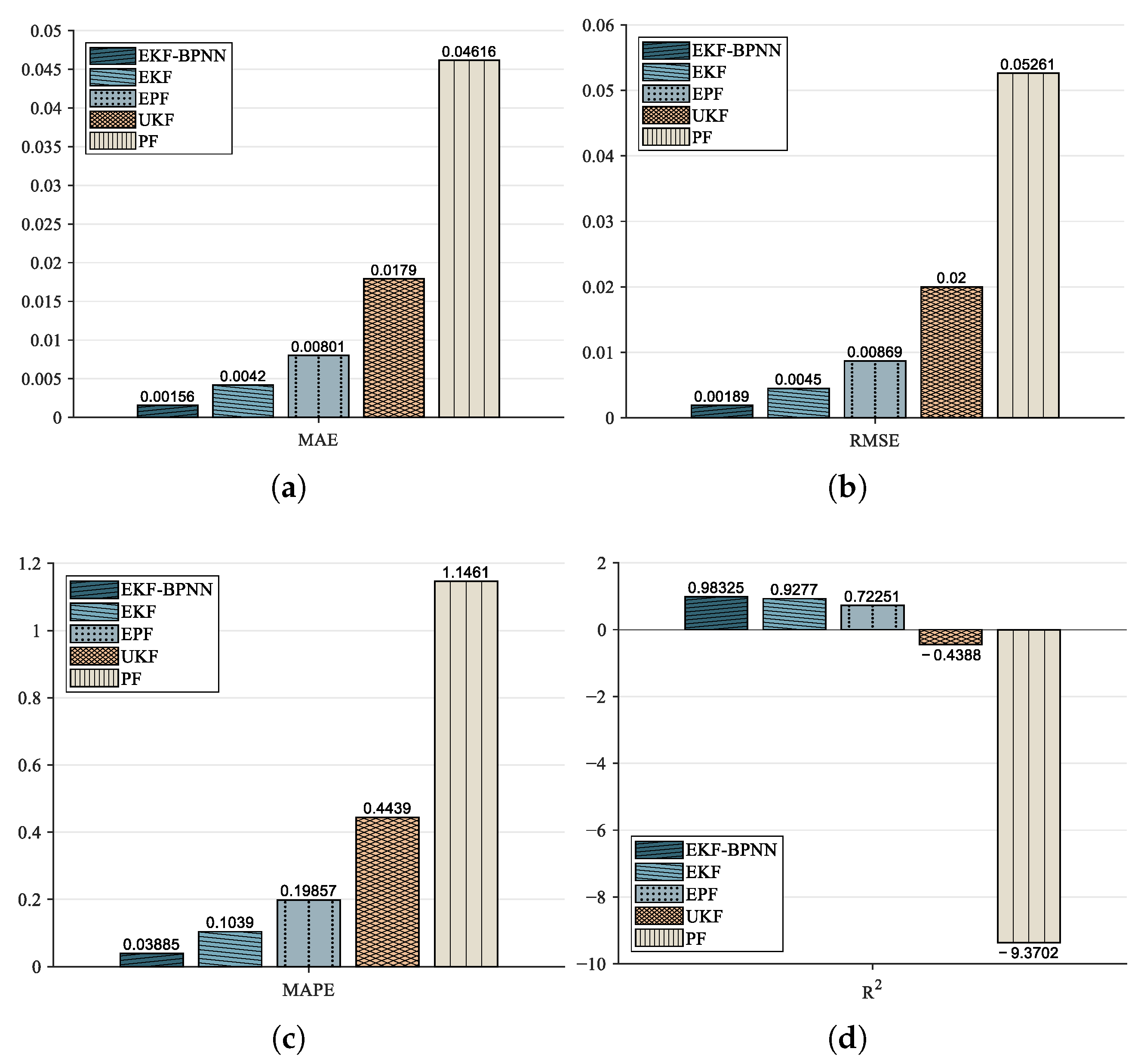
- The performance of the proposed EKF–BPNN prediction algorithm was evaluated and compared with nonlinear estimation methods such as EKF, PF, unscented Kalman filter (UKF), and extended Kalman particle filter (EPF) using metrics including mean absolute error (MAE), root mean square error (RMSE), mean absolute percentage error (MAPE), and the coefficient of determination (). The results confirm that the proposed method achieves higher accuracy in RUL prediction compared to existing approaches.
- (4)
- Finally, the findings demonstrate that for objects with weak nonlinearity and slow degradation, such as thermocouple instruments, the proposed EKF–BPNN algorithm is not only suitable but also effectively compensates for the limitations of purely model-based methods, leading to better RUL prediction performance. Additionally, it is shown that RUL prediction algorithms with strong nonlinear modeling capabilities may introduce greater errors when applied to objects with weak nonlinear features, thereby worsening prediction outcomes. Hence, tailored solutions should be applied when addressing degradation problems across different types of objects.
2. Pt–Rh Thermocouple Degradation Model
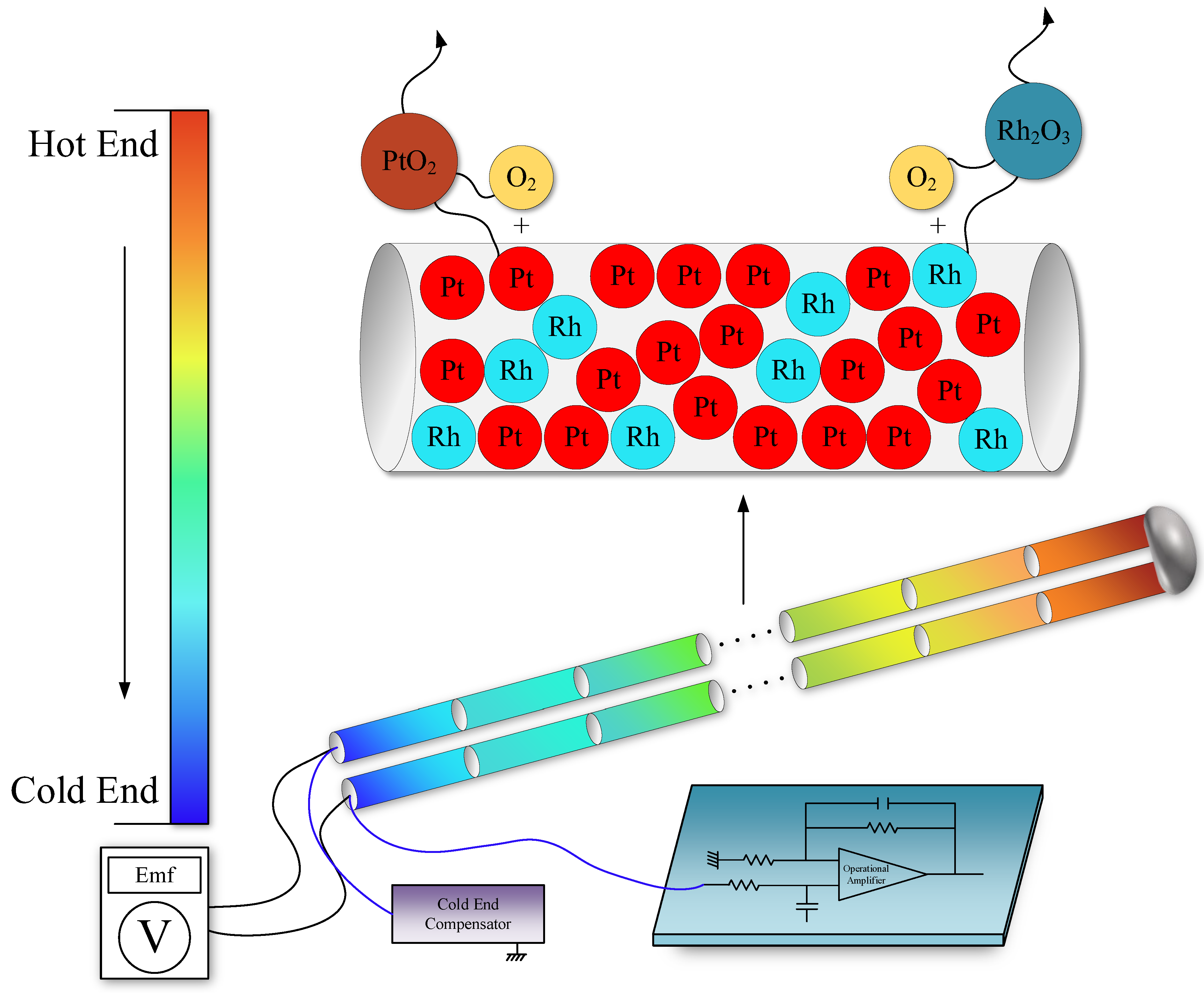
2.1. Vapor Transport
- ①
- molecules diffuse toward the alloy surface;
- ②
- dissociates and adsorbs on the surface, reacting with metal atoms to form oxide molecules;
- ③
- At high temperature, the oxide molecules evaporate and desorb from the surface;
- ④
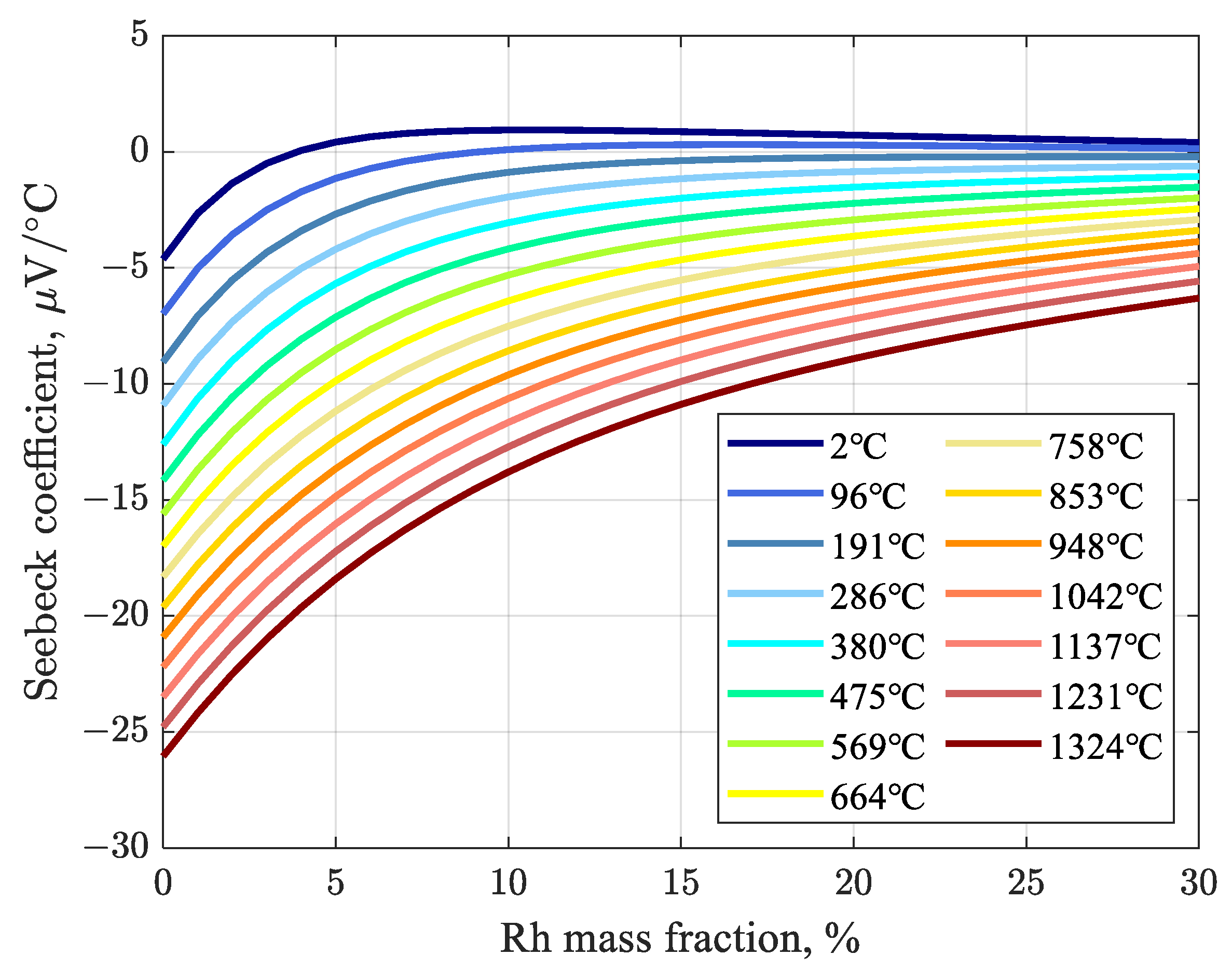
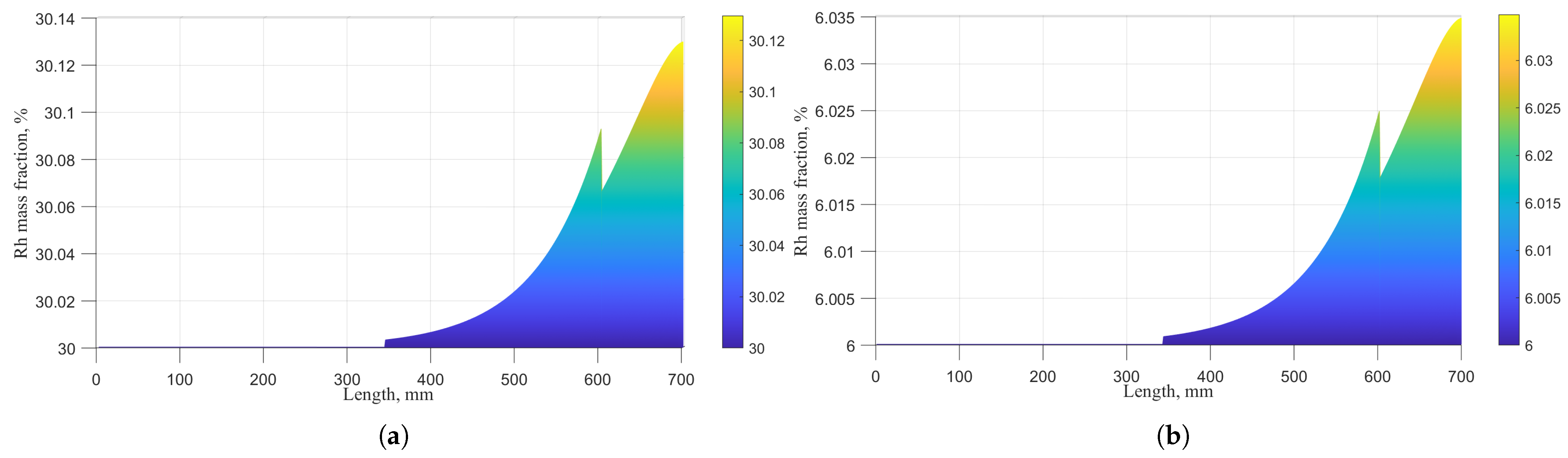
- The oxide molecules are transported away from the surface, thereby altering the Rh mass fraction and degrading the thermoelectric homogeneity of the wire.
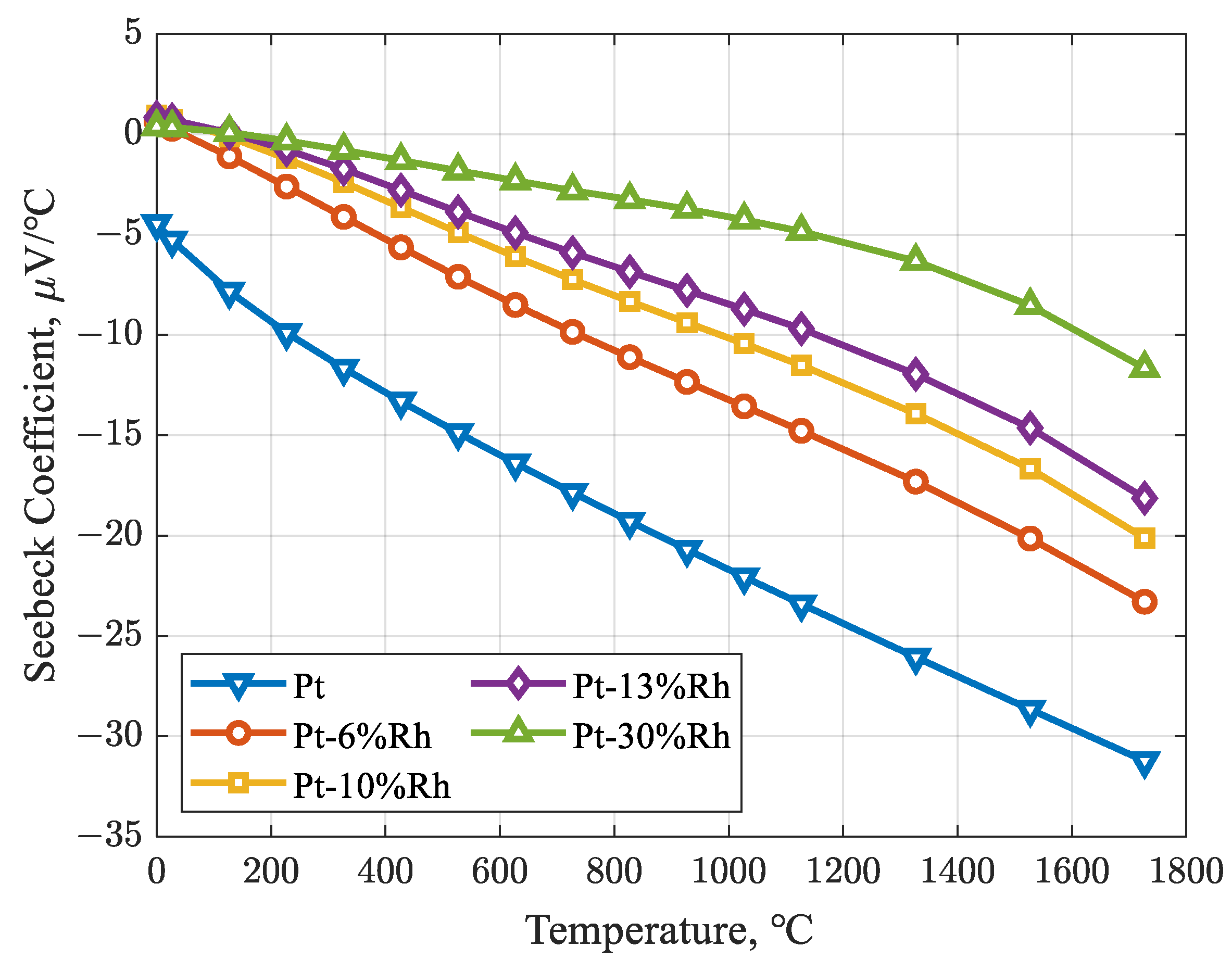
2.2. Change of Seebeck Coefficient
2.3. State Space Model
3. Mathematical Analysis
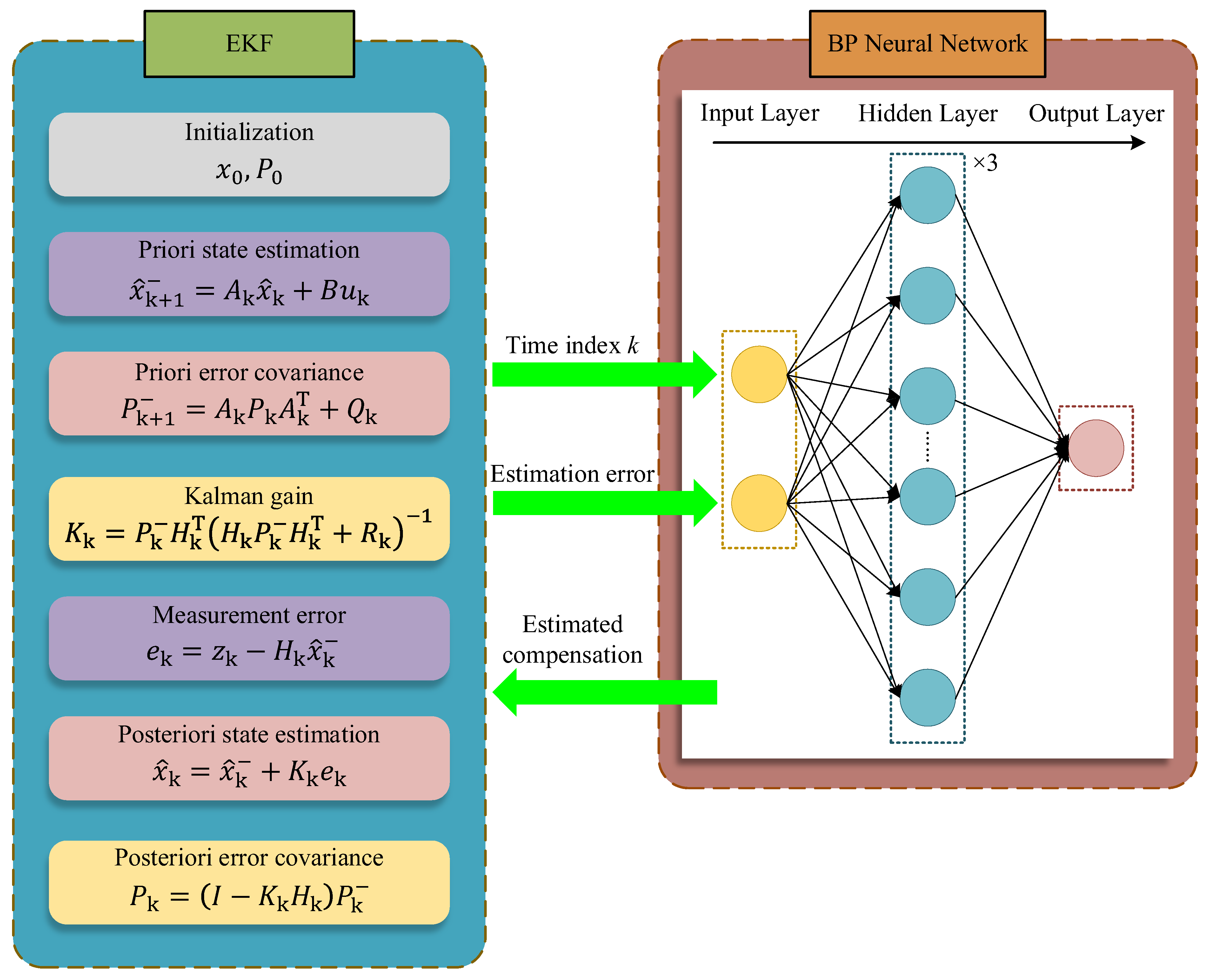
3.1. Extended Kalman Filter

| Step | Algorithm |
|---|---|
| 1. | Initialize: , , Q, R |
| 2. | Form the Jacobian matrix |
| BEGIN LOOP | |
| 3. | |
| 4. | |
| 5. | |
| 6. | |
| 7. | |
| END LOOP |
3.2. Back-Propagation Neural Network
3.3. EKF–BPNN Method
4. Experimental Analysis and Discussion
4.1. Degradation Model Validation of Type B Pt–Rh Thermocouple
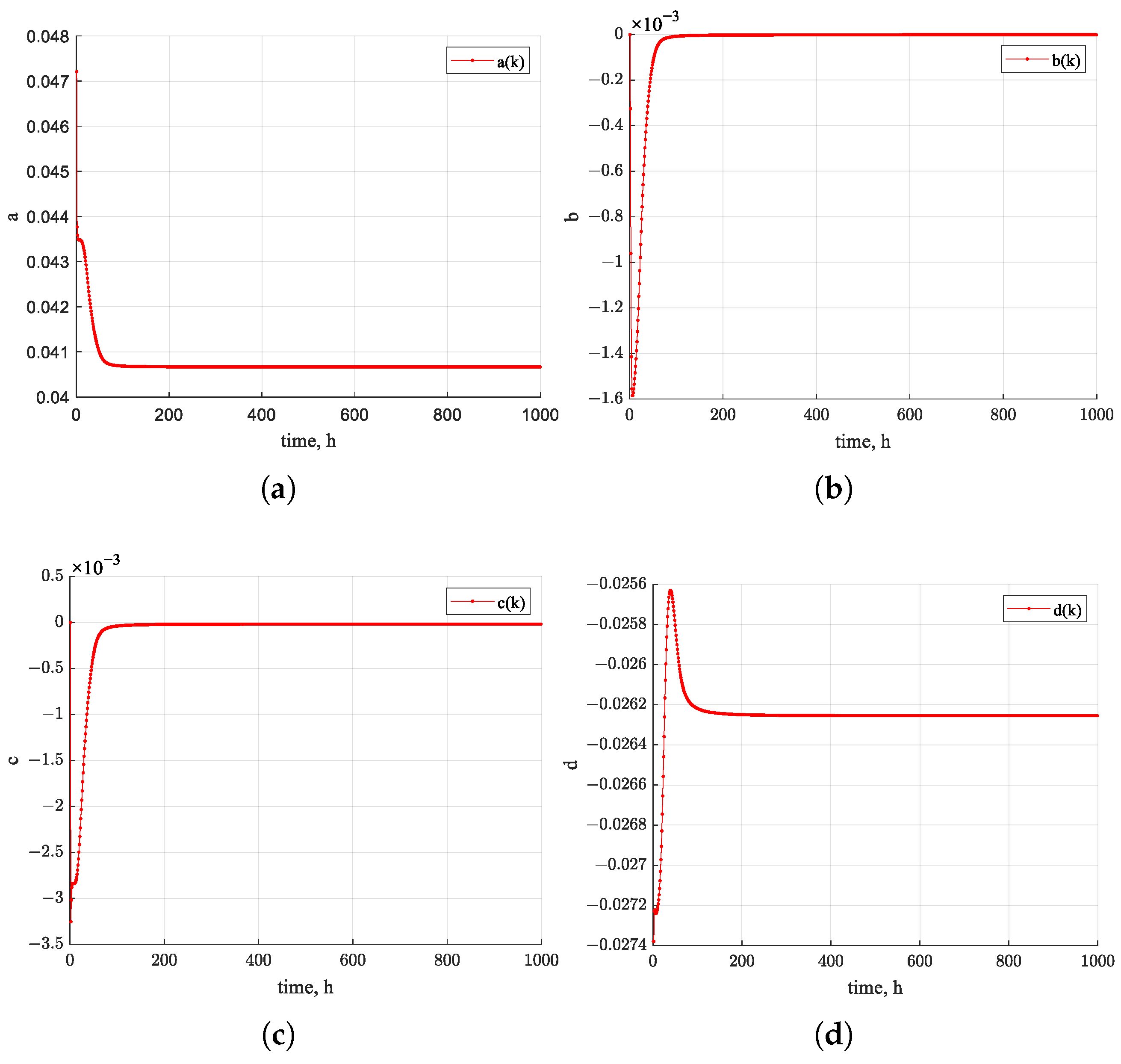
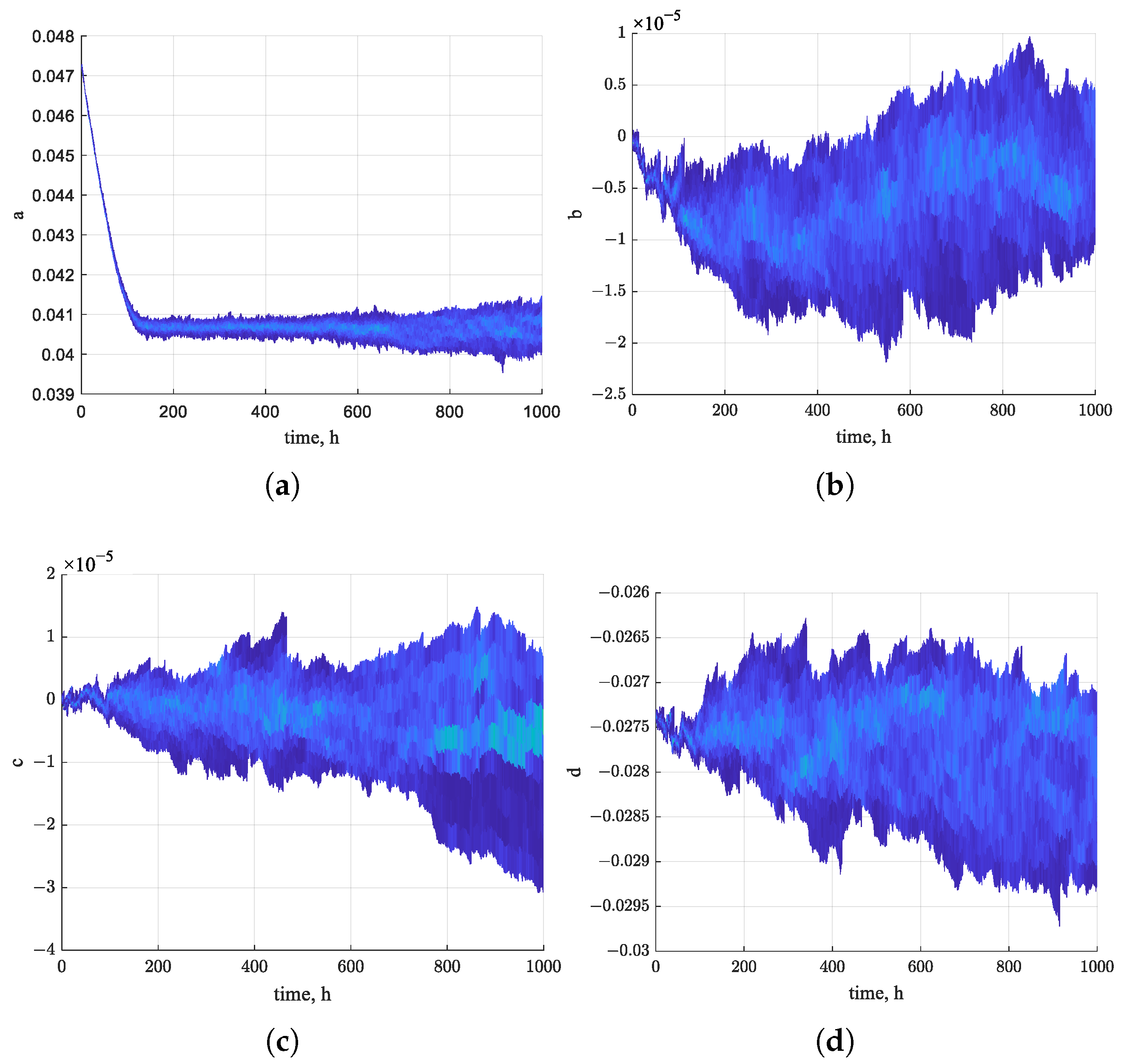
4.2. Pt–Rh Thermocouple Instrument Output
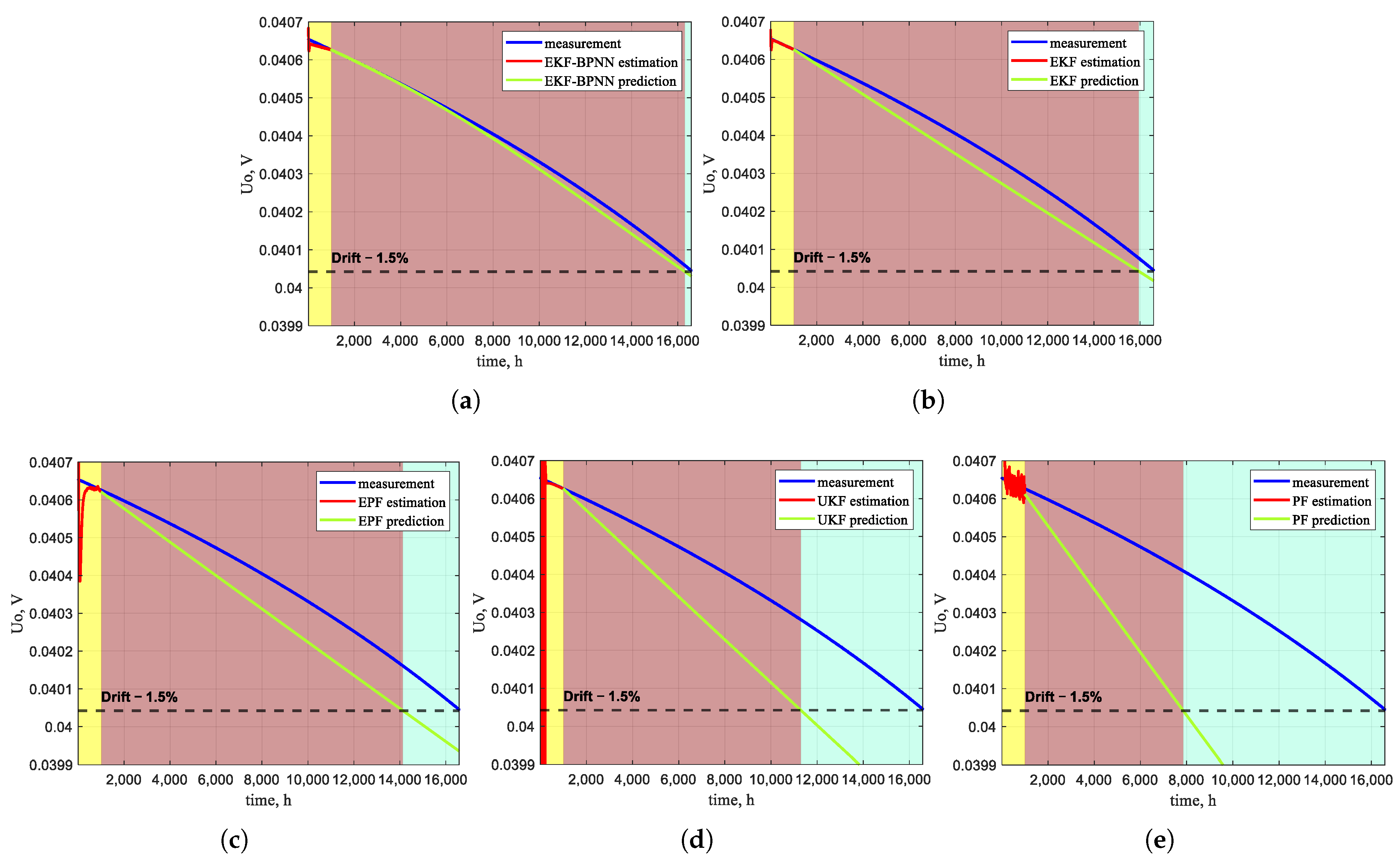
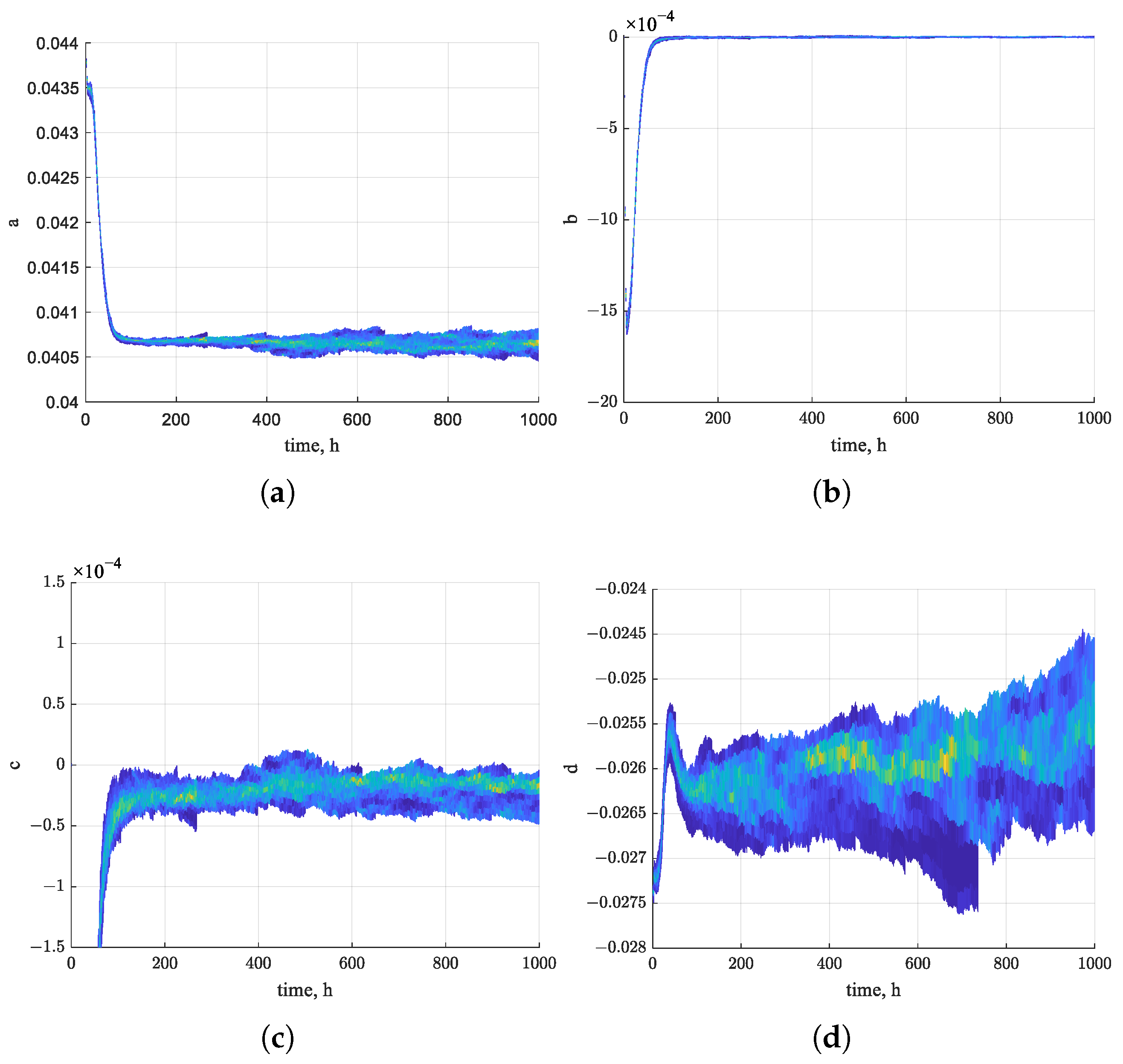
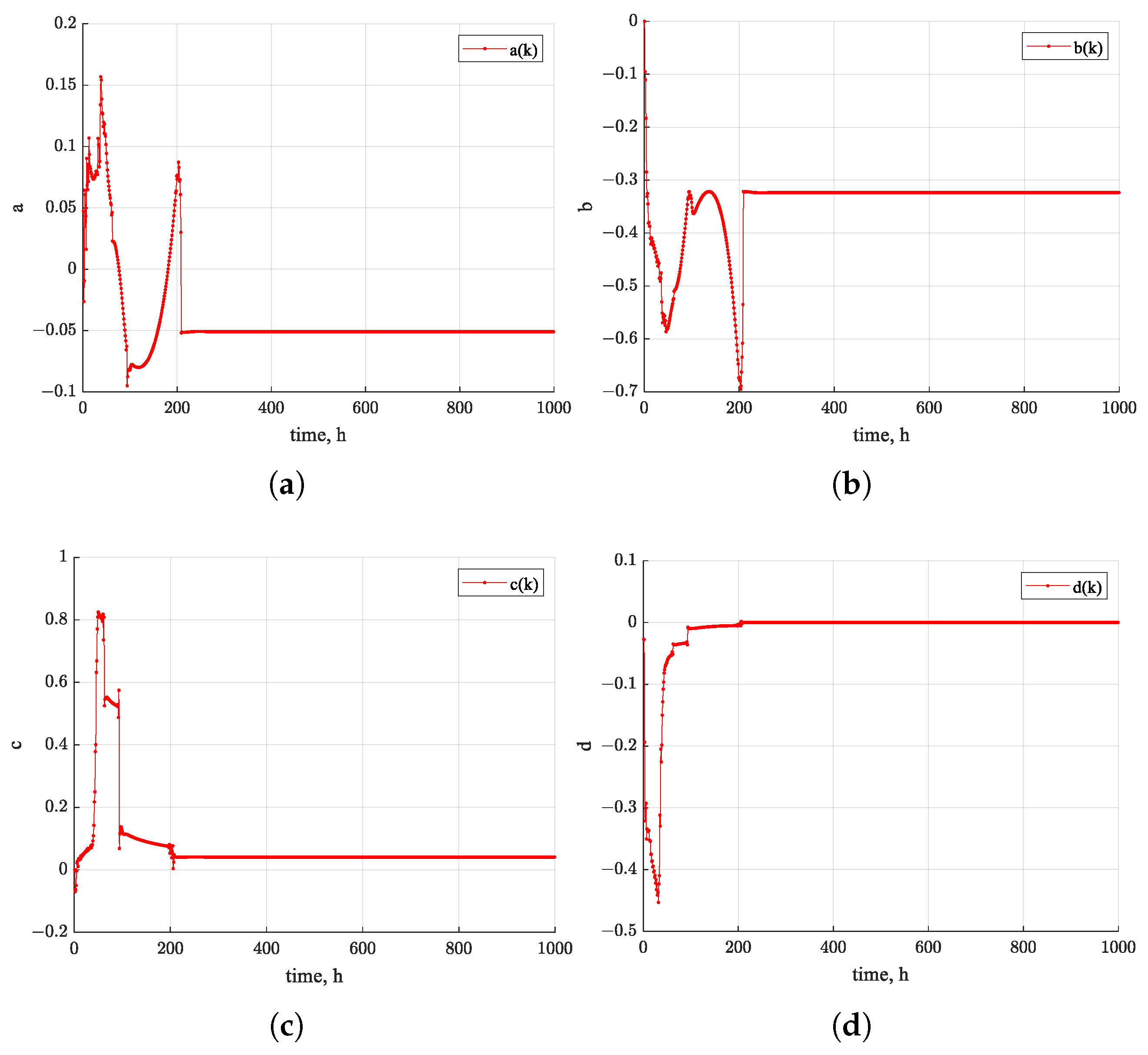
4.3. Prediction by EKF–BPNN Compared with Other Algorithms
4.4. Results Analysis
| MAE/% | RMSE/% | MAPE/% | ||
|---|---|---|---|---|
| EKF–BPNN1 | 0.0013 | 0.0016 | 0.0326 | 0.9905 |
| EKF–BPNN2 | 0.0011 | 0.0014 | 0.0283 | 0.9929 |
| EKF–BPNN3 | 0.0018 | 0.0021 | 0.0446 | 0.9842 |
| EKF–BPNN4 | 0.0012 | 0.0014 | 0.0290 | 0.9927 |
| EKF–BPNN5 | 0.0015 | 0.0018 | 0.0376 | 0.9881 |
| EKF–BPNN6 | 0.0031 | 0.0037 | 0.0763 | 0.9496 |
| EKF–BPNN7 | 0.0005 | 0.0006 | 0.0118 | 0.9987 |
| EKF–BPNN8 | 0.0011 | 0.0013 | 0.0273 | 0.9938 |
| EKF–BPNN9 | 0.0031 | 0.0039 | 0.0781 | 0.9465 |
| EKF–BPNN10 | 0.0009 | 0.0011 | 0.0229 | 0.9955 |
| EKF1 | 0.0042 | 0.0045 | 0.1039 | 0.9277 |
| EKF2 | 0.0042 | 0.0045 | 0.1039 | 0.9277 |
| EKF3 | 0.0042 | 0.0045 | 0.1039 | 0.9277 |
| EKF4 | 0.0042 | 0.0045 | 0.1039 | 0.9277 |
| EKF5 | 0.0042 | 0.0045 | 0.1039 | 0.9277 |
| EKF6 | 0.0042 | 0.0045 | 0.1039 | 0.9277 |
| EKF7 | 0.0042 | 0.0045 | 0.1039 | 0.9277 |
| EKF8 | 0.0042 | 0.0045 | 0.1039 | 0.9277 |
| EKF9 | 0.0042 | 0.0045 | 0.1039 | 0.9277 |
| EKF10 | 0.0042 | 0.0045 | 0.1039 | 0.9277 |
| EPF1 | 0.0086 | 0.0092 | 0.2126 | 0.6925 |
| EPF2 | 0.0078 | 0.0085 | 0.1940 | 0.7402 |
| EPF3 | 0.0078 | 0.0085 | 0.1937 | 0.7412 |
| EPF4 | 0.0058 | 0.0062 | 0.1430 | 0.8617 |
| EPF5 | 0.0089 | 0.0097 | 0.2217 | 0.6571 |
| EPF6 | 0.0091 | 0.0100 | 0.2268 | 0.6404 |
| EPF7 | 0.0072 | 0.0078 | 0.1782 | 0.7823 |
| EPF8 | 0.0069 | 0.0074 | 0.1702 | 0.8019 |
| EPF9 | 0.0091 | 0.0099 | 0.2251 | 0.6464 |
| EPF10 | 0.0089 | 0.0097 | 0.2204 | 0.6614 |
| UKF1 | 0.0179 | 0.0200 | 0.4439 | −0.4388 |
| UKF2 | 0.0179 | 0.0200 | 0.4439 | −0.4388 |
| UKF3 | 0.0179 | 0.0200 | 0.4439 | −0.4388 |
| UKF4 | 0.0179 | 0.0200 | 0.4439 | −0.4388 |
| UKF5 | 0.0179 | 0.0200 | 0.4439 | −0.4388 |
| UKF6 | 0.0179 | 0.0200 | 0.4439 | −0.4388 |
| UKF7 | 0.0179 | 0.0200 | 0.4439 | −0.4388 |
| UKF8 | 0.0179 | 0.0200 | 0.4439 | −0.4388 |
| UKF9 | 0.0179 | 0.0200 | 0.4439 | −0.4388 |
| UKF10 | 0.0179 | 0.0200 | 0.4439 | −0.4388 |
| PF1 | 0.0397 | 0.0446 | 0.9847 | −6.1899 |
| PF2 | 0.0474 | 0.0532 | 1.1759 | −9.2133 |
| PF3 | 0.0661 | 0.0758 | 1.6423 | −19.7456 |
| PF4 | 0.0389 | 0.0443 | 0.9648 | −6.0894 |
| PF5 | 0.0411 | 0.0468 | 1.0210 | −6.8839 |
| PF6 | 0.0475 | 0.0544 | 1.1803 | −9.6856 |
| PF7 | 0.0387 | 0.0443 | 0.9619 | −6.0898 |
| PF8 | 0.0579 | 0.0665 | 1.4370 | −14.9668 |
| PF9 | 0.0380 | 0.0436 | 0.9441 | −5.854 |
| PF10 | 0.0463 | 0.0526 | 1.1489 | −8.9838 |
5. Conclusions
Author Contributions
Funding
Institutional Review Board Statement
Informed Consent Statement
Data Availability Statement
Acknowledgments
Conflicts of Interest
Abbreviations
| BPNN | Back-propagation neural network |
| EKF | Extended Kalman filter |
| Emf | Electromotive force |
| EPF | Extended Kalman particle filter |
| KF | Kalman filter |
| PF | Particle filter |
| Pt | Platinum |
| Rh | Rhodium |
| RUL | Remaining useful life |
| UKF | Unscented Kalman filter |
References
- Zhong, S.; Hu, S.; Zha, M.; Li, S. Thermal hydraulic instrumentation system of the HTR-10. Nucl. Eng. Des. 2002, 218, 199–208. [Google Scholar] [CrossRef]
- Hai, Z.; Su, Z.; Chen, Y.; Zhang, Y.; Gong, S.; Lin, R.; Gao, S.; Zhong, Z.; Zhang, Z.; Xue, C.; et al. Ag/Pt thick-film thermocouple with high stability using mask-printed for extreme elevated-temperature environments. J. Alloys Compd. 2025, 1037, 182471. [Google Scholar] [CrossRef]
- Ara, K.; Yamada, M.; Wakayama, N.; Kobayashi, K. High-Temperature Characteristics of Pt-Mo Alloy Thermocouple for In-Core Temperature Measurements in Very High Temperature Gas-Cooled Reactor. J. Nucl. Sci. Technol. 1987, 24, 480–489. [Google Scholar] [CrossRef]
- Thermoelectric Effects in Metals: Thermocouples. Available online: http://Materials.Usask.Ca (accessed on 6 November 2001).
- Kundu, P.; Darpe, A.K.; Kulkarni, M.S. A review on diagnostic and prognostic approaches for gears. Struct. Health Monit. 2020, 20, 2853–2893. [Google Scholar] [CrossRef]
- Li, X.; Pu, Y.; Wu, N.; Cao, H.; Ding, X.; Huang, W. A collaborative decision framework for dynamic control of gear remaining useful life using multi-source information in active health management. Neurocomputing 2025, 656, 131536. [Google Scholar] [CrossRef]
- Mi, J.; Liu, L.; Zhuang, Y.; Bai, L.; Li, Y.F. A Synthetic Feature Processing Method for Remaining Useful Life Prediction of Rolling Bearings. IEEE Trans. Reliab. 2023, 72, 125–136. [Google Scholar] [CrossRef]
- Zhang, T.; Wang, H. Explainable remaining useful life uncertainty prediction method for rolling bearing. Eng. Appl. Artif. Intell. 2025, 161, 112114. [Google Scholar] [CrossRef]
- Zhou, Z.; Bai, M.; Long, Z.; Liu, J.; Yu, D. An adaptive remaining useful life prediction model for aeroengine based on multi-angle similarity. Measurement 2024, 226, 114082. [Google Scholar] [CrossRef]
- Fu, S.; Wang, Y.; Lin, L.; Zhao, M.; Zu, L.; Lu, Y.; Guo, F.; Suo, S.; Liu, Y.; Zhang, S.; et al. DKAMFormer: Domain Knowledge-Augmented Multiscale Transformer for Remaining Useful Life Prediction of Aeroengine. IEEE/CAA J. Autom. Sin. 2025, 12, 1610–1635. [Google Scholar] [CrossRef]
- Duan, C.; Cao, H.; Liu, F.; Duan, X.; Pu, H.; Luo, J. An interactive prognostics framework for lithium-ion battery remaining useful life based on neural networks and statistical processes. Reliab. Eng. Syst. Saf. 2025, 264, 111434. [Google Scholar] [CrossRef]
- Chen, G.; Zhong, S.; Yang, Y.; Zhang, X.; Deng, W.; Liu, J. A lithium-ion battery health state assessment and remaining useful life prediction method based on multi slope features. J. Energy Storage 2025, 130, 117324. [Google Scholar] [CrossRef]
- Yang, W.; Wu, K.; Long, B.; Tian, S. A Novel Method for Remaining Useful Life Prediction of RF Circuits Based on the Gated Recurrent Unit-Convolutional Neural Network Model. Sensors 2024, 24, 2841. [Google Scholar] [CrossRef]
- Wu, T.; Yao, Y.; Li, Z.; Chen, B.; Wu, Y.; Sun, W. Remaining useful life prediction of circuit breaker operating mechanisms based on wavelet-enhanced dual-tree residual networks. J. Power Electron. 2023, 24, 78–91. [Google Scholar] [CrossRef]
- Kang, J.; Kim, T.; Kim, Y.S. Novel state of charge estimation of lithium-ion batteries using empirical neural tangent kernel and unscented Kalman filter. J. Energy Storage 2025, 111, 115372. [Google Scholar] [CrossRef]
- Wang, D.; Yang, Y.; Gu, T. A hierarchical adaptive extended Kalman filter algorithm for lithium-ion battery state of charge estimation. J. Energy Storage 2023, 62, 106831. [Google Scholar] [CrossRef]
- Chen, X.; Li, K.; Wang, S.; Liu, H. A hybrid prognostic approach combined with deep Bayesian transformer and enhanced particle filter for remaining useful life prediction of bearings. Measurement 2025, 252, 117184. [Google Scholar] [CrossRef]
- Cui, L.; Li, W.; Liu, D.; Wang, H. A Novel Robust Dual Unscented Particle Filter Method for Remaining Useful Life Prediction of Rolling Bearings. IEEE Trans. Instrum. Meas. 2024, 73, 1–9. [Google Scholar] [CrossRef]
- Takyi-Aninakwa, P.; Wang, S.; Zhang, H.; Li, H.; Xu, W.; Fernandez, C. An optimized relevant long short-term memory-squared gain extended Kalman filter for the state of charge estimation of lithium-ion batteries. Energy 2022, 260, 125093. [Google Scholar] [CrossRef]
- Duan, L.; Zhang, X.; Jiang, Z.; Gong, Q.; Wang, Y.; Ao, X. State of charge estimation of lithium-ion batteries based on second-order adaptive extended Kalman filter with correspondence analysis. Energy 2023, 280, 128159. [Google Scholar] [CrossRef]
- Monirul, I.M.; Qiu, L.; Ruby, R. Accurate SOC estimation of ternary lithium-ion batteries by HPPC test-based extended Kalman filter. J. Energy Storage 2024, 92, 112304. [Google Scholar] [CrossRef]
- Xu, Z.; Xie, N.; Li, K. Remaining useful life prediction for lithium-ion batteries with an improved grey particle filter model. J. Energy Storage 2024, 78, 110081. [Google Scholar] [CrossRef]
- Pang, H.; Chen, K.; Geng, Y.; Wu, L.; Wang, F.; Liu, J. Accurate capacity and remaining useful life prediction of lithium-ion batteries based on improved particle swarm optimization and particle filter. Energy 2024, 293, 130555. [Google Scholar] [CrossRef]
- Li, X.; Du, H.; Wang, T.; Bi, J.; Zhang, H.; Zhao, S.; Yu, H. Enhanced remaining useful life prediction of lithium-ion batteries using genetic algorithm-optimized backpropagation neural networks. J. Power Sources 2025, 652, 237619. [Google Scholar] [CrossRef]
- Wang, C.; Huang, Z.; He, C.; Lin, X.; Li, C.; Huang, J. Research on remaining useful life prediction method for lithium-ion battery based on improved GA-ACO-BPNN optimization algorithm. Sustain. Energy Technol. Assess. 2025, 73, 104142. [Google Scholar] [CrossRef]
- Luan, W.; Cai, H.; Wang, X.; Zhao, B. State of Health for Lithium-Ion Batteries Based on Explainable Feature Fragments via Graph Attention Network and Bi-Directional Gated Recurrent Unit. Sensors 2025, 25, 5953. [Google Scholar] [CrossRef] [PubMed]
- Ma, P.; Li, G.; Zhang, H.; Wang, C.; Li, X. Prediction of Remaining Useful Life of Rolling Bearings Based on Multiscale Efficient Channel Attention CNN and Bidirectional GRU. IEEE Trans. Instrum. Meas. 2024, 73, 1–13. [Google Scholar] [CrossRef]
- Wang, Y.; Xie, Y.; Liang, H.; Ma, H. Remaining useful life prediction of DC contactor based on LSTM. Microelectron. Reliab. 2025, 172, 115815. [Google Scholar] [CrossRef]
- Yi, F.; Shu, X.; Zhou, J.; Zhang, J.; Feng, C.; Gong, H.; Zhang, C.; Yu, W. Remaining useful life prediction of PEMFC based on matrix long short-term memory. Int. J. Hydrogen Energy 2025, 111, 228–237. [Google Scholar] [CrossRef]
- Xie, M.; Wei, Z.; Zhao, J.; Wang, Y.; Liang, X.; Pei, X. Remaining useful life prediction of pipelines considering the crack coupling effect using genetic algorithm-back propagation neural network. Thin-Walled Struct. 2024, 204, 112330. [Google Scholar] [CrossRef]
- Miao, Y.; Xia, Y.; Liu, J. Remaining Useful Life Prediction via a Double Convolutional Attention-Based CNN-GRU Model. IEEE Trans. Instrum. Meas. 2025, 74, 1–13. [Google Scholar] [CrossRef]
- Yao, X.; Su, K.; Zhang, H.; Zhang, S.; Zhang, H.; Zhang, J. Remaining useful life prediction for lithium-ion batteries in highway electromechanical equipment based on feature-encoded LSTM-CNN network. Energy 2025, 323, 135719. [Google Scholar] [CrossRef]
- Edler, F.; Ederer, P. Thermoelectric Homogeneity and Stability of Platinum-Rhodium Alloyed Thermoelements of Different Compositions. In Proceedings of the Ninth International Temperature Symposium, Los Angeles, CA, USA, 19–23 March 2012. [Google Scholar]
- Jehn, H. High temperature behaviour of platinum group metals in oxidizing atmospheres. J. Less Common Met. 1984, 100, 321–339. [Google Scholar] [CrossRef]
- Bentley, R.E. Handbook of Temperature Measurement Vol 3: The Theory and Practive of Thermoelectric Thermometry; Springer: Singapore, 1998; pp. 38–39. [Google Scholar]
- Rhys, D.W. Precious-metal thermocouples. Metall. Rev. 1969, 14, 47–60. [Google Scholar] [CrossRef]
- Uthayakumaar, S.; Davidson, S.; Pearce, J. Mass loss of Platinum-Rhodium thermocouple wires at 1324 °C: Lower mass loss observed with enclosed wires. Johns. Matthey Technol. Rev. 2021, 65, 568–573. [Google Scholar] [CrossRef]
- Rubel, M.; Pszonicka, M.; Palczewska, W. The effects of oxygen interaction with Pt–Rh catalytic alloys. J. Mater. Sci. 1985, 20, 3639–3648. [Google Scholar] [CrossRef]
- Jacob, K.T.; Priya, S.; Waseda, Y. Alloy-oxide equilibria in the system Pt–Rh-O. Bull. Mater. Sci. 1998, 21, 99–103. [Google Scholar] [CrossRef]
- Chaston, J.C. Reaction of oxygen with the Platinum metals. I-The oxidation of Platinum. Platin. Met. Rev. 1964, 8, 50–54. [Google Scholar] [CrossRef]
- Fromm, E.; Gebhardt, E. Gase und Kohlenstoff in Metallen, 1st ed.; Springer: Berlin/Heidelberg, Germany, 1976. [Google Scholar]
- Berry, R.J. Multilayer oxidation of polycrystalline platinum. Can. J. Chem. 1977, 55, 1792–1793. [Google Scholar] [CrossRef]
- Schmahl, N.G.; Minzl, E. Die thermische Zersetzung des Rhodium (III)-oxids und deren Beeinflussung durch Legierungsbildung mit Platin und Palladium. Z. Phys. Chem. 1964, 41, 78–96. [Google Scholar] [CrossRef]
- Krier, C.A.; Jaffee, R.I. Oxidation of the platinum-group metals. J. Less Common Met. 1963, 5, 411–431. [Google Scholar] [CrossRef]
- Burns, G.W.; Scroger, M.G.; Strouse, G.F.; Croarkin, M.C.; Guthrie, W.F. Temperature-Electromotive Force Reference Functions and Tables for the Letter-Designated Thermocouple Types Based on the ITS-90; United States Department of Commerce Technology Administration National Institute of Standards and Technology: Washington, DC, USA, 1993; pp. 9–98.
- Cusack, N.; Kendall, P. The absolute scale of thermoelectric power at high temperature. Proc. Phys. Soc. 1958, 72, 898–910. [Google Scholar] [CrossRef]
- Pearce, J.V. A validated physical model of the thermoelectric drift of Pt–Rh thermocouples above 1200 °C. Metrologia 2020, 57, 025009. [Google Scholar] [CrossRef]
- Xue, Z.; Zhang, Y.; Cheng, C.; Ma, G. Remaining useful life prediction of lithium-ion batteries with adaptive unscented kalman filter and optimized support vector regression. Neurocomputing 2020, 376, 95–102. [Google Scholar] [CrossRef]
- Krener, A.J. The Convergence of the Extended Kalman Filter. In Proceedings of the Directions in Mathematical Systems Theory and Optimization, Heidelberg, Germany, 23 October 2002. [Google Scholar]
- Reif, K.; Gunther, S.; Yaz, E.; Unbehauen, R. Stochastic stability of the continuous-time extended Kalman filter. IEE Proc.-Control Theory Appl. 2000, 147, 45–52. [Google Scholar] [CrossRef]
- Pearce, J.V.; Greenen, A.D.; Smith, A.; Elliott, C.J. Relating composition and thermoelectric stability of Pt–Rh alloy thermocouples. Int. J. Thermophys. 2017, 38, 26. [Google Scholar] [CrossRef]
- Betta, G.; Pietrosanto, A. Instrument Fault Detection and Isolation: State of the Art and New Research Trends. IEEE Trans. Instrum. Meas. 2000, 49, 1. [Google Scholar] [CrossRef]
- Yang, J.; Fang, W.; Chen, J.; Yao, B. A lithium-ion battery remaining useful life prediction method based on unscented particle filter and optimal combination strategy. J. Energy Storage 2022, 55, 105648. [Google Scholar] [CrossRef]
- Zhang, X.; Duan, L.; Gong, Q.; Wang, Y.; Song, H. State of charge estimation for lithium-ion battery based on adaptive extended Kalman filter with improved residual covariance matrix estimator. J. Power Sources 2024, 589, 233758. [Google Scholar] [CrossRef]


| Temperature (°C) | Pt | Pt-6%Rh | Pt-10%Rh | Pt-13%Rh | Pt-30%Rh |
|---|---|---|---|---|---|
| −173 | 4.29 | - | - | - | - |
| −123 | 1.32 | - | - | - | - |
| −73 | −1.27 | - | - | - | - |
| 0 | −4.45 | 0.619 | 0.953 | 0.84 | 0.373 |
| 27 | −5.28 | 0.272 | 0.755 | 0.712 | 0.342 |
| 127 | −7.83 | −1.1 | −0.128 | 0.08 | 0.099 |
| 227 | −9.89 | −2.602 | −1.215 | −0.769 | −0.32 |
| 327 | −11.66 | −4.117 | −2.394 | −1.731 | −0.791 |
| 427 | −13.31 | −5.633 | −3.646 | −2.79 | −1.303 |
| 527 | −14.88 | −7.101 | −4.896 | −3.866 | −1.812 |
| 627 | −16.39 | −8.503 | −6.098 | −4.906 | −2.307 |
| 727 | −17.86 | −9.847 | −7.242 | −5.9 | −2.808 |
| 827 | −19.29 | −11.108 | −8.327 | −6.848 | −3.251 |
| 927 | −20.69 | −12.34 | −9.386 | −7.781 | −3.728 |
| 1027 | −22.06 | −13.557 | −10.436 | −8.715 | −4.253 |
| 1127 | −23.41 | −14.776 | −11.513 | −9.69 | −4.841 |
| 1327 | −26.06 | −17.306 | −13.924 | −11.956 | −6.319 |
| 1527 | −28.66 | −20.141 | −16.664 | −14.634 | −8.53 |
| 1727 | −31.23 | −23.292 | −20.12 | −18.134 | −11.658 |
| EKF–BPNN vs. EKF | EKF–BPNN vs. EPF | EKF–BPNN vs. UKF | EKF–BPNN vs. PF | |
|---|---|---|---|---|
| MAE | 5.59 | 6.26 | 6.13 | 1.07 |
| RMSE | 3.27 | 1.11 | 1.56 | 1.30 |
| MAPE | 6.17 | 6.10 | 6.48 | 1.08 |
| 6.79 | 5.65 | 2.16 | 5.46 |
Disclaimer/Publisher’s Note: The statements, opinions and data contained in all publications are solely those of the individual author(s) and contributor(s) and not of MDPI and/or the editor(s). MDPI and/or the editor(s) disclaim responsibility for any injury to people or property resulting from any ideas, methods, instructions or products referred to in the content. |
© 2026 by the authors. Licensee MDPI, Basel, Switzerland. This article is an open access article distributed under the terms and conditions of the Creative Commons Attribution (CC BY) license.
Share and Cite
Li, N.; Dai, S.; Liu, Y.; Zhu, Y.; Li, J.; Huang, X. Data-Driven Remaining Useful Life Prediction for Pt–Rh Thermocouples Using an Extended Kalman Filter. Sensors 2026, 26, 1483. https://doi.org/10.3390/s26051483
Li N, Dai S, Liu Y, Zhu Y, Li J, Huang X. Data-Driven Remaining Useful Life Prediction for Pt–Rh Thermocouples Using an Extended Kalman Filter. Sensors. 2026; 26(5):1483. https://doi.org/10.3390/s26051483
Chicago/Turabian StyleLi, Na, Siyang Dai, Yi Liu, Yunlong Zhu, Jitao Li, and Xiaojin Huang. 2026. "Data-Driven Remaining Useful Life Prediction for Pt–Rh Thermocouples Using an Extended Kalman Filter" Sensors 26, no. 5: 1483. https://doi.org/10.3390/s26051483
APA StyleLi, N., Dai, S., Liu, Y., Zhu, Y., Li, J., & Huang, X. (2026). Data-Driven Remaining Useful Life Prediction for Pt–Rh Thermocouples Using an Extended Kalman Filter. Sensors, 26(5), 1483. https://doi.org/10.3390/s26051483