A Two-Level Ensemble Machine Learning Framework for OSA Classification Whilst Awake from Noisy Tracheal Breathing Sounds



Highlights
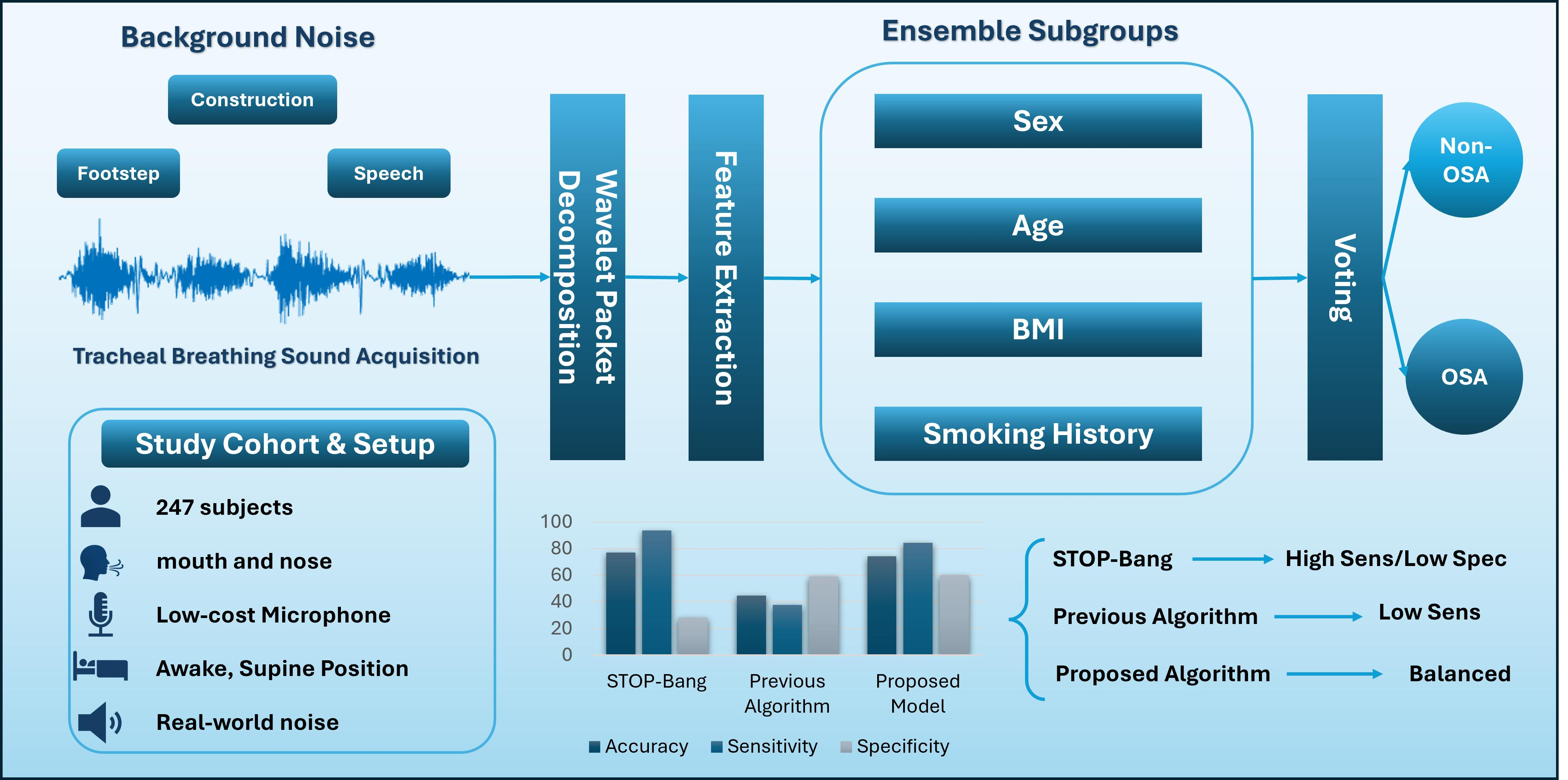
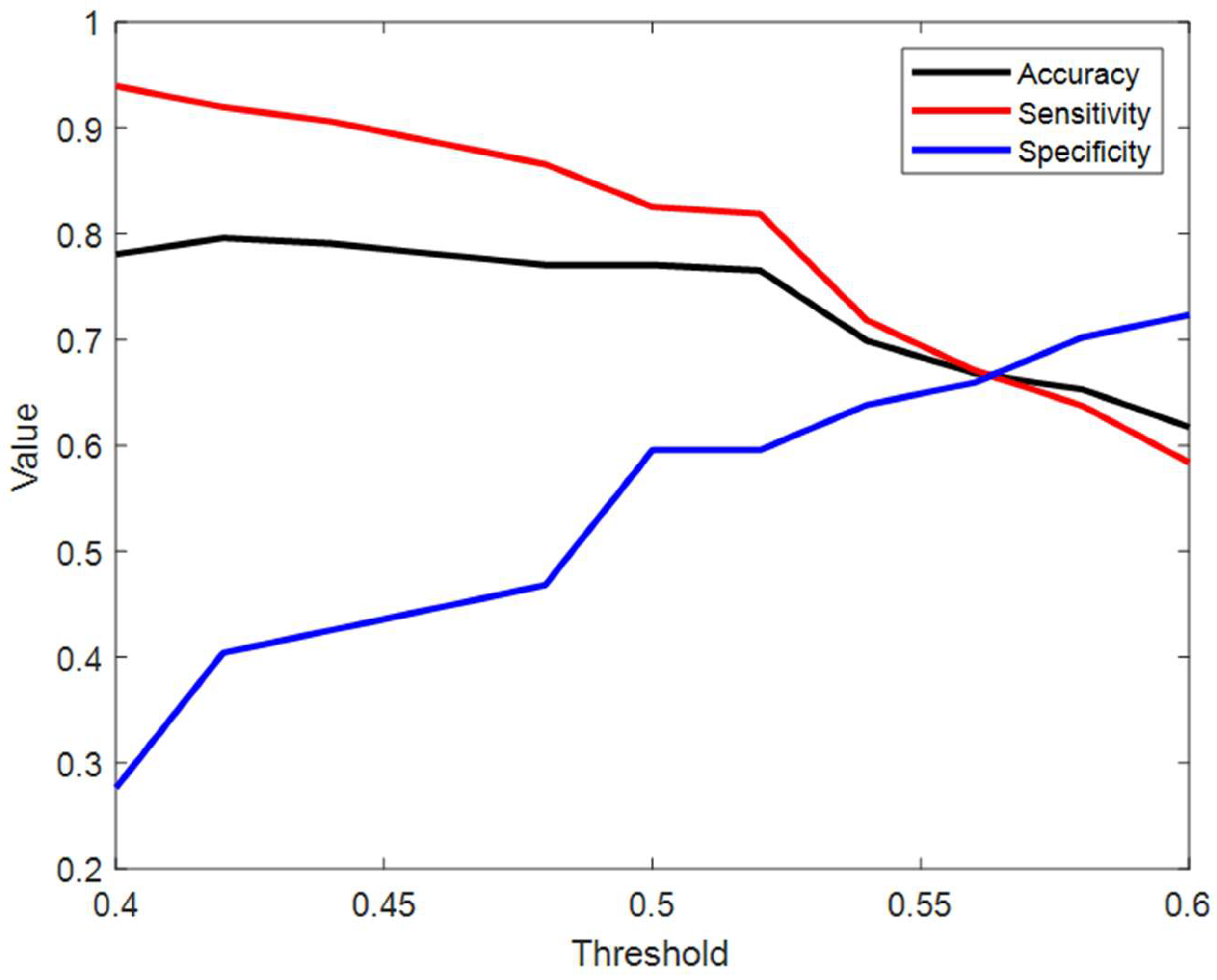
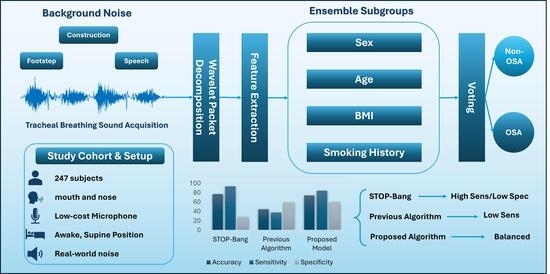
- A two-level ensemble machine learning framework using awake tracheal breathing sounds achieved 77.1% accuracy, 84.3% sensitivity, and 59.9% specificity in a noisy recording environment.
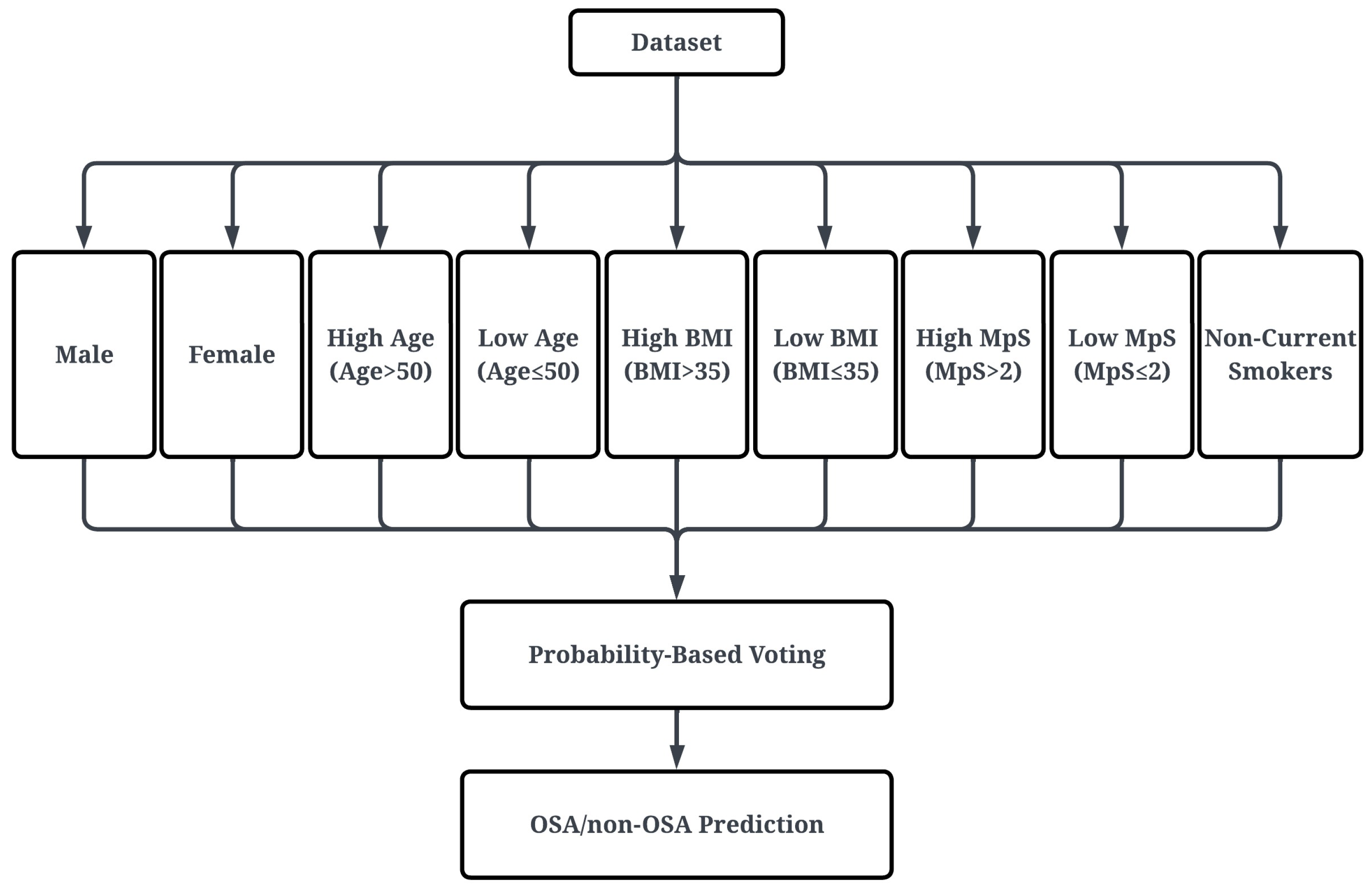
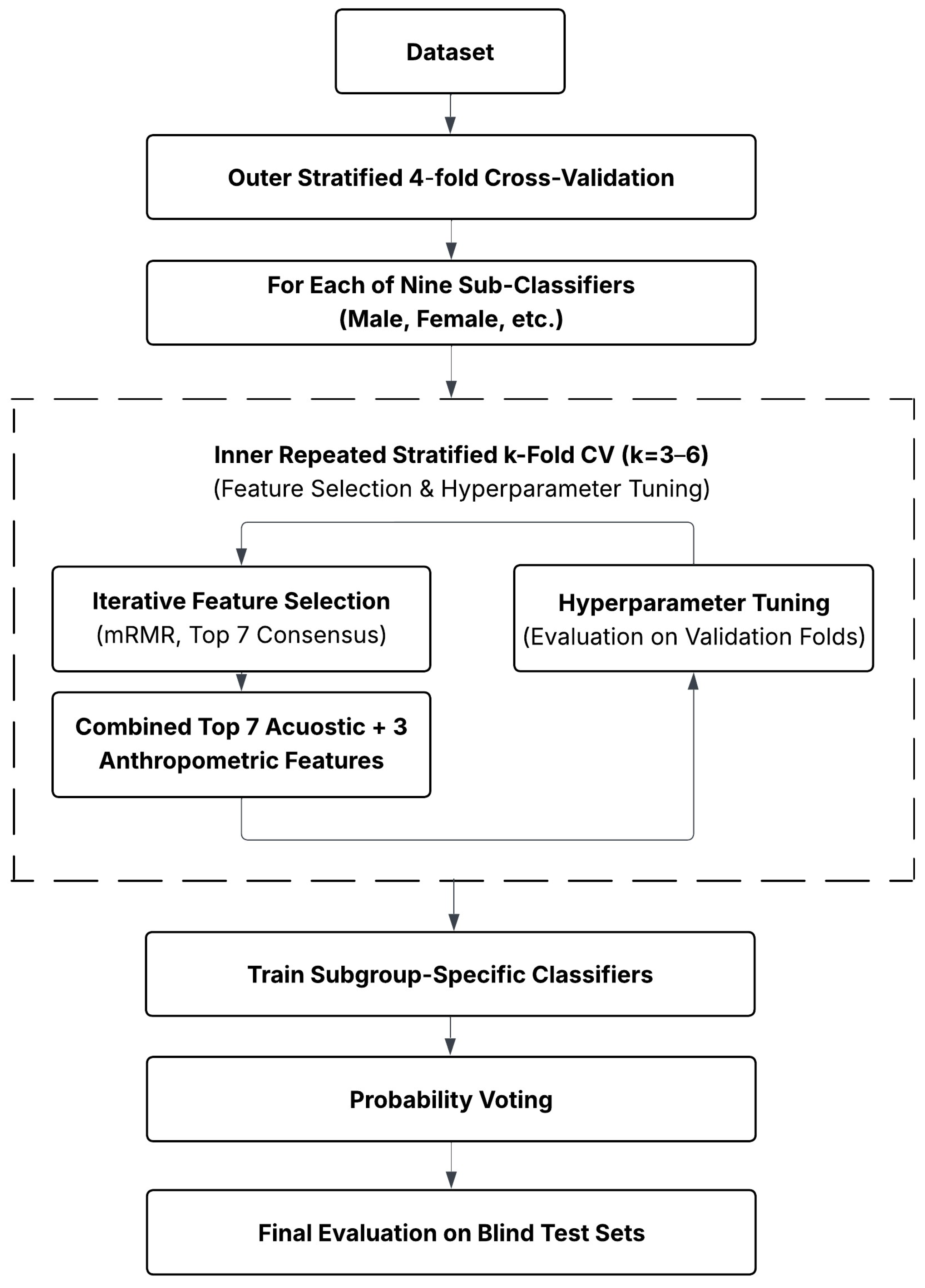
- Stratifying nine sub-classifiers by anthropometric profiles and aggregating predictions using probability-based voting improved robustness under real-world noise.
- The results support feasible awake OSA screening in noisy, real-world recordings, motivating further validation on larger and more balanced cohorts.
- The framework’s high sensitivity suggests its effectiveness as a primary screening tool to prioritize at-risk patients for confirmatory clinical diagnosis.
Abstract
1. Introduction
2. Materials and Methods
2.1. Data Collection
2.2. Data Preparation
2.3. Data Preprocessing
2.4. Feature Extraction
2.5. Sub-Classifier Definition
2.6. Training Strategy
3. Results
3.1. Final Predictive Feature Set
3.2. Performance Across Four Folds
3.3. Probability-Based Voting vs. Majority Voting
3.4. Leave-One-Subgroup-Out Analysis
3.5. Comparison with Previous Algorithms
3.6. Confusion Matrix Analysis
4. Discussion
4.1. Feature Relevance and Physiological Interpretability
4.2. Ensemble Fusion Strategies
4.3. Algorithm Performance
4.4. Error Analysis
4.5. Limitations and Future Directions
5. Conclusions
Author Contributions
Funding
Institutional Review Board Statement
Informed Consent Statement
Data Availability Statement
Conflicts of Interest
Abbreviations
| OSA | Obstructive sleep apnea |
| BMI | Body mass index |
| MpS | Mallampati score |
| PSG | polysomnography |
| AHI | Apnea-Hypopnea index |
| HSAT | Home sleep apnea testing |
| ESS | Epworth Sleepiness Scale |
| TBS | Tracheal breathing sound |
| SNR | Signal-to-noise ratio |
| WPD | Wavelet packet decomposition |
| mRMR | Minimum redundancy maximum relevance |
| AUC | Area under the curve |
| LOSO | Leave-one-subgroup-out |
| EFL | Expiratory flow limitation |
References
- Veasey, S.C.; Rosen, I.M. Obstructive Sleep Apnea in Adults. N. Engl. J. Med. 2019, 380, 1442–1449. [Google Scholar] [CrossRef]
- Qureshi, A.; Ballard, R.D.; Nelson, H.S. Obstructive Sleep Apnea. J. Allergy Clin. Immunol. 2003, 112, 643–651. [Google Scholar] [CrossRef] [PubMed]
- Ho, M.L.; Brass, S.D. Obstructive Sleep Apnea. Neurol. Int. 2011, 3, e15. [Google Scholar] [CrossRef] [PubMed]
- Marin, J.M.; Carrizo, S.J.; Vicente, E.; Agusti, A.G. Long-Term Cardiovascular Outcomes in Men with Obstructive Sleep Apnoea-Hypopnoea with or without Treatment with Continuous Positive Airway Pressure: An Observational Study. Lancet 2005, 365, 1046–1053. [Google Scholar] [CrossRef]
- Benjafield, A.V.; Ayas, N.T.; Eastwood, P.R.; Heinzer, R.; Ip, M.S.M.; Morrell, M.J.; Nunez, C.M.; Patel, S.R.; Penzel, T.; Pépin, J.-L.; et al. Estimation of the Global Prevalence and Burden of Obstructive Sleep Apnoea: A Literature-Based Analysis. Lancet Respir. Med. 2019, 7, 687–698. [Google Scholar] [CrossRef]
- Sönmez, I.; Vo Dupuy, A.; Yu, K.S.; Cronin, J.; Yee, J.; Azarbarzin, A. Unmasking Obstructive Sleep Apnea: Estimated Prevalence and Impact in the United States. Respir. Med. 2025, 248, 108348. [Google Scholar] [CrossRef]
- Watson, N.; Yu, K.; Campbell, D.; Bloudek, L.; Yee, J.; Cronin, J.; Azofra, A.S.; Boskovic, N. 0637 Prevalence and Unmet Need of Obstructive Sleep Apnea in the United States. Sleep 2025, 48, A278. [Google Scholar] [CrossRef]
- Bonsignore, M.R.; Saaresranta, T.; Riha, R.L. Sex Differences in Obstructive Sleep Apnoea. Eur. Respir. Rev. 2019, 28, 190030. [Google Scholar] [CrossRef]
- Leppänen, T.; Kulkas, A.; Duce, B.; Mervaala, E.; Töyräs, J. Severity of Individual Obstruction Events Is Gender Dependent in Sleep Apnea. Sleep Breath. 2017, 21, 397–404. [Google Scholar] [CrossRef]
- Kapsimalis, F.; Kryger, M.H. Gender and Obstructive Sleep Apnea Syndrome, Part 1: Clinical Features. Sleep 2002, 25, 412–419. [Google Scholar] [CrossRef]
- Osorio, R.S.; Martínez-García, M.Á.; Rapoport, D.M. Sleep Apnoea in the Elderly: A Great Challenge for the Future. Eur. Respir. J. 2022, 59, 2101649. [Google Scholar] [CrossRef] [PubMed]
- Ernst, G.; Mariani, J.; Blanco, M.; Finn, B.; Salvado, A.; Borsini, E. Increase in the Frequency of Obstructive Sleep Apnea in Elderly People. Sleep Sci. 2019, 12, 222–226. [Google Scholar] [CrossRef] [PubMed]
- Young, T.; Peppard, P.E.; Gottlieb, D.J. Epidemiology of Obstructive Sleep Apnea: A Population Health Perspective. Am. J. Respir. Crit. Care Med. 2002, 165, 1217–1239. [Google Scholar] [CrossRef]
- Vgontzas, A.N.; Tan, T.L.; Bixler, E.O.; Martin, L.F.; Shubert, D.; Kales, A. Sleep Apnea and Sleep Disruption in Obese Patients. Arch. Intern. Med. 1994, 154, 1705–1711. [Google Scholar] [CrossRef]
- Peppard, P.E.; Young, T.; Palta, M.; Dempsey, J.; Skatrud, J. Longitudinal Study of Moderate Weight Change and Sleep-Disordered Breathing. JAMA 2000, 284, 3015–3021. [Google Scholar] [CrossRef]
- Kumar, H.V.M.; Schroeder, J.W.; Gang, Z.; Sheldon, S.H. Mallampati Score and Pediatric Obstructive Sleep Apnea. J. Clin. Sleep Med. 2014, 10, 985–990. [Google Scholar] [CrossRef]
- Nuckton, T.J.; Glidden, D.V.; Browner, W.S.; Claman, D.M. Physical Examination: Mallampati Score as an Independent Predictor of Obstructive Sleep Apnea. Sleep 2006, 29, 903–908. [Google Scholar] [CrossRef]
- Wetter, D.W.; Young, T.B.; Bidwell, T.R.; Badr, M.S.; Palta, M. Smoking as a Risk Factor for Sleep-Disordered Breathing. Arch. Intern. Med. 1994, 154, 2219–2224. [Google Scholar] [CrossRef]
- Zeng, X.; Ren, Y.; Wu, K.; Yang, Q.; Zhang, S.; Wang, D.; Luo, Y.; Zhang, N. Association Between Smoking Behavior and Obstructive Sleep Apnea: A Systematic Review and Meta-Analysis. Nicotine Tob. Res. 2023, 25, 364–371. [Google Scholar] [CrossRef]
- Najafabadi, V.B.; Moussavi, Z. The Impact of Smoking Status on Obstructive Sleep Apnea: Insights from Anthropometric and Physiological Covariates*. In Proceedings of the 2025 47th Annual International Conference of the IEEE Engineering in Medicine and Biology Society (EMBC), Copenhagen, Denmark, 14–18 July 2025; IEEE: New York, NY, USA, 2025; pp. 1–5. [Google Scholar]
- Borsini, E.; Nogueira, F.; Nigro, C. Apnea-Hypopnea Index in Sleep Studies and the Risk of over-Simplification. Sleep Sci. 2018, 11, 45–48. [Google Scholar] [CrossRef]
- Markun, L.C.; Sampat, A. Clinician-Focused Overview and Developments in Polysomnography. Curr. Sleep Med. Rep. 2020, 6, 309–321. [Google Scholar] [CrossRef]
- Hossain, J.L.; Shapiro, C.M. The Prevalence, Cost Implications, and Management of Sleep Disorders: An Overview. Sleep Breath. 2002, 6, 85–102. [Google Scholar] [CrossRef]
- Flemons, W.W.; Douglas, N.J.; Kuna, S.T.; Rodenstein, D.O.; Wheatley, J. Access to Diagnosis and Treatment of Patients with Suspected Sleep Apnea. Am. J. Respir. Crit. Care Med. 2004, 169, 668–672. [Google Scholar] [CrossRef] [PubMed]
- Kapur, V.K.; Auckley, D.H.; Chowdhuri, S.; Kuhlmann, D.C.; Mehra, R.; Ramar, K.; Harrod, C.G. Clinical Practice Guideline for Diagnostic Testing for Adult Obstructive Sleep Apnea: An American Academy of Sleep Medicine Clinical Practice Guideline. J. Clin. Sleep Med. 2017, 13, 479–504. [Google Scholar] [CrossRef] [PubMed]
- Rosen, I.M.; Kirsch, D.B.; Chervin, R.D.; Carden, K.A.; Ramar, K.; Aurora, R.N.; Kristo, D.A.; Malhotra, R.K.; Martin, J.L.; Olson, E.J.; et al. Clinical Use of a Home Sleep Apnea Test: An American Academy of Sleep Medicine Position Statement. J. Clin. Sleep Med. 2017, 13, 1205–1207. [Google Scholar] [CrossRef]
- El Shayeb, M.; Topfer, L.-A.; Stafinski, T.; Pawluk, L.; Menon, D. Diagnostic Accuracy of Level 3 Portable Sleep Tests versus Level 1 Polysomnography for Sleep-Disordered Breathing: A Systematic Review and Meta-Analysis. Can. Med. Assoc. J. 2014, 186, E25–E51. [Google Scholar] [CrossRef]
- Chung, F.; Abdullah, H.R.; Liao, P. STOP-Bang Questionnaire: A Practical Approach to Screen for Obstructive Sleep Apnea. Chest 2016, 149, 631–638. [Google Scholar] [CrossRef]
- Johns, M.W. A New Method for Measuring Daytime Sleepiness: The Epworth Sleepiness Scale. Sleep 1991, 14, 540–545. [Google Scholar] [CrossRef]
- Abrishami, A.; Khajehdehi, A.; Chung, F. A Systematic Review of Screening Questionnaires for Obstructive Sleep Apnea. Can. J. Anesth. J. Can. D’anesthésie 2010, 57, 423–438. [Google Scholar] [CrossRef]
- Cao, S.; Rosenzweig, I.; Bilotta, F.; Jiang, H.; Xia, M. Automatic Detection of Obstructive Sleep Apnea Based on Speech or Snoring Sounds: A Narrative Review. J. Thorac. Dis. 2024, 16, 2654–2667. [Google Scholar] [CrossRef]
- Park, J.-Y.; Shin, H.-R.; Kim, M.H.; Kim, Y.; Ryu, W.-S.; Kim, E.Y.; Chang, H.; Lee, W.-J.; Kim, J.H.; Kim, T.-J. A Novel Machine Learning Model for Screening the Risk of Obstructive Sleep Apnea Using Craniofacial Photography with Questionnaires. J. Clin. Sleep Med. 2025, 21, 843–854. [Google Scholar] [CrossRef] [PubMed]
- Alqudah, A.M.; Elwali, A.; Kupiak, B.; Hajipour, F.; Jacobson, N.; Moussavi, Z. Obstructive Sleep Apnea Detection during Wakefulness: A Comprehensive Methodological Review. Med. Biol. Eng. Comput. 2024, 62, 1277–1311. [Google Scholar] [CrossRef] [PubMed]
- Pasterkamp, H.; Kraman, S.S.; Wodicka, G.R. Respiratory Sounds: Advances beyond the Stethoscope. Am. J. Respir. Crit. Care Med. 1997, 156, 974–987. [Google Scholar] [CrossRef]
- Sola-Soler, J.; Fiz, J.A.; Torres, A.; Jane, R. Identification of Obstructive Sleep Apnea Patients from Tracheal Breath Sound Analysis during Wakefulness in Polysomnographic Studies. In Proceedings of the 2014 36th Annual International Conference of the IEEE Engineering in Medicine and Biology Society, Chicago, IL, USA, 26–30 August 2014; IEEE: New York, NY, USA, 2014; pp. 4232–4235. [Google Scholar]
- Alqudah, A.M.; Moussavi, Z. Deep Learning Model for OSA Detection Using Tracheal Breathing Sounds During Wakefulness. CMBES Proc. 2023, 45. [Google Scholar]
- Alqudah, A.; Moussavi, Z. Assessing Obstructive Sleep Apnea Severity During Wakefulness via Tracheal Breathing Sound Analysis. Sensors 2025, 25, 6280. [Google Scholar] [CrossRef]
- Elwali, A.; Moussavi, Z. Determining Breathing Sound Features Representative of Obstructive Sleep Apnea During Wakefulness with Least Sensitivity to Other Risk Factors. J. Med. Biol. Eng. 2019, 39, 230–237. [Google Scholar] [CrossRef]
- Elwali, A.; Moussavi, Z. Obstructive Sleep Apnea Screening and Airway Structure Characterization During Wakefulness Using Tracheal Breathing Sounds. Ann. Biomed. Eng. 2017, 45, 839–850. [Google Scholar] [CrossRef]
- Elwali, A.; Moussavi, Z. A Novel Decision Making Procedure during Wakefulness for Screening Obstructive Sleep Apnea Using Anthropometric Information and Tracheal Breathing Sounds. Sci. Rep. 2019, 9, 11467. [Google Scholar] [CrossRef]
- Harper, P.; Kraman, S.S.; Pasterkamp, H.; Wodicka, G.R. An Acoustic Model of the Respiratory Tract. IEEE Trans. Biomed. Eng. 2001, 48, 543–550. [Google Scholar] [CrossRef]
- Moussavi, Z.; Elwali, A.; Soltanzadeh, R.; MacGregor, C.A.; Lithgow, B. Breathing Sounds Characteristics Correlate with Structural Changes of Upper Airway Due to Obstructive Sleep Apnea. In Proceedings of the 2015 37th Annual International Conference of the IEEE Engineering in Medicine and Biology Society (EMBC), Milan, Italy, 25–29 August 2015; IEEE: New York, NY, USA, 2015; pp. 5956–5959. [Google Scholar]
- Peng, H.; Long, F.; Ding, C. Feature Selection Based on Mutual Information Criteria of Max-Dependency, Max-Relevance, and Min-Redundancy. IEEE Trans. Pattern Anal. Mach. Intell. 2005, 27, 1226–1238. [Google Scholar] [CrossRef]
- Remmers, J.E.; deGroot, W.J.; Sauerland, E.K.; Anch, A.M. Pathogenesis of Upper Airway Occlusion during Sleep. J. Appl. Physiol. 1978, 44, 931–938. [Google Scholar] [CrossRef] [PubMed]
- Jing, H.; Wang, Y.; Wang, L.; Choi, S.; Xi, Z.; Cui, X. Analyzing the Inspiratory Airflow Unsteadiness in the Respiratory Tract Using Dynamic Mode Decomposition Method. Phys. Fluids 2024, 36, 101910. [Google Scholar] [CrossRef]
- Jing, H.; Ge, H.; Tang, H.; Farnoud, A.; Islam, M.S.; Wang, L.; Wang, C.; Cui, X. Assessing Airflow Unsteadiness in the Human Respiratory Tract under Different Expiration Conditions. J. Biomech. 2024, 162, 111910. [Google Scholar] [CrossRef]
- Stanescu, D.; Kostianev, S.; Sanna, A.; Liistro, G.; Veriter, C. Expiratory Flow Limitation during Sleep in Heavy Snorers and Obstructive Sleep Apnoea Patients. Eur. Respir. J. 1996, 9, 2116–2121. [Google Scholar] [CrossRef]
- Sanchez, I.; Pasterkamp, H. Tracheal Sound Spectra Depend on Body Height. Am. Rev. Respir. Dis. 1993, 148, 1083–1087. [Google Scholar] [CrossRef]
- Mohsenin, V. Effects of Gender on Upper Airway Collapsibility and Severity of Obstructive Sleep Apnea. Sleep Med. 2003, 4, 523–529. [Google Scholar] [CrossRef]
- Wimms, A.; Woehrle, H.; Ketheeswaran, S.; Ramanan, D.; Armitstead, J. Obstructive Sleep Apnea in Women: Specific Issues and Interventions. Biomed. Res. Int. 2016, 2016, 1764837. [Google Scholar] [CrossRef]
- Schwartz, A.R.; Patil, S.P.; Squier, S.; Schneider, H.; Kirkness, J.P.; Smith, P.L. Obesity and Upper Airway Control during Sleep. J. Appl. Physiol. 2010, 108, 430–435. [Google Scholar] [CrossRef]
- Mittman, C.; Edelman, N.H.; Norris, A.H.; Shock, N.W. Relationship between Chest Wall and Pulmonary Compliance and Age. J. Appl. Physiol. 1965, 20, 1211–1216. [Google Scholar] [CrossRef]
- Bailer, M.; Sprügel, M.I.; Stein, E.M.; Utz, J.; Mestermann, S.; Spitzer, P.; Kornhuber, J. Diagnostic Accuracy of Screening Questionnaires for Obstructive Sleep Apnea in Psychiatric Patients. J. Psychiatr. Res. 2025, 186, 280–288. [Google Scholar] [CrossRef]
- Schwartz, A.R.; Smith, P.L.; Wise, R.A.; Bankman, I.; Permutt, S. Effect of Positive Nasal Pressure on Upper Airway Pressure-Flow Relationships. J. Appl. Physiol. 1989, 66, 1626–1634. [Google Scholar] [CrossRef] [PubMed]
- Opsahl, U.L.; Berge, M.; Lehmann, S.; Bjorvatn, B.; Opsahl, P.; Johansson, A. Acoustic Pharyngometry—A New Method to Facilitate Oral Appliance Therapy. J. Oral Rehabil. 2021, 48, 601–613. [Google Scholar] [CrossRef]
- Vana, K.D.; Silva, G.E.; Carreon, J.D.; Quan, S.F. Using Anthropometric Measures to Screen for Obstructive Sleep Apnea in the Sleep Heart Health Study Cohort. J. Clin. Sleep Med. 2021, 17, 1635–1643. [Google Scholar] [CrossRef]
- Ozturk, N.A.A.; Dilektasli, A.G.; Cetinoglu, E.D.; Ursavas, A.; Karadag, M. Diagnostic Accuracy of a Modified STOP-BANG Questionnaire with National Anthropometric Obesity Indexes. Turk. Thorac. J. 2019, 20, 103–107. [Google Scholar] [CrossRef]



| Class | n | Age | Sex (M/F) | BMI | MpS (I, II, III, IV) | Smoking History (Never, Former, Current) | AHI |
|---|---|---|---|---|---|---|---|
| OSA | 149 | 48.1 ± 12.0 | (99, 50) | 35.9 ± 8.9 | (32, 26, 38, 53) | (85, 37, 28) | 42.6 ± 26.7 |
| Non-OSA | 47 | 44.1 ± 13.0 | (19, 28) | 31.9 ± 6.8 | (10, 11, 17, 9) | (34, 6, 7) | 5.7 ± 2.6 |
| Category | Feature List |
|---|---|
| Statistical | 1. Mean, 2. Variance, 3. Std Deviation, 4. Energy, 5. Median |
| Higher-Order | 6. Skewness, 7. Kurtosis |
| Temporal | 8. Zero-Crossing Rate |
| Spectral | 9. Centroid, 10. Spread, 11. Skewness, 12. Kurtosis, 13. Entropy |
| Complexity | 14. Shannon Entropy, 15. Tsallis entropy, 16. Rényi Entropy |
| Subgroup | OSA | Non-OSA | Ratio * |
|---|---|---|---|
| Male | 99 | 19 | 5.21 |
| Female | 50 | 28 | 1.79 |
| High Age | 64 | 18 | 3.56 |
| Low Age | 85 | 29 | 2.93 |
| High BMI | 66 | 11 | 6.00 |
| Low BMI | 83 | 36 | 2.31 |
| High MpS | 91 | 26 | 3.50 |
| Low MpS | 58 | 21 | 2.76 |
| Non-Current Smokers | 121 | 40 | 3.03 |
| Feature No. | Sub-Classifier | Descriptor | Maneuver | Frequency Range (Hz) |
|---|---|---|---|---|
| 9 | Male | Spectral Centroid | MI | 0–172 |
| 473 | Male | Spectral Centroid | NI | 1550–1722 |
| 276 | Male | Kurtosis | ME | 1206–1378 |
| 412 | Female | Spectral Entropy | NI | 861–1033 |
| 410 | Female—Low BMI | Spectral Kurtosis | NI | 861–1033 |
| 616 | High Age | Median | NE | 1378–1550 |
| 373 | High Age | Standard Deviation | NI | 517–689 |
| 522 | Low Age | Spectral Kurtosis | NE | 344–517 |
| 362 | High BMI | Spectral Kurtosis | NI | 344–517 |
| 113 | Low BMI | Mean | MI | 1206–1378 |
| 628 | High MpS | Kurtosis | NE | 1550–1723 |
| 599 | Low MpS– Non-Current Smokers | Zero-Crossing Rate | NE | 1206–1723 |
| Metric | Fold 1 | Fold 2 | Fold 3 | Fold 4 | Average |
|---|---|---|---|---|---|
| Balanced Accuracy | 74.5 | 68.4 | 72.4 | 69.6 | 72.1 ± 2.0 |
| Accuracy | 75.5 | 73.5 | 79.6 | 79.6 | 77.1 ± 3.1 |
| Sensitivity | 76.3 | 78.4 | 86.5 | 89.2 | 84.3 ± 5.8 |
| Specificity | 72.7 | 58.3 | 58.3 | 50.0 | 59.9 ± 9.4 |
| AUC | 0.80 | 0.78 | 0.74 | 0.74 | 0.77 ± 0.01 |
| Metric | Fold 1 | Fold 2 | Fold 3 | Fold 4 | Average |
|---|---|---|---|---|---|
| Balanced Accuracy | 78.5 | 66.9 | 72.4 | 66.9 | 71.2 ± 5.5 |
| Accuracy | 81.6 | 75.5 | 79.6 | 75.5 | 78.1 ± 3.1 |
| Sensitivity | 84.2 | 83.8 | 86.5 | 83.8 | 84.6 ± 1.3 |
| Specificity | 72.7 | 50.0 | 58.3 | 50.0 | 57.8 ± 10.7 |
| Sub-Classifier | Balanced Accuracy | Accuracy | Sensitivity | Specificity |
|---|---|---|---|---|
| Male | 68.9 | 74.0 | 79.2 | 57.8 |
| Female | 67.4 | 73.5 | 79.2 | 55.7 |
| High Age | 70.5 | 77.0 | 83.3 | 57.8 |
| Low Age | 71.2 | 77.0 | 82.6 | 59.9 |
| High BMI | 68.2 | 73.5 | 78.5 | 57.8 |
| Low BMI | 69.5 | 76.5 | 83.3 | 55.7 |
| High MpS | 71.2 | 77.0 | 83.6 | 59.9 |
| Low MpS | 70.2 | 76.5 | 82.6 | 57.8 |
| Non-Current Smokers | 68.3 | 77.6 | 85.2 | 51.3 |
| Algorithm | Balanced Accuracy | Accuracy | Sensitivity | Specificity |
|---|---|---|---|---|
| STOP-Bang [28] | 60.9 ± 3.4 | 76.9 ± 2.2 | 93.6 ± 2.5 | 28.3 ± 3.1 |
| AWakeOSA [40] | 48.4 ± 1.9 | 44.9 ± 6.1 | 37.8 ± 3.6 | 59.1 ± 5.7 |
| Global Bagged Trees | 56.6 ± 4.7 | 78.6 ± 1.2 | 98.7 ± 1.6 | 14.6 ± 10.5 |
| Proposed Framework | 72.1 ± 2.0 | 77.1 ± 3.1 | 84.3 ± 5.8 | 59.9 ± 9.4 |
| Parameters | Correct OSA | Correct Non-OSA | False Negative | False Positive |
|---|---|---|---|---|
| n | 123 | 28 | 26 | 19 |
| Male (%) | 75.6 | 25 | 23.1 | 63.1 |
| Age | 47.7 ± 12.0 | 43.9 ± 13.3 | 50.2 ± 2.8 | 46.3 ± 12.9 |
| BMI (kg/m2) | 36.8 ± 7.1 | 31.7 ± 6.8 | 31.9 ± 5.2 | 32.3 ± 7.1 |
| Current Smokers (%) | 20.3 | 21.4 | 22.5 | 5.3 |
| Neck Circumference | 44.7 ± 4.9 | 38.3 ± 3.8 | 38.5 ± 2.8 | 40.3 ± 3.2 |
| MpS | (25, 22, 34, 42) | (5, 8, 10, 5) | (7, 4, 4, 11) | (5, 3, 7, 4) |
| Snoring (%) | 96.8 | 85.7 | 92.3 | 84.2 |
| Receding Mandible | (4, 116, 3) | (3, 23, 2) | (0, 23, 3) | (1, 71, 1) |
| AHI | 44.7 ± 28.0 | 5.3 ± 2.6 | 32.3 ± 15.5 | 6.3 ± 2.5 |
Disclaimer/Publisher’s Note: The statements, opinions and data contained in all publications are solely those of the individual author(s) and contributor(s) and not of MDPI and/or the editor(s). MDPI and/or the editor(s) disclaim responsibility for any injury to people or property resulting from any ideas, methods, instructions or products referred to in the content. |
© 2026 by the authors. Licensee MDPI, Basel, Switzerland. This article is an open access article distributed under the terms and conditions of the Creative Commons Attribution (CC BY) license.
Share and Cite
Bastani Najafabadi, V.; Ashraf, W.; Elwali, A.; Moussavi, Z. A Two-Level Ensemble Machine Learning Framework for OSA Classification Whilst Awake from Noisy Tracheal Breathing Sounds. Sensors 2026, 26, 1349. https://doi.org/10.3390/s26041349
Bastani Najafabadi V, Ashraf W, Elwali A, Moussavi Z. A Two-Level Ensemble Machine Learning Framework for OSA Classification Whilst Awake from Noisy Tracheal Breathing Sounds. Sensors. 2026; 26(4):1349. https://doi.org/10.3390/s26041349
Chicago/Turabian StyleBastani Najafabadi, Vahid, Walid Ashraf, Ahmed Elwali, and Zahra Moussavi. 2026. "A Two-Level Ensemble Machine Learning Framework for OSA Classification Whilst Awake from Noisy Tracheal Breathing Sounds" Sensors 26, no. 4: 1349. https://doi.org/10.3390/s26041349
APA StyleBastani Najafabadi, V., Ashraf, W., Elwali, A., & Moussavi, Z. (2026). A Two-Level Ensemble Machine Learning Framework for OSA Classification Whilst Awake from Noisy Tracheal Breathing Sounds. Sensors, 26(4), 1349. https://doi.org/10.3390/s26041349