Article

Fluorescence Analysis of Local Microenvironments in Polymer Films Using Solvatochromic Dyes

Department of Chemical Science and Engineering, Institute of Science Tokyo, Tokyo 152-8552, Japan
*
Author to whom correspondence should be addressed.
Sensors 2026, 26(4), 1346; https://doi.org/10.3390/s26041346
Submission received: 29 January 2026 / Revised: 18 February 2026 / Accepted: 19 February 2026 / Published: 20 February 2026

Abstract

Polymer films and polymer blend films are widely used as functional materials; however, their photophysical behavior cannot be fully explained solely by bulk properties such as relative permittivity or glass transition temperature. In this study, we investigate how local polymer microenvironments regulate fluorescence responses by employing two strongly emissive solvatochromic dyes—FπPCM, a D–π–A-type π-conjugation-extended fluorene dye, and PK, a D–π–A-type pyrene dye—as molecular probes. The photophysical properties of these dyes were systematically examined in a series of transparent polymer matrices, including polystyrene, polycarbonate, poly(methyl methacrylate), poly(vinyl chloride), triacetylcellulose, poly(butyl methacrylate), and poly(2-ethyl-2-oxazoline). Polymer films containing the dyes were prepared by solution casting from homogeneous polymer–dye solutions onto quartz substrates followed by solvent evaporation. Both dyes exhibited polymer-dependent variations in fluorescence wavelength, quantum yield, and lifetime, reflecting not only differences in polymer polarity but also local chain packing and specific dye–polymer interactions. Fluorescence lifetime analysis of PS/POz blend films revealed microscopic heterogeneity even in miscible systems, quantitatively captured using averaged lifetime parameters. Temperature-dependent fluorescence measurements further demonstrated that thermal history and structural relaxation significantly influence local polymer environments. In particular, ratiometric fluorescence analysis of PMMA/PBMA blend films enabled reproducible temperature sensing over a wide range from 30 to 120 °C, despite an overall negative temperature response. These results establish solvatochromic dyes as versatile optical probes for evaluating local polymer microenvironments and highlight their potential for polymer-state monitoring and fluorescence-based temperature-sensing applications.

Graphical Abstract

1. Introduction

Polymer films and polymer blend films are widely used in diverse applications such as optical waveguides [1] and solar cells [2]. However, their functional performance cannot always be rationalized solely by bulk parameters such as relative permittivity (εr), glass transition temperature (Tg), and elastic modulus. In practical systems, fluorescence behavior is strongly influenced by the local environments surrounding embedded molecules, including local polarity, segmental mobility of polymer chains, microscopic heterogeneity (e.g., local composition fluctuations that may arise even in thermodynamically miscible systems), and structural relaxation associated with thermal history and annealing. Therefore, experimental strategies capable of probing polymer microenvironments under realistic operating conditions are increasingly required.
For polymer film characterization, various analytical techniques have been widely employed. Differential scanning calorimetry (DSC) has been extensively used to evaluate Tg and miscibility in polymer blends through composition-dependent Tg shifts [3,4,5]. Dynamic mechanical analysis (DMA) provides complementary information by enabling the detection of phase separation that may not be observable by DSC and allowing quantitative evaluation of viscoelastic relaxation dynamics, including storage modulus evolution and free-volume-related parameters [6,7,8]. Structural ordering and crystallinity have been investigated using X-ray diffraction (XRD) and grazing-incidence (GI) scattering techniques [9,10,11], while atomic force microscopy (AFM) has been widely applied to visualize surface morphology and nanoscale phase-separation features in polymer films [12,13]. Despite these advances, most techniques provide bulk-averaged or static structural information and do not directly reflect excited-state environments experienced by emissive probes, such as local polarity, specific intermolecular interactions, and local dynamics. This limitation becomes particularly significant in polymer blends, where multiple microenvironments can coexist on microscopic length scales, making it difficult to quantitatively rationalize emission behavior using a single εr or a single Tg value. Moreover, non-destructive optical methods capable of tracking dynamic structural changes induced by thermal history remain limited.
In recent years, fluorescent dyes have attracted increasing attention not only as sensitive and non-destructive probes in bioimaging [14,15,16,17,18,19,20,21,22,23], but also as molecular reporters embedded in condensed-phase materials such as polymer films and gels, where environmental responsiveness can be exploited to visualize internal material states [24,25,26,27,28,29,30,31]. In polymer films, fluorescent probes have been widely used to report local polarity and specific intermolecular interactions through solvatochromic emission shifts [32,33,34]. In addition, macromolecular orientation and packing of polymer matrices can modulate emission wavelengths and spectral shapes via anisotropic microenvironments and dye alignment effects [35]. In gels, fluorescence probes have enabled visualization of phase transitions and local suppression of molecular motion, providing optical access to dynamic microenvironments [36,37]. Furthermore, mechanoresponsive fluorescence responses, including mechanofluorochromism arising from aggregate reorganization or mechanophore activation, have been reported [38,39,40]. These studies highlight fluorescence spectroscopy as a versatile optical sensing strategy for probing condensed-phase microenvironments.
Among these probes, solvatochromic dyes are particularly attractive because they respond sensitively to environmental polarity and report excited-state stabilization—especially of intramolecular charge-transfer (ICT) states—through changes in fluorescence wavelength, quantum yield, and lifetime [41,42]. Such multidimensional optical responses make solvatochromic dyes promising candidates for quantitative sensing of polymer microenvironments. Building on our recent findings that temperature-dependent changes in solution can be effectively captured by fluorescence measurements [43], solvatochromic dyes offer a promising platform for optical evaluation of local environments and their temperature responsiveness in polymer films.
In this study, we employed two strongly emissive solvatochromic dyes previously reported by our group: FπPCM, a D–π–A-type π-conjugation-extended fluorene dye [44,45], and PK [46,47,48,49], a D–π–A-type pyrene dye. Their photophysical properties—including fluorescence wavelength, quantum yield, and fluorescence lifetime—were systematically compared in a series of transparent polymer matrices, namely polystyrene (PS), polycarbonate (PC), poly(methyl methacrylate) (PMMA), poly(vinyl chloride) (PVC), triacetylcellulose (TAC), poly(butyl methacrylate) (PBMA), and poly(oxazoline) (POz). Furthermore, using PS/POz blend films as a model system, we discuss how microscopic heterogeneity in miscible blends influences fluorescence lifetime behavior based on averaged lifetime analysis. We also investigate thermal-history effects and demonstrate ratiometric fluorescence thermometry in PMMA/PBMA blend films, extending solvatochromic dyes beyond conventional polarity probes toward optical sensing of polymer microenvironment dynamics and temperature.

2. Materials and Methods

2.1. Materials and Sample Preparation

In this study, commonly used transparent polymer matrices were employed, including polystyrene (PS, Mw = 35,000, Sigma-Aldrich (Tokyo, Japan)), polycarbonate (PC, BPA-PC, Mw = 64,000, Sigma-Aldrich (Tokyo, Japan)), poly(methyl methacrylate) (PMMA, Mw = 100,000, FUJIFILM Wako Pure Chemical Corporation (Tokyo, Japan)), poly(vinyl chloride) (PVC, Mw = 50,000–75,000, Kanto Chemical Co., Inc. (Tokyo, Japan)), triacetylcellulose (TAC, FUJIFILM Wako Pure Chemical Corporation (Tokyo, Japan)), poly(butyl methacrylate) (PBMA, Mw = 200,000, Sigma-Aldrich (Tokyo, Japan)), and poly(2-ethyl-2-oxazoline) (POz, Mw ≈ 50,000, Sigma-Aldrich (Tokyo, Japan)). The dye concentration in all polymer films was adjusted to 0.1 wt%. Each polymer and dye were completely dissolved in the corresponding solvent to obtain homogeneous solutions prior to film preparation. PS, BPA-PC, PMMA, PVC, PBMA, and POz were dissolved in tetrahydrofuran (THF), whereas TAC was dissolved in a mixed solvent of dichloromethane/methanol (9/1, v/v). The resulting solutions were cast onto quartz substrates and allowed to dry under ambient conditions to achieve slow solvent evaporation, affording uniform polymer films.
The film thickness was not precisely measured; however, all samples were prepared using identical solution concentrations and casting volumes, resulting in comparable optical densities across different polymer matrices. Because the dye concentration was fixed at 0.1 wt%, the local polymer environment surrounding each dye molecule is expected to be governed primarily by the intrinsic polymer properties rather than macroscopic film thickness variations. To minimize solvent effects on fluorescence properties, the films were dried thoroughly until no further spectral changes were observed. Therefore, the measured fluorescence parameters are considered to reflect the intrinsic polymer microenvironment rather than residual solvent contributions.
Since PS and POz are known to be mutually miscible [50], blend films of PS and POz with mass ratios of 3:1, 1:1, and 1:3 were also prepared. For the PS–POz blend samples, PS and POz were first dissolved in chloroform, followed by reprecipitation by dropwise addition into hexane cooled to 0 °C. The resulting precipitates were collected and dried under vacuum prior to film preparation, and films were subsequently prepared using the same casting procedure described above.

2.2. Photophysical Measurements

Fluorescence lifetimes in solution were measured using an Edinburgh Instruments FS5 spectrofluorometer equipped with a time-correlated single-photon counting (TCSPC) system and an EPL-405 picosecond pulsed diode laser (λex = 402.5 ± 5 nm; pulse width ≈ 75 ps; repetition rate 2.5 kHz–20 MHz). Absolute photoluminescence quantum yields were determined using a Hamamatsu Photonics Quantaurus-QY system. Temperature-dependent fluorescence spectra of polymer films were measured using an Edinburgh Instruments FS5 spectrofluorometer equipped with an SC-50 Optical Fibre Launcher, coupled to a polarized optical microscope (POM; Olympus BX51) and a METTLER TOLEDO FP82HT hot stage controlled by a METTLER TOLEDO FP900 central processor (METTLER TOLEDO, Greifensee, Switzerland).

3. Results

To elucidate how local polymer microenvironments govern the photophysical properties of solvatochromic dyes, we first examine their fluorescence responses in single-component polymer films with systematically varied polarity and chain characteristics. This analysis establishes a baseline framework for interpreting how polymer matrices influence fluorescence wavelength, quantum yield, and lifetime. Building on this foundation, we extend the investigation to polymer blend systems, where microscopic heterogeneity can emerge even under thermodynamically miscible conditions, and evaluate its impact on excited-state dynamics. Finally, we investigate temperature-dependent fluorescence behavior to clarify the effects of thermal history and structural relaxation and to demonstrate the feasibility of ratiometric fluorescence thermometry in polymer blend films.

3.1. Environment-Dependent Fluorescence Properties in Polymer Films

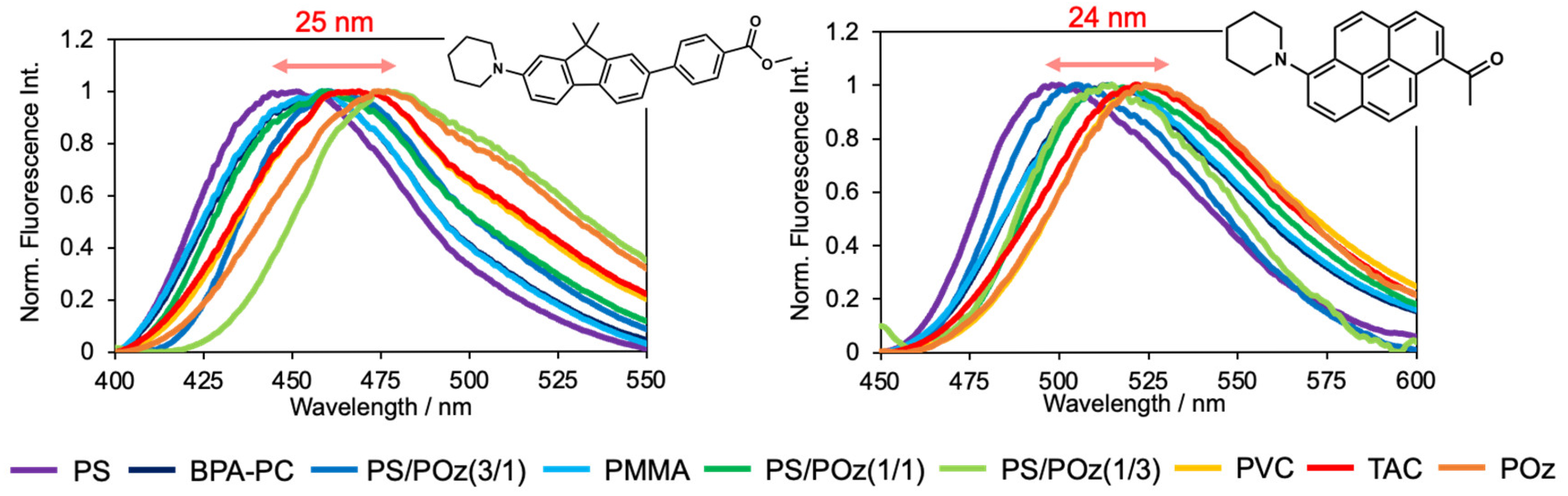
Table 1 summarizes the fluorescence properties of the solvatochromic dyes FπPCM and PK embedded in various polymer films, and the corresponding fluorescence spectra are shown in Figure 1. Both dyes exhibit polymer-dependent variations in the maximum fluorescence wavelength (λfl), fluorescence quantum yield (Φfl), and fluorescence lifetime (τfl). For comparison, the intrinsic photophysical properties of FπPCM and PK are also summarized in Table S1. In this study, the polarity of the polymer matrices is discussed in terms of relative permittivity (εr) [51].
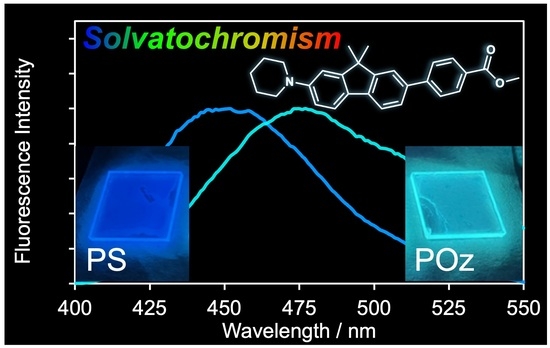
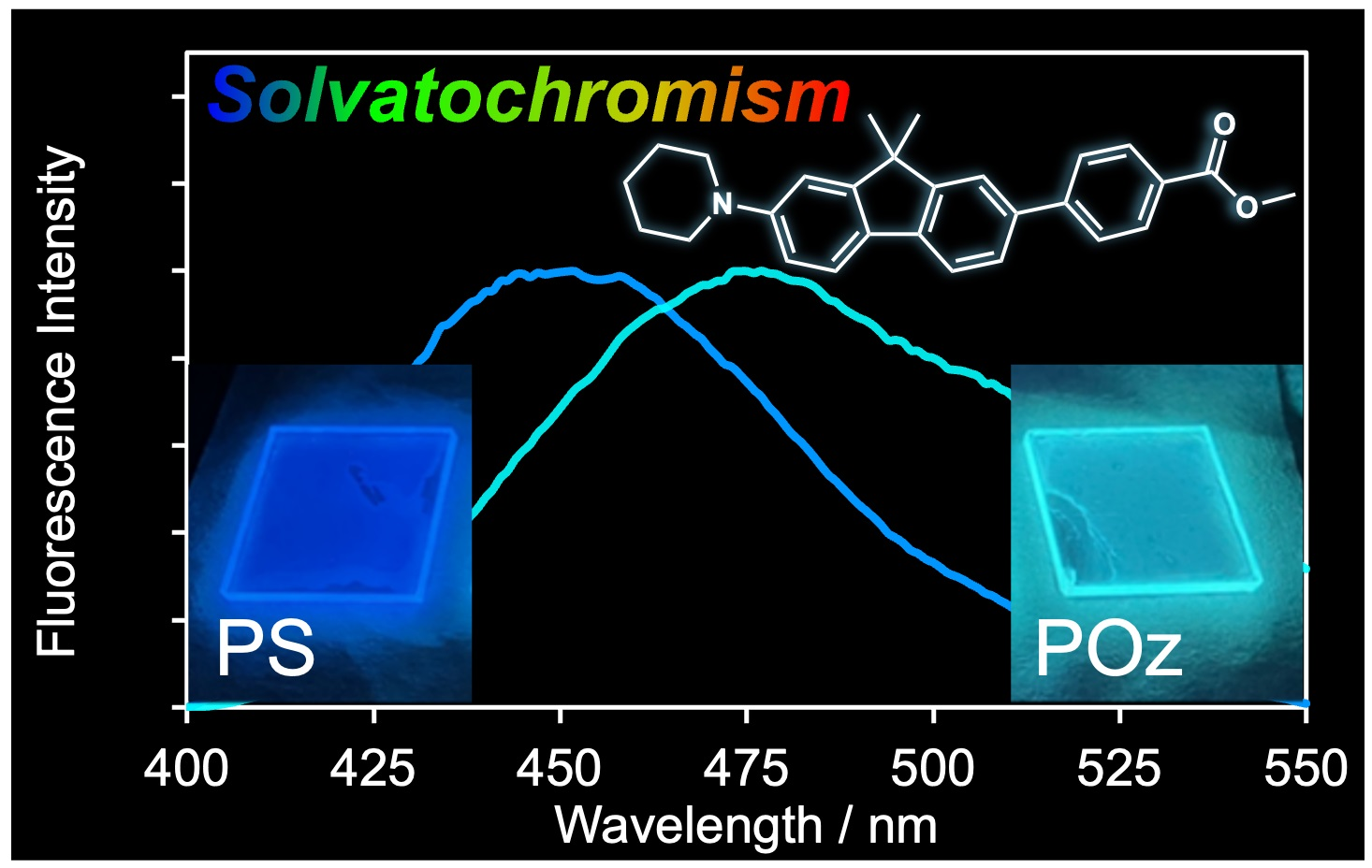
For FπPCM, the fluorescence maximum gradually red-shifts from 452 nm in the relatively low-polarity polymer PS (εr = 2.4–2.7) to 477 nm in polymer matrices containing POz, which exhibits a higher relative permittivity (εr = 4–6). In contrast, PK emits at 500 nm in PS, while a further red-shift to 524 nm is observed in PVC-, TAC-, and POz-based matrices. Notably, both dyes exhibit comparable spectral shifts of approximately 25 nm across the polymer series. The fluorescence maxima of FπPCM in POz coincide with those observed in low-polarity solvents such as n-hexane and toluene, whereas the emission maxima of PK in POz are comparable to those in medium- to high-polarity solvents such as THF and dichloromethane. These results indicate that the observed fluorescence wavelengths (477 nm for FπPCM and 524 nm for PK) do not primarily reflect intrinsic differences in the intramolecular charge-transfer (ICT) character of the dyes themselves; instead, they are governed by how effectively the polymer matrix stabilizes the ICT excited state within the local dye environment. This interpretation is further supported by the Φfl data. In relatively rigid polymer films such as PS, PMMA, PVC, and TAC, both dyes maintain high Φfl values (0.8–1.0). In contrast, a pronounced decrease in Φfl is observed in POz and POz-rich PS/POz blend films, particularly for PK, where Φfl decreases to 0.18–0.37. This behavior suggests that PK is more strongly affected by interactions with polymer chains than FπPCM, leading to enhanced nonradiative deactivation.
Time-resolved fluorescence decay profiles and the corresponding exponential fitting results are shown in Figures S1 and S2. As evident from the τfl values listed in Table 1, FπPCM exhibits relatively short fluorescence lifetimes (τfl ≈ 1–2 ns) in most polymer films, whereas PK shows significantly longer lifetimes (τfl ≈ 4–5 ns). The latter lifetimes closely resemble those observed for PK in polar solvents such as THF and dichloromethane, suggesting that PK is relatively homogeneously dispersed and well solvated within the polymer matrices. In contrast, except in PS, FπPCM exhibits biexponential fluorescence decay behavior in most polymer films. This observation indicates that, even when the decay profiles appear nearly monoexponential, FπPCM experiences microscopic heterogeneity within the polymer matrices, likely arising from local variations in polymer–dye interactions, incomplete mixing on a microscopic scale, and possible partial intermolecular interactions among dye molecules within the polymer environment (Figure S5) [52,53]. Despite this heterogeneity, both dyes consistently report changes in local polymer polarity through their fluorescence responses.
It should be noted that the observed fluorescence behavior cannot be fully rationalized solely by the bulk εr values of the polymer matrices. Instead, the experimental results suggest that three factors—local polarity, chain mobility, and specific polymer–dye interactions—cooperatively determine excited-state stabilization and decay dynamics. For example, in relatively rigid glassy polymers such as PS and PMMA, high fluorescence quantum yields are maintained despite differences in εr, indicating that restricted segmental motion effectively suppresses nonradiative decay pathways. In contrast, POz exhibits both higher polarity and increased chain mobility arising from its flexible oxazoline backbone and polar amide groups. This combination likely facilitates stronger local solvation of the ICT state while simultaneously allowing conformational relaxation, resulting in reduced Φfl and enhanced nonradiative decay, particularly for PK. Furthermore, the pronounced sensitivity of PK compared to FπPCM suggests stronger specific interactions between PK and polar polymer segments, consistent with the larger decrease in Φfl and changes in lifetime observed in POz-rich environments. Overall, these results demonstrate that fluorescence variations are governed by the interplay between local polarity and polymer dynamics rather than by εr alone.

3.2. Analysis of Fluorescence Lifetime Modulation in Polymer Blends

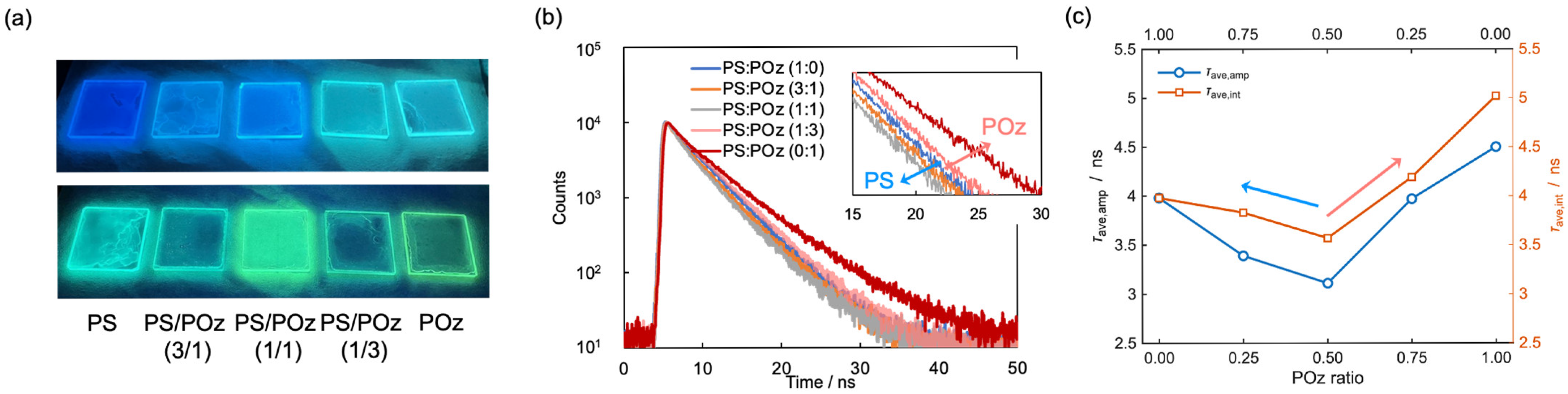
Next, we examine the photophysical behavior of PS/POz polymer blend films. As summarized in Table 1, the Φfl of PK, which interacts more strongly with polymer matrices than FπPCM, depends sensitively on the PS/POz blending ratio. Representative fluorescence photographs of the blend films at different mass fractions are shown in Figure 2a. To clarify the underlying excited-state processes, fluorescence lifetime analysis was performed.
Figure 2b shows the time-resolved fluorescence decay profiles of PK embedded in PS/POz blend films with varying mass fractions. The fluorescence lifetime profile increases with increasing POz content, whereas shorter lifetimes are observed as the PS fraction becomes dominant. In all PS/POz blend films, the decay curves are best described by a biexponential function (Equation (1)). Although PS and POz are thermodynamically highly miscible [54,55], these results indicate the presence of microscopic heterogeneity within the blend films, giving rise to multiple emissive microenvironments. Consequently, direct assignment of each lifetime component to a single emissive environment is not straightforward.
To address this issue, we employed the amplitude-weighted average lifetime, τAv,amp (Equation (2)), and the intensity-weighted average lifetime, τAv,int (Equation (3)), for further discussion. In heterogeneous polymer matrices, average lifetimes provide a more robust and physically meaningful descriptor of overall excited-state deactivation dynamics than individual lifetime components. The fluorescence decay profiles were fitted according to the following equations:
R t = A 1 e t τ 1 + A 2 e t τ 2
τ A v , a m p = i A i τ i i A i
τ A v , i n t = t R t d t R t d t = i A i τ i 2 i A i τ i
where Ai and τi are the amplitude and lifetime of component i, respectively, t is the time after excitation, and R(t) represents the fluorescence intensity at time t. Using the fitted values of τ1 and τ2, both τAv,amp and τAv,int were calculated and plotted as a function of the PS/POz mass fraction, as shown in Figure 2c. The error propagation of the τAv,amp and τAv,int is summarized in Table S2. The standard deviations of the lifetime values were within ±0.04 ns, indicating high reliability of the fitting procedure.
As shown in Figure 2c, the dependence of both τAv,amp and τAv,int on the PS/POz composition is distinctly non-monotonic, exhibiting a clear minimum near the equimolar composition (POz = 0.50) followed by a progressive increase in the POz-rich region (POz ≥ 0.50). The initial lifetime shortening toward the 1:1 composition suggests that PK experiences the highest degree of microscopic heterogeneity and interfacial disorder in the mixed polymer environment, where PS-rich and POz-rich domains coexist and interfacial density is maximized. Such interfacial environments are expected to enhance nonradiative decay pathways through local packing frustration, polarity fluctuations, and dynamic disorder. Beyond this composition, both τAv,amp and τAv,int increase with increasing POz content, indicating progressive stabilization of the excited state of PK in POz-rich environments. Notably, τAv,int exhibits a more pronounced increase than τAv,amp, reflecting the disproportionate contribution of longer-lived emissive populations to the time-integrated emission intensity and suggesting redistribution toward POz-dominated microenvironments.
Importantly, this lifetime elongation is accompanied by a pronounced decrease in Φfl, as summarized in Table 1. With increasing POz content, Φfl of PK decreases systematically from 0.57 in pure PS to 0.18 in pure POz, despite the simultaneous increase in the average τfl. This apparent decoupling between τfl and Φfl indicates that the lifetime modulation in POz-rich environments does not originate from a simple suppression of nonradiative decay; rather, it suggests a reduction in the radiative decay rate constant (kr) and/or additional nonradiative pathways induced by specific dye–polymer interactions. Such behavior is consistent with a scenario in which POz provides a more polar and hydrogen-bonding-rich local environment that stabilizes a more pronounced ICT-like excited state of PK. While this stabilization prolongs the excited-state lifetime, it simultaneously decreases the radiative transition probability, resulting in a lower Φfl. Therefore, the PS/POz blending ratio acts as an effective external parameter for continuously tuning the balance between radiative and nonradiative decay processes of PK without altering its molecular structure. Overall, the non-monotonic lifetime behavior highlights the critical role of microenvironment heterogeneity—particularly interfacial effects—in governing excited-state dynamics and underscores the importance of evaluating both τfl and Φfl in polymer sensing systems.

3.3. Temperature-Dependent Photophysical Properties of Polymer Films

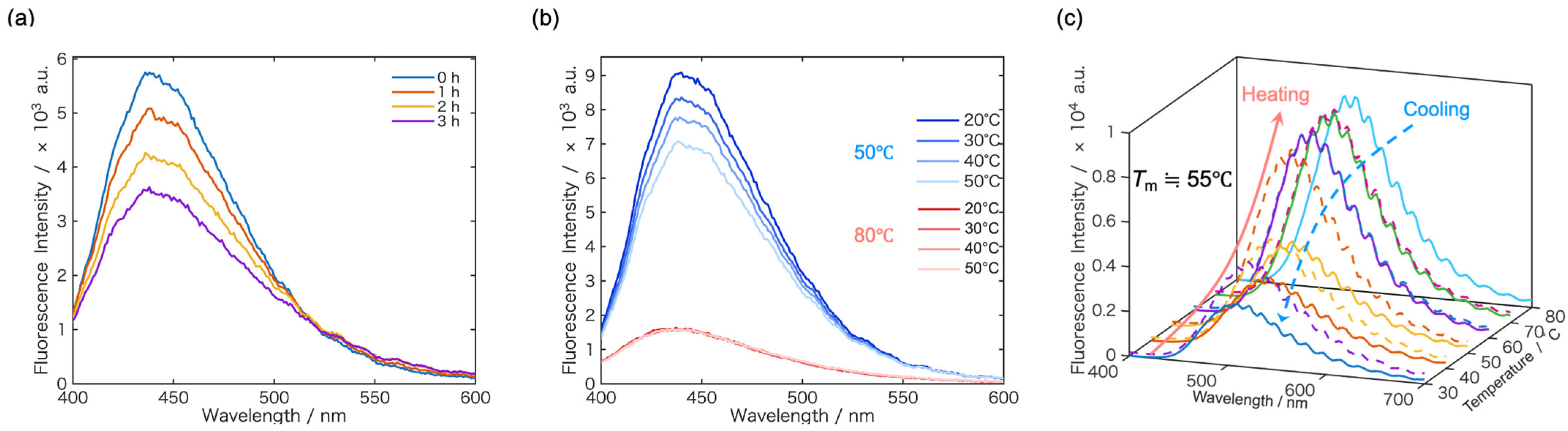
In this section, the temperature-dependent fluorescence behavior of polymer films was investigated using the fluorescent dye FπPCM as a molecular probe. As a model system, we first examined the temperature-dependent fluorescence behavior of poly(butyl methacrylate) (PBMA), whose glass transition temperature (Tg) has been reported to be close to room temperature (approximately 0–30 °C) [54,55,56]. The fluorescence behavior of FπPCM in PBMA films was studied under thermal annealing conditions at 50 °C and 80 °C, both of which are well above the bulk Tg of PBMA (Figure 3a,b).
Time-dependent fluorescence measurements during annealing revealed a gradual decrease in fluorescence intensity with increasing annealing time (Figure 3a). This behavior suggests that FπPCM molecules, initially distributed in a microscopically heterogeneous manner within the as-cast PBMA film, undergo progressive reorganization upon thermal annealing. Specifically, enhanced segmental mobility of PBMA chains above Tg likely facilitates stronger and more homogeneous dye–polymer interactions, leading to modifications of the local environment surrounding FπPCM and enhanced nonradiative deactivation.
To further elucidate the influence of thermal history, temperature-dependent fluorescence spectra were recorded after annealing the films for 3 h at either 50 °C or 80 °C (Figure 3b). For the sample annealed at 50 °C, the fluorescence intensity decreased monotonically with increasing measurement temperature, indicating that the polymer matrix remained dynamically responsive and that thermally activated structural relaxation continued during measurement. In contrast, for the sample annealed at 80 °C, the fluorescence intensity exhibited little to no temperature dependence over the same temperature range. This marked difference suggests that annealing at 80 °C induces a more equilibrated polymer structure, in which segmental mobility of PBMA chains and the local environment surrounding FπPCM have already reached a thermodynamically stable state. Consequently, further temperature increases during fluorescence measurements do not significantly alter dye–polymer interactions or excited-state deactivation dynamics. These results demonstrate that fluorescence analysis provides a sensitive optical readout of thermal-history–dependent structural relaxation in polymer films, confirming that FπPCM serves as an effective probe for detecting subtle changes in polymer chain dynamics above Tg.

3.4. Ratiometric Analysis of Temperature-Dependent Fluorescence in PMMA/PBMA Blend Film

In contrast to the annealing-dependent study described in Section 3.3, the temperature-dependent fluorescence behavior of PMMA/PBMA (1:1, w/w) blend films was investigated immediately after film preparation, without additional thermal annealing, to evaluate ratiometric fluorescence thermometry under nonequilibrium polymer conditions. We have previously reported that 1-(4-(9,9-dimethyl-7-(piperidin-1-yl)-9H-fluoren-2-yl)phenyl)-2,2,2-trifluoroethan-1-one (FπF), a structurally related dye bearing a trifluoroacetyl group instead of an ester substituent, exhibits a positive temperature-dependent fluorescence response in solution [43]. In the present study, the ester-substituted solvatochromic dye FπPCM was employed as the fluorescent probe (Figure 4).
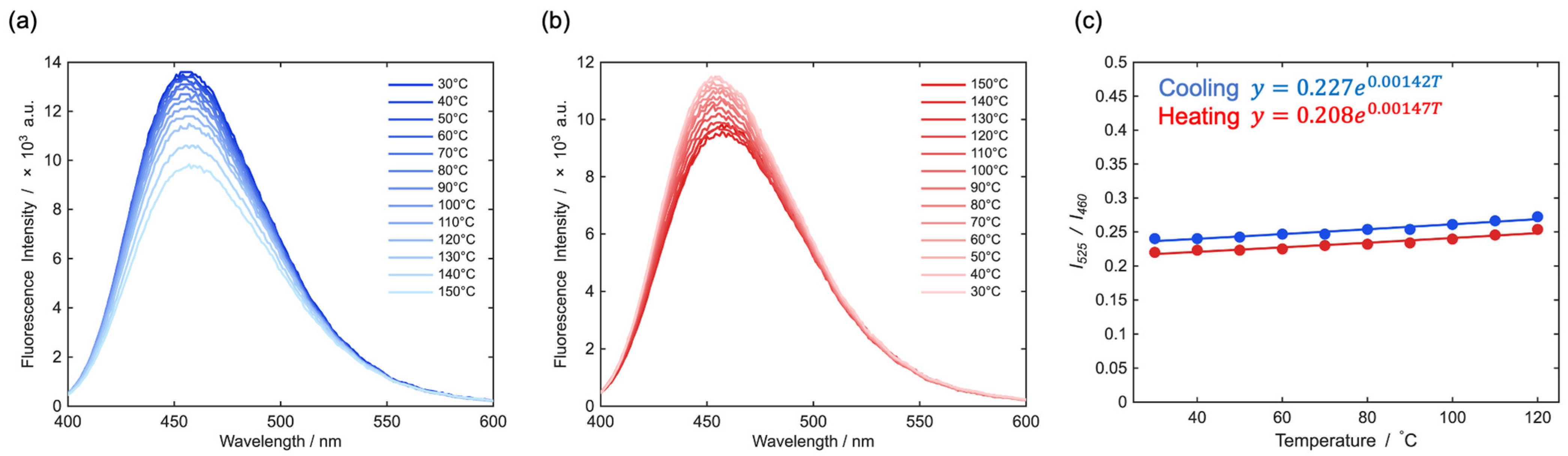
To minimize the influence of thermal history, the PMMA/PBMA film was first heated to 150 °C and subsequently cooled to 30 °C, and the data acquired during the second heating–cooling cycle were used for analysis. Temperature-dependent fluorescence spectra were recorded at 10 °C intervals during both the heating process (Figure 4a) and the cooling process (Figure 4b). A direct comparison of the spectra indicates that the fluorescence response during cooling is less pronounced than that observed during heating; therefore, quantitative ratiometric analysis was adopted to obtain a reproducible optical readout.
Specifically, the fluorescence intensity at 460 nm (I460), corresponding to the emission maximum, and that at 525 nm (I525), where the fluorescence intensity remains nearly temperature-independent, were extracted from the spectra. The fluorescence intensity ratio, Δ(T) = I525/I460, was then plotted as a function of temperature. Exponential fitting of Δ(T) for both the heating and cooling processes yielded nearly identical fitting curves, indicating that the ratiometric response is highly reproducible and largely independent of the thermal scanning direction. Based on the obtained exponential fitting functions, the absolute thermal sensitivity (SA) and relative thermal sensitivity (SR) were calculated according to the following equations (Table 2):
S A T = T T × 100   %   K 1
S R = 1 ( T ) T × 100   %   K 1
σ   T = δ T = 100 S R T δ T T
Here, Δ(T) represents the fluorescence intensity ratio, and σ(T) denotes the temperature resolution, defined as the minimum detectable temperature change determined by the relative uncertainty of the fluorescence intensity ratio, δΔ(T)/Δ(T).
As summarized in Table 2, Δ(T) = I525/I460 increases monotonically with increasing temperature for both the heating and cooling processes. Because the fluorescence intensity at the emission maximum (460 nm) decreases with increasing temperature, this behavior corresponds to an overall negative temperature response. This trend contrasts with the previously reported behavior of FπF in solution, which exhibits a positive temperature-dependent fluorescence response. In the present study, temperature-dependent fluorescence spectra of FπF embedded in PMMA/PBMA (1:1, w/w) films were also recorded (Figure S4). Notably, unlike its solution behavior, FπF likewise exhibits a negative temperature dependence in the polymer film. This discrepancy can be attributed to restricted molecular mobility in the polymer matrix. In PMMA/PBMA films, both FπF and FπPCM experience substantially reduced conformational freedom compared to solution, suppressing the formation of highly emissive temperature-stabilized excited states. Consequently, thermally activated nonradiative decay pathways, such as internal conversion, become dominant with increasing temperature, leading to decreased fluorescence intensity. Thus, the temperature-dependent fluorescence behavior in polymer films follows the general trend observed for conventional fluorescent probes in condensed phases.
Despite the negative temperature response, Δ(T) could be reliably fitted by a single exponential function over a wide temperature range from 30 to 120 °C for both heating and cooling cycles. The close agreement between the fitted Δ(T) values and the experimental ratios, together with nearly identical fitting parameters obtained for the two thermal processes, demonstrates the robustness of the ratiometric analysis and confirms that thermal hysteresis is negligible under the present conditions. These results validate the exponential model as a practical descriptor for ratiometric fluorescence thermometry in polymer matrices.
From the exponential fits, SA and SR were determined. As shown in Table 2, SR remains nearly constant at approximately 0.14% K−1 over the entire temperature range for both heating and cooling processes. Although this sensitivity is modest compared with systems reporting SR values of approximately 0.18% K−1, numerous fluorescent thermometers in condensed-phase systems operate with comparable or lower relative sensitivities on the order of ~0.1–0.15% K−1 [57]. Therefore, the SR value of ~0.14% K−1 obtained in this study lies within a practically relevant range for temperature-sensing applications, particularly when combined with the wide operating temperature window, high reproducibility, and minimal thermal hysteresis observed here. Importantly, the nearly temperature-independent SR represents a significant practical advantage, enabling straightforward calibration and reliable temperature readout without temperature-specific correction factors.
Notably, quantitative evaluations of SR for organic fluorescent dyes embedded in polymer films remain relatively limited in the literature. One representative example is the rhodamine B-based polymer temperature paint reported by Yano et al., which exhibited a relative sensitivity of approximately 0.37% K−1 [58]. Although the SR value obtained in the present study (~0.14% K−1) is smaller than that reported for the rhodamine system, the excellent fitting precision, high reproducibility, and temperature-independent stability of SR demonstrated here indicate that the sensitivity is sufficient for reliable temperature sensing in polymer films.
In addition, the thermal resolution σ(T), derived from SR and the relative uncertainty of Δ(T), remains nearly constant (≈6.8–7.0 °C) over the entire investigated temperature range. This uniform resolution, together with the broad operational window from 30 to 120 °C, highlights the applicability of FπPCM–PMMA/PBMA blend films as practical ratiometric fluorescent thermometers. Taken together, these results demonstrate that solvatochromic fluorescent dyes embedded in polymer films can function as robust and reproducible temperature sensors, even when the absolute sensitivity is moderate, owing to their wide dynamic range, reproducible thermal response, and minimal hysteresis.

4. Conclusions

In this study, we systematically investigated the photophysical behavior of strongly emissive solvatochromic dyes embedded in polymer films and polymer blend systems, focusing on how local polymer microenvironments regulate fluorescence beyond bulk-averaged material descriptors. By employing two D–π–A-type solvatochromic dyes, FπPCM and PK, we demonstrated that the fluorescence wavelength (λfl), quantum yield (Φfl), and lifetime (τfl) are strongly modulated by the surrounding polymer matrix. These modulations reflect not only differences in relative permittivity (εr), but also local chain packing, segmental mobility, and specific dye–polymer interactions. Accordingly, our results clearly show that bulk descriptors such as εr and Tg alone are insufficient to fully describe fluorescence responses in polymer films.
Fluorescence lifetime analysis of PS/POz blend films revealed that even thermodynamically miscible polymer systems exhibit microscopic heterogeneity, giving rise to multiple emissive microenvironments. The use of amplitude- and intensity-averaged lifetimes provided a robust and physically meaningful framework for capturing overall excited-state deactivation dynamics in such heterogeneous matrices. Notably, in the case of PK, increasing POz content led to simultaneous lifetime elongation and fluorescence quenching, indicating decoupled radiative and nonradiative processes induced by highly polar, hydrogen-bonding-rich polymer environments.
Furthermore, temperature-dependent fluorescence studies clarified the critical roles of thermal history and structural relaxation in determining polymer microenvironments. In PBMA films, annealing above Tg induced irreversible changes in fluorescence behavior, reflecting equilibration of polymer chain dynamics. In contrast, ratiometric fluorescence analysis of PMMA/PBMA blend films enabled a reproducible description of temperature dependence over a wide range (30–120 °C), despite an overall negative temperature response. The nearly constant relative sensitivity and minimal thermal hysteresis demonstrate the robustness and practical applicability of this strategy for fluorescence-based temperature sensing.
Overall, this work demonstrates that solvatochromic dyes can serve as sensitive molecular probes for visualizing polymer microenvironments and their dynamic evolution. Beyond temperature sensing, the present findings provide quantitative optical readouts correlated with polymer microheterogeneity and relaxation dynamics, highlighting the potential of fluorescence-based approaches for polymer-state monitoring and functional material sensing applications.

Supplementary Materials

The following supporting information can be downloaded at: https://www.mdpi.com/article/10.3390/s26041346/s1. Figures S1–S5: Tables S1–S3. Table S1. Photophysical properties of FπPCM and PK in various organic solvents. Figure S1. Fluorescence decay curves and fitting results of FπPCM in polymer films. Measurements were carried out with an excitation wavelength of 402.5 nm. The same fitting range was applied to all polymer films, and the decay profiles were analyzed using a tail-fitting approach. Figure S2. Fluorescence decay curves and fitting results of PK in polymer films. Measurements were carried out with an excitation wavelength of 402.5 nm. The same fitting range was applied to all polymer films, and the decay profiles were analyzed using a tail-fitting approach. Table S2. Fluorescence lifetime parameters of FπPCM and PK in various polymer films obtained from the analyses of Figures S1 and S2. The fluorescence decay curves were fitted using single- or biexponential functions, yielding lifetimes (τ1, τ2), their associated amplitudes (A1, A2), amplitude-averaged lifetimes (τAv,amp), and intensity-averaged lifetimes (τAv,int). Errors represent fitting uncertainties, and χ2 values indicate the goodness of fit. Figure S3. Fluorescence decay curves and fitting results of PS/POz in polymer films. Measurements were carried out with an excitation wavelength of 402.5 nm. The same fitting range was applied to all polymer films, and the decay profiles were analyzed using a tail-fitting approach. Table S3. Fluorescence lifetime parameters of FπPCM in PS/POz polymer blend films obtained from the analyses of Figures S3. The fluorescence decay curves were fitted using single- or biexponential functions, yielding lifetimes (τ1, τ2), their associated amplitudes (A1, A2), amplitude-averaged lifetimes (τAv,amp), and intensity-averaged lifetimes (τAv,int). χ2 values indicate the goodness of fit. Figure S4. Temperature-dependent fluorescence spectra of FπF embedded in a PBMA film, recorded during heating. Figure S5. Fluorescence lifetime decay profiles of FπPCM embedded in PMMA films at different dye concentrations (0.1, 1.0, and 10 wt%).

Author Contributions

Conceptualization, T.T. and G.-i.K.; validation, T.T. and G.-i.K.; investigation, T.M. and T.T.; writing—original draft preparation, T.M. and T.T.; writing—review and editing, T.T., Y.S. and G.-i.K. All authors have read and agreed to the published version of the manuscript.

Funding

This project was supported in part by MEXT/JSPS KAKENHI grants 23H02036 (G.K.) and 25K22304 (G.K.), the Sasakawa Scientific Research Grant from The Japan Science Society (T.T.), and JST SPRING, Grant Number JPMJSP2180 (T.T. and Y.S.).

Institutional Review Board Statement

Not applicable.

Informed Consent Statement

Not applicable.

Data Availability Statement

The original contributions presented in the study are included in the article/Supplementary Materials. Further inquiries can be directed to the corresponding author.

Conflicts of Interest

The authors declare no conflicts of interest.

References

  1. Ma, H.; Jen, A.K.-Y.; Dalton, L.R. Polymer-Based Optical Waveguides: Materials, Processing, and Devices. Adv. Mater. 2002, 14, 1339–1365. [Google Scholar] [CrossRef]
  2. Li, G.; Zhu, R.; Yang, Y. Polymer solar cells. Nat. Photonics 2012, 6, 153–161. [Google Scholar] [CrossRef]
  3. Reddy, M.R.; Subrahmanyam, A.R.; Reddy, M.M.; Kumar, J.S.; Kamalaker, V.; Reddy, M.J. XRD, SEM, FT-IR, and DSC studies of polymer blend films of PMMA and PEO. Mater. Today Proc. 2016, 3, 3713–3718. [Google Scholar] [CrossRef]
  4. Mendieta-Taboada, O.; Sobral, P.J.A.; Carvalho, R.A.; Habitante, A.M.B.Q. Thermomechanical properties of biodegradable films based on blends of gelatin and poly(vinyl alcohol). Food Hydrocoll. 2008, 22, 1485–1492. [Google Scholar] [CrossRef]
  5. Hamazaki, N.; Cho, J.; Miyata, S. Phase separation behavior of blends of poly(vinylidene fluoride-co-tetrafluoroethylene) and poly(methyl methacrylate) by differential scanning calorimetry. Polym. J. 1991, 23, 333–337. [Google Scholar] [CrossRef][Green Version]
  6. de Paula, A.C.; Uliana, F.; da Silva Filho, E.A.; Soares, K.; Luz, P.P. Use of DMA-material pocket to determine the glass transition temperature of nitrocellulose blends in film form. Carbohydr. Polym. 2019, 226, 115288. [Google Scholar] [CrossRef] [PubMed]
  7. Scobbo, J.J., Jr. Dynamic mechanical analysis of compatibilized polymer blends. Polym. Test. 1991, 10, 279–290. [Google Scholar] [CrossRef]
  8. Lewandowska, K. Miscibility and thermal stability of poly(vinyl alcohol)/chitosan mixtures. Thermochim. Acta 2009, 493, 42–48. [Google Scholar] [CrossRef]
  9. Saito, I.; Shimada, D.; Aikawa, M.; Miyazaki, T.; Shimokita, K.; Takagi, H.; Yamamoto, K. Orientation and relaxation behaviors of lamellar microdomains of poly(methyl methacrylate)-b-poly(n-butyl acrylate) thin films as revealed by grazing-incidence small-angle X-ray scattering. Polym. J. 2016, 48, 399–406. [Google Scholar] [CrossRef]
  10. Nakanishi, Y.; Uchida, K.; Mita, K.; Kamitani, K.; Kojio, K.; Takahara, A. Morphological study of isotactic polypropylene thin films on different substrates using grazing incidence wide-angle X-ray diffraction. Polymer 2022, 245, 124665. [Google Scholar] [CrossRef]
  11. Jin, S.; Hirai, T.; Ahn, B.; Rho, Y.; Kim, K.-W.; Kakimoto, M.; Gopalan, P.; Hayakawa, T.; Ree, M. Synchrotron Grazing Incidence X-ray Scattering Study of the Morphological Structures in Thin Films of a Polymethacrylate Diblock Copolymer Bearing POSS Moieties. J. Phys. Chem. B 2010, 114, 8033–8042. [Google Scholar] [CrossRef] [PubMed]
  12. Nguyen-Tri, H.; Ghassemi, P.; Carriere, P.; Nanda, S.; Assadi, A.A.; Nguyen, D.D. Recent Applications of Advanced Atomic Force Microscopy in Polymer Science: A Review. Polymers 2020, 12, 1142. [Google Scholar] [CrossRef] [PubMed]
  13. Smilgies, D.-M. Probing Functional Thin Films with Grazing Incidence X-Ray Scattering: The power of Indexing. Crystals 2025, 15, 63. [Google Scholar] [CrossRef]
  14. Reisch, A.; Klymchenko, A.S. Fluorescent Polymer Nanoparticles Based on Dyes: Seeking Brighter Tools for Bioimaging. Small 2016, 12, 1968–1992. [Google Scholar] [CrossRef]
  15. Wolfbeis, O.S. An overview of nanoparticles commonly used in fluorescent bioimaging. Chem. Soc. Rev. 2015, 44, 4743–4768. [Google Scholar] [CrossRef]
  16. Li, K.; Liu, B. Polymer encapsulated conjugated polymer nanoparticles for fluorescence bioimaging. J. Mater. Chem. 2012, 22, 1257–1264. [Google Scholar] [CrossRef]
  17. Klymchenko, A.S. Fluorescent Probes for Lipid Membranes: From the Cell Surface to Organelles. Acc. Chem. Res. 2023, 56, 1–12. [Google Scholar] [CrossRef]
  18. Ashoka, A.H.; Aparin, I.O.; Reisch, A.; Klymchenko, A.S. Brightness of fluorescent organic nanomaterials. Chem. Soc. Rev. 2023, 52, 4525–4548. [Google Scholar] [CrossRef]
  19. Ding, D.; Li, K.; Liu, B.; Tang, B.Z. Bioprobes Based on AIE Fluorogens. Acc. Chem. Res. 2013, 46, 2441–2453. [Google Scholar] [CrossRef]
  20. Khalid, A.; Tomljenovic-Hanic, S. Emerging Fluorescent Nanoparticles for Non-Invasive Bioimaging. Molecules 2024, 29, 5594. [Google Scholar] [CrossRef]
  21. Calzoni, E.; Cesaretti, A.; Montegiove, N.; Valicenti, M.L.; Morena, F.; Misra, R.; Carlotti, B.; Martino, S. Phenothiazine-Based Nanoaggregates: Dual Role in Bioimaging and Stem Cell-Driven Photodynamic Therapy. Nanomaterials 2025, 15, 894. [Google Scholar] [CrossRef] [PubMed]
  22. Ganai, A.M.; Vrettos, E.I.; Kyrkou, S.G.; Zoi, V.; Khan Pathan, T.; Karpoormath, R.; Bouziotis, P.; Alexiou, G.A.; Kastis, G.A.; Protonotarios, N.E.; et al. Design Principles and Applications of Fluorescent Kinase Inhibitors for Simultaneous Cancer Bioimaging and Therapy. Cancers 2024, 16, 3667. [Google Scholar] [CrossRef] [PubMed]
  23. Hariprasad, V.; Keremane, K.S.; Naik, P.; Babu, D.D.; Shivashankar, S.M. Tetraphenylethylene (TPE)-Based AIE Luminogens: Recent Advances in Bioimaging Applications. Photochem 2025, 5, 23. [Google Scholar] [CrossRef]
  24. Dantelle, G.; Reita, V.; Delacour, C. Luminescent Yb3+,Er3+-doped α-La(IO3)3 Nanocrystals for Neuronal Network Bio-Imaging and Nanothermometry. Nanomaterials 2021, 11, 479. [Google Scholar] [CrossRef]
  25. Cui, L.; Dong, Z.; Yu, D.; Wang, Y.; Meijerink, A. High-sensitivity luminescent temperature sensors: MFX:1%Sm2+ (M = Sr, Ba, X = Cl, Br). Sci. Adv. 2024, 10, eado7737. [Google Scholar] [CrossRef]
  26. Kan, T.; Aoki, H.; Binh-Khiem, N.; Matsumoto, K.; Shimoyama, I. Ratiometric optical temperature sensor using two fluorescent dyes dissolved in an ionic liquid encapsulated by Parylene film. Sensors 2013, 13, 4138–4145. [Google Scholar] [CrossRef]
  27. Iasilli, G.; Battisti, A.; Tantussi, F.; Fuso, F.; Allegrini, M.; Ruggeri, G.; Pucci, A. Aggregation-Induced Emission of Tetraphenylethylene in Styrene-Based Polymers. Macromol. Chem. Phys. 2014, 215, 499–506. [Google Scholar] [CrossRef]
  28. Picchi, A.; Wang, Q.; Ventura, F.; Micheletti, C.; Heijkoop, J.; Picchioni, F.; Ciofini, I.; Adamo, C.; Pucci, A. Effect of Polymer Composition on the Optical Properties of a New Aggregation-Induced Emission Fluorophore: A Combined Experimental and Computational Approach. Polymers 2023, 15, 3530. [Google Scholar] [CrossRef]
  29. Pucci, A. Mechanochromic Fluorescent Polymers with Aggregation-Induced Emission Features. Sensors 2019, 19, 4969. [Google Scholar] [CrossRef]
  30. Pucci, A.; Ruggeri, G. Mechanochromic polymer blends. J. Mater. Chem. 2011, 21, 8282–8291. [Google Scholar] [CrossRef]
  31. Shimizu, M.; Sakurai, T. Organic fluorophores that emit ultraviolet light in the aggregated state. Aggregate 2022, 3, e144. [Google Scholar] [CrossRef]
  32. Shimizu, M. The Journey to Precious-Metal-Free Organic Phosphors from Single-Benzene-Cored Fluorophores. Chem. Rec. 2021, 21, 1489–1505. [Google Scholar] [CrossRef] [PubMed]
  33. Shimizu, M.; Mochida, K.; Katoh, M.; Hiyama, T. Synthesis and Photophysical Properties of 2-Donor-7-acceptor-9-silafluorenes: Remarkable Fluorescence Solvatochromism and Highly Efficient Fluorescence in Doped Polymer Films. J. Phys. Chem. C 2010, 114, 10004–10014. [Google Scholar] [CrossRef]
  34. Shen, T.; Chen, M.; Zhang, H.; Sun, J.Z.; Tang, B.Z. Copolymers of 4-Trimethylsilyl Diphenyl Acetylene and 1-Trimethylsilyl-1-Propyne: Polymer Synthesis and Luminescent Property Adjustment. Molecules 2022, 28, 27. [Google Scholar] [CrossRef]
  35. Konishi, G.; Sawatari, Y.; Iwai, R.; Tanaka, T.; Shimomura, Y.; Tokita, M. Synthesis of Side-Chain Liquid Crystalline Polyacrylates with Bridged Stilbene Mesogens. Molecules 2024, 29, 5220. [Google Scholar] [CrossRef]
  36. Niko, Y.; Konishi, G. Polymer-Chain-Induced Tunable Luminescence Properties of Amphiphilic Poly(2-oxazoline)s Possessing a N,N-Dialkylpyrene-1-carboxamide Chromophore in the Side Chain. Macromolecules 2012, 45, 2327–2337. [Google Scholar] [CrossRef]
  37. Sasaki, S.; Konishi, G. Thermo-responsive fluorescence of AIE-active poly(N-isopropylacrylamides) labeled with highly twisted bis(N,N-dialkylamino)arenes. RSC Adv. 2017, 7, 17403–17416. [Google Scholar] [CrossRef]
  38. Ciardelli, F.; Ruggeri, G.; Pucci, A. Dye-containing polymers: Methods for preparation of mechanochromic materials. Chem. Soc. Rev. 2013, 42, 857–870. [Google Scholar] [CrossRef]
  39. Shundo, A.; Okada, Y.; Ito, F.; Tanaka, K. FluorescenceBehavior of Dyes in Thin Films of Various Polymers. Macromolecules 2012, 45, 329–335. [Google Scholar] [CrossRef]
  40. Shimizu, M.; Nishimura, K.; Mineyama, M.; Terao, R.; Sakurai, T.; Sakaguchi, H. Bis(tricyclic) Aromatic Enes That Exhibit Efficient Fluorescence in the Solid State. Molecules 2024, 29, 5361. [Google Scholar] [CrossRef]
  41. Sasaki, S.; Drummen, G.P.C.; Konishi, G. Recent advances in twisted intramolecular charge transfer (TICT) fluorescence and related phenomena in materials chemistry. J. Mater. Chem. C 2016, 4, 2731–2743. [Google Scholar] [CrossRef]
  42. Tanaka, T.; Koyanagi, H.; Ehara, T.; Ryu, T.; Miyata, K.; Suzuki, S.; Igawa, K.; Onda, K.; Konishi, G. Push–Pull Bridged Stilbenes as Small Solvatochromic Aggregation-Induced Emission Luminogen: Design and Excited-State Deactivation Dynamics. Aggregate 2026, 7, e70295. [Google Scholar] [CrossRef]
  43. Hori, A.; Matsumoto, A.; Ikenouchi, J.; Konishi, G. D–π–A Fluorophores with Strong Solvatochromism for Single-moMlecule Ratiometric Thermometers. J. Am. Chem. Soc. 2025, 147, 9953–9961. [Google Scholar] [CrossRef] [PubMed]
  44. Tanaka, T.; Matsumoto, A.; Klymchenko, A.S.; Tsurumaki, E.; Ikenouchi, J.; Konishi, G. Fluorescent Solvatochromic Probes for Long-Term Imaging of Lipid Order in Living Cells. Adv. Sci. 2024, 11, 2309721. [Google Scholar] [CrossRef] [PubMed]
  45. Matsumoto, A.; Inoko, A.; Tanaka, T.; Konishi, G.; Hosoda, W.; Kojima, T.; Ohnishi, K.; Ikenouchi, J. Chemotherapy resistance due to epithelial-to-mesenchymal transition is caused by abnormal lipid metabolic balance. eLife 2026, 13, RP104374. [Google Scholar] [CrossRef] [PubMed]
  46. Niko, Y.; Klymchenko, A.S. Emerging solvatochromic push–pull dyes for monitoring lipid order of biomembranes in live cells. J. Biochem. 2021, 170, 163–174. [Google Scholar] [CrossRef]
  47. Inoue, K.; Kawakami, R.; Murakami, M.; Nakayama, T.; Yamamoto, S.; Inoue, K.; Tsuda, T.; Sayama, K.; Imamura, T.; Kaneno, D.; et al. Synthesis and photophysical properties of a new push–pull pyrene dye with green-to-far-red emission and its application to human cellular and skin tissue imaging. J. Mater. Chem. B 2022, 10, 1641–1649. [Google Scholar] [CrossRef]
  48. Valanciunaite, J.; Kempf, E.; Seki, H.; Danylchuk, D.I.; Peyriéras, N.; Niko, Y.; Klymchenko, A.S. Polarity Mapping of Cells and Embryos by Improved Fluorescent Solvatochromic Pyrene Probe. Anal. Chem. 2020, 92, 6512–6520. [Google Scholar] [CrossRef]
  49. Niko, Y.; Didier, P.; Mély, Y.; Konishi, G.; Klymchenko, A.S. Bright and photostable push-pull pyrene dye visualizes lipid order variation between plasma and intracellular membranes. Sci. Rep. 2016, 6, 18870. [Google Scholar] [CrossRef]
  50. Kobayashi, S.; Kaku, M.; Saegusa, T. Miscibility of poly(2-oxazolines) with commodity polymers. Macromolecules 1988, 21, 334–338. [Google Scholar] [CrossRef]
  51. Wypych, G. Handbook of Polymers; ChemTec Publishing: Toronto, ON, Canada, 2012. [Google Scholar]
  52. Lee, D.; Jeong, U.; Kim, D. Oxygen-excluded nanoimaging of polymer blend films. Sci. Adv. 2025, 11, eadt6177. [Google Scholar] [CrossRef]
  53. Park, Y.; Jeong, D.; Jeong, U.; Park, H.; Kim, D. Polarity Nano-Mapping of Polymer Film Using Spectrally Resolved Super-Resolution Imaging. ACS Appl. Mater. Interfaces 2022, 14, 46032–46042. [Google Scholar] [CrossRef]
  54. Lee, J.; Chul Kim, S. Synthesis and Thermal Properties of Polyurethane, Poly(butyl methacrylate), and Poly(methylmethacrylate) Multi-Component IPN’s. Polym. J. 1984, 16, 453–459. [Google Scholar] [CrossRef]
  55. Rogers, S.; Mandelkern, L. Glass Transitions of the Poly-(n-Alkyl Methacrylates). J. Phys. Chem. 1957, 61, 985–991. [Google Scholar] [CrossRef]
  56. Luengo, G.; Pan, J.; Heuberger, M.; Israelachvili, J.N. Temperature and Time Effects on the “Adhesion Dynamics” of Poly(butyl methacrylate) (PBMA) Surfaces. Langmuir 1998, 14, 3873–3881. [Google Scholar] [CrossRef]
  57. Đačanin Far, L.; Dramićanin, M.D. Luminescence Thermometry with Nanoparticles: A Review. Nanomaterials 2023, 13, 2904. [Google Scholar] [CrossRef]
  58. Obata, M.; Morita, M.; Nakase, K.; Mitsuo, K.; Asai, K.; Hirohara, S.; Yano, S. Synthesis and Photophysical Properties of Rhodamine B Dye-Bearing Poly(isobutyl methacrylate-co-2,2,2-trifluoroethyl methacrylate) as a Temperature-Sensing Polymer Film. J. Polym. Sci. Part A Polym. Chem. 2007, 45, 2876–2885. [Google Scholar] [CrossRef]
Figure 1. Molecular structures of the dyes and fluorescence spectra recorded in various polymer films with a dye loading of 0.1 wt%. The left panel shows the data for FπPCM, while the right panel corresponds to PK.
Sensors 26 01346 g001
Figure 2. Fluorescence characteristics of PS/POz polymer blend films with varying mass fractions. (a) Fluorescence photographs of PS/POz blend films incorporating fluorescent dyes. Images in the upper and lower rows correspond to FπPCM and PK, respectively. The values in parentheses indicate the mass ratios of PS to POz. Excitation was performed using a black light (λex = 365 nm). (b) Time-resolved fluorescence decay profiles of PK embedded in PS/POz polymer blend films at different mass fractions, recorded with an excitation wavelength of 402.5 nm. An enlarged view of the decay profiles in the 15–30 ns time window is shown. (c) Amplitude-averaged (τAv,amp) and intensity-averaged (τAv,int) fluorescence lifetimes plotted as a function of the PS/POz mass fraction, determined by exponential fitting of the decay curves shown in panel (b).
Sensors 26 01346 g002
Figure 3. (a) Time evolution of the fluorescence spectra of FπPCM in a PBMA film during annealing at 80 °C. (b) Fluorescence spectra measured at various temperatures after annealing for 3 h at different annealing temperatures (50 °C and 80 °C). At each temperature, spectra were recorded after a stabilization period of 10 min. (c) Temperature-dependent fluorescence spectra of FπPCM in a PEG matrix during heating and cooling. The melting temperature of PEG is approximately 55 °C.
Sensors 26 01346 g003
Figure 4. Ratiometric thermometric performance of FπPCM embedded in a PMMA/PBMA (1:1, w/w) film. (a) Temperature-dependent fluorescence spectra recorded during the heating process. (b) Temperature-dependent fluorescence spectra recorded during the cooling process. (c) Temperature dependence of the fluorescence intensity ratio at 525 nm and 460 nm (I525/I460), fitted with an exponential function. The R2 values are 0.950 and 0.933 for the cooling and heating processes, respectively.
Sensors 26 01346 g004
Table 1. Maximum fluorescence wavelength (λfl), absolute fluorescence quantum yield (Φfl), and fluorescence lifetime (τfl) of FπPCM and PK in various polymer films. Fluorescence lifetime measurements were performed with an excitation wavelength of 402.5 nm and an instrument response function of 78 ps.
Entryεr 1FπPCMPK
λfl/nmΦflτfl/ns (%) 2λfl/nmΦflτfl/ns (%) 2
PS2.4–2.74520.872.015000.573.98
BPA-PC3.24590.961.03 (21)
1.92 (79)
5150.854.83
PS/POz (3/1)-4600.68-5050.561.27 (25)
4.09 (75)
PMMA3.64590.941.21 (36)
2.17 (64)
5150.894.99
PS/POz (1/1)-4590.91-5150.371.60 (38)
4.05 (62)
PS/POz (1/3)-4770.42-5150.301.56 (13)
4.34 (87)
PVC3.39–3.54690.991.27 (30)
2.18 (70)
5240.955.35
TAC3.0–4.54690.841.84 (93)
4.11 (7.0)
5220.945.14
POz-4770.921.31 (41)
2.45 (59)
5240.182.11 (29)
5.47 (71)
1 Relative permittivity (εr) values used in this study were taken from Ref. [51]. 2 Amplitudes (fractional contributions) for each decay component derived from biexponential fitting according to Equation (1).
Table 2. Temperature dependence of the fluorescence intensity ratio (I525/I460), thermometric parameter Δ(T), absolute thermal sensitivity (SA), relative thermal sensitivity (SR), and thermal resolution σ(T) for FπPCM embedded in PMMA.
Cooling Process
Temp./°CRatioΔTSa (T)/%°C−1Sr (T)/%°C−1σ (T)
300.2400.2370.0340.1427.03
400.2400.2400.0340.1427.03
500.2420.2430.0350.1427.03
600.2470.2470.0350.1427.03
700.2470.2500.0360.1427.03
800.2540.2540.0360.1427.03
900.2540.2580.0370.1427.03
1000.2610.2610.0370.1427.03
1100.2660.2650.0380.1427.03
1200.2730.2690.0380.1427.03
Heating Process
RatioΔTSa (T)/%°C−1Sr (T)/%°C−1σ (T)
300.2200.2180.0320.1476.81
400.2230.2210.0320.1476.81
500.2230.2240.0330.1476.81
600.2250.2270.0330.1476.81
700.2300.2310.0340.1476.81
800.2320.2340.0340.1476.81
900.2340.2380.0350.1476.81
1000.2400.2410.0350.1476.81
1100.2450.2450.0360.1476.81
1200.2540.2480.0360.1476.81
Disclaimer/Publisher’s Note: The statements, opinions and data contained in all publications are solely those of the individual author(s) and contributor(s) and not of MDPI and/or the editor(s). MDPI and/or the editor(s) disclaim responsibility for any injury to people or property resulting from any ideas, methods, instructions or products referred to in the content.