Inferring Arm Movement Direction from EEG Signals Using Explainable Deep Learning

Abstract
1. Introduction
2. Materials and Methods
2.1. Participants
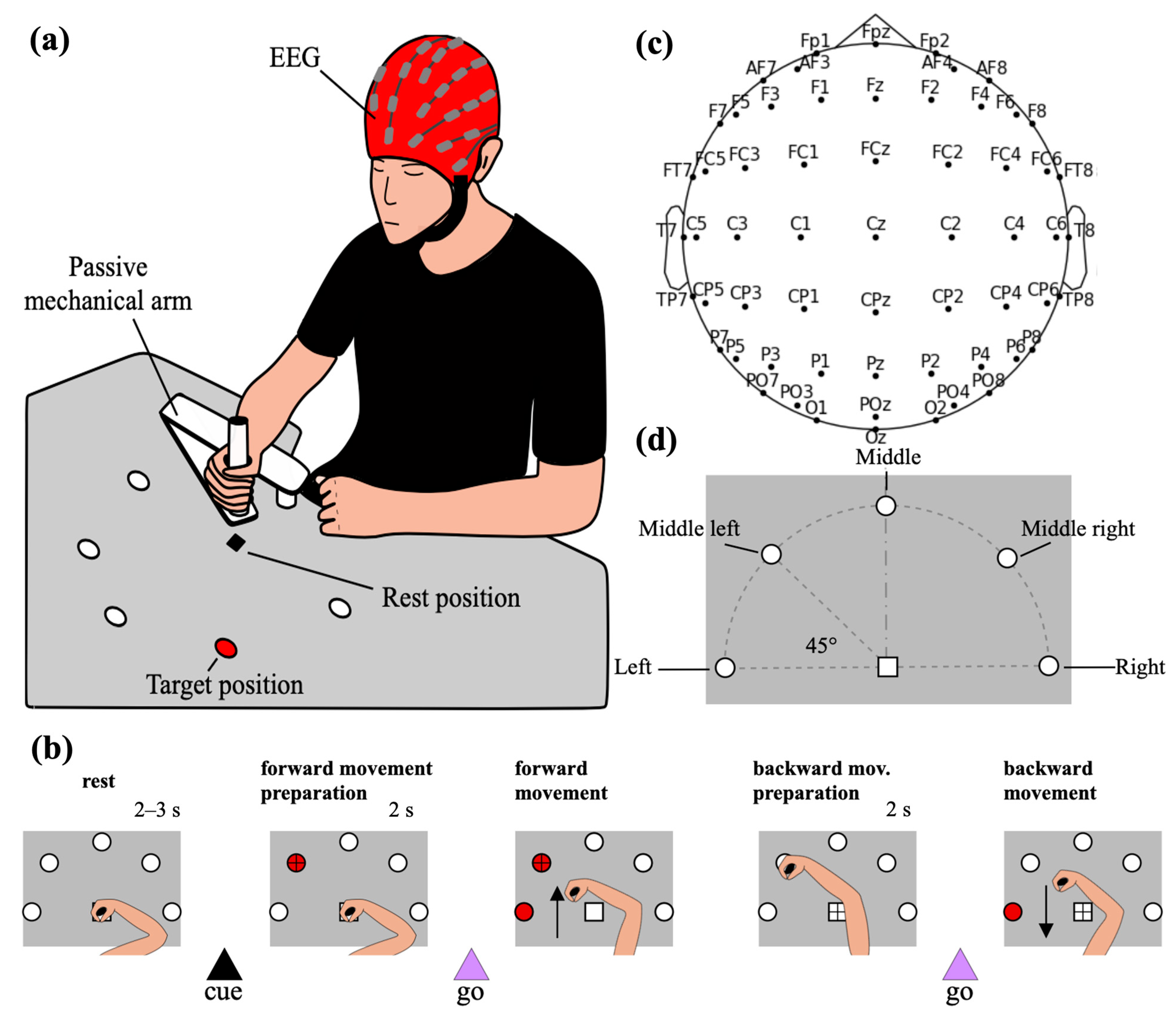
2.2. Experimental Protocol
2.3. EEG Data Analysis
2.3.1. EEG Preprocessing
2.3.2. Scalp Event-Related Spectral Perturbation
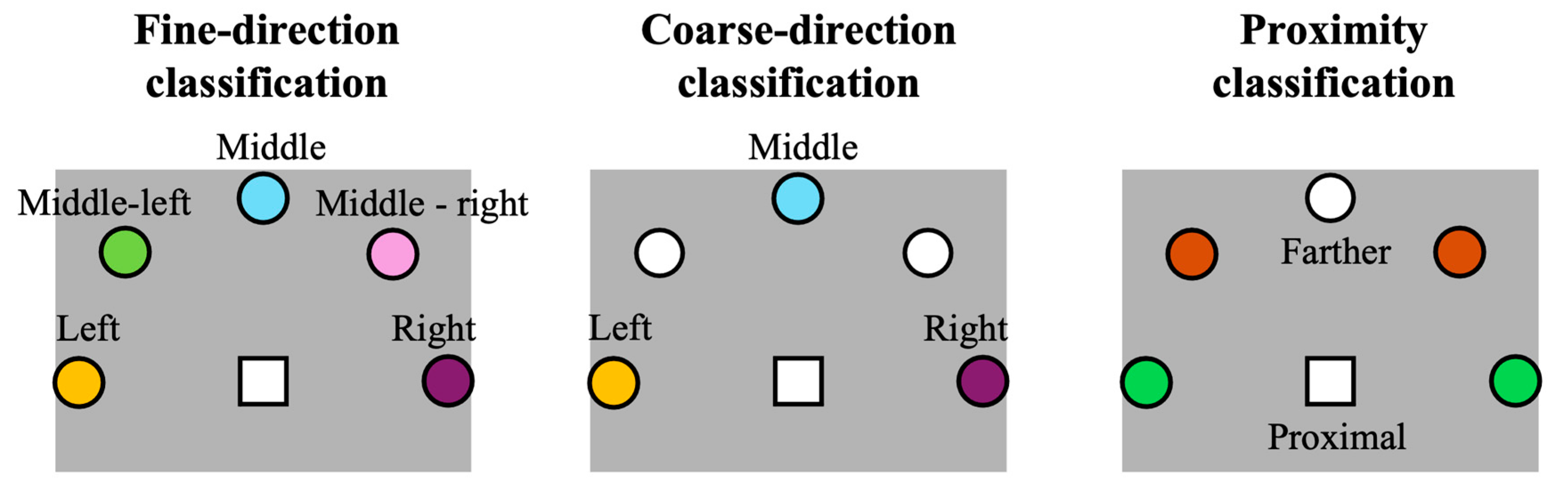
2.3.3. Deep Learning-Based Classification
2.3.4. Explanation Techniques
2.3.5. Complementary Analysis Applied to the Backward Movement Preparation Phase
3. Results
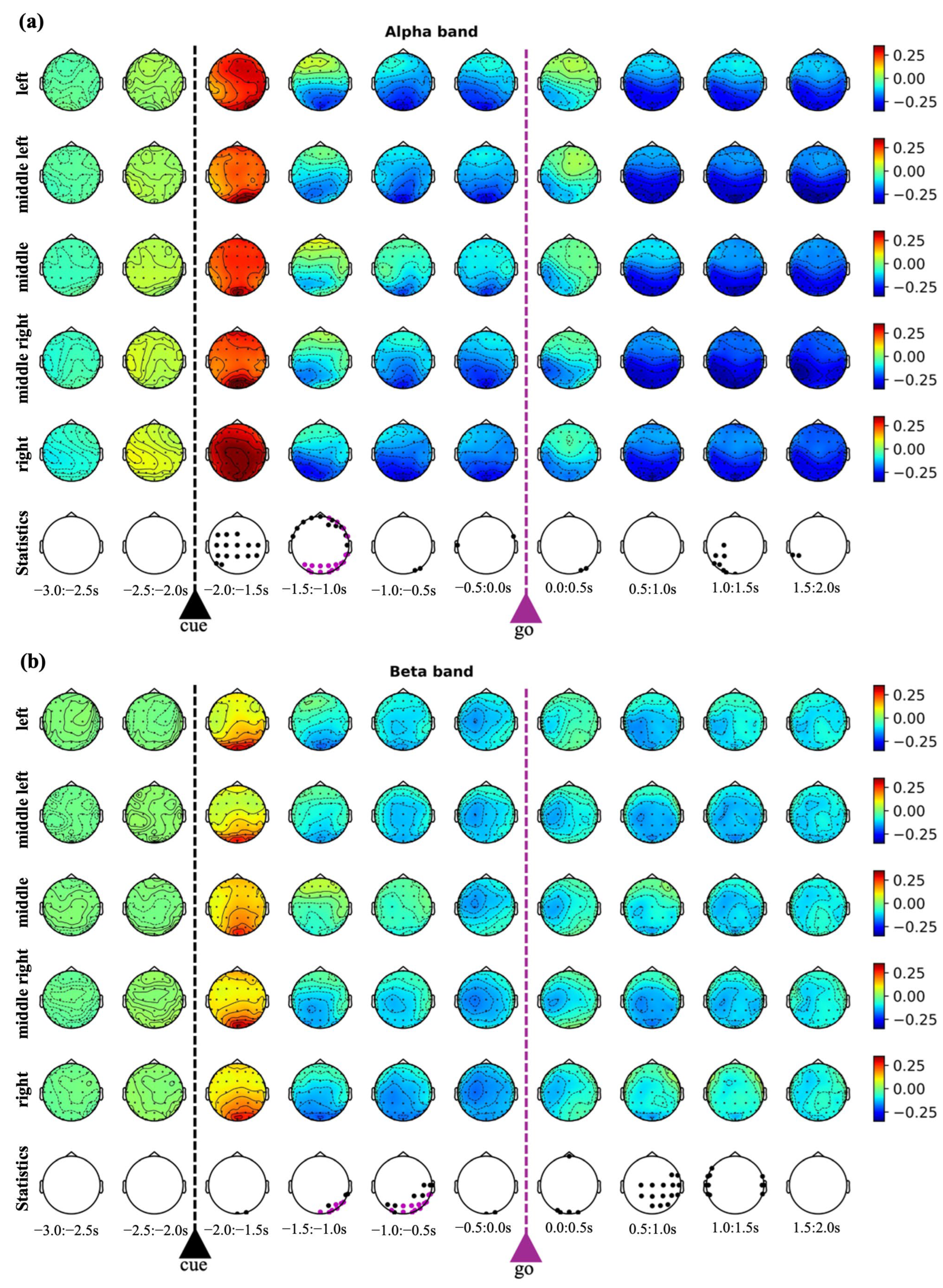
3.1. Scalp Event-Related Spectral Perturbation
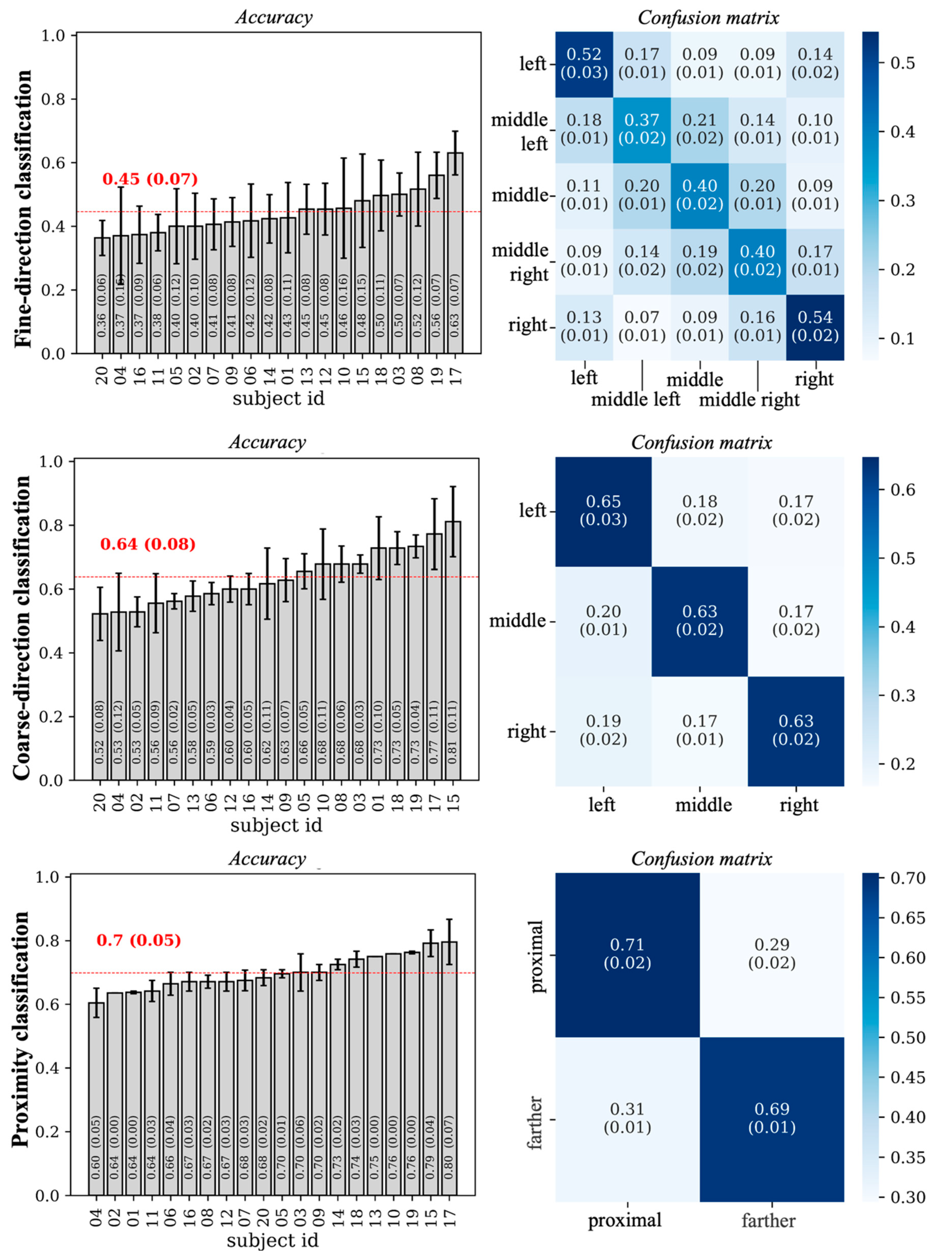
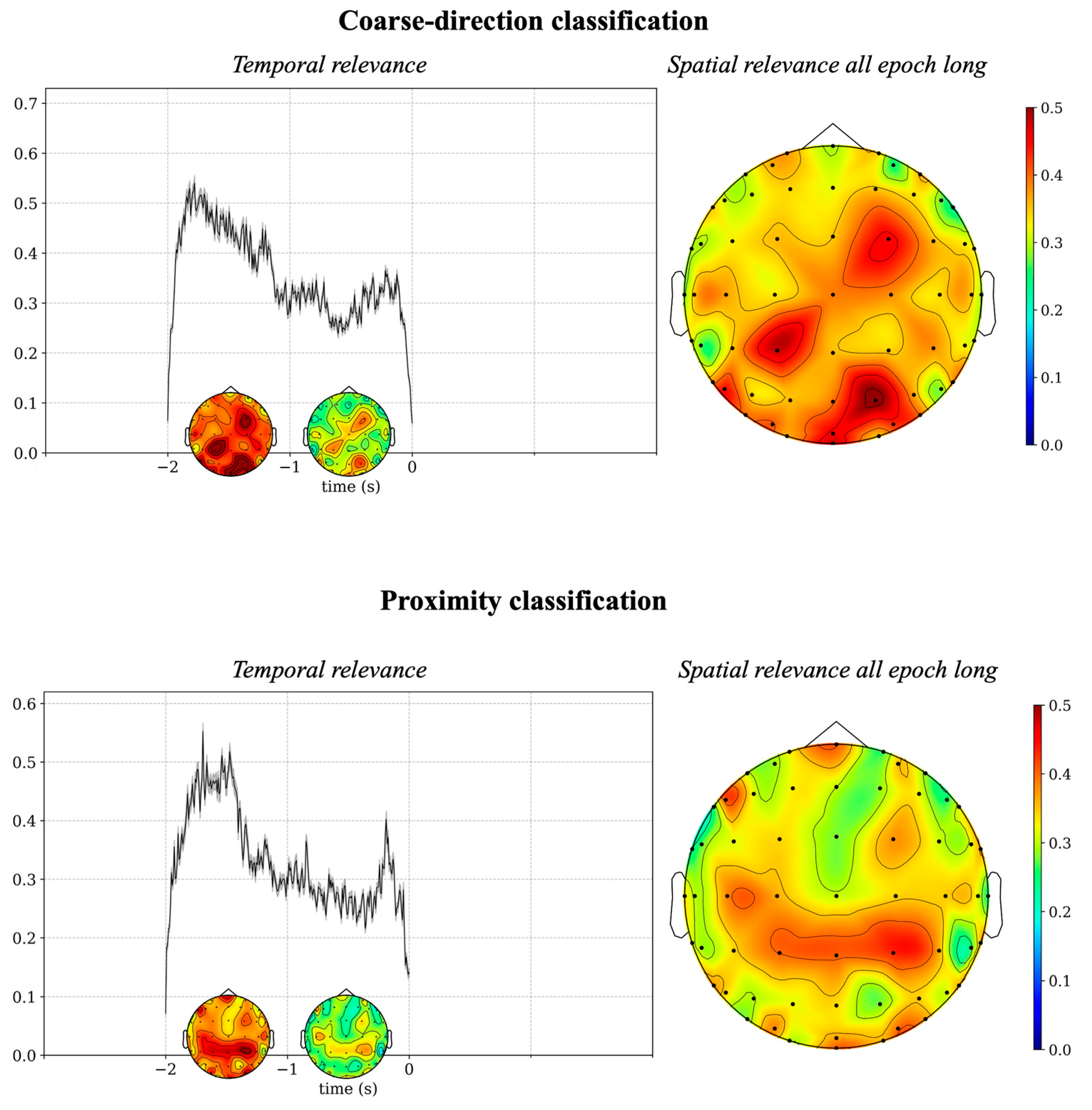
3.2. Deep Learning Classification and Analysis
3.3. Complementary Analysis for the Backward Movement Preparation Epochs
4. Discussion
5. Conclusions
Author Contributions
Funding
Institutional Review Board Statement
Informed Consent Statement
Data Availability Statement
Conflicts of Interest
References
- Wolpaw, J.; Wolpaw, E.W. Brain-Computer Interfaces: Principles and Practice; Oxford University Press: Oxford, UK, 2012. [Google Scholar]
- Collinger, J.L.; Wodlinger, B.; Downey, J.E.; Wang, W.; Tyler-Kabara, E.C.; Weber, D.J.; McMorland, A.J.; Velliste, M.; Boninger, M.L.; Schwartz, A.B. High-performance neuroprosthetic control by an individual with tetraplegia. Lancet Lond. Engl. 2013, 381, 557–564. [Google Scholar] [CrossRef] [PubMed]
- Millán, J.D.R.; Rupp, R.; Müller-Putz, G.R.; Murray-Smith, R.; Giugliemma, C.; Tangermann, M.; Vidaurre, C.; Cincotti, F.; Kübler, A.; Leeb, R.; et al. Combining Brain-Computer Interfaces and Assistive Technologies: State-of-the-Art and Challenges. Front. Neurosci. 2010, 4, 161. [Google Scholar] [CrossRef]
- Filippini, M.; Borra, D.; Ursino, M.; Magosso, E.; Fattori, P. Decoding sensorimotor information from superior parietal lobule of macaque via Convolutional Neural Networks. Neural Netw. 2022, 151, 276–294. [Google Scholar] [CrossRef]
- Borra, D.; Filippini, M.; Ursino, M.; Fattori, P.; Magosso, E. Motor decoding from the posterior parietal cortex using deep neural networks. J. Neural Eng. 2023, 20, 036016. [Google Scholar] [CrossRef]
- Schalk, G.; Kubanek, J.; Miller, K.; Anderson, N.; Leuthardt, E.; Ojemann, J.; Limbrick, D.; Moran, D.; Gerhardt, L.; Wolpaw, J. Decoding two-dimensional movement trajectories using electrocorticographic signals in humans. J. Neural Eng. 2007, 4, 264–275. [Google Scholar] [CrossRef]
- Pistohl, T.; Ball, T.; Schulze-Bonhage, A.; Aertsen, A.; Mehring, C. Prediction of arm movement trajectories from ECoG-recordings in humans. J. Neurosci. Methods 2008, 167, 105–114. [Google Scholar] [CrossRef]
- Nagarajan, A.; Robinson, N.; Ang, K.K.; Chua, K.S.G.; Chew, E.; Guan, C. Transferring a deep learning model from healthy subjects to stroke patients in a motor imagery brain-computer interface. J. Neural Eng. 2024, 21, 016007. [Google Scholar] [CrossRef]
- Neuper, C.; Wörtz, M.; Pfurtscheller, G. ERD/ERS patterns reflecting sensorimotor activation and deactivation. In Progress in Brain Research; Elsevier: Amsterdam, The Netherlands, 2006; Volume 159, pp. 211–222. [Google Scholar] [CrossRef]
- Shakeel, A.; Navid, M.S.; Anwar, M.N.; Mazhar, S.; Jochumsen, M.; Niazi, I.K. A Review of Techniques for Detection of Movement Intention Using Movement-Related Cortical Potentials. Comput. Math. Methods Med. 2015, 2015, 346217. [Google Scholar] [CrossRef] [PubMed]
- Lotte, F.; Bougrain, L.; Cichocki, A.; Clerc, M.; Congedo, M.; Rakotomamonjy, A.; Yger, F. A review of classification algorithms for EEG-based brain–computer interfaces: A 10 year update. J. Neural Eng. 2018, 15, 031005. [Google Scholar] [CrossRef]
- Li, J.; Wang, Y.; Zhang, L.; Jung, T.-P. Combining ERPs and EEG spectral features for decoding intended movement direction. In 2012 Annual International Conference of the IEEE Engineering in Medicine and Biology Society, San Diego, CA, USA, 28 August–1 September 2012; IEEE: New York, NY, USA, 2012; pp. 1769–1772. [Google Scholar] [CrossRef]
- Sagila, G.K.; Vinod, A.P. Direction decoding of imagined hand movements using subject-specific features from parietal EEG. J. Neural Eng. 2022, 19, 056004. [Google Scholar] [CrossRef] [PubMed]
- Úbeda, A.; Azorín, J.M.; Chavarriaga, R.; Millán, J.d.R. Classification of upper limb center-out reaching tasks by means of EEG-based continuous decoding techniques. J. Neuroeng. Rehabil. 2017, 14, 9. [Google Scholar] [CrossRef]
- Kobler, R.J.; Kolesnichenko, E.; Sburlea, A.I.; Müller-Putz, G.R. Distinct cortical networks for hand movement initiation and directional processing: An EEG study. NeuroImage 2020, 220, 117076. [Google Scholar] [CrossRef]
- Waldert, S.; Preissl, H.; Demandt, E.; Braun, C.; Birbaumer, N.; Aertsen, A.; Mehring, C. Hand Movement Direction Decoded from MEG and EEG. J. Neurosci. 2008, 28, 1000–1008. [Google Scholar] [CrossRef] [PubMed]
- Ma, Z.; Yang, X.; Meng, J.; Wang, K.; Xu, M.; Ming, D. Decoding Arm Movement Direction Using Ultra-High-Density EEG. IEEE J. Biomed. Health Inform. 2025, 29, 4035–4045. [Google Scholar] [CrossRef]
- Roy, Y.; Banville, H.; Albuquerque, I.; Gramfort, A.; Falk, T.H.; Faubert, J. Deep learning-based electroencephalography analysis: A systematic review. J. Neural Eng. 2019, 16, 051001. [Google Scholar] [CrossRef]
- Lawhern, V.J.; Solon, A.J.; Waytowich, N.R.; Gordon, S.M.; Hung, C.P.; Lance, B.J. EEGNet: A compact convolutional neural network for EEG-based brain–computer interfaces. J. Neural Eng. 2018, 15, 056013. [Google Scholar] [CrossRef] [PubMed]
- Simões, M.; Borra, D.; Santamaría-Vázquez, E.; Bittencourt-Villalpando, M.; Krzemiński, D.; Miladinović, A.; Schmid, T.; Zhao, H.; Amaral, C.; Direito, B.; et al. BCIAUT-P300: A Multi-Session and Multi-Subject Benchmark Dataset on Autism for P300-Based Brain-Computer-Interfaces. Front. Neurosci. 2020, 14, 568104. [Google Scholar] [CrossRef]
- An, J.; Chen, X.; Wu, D. Algorithm contest of motor imagery BCI in the World Robot Contest 2022: A survey. Brain Sci. Adv. 2023, 9, 166–181. [Google Scholar] [CrossRef]
- Borra, D.; Mondini, V.; Magosso, E.; Müller-Putz, G.R. Decoding movement kinematics from EEG using an interpretable convolutional neural network. Comput. Biol. Med. 2023, 165, 107323. [Google Scholar] [CrossRef] [PubMed]
- Vahid, A.; Mückschel, M.; Stober, S.; Stock, A.-K.; Beste, C. Applying deep learning to single-trial EEG data provides evidence for complementary theories on action control. Commun. Biol. 2020, 3, 112. [Google Scholar] [CrossRef]
- Borra, D.; Magosso, E.; Ravanelli, M. A protocol for trustworthy EEG decoding with neural networks. Neural Netw. 2024, 182, 106847. [Google Scholar] [CrossRef] [PubMed]
- Shrikumar, A.; Greenside, P.; Kundaje, A. Learning Important Features Through Propagating Activation Differences. arXiv 2017. [Google Scholar] [CrossRef]
- Zeiler, M.D.; Fergus, R. Visualizing and Understanding Convolutional Networks. In Computer Vision–ECCV 2014; Fleet, D., Pajdla, T., Schiele, B., Tuytelaars, T., Eds.; Springer International Publishing: Cham, The Netherlands, 2014; Volume 8689, pp. 818–833. [Google Scholar] [CrossRef]
- Linardatos, P.; Papastefanopoulos, V.; Kotsiantis, S. Explainable AI: A Review of Machine Learning Interpretability Methods. Entropy 2020, 23, 18. [Google Scholar] [CrossRef] [PubMed]
- Borra, D.; Fantozzi, S.; Bisi, M.C.; Magosso, E. Modulations of Cortical Power and Connectivity in Alpha and Beta Bands during the Preparation of Reaching Movements. Sensors 2023, 23, 3530. [Google Scholar] [CrossRef]
- Gramfort, A. MEG and EEG data analysis with MNE-Python. Front. Neurosci. 2013, 7, 267. [Google Scholar] [CrossRef]
- Lee, G.; Gommers, R.; Waselewski, F.; Wohlfahrt, K.; O’Leary, A. PyWavelets: A Python package for wavelet analysis. J. Open Source Softw. 2019, 4, 1237. [Google Scholar] [CrossRef]
- Paszke, A.; Gross, S.; Chintala, S.; Chanan, G.; Yang, E.; Devito, Z.; Lin, E.; Desmaison, A.; Antiga, L.; Lerer, A. Automatic Differentiation in PyTorch. in NIPS-W, 2017. Available online: https://openreview.net/pdf?id=BJJsrmfCZ (accessed on 20 March 2025).
- Kokhlikyan, N.; Miglani, V.; Martin, M.; Wang, E.; Alsallakh, B.; Reynolds, J.; Melnikov, A.; Kliushkina, N.; Araya, C.; Yan, S. Captum: A unified and generic model interpretability library for PyTorch. arXiv 2022, arXiv:2009.07896. [Google Scholar]
- Fischler, M.A.; Bolles, R.C. Random sample consensus: A paradigm for model fitting with applications to image analysis and automated cartography. Commun. ACM 1981, 24, 381–395. [Google Scholar] [CrossRef]
- Lee, T.-W.; Girolami, M.; Sejnowski, T.J. Independent Component Analysis Using an Extended Infomax Algorithm for Mixed Subgaussian and Supergaussian Sources. Neural Comput. 1999, 11, 417–441. [Google Scholar] [CrossRef]
- Nichols, T.E.; Holmes, A.P. Nonparametric permutation tests for functional neuroimaging: A primer with examples. Hum. Brain Mapp. 2002, 15, 1–25. [Google Scholar] [CrossRef]
- Benjamini, Y.; Hochberg, Y. Controlling the False Discovery Rate: A Practical and Powerful Approach to Multiple Testing. J. R. Stat. Soc. Ser. B Methodol. 1995, 57, 289–300. [Google Scholar] [CrossRef]
- Kingma, D.P.; Ba, J. Adam: A Method for Stochastic Optimization. arXiv 2017. [Google Scholar] [CrossRef]
- Ravindran, A.S.; Contreras-Vidal, J. An empirical comparison of deep learning explainability approaches for EEG using simulated ground truth. Sci. Rep. 2023, 13, 17709. [Google Scholar] [CrossRef] [PubMed]
- Volkova, K.; Lebedev, M.A.; Kaplan, A.; Ossadtchi, A. Decoding movement from electrocorticographic activity: A review. Front. Neuroinform. 2019, 13, 74. [Google Scholar] [CrossRef]
- Ball, T.; Schulze-Bonhage, A.; Aertsen, A.; Mehring, C. Differential representation of arm movement direction in relation to cortical anatomy and function. J. Neural Eng. 2009, 6, 016006. [Google Scholar] [CrossRef]
- Reddy, C.G.; Reddy, G.G.; Kawasaki, H.; Oya, H.; Miller, L.E.; Howard, M.A. Decoding movement-related cortical potentials fromelectrocorticography. Neurosurg. Focus 2009, 27, E11. [Google Scholar] [CrossRef]
- Bundy, D.T.; Pahwa, M.; Szrama, N.; Leuthardt, E.C. Decoding three-dimensional reaching movements using electrocorticographic signals in humans. J. Neural Eng. 2016, 13, 026021. [Google Scholar] [CrossRef] [PubMed]
- Combrisson, E.; Di Rienzo, F.; Saive, A.-L.; Perrone-Bertolotti, M.; Soto, J.L.P.; Kahane, P.; Lachaux, J.-P.; Guillot, A.; Jerbi, K. Human local field potentials in motor and non-motor brain areas encode upcoming movement direction. Commun. Biol. 2024, 7, 506. [Google Scholar] [CrossRef]
- Wang, Y.; Makeig, S. Predicting Intended Movement Direction Using EEG from Human Posterior Parietal Cortex. In Foundations of Augmented Cognition. Neuroergonomics and Operational Neuroscience; Schmorrow, D.D., Estabrooke, I.V., Grootjen, M., Eds.; Springer: Berlin/Heidelberg, Germany, 2009; Volume 5638, pp. 437–446. [Google Scholar] [CrossRef]
- Cui, H. Forward Prediction in the Posterior Parietal Cortex and Dynamic Brain-Machine Interface. Front. Integr. Neurosci. 2016, 10, 35. [Google Scholar] [CrossRef] [PubMed]
- Santandrea, E.; Breveglieri, R.; Bosco, A.; Galletti, C.; Fattori, P. Preparatory activity for purposeful arm movements in the dorsomedial parietal area V6A: Beyond the online guidance of movement. Sci. Rep. 2018, 8, 6926. [Google Scholar] [CrossRef]
- Gardner, E.P. Neural pathways for cognitive command and control of hand movements. Proc. Natl. Acad. Sci. USA 2017, 114, 4048–4050. [Google Scholar] [CrossRef] [PubMed]
- Becker, D.; Creutzfeldt, O.D.; Schwibbe, M.; Wuttke, W. Changes in physiological, EEG and psychological parameters in women during the spontaneous menstrual cycle and following oral contraceptives. Psychoneuroendocrinology 1982, 7, 75–90. [Google Scholar] [CrossRef]
- Cochin, S.; Barthelemy, C.; Roux, S.; Martineau, J. Observation and execution of movement: Similarities demonstrated by quantified electroencephalography. Eur. J. Neurosci. 1999, 11, 1839–1842. [Google Scholar] [CrossRef] [PubMed]
- Frenkel-Toledo, S.; Bentin, S.; Perry, A.; Liebermann, D.G.; Soroker, N. Dynamics of the EEG power in the frequency and spatial domains during observation and execution of manual movements. Brain Res. 2013, 1509, 43–57. [Google Scholar] [CrossRef]
- Frenkel-Toledo, S.; Bentin, S.; Perry, A.; Liebermann, D.G.; Soroker, N. Mirror-neuron system recruitment by action observation: Effects of focal brain damage on mu suppression. NeuroImage 2014, 87, 127–137. [Google Scholar] [CrossRef]
- Pfurtscheller, G.; Neuper, C.; Krausz, G. Functional dissociation of lower and upper frequency mu rhythms in relation to voluntary limb movement. Clin. Neurophysiol. 2000, 111, 1873–1879. [Google Scholar] [CrossRef]
- Borra, D.; Fantozzi, S.; Magosso, E. Interpretable and lightweight convolutional neural network for EEG decoding: Application to movement execution and imagination. Neural Netw. 2020, 129, 55–74. [Google Scholar] [CrossRef]
- Borra, D.; Magosso, E. Unveiling multi-domain signatures of EEG oscillations using a fully-interpretable convolutional neural network. Comput. Methods Programs Biomed. 2025, 271, 109008. [Google Scholar] [CrossRef]
- Halliday, D.M.; Conway, B.A.; Farmer, S.F.; Rosenberg, J.R. Using electroencephalography to study functional coupling between cortical activity and electromyograms during voluntary contractions in humans. Neurosci. Lett. 1998, 241, 5–88. [Google Scholar] [CrossRef] [PubMed]
- Tun, N.; Sanuki, F.; Iramina, K. Electroencephalogram-Electromyogram Functional Coupling and Delay Time Change Based on Motor Task Performance. Sensors 2021, 21, 4380. [Google Scholar] [CrossRef]
- Xi, X.; Wu, X.; Zhao, Y.-B.; Wang, J.; Kong, W.; Luo, Z. Cortico-muscular functional network: An exploration of cortico-muscular coupling in hand movements. J. Neural Eng. 2021, 18, 046084. [Google Scholar] [CrossRef] [PubMed]



| Block ID | Layer Name | Main Hyper-Parameters | Output Shape |
|---|---|---|---|
| Input | - | (1, 60, 5 s × 128 Hz = 640) | |
| 1 | Time-Conv2D | n. filters = 8; filter length = 16; activation = linear | (8, 60, 640) |
| BatchNorm2D | - | (8, 60, 640) | |
| Space-DepthConv2D | n. filters = 16; filter length = 60; activation = linear | (16, 1, 640) | |
| BatchNorm2D | - | (16, 1, 640) | |
| ELU | - | (16, 1, 640) | |
| Time-AvgPool2D | filter length = 4 | (16, 1, 160) | |
| Dropout | dropout rate = 0.1 | (16, 1, 160) | |
| 2 | Time-SepConv2D | n. filters = 16; filter length = 8; activation = linear | (16, 1, 160) |
| BatchNorm2D | (16, 1, 160) | ||
| ELU | (16, 1, 160) | ||
| Time-AvgPool2D | filter length = 4 | (16, 1, 40) | |
| Dropout | dropout rate = 0.1 | (16, 1, 40) | |
| Flatten | 640 | ||
| 3 | Fully-connected | n. classes = 2, 3, 5 | 2, 3, 5 |
| Softmax | - | 2, 3, 5 |
| Subject ID | Fine Direction Classification | Coarse Direction Classification | Proximity Classification | ||||||
|---|---|---|---|---|---|---|---|---|---|
| Accuracy | F1-Score | AUC | Accuracy | F1-Score | AUC | Accuracy | F1-Score | AUC | |
| 1 | 0.43 | 0.57 | 0.75 | 0.73 | 0.83 | 0.87 | 0.64 | 0.77 | 0.83 |
| 2 | 0.40 | 0.55 | 0.71 | 0.53 | 0.68 | 0.69 | 0.64 | 0.77 | 0.84 |
| 3 | 0.50 | 0.65 | 0.82 | 0.68 | 0.80 | 0.84 | 0.70 | 0.82 | 0.88 |
| 4 | 0.37 | 0.51 | 0.72 | 0.53 | 0.67 | 0.72 | 0.60 | 0.75 | 0.81 |
| 5 | 0.40 | 0.54 | 0.74 | 0.66 | 0.78 | 0.83 | 0.70 | 0.82 | 0.89 |
| 6 | 0.42 | 0.56 | 0.74 | 0.59 | 0.72 | 0.78 | 0.66 | 0.80 | 0.86 |
| 7 | 0.41 | 0.56 | 0.70 | 0.56 | 0.71 | 0.75 | 0.68 | 0.80 | 0.87 |
| 8 | 0.52 | 0.66 | 0.83 | 0.68 | 0.80 | 0.86 | 0.67 | 0.80 | 0.86 |
| 9 | 0.41 | 0.56 | 0.72 | 0.63 | 0.76 | 0.79 | 0.70 | 0.82 | 0.88 |
| 10 | 0.46 | 0.60 | 0.76 | 0.68 | 0.79 | 0.84 | 0.76 | 0.86 | 0.92 |
| 11 | 0.38 | 0.53 | 0.69 | 0.56 | 0.70 | 0.72 | 0.64 | 0.77 | 0.83 |
| 12 | 0.45 | 0.61 | 0.76 | 0.60 | 0.73 | 0.79 | 0.67 | 0.79 | 0.85 |
| 13 | 0.45 | 0.61 | 0.75 | 0.58 | 0.72 | 0.76 | 0.75 | 0.85 | 0.91 |
| 14 | 0.42 | 0.57 | 0.76 | 0.62 | 0.75 | 0.79 | 0.73 | 0.84 | 0.90 |
| 15 | 0.48 | 0.62 | 0.80 | 0.81 | 0.89 | 0.95 | 0.79 | 0.88 | 0.94 |
| 16 | 0.37 | 0.52 | 0.68 | 0.60 | 0.74 | 0.82 | 0.67 | 0.80 | 0.86 |
| 17 | 0.63 | 0.76 | 0.89 | 0.77 | 0.86 | 0.93 | 0.80 | 0.87 | 0.93 |
| 18 | 0.50 | 0.65 | 0.79 | 0.73 | 0.83 | 0.90 | 0.74 | 0.85 | 0.91 |
| 19 | 0.56 | 0.70 | 0.87 | 0.73 | 0.84 | 0.91 | 0.76 | 0.86 | 0.91 |
| 20 | 0.36 | 0.52 | 0.69 | 0.52 | 0.66 | 0.76 | 0.68 | 0.81 | 0.87 |
| 0.45 (0.07) | 0.59 (0.06) | 0.76 (0.06) | 0.64 (0.08) | 0.76 (0.06) | 0.82 (0.07) | 0.70 (0.05) | 0.82 (0.04) | 0.88 (0.04) | |
Disclaimer/Publisher’s Note: The statements, opinions and data contained in all publications are solely those of the individual author(s) and contributor(s) and not of MDPI and/or the editor(s). MDPI and/or the editor(s) disclaim responsibility for any injury to people or property resulting from any ideas, methods, instructions or products referred to in the content. |
© 2026 by the authors. Licensee MDPI, Basel, Switzerland. This article is an open access article distributed under the terms and conditions of the Creative Commons Attribution (CC BY) license.
Share and Cite
Fraternali, M.; Magosso, E.; Borra, D. Inferring Arm Movement Direction from EEG Signals Using Explainable Deep Learning. Sensors 2026, 26, 1235. https://doi.org/10.3390/s26041235
Fraternali M, Magosso E, Borra D. Inferring Arm Movement Direction from EEG Signals Using Explainable Deep Learning. Sensors. 2026; 26(4):1235. https://doi.org/10.3390/s26041235
Chicago/Turabian StyleFraternali, Matteo, Elisa Magosso, and Davide Borra. 2026. "Inferring Arm Movement Direction from EEG Signals Using Explainable Deep Learning" Sensors 26, no. 4: 1235. https://doi.org/10.3390/s26041235
APA StyleFraternali, M., Magosso, E., & Borra, D. (2026). Inferring Arm Movement Direction from EEG Signals Using Explainable Deep Learning. Sensors, 26(4), 1235. https://doi.org/10.3390/s26041235