Research of Fall Detection and Fall Prevention Technologies: A Review

Abstract
1. Introduction
Brief Pathophysiology of Fall
- Hendrich II fall risk model
- Morse fall scale
- St. Thomas fall risk assessment
- Schmid fall risk assessment
- Little Schmid fall risk assessment
- Humpty Dumpty
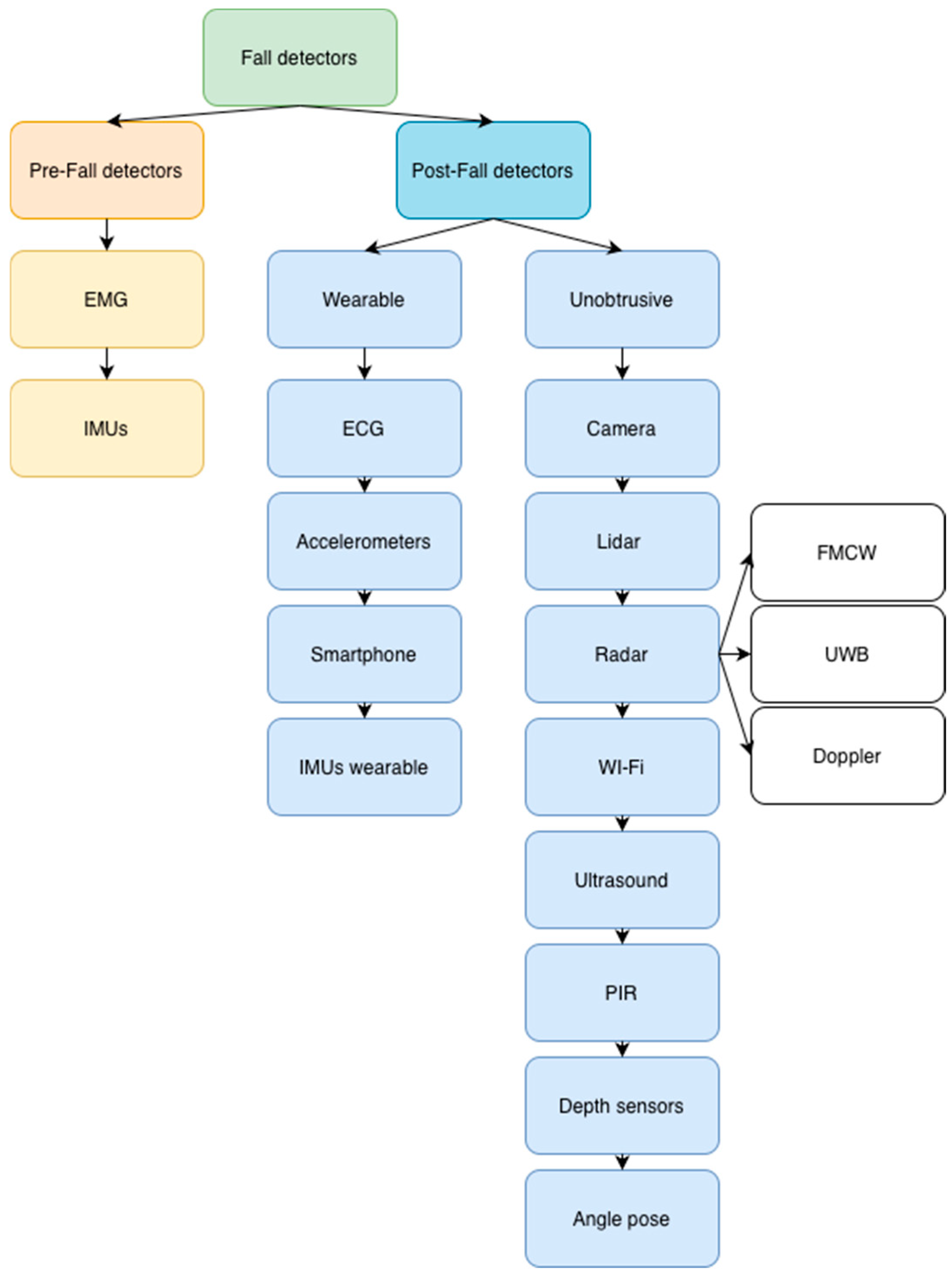
2. Pre-Fall Prediction
Detection via Biosignal and IMUs
3. Post Fall Detection, Wearable
3.1. Detection by Biosignal
3.2. Wearables
3.3. Smartphone
4. Post Fall Detection, Unobtrusive
4.1. Camera Based
4.2. LiDAR
4.3. Radar
4.3.1. Doppler Radar
4.3.2. Frequency-Modulated Continuous Wave (FMCW)
4.3.3. Continuous Wave
4.3.4. Ultrawide Band (UWB)
4.4. Ultrasonic Sensor
4.5. Wi-Fi Detection
4.6. Depth Sensor
4.7. InfraRed Camera Based
4.8. Acoustic
4.9. Vibration
4.10. PIR Sensors
4.11. Angle Pose System
5. Discussion
5.1. Algorithmic Trajectory Beyond Sensors
5.2. Human Activity Recognition

| Technology | Usage | Limitation | Precision | References |
|---|---|---|---|---|
| Inertial measurement units (IMUs) | Pre-fall detection | Sensor placement strongly influence outcome High false alarm rates in real world use Algorithmic generalization Latency—detection before fall User comfort—wearing multiple units, discomfort | Reduced precision (drop to ≈60% when applied on actual falls) Wide specificity variation (≈83% ± 30%) | [108,109,131,132] |
| Biosignal | Pre-fall detection | Quality may vary widely across subjects (weight, height, another anthropometric) Tight skin contact or multiple sites High false detection | Sensitivity ≈ 19% | [24,25,29,131] |
| Camera | Post-Fall detection, unobtrusive | Light (no/visibility) Multiple occupants Privacy-preserving | Precision typically 70–80% | |
| High cost | [56,57,58,59,60,61,62,63,64,65,66,67,68,69,70,71,72,73,74,75,76,77,78,79,80,81,82,83,84,85,86,87,88,89,90,91,92,93,94,95,96,97,98,99,100,101,102,103,104,105,106,107,122,124,125,126,133] | |||
| False alarms—careful calibration and optimization | ||||
| Biosignal | Post-Fall detection, wearable | Skin irritation, differences in body shape | Real world precision 57–80% | [29,32,132] |
| Wearables | Post-Fall detection, wearable | Skin irritation, skin contacts, sensor placement, often occurring of false alarms, lack of real world datasets | In laboratory tests precision ≈ 90% | [29,109,123,131] |
| Smartphone | Post-Fall detection, wearable | Skin irritation, privacy concerns, miss low impact falls | Precision range ≈ 60–90% | [48,134,135] |
| Inertial measurement units (IMUs) wearable | Post-Fall detection, wearable | Skin irritation, sensor placement, high false positive rates | Good results in laboratory environment (90% precision), in real world ≈ 60% | [124,125,136] |
| Lidar | Post-Fall detection, unobtrusive | Limited range, environmental sensitivity | 2D-lidar 98% combined with CNNs | [57,58,60] |
| Radar | Post-Fall detection, unobtrusive | Reflective surface, performance varies markedly with radar height | Precision ≈ 90%, multiple LiDAR increase precision (98%) | [68,76,77,137] |
| Ultrasonic sensor | Post-Fall detection, unobtrusive | Objects that are close together can be indistinguishable, environmental sensitivity Objects closer than a few centimeters cannot be measured | Accuracy ≈ 90–98% | [114,137,138] |
| Wi-Fi | Post-Fall detection, unobtrusive | Antenna orientation Occlusion and blockage Signal ambiguity | DeFall 95% SIFall 98% accuracy Deep learning CSI systems reach 96% | [83,85,139,140] |
| Depth sensor | Post-Fall detection, unobtrusive | Occlusion—inaccurate depth Accuracy degrades beyond ≈4.5 m Single person tracking | Typical precision of ±1–3 mm within its optimal range (0.5–4.5 m for v2) Accuracy above 90% in laboratory studies | [88,90,141] |
| InfraRed camera | Post-Fall detection, unobtrusive | Occlusion Light, Similar temperature object | 95% accuracy With use of CNNs 96% | [93,102,142] |
| Acoustic | Post-Fall detection, unobtrusive | Ambient sound interference Walls, furniture or a person’s body can block or attenuate the wave, precision is bounded by ambient noise | Precision reaches ≈ 86% SVM classifiers on PCA-reduced acoustic features typically achieve 80–90% accuracy, but sensitivity can drop below 70% in noisy rooms | [29,58,60,96,97,98,99,100,101,102,103,104,105,106,107,108,109,110,111,112,113,114,115,116,117,118,119,120,121,122,123,124,125,126,127,128,129,130,131,132,133,134,135,136,137,138,139,140,141,142,143] |
| Vibration | Post-Fall detection, unobtrusive | Occlusion Environmental noise (footsteps, dropping object) | 90% accuracy Combination with k-means 100% | [97,100,144] |
| Passive infrared (PIR) sensor | Post-Fall detection, unobtrusive | High temperature, pets can activate, multiple people in room, Sensor detect just movement | In controlled lab test 75–85% precision Use of two sensors ≈95% sensitivity | [101,102,104,105,113] |
| Angle pose system | Post-Fall detection, unobtrusive | Occlusion Light, visual noise Misclassifying rapid sitting | OpenPose + LSTM/GRU 98% | [106,145,146] |
5.3. Impact of ML Model Hyperparameters on Fall Detection Performance
6. Conclusions
Author Contributions
Funding
Data Availability Statement
Conflicts of Interest
References
- Singh, A.; Rehman, S.U.; Yongchareon, S.; Chong, P.H.J. Sensor Technologies for Fall Detection Systems: A Review. IEEE Sens. J. 2020, 20, 6889–6919. [Google Scholar] [CrossRef]
- Igual, R.; Medrano, C.; Plaza, I. Challenges, issues and trends in fall detection systems. Biomed. Eng. OnLine 2013, 12, 66. [Google Scholar] [CrossRef]
- Tanwar, R.; Nandal, N.; Zamani, M.; Manaf, A.A. Pathway of Trends and Technologies in Fall Detection: A Systematic Review. Healthcare 2022, 10, 172. [Google Scholar] [CrossRef] [PubMed]
- Qiu, H.; Rehman, R.Z.U.; Yu, X.; Xiong, S. Application of Wearable Inertial Sensors and A New Test Battery for Distinguishing Retrospective Fallers from Non-fallers among Community-dwelling Older People. Sci. Rep. 2018, 8, 16349. [Google Scholar] [CrossRef] [PubMed]
- Sczuka, K.S.; Schwickert, L.; Becker, C.; Klenk, J. Re-Enactment as a Method to Reproduce Real-World Fall Events Using Inertial Sensor Data: Development and Usability Study. J. Med. Internet Res. 2020, 22, e13961. [Google Scholar] [CrossRef]
- Greene, B.R.; McManus, K.; Redmond, S.J.; Caulfield, B.; Quinn, C.C. Digital assessment of falls risk, frailty, and mobility impairment using wearable sensors. npj Digit. Med. 2019, 2, 125. [Google Scholar] [CrossRef]
- Merrett, G.V.; Tan, Y.K.; Merrett, G.V.; Tan, Y.K. Wireless Sensor Networks: Application—Centric Design. 2010. Available online: https://www.intechopen.com/books/135 (accessed on 11 December 2025).
- Khan, S.S.; Hoey, J. Review of fall detection techniques: A data availability perspective. Med. Eng. Phys. 2017, 39, 12–22. [Google Scholar] [CrossRef]
- Delahoz, Y.S.; Labrador, M.A.; Delahoz, Y.S.; Labrador, M.A. Survey on Fall Detection and Fall Prevention Using Wearable and External Sensors. Sensors 2014, 14, 19806–19842. [Google Scholar] [CrossRef]
- Nooruddin, S.; Islam, M.M.; Sharna, F.A.; Alhetari, H.; Kabir, M.N. Sensor-based fall detection systems: A review. J. Ambient Intell. Humaniz. Comput. 2022, 13, 2735–2751. [Google Scholar] [CrossRef]
- El-Bendary, N.; Tan, Q.; Pivot, F.C.; Lam, A. Fall Detection and Prevention for the Elderly: A Review of Trends and Challenges. Int. J. Smart Sens. Intell. Syst. 2013, 6, 1230–1266. [Google Scholar] [CrossRef]
- Horová, J.; Brabcová, I.; Bejvančická, P. Risk assessment of falls. Medicína Praxi 2020, 17, 200–202. [Google Scholar] [CrossRef]
- Plati, C.; Lanara, V.; Mantas, J. Risk factors responsible for patients’ falls. Scand. J. Caring Sci. 1992, 6, 113–118. [Google Scholar] [CrossRef]
- Callis, N. Falls prevention: Identification of predictive fall risk factors. Appl. Nurs. Res. 2016, 29, 53–58. [Google Scholar] [CrossRef]
- Najafpour, Z.; Godarzi, Z.; Arab, M.; Yaseri, M. Risk Factors for Falls in Hospital In-Patients: A Prospective Nested Case Control Study. Int. J. Health Policy Manag. 2019, 8, 300–306. [Google Scholar] [CrossRef] [PubMed]
- Franck, L.S.; Gay, C.L.; Cooper, B.; Ezrre, S.; Murphy, B.; Chan, J.S.-L.; Buick, M.; Meer, C.R. The Little Schmidy Pediatric Hospital Fall Risk Assessment Index: A diagnostic accuracy study. Int. J. Nurs. Stud. 2017, 68, 51–59. [Google Scholar] [CrossRef]
- Hill-Rodriguez, D.; Messmer, P.R.; Williams, P.D.; Zeller, R.A.; Williams, A.R.; Wood, M.; Henry, M. The Humpty Dumpty Falls Scale: A Case–Control Study. J. Spec. Pediatr. Nurs. 2009, 14, 22–32. [Google Scholar] [CrossRef] [PubMed]
- Chromá, J. Risk of falling in pediatric nursing. Cent. Eur. J. Nurs. Midwifery 2016, 7, 542–548. [Google Scholar] [CrossRef]
- Pokorná, A.; Štrombachová, V.; Kučerová, J.; Búřilová, P.; Dolanová, D.; Pospíšil, M. Metodika Sledování Nežádoucích Událostí ve Zdravotnických Zařízeních Lůžkové Péče 2023. Available online: https://shnu.uzis.cz/res/file/metodicke_dokumenty/obecna_metodika_sledovani_nu_2022_final_na_web.pdf (accessed on 5 February 2026).
- Lapierre, N.; Neubauer, N.; Miguel-Cruz, A.; Rios Rincon, A.; Liu, L.; Rousseau, J. The state of knowledge on technologies and their use for fall detection: A scoping review. Int. J. Med. Inf. 2018, 111, 58–71. [Google Scholar] [CrossRef]
- Ren, L.; Peng, Y. Research of Fall Detection and Fall Prevention Technologies: A Systematic Review. IEEE Access 2019, 7, 77702–77722. [Google Scholar] [CrossRef]
- Hu, X.; Qu, X. Pre-impact fall detection. Biomed. Eng. OnLine 2016, 15, 61. [Google Scholar] [CrossRef]
- Leone, A.; Rescio, G.; Caroppo, A.; Siciliano, P. Wireless Electromyography Technology for Fall Risk Evaluation. In Sensors; Andò, B., Baldini, F., Di Natale, C., Marrazza, G., Siciliano, P., Eds.; Lecture Notes in Electrical Engineering; Springer International Publishing: Cham, Switzerland, 2018; pp. 322–329. [Google Scholar]
- Leone, A.; Rescio, G.; Caroppo, A.; Siciliano, P. A Wearable EMG-based System Pre-fall Detector. Procedia Eng. 2015, 120, 455–458. [Google Scholar] [CrossRef]
- Rescio, G.; Leone, A.; Caroppo, A.; Casino, F.; Siciliano, P. A Minimally Invasive Electromyography-based System for Pre-fall Detection. Int. J. Eng. Innov. Technol. 2015, 5, 1–7. [Google Scholar]
- Noury, N.; Fleury, A.; Rumeau, P.; Bourke, A.K.; Laighin, G.O.; Rialle, V.; Lundy, J.E. Fall detection—Principles and Methods. In Proceedings of the 2007 29th Annual International Conference of the IEEE Engineering in Medicine and Biology Society, Lyon, France, 22–26 August 2007; pp. 1663–1666. Available online: https://ieeexplore.ieee.org/abstract/document/4352627 (accessed on 17 October 2023).
- Hong, S.; Kim, H. Detecting environmental barriers affecting older adult pedestrians via Gramian angular field-based CNN of smartphone sensor data. Front. Public Health 2025, 13, 1697589. [Google Scholar] [CrossRef] [PubMed]
- Leone, A.; Rescio, G.; Giampetruzzi, L.; Siciliano, P. Smart EMG-based Socks for Leg Muscles Contraction Assessment. In Proceedings of the 2019 IEEE International Symposium on Measurements & Networking (M&N), Catania, Italy, 8–10 July 2019; IEEE Conference Publication: Piscataway, NJ, USA, 2019. Available online: https://ieeexplore.ieee.org/abstract/document/8804991 (accessed on 17 October 2023).
- Santoyo-Ramón, J.A.; Casilari-Pérez, E.; Cano-García, J.M. A study on the impact of the users’ characteristics on the performance of wearable fall detection systems. Sci. Rep. 2021, 11, 23011. [Google Scholar] [CrossRef]
- Kiprijanovska, I.; Gjoreski, H.; Gams, M.; Kiprijanovska, I.; Gjoreski, H.; Gams, M. Detection of Gait Abnormalities for Fall Risk Assessment Using Wrist-Worn Inertial Sensors and Deep Learning. Sensors 2020, 20, 5373. [Google Scholar] [CrossRef]
- Zhou, Y.; Zhang, D.; Ji, Y.; Bu, S.; Hu, X.; Zhao, C.; Lv, Z.; Li, L. Wearable sensors and machine learning fusion-based fall risk prediction in covert cerebral small vessel disease. Front. Neurosci. 2025, 19, 1493988. [Google Scholar] [CrossRef]
- Butt, F.S.; La Blunda, L.; Wagner, M.F.; Schäfer, J.; Medina-Bulo, I.; Gómez-Ullate, D. Fall Detection from Electrocardiogram (ECG) Signals and Classification by Deep Transfer Learning. Information 2021, 12, 63. [Google Scholar] [CrossRef]
- Castaldo, R.; Pecchia, L. Preliminary Results from a Proof of Concept Study for Fall Detection via ECG Morphology. In Proceedings of the XIV Mediterranean Conference on Medical and Biological Engineering and Computing 2016, Cyprus, 31 March–2 April 2016; Kyriacou, E., Christofides, S., Pattichis, C.S., Eds.; IFMBE Proceedings; Springer International Publishing: Cham, Switzerland, 2016; pp. 205–208. [Google Scholar]
- Melillo, P.; Castaldo, R.; Sannino, G.; Orrico, A.; de Pietro, G.; Pecchia, L. Wearable technology and ECG processing for fall risk assessment, prevention and detection. In Proceedings of the 2015 37th Annual International Conference of the IEEE Engineering in Medicine and Biology Society (EMBC) 2015, Milan, Italy, 25–29 August 2015; pp. 7740–7743. Available online: https://ieeexplore.ieee.org/abstract/document/7320186 (accessed on 19 February 2024).
- Nadeem, A.; Mehmood, A.; Rizwan, K. A dataset build using wearable inertial measurement and ECG sensors for activity recognition, fall detection and basic heart anomaly detection system. Data Brief 2019, 27, 104717. [Google Scholar] [CrossRef]
- Luna-Perejón, F.; Muñoz-Saavedra, L.; Civit-Masot, J.; Civit, A.; Domínguez-Morales, M. AnkFall—Falls, Falling Risks and Daily-Life Activities Dataset with an Ankle-Placed Accelerometer and Training Using Recurrent Neural Networks. Sensors 2021, 21, 1889. [Google Scholar] [CrossRef]
- Sudarshan, B.G.; Hegde, R.; Kumar, P.; Satyanarayana, B.S. Design and Development of Fall Detector Using Fall Acceleration. Int. J. Res. Eng. Technol. 2013, 2, 57–61. [Google Scholar] [CrossRef]
- Wang, Z.; Ramamoorthy, V.; Gal, U.; Guez, A. Possible Life Saver: A Review on Human Fall Detection Technology. Robotics 2020, 9, 55. [Google Scholar] [CrossRef]
- Alves, J.; Silva, J.; Grifo, E.; Resende, C.; Sousa, I.; Alves, J.; Silva, J.; Grifo, E.; Resende, C.; Sousa, I. Wearable Embedded Intelligence for Detection of Falls Independently of on-Body Location. Sensors 2019, 19, 2426. [Google Scholar] [CrossRef]
- Bourke, A.K.; O’Brien, J.V.; Lyons, G.M. Evaluation of a threshold-based tri-axial accelerometer fall detection algorithm. Gait Posture 2007, 26, 194–199. [Google Scholar] [CrossRef] [PubMed]
- Wu, G.; Xue, S. Portable Preimpact Fall Detector with Inertial Sensors. IEEE Trans. Neural Syst. Rehabil. Eng. 2008, 16, 178–183. [Google Scholar] [CrossRef] [PubMed]
- Scheurer, S.; Koch, J.; Kucera, M.; Bryn, H.; Bärtschi, M.; Meerstetter, T.; Nef, T.; Urwyler, P.; Scheurer, S.; Koch, J.; et al. Optimization and Technical Validation of the AIDE-MOI Fall Detection Algorithm in a Real-Life Setting with Older Adults. Sensors 2019, 19, 1357. [Google Scholar] [CrossRef]
- Vallabh, P.; Malekian, R. Fall detection monitoring systems: A comprehensive review. J. Ambient Intell. Humaniz. Comput. 2018, 9, 1809–1833. [Google Scholar] [CrossRef]
- Er, J.K.; Ang, W.T. Evaluation of Single HMM as a Pre-Impact Fall Detector Based on Different Input Signals. In Proceedings of the 2018 IEEE Region Ten Symposium (Tensymp), Sydney, Australia, 4–6 July 2018; pp. 207–212. Available online: https://ieeexplore.ieee.org/abstract/document/8691981/references#references (accessed on 24 October 2023).
- Pierleoni, P.; Belli, A.; Maurizi, L.; Palma, L.; Pernini, L.; Paniccia, M.; Valenti, S. A Wearable Fall Detector for Elderly People Based on AHRS and Barometric Sensor. IEEE Sens. J. 2016, 16, 6733–6744. [Google Scholar] [CrossRef]
- Luna-Perejón, F.; Domínguez-Morales, M.J.; Civit-Balcells, A. Wearable Fall Detector Using Recurrent Neural Networks. Sensors 2019, 19, 4885. [Google Scholar] [CrossRef]
- Zhen, T.; Mao, L.; Wang, J.; Gao, Q. Wearable preimpact fall detector using SVM. In Proceedings of the 2016 10th International Conference on Sensing Technology (ICST), Nanjing, China, 11–13 November 2016; pp. 1–6. Available online: https://ieeexplore.ieee.org/abstract/document/7796223/keywords#keywords (accessed on 24 October 2023).
- Vavoulas, G.; Pediaditis, M.; Chatzaki, C.; Spanakis, E.G.; Tsiknakis, M. The MobiFall Dataset: Fall Detection and Classification with a Smartphone. Int. J. Monit. Surveill. Technol. Res. 2014, 2, 44–56. [Google Scholar] [CrossRef]
- Albert, M.V.; Kording, K.; Herrmann, M.; Jayaraman, A. Fall Classification by Machine Learning Using Mobile Phones. PLoS ONE 2012, 7, e36556. [Google Scholar]
- Yadav, S.K.; Tiwari, K.; Pandey, H.M.; Akbar, S.A. Skeleton-based human activity recognition using ConvLSTM and guided feature learning. Soft Comput. 2022, 26, 877–890. [Google Scholar] [CrossRef]
- Su, C.; Wei, J.; Lin, D.; Kong, L.; Guan, Y.L. A novel model for fall detection and action recognition combined lightweight 3D-CNN and convolutional LSTM networks. Pattern Anal. Appl. 2024, 27, 3. [Google Scholar] [CrossRef]
- Doulamis, N. Vision Based Fall Detector Exploiting Deep Learning. In Proceedings of the 9th ACM International Conference on PErvasive Technologies Related to Assistive Environments, Corfu Island, Greece, 29 June–1 July 2016; Association for Computing Machinery: New York, NY, USA, 2016; pp. 1–8. [Google Scholar] [CrossRef]
- Zhang, Z.; Conly, C.; Athitsos, V. A survey on vision-based fall detection. In Proceedings of the 8th ACM International Conference on PErvasive Technologies Related to Assistive Environments, Corfu Island, Greece, 30 June–3 July 2016; Association for Computing Machinery: New York, NY, USA, 2015; pp. 1–7. [Google Scholar] [CrossRef]
- Lee, D.-W.; Jun, K.; Naheem, K.; Kim, M.S. Deep Neural Network–Based Double-Check Method for Fall Detection Using IMU-L Sensor and RGB Camera Data. IEEE Access 2021, 9, 48064–48079. [Google Scholar] [CrossRef]
- Dutt, M.; Gupta, A.; Goodwin, M.; Omlin, C.W.; Dutt, M.; Gupta, A.; Goodwin, M.; Omlin, C.W. An Interpretable Modular Deep Learning Framework for Video-Based Fall Detection. Appl. Sci. 2024, 14, 4722. [Google Scholar] [CrossRef]
- Hellmers, S.; Krey, E.; Gashi, A.; Koschate, J.; Schmidt, L.; Stuckenschneider, T.; Hein, A.; Zieschang, T. Comparison of machine learning approaches for near-fall-detection with motion sensors. Front. Digit. Health 2023, 5, 1223845. [Google Scholar] [CrossRef]
- Joo, J.-E.; Hu, Y.; Kim, S.; Kim, H.; Park, S.; Kim, J.-H.; Kim, Y.; Park, S.-M. An Indoor-Monitoring LiDAR Sensor for Patients with Alzheimer Disease Residing in Long-Term Care Facilities. Sensors 2022, 22, 7934. [Google Scholar] [CrossRef]
- Frøvik, N.; Malekzai, B.A.; Øvsthus, K. Utilising LiDAR for fall detection. Healthc. Technol. Lett. 2021, 8, 11–17. [Google Scholar] [CrossRef]
- Miawarni, H.; Sardjono, T.A.; Setijadi, E.; Wijayanti; Arraziqi, D.; Gumelar, A.B.; Purnomo, M.H. Fall Detection System for Elderly based on 2D LiDAR: A Preliminary Study of Fall Incident and Activities of Daily Living (ADL) Detection. In Proceedings of the 2020 International Conference on Computer Engineering, Network, and Intelligent Multimedia (CENIM), Surabaya, Indonesia, 17–18 November 2020; pp. 1–5. Available online: https://ieeexplore.ieee.org/abstract/document/9298000 (accessed on 17 October 2023).
- Bouazizi, M.; Ye, C.; Ohtsuki, T. 2-D LIDAR-Based Approach for Activity Identification and Fall Detection. IEEE Internet Things J. 2022, 9, 10872–10890. [Google Scholar] [CrossRef]
- Diraco, G.; Leone, A.; Siciliano, P. A Fall Detector Based on Ultra-Wideband Radar Sensing. In Sensors; Andò, B., Baldini, F., Di Natale, C., Marrazza, G., Siciliano, P., Eds.; Lecture Notes in Electrical Engineering; Springer International Publishing: Cham, Switzerland, 2018; pp. 373–382. [Google Scholar]
- Islam, M.M.; Tayan, O.; Islam, M.R.; Islam, M.S.; Nooruddin, S.; Nomani Kabir, M.; Islam, M.R. Deep Learning Based Systems Developed for Fall Detection: A Review. IEEE Access 2020, 8, 166117–166137. [Google Scholar] [CrossRef]
- Rezaei, A.; Mascheroni, A.; Stevens, M.C.; Argha, R.; Papandrea, M.; Puiatti, A.; Lovell, N.H. Unobtrusive Human Fall Detection System Using mmWave Radar and Data Driven Methods. IEEE Sens. J. 2023, 23, 7968–7976. [Google Scholar] [CrossRef]
- Mercuri, M.; Soh, P.J.; Zheng, X.; Karsmakers, P.; Vandenbosch, G.A.E.; Leroux, P.; Schreurs, D. Analysis of a fall detection radar placed on the ceiling and wall. In Proceedings of the 2014 Asia-Pacific Microwave Conference, Sendai, Japan, 4–7 November 2014; pp. 947–949. Available online: https://ieeexplore.ieee.org/abstract/document/7067587 (accessed on 17 October 2023).
- Su, B.Y.; Ho, K.C.; Rantz, M.J.; Skubic, M. Doppler Radar Fall Activity Detection Using the Wavelet Transform. IEEE Trans. Biomed. Eng. 2015, 62, 865–875. [Google Scholar] [CrossRef]
- Jokanovic, B.; Amin, M.G.; Ahmad, F. Effect of data representations on deep learning in fall detection. In Proceedings of the 2016 IEEE Sensor Array and Multichannel Signal Processing Workshop (SAM), Rio de Janeiro, Brazil, 10–13 July 2016; pp. 1–5. Available online: https://ieeexplore.ieee.org/abstract/document/7569734 (accessed on 17 October 2023).
- Liu, L.; Popescu, M.; Skubic, M.; Rantz, M.; Yardibi, T.; Cuddihy, P. Automatic fall detection based on Doppler radar motion signature. In Proceedings of the 2011 5th International Conference on Pervasive Computing Technologies for Healthcare (PervasiveHealth) and Workshops, Dublin, Ireland, 23–26 May 2011; pp. 222–225. [Google Scholar]
- Li, Z.; Du, J.; Zhu, B.; Greenwald, S.E.; Xu, L.; Yao, Y.; Bao, N.; Li, Z.; Du, J.; Zhu, B.; et al. Doppler Radar Sensor-Based Fall Detection Using a Convolutional Bidirectional Long Short-Term Memory Model. Sensors 2024, 24, 5365. [Google Scholar] [CrossRef] [PubMed]
- Erol, B.; Amin, M.G. Radar Data Cube Analysis for Fall Detection. In Proceedings of the 2018 IEEE International Conference on Acoustics, Speech and Signal Processing (ICASSP), Calgary, AB, Canada, 15–20 April 2018; pp. 2446–2450. Available online: https://ieeexplore.ieee.org/abstract/document/8461512 (accessed on 24 October 2023).
- Ding, C.; Zou, Y.; Sun, L.; Hong, H.; Zhu, X.; Li, C. Fall detection with multi-domain features by a portable FMCW radar. In Proceedings of the 2019 IEEE MTT-S International Wireless Symposium (IWS), Guangzhou, China, 19–22 May 2019; pp. 1–3. Available online: https://ieeexplore.ieee.org/abstract/document/8804036 (accessed on 3 June 2024).
- Yang, T.; Cao, J.; Guo, Y. Placement selection of millimeter wave FMCW radar for indoor fall detection. In Proceedings of the 2018 IEEE MTT-S International Wireless Symposium (IWS), Chengdu, China, 6–10 May 2018; pp. 1–3. Available online: https://ieeexplore.ieee.org/abstract/document/8400812 (accessed on 3 June 2024).
- Yao, Y.; Zhang, H.; Liu, C.; Geng, F.; Wang, P.; Du, L.; Chen, X.; Han, B.; Yang, T.; Fang, Z. Unsupervised-Learning-Based Unobtrusive Fall Detection Using FMCW Radar. IEEE Internet Things J. 2024, 11, 5078–5089. [Google Scholar] [CrossRef]
- Ma, L.; Li, X.; Liu, G.; Cai, Y.; Ma, L.; Li, X.; Liu, G.; Cai, Y. Fall Direction Detection in Motion State Based on the FMCW Radar. Sensors 2023, 23, 5031. [Google Scholar] [CrossRef] [PubMed]
- Liang, T.; Liu, R.; Yang, L.; Lin, Y.; Shi, C.-J.R.; Xu, H. Fall Detection System Based on Point Cloud Enhancement Model for 24 GHz FMCW Radar. Sensors 2024, 24, 648. [Google Scholar] [CrossRef]
- Baik, J.-Y.; Shin, H.-C. Fall Detection Using FMCW Radar to Reduce Detection Errors for the Elderly. J. Electromagn. Eng. Sci. 2024, 24, 78–88. [Google Scholar] [CrossRef]
- Cho, H.; Kang, S.; Sim, Y.; Lee, S.; Jung, Y.; Cho, H.; Kang, S.; Sim, Y.; Lee, S.; Jung, Y. Fall Detection Based on Continuous Wave Radar Sensor Using Binarized Neural Networks. Appl. Sci. 2025, 15, 546. [Google Scholar] [CrossRef]
- Tewari, R.C.; Sharma, S.; Routray, A.; Maiti, J. Effective fall detection and post-fall breath rate tracking using a low-cost CW Doppler radar sensor. Comput. Biol. Med. 2023, 164, 107315. [Google Scholar] [CrossRef] [PubMed]
- Jokanovic, B.; Amin, M.; Ahmad, F. Radar fall motion detection using deep learning. In Proceedings of the 2016 IEEE Radar Conference (RadarConf), Philadelphia, PA, USA, 2–6 May 2016; pp. 1–6. Available online: https://ieeexplore.ieee.org/abstract/document/7485147 (accessed on 17 October 2023).
- Rodriguez, J.; Mercuri, M.; Karsmakers, P.; Soh, P.J.; Leroux, P.; Schreurs, D.; Pollin, S.; Van der Perre, L.; Stas, A. Automatic fall detector based on sliding window principle. In Proceedings of the 34th WIC Symposium on Information Theory in the Benelux and the Third joint WIC/IEEE SP Symposium on Information Theory and Signal Processing in the Benelux, Leuven, Belgium, 30–31 May 2013; Werkgemeenschap voor Informatie-en Communicatietheorie (WIC): Heverlee, Belgium, 2013; pp. 215–219. Available online: https://lirias.kuleuven.be/1673135 (accessed on 17 October 2023).
- Sadreazami, H.; Bolic, M.; Rajan, S. CapsFall: Fall Detection Using Ultra-Wideband Radar and Capsule Network. IEEE Access 2019, 7, 55336–55343. [Google Scholar] [CrossRef]
- Imbeault-Nepton, T.; Maître, J.; Bouchard, K.; Gaboury, S. Fall Detection from UWB Radars: A Comparative Analysis of Deep Learning and Classical Machine Learning Techniques. In Proceedings of the 2023 ACM Conference on Information Technology for Social Good, Lisbon, Portugal, 6–8 September 2023; Association for Computing Machinery: New York, NY, USA, 2023; pp. 197–204. [Google Scholar]
- Wang, X.; Ellul, J.; Azzopardi, G. Elderly Fall Detection Systems: A Literature Survey. Front. Robot. AI 2020, 7, 71. [Google Scholar] [CrossRef]
- Damodaran, N.; Haruni, E.; Kokhkharova, M.; Schäfer, J. Device free human activity and fall recognition using WiFi channel state information (CSI). CCF Trans. Pervasive Comput. Interact. 2020, 2, 1–17. [Google Scholar] [CrossRef]
- Palipana, S.; Rojas, D.; Agrawal, P.; Pesch, D. FallDeFi: Ubiquitous Fall Detection using Commodity Wi-Fi Devices. Proc. ACM Interact. Mob. Wearable Ubiquitous Technol. 2018, 1, 155. [Google Scholar] [CrossRef]
- Mattela, G.; Tripathi, M.; Pal, C. A Novel Approach in WiFi CSI-Based Fall Detection. SN Comput. Sci. 2022, 3, 214. [Google Scholar] [CrossRef]
- Wang, Y.; Wu, K.; Ni, L.M. WiFall: Device-Free Fall Detection by Wireless Networks. IEEE Trans. Mob. Comput. 2017, 16, 581–594. [Google Scholar] [CrossRef]
- Shan, Z.; Li, R.; Schwertfeger, S.; Shan, Z.; Li, R.; Schwertfeger, S. RGBD-Inertial Trajectory Estimation and Mapping for Ground Robots. Sensors 2019, 19, 2251. [Google Scholar] [CrossRef] [PubMed]
- Tölgyessy, M.; Dekan, M.; Chovanec, Ľ.; Tölgyessy, M.; Dekan, M.; Chovanec, Ľ. Skeleton Tracking Accuracy and Precision Evaluation of Kinect V1, Kinect V2, and the Azure Kinect. Appl. Sci. 2021, 11, 5756. [Google Scholar] [CrossRef]
- Kepski, M.; Kwolek, B. Fall Detection on Embedded Platform Using Kinect and Wireless Accelerometer. In Computers Helping People with Special Needs; Miesenberger, K., Karshmer, A., Penaz, P., Zagler, W., Eds.; Lecture Notes in Computer Science; Springer: Berlin/Heidelberg, Germany, 2012; pp. 407–414. [Google Scholar]
- Zobi, M.; Bolzani, L.; Tabii, Y.; Thami, R.O.H.; Zobi, M.; Bolzani, L.; Tabii, Y.; Thami, R.O.H. Robust 3D Skeletal Joint Fall Detection in Occluded and Rotated Views Using Data Augmentation and Inference–Time Aggregation. Sensors 2025, 25, 6783. [Google Scholar] [CrossRef]
- Kwolek, B.; Kepski, M. Human fall detection on embedded platform using depth maps and wireless accelerometer. Comput. Methods Programs Biomed. 2014, 117, 489–501. [Google Scholar] [CrossRef]
- Rezaei, A.M.; Stevens, M.C.; Argha, A.; Mascheroni, A.; Puiatti, A.; Lovell, N.H. An Unobtrusive Fall Detection System Using Low Resolution Thermal Sensors and Convolutional Neural Networks. In Proceedings of the 2021 43rd Annual International Conference of the IEEE Engineering in Medicine & Biology Society (EMBC), Virtual, 1–5 November 2021; pp. 6949–6952. Available online: https://ieeexplore.ieee.org/document/9631059 (accessed on 24 October 2023).
- Fan, X.; Zhang, H.; Leung, C.; Shen, Z. Robust unobtrusive fall detection using infrared array sensors. In Proceedings of the 2017 IEEE International Conference on Multisensor Fusion and Integration for Intelligent Systems (MFI), Daegu, Republic of Korea, 16–18 November 2017; pp. 194–199. Available online: https://ieeexplore.ieee.org/document/8170428 (accessed on 21 January 2026).
- Nogas, J.; Khan, S.S.; Mihailidis, A. DeepFall: Non-Invasive Fall Detection with Deep Spatio-Temporal Convolutional Autoencoders. J. Healthc. Inform. Res. 2020, 4, 50–70. [Google Scholar] [CrossRef]
- Alex, J.S.R.; Abai Kumar, M.; Swathy, D.V. Deep Learning Approaches for Fall Detection Using Acoustic Information. In Advances in Smart Grid Technology; Zhou, N., Hemamalini, S., Eds.; Lecture Notes in Electrical Engineering; Springer: Singapore, 2021; pp. 479–488. [Google Scholar]
- Lian, J.; Yuan, X.; Li, M.; Tzeng, N.-F. Fall Detection via Inaudible Acoustic Sensing. Proc. ACM Interact. Mob. Wearable Ubiquitous Technol. 2021, 5, 114. [Google Scholar] [CrossRef]
- Alwan, M.; Rajendran, P.J.; Kell, S.; Mack, D.; Dalal, S.; Wolfe, M.; Felder, R. A Smart and Passive Floor-Vibration Based Fall Detector for Elderly. In Proceedings of the 2006 2nd International Conference on Information & Communication Technologies, Damascus, Syria, 24–28 April 2006; Volume 1, pp. 1003–1007. Available online: https://ieeexplore.ieee.org/abstract/document/1684511 (accessed on 24 October 2023).
- Clemente, J.; Li, F.; Valero, M.; Song, W. Smart Seismic Sensing for Indoor Fall Detection, Location, and Notification. IEEE J. Biomed. Health Inform. 2020, 24, 524–532. [Google Scholar] [CrossRef]
- Clemente, J.; Song, W.; Valero, M.; Li, F.; Liy, X. Indoor Person Identification and Fall Detection through Non-intrusive Floor Seismic Sensing. In Proceedings of the 2019 IEEE International Conference on Smart Computing (SMARTCOMP), Washington, DC, USA, 12–15 June 2019; pp. 417–424. Available online: https://ieeexplore.ieee.org/abstract/document/8784060 (accessed on 24 October 2023).
- Okumura, N.; Yamanoi, Y.; Kato, R.; Yamamura, O. Fall detection and walking estimation using floor vibration for solitary elderly people. In Proceedings of the 2019 IEEE International Conference on Systems, Man and Cybernetics (SMC), Bari, Italy, 6–9 October 2019; pp. 1437–1442. Available online: https://ieeexplore.ieee.org/abstract/document/8914664 (accessed on 24 October 2023).
- Hassan, C.A.U.; Karim, F.K.; Abbas, A.; Iqbal, J.; Elmannai, H.; Hussain, S.; Ullah, S.S.; Khan, M.S. A Cost-Effective Fall-Detection Framework for the Elderly Using Sensor-Based Technologies. Sustainability 2023, 15, 3982. [Google Scholar] [CrossRef]
- Lin, Y.; Zhao, Q.; Lin, Y.; Zhao, Q. Human Occupancy Monitoring and Positioning with Speed-Responsive Adaptive Sliding Window Using an Infrared Thermal Array Sensor. Sensors 2024, 25, 129. [Google Scholar] [CrossRef] [PubMed]
- He, C.; Liu, S.; Zhong, G.; Wu, H.; Cheng, L.; Yan, G.; Wen, Y. A Noncontact Fall Detection Method for Bedside Application With a MEMS Infrared Sensor and a Radar Sensor. IEEE Internet Things J. 2023, 10, 12577–12589. [Google Scholar] [CrossRef]
- Yun, J.; Lee, S.-S.; Yun, J.; Lee, S.-S. Human Movement Detection and Identification Using Pyroelectric Infrared Sensors. Sensors 2014, 14, 8057–8081. [Google Scholar] [CrossRef] [PubMed]
- He, C.; Liu, S.; Zhong, G.; Wu, H.; Cheng, L.; Lin, J.; Huang, Q. A Non-Contact Fall Detection Method for Bathroom Application Based on MEMS Infrared Sensors. Micromachines 2023, 14, 130. [Google Scholar] [CrossRef]
- Chen, W.; Jiang, Z.; Guo, H.; Ni, X. Fall Detection Based on Key Points of Human-Skeleton Using OpenPose. Symmetry 2020, 12, 744. [Google Scholar] [CrossRef]
- Liu, J.; Lockhart, T.E. Trunk Angular Kinematics during Slip-Induced Falls and Activities of Daily Living—Towards Developing a Fall Detector. Proc. Hum. Factors Ergon. Soc. Annu. Meet. 2009, 53, 892–896. [Google Scholar] [CrossRef]
- Yu, X.; Jang, J.; Xiong, S. A Large-Scale Open Motion Dataset (KFall) and Benchmark Algorithms for Detecting Pre-impact Fall of the Elderly Using Wearable Inertial Sensors. Front. Aging Neurosci. 2021, 13, 692865. [Google Scholar] [CrossRef]
- Hauth, J.; Jabri, S.; Kamran, F.; Feleke, E.W.; Nigusie, K.; Ojeda, L.V.; Handelzalts, S.; Nyquist, L.; Alexander, N.B.; Huan, X.; et al. Automated Loss-of-Balance Event Identification in Older Adults at Risk of Falls during Real-World Walking Using Wearable Inertial Measurement Units. Sensors 2021, 21, 4661. [Google Scholar] [CrossRef]
- Cartocci, N.; Gkikakis, A.E.; Kurvina, N.; Takele, N.; Pera, F.; Settino, M.T.; Caldwell, D.G.; Ortiz, J. Recognition of Physiological Patterns During Activities of Daily Living Using Wearable Biosignal Sensors. In Proceedings of the 22nd Congress of the International Ergonomics Association, Volume 3, Jeju, Republic of Korea, 25–29 August 2024; Jin, S., Kim, J.H., Kong, Y.-K., Park, J., Yun, M.H., Eds.; Springer Nature: Singapore, 2025; pp. 447–454. [Google Scholar]
- Palmerini, L.; Klenk, J.; Becker, C.; Chiari, L.; Palmerini, L.; Klenk, J.; Becker, C.; Chiari, L. Accelerometer-Based Fall Detection Using Machine Learning: Training and Testing on Real-World Falls. Sensors 2020, 20, 6479. [Google Scholar] [CrossRef]
- Chaudhuri, S.; Oudejans, D.; Thompson, H.J.; Demiris, G. Real World Accuracy and Use of a Wearable Fall Detection Device by Older Adults. J. Am. Geriatr. Soc. 2015, 63, 2415–2416. [Google Scholar] [CrossRef]
- Uddin, M.Z.; Khaksar, W.; Torresen, J.; Uddin, M.Z.; Khaksar, W.; Torresen, J. Ambient Sensors for Elderly Care and Independent Living: A Survey. Sensors 2018, 18, 2027. [Google Scholar] [CrossRef] [PubMed]
- Hsu, F.-S.; Chang, T.-C.; Su, Z.-J.; Huang, S.-J.; Chen, C.-C. Smart Fall Detection Framework Using Hybridized Video and Ultrasonic Sensors. Micromachines 2021, 12, 508. [Google Scholar] [CrossRef]
- Kibet, D.; So, M.S.; Kang, H.; Han, Y.; Shin, J.-H. Sudden Fall Detection of Human Body Using Transformer Model. Sensors 2024, 24, 8051. [Google Scholar] [CrossRef] [PubMed]
- Núñez-Marcos, A.; Arganda-Carreras, I. Transformer-based fall detection in videos. Eng. Appl. Artif. Intell. 2024, 132, 107937. [Google Scholar] [CrossRef]
- Zafar, R.O.; Zafar, F. Real-time activity and fall detection using transformer-based deep learning models for elderly care applications. BMJ Health Care Inform. 2025, 32, e101439. [Google Scholar] [CrossRef] [PubMed]
- Shin, J.; Hassan, N.; Miah1, A.S.M.; Nishimura, S. A Comprehensive Methodological Survey of Human Activity Recognition Across Divers Data Modalities 2024. arXiv 2024, arXiv:2409.09678. [Google Scholar] [CrossRef]
- Bian, S.; Liu, M.; Zhou, B.; Lukowicz, P.; Bian, S.; Liu, M.; Zhou, B.; Lukowicz, P. The State-of-the-Art Sensing Techniques in Human Activity Recognition: A Survey. Sensors 2022, 22, 4596. [Google Scholar] [CrossRef]
- Gomaa, W.; Khamis, M.A. A perspective on human activity recognition from inertial motion data. Neural Comput. Appl. 2023, 35, 20463–20568. [Google Scholar] [CrossRef]
- Gaya-Morey, F.X.; Manresa-Yee, C.; Buades-Rubio, J.M. Deep Learning for Computer Vision based Activity Recognition and Fall Detection of the Elderly: A Systematic Review. Appl. Intell. 2024, 54, 8982–9007. [Google Scholar] [CrossRef]
- Ciortuz, G.; Hozhabr Pour, H.; Irshad, M.T.; Nisar, M.A.; Huang, X.; Fudickar, S. Machine learning models for wearable-based human activity recognition: A comparative study. Neurocomputing 2025, 650, 130911. [Google Scholar] [CrossRef]
- Attal, F.; Mohammed, S.; Dedabrishvili, M.; Chamroukhi, F.; Oukhellou, L.; Amirat, Y.; Attal, F.; Mohammed, S.; Dedabrishvili, M.; Chamroukhi, F.; et al. Physical Human Activity Recognition Using Wearable Sensors. Sensors 2015, 15, 31314–31338. [Google Scholar] [CrossRef]
- Siwadamrongpong, W.; Chinrungrueng, J.; Hasegawa, S.; Nantajeewarawat, E. Fall Detection and Prediction Based on IMU and EMG Sensors for Elders. In Proceedings of the 2022 19th International Joint Conference on Computer Science and Software Engineering (JCSSE), Bangkok, Thailand, 22–25 June 2022; pp. 1–6. Available online: https://ieeexplore.ieee.org/abstract/document/9836284 (accessed on 17 October 2023).
- Yan, J.; Wang, X.; Shi, J.; Hu, S. Skeleton-Based Fall Detection with Multiple Inertial Sensors Using Spatial-Temporal Graph Convolutional Networks. Sensors 2023, 23, 2153. [Google Scholar] [CrossRef]
- Tian, Z.; Zhang, L.; Wang, G.; Wang, X. An RGB camera-based fall detection algorithm in complex home environments. Interdiscip. Nurs. Res. 2022, 1, 14–26. [Google Scholar] [CrossRef]
- Liu, H.; Liu, T.; Chen, Y.; Zhang, Z.; Li, Y.F. EHPE: Skeleton Cues-Based Gaussian Coordinate Encoding for Efficient Human Pose Estimation. IEEE Trans. Multimed. 2024, 26, 8464–8475. [Google Scholar] [CrossRef]
- Liu, T.; Liu, H.; Yang, B.; Zhang, Z. LDCNet: Limb Direction Cues-Aware Network for Flexible HPE in Industrial Behavioral Biometrics Systems. IEEE Trans. Ind. Inform. 2024, 20, 8068–8078. [Google Scholar] [CrossRef]
- Liu, H.; Chen, Q.; Liu, Z.; Liu, T.; Zhao, L.; Zhang, Z.; Li, Y.F. SkeFormer: Skeletal Cues-aware Bone point Relationship Learning for Efficient FBIC via Transformers. IEEE Trans. Multimed. 2025, 1–14. [Google Scholar] [CrossRef]
- Ahn, S.; Choi, M.; Lee, J.; Kim, J.; Chung, S. Non-Contact Fall Detection System Using 4D Imaging Radar for Elderly Safety Based on a CNN Model. Sensors 2025, 25, 3452. [Google Scholar] [CrossRef]
- Aziz, O.; Klenk, J.; Schwickert, L.; Chiari, L.; Becker, C.; Park, E.J.; Mori, G.; Robinovitch, S.N. Validation of accuracy of SVM-based fall detection system using real-world fall and non-fall datasets. PLoS ONE 2017, 12, e0180318. [Google Scholar] [CrossRef]
- Bagalà, F.; Becker, C.; Cappello, A.; Chiari, L.; Aminian, K.; Hausdorff, J.M.; Zijlstra, W.; Klenk, J. Evaluation of Accelerometer-Based Fall Detection Algorithms on Real-World Falls. PLoS ONE 2012, 7, e37062. [Google Scholar] [CrossRef] [PubMed]
- Ghayvat, H.; Pandya, S.; Patel, A. Proposal and Preliminary Fall-related Activities Recognition in Indoor Environment. In Proceedings of the 2019 IEEE 19th International Conference on Communication Technology (ICCT), Xi’an, China, 16–19 October 2019; pp. 362–366. Available online: https://ieeexplore.ieee.org/document/8947044 (accessed on 11 December 2025).
- Harari, Y.; Shawen, N.; Mummidisetty, C.K.; Albert, M.V.; Kording, K.P.; Jayaraman, A. A smartphone-based online system for fall detection with alert notifications and contextual information of real-life falls. J. NeuroEngineering Rehabil. 2021, 18, 124. [Google Scholar] [CrossRef] [PubMed]
- Stampfler, T.; Elgendi, M.; Fletcher, R.R.; Menon, C. Fall detection using accelerometer-based smartphones: Where do we go from here? Front. Public Health 2022, 10, 996021. [Google Scholar] [CrossRef] [PubMed]
- Lin, H.-C.; Chen, M.-J.; Lee, C.-H.; Kung, L.-C.; Huang, J.-T. Fall Recognition Based on an IMU Wearable Device and Fall Verification through a Smart Speaker and the IoT. Sensors 2023, 23, 5472. [Google Scholar] [CrossRef]
- Hu, S.; Cao, S.; Toosizadeh, N.; Barton, J.; Hector, M.G.; Fain, M.J. Radar-Based Fall Detection: A Survey. IEEE Robot. Autom. Mag. 2024, 31, 170–185. [Google Scholar] [CrossRef]
- Nadee, C.; Chamnongthai, K. An Ultrasonic-Based Sensor System for Elderly Fall Monitoring in a Smart Room. J. Healthc. Eng. 2022, 2022, 2212020. [Google Scholar] [CrossRef]
- Cardenas, J.D.; Gutierrez, C.A.; Aguilar-Ponce, R. Influence of the Antenna Orientation on WiFi-Based Fall Detection Systems. Sensors 2021, 21, 5121. [Google Scholar] [CrossRef]
- Ji, S.; Xie, Y.; Li, M. SiFall: Practical Online Fall Detection with RF Sensing. In Proceedings of the 20th ACM Conference on Embedded Networked Sensor Systems, Boston, MA, USA, 6–9 November 2022; Association for Computing Machinery: New York, NY, USA, 2023; pp. 563–577. Available online: https://dl.acm.org/doi/10.1145/3560905.3568517 (accessed on 21 January 2026).
- Nizam, Y.; Mohd, M.N.H.; Jamil, M.M.A. Human Fall Detection from Depth Images using Position and Velocity of Subject. Procedia Comput. Sci. 2017, 105, 131–137. [Google Scholar] [CrossRef]
- Yang, J.; He, Y.; Zhu, J.; Lv, Z.; Jin, W. Fall Detection Method for Infrared Videos Based on Spatial-Temporal Graph Convolutional Network. Sensors 2024, 24, 4647. [Google Scholar] [CrossRef]
- Kaur, P.; Wang, Q.; Shi, W. Fall detection from audios with Audio Transformers. Smart Health 2022, 26, 100340. [Google Scholar] [CrossRef]
- Shao, Y.; Wang, X.; Song, W.; Ilyas, S.; Guo, H.; Chang, W.-S. Feasibility of Using Floor Vibration to Detect Human Falls. Int. J. Environ. Res. Public. Health 2020, 18, 200. [Google Scholar] [CrossRef]
- Salimi, M.; Machado, J.J.M.; Tavares, J.M.R.S. Using Deep Neural Networks for Human Fall Detection Based on Pose Estimation. Sensors 2022, 22, 4544. [Google Scholar] [CrossRef]
- Lin, C.-B.; Dong, Z.; Kuan, W.-K.; Huang, Y.-F. A Framework for Fall Detection Based on OpenPose Skeleton and LSTM/GRU Models. Appl. Sci. 2020, 11, 329. [Google Scholar] [CrossRef]
- Yu, X.; Koo, B.; Jang, J.; Kim, Y.; Xiong, S. A comprehensive comparison of accuracy and practicality of different types of algorithms for pre-impact fall detection using both young and old adults. Measurement 2022, 201, 111785. [Google Scholar] [CrossRef]
- Skubic, M.; Harris, B.H.; Stone, E.; Ho, K.C.; Su, B.-Y.; Rantz, M. Testing non-wearable fall detection methods in the homes of older adults. In Proceedings of the 2016 38th Annual International Conference of the IEEE Engineering in Medicine and Biology Society (EMBC), Orlando, FL, USA, 16–20 August 2016; pp. 557–560. Available online: https://ieeexplore.ieee.org/document/7590763 (accessed on 22 January 2026).
- Casilari, E.; Lora-Rivera, R.; García-Lagos, F. A Study on the Application of Convolutional Neural Networks to Fall Detection Evaluated with Multiple Public Datasets. Sensors 2020, 20, 1466. [Google Scholar] [CrossRef] [PubMed]
- Chelli, A.; Pätzold, M. A Machine Learning Approach for Fall Detection Based on the Instantaneous Doppler Frequency. IEEE Access 2019, 7, 166173–166189. [Google Scholar] [CrossRef]
- Wang, X.; Ma, P.; Lian, J.; Liu, J.; Ma, Y. An echo state network based on enhanced intersecting cortical model for discrete chaotic system prediction. Front. Phys. 2025, 13, 1636357. [Google Scholar] [CrossRef]


| Methods | Pros | Limitations | References |
|---|---|---|---|
| Pre-fall detection | Creating models of typical walking patterns and identifying deviations indicative of a potential fall | Require careful calibration, Sensor placement strongly influence outcome | [108,109,110] |
| Post-Fall Detection (Wearable) | Real-time monitoring and fall detection | Battery life and patient compliance Sensor placement-affect precision | [111,112] |
| Post-Fall Detection (Unobtrusive) | Privacy-preserving monitoring | Limited range Dependence on fixed sensor placement | [60,75,76,88,113,114] |
| Struggle to distinguish between lying due fall and sleep/rest/exercise | |||
| False alarms—careful calibration and optimization Multiple occupants in room |
Disclaimer/Publisher’s Note: The statements, opinions and data contained in all publications are solely those of the individual author(s) and contributor(s) and not of MDPI and/or the editor(s). MDPI and/or the editor(s) disclaim responsibility for any injury to people or property resulting from any ideas, methods, instructions or products referred to in the content. |
© 2026 by the authors. Licensee MDPI, Basel, Switzerland. This article is an open access article distributed under the terms and conditions of the Creative Commons Attribution (CC BY) license.
Share and Cite
Hrubý, D.; Hrubá, E.; Černý, M. Research of Fall Detection and Fall Prevention Technologies: A Review. Sensors 2026, 26, 1192. https://doi.org/10.3390/s26041192
Hrubý D, Hrubá E, Černý M. Research of Fall Detection and Fall Prevention Technologies: A Review. Sensors. 2026; 26(4):1192. https://doi.org/10.3390/s26041192
Chicago/Turabian StyleHrubý, Dan, Eva Hrubá, and Martin Černý. 2026. "Research of Fall Detection and Fall Prevention Technologies: A Review" Sensors 26, no. 4: 1192. https://doi.org/10.3390/s26041192
APA StyleHrubý, D., Hrubá, E., & Černý, M. (2026). Research of Fall Detection and Fall Prevention Technologies: A Review. Sensors, 26(4), 1192. https://doi.org/10.3390/s26041192