Measuring Dynamic Tendon Torsion Using Ultrasound Speckle Tracking: Validation with Silicone Phantom and In Vivo Application on Human Tibialis Posterior Tendon
 , , and
Highlights
- Transverse plane speckle tracking is validated for quantifying dynamic torsion angles on silicone phantoms.
- Speckle tracking can be applied to measure dynamic torsion of human tibialis posterior tendon with reliable results.
- Transverse plane speckle tracking is a valid and reliable method for assessing tendons’ dynamic torsion characteristics.
- Dynamic torsion assessments via speckle tracking may provide functionally and clinically relevant information regarding tendons’ dynamic torsion characteristics.
Abstract
1. Introduction
2. Materials and Methods
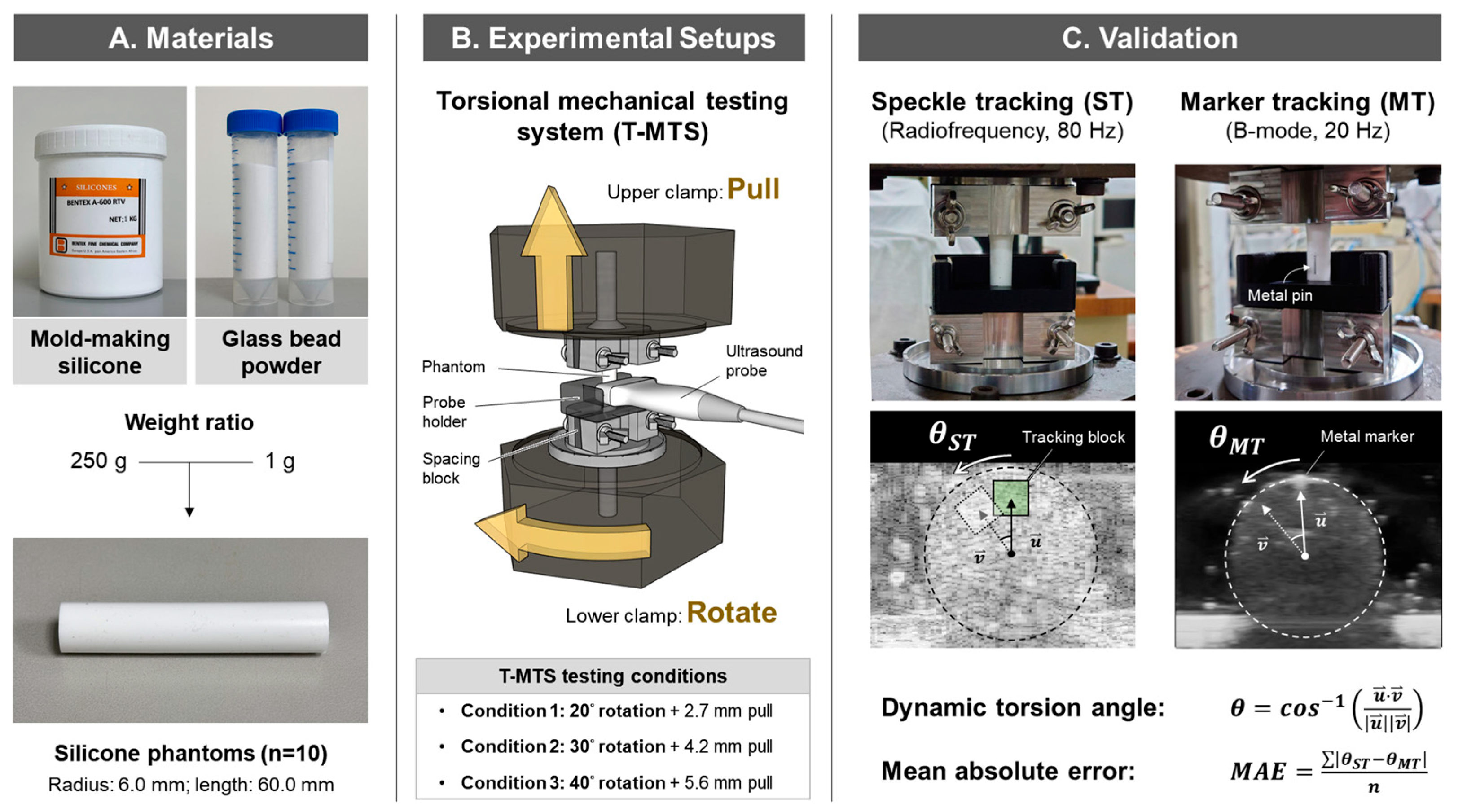
2.1. Validation of ST Dynamic Torsion Assessment
2.1.1. Experimental Materials
2.1.2. Dynamic Torsion Mechanical Testing
2.1.3. Acquisition of Phantom Images
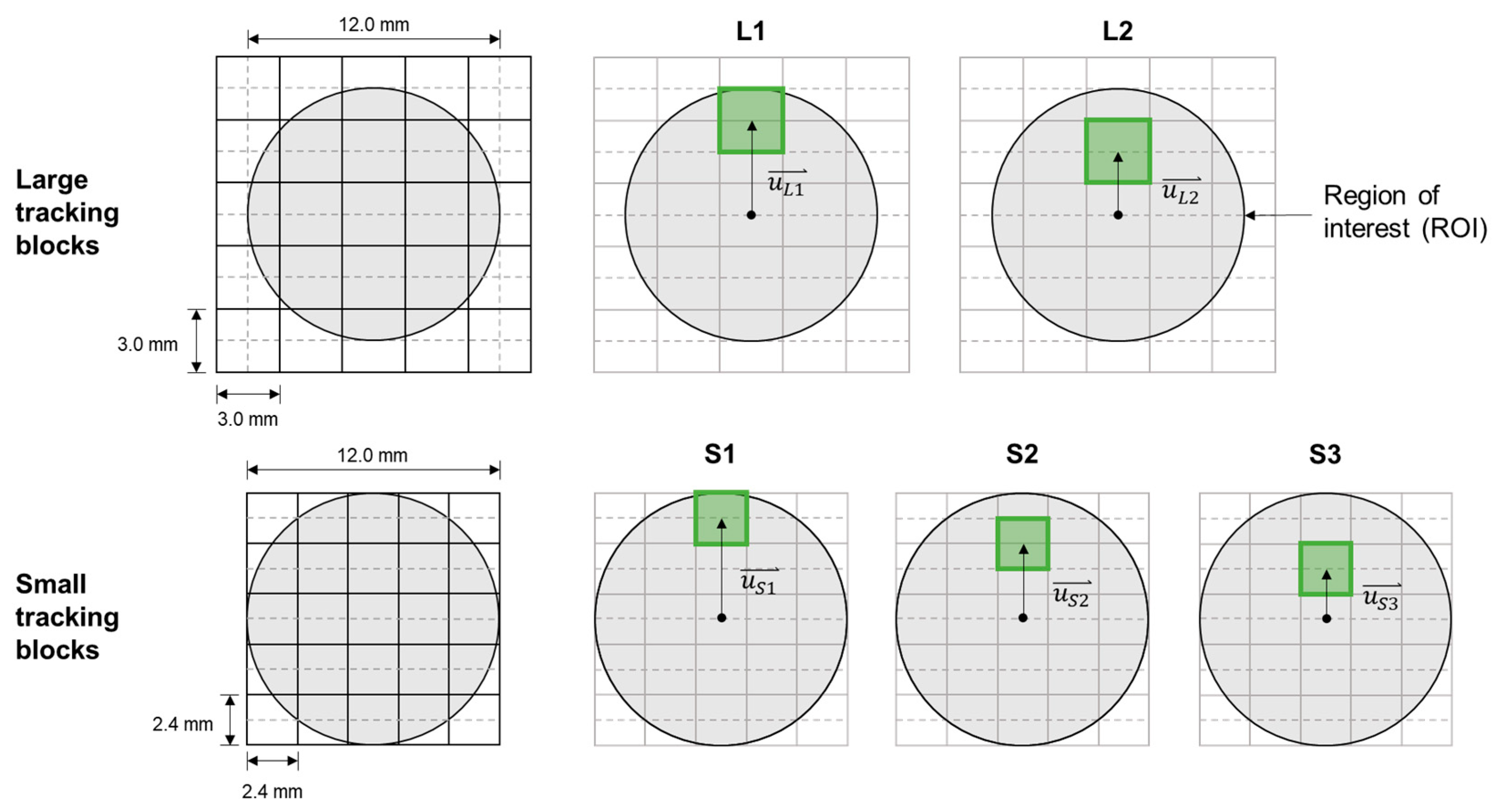
2.1.4. Speckle-Tracking Analysis
2.1.5. Marker Tracking Analysis
2.1.6. Statistical Analyses
2.2. In Vivo Application of ST Dynamic Torsion Assessment on Human TPT
2.2.1. Participants
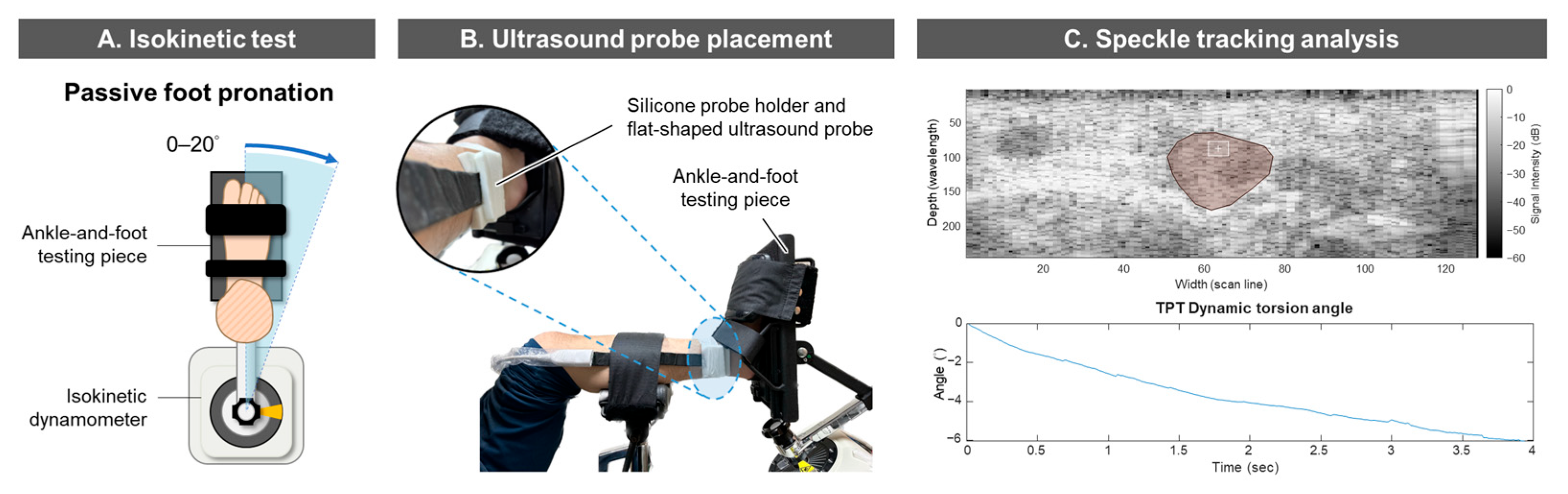
2.2.2. Study Procedure
2.2.3. Acquisition of Tendon Images
2.2.4. Speckle-Tracking Analysis of TPT Dynamic Torsion
2.2.5. Collection of Foot Pronation Angles
2.2.6. Reliability Test
2.2.7. Statistical Analyses
3. Results
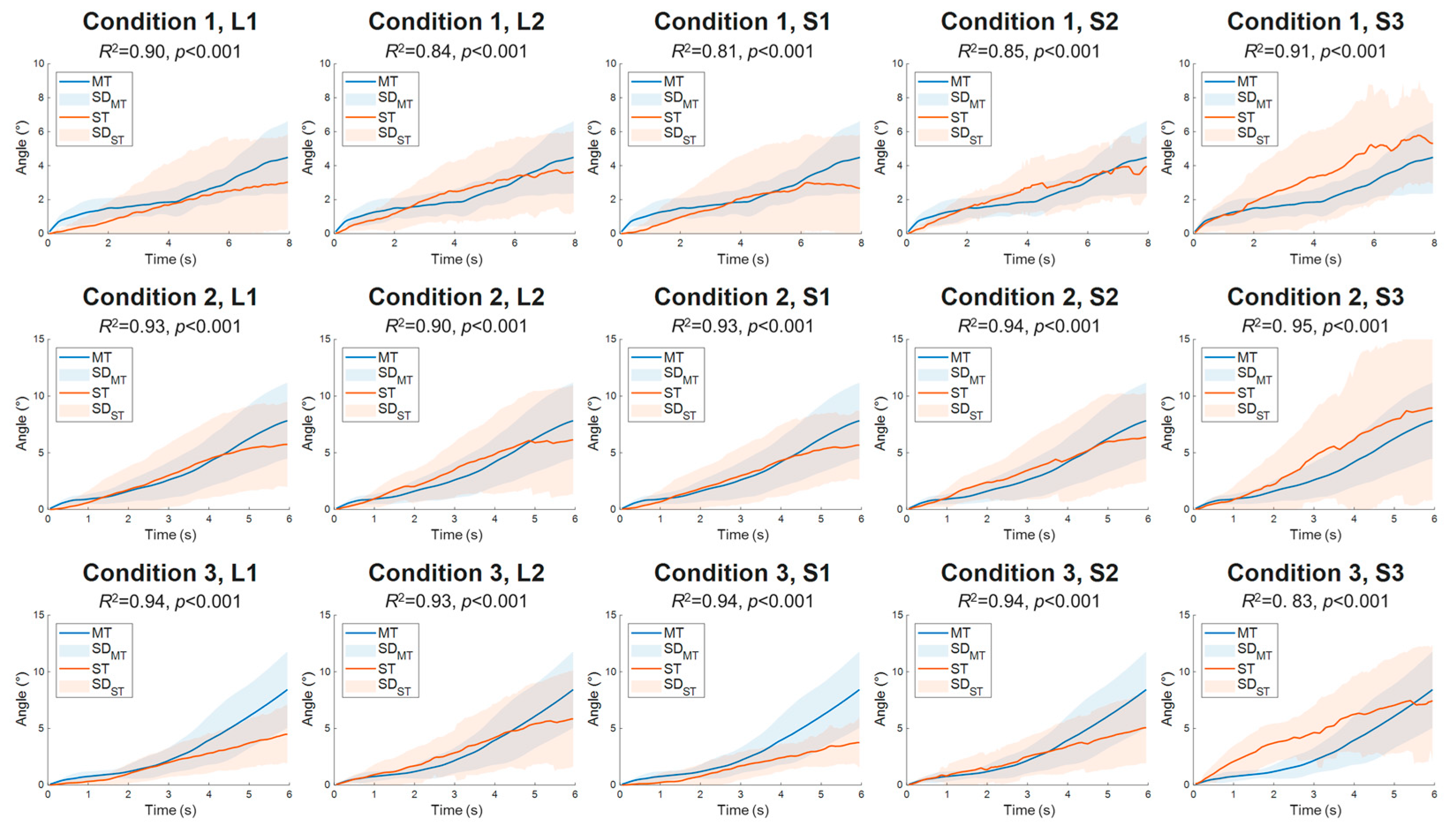
3.1. Validation of ST Dynamic Torsion Assessment
3.2. In Vivo Application of ST Dynamic Torsion Assessment on Human TPT
4. Discussion
4.1. Validation of ST Dynamic Torsion Assessment
4.2. In Vivo Application of ST Dynamic Torsion Assessment on Human TPT
4.3. Suggestions for Future In Vivo ST Dynamic Torsion Assessment
5. Conclusions
Author Contributions
Funding
Institutional Review Board Statement
Informed Consent Statement
Data Availability Statement
Acknowledgments
Conflicts of Interest
Abbreviations
| ANOVA | Analysis of variance |
| CI | Confidence interval |
| CV | Coefficient of variance |
| FPI-6 | Six-item Foot Posture Index |
| GG | Greenhouse–Geisser correction |
| ICC | Interclass correlation coefficient |
| MAE | Mean absolute error |
| MT | Marker tracking |
| NCC | Normalized cross-correlation |
| ROI | Region of interest |
| SEM | Standard error of the measurement |
| ST | Speckle tracking |
| T-MTS | Torsional mechanical testing system |
| TPT | Tibialis posterior tendon |
References
- Roukis, T.S.; Hurless, J.S.; Page, J.C. Torsion of the tendon of tibialis posterior. J. Am. Podiatr. Med. Assoc. 1995, 85, 464–469. [Google Scholar] [CrossRef] [PubMed]
- van Gils, C.C.; Steed, R.H.; Page, J.C. Torsion of the human Achilles tendon. J. Foot Ankle Surg. 1996, 35, 41–48. [Google Scholar] [CrossRef]
- Nelson, M.L.; Roukis, T.S.; Page, J.C.; Northcote, K.L. Torsion of the tendon of peroneus brevis. J. Am. Podiatr. Med. Assoc. 1997, 87, 490–494. [Google Scholar] [CrossRef]
- Kalson, N.S.; Malone, P.S.; Bradley, R.S.; Withers, P.J.; Lees, V.C. Fibre bundles in the human extensor carpi ulnaris tendon are arranged in a spiral. J. Hand Surg. Eur. Vol. 2012, 37, 550–554. [Google Scholar] [CrossRef]
- Pekala, P.A.; Henry, B.M.; Ochala, A.; Kopacz, P.; Taton, G.; Mlyniec, A.; Walocha, J.A.; Tomaszewski, K.A. The twisted structure of the Achilles tendon unraveled: A detailed quantitative and qualitative anatomical investigation. Scand. J. Med. Sci. Sports 2017, 27, 1705–1715. [Google Scholar] [CrossRef]
- Kannus, P. Structure of the tendon connective tissue. Scand. J. Med. Sci. Sports 2000, 10, 312–320. [Google Scholar] [CrossRef]
- Roukis, T.S.; Hurless, J.S.; Page, J.C. Functional significance of torsion of the tendon of tibialis posterior. J. Am. Podiatr. Med. Assoc. 1996, 86, 156–163. [Google Scholar] [CrossRef]
- Thorpe, C.T.; Klemt, C.; Riley, G.P.; Birch, H.L.; Clegg, P.D.; Screen, H.R. Helical sub-structures in energy-storing tendons provide a possible mechanism for efficient energy storage and return. Acta Biomater. 2013, 9, 7948–7956. [Google Scholar] [CrossRef]
- Cheng, V.W.T.; Screen, H.R.C. The micro-structural strain response of tendon. J. Mater. Sci. 2007, 42, 8957–8965. [Google Scholar] [CrossRef]
- Bojsen-Moller, J.; Magnusson, S.P. Mechanical properties, physiological behavior, and function of aponeurosis and tendon. J. Appl. Physiol. 2019, 126, 1800–1807. [Google Scholar] [CrossRef] [PubMed]
- Pringels, L.; Stouthandel, M.; Van Hoof, T.; Martens, M.; Chevalier, A.; Burssens, A.; Wezenbeek, E.; Vanden Bossche, L. Intratendinous pressure of the Achilles tendon during exercise is related to the degree of tendon torsion. Scand. J. Med. Sci. Sports 2023, 33, 2230–2238. [Google Scholar] [CrossRef] [PubMed]
- Kim, D.H.; Wilson, D.R.; Hecker, A.T.; Jung, T.M.; Brown, C.H., Jr. Twisting and braiding reduces the tensile strength and stiffness of human hamstring tendon grafts used for anterior cruciate ligament reconstruction. Am. J. Sports Med. 2003, 31, 861–867. [Google Scholar] [CrossRef]
- Thambyah, A.; Thiagarajan, P.; Goh, J.C. Biomechanical study on the effect of twisted human patellar tendon. Clin. Biomech. 2000, 15, 756–760. [Google Scholar] [CrossRef] [PubMed]
- Xu, D.; Zhou, H.; Jie, T.; Zhou, Z.; Yuan, Y.; Jemni, M.; Quan, W.; Gao, Z.; Xiang, L.; Gusztav, F.; et al. Data-driven deep learning for predicting ligament fatigue failure risk mechanisms. Int. J. Mech. Sci. 2025, 301, 110519. [Google Scholar] [CrossRef]
- Shim, V.B.; Handsfield, G.G.; Fernandez, J.W.; Lloyd, D.G.; Besier, T.F. Combining in silico and in vitro experiments to characterize the role of fascicle twist in the Achilles tendon. Sci. Rep. 2018, 8, 13856. [Google Scholar] [CrossRef]
- Chiaramonte, R.; Bonfiglio, M.; Castorina, E.G.; Antoci, S.A.M. The primacy of ultrasound in the assessment of muscle architecture: Precision, accuracy, reliability of ultrasonography. Physiatrist, radiologist, general internist, and family practitioner’s experiences. Rev. Assoc. Médica Bras. (1992) 2019, 65, 165–170. [Google Scholar] [CrossRef]
- Obst, S.J.; Renault, J.B.; Newsham-West, R.; Barrett, R.S. Three-dimensional deformation and transverse rotation of the human free Achilles tendon in vivo during isometric plantarflexion contraction. J. Appl. Physiol. 2014, 116, 376–384. [Google Scholar] [CrossRef]
- Wang, M.Y.; Yang, T.H.; Huang, H.; Hsu, H.Y.; Kuo, L.C.; Su, F.C.; Huang, C.C. Evaluation of Hand Tendon Movement by Using High-Frequency Ultrasound Vector Doppler Imaging. IEEE Trans. Biomed. Eng. 2020, 67, 2945–2952. [Google Scholar] [CrossRef]
- Geyer, H.; Caracciolo, G.; Abe, H.; Wilansky, S.; Carerj, S.; Gentile, F.; Nesser, H.J.; Khandheria, B.; Narula, J.; Sengupta, P.P. Assessment of myocardial mechanics using speckle tracking echocardiography: Fundamentals and clinical applications. J. Am. Soc. Echocardiogr. 2010, 23, 351–369. [Google Scholar] [CrossRef]
- Takeuchi, M.; Otsuji, Y.; Lang, R.M. Evaluation of left ventricular function using left ventricular twist and torsion parameters. Curr. Cardiol. Rep. 2009, 11, 225–230. [Google Scholar] [CrossRef] [PubMed]
- Russel, I.K.; Gotte, M.J.; Bronzwaer, J.G.; Knaapen, P.; Paulus, W.J.; van Rossum, A.C. Left ventricular torsion: An expanding role in the analysis of myocardial dysfunction. JACC Cardiovasc. Imaging 2009, 2, 648–655. [Google Scholar] [CrossRef]
- Notomi, Y.; Lysyansky, P.; Setser, R.M.; Shiota, T.; Popovic, Z.B.; Martin-Miklovic, M.G.; Weaver, J.A.; Oryszak, S.J.; Greenberg, N.L.; White, R.D.; et al. Measurement of ventricular torsion by two-dimensional ultrasound speckle tracking imaging. J. Am. Coll. Cardiol. 2005, 45, 2034–2041. [Google Scholar] [CrossRef] [PubMed]
- Biswas, M.; Sudhakar, S.; Nanda, N.C.; Buckberg, G.; Pradhan, M.; Roomi, A.U.; Gorissen, W.; Houle, H. Two- and three-dimensional speckle tracking echocardiography: Clinical applications and future directions. Echocardiography 2013, 30, 88–105. [Google Scholar] [CrossRef] [PubMed]
- Korstanje, J.W.; Selles, R.W.; Stam, H.J.; Hovius, S.E.; Bosch, J.G. Development and validation of ultrasound speckle tracking to quantify tendon displacement. J. Biomech. 2010, 43, 1373–1379. [Google Scholar] [CrossRef]
- van Doesburg, M.H.; Yoshii, Y.; Henderson, J.; Villarraga, H.R.; Moran, S.L.; Amadio, P.C. Speckle-tracking sonographic assessment of longitudinal motion of the flexor tendon and subsynovial tissue in carpal tunnel syndrome. J. Ultrasound Med. 2012, 31, 1091–1098. [Google Scholar] [CrossRef]
- Gao, L.; Schmitz, H.A.; Zuniga, A.A.; Klewer, J.A.; Szivek, J.A.; Taljanovic, M.S.; Latt, L.D.; Witte, R.S. Minimizing strain error for in vivo ultra-sound elasticity imaging of human tendon. In Proceedings of the 2016 IEEE International Ultrasonics Symposium (IUS), Tours, France, 18–21 September 2016; IEEE: New York, NY, USA, 2016. [Google Scholar]
- Khair, R.M.; Stenroth, L.; Peter, A.; Cronin, N.J.; Reito, A.; Paloneva, J.; Finni, T. Scandinavian Journal of Medicine and Science in Sports. Scand. J. Med. Sci. Sports 2021, 31, 1069–1077. [Google Scholar] [CrossRef]
- Couppé, C.; Svensson, R.B.; Josefsen, C.O.; Kjeldgaard, E.; Magnusson, S.P. Ultrasound speckle tracking of Achilles tendon in individuals with unilateral tendinopathy: A pilot study. Eur. J. Appl. Physiol. 2020, 120, 579–589. [Google Scholar] [CrossRef]
- Fröberg, A.; Cisse, A.S.; Larsson, M.; Martensson, M.; Peolsson, M.; Movin, T.; Arndt, A. Altered patterns of displacement within the Achilles tendon following surgical repair. Knee Surg. Sports Traumatol. Arthrosc. 2017, 25, 1857–1865. [Google Scholar] [CrossRef]
- Arndt, A.; Bengtsson, A.S.; Peolsson, M.; Thorstensson, A.; Movin, T. Non-uniform displacement within the Achilles tendon during passive ankle joint motion. Knee Surg. Sports Traumatol. Arthrosc. 2012, 20, 1868–1874. [Google Scholar] [CrossRef] [PubMed]
- Pearson, S.J.; Mohammed, A.S.A.; Hussain, S.R. Patellar tendon in vivo regional strain with varying knee angle. J. Biomech. 2017, 61, 45–50. [Google Scholar] [CrossRef]
- Slane, L.C.; Dandois, F.; Bogaerts, S.; Vandenneucker, H.; Scheys, L. Non-uniformity in the healthy patellar tendon is greater in males and similar in different age groups. J. Biomech. 2018, 80, 16–22. [Google Scholar] [CrossRef]
- Wang, M.W.; Lee, W.N.; Hung, C.C.; Hsieh, J.H.; Chen, Y.H.; Ting-Fang Shih, T.; Wang, J.H.; Yin, N.H.; Wang, H.K. Validation of the Efficacy of Ultrasound Speckle Tracking in Measuring Tendon Gliding After Finger Flexor Tendon Repair. Ultrasound Med. Biol. 2023, 49, 2548–2556. [Google Scholar] [CrossRef]
- Li, H.; Lee, W.-N. The effect of tissue anisotropy on ultrasound strain imaging (USI): A preliminary study. In Proceedings of the 2015 IEEE International Ultrasonics Symposium (IUS), Taipei, Taiwan, 21–24 October 2015; IEEE: New York, NY, USA, 2015. [Google Scholar]
- Bandaru, R.S.; Evers, S.; Selles, R.W.; Thoreson, A.R.; Amadio, P.C.; Hovius, S.E.; Bosch, J.G. Speckle Tracking of Tendon Displacement in the Carpal Tunnel: Improved Quantification Using Singular Value Decomposition. IEEE J. Biomed. Health Inform. 2019, 23, 817–824. [Google Scholar] [CrossRef]
- Mills, F.B., 4th; Williams, K.; Chu, C.H.; Bornemann, P.; Jackson, J.B., 3rd. Prevalence of Abnormal Ultrasound Findings in Asymptomatic Posterior Tibial Tendons. Foot Ankle Int. 2020, 41, 1049–1055. [Google Scholar] [CrossRef] [PubMed]
- Gao, L.; Yuan, J.S.; Heden, G.J.; Szivek, J.A.; Taljanovic, M.S.; Latt, L.D.; Witte, R.S. Ultrasound elasticity imaging for determining the mechanical properties of human posterior tibial tendon: A cadaveric study. IEEE Trans. Biomed. Eng. 2015, 62, 1179–1184. [Google Scholar] [CrossRef] [PubMed]
- Slane, L.C.; Thelen, D.G. The use of 2D ultrasound elastography for measuring tendon motion and strain. J. Biomech. 2014, 47, 750–754. [Google Scholar] [CrossRef] [PubMed]
- Hintermann, B.; Nigg, B.M.; Sommer, C. Foot movement and tendon excursion: An in vitro study. Foot Ankle Int. 1994, 15, 386–395. [Google Scholar] [CrossRef]
- Flemister, A.S.; Neville, C.G.; Houck, J. The relationship between ankle, hindfoot, and forefoot position and posterior tibial muscle excursion. Foot Ankle Int. 2007, 28, 448–455. [Google Scholar] [CrossRef]
- Bedford, A.; Liechti, K.M. Torsion. In Mechanics of Materials, 2nd ed.; Springer International Publishing: Cham, Switzerland, 2020; pp. 211–299. [Google Scholar]
- Li, H.; Guo, Y.; Lee, W.N. Systematic Performance Evaluation of a Cross-Correlation-Based Ultrasound Strain Imaging Method. Ultrasound Med. Biol. 2016, 42, 2436–2456. [Google Scholar] [CrossRef]
- Huang, L.; Petrank, Y.K.; Huang, S.W.; Jia, C.; Donnell, M.O. Phase rotation methods in filtering correlation coefficients for ultrasound speckle tracking. IEEE Trans. Ultrason. Ferroelectr. Freq. Control 2009, 56, 1368–1382. [Google Scholar] [CrossRef]
- Svensson, R.B.; Slane, L.C.; Magnusson, S.P.; Bogaerts, S. Ultrasound-based speckle-tracking in tendons: A critical analysis for the technician and the clinician. J. Appl. Physiol. 2021, 130, 445–456. [Google Scholar] [CrossRef]
- Albert, A.; Zhang, L. A novel definition of the multivariate coefficient of variation. Biom. J. 2010, 52, 667–675. [Google Scholar] [CrossRef]
- Chou, C.Y.; Lee, W.N.; Hung, K.L.; Tsai, Y.J.; Wang, M.W.; Kawczynski, A.; Klich, S.; Wattananon, P.; Wang, H.K. Validation of Muscle Ultrasound Speckle Tracking and the Effect of Nordic Hamstring Exercise on Biceps Femoris Displacement. Ultrasound Med. Biol. 2025, 51, 715–721. [Google Scholar] [CrossRef] [PubMed]
- Dandois, F.; Taylan, O.; Bellemans, J.; D’Hooge, J.; Vandenneucker, H.; Slane, L.; Scheys, L. Validated Ultrasound Speckle Tracking Method for Measuring Strains of Knee Collateral Ligaments In-Situ during Varus/Valgus Loading. Sensors 2021, 21, 1895. [Google Scholar] [CrossRef]
- Redmond, A.C.; Crosbie, J.; Ouvrier, R.A. Development and validation of a novel rating system for scoring standing foot posture: The Foot Posture Index. Clin. Biomech. 2006, 21, 89–98. [Google Scholar] [CrossRef]
- Terada, M.; Wittwer, A.M.; Gribble, P.A. Intra-rater and inter-rater reliability of the five image-based criteria of the foot posture index-6. Int. J. Sports Phys. Ther. 2014, 9, 187–194. [Google Scholar]
- Neumann, D.A. Ankle and Foot. In Kinesiology of the Musculoskeletal System: Foundations for Rehabilitation, 3rd ed.; Elsevier: St. Louis, MO, USA, 2017; pp. 595–652. [Google Scholar]
- Willems, T.M.; Witvrouw, E.; Delbaere, K.; Philippaerts, R.; De Bourdeaudhuij, I.; De Clercq, D. Intrinsic risk factors for inversion ankle sprains in females—A prospective study. Scand. J. Med. Sci. Sports 2005, 15, 336–345. [Google Scholar] [CrossRef]
- Gonosova, Z.; Linduska, P.; Bizovska, L.; Svoboda, Z. Reliability of Ankle(-)Foot Complex Isokinetic Strength Assessment Using the Isomed 2000 Dynamometer. Medicina 2018, 54, 43. [Google Scholar] [CrossRef] [PubMed]
- Kuder, I.M.; Rock, M.; Jones, G.G.; Amis, A.A.; Cegla, F.B.; van Arkel, R.J. An Optimization Approach for Creating Application-specific Ultrasound Speckle Tracking Algorithms. Ultrasound Med. Biol. 2024, 50, 1108–1121. [Google Scholar] [CrossRef]
- Stegman, K.J.; Djurickovic, S.; Dechev, N. In vivo estimation of flexor digitorum superficialis tendon displacement with speckle tracking on 2-D ultrasound images using Laplacian, Gaussian and Rayleigh techniques. Ultrasound Med. Biol. 2014, 40, 568–582. [Google Scholar] [CrossRef] [PubMed]
- Fröberg, A.; Martensson, M.; Larsson, M.; Janerot-Sjoberg, B.; D’Hooge, J.; Arndt, A. High variability in strain estimation errors when using a commercial ultrasound speckle tracking algorithm on tendon tissue. Acta Radiol. 2016, 57, 1223–1229. [Google Scholar] [CrossRef]
- Goldstein, A. Slice thickness measurements. J. Ultrasound Med. 1988, 7, 487–498. [Google Scholar] [CrossRef] [PubMed]
- Bogaerts, S.; De Brito Carvalho, C.; Scheys, L.; Desloovere, K.; D’Hooge, J.; Maes, F.; Suetens, P.; Peers, K. Evaluation of tissue displacement and regional strain in the Achilles tendon using quantitative high-frequency ultrasound. PLoS ONE 2017, 12, e0181364. [Google Scholar] [CrossRef]
- Lundberg, A. Kinematics of the ankle and foot: In vivo roentgen stereophotogrammetry. Acta Orthop. Scand. 1989, 60, 1–26. [Google Scholar] [CrossRef]
- Lundberg, A.; Svensson, O.K.; Bylund, C.; Goldie, I.; Selvik, G. Kinematics of the ankle/foot complex—Part 2: Pronation and supination. Foot Ankle 1989, 9, 248–253. [Google Scholar] [CrossRef]
- Mousavi, S.H.; Hijmans, J.M.; Rajabi, R.; Diercks, R.; Zwerver, J.; van der Worp, H. Kinematic risk factors for lower limb tendinopathy in distance runners: A systematic review and meta-analysis. Gait Posture 2019, 69, 13–24. [Google Scholar] [CrossRef] [PubMed]
- Rabbito, M.; Pohl, M.B.; Humble, N.; Ferber, R. Biomechanical and clinical factors related to stage I posterior tibial tendon dysfunction. J. Orthop. Sports Phys. Ther. 2011, 41, 776–784. [Google Scholar] [CrossRef]
- Durrant, B.; Chockalingam, N.; Hashmi, F. Posterior tibial tendon dysfunction: A review. J. Am. Podiatr. Med. Assoc. 2011, 101, 176–186. [Google Scholar] [CrossRef]
- Lynch, H.A.; Johannessen, W.; Wu, J.P.; Jawa, A.; Elliott, D.M. Effect of fiber orientation and strain rate on the nonlinear uniaxial tensile material properties of tendon. J. Biomech. Eng. 2003, 125, 726–731. [Google Scholar] [CrossRef]
- Cook, J.L.; Purdam, C.R. Is tendon pathology a continuum? A pathology model to explain the clinical presentation of load-induced tendinopathy. Br. J. Sports Med. 2009, 43, 409–416. [Google Scholar] [CrossRef]
- Abate, M.; Silbernagel, K.G.; Siljeholm, C.; Di Iorio, A.; De Amicis, D.; Salini, V.; Werner, S.; Paganelli, R. Pathogenesis of tendinopathies: Inflammation or degeneration? Arthritis Res. Ther. 2009, 11, 235. [Google Scholar] [CrossRef] [PubMed]
- Millar, N.L.; Silbernagel, K.G.; Thorborg, K.; Kirwan, P.D.; Galatz, L.M.; Abrams, G.D.; Murrell, G.A.C.; McInnes, I.B.; Rodeo, S.A. Tendinopathy. Nat. Rev. Dis. Primers 2021, 7, 1. [Google Scholar] [CrossRef]
- Arnoczky, S.P.; Lavagnino, M.; Egerbacher, M. The mechanobiological aetiopathogenesis of tendinopathy: Is it the over-stimulation or the under-stimulation of tendon cells? Int. J. Exp. Pathol. 2007, 88, 217–226. [Google Scholar] [CrossRef]
- Magnusson, S.P.; Kjaer, M. The impact of loading, unloading, ageing and injury on the human tendon. J. Physiol. 2019, 597, 1283–1298. [Google Scholar] [CrossRef]
- Magnusson, S.P.; Langberg, H.; Kjaer, M. The pathogenesis of tendinopathy: Balancing the response to loading. Nat. Rev. Rheumatol. 2010, 6, 262–268. [Google Scholar] [CrossRef]
- Mersmann, F.; Pentidis, N.; Tsai, M.S.; Schroll, A.; Arampatzis, A. Patellar Tendon Strain Associates to Tendon Structural Abnormalities in Adolescent Athletes. Front. Physiol. 2019, 10, 963. [Google Scholar] [CrossRef]
- Funaro, A.; Shim, V.; Mylle, I.; Vanwanseele, B. Subject-specific biomechanics influences tendon strains in patients with Achilles tendinopathy. Sci. Rep. 2025, 15, 1084. [Google Scholar] [CrossRef]
- Bosch, J.G.; Afsham, N.; Najafi, M.; Abolmaesumi, P.; Rohling, R.; Doyley, M.M. Out-of-plane motion estimation based on a Rician-Inverse Gaussian model of RF ultrasound signals: Speckle tracking without fully developed speckle. In Proceedings of the Medical Imaging 2012: Ultrasonic Imaging, Tomography, and Therapy, San Diego, CA, USA, 5–6 February 2012. [Google Scholar]
- Maharaj, J.N.; Cresswell, A.G.; Lichtwark, G.A. The mechanical function of the tibialis posterior muscle and its tendon during locomotion. J. Biomech. 2016, 49, 3238–3243. [Google Scholar] [CrossRef] [PubMed]
- Kharazi, M.; Bohm, S.; Theodorakis, C.; Mersmann, F.; Arampatzis, A. Quantifying mechanical loading and elastic strain energy of the human Achilles tendon during walking and running. Sci. Rep. 2021, 11, 5830. [Google Scholar] [CrossRef] [PubMed]
- Habersack, A.; Zussner, T.; Thaller, S.; Tilp, M.; Svehlik, M.; Kruse, A. Validity and reliability of a novel 3D ultrasound approach to assess static lengths and the lengthening behavior of the gastrocnemius medialis muscle and the Achilles tendon in vivo. Knee Surg. Sports Traumatol. Arthrosc. 2022, 30, 4203–4213. [Google Scholar] [CrossRef]



| T-MTS Testing Conditions | Tracking Block Configurations | |||||
|---|---|---|---|---|---|---|
| L1 | L2 | S1 | S2 | S3 | ||
| ST results (°) | 1 | 3.5 (2.6) | 4.0 (2.1) | 2.7 (3.1) | 3.8 (1.7) | 6.1 (3.2) |
| 2 | 5.5 (4.0) | 6.1 (4.8) | 5.6 (3.0) | 6.4 (3.7) | 8.6 (8.5) | |
| 3 | 4.6 (3.1) | 7.1 (5.0) | 3.6 (3.5) | 5.3 (3.5) | 7.6 (7.0) | |
| MAE (°) [95% CI] | 1 | 2.4 (1.4) [1.4, 3.4] | 2.2 (1.2) [1.3, 3.0] | 3.4 (1.7) [2.2, 4.6] | 2.2 (1.7) [1.0, 3.4] | 3.0 (2.2) [1.4, 4.6] |
| 2 | 4.3 (4.1) [1.4, 7.2] | 4.4 (4.1) [1.4, 7.3] | 3.7 (4.1) [0.8, 6.6] | 3.8 (3.5) [1.3, 6.3] | 5.1 (6.1) [0.7, 9.5] | |
| 3 | 5.3 (3.9) [2.5, 8.1] | 5.8 (4.2) [2.8, 8.8] | 5.4 (3.9) [2.6, 8.2] | 4.7 (3.2) [2.4, 7.0] | 5.6 (3.5) * [3.1, 8.1] | |
| NCC | 1 | 0.99 (0.01) | 0.99 (0.01) | 0.99 (0.01) | 0.99 (0.01) | 0.99 (0.01) |
| 2 | 0.97 (0.01) | 0.98 (0.01) | 0.97 (0.01) | 0.98 (0.01) | 0.98 (0.01) | |
| 3 | 0.98 (0.01) | 0.99 (0.01) | 0.98 (0.01) | 0.98 (0.01) | 0.99 (0.01) | |
| CV (%) | 1 | 4.7 (2.1) | 5.2 (2.2) | 3.5 (2.3) | 3.7 (1.6) | 3.7 (1.2) |
| 2 | 5.3 (2.5) | 5.2 (2.4) | 3.9 (1.8) | 4.1 (1.5) | 3.6 (1.7) | |
| 3 | 3.7 (1.1) | 4.8 (2.0) | 3.7 (2.4) | 3.8 (1.1) | 3.6 (1.8) | |
| Tracking Block Configurations | p | |||||
|---|---|---|---|---|---|---|
| L1 | L2 | S1 | S2 | S3 | ||
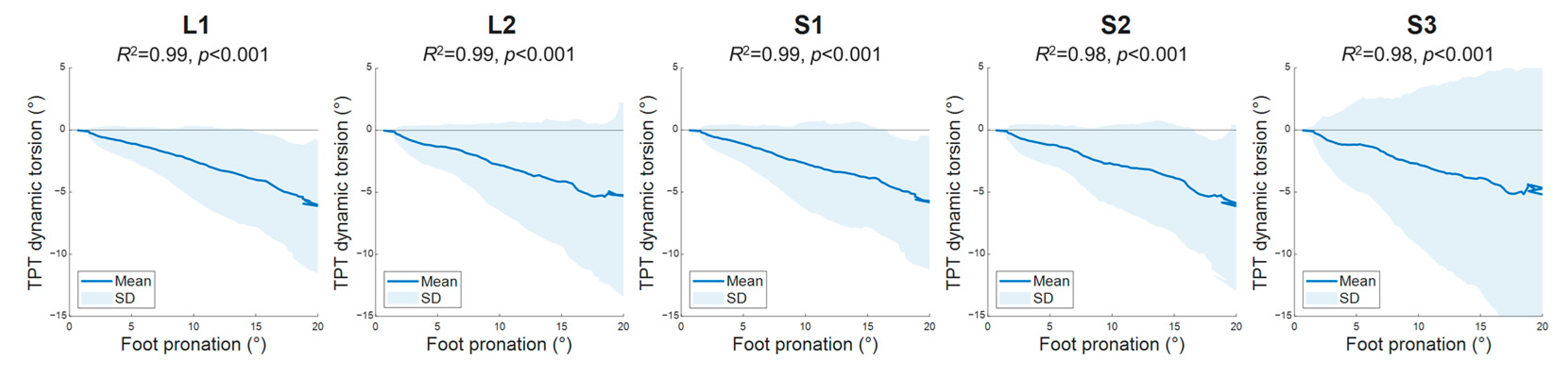
| ST results (°) | −5.5 (4.7) | −5.1 (7.0) | −5.4 (4.7) | −5.5 (5.9) | −4.4 (11.5) | 0.705 a |
| NCC | 0.99 (0.01) | 0.99 (0.01) | 0.99 (0.01) | 0.99 (0.01) | 0.99 (0.01) | - |
| CV (%) | 3.4 (3.4) | 3.1 (2.4) | 3.5 (3.0) | 3.0 (2.3) | 2.5 (2.1) | - |
| Tracking Block Configurations | |||||
|---|---|---|---|---|---|
| L1 | L2 | S1 | S2 | S3 | |
| ICC(3,3) | 0.73 (−0.10, 0.93) | 0.87 (0.46, 0.97) | 0.74 (−0.06, 0.93) | 0.81 (0.22, 0.95) | 0.86 (0.44, 0.97) |
| SEM (°) | 2.5 | 1.8 | 2.6 | 2.6 | 2.5 |
| MDC (°) | 7.0 | 5.0 | 7.1 | 7.1 | 6.8 |
| Reference | Tested Materials/Tissue | Referencing Method | Correlation | Error |
|---|---|---|---|---|
| Korstanje et al., 2010 [24] | Porcine flexor tendon | MT | - | 0.08 mm a |
| Human cadaveric FDS tendon | MT | - | 0.05 mm a | |
| Human FDS tendon (in vivo) | MT | - | 0.30 mm a | |
| van Doesburg et al., 2012 [25] | Human FDS tendon (in vivo) | MT | - | 0.30 mm b |
| Stegman et al., 2014 [54] | Human FDS tendon (in vivo) | MT | - | 0.67–1.90 mm c |
| Slane et al., 2014 [38] | Polyvinyl chloride-plastisol phantom | DIC | 0.99 | - |
| Porcine flexor tendon | DIC | 0.76–0.97 | - | |
| Fröberg et al., 2016 [55] | Polyvinyl alcohol (PVA) phantom | MTS | - | 0.21% (strain) |
| Porcine flexor tendon | MTS | - | 0.96–14.85% (strain) | |
| Human Achilles tendon allograft | MTS | - | 0.72% (strain) | |
| Bandaru et al., 2019 [35] | Human cadaveric FDS tendon | MT | - | 0.7–1.5 mm b |
| Dandois et al., 2021 [47] | Human cadaveric knee MCL | DIC | 0.63–0.99 | 0.26–0.38% (strain) |
| Human cadaveric knee LCL | DIC | 0.97–0.99 | 0.24–0.57% (strain) | |
| Wang et al., 2023 [33] | Porcine flexor tendon | MTS | 0.98 | 0.15 mm c |
| Kuder et al., 2024 [53] | Porcine knee MCL | DIC | 0.99 | 0.59% (strain) |
| Human cadaveric knee MCL & POL | MA | 0.91–0.94 | - | |
| Chou et al., 2025 [46] | Porcine leg muscle | MTS | 0.99 | 0.8 mm c |
Disclaimer/Publisher’s Note: The statements, opinions and data contained in all publications are solely those of the individual author(s) and contributor(s) and not of MDPI and/or the editor(s). MDPI and/or the editor(s) disclaim responsibility for any injury to people or property resulting from any ideas, methods, instructions or products referred to in the content. |
© 2026 by the authors. Licensee MDPI, Basel, Switzerland. This article is an open access article distributed under the terms and conditions of the Creative Commons Attribution (CC BY) license.
Share and Cite
Hung, K.-L.; Syu, D.-K.; Lee, W.-N.; Chen, P.-Y.; Wang, C.-C.; Chen, W.-S.; Lin, C.-Y.; Wang, H.-K. Measuring Dynamic Tendon Torsion Using Ultrasound Speckle Tracking: Validation with Silicone Phantom and In Vivo Application on Human Tibialis Posterior Tendon. Sensors 2026, 26, 1187. https://doi.org/10.3390/s26041187
Hung K-L, Syu D-K, Lee W-N, Chen P-Y, Wang C-C, Chen W-S, Lin C-Y, Wang H-K. Measuring Dynamic Tendon Torsion Using Ultrasound Speckle Tracking: Validation with Silicone Phantom and In Vivo Application on Human Tibialis Posterior Tendon. Sensors. 2026; 26(4):1187. https://doi.org/10.3390/s26041187
Chicago/Turabian StyleHung, Kun-Lin, De-Kai Syu, Wei-Ning Lee, Pei-Yu Chen, Chen-Chie Wang, Wen-Siang Chen, Che-Yu Lin, and Hsing-Kuo Wang. 2026. "Measuring Dynamic Tendon Torsion Using Ultrasound Speckle Tracking: Validation with Silicone Phantom and In Vivo Application on Human Tibialis Posterior Tendon" Sensors 26, no. 4: 1187. https://doi.org/10.3390/s26041187
APA StyleHung, K.-L., Syu, D.-K., Lee, W.-N., Chen, P.-Y., Wang, C.-C., Chen, W.-S., Lin, C.-Y., & Wang, H.-K. (2026). Measuring Dynamic Tendon Torsion Using Ultrasound Speckle Tracking: Validation with Silicone Phantom and In Vivo Application on Human Tibialis Posterior Tendon. Sensors, 26(4), 1187. https://doi.org/10.3390/s26041187