Quantifying Sheep Behaviour Using a 3D Accelerometer: A Proof-of-Concept for Objective Stress Assessment


Highlights
- A novel, miniaturised three-dimensional accelerometer system incorporating a nRF52832 microcontroller was developed with a primary focus on rumination detection. In addition to this core function, the system enables classification of resting/idling behaviour and shows potential for detecting eating behaviour following further technical refinement.
- The duration of rumination and resting/idling changed significantly when sheep were separated from their familiar group and relocated to an unfamiliar environment in pairs, which was defined as a “potential stressor.”
- Deviations in rumination and resting/idling from individual baseline behaviour may be suitable for triggering automated alerts, as such deviations may indicate stress-related responses. However, validation in larger cohorts of sheep is required to confirm this applicability.
- Automatic behaviour detection represents a promising approach for early stress identification and reliable welfare assessment in both laboratory animal and livestock settings.
Abstract
1. Introduction
2. Materials and Methods
2.1. Animals and Research Site
2.2. Sensor Device and Measuring System
2.2.1. Development of a Mobile Sensor System for Automated Behavioural Monitoring in Sheep
2.2.2. Tri-Accelerometer Specifications
2.2.3. Microcontroller
2.2.4. System Software
2.2.5. Data Storage and Power Supply for Electronic Components
2.2.6. Halters and Sensor Deployment
2.2.7. Software-Based Visual Behavioural Observation During Measurements
- (A)
- Rumination behaviour, which includes the processes of regurgitating, re-chewing, re-salivating, and re-swallowing cud. This can be done while standing or lying down.
- (B)
- Resting/idling behaviour, which includes the time an animal spends in a passive or resting state, without eating, ruminating, or interacting with other sheep. This behaviour can occur while standing or lying down, with the eyes open or shut, and with the head held upright or stretched towards the ground.
- (C)
- Eating behaviour, which includes the time an animal spends consuming feed provided in or close to the trough.
2.3. Specific Information Regarding Part 1: Testing and Validating 3D-Accelerometer-Based Classification of Sheep Behaviours
2.3.1. Study Design
2.3.2. Data Collection and Analysis
2.3.3. Digitalisation of the Visual Observation Protocol
2.3.4. Development of Behavioural Classification Algorithms/Models
2.3.5. Model Validation (Sensitivity, Specificity, Accuracy, and Precision)
2.3.6. Statistical Analysis for Part 1
2.4. Specific Information Regarding Part 2: Assessing Behavioural Changes in Sheep Exposed to a Potential Stressor
2.4.1. Study Design: Description of the Conditions Sheep Were Subjected to
2.4.2. Digitisation of Long-Term Observations Based on Video Recordings
2.4.3. Statistical Analysis for Part 2
3. Results
3.1. Results of Part 1: Testing and Validating the Recognition of Sheep Behaviours Using a 3D Accelerometer
3.1.1. Performance of the Discriminant Model Analysis
Rumination Behaviour

| Animal | Duration (min) | Observed | Detected | TP | TN | FP | FN | Accuracy | Sensitivity | Specificity | Precision | Cohen’s Kappa |
|---|---|---|---|---|---|---|---|---|---|---|---|---|
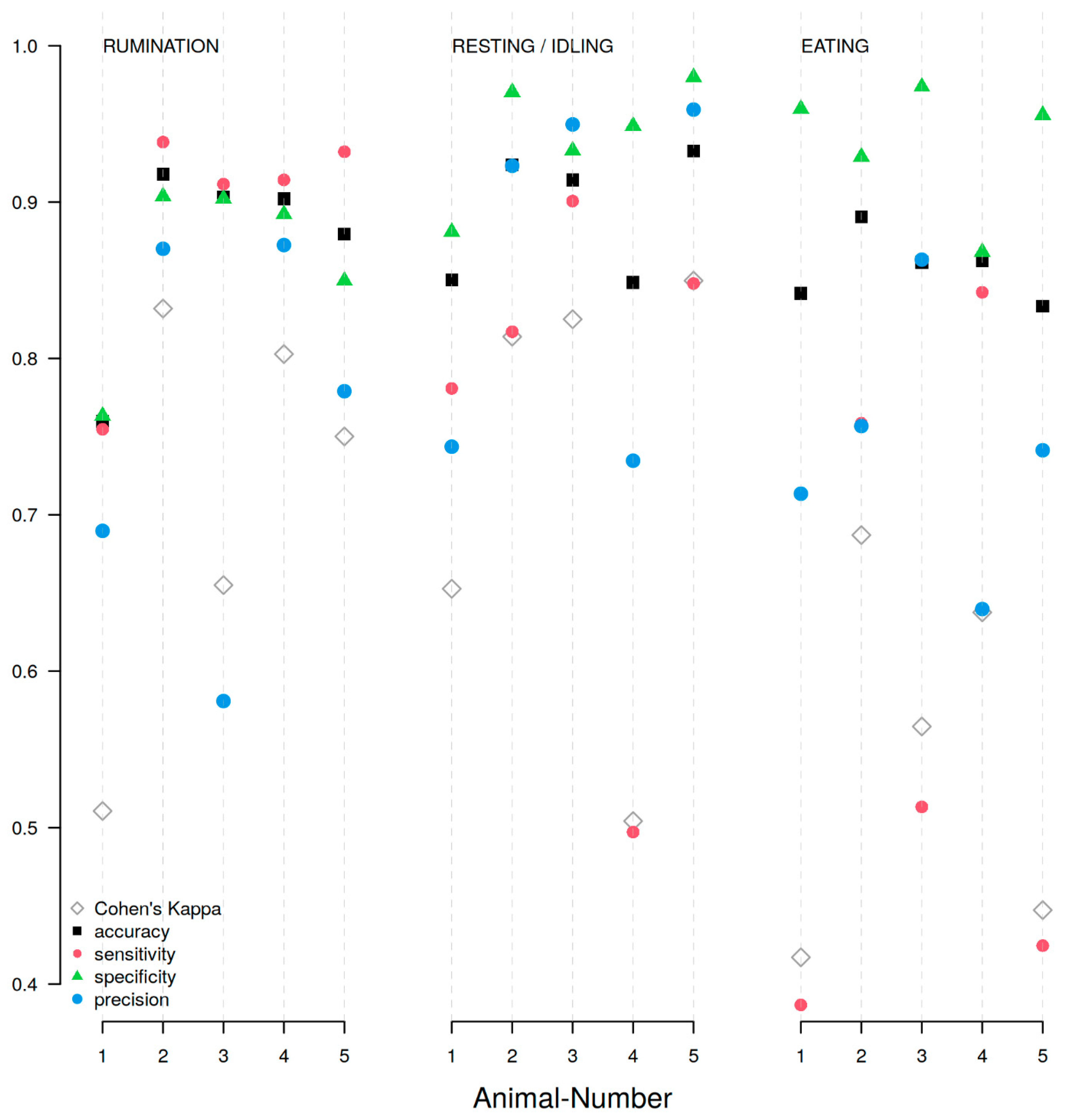
| 1 | 3126 | 1284 | 1405 | 969 | 1406 | 436 | 315 | 0.76 | 0.75 | 0.76 | 0.69 | 0.51 |
| 2 | 3785 | 1542 | 1663 | 1447 | 2027 | 216 | 95 | 0.92 | 0.94 | 0.90 | 0.87 | 0.83 |
| 3 | 2620 | 339 | 532 | 309 | 2058 | 223 | 30 | 0.90 | 0.91 | 0.90 | 0.58 | 0.65 |
| 4 | 3237 | 1445 | 1514 | 1321 | 1599 | 193 | 124 | 0.90 | 0.91 | 0.89 | 0.87 | 0.80 |
| 5 | 3256 | 1180 | 1412 | 1100 | 1764 | 312 | 80 | 0.88 | 0.93 | 0.85 | 0.78 | 0.75 |
Resting/Idling Behaviour
| Animal | Duration (min) | Observed | Detected | TP | TN | FP | FN | Accuracy | Sensitivity | Specificity | Precision | Cohen’s Kappa |
|---|---|---|---|---|---|---|---|---|---|---|---|---|
| 1 | 3126 | 958 | 1006 | 748 | 1910 | 258 | 210 | 0.85 | 0.78 | 0.88 | 0.74 | 0.65 |
| 2 | 3785 | 1148 | 1016 | 938 | 2559 | 78 | 210 | 0.92 | 0.82 | 0.97 | 0.92 | 0.81 |
| 3 | 2620 | 1530 | 1451 | 1378 | 1017 | 73 | 152 | 0.91 | 0.90 | 0.93 | 0.95 | 0.83 |
| 4 | 3237 | 718 | 486 | 357 | 2390 | 129 | 361 | 0.85 | 0.50 | 0.95 | 0.73 | 0.50 |
| 5 | 3256 | 1164 | 1029 | 987 | 2050 | 42 | 177 | 0.93 | 0.85 | 0.98 | 0.96 | 0.85 |
Eating Behaviour
| Animal | Duration (min) | Observed | Detected | TP | TN | FP | FN | Accuracy | Sensitivity | Specificity | Precision | Cohen’s Kappa |
|---|---|---|---|---|---|---|---|---|---|---|---|---|
| 1 | 3126 | 644 | 349 | 249 | 2382 | 100 | 395 | 0.84 | 0.39 | 0.96 | 0.71 | 0.42 |
| 2 | 3785 | 853 | 855 | 647 | 2724 | 208 | 206 | 0.89 | 0.76 | 0.93 | 0.76 | 0.69 |
| 3 | 2620 | 639 | 380 | 328 | 1929 | 52 | 311 | 0.86 | 0.51 | 0.97 | 0.86 | 0.56 |
| 4 | 3237 | 704 | 927 | 593 | 2199 | 334 | 111 | 0.86 | 0.84 | 0.87 | 0.64 | 0.64 |
| 5 | 3256 | 749 | 429 | 318 | 2396 | 111 | 431 | 0.83 | 0.42 | 0.96 | 0.74 | 0.45 |
3.2. Results of Part 2: Assessing Behavioural Changes in Sheep Exposed to a Potential Stressor
3.2.1. The Impact of Separating Sheep from Their Familiar Group and Relocating Them to an Unfamiliar Enclosure
3.2.2. Impact of the Unfamiliar Condition on Behaviours in the Standing and Lying Position
4. Discussion
5. Conclusions
Supplementary Materials
Author Contributions
Funding
Institutional Review Board Statement
Informed Consent Statement
Data Availability Statement
Acknowledgments
Conflicts of Interest
References
- Bhargava, K.; Donnelly, W.; Ivanov, S. Wireless sensor based data analytics for precision farming. In Department of Computing and Mathematics; Waterford Institute of Technology: Waterford, Ireland, 2019; p. 160. Available online: https://www.researchgate.net/profile/Kriti-Bhargava-2/publication/333995276_Wireless_Sensor_Based_Data_Analytics_for_Precision_Farming/links/5d11da90299bf1547c7c7efa/Wireless-Sensor-Based-Data-Analytics-for-Precision-Farming.pdf (accessed on 10 January 2026).
- Hendriks, S.J.; Phyn, C.V.C.; Huzzey, J.M.; Mueller, K.R.; Turner, S.A.; Donaghy, D.J.; Roche, J.R. Evaluating the appropriate use of wearable accelerometers in research to monitor lying behaviors of dairy cows. J. Dairy. Sci. 2020, 103, 12140–12157. [Google Scholar]
- Bailey, J. Does the stress of laboratory life and experimentation on animals adversely affect research data? A critical review. Altern. Lab. Anim. 2018, 46, 291–305. [Google Scholar] [CrossRef]
- Cockram, M. A review of behavioural and physiological responses of sheep to stressors to identify potential behavioural signs of distress. Anim. Welf. 2004, 13, 283–291. [Google Scholar] [CrossRef]
- Tuyttens, F.A.M.; de Graaf, S.; Heerkens, J.L.; Jacobs, L.; Nalon, E.; Ott, S.; Ampe, B. Observer bias in animal behaviour research: Can we believe what we score, if we score what we believe? Anim. Behav. 2014, 90, 273–280. [Google Scholar] [CrossRef]
- Riaboff, L.; Shalloo, L.; Smeaton, A.F.; Couvreur, S.; Madouasse, A.; Keane, M.T. Predicting livestock behaviour using accelerometers: A systematic review of processing techniques for ruminant behaviour prediction from raw accelerometer data. Comput. Electron. Agric. 2022, 192, 106610. [Google Scholar] [CrossRef]
- Price, E.; Langford, J.; Fawcett, T.W.; Wilson, A.J.; Croft, D.P. Classifying the posture and activity of ewes and lambs using accelerometers and machine learning on a commercial flock. Appl. Anim. Behav. Sci. 2022, 251, 105630. [Google Scholar] [CrossRef]
- Schneidewind, S.J.; Al Merestani, M.R.; Schmidt, S.; Schmidt, T.; Thöne-Reineke, C.; Wiegard, M. Rumination Detection in Sheep: A Systematic Review of Sensor-Based Approaches. Animals 2023, 13, 3756. [Google Scholar] [CrossRef]
- Caja, G.; Castro-Costa, A.; Salama, A.A.; Oliver, J.; Baratta, M.; Ferrer, C.; Knight, C.H. Sensing solutions for improving the performance, health and wellbeing of small ruminants. J. Dairy. Res. 2020, 87, 34–46. [Google Scholar] [CrossRef] [PubMed]
- Decandia, M.; Giovanetti, V.; Molle, G.; Acciaro, M.; Mameli, M.; Cabiddu, A.; Dimauro, C. The effect of different time epoch settings on the classification of sheep behaviour using tri-axial accelerometry. Comput. Electron. Agric. 2018, 154, 112–119. [Google Scholar] [CrossRef]
- Mansbridge, N.; Mitsch, J.; Bollard, N.; Ellis, K.; Miguel-Pacheco, G.G.; Dottorini, T.; Kaler, J. Feature selection and comparison of machine learning algorithms in classification of grazing and rumination behaviour in sheep. Sensors 2018, 18, 3532. [Google Scholar] [CrossRef]
- Decandia, M.; Rassu, S.P.G.; Psiroukis, V.; Hadjigeorgiou, I.; Fountas, S.; Molle, G.; Giovanetti, V. Evaluation of proper sensor position for classification of sheep behaviour through accelerometers. Small Rumin. Res. 2021, 201, 106445. [Google Scholar] [CrossRef]
- Turner, K.E. Sheep Grazing and Lambing Behaviour Analysis from Accelerometer Data Using Deep Learning. Master’s Thesis, Murdoch University, Murdoch, Australia, 2022. [Google Scholar]
- Suhaimi, A.F.; Mutiara, G.A.; Rizal, M.F. Leveraging Embedded Accelerometers and Machine Learning for Real-Time Sheep Behavior Classification in Precision Farming; IEEE Access: New York, NY, USA, 2025. [Google Scholar]
- do Nascimento Amorim, M.; dos Santos Costa, D.; dos Santos Harada, É.; da Silva, W.P.; Turco, S.H.N. Performance of electronic device and different visual observation intervals in assessing feeding behavior in sheep. Comput. Electron. Agric. 2025, 231, 110053. [Google Scholar] [CrossRef]
- do Nascimento Amorim, M.; Turco, S.H.N.; dos Santos Costa, D.; Ferreira, I.J.S.; da Silva, W.P.; Sabino, A.L.C.; da Silva-Miranda, K.O. Discrimination of ingestive behavior in sheep using an electronic device based on a triaxial accelerometer and machine learning. Comput. Electron. Agric. 2024, 218, 108657. [Google Scholar] [CrossRef]
- Ikurior, S.J.; Marquetoux, N.; Leu, S.T.; Corner-Thomas, R.A.; Scott, I.; Pomroy, W.E. What are sheep doing? Tri-axial accelerometer sensor data identify the diel activity pattern of ewe lambs on pasture. Sensors 2021, 21, 6816. [Google Scholar] [CrossRef]
- Varlyakov, I.; Slavov, T. Ethological parameters as markers of sheep welfare. Agric. Sci. Technol. 2012, 4, 1313–8820. [Google Scholar]
- Abdel-Rahman, M. Behavioral and endocrinological changes of sheep subjected to isolation stress. Assiut Vet. Med. J. 2000, 42, 63–70. [Google Scholar]
- De, K.; Saxena, V.K.; Balaganur, K.; Kumar, D.; Naqvi, S.M.K. Effect of short-term seclusion of sheep on their welfare indicators. J. Vet. Behav. 2018, 27, 1–7. [Google Scholar] [CrossRef]
- Abdel-Rahman, M.; Wisii, D.; Madeha, H. Behavioral, physiological and adrenal responses to regrouping and relocation in sheep. Assiut Vet. Med. J. 2006, 52, 1457–1465. [Google Scholar]
- Méndez, D.A.; Fajardo, B.; Sanjuan, S.; Calabuig, J.M.; Arnau, R.; Villagrá, A.; Calvet-Sanz, S.; Estelles, F. Development of goat behaviour prediction with accelerometer data: A machine learning and pre-processing approach. Comput. Electron. Agric. 2025, 237, 110701. [Google Scholar] [CrossRef]
- Mattiello, S.; Battini, M.; De Rosa, G.; Napolitano, F. How can we assess positive welfare in ruminants? Animals 2019, 9, 758. [Google Scholar] [CrossRef]
- Steinmetz, M.; von Soosten, D.; Hummel, J.; Meyer, U.; Dänicke, S. Validation of the RumiWatch Converter V0. 7.4. 5 classification accuracy for the automatic monitoring of behavioural characteristics in dairy cows. Arch. Anim. Nutr. 2020, 74, 164–172. [Google Scholar] [CrossRef] [PubMed]
- Lewis, R.; Emmans, G. Feed intake of sheep as affected by body weight, breed, sex, and feed composition. J. Anim. Sci. 2010, 88, 467–480. [Google Scholar] [CrossRef]
- Berthel, R.; Deichelboher, A.; Dohme-Meier, F.; Egli, W.; Keil, N. Validation of automatic monitoring of feeding behaviours in sheep and goats. PLoS ONE 2023, 18, e0285933. [Google Scholar] [CrossRef]
- Reefmann, N.; Wechsler, B.; Gygax, L. Behavioural and physiological assessment of positive and negative emotion in sheep. Anim. Behav. 2009, 78, 651–659. [Google Scholar] [CrossRef]
- Santurtun, E.; Moreau, V.; Marchant-Forde, J.; Phillips, C. Physiological and behavioral responses of sheep to simulated sea transport motions. J. Anim. Sci. 2015, 93, 1250–1257. [Google Scholar] [CrossRef] [PubMed]
- Menchetti, L.; Nanni Costa, L.; Zappaterra, M.; Padalino, B. Effects of reduced space allowance and heat stress on behavior and eye temperature in unweaned lambs: A pilot study. Animals 2021, 11, 3464. [Google Scholar] [CrossRef] [PubMed]


| Behaviour | Duration (min) | Observed | Detected | TP | TN | FP | FN | Accuracy | Sensitivity | Specificity | Precision | Cohen’s Kappa |
|---|---|---|---|---|---|---|---|---|---|---|---|---|
| Rumination | 16,024 | 5790 | 6525 | 5146 | 8854 | 1380 | 644 | 0.874 | 0.889 | 0.865 | 0.789 | 0.73 |
| Resting/idling | 16,024 | 5518 | 4988 | 4408 | 9926 | 580 | 1110 | 0.895 | 0.799 | 0.945 | 0.884 | 0.76 |
| Eating | 16,024 | 3589 | 2940 | 2135 | 11,630 | 805 | 1454 | 0.859 | 0.595 | 0.935 | 0.726 | 0.57 |
| Animal/ Behaviour | 1 | 2 | 3 | 4 | SD | 1 | 2 | 3 | 4 | SD | Paired t-Test | ||
|---|---|---|---|---|---|---|---|---|---|---|---|---|---|
| Baseline Condition (min/24 h) | Unfamiliar Condition (min/24 h) | p = | |||||||||||
| Rumination | 451 | 476 | 474 | 541 | 485.5 | 38.7 | 318 | 274 | 188 | 276 | 264 | 54.6 | 0.00764 ** |
| Resting/idling | 632 | 594 | 692 | 630 | 637 | 40.6 | 913 | 934 | 1064 | 859 | 942.5 | 86.9 | 0.00237 ** |
| Eating | 331 | 299 | 240 | 200 | 267.5 | 58.7 | 162 | 162 | 160 | 198 | 170.5 | 18.4 | 0.125 † |
| Other | 26 | 71 | 34 | 69 | 49.5 | 24 | 47 | 70 | 28 | 107 | 63 | 34 | 0.292 |
| Σ | 1440 | 1440 | 11,520 | ||||||||||
| Animal/ Behaviour | 1 | 2 | 3 | 4 | SD | 1 | 2 | 3 | 4 | SD | Paired t-Test | ||
|---|---|---|---|---|---|---|---|---|---|---|---|---|---|
| Rumination | Baseline Condition (min/24 h) | Unfamiliar Condition (min/24 h) | p = | ||||||||||
| Lying down | 373 | 461 | 444 | 455 | 433.3 | 40.8 | 208 | 268 | 163 | 257 | 224 | 48.3 | 0.00357 ** |
| Standing up | 78 | 15 | 30 | 86 | 52.2 | 35.0 | 110 | 6 | 25 | 19 | 40.0 | 47.3 | 0.5914 |
| Resting/Idling | Baseline Condition (min/24 h) | Unfamiliar Condition (min/24 h) | p = | ||||||||||
| Lying down | 518 | 544 | 403 | 490 | 488.8 | 61.3 | 548 | 689 | 557 | 374 | 542 | 129.2 | 0.461 |
| Standing up | 114 | 50 | 289 | 140 | 148.2 | 101.2 | 365 | 245 | 507 | 485 | 400.5 | 121 | 0.00464 ** |
Disclaimer/Publisher’s Note: The statements, opinions and data contained in all publications are solely those of the individual author(s) and contributor(s) and not of MDPI and/or the editor(s). MDPI and/or the editor(s) disclaim responsibility for any injury to people or property resulting from any ideas, methods, instructions or products referred to in the content. |
© 2026 by the authors. Licensee MDPI, Basel, Switzerland. This article is an open access article distributed under the terms and conditions of the Creative Commons Attribution (CC BY) license.
Share and Cite
Schneidewind, S.J.; Al Merestani, M.R.; Schmidt, S.; Waser, W.; Schmidt, T.; Wiegard, M.; Schmidt, U.; Thoene-Reineke, C. Quantifying Sheep Behaviour Using a 3D Accelerometer: A Proof-of-Concept for Objective Stress Assessment. Sensors 2026, 26, 1169. https://doi.org/10.3390/s26041169
Schneidewind SJ, Al Merestani MR, Schmidt S, Waser W, Schmidt T, Wiegard M, Schmidt U, Thoene-Reineke C. Quantifying Sheep Behaviour Using a 3D Accelerometer: A Proof-of-Concept for Objective Stress Assessment. Sensors. 2026; 26(4):1169. https://doi.org/10.3390/s26041169
Chicago/Turabian StyleSchneidewind, Stephanie Janet, Mohamed Rabih Al Merestani, Sven Schmidt, Wolfgang Waser, Tanja Schmidt, Mechthild Wiegard, Uwe Schmidt, and Christa Thoene-Reineke. 2026. "Quantifying Sheep Behaviour Using a 3D Accelerometer: A Proof-of-Concept for Objective Stress Assessment" Sensors 26, no. 4: 1169. https://doi.org/10.3390/s26041169
APA StyleSchneidewind, S. J., Al Merestani, M. R., Schmidt, S., Waser, W., Schmidt, T., Wiegard, M., Schmidt, U., & Thoene-Reineke, C. (2026). Quantifying Sheep Behaviour Using a 3D Accelerometer: A Proof-of-Concept for Objective Stress Assessment. Sensors, 26(4), 1169. https://doi.org/10.3390/s26041169