Review

Flexible Triboelectric Mechanical Energy Harvesters for Wearable and Self-Powered Sensing Applications: A Review

1
Department of Semiconductor Engineering, Gachon University, Seongnam 13120, Republic of Korea
2
Department of Electronic Engineering, Gachon University, Seongnam 13120, Republic of Korea
*
Author to whom correspondence should be addressed.
Sensors 2026, 26(4), 1166; https://doi.org/10.3390/s26041166
Submission received: 30 November 2025 / Revised: 23 January 2026 / Accepted: 9 February 2026 / Published: 11 February 2026

Abstract

Triboelectric nanogenerators (TENGs) have been gaining significant attention owing to their excellent energy conversion efficiency and their integration towards a large number of practical applications in energy harvesting, wearables, and self-powered sensing. In recent advancements, the utilization of flexible triboelectric composite films can help to enhance the TENG’s electrical output performance, as they possess excellent mechanical and dielectric properties and tunable surface characteristics. Moreover, by combining flexible active layers with triboelectric nanogenerators, the advantages of each component result in sensor devices which offer superior characteristics, including high sensitivity, biocompatibility, less weight, and mechanical flexibility. This review mainly focuses on the applications of TENGs in mechanical energy harvesting, self-powered wearable sensor systems, as well as the latest research progress in the TENG field. The working principles of TENG will be first explained in detail, including four basic operational modes of TENG, simulation results, and the working mechanism of the contact–separation mode TENGs. The fabrication techniques of triboelectric flexible films, along with TENG construction, will then be introduced. Common applications of TENGs are based on mechanical energy harvesting and powering portable electronic devices, which will subsequently be classified and summarized. Additionally, the applications of various wearable and self-powered sensor applications are elucidated. Finally, the current limitations and future directions of the TENG will be explained in detail and proposed. By exploring these innovations, the review underscores the importance of triboelectric flexible film-based TENGs in driving the future of energy harvesting and sensor technologies.

1. Introduction

With the rapid expansion of smart, flexible, and wearable electronic devices and the growing energy crisis caused by the reduction in fossil fuels, mechanical energy harvesting from the living environment to power wearable and low-powered portable electronics has attracted increasing attention [1,2]. In parallel, the widespread evolution of portable and wearable electronics has raised the demand for continuous, dependable energy sources. Although modern batteries offer improved energy density and longer operating times, their fundamental limitations, such as storage capacity, weight, and size, and the continuous need for recharging, still pose significant challenges [3,4]. These limitations are particularly restrictive for mobile and remote applications that support the expansion of the Internet of Things [5]. The development of green energy harvesting technologies currently plays a key role in addressing worldwide energy demands and environmental interests. Different types of energy harvesting technologies exist to convert different external energy sources, such as mechanical, wind, tidal, sound, and thermal energy, into electricity [6,7,8]. Examples of energy harvesting mechanisms in such technologies include the utilization of piezoelectric, triboelectric, thermoelectric, and electromagnetic effects.
Among various harvesting technologies, triboelectric nanogenerators (TENGs) are one of the promising techniques that convert mechanical energy into electricity, which is vital for self-powered systems. In the year 2012, Z. L. Wang and his co-workers proposed a TENG based on the contact electrification and electrostatic induction phenomena [9]. TENGs have attracted more interest due to their advantages, such as simple design, high energy conversion efficiency, lower cost, long-lasting nature, and a wide range of possible materials used in TENG fabrication [10,11,12]. For example, H. Luo et al. proposed a multi-phase rotating disk TENG (MPRD-TENG) with excellent DC electrical output for operating fire warning alarm systems and speed-monitoring applications [13]. Moreover, H. Luo et al. designed a highly stable rotary solid–liquid TENG (RSL-TENG) for wastewater detection applications, which are abundantly available in temperature, humidity, and light-sensitive monitoring modules [14]. Since the concept was invented, TENGs have been extensively investigated in various application areas, such as energy harvesting, healthcare monitoring, robotics, and sensor devices [15,16,17,18]. Also, several methodologies have been improving the TENG output power, such as structural design, charge injection, and material optimization by incorporating fillers, etc. [19,20,21,22]. So far, several organic polymers and inorganic materials, dielectrics, carbon materials, filler materials, and loaded polymers (composites) have been selected for designing flexible and high-output TENGs, such as BaTiO3, KNaNbO3, Mxene, CNTs, PVA, PVDF, PDMS, etc. [23,24,25,26,27]. Triboelectric charges are built on surfaces where dissimilar materials with opposite electron affinities contact by external friction. The polymers and composite films improve the surface charge density, mechanical strength, and electrical properties of materials, resulting in high electrical output from the corresponding TENG. Also, their essential beneficial factors include easy incorporation, biocompatibility, and high energy-conversion efficiency, which make TENGs highly promising for self-powered sensing and wearable applications [28,29,30]. Such devices can employ various forms of mechanical energies, like pressure, stretching, vibration, and rotations, and convert them into electrical energy. The compatibility of polymer and composite polymer film-based materials allows for high flexibility, lower cost, high mechanical strength, and easy fabrication, making them ideal for next-generation applications.
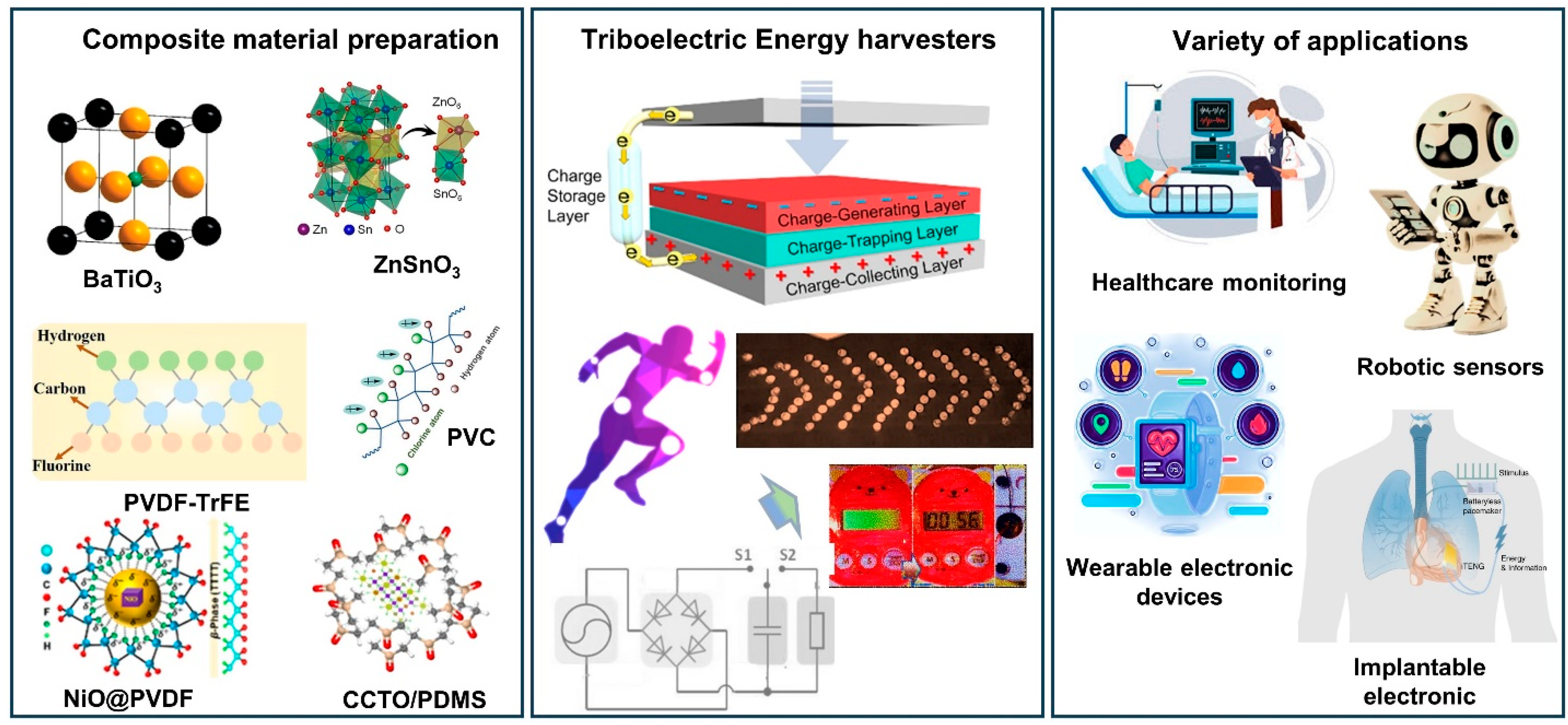
This review highlights recent progress in the area of polymer/composite films employed in flexible TENGs and their smart applications. The discussion includes operation modes, working principles of TENGs, and the mechanism of the contact–separation mode of TENGs was explained in detail. Also, the COMSOL multi-physics simulation results are explained. Further, various classes of polymer/composite films and TENG fabrication techniques are systematically analyzed to explain how their design structures contribute to charge-generation efficiency, mechanical properties, and interfacial stability. The capability of these engineered film-based TENGs delivers high output performance while maintaining flexibility and long-term operational stability, making them promising candidates for next-generation smart electronics. Therefore, the practical and real-time applications of the TENG under mechanical energy harvesting, wearable, and smart self-powered sensors were systematically investigated. However, significant challenges endure, such as optimizing filler materials in polymer matrix interfaces, confirming stable electric output under constant mechanical loading, and developing eco-friendly fabrication methods. Overcoming these limitations is vital for the development of flexible TENGs constructed from organic, inorganic, and hybrid composite films, thereby supporting their reliable use in advanced wearable sensing devices, soft robotic systems, and health-monitoring applications, as shown in Figure 1, refs [31,32,33,34,35,36,37,38,39,40].

2. TENG Working Principle

Self-powered electronic applications utilizing the triboelectric effect show significant capabilities in converting mechanical energies into electrical power, eliminating reliance on external power sources. These devices boast increased consistency, scalability, and compactness, offering unparalleled versatility in a variety of applications. In this section, starting from the triboelectric working principle, the operational working modes of various TENGs will be described, with a detailed emphasis on the working mechanism of the contact–separation-mode TENG. The triboelectric effect occurs abundantly in living environments and generates electrical charges through mechanical actions, such as contact and separation between a pair of materials. Prof. Z. L. Wang and his group devised the TENG in 2012 by combining the effects of contact electrification and electrostatic induction, thus providing a new direction through the development of a novel energy source for the era of green energy [9].
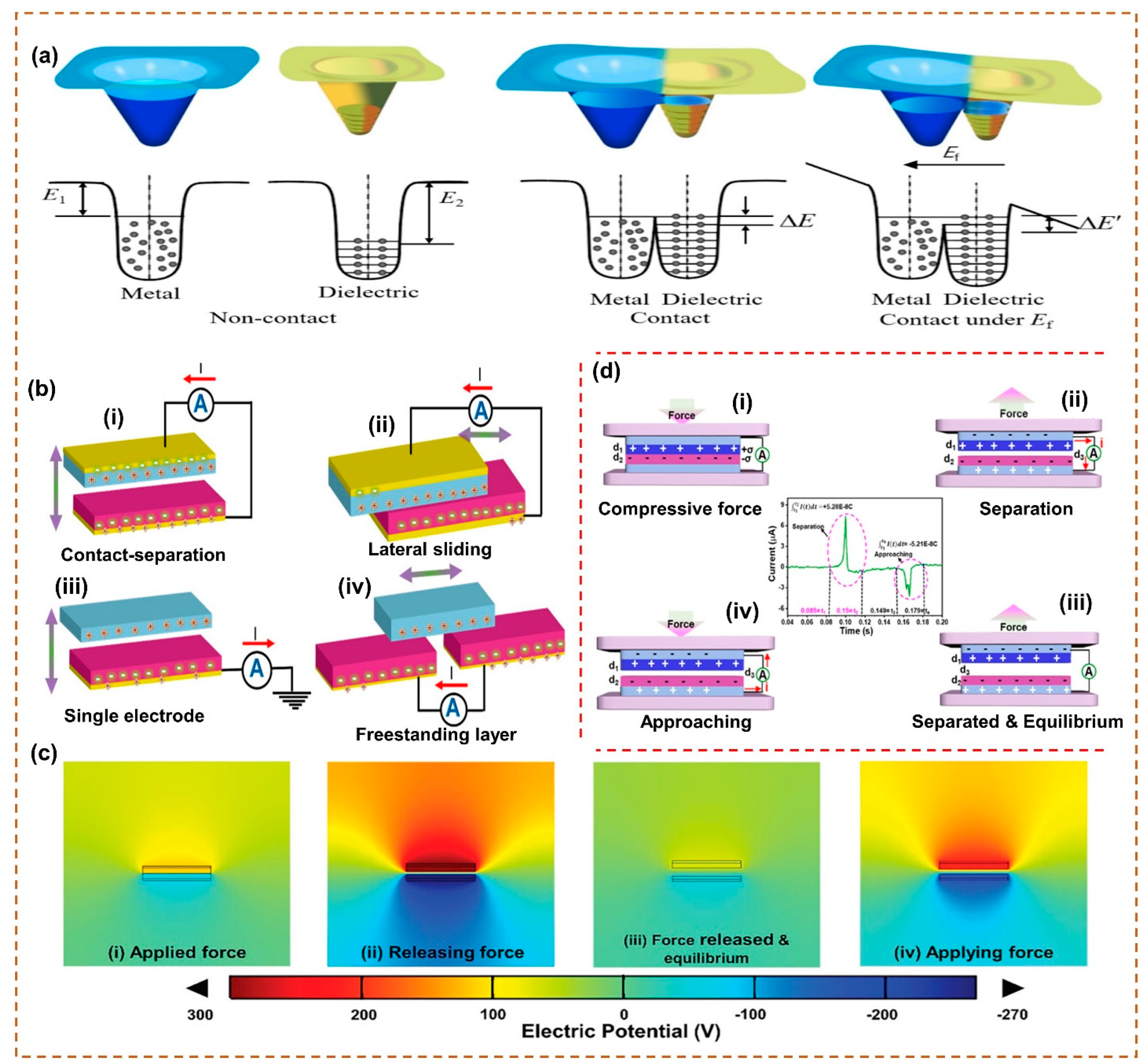
The principles of charge flow between the two triboelectric material surfaces have been extensively reviewed and can generally be split into three types: electron, ion, and material transfers [41,42,43]. Electron transfer is widely considered the main charge transfer process in solid–solid triboelectrification, particularly for insulating and semiconducting materials. When two surfaces come into close contact, their surface electronic states interact, causing electrons to move from the material with a higher Fermi level to the material with a higher work function [41]. Ion transfer becomes important in triboelectric processes that involve liquids, soft materials, or humid conditions [42]. Material transfer happens when tiny molecular parts, polymer chains, or nanoscale particles are physically shifted from one surface to another during contact. This effect is most often seen in soft polymer materials, elastomers, and rough surfaces [43]. Together, these mechanisms determine the surface charge and electric potential that enable energy generation in triboelectric nanogenerators. For example, G. Xu et al. proposed that electron transfer is the main process of contact electrification and put forward an electron cloud model to explain the relevant mechanism [44]. Figure 2a describes, on an atomic level, the electronic behavior when two originally separated layers, each containing a triboelectrically active material, come into contact. When separated, the electrons in each layer are strongly bound within their respective potential wells and specific orbitals as they are within the attractive region of their respective atomic potential. Their corresponding electron clouds, therefore, remain separated without overlapping, and charge escape and transfer are barred. When the atoms of the separated layers approach and come into contact, their respective electron clouds overlap, and charge “screening” lowers the energy barrier between the two materials, allowing the originally distinct potential wells of each layer to merge and transform into an asymmetric double-well potential. The chemical potentials of the surfaces of the layers also equilibrate during contact, facilitating electron transfer. When the layers are separated, if the rate of mechanical separation exceeds the rate of electron re-equilibration, then the transferred electrons would remain on the material surface as static charges, causing both triboelectric materials to exhibit positive and negative polarities, respectively.

3. Operational Modes of TENG

Depending on the structural design and the shape of the triboelectric materials in a TENG device, four types of fundamental operational modes have been defined, such as contact–separation TENG (CS-TENG), single-electrode (SE-TENG), lateral-sliding (LS-TENG), and freestanding (FS-TENG) modes, as shown in Figure 2b, refs [45,46,47]. According to different electrode configurations, it can be split into two types, i.e., single and double electrode types.
The most common and simple fundamental form of operation mode is the CS-mode TENG, as shown in Figure 2b(i), which is applied when the relative motion is perpendicular to the interface [48,49,50]. The two dissimilar dielectric materials are oppositely placed, and the electrodes are attached to each dielectric material. When the two dielectric materials come into contact by applying friction, a charge is generated on the active materials. When both dielectric layers are separated by removing friction, the surfaces of both dielectric layers preserve their electric charges, which can lead to a potential difference between the two dielectric materials. As a result, an electrostatic field is generated, and a charge transport starts from one electrode to another. When the dielectric materials come into contact again, the electrostatic field vanishes, and electron flows return. The result of the alternating current signal will be generated by this continuous contact–separation TENG process. CS-TENG provides a fundamental and effective route for converting mechanical energy, characterized by simple design, stable electrical output performance, and wide adaptability to mechanical stimuli. Advances in materials, structural design, and device integration continue to enhance their performance and support their application in self-powered and sustainable electronic systems.
In the lateral-sliding-mode TENG (LS-TENG), the two different dielectric materials remain in direct contact, and a frictional force induces sliding or rotational motion, thus leading the effective contact area to change constantly, as shown in Figure 2b(ii) [51,52,53]. This interaction generates triboelectric charges on the dielectric material surfaces, leading to a changing potential difference between the electrodes and generating an alternating output current. Compared with the CS mode, the LS mode configuration facilitates more effective charge generation, supplies higher electrical output, and does not require an air gap for surface separation. Nevertheless, LS mode is limited by the intense friction that occurs during operation, which can accelerate material degradation and reduce the overall lifespan of the TENG. LS-TENGs offer an efficient route for harvesting mechanical energy, supported by continuing developments in device architecture, surface modification, and power regulation. Also, continued interdisciplinary efforts are expected to improve their reliability and facilitate their integration into self-powered and sustainable electronic systems.
In the single-electrode-mode TENG (SE-TENG) (Figure 2b(iii)), a single grounded electrode, typically composed of a material with less affinity to attract electrons, functions as both the reference electrode and the triboelectric dielectric layer [54,55]. This electrode interacts with a freely moving dielectric layer that has a higher electron affinity. When the dielectric material approaches the grounded electrode, electrostatic induction drives electrons from the electrode toward the ground. As the dielectric material goes away, the induced potential reverses, causing electrons to go back from the ground to the electrode. Although it has a simple and versatile nature, the SE mode frequently suffers from limited electron-transfer efficiency, which reduces the overall power output. SE-TENGs offer a simple yet adaptable solution for mechanical energy harvesting and self-powered sensing. Continuing advances in triboelectric materials, device fabrication, and system integration are expected to enhance their output power and accelerate their adoption in wearable electronics and delivered sensing systems.
In the freestanding-mode TENG (FS-TENG), two symmetrical electrodes connected through an external circuit are positioned under a movable dielectric triboelectric material, as shown in Figure 2b(iv) [56,57]. When the dielectric material shifts relative to the electrodes, the spatial distribution of electrostatic potential is altered, driving electrons to move back and forth between the electrodes and generating an electrical output. Because charge transport occurs through electrostatic induction rather than direct mechanical rubbing between solid surfaces, this mode significantly reduces surface wear and improves the long-term durability of the TENG. FS-TENG efficiently harvests mechanical energy by coupling the moving triboelectric layer to the fixed electrodes, which minimizes mechanical wear and supports varied motion modes. This design enhances electrostatic charge induction, while continued advances in triboelectric layers, device structures, and system integration are expected to elevate performance further and expand applications in self-powered electronics, smart sensing, and sustainable energy harvesting.
In addition, the working mechanism of the CS-mode TENG was further investigated using COMSOL simulation results to show the obtained electric potential during the contact and separation operation. Based on the observed surface charge density and dielectric constant of the triboelectric materials, the generated electric potential from the TENG was observed in different stages by performing an analysis using a finite element analyzer, solver, and COMSOL simulation software. The detailed device simulation results are provided in Figure 2c(i–iv), ref. [58]. The highest electric potential was produced when the TENG was in approaching and separating stages, and the minimum potential was produced when the device was in idle, contact, and separated stages.

4. Working Mechanism of CS-Mode TENG

The working mechanism of the vertical contact–separation-mode TENG was explained in detail, and it depends on the coupling effects of triboelectrification and electrostatic induction, as shown in Figure 2d, refs [48,49,50,59]. This CS mode was mainly divided into four stages. First, both the dielectric layers fully contact by the friction applied on the TENG (Figure 2d(i)), and the positive and negative charges are produced on the surface of the dielectric materials. The produced charges do not transfer and are quickly neutralized owing to the insulating nature of the dielectric layers. When the dielectric materials start to separate due to the removal of friction on TENG (Figure 2d(ii)), the electric potential difference is created in both electrodes, leading to electron flow transfer from one electrode to another. As a result, the triboelectric positive electric output is generated from the TENG. When the dielectric material is completely separated or reaches an equilibrium state by removing friction on TENG (Figure 2d(iii)), the potential difference is completely offset by the electron flow between the electrodes, and no electric potential is produced in the external circuit. Furthermore, both dielectric materials make contact again by applying friction on TENG (Figure 2d(iv)), creating a reverse electrical output signal via an external circuit because of the backflow of the electrons. Consequently, continuous external friction applied and removed on the TENG could produce a continuous alternative output current signal.
Figure 2. (a) Working principle of TENG [44]. (b) Different types of operational modes of TENG: (i) contact–separation mode, (ii) freestanding mode, (iii) sliding mode, and (iv) single-electrode mode [47]. (c) (iiv) COMSOL Multiphysics simulation results of TENG [58]. (d) (iiv) Working mechanism of the CS-mode TENG [59]. All essential copyrights and permissions received.
Sensors 26 01166 g002

5. Fabrication Techniques of Triboelectric Flexible Films Along with TENG Design

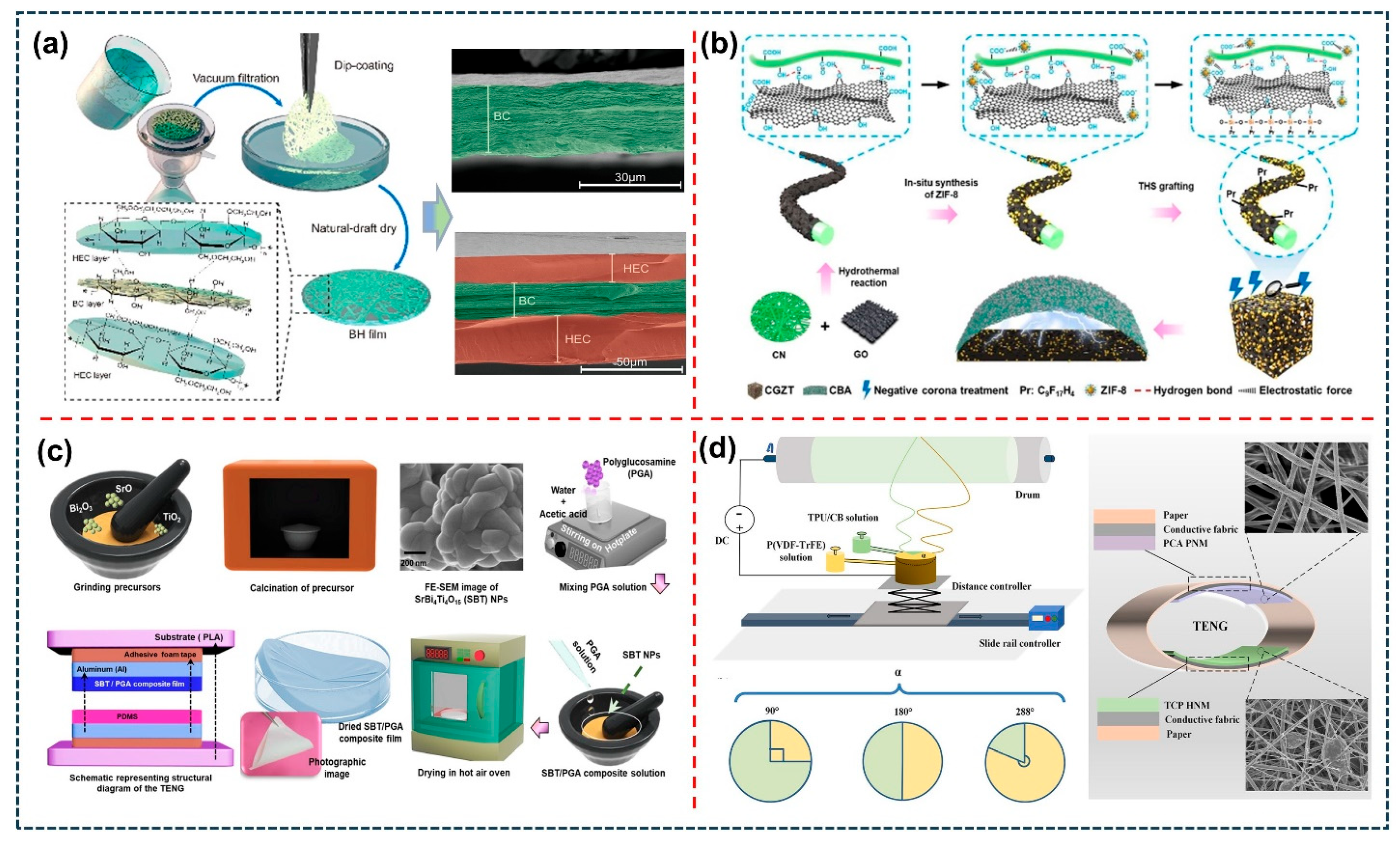
Various effective materials synthesis techniques have been implemented to design high-performance TENG devices, along with flexible triboelectric films, addressing diverse energy harvesting and various self-powered sensing applications, as shown in Figure 3. These techniques include hydrothermal, vacuum filtration, plasma treating, tape casting, spin and dip coating, doctor blade, 3D printing, spray coating, electrospinning, etc., to prepare flexible triboelectric films and design a TENG. In this case, to prepare flexible triboelectric films and high-performance TENGs, various materials were selected, such as polymer materials, dielectric/ferroelectric materials, conductive fillers, and combined filler materials in polymers for forming composite films. For example, A. Gupta. et al. proposed a novel metal-coupled NaYF4 dielectric polymer matrix, which is prepared by an in situ hydrothermal process and doped with lanthanide ions (NaYF4: Yb, Er@Ag nanocomposites, NCs) mixed in Ecoflex and polyester cloth (PC) [60]. Further, the TENG is designed with and without a polymer spacer, and both triboelectric materials act as triboelectric positive and negative layers. The fabricated TENG exhibits excellent electrical output performance and harvests mechanical energy from human activities, as well as further utilizes it for wearable applications. W. Wang et al. prepared a Pd@ZnO/MoSe2 nanoflower via a solvothermal synthesis reaction, and further, the Pd@ZnO/MoSe2 solution was decorated on a Cu-Ni electrode using a spray-coating technique for the gas sensing and TENG applications [61]. E. Cho. et al. developed a hierarchical-wrinkled-architecture TENG (HWA-TENG) based on the plasma–polymer–fluorocarbon (PPFC) thin film [62]. The fabricated thin film is employed as a high-performance triboelectrification layer due to the high surface charge potential, water repellency, transparency, and ultrathin thickness. This proposed PPFC-based HWA-TENG demonstrated excellent electrical output and was successfully employed as a raindrop energy harvester. C.K. Chung et al. developed a micro-needle structure created on a PDMS/conductive polyester fabric-based MN-TENG device [63]. In this study, microstructures were designed using laser engraving machines. The fabricated MN-TENG exhibits a stable, high electrical output and is used to power various low-powered electronic devices. Also, C. Luo. et al. established an eco-friendly and recyclable bacterial cellulose-based flexible triboelectric nanogenerator (BC-TENG), as shown in Figure 3a, ref. [64]. Here, the surface potential of BC films was controlled and designed using a dip-coating hydroxyethyl cellulose solution to improve the electrical output performance of the BC-TENG. In addition, the BC-TENG exhibits outstanding electrical output stability and is effectively employed as a self-powered sensor to detect the mechanical movements in daily human life and power portable electronic gadgets. As shown in Figure 3b, F. Wang. et al. developed a TENG self-powered filter using triboelectric material ZIF-8 decorated on the surface of cellulose/graphene oxide aerogel (CN/GO aerogel) and grafting it with trimethoxy(1H,1H,2H,2H-heptadecafluorodecyl) silane using negative corona treatment [65]. The fabricated TENG generated excellent output performance via electrical energy converted from the mechanical energy through the breathing-driven mechanism. From these results, the TENG is utilized for different applications such as wearable and self-powered healthcare monitoring. Moreover, A. Kurakula et al. prepared a strontium bismuth titanate nanoparticle (SBT NPs) incorporated polyglucosamine (PGA) (SBT/PGA) composite film-based flexible TENG, as shown in Figure 3c, ref. [59]. The SBT NPs were synthesized via a solid-state synthesis technique. The prepared composite films show excellent dielectric properties, which can lead to improvement in the electrical performance of the corresponding TENG. S. He et al. established a TENG device based on the porous/patterned surface PE/PDMS and PA/PEG triboelectric films, which are prepared via a traditional 3D printing technique [66]. The fabricated TENG shows excellent flexibility, a short fabrication cycle, lower cost, and the possibility of large-area modeling properties, along with high electrical output. These results can stimulate the industrialization of the proposed TENG and make it more accessible for practical applications. Furthermore, B. Amrutha et al. prepared a copper oxide nanoparticle (CuO NPs) loaded with PVDF composite nanofibers—a TENG device for energy harvesting applications [67]. The CuO/PVDF composite nanofibers were fabricated via the conventional electrospinning technique. The proposed TENG exhibits excellent electrical output and harvests energy from daily human activities. In addition, J. Yin et al. have developed a flexible TENG based on hybrid-structured nanofiber membranes (HNMs) using TPU/CB beaded nanofibers and PVDF-TrFE nanofibers by a modified free-surface electrospinning technique (MFSE), as shown in Figure 3d, ref. [68]. The fabricated HNM-based TENG exhibited superior electrical output and was further employed as a mechanical-energy harvesting device to convert biomechanical energy from daily human activities. M. Kim et al. developed a high-performance TENG using a composite film of PEDOT:PSS-loaded PVDF-TrFE and MAPbI3 particles [69]. The composite film was fabricated using a spin-coating technique. The fabricated perovskite thin film-based TENG exhibited an excellent electrical output, and the TENG was employed to harvest mechanical energy for powering various electronic devices. Moreover, J. Mao et al., H. Zhu et al., H. Patnam et al., P.S. Das et al., Y. Lui et al., and T. Huang et al. also designed a flexible polymer/composite film via different fabrication techniques, such as blade coating, casting/rolling, solution casting, vacuum filtration, spin coating, and electrospinning [70,71,72,73,74,75]. The prepared flexible films were utilized to fabricate TENG devices for energy harvesting and sensor applications. From these results, flexible TENGs are fabricated based on the flexible polymer/composite films via different techniques, which are easy, scalable, lightweight, budget-friendly, and environmentally friendly. Therefore, the flexible triboelectric polymer or composite films based on TENG have unique advantages in the various energy harvesting, wearable electronic, and self-powered sensor fields. A summary of a comprehensive list of different fabrication processes of polymer/composite film-based TENGs for various TENG applications is shown in Table 1. As material technologies continue to progress, constructing highly flexible triboelectric polymer and composite films will gradually become more important for enabling more efficient and flexible TENG constructions.

6. Applications of Flexible Polymer/Composite Films Based on TENG

The combination of TENGs designed from flexible polymer/composite films into specific applications offers significant potential to enhance their electrical output and large-scale practical applications. The films enable efficient energy conversion and open a wide range of applications owing to their adaptable structural properties. This combination plays a key role in the advancement of self-powered sensing devices and holds great promise for human biomechanical energy harvesting, wearable, and self-powered smart sensing applications.

7. Mechanical Energy Harvesting

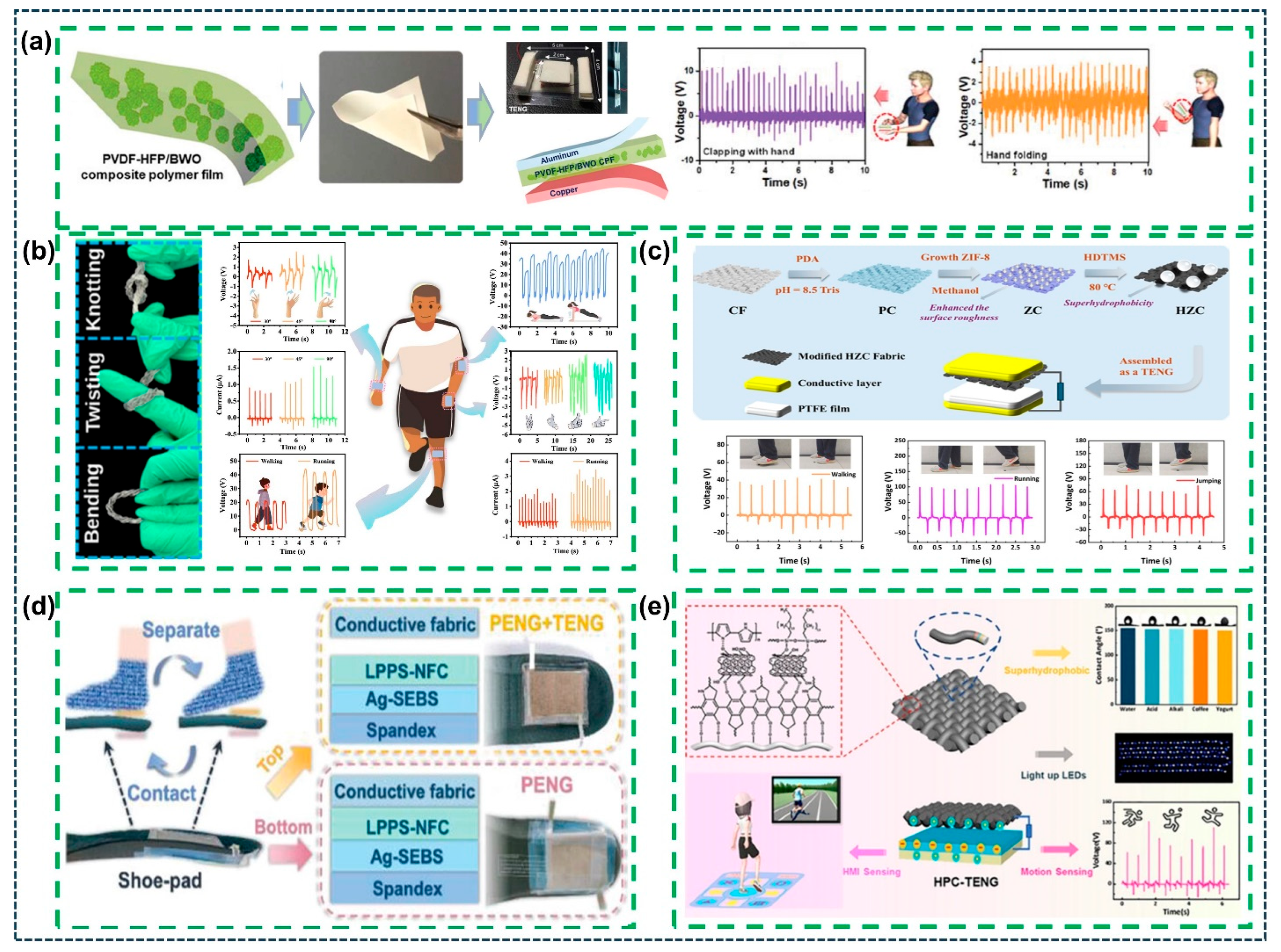
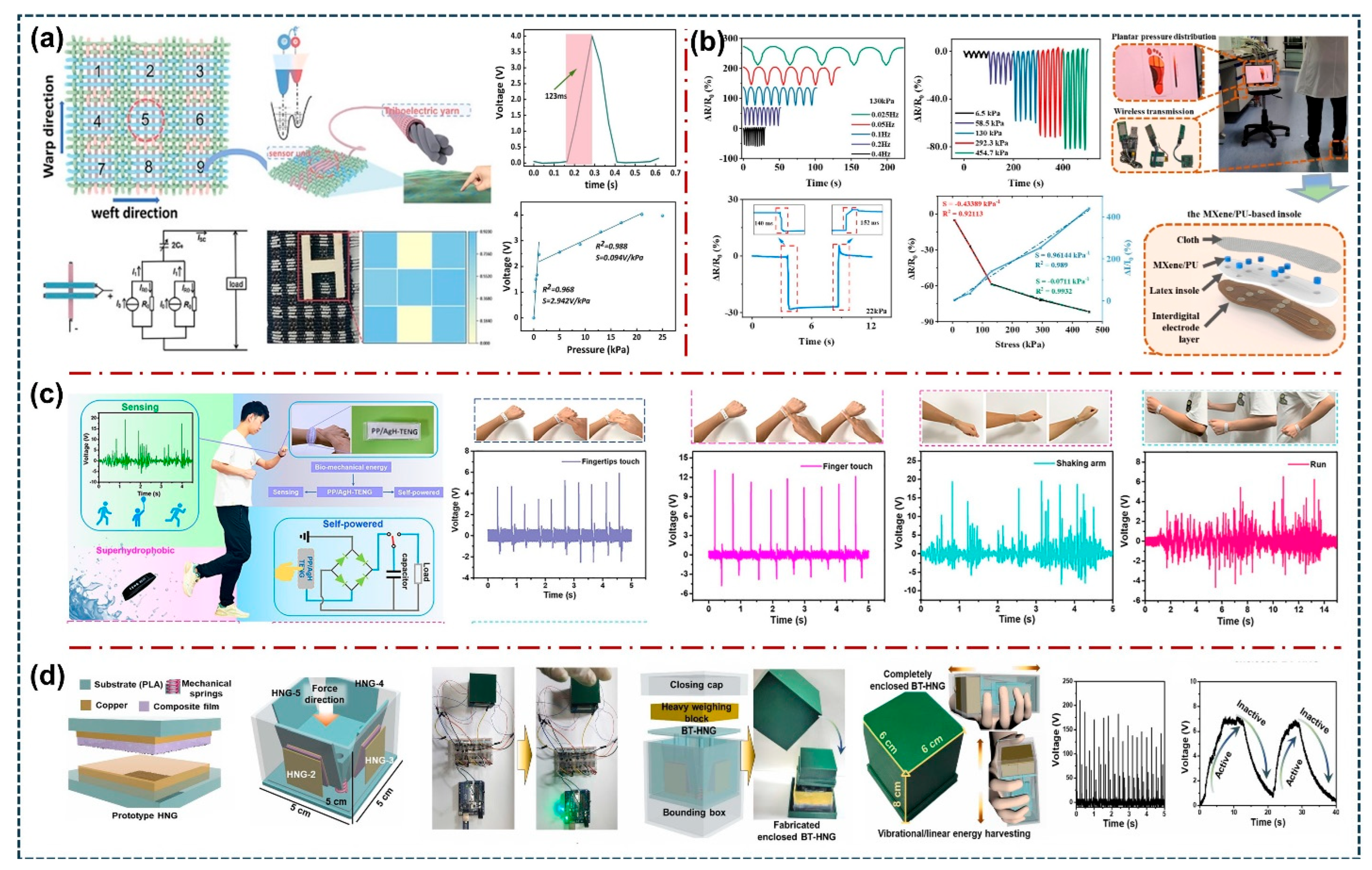
Within the last couple of decades, several studies have been conducted on the flexible polymer/composite film-based TENGs for biomechanical energy harvesting, wearable, and self-powered sensing applications. P. Manchi et al. constructed a high-performance flexible TENG device based on the dielectric and ferroelectric bismuth tungstate (Bi2WO6) marigold flower-like structures by hydrothermal synthesis and further embedded them into a poly (vinylidene fluoride-co-hexafluoropropylene) (PVDF-HFP) polymer to form a flexible PVDF-HFP/Bi2WO6 composite polymer film (CPF), as shown in Figure 4a, ref. [76]. The fabricated flexible PVDF-HFP/Bi2WO6 CPF exhibited a high polar crystalline β-phase, a high piezoelectric coefficient, and ferroelectric properties, which can improve the TENG’s electrical output. The proposed TENG shows a highly stable and durable electrical output over the long term, harvesting mechanical energy from everyday human body activities and powering various portable electronic devices. Also, Y.L. Yashaswini et al. designed high-performance TENGs using functionalized reduced graphene oxide (FrGO) in the polyvinyl alcohol (PVA) nanocomposite [77]. The fabricated flexible FrGO nanocomposite-based TENG exhibited an electrical output 17 times higher, as compared to pristine PVA-TENG. Further, the proposed TENG demonstrated a practical applicability, demonstrating its ability to power LEDs and digital timers via charging commercial capacitors using bridge rectifiers. Q. Ju et al. proposed a reduced graphene oxide (rGO) and polyaniline (PANI) decorated on a carbon fiber (CF) core electrode-based TENG, as shown in Figure 4b, ref. [78]. The fabricated TENG exhibits excellent electrical output and was also utilized for energy storage applications using a hybrid self-powered supercapacitor. The proposed model utilizes mechanical energy from daily human activities for harvesting and employs it to power electronic devices. Also, R. Umapathi et al. proposed lead-free strontium-doped bismuth ferrite (BSFO) nanoparticles with multiferroic and dielectric behavior via a solid-state synthesis technique and further incorporated them into PDMS to fabricate the BSFO/PDMS composite film-based TENG [79]. The fabricated BSFO-TENG delivered excellent power density and long-term operational stability. Furthermore, it illuminated various commercial LEDs, powered a digital clock, harvested electrical energy from daily human body motions, and was utilized for security alert applications. M. Mao et al. developed a biodegradable, recyclable, and biocompatible composite film-based TENG using a polyethyleneimine (PEI)/iron chloride (FeCl3)/microcrystalline cellulose (MCC) composite film [80]. The fabricated MCC/PEI/FeCl3 composite films based on TENG demonstrated exceptional pressure sensitivity and high-humidity sensing, fatigue resistance, and highly stable and long-term durable electrical output. Furthermore, the device exhibits high sensitivity to human body activities, such as walking, running, jumping, coughing, and breathing, etc. From these results, the proposed TENG is employed to harvest mechanical energy from the daily human actions and pressure-sensing applications. In addition, V. Mohan et al. fabricated a TENG using sonochemically prepared graphene/polydimethylsiloxane (SGP) nanocomposite and PEO layers [81]. The proposed TENG shows excellent electrical output, and the device can be successfully combined into practical applications such as human motion monitoring in daily activities, gaming interfaces, and power-point control applications. In a more fundamental study, C.M. Veerabhadraswamy et al. proposed a natural fiber-based TENG comprising PVA, and the agro-waste composites were prepared using a solution casting method [82]. The fabricated TENG exhibited high electrical output and powered various low-powered portable electronics, including LEDs and LCD timers. Also, it functioned biomechanical sensor for harvesting mechanical energy from daily human motions. M. Qu et al. established a flexible superhydrophobic MOF-based textile TENG for mechanical energy harvesting and wearable electronic applications, as shown in Figure 4c [83]. The fabricated TENG shows high electrical output and high durability even after long-term study over several weeks. The TENG demonstrated mechanical harvesting from human body activities and powering electronics, as well as self-powered sensors in human motion detection and Morse code information transmission. Furthermore, the conversion of mechanical energy into electrical energy from human mechanical movements by operating a TENG can be thought of as a sensing capability to be used in wearable applications. This functionality can be observed as high responsivity to voltage and current variations within a sensible time. In this case, flexible TENGs can be a perfect wearable sensor, with a quick response and sensitivity to mechanical stimuli. F. Jiang et al., in Figure 4d, developed a breathable, stretchable, and stable nanofiber composite (LPPS-NFC) via the electrospinning technique based on the Cs3Bi2Br9 perovskites decorated in lead-free perovskite/poly (vinylidene fluoride-co-hexafluoropropylene) (PVDF-HFP) and styrene-ethylene-butylene-styrene (SEBS) [84]. The LPPS-NFC-based TENG demonstrated excellent electrical output, enabling it to show a robust wearable device that converts mechanical energy from the different mechanical motions into electricity to operate various portable electronics. These results demonstrate that the proposed LPPS-NFC-based TENG can endure extreme deformation while maintaining excellent electrical output, highlighting its strong potential for use in smart textiles and wearable power sources. Moreover, J. He et al. presented a novel superhydrophobic and conductive composite fabric (HPC) using polydopamine (PDA), carbon nanotubes (CNTs), and polypyrrole (PPy), which were loaded on the cotton fabric surface to create the hydrophobic nature of cetyltrimethoxysilane (HDTMS), as shown in Figure 4e, ref. [85]. The prepared HPC exhibits excellent wear resistance, breathability, and self-cleaning properties, as well as high and stable electrical output from the HPC-TENG. The proposed TENG demonstrated mechanical energy harvesting from human activities and powering various electronics, as well as utilizing human–machine interface sensors for gaming blankets.

8. Self-Powered Sensors

In addition to detecting mechanical stimuli, physiological signals, and pressure-sensing parameters, increasing research efforts are being directed toward monitoring a wide range of environmentally relevant factors, reflecting the rising attention to sustainable and eco-friendly sensing technologies. For example, Q. Tao et al. proposed a triboelectric fabric pressure mapping sensor with high sensitivity and free crosstalk using polytetrafluoroethylene/stainless steel (PTFE-SS) braided yarns and the polyamide 66/stainless steel (PA66-SS) braided yarns in the weave fabric, as shown in Figure 5a, ref. [86]. The fabricated fabric-based pressure sensor TENG demonstrated excellent sensitivity of 2.942 V·kPa−1 and a fast response time of 123 ms. This proposed device was also utilized as a sensor for human motion sensing while doing daily activities, as well as a touch sensor. T. Yang et al. proposed sheath-core PVDF/graphene/carbon fiber (PVDF/G-CF) yarns fabricated using a conjugate electrospinning technique, covering a commercial CF core and an electrospun graphene-doped PVDF sheath [87], which can enhance the fatigue resistance of electrospun nanofibers under prolonged friction and keep a high degree of freedom. The resulting electronic textile, woven with large-area electrospun PVDF/G-CF yarns, delivers a high-power density of 25.5 mW/m2. The uniform distribution of PVDF/G nanofibers on the textile surface provides good softness, washability, and long-term durability. Further, the proposed electrospun PVDF/G-CF textile shows strong potential for pressure sensing, motion monitoring, and self-powered operation, making it a strong potential application for next-generation wearable electronic systems. X. Wang et al. proposed a soft and stretchable TENG skin for energy harvesting to operate portable electronics from biomechanical energy [88]. The fabricated TENG exhibits excellent electrical output and has desirable features like biocompatibility, simple fabrication, lightweight, and environmentally friendly nature. The TENG is integrated with a power management unit to drive electronic devices by harvesting energy from hand motion. Also, the proposed TENG provides a new insight for clean power sources of skin-mounted electronic gadgets and promotes the development of sustainable energy sources for wearable and portable electronics. J. Huang et al. established a novel self-powered pressure sensor based on the bacterial cellulose/chitosan (BC/CS) composites and copper nanoparticles-doped polydimethylsiloxane (PDMS/CU) films [89]. The fabricated device demonstrated excellent mechanical stability and high-pressure sensitivity of 0.24 V/kPa−1. The device exhibits high sensitivity when it is attached to human body parts, and it detects joint motions. In addition, S. Wang et al. developed 3D microporous MXene/polyurethane (MXene/PU) composite gel-based triboelectric nanogenerators, as shown in Figure 5b, ref. [90]. The fabricated Mxene/PU exhibits exceptional performance characteristics such as a large compressive range, excellent cycling durability, long-term stability, and high sensitivity of 0.96144 kPa–1. The proposed TENG generates excellent electrical output performance as well as remarkable effectiveness in applications of healthcare monitoring and rehabilitation. M. Qu et al. fabricated a superhydrophobic, humidity-resistant flexible TENG based on the PDMS/PTFE and AgNWs/PVA hydrogel electrodes, as shown in Figure 5c, ref. [91]. The fabricated PP/AgH-TENG generated a high electrical power density of 3.07 W/m2 and can easily power several portable electronic devices. Additionally, the bracelet-type TENG was developed to harvest mechanical energy from human movements, as well as demonstrated its potential in the field of wearable sensing applications. Also, Y. Liu et al. have developed a rapid-response, highly sensitive, and self-powered artificial sensory memory actuated by a triboelectric sensory receptor (TESR) for real-time neuromorphic computing applications [92]. The flexible TESR is designed based on the DPP-DTT and ion-gel layers. The device exhibits high electrical output and pressure-sensing properties with a sensitivity of 0.192 kPa−1. Further, several TESR devices were arranged in a matrix shape to demonstrate handwritten image recognition and neuromorphic computing results. These results from TESR sensors have strong potential for real-time broad applications in neuromorphic systems, human–machine interaction, and large-scale neural networks. Also, M.V. Paranjape et al. have proposed a 3D-printed box-type hybrid nanogenerator (BT-HNG) based on the acetone-dissolved microarchitectured strontium (Sr)-doped silver niobate (ASNb)/ecoflex composite film for efficient mechanical energy harvesting and sensor applications (Figure 5d), ref. [93]. The highly effective and stable electrical output exhibited by BT-HNG is further utilized for powering small-scale electronic devices. Moreover, the proposed BT-HNG successfully demonstrated its use as a real-time sensor that can be utilized for powering the stairs, corridors, streetlamps, etc., in human presence, as well as harvesting vibrational/linear movements into electrical energy.
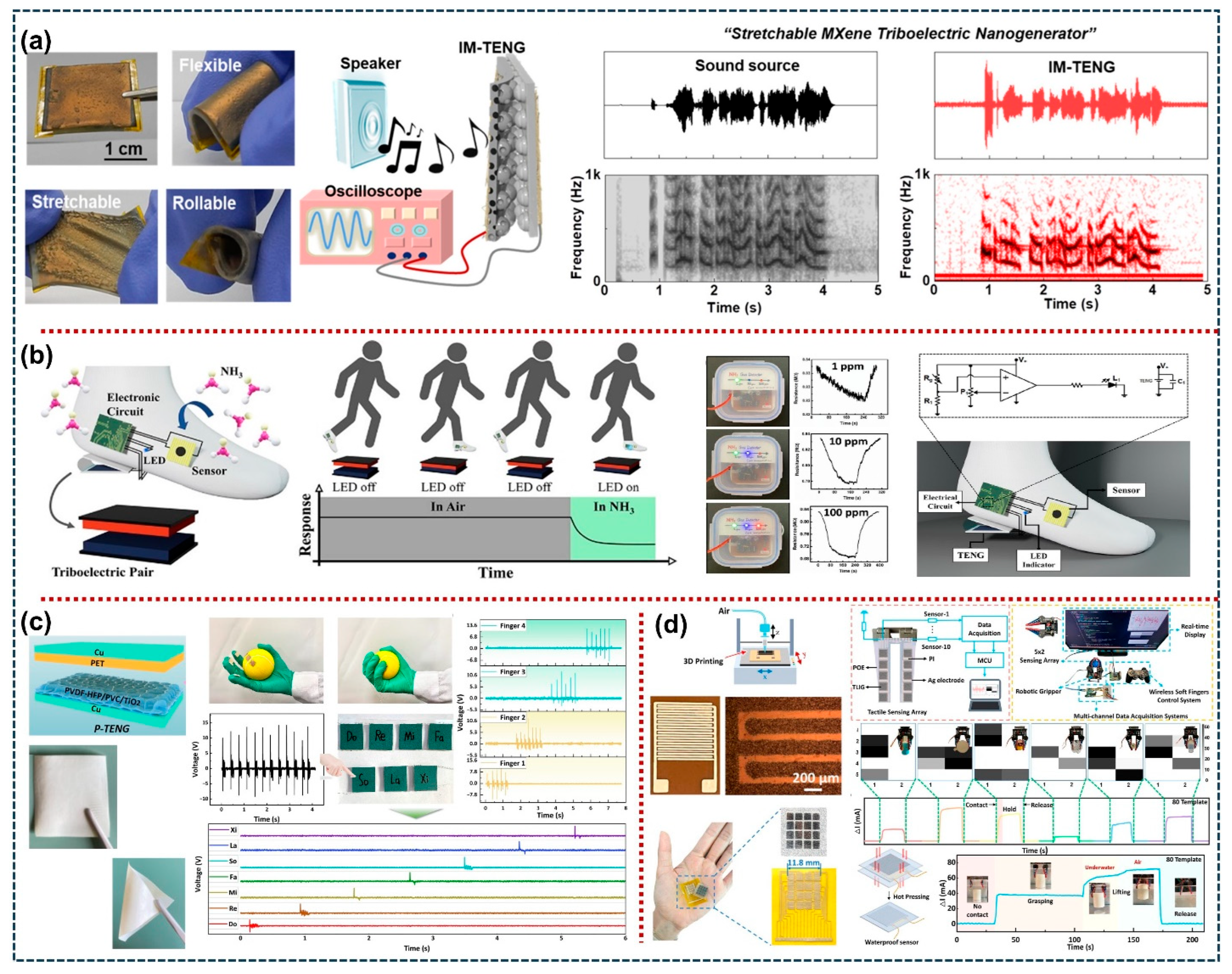
The flexible polymer/composite film-based TENG devices have demonstrated substantial potential for the enhancement of electrical output and various self-powered sensing applications, including acoustic, tactile, etc. For example, G.M. Rani et al. successfully fabricated a nature-driven CF-CNT TENG device based on the carbon nanotubes (CNT) decorated on the cigarette filter (CFs) [94]. The assembled CF-CNT-based TENG demonstrated high and stable electrical output, and it employed various commercial portable electronics. Furthermore, the proposed device can be used as a sound-driven TENG that works efficiently across different bandwidth frequencies. These results demonstrate that the CF-CNT TENG has immense potential in various sensing, acoustic, and energy harvesting applications. Also, S.K. Ghosh et al. have developed a high-performance stretchable TENG based on a sandwich structure between the Ag NWs electrodes and hierarchically engineered spongy TPU composite polymer with ferroelectric barium titanate (BTO) and 2D MXene (Ti3C2Tx) nanosheets, as shown in Figure 6a, ref. [95]. The Mxene sheets increase the dielectric properties by coupling with BTO particles, resulting in high and stable electrical output from the TENG. The fabricated TENG exhibits a high electrical output power density of 6.65 W/m2, high pressure sensitivity, and efficiency. The TENG enables a broad range of real-time applications, including mechanical energy harvesting, vital-sign monitoring, acoustic sensing, and gesture-sensing functionality of a robotic hand. S. Sardana et al. have designed an electrospun triboelectric nanogenerator (TENG) based on the MXenes loaded cellulose acetate NFs, as shown in Figure 6b, ref. [96]. The fabricated TENG generated a high output power density of 1.361 W/m2. Further, they assembled an MXene/TiO2/C-NFs heterojunction-based sensory component using cellulose nanofibers for the detection of NH3. The sensor exhibits excellent reproducibility, high sensitivity, and fast response/recovery time of 76 s/62 s at room temperature. The proposed sensor demonstrated its possibilities as a gas-sensing network driven by human motion energy and external battery dependence for environment monitoring applications. L. Yang et al. have proposed a novel liquid metal (LM)-incorporated thermoplastic polyurethane (TPU) nanofiber-based TENG for mechanical energy harvesting and self-powered sensing properties [97]. Dual optimization of interfacial polarization and charge trapping capabilities was achieved by incorporating the LM nanoparticles into the nanofiber network. The proposed SM-TENG demonstrated the highest electrical output and ultralong-term stability results. This SM-TENG exhibits a high-pressure-sensitive triboelectric response of 6.11 V/kPa, and it enables multimodal sensing properties, including gait analysis, information transmission, physiological signal monitoring, and encrypted human–machine communication. These results are promising for next-generation smart healthcare systems and human–machine interfaces. On the other hand, M. Anithkumar et al. fabricated a novel hybrid nanogenerator (HNG) with multifunctional composite film (MFC), made up of Cu2O-doped 0.3Ba0.7Ca0.3TiO3-0.7BaSn0.12Ti0.88O3 nanoparticles (Cu2O-BCST NPs) [98]. The HNG demonstrated an outstanding electrical output due to the synergistic properties of the MFC. Further, DL-HNG was assembled with a matrix structure using 3D-printed masks; its demonstrations are systematically operated. The DL-HNG can also be employed as a flexible self-powered trackpad (or touch) sensor to control the mouse pointer in computer or touch-screen display devices. Q. Yi et al. have established a novel 3D printer and integrated a self-powered wearable sensing system for real-time vital sign monitoring applications [99]. The TENG fabricated using Mxene ink is coupled with a styrene–ethylene–butylene–styrene (SEBS) substrate with a positive triboelectric property and high stretchability. The device exhibits excellent power density, high sensitivity of 6.03 kPa−1, and a fast response time of 80 ms. The proposed TENG employed as a wearable system for continuous and real-time physiological biosignal monitoring under human motions and signaling exhibits potential in sensing applications. Also, in Figure 6c, Q. Liu et al. have developed a surface-patterned PVDF-HFP/PVC/TiO2 composite film-based flexible triboelectric nanogenerator for tactile sensing applications [100]. The prepared composite films show excellent hydrophobic nature with a rough surface, which enables the device to overcome the effect of water molecules on charge transfer in the humid environment, thus resulting in high and stable electrical output from the corresponding TENG device. The proposed TENG demonstrated the mechanical energy harvesting from human movements as well as a self-powered sensor in the tactile sensing applications. In addition, J. Ji et al. have designed a flexible tactile sensor based on the templated laser-induced graphene (TLIG) 3D-printed on Ag electrodes, as shown in Figure 6d, ref. [101]. The designed tactile sensor obtains a high sensitivity of 52,260.2 kPa−1, a broad detection range up to 1000 kPa, a quick response and recovery time of 12 and 16 ms, and high stability over 10,000 cycles. The TLIG device acts as a sensory receptor for the soft robotic gripper, and its ability for texture recognition is further demonstrated through the implementation of a soft tactile sensing array. Moreover, M. Lou et al., C. Ning et al., F. Chen et al., W. Xu et al., Y. Yang et al., and Y. Li et al. also designed a flexible polymer/composite film-based TENG device for energy harvesting and real-time acoustic and tactile sensing applications [102,103,104,105,106,107]. From these results, the flexible polymer/composite film-based TENG have been widely used in different practical and real-time scenarios, including energy harvesting and various sensor applications. Table 2 and Table 3 represent the summary of various TENG sensors with their electrical output results, sensing parameters, and applications. Furthermore, the comparison table of the TENG device with various important parameters, including materials, electrical output, stability/durability, cost of fabrication, and their application areas, was summarized in Table 4.

9. Conclusions and Feature Perspectives

In conclusion, this review highlights recent progress in the development of flexible triboelectric polymer/composite films for TENGs designed for energy harvesting, wearable technologies, and self-powered sensing applications. Advances in polymer engineering and composite-film preparation show that the addition of selected filler materials can substantially improve dielectric properties, charge-generation ability, mechanical strength, and robust behavior under various environmental conditions. The combined behavior of polymers and engineered nanofillers has enabled flexible TENGs that deliver enhanced electrical output while also providing consistent sensing functions for motion tracking and physiological monitoring. These developments highlight the role of material innovation in affecting the performance constraints of traditional triboelectric films and in expanding the operational versatility of TENG devices. Finally, practical and real-time applications enabled by TENG devices are also introduced, such as wearable, portable, health monitoring, acoustic, tactile, and self-powered pressure sensor systems. These findings show that continuity and multifunctional features can significantly improve and broaden an active device’s capabilities in practical and real-time application scenarios.
With these advances, ongoing innovation has generated a wide range of studies offering practical strategies for the realization of continuous and multimodal active devices, thereby highlighting their strong potential for deployment in diverse real-world applications. Over the past decades, flexible triboelectric polymer/composite films have played a vital role in advancing TENG devices, mainly due to their ability to deliver higher electrical output, mechanical strength, and support for distinct functional parameters. These strengths position polymer or composite film-based TENGs as robust candidates for wearable energy harvesters and self-powered sensor devices, where devices must remain lightweight, flexible, deformable, and reliable during continuous use. However, applying these materials in practical or real-world application scenarios introduces some challenges. Wearable and textile systems require films that can endure repeated bending, stretching, and surface friction without losing electrical performance. Self-powered sensing applications must also ensure that the materials operate stably under different humidity/temperature ranges and long-term cyclic tests.
Moving forward, several research areas merit focused research to accelerate the practical use of these flexible polymers and composite materials. Enhancing electrical output performance remains a priority and can be achieved by designing these composite films by incorporating high dielectric permittivity fillers, strengthening interactions at polymer and filler interfaces, and producing multiscale structures that promote efficient charge generation and movement. Improving mechanical stability and long-term durability is equally important, as composite films can degrade when exposed to moisture, heat, or sustained mechanical stress. Integrating protective surface layers, reinforcing polymer networks, or using materials capable of employing a self-healing nature may help address these concerns. Another promising direction is the development of flexible polymer composite films with built-in sensing functions. By tailoring the composition or integrating responsive nanomaterials, a TENG device could simultaneously harvest energy and monitor mechanical or environmental changes, which would be valuable for advanced wearables, motion tracking, tactile pressure sensing, and health-monitoring technologies. Also, the integration of TENGs with energy storage, wireless communication modules, and multifunctional sensing components will be essential for realizing fully self-powered systems. Overall, continued innovations in polymer/composite material fabrication, structural design, and device integration are expected to accelerate the development of flexible composite film-based TENGs, paving the way for their potential applications in energy harvesting, wearable electronics, self-powered smart sensing networks, and health-care monitoring.

Author Contributions

Conceptualization, Methodology, Software, Formal analysis, Writing—original draft preparation, M.P.; supervision, visualization, Funding acquisition, project administration, writing—review and editing, H.-J.Y. All authors have read and agreed to the published version of the manuscript.

Funding

This research was funded by the National Research Foundation of Korea (NRF); grant funded by the Korean government (MSIT) (No. RS-2025-00521476 and No. RS-2024-00445819).

Data Availability Statement

Data will be made available on request.

Conflicts of Interest

The authors declare no conflict of interest.

References

  1. Mao, Y.; Li, Y.; Xie, J.; Liu, H.; Guo, C.; Hu, W. Triboelectric nanogenerator/supercapacitor in-one self-powered textile based on PTFE yarn wrapped PDMS/MnO2NW hybrid elastomer. Nano Energy 2021, 84, 105918. [Google Scholar] [CrossRef]
  2. Li, C.; Luo, R.; Bai, Y.; Shao, J.; Ji, J.; Wang, E.; Li, Z.; Meng, H.; Li, Z. Molecular doped biodegradable triboelectric nanogenerator with optimal output performance. Adv. Funct. Mater. 2024, 34, 2400277. [Google Scholar] [CrossRef]
  3. Sasikumar, M.; Sreenivasan, S.; Vijayakumar, P.; Manikandan, S. Multi-Objective Energy Management in Microgrids with Hybrid Renewable Energy Sources and Battery Energy Storage Systems Using Hybrid Optimization Algorithm. Trans. Electr. Electron. Mater. 2025, 1–18. [Google Scholar] [CrossRef]
  4. Polat, S.; Mashrah, M.; Maksur, A. Evaluation of weight, area, and volumetric specific capacitance performance of high graphene content ZnFe2O4 electrode for supercapacitors. Trans. Electr. Electron. Mater. 2024, 25, 801–810. [Google Scholar] [CrossRef]
  5. Singh, G.; Singh, A.P.; Ali, Z.; Sharma, N.K.; Singh, V.K. An Innovative DGS Based Textile Antenna with Semi-Circular Slot for Future IoT’s and AI Applications. Trans. Electr. Electron. Mater. 2025, 26, 78–103. [Google Scholar] [CrossRef]
  6. Khalifa, M.; Kumar, M.; Subramanian, G.; Anandhan, S. A Facile Strategy to Achieve High Piezoelectric Performance in Electrospun Poly (Vinylidene Fluoride) Non-woven Nanofabrics. Trans. Electr. Electron. Mater. 2024, 25, 201–209. [Google Scholar] [CrossRef]
  7. Ghemari, Z.; Belkhiri, S. Exploring Novel Piezoelectric Materials with Enhanced Thermal Stability for High-Performance Sensors. Trans. Electr. Electron. Mater. 2025, 26, 289–304. [Google Scholar] [CrossRef]
  8. Shwetha, M.; Lakshmi, S. Harmless Sustainable Energy Resource using TEG with MPPT Based DC-DC Converter for Power Gain in Implantable Medical Devices. Trans. Electr. Electron. Mater. 2024, 25, 608–635. [Google Scholar] [CrossRef]
  9. Niu, S.; Wang, Z.L. Theoretical systems of triboelectric nanogenerators. Nano Energy 2015, 14, 161–192. [Google Scholar] [CrossRef]
  10. Fu, H.; Liu, L.; Liu, W.; Long, Z.; Huang, P.; Fu, K.; Ou, H.; Hu, L.; Liao, M.; Gong, J. Polydopamine-Ag engineered BaTiO3 core-double-shells nanohybrids in PDMS composites for synergistically enhanced triboelectric output and antibiosis in self-sustaining wearables. Chem. Eng. J. 2025, 525, 170081. [Google Scholar] [CrossRef]
  11. Ge, X.; Hu, N.; Yan, F.; Wang, Y. Development and applications of electrospun nanofiber-based triboelectric nanogenerators. Nano Energy 2023, 112, 108444. [Google Scholar] [CrossRef]
  12. Guo, W.T.; Lei, Y.; Zhao, X.H.; Li, R.; Lai, Q.T.; Liu, S.Z.; Chen, H.; Fan, J.C.; Xu, Y.; Tang, X.G.; et al. Printed-scalable microstructure BaTiO3/ecoflex nanocomposite for high-performance triboelectric nanogenerators and self-powered human-machine interaction. Nano Energy 2024, 131, 110324. [Google Scholar] [CrossRef]
  13. Luo, H.; Ni, X.; Zhang, C.; Cui, Y.; Yang, T.; Shao, J.; Jing, X. Multi-Phase Rotating Disk Triboelectric Nanogenerator with DC Output for Speed Monitoring. Small 2024, 20, 2406091. [Google Scholar] [CrossRef] [PubMed]
  14. Luo, H.; Ni, X.; Cui, Y.; Huang, C.; Yuan, P.; Yang, T.; Shao, J.; Huang, X. High stability rotary solid-liquid triboelectric nanogenerator for ionic liquid detection. Nano Energy 2025, 138, 110870. [Google Scholar] [CrossRef]
  15. Liu, W.; Wang, X.; Yang, L.; Wang, Y.; Xu, H.; Sun, Y.; Nan, Y.; Sun, C.; Zhou, H.; Huang, Y. Swing Origami-Structure-Based Triboelectric Nanogenerator for Harvesting Blue Energy toward Marine Environmental Applications. Adv. Sci. 2024, 11, 2401578. [Google Scholar] [CrossRef] [PubMed]
  16. Guo, M.; Xia, Y.; Liu, J.; Zhang, Y.; Li, M.; Wang, X. Wearable Pressure Sensor Based on Triboelectric Nanogenerator for Information Encoding, Gesture Recognition, and Wireless Real-Time Robot Control. Adv. Funct. Mater. 2025, 35, 2419209. [Google Scholar] [CrossRef]
  17. Wang, Y.; Chu, L.; Meng, S.; Yang, M.; Yu, Y.; Deng, X.; Qi, C.; Kong, T.; Liu, Z. Scalable and ultra-sensitive nanofibers coaxial yarn-woven triboelectric nanogenerator textile sensors for real-time gait analysis. Adv. Sci. 2024, 11, 2401436. [Google Scholar] [CrossRef]
  18. Ma, C.; Matin Nazar, A.; Moradi, A.H.; Goharian, H.; Mao, G.; Yari, M.; Ji, X.; Dong, S. Advanced Triboelectric Nanogenerator Sensing Technologies for High-Efficiency Cardiovascular Monitoring. Energy Technol. 2025, 13, 2401863. [Google Scholar] [CrossRef]
  19. Sengupta, C.; Mondal, S.K.; Pati, B.; Mondal, T. Anisotropic functionalized filler driven interfacial charge orchestration in elastomer composite based TENG for wireless communication. Chem. Eng. J. 2025, 523, 168504. [Google Scholar] [CrossRef]
  20. Tan, L.; Zeng, Q.; Xu, F.; Zhao, Q.; Chen, A.; Wang, T.; Tao, X.; Yang, Y.; Wang, X. Controllable Manipulation of Large-Volume Droplet on Non-Slippery Surfaces Based on Triboelectric Contactless Charge Injection. Adv. Mater. 2024, 36, 2313878. [Google Scholar] [CrossRef]
  21. Wang, J.; Xu, S.; Li, G.; Zhang, X.; Zhao, Q.; Wu, H.; Li, K.; Fu, S.; Shan, C.; He, W.; et al. Effectively inhibiting charge injection and dielectric loss of high permittivity inorganic materials by rationally coating organic polymer for achieving high output charge density. Adv. Energy Mater. 2024, 14, 2400429. [Google Scholar] [CrossRef]
  22. Manchi, P.; Paranjape, M.V.; Kurakula, A.; Graham, S.A.; Kavarthapu, V.S.; Yu, J.S. PDA-Ag/TiO2 Nanoparticles-Loaded Electrospun Nylon Composite Nanofibrous Film-Based Triboelectric Nanogenerators for Wearable Biomechanical Energy Harvesting and Multifunctional Sensors. Adv. Funct. Mater. 2025, 35, 2416018. [Google Scholar] [CrossRef]
  23. Sahu, P.; Choudhary, R.N.P.; Samal, S.K. Investigation of Electrical, Dielectric, and Ferroelectric Properties of Complex Compounds BaTiO3-Bi0.5K0.5TiO3 for some Device Applications. Trans. Electr. Electron. Mater. 2024, 25, 577–588. [Google Scholar] [CrossRef]
  24. Agnihotri, P.; Hawaldar, R.; Rai, R. Study the structural, electrical and ferroelectric behaviour of lead-free sodium potassium niobate (KNN) ceramics in view of energy storage capacity. Trans. Electr. Electron. Mater. 2024, 25, 745–759. [Google Scholar] [CrossRef]
  25. Ghemari, Z.; Bendaikha, A.; Belkhiri, S.; Saad, S. Fabrication of Flexible Resistive Pressure Sensors Using Graphene/Polydimethylsiloxane Composites. Trans. Electr. Electron. Mater. 2025, 26, 323–344. [Google Scholar] [CrossRef]
  26. Nabeel, N.; Jain, A.; Juglan, K.C.; Naeem, S. Synthesis and Optimization of Polypyrrole/Reduced Graphene Oxide/Nickel Cobalt Ferrite (PRNC) Ternary Composites for the Application in High-Performance Supercapacitors. Trans. Electr. Electron. Mater. 2025, 26, 890–905. [Google Scholar] [CrossRef]
  27. Manchi, P.; Yoon, H.J. Electrospun Nanofibers Based Flexible Triboelectric Nanogenerators for Mechanical Energy Harvesting and Smart Sensing Applications: A Review. Trans. Electr. Electron. Mater. 2025, 27, 90–99. [Google Scholar] [CrossRef]
  28. Lai, Y.C.; Deng, J.; Zhang, S.L.; Niu, S.; Guo, H.; Wang, Z.L. Single-thread-based wearable and highly stretchable triboelectric nanogenerators and their applications in cloth-based self-powered human-interactive and biomedical sensing. Adv. Funct. Mater. 2017, 27, 1604462. [Google Scholar] [CrossRef]
  29. Guan, X.; Xu, B.; Wu, M.; Jing, T.; Yang, Y.; Gao, Y. Breathable, washable and wearable woven-structured triboelectric nanogenerators utilizing electrospun nanofibers for biomechanical energy harvesting and self-powered sensing. Nano Energy 2021, 80, 105549. [Google Scholar] [CrossRef]
  30. Wu, F.; Li, C.; Yin, Y.; Cao, R.; Li, H.; Zhang, X.; Zhao, S.; Wang, J.; Wang, B.; Xing, Y.; et al. A Flexible, Lightweight, and Wearable Triboelectric Nanogenerator for Energy Harvesting and Self-Powered Sensing. Adv. Mater. Technol. 2019, 4, 1800216. [Google Scholar] [CrossRef]
  31. Smith, M.B.; Page, K.; Siegrist, T.; Redmond, P.L.; Walter, E.C.; Seshadri, R.; Brus, L.E.; Steigerwald, M.L. Crystal structure and the paraelectric-to-ferroelectric phase transition of nanoscale BaTiO3. J. Am. Chem. Soc. 2008, 130, 6955–6963. [Google Scholar] [CrossRef]
  32. Biswas, A.; Saha, S.; Jana, N.R. ZnSnO3 nanoparticle-based piezocatalysts for ultrasound-assisted degradation of organic pollutants. ACS Appl. Nano Mater. 2019, 2, 1120–1128. [Google Scholar] [CrossRef]
  33. Zhang, J.W.; Meng, X.; Fu, G.; Han, T.; Xu, F.; Putson, C.; Liu, X. Enhanced polarization effect of flexible magnetoelectric PVDF-TrFE/Fe3O4 smart nanocomposites for nonvolatile memory application. ACS Appl. Electron. Mater. 2023, 5, 1844–1852. [Google Scholar] [CrossRef]
  34. He, Y.; Zhu, B.; Tan, S.; Liu, Z.; Zhang, X.; Zhang, Z. Improving the energy storage performance of a chlorinated poly (vinyl chloride) film at elevated electric field and temperature via a simple annealing process. ACS Appl. Energy Mater. 2023, 6, 5407–5415. [Google Scholar] [CrossRef]
  35. Venkatesan, H.M.; Arun, A.P. Nickel-oxide-doped polyvinylidene fluoride nanofiber-based flexible triboelectric nanogenerator for energy harvesting and healthcare monitoring applications. ACS Appl. Electron. Mater. 2024, 6, 1161–1173. [Google Scholar] [CrossRef]
  36. Manchi, P.; Graham, S.A.; Paranjape, M.V.; Kurakula, A.; Kavarthapu, V.S.; Yu, J.S. Calcium copper titanate incorporated polydimethylsiloxane flexible composite film-based triboelectric nanogenerator for energy harvesting and self-powered sensing applications. J. Mater. Sci. Technol. 2024, 190, 56–66. [Google Scholar] [CrossRef]
  37. Kim, D.W.; Lee, J.H.; Kim, J.K.; Jeong, U. Material aspects of triboelectric energy generation and sensors. NPG Asia Mater. 2020, 12, 6. [Google Scholar] [CrossRef]
  38. Lai, Y.C.; Wu, H.M.; Lin, H.C.; Chang, C.L.; Chou, H.H.; Hsiao, Y.C.; Wu, Y.C. Entirely, intrinsically, and autonomously self-healable, highly transparent, and superstretchable triboelectric nanogenerator for personal power sources and self-powered electronic skins. Adv. Funct. Mater. 2019, 29, 1904626. [Google Scholar] [CrossRef]
  39. Paranjape, M.V.; Graham, S.A.; Manchi, P.; Kurakula, A.; Yu, J.S. Lead-free silver niobate microparticles-loaded PDMS composite films for high-performance clip-like hybrid mechanical energy harvesters. J. Mater. Sci. Technol. 2024, 176, 145–154. [Google Scholar] [CrossRef]
  40. Ouyang, H.; Liu, Z.; Li, N.; Shi, B.; Zou, Y.; Xie, F.; Ma, Y.; Li, Z.; Li, H.; Zheng, Q.; et al. Symbiotic cardiac pacemaker. Nat. Commun. 2019, 10, 1821. [Google Scholar] [CrossRef]
  41. Xu, C.; Zi, Y.; Wang, A.C.; Zou, H.; Dai, Y.; He, X.; Wang, P.; Wang, Y.C.; Feng, P.; Li, D.; et al. On the electron-transfer mechanism in the contact-electrification effect. Adv. Mater. 2018, 30, 1706790. [Google Scholar] [CrossRef]
  42. Yan, D.; Ye, J.; Zhou, Y.; Lei, X.; Deng, B.; Xu, W. Research progress of fabrics with different geometric structures for triboelectric nanogenerators in flexible and wearable electronics. Adv. Fiber Mater. 2023, 5, 1852–1878. [Google Scholar] [CrossRef]
  43. Zhang, R.; Hummelgård, M.; Örtegren, J.; Olsen, M.; Andersson, H.; Yang, Y.; Zheng, H.; Olin, H. The triboelectricity of the human body. Nano Energy 2021, 86, 106041. [Google Scholar] [CrossRef]
  44. Xu, G.; Guan, D.; Fu, J.; Li, X.; Li, A.; Ding, W.; Zi, Y. Density of surface states: Another key contributing factor in triboelectric charge generation. ACS Appl. Mater. Interfaces 2022, 14, 5355–5362. [Google Scholar] [CrossRef] [PubMed]
  45. Kang, X.; Li, P.; Yurchenko, D.; Dai, S.; Wang, J. Fundamental theory and cutting-edge applications of TENGs. Mater. Futures 2025, 4, 042101. [Google Scholar] [CrossRef]
  46. Tao, L.; Chen, T.; Wu, J.; Zhang, T.; Shao, L.; Zhang, H.; Liu, L.; Wu, H.; Chen, T.; Ji, J. Principles of Operation and Application Extensions of Triboelectric Nanogenerators: Structure and Material Optimization. Micromachines 2025, 16, 1127. [Google Scholar] [CrossRef] [PubMed]
  47. Babu, A.; Mandal, D. Roadmap to human–machine interaction through triboelectric nanogenerator and machine learning convergence. ACS Appl. Energy Mater. 2024, 7, 822–833. [Google Scholar] [CrossRef]
  48. Hasan, S.; Kouzani, A.Z.; Adams, S.; Long, J.; Mahmud, M.P. Comparative study on the contact-separation mode triboelectric nanogenerator. J. Electrost. 2022, 116, 103685. [Google Scholar] [CrossRef]
  49. Zhang, H.; Quan, L.; Chen, J.; Xu, C.; Zhang, C.; Dong, S.; Lü, C.; Luo, J. A general optimization approach for contact-separation triboelectric nanogenerator. Nano Energy 2019, 56, 700–707. [Google Scholar] [CrossRef]
  50. Zhao, H.; Wang, H.; Yu, H.; Xu, Q.; Li, X.; Guo, J.; Shao, J.; Wang, Z.L.; Xu, M.; Ding, W. Theoretical modeling of contact-separation mode triboelectric nanogenerators from initial charge distribution. Energy Environ. Sci. 2024, 17, 2228–2247. [Google Scholar] [CrossRef]
  51. Niu, S.; Liu, Y.; Wang, S.; Lin, L.; Zhou, Y.S.; Hu, Y.; Wang, Z.L. Theory of sliding-mode triboelectric nanogenerators. Adv. Mater. 2013, 25, 6184–6193. [Google Scholar] [CrossRef]
  52. Zhang, H.; Zhang, C.; Zhang, J.; Quan, L.; Huang, H.; Jiang, J.; Dong, S.; Luo, J. A theoretical approach for optimizing sliding-mode triboelectric nanogenerator based on multi-parameter analysis. Nano Energy 2019, 61, 442–453. [Google Scholar] [CrossRef]
  53. Shao, J.; Jiang, T.; Tang, W.; Xu, L.; Kim, T.W.; Wu, C.; Chen, X.; Chen, B.; Xiao, T.; Bai, Y.; et al. Studying about applied force and the output performance of sliding-mode triboelectric nanogenerators. Nano Energy 2018, 48, 292–300. [Google Scholar] [CrossRef]
  54. Niu, S.; Liu, Y.; Wang, S.; Lin, L.; Zhou, Y.S.; Hu, Y.; Wang, Z.L. Theoretical investigation and structural optimization of single-electrode triboelectric nanogenerators. Adv. Funct. Mater. 2014, 24, 3332–3340. [Google Scholar] [CrossRef]
  55. Shao, J.; Willatzen, M.; Shi, Y.; Wang, Z.L. 3D mathematical model of contact-separation and single-electrode mode triboelectric nanogenerators. Nano Energy 2019, 60, 630–640. [Google Scholar] [CrossRef]
  56. Jiang, T.; Chen, X.; Han, C.B.; Tang, W.; Wang, Z.L. Theoretical study of rotary freestanding triboelectric nanogenerators. Adv. Funct. Mater. 2015, 25, 2928–2938. [Google Scholar] [CrossRef]
  57. Ren, X.; Fan, H.; Wang, C.; Ma, J.; Zhao, N. Coaxial rotatory-freestanding triboelectric nanogenerator for effective energy scavenging from wind. Smart Mater. Struct. 2018, 27, 065016. [Google Scholar] [CrossRef]
  58. Kavarthapu, V.S.; Paranjape, M.V.; Manchi, P.; Kurakula, A.; Lee, J.K.; Graham, S.A.; Yu, J.S. Wireless Alerts and Data Monitoring from BNNO-MWCNTs/PDMS Composite Film-Based TENG Integrated Inhaler for Smart Healthcare Application. Small 2024, 20, 2403218. [Google Scholar] [CrossRef] [PubMed]
  59. Kurakula, A.; Paranjape, M.V.; Manchi, P.; Arbaz, S.J.; Gujjala, L.K.S.; Graham, S.A.; Kavarthapu, V.S.; Yu, J.S. Aurivillius-type SrBi4Ti4O15/PGA composite film-based flexible triboelectric nanogenerators for energy harvesting/storage and multipurpose tap-indication transducer applications. ACS Appl. Mater. Interfaces 2024, 16, 48246–48256. [Google Scholar] [CrossRef] [PubMed]
  60. Gupta, A.; Gajula, P.; Yoon, J.U.; Lee, S.H.; Kim, H.; Adusumalli, V.N.; Bae, J.W.; Park, Y.I. Revolutionizing energy harvesting: Eco-friendly and adaptable triboelectric sensors with recycled cloth and metallo-dielectric loaded Ecoflex hybrid films. Nano Energy 2024, 122, 109346. [Google Scholar] [CrossRef]
  61. Wang, W.; Wang, D.; Zhang, X.; Yang, C.; Zhang, D. Self-powered nitrogen dioxide sensor based on Pd-decorated ZnO/MoSe2 nanocomposite driven by triboelectric nanogenerator. Nanomaterials 2022, 12, 4274. [Google Scholar] [CrossRef]
  62. Cho, E.; Kim, K.N.; Yong, H.; Choi, W.J.; Park, J.S.; Lee, S.J. Highly transparent and water-repellent hierarchical-wrinkled-architecture triboelectric nanogenerator with ultrathin plasma-polymer-fluorocarbon film for artificial triboelectric skin. Nano Energy 2022, 103, 107785. [Google Scholar] [CrossRef]
  63. Chung, C.K.; Huang, Y.J.; Wang, T.K.; Lo, Y.L. Fiber-based triboelectric nanogenerator for mechanical energy harvesting and its application to a human–machine interface. Sensors 2022, 22, 9632. [Google Scholar] [CrossRef]
  64. Luo, C.; Shao, Y.; Yu, H.; Ma, H.; Zhang, Y.; Yin, B.; Yang, M.B. Improving the output performance of bacterial cellulose-based triboelectric nanogenerators by modulating the surface potential in a simple method. ACS Sustain. Chem. Eng. 2022, 10, 13050–13058. [Google Scholar] [CrossRef]
  65. Wang, F.; Wang, S.; Liu, Y.; Ouyang, S.; Sun, D.; Yang, X.; Li, J.; Wu, Z.; Qian, J.; Zhao, Z.; et al. Cellulose nanofiber-based triboelectric nanogenerators for efficient air filtration in harsh environments. Nano Lett. 2024, 24, 2861–2869. [Google Scholar] [CrossRef]
  66. He, S.; Yu, Z.; Zhou, H.; Huang, Z.; Zhang, Y.; Li, Y.; Li, J.; Wang, Y.; Li, D. Polymer tubes as carrier boats of thermosetting and powder materials based on 3D printing for triboelectric nanogenerator with microstructure. Nano Energy 2018, 52, 134–141. [Google Scholar] [CrossRef]
  67. Amrutha, B.; Prasad, G.; Sathiyanathan, P.; Reza, M.S.; Kim, H.; Pathak, M.; Prabu, A.A. Fabrication of CuO-NP-doped PVDF composites based electrospun triboelectric nanogenerators for wearable and biomedical applications. Polymers 2023, 15, 2442. [Google Scholar] [CrossRef] [PubMed]
  68. Yin, J.; Li, J.; Ramakrishna, S.; Xu, L. Hybrid-structured electrospun nanofiber membranes as triboelectric nanogenerators for self-powered wearable electronics. ACS Sustain. Chem. Eng. 2023, 11, 14020–14030. [Google Scholar] [CrossRef]
  69. Kim, M.; Lee, S.; Cao, V.A.; Kim, M.C.; Nah, J. Performance enhancement of triboelectric nanogenerators via photo-generated carriers using a polymer-perovskite composite. Nano Energy 2023, 112, 108474. [Google Scholar] [CrossRef]
  70. Mao, J.; Wen, Y.; Feng, X.; Xu, W.; Seo, S. Multi-Sized porous silica/PDMS composite layer for enhanced performance in triboelectric nanogenerators. Appl. Surf. Sci. 2025, 687, 162291. [Google Scholar] [CrossRef]
  71. Zhu, H.; Liang, J.; Long, W.; Zeng, F.; Zhang, X.; Chen, Z. Enhancing PDMS-based triboelectric nanogenerator output by optimizing the microstructure and dielectric constant. J. Mater. Chem. C 2024, 12, 1782–1791. [Google Scholar] [CrossRef]
  72. Patnam, H.; Dudem, B.; Graham, S.A.; Yu, J.S. High-performance and robust triboelectric nanogenerators based on optimal microstructured poly (vinyl alcohol) and poly (vinylidene fluoride) polymers for self-powered electronic applications. Energy 2021, 223, 120031. [Google Scholar] [CrossRef]
  73. Das, P.S.; Park, J.Y.; Kim, D.H. Vacuum filtered conductive nylon membrane-based flexible TENG for wearable electronics. Micro Nano Lett. 2017, 12, 697–700. [Google Scholar] [CrossRef]
  74. Liu, Y.; Li, E.; Yan, Y.; Lin, Z.; Chen, Q.; Wang, X.; Shan, L.; Chen, H.; Guo, T. A one-structure-layer PDMS/Mxenes based stretchable triboelectric nanogenerator for simultaneously harvesting mechanical and light energy. Nano Energy 2021, 86, 106118. [Google Scholar] [CrossRef]
  75. Huang, T.; Lu, M.; Yu, H.; Zhang, Q.; Wang, H.; Zhu, M. Enhanced power output of a triboelectric nanogenerator composed of electrospun nanofiber mats doped with graphene oxide. Sci. Rep. 2015, 5, 13942. [Google Scholar] [CrossRef]
  76. Manchi, P.; Graham, S.A.; Patnam, H.; Paranjape, M.V.; Yu, J.S. High-Efficiency Poly (Vinylidene Fluoride-Co-Hexafluoropropylene) Loaded 3D Marigold Flower-Like Bismuth Tungstate Triboelectric Films for Mechanical Energy Harvesting and Sensing Applications. Small 2022, 18, 2200822. [Google Scholar] [CrossRef] [PubMed]
  77. Yashaswini, V.L.; Farheen, S.R.; Mahadevaswamy, B.P.; Madhukar, B.S.; Sangamesha, M.A.; Krishnaveni, S. Synergistic effects of rGO functionalization in nanocomposite-based triboelectric nanogenerators for enhanced energy harvesting. Sens. Actuators A Phys. 2024, 370, 115200. [Google Scholar] [CrossRef]
  78. Ju, Q.; Zu, G.; Wu, H.; Yang, X. Flexible Fiber Shaped Self-Powered System Based on Conductive PANI for Signal Sensing and Energy Harvesting. ACS Appl. Mater. Interfaces 2024, 16, 54412–54422. [Google Scholar] [CrossRef]
  79. Umapathi, R.; Pammi, S.V.N.; Han, S.; Haribabu, J.; Safarkhani, M.; Rani, G.M.; Huh, Y.S. Designing smart anti-theft alarm system via lead-free BSFO-PDMS composite based triboelectric nanogenerator. Chem. Eng. J. 2025, 511, 161799. [Google Scholar] [CrossRef]
  80. Mao, M.; Zhao, Q.; Kang, J.; Mu, Q.; Tao, J.; Zhao, X.; He, X.; Li, J. Humidity-adaptive microcrystalline cellulose triboelectric composite film with engineered microstructures for sensing and energy harvesting. Chem. Eng. J. 2025, 515, 163921. [Google Scholar] [CrossRef]
  81. Mohan, V.; Reji, R.P.; Krishnamoorthy, K.; Sivalingam, Y.; Jayaraman, S.V.; Kim, S.J. Non-Metallic Triboelectric Patch as a Haptic Sensor for Diversified Applications. Carbon Neutraliz. 2025, 4, 70038. [Google Scholar] [CrossRef]
  82. Veerabhadraswamy, C.M.; Rashmi, S.N.; Tazleem, S.M.; Puneeth, S.; Farheen, S.R.; Sangamesha, M.A.; Krishnaveni, S. Novel approach to bio-inspired triboelectric nanogenerators employing recycled natural fibres for sustainable energy harvesting. Sens. Actuators A Phys. 2024, 377, 115678. [Google Scholar] [CrossRef]
  83. Qu, M.; Liu, Z.; Liu, H.; Li, J.; Liu, Q.; Xue, K.; Zhang, R.; Wei, X.; Huang, Z.; He, J. A Flexible Superhydrophobic MOF-Based Textile Triboelectric Nanogenerator with Multifunctions: Mechanical Energy Harvesting, Self-Powered Human Motion Sensing, and Human–Computer Interaction. ACS Appl. Mater. Interfaces 2025, 17, 64591–64605. [Google Scholar] [CrossRef] [PubMed]
  84. Jiang, F.; Zhou, X.; Lv, J.; Chen, J.; Chen, J.; Kongcharoen, H.; Zhang, Y.; Lee, P.S. Stretchable, breathable, and stable lead-free perovskite/polymer nanofiber composite for hybrid Triboelectric and piezoelectric energy harvesting. Adv. Mater. 2022, 34, 2200042. [Google Scholar] [CrossRef]
  85. He, J.; Xue, Y.; Liu, H.; Li, J.; Liu, Q.; Zhao, Y.; Mu, L.; Sun, C.L.; Qu, M. Humidity-resistant, conductive fabric-based triboelectric nanogenerator for efficient energy harvesting and human–machine interaction sensing. ACS Appl. Mater. Interfaces 2023, 15, 43963–43975. [Google Scholar] [CrossRef]
  86. Tao, Q.; Zheng, C.; Wang, R.; Hu, J.; Jiang, J. Scalable-Manufacturing Triboelectric Fabric Sensor for Pressure Distribution Mapping during Human Body Activities. ACS Appl. Mater. Interfaces 2025, 17, 55107–55120. [Google Scholar] [CrossRef]
  87. Yang, T.; Wan, C.; Zhang, X.; Liu, T.; Niu, L.; Fang, J.; Liu, Y. High-efficiency preparation of multifunctional conjugated electrospun graphene doped PVDF/CF yarns for energy harvesting and human movement monitoring in TENG textile. Nano Res. 2024, 17, 4478–4488. [Google Scholar] [CrossRef]
  88. Wang, X.; Yin, Y.; Yi, F.; Dai, K.; Niu, S.; Han, Y.; Zhang, Y.; You, Z. Bioinspired stretchable triboelectric nanogenerator as energy-harvesting skin for self-powered electronics. Nano Energy 2017, 39, 429–436. [Google Scholar] [CrossRef]
  89. Huang, J.; Hao, Y.; Zhao, M.; Qiao, H.; Huang, F.; Li, D.; Wei, Q. Biomass-based wearable and Self-powered pressure sensor for human motion detection. Compos.-A Appl. Sci. Manuf. 2021, 146, 106412. [Google Scholar] [CrossRef]
  90. Wang, S.; Chen, Z.; Zhou, H.; Fu, X.; Chen, B.; Wang, F.; Liu, A.; Guo, W.; Ye, M. Microporous MXene/polyurethane gels derived from iron foam templates for ultra-high stable pressure sensors and triboelectric nanogenerators. ACS Appl. Electron. Mater. 2024, 6, 3491–3500. [Google Scholar] [CrossRef]
  91. Qu, M.; Shen, L.; Wang, J.; Zhang, N.; Pang, Y.; Wu, Y.; Ge, J.; Peng, L.; Yang, J.; He, J. Superhydrophobic, humidity-resistant, and flexible triboelectric nanogenerators for biomechanical energy harvesting and wearable self-powered sensing. ACS Appl. Nano Mater. 2022, 5, 9840–9851. [Google Scholar] [CrossRef]
  92. Liu, Y.; Yang, W.; Yan, Y.; Wu, X.; Wang, X.; Zhou, Y.; Hu, Y.; Chen, H.; Guo, T. Self-powered high-sensitivity sensory memory actuated by triboelectric sensory receptor for real-time neuromorphic computing. Nano Energy 2020, 75, 104930. [Google Scholar] [CrossRef]
  93. Paranjape, M.V.; Graham, S.A.; Manchi, P.; Kurakula, A.; Lee, J.K.; Kavarthapu, V.S.; Yu, J.S. Microarchitectured strontium doped silver niobate embedded ecoflex composite films for highly efficient box-type mechanical energy harvesters. Nano Energy 2024, 119, 109005. [Google Scholar] [CrossRef]
  94. Rani, G.M.; Wu, C.M.; Motora, K.G.; Umapathi, R.; Jose, C.R.M. Acoustic-electric conversion and triboelectric properties of nature-driven CF-CNT based triboelectric nanogenerator for mechanical and sound energy harvesting. Nano Energy 2023, 108, 108211. [Google Scholar] [CrossRef]
  95. Ghosh, S.K.; Kim, J.; Kim, M.P.; Na, S.; Cho, J.; Kim, J.J.; Ko, H. Ferroelectricity-coupled 2D-MXene-based hierarchically designed high-performance stretchable triboelectric nanogenerator. ACS Nano 2022, 16, 11415–11427. [Google Scholar] [CrossRef]
  96. Sardana, S.; Kaur, H.; Arora, B.; Aswal, D.K.; Mahajan, A. Self-powered monitoring of ammonia using an MXene/TiO2/cellulose nanofiber heterojunction-based sensor driven by an electrospun triboelectric nanogenerator. ACS Sens. 2022, 7, 312–321. [Google Scholar] [CrossRef] [PubMed]
  97. Yang, L.; Hu, W.; Cao, R.; Zhou, Q.; Hu, C.; Dong, B.; Song, H.; Xu, L. Liquid metal modified all-nanofiber triboelectric nanogenerator for energy harvesting and multi-functional self-powered sensing. Chem. Eng. J. 2025, 517, 164372. [Google Scholar] [CrossRef]
  98. Anithkumar, M.; Prasanna, A.P.S.; Alluri, N.R.; Kim, S.J. Self-powered smart touchpad using novel intrinsic Piezo–Tribo hybrid nanogenerator. Adv. Funct. Mater. 2023, 33, 2213907. [Google Scholar] [CrossRef]
  99. Yi, Q.; Pei, X.; Das, P.; Qin, H.; Lee, S.W.; Esfandyarpour, R. A self-powered triboelectric MXene-based 3D-printed wearable physiological biosignal sensing system for on-demand, wireless, and real-time health monitoring. Nano Energy 2022, 101, 107511. [Google Scholar] [CrossRef]
  100. Liu, Q.; Xue, Y.; He, J.; Li, J.; Mu, L.; Zhao, Y.; Liu, H.; Sun, C.L.; Qu, M. Highly moisture-resistant flexible thin-film-based triboelectric nanogenerator for environmental energy harvesting and self-powered tactile sensing. ACS Appl. Mater. Interfaces 2024, 16, 38269–38282. [Google Scholar] [CrossRef]
  101. Ji, J.; Zhao, W.; Wang, Y.; Li, Q.; Wang, G. Templated laser-induced-graphene-based tactile sensors enable wearable health monitoring and texture recognition via deep neural network. ACS Nano 2023, 17, 20153–20166. [Google Scholar] [CrossRef] [PubMed]
  102. Lou, M.; Abdalla, I.; Zhu, M.; Wei, X.; Yu, J.; Li, Z.; Ding, B. Highly wearable, breathable, and washable sensing textile for human motion and pulse monitoring. ACS Appl. Mater. Interfaces 2020, 12, 19965–19973. [Google Scholar] [CrossRef]
  103. Ning, C.; Dong, K.; Cheng, R.; Yi, J.; Ye, C.; Peng, X.; Sheng, F.; Jiang, Y.; Wang, Z.L. Flexible and stretchable fiber-shaped triboelectric nanogenerators for biomechanical monitoring and human-interactive sensing. Adv. Funct. Mater. 2021, 31, 2006679. [Google Scholar] [CrossRef]
  104. Chen, F.; Wu, Y.; Ding, Z.; Xia, X.; Li, S.; Zheng, H.; Diao, C.; Yue, G.; Zi, Y. A novel triboelectric nanogenerator based on electrospun polyvinylidene fluoride nanofibers for effective acoustic energy harvesting and self-powered multifunctional sensing. Nano Energy 2019, 56, 241–251. [Google Scholar] [CrossRef]
  105. Xu, W.; Guo, J.; Wen, H.; Meng, X.; Hong, H.; Yuan, J.; Gao, J.; Liu, D.; Ran, Q.; Wang, Y.; et al. Laminated triboelectric acoustic energy harvester based on electrospun nanofiber towards real-time noise decibel monitoring. Nano Energy 2022, 99, 107348. [Google Scholar] [CrossRef]
  106. Yang, Y.; Zhang, H.; Lin, Z.H.; Zhou, Y.S.; Jing, Q.; Su, Y.; Yang, J.; Chen, J.; Hu, C.; Wang, Z.L. Human skin based triboelectric nanogenerators for harvesting biomechanical energy and as self-powered active tactile sensor system. ACS Nano 2013, 7, 9213–9222. [Google Scholar] [CrossRef]
  107. Li, Y.; Chen, S.; Yan, H.; Jiang, H.; Luo, J.; Zhang, C.; Pang, Y.; Tan, Y. Biodegradable, transparent, and antibacterial alginate-based triboelectric nanogenerator for energy harvesting and tactile sensing. Chem. Eng. J. 2023, 468, 143572. [Google Scholar] [CrossRef]
  108. Park, H.; Ryu, Y.; Joo, H.; Gwak, S.; Gbadam, G.S.; Niu, S.; Lee, J.H. High-output, thermally resilient Nano-TiO2 dielectric gel triboelectric nanogenerator for energy harvesting and reliable temperature-independent pressure sensing. J. Mater. Chem. A 2025, 13, 4197–4206. [Google Scholar] [CrossRef]
  109. Li, Z.; Lu, Y.; Wang, X.; Li, T.; Xiao, Y.; Li, Y.; Kang, W. All-Weather Triboelectric Nanogenerator with Bidirectional Temperature Regulation and Hydrophobicity for Energy Harvesting and Motion Detection. Chem. Eng. J. 2025, 522, 5334035. [Google Scholar] [CrossRef]
  110. Yang, X.; Daoud, W.A. Synergetic effects in composite-based flexible hybrid mechanical energy harvesting generator. J. Mater. Chem. A 2017, 5, 9113–9121. [Google Scholar] [CrossRef]
  111. Tang, W.; Jiang, T.; Fan, F.R.; Yu, A.F.; Zhang, C.; Cao, X.; Wang, Z.L. Liquid-metal electrode for high-performance triboelectric nanogenerator at an instantaneous energy conversion efficiency of 70.6%. Adv. Funct. Mater. 2015, 25, 3718–3725. [Google Scholar] [CrossRef]
  112. Lin, Z.; Zhang, B.; Xie, Y.; Wu, Z.; Yang, J.; Wang, Z.L. Elastic-connection and soft-contact triboelectric nanogenerator with superior durability and efficiency. Adv. Funct. Mater. 2021, 31, 2105237. [Google Scholar] [CrossRef]
  113. Chiu, Y.S.; Rinawati, M.; Chang, Y.H.; Aulia, S.; Chang, C.C.; Chang, L.Y.; Hung, W.S.; Mizuguchi, H.; Haw, S.C.; Yeh, M.H. Enhancing self-induced polarization of PVDF-based triboelectric film by P-doped g-C3N4 for ultrasensitive triboelectric pressure sensors. Nano Energy 2024, 131, 110207. [Google Scholar] [CrossRef]
  114. Mubarak, A.; Sarsembayev, B.; Serik, Y.; Onabek, A.; Kappassov, Z.; Bakenov, Z.; Tsuchiya, K.; Kalimuldina, G. Quenched PVDF/PMMA Porous Matrix for Triboelectric Energy Harvesting and Sensing. Energy Environ. Mater. 2025, 8, 12808. [Google Scholar] [CrossRef]
  115. Maity, S.K.; Tyagi, U.; Sharma, A.K.; Bisht, P.; Sirohi, S.; Kumar, K.; Sheoran, N.; Singh, S.; Kumar, G. Enhancing the electrical performance of chitosan-based triboelectric nanogenerator using graphene nanoplatelets for real-time sports application. Cellulose 2025, 32, 1787–1804. [Google Scholar] [CrossRef]
  116. Abid, Y.; Shuja, A.; Murtaza, I. Nanofiber-based triboelectric nanogenerator integrated with supercapacitor using power processing circuit for energy harvesting applications. J. Mater. Sci. Mater. Electron. 2025, 36, 1363. [Google Scholar] [CrossRef]
  117. Min, G.; Pullanchiyodan, A.; Dahiya, A.S.; Hosseini, E.S.; Xu, Y.; Mulvihill, D.M.; Dahiya, R. Ferroelectric-assisted high-performance triboelectric nanogenerators based on electrospun P (VDF-TrFE) composite nanofibers with barium titanate nanofillers. Nano Energy 2021, 90, 106600. [Google Scholar] [CrossRef]
  118. Kheirabadi, N.R.; Karimzadeh, F.; Enayati, M.H.; Kalali, E.N. Sustainable and photoresponse triboelectric nanogenerators based on 2D-gC3N4 and agricultural wastes. J. Mater. Sci. Mater. Electron. 2023, 34, 1571. [Google Scholar] [CrossRef]
  119. Peng, F.; Liu, D.; Zhao, W.; Zheng, G.; Ji, Y.; Dai, K.; Mi, L.; Zhang, D.; Liu, C.; Shen, C. Facile fabrication of triboelectric nanogenerator based on low-cost thermoplastic polymeric fabrics for large-area energy harvesting and self-powered sensing. Nano Energy 2019, 65, 104068. [Google Scholar] [CrossRef]
  120. Zhang, D.; Yang, Y.; Xu, Z.; Wang, D.; Du, C. An eco-friendly gelatin based triboelectric nanogenerator for a self-powered PANI nanorod/NiCO2O4 nanosphere ammonia gas sensor. J. Mater. Chem. A 2022, 10, 10935–10949. [Google Scholar] [CrossRef]
  121. Sun, C.; Zu, G.; Wei, Y.; Song, X.; Yang, X. Flexible triboelectric nanogenerators based on electrospun poly (vinylidene fluoride) with MoS2/carbon nanotube composite nanofibers. Langmuir 2022, 38, 1479–1487. [Google Scholar] [CrossRef]
  122. Song, Y.; Liu, M.; Bao, J.; Hu, Y.; Xu, M.; Yang, Z.; Yang, Q.; Cai, H.; Xiong, C.; Shi, Z. TOCN/copper calcium titanate composite aerogel films as high-performance triboelectric materials for energy harvesting. Carbohydr. Polym. 2022, 298, 120111. [Google Scholar] [CrossRef] [PubMed]
  123. Chen, J.; Guo, H.; He, X.; Liu, G.; Xi, Y.; Shi, H.; Hu, C. Enhancing performance of triboelectric nanogenerator by filling high dielectric nanoparticles into sponge PDMS film. ACS Appl. Mater. Interfaces 2016, 8, 736–744. [Google Scholar] [CrossRef] [PubMed]
  124. Zhong, J.; Hou, X.; He, J.; Xue, F.; Yang, Y.; Chen, L.; Yu, J.; Mu, J.; Geng, W.; Chou, X. Asymmetric permittivity enhanced bilayer polycaprolactone nanofiber with superior inner interfacial polarization and charge retention for high-output and humidity-resistant triboelectric nanogenerators. Nano Energy 2022, 98, 107289. [Google Scholar] [CrossRef]
  125. Wang, H.; Fan, Z.; Zhao, T.; Dong, J.; Wang, S.; Wang, Y.; Xiao, X.; Liu, C.; Pan, X.; Zhao, Y.; et al. Sandwich-like triboelectric nanogenerators integrated self-powered buoy for navigation safety. Nano Energy 2021, 84, 105920. [Google Scholar] [CrossRef]
Figure 1. Overview of flexible TENG. Fabrication of organic, inorganic, and composite-based TENGs for energy harvesting and a variety of smart sensing applications [31,32,33,34,35,36,37,38,39,40]. All essential copyrights and permissions received.
Sensors 26 01166 g001
Figure 3. Fabrication techniques of polymer/composite films based on TENG. (a) Preparation process of bacterial cellulose fiber-based TENG device, which is fabricated using vacuum-filtration and dip-coating techniques [64]. (b) Schematic representation of ZIF-8 decorated carboxycellulose nanofiber/graphene oxide aerogels (CG aerogels) via a hydrothermal reaction for the construction of flexible TENG [65]. (c) Schematic diagrams and fabrication of SBT NPs loaded with PGS composite films via the solid-state synthesis technique for TENG design [59]. (d) MFSE preparation process of TCP HNMs with P(VDF-TrFE), two adjustable regions, and assembled TENG [68]. All essential copyrights and permissions received.
Sensors 26 01166 g003
Figure 4. Practical applications of the TENG for mechanical energy harvesting. (a) Schematic illustration of the PVDF-HFP/BWO composite polymer film-based TENG for mechanical energy harvesting [76]. (b) Photographic images of the coaxial optical fiber self-powered system and energy harvesting from human body activities [78]. (c) Construction process of HZC fabric-based TENG device and its real-time mechanical energy harvesting applications [83]. (d) Schematic illustration of the LPPS-NFC-based flexible and wearable TENG device placed on the shoe pad actuated by the foot stamping for energy harvesting and sensing applications [84]. (e) Schematic diagram representation and output results of HPC fabric-based TENG for mechanical energy harvesting, wearable, and smart sensing applications [85]. All essential copyrights and permissions received.
Sensors 26 01166 g004
Figure 5. (a) Schematic diagram illustration and fabrication of triboelectric fabric sensor array (TFSA) for pressure sensor applications [86]. (b) 3D microporous MXene/polyurethane (MXene/PU) composite gels based on ultra-high stable pressure sensors and flexible triboelectric nanogenerators for gait monitoring applications [90]. (c) Core-shell superhydrophobic and flexible triboelectric nanogenerator based on the PDMS film surface modified with PTFE particles as the triboelectric layer and AgNWs/PVA hydrogel electrodes for biomechanical energy harvesting and wearable self-powered sensing applications [91]. (d) Schematic representing the structural composition of the fabricated HNG, along with the heavy-weighting block enclosed in a 3D-printed box for vibrational/linear mechanical energy harvesting applications [93]. All essential copyrights and permissions received.
Sensors 26 01166 g005
Figure 6. (a) Photographic images of the IM-TENG determining its flexible, stretchable, and rollable nature, further the experimental setup and output results of the acoustic wave sensing [95]. (b) Schematic representation of the MXene/TiO2/cellulose nanofiber-based TENG integrated shoe for energy harvesting and self-powered gas sensing applications [96]. (c) Schematic diagram and photographic images of flexible PVDF–HFP/PVC/TiO2 composite film-based TENG for environmental energy harvesting and self-powered tactile sensing applications [100]. (d) Templated laser-induced graphene (TLIG)-based 3D-printed Ag electrodes for tactile sensing applications, which are used in the tactile sensing array system on a wireless soft robotic gripper [101]. All essential copyrights and permissions received.
Sensors 26 01166 g006
Table 1. Comprehensive list of different fabrication processes of polymer/composite films based on TENGs for various TENG applications.
Polymer/
Composite Film
Fabrication MethodElectrical OutputApplicationRef.
VoltageCurrentPower
NaYF4: Yb,Er@
Au (Ln@Au) nanocomposite
Hydrothermal424 V8.5 µA3.7 W/m2Mechanical energy harvesting[60]
Pd@ZnO/MoSe2@Cu-Ni electrodeSpray coating200 V--17.5 μWMechanical energy harvesting and gas sensing[61]
HWA-PPFCPlasma treatment200 V30 μA11 W/m2Raindrop energy harvesting[62]
MN-PDMSLaser-treated micropattern73.6 V36 μA0.264 W/m2Human motion sensor[63]
BC/HECVacuum filtration/Dip-coating76.61 V8.68 μA290.7 μWMechanical energy harvesting[64]
CN/GO/ZIF-8/THSHydrothermal184.5 V22.8 μA41.32 μW/cm2Wearable and self-powered sensor[65]
SBT/PGASolid-state and drop-casting~239 V~7.5 μA2 W/m2Energy harvesting and self-powered sensor[59]
PE/PDMS and PA/PEG3D printing306 V6.14 mA236.67 W/m3Energy harvesting [66]
PVDF-CuOElectrospinning7.5 V----Biomechanical energy harvesting[67]
PCA PNMs-TCP HNMsElectrospinning49.29 V--0.054 W/m2Energy harvesting and self-powered sensor[68]
PVDF-TrFE/PEDOT:PSS/MAPbI3Spin coating----12.5 mW/cm2Mechanical energy harvesting[69]
PDMS/SilicaBlade coating254 V20.4 μA4.37 W/m2Energy harvesting[70]
PDMS/Ag NW CompositeCasting and Rolling33.4 V4.5 mA0.162 W/m2Mechanical energy harvesting[71]
PVDF/PVASolution casting230 V6 μA3.1 W/m2 Self-powered electronic [72]
MWCNT/PEDOT:PSS@NylonVacuum filtration109.6 V----Wearable
electronics
[73]
PDMS/MxeneSpin coating453 V131 μA --Acoustic and wind energy harvesting[74]
PVDF/GO@PHBVElectrospinning340 V78 μA0.141 mWEnergy harvesting[75]
Table 2. A summary of TENGs and various sensor systems, highlighting their sensing parameters, and application fields.
Materials (Polymer/
Composite Film)
Electrical Output (Voltage, Current, and Power)Sensing ParametersApplicationRef.
VIPDSensitivityResponse Time
PVDF-HFP/BWO CPF140 5 µA43.3 mW/cm20.88 V·cm−15 msEnergy harvesting and sensor[76]
PVA-NH2 FrGO322.46 V78.22 µA192 mW----Energy harvesting and self-powered sensor[77]
rGo@PANI@CF160 V9 μA0.576 W/m2----Signal sensing and energy harvesting[78]
PDMS-BSFO152 V10.6 µA4.71 W/m2----Energy harvesting and sensing[79]
MCC/PEI/
FeCl3
248.3 V5.3 μA0.575 W/m23.136 V/N60 msEnergy harvesting and self-powered multi sensor[80]
GO/PDMS415 V5.06 µA552 µW0.385 V/N--Energy harvesting[81]
PVA-Natural fibers (NF)154.64 V6.29 µA28.65 mW/m2----Bio-mechanical sensor[82]
Modified HZC fabric110 V18 μA0.625 W/m2 2 msMechanical energy harvesting and multi-sensing applications[83]
PVDF-HFP/SEBS@ Cs3Bi2Br9400 V1.63 µA/cm22.34 W/m2----Wearable and self-powered sensor[84]
DA/CNT/Py@
CC
300 V50 µA2.6 W/m2----Wearable applications and self-powered sensor[85]
PTFE-SS @PA66-SS4 V26.112 nA--2.942 V·kPa−1123 msWearable applications and a self-powered pressure sensor[86]
PVDF/G-CF71.5 V0.36 mA/cm225.5 mW/m23.48286 V·kPa−10.16 sWearable sensor, pressure sensor, and human motion monitoring [87]
Physiological saline/silicone rubber57.0 V1.7 mA/m211.6 W/m2----Wearable applications and a self-powered energy harvester[88]
Bacterial cellulose/chitosan (BC/CS)23 V500 nA3.25 mW/m20.24 V·kPa−1--Mechanical energy harvesting and pressure sensor[89]
MXene/PU7.5 V17 nA--2.64819 V·kPa−1140 msPressure sensor[90]
PP@AgH/PVA----3.07 W/m222.86 V/N--Wearable self-powered pressure sensing and energy harvesting[91]
n-Cu/m-PDMS~13 V--~33 µW/cm20.192 kPa−18 msSelf-powered pressure sensing and health monitoring[92]
ASNb/ecoflex CF270 V9 µA4 W/m2----Mechanical energy harvesting and smart sensing[93]
CF-CNT60 V1.805 µA110.6 mW/m2----Acoustic energy harvesting [94]
TPU/BTO/MXene NCF260 V160 mA/m26.65 W/m24.6 V·kPa−1 Energy harvesting, acoustic, and gesture sensing[95]
MXene/TiO2@CNF 140 V92 μA~1.36 W/m2--76 sNH3 gas sensor[96]
TPU@LM162 V3.3 μA0.176 W/m26.11 V·kPa−14.9 sPressure sensor and health monitoring[97]
Cu2O-BCST@
PDMS
176.41 V--0.168 W/m2----Self-powered touch sensor[98]
Mxene/SEBS----~0.81 W/m2~ 6.03 kPa−1~80 msWearable sensor for wireless healthcare monitoring[99]
PVDF–HFP/PVC/
TiO2 CF
235 V35 μA1.4 W/m2----Energy harvesting and self-powered tactile sensing[100]
Templated laser-induced graphene (TLIG)------52,260.2 kPa−112 msTactile sensor, health monitoring, and texture recognition[101]
Nylon/PTFE2.17 V~22 nA9.9 μW/m21.33 V·kPa−1--Pressure sensor, human motion, and pulse monitoring[102]
CNT/AgNWs@PDMS22 V0.6 µA21.5 µW/m25.2 mV·Pa−1--Pressure and tactile sensing applications[103]
PVDF/CF400 V175 µA7 W/m2----Self-powered sensor and acoustic energy harvesting[104]
PVDF/Nylon124 V23.5 μA1.28 W/m253.6 V·Pa−1--Pressure sensor and acoustic energy harvester[105]
PDMS/ITO−1000 V8 mA/m20.5 W/m2~0.29 V·kPa−1--Pressure and tactile sensor system[106]
AgNWs/SA53 V0.37 μA4 μW0.237 V/kPa100 msPressure and tactile sensor system[107]
Table 3. A summary of TENGs and various sensor systems, highlighting their electrical output performance, energy conversion efficiency, sensitivity, and temperature fields.
Materials (Polymer/
Composite Film)
Electrical Output (Voltage, Current, and Power)EfficiencySensitivityTemperature Dependency Ref.
VIPD
PVC/TiO2 NPs121 V 11.1 μA141 μW/cm220%2.03 V·kPa−1Stable output at 25–55 °C[108]
P-ZnO@
PVDF/TBAHP TLNM
98 V18.7 μA362.5 mW/m242.8%--Stable output at 10–45 °C[109]
PVDF/MWCNT/BaTiO348.46 V1.22 mA·m−229.27 mW/m231.62%----[110]
Liquid metal679 V9 μA6.7 W/m270.6%----[111]
PTFE76 V0.74 µA28 µW29.7%----[112]
Phosphorus-doped
g-C3N4@PVDF
177 V15 μA118 μW/cm2--1.48 V·kPa−1--[113]
PVDF/3wt.%PMMA600 V1.2 μA0.750 W/m2--0.45 V·kPa−1--[114]
CS/GNPs CFs166.25 V13.56 µA44 mW/m2--0.96 V·kPa−140 ± 5 °C[115]
PVA/rGO NFs728 V22 μA7.2 mW73%----[116]
SBT/PGA2397.5 μA2 W/m248%--Almost stable output at 30–60 °C[59]
Table 4. A summary of TENGs and various materials, highlighting their electrical output performance, durability, cost of fabrication, and their applications.
Materials (Polymer/
Composite Film)
Electrical Output (Voltage, Current, and Power)Durability/StabilityCost of FabricationApplications Ref.
VIPD
P(VDF-TrFE)/BaTiO3315 V6.7 µA/cm2141 μW/cm210,000 cyclesModerate cost (electro-spinning)Wearable electronics and a pressure sensor[116]
PVA/rGO NF@PTFE/PI728 V22 µA~2.25 W/m2Not reportedModerate cost (electro-spinning)Energy harvesting for
self-charging supercapacitor
[117]
Corn husk-based TENG630 V0.79 mA32.75 mW/
cm2
Stable output ~7200 cyclesVery low (bio-materials)Powering electronic devices[118]
PA-66 fabric/
PP fabric
210 V28.3 μA0.901 W/m2Stable output ~6000 cyclesLow costSelf-powered pedestrian volume and pugilism training monitor[119]
Gelatin/polyimide@ PANI/NiCo2O4400 V49 μA0.246 W/m210,000 cyclesLow costMechanical energy harvesting and gas sensor[120]
MoS2/CNT@
Nylon
300 V11.5 μA0.134 W/m2Stable 3000 cycles (6 months)Moderate cost (electro-spinning)Mechanical energy harvesting[121]
TOCN/CCTO composite aerogel152 V33.8 μA0.483 W/m2Stable ~50,000 cyclesLow-costEnergy harvesting for electronic gadgets[122]
SrTiO3@PDMS Composite sponge338 V9.06 μA/cm26.47 W/m2Stable ~15,000 cyclesLow-cost (blade coating)Energy harvesting for electronic gadgets[123]
PCL/CNTs808 V23 μA54 W/m2Stable ~10,000 cycles (21 days)Moderate cost (electro-spinning)Mechanical energy harvesting and sensing[124]
PTFE balls/Al--20.91 μA34.65 W/m3--High cost (complex design)Harvesting wave energy, sensors, and robotics[125]
Disclaimer/Publisher’s Note: The statements, opinions and data contained in all publications are solely those of the individual author(s) and contributor(s) and not of MDPI and/or the editor(s). MDPI and/or the editor(s) disclaim responsibility for any injury to people or property resulting from any ideas, methods, instructions or products referred to in the content.