A Review of Federated Large Language Models for Industry 4.0

Abstract
1. Introduction
- We provide a structured overview of the research landscape at the intersection of LLMs and FL for industrial applications, clarifying the motivation for their integration and analyzing their potential to address key challenges in large-model deployment under Industry 4.0 constraints.
- We review and comparatively analyze representative Fed-LLM techniques and system architectures from both algorithmic and system perspectives, highlighting how different design choices impact industrial feasibility.
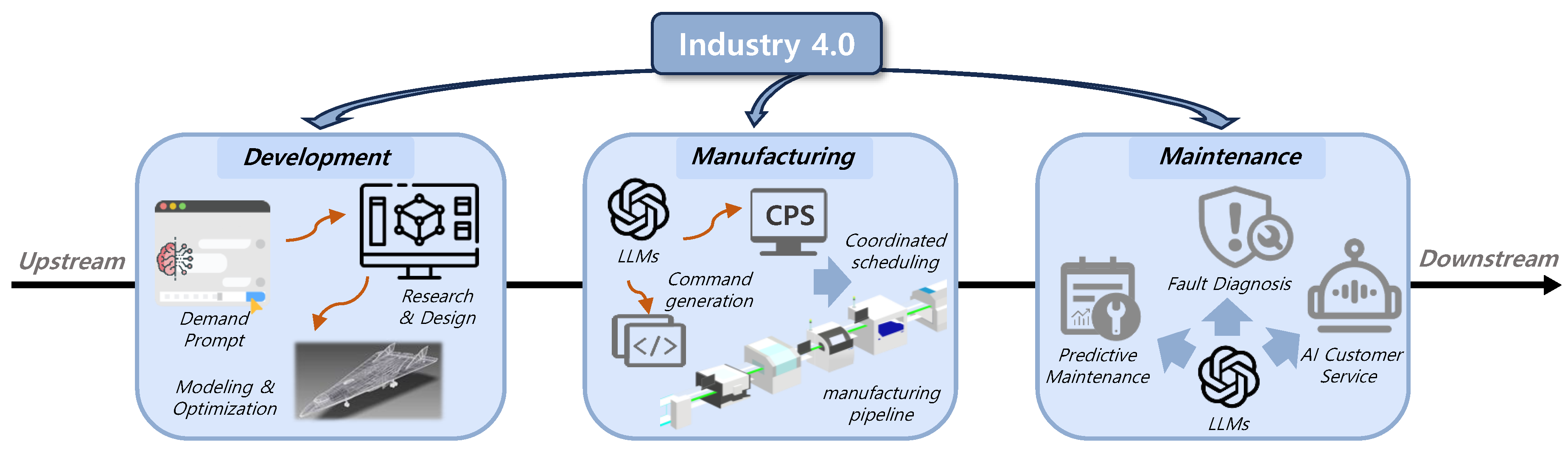
- We summarize upstream-to-downstream industrial application scenarios enabled by the integration of LLMs and FL and discuss representative use cases to illustrate practical workflows and deployment patterns.
- We identify critical challenges that hinder large-scale industrial adoption of Fed-LLM and outline promising directions for future research.
2. Methodology
2.1. Identification
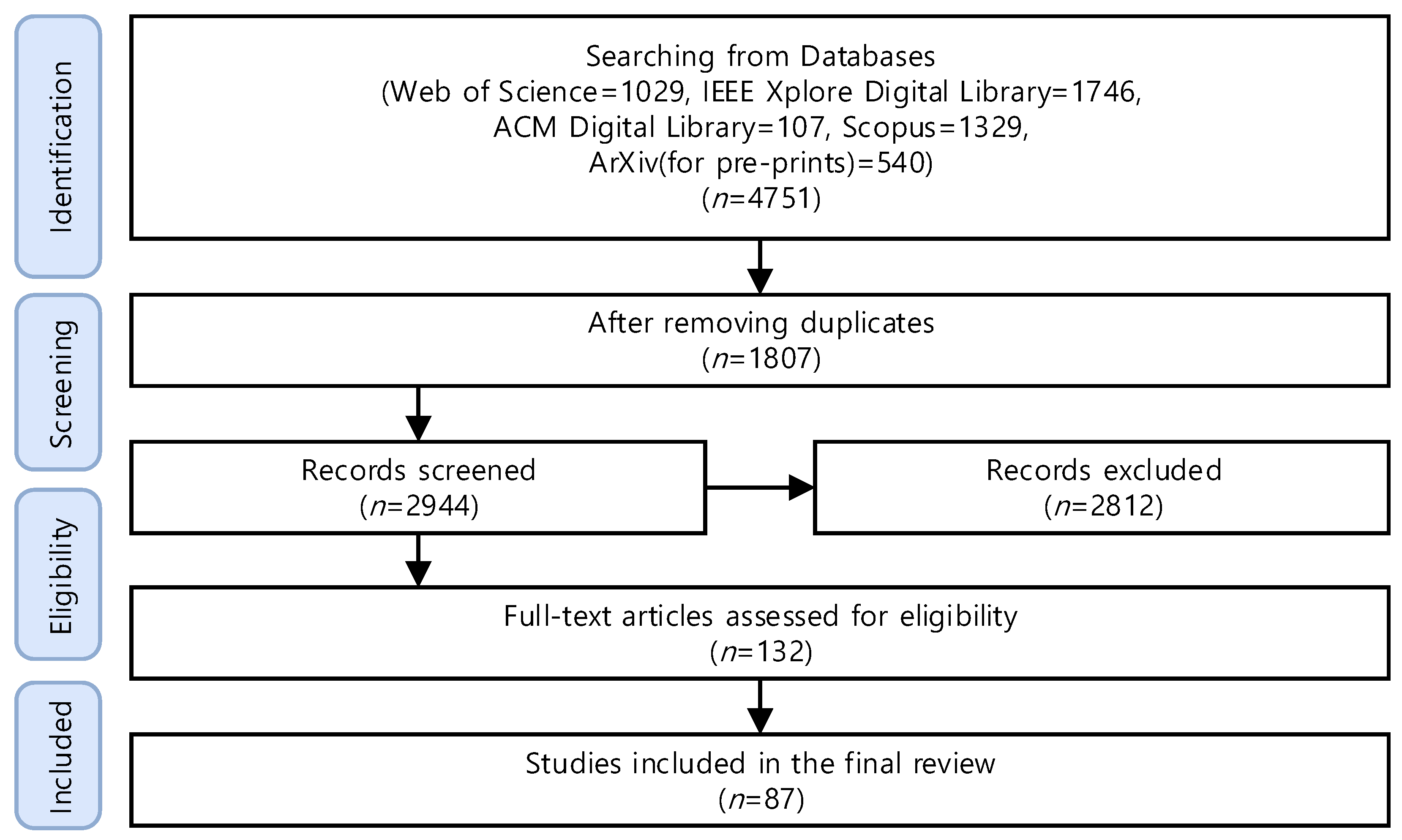
- FL and LLM: capturing foundational algorithmic frameworks and system-level designs for Fed-LLM;
- FL in Industry: covering mature federated learning solutions addressing industrial data privacy, communication efficiency, and edge deployment constraints;
- LLM in Industry: identifying industrial-oriented adaptations and applications of LLM;
- Fed-LLM in Industry: targeting studies that explicitly integrate all three dimensions.
- Terms related to FL: federated learning, FL;
- Terms related to large-scale model: large language model, LLM;
- Industrial and information physical system scenarios: Industry 4.0, manufacturing;
- Terms related to mentioned challenges: resource constrained, communication, aggregation security, heterogeneity.
2.2. Exclusion and Inclusion Criteria
2.3. Data Collection Process
3. Foundational Concepts
3.1. Industry 4.0
3.1.1. Industrial Internet of Things
3.1.2. Cyber-Physical Systems
3.2. Large Language Model
3.3. Federated Learning
4. Enabling Techniques of FL and LLM in Industry 4.0
4.1. Challenges
4.1.1. C2 Overhead
4.1.2. Privacy and Security
4.1.3. Heterogeneity
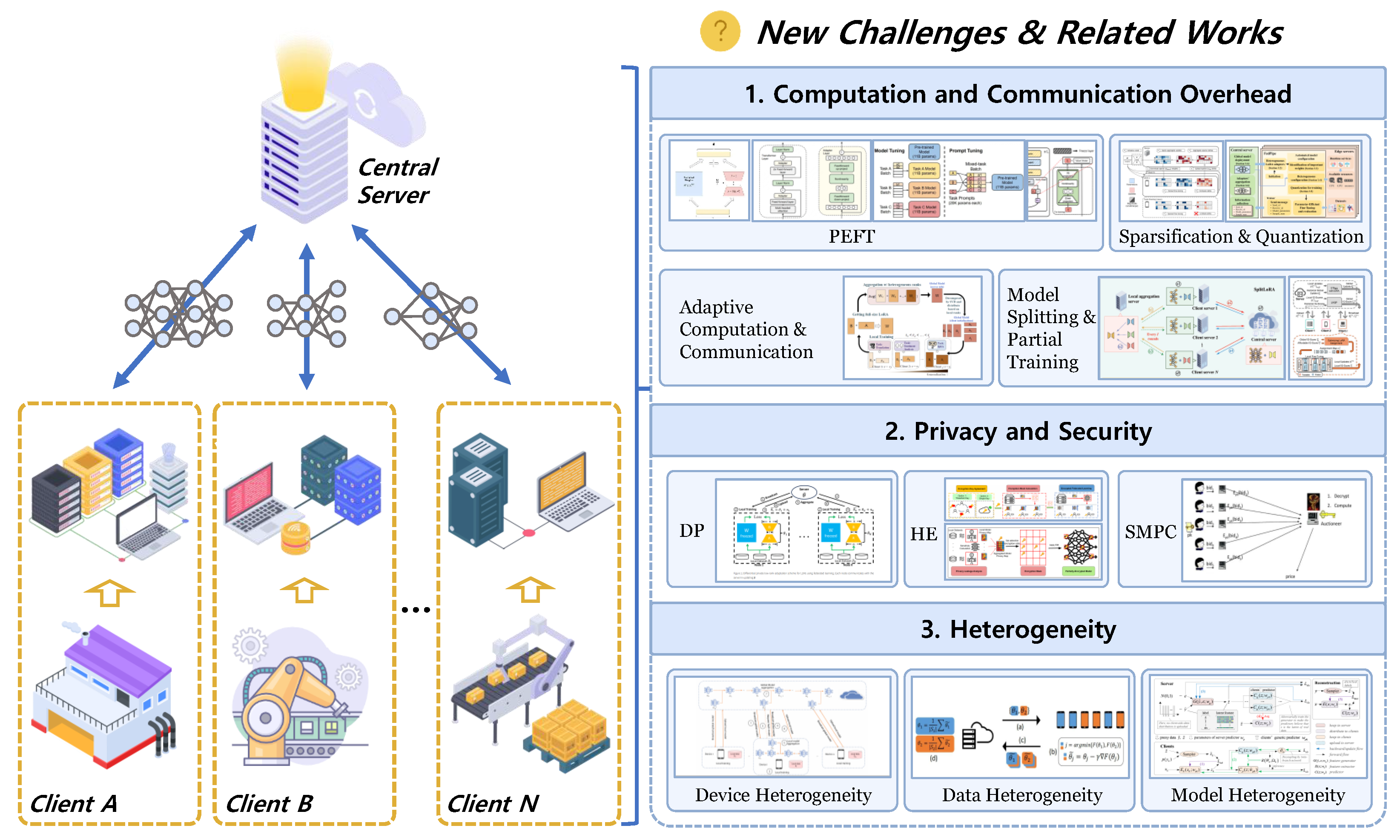
- Heterogeneity across devices leads to variation in computational power, storage, and communication ability at each node. This can lead to inconsistent local training times, with synchronization being penalized by low-resource nodes, leading to the common “straggler effect” [30].
- Heterogeneity in data, i.e., differences in the distribution, scale, and feature space of the data across nodes, leads to non-IID data. This issue ultimately results in the global model not being able to balance optimal solutions for all nodes, which leads to fluctuations in convergence and unequal model performance.
- Model heterogeneity refers to the discrepancies of model architectures, parameter scales, or module designs across clients. This makes traditional parameter aggregation methods like FedAvg ineffective while also complicating model fusion and knowledge transfer.
4.2. Techniques for C2 Overhead
4.2.1. PEFT
4.2.2. Sparsification and Quantization
4.2.3. Dynamic Adjustment and Adaptive
4.2.4. Model Splitting and Hierarchical Training
4.2.5. Conclusion of C2 Overhead Techniques
4.3. Techniques for Privacy and Security
4.3.1. DP
4.3.2. HE
4.3.3. SMPC
4.3.4. Comparison of Privacy and Security Techniques
4.4. Techniques for Heterogeneity
4.4.1. Device Heterogeneity
4.4.2. Data Heterogeneity
4.4.3. Model Heterogeneity
4.4.4. Conclusions of Heterogeneity Techniques
5. LLM and FL Synergies for Industry 4.0
5.1. LLM-Empowered Industry 4.0
5.2. FL-Empowered Industry 4.0
- First, conventional FL is mainly applied to small-to-medium-sized models, with limited support for complex semantic reasoning tasks.
- Second, data heterogeneity, device heterogeneity, and strict compliance requirements in industrial scenarios continue to challenge model robustness, security, and scalability. With growing demand for stronger semantic understanding in industrial systems, integrating LLM into FL has become a natural progression.
5.3. Fed-LLM-Empowered Industry 4.0
5.3.1. Open Fed-LLM System
5.3.2. Fed-LLM-Empowered Industry 4.0
- First, it ensures sensitive process documentation, quality records, and production log privacy data remain within the domain at the equipment level.
- Second, it enhances the model’s generalization capabilities for anomaly patterns, process semantics, and multi-device collaboration strategies by aggregating cross-factory domain knowledge.
- Third, it supports continuous learning and scenario adaptation for LLM in highly dynamic manufacturing workshops with frequently changing tasks, reducing manual maintenance costs.
6. Challenges and Future Directions
6.1. Industrial-Grade Lightweighting
6.2. Industrial Deep Heterogeneity
6.3. RAG-Enhanced Industrial Fed-LLM
6.4. Machine Unlearning and Continual Learning for Fed-LLM
7. Conclusions
Author Contributions
Funding
Data Availability Statement
Acknowledgments
Conflicts of Interest
Abbreviations
| Abbreviation | Definition |
| AI | Artificial Intelligence |
| IIoT | Industrial Internet of Things |
| CPS | Cyber-Physical System |
| LLMs | Large Language Models |
| SCM | Supply Chain Management |
| PdM | Predictive Maintenance |
| PLM | Product Lifecycle Management |
| FL | Federated Learning |
| Fed-LLM | Federated Large Language Model |
| PRISMA | Preferred Reporting Items for Systematic Reviews and Meta-Analyses |
| IoT | Internet of Things |
| NLP | Natural Language Processing |
| C2 | Computation and Communication |
| PLCs | Programmable Logic Controllers |
| Non-IID | Non-Independent and Identically Distributed |
| PEFT | Parameter-Efficient Fine-Tuning |
| LoRA | Low-Rank Adaptation |
| KD | Knowledge Distillation |
| DP | Differential Privacy |
| HE | Homomorphic Encryption |
| SMPC | Secure Multi-Party Computation |
| AGV | Automated Guided Vehicle |
| RAG | Retrieval-Augmented Generation |
References
- Jadhav, Y.; Farimani, A.B. Large Language Model Agent as a Mechanical Designer. arXiv 2024, arXiv:2404.17525. [Google Scholar] [CrossRef]
- Wu, Y.; Yang, H.; Wang, X.; Yu, H.; El Saddik, A.; Hossain, M.S. An effective FL system for Industrial IoT data streaming. Alex. Eng. J. 2024, 105, 414–422. [Google Scholar] [CrossRef]
- Chkirbene, Z.; Hamila, R.; Gouissem, A.; Devrim, U. Large language models (llm) in industry: A survey of applications, challenges, and trends. In Proceedings of the 2024 IEEE 21st International Conference on Smart Communities: Improving Quality of Life using AI, Robotics and IoT (HONET); IEEE: Piscataway, NJ, USA, 2024; pp. 229–234. [Google Scholar]
- Raza, M.; Jahangir, Z.; Riaz, M.B.; Saeed, M.J.; Sattar, M.A. Industrial applications of large language models. Sci. Rep. 2025, 15, 13755. [Google Scholar] [CrossRef]
- Cheng, Y.; Zhang, W.; Zhang, Z.; Zhang, C.; Wang, S.; Mao, S. Towards federated large language models: Motivations, methods, and future directions. IEEE Commun. Surv. Tutor. 2024, 27, 2733–2764. [Google Scholar] [CrossRef]
- Syed, M.A.B.; Rhaman, Q.; Sushil, S. Federated Learning in Manufacturing: A Systematic Review and Pathway to Industry 5.0. In Proceedings of the 2023 5th International Conference on Sustainable Technologies for Industry 5.0 (STI); IEEE: Piscataway, NJ, USA, 2023; pp. 1–6. [Google Scholar]
- Leng, J.; Li, R.; Xie, J.; Zhou, X.; Li, X.; Liu, Q.; Chen, X.; Shen, W.; Wang, L. Federated learning-empowered smart manufacturing and product lifecycle management: A review. Adv. Eng. Inform. 2025, 65, 103179. [Google Scholar] [CrossRef]
- Yang, H.; Liu, H.; Yuan, X.; Wu, K.; Ni, W.; Zhang, J.A.; Liu, R.P. Synergizing Intelligence and Privacy: A Review of Integrating Internet of Things, Large Language Models, and Federated Learning in Advanced Networked Systems. Appl. Sci. 2025, 15, 6587. [Google Scholar] [CrossRef]
- Ouerghemmi, C.; Ertz, M. Integrating Large Language Models into Digital Manufacturing: A Systematic Review and Research Agenda. Computers 2025, 14, 318. [Google Scholar] [CrossRef]
- Li, Y.; Zhao, H.; Jiang, H.; Pan, Y.; Liu, Z.; Wu, Z.; Shu, P.; Tian, J.; Yang, T.; Xu, S.; et al. Large language models for manufacturing. arXiv 2024, arXiv:2410.21418. [Google Scholar]
- Ouyang, W.; Liu, Q.; Mu, J.; AI-Dulaimi, A.; Jing, X.; Liu, Q. Communication-Efficient Federated Learning for Large-Scale Multiagent Systems in ISAC: Data Augmentation With Reinforcement Learning. IEEE Syst. J. 2024, 18, 1893–1904. [Google Scholar] [CrossRef]
- Hu, J.; Wang, D.; Wang, Z.; Pang, X.; Xu, H.; Ren, J.; Ren, K. Federated Large Language Model: Solutions, Challenges and Future Directions. IEEE Wirel. Commun. 2025, 32, 82–89. [Google Scholar] [CrossRef]
- Wang, Z.; Wu, F.; Yu, F.; Zhou, Y.; Hu, J.; Min, G. Federated continual learning for edge-ai: A comprehensive survey. arXiv 2024, arXiv:2411.13740. [Google Scholar] [CrossRef]
- Nguyen, D.C.; Ding, M.; Pathirana, P.N.; Seneviratne, A.; Li, J.; Poor, H.V. Federated learning for internet of things: A comprehensive survey. IEEE Commun. Surv. Tutor. 2021, 23, 1622–1658. [Google Scholar] [CrossRef]
- Arisdakessian, S.; Wahab, O.A.; Mourad, A.; Otrok, H.; Guizani, M. A survey on IoT intrusion detection: Federated learning, game theory, social psychology, and explainable AI as future directions. IEEE Internet Things J. 2022, 10, 4059–4092. [Google Scholar] [CrossRef]
- Ullah, I.; Hassan, U.U.; Ali, M.I. Multi-level federated learning for industry 4.0-A crowdsourcing approach. Procedia Comput. Sci. 2023, 217, 423–435. [Google Scholar] [CrossRef]
- Lee, J.; Bagheri, B.; Kao, H.A. A cyber-physical systems architecture for industry 4.0-based manufacturing systems. Manuf. Lett. 2015, 3, 18–23. [Google Scholar] [CrossRef]
- Zhao, W.X.; Zhou, K.; Li, J.; Tang, T.; Wang, X.; Hou, Y.; Min, Y.; Zhang, B.; Zhang, J.; Dong, Z.; et al. A survey of large language models. arXiv 2023, arXiv:2303.18223. [Google Scholar]
- McMahan, B.; Moore, E.; Ramage, D.; Hampson, S.; y Arcas, B.A. Communication-efficient learning of deep networks from decentralized data. In Proceedings of the Artificial Intelligence and Statistics; PMLR: Cambridge, MA, USA, 2017; pp. 1273–1282. [Google Scholar]
- Li, X.; Huang, K.; Yang, W.; Wang, S.; Zhang, Z. On the convergence of fedavg on non-iid data. arXiv 2019, arXiv:1907.02189. [Google Scholar]
- Li, H.; Wang, R.; Jiang, M.; Liu, J. STAR-RIS Empowered Heterogeneous Federated Edge Learning with Flexible Aggregation. IEEE Internet Things J. 2025, 12, 28374–28389. [Google Scholar] [CrossRef]
- Fu, X.; Chen, Z.; Zhang, B.; Chen, C.; Li, J. Federated graph learning with structure proxy alignment. In Proceedings of the 30th ACM SIGKDD Conference on Knowledge Discovery and Data Mining, Barcelona, Spain, 6–10 August 2024; pp. 827–838. [Google Scholar]
- Li, H.; Wang, R.; Wu, J.; Zhang, W. Federated edge learning via reconfigurable intelligent surface with one-bit quantization. In Proceedings of the GLOBECOM 2022—2022 IEEE Global Communications Conference; IEEE: Piscataway, NJ, USA, 2022; pp. 1055–1060. [Google Scholar]
- Melis, L.; Song, C.; De Cristofaro, E.; Shmatikov, V. Exploiting unintended feature leakage in collaborative learning. In Proceedings of the 2019 IEEE Symposium on Security and Privacy (SP); IEEE: Piscataway, NJ, USA, 2019; pp. 691–706. [Google Scholar]
- Zhu, L.; Liu, Z.; Han, S. Deep leakage from gradients. Adv. Neural Inf. Process. Syst. 2019, 32, 14774–14784. [Google Scholar]
- Yue, K.; Jin, R.; Wong, C.W.; Baron, D.; Dai, H. Gradient obfuscation gives a false sense of security in federated learning. In Proceedings of the 32nd USENIX security symposium (USENIX Security 23), Anaheim, CA, USA, 9–11 August 2023; pp. 6381–6398. [Google Scholar]
- Das, B.C.; Amini, M.H.; Wu, Y. Privacy risks analysis and mitigation in federated learning for medical images. In Proceedings of the 2023 IEEE International Conference on Bioinformatics and Biomedicine (BIBM); IEEE: Piscataway, NJ, USA, 2023; pp. 1870–1873. [Google Scholar]
- Pei, J.; Liu, W.; Li, J.; Wang, L.; Liu, C. A review of federated learning methods in heterogeneous scenarios. IEEE Trans. Consum. Electron. 2024, 70, 5983–5999. [Google Scholar] [CrossRef]
- Chen, C.; Liao, T.; Deng, X.; Wu, Z.; Huang, S.; Zheng, Z. Advances in robust federated learning: A survey with heterogeneity considerations. IEEE Trans. Big Data 2025, 11, 1548–1567. [Google Scholar] [CrossRef]
- Jiang, Y.; Wang, S.; Valls, V.; Ko, B.J.; Lee, W.H.; Leung, K.K.; Tassiulas, L. Model pruning enables efficient federated learning on edge devices. IEEE Trans. Neural Netw. Learn. Syst. 2022, 34, 10374–10386. [Google Scholar] [CrossRef]
- Wei, S.; Tong, Y.; Zhou, Z.; Xu, Y.; Gao, J.; Wei, T.; He, T.; Lv, W. Federated reasoning LLMs: A survey. Front. Comput. Sci. 2025, 19, 1912613. [Google Scholar] [CrossRef]
- Malaviya, S.; Shukla, M.; Lodha, S. Reducing communication overhead in federated learning for pre-trained language models using parameter-efficient finetuning. In Proceedings of the Conference on Lifelong Learning Agents; PMLR: Cambridge, MA, USA, 2023; pp. 456–469. [Google Scholar]
- Houlsby, N.; Giurgiu, A.; Jastrzebski, S.; Morrone, B.; De Laroussilhe, Q.; Gesmundo, A.; Attariyan, M.; Gelly, S. Parameter-efficient transfer learning for NLP. In Proceedings of the International Conference on Machine Learning; PMLR: Cambridge, MA, USA, 2019; pp. 2790–2799. [Google Scholar]
- Wu, Y.; Tian, C.; Li, J.; Sun, H.; Tam, K.; Zhou, Z.; Liao, H.; Guo, Z.; Li, L.; Xu, C. A survey on federated fine-tuning of large language models. arXiv 2025, arXiv:2503.12016. [Google Scholar] [CrossRef]
- Cai, D.; Wu, Y.; Wang, S.; Xu, M. FedAdapter: Efficient federated learning for mobile NLP. In Proceedings of the ACM Turing Award Celebration Conference-China 2023, Wuhan, China, 28–30 July 2023; pp. 27–28. [Google Scholar]
- Ghiasvand, S.; Yang, Y.; Xue, Z.; Alizadeh, M.; Zhang, Z.; Pedarsani, R. Communication-efficient and tensorized federated fine-tuning of large language models. In Proceedings of the Findings of the Association for Computational Linguistics: ACL 2025, Vienna, Austria, 27 July–August 2025; pp. 24192–24207. [Google Scholar]
- Li, X.L.; Liang, P. Prefix-tuning: Optimizing continuous prompts for generation. arXiv 2021, arXiv:2101.00190. [Google Scholar] [CrossRef]
- Sun, G.; Mendieta, M.; Luo, J.; Wu, S.; Chen, C. Fedperfix: Towards partial model personalization of vision transformers in federated learning. In Proceedings of the IEEE/CVF International Conference on Computer Vision, Paris, France, 4–6 October 2023; pp. 4988–4998. [Google Scholar]
- Sun, J.; Xu, Z.; Yin, H.; Yang, D.; Xu, D.; Chen, Y.; Roth, H.R. Fedbpt: Efficient federated black-box prompt tuning for large language models. arXiv 2023, arXiv:2310.01467. [Google Scholar]
- Rathee, M.; Shen, C.; Wagh, S.; Popa, R.A. Elsa: Secure aggregation for federated learning with malicious actors. In Proceedings of the 2023 IEEE Symposium on Security and Privacy (SP); IEEE: Piscataway, NJ, USA, 2023; pp. 1961–1979. [Google Scholar]
- Guo, T.; Guo, S.; Wang, J.; Tang, X.; Xu, W. Promptfl: Let federated participants cooperatively learn prompts instead of models–federated learning in age of foundation model. IEEE Trans. Mob. Comput. 2023, 23, 5179–5194. [Google Scholar] [CrossRef]
- Hoory, S.; Feder, A.; Tendler, A.; Erell, S.; Peled-Cohen, A.; Laish, I.; Nakhost, H.; Stemmer, U.; Benjamini, A.; Hassidim, A.; et al. Learning and evaluating a differentially private pre-trained language model. In Proceedings of the Findings of the Association for Computational Linguistics: EMNLP 2021, Virtual, 16–20 November 2021; pp. 1178–1189. [Google Scholar]
- Che, T.; Liu, J.; Zhou, Y.; Ren, J.; Zhou, J.; Sheng, V.; Dai, H.; Dou, D. Federated learning of large language models with parameter-efficient prompt tuning and adaptive optimization. In Proceedings of the 2023 Conference on Empirical Methods in Natural Language Processing, Singapore, 6–10 December 2023; pp. 7871–7888. [Google Scholar]
- Lester, B.; Al-Rfou, R.; Constant, N. The power of scale: Parameter-efficient adaptation for pretrained language models. In Proceedings of the 2021 Conference on Empirical Methods in Natural Language Processing (EMNLP), Punta Cana, Dominican Republic, 7–11 November 2021; pp. 3045–3059. [Google Scholar]
- Hu, E.J.; Shen, Y.; Wallis, P.; Allen-Zhu, Z.; Li, Y.; Wang, S.; Wang, L.; Chen, W. Lora: Low-rank adaptation of large language models. ICLR 2022, 1, 3. [Google Scholar]
- Zhang, J.; Vahidian, S.; Kuo, M.; Li, C.; Zhang, R.; Yu, T.; Wang, G.; Chen, Y. Towards building the federatedgpt: Federated instruction tuning. In Proceedings of the ICASSP 2024-2024 IEEE International Conference on Acoustics, Speech and Signal Processing (ICASSP); IEEE: Piscataway, NJ, USA, 2024; pp. 6915–6919. [Google Scholar]
- Guo, P.; Zeng, S.; Wang, Y.; Fan, H.; Wang, F.; Qu, L. Selective aggregation for low-rank adaptation in federated learning. In Proceedings of the 2024 IEEE International Conference on Acoustics, Speech and Signal Processing, Seoul, Republic of Korea, 14–19 April 2024; pp. 6915–6919. [Google Scholar]
- Chen, S.; Ju, Y.; Dalal, H.; Zhu, Z.; Khisti, A. Robust federated finetuning of foundation models via alternating minimization of lora. arXiv 2024, arXiv:2409.02346. [Google Scholar] [CrossRef]
- Fang, Z.; Lin, Z.; Chen, Z.; Chen, X.; Gao, Y.; Fang, Y. Automated federated pipeline for parameter-efficient fine-tuning of large language models. arXiv 2024, arXiv:2404.06448. [Google Scholar] [CrossRef]
- Yang, Y.; Liu, X.; Gao, T.; Xu, X.; Wang, G. Sa-fedlora: Adaptive parameter allocation for efficient federated learning with lora tuning. arXiv 2024, arXiv:2405.09394. [Google Scholar]
- Bai, J.; Chen, D.; Qian, B.; Yao, L.; Li, Y. Federated fine-tuning of large language models under heterogeneous tasks and client resources. Adv. Neural Inf. Process. Syst. 2024, 37, 14457–14483. [Google Scholar]
- Lin, Z.; Hu, X.; Zhang, Y.; Chen, Z.; Fang, Z.; Chen, X.; Li, A.; Vepakomma, P.; Gao, Y. Splitlora: A split parameter-efficient fine-tuning framework for large language models. arXiv 2024, arXiv:2407.00952. [Google Scholar]
- Zhang, Z.; Hu, R.; Liu, P.; Xu, J. Fed-pilot: Optimizing LoRA Allocation for Efficient Federated Fine-Tuning with Heterogeneous Clients. arXiv 2024, arXiv:2410.10200. [Google Scholar]
- Su, S.; Li, B.; Xue, X. Fedra: A random allocation strategy for federated tuning to unleash the power of heterogeneous clients. In Proceedings of the European Conference on Computer Vision; Springer: Berlin/Heidelberg, Germany, 2024; pp. 342–358. [Google Scholar]
- Qin, Z.; Wu, Z.; He, B.; Deng, S. Federated data-efficient instruction tuning for large language models. In Proceedings of the Findings of the Association for Computational Linguistics: ACL 2025, Vienna, Austria, 27 July–1 August 2025; pp. 15550–15568. [Google Scholar]
- Bai, G.; Li, Y.; Li, Z.; Zhao, L.; Kim, K. Fedspallm: Federated pruning of large language models. In Proceedings of the 2025 Conference of the Nations of the Americas Chapter of the Association for Computational Linguistics: Human Language Technologies (Volume 1: Long Papers), Albuquerque, NM, USA, 29 April–4 May 2025; pp. 8361–8373. [Google Scholar]
- Wu, F.; Li, Z.; Li, Y.; Ding, B.; Gao, J. Fedbiot: Llm local fine-tuning in federated learning without full model. In Proceedings of the 30th ACM SIGKDD Conference on Knowledge Discovery and Data Mining, Barcelona, Spain, 25–29 August 2024; pp. 3345–3355. [Google Scholar]
- Ghiasvand, S.; Alizadeh, M.; Pedarsani, R. Decentralized Low-Rank Fine-Tuning of Large Language Models. arXiv 2025, arXiv:2501.15361. [Google Scholar]
- Abadi, M.; Chu, A.; Goodfellow, I.; McMahan, H.B.; Mironov, I.; Talwar, K.; Zhang, L. Deep learning with differential privacy. In Proceedings of the 2016 ACM SIGSAC Conference on Computer and Communications Security, Vienna, Austria, 24–28 October 2016; pp. 308–318. [Google Scholar]
- Liu, X.Y.; Zhu, R.; Zha, D.; Gao, J.; Zhong, S.; White, M.; Qiu, M. Differentially private low-rank adaptation of large language model using federated learning. ACM Trans. Manag. Inf. Syst. 2025, 16, 1–24. [Google Scholar] [CrossRef]
- Paillier, P. Public-key cryptosystems based on composite degree residuosity classes. In Proceedings of the International Conference on the Theory and Applications of Cryptographic Techniques; Springer: Berlin/Heidelberg, Germany, 1999; pp. 223–238. [Google Scholar]
- Zhang, L.; Xu, J.; Vijayakumar, P.; Sharma, P.K.; Ghosh, U. Homomorphic encryption-based privacy-preserving federated learning in IoT-enabled healthcare system. IEEE Trans. Netw. Sci. Eng. 2022, 10, 2864–2880. [Google Scholar] [CrossRef]
- Yao, A.C. Protocols for secure computations. In Proceedings of the 23rd Annual Symposium on Foundations of Computer Science (SFCS 1982); IEEE: Piscataway, NJ, USA, 1982; pp. 160–164. [Google Scholar]
- Bonawitz, K.; Ivanov, V.; Kreuter, B.; Marcedone, A.; McMahan, H.B.; Patel, S.; Ramage, D.; Segal, A.; Seth, K. Practical secure aggregation for privacy-preserving machine learning. In Proceedings of the 2017 ACM SIGSAC Conference on Computer and Communications Security, Dallas, TX, USA, 30 October–3 November 2017; pp. 1175–1191. [Google Scholar]
- Zhang, J.; Hua, Y.; Wang, H.; Song, T.; Xue, Z.; Ma, R.; Guan, H. Fedala: Adaptive local aggregation for personalized federated learning. In Proceedings of the AAAI conference on artificial intelligence, Washington, DC, USA, 7–14 February 2023; Volume 37, pp. 11237–11244. [Google Scholar]
- Lu, W.; Hu, X.; Wang, J.; Xie, X. Fedclip: Fast generalization and personalization for clip in federated learning. arXiv 2023, arXiv:2302.13485. [Google Scholar] [CrossRef]
- Liu, J.; Jia, J.; Che, T.; Huo, C.; Ren, J.; Zhou, Y.; Dai, H.; Dou, D. Fedasmu: Efficient asynchronous federated learning with dynamic staleness-aware model update. In Proceedings of the AAAI Conference on Artificial Intelligence, Vancouver, BC, Canada, 20–27 February 2024; Volume 38, pp. 13900–13908. [Google Scholar]
- Li, S.; Yao, D.; Liu, J. FedVS: Straggler-resilient and privacy-preserving vertical federated learning for split models. In Proceedings of the International Conference on Machine Learning; PMLR: Cambridge, MA, USA, 2023; pp. 20296–20311. [Google Scholar]
- Zhang, Y.; Yang, Q. A survey on multi-task learning. IEEE Trans. Knowl. Data Eng. 2021, 34, 5586–5609. [Google Scholar] [CrossRef]
- Li, T.; Sahu, A.K.; Talwalkar, A.; Smith, V. Federated learning: Challenges, methods, and future directions. IEEE Signal Process. Mag. 2020, 37, 50–60. [Google Scholar] [CrossRef]
- Cho, Y.J.; Manoel, A.; Joshi, G.; Sim, R.; Dimitriadis, D. Heterogeneous ensemble knowledge transfer for training large models in federated learning. arXiv 2022, arXiv:2204.12703. [Google Scholar] [CrossRef]
- Reddi, S.; Charles, Z.; Zaheer, M.; Garrett, Z.; Rush, K.; Konečnỳ, J.; Kumar, S.; McMahan, H.B. Adaptive federated optimization. arXiv 2020, arXiv:2003.00295. [Google Scholar]
- Weng, P.Y.; Hoang, M.; Nguyen, L.; Thai, M.T.; Weng, L.; Hoang, N. Probabilistic federated prompt-tuning with non-IID and imbalanced data. Adv. Neural Inf. Process. Syst. 2024, 37, 81933–81958. [Google Scholar]
- Ghosh, A.; Chung, J.; Yin, D.; Ramchandran, K. An efficient framework for clustered federated learning. Adv. Neural Inf. Process. Syst. 2020, 33, 19586–19597. [Google Scholar] [CrossRef]
- Liu, B.; Ma, Y.; Zhou, Z.; Shi, Y.; Li, S.; Tong, Y. Casa: Clustered federated learning with asynchronous clients. In Proceedings of the 30th ACM SIGKDD Conference on Knowledge Discovery and Data Mining, Barcelona, Spain, 25–29 August 2024; pp. 1851–1862. [Google Scholar]
- Fallah, A.; Mokhtari, A.; Ozdaglar, A. Personalized federated learning: A meta-learning approach. arXiv 2020, arXiv:2002.07948. [Google Scholar] [CrossRef]
- Yao, D.; Pan, W.; Dai, Y.; Wan, Y.; Ding, X.; Yu, C.; Jin, H.; Xu, Z.; Sun, L. FedGKD: Toward heterogeneous federated learning via global knowledge distillation. IEEE Trans. Comput. 2023, 73, 3–17. [Google Scholar] [CrossRef]
- Fan, T.; Ma, G.; Kang, Y.; Gu, H.; Song, Y.; Fan, L.; Chen, K.; Yang, Q. Fedmkt: Federated mutual knowledge transfer for large and small language models. In Proceedings of the 31st International Conference on Computational Linguistics, Dhabi, United Arab Emirates, 19–24 January 2025; pp. 243–255. [Google Scholar]
- Dong, C.; Xie, Y.; Ding, B.; Shen, Y.; Li, Y. Tunable soft prompts are messengers in federated learning. arXiv 2023, arXiv:2311.06805. [Google Scholar] [CrossRef]
- Zhang, X.; Wang, J.; Bao, W.; Zhang, Y.; Zhu, X.; Peng, H.; Zhao, X. Improving generalization and personalization in model-heterogeneous federated learning. IEEE Trans. Neural Netw. Learn. Syst. 2024, 36, 88–101. [Google Scholar] [CrossRef]
- He, C.; Annavaram, M.; Avestimehr, S. Group knowledge transfer: Federated learning of large cnns at the edge. Adv. Neural Inf. Process. Syst. 2020, 33, 14068–14080. [Google Scholar]
- Yu, S.; Muñoz, J.P.; Jannesari, A. Bridging the gap between foundation models and heterogeneous federated learning. arXiv 2023, arXiv:2310.00247. [Google Scholar] [CrossRef]
- Boonmee, A.; Wongsuwan, K.; Sukjai, P. Consultation on industrial machine faults with large language models. arXiv 2024, arXiv:2410.03223. [Google Scholar] [CrossRef]
- Su, C.; Yu, K.; Zhang, J.; Shao, M.; Bauer, D. Integrating Ontologies with Large Language Models for Enhanced Control Systems in Chemical Engineering. arXiv 2025, arXiv:2510.26898. [Google Scholar] [CrossRef]
- Kumar, S.; Kapoor, S.; Vardhan, H.; Zhao, Y. Generative AI for CAD Automation: Leveraging Large Language Models for 3D Modelling. arXiv 2025, arXiv:2508.00843. [Google Scholar]
- Wu, S.; Khasahmadi, A.H.; Katz, M.; Jayaraman, P.K.; Pu, Y.; Willis, K.; Liu, B. Cadvlm: Bridging language and vision in the generation of parametric cad sketches. In Proceedings of the European Conference on Computer Vision; Springer: Berlin/Heidelberg, Germany, 2024; pp. 368–384. [Google Scholar]
- Ni, J.; Yin, X.; Lu, X.; Li, X.; Wei, J.; Tong, R.; Tang, M.; Du, P. CADDesigner: Conceptual Design of CAD Models Based on General-Purpose Agent. arXiv 2025, arXiv:2508.01031. [Google Scholar] [CrossRef]
- Makatura, L.; Foshey, M.; Wang, B.; HähnLein, F.; Ma, P.; Deng, B.; Tjandrasuwita, M.; Spielberg, A.; Owens, C.E.; Chen, P.Y.; et al. How can large language models help humans in design and manufacturing? arXiv 2023, arXiv:2307.14377. [Google Scholar] [CrossRef]
- Bandhana, A.; Vokřínek, J. AI-Driven Manufacturing: Surveying for Industry 4.0 and Beyond. In Proceedings of the Operations Research Forum; Springer: Berlin/Heidelberg, Germany, 2025; Volume 6, p. 145. [Google Scholar]
- Russell-Gilbert, A. RAAD-LLM: Adaptive Anomaly Detection Using LLMs and RAG Integration. Ph.D. Thesis, Mississippi State University, Starkville, MS, USA, 2025. [Google Scholar]
- Harbola, C.; Purwar, A. Prescriptive Agents based on RAG for Automated Maintenance (PARAM). arXiv 2025, arXiv:2508.04714. [Google Scholar]
- da Silveira Dib, M.A.; Prates, P.; Ribeiro, B. SecFL–Secure Federated Learning Framework for predicting defects in sheet metal forming under variability. Expert Syst. Appl. 2024, 235, 121139. [Google Scholar] [CrossRef]
- Deng, T.; Li, Y.; Liu, X.; Wang, L. Federated learning-based collaborative manufacturing for complex parts. J. Intell. Manuf. 2023, 34, 3025–3038. [Google Scholar] [CrossRef]
- Hegiste, V.; Legler, T.; Fridman, K.; Ruskowski, M. Federated object detection for quality inspection in shared production. In Proceedings of the 2023 Eighth International Conference on Fog and Mobile Edge Computing (FMEC); IEEE: Piscataway, NJ, USA, 2023; pp. 151–158. [Google Scholar]
- Nguyen, T.T.; Bekrar, A.; Le, T.M.; Artiba, A.; Chargui, T.; Trinh, T.T.H.; Snoun, A. Federated Learning-Based Framework: A New Paradigm Proposed for Supply Chain Risk Management. Eng. Proc. 2025, 97, 5. [Google Scholar]
- Shubyn, B.; Kostrzewa, D.; Grzesik, P.; Benecki, P.; Maksymyuk, T.; Sunderam, V.; Syu, J.H.; Lin, J.C.W.; Mrozek, D. Federated Learning for improved prediction of failures in Autonomous Guided Vehicles. J. Comput. Sci. 2023, 68, 101956. [Google Scholar] [CrossRef]
- Jiang, G.; Zhao, K.; Liu, X.; Cheng, X.; Xie, P. A federated learning framework for cloud–edge collaborative fault diagnosis of wind turbines. IEEE Internet Things J. 2024, 11, 23170–23185. [Google Scholar] [CrossRef]
- Landau, D.; de Pater, I.; Mitici, M.; Saurabh, N. Federated learning framework for collaborative remaining useful life prognostics: An aircraft engine case study. Future Gener. Comput. Syst. 2026, 174, 107945. [Google Scholar] [CrossRef]
- Ahn, J.; Lee, Y.; Kim, N.; Park, C.; Jeong, J. Federated learning for predictive maintenance and anomaly detection using time series data distribution shifts in manufacturing processes. Sensors 2023, 23, 7331. [Google Scholar] [CrossRef]
- Fan, T.; Kang, Y.; Ma, G.; Chen, W.; Wei, W.; Fan, L.; Yang, Q. Fate-llm: A industrial grade federated learning framework for large language models. arXiv 2023, arXiv:2310.10049. [Google Scholar] [CrossRef]
- Kuang, W.; Qian, B.; Li, Z.; Chen, D.; Gao, D.; Pan, X.; Xie, Y.; Li, Y.; Ding, B.; Zhou, J. Federatedscope-llm: A comprehensive package for fine-tuning large language models in federated learning. In Proceedings of the 30th ACM SIGKDD Conference on Knowledge Discovery and Data Mining, Barcelona, Spain, 25–29 August 2024; pp. 5260–5271. [Google Scholar]
- Ye, R.; Wang, W.; Chai, J.; Li, D.; Li, Z.; Xu, Y.; Du, Y.; Wang, Y.; Chen, S. OpenFedLLM: Training Large Language Models on Decentralized Private Data via Federated Learning. In Proceedings of the 30th ACM SIGKDD Conference on Knowledge Discovery and Data Mining; Association for Computing Machinery: New York, NY, USA, 2024. [Google Scholar] [CrossRef]
- Doğruluk, E.; Açıkgöz, H. Edge-Centric Federated Learning for LLMs in Smart Manufacturing: Architectures, Challenges, and Opportunities. In Proceedings of the 2025 4th International Conference on Innovative Mechanisms for Industry Applications (ICIMIA); IEEE: Piscataway, NJ, USA, 2025; pp. 1250–1256. [Google Scholar]
- Xu, D.; Yin, W.; Jin, X.; Zhang, Y.; Wei, S.; Xu, M.; Liu, X. Llmcad: Fast and scalable on-device large language model inference. arXiv 2023, arXiv:2309.04255. [Google Scholar] [CrossRef]
- Xia, Y.; Chen, Y.; Zhao, Y.; Kuang, L.; Liu, X.; Hu, J.; Liu, Z. Fcllm-dt: Enpowering federated continual learning with large language models for digital twin-based industrial iot. IEEE Internet Things J. 2024, 12, 6070–6081. [Google Scholar] [CrossRef]
- Wang, L.; Bian, J.; Zhang, L.; Xu, J. Adaptive LoRA Experts Allocation and Selection for Federated Fine-Tuning. arXiv 2025, arXiv:2509.15087. [Google Scholar] [CrossRef]
- Li, Y.; Yu, Y.; Liang, C.; He, P.; Karampatziakis, N.; Chen, W.; Zhao, T. LoftQ: LoRA-Fine-Tuning-Aware Quantization for Large Language Models. In Proceedings of the International Conference on Learning Representations (ICLR), Vienna, Austria, 7–11 May 2024. [Google Scholar]
- Yan, Y.; Feng, C.; Zuo, W.; Zhu, L.; Mong, R. Federated Residual Low-Rank Adaption of Large Language Models. In Proceedings of the International Conference on Learning Representations (ICLR), Singapore, 24–28 April 2025. [Google Scholar]
- Tang, X.; Guo, S.; Zhang, J.; Guo, J. Learning personalized causally invariant representations for heterogeneous federated clients. In Proceedings of the Twelfth International Conference on Learning Representations, Vienna, Austria, 7–11 May 2024. [Google Scholar]
- Weng, Z.; Cai, W.; Zhou, B. FedSKD: Aggregation-free Model-heterogeneous Federated Learning using Multi-dimensional Similarity Knowledge Distillation. arXiv 2025, arXiv:2503.18981. [Google Scholar]
- Siddika, F.; Hossen, M.A.; Zhang, W.; Sharma, A. Dual-Distilled Heterogeneous Federated Learning with Adaptive Margins for Trainable Global Prototypes. arXiv 2025, arXiv:2508.19009. [Google Scholar]
- Wu, Z.; Sun, s.; Wang, Y.; Liu, M.; Xu, k.; Pan, Q.; Gao, B.; Wen, T. Beyond Model Scale Limits: End-Edge-Cloud Federated Learning with Self-Rectified Knowledge Agglomeration. arXiv 2025, arXiv:2501.00693. [Google Scholar]
- Guerraoui, R.; Kermarrec, A.; Petrescu, D.; Pires, R.; Randl, M.; de Vos, M. Efficient federated search for retrieval-augmented generation. In Proceedings of the 5th Workshop on Machine Learning and Systems, Rotterdam, The Netherlands, 30 March–3 April 2025; pp. 74–81. [Google Scholar]
- Shojaee, P.; Harsha, S.; Luo, D.; Maharaj, A.; Yu, T.; Li, Y. Federated retrieval augmented generation for multi-product question answering. In Proceedings of the 31st International Conference on Computational Linguistics: Industry Track, Abu Dhabi, United Arab Emirates, 19–24 January 2025; pp. 387–397. [Google Scholar]
- Zhong, Z.; Bao, W.; Wang, J.; Chen, J.; Lyu, L.; Wei, Y. SacFL: Self-Adaptive Federated Continual Learning for Resource-Constrained End Devices. IEEE Trans. Neural Netw. Learn. Syst. 2025, 36, 17169–17183. [Google Scholar] [CrossRef] [PubMed]
- Zhong, Z.; Bao, W.; Wang, J.; Zhang, S.; Zhou, J.; Lyu, L.; Bryan, L.; Wei, Y. Unlearning through Knowledge Overwriting: Reversible Federated Unlearning via Selective Sparse Adapter. In Proceedings of the 2025 IEEE/CVF Conference on Computer Vision and Pattern Recognition (CVPR), Nashville, TN, USA, 11–15 June 2025. [Google Scholar]
- Yu, S.; Pablo, J.; Jannesari, A. Federated Foundation Models: Privacy-Preserving and Collaborative Learning for Large Models. arXiv 2024, arXiv:2305.11414. [Google Scholar] [CrossRef]



| Review | Industry 4.0 | LLM | Data Soils | Key Contribution | Differences from Our Review |
|---|---|---|---|---|---|
| Chkirbene et al. [3] | ✔ | ✔ | ✘ | Discusses the technological evolution of LLM and investigates their practical applications in automation, decision-making, and content generation across industries (e.g., healthcare, finance, and customer service). | This work focuses on the application of general-purpose LLM in specific industries, lacking detailed research on privacy protection issues in industrial scenarios. |
| Raza et al. [4] | ✔ | ✔ | ✘ | The system summarizes the development, architecture, and industry applications of LLM, while addressing security, privacy, and ethical concerns. | This work focuses on the applications and challenges of LLM across multiple industries and does not specifically explore introducing FL to address privacy concerns. |
| Cheng et al. [5] | ✘ | ✔ | ✔ | Summarizes key technologies and applications of LLM and FL, presenting motivations and challenges; discusses privacy issues in Fed-LLM. | This work focuses on the combination of FL and LLM. Our review emphasizes discussions on Fed-LLM in industrial settings. |
| Syed et al. [6] | ✔ | ✘ | ✔ | Systematically summarizes the application of FL in addressing issues related to data privacy, data security, and anomaly detection within Industry 4.0 manufacturing environments. | This work focuses on FL applications in Industry 4.0 manufacturing. Our review primarily discusses the integration of LLM with FL to address data silos and privacy challenges in industry. |
| Leng et al. [7] | ✔ | ✘ | ✔ | Considering privacy and security requirements in manufacturing, this work discusses the application of FL in intelligent manufacturing systems and product lifecycle management (PLM). | This work focuses on the application of FL in specific manufacturing domains. Our review primarily discusses the integration of LLM with FL to address data silos and privacy-related issues in industrial settings. |
| Yang et al. [8] | Partial | ✔ | ✔ | Discusses the synergistic application of IoT, LLM, and FL in edge computing environments to address privacy protection challenges. | This work focuses on the integration of IoT, LLM, and FL, whereas our review encompasses a broader range of industrial application scenarios. |
| Our review | ✔ | ✔ | ✔ | Exploring the synergistic mechanisms, typical applications, and key challenges of integrating LLM with FL in Industry 4.0. | — |
| Database | Search String | |||
|---|---|---|---|---|
| FL and LLM | FL in Industry | LLM in Industry | Fed-LLM in Industry | |
| Web of Science/IEEE Xplore/ACM/Scopus | (“federated learning” OR FL) AND (“large language model” OR LLM) AND (“resource constrained” OR “communication” OR “aggregation security” OR “heterogeneity”) | (“federated learning” OR FL) AND (“Industry 4.0” OR “manufacturing”) | (“large language model” OR LLM) AND (“Industry 4.0” OR “manufacturing”) | (“federated learning” OR FL) AND (“large language model” OR LLM) AND (“Industry 4.0” OR “manufacturing”) |
| arXiv | federated learning AND large language model AND resource constrained; federated learning AND large language model AND communication; federated learning AND large language model AND aggregation security; federated learning AND large language model AND heterogeneity | federated learning AND Industry 4.0; federated learning AND manufacturing | large language model AND Industry 4.0; large language model AND manufacturing | federated learning AND large language model AND Industry 4.0; federated learning AND large language model AND manufacturing |
| Criterion Type | Category | Description |
|---|---|---|
| Inclusion | Scope relevance | Studies explicitly involving FL and/or LLM within industrial–related scenarios. |
| Technical depth | Works providing sufficient technical substance, including architectural descriptions, algorithmic design, methodological details, or empirical validation. | |
| Publication quality | Peer-reviewed journal articles and conference papers, as well as highly relevant preprints addressing emerging challenges in Fed-LLM. | |
| Exclusion | Scope relevance | Studies focusing solely on FL or LLM without any industrial application context. |
| Deployment feasibility | Studies that discuss FL or LLM only at an abstract or algorithmic level, without analyzing deployment feasibility under industrial constraints such as limited computation or communication resources, heterogeneity, privacy and security requirements. | |
| Research focus | Studies in which FL or LLM are mentioned merely as background concepts, auxiliary tools, or comparative baselines rather than as primary research objects. | |
| Publication type | Books, book chapters, technical reports, theses, dissertations, editorials, and other non-academic publications. |
| Approach | Mechanism | Related Method |
|---|---|---|
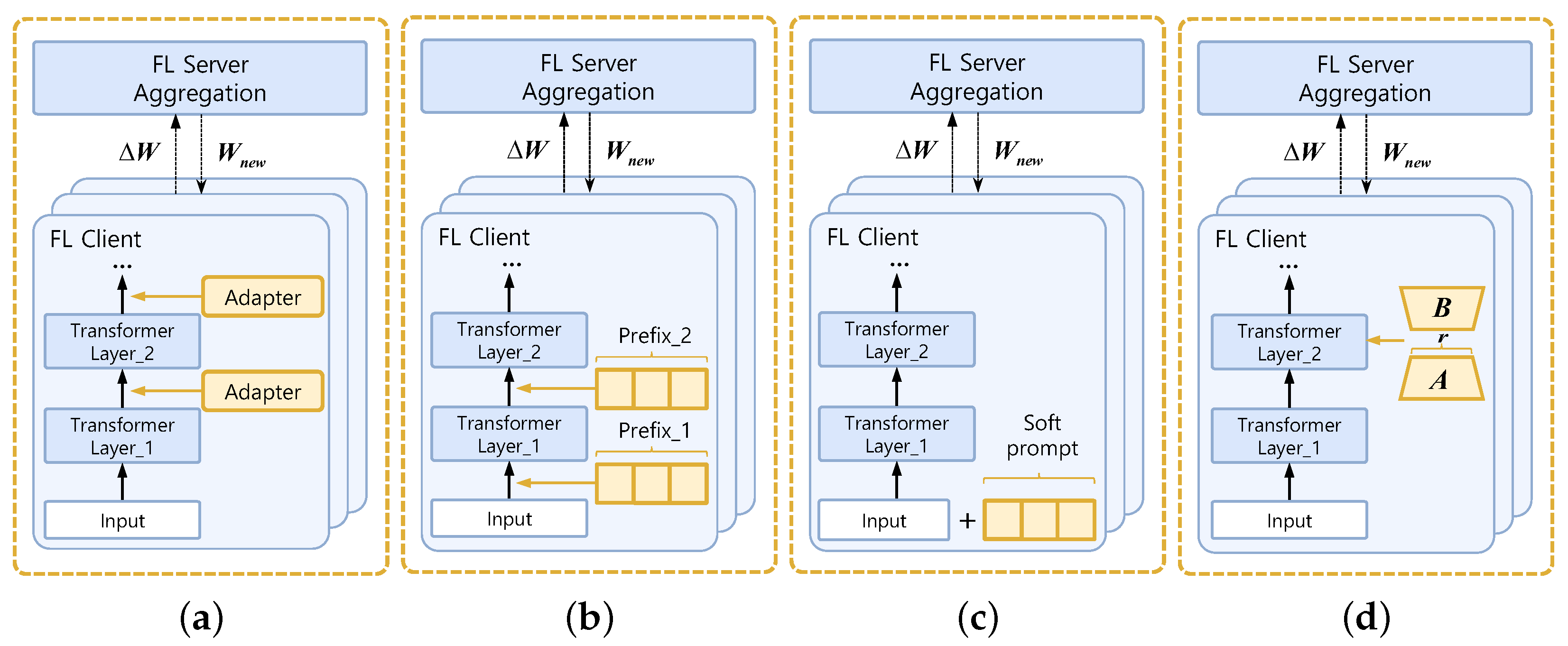
| PEFT | By training and transferring only a small subset of parameters, computational and communication costs are reduced. | Adapter Tuning, Prefix-tuning, Prompt-tuning, and LoRA |
| Sparsification and Quantization | Sparsifying or quantizing parameters during computation or transmission, thus lowering computational demands and compressing communication bytes with minimal impact on convergence. | FLASC, RoLoRA, and FedPipe |
| Dynamic Adjustment and Adaptation | Optimizing communication timing, client involvement, and aggregation methods to dynamically scale local updates or minimize unnecessary communication. | SA-FedLoRA and FlexLoRA |
| Model Partitioning and Layered Training | Dividing models into layers or modules for collaborative training across clients or edge servers, synchronizing only a subset of layer parameters to reduce computational and communication overhead. | SplitLoRA, FedRA, and Fed-piLot |
| Method | Type | FL-Setup | #Clients | Basic Model |
|---|---|---|---|---|
| FedAdapter [35] | Adapter | Cross-device | – | RoBERTa / LLaMA2-13B |
| FedTT+ [36] | Adapter | Cross-silo, Cross-device | 10– | DeBERTa-Base / LLaMA-2 |
| FedPrefix [38] | Prefix | Cross-silo | 64 | ViT |
| PromptFL [42] | Prompt | Cross-device | 64 | CLIP |
| FedPepTAO [43] | Prompt, LoRA | Cross-device | 100 | LLaMA-7B |
| Fed-IT [46] | LoRA | Cross-device | 100 | LLaMA-7B |
| FedSA-LoRA [47] | Adaptive LoRA | Cross-device | 10–100 | LLaMA3-8B |
| Techniques | Privacy | Accuracy Impact | C2 Cost | Scalability | Complexity |
|---|---|---|---|---|---|
| DP | ✔ | ✔✔✔ | ✔ | ✔ ✔ ✔ | |
| HE | ✔✔✔ | ✔ | ✔✔✔✔ | ✔ | |
| SMPC | ✔✔✔ | ✔ | ✔✔✔ | ✔ ✔ | where k = number of parties. |
| Challenge | Approach | Mechanism |
|---|---|---|
| Device Heterogeneity | PEFT | Clients train only lightweight adapters, LoRAs, and other fine-tunable modules, or dynamically adjust LoRA rank and adapter depth to adapt to heterogeneous computing power. |
| Model Splitting & Partial Training | The global model is divided into layers or modules based on computational capabilities, with weaker devices training only the small modules assigned to them. | |
| Asynchronous Aggregation | Employs an asynchronous update mechanism, enabling high-performance clients to upload gradient updates more frequently. | |
| Data Heterogeneity | Regularization | Incorporate global model constraints or parameter regularization terms into the local objective function. |
| Adaptive Aggregation | Implement weighted strategies or adaptive averaging during the global aggregation phase. | |
| Client Clustered | Cluster clients based on data distribution similarity, share models within the same cluster, and optimize independently across different clusters. | |
| Meta-Learning | Employ meta-learning principles to learn global initialization parameters, enabling rapid adaptation to task distributions across clients. | |
| Multi-task Learning | Effectively models relationships between tasks to simultaneously learn multiple related tasks, enabling knowledge sharing and collaborative optimization. | |
| Model Heterogeneity | Knowledge Transfer | Transfers knowledge to lightweight local student models via a global teacher model or client-side ensemble teachers. |
| Subnetwork Extraction | Extract high-performance subnetworks through saliency scoring, pruning, or low-rank decomposition, updating only these critical parameters on the client. |
| Framework | Challenge | Multi-GPU | Benchmark | ||||
|---|---|---|---|---|---|---|---|
| C2 Overhead | Privacy and Security | Heterogeneity | |||||
| Device | Data | Model | |||||
| FATE-LLM [100] | ✔ | ✔ | ✔ | ✔ | ✔ | ✔ | ✘ |
| FS-LLM [101] | ✔ | ✔ | ✔ | ✔ | ✘ | ✔ | ✔ |
| Shepherd [46] | ✔ | ✘ | ✔ | ✔ | ✔ | ✘ | ✘ |
| OpenFedLLM [102] | ✔ | ✘ | ✔ | ✔ | ✘ | ✘ | ✔ |
Disclaimer/Publisher’s Note: The statements, opinions and data contained in all publications are solely those of the individual author(s) and contributor(s) and not of MDPI and/or the editor(s). MDPI and/or the editor(s) disclaim responsibility for any injury to people or property resulting from any ideas, methods, instructions or products referred to in the content. |
© 2026 by the authors. Licensee MDPI, Basel, Switzerland. This article is an open access article distributed under the terms and conditions of the Creative Commons Attribution (CC BY) license.
Share and Cite
Jing, F.; Zhang, Y.; Gao, M.; Zhang, X.; Zhou, H. A Review of Federated Large Language Models for Industry 4.0. Sensors 2026, 26, 1116. https://doi.org/10.3390/s26041116
Jing F, Zhang Y, Gao M, Zhang X, Zhou H. A Review of Federated Large Language Models for Industry 4.0. Sensors. 2026; 26(4):1116. https://doi.org/10.3390/s26041116
Chicago/Turabian StyleJing, Feng, Yujing Zhang, Mei Gao, Xiongtao Zhang, and Huaizhe Zhou. 2026. "A Review of Federated Large Language Models for Industry 4.0" Sensors 26, no. 4: 1116. https://doi.org/10.3390/s26041116
APA StyleJing, F., Zhang, Y., Gao, M., Zhang, X., & Zhou, H. (2026). A Review of Federated Large Language Models for Industry 4.0. Sensors, 26(4), 1116. https://doi.org/10.3390/s26041116