Traffic Light Recognition Assistant for Color Vision Deficiency Using YOLO with Multilingual Audio Feedback


Abstract
1. Introduction
2. Related Works
2.1. Deep Learning-Based Traffic Light Recognition
2.2. Color-Based and Image Processing Approaches for CVD
2.3. Voice-Assisted Vision Systems
2.4. Research Gap and Rationale
- (1)
- We reformulate traffic light recognition for drivers with color vision deficiency as a spatial-position inference problem that minimizes reliance on color-based perception.
- (2)
- We introduce a full-frame traffic light annotation strategy that encodes the structural and positional relationships of signal lights to support robust state inference.
- (3)
- We design and implement a real-time assistive traffic light recognition prototype with a PyQt5 graphical user interface and fully offline multilingual audio feedback in Indonesian, Mandarin, and English.
- (4)
- We evaluate the feasibility of the proposed system under diverse real-world conditions, reporting detection confidence and processing latency on a CPU-only configuration.
3. Proposed Methods
3.1. Framework Overview and Design Principles
3.2. Dataset Preparation and Annotation Strategy
3.3. Model Custom Training and Performance Comparison
3.4. Model Selection Rationale
4. Experimental and Results Analysis
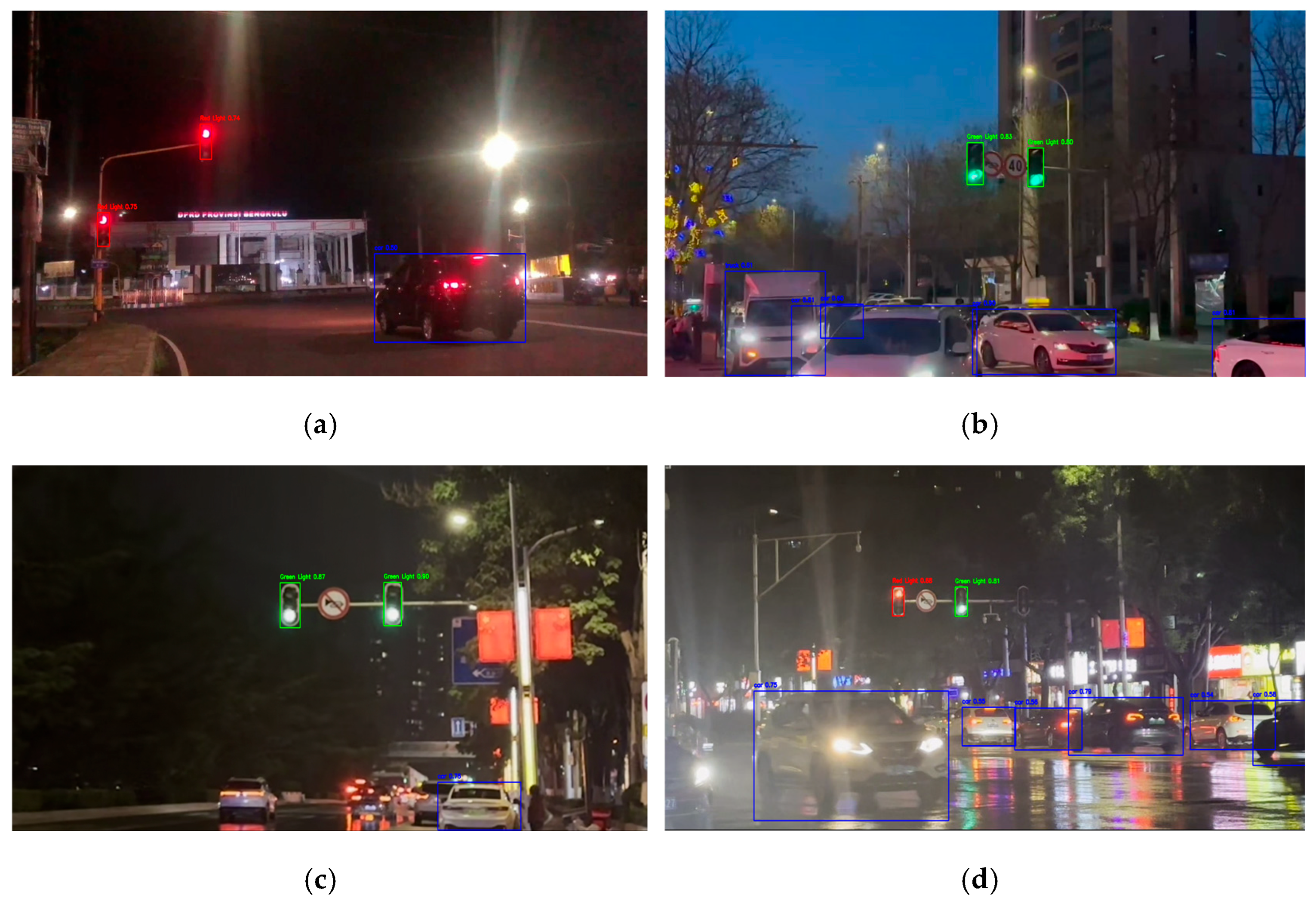
4.1. Environmental Scenario Setup
4.2. Computational Efficiency and Real-Time Performance
4.3. Detection Accuracy and Model Robustness
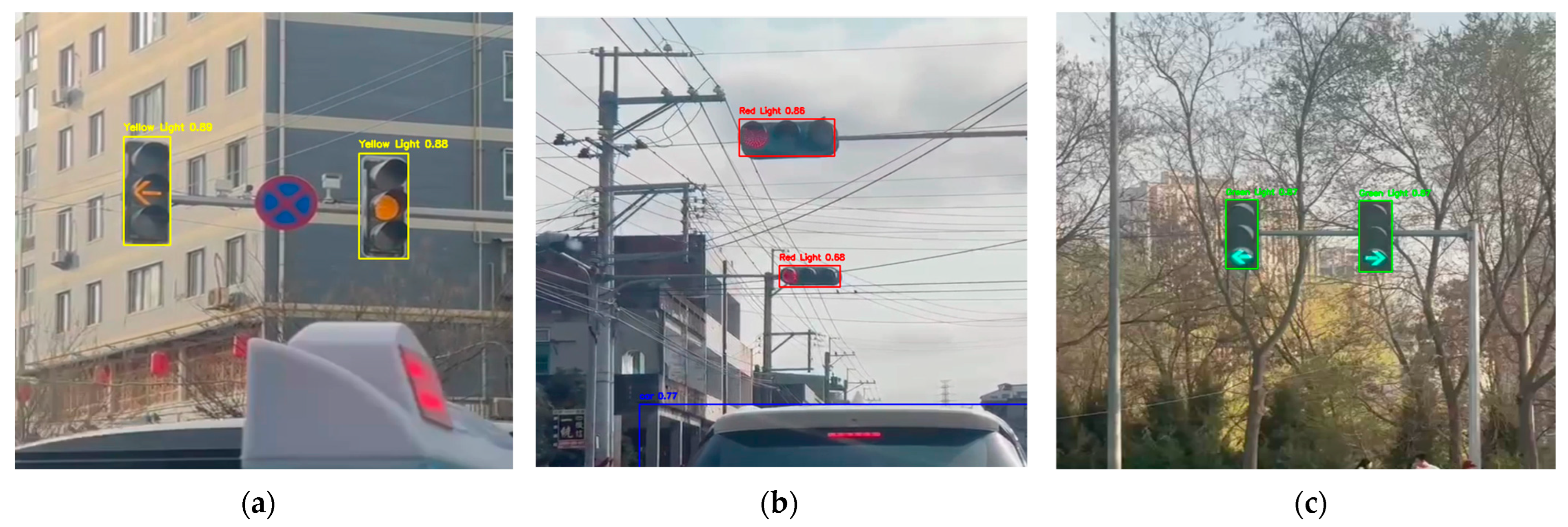
4.4. Spatial Robustness and Signal Configuration Analysis
5. System Implementation and Application Design
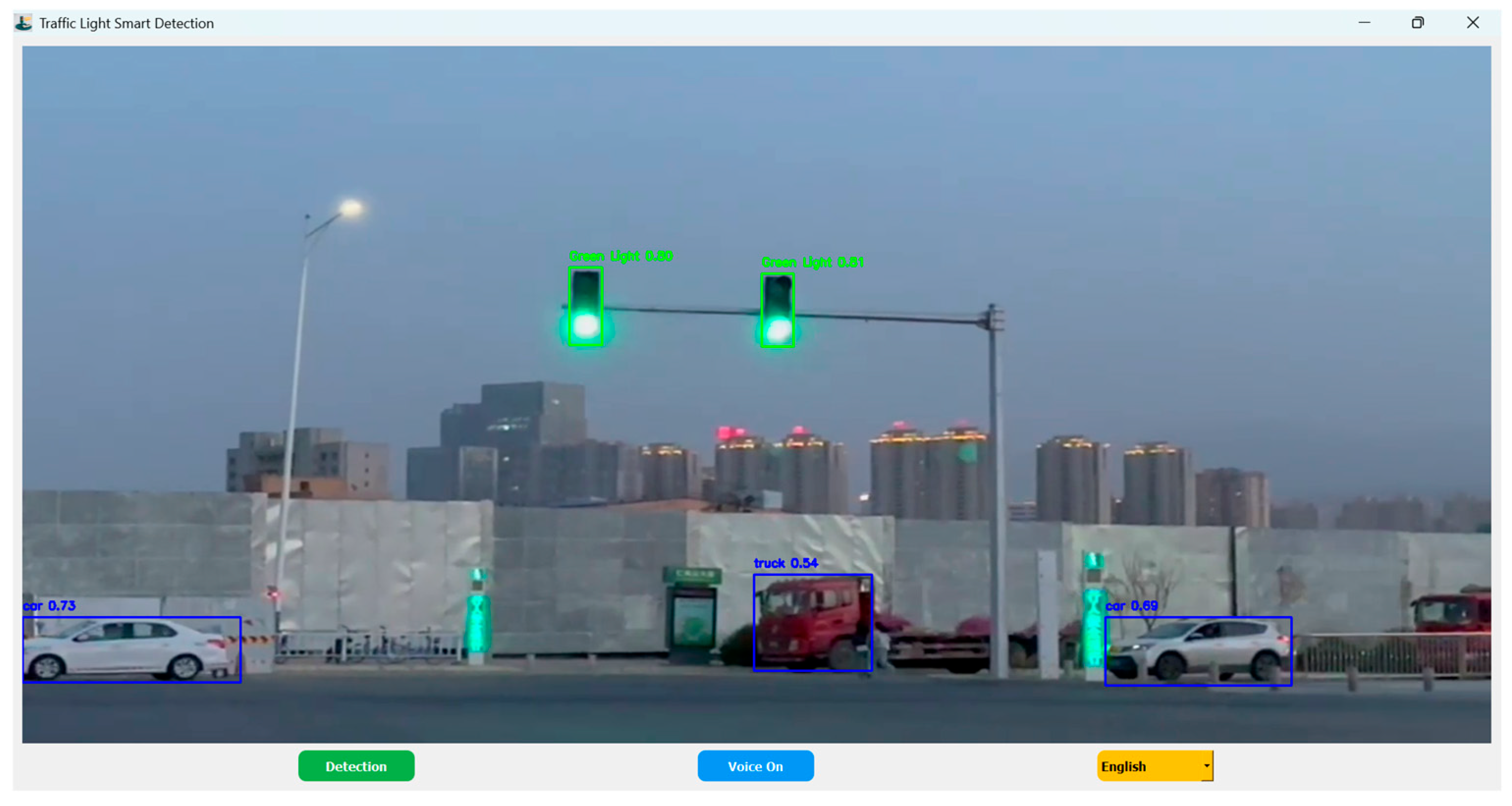
5.1. Visual Perception
5.2. Audio Feedback
- Red Light: “Red light, please stop and relax!”
- Yellow Light: “Yellow light, please prepare!”
- Green Light: “Green light, you may go, have a pleasant journey!”
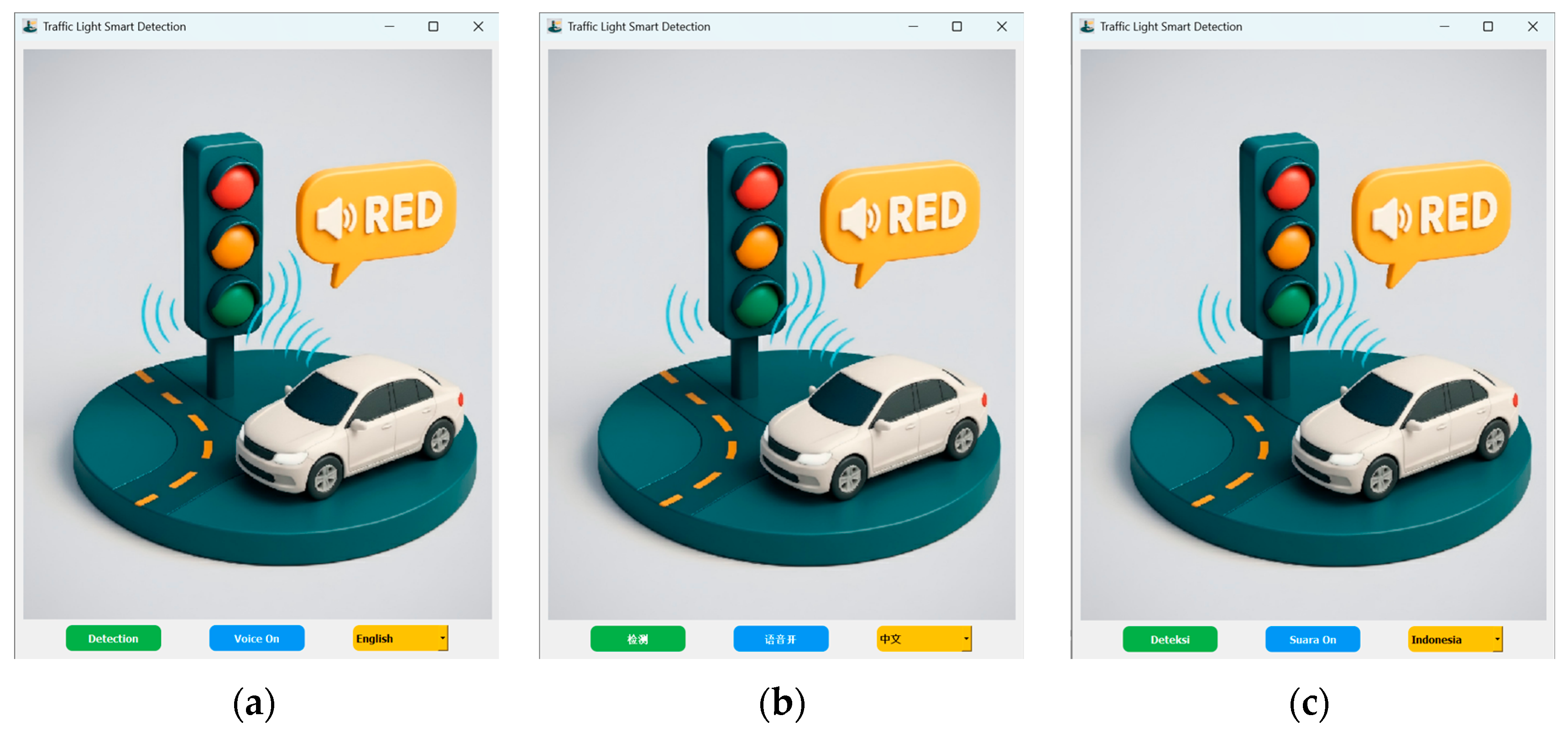
5.3. Multilingual
6. Conclusions
6.1. Main Contributions
- After comparison with previous model training results, this study decided to use YOLOv12 for implementation in the user application;
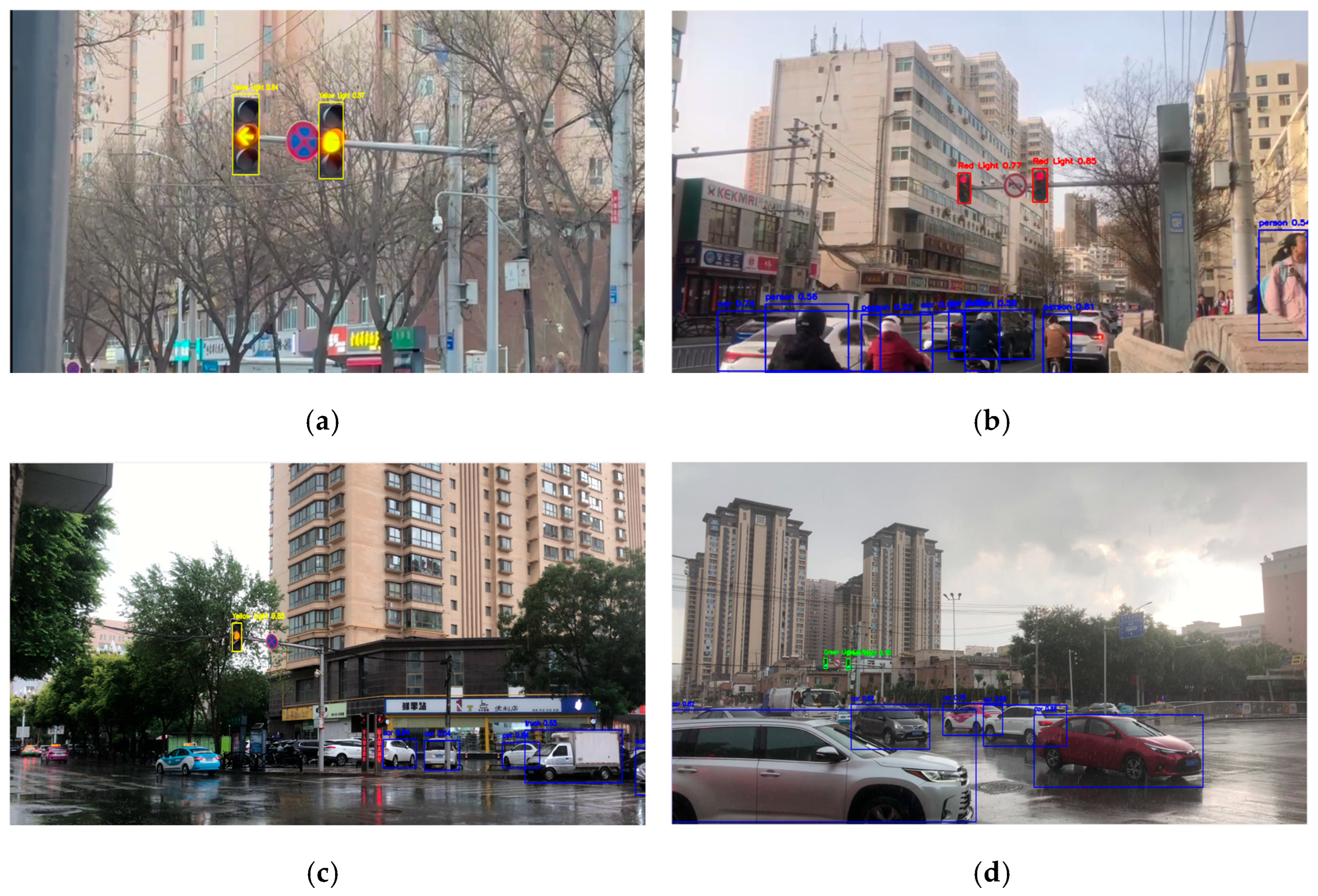
- The model was tested with eight scenarios involving poor conditions at night, bad weather, and crowded traffic. During day testing, the system achieved an average detection confidence of approximately 0.73 with a maximum confidence level of 0.95, while at night, the detection performance decreases, especially in crowded environments;
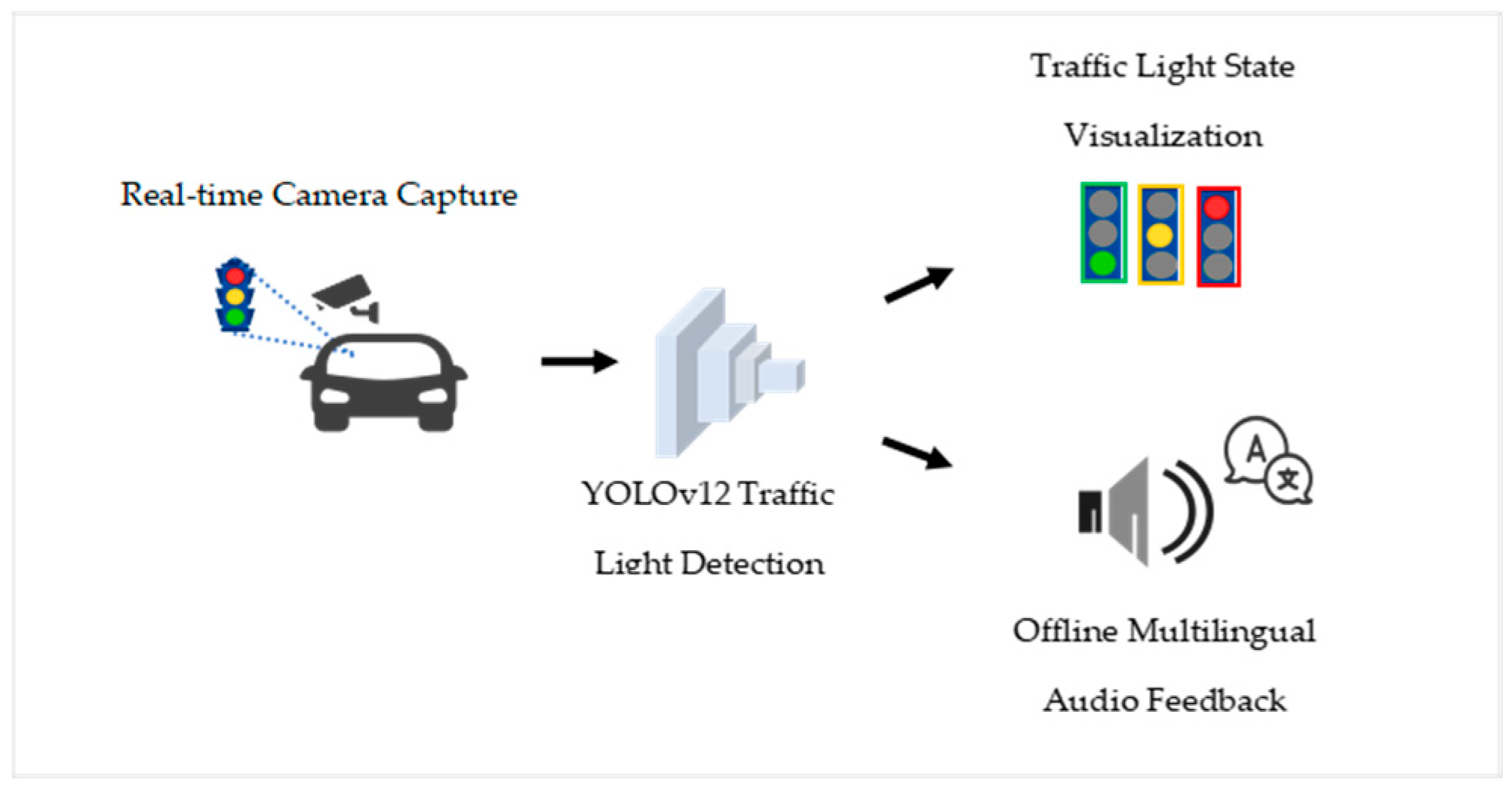
- The application is designed with traffic light visualization that includes bounding boxes, name labels, and confidence levels. The audio produced followed the user’s language selection and is only played when there is a change in traffic light status.
6.2. System Limitations and Safety Considerations
6.3. Future Work
Author Contributions
Funding
Institutional Review Board Statement
Informed Consent Statement
Data Availability Statement
Acknowledgments
Conflicts of Interest
Abbreviations
| Avg | Average |
| CVD | Color Vision Deficiency |
| CNN | Convolutional Neural Network |
| DL | Deep Learning |
| FPS | Frames Per Second |
| GPU | Graphics Processing Unit |
| HSV | Hue, Saturation, Value |
| i7 | Intel Core i7 Processor |
| mAP | Mean Average Precision |
| NCN | Night, Clear, Normal traffic scenario |
| NCC | Night, Clear, Crowded traffic scenario |
| NRN | Night, Rain, Normal traffic scenario |
| NRC | Night, Rain, Crowded traffic scenario |
| DCN | Day, Clear, Normal traffic scenario |
| DCC | Day, Clear, Crowded traffic scenario |
| DRN | Day, Rain, Normal traffic scenario |
| DRC | Day, Rain, Crowded traffic scenario |
| QTimer | Qt Timer (PyQt5) |
| SGD | Stochastic Gradient Descent |
| TTS | Text-to-Speech |
| YOLO | You Only Look Once |
References
- Simunovic, M.P. Colour Vision Deficiency. Eye 2010, 24, 747–755. [Google Scholar] [CrossRef]
- Almustanyir, A. A Global Perspective of Color Vision Deficiency: Awareness, Diagnosis, and Lived Experiences. Healthcare 2025, 13, 2031. [Google Scholar] [CrossRef]
- Tagarelli, A.; Piro, A.; Tagarelli, G.; Lantieri, P.B.; Risso, D.; Olivieri, R.L. Colour Blindness in Everyday Life and Car Driving. Acta Ophthalmol. Scand. 2004, 82, 436–442. [Google Scholar] [CrossRef]
- Kim, Y.K.; Kim, K.W.; Yang, X. Real Time Traffic Light Recognition System for Color Vision Deficiencies. In Proceedings of the 2007 International Conference on Mechatronics and Automation, Harbin, China, 5–9 August 2007; pp. 76–81. [Google Scholar]
- Pepple, G.; Adio, A. Visual Function of Drivers and Its Relationship to Road Traffic Accidents in Urban Africa. SpringerPlus 2014, 3, 47. [Google Scholar] [CrossRef]
- Nuñez, J.R.; Anderton, C.R.; Renslow, R.S. Optimizing Colormaps with Consideration for Color Vision Deficiency to Enable Accurate Interpretation of Scientific Data. PLoS ONE 2018, 13, e0199239. [Google Scholar] [CrossRef]
- Rocchini, D.; Nowosad, J.; D’Introno, R.; Chieffallo, L.; Bacaro, G.; Gatti, R.C.; Foody, G.M.; Furrer, R.; Gábor, L.; Malavasi, M.; et al. Scientific Maps Should Reach Everyone: The Cblindplot R Package to Let Colour Blind People Visualise Spatial Patterns. Ecol. Inform. 2023, 76, 102045. [Google Scholar] [CrossRef]
- Tan, T.F.; Wongsawad, W.; Hurairah, H.; Loy, M.J.; Lwin, W.W.; Mohd Rawi, N.A.; Sidik, M.; Grzybowski, A.; Raman, R.; Ruamviboonsuk, P.; et al. Colour Vision Restrictions for Driving: An Evidence-Based Perspective on Regulations in ASEAN Countries Compared to Other Countries. Lancet Reg. Health-Southeast Asia 2023, 14, 100171. [Google Scholar] [CrossRef]
- Nasruddin, N.I.; Arimaswati, A.; Putri, D.N.; Rustam Hn, M. Deteksi Buta Warna Dengan Metode Ishihara Pada Mahasiswa Baru Jalur Penerimaan Snmptn Universitas Halu Oleo. J. ABDI 2023, 2, 6923–6928. [Google Scholar] [CrossRef]
- Kobal, N.; Hawlina, M. Comparison of Visual Requirements and Regulations for Obtaining a Driving License in Different European Countries and Some Open Questions on Their Adequacy. Front. Hum. Neurosci. 2022, 16, 927712. [Google Scholar] [CrossRef]
- GOV.UK. Visual Disorders: Assessing Fitness to Drive. 2025. Available online: https://www.gov.uk/guidance/visual-disorders-assessing-fitness-to-drive#colour-blindness (accessed on 31 December 2025).
- Smith, E.M.; Huff, S.; Wescott, H.; Daniel, R.; Ebuenyi, I.D.; O’Donnell, J.; Maalim, M.; Zhang, W.; Khasnabis, C.; MacLachlan, M. Assistive Technologies Are Central to the Realization of the Convention on the Rights of Persons with Disabilities. Disabil. Rehabil. Assist. Technol. 2024, 19, 486–491. [Google Scholar] [CrossRef]
- Borg, J.; Lindström, A.; Larsson, S. Assistive Technology in Developing Countries: A Review from the Perspective of the Convention on the Rights of Persons with Disabilities. Prosthet. Orthot. Int. 2011, 35, 20–29. [Google Scholar] [CrossRef]
- Hacohen, S.; Medina, O.; Shoval, S. Autonomous Driving: A Survey of Technological Gaps Using Google Scholar and Web of Science Trend Analysis. IEEE Trans. Intell. Transp. Syst. 2022, 23, 21241–21258. [Google Scholar] [CrossRef]
- Behrendt, K.; Novak, L.; Botros, R. A Deep Learning Approach to Traffic Lights: Detection, Tracking, and Classification. In Proceedings of the 2017 IEEE International Conference on Robotics and Automation (ICRA), Singapore, 29 May–6 June 2017; pp. 1370–1377. [Google Scholar]
- Gong, C.; Li, A.; Song, Y.; Xu, N.; He, W. Traffic Sign Recognition Based on the YOLOv3 Algorithm. Sensors 2022, 22, 9345. [Google Scholar] [CrossRef]
- Hindarto, D. Enhancing Road Safety with Convolutional Neural Network Traffic Sign Classification. SinkrOn 2023, 8, 2810–2818. [Google Scholar] [CrossRef]
- Pavlitska, S.; Lambing, N.; Bangaru, A.K.; Zöllner, J.M. Traffic Light Recognition Using Convolutional Neural Networks: A Survey. arXiv 2023, arXiv:2309.02158. [Google Scholar] [CrossRef]
- Sandler, M.; Howard, A.; Zhu, M.; Zhmoginov, A.; Chen, L.-C. MobileNetV2: Inverted Residuals and Linear Bottlenecks. In Proceedings of the 2018 IEEE/CVF Conference on Computer Vision and Pattern Recognition; IEEE: Salt Lake City, UT, USA, 2018; pp. 4510–4520. [Google Scholar]
- Nine, J.; Mathavan, R. Traffic Light and Back-Light Recognition Using Deep Learning and Image Processing with Raspberry Pi. Embed. Selforganising Syst. 2021, 8, 15–19. [Google Scholar] [CrossRef]
- Zeng, Y.; Lan, J.; Ran, B.; Wang, Q.; Gao, J. Restoration of Motion-Blurred Image Based on Border Deformation Detection: A Traffic Sign Restoration Model. PLoS ONE 2015, 10, e0120885. [Google Scholar] [CrossRef]
- Possatti, L.C.; Guidolini, R.; Cardoso, V.B.; Berriel, R.F.; Paixao, T.M.; Badue, C.; De Souza, A.F.; Oliveira-Santos, T. Traffic Light Recognition Using Deep Learning and Prior Maps for Autonomous Cars. In Proceedings of the 2019 International Joint Conference on Neural Networks (IJCNN), Budapest, Hungary, 14–19 July 2019; pp. 1–8. [Google Scholar]
- Yagob, F.; Sasiadek, J.Z. Enhanced Real-Time Method Traffic Light Signal Color Recognition Using Advanced Convolutional Neural Network Techniques. World Electr. Veh. J. 2025, 16, 441. [Google Scholar] [CrossRef]
- Khaled, L.B.; Rahman, M.; Ebu, I.A.; Ball, J.E. FlashLightNet: An End-to-End Deep Learning Framework for Real-Time Detection and Classification of Static and Flashing Traffic Light States. Sensors 2025, 25, 6423. [Google Scholar] [CrossRef]
- Wang, Q.; Zhang, Q.; Liang, X.; Wang, Y.; Zhou, C.; Mikulovich, V.I. Traffic Lights Detection and Recognition Method Based on the Improved YOLOv4 Algorithm. Sensors 2021, 22, 200. [Google Scholar] [CrossRef]
- Lin, H.-Y.; Chen, L.-Q.; Wang, M.-L. Improving Discrimination in Color Vision Deficiency by Image Re-Coloring. Sensors 2019, 19, 2250. [Google Scholar] [CrossRef]
- Nevathetha, R.A.; Fathima, K.K.; Niveditha, S.; Selvavathi, M. Color Detection Using Opencv. Int. J. Sci. Res. Eng. Manag. 2023, 7, 1–7. [Google Scholar] [CrossRef]
- Che, M.; Che, M.; Chao, Z.; Cao, X. Traffic Light Recognition for Real Scenes Based on Image Processing and Deep Learning. Comput. Inform. 2020, 39, 439–463. [Google Scholar] [CrossRef]
- Kompalli, P.L.; Kalidindi, A.; Chilukala, J.; Nerella, K.; Shaik, W.; Cherukuri, D. A Color Guide for Color Blind People Using Image Processing and OpenCV. Int. J. Online Eng. 2023, 19, 30–46. [Google Scholar] [CrossRef]
- Goenawan, A.D.; Rachman, M.B.A.; Pulungan, M.P. Identifikasi Warna Pada Objek Citra Digital Secara Real Time Menggunakan Pengolahan Model Warna HSV. J. Tek. Inform. Elektro 2022, 4, 68–74. [Google Scholar] [CrossRef]
- Shivakumar, N. Colored Object Detection For Blind People Using CNN. Comput. Sci. Eng. 2022, 10. Available online: https://www.researchgate.net/publication/368921662_Colored_Object_Detection_For_Blind_People_Using_CNN (accessed on 7 January 2026).
- Das, D.; Roy, S. Object Detection with Voice Output for Visually Impaired. In Proceedings of the 2024 International Conference on Communication, Computing and Internet of Things (IC3IoT), Chennai, India, 17–18 April 2024; pp. 1–6. [Google Scholar]
- Dewangan, R.K.; Chaubey, D.S. Object Detection System with Voice Output Using Python. Int. J. Res. Trends Innov. 2021, 6, 15–20. [Google Scholar]
- Ravindra Karmarkar, R.; Honmane, V.N. Object Detection System for the Blind with Voiceguidance. Int. J. Eng. Appl. Sci. Technol. 2021, 6, 67–70. [Google Scholar] [CrossRef]
- Manawadu, M.; Wijenayake, U. Voice-Assisted Real-Time Traffic Sign Recognition System Using Convolutional Neural Network. arXiv 2024, arXiv:2404.07807. [Google Scholar]
- Sukhani, K.; Shankarmani, R.; Shah, J.; Shah, K. Traffic Sign Board Recognition and Voice Alert System Using Convolutional Neural Network. In Proceedings of the 2021 2nd International Conference for Emerging Technology (INCET), Belagavi, India, 21–23 May 2021; pp. 1–5. [Google Scholar]



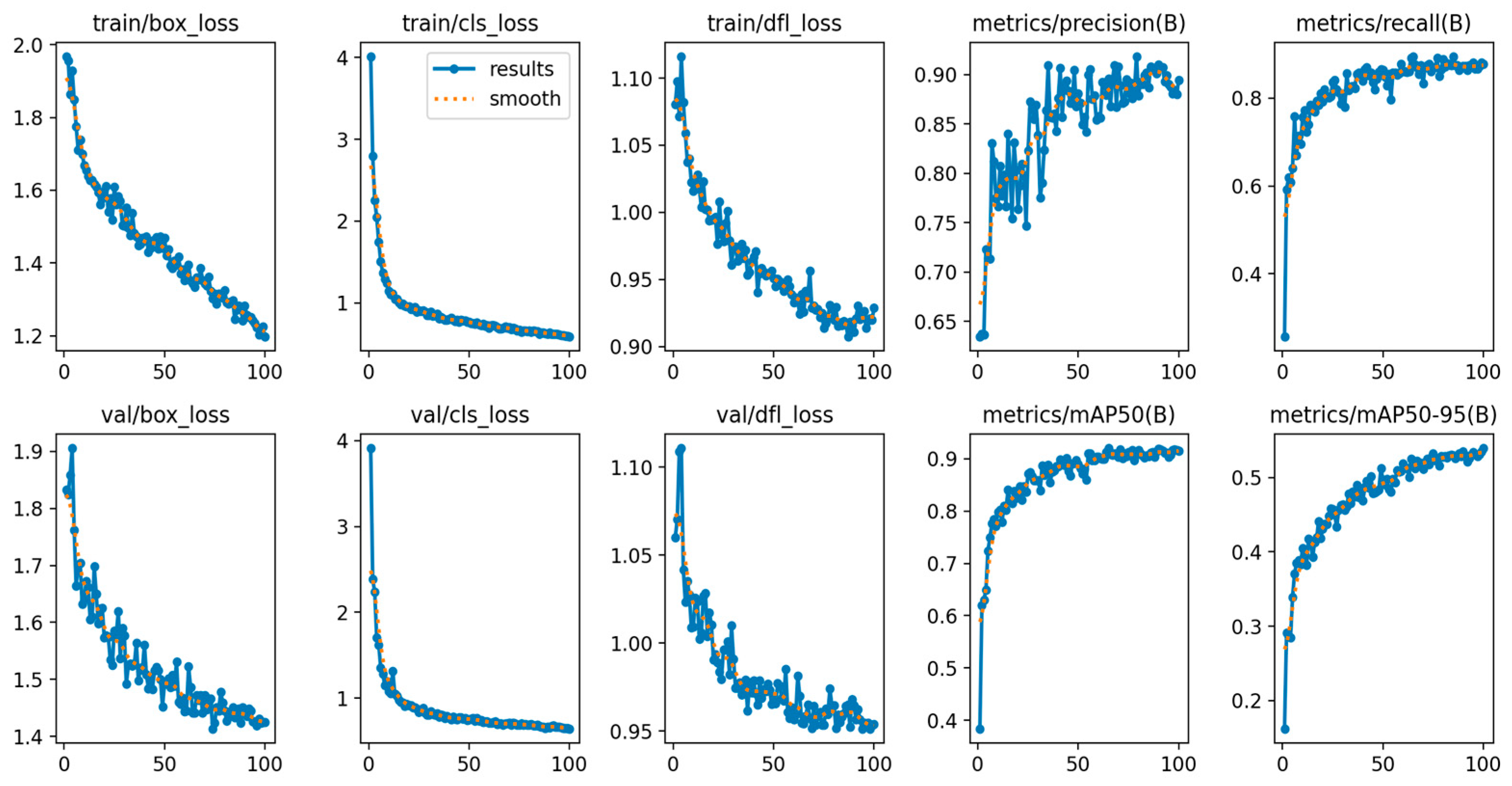
| Model | Precision | Recall | mAP@50 | mAP@95 |
|---|---|---|---|---|
| YOLO 8n | 0.916 | 0.895 | 0.923 | 0.537 |
| YOLO 10n | 0.892 | 0.840 | 0.892 | 0.524 |
| YOLO 11n | 0.927 | 0.895 | 0.913 | 0.532 |
| YOLO 12n | 0.918 | 0.895 | 0.920 | 0.539 |
| Scenario | FPS | Inference | Process |
|---|---|---|---|
| DCN | 4.639 | 0.211 | 0.219 |
| DCC | 4.634 | 0.211 | 0.220 |
| DRN | 4.623 | 0.212 | 0.221 |
| DRC | 4.555 | 0.215 | 0.224 |
| NCN | 4.908 | 0.197 | 0.205 |
| NCC | 4.991 | 0.193 | 0.201 |
| NRN | 4.913 | 0.198 | 0.205 |
| NRC | 4.758 | 0.205 | 0.213 |
| Metrics | Daylight | Night | |||||||
|---|---|---|---|---|---|---|---|---|---|
| Clear | Rain | Clear | Rain | ||||||
| Normal | Crowded | Normal | Crowded | Normal | Crowded | Normal | Crowded | ||
| Green Light Detected | Total | 18,672 | 22,167 | 26,059 | 29,051 | 5456 | 9461 | 11,818 | 14,795 |
| Red Light Detected | Total | 10,379 | 14,166 | 15,785 | 16,372 | 2483 | 6235 | 6925 | 8066 |
| Yellow Light Detected | Total | 2306 | 2503 | 3542 | 3775 | 1160 | 1404 | 1692 | 2089 |
| Green Light Detection Confidence | Avg | 0.74 | 0.75 | 0.76 | 0.75 | 0.72 | 0.69 | 0.71 | 0.73 |
| Highest | 0.95 | 0.95 | 0.95 | 0.95 | 0.91 | 0.91 | 0.91 | 0.92 | |
| Red Light Detection Confidence | Avg | 0.74 | 0.74 | 0.74 | 0.74 | 0.73 | 0.70 | 0.71 | 0.72 |
| Highest | 0.90 | 0.90 | 0.90 | 0.90 | 0.89 | 0.89 | 0.89 | 0.89 | |
| Yellow Light Detection Confidence | Avg | 0.78 | 0.78 | 0.79 | 0.79 | 0.82 | 0.81 | 0.79 | 0.77 |
| Highest | 0.91 | 0.91 | 0.91 | 0.91 | 0.91 | 0.91 | 0.91 | 0.91 | |
Disclaimer/Publisher’s Note: The statements, opinions and data contained in all publications are solely those of the individual author(s) and contributor(s) and not of MDPI and/or the editor(s). MDPI and/or the editor(s) disclaim responsibility for any injury to people or property resulting from any ideas, methods, instructions or products referred to in the content. |
© 2026 by the authors. Licensee MDPI, Basel, Switzerland. This article is an open access article distributed under the terms and conditions of the Creative Commons Attribution (CC BY) license.
Share and Cite
Ma, Y.; Arifah, F.; Afifah, Q.; Bun, L.; Zhang, K.; Tang, M. Traffic Light Recognition Assistant for Color Vision Deficiency Using YOLO with Multilingual Audio Feedback. Sensors 2026, 26, 1093. https://doi.org/10.3390/s26041093
Ma Y, Arifah F, Afifah Q, Bun L, Zhang K, Tang M. Traffic Light Recognition Assistant for Color Vision Deficiency Using YOLO with Multilingual Audio Feedback. Sensors. 2026; 26(4):1093. https://doi.org/10.3390/s26041093
Chicago/Turabian StyleMa, Yinyuan, Fathan Arifah, Qonita Afifah, Liko Bun, Kangfu Zhang, and Minan Tang. 2026. "Traffic Light Recognition Assistant for Color Vision Deficiency Using YOLO with Multilingual Audio Feedback" Sensors 26, no. 4: 1093. https://doi.org/10.3390/s26041093
APA StyleMa, Y., Arifah, F., Afifah, Q., Bun, L., Zhang, K., & Tang, M. (2026). Traffic Light Recognition Assistant for Color Vision Deficiency Using YOLO with Multilingual Audio Feedback. Sensors, 26(4), 1093. https://doi.org/10.3390/s26041093