A Hybrid Hash–Encryption Scheme for Secure Transmission and Verification of Marine Scientific Research Data

Abstract
1. Introduction
- (1)
- The introduction of the HMR mechanism, a chain-oriented hashing framework adapted to edge scenarios, capable of achieving efficient integrity verification in environments with highly fragmented data and frequent link disruptions.
- (2)
- The development of the EMR scheme, a hybrid encryption solution designed for communication asymmetry, which substantially improves encryption efficiency and security under resource-constrained and unstable transmission conditions.
- (3)
- The implementation of a multidimensional simulation platform for system evaluation, which validates the proposed approach in complex survey environments using metrics such as verification latency, encryption delay, packet-loss resilience, and data volume variation.
2. Related Work
3. Methodology Design
- (1)
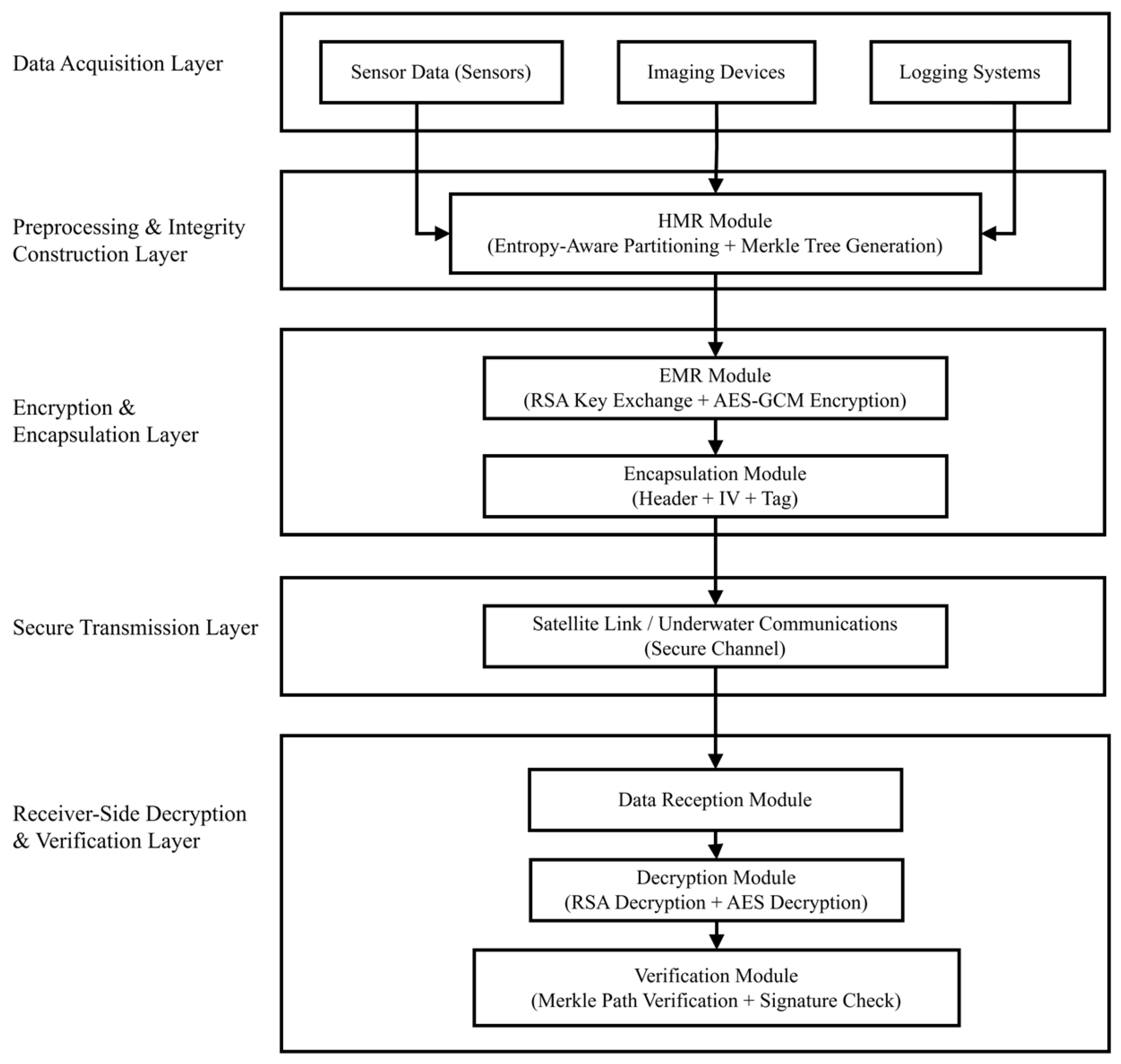
- Data Acquisition: The system supports heterogeneous multi-source inputs from ocean sensors, imaging devices, and logging systems, covering typical data types such as temperature, salinity, image frames, and navigation records. These are collected and encoded into a structured format for subsequent processing.
- (2)
- HMR Processing: Adaptive partitioning is performed based on entropy distribution of the data, while Merkle paths are utilized to generate distributed indices. This establishes an integrity structure with incremental verification capability, thereby enhancing structural consistency and reliability.
- (3)
- EMR Encryption: The system integrates RSA-based key agreement with AES-GCM symmetric encryption. Through key decoupling, authentication tagging, and concurrent encryption strategies, the encapsulation logic simultaneously ensures cryptographic strength and computational efficiency, meeting the real-time requirements of edge nodes.
- (4)
- Secure Transmission: The data encapsulation format is tailored for the complexity of marine communication links, maintaining compatibility with satellite relays, submarine optical cables, and ad hoc wireless channels. In high packet-loss environments, lightweight redundancy structures and authentication mechanisms are employed to secure stable transmission.
- (5)
- Decryption and Verification: At the receiving end, the encapsulated data are parsed in accordance with the protocol, automatically completing key recovery, data decryption, and multipath signature verification. This guarantees the verifiability of data integrity and traceability to the original source.
3.1. HMR Mechanism Design and Optimization
3.2. EMR Mechanism Design and Performance Optimization
3.3. Block-Level Feedback and Retransmission Protocol
- ACK: reports the highest contiguous verified block index .
- NACK: reports missing blocks within a sliding window, using a list or bitmap.
4. Experimental Setup and Results
4.1. Dataset Construction and Experimental Environment
- (1)
- Sensor Data Streams: Structured outputs simulating CTD, ADCP, and GPS devices. Entropy values ranged from 0.873 to 0.920, covering temperature, pressure, salinity, geographic coordinates, and timestamps. This category exhibits strong sequentiality and high structural regularity. The simulation approach follows established practices in marine sensor data generation, where synthetic CTD profiles are widely employed to evaluate processing algorithms under controlled conditions [26,27]. The generated temperature and salinity distributions were designed to remain consistent with established World Ocean Database standards [28].
- (2)
- Image Block Data: Designed to mimic sonar imaging outputs and subsea video frames. Data were synthesized using a partitioned variable-entropy algorithm, yielding entropy values in the range of 0.769 to 0.912. The dataset was stratified into low-entropy (30%), medium-entropy (30%), and high-entropy (40%) subsets to reflect spatial heterogeneity in image structures. This methodology is consistent with recent advances in underwater image processing research, where synthetic sonar datasets have been shown to be effective for algorithm validation and performance benchmarking [29,30].
- (3)
- Text Log Data: Covering shipboard logs, device status reports, and navigation records. This dataset exhibited high redundancy, with entropy concentrated between 0.671 and 0.679, reflecting repetitive patterns and structural regularity. The generation of synthetic maritime navigation logs followed established practices in marine cybersecurity research, where controlled datasets are necessary to evaluate encryption mechanisms without compromising operational security [12].
4.2. Sensitivity Analysis and Selection of
4.3. Performance Comparison and Analysis
4.4. Ablation Study
4.5. Resource-Constrained Device Evaluation
5. Discussion
6. Conclusions
7. Patents
Author Contributions
Funding
Institutional Review Board Statement
Data Availability Statement
Conflicts of Interest
References
- Adam, N.; Ali, M.; Naeem, F.; Ghazy, A.S.; Kaddoum, G. State-of-the-Art Security Schemes for the Internet of Underwater Things: A Holistic Survey. IEEE Open J. Commun. Soc. 2024, 5, 6561–6592. [Google Scholar] [CrossRef] [Scilit]
- Igbinenikaro, O.P.; Adekoya, O.O.; Etukudoh, E.A. Emerging underwater survey technologies: A review and future outlook. Open Access Res. J. Sci. Technol. 2024, 10, 71–84. [Google Scholar] [CrossRef] [Scilit]
- Theocharidis, T.; Kavallieratou, E. Underwater Communication Technologies: A Review. Telecommun. Syst. 2025, 88, 54. [Google Scholar] [CrossRef] [Scilit]
- Li, M.; Zhou, J.; Chattopadhyay, S.; Goh, M. Maritime Cybersecurity: A Comprehensive Review. arXiv 2024, arXiv:2409.11417. [Google Scholar]
- Ghazal, T.M.; Hasan, M.K.; Raju, K.N.; Khan, M.A.; Alshamayleh, A.; Bhatt, M.W.; Ahmad, M. Data Space Privacy Model with Federated Learning Technique for Securing IoT Communications in Autonomous Marine Vehicles. J. Intell. Robot. Syst. 2025, 111, 84. [Google Scholar] [CrossRef] [Scilit]
- Alanhdi, A.; Toka, L. A Survey on Integrating Edge Computing with AI and Blockchain in Maritime Domain, Aerial Systems, IoT, and Industry 4.0. IEEE Access 2024, 12, 28684–28709. [Google Scholar] [CrossRef] [Scilit]
- Tabish, N.; Chaur-Luh, T. Maritime Autonomous Surface Ships: A Review of Cybersecurity Challenges, Countermeasures, and Future Perspectives. IEEE Access 2024, 12, 17114–17136. [Google Scholar] [CrossRef] [Scilit]
- Berman, I.; Zereik, E.; Kapitonov, A.; Bonsignorio, F.; Khassanov, A.; Oripova, A.; Lonshakov, S.; Bulatov, V. Trustable Environmental Monitoring by Means of Sensors Networks on Swarming Autonomous Marine Vessels and Distributed Ledger Technology. Front. Robot. AI 2020, 7, 70. [Google Scholar] [CrossRef] [Scilit]
- Dimitrov, G.; Mitishev, I. Enhancing Maritime Communication Security with Blockchain Technology. Elektronika ir Elektrotechnika 2025, 31, 71–78. [Google Scholar] [CrossRef] [Scilit]
- Alsharabi, N.; Ktari, J.; Frikha, T.; Alayba, A.; Alzahrani, A.J.; Jadi, A.; Hamam, H. Using blockchain and AI technologies for sustainable, biodiverse, and transparent fisheries of the future. J. Cloud Comput. 2024, 13, 135. [Google Scholar] [CrossRef] [Scilit]
- Zemlianko, H.; Kharchenko, V. Ensuring Cybersecurity of the Cyber Physical System of Combined Fleets of Unmanned Aerial, Ground and Sea Vehicles. In Integrated Computer Technologies in Mechanical Engineering—2023, Vol 2, ICTM 2023; Springer: Cham, Switzerland, 2024; Volume 996. [Google Scholar] [CrossRef] [Scilit]
- Farao, A.; Zarras, A.; Voudouris, A.; Paparis, G.; Xenakis, C. B2SAPP: Blockchain Based Solution for Maritime Security Applications. Front. Comput. Sci. 2025, 7, 1572009. [Google Scholar] [CrossRef] [Scilit]
- Harish, A.V.; Tam, K.; Jones, K. Literature Review of Maritime Cyber Security: The First Decade. Marit. Technol. Res. 2024, 7, 273805. [Google Scholar] [CrossRef] [Scilit]
- Santos, N.P. Revolutionizing Ocean Engineering: The Impact of Autonomous Vehicles. Acad. Eng. 2024. [Google Scholar] [CrossRef] [Scilit]
- Shamsuzzaman, H.; Mosleuzzaman, M.; Paran, M.S. Real-time cybersecurity integration in plcs and iot gateways: A performance-conscious approach to encryption, authentication, and intrusion detection. Am. J. Adv. Technol. Eng. Solut. 2025, 1, 32–57. [Google Scholar] [CrossRef] [Scilit]
- Fattah, S.; Gani, A.; Ahmedy, I.; Idris, M.Y.I.; Targio Hashem, I.A. A survey on underwater wireless sensor networks: Requirements, taxonomy, recent advances, and open research challenges. Sensors 2020, 20, 5393. [Google Scholar] [CrossRef] [Scilit]
- Merkle, R.C. A digital signature based on a conventional encryption function. In Proceedings of the Conference on the Theory and Application of Cryptographic Techniques, Santa Barbara, CA, USA, 16–20 August 1987; pp. 369–378. [Google Scholar]
- Manber, U. Finding Similar Files in a Large File System. In Proceedings of the Usenix Winter, San Francisco, CA, USA, 17–21 January 1994; pp. 1–10. [Google Scholar]
- Rescorla, E. The Transport Layer Security (TLS) Protocol Version 1.3; 2070-1721; Internet Engineering Task Force (IETF): Fremont, CA, USA, 2018. [Google Scholar]
- Dworkin, M. Recommendation for Block Cipher Modes of Operation: Galois/Counter Mode (GCM) and GMAC; NIST Special Publication (SP): Gaithersburg, MD, USA, 2007.
- Burleigh, S.; Fall, K.; Birrane, E.J. Bundle Protocol Version 7; RFC 9171; Internet Engineering Task Force (IETF): Fremont, CA, USA, 2022. [Google Scholar]
- Burrows, M.; Abadi, M.; Needham, R. A logic of authentication. ACM Trans. Comput. Syst. 1990, 8, 18–36. [Google Scholar] [CrossRef] [Scilit]
- Cremers, C.J. The Scyther Tool: Verification, Falsification, and Analysis of Security Protocols: Tool Paper. In Proceedings of the International Conference on Computer Aided Verification, Princeton, NJ, USA, 7–14 July 2008; pp. 414–418. [Google Scholar]
- Liu, G.; Van Huynh, N.; Du, H.; Hoang, D.T.; Niyato, D.; Zhu, K.; Kang, J.; Xiong, Z.; Jamalipour, A.; Kim, D.I. Generative ai for unmanned vehicle swarms: Challenges, applications and opportunities. arXiv 2024, arXiv:2402.18062. [Google Scholar] [CrossRef] [Scilit]
- Suherman, A.; Huda, H.N.; Timilsina, R.R.; Hernuryadin, Y.; Untoro, F.; Amboro, R.T.; Sock, F.; Koirala, P. Scaling Digital Fisheries Management: The Role of e-PIT in Enhancing Data Accuracy and Operational Efficiency. Sci. J. Fish. Mar. 2025, 17, 404–420. [Google Scholar] [CrossRef] [Scilit]
- Partridge, D.; Banerjee, D.; Ford, D.; Wang, K.; Skakala, J.; Wihsgott, J.; Menon, P.; Kay, S.; Clewley, D.; Rochner, A. A Digital Twin Ocean: Can we improve Coastal Ocean Forecasts using targeted Marine Autonomy? EGUsphere 2025, 2025, 1–26. [Google Scholar] [CrossRef] [Scilit]
- Tan, Z.; Zhu, Y.; Cheng, L.; Gouretski, V.; Pan, Y.; Yuan, H.; Wang, Z.; Li, G.; Song, X.; Zhang, B. CODC-S: A quality-controlled global ocean salinity profiles dataset. Sci. Data 2025, 12, 917. [Google Scholar] [CrossRef] [Scilit]
- Mishonov, A.V.; Boyer, T.P.; Baranova, O.K.; Bouchard, C.N.; Cross, S.L.; Garcia, H.E.; Locarnini, R.A.; Paver, C.R.; Reagan, J.R.; Wang, Z. World Ocean Database 2023; NOAA: Silver Spring, MD, USA, 2024.
- Elmezain, M.; Saoud, L.S.; Sultan, A.; Heshmat, M.; Seneviratne, L.; Hussain, I. Advancing underwater vision: A survey of deep learning models for underwater object recognition and tracking. IEEE Access 2025, 13, 17830–17867. [Google Scholar] [CrossRef] [Scilit]
- Markkandan, S. Studies on Underwater Image Processing Using Artificial Intelligence Technologies. IEEE Access 2024, 13, 3929–3969. [Google Scholar] [CrossRef] [Scilit]



| Data Type | Data Size Range | Average Entropy | Entropy Range | Structural Features | Application Scenario |
|---|---|---|---|---|---|
| Sensor Data | 1 KB–5 MB | 0.904 | 0.873–0.920 | Highly structured | Real-time monitoring |
| Image Data | 1 KB–5 MB | 0.884 | 0.769–0.912 | Mixed entropy | Subsea imaging |
| Text Logs | 1 KB–5 MB | 0.678 | 0.671–0.679 | Low-entropy, repetitive | Survey records |
| Scheme | Hash Time (ms) | Encryption Time (ms) | Decryption Time (ms) | Storage Overhead (%) | Security Level |
|---|---|---|---|---|---|
| SHA-256 + RSA + AES | 12.5 | 45.2 | 48.1 | 12.8 | High |
| BLAKE2 + ECC + ChaCha20 | 8.3 | 35.7 | 36.2 | 15.2 | High |
| SHA-3 + RSA + AES-GCM | 15.2 | 52.1 | 54.3 | 13.5 | Very High |
| HMR + EMR (Proposed) | 6.8 | 38.9 | 41.2 | 10.4 | High+ |
| Scheme | Hash Time (ms) | Encryption Time (ms) | Decryption Time (ms) | Storage Overhead (%) | Security Level |
|---|---|---|---|---|---|
| HMR-only | 9.3 | - | - | 5.1 | Medium |
| EMR-only | - | 40.2 | 43.5 | 12.5 | High |
| HMR + EMR (Proposed) | 6.8 | 38.9 | 41.2 | 10.4 | High+ |
Disclaimer/Publisher’s Note: The statements, opinions and data contained in all publications are solely those of the individual author(s) and contributor(s) and not of MDPI and/or the editor(s). MDPI and/or the editor(s) disclaim responsibility for any injury to people or property resulting from any ideas, methods, instructions or products referred to in the content. |
© 2026 by the authors. Licensee MDPI, Basel, Switzerland. This article is an open access article distributed under the terms and conditions of the Creative Commons Attribution (CC BY) license.
Share and Cite
Wang, H.; Chen, M.; Wang, M.; Yang, M. A Hybrid Hash–Encryption Scheme for Secure Transmission and Verification of Marine Scientific Research Data. Sensors 2026, 26, 994. https://doi.org/10.3390/s26030994
Wang H, Chen M, Wang M, Yang M. A Hybrid Hash–Encryption Scheme for Secure Transmission and Verification of Marine Scientific Research Data. Sensors. 2026; 26(3):994. https://doi.org/10.3390/s26030994
Chicago/Turabian StyleWang, Hanyu, Mo Chen, Maoxu Wang, and Min Yang. 2026. "A Hybrid Hash–Encryption Scheme for Secure Transmission and Verification of Marine Scientific Research Data" Sensors 26, no. 3: 994. https://doi.org/10.3390/s26030994
APA StyleWang, H., Chen, M., Wang, M., & Yang, M. (2026). A Hybrid Hash–Encryption Scheme for Secure Transmission and Verification of Marine Scientific Research Data. Sensors, 26(3), 994. https://doi.org/10.3390/s26030994