A Comprehensive Review of Non-Invasive Core Body Temperature Measurement Techniques


Abstract
1. Introduction
2. Core Body Temperature Measurement Techniques
2.1. Invasive and Semi-Invasive Reference Measurements
2.2. Non-Invasive and Minimally Burdensome Measurement Approaches
2.2.1. In-Ear Temperature Sensors for Core Body Temperature Monitoring
2.2.2. Infrared Thermography for Non-Contact Temperature Assessment
2.2.3. Ingestible Telemetric Sensors for Core Body Temperature Measurement
2.2.4. Heat-Flux-Based Methods for Core Body Temperature Estimation
2.2.5. Model-Based and Multimodal Estimation of Core Body Temperature
3. Discussion and Future Perspectives
4. Limitation of This Review
5. Conclusions
Funding
Data Availability Statement
Acknowledgments
Conflicts of Interest
References
- Collins, K.J. Regulation of Body Temperature. In Care of the Critically III Patient; Tinker, J., Zapol, W.M., Eds.; Springer: London, UK, 1992. [Google Scholar] [CrossRef]
- Lin, C.L. Fundamental Concepts of Human Thermoregulation and Adaptation to Heat: A Review in the Context of Global Warming. Int. J. Environ. Res. Public Health 2020, 17, 7795. [Google Scholar] [CrossRef]
- Cramer, M.N.; Gagnon, D.; Laitano, O.; Crandall, C.G. Human temperature regulation under heat stress in health, disease, and injury. Physiol. Rev. 2022, 102, 1907–1989. [Google Scholar] [CrossRef]
- Tamura, T.; Huang, M.; Togawa, T. Current Developments in Wearable Thermometer. Adv. Biomed. Eng. 2018, 7, 88–99. [Google Scholar] [CrossRef]
- Sekiguchi, Y.; Belval, L.N.; Stearns, L.; Casa, J. Monitoring Internal Body Temperature. Sports Sci. Exch. 2019, 29, 1–5. [Google Scholar]
- Ota, H.; Chao, M.; Gao, Y.; Wu, E.; Tai, L.-C.; Chen, K.; Matsuoka, Y.; Iwai, K.; Fahad, H.M.; Gao, W.; et al. 3D Printed “Earable” Smart Devices for Real-Time Detection of Core Body Temperature. ACS Sensors 2017, 2, 990–997. [Google Scholar] [CrossRef]
- Wang, Q.; Zhou, Y.; Ghassemi, P.; McBride, D.; Casamento, J.P.; Pfefer, T. Infrared Thermography for Measuring Elevated Body Temperature: Clinical Accuracy, Calibration, and Evaluation. Sensors 2021, 22, 215. [Google Scholar] [CrossRef] [PubMed]
- Byrne, C.; Lim, C.L. The ingestible telemetric body core temperature sensor: A review of validity and exercise applications. Br. J. Sports Med. 2007, 41, 126–133. [Google Scholar] [CrossRef] [PubMed]
- Gunga, H.C.; Sandsund, M.; Reinertsen, R.E.; Sattler, F.; Koch, J. A non-invasive device to continuously determine heat strain in humans. J. Therm. Biol. 2008, 33, 297–307. [Google Scholar] [CrossRef]
- Niedermann, R.; Wyss, E.; Annaheim, S.; Psikuta, A.; Davey, S.; Rossi, R.M. Prediction of human core body temperature using non-invasive measurement methods. Int. J. Biometeorol. 2013, 58, 7–15. [Google Scholar] [CrossRef]
- Moran, D.S.; Mendal, L. Core Temperature Measurement: Methods and Current Insights. Sports Med. 2002, 32, 879–885. [Google Scholar] [CrossRef] [PubMed]
- Conway, A.; Bittner, M.; Phan, D.; Chang, K.; Kamboj, N.; Tipton, E.; Parotto, M. Accuracy and precision of zero-heat-flux temperature measurements with the 3M™ Bair Hugger™ Temperature Monitoring System: A systematic review and meta-analysis. J. Clin. Monit. Comput. 2021, 35, 39–49. [Google Scholar] [CrossRef]
- Cutuli, S.L.; See, E.J.; Osawa, E.A.; Ancona, P.; Marshall, D.; Eastwood, G.M.; Glassford, N.J.; Bellomo, R. Accuracy of non-invasive body temperature measurement methods in adult patients admitted to the intensive care unit: A systematic review and meta-analysis. Crit. Care Resusc. 2023, 1, 6–13. [Google Scholar] [CrossRef] [PubMed]
- Falcone, T.; Cordella, F.; Molinaro, V.; Zollo, L.; Ferraro, S.D. Real-time human core temperature estimation methods and their application in the occupational field: A systematic review. Measurement 2021, 183, 109776. [Google Scholar] [CrossRef]
- Foster, J.; Lloyd, A.B.; Havenith, G. Non-contact infrared assessment of human body temperature: The journal Temperature toolbox. Temperature 2021, 8, 306–319. [Google Scholar] [CrossRef]
- Dolson, C.M.; Harlow, E.R.; Phelan, D.M.; Gabbett, T.J.; Gaal, B.; McMellen, C.; Geletka, B.J.; Calcei, J.G.; Voos, J.E.; Seshadri, D.R. Wearable Sensor Technology to Predict Core Body Temperature: A Systematic Review. Sensors 2022, 22, 7639. [Google Scholar] [CrossRef]
- Zhao, Y.; Bergmann, H.M. Non-Contact Infrared Thermometers and Thermal Scanners for Human Body Temperature Monitoring: A Systematic Review. Sensors 2023, 23, 7439. [Google Scholar] [CrossRef] [PubMed]
- Sessler, D.I.; Warner, D.S.; Mark, M.A. Temperature Monitoring and Perioperative Thermoregulation. Anesthesiology 2008, 109, 318–338. [Google Scholar] [CrossRef] [PubMed]
- Lefrant, J.-Y.; Muller, L.; de La Coussaye, J.E.; Benbabaali, M.; Lebris, C.; Zeitoun, N.; Mari, C.; Saïssi, G.; Ripart, J.; Eledjam, J.-J. Temperature measurement in intensive care patients: Comparison of urinary bladder, oesophageal, rectal, axillary, and inguinal methods versus pulmonary artery core method. Intensive Care Med. 2003, 29, 414–418. [Google Scholar] [CrossRef]
- Evans, D.C.; Doraiswamy, V.A.; Prosciak, M.P.; Silviera, M.; Seamon, M.J.; Funes, V.R.; Clipolla, J.; Wang, C.F.; Kavuturu, S.; Torigian, D.A.; et al. Complications Associated with Pulmonary Artery Catheters: A Comprehensive Clinical Review. Scand. J. Surg. 2009, 98, 199–208. [Google Scholar] [CrossRef]
- Hymczak, H.; Golab, A.; Mendrala, K.; Plicner, D.; Darocha, T.; Podsiadlo, P.; Hudziak, D.; Gocol, R.; Kosinski, S. Core Temperature Measurement—Principles of Correct Measurement, Problems, and Complications. Int. J. Environ. Public Health 2021, 18, 10606. [Google Scholar] [CrossRef]
- Lee, S.M.C.; Williams, W.J.; Schneider, S.M.F. Core Temperature Measurement During Supine Exercise: Esophageal, Rectal, and Intestinal Temperatures. Aviat. Space Environ. Med. 2000, 71, 939–945. [Google Scholar]
- Miller, K.C.; Adams, W.M. Common Body Temperature Sites Provide Invalid Measures of Body Core Temperature in Hyperthermic Humans Wearing American Football Uniforms. Temperature 2020, 8, 166–175. [Google Scholar] [CrossRef]
- Crowe, M.J.; Meehan, M.T.; Jones, R.E. Comparison of Rectal and Gastrointestinal Core Temperatures During Heat Tolerance Testing. Medicina 2025, 61, 1111. [Google Scholar] [CrossRef] [PubMed]
- Eggenberger, P.; MacRae, B.A.; Kemp, S.; Bürgisser, M.; Rossi, R.M.; Annaheim, S. Prediction of Core Body Temperature Based on Skin Temperature, Heat Flux, and Heart Rate Under Different Exercise and Clothing Conditions in the Heat in Young Adult Males. Front. Physiol. 2018, 9, 1780. [Google Scholar] [CrossRef] [PubMed]
- Scott, R.W.; Fredriksen, K. Barriers to body temperature monitoring among prehospital personnel: A qualitative study using the modified nominal group technique. BMJ Open 2022, 12, e058910. [Google Scholar] [CrossRef] [PubMed]
- Lilly, J.K.; Boland, J.P.; Zekan, S. Urinary Bladder Temperature Monitoring: A New Index of Body Core Temperature. Crit. Care Med. 1980, 8, 742–745. [Google Scholar] [CrossRef]
- Bräuer, A.; Fazliu, A.; Perl, T.; Heise, D.; Meissner, K.; Brandes, I.F. Accuracy of zero-heat-flux thermometry and bladder temperature measurement in critically ill patients. Sci. Rep. 2020, 10, 21746. [Google Scholar] [CrossRef]
- Langenhorst, J.; Benkert, A.; Peterss, S.; Feuerecker, M.; Scheiermann, T.; Scheiermann, P.; Witte, M.; Benkert, A.; Bayer, A.; Prueckner, S.; et al. Agreement of in-ear temperature to core body temperature measures during invasive whole-body cooling for hypothermic circulatory arrest in aortic arch surgery. Sci. Rep. 2024, 14, 27607. [Google Scholar] [CrossRef]
- Pompei, F.; Pompei, M. Noninvasive temporal artery thermometry: Physics, physiology, and clinical accuracy. Thermosense XXVI 2004, 5405, 61–67. [Google Scholar] [CrossRef]
- Olson, K.D.; O’Brien, P.; Lin, A.S.; Fabry, D.A.; Hanke, S.; Schroeder, M.J. A Continuously Worn Dual Temperature Sensor System for Accurate Monitoring of Core Body Temperature from the Ear Canal. Sensors 2023, 23, 7323. [Google Scholar] [CrossRef]
- Tan, S.C.C.; Tan, T.C.K.; Chiang, C.Y.N.; Pan, J.; Low, I.C.C. External auricle temperature enhances ear-based wearable accuracy during physiological strain monitoring in the heat. Sci. Rep. 2024, 14, 12418. [Google Scholar] [CrossRef]
- Chaglla, J.S.E.; Celik, N.; Balachandran, W. Measurement of Core Body Temperature Using Graphene-Inked Infrared Thermopile Sensor. Sensors 2018, 18, 3315. [Google Scholar] [CrossRef]
- Ko, Y.; Jung, J.Y.; Kim, H.-T.; Lee, J.-Y. Auditory canal temperature measurement using a wearable device during sleep: Comparisons with rectal temperatures at 6, 10, and 14 cm depths. J. Therm. Biol. 2019, 85, 102410. [Google Scholar] [CrossRef]
- Roossien, C.C.; Hodselmans, A.P.; Heus, R.; Reneman, M.F.; Verkerke, G.J. Evaluation of a Wearable Non-Invasive Thermometer for Monitoring Ear Canal Temperature during Physically Demanding (Outdoor) Work. Int. J. Environ. Res. Public Health 2021, 18, 4896. [Google Scholar] [CrossRef]
- Kato, I.; Watanabe, H.; Nagashima, K. Evaluation of newly developed wearable ear canal thermometer, mimicking the application to activities on sports and labor fields. J. Physiol. Sci. 2023, 73, 15. [Google Scholar] [CrossRef]
- Zhang, W.; Li, L.; Wang, Y.; Dong, X.; Liu, C.; Sun, L.; Guan, Q.; Zhang, F.; Xu, S. Continuous Core Body Temperature Monitoring for Heatstroke Alert via a Wearable In-Ear Thermometer. ACS Sens. 2025, 10, 1440–1449. [Google Scholar] [CrossRef]
- Ellebrecht, D.B.; Gola, D.; Kaschwich, M. Evaluation of a Wearable in-Ear Sensor for Temperature and Heart Rate Monitoring: A Pilot Study. J. Med. Syst. 2022, 46, 91. [Google Scholar] [CrossRef]
- Hasting, S.; Kim, S.W.; Brown, R.D. Face Temperature as an Indicator of Thermal Stress in Outdoor Work Environments. Atmosphere 2020, 11, 627. [Google Scholar] [CrossRef]
- Riaz, U.; Idris, M.; Ahmed, M.; Ali, F.; Yang, L. Infrared Thermography as a Potential Non-Invasive Tool for Estrus Detection in Cattle and Buffaloes. Animals 2023, 13, 1425. [Google Scholar] [CrossRef]
- Hayward, G.; Verbkel, J.Y.; Ismail, F.A.; Edwards, G.; Wang, K.; Fleming, S.; Holtman, G.A.; Glogowska, M.; Morris, E.; Curtis, K.; et al. Non-contact infrared versus axillary and tympanic thermometers in children attending primary care: A mixed-methods study of accuracy and acceptability. Br. J. Gen. Pract. 2020, 70, e236–e244. [Google Scholar] [CrossRef]
- Perpetuini, D.; Filippini, C.; Cardone, D.; Merla, A. An Overview of Thermal Infrared Imaging-Based Screenings during Pandemic Emergencies. Int. J. Environ. Res. Public Health 2021, 18, 3286. [Google Scholar] [CrossRef]
- Cai, Z.; Cui, J.; Yuan, H.; Cheng, M. Application and research progress of infrared thermography in temperature measurement of livestock and poultry animals: A review. Comput. Electron. Agric. 2023, 205, 107586. [Google Scholar] [CrossRef]
- Hildebrandt, C.; Raschner, C.; Ammer, K. An Overview of Recent Application of Medical Infrared Thermography in Sports Medicine in Austria. Sensors 2010, 10, 4700–4715. [Google Scholar] [CrossRef]
- Cabizosu, A.; Pagan, C.M.; Alcaraz, P.E.; Noguera, F.J.M. Infrared Thermography Sensor in the Analysis of Acute Metabolic Stress Response during Race Walking Competition. Biosensors 2024, 14, 478. [Google Scholar] [CrossRef]
- Coehoom, C.J.; Martin, P.S.; Teran, J.; Cowart, H.; Waite, L.; Newman, S. Firefighter uncompensable heat stress results in excessive upper body temperatures measured by infrared thermography: Implications for cooling strategies. Appl. Ergon. 2024, 120, 104342. [Google Scholar] [CrossRef]
- Ring, E.F.J.; Ammer, K. Infrared thermal imaging in medicine. Physiol. Meas. 2012, 33, R33–R46. [Google Scholar] [CrossRef]
- Teunissen, L.P.J.; Daanen, H.A.M. Infrared thermal imaging of the inner canthus of the eye as an estimator of body core temperature. J. Med. Eng. Technol. 2011, 35, 134–138. [Google Scholar] [CrossRef]
- Fernandes, A.A.; Moreira, D.G.; Brito, C.J.; da Silva, C.D.; Sillero-Quintana, M.; Pimenta, E.M.; Bach, A.J.E.; Garcia, E.S.; Marins, J.C.B. Validity of inner canthus temperature recorded by infrared thermography as a non-invasive surrogate measure for core temperature at rest, during exercise and recovery. J. Therm. Biol. 2016, 62, 50–55. [Google Scholar] [CrossRef]
- Nishimura, H.; Kamiya, K. Fever screening during the influenza (H1N1-2009) pandemic at Narita International Airport, Japan. BMC Infect Dis. 2011, 11, 111. [Google Scholar] [CrossRef]
- Khaksari, K.; Nguyen, T.; Hill, B.; Quang, T.; Perreault, J.; Gorti, V.; Malpani, R.; Blick, E.; Cano, T.G.; Shadgan, B.; et al. Review of the efficacy of infrared thermography for screening infectious diseases with applications to COVID-19. J. Med. Imaging 2021, 8, 010901. [Google Scholar] [CrossRef]
- Dollard, P.; Griffin, I.; Berro, A.; Cohen, N.J.; Singler, K.; Hader, Y.; de la Motte Hurst, C.; Stolp, A.; Atti, S.; Hausman, L.; et al. Risk Assessment and Management of COVID-19 Among Travelers Arriving at Designated U.S. Airports, January 17–September 13, 2020. MMWR Morb. Mortal. Wkly. Rep. 2020, 69, 1681–1685. [Google Scholar] [CrossRef]
- Kakulu, R.K.; Kimaro, E.G.; Mpolya, E.A. Effectiveness of Point of Entry Health Screening Measures among Travelers in the Detection and Containment of the International Spread of COVID-19: A Review of the Evidence. Int. J. Environ. Res. Public Health 2024, 21, 410. [Google Scholar] [CrossRef]
- Hussain, A.S.; Hussain, H.S.; Betcher, N.; Behm, R.; Cagir, B. Proper use of noncontact infrared thermometry for temperature screening during COVID-19. Sci. Rep. 2021, 11, 11832. [Google Scholar] [CrossRef]
- Sullivan, S.J.L.; Rinaldi, J.E.; Hariharan, P.; Casamento, J.P.; Baek, S.; Seay, N.; Vesnovsky, O.; Topoleski, L.D.T. Clinical evaluation of non-contact infrared thermometers. Sci. Rep. 2021, 11, 22079. [Google Scholar] [CrossRef]
- Liu, C.-C.; Chang, R.-E.; Chang, W.-C. Limitations of Forehead Infrared Body Temperature Detection for Fever Screening for Severe Acute Respiratory Syndrome. Infect. Control Hosp. Epidemiol. 2004, 25, 1109–1111. [Google Scholar] [CrossRef]
- Ronneberg, K.; Roberts, W.O.; McBean, A.D.; Center, B.A. Temporal artery temperature measurements do not detect hyperthermic marathon runners. Med. Sci. Sport Exerc. 2008, 40, 1373–1375. [Google Scholar] [CrossRef]
- Casa, D.J.; Becker, S.M.; Ganio, M.S.; Brown, C.M.; Yeargin, S.W.; Roti, M.W.; Siegler, J.; Blower, J.A.; Glaviano, N.R.; Huggins, R.A.; et al. Validity of Devices That Assess Body Temperature During Outdoor Exercise in the Heat. J. Athl. Train. 2007, 42, 333–342. [Google Scholar]
- Hower, T.C.; Blehm, K.D. Infrared Thermometry in the Measurement of Heat Stress in Firefighters Wearing Protective Clothing. Appl. Occup. Environ. Hyg. 1990, 5, 782–786. [Google Scholar] [CrossRef]
- Ganio, M.S.; Brown, C.M.; Casa, D.J.; Becker, S.M.; Yeargin, S.W.; Mcdermott, B.P.; Boots, L.M.; Boyd, P.W.; Armstrong, L.E.; Maresh, C.M. Validity and Reliability of Devices That Assess Body Temperature During Indoor Exercise in the Heat. J. Athl. Train. 2009, 44, 124–135. [Google Scholar] [CrossRef]
- Low, D.A.; Vu, A.; Brown, M.; Davis, S.L.; Keller, D.M.; Levine, B.D.; Crandall, C.G. Temporal Thermometry Fails to Track Body Core Temperature during Heat Stress. Med. Sci. Sport Exerc. 2007, 39, 1029–1035. [Google Scholar] [CrossRef] [PubMed]
- Wang, F.-K.; Shih, J.-Y.; Juan, P.-H.; Su, Y.-C.; Wang, Y.C. Non-Invasive Cattle Body Temperature Measurement Using Infrared Thermography and Auxiliary Sensors. Sensors 2021, 21, 425. [Google Scholar] [CrossRef]
- Shan, C.; Hu, J.; Zhou, T.; Li, J. Accurate Core Body Temperature Prediction for Infrared Thermography Considering Ambient Temperature and Personal Features. IEEE J. Biomed. Health Inform. 2025, 29, 5016–5027. [Google Scholar] [CrossRef]
- Abdigazy, A.; Arfan, M.; Lazzi, G.; Sideris, C.; Abramson, A.; Khan, Y. End-to-end design of ingestible electronics. Nat. Electron. 2024, 7, 102–118. [Google Scholar] [CrossRef]
- Mau, M.M.; Sarker, S.; Terry, B.S. Ingestible devices for long-term gastrointestinal residency: A review. Prog. Biomed. Eng. 2021, 3, 042001. [Google Scholar] [CrossRef]
- Kalantar-zadeh, K.; Ha, N.; Ou, J.Z.; Berean, K.J. Ingestible sensors. ACS Sens. 2017, 2, 468–483. [Google Scholar] [CrossRef]
- Eberhart, R.C.; Hogrefe, A.F. A commandable ingestible temperature monitor. In Proceedings of the Annual International Conference of the IEEE Engineering in Medicine and Biology Society; IEEE: Piscataway, NJ, USA, 2006. [Google Scholar] [CrossRef]
- Mittal, B.B.; Sathiaseelan, V.; Rademaker, A.W.; Pierce, M.C.; Johnson, P.M.; Brand, W.N. Evaluation of an ingestible telemetric temperature sensor for deep hyperthermia applications. Int. J. Radiat. Oncol. Biol. Phys. 1991, 21, 1353–1361. [Google Scholar] [CrossRef] [PubMed]
- Engels, H.-J.; Yarandi, H.N.; Davis, J.E. Utility of an ingestible capsule for core temperature measurements during body warming. J. Exxerc. Physiol. Online 2009, 12, 1–9. [Google Scholar]
- Ruddock, A.D.; Tew, G.A.; Purvis, A.J. Reliability of intestinal temperature using an ingestible telemetry pill system during exercise in a hot environment. J. Strength Cond. Res. 2014, 28, 861–869. [Google Scholar] [CrossRef] [PubMed]
- Bongers, C.C.W.G.; Hopman, M.T.E.; Eijsvogels, T.M.H. Validity and reliability of the myTemp ingestible temperature capsule. J. Sci. Med. Sport 2018, 21, 322–326. [Google Scholar] [CrossRef] [PubMed]
- Koumar, O.C.; Beaufils, R.; Chesneau, C.; Normand, H.; Bessot, N. Validation of e-Celsius gastrointestinal telemetry system as measure of core temperature. J. Therm. Biol. 2023, 112, 103471. [Google Scholar] [CrossRef]
- Monnard, C.R.; Fares, E.-J.; Calonne, J.; Miles-Chan, J.L.; Montani, J.-P.; Durrer, D.; Schutz, Y.; Dulloo, A.G. Issues in continuous 24-h core body temperature monitoring in humans using an ingestible capsule telemetric sensor. Front. Endocrinol. 2017, 8, 130. [Google Scholar] [CrossRef]
- Kolka, M.A.; Levine, L.; Stephenson, L.A. Use of an ingestible telemetry sensor to measure core temperature under chemical protective clothing. J. Therm. Biol. 1997, 22, 343–349. [Google Scholar] [CrossRef]
- Goodman, D.A.; Kenefick, R.W.; Cadarette, B.S.; Cheuvront, S.N. Influence of sensor ingestion timing on consistency of temperature measures. Med. Sci. Sports Exerc. 2009, 41, 597–602. [Google Scholar] [CrossRef]
- Travers, G.J.S.; Nichols, D.S.; Farooq, A.; Racinais, S.; Periard, J.D. Validation of an ingestible temperature data logging and telemetry system during exercise in the heat. Temperature 2016, 3, 208–219. [Google Scholar] [CrossRef]
- Fanyu, H.; Magnin, C.; Brouqui, P. Ingestible sensors correlate closely with peripheral temperature measurements in febrile patients. J. Infect. 2020, 80, 161–166. [Google Scholar] [CrossRef]
- Osinchuk, S.; Taylor, S.M.; Shmon, C.L.; Pharr, J.; Campbell, J. Comparison between core temperatures measured telemetrically using the CorTemp® ingestible temperature sensor and rectal temperature in healthy Labrador retrievers. Can. Vet. J. 2014, 55, 939–945. [Google Scholar] [PubMed]
- Darwent, D.; Zhou, X.; van den Heuvel, C.; Sargent, C.; Roach, G.D. The Validity of Temperature-Sensitive Ingestible Capsules for Measuring Core Body Temperature in Laboratory Protocols. Chronobiol. Int. 2011, 28, 719–726. [Google Scholar] [CrossRef]
- Bongers, C.W.G.; Hopman, M.T.E.; Eijsvogels, T.M.H. Using an ingestible telemetric temperature pill to assess gastrointestinal temperature during exercise. J. Vis. Exp. 2015, 104, e53258. [Google Scholar] [CrossRef]
- Domitrovich, J.W.; Cuddy, J.S.; Ruby, B.C. Core-temperature sensor ingestion timing and measurement variability. J. Athl. Train. 2010, 45, 594–600. [Google Scholar] [CrossRef] [PubMed]
- Hunt, A.P.; Bach, A.J.E.; Borg, D.N.; Costello, J.T.; Stewart, I.B. The Systematic Bias of Ingestible Core Temperature Sensors Requires a Correction by Linear Regression. Front. Physiol. 2017, 8, 260. [Google Scholar] [CrossRef] [PubMed]
- Bongers, C.C.W.G.; Daanen, H.A.M.; Bogerd, C.P.; Hopman, M.T.E.; Eijsvogels, T.M.H. Validity, reliability, and inertia of four different temperature capsule systems. Med. Sci. Sports Exerc. 2018, 50, 169–175. [Google Scholar] [CrossRef]
- Yoshida, S.; Miyaguchi, H.; Nakamura, T. Development of Ingestible Thermometer with Built-in Coil Antenna Charged by Gastric Acid Battery and Demonstration of Long-Time in Vivo Telemetry. IEEE Access 2021, 9, 102368–102377. [Google Scholar] [CrossRef]
- Fox, R.H.; Solman, A.J. A new technique for monitoring the deep body temperature in man from the intact skin surface. J. Physiol. 1971, 212, 8–10. [Google Scholar]
- Fox, R.H.; Solman, A.J.; Issacs, R.; Fry, A.J.; MacDonald, I.C. A new method for monitoring deep body temperature from the skin surface. Clin. Sci. 1973, 44, 81–86. [Google Scholar] [CrossRef]
- Kitamura, K.-I.; Zhu, X.; Chen, W.; Nemoto, T. Development of a new method for the noninvasive measurement of deep body temperature without a heater. Med. Eng. Phys. 2010, 32, 1. [Google Scholar] [CrossRef] [PubMed]
- Togawa, T.; Nemoto, T.; Tsuji, T.; Suma, K. Deep temperature monitoring in intensive care. Resuscitation 1979, 7, 53–57. [Google Scholar] [CrossRef]
- Tsuji, T. Patient monitoring during and after open heart surgery by an improved deep body thermometer. In Medical Progress through Technology; Atsumi, K., Kajiya, F., Tsuji, T., Tsujioka, K., Eds.; Springer: Dordrecht, The Netherlands, 1987. [Google Scholar] [CrossRef]
- Teunissen, L.P.J.; Klewer, J.; de Haan, A.; de Koning, J.J.; Daanen, H.A.M. Non-invasive continuous core temperature measurement by zero heat flux. Physiol. Meas. 2011, 32, 559–570. [Google Scholar] [CrossRef] [PubMed]
- Mäkinen, M.-T.; Pesonen, A.; Jousela, I.; Päivärinta, J.; Poikajärvi, S.; Albäck, A.; Salminen, U.-S.; Pesonen, E. Novel Zero-Heat-Flux Deep Body Temperature Measurement in Lower Extremity Vascular and Cardiac Surgery. J. Cardiothorac. Vasc. Anesth. 2016, 30, 973–978. [Google Scholar] [CrossRef] [PubMed]
- Dahyot-Fizelier, C.; Lamarche, S.; Kerforne, T.; Bénard, T.; Giraud, B.; Bellier, R.; Carise, E.; Frasca, D.; Mimoz, O. Accuracy of Zero-Heat-Flux Cutaneous Temperature in Intensive Care Adults. Crit. Care Med. 2017, 45, e715–e717. [Google Scholar] [CrossRef]
- Lu, H.; Aratake, S.; Naito, H.; Nogawa, M.; Nemoto, T.; Togawa, T.; Tanaka, S. Development of a Core Body Thermometer Applicable for High-Temperature Environment Based on the Zero-Heat-Flux Method. Sensors 2023, 23, 1970. [Google Scholar] [CrossRef]
- Gunga, H.-C.; Werner, A.; Stahn, A.; Steinach, M.; Schlabs, T.; Koralewski, E.; Kunz, D.; Belavý, D.L.; Felsenberg, D.; Sattler, F.; et al. The Double Sensor—A non-invasive device to continuously monitor core temperature in humans on earth and in space. Respir. Physiol. Neurobiol. 2009, 169, S63–S68. [Google Scholar] [CrossRef]
- Opatz, O.; Stahn, A.; Werner, A.; Gunga, H.-C. Determining core body temperature via heat flux—A new promising approach. Resuscitation 2010, 81, 1588–1589. [Google Scholar] [CrossRef]
- Matsunaga, D.; Tanaka, Y.; Seyama, M.; Nagashima, K. Non-invasive and wearable thermometer for continuous monitoring of core body temperature under various convective conditions. In Proceedings of the IEEE Engineering in Medicine and Biology Society (EMBC) 2020; IEEE: Piscataway, NJ, USA, 2020; pp. 4377–4380. [Google Scholar] [CrossRef]
- Hashimoto, Y.; Tada, S.; Nishida, Y. Improvement of environmental robustness in non-invasive core body temperature sensor studied numerically and experimentally. Sens. Actuators A Phys. 2024, 368, 115136. [Google Scholar] [CrossRef]
- Hashimoto, Y.; Tada, S.; Nishida, Y. Reference-Free Calibration for Wearable Core Body Temperature Sensor Based on Single-Heat-Flux Method. IEEE Sens. Lett. 2024, 8, 2502904. [Google Scholar] [CrossRef]
- Tanaka, Y.; Matsunaga, D.; Tajima, T.; Seyama, M.; Kato, I.; Nagashima, K. Skin-Attachable Sensor for Continuous Core Body Temperature Monitoring. IEEE Sens. J. 2024, 24, 38708–38714. [Google Scholar] [CrossRef]
- Hashimoto, Y.; Tada, S.; Nishida, Y. Rapid Dataset-Free Self-Calibration for Heat Flux-Based Core Body Temperature Sensors. IEEE Access 2025, 13, 61048–61055. [Google Scholar] [CrossRef]
- Hashimoto, Y.; Tada, S.; Nishida, Y. Lightweight Probe Cover for Wearable Thermal Device Designed Through Topology Optimization. IEEE Access 2025, 13, 69081–69089. [Google Scholar] [CrossRef]
- Hashimoto, Y.; Noto, K.; Tada, S.; Nishida, Y. Wearable Multimodal Sensor Probe for Monitoring Core Body Temperature, Electrocardiogram, Heart Rate, and Sweat Rate. IEEE Access 2025, 13, 70769–70778. [Google Scholar] [CrossRef]
- Goods, P.S.R.; Maloney, P.; Miller, J.; Jennings, D.; Fahey-Gilmour, J.; Peeling, P.; Galna, B. Concurrent validity of the CORE wearable sensor with BodyCap temperature pill to assess core body temperature during an elite women’s field hockey heat training camp. Eur. J. Sport Sci. 2023, 23, 1509–1517. [Google Scholar] [CrossRef]
- Daanen, H.A.M.; Kohlen, V.; Teunissen, L.P.J. Heat flux systems for body core temperature assessment during exercise. J. Therm. Biol. 2023, 112, 103480. [Google Scholar] [CrossRef]
- Xu, X.; Wu, G.; Lian, Z.; Xu, H. Feasibility analysis of applying non-invasive core body temperature measurement in sleep research. Energy Build. 2024, 303, 113827. [Google Scholar] [CrossRef]
- Januário, W.M.; Lessa, N.F.; Schittine, A.J.O.; Prata, E.R.B.A.; Marins, J.C.B.; Natali, A.J.; Wanner, S.P.; Prímola-Gomes, T.N. Validity and reproducibility of the CALERA Research Sensor to estimate core temperature at different intensities of a cycling exercise in the heat. J. Therm. Biol. 2024, 123, 103907. [Google Scholar] [CrossRef]
- Kaltsatou, A.; Anifanti, M.; Flouris, A.D.; Xiromerisiou, G.; Kouidi, E. Validity of the CALERA research sensor to assess body core temperature during maximum exercise in patients with heart failure. Sensors 2024, 24, 807. [Google Scholar] [CrossRef] [PubMed]
- Ehlers, U.E.; Ulmer, J.; Keller, M.; Klein, C.; Pietsch, U. Comparison of continuous temperature measurement methods in the intensive care unit: Standard bladder catheter measurements versus non-invasive transcutaneous sensors. J. Clin. Monit. Comput. 2025, 39, 193–203. [Google Scholar] [CrossRef] [PubMed]
- Priego-Quesada, J.I.; MacKay, N.; Adejuwon, D.C.; Keir, D.A. Effect of aerobic fitness on the validity of the Calera Research™ sensor to estimate core temperature during exercise. J. Therm. Biol. 2025, 127, 104067. [Google Scholar] [CrossRef]
- McLaughlin, B.C.; Aguilera, J.T.; D’Lugos, A.C. Validity of the CORE wearable sensor during constant-load cycling exercise in the heat. J. Therm. Biol. 2025, 132, 104241. [Google Scholar] [CrossRef]
- Xu, H.; Xu, Y.; Wang, H.; Lei, T.-H.; Wang, F. Validity of the wearable CORE temperature sensor during 8-hour indoor heat exposure with and without electric fan use. Build. Environ. 2025, 282, 113288. [Google Scholar] [CrossRef]
- Huang, M.; Chen, W. Theoretical simulation of the dual-heat-flux method in deep body temperature measurements. In Proceedings of the 2010 Annual International Conference of the IEEE Engineering in Medicine and Biology, Buenos Aires, Argentina, 31 August–4 September 2010; IEEE: Piscataway, NJ, USA, 2010; pp. 1–4. [Google Scholar] [CrossRef]
- Huang, M.; Chen, W.; Kitamura, K.; Nemoto, T.; Tamura, T. Improvement of the dual-heat-flux method for deep body temperature measurement based on a finite element model. In Proceedings of the 2013 35th Annual International Conference of the IEEE Engineering in Medicine and Biology Society (EMBC), Osaka, Japan, 3–7 July 2013; IEEE: Piscataway, NJ, USA, 2013; pp. 1–4. [Google Scholar] [CrossRef]
- Huang, M.; Tamura, T.; Chen, W.; Kanaya, S. Evaluation of structural and thermophysical effects on the measurement accuracy of deep body thermometers based on dual-heat-flux method. J. Therm. Biol. 2015, 47, 26–31. [Google Scholar] [CrossRef]
- Feng, J.; Zhou, C.; He, C.; Li, Y.; Ye, X. Development of an improved wearable device for core body temperature monitoring based on the dual heat flux principle. Physiol. Meas. 2017, 38, 652–668. [Google Scholar] [CrossRef]
- Huang, M.; Tamura, T.; Tang, Z.; Chen, W.; Kanaya, S. A wearable thermometry for core body temperature measurement and its experimental verification. IEEE J. Biomed. Health Inform. 2017, 21, 708–714. [Google Scholar] [CrossRef]
- Fang, J.; Zhou, C.; Ye, X. Optimization of a Wearable Device for Core Body Temperature Monitoring Based on the Dual-Heat-Flux Model. IOP Conf. Ser. Mater. Sci. Eng. 2019, 677, 032006. [Google Scholar] [CrossRef]
- Yoshida, A.; Kamon, R.; Naka, T.; Chigusa, N.; Kinoshita, S.; Kawabata, T. Evaluation of conventional invasive measurements and examination of non-invasive measurement technique on human body core temperature. IOP Conf. Ser. Mater. Sci. Eng. 2021, 1137, 012038. [Google Scholar] [CrossRef]
- Tokizawa, K.; Shimuta, T.; Tsuchimoto, H. Validity of a wearable core temperature estimation system in heat using patch-type sensors on the chest. J. Therm. Biol. 2022, 108, 103294. [Google Scholar] [CrossRef]
- Tamura, T.; Huang, M.; Yoshimura, T.; Umezu, S.; Ogata, T. An Advanced Internet of Things System for Heatstroke Prevention with a Noninvasive Dual-Heat-Flux Thermometer. Sensors 2022, 22, 9985. [Google Scholar] [CrossRef] [PubMed]
- Żmigrodzki, J.; Cygan, S.; Łusakowski, J.; Lamprecht, P. Analytical Analysis of Factors Affecting the Accuracy of a Dual-Heat Flux Core Body Temperature Sensor. Sensors 2024, 24, 1887. [Google Scholar] [CrossRef] [PubMed]
- Xu, X.; Karis, A.J.; Buller, M.J.; Santee, W.R. Relationship between core temperature, skin temperature, and heat flux during exercise in heat. Eur. J. Appl. Physiol. 2013, 113, 2381–2389. [Google Scholar] [CrossRef]
- Shan, C.; Hu, J.; Zou, J.; Zhang, A. Wearable Personal Core Body Temperature Measurement Considering Individual Differences and Dynamic Tissue Blood Perfusion. IEEE J. Biomed. Health Inform. 2022, 26, 2158–2168. [Google Scholar] [CrossRef] [PubMed]
- Buller, M.J.; Tharion, W.J.; Hoyt, R.W.; Jenkins, O.C. Estimation of human internal temperature from wearable physiological sensors. Proc. AAAI Conf. Artif. Intell. 2010, 24, 1763–1768. [Google Scholar] [CrossRef]
- Hunt, A.P.; Buller, M.J.; Maley, M.J.; Costello, J.T.; Stewart, I.B. Validity of a noninvasive estimation of deep body temperature when wearing personal protective equipment during exercise and recovery. Mil. Med. Res. 2019, 6, 20. [Google Scholar] [CrossRef]
- Zhao, Y.; Bergmann, J.H.M. Core body temperature estimation from heart rate via multi-model Kalman filtering and variance-based fusion. Physiol. Meas. 2025, 46, 105002. [Google Scholar] [CrossRef]
- Buller, M.J.; Tharion, W.J.; Cheuvront, S.N.; Montain, S.J.; Kenefick, R.W.; Castellani, J.; Latzka, W.A.; Roberts, W.S.; Richter, M.; Jenkins, O.C.; et al. Estimation of human core temperature from sequential heart rate observations. Physiol. Meas. 2013, 34, 781–798. [Google Scholar] [CrossRef] [PubMed]
- Hamatani, T.; Uchiyama, A.; Higashino, T. Estimating core body temperature based on human thermal model using wearable sensors. In Proceedings of the 30th Annual ACM Symposium on Applied Computing; ACM: New York, NY, USA, 2015; pp. 521–526. [Google Scholar] [CrossRef]
- Richmond, V.L.; Davey, S.; Griggs, K.; Havenith, G. Prediction of core body temperature from multiple variables. Ann. Work. Expo. Health 2015, 59, 1168–1178. [Google Scholar] [CrossRef]
- Laxminarayan, S.; Rakesh, V.; Oyama, T.; Kazman, J.B.; Yanovich, R.; Ketko, I.; Epstein, Y.; Morrison, S.; Reifman, J. Individualized estimation of human core body temperature using noninvasive measurements. J. Appl. Physiol. 2017, 124, 1387–1402. [Google Scholar] [CrossRef] [PubMed]
- Sim, S.Y.; Joo, K.M.; Kim, H.B.; Jang, S.; Kim, B.; Hong, S.; Kim, S.; Park, K.S. Estimation of circadian body temperature rhythm based on heart rate in healthy, ambulatory subjects. IEEE J. Biomed. Health Inform. 2017, 21, 407–415. [Google Scholar] [CrossRef]
- Looney, D.P.; Buller, M.J.; Gribok, A.V.; Leger, J.L.; Potter, A.W.; Rumpler, W.V.; Tharion, W.J.; Welles, A.P.; Friedl, K.E.; Hoyt, R.W. Estimating resting core temperature using heart rate. J. Meas. Phys. Behav. 2018, 1, 79–85. [Google Scholar] [CrossRef]
- Welles, A.P.; Xu, X.; Santee, W.R.; Looney, D.P.; Buller, M.J.; Potter, A.W.; Hoyt, R.W. Estimation of core body temperature from skin temperature, heat flux, and heart rate using a Kalman filter. Comput. Biol. Med. 2018, 99, 1–6. [Google Scholar] [CrossRef]
- Hagen, J.; Himmler, A.; Clark, J.; Ramadan, J.; Stone, J.; Divine, J.; Mangine, R. Test and evaluation of heart rate derived core temperature algorithms for use in NCAA Division I football athletes. J. Funct. Morphol. Kinesiol. 2020, 5, 46. [Google Scholar] [CrossRef]
- Hirata, A.; Miyazawa, T.; Uematsu, R.; Kodera, S.; Hashimoto, Y.; Takagahara, K.; Higuchi, Y.; Togo, H.; Kawahara, T.; Tanaka, H. Body Core Temperature Estimation Using New Compartment Model with Vital Data From Wearable Devices. IEEE Access 2021, 9, 124452–124462. [Google Scholar] [CrossRef]
- Moyen, N.E.; Bapat, R.C.; Tan, B.; Hunt, L.A.; Jay, O.; Mundel, T. Accuracy of algorithm to non-invasively predict core body temperature using the Kenzen wearable device. Int. J. Environ. Res. Public Health 2021, 18, 13126. [Google Scholar] [CrossRef]
- Rizvi, I.H.; Raj, U. A modified Kalman filter based model for core temperature estimation during exercise and recovery with/without personal cooling interventions. J. Therm. Biol. 2022, 109, 103307. [Google Scholar] [CrossRef]
- Pearson, S.J.; Highlands, B.; Jones, R.; Matthews, M.J. Comparisons of core temperature between a telemetric pill and heart rate estimated core temperature in firefighters. Saf. Health Work. 2022, 13, 99–103. [Google Scholar] [CrossRef]
- Kurosaka, C.; Maruyama, T.; Yamada, S.; Hachiya, Y.; Ueta, Y.; Higashi, T. Estimating core body temperature using electrocardiogram signals. PLoS ONE 2022, 17, e0270626. [Google Scholar] [CrossRef]
- de Korte, J.Q.; Veenstra, B.J.; van Rijswick, M.; Derksen, E.J.K.; Hopman, M.T.E.; Bongers, C.C.W.G.; Eijsvogels, T.M.H. A heart rate based algorithm to estimate core temperature responses in elite athletes exercising in the heat. Front. Sports Act. Living 2022, 4, 882254. [Google Scholar] [CrossRef]
- Etienne, S.; Oliveras, R.; Schiboni, G.; Durrer, L.; Rochat, F.; Eib, P.; Zahner, M.; Osthoff, M.; Bassetti, S.; Eckstein, J. Free-living core body temperature monitoring using a wrist-worn sensor after COVID-19 booster vaccination a pilot study. Biomed. Eng. Online 2023, 22, 25. [Google Scholar] [CrossRef] [PubMed]
- Peggen, M.A.G.; Bongers, C.C.W.G.; de Korte, J.Q.; Veenstra, B.J.; Levels, K.; Hopman, M.T.E.; Eijsvogels, T.M.H. Validity of the estimated core temperature algorithm during real-world prolonged walking exercise under warm ambient conditions. J. Therm. Biol. 2024, 125, 103982. [Google Scholar] [CrossRef]
- Falcone, T.; Del Ferraro, S.; Molinaro, V.; Zollo, L.; Lenzuni, P. A real-time biphasic Kalman filter based model for estimating human core temperature from heart rate measurements for application in the occupational field. Front. Public Health 2024, 12, 1219595. [Google Scholar] [CrossRef]
- Zhao, Y.; Bergmann, J.H.M. Estimating core body temperature from heart rate using a residual-compensated adaptive Kalman filter. Biocybern. Biomed. Eng. 2025, 45, 617–629. [Google Scholar] [CrossRef]
- Zhao, Y.; Bergmann, J. A Hybrid Core Temperature Estimation Method Integrating Physiological and Environmental Factors. IEEE Sens. Lett. 2025, 9, 7003604. [Google Scholar] [CrossRef]
- Mah, A.; Zadeh, L.G.; Tehrani, M.K.; Askari, S.; Shadgan, B. Studying the accuracy of infrared thermography for measuring core body temperature. In Proceedings of the SPIE, Biophotonics in Exercise Science, Sports Medicine, Health Monitoring Technologies, and Wearables III; SPIE: Bellingham, WA, USA, 2022; Volume 11956, p. 119560E. [Google Scholar] [CrossRef]
- Bao, Y.; Wang, Z.; Zhang, Q.; Xiao, K.; Tosi, D.; Massaroni, C.; Li, X.; Min, R. All-in-One: Smartphone-Based Intelligent Photonic mHealth System for Plantar and Cardiorespiratory Monitoring. IEEE Internet Things J. 2026, 13, 5393–5406. [Google Scholar] [CrossRef]


| Review (Year) | In-Ear Sensors | Ingestible Sensors | Infrared Thermography | Heat-Flux-Based Method | HR-Based Method | Mult-Sensor Fusion | ||
|---|---|---|---|---|---|---|---|---|
| Zero-Heat-Flux Method | Single-Heat-Flux Method | Dual-Heat-Flux Method | ||||||
| Moran et al. (2002) [11] | ✓ | — | — | — | — | — | — | — |
| Byrne et al. (2007) [8] | — | ✓ | — | — | — | — | — | — |
| Tamura et al. (2018) [4] | ✓ | — | ✓ | ✓ | — | ✓ | — | — |
| Conway et al. (2020) [12] | — | — | — | ✓ | — | — | — | — |
| Cutuli et al. (2021) [13] | ✓ | — | — | ✓ | — | — | — | — |
| Falcone et al. (2021) [14] | — | — | — | ✓ | ✓ | — | ✓ | ✓ |
| Foster et al. (2021) [15] | — | — | ✓ | — | — | — | — | — |
| Dolson et al. (2022) [16] | — | — | — | — | — | — | ✓ | ✓ |
| Zhao et al. (2023) [17] | — | — | ✓ | — | — | — | — | — |
| This study | ✓ | ✓ | ✓ | ✓ | ✓ | ✓ | ✓ | ✓ |
| Method | Advantages | Limitations | Representative Application Scenarios |
|---|---|---|---|
| Invasive measurement (pulmonary artery, esophageal, rectal) | Highest accuracy Closest to physiological definition Gold standard | Highly invasive Low usability Unsuitable for long-term or field use | Surgery and anesthesia management Intensive care Physiological reference measurements |
| In-ear sensors | Non-invasive Good wearability Suitable for continuous monitoring Low-moderate cost | Sensitive to placement and ambient conditions Limited accuracy | Daily health monitoring Sports and occupational safety Wearable healthcare |
| IRT | Non-contact Rapid measurement Suitable for mass screening | Low individual accuracy Strongly affected by environment Indirect estimation | Fever screening during pandemics Public health surveillance Disaster response |
| Ingestible sensors | High accuracy close to invasive methods | Single-use Limited monitoring duration High cost (50–100 USD per use) Requiring FDA/CE medical certification Recovery issues | Sports science Military and firefighting training Validation studies |
| ZHF method | High accuracy Clinically validated Continuous monitoring | Requires active heating High power consumption Bulky sensor High cost (>500 USD) | Perioperative monitoring Intensive care Clinical research |
| SHF method | Simple structure Low power consumption Wearable potential | Sensitive to skin thermal properties and environment Limited robustness High cost (USD 325–1000) | Wearable prototypes Moderate-accuracy field monitoring |
| DHF method | Improved robustness to individual variability Better balance of accuracy and wearability | Increased complexity Calibration and motion artifacts High cost (USD 430) | Advanced wearable core temperature sensors Field and occupational monitoring |
| Heart rate–based estimation | Extremely high usability Uses existing wearables Low cost | Model dependency Training data required Generalization issues Strong individual dependence | Heat strain screening Large-scale population monitoring |
| Heart rate + other sensors (skin temperature, acceleration, etc.) | Higher accuracy than single-sensor methods Scalable Adaptive models | Model dependency Training data required Generalization issues | Industrial safety Sports monitoring Continuous daily-life assessment |
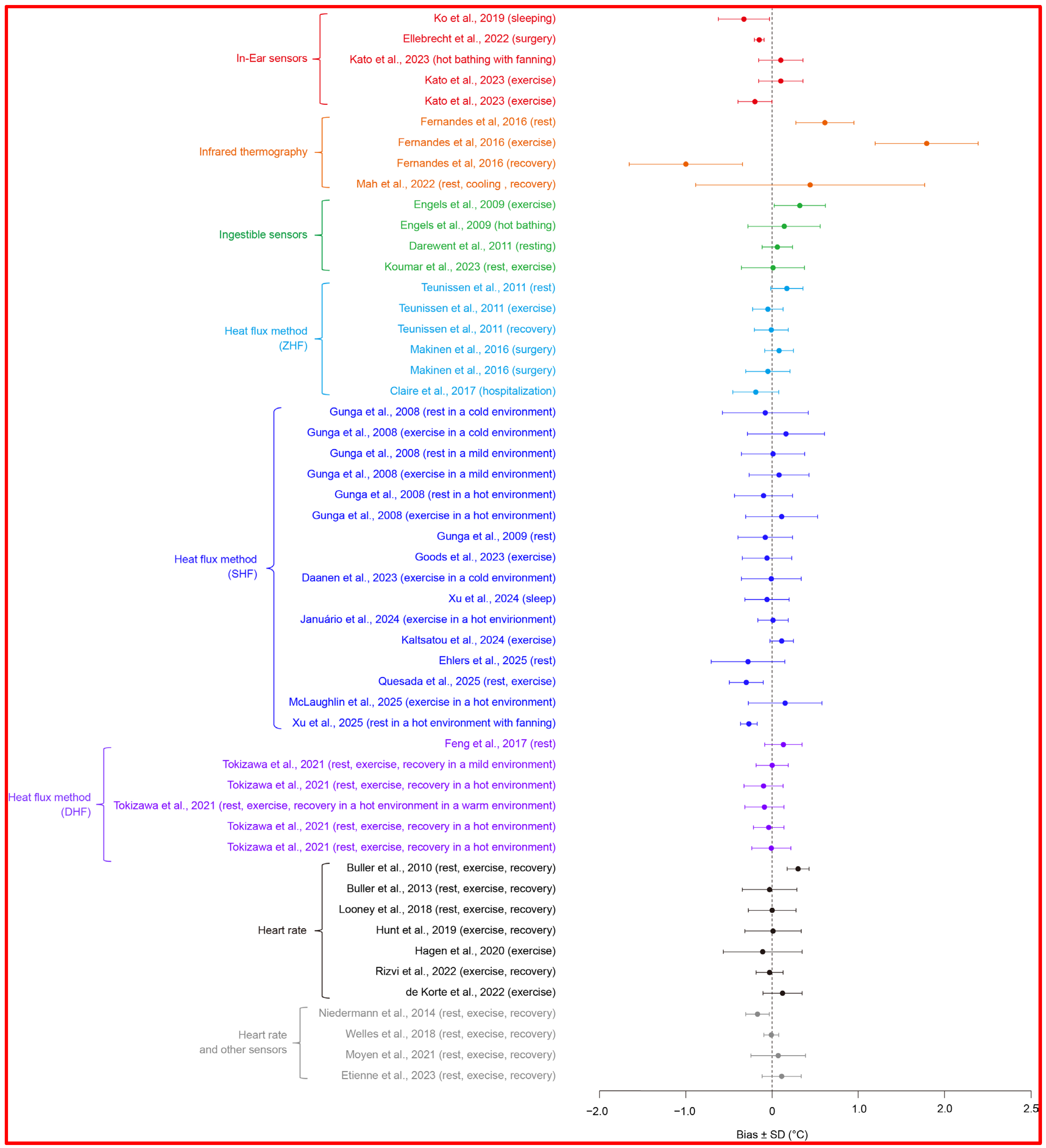
| Measurement Technique | Paper | Subject Types | Number of Validation Subjects, n | Environmental Conditions | Exercise Types | Reference for CBT | Bias ± SD [°C] |
|---|---|---|---|---|---|---|---|
| In-ear sensors | Ko et al. 2019 [34] | Healthy females (24 ± 3 years) | 9 | 27 °C, 50% RH | Sleep | Rectal | −0.32 ± 0.30 |
| Ellebrecht et al. 2022 [38] | Make patients (72 ± 9 years) | 10 | N/A | Surgery | Bladder | −0.15 ± 0.06 | |
| Kato et al. 2023 [36] | Healthy adults (23 ± 2 years) | 9 (6 males, 3 females) | 28 °C, 50% RH | Lower-limb warm-water immersion with 2 m/s airflow | Rectal | 0.10 ± 0.26 | |
| Kato et al. 2023 [36] | Healthy adult males (22 ± 1 years) | 11 | 35 °C, 50% RH | Walking at 4 km/h with 0.5% slope | Rectal | 0.10 ± 0.26 | |
| Kato et al. 2023 [36] | Healthy adults (23 ± 3 years) | 9 (5 males, 4 females) | 35 °C, 65% RH | Running at 6 km/h with a 5% slope | Rectal | −0.20 ± 0.20 | |
| IRT | Fernandes et al. 2016 [49] | Healthy, physically active adult males (22.4 ± 3.3 years) | 12 | 24.9 ± 0.6 °C, 62.3 ± 5.7% RH | Rest | Gastrointestinal | 0.61 ± 0.34 |
| Fernandes et al. 2016 [49] | Healthy, physically active adult males (22.4 ± 3.3 years) | 12 | 24.9 ± 0.6 °C, 62.3 ± 5.7% RH | Exercise (60% VO2max) | Gastrointestinal | 1.79 ± 0.60 | |
| Fernandes et al. 2016 [49] | Healthy, physically active adult males (22.4 ± 3.3 years) | 12 | 24.9 ± 0.6 °C, 62.3 ± 5.7% RH | Recovery | Gastrointestinal | −1.00 ± 0.66 | |
| Mah et al. 2022 [146] | Healthy adults (28.3 ± 9.4 years) | 30 (14 males, 16 females) | 23 °C, 55% RH | Rest, Lower-limb cold-water immersion, recovery | Oral | 0.44 ± 1.33 | |
| Ingestible sensors | Engels et al. 2009 [69] | Healthy adult females (55.3 ± 5.9 years) | 8 | N/A | 75% HRmax exercise | Rectal | 0.32 ± 0.30 |
| Engels et al. 2009 [69] | Healthy adult females (55.3 ± 5.9 years) | 8 | N/A | 40 °C whole-body warm-water immersion | Rectal | 0.14 ± 0.42 | |
| Darewent et al. 2011 [79] | Healthy adult males (22.4 ± 2.4 years) | 11 | 21.0 ± 1.0 °C | Rest | Rectal | 0.06 ± 0.18 | |
| Koumar et al. 2023 [72] | Healthy adults (18–59 years) | 23 (13 males, 10 females) | N/A | In hospital (24 h), fasting, light activity, normal sleep | Rectal | 0.01 ± 0.37 | |
| Heat-flux method (ZHF) | Teunissen et al. 2011 [90] | Healthy moderately fit adults (28.3 ± 5.3 years) | 7 (4 males, 3 females) | 35 °C, 50% RH | Rest | Esophageal | 0.17 ± 0.19 |
| Teunissen et al. 2011 [90] | Healthy moderately fit adults (28.3 ± 5.3 years) | 7 (4 males, 3 females) | 35 °C, 50% RH | Exercise | Esophageal | −0.05 ± 0.18 | |
| Teunissen et al. 2011 [90] | Healthy moderately fit adults (28.3 ± 5.3 years) | 7 (4 males, 3 females) | 35 °C, 50% RH | Recovery | Esophageal | −0.01 ± 0.20 | |
| Makinen et al. 2016 [91] | Vascular surgery patients (64 ± 13 years) | 15 (11 males, 4 females) | N/A | Vascular surgery | Esophageal | 0.08 ± 0.17 | |
| Makinen et al. 2016 [91] | Cardiac surgery patients (68 ± 9 years) | 15 (11 males, 4 females) | N/A | Cardiac surgery | Pulmonary artery | −0.05 ± 0.26 | |
| Clare et al. 2017 [92] | ICU patients (54 ± 5 years) | 52 (27 males, 25 females) | N/A | Rest | Esophageal | 0.19 ± 0.27 | |
| Heat-flux method (SHF) | Gunga et al. 2008 [9] | Healthy adult males (39.5 ± 10.2 years) | 20 | 10 °C | Rest | Rectal | −0.08 ± 0.50 |
| Gunga et al. 2008 [9] | Healthy adult males (39.5 ± 10.2 years) | 20 | 10 °C | Exercise at 35%, 45%, and 55% VO2max) | Rectal | 0.16 ± 0.45 | |
| Gunga et al. 2008 [9] | Healthy adult males (39.5 ± 10.2 years) | 20 | 25 °C | Rest | Rectal | 0.01 ± 0.37 | |
| Gunga et al. 2008 [9] | Healthy adult males (39.5 ± 10.2 years) | 20 | 25 °C | Exercise at 25%, 45%, and 55% VO2max) | Rectal | 0.08 ± 0.35 | |
| Gunga et al. 2008 [9] | Healthy adult males (39.5 ± 10.2 years) | 20 | 40 °C | Rest | Rectal | −0.10 ± 0.34 | |
| Gunga et al. 2008 [9] | Healthy adult males (39.5 ± 10.2 years) | 20 | 40 °C | Exercise at 25%, 35%, and 45% VO2max) | Rectal | 0.11 ± 0.42 | |
| Gunga et al. 2009 [94] | Healthy adult males (31.9 ± 8.0 years) | 7 | N/A | Rest | Rectal | −0.08 ± 0.32 | |
| Goods et al. 2023 [103] | Athlete females (26 ± 4 years) | 19 | 31.0 °C, 38.5% RH | Exercise (Training) | Gastrointestinal | −0.06 ± 0.29 | |
| Goods et al. 2023 [103] | Athlete females (26 ± 4 years) | 19 | 32.2 °C, 50% RH | Exercise (Match) | Gastrointestinal | −0.10 ± 0.37 | |
| Goods et al. 2023 [103] | Athlete females (26 ± 4 years) | 19 | 27.6 °C, 80% RH | Exercise (Match) | Gastrointestinal | −0.17 ± 0.42 | |
| Goods et al. 2023 [103] | Athlete females (26 ± 4 years) | 19 | 27.4 °C, 74% RH | Exercise (Match) | Gastrointestinal | −0.34 ± 0.32 | |
| Daanen et al. 2023 [104] | Healthy adults (24.3 ± 1.2 years) | 9 (4 males, 5 females) | 18 °C, 50% RH | Rest, exercise (cycling), recovery | Rectal | −0.01 ± 0.35 | |
| Xu et al. 2024 [105] | Healthy adults (20–25 years) | 14 (7 males, 7 females) | 16, 20, 24 °C | Rest, sleep | Gastrointestinal | −0.06 ± 0.26 | |
| Januario et al. 2024 [106] | Healthy adults (33.4 ± 8.2 years) | 15 (7 males, 8 females) | 32 °C, 60% RH | Rest, exercise (cycling), recovery | Gastrointestinal | 0.01 ± 0.18 | |
| Kaltsatou et al. 2024 [107] | Chronic heart failure patients (53.5 ± 8.5 years) | 12 (8 males, 4 females) | 28 °C, 39% RH | Rest | Gastrointestinal | −0.14 ± 0.41 | |
| Kaltsatou et al. 2024 [107] | Chronic heart failure patients (53.5 ± 8.5 years) | 12 (8 males, 4 females) | 28 °C, 39% RH | Exercise (Bruce protocol) | Gastrointestinal | 0.06 ± 0.20 | |
| Kaltsatou et al. 2024 [107] | Chronic heart failure patients (53.5 ± 8.5 years) | 12 (8 males, 4 females) | 28 °C, 39% RH | Recovery | Gastrointestinal | 0.11 ± 0.14 | |
| Ehler et al. 2025 [108] | ICU patients (63.3 ± 15.1 years) | 112 (64 males, 48 females) | N/A | N/A | Bladder | −0.38 ± 0.43 | |
| Quesada et al. 2025 [109] | Healthy adults (23 ± 4 years) | 20 (10 males, 10 females) | 22.2 ± 0.5 °C, 37 ± 10% RH | Rest, exercise (cycling), recovery | Gastrointestinal | −0.3 ± 0.2 | |
| McLaughlin et al. 2025 [110] | Healthy adults (30.5 ± 9.23 years) | 24 (13 males, 11 females) | 35.9 ± 0.3 °C, 20.7 ± 3.3% RH | Exercise (cycling) | Rectal | 0.15 ± 0.43 | |
| Xu et al. 2025 [111] | Healthy males (24.7 ± 1.3 years) | 24 | 40 °C, 57–58% RH, 0.15 ± 0.05 m/s | Free-living conditions ranging from rest to low-intensity daily activities (8 h) | Rectal | −0.19 ± 0.27 | |
| Xu et al. 2025 [111] | Healthy females (23 ± 2 years) | 14 | 40 °C, 57–58% RH, 0.15 ± 0.05 m/s | Free-living conditions ranging from rest to low-intensity daily activities (8 h) | Rectal | 0.06 ± 0.26 | |
| Xu et al. 2025 [111] | Healthy males (24.7 ± 1.3 years) | 24 | 40 °C, 57–58% RH, 0.15 ± 3.2 ± 0.4 m/s | Free-living conditions ranging from rest to low-intensity daily activities (8 h) | Rectal | −0.34 ± 0.12 | |
| Xu et al. 2025 [111] | Healthy females (23 ± 2 years) | 14 | 40 °C, 57–58% RH, 0.15 ± 3.2 ± 0.4 m/s | Free-living conditions ranging from rest to low-intensity daily activities (8 h) | Rectal | −0.27 ± 0.10 | |
| Heat-flux method (DHF) | Feng et al. 2017 [115] | Healthy adults (26.8 ± 2.1 years) | 34 (30 males, 4 females) | 26 °C, 50–60% RH | Rest | Sublingual | 0.13 ± 0.22 |
| Tokizawa et al. 2021 [119] | Healthy adults (37 ± 7 years) | 21 (15 males, 6 females) | 25 °C, 35 °C | Rest, exercise, recovery | Esophageal | 0.00 ± 0.19 | |
| Tokizawa et al. 2021 [119] | Healthy adult males (36 ± 8 years) | 9 | 35 °C | Rest, exercise, recovery | Esophageal | −0.10 ± 0.23 | |
| Tokizawa et al. 2021 [119] | Healthy adult males (36 ± 11 years) | 11 | 30 °C | Rest, exercise, recovery | Esophageal | −0.09 ± 0.23 | |
| Tokizawa et al. 2021 [119] | Healthy adult males (36 ± 11 years) | 11 | 40 °C | Rest, exercise, recovery | Esophageal | −0.04 ± 0.18 | |
| Tokizawa et al. 2021 [119] | Healthy adult males (30 ± 6 years) | 8 | 35 °C | Rest, exercise, recovery | Esophageal | −0.01 ± 0.23 | |
| Heart rate (Kalman filter) | Buller et al. 2010 [124] | Soldiers, runners | 25 | 20–40 °C | Exercise (low-to-moderate-intensity exercise, 2–8 h, intermittent) | Rectal, esophageal | 0.30 ± 0.13 |
| Heart rate (extended Kalman filter) | Buller et al. 2013 [127] | Healthy adults (20–30 years) | 83 (82 males, 1 females) | 9–45 °C, 9–97% RH, 0–4 m/s | Treadmill walking/running, cycling, long-distance marching/patrolling; ~1–24 h | Rectal, esophageal, gastrointestinal | −0.03 ± 0.32 |
| Looney et al. 2018 [132] | Healthy males (24 ± 3 years), and females (24 ± 4 years) | 8 (6 males, 2 females) | 18–22 °C | Sleep and light seated activities (≈16 h) | Gastrointestinal | 0.00 ± 0.28 | |
| Hunt et al. 2019 [125] | Healthy adult males (26.4 ± 6.0 years) | 8 | 24 °C, 50% RH; 32 °C, 60% RH | Treadmill walking at 2.5–5.5 km/h with recovery periods | Gastrointestinal | 0.01 ± 0.33 | |
| Hagen et al. 2020 [134] | Healthy adult male athletes (American football) | 13 | N/A | Sports training (5 min × 18–22 sets) | Gastrointestinal | −0.11 ± 0.46 | |
| Rizvi et al. 2022 [137] | Healthy 8 males (21.4 ± 2.3 years) and 8 males (22.7 ± 1.8 years) | 16 | 36 ± 0.5 °C, 59 ± 5% RH, 0.17 ± 0.05 m/s | Treadmill walking at 4.5 km/h with recovery periods | Gastrointestinal | −0.03 ± 0.16 | |
| de Korte et al. 2022 [140] | Elite male (26 ± 5) and female (26 ± 5) athletes | 101 (49 males, 52 females) | 31.6 ± 1.0 °C, 74 ± 5% RH | Graded exercise | Gastrointestinal | 0.15 ± 0.23 | |
| Peggen et al. 2024 [142] | General adults (some on cardiovascular/psychotropic medications) (56 ± 16) | 18 (11 males, 7 females) | N/A | Free-living conditions ranging from rest to low-intensity daily activities (≈26 h) | Gastrointestinal | 0.09 ± 0.22 | |
| Heart rate and other sensors | Niedermann et al. 2014 [10] | Healthy physically active males (23.0 ± 3.9 years) | 10 | 30 ± 0.2 °C, 42.9 ± 1.1% RH, <0.3 m/s | Rest, exercise at 40% and 60% VO2max, recovery | Gastrointestinal | −0.17 ± 0.14 |
| Niedermann et al. 2014 [10] | Healthy physically active males (24.6 ± 2.0 years) | 10 | 10.1 ± 0.2 °C, 49.5 ± 4.9% RH, 0.5 ± 0.1 m/s | Rest, exercise at 60% VO2max, recovery | Gastrointestinal | 0.04 ± 0.28 | |
| Welles et al. 2018 [133] | Healthy adult soldiers (22 ± 4 years) | 8 | 25 °C, 50% RH; 35 °C, 70% RH; 40 °C, 20% RH | Rest, exercise, recovery | Gastrointestinal | −0.01 ± 0.09 | |
| Moyen et al. 2021 [136] | Healthy adults (28.9 ± 7.8 years) | 27 (19 males, 8 females) | 13–43 °C, 11–75% RH | Rest, exercise, recovery | Rectal, gastrointestinal | 0.07 ± 0.32 | |
| Etienne et al. 2023 [141] | Post-vaccination healthy adults (35.8 ± 8.2 years) | 17 | N/A | Free-living conditions ranging from rest to low-intensity daily activities (≈26 h) | Gastrointestinal | 0.11 ± 0.23 |
Disclaimer/Publisher’s Note: The statements, opinions and data contained in all publications are solely those of the individual author(s) and contributor(s) and not of MDPI and/or the editor(s). MDPI and/or the editor(s) disclaim responsibility for any injury to people or property resulting from any ideas, methods, instructions or products referred to in the content. |
© 2026 by the author. Licensee MDPI, Basel, Switzerland. This article is an open access article distributed under the terms and conditions of the Creative Commons Attribution (CC BY) license.
Share and Cite
Hashimoto, Y. A Comprehensive Review of Non-Invasive Core Body Temperature Measurement Techniques. Sensors 2026, 26, 972. https://doi.org/10.3390/s26030972
Hashimoto Y. A Comprehensive Review of Non-Invasive Core Body Temperature Measurement Techniques. Sensors. 2026; 26(3):972. https://doi.org/10.3390/s26030972
Chicago/Turabian StyleHashimoto, Yuki. 2026. "A Comprehensive Review of Non-Invasive Core Body Temperature Measurement Techniques" Sensors 26, no. 3: 972. https://doi.org/10.3390/s26030972
APA StyleHashimoto, Y. (2026). A Comprehensive Review of Non-Invasive Core Body Temperature Measurement Techniques. Sensors, 26(3), 972. https://doi.org/10.3390/s26030972