2.1. Linear Phased Array Feed Pattern Model
The phased array feed achieves flexible control of beam direction and shape by adjusting the phase and amplitude of each TR module, enabling rapid beam scanning, beam reshaping, and precise spatial pointing [
28,
29,
30]. According to the theory of phased array feeds, phased array antennas adjust the phase shifters to change the relative phase between elements. This adjustment steers the beam’s maximum radiation direction. As a result, the antenna achieves regular spatial scanning and predictable patterns [
31]. The characteristics of the feed radiation field are determined by parameters such as the precise geometric dimensions of the feeding elements, the pattern, and the complex excitation coefficients. Based on the field superposition principle, the far-field strength of the phased array feed in any given direction is determined by the coherent superposition of the radiated fields from individual elements. This process involves a vector summation that accounts for both amplitude and phase. When the polarization directions of the elements are consistent, the vector sum can be simplified to scalar addition [
32], thereby directly characterizing the radiation properties of the phased array feed.
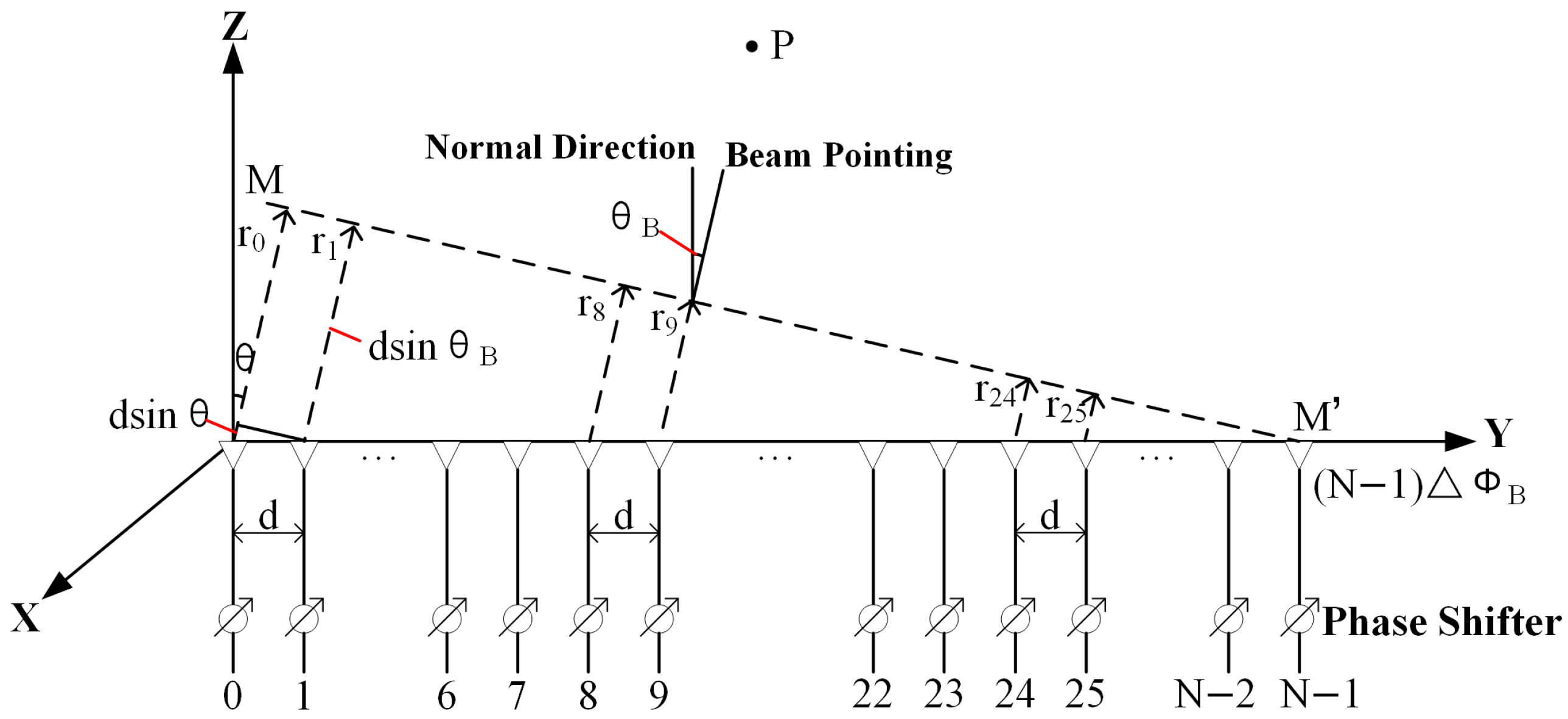
Based on the principles of phase scanning and the field superposition, the feed excitation model of a linear phased array feed consisting of
N elements is analyzed (
Figure 1). Assuming each feed is a point radiation source with equal-amplitude, phase-excited excitation without error. Assuming no mutual coupling between feeding elements, and that the spacing between each element is equal to
d.
The far-field strength
at observation point
P due to the
n-th feeding element is given by the following:
where
is a proportionality coefficient related to the radiation strength of the
n-th element (identical for all elements with the same geometry [
32]),
is the wavenumber,
is the wavelength,
is the complex excitation current of the
n-th element, and
is the element pattern that is determined solely by its geometry, dimensions, and independent of the array configuration. In modeling, the linear feed employs
model to approximate the unit pattern function, where
represents the angle between the line-of-sight direction from the feed unit to a point on the reflector surface, and the feed’s main radiation direction, and
q is the beamwidth factor.
When the observation point
P is in the far-field, the distances from each element to the point can be approximately parallel. Taking the first element as the phase reference, the spatial phase difference caused by the different positions of each element in the ideal state is as follows:
The overall directional pattern model of the linear phased array feed is synthesized based on the principle of electric field superposition as follows [
33]:
where Δ
is the spatial phase difference determined by relative element positions (sensitive to manufacturing errors, positional offsets, structural deformations), and
is the phase difference within the array controlled by two adjacent phase shifters (affected by errors such as source instability, channel distortion, phase quantization, mutual coupling).
In order to achieve rapid spatial scanning of the beam, a variable phase shifter is connected after each element [
31], as shown in
Figure 1, set the phase shift amounts of each element phase shifter to be respectively
. When the beam is steered toward
, the phase shifters are adjusted so that their phase shifts exactly compensate for the path-induced phase differences, resulting in coherent addition of the fields and a maximum in the desired direction. The phase difference within the array controlled by the phase shifter is
. By adjusting the phase difference within the array, the antenna beam direction is controlled. The beam direction changes from the direction of the array normal
to the direction of the beam
. The electromagnetic waves
excited by each feeding element along the line in
Figure 1 have the same phase, referred to as an in-phase wavefront. The direction of the beam maximum pattern is perpendicular to the in-phase wavefront [
34].
In summary, when each feeding element remains in an ideal condition, the overall pattern model excited by the linear phased array feed can be expressed as follows:
2.2. Parabolic Cylindrical Reflector Pattern Model
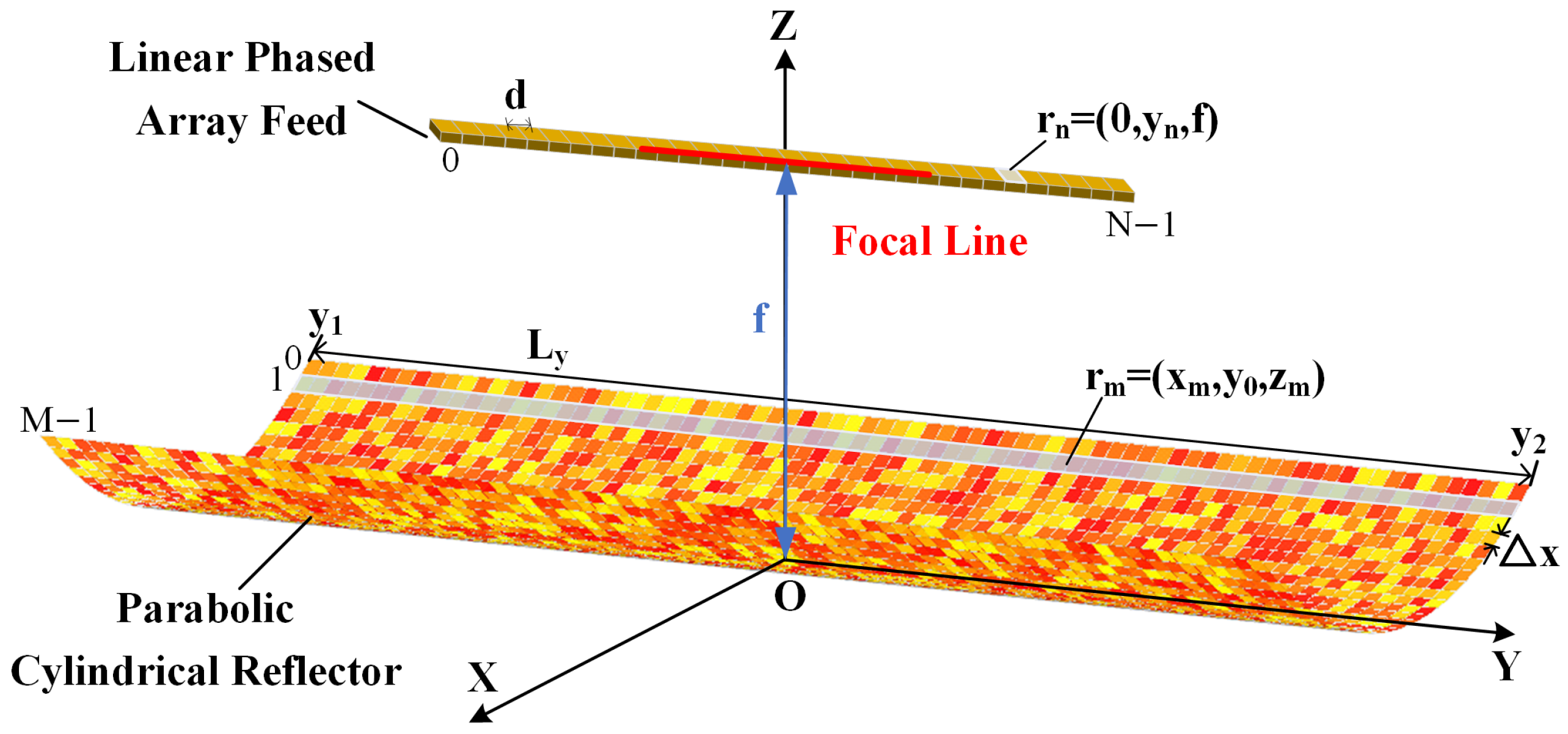
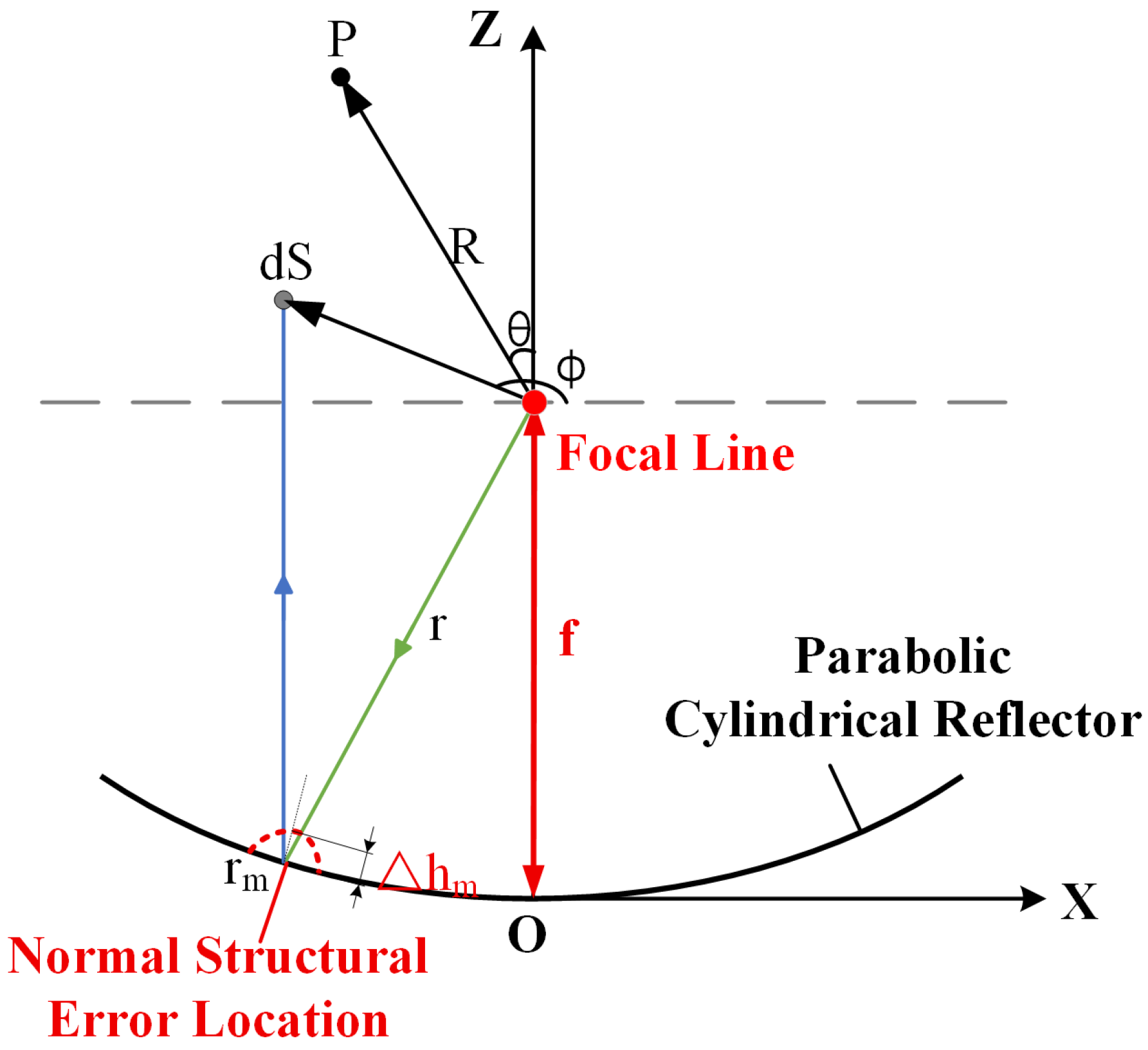
The parabolic cylindrical reflector is formed by translating a parabola along the normal of its plane. There are usually two types of feed: one places a point source at a specific location on the focal line; the other, employed in this study, is the phase center of the linear phased array feed, which is located on the focal line of the parabolic cylindrical reflector. In this case, the phase of the antenna aperture field remains in phase, and the overall structure is shown in
Figure 2. To precisely describe the geometric relationship between the feed and the reflector, the vertex of the parabolic reflector is defined as the origin
of the global coordinate system. The
Y axis is parallel to the extension of the parabolic reflector’s focal line. The
Z axis is perpendicular to the tangent plane at the reflector vertex and points toward the feed. The
X axis is perpendicular to the
Y-
Z plane.
Perpendicular to the focal line, the parabolic cylindrical antenna system forms a fixed normal beam (without array scanning capability) due to significant reflector curvature variation and no feed distribution. Its radiation characteristics are jointly determined by the feed’s radiation performance and the antenna’s focusing properties [
35]. Parallel to the focal line, the system has beamforming capability, with beam scanning achieved by adjusting the phase of the feeding elements to meet the requirements of various SAR imaging modes.
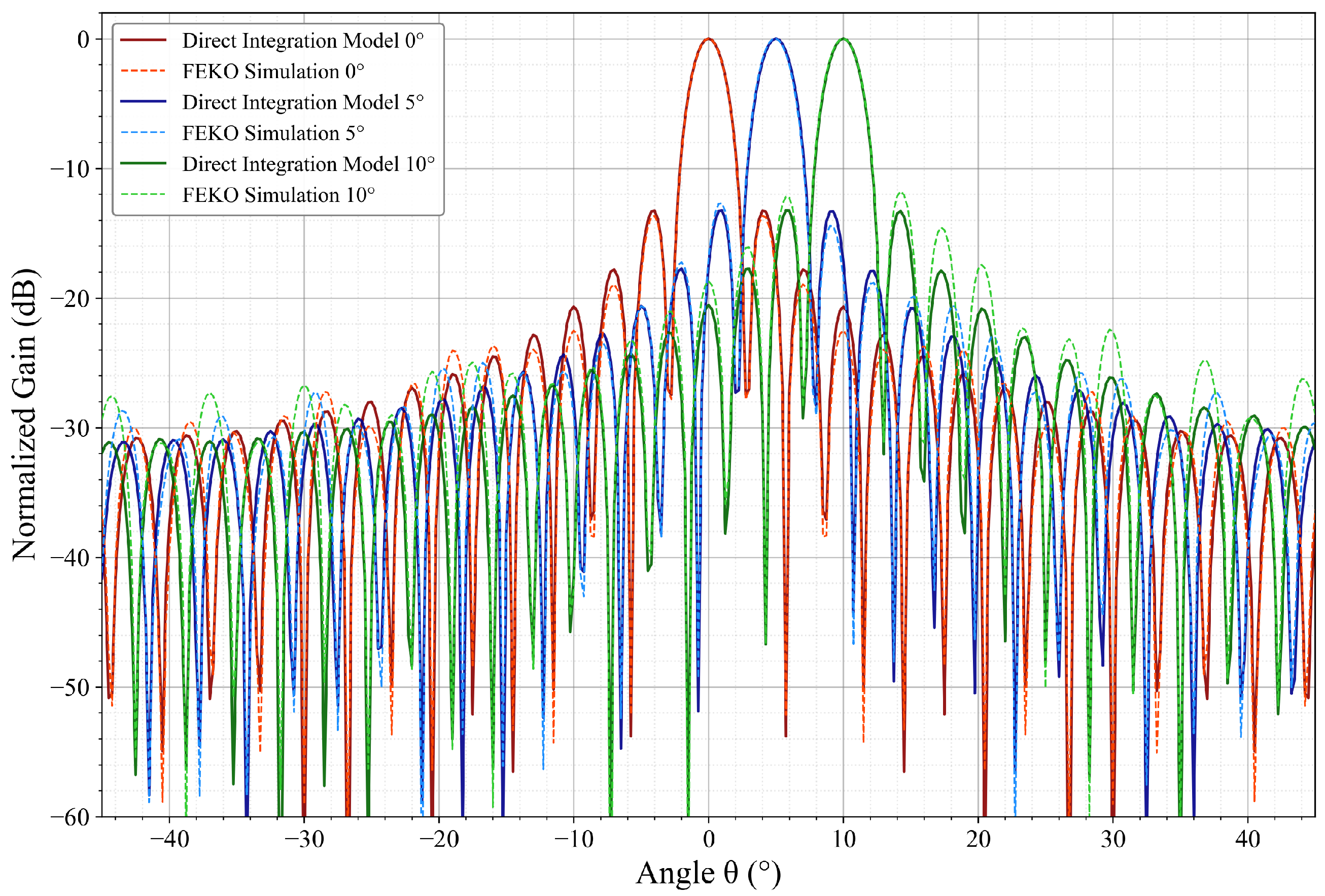
This study aims to construct a model capable of evaluating the impact of multi-source structural errors on far-field radiation patterns. To this end, the following assumptions are made based on high-frequency approximation theory. The validity of these assumptions is verified via FEKO simulations at the end of this section.
1. Mutual coupling between elements and multiple reflections are neglected: For the electrically large antennas investigated in this work, the PO method accurately characterizes the radiation of the main lobe and sidelobes. The pattern distortion caused by multi-source structural errors significantly outweighs perturbations from mutual coupling, making this assumption valid, particularly for high-frequency applications.
2. Scattering effects from reflector edges, transition zones, and shadow regions are neglected: In parabolic cylindrical antennas, energy is highly concentrated within the main beam. Consequently, the influence of edge diffraction fields on the main lobe and near sidelobes is minimal, rendering this approximation sufficient for most practical scenarios.
3. Feed blockage effects on the reflection path are ignored: This simplification allows the model to be directly adapted to offset-fed structures, which are widely used in SAR systems. Additionally, it serves as an ideal performance benchmark for center-fed structures (as shown in the figures in this paper) by excluding blockage effects. However, for scenarios involving severe feed blockage or requiring high-precision cross-polarization analysis, these factors should be addressed in future studies.
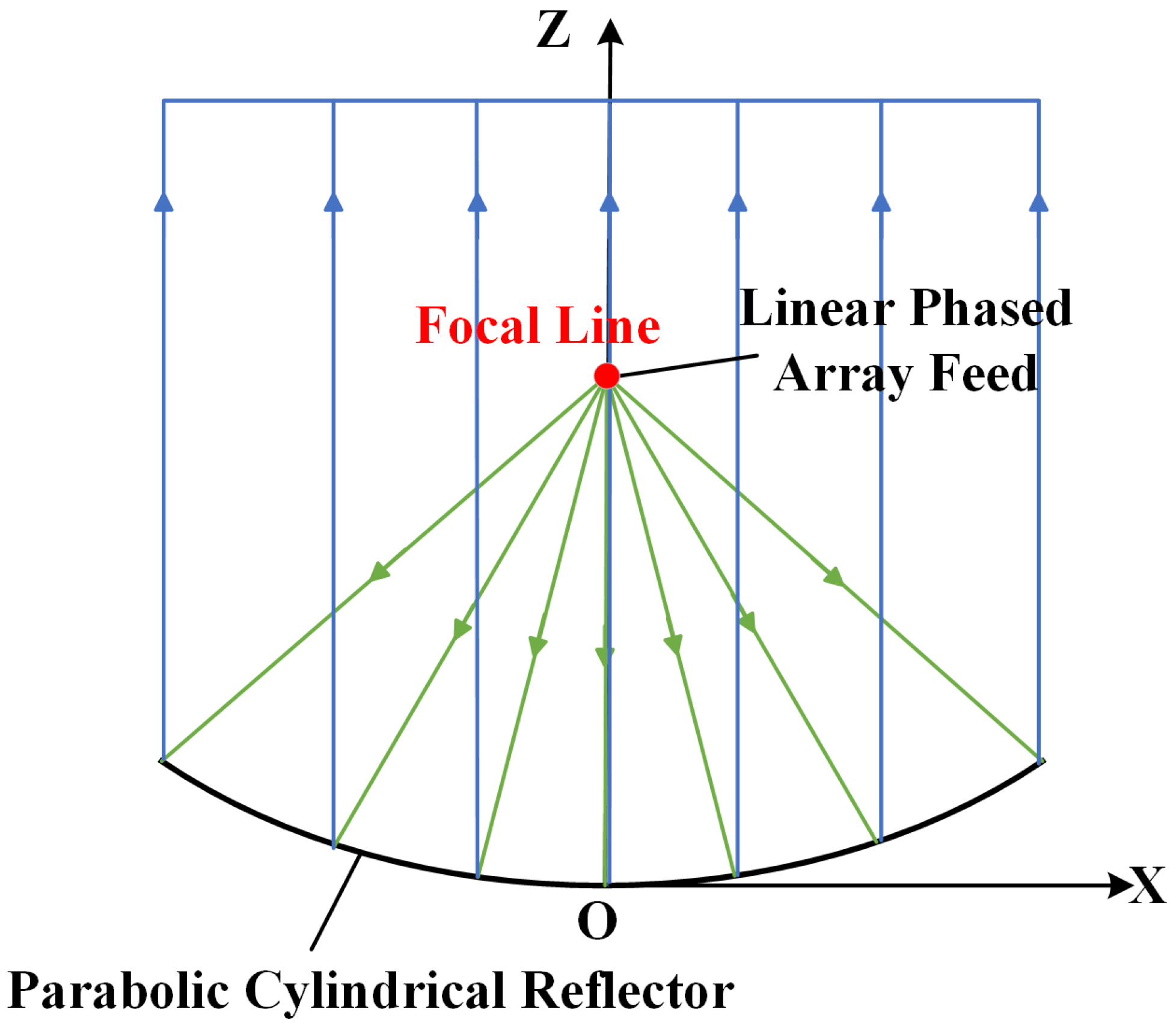
The reflection principle of a parabolic cylindrical reflector is shown in
Figure 3. The linear phased array feed generates a sector wave centered on the focal line. After reflection by the parabolic cylindrical reflector, one-dimensional focusing is achieved in the direction perpendicular to the focal line. The reflected wavefront approximates a plane wave. It maintains its fan beam characteristic along the focal line and serves solely as a reflector without a focusing effect. The parabolic cylindrical antenna is generally a fan beam antenna and is suitable for a radar system with wavelengths ranging from centimeters to meters [
17,
35,
36].
The specific processes of constructing the parabolic cylindrical antenna’s far-field pattern model based on the PO method are: First, calculate the equivalent surface current induced by the primary feed’s radiation field on the reflector. Second, compute the far-field radiation of the equivalent surface current using the radiation integral. Finally, derive the antenna’s far-field pattern.
Assuming the focal line is along the
Y axis, the geometry of the parabolic cylindrical reflector is approximated as follows:
where
f is the focal length. The element normal vector
at any point
on the parabolic cylinder is represented by the gradient direction.
The incident wave electric field at a point on the parabolic cylindrical reflector for the
n-th feeding element in a linear phased array feed system is as follows:
where
is the excitation amplitude of the feeding element, Δ
is the excitation phase of two adjacent feeding elements,
is the position vector of the
n-th feeding element,
is the position vector of the
m-th discrete element on the reflector,
is the actual distance between the feeding element and the reflective surface element,
is the main radiation direction range vector of the feeding element,
is the element polarization vector describing the direction of the electric field vector in space. For a single polarized array, if the electric field is a horizontally polarized wave along the
X axis, then
; if the electric field is a vertically polarized wave along the
Z axis, then
.
According to the principle of field strength superposition, the total incident electric field at a discrete element on the parabolic cylindrical reflector, generated by the feeding array mechanism, is the vector superposition of the
N electric fields of the elements, which can be described as follows.
According to the PO method, the equivalent current density at this position on the parabolic cylindrical reflector is shown in (
8).
where
is the element normal vector at point,
is the incident magnetic field given by (
9).
where
is the free space wave impedance.
is the incident wave element vector. When the linear phased array feed is excited, it is typically represented by the element vector pointing from the feed center to the reflector, i.e.,
.
The far-field pattern is obtained by integrating the equivalent current over the reflector, as written in (
10).
where
is the element vector of the far-field observation direction of the incident wave after reflection in the spherical coordinate system, and
is the area element of the reflector.
Substituting the total incident field (
7), the equivalent current (
8) and (
9) into the far-field integral expression (
10), the far-field pattern yield is shown in (
11):
where
is the polarization vector factor containing the normal vector of the reflector, the incident direction, and the polarization direction;
is the overall amplitude factor of the model;
is the overall phase factor of the model consisting of four components: the scanning phase
of the feed, the actual path propagation phase
from the feed to the reflector, the actual projection phase
from the reflector to the far-field, and the polarization vector phase
.
In order to more accurately discuss the impact of structural errors on the electromagnetic characteristics of the reflected wave, the parabolic cylindrical reflector is discretized in one-dimension along the
X axis with the largest curvature change. It is divided into
M grid cells, with the cell center at
and the cell discretization length as
. Continuous integration is performed along the focal line direction where the curvature change is approximately constant, with an integration length of
. It can be further obtained as follows:
2.3. Comprehensive Analysis and Modeling of Errors in Linear Array-Fed Parabolic Cylindrical Antennas
This research focuses on the installation position error which is a type of structural error, defined as the random spatial offset of feeding elements relative to their designed positions during installation or application. This error directly induces non-ideal spatial phase differences in far-field radiation by changing the geometric paths between array elements [
37,
38], without changing the in-array phase differences controlled by the phase shifter. The adverse effect of the feed installation position error on the antenna pattern is significant, typically including main lobe offset, gain reduction, and sidelobe level rise [
39].
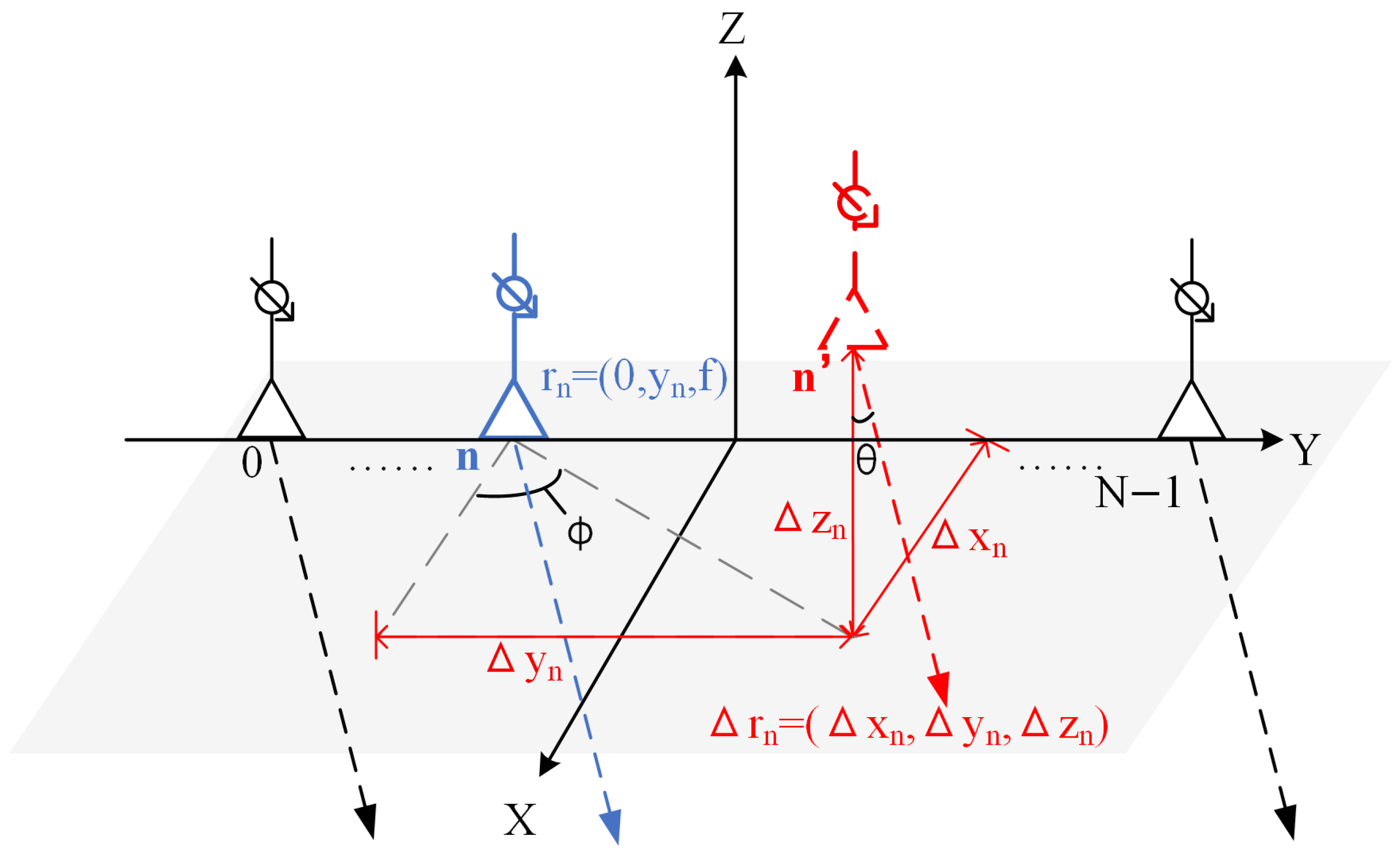
Under ideal condition, assuming the linear feed array is positioned at global coordinate
, with the primary radiation direction along the
axis pointing toward the reflector, a certain feed unit generates an error offset
as shown in
Figure 4.
For each feeding element with installation-position errors, an additional path difference is introduced by its position deviation. With these errors taken into account, the actual position of the
n-th feeding element is as follows:
Due to the change in the spatial position between the feed, the spatial phase difference varies. Under the influence of errors, the overall pattern model of the linear phased array feed becomes the following:
The surface error of the parabolic cylindrical reflector is another important factor affecting antenna performance. Its causes are complex and may involve multiple factors, such as self-weight, manufacturing processes, and environmental thermal effects [
40,
41]. The normal structural error, the focus of this research, is defined as the deviation between the local normal direction of the reflector and its ideal designed value. This error disrupts the incident path, inducing phase distortion in the reflected wavefront. Consequently, it leads to several performance degradations: reduced antenna gain, beam pointing deviation, sidelobe elevation, and beam broadening [
42].
A partitioned superposition approach is proposed to solve this problem. First, the reflector is discretized one-dimensionally along the direction with dramatic curvature changes. Next, the impact of the normal structural error of each discrete element on the local radiation field is evaluated. Finally, coherent superimposition of the radiation fields from all discrete elements yields a pattern model incorporating the reflector’s overall normal structural error [
42,
43].
Assuming that structural errors in the reflector cause a discrete element to deviate from its theoretical position, resulting in a small normal offset
, where positive direction indicates a protrusion, and the negative direction indicates a depression, as shown in
Figure 5.
When the center position of the ideal grid is slightly offset due to local normal errors, the actual grid center position
is as follows:
Reflector normal structural error induces dual-phase perturbation in the far-field pattern: it not only modifies the actual incident wave path length from the feed to the error location, but also varies the reflected path from this location to the far-field. The resulting phase distortion arises from the coherent superposition of these two phase perturbations.
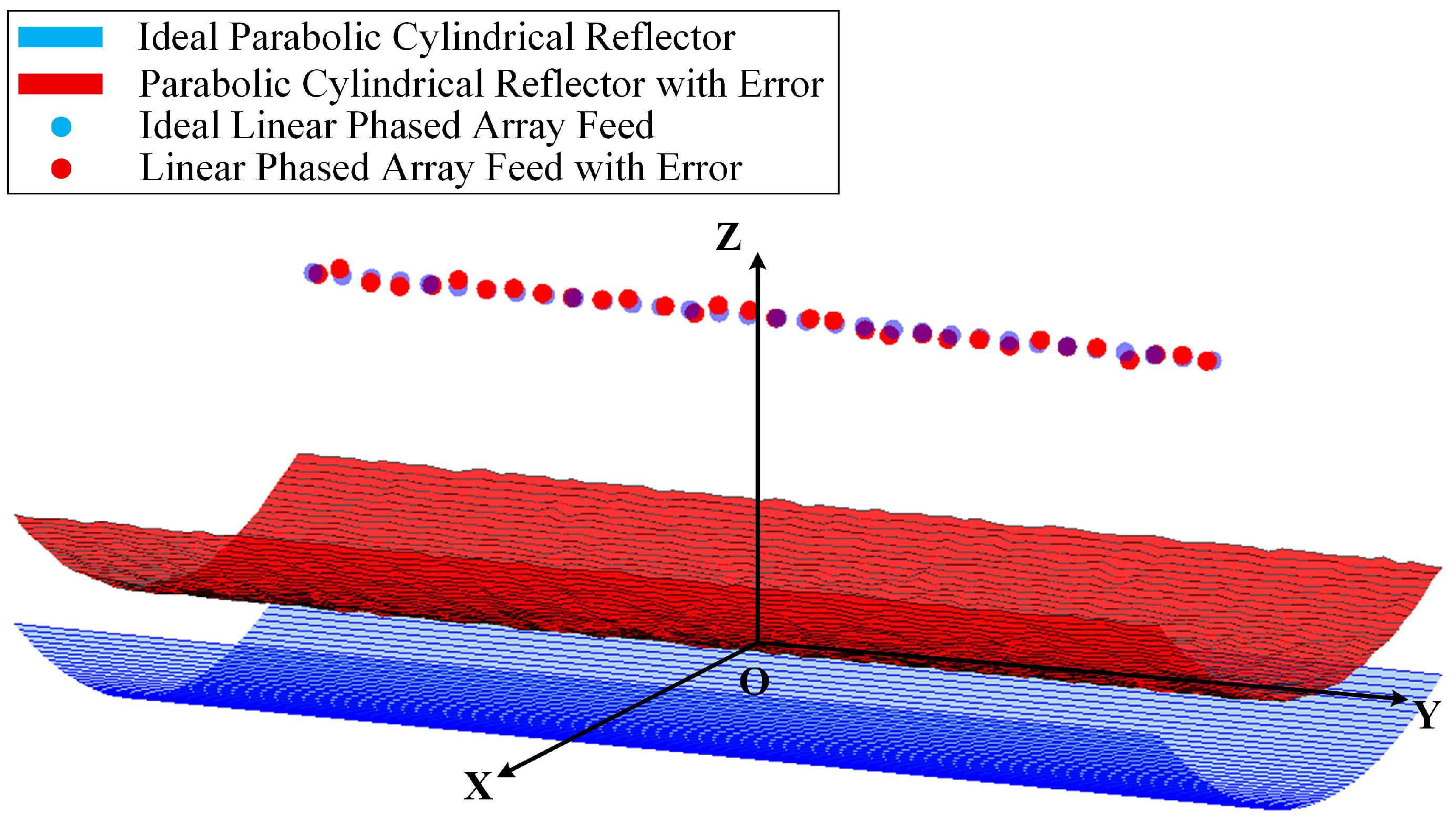
A simulation model of the linear array-fed parabolic cylindrical antenna system is established by incorporating the three-dimensional random position deviation of the phased array feed and random normal deformation of the reflector (
Figure 6). The blue model represents the ideal structure without errors, and the red model corresponds to the structure with the two aforementioned errors. A slight
Z-axis translation of the ideal reflector is applied for visual clarity only, with no impact on simulation physics or results.
The coexistence of multi-source structural errors exerts a dual modulation effect on the antenna radiation field. The path vector from the feed to the reflector is as follows:
On the one hand, the feed’s position error first modifies the initial phase of the incident wave across the reflector. Interacting with the reflector’s normal errors, it induces secondary perturbations in the reflected wave’s path and phase, which collectively disrupt the reflected wave’s coherent superposition and thus alter the far-field pattern’s radiation characteristics. In the parabolic cylindrical pattern model, it is reflected that the precise path phase
from the feed to the reflector and the far-field projection phase
change respectively, which lead to the two key phase factors in (
12), respectively becoming
and
, produce nonlinear phase distortion.
Moreover, structural errors alter the relative position between the feed and the reflector. This alters the incident field amplitude by varying the local illumination angle and propagation path length. Consequently, the radiation pattern function of the feeding element is expressed as follows:
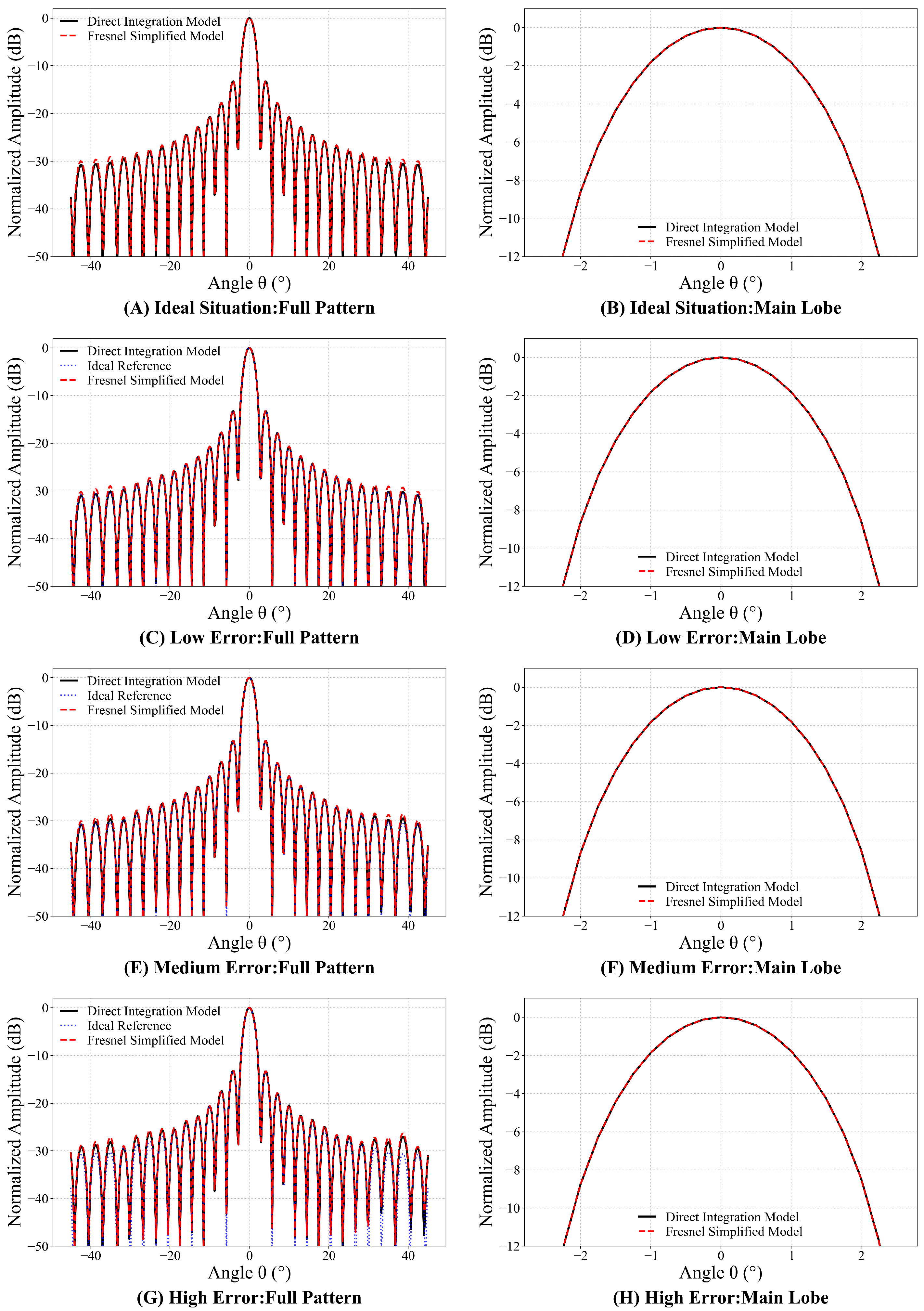
The direct integration pattern model of the parabolic cylindrical antenna is as shown in (
18):