
Article

Quantifying the Trajectory Tracking Accuracy in UGVs: The Role of Traffic Scheduling in Wi-Fi-Enabled Time-Sensitive Networking

1
Department of Information Engineering, University of Padova, 35131 Padova, Italy
2
National Research Council of Italy—IEIIT, 35131 Padova, Italy
3
Department of Management and Engineering, University of Padova, 36100 Vicenza, Italy
4
National Research Council of Italy—IEIIT, 10129 Torino, Italy
*
Author to whom correspondence should be addressed.
These authors contributed equally to this work.
Sensors 2026, 26(3), 881; https://doi.org/10.3390/s26030881
Submission received: 1 November 2025 / Revised: 13 January 2026 / Accepted: 26 January 2026 / Published: 29 January 2026

Abstract

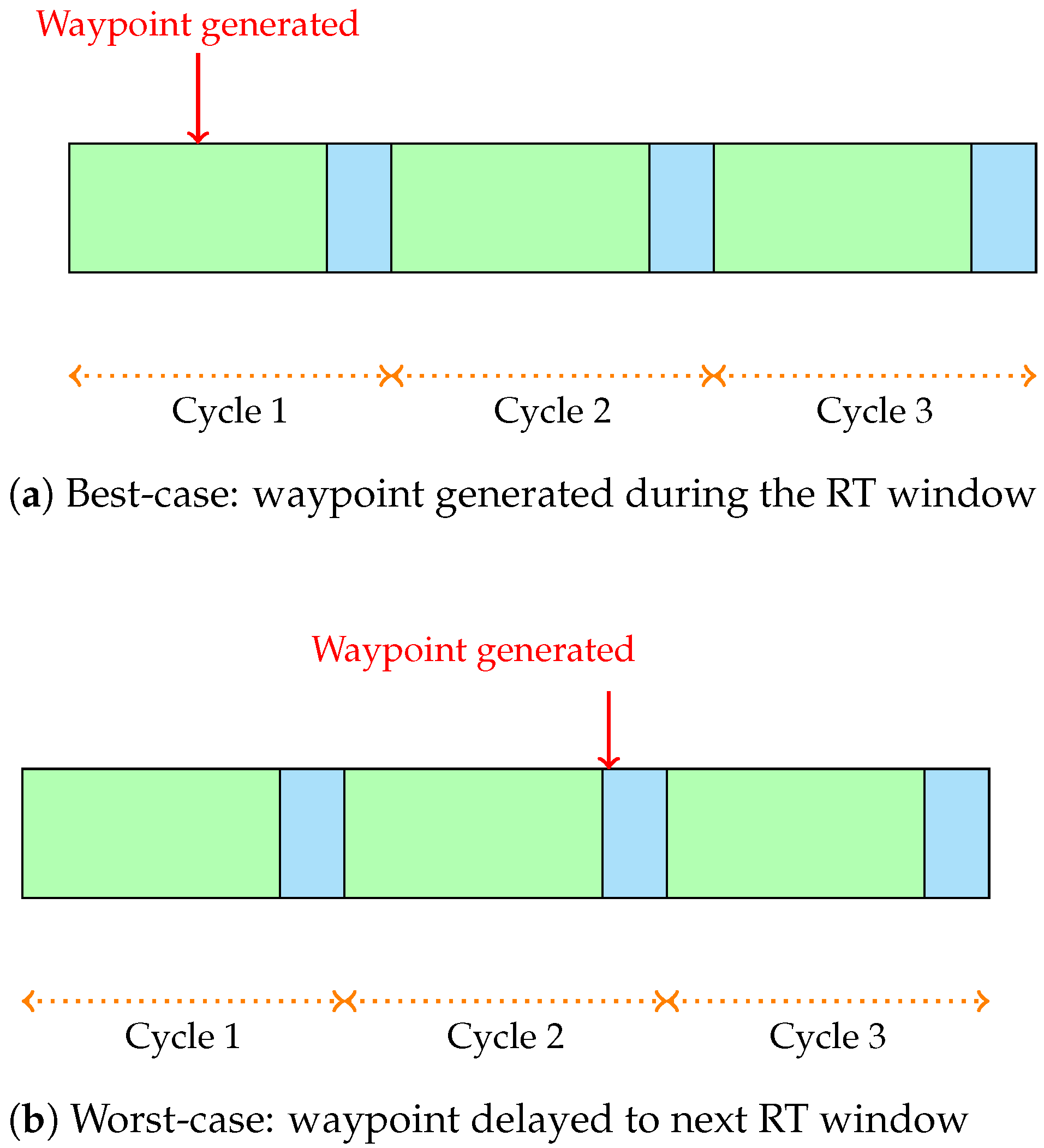
Accurate trajectory tracking is a key requirement in unmanned ground vehicles (UGVs) operating in autonomous driving, mobile robotics, and industrial automation. In wireless Time-Sensitive Networking (WTSN) scenarios, trajectory accuracy strongly depends on deterministic packet delivery, precise traffic scheduling, and time synchronization among distributed devices. This paper quantifies the impact of IEEE 802.1Qbv time-aware traffic scheduling on trajectory tracking accuracy in UGVs operating over Wi-Fi-enabled TSN networks. The analysis focuses on how misconfigured real-time (RT) and best-effort (BE) transmission windows, as well as clock misalignment between devices, affect packet reception and control performance. A mathematical framework is introduced to predict the number of correctly received RT packets based on cycle time, packet periodicity, scheduling window lengths, and synchronization offsets, enabling the a priori dimensioning of RT and BE windows. The proposed model is validated through extensive simulations conducted in an ROS–Gazebo environment, utilising Linux-based traffic shaping and scheduling tools. Results show that improper traffic scheduling and synchronization offsets can significantly degrade trajectory tracking accuracy, while correctly dimensioned scheduling windows ensure reliable packet delivery and stable control, even under imperfect synchronization. The proposed approach provides practical design guidelines for configuring wireless TSN networks supporting real-time trajectory tracking in mobile robotic systems.
Keywords: time-sensitive networking (TSN); wireless TSN; IEEE 802.1Qbv; trajectory tracking; unmanned ground vehicles (UGVs); traffic scheduling; real-time communication; mobile robotics; networked control systems; Wi-Fi TSN time-sensitive networking (TSN); wireless TSN; IEEE 802.1Qbv; trajectory tracking; unmanned ground vehicles (UGVs); traffic scheduling; real-time communication; mobile robotics; networked control systems; Wi-Fi TSN