1. Introduction
The rapid proliferation of interconnected mobile and Internet of Things (IoT) devices has transformed the collection and processing of personal data, particularly in the domain of digital health. Mobile health applications (also known as mHealth), wearable sensors, and IoT platforms now operate as integrated ecosystems capable of continuously monitoring physiological, behavioral, and environmental signals. While these technologies enable personalized healthcare and data-driven wellness services, they also amplify privacy and transparency risks by increasing the volume, sensitivity, and contextual diversity of user data being collected and shared [
1].
However, the ability of end users to check if the apps they use respect their privacy remains limited by the opacity of data-handling practices across mobile and IoT applications [
2,
3]. In this context, there is a growing need for systematic, data-driven tools capable of automating the evaluation of privacy-related metadata, able to assist end users to identify potential privacy risks across heterogeneous mobile and IoT environments. That is, to help them to make effective their (GDPR) (General Data Protection Regulation (GDPR),
Regulation (EU) 2016/679 of the European Parliament and of the Council of 27 April 2016 on the protection of natural persons with regard to the processing of personal data and on the free movement of such data, and repealing Directive 95/46/EC (General Data Protection Regulation).) right to be informed in a clear understandable manner, and to consent or refuse personal data treatments (right to consent). Existing approaches often target isolated aspects of the problem—such as static analysis of permissions, natural language processing of privacy policies, or crowdsourced transparency reports—but lack integration within a reproducible and interpretable ecosystem [
4]. Moreover, it is difficult for mobile privacy researchers to find these non-isolated metadata repositories that can be queried to obtain data for research purposes. This was the situation we faced when we intended to test our own privacy indicators and revised the available datasets and repositories [
5,
6,
7,
8]. This issue primarily motivated the work presented in this article, which is also inspired by open infrastructures such as AndroZoo [
9].
To address these challenges, App-PI (App Privacy Impact), a modular and extensible ecosystem designed to operationalize automated privacy analysis across mobile and IoT applications was designed. App-PI implements a complete end-to-end data flow—from metadata ingestion and transformation to analysis, verification, and visualization—supported by the App-PIMD repository, which consolidates multi-source privacy metadata. Although the ecosystem is domain-agnostic, it is demonstrated here in the mHealth context, where privacy sensitivity and data heterogeneity are particularly pronounced. This is especially relevant in mHealth environments, which are closely aligned with IoT environments that enable continuous, sensor-driven data collection and connectivity.
The research question that motivates the design of the data flow presented by App-PI is how to make effective the right to be informed of mobile application users in general. In other words, any user, regardless of their profile, should be able to access useful and reliable information about the impact that the applications they use may have on their privacy. Such tools are currently scarce. The generality of the profile refers above all to technical and intellectual capabilities, and the ability to pay for these services. There is no doubt that expert knowledge can provide the best quality information, but it comes at a cost. App-PI proposed a system based on the automatic construction of tools that inform users. Although automation means giving up the best of expert knowledge, it offers the possibility of building affordable tools for any user with adequate information quality to assist them in their self-protection.
The flow and processing of data that supports the construction of indicators and visualization tools for users of health applications is shown. Modular ETL pipelines are used for automated metadata collection, normalization, and integration into the App-PIMD repository. The App-PIMD repository provides researchers and privacy-service developers with accurate, high-quality, up-to-date data that supports empirical analysis, reproducible research, and actionable indicators for users. Two principles guide the design of this data flow. First, to provide reliable, high-quality data so that the information users receive is reliable and useful for protecting their privacy. Secondly, to provide this information in a simple, easy-to-understand way for any user profile, with the same aim. To this end, the construction of indicators and visualization tools is proposed, some of which are presented in this article. The whole process is illustrated through a real-world case study, (Samsung Health), chosen because of its popularity between mHealth users.
The remainder of this paper is structured as follows.
Section 2 reviews the state of the art and related work in privacy transparency and app analyses.
Section 3 details the architecture and data flow of the App-PI ecosystem.
Section 4 and
Section 6 present the mHealth case study and discuss the empirical findings. Finally,
Section 5,
Section 7, and
Section 8 summarize the results and conclusions and outline future research directions.
2. State of the Art and Related Work
2.1. Privacy and Digital Health in the Internet of Everything (IoE)
Health and wellness applications represent one of the fastest-growing segments of the digital economy. In 2024, the global revenue of the health app industry reached USD 3.74 billion in global revenue, marking a 9% growth from the previous year (
https://www.businessofapps.com/data/health-app-market/, accessed on 7 January 2026). This growing popularity aligns with the wider IoE ecosystem, where wearable and mobile sensors continuously generate sensitive personal and physiological data.
The convergence of medical IoT, data analytics, and cloud ecosystems offers unprecedented opportunities for personalized care but simultaneously multiplies privacy challenges [
2,
3]. Recent research argues that the success or failure of mobile-health data protection strategies depends not only on technical measures, but on the interplay between contextual system, user, task and other factors, which can result in significant harm to individuals [
10].
Since Android 14, Google introduced a new permission model through
HealthConnect and the
HealthPermissions group (
https://developer.android.com/reference/android/health/connect/HealthPermissions, accessed on 7 January 2026), providing on-device governance of health data exchange. Although this marks progress toward privacy-by-design architectures, it also highlights the lack of independent mechanisms to assess whether health apps use permissions responsibly or consistently with their declarations.
2.2. Regulatory and Ethical Frameworks for Health Data Privacy
Beyond technical architectures, privacy assurance in health apps is deeply influenced by evolving regulatory landscapes. The
General Data Protection Regulation (GDPR) in Europe and the
Health Insurance Portability and Accountability Act (HIPAA) in the United States define explicit requirements for consent, purpose limitation, and data minimization. Emerging frameworks such as the
EU AI Act extend these requirements to algorithmic transparency and accountability [
11]. Researchers emphasize that ethical oversight in digital health must extend beyond traditional norms, focusing on accountability, fairness, and protection of vulnerable users [
12].
The App-PI ecosystem aligns with these principles by operationalizing user’s right to be informed in accordance with GDPR principles in article 5—Lawfulness, fairness, and transparency—through data evidence stored in structured repositories.
2.3. Automated Privacy Assessment and Transparency Mechanisms
Traditional privacy labeling systems, such as Apple’s
App Privacy Details and Google Play’s
Data Safety section, provide self-declared summaries of data practices. However, these mechanisms rely on manual developer input and often lack empirical verification [
13,
14]. Recent works propose automated transparency pipelines that analyze app binaries, permissions, and network flows to infer actual data usage [
15,
16,
17,
18,
19]. Approaches such as
PrivacyMeter [
20] and
Polisis [
21] apply natural language processing to privacy policies. However, these developments focus on analyzing app privacy in isolation, without systematically comparing declared and observed behaviors through machine-readable evidence, which can lead to inaccurate assessments of overall privacy.
Literature reviews indicate that the majority of complete privacy assessment approaches available to end users are technically focused, as the isolated approaches discussed in the previous paragraph [
22,
23]. These approaches overcome the limitations of isolated analyses by combining multiple technical methods (e.g., static and dynamic analysis, network traffic inspection), which makes them efective at identifying privacy risks. However, they are not easily adaptable to address non-technical issues, such as transparency assessments across privacy labels or policies [
24,
25]. Moreover, these approaches frequently overlook user perspectives and rely on opaque analysis techniques, which has been shown to be an issue when it comes to assessing privacy in mHealth applications [
26,
27,
28]. Those that are more hybrid-focused tend to be organization-centric, such as IoTPrivComp [
29] and the NIST Privacy Framework [
30]. While these are available frameworks that can be adopted by practitioners, they also do not provide users with tools to assess the impact on their privacy. App-PI complements these efforts with a user-oriented approach.
2.4. Metadata Repositories and Privacy Intelligence Infrastructures
Metadata repositories have long supported empirical privacy research [
5]. Projects such as AndroZoo [
6,
9], Exodus Privacy (
https://exodus-privacy.eu.org/, accessed on 7 January 2026), and PrivacyGrade [
31] enabled large-scale analyses of Android apps by collecting APKs and static privacy signals. However, most of these initiatives focus on code and permissions rather than integrating broader metadata—such as privacy policies or the consistency between declared and actual data practices [
5].
Later efforts like AndroVault [
7,
8] expanded these repositories by adding structured relationships and knowledge graphs among apps. However, these systems are limited in scope, as they do not incorporate modern disclosure elements (e.g., Google Play’s
Data Safety section) and mostly rely on pre-2017 datasets, which precede key privacy updates such as Health Connect and the current Android permission model [
32]. Other repositories [
33] capture additional metadata such as code evolution from open-source projects, but this excludes most proprietary apps actually used by end users.
The App-PIMD repository extends these prior efforts by merging heterogeneous sources into a unified, machine-readable schema. As part of the App-PI ecosystem, it acts as a foundational privacy assurance infrastructure, enabling the reproducible and large-scale monitoring of mobile app privacy.
2.5. Emerging Approaches: AI-Assisted Privacy Auditing and User-Centric Tools
Recent years have seen the emergence of AI-driven methods for privacy auditing. Building on advances in natural language processing and deep learning, machine learning models are now used, identify potential misuse of sensitive data, and classify apps by privacy risk level [
34]. Large language models (LLMs) have also been leveraged to automatically interpret complex privacy policies [
35]. On the user side, interactive visual analytics tools—such as
AppCensus [
36]—have demonstrated the value of making permission risks and data flows accessible to non-expert audiences. However,
AppCensus is now a commercial service and not openly available for research use, which limits its applicability for reproducible studies. Building on this line of work, App-PI integrates an open visualization layer that links transparency metrics with user-oriented dashboards, enabling interpretable and reproducible privacy insights.
2.6. Synthesis and Positioning of the App-PI Ecosystem
Across the reviewed literature, several open challenges persist:
- 1.
Incomplete and outdated metadata: existing repositories often lack up-to-date information on privacy declarations, or new permission models.
- 2.
Fragmentation of evidence: repositories and studies often analyze permissions, network behavior, or policies in isolation, lacking integrated pipelines.
- 3.
Limited interpretability for health app users: privacy metrics remain complex and rarely translated into actionable insights for individuals managing sensitive health data.
The App-PI ecosystem addresses these challenges by unifying data ingestion, analysis, and visualization within a coherent architecture. Its modular ETL pipelines, metadata repository (App-PIMD), and assessment tools demonstrate a concrete implementation of computational transparency. By bridging empirical privacy research, and user-centric design, App-PI represents a new stage in the evolution of privacy assurance systems for the mHealth domain.
3. mHealth Apps Privacy Assessment in App-PI
In this section, we show mHealth privacy processing, including ETLs, the Privacy Assessment Analysis, or the Visualization Tools [
37]. These enhancements allow for a more comprehensive assessment of privacy impact in health applications, as they enable the systematic analysis of app behaviors, data collection practices, and visualization tools that facilitate interpretation and comparison of results.
3.1. Ecosystem Components
Several tools collaborate to assess privacy in mobile apps.
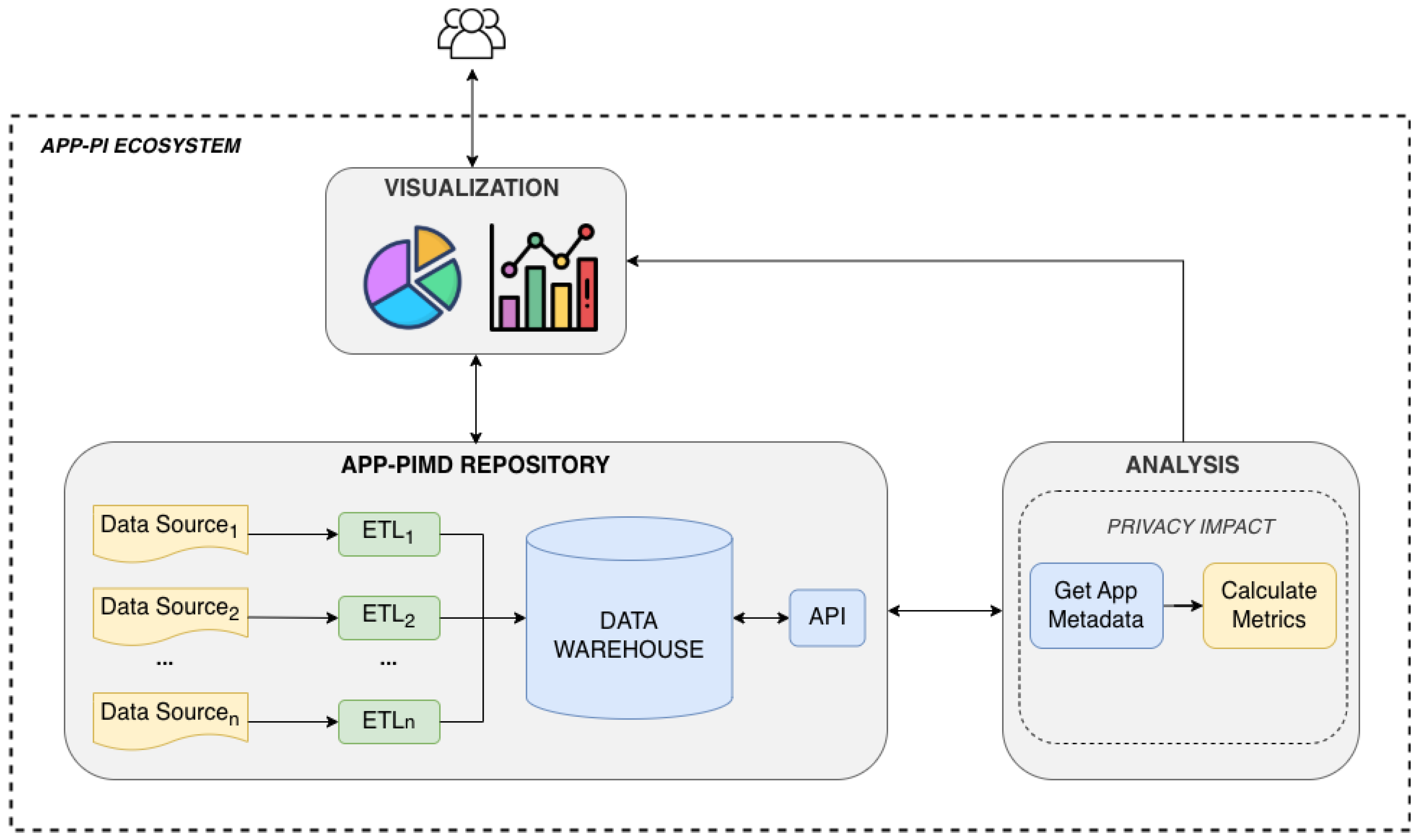
Figure 1 shows this ecosystem. The central component is a metadata repository, which serves structured metadata to the other components. This is the App-PIMD repository, which hosts metadata related to privacy and security aspects of mobile apps (the repository is freely available to anyone at
https://app-pi.infor.uva.es/docs, accessed on 7 January 2026). The
analysis tools compute privacy indicators and perform transparency assessments. The
visualization tools present these indicators and results in an accessible, easy-to-understand manner, ensuring that users with diverse technical backgrounds can interpret them. This structured and interoperable approach is particularly valuable when assessing health apps, where data sensitivity and user trust are critical factors.
3.2. Component Interactions
The interaction between the App-PIMD repository and the rest of the components follows a structured data flow that starts with the aggregation and structuration of information gathered in the warehouse. Once this data is available, the analysis tools can request it and compute metrics that reflect privacy risk levels. These analyses are stored at the repository so they are accessible to anyone. Finally, the data flow ends when the visualization tools integrate the outcomes of all available metadata and analyses, providing a comprehensive and intuitive representation of privacy indicators that facilitates informed decision-making by end users.
3.3. Design of the App-PI Data Flow Supporting mHealth App Privacy Evaluation
Two issues have been of crucial importance for the design of the ecosystem and its data flow: the quality of the data, and the extensibility of the ecosystem. The data entering the ecosystem must come from reliable sources and must not be degraded or corrupted at any stage of its collection and/or processing. Only in this way can the quality of the services provided be guaranteed. The extensibility of the ecosystem refers to its ability to accommodate new components and/or data.
In
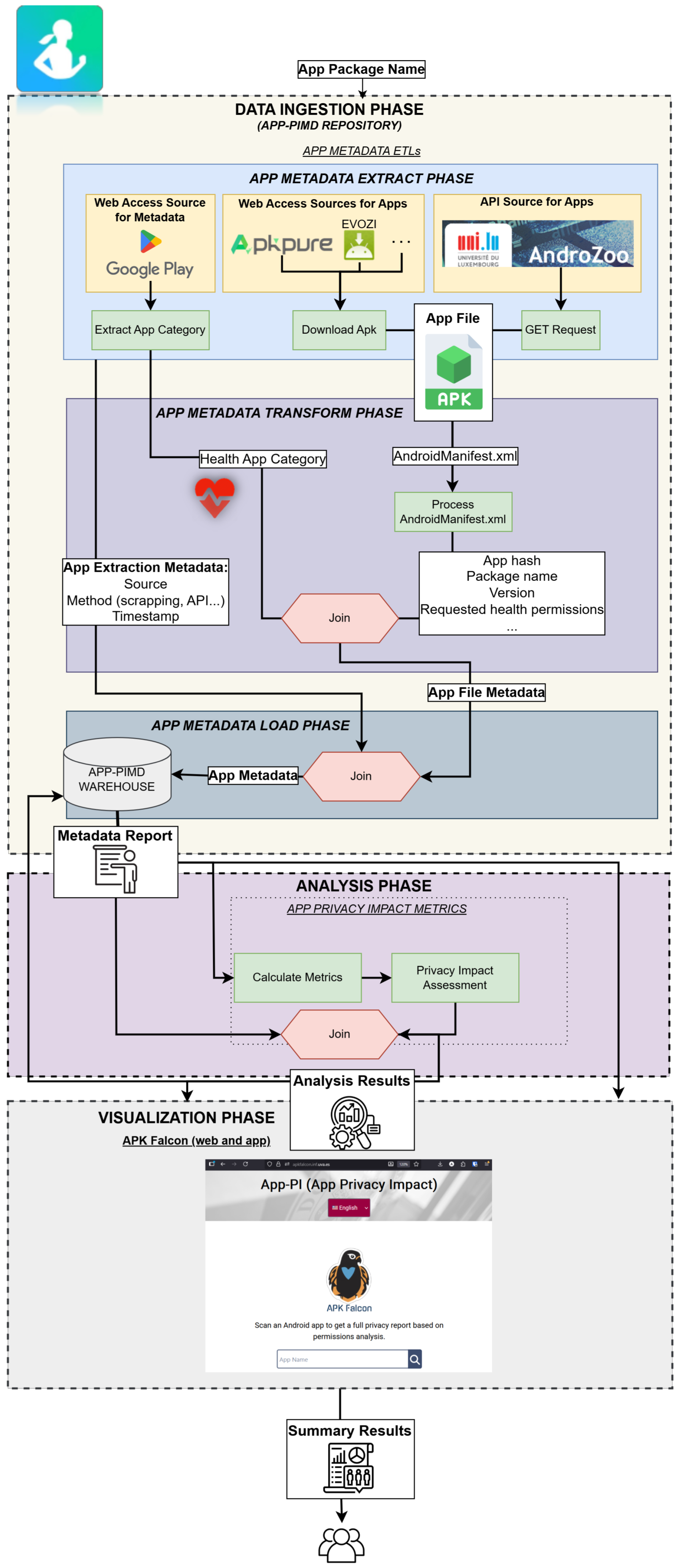
Figure 2, the data flow in this ecosystem for the case study of
Section 4 is shown. The data flow is structured in several phases, according to the type of tasks performed on data:
Data Ingestion,
Data Analysis, and
Data Visualization.
3.3.1. Data Ingestion Phase
The process begins with the data ingestion phase, in which app metadata are loaded as structured data into the central repository, App-PIMD. This is done by a set of ETL pipelines, which ensure that data values are valid before entering the repository. The ETL processes are used to extract different types of information from multiple data sources, transform them into structured datasets, and store them. The design approach followed ensures the extensibility and adaptability of the ingestion phase to accommodate new categories of data that may emerge in the context of mobile app privacy.
To ensure the repository remains up to date, the ETL pipelines are executed on a monthly schedule. This periodic update ensures that newly released applications and changes in existing ones are incorporated in a timely manner. The process begins by retrieving the most popular apps in each Google Play category, after which the corresponding ETL workflows are launched to process and integrate their metadata into the repository.
Two types of ETLs have been considered. First, to extract the information provided to end users about the personal data collected by the app. These data can be used to assess transparency in app’s privacy policies and data safety declarations. Second, to extract app metadata and metadata about the operating system in which apps run. These metadata can be used to obtain indicators that help users to understand potential privacy risks. The following subsections describe the two types of ETL processes implemented in this phase.
App Declarations ETLs
- 1.
- 2.
Transform Phase. From the raw declaration data, the personal data items collected by the app are extracted and converted into structured, machine-readable formats. This is achieved using pattern matching techniques to identify and classify the types of personal data mentioned in the declarations. To ensure consistency and accuracy, a predefined vocabulary of personal data types is used. This vocabulary is based on the Google Play
Data Safety section documentation (
https://support.google.com/googleplay/android-developer/answer/10787469?hl=en, accessed on 7 January 2026), which provides a reference list of data types that an app may request. Any items not matching the vocabulary are flagged for manual review.
- 3.
Load Phase. During this phase, the structured data obtained from the extraction process are ingested into the data warehouse.
3.3.2. Analysis Phase
Metadata stored in the warehouse, previously collected at the
Data Ingestion Phase (
Metadata Report in the
Figure 2), are analyzed to assess different aspects of app privacy. This phase encompasses two complementary analytical processes. The first performs an
App Declarations Transparency Assessment, which evaluates the consistency and completeness of the privacy-related statements provided by app developers, such as privacy policies and data safety declarations [
38]. We define
consistency as the alignment between what an application declares in its Privacy Policy, what it reports in the Google Play
Data Safety section, and the permissions requested in its
AndroidManifest.xml [
38]. Any mismatch among these three sources is considered a
inconsistency. For example, if the app requests the permission
READ_HEART_RATE but does not disclose the collection of heart-rate data in its
Data Safety section, this is flagged as an inconsistency. The second process focuses on computing
App Privacy Impact Metrics, derived from the metadata and permissions extracted from the apps. These metrics provide quantitative, easy-to-understand indicators of the potential privacy risks associated with each application [
39]. The metrics consider several factors, including the sensitivity of the permissions, the number of permissions requested, and their potential impact on user privacy [
39]. The impact of each permission is computed based on cybersecurity expert knowledge [
40]. Together, these analyses offer a comprehensive view of both the actual and declared privacy practices of mobile applications, appearing as
Analysis Results in
Figure 2. These results are uploaded to the central warehouse, where they are made available to other components, services and researchers who query the repository.
3.3.3. Visualization Phase
This phase presents the results obtained during the
Analysis Phase (
Analysis Results) in a clear and easily interpretable manner for end users. For now, one tool has been implemented to support users in understanding the privacy characteristics of mobile applications:
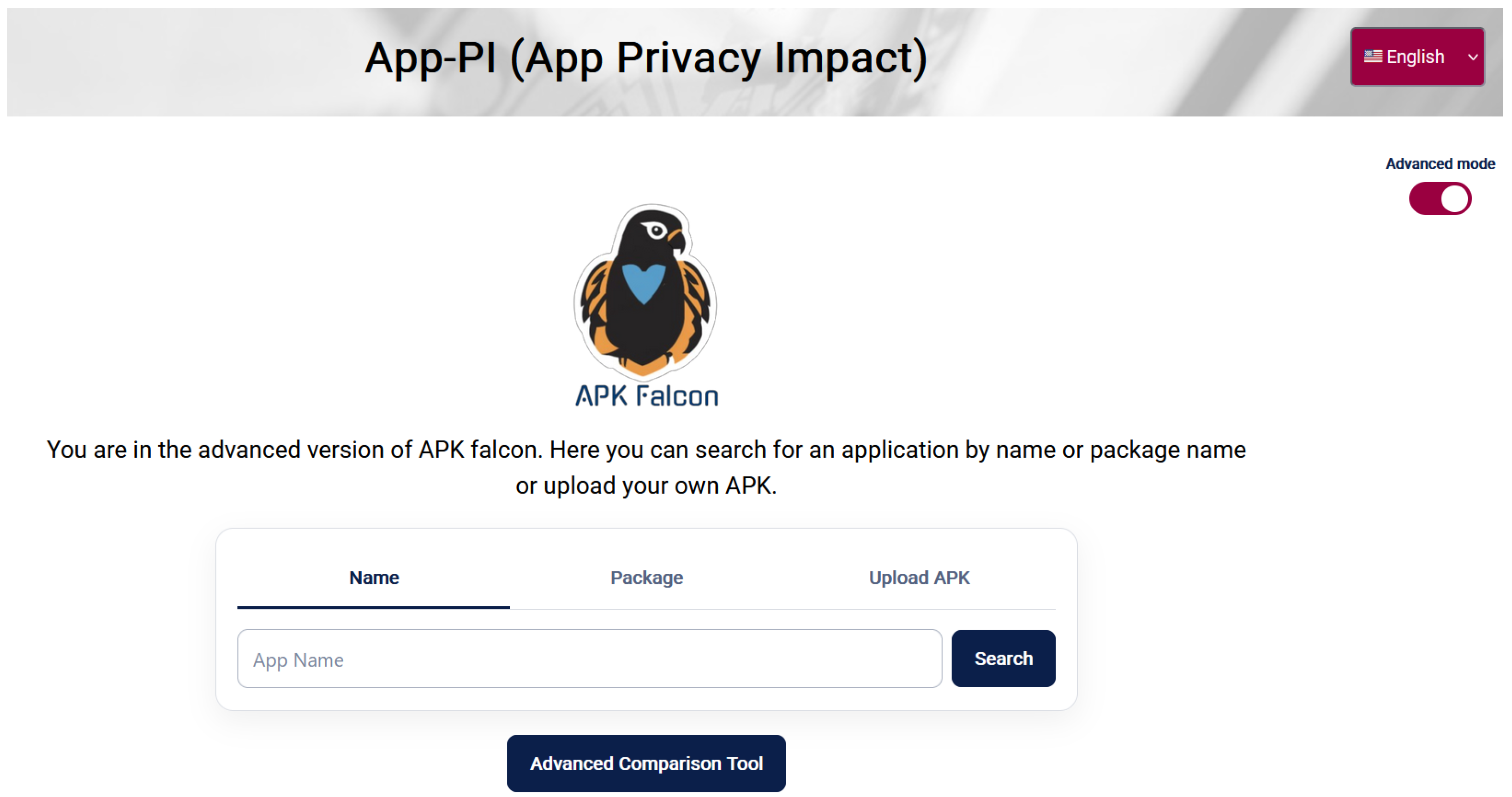
APK Falcon, as shown in
Figure 3 (Available at
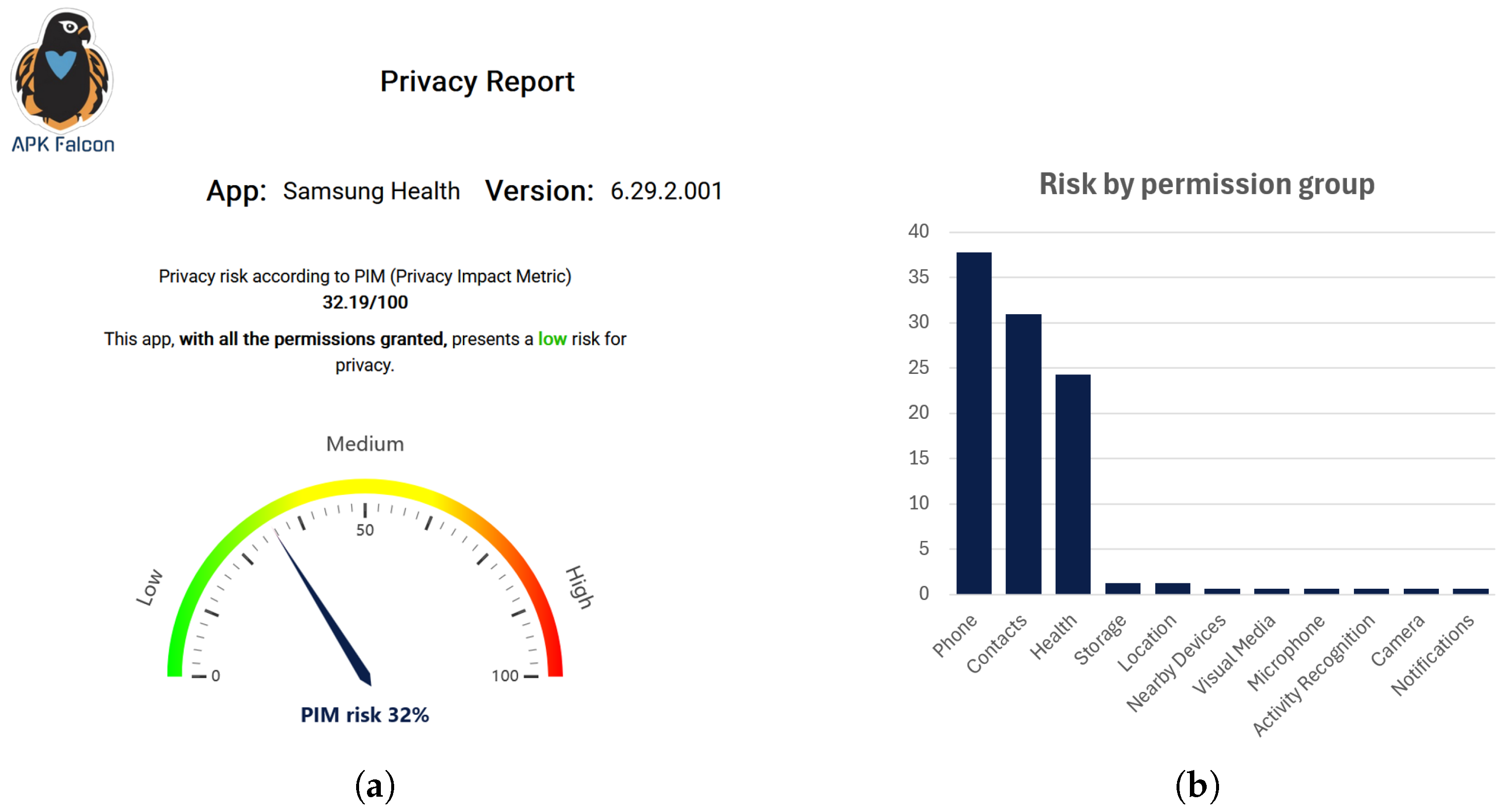
https://apkfalcon.inf.uva.es/, accessed on 7 January 2026). It is a user service that presents the results of a privacy indicator obtained using the information about permissions requested by an app. The global privacy impact is shown as a numeric value, classified in three categories: Low (green in the figure), Medium (yellow), and High (red). This privacy indicator works only with permission on which users can operate, that is, they can grant or revoke in the Settings of their mobile devices. Therefore, it does not provide an absolute and accurate information about app intrusiveness, but offers information to support end users decision-making: providing users with awareness of potential app impact on their privacy before installing apps on their personal devices. Since its initial development, APK Falcon has evolved into a fully-featured privacy assessment visualization tool, available both as a web site (
https://apkfalcon.inf.uva.es/, accessed on 7 January 2026) and a mobile application (currently being uploaded to Google Play Store). It is a multilingual tool (English, Spanish, German, French, and Italian) that allows users to search for applications by name and retrieve detailed privacy information, including the app’s name, version, icon, and a global privacy impact score broken down by permission groups. Users can simulate how granting or revoking permission groups affects the overall impact using interactive charts and explore a table of similar applications within the same category, showing higher and lower privacy impact scores, with the option to select multiple apps for side-by-side comparison.
4. Application to a mHealth App: Workflow and Data Flow
This use case illustrates the full execution of the App-PI data flow applied to the
Samsung Health (
Samsung Health is mentioned strictly as a case study; the authors have no commercial or institutional relationship with Samsung.) app, available on Google Play (
https://play.google.com/store/apps/details?id=com.sec.android.app.shealth, accessed on 7 January 2026). The goal is to demonstrate how the proposed ecosystem supports the privacy evaluation of mobile applications. Version 6.29.2.001 of the application was analyzed (the analyzed version is available in the App-PIMD repository). To select a mobile application we decided to use one of the more widely used criteria in mobile environments to rate the representativeness of apps: number of downloads from Google Play. Unfortunately, we did not find open-source mHealth applications with comparable functionality, adoption, or data collection features that could provide a representative case study.
Samsung Health was selected as the representative sample primarily because it is one of the most widely used mHealth applications, with more than one billion installs and approximately 1.55 million user ratings on Google Play (values as of 17 November 2025). This level of adoption makes it a highly representative example of real-world usage patterns and ensures the relevance of the case study. In addition to its widespread use, the app integrates and processes multiple categories of sensitive health data and—according to its own Data Safety disclosures—shares such information across different services. This makes it a particularly suitable case for assessing privacy risks. Finally, it constitutes a typical example of proprietary software, which reflects the majority of applications encountered by end users.
The data flow begins with the package name of the application to be loaded (see
Figure 2). The package name for the
Samsung Health application is “com.sec.android.app.shealth” as can be seen at its Google Play URL. This is the only input provided to the App-PI ecosystem in this instance.
4.1. Data Ingestion Phase
The App-PIMD repository triggers all the ETLs to start looking for the required information from the different data sources when it receives the package name of the requested application.
4.2. Analysis Phase
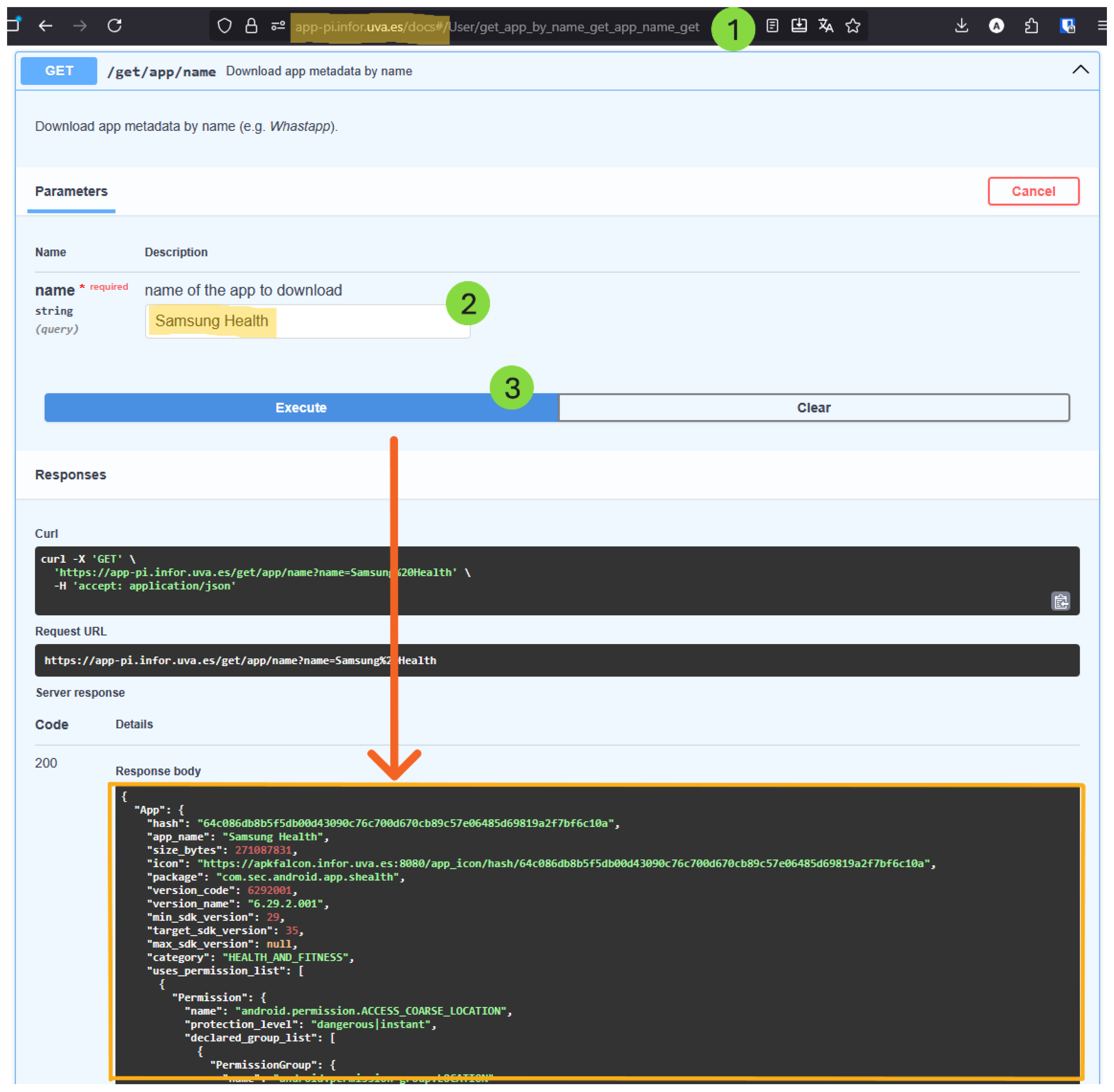
By invoking the App-PIMD endpoint
/get/app/name with “Samsung Health”, the
Analysis Phase retrieves the previously collected
Metadata Report (see
Figure 4). Then, the two complementary analysis phases are executed: the
App Declarations Transparency Assessment and the
App Privacy Impact Metrics.
App Privacy Impact Metrics
Table 2 presents the estimated privacy risk for each permission group, as calculated by the privacy impact metric, showing both absolute and percentage values [
39]. For example, the
Phone permission group has an impact value of 0.496785, representing 37.75% of the app’s total privacy impact. This value is calculated as the sum of the individual impacts of all
Dangerous permissions within the
Phone group that are requested by the app. The overall impact metric is based solely on
Dangerous permissions, as these are the only permissions that users can control [
39]. In this case, the app requests
READ_PHONE_NUMBERS, with an impact of 0.488382, and
READ_PHONE_STATE, with an impact of 0.008403, which together result in a total impact of 0.496785 for the
Phone group. The percentages indicate the relative contribution of each permission group to the app’s overall privacy impact. The groups with the greatest relative impact are
Phone (37.75%) and
Contacts (30.96%), followed by
Health permissions (24.27%). Although health permissions are not the largest contributors, they are among the top three, highlighting their significance. The app’s final privacy impact value (0.3219, i.e., 32.19%) is obtained by dividing the sum of impacts of all requested groups (1.3160) by the maximum impact that a hypothetical app requesting every possible
Dangerous permission would reach (4.088). This indicates that the app is not highly intrusive—an observation that may be somewhat unexpected given the sensitivity of the data handled.
4.3. Visualization Phase
Finally, we reach the visualization phase, where all previously extracted, processed, and analyzed data is presented in a clear and accessible manner. In this example, the APK Falcon tool is used to assess the privacy impact of the selected application, Samsung Health.
Figure 5a presents a screenshot of APK Falcon displaying the extracted
Metadata Report, including the app name and version, along with the
Analysis Results; both are publicly available in the App-PIMD repository. The overall privacy impact score is shown both as a numerical value with an explanation and as an intuitive chart using traffic-light–style colors, making it especially accessible to non-expert users.
Figure 5b illustrates the contribution of each permission group to the overall privacy metric, allowing users to identify which groups have the greatest impact on their privacy. Furthermore, APK Falcon enables users to simulate changes in the overall impact by allowing or denying specific permission groups, made possible because the privacy impact metric focuses exclusively on
Dangerous permissions and their groups [
39].
5. Synthesis of Key Results
This section summaries the key outcomes obtained from both the design of the App-PI ecosystem’s data flow and its application to the Samsung Health use case. The aim is to provide a concise overview of the results produced, emphasizing the system’s capacity to ensure data quality, extensibility, and the interpretability of privacy assessment results.
At ecosystem-level results, the App-PI ecosystem successfully demonstrated the complete execution of its data flow, from ingestion to visualization, relying only on the app package name as input. The modular design enabled the integration of multiple ETL pipelines and analysis tools, ensuring data consistency and traceability across all stages. The quality assurance mechanisms embedded in the ingestion phase contributed to reliable metadata generation, while the visualization tool (APK Falcon) effectively translated analytical results into user-friendly representations. These results confirm the extensibility and operational robustness of the ecosystem.
The results of the
Samsung Health use case are detailed below for each phase. The
Data Ingestion Phase processes extracted and structured both app declarations and metadata from multiple repositories (see
Section 4.1). The
Analysis Phase (
Section 4.2) identified a total of 75 declared permissions, of which 50 were classified as
Dangerous—that is, under direct user control. The computed privacy impact metric yielded a global risk value of 0.3219 (32.19%), indicating a moderate level of intrusiveness. The primary contributors to this score were the
Phone (37.75%),
Contacts (30.96%), and
Health (24.27%) permission groups. These outcomes are visualized through APK Falcon, which presents both the global score and per-group contributions, allowing users to simulate different permission configurations.
Overall, the results confirm that App-PI provides an automated, traceable, and interpretable workflow for privacy assessment in mHealth applications. It efficiently integrates heterogeneous data sources and produces quantitative and qualitative insights that can support privacy user awareness.
6. Discussion
The App-PI ecosystem and its application to the Samsung Health case study have demonstrated the feasibility of automated, data-driven privacy assessments for mHealth applications. However, several limitations and considerations must be acknowledged regarding the Visualization Phase, and generalizability of the ecosystem.
6.1. Visualization of Privacy Indicators
Although our current visualization tools do not yet cover all aspects of the privacy analysis, the modular design of App-PI enables new visual components to be incorporated and integrated seamlessly, strengthening the ecosystem’s value for end users. As introduced in
Section 2, existing privacy assessment approaches differ notably in both scope and target audience. Regarding the scope of the analysis, we can distinguish between technical-centric approaches and others that include non-technical elements, i.e., hybrid approaches. Technical-centric solutions based on methods such as static or dynamic analyses overlook the declarative and non-technical elements present in hybrid approaches [
16,
18,
24,
25]. Hybrid approaches combine these methods with declared data practices to offer a more comprehensive assessment. These are needed for better evaluations, as explained in
Section 2 [
17,
19,
20,
21]. However, they still fall short of offering users concrete guidance on how to mitigate risks.
Considering the target audience, we can distinguish between organizational-centric and user-centric approaches. Organizational-centric frameworks provide high-level guidance to companies and public bodies, but they do not focus on offering users interpretable or actionable insights [
29,
30]. In contrast, user-centric approaches aim to empower end users by providing them with interpretable analyses and actionable recommendations to help them make informed decisions regarding their privacy, such as AppCensus [
36]. Compared to these frameworks, App-PI is a hybrid, user-centric approach. AppCensus is the framework that is closest to App-PI, as it is also a hybrid, user-centric approach. However, it is not openly available for research or reproducibility. In contrast, App-PI provides an open, extensible framework that can be used to reproduce analyses and integrate new tools, even from third parties.
6.2. Generalizability of Results
The current evaluation successfully demonstrated the ecosystem’s functionality using Samsung Health as an initial case study. The App-PI ecosystem is designed to analyze any application, leveraging a robust and scalable architecture that can process diverse apps with varying behaviors, privacy policies, and data-handling practices. Despite the Android version or whether the app utilizes Health Connect, the ecosystem remains effective in assessing privacy impacts. The planned extension of the evaluation to a larger set of mHealth apps will help showcase the ecosystem’s versatility and confirm its value for privacy impact assessment across different application types.
6.3. Interpretation of Privacy Metrics
The interpretation of privacy impact metrics also warrants discussion. Although the computed value for
Samsung Health (32.19%) suggests a moderate level of intrusiveness based on the visualization tool’s predefined thresholds, such categorization should still be interpreted with caution. While these thresholds provide initial guidance for interpreting privacy scores, they are not derived from empirical distributions across large app samples. The current definition of the privacy impact metric yields a normalized value in the interval
, where 1 represents the highest level of intrusiveness according to the metric design [
39]. The visualization tool represents this continuous value into
low,
moderate, and
high categories by dividing the interval into three equal segments and scaling the result to a 0–100 range. Future iterations could enhance the reliability of these reference scales by incorporating data-driven thresholds based on statistical analysis of privacy scores across comprehensive app datasets. As an illustrative example of a data-driven approach, future iterations will compute the privacy impact metric for a large and diverse corpus of mobile applications covering multiple categories. Once collected, these values will be analysed to obtain their empirical distribution. Using this distribution, we could derive percentile-based thresholds (e.g., 25th, 50th, and 75th percentiles) to define data-driven boundaries for
low,
moderate, and
high impact. This would allow the visualization tool to ground its categories in observed real-world patterns instead of equal interval splitting, aligning the interpretation of the metric with typical risk levels.
It is also important to note that the current privacy metrics are derived solely from
Dangerous permissions, which users can grant or revoke manually. While this focus strengthens the ecosystem’s applicability and interpretability—since it aligns with user autonomy—it does not capture all potential privacy risks. Background data transmissions, SDK-level tracking, and undeclared data flows may still occur without requiring user-controlled permissions. Hence, the privacy impact metric should be viewed as a user-centric indicator rather than a comprehensive measure of privacy compliance. Nevertheless, the metric has been validated through statistical analyses, confirming its ability to meaningfully reflect privacy risk levels as they are disclosed by user reviews on similar services [
39]. In addition, we are currently conducting user-centred evaluation studies to further validate the metric’s interpretability and practical usefulness for end users.
7. Conclusions
The use of the App-PI metadata ecosystem with mHealth applications has been shown. Privacy impact assessment is automated, incorporating the data-driven computation of privacy indicators and end-user interfaces to facilitate end user consumption. The proposed data flow—encompassing ingestion, analysis, and visualization—was demonstrated through the evaluation of Samsung Health, confirming the system’s ability to detect inconsistencies between declared and actual data practices and to compute quantifiable privacy impact metrics. The modular ETL pipelines and the App-PIMD repository ensure data quality, traceability, and reproducibility, while the visualization tools (APK Falcon and ApkAudit) translate analytical results into interpretable insights accessible to non-expert users. Overall, the ecosystem consolidates technical, and user-centric dimensions of privacy assurance, contributing for empirical privacy analysis in the mHealth domain.
8. Future Work
Future developments include integrating dynamic analysis techniques to complement static verification, Moreover, expanding the transparency visualization layer to merge privacy impact metrics with disclosure-consistency indicators, enhancing user interpretability. These future extensions will reinforce App-PI’s role as an open, data-driven infrastructure for privacy accountability in digital health.
Author Contributions
Conceptualization, A.P.-F., M.M.M.-G., A.A., and P.A.C.-L.; Data curation, A.P.-F.; Founding acquisition, M.M.M.-G.; Investigation A.A. and P.A.C.-L.; Methodology, M.M.M.-G.; Software, A.P.-F.; Validation, M.M.M.-G. and P.A.C.-L.; Visualization, A.P.-F. and A.A.; writing—original draft preparation, A.P.-F. and M.M.M.-G.; writing—review and editing, A.P.-F. and M.M.M.-G. All authors have read and agreed to the published version of the manuscript.
Funding
This work is included in the activities of the strategic Cybersecurity project “App-PI (App Privacy Impact): An ecosystem for the evaluation of the impact of apps for mobile devices on the privacy and security of their users” (C120.23_UVa), which is carried out under a collaboration agreement between the University of Valladolid and the Spanish National Institute of Cybersecurity (INCIBE) for the promotion of strategic Cybersecurity projects in Spain, within the framework of the funds of the Recovery, Transformation and Resilience Plan, financed by the European Union (Next Generation).
Institutional Review Board Statement
Not applicable.
Informed Consent Statement
Not applicable.
Data Availability Statement
Data analyzed in this article are publicly available in the App-PIMD repository:
https://app-pi.infor.uva.es/docs/, accessed on 7 January 2026. Analysis results are available within the article. Other data that support the findings of this study are available from the corresponding author.
Acknowledgments
The authors acknowledge Javier Crespo Guerrero for the first prototype of the APK Falcon visualization tool, in which he included facilities that showed the great potential of visualization tools to communicate privacy data-driven analysis to end users.
Conflicts of Interest
The authors declare no conflicts of interest.
References
- DBIR Team. Data Breach Investigations Report; Technical Report; Verizon: Bedminster, NJ, USA, 2025. [Google Scholar]
- Kitkowska, A.; Karegar, F.; Wästlund, E. Share or Protect: Understanding the Interplay of Trust, Privacy Concerns, and Data Sharing Purposes in Health and Well-Being Apps. In Proceedings of the 15th Biannual Conference of the Italian SIGCHI Chapter, CHItaly 2023, Torino, Italy, 20–22 September 2023; Gena, C., Russis, L.D., Spano, L.D., Lanzilotti, R., Mascio, T.D., Prandi, C., Andolina, S., Eds.; ACM: New York, NY, USA, 2023; pp. 15:1–15:14. [Google Scholar] [CrossRef]
- Nurgalieva, L.; O’Callaghan, D.; Doherty, G. Security and privacy of mHealth applications: A scoping review. IEEE Access 2020, 8, 104247–104268. [Google Scholar] [CrossRef]
- Akgul, O.; Peddinti, S.T.; Taft, N.; Mazurek, M.L.; Harkous, H.; Srivastava, A.; Seguin, B. A Decade of Privacy-Relevant Android App Reviews: Large Scale Trends. In Proceedings of the 33rd USENIX Security Symposium (USENIX Security 24), Philadelphia, PA, USA, 14 August 2024; pp. 5089–5106. [Google Scholar]
- Geiger, F.X.; Malavolta, I. Datasets of Android Applications: A Literature Review. arXiv 2018, arXiv:1809.10069. [Google Scholar] [CrossRef]
- Li, L.; Gao, J.; Hurier, M.; Kong, P.; Bissyandé, T.F.; Bartel, A.; Klein, J.; Le Traon, Y. AndroZoo++: Collecting Millions of Android Apps and Their Metadata for the Research Community. arXiv 2017, arXiv:1709.05281. [Google Scholar]
- Meng, G.; Xue, Y.; Siow, J.K.; Su, T.; Narayanan, A.; Liu, Y. AndroVault: Constructing Knowledge Graph from Millions of Android Apps for Automated Analysis. arXiv 2017, arXiv:1711.07451. [Google Scholar] [CrossRef]
- Zhou, H.; Li, W.; Zhang, B.; Ji, Q.; Tan, Y.; Na, C. MAKG: A Mobile Application Knowledge Graph for the Research of Cybersecurity. In Proceedings of the Knowledge Graph and Semantic Computing: Knowledge Graph Empowers New Infrastructure Construction; QQin, B., Jin, Z., Wang, H., Pan, J., Liu, Y., An, B., Eds.; Springer: Singapore, 2021; pp. 321–328. [Google Scholar]
- Allix, K.; Bissyandé, T.F.; Klein, J.; Le Traon, Y. AndroZoo: Collecting Millions of Android Apps for the Research Community. In Proceedings of the 13th International Conference on Mining Software Repositories, Austin, TX, USA, 14–22 May 2016; pp. 468–471. [Google Scholar]
- Pool, J.; Akhlaghpour, S.; Fatehi, F. Towards a contextual theory of Mobile Health Data Protection (MHDP): A realist perspective. Int. J. Med. Inform. 2020, 141, 104229. [Google Scholar] [CrossRef] [PubMed]
- Veale, M.; Zuiderveen Borgesius, F. Demystifying the Draft EU Artificial Intelligence Act—Analysing the good, the bad, and the unclear elements of the proposed approach. Comput. Law Rev. Int. 2021, 22, 97–112. [Google Scholar] [CrossRef]
- Nebeker, C.; Torous, J.; Ellis, R.J.B. Building the case for actionable ethics in digital health research supported by artificial intelligence. BMC Med. 2019, 17, 137. [Google Scholar] [CrossRef] [PubMed]
- Koch, S.; Wessels, M.; Altpeter, B.; Olvermann, M.; Johns, M. Keeping Privacy Labels Honest. Proc. Priv. Enhancing Technol. 2022, 2022, 486–506. [Google Scholar] [CrossRef]
- Zhang, S.; Sadeh, N. Do Privacy Labels Answer Users’ Privacy Questions? In Proceedings of the Symposium on Usable Security and Privacy (USEC) 2023, San Diego, CA, USA, 27 February 2023. [Google Scholar] [CrossRef]
- Shrivastava, G.; Kumar, P.; Gupta, D.; Rodrigues, J.J.P.C. Privacy issues of android application permissions: A literature review. Trans. Emerg. Telecommun. Technol. 2020, 31, e3773. [Google Scholar] [CrossRef]
- Hudson, S.; Liu, Y. Mobile app users’ privacy concerns: Different heuristics for privacy assurance statements in the EU and China. Inf. Technol. People 2023, 36, 245–262. [Google Scholar] [CrossRef]
- Jain, V.; Gupta, S.D.; Ghanavati, S.; Peddinti, S.T.; McMillan, C. PAcT: Detecting and Classifying Privacy Behavior of Android Applications. In Proceedings of the 15th ACM Conference on Security and Privacy in Wireless and Mobile Networks, New York, NY, USA, 16–19 May 2022; pp. 104–118. [Google Scholar] [CrossRef]
- Liu, H.; Leith, D.J.; Patras, P. Android OS Privacy Under the Loupe - A Tale from the East. In Proceedings of the 16th ACM Conference on Security and Privacy in Wireless and Mobile Networks, WiSec 2023, Guildford, UK, 29 May–1 June 2023; Boureanu, I., Schneider, S., Reaves, B., Tippenhauer, N.O., Eds.; ACM: New York, NY, USA, 2023; pp. 31–42. [Google Scholar] [CrossRef]
- Hatamian, M.; Momen, N.; Fritsch, L.; Rannenberg, K. A Multilateral Privacy Impact Analysis Method for Android Apps. In Proceedings of the Privacy Technologies and Policy; NNaldi, M., Italiano, G.F., Rannenberg, K., Medina, M., Bourka, A., Eds.; Springer: Cham, Switzerland, 2019; pp. 87–106. [Google Scholar]
- Binns, R.; Zhao, T.; Veale, M. PrivacyMeter: Automated Auditing of Privacy Statements Using Natural Language Models. In Proceedings of the ACM Conference on Fairness, Accountability, and Transparency (FAccT), Seoul, Republic of Korea, 21–24 June 2022. [Google Scholar]
- Harkous, H.; Fawaz, K.; Lebret, R.; Schaub, F.; Shin, K.G.; Aberer, K. Polisis: Automated Analysis and Presentation of Privacy Policies Using Deep Learning. In Proceedings of the 27th USENIX Security Symposium (USENIX Security 18), Baltimore, MD, USA, 15–17 August 2018; pp. 531–548. [Google Scholar]
- Hakiem, N.; Afrizal, S.H.; Setiadi, Y.; Albab, H.S.; Riasetiawan, M.; Zulhuda, S. Security and Privacy Policy Assessment in Mobile Health Applications: A Literature Review. J. Syst. Manag. Sci. 2024, 14, 355–371. [Google Scholar] [CrossRef]
- Benjumea, J.; Ropero, J.; Rivera-Romero, O.; Dorronzoro-Zubiete, E.; Carrasco, A. Privacy Assessment in Mobile Health Apps: Scoping Review. JMIR mHealth uHealth 2020, 8, e18868. [Google Scholar] [CrossRef] [PubMed]
- Marono, J.; Silva, C.; Barraca, J.P.; Cunha, V.; Salvador, P. Assessing mobile application privacy: A quantitative framework for privacy measurement. arXiv 2023, arXiv:2311.00066. [Google Scholar] [CrossRef]
- Yang, Y.; Du, X.; Yang, Z. Pradroid: Privacy risk assessment for android applications. In Proceedings of the 2021 IEEE 5th International Conference on Cryptography, Security and Privacy (CSP), Zhuhai, China, 8–10 January 2021; IEEE: New York, NY, USA, 2021; pp. 90–95. [Google Scholar]
- Zhu, M.; Wu, C.; Huang, S.; Zheng, K.; Young, S.D.; Yan, X.; Yuan, Q. Privacy paradox in mHealth applications: An integrated elaboration likelihood model incorporating privacy calculus and privacy fatigue. Telemat. Inform. 2021, 61, 101601. [Google Scholar] [CrossRef]
- Shojaei, P.; Vlahu-Gjorgievska, E.; Chow, Y.W. Enhancing privacy in mHealth Applications: A User-Centric model identifying key factors influencing Privacy-Related behaviours. Int. J. Med. Inform. 2025, 199, 105907. [Google Scholar] [CrossRef] [PubMed]
- Dang, Y.; Guo, S.; Guo, X.; Wang, M.; Xie, K. Privacy Concerns About Health Information Disclosure in Mobile Health: Questionnaire Study Investigating the Moderation Effect of Social Support. JMIR mHealth uHealth 2021, 9, e19594. [Google Scholar] [CrossRef] [PubMed]
- Ahmad, J.; Li, F.; Luo, B. IoTPrivComp: A Measurement Study of Privacy Compliance in IoT Apps. In Proceedings of the Computer Security—ESORICS 2022, Copenhagen, Denmark, 26–30 September 2022; Atluri, V., Di Pietro, R., Jensen, C.D., Meng, W., Eds.; Springer: Cham, Switzerland, 2022; pp. 589–609. [Google Scholar]
- National Institute of Standards and Technology. NIST Privacy Framework: A Tool for Improving Privacy Through Enterprise Risk Management, Version 1.0; Technical Report CSWP 10; NIST: Gaithersburg, MD, USA, 2020. [CrossRef]
- Jin, H.; Liu, M.; Dodhia, K.; Li, Y.; Srivastava, G.; Fredrikson, M.; Agarwal, Y.; Hong, J.I. Why Are They Collecting My Data?: Inferring the Purposes of Network Traffic in Mobile Apps. In Proceedings of the ACM on Interactive, Mobile, Wearable and Ubiquitous Technologies; Association for Computing Machinery: New York, NY, USA, 2018; Volume 2, pp. 173:1–173:27. [Google Scholar] [CrossRef]
- Mayrhofer, R.; Stoep, J.V.; Brubaker, C.; Hackborn, D.; Bonné, B.; Tuncay, G.S.; Jover, R.P.; Specter, M. The Android Platform Security Model. arXiv 2023, arXiv:1904.05572. [Google Scholar] [CrossRef]
- Geiger, F.X.; Malavolta, I.; Pascarella, L.; Palomba, F.; Di Nucci, D.; Bacchelli, A. A graph-based dataset of commit history of real-world Android apps. In Proceedings of the 15th International Conference on Mining Software Repositories, New York, NY, USA, 28–29 May 2018; pp. 30–33. [Google Scholar] [CrossRef]
- Feichtner, J.; Gruber, S. Understanding Privacy Awareness in Android App Descriptions Using Deep Learning. In Proceedings of the Tenth ACM Conference on Data and Application Security and Privacy, New York, NY, USA, 16–18 March 2020; pp. 203–214. [Google Scholar] [CrossRef]
- Rodriguez, D.; Yang, I.; Alamo, J.M.D.; Sadeh, N. Large language models: A new approach for privacy policy analysis at scale. Computing 2024, 106, 3879–3903. [Google Scholar] [CrossRef]
- Egelman, S. Taking responsibility for someone else’s code: Studying the privacy behaviors of mobile apps at scale. In Proceedings of the 2020 USENIX Conference on Privacy Engineering Practice and Respect (PEPR 20), Santa Clara, CA, USA, 11–12 May 2020. [Google Scholar]
- Martínez-González, M.M.; Pérez-Fuente, A.; Aparicio, A.; Criado-Lozano, P.A. Using the Metadata-Based App-PI Ecosystem to Assess the Privacy Impact of Health Apps. In Proceedings of the International Conference on Ubiquitous Computing and Ambient Intelligence (UCAmI 2024), Belfast, UK, 27–29 November 2024; Bravo, J., Nugent, C., Cleland, I., Eds.; Lecture Notes in Networks and Systems; Springer: Cham, Switzerland, 2024; Volume 1212. [Google Scholar] [CrossRef]
- Pérez-Fuente, A.; Criado-Lozano, P.A.; Martínez-González, M.M. Fake Transparency: When Mobile Apps Say One Thing but Do Another. In Proceedings of the Fourth European Workshop on Algorithmic Fairness, Eindhoven, The Netherlands, 30 June–2 July 2025; Volume 294, pp. 369–375. [Google Scholar]
- Aparicio, A.; Martínez-González, M.M.; Pérez-Fuente, A.; Criado-Lozano, P.A. PIM: A Metric to Empower Mobile App Users in Privacy Management. In Proceedings of the 2025 International Workshop on Mobile and IoT Security Technologies (MIST), Toulouse, France, 22 September 2025. [Google Scholar] [CrossRef]
- Upadhayay, M.; Sharma, A.; Garg, G.; Arora, A. RPNDroid: Android Malware Detection using Ranked Permissions and Network Traffic. In Proceedings of the 2021 Fifth World Conference on Smart Trends in Systems Security and Sustainability (WorldS4), London, UK, 29–30 July 2021; pp. 19–24. [Google Scholar] [CrossRef]
- Mayrhofer, R.; Stoep, J.V.; Brubaker, C.; Kralevich, N. The android platform security model. ACM Trans. Priv. Secur. (TOPS) 2021, 24, 1–35. [Google Scholar] [CrossRef]
| Disclaimer/Publisher’s Note: The statements, opinions and data contained in all publications are solely those of the individual author(s) and contributor(s) and not of MDPI and/or the editor(s). MDPI and/or the editor(s) disclaim responsibility for any injury to people or property resulting from any ideas, methods, instructions or products referred to in the content. |







 ,
,