Effectiveness of Mobile Health Application-Based Interventions for Fall Prevention in Community-Dwelling Older Adults: A Systematic Review and Meta-Analysis of Randomized Controlled Trials

 ,
,  , , and
Highlights
- mHealth app-based interventions reduced fall risk and improved balance, strength, and fear of falling in community-dwelling older adults.
- Interventions were feasible and safe, with generally acceptable adherence and no serious adverse events.
- mHealth applications offer a scalable adjunct to conventional fall-prevention programs.
- Their integration into routine care may enhance access to fall prevention in community settings.
Abstract
1. Introduction
1.1. Background
1.2. Research Gap and Objectives
- (i.)
- Do mHealth application (app)-based interventions reduce fall incidence (both rate and risk) in community-dwelling older adults?
- (ii.)
- Do these interventions improve key secondary outcomes, including balance, strength, and falls efficacy?
- (iii.)
- What are the effects on adherence, feasibility, and safety?
2. Materials and Methods
2.1. Information Sources
2.2. Study Selection Process
2.3. Eligibility Criteria
2.3.1. Design
2.3.2. Population
2.3.3. Interventions
2.3.4. Comparator
2.3.5. Outcomes
2.3.6. Time
No Limitations
2.4. Methodological Quality and Risk of Bias Assessment
2.5. Data Extraction
2.6. Data Synthesis and Analysis
3. Results
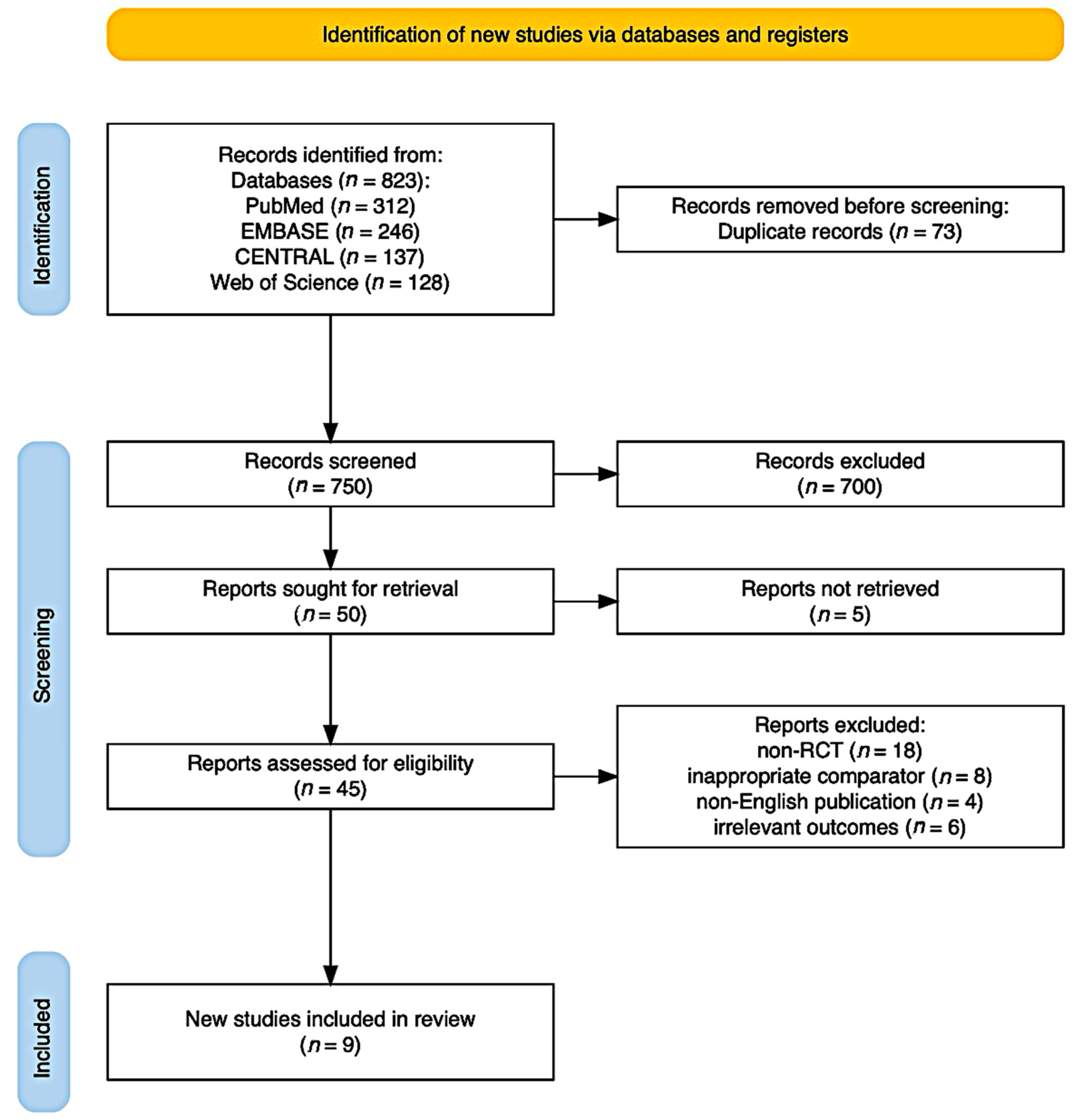
3.1. Included Studies
3.2. Study Characteristics
3.3. Classification of mHealth Interventions
3.4. Study Quality and Risk of Bias
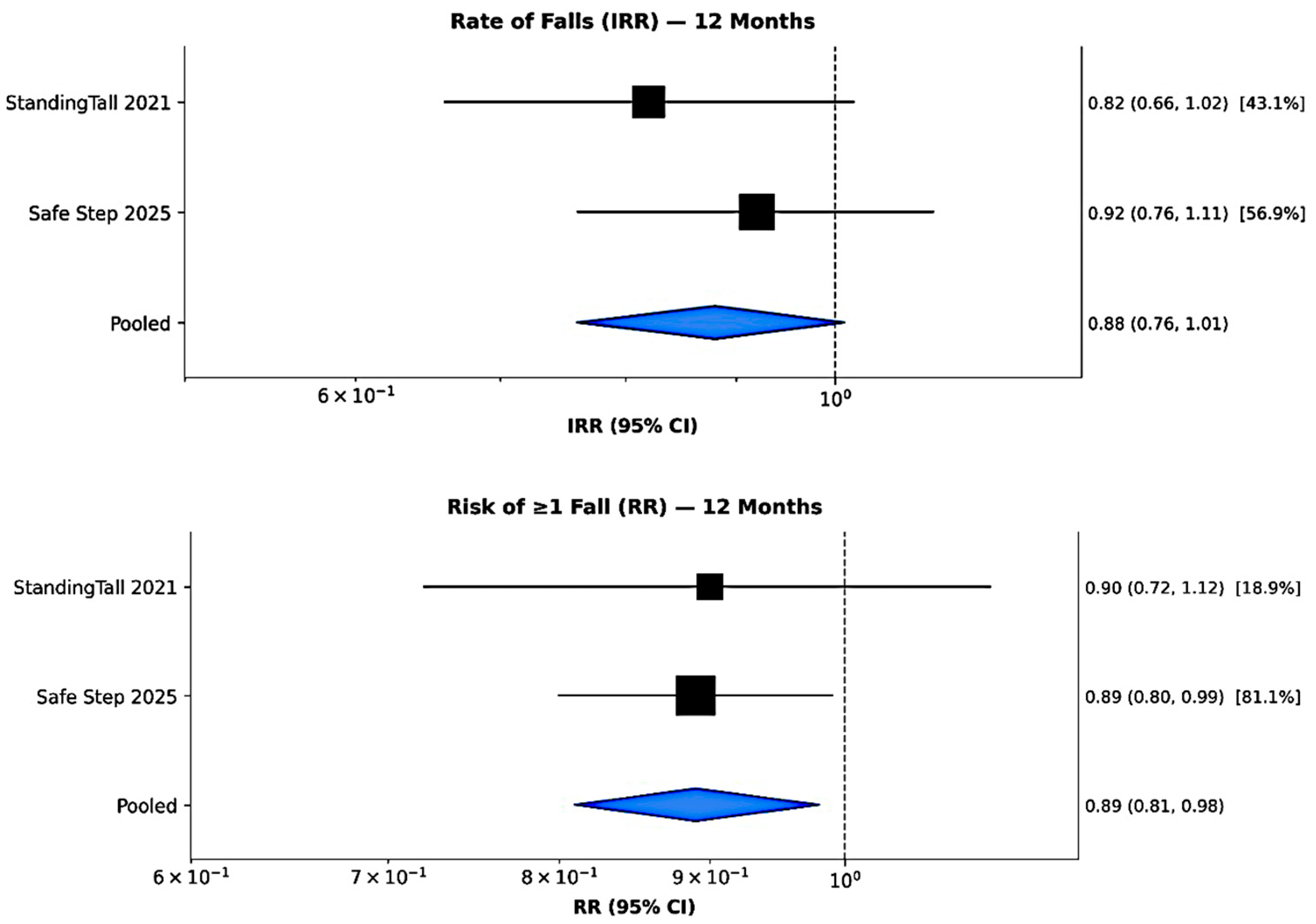
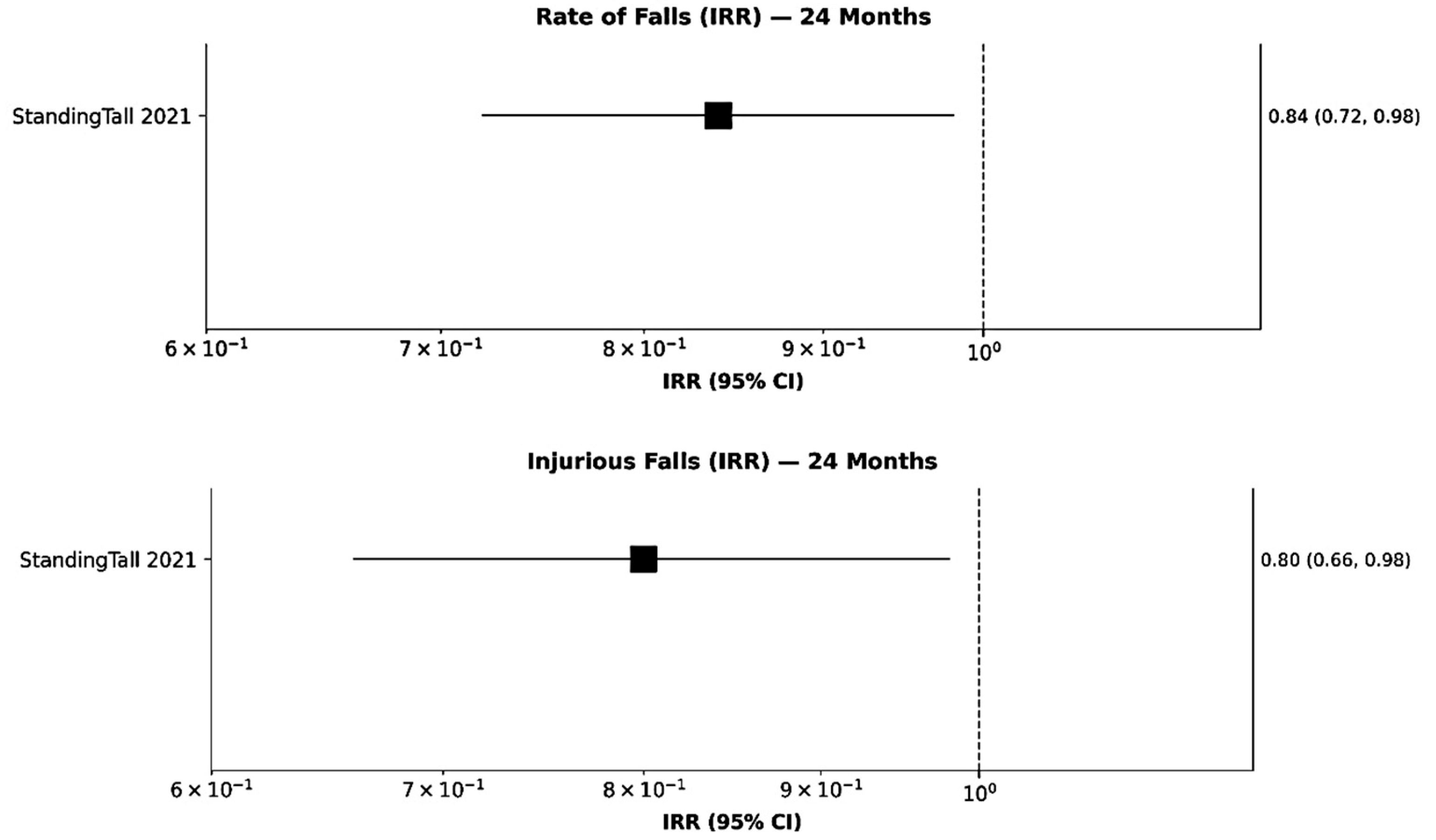
3.5. Primary Outcome: Fall Incidence
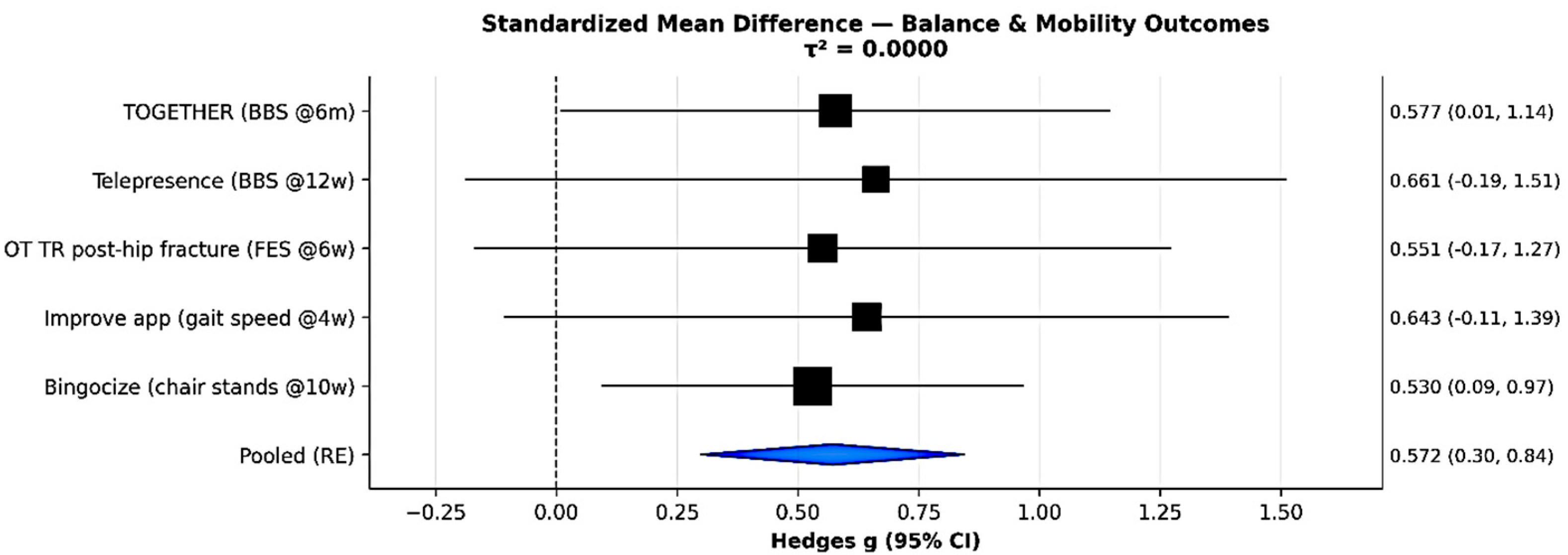
3.6. Secondary Outcomes: Physical and Psychological Function
3.7. Adherence, Feasibility, and Safety
4. Discussion
4.1. Clinical Implications and Implementation
4.2. Strength
4.3. Limitations of the Review and Evidence Base
4.4. Recommendations for Future Research
5. Conclusions
Supplementary Materials
Author Contributions
Funding
Institutional Review Board Statement
Informed Consent Statement
Data Availability Statement
Acknowledgments
Conflicts of Interest
Abbreviations
| RCTs | Randomized Controlled Trials |
| SMD | Standard Mean Difference |
| App | Application |
| PRISMA | Preferred Reporting Items for Systematic Reviews and Meta-Analyses |
| PEDro | Physiotherapy Evidence Database |
| IRR | Incidence Rate Ratio |
| RR | Relative Risk |
| mHealth | Mobile Health |
| RoB | Risk of Bias |
| NNT | Number Needed to Treat |
| BBS | Berg Balance Scale |
| TUG | Time Up and Go |
| SPPB | Short Physical Performance Battery |
References
- Delbaere, K.; Valenzuela, T.; Lord, S.R.; Clemson, L.; Zijlstra, G.A.R.; Close, J.C.T.; Lung, T.; Woodbury, A.; Chow, J.; McInerney, G.; et al. E-health StandingTall balance exercise for fall prevention in older people: Results of a two year randomised controlled trial. BMJ 2021, 373, n740. [Google Scholar] [CrossRef]
- Yoshida-Intern, S. A Global Report on Falls Prevention Epidemiology of Falls; WHO: Geneva, Switzerland, 2007. [Google Scholar]
- Ambrose, A.F.; Paul, G.; Hausdorff, J.M. Risk factors for falls among older adults: A review of the literature. Maturitas 2013, 75, 51–61. [Google Scholar] [CrossRef]
- Pettersson, B.; Lundin-Olsson, L.; Skelton, D.A.; Liv, P.; Zingmark, M.; Rosendahl, E.; Sandlund, M. Effectiveness of the Safe Step Digital Exercise Program to Prevent Falls in Older Community-Dwelling Adults: Randomized Controlled Trial. J. Med. Internet Res. 2025, 27, e67539. [Google Scholar] [PubMed]
- Hong, J.; Kong, H.J.; Yoon, H.J. Web-Based Telepresence Exercise Program for Community-Dwelling Elderly Women With a High Risk of Falling: Randomized Controlled Trial. JMIR mHealth uHealth 2018, 6, e132. [Google Scholar] [CrossRef] [PubMed]
- Ye, Q.; Yang, Y.; Yao, M.; Yang, Y.; Lin, T. Effects of teach-back health education (TBHE) based on WeChat mini-programs in preventing falls at home for urban older adults in China: A randomized controlled trial. BMC Geriatr. 2022, 22, 611. [Google Scholar]
- Lugade, V.; Torbitt, M.; O’Brien, S.R.; Silsupadol, P. Smartphone- and Paper-Based Delivery of Balance Intervention for Older Adults Are Equally Effective, Enjoyable, and of High Fidelity: A Randomized Controlled Trial. Sensors 2023, 23, 7451. [Google Scholar] [CrossRef]
- Li, C.T.; Hung, G.K.; Fong, K.N.; Gonzalez, P.C.; Wah, S.H.; Tsang, H.W. Effects of home-based occupational therapy telerehabilitation via smartphone for outpatients after hip fracture surgery: A feasibility randomised controlled study. J. Telemed. Telecare 2022, 28, 239–247. [Google Scholar] [CrossRef] [PubMed]
- Park, Y.J. Effects of communal exercise with visual and auditory feedback provided by a smart application on gait ability and fear of falling in Parkinson’s disease patients. J. Exerc. Rehabil. 2014, 10, 286–290. [Google Scholar]
- Shake, M.C.; Crandall, K.J.; Mathews, R.P.; Falls, D.G.; Dispennette, A.K. Efficacy of Bingocize((R)): A Game-Centered Mobile Application to Improve Physical and Cognitive Performance in Older Adults. Games Health J. 2018, 7, 253–261. [Google Scholar] [CrossRef]
- Hawley-Hague, H.; Tacconi, C.; Mellone, S.; Martinez, E.; Yang, F.; Su, T.L.; Chiari, L.; Helbostad, J.L.; Todd, C. Using Smartphone TechnolOGy to Support an EffecTive Home ExeRcise Intervention to Prevent Falls amongst Community-Dwelling Older Adults: The TOGETHER Feasibility RCT. Gerontology 2023, 69, 783–798. [Google Scholar]
- Ganz, D.A.; Latham, N.K. Prevention of falls in community-dwelling older adults. N. Engl. J. Med. 2020, 382, 734–743. [Google Scholar] [CrossRef] [PubMed]
- Phelan, E.A.; Ritchey, K. Fall Prevention in Community-Dwelling Older Adults. Ann. Intern. Med. 2018, 169, ITC81–ITC96. [Google Scholar] [CrossRef] [PubMed]
- Rubenstein, L.Z. Falls in older people: Epidemiology, risk factors and strategies for prevention. Age Ageing 2006, 35, ii37–ii41. [Google Scholar] [CrossRef] [PubMed]
- James, S.L.; Lucchesi, L.R.; Bisignano, C.; Castle, C.D.; Dingels, Z.V.; Fox, J.T.; Hamilton, E.B.; Henry, N.J.; Krohn, K.J.; Liu, Z.; et al. The global burden of falls: Global, regional and national estimates of morbidity and mortality from the Global Burden of Disease Study 2017. Inj. Prev. 2020, 26, i3–i11. [Google Scholar] [CrossRef]
- Scheffer, A.C.; Schuurmans, M.J.; van Dijk, N.; van der Hooft, T.; de Rooij, S.E. Fear of falling: Measurement strategy, prevalence, risk factors and consequences among older persons. Age Ageing 2008, 37, 19–24. [Google Scholar] [CrossRef]
- Burns, E.R.; Stevens, J.A.; Lee, R. The direct costs of fatal and non-fatal falls among older adults—United States. J. Safety Res. 2016, 58, 99–103. [Google Scholar] [CrossRef]
- Anderson, M.; Perrin, A. Technology Use Among Seniors; Pew Research Center for Internet & Technology: Washington, DC, USA, 2017; p. 18. [Google Scholar]
- Gaspar, A.G.M.; Lapao, L.V. eHealth for Addressing Balance Disorders in the Elderly: Systematic Review. J. Med. Internet Res. 2021, 23, e22215. [Google Scholar] [CrossRef]
- Valenzuela, T.; Okubo, Y.; Woodbury, A.; Lord, S.R.; Delbaere, K. Adherence to Technology-Based Exercise Programs in Older Adults: A Systematic Review. J. Geriatr. Phys. Ther. 2018, 41, 49–61. [Google Scholar] [CrossRef]
- Ambrens, M.; Alley, S.; Oliveira, J.S.; To, Q.; Delbaere, K.; Vandelanotte, C.; Tiedemann, A. Effect of eHealth-delivered exercise programmes on balance in people aged 65 years and over living in the community: A systematic review and meta-analysis of randomised controlled trials. BMJ Open 2022, 12, e051377. [Google Scholar]
- Solis-Navarro, L.; Gismero, A.; Fernandez-Jane, C.; Torres-Castro, R.; Sola-Madurell, M.; Berge, C.; Perez, L.M.; Ars, J.; Martin-Borras, C.; Vilaro, J.; et al. Effectiveness of home-based exercise delivered by digital health in older adults: A systematic review and meta-analysis. Age Ageing 2022, 51, afac243. [Google Scholar]
- Pettersson, B.; Janols, R.; Wiklund, M.; Lundin-Olsson, L.; Sandlund, M. Older Adults’ Experiences of Behavior Change Support in a Digital Fall Prevention Exercise Program: Qualitative Study Framed by the Self-determination Theory. J. Med. Internet Res. 2021, 23, e26235. [Google Scholar]
- Ambrens, M.; van Schooten, K.S.; Lung, T.; Clemson, L.; Close, J.C.T.; Howard, K.; Lord, S.R.; Zijlstra, G.A.R.; Tiedemann, A.; Valenzuela, T.; et al. Economic evaluation of the e-Health StandingTall balance exercise programme for fall prevention in people aged 70 years and over. Age Ageing 2022, 51, afac130. [Google Scholar] [CrossRef]
- Page, M.J.; McKenzie, J.E.; Bossuyt, P.M.; Boutron, I.; Hoffmann, T.C.; Mulrow, C.D.; Shamseer, L.; Tetzlaff, J.M.; Akl, E.A.; Brennan, S.E.; et al. The PRISMA 2020 statement: An updated guideline for reporting systematic reviews. BMJ 2021, 372, n71. [Google Scholar] [CrossRef] [PubMed]
- Page, M.J.; Shamseer, L.; Tricco, A.C. Registration of systematic reviews in PROSPERO: 30,000 records and counting. Syst. Rev. 2018, 7, 32. [Google Scholar] [CrossRef] [PubMed]
- Hammer, B.; Virgili, E.; Bilotta, F. Evidence-based literature review: De-duplication a cornerstone for quality. World J. Methodol. 2023, 13, 390–398. [Google Scholar] [PubMed]
- Maher, C.G.; Sherrington, C.; Herbert, R.D.; Moseley, A.M.; Elkins, M. Reliability of the PEDro scale for rating quality of randomized controlled trials. Phys. Ther. 2003, 83, 713–721. [Google Scholar] [CrossRef]
- de Morton, N.A. The PEDro scale is a valid measure of the methodological quality of clinical trials: A demographic study. Aust. J. Physiother. 2009, 55, 129–133. [Google Scholar] [CrossRef]
- Higgins, J.P.; Savović, J.; Page, M.J.; Elbers, R.G.; Sterne, J.A. Assessing risk of bias in a randomized trial. In Cochrane Handbook for Systematic Reviews of Interventions, 2nd ed.; Higgins, J.P., Thoms, J., Chandler, J., Cumpston, M., Li, T., Page, M.J., Welch, V.A., Eds.; John Wiley & Sons: Chichester, UK, 2019; pp. 205–228. [Google Scholar]
- Higgins, J.P.; Thoms, J.; Chandler, J.; Cumpston, M.; Li, T.; Page, M.J.; Welch, V.A. Cochrane Handbook for Systematic Reviews of Interventions, 2nd ed.; John Wiley & Sons: Chichester, UK, 2019; pp. 1–694. [Google Scholar]
- Hedges, L.V.; Olkin, I. Statistical Methods for Meta-Analysis, 1st ed.; Academic Press: Cambridge, MA, USA, 1985; pp. 1–369. [Google Scholar]
- Higgins, J.P.; Thompson, S.G.; Deeks, J.J.; Altman, D.G. Measuring inconsistency in meta-analyses. BMJ 2003, 327, 557–560. [Google Scholar] [CrossRef]
- Guyatt, G.H.; Oxman, A.D.; Vist, G.E.; Kunz, R.; Falck-Ytter, Y.; Alonso-Coello, P.; Schunemann, H.J.; Group, G.W. GRADE: An emerging consensus on rating quality of evidence and strength of recommendations. BMJ 2008, 336, 924–926. [Google Scholar] [CrossRef]
- IntHout, J.; Ioannidis, J.P.; Borm, G.F. The Hartung-Knapp-Sidik-Jonkman method for random effects meta-analysis is straightforward and considerably outperforms the standard DerSimonian-Laird method. BMC Med. Res. Methodol. 2014, 14, 25. [Google Scholar] [CrossRef]
- Sherrington, C.; Fairhall, N.; Kwok, W.; Wallbank, G.; Tiedemann, A.; Michaleff, Z.A.; Ng, C.; Bauman, A. Evidence on physical activity and falls prevention for people aged 65+ years: Systematic review to inform the WHO guidelines on physical activity and sedentary behaviour. Int. J. Behav. Nutr. Phys. Act. 2020, 17, 144. [Google Scholar] [CrossRef] [PubMed]
- Montero-Odasso, M.; van der Velde, N.; Martin, F.C.; Petrovic, M.; Tan, M.P.; Ryg, J.; Aguilar-Navarro, S.; Alexander, N.B.; Becker, C.; Blain, H.; et al. World guidelines for falls prevention and management for older adults: A global initiative. Age Ageing 2022, 51, 1501. [Google Scholar] [CrossRef] [PubMed]
- Smarr, C.A.; Mitzner, T.L.; Beer, J.M.; Prakash, A.; Chen, T.L.; Kemp, C.C.; Rogers, W.A. Domestic Robots for Older Adults: Attitudes, Preferences, and Potential. Int. J. Soc. Robot. 2014, 6, 229–247. [Google Scholar] [PubMed]
- Zhang, Y.; Zhang, Y.; Du, S.; Wang, Q.; Xia, H.; Sun, R. Exercise interventions for improving physical function, daily living activities and quality of life in community-dwelling frail older adults: A systematic review and meta-analysis of randomized controlled trials. Geriatr. Nurs. 2020, 41, 261–273. [Google Scholar] [CrossRef]
- Bi, S.; Yuan, J.; Wang, Y.; Zhang, W.; Zhang, L.; Zhang, Y.; Zhu, R.; Luo, L. Effectiveness of Digital Health Interventions in Promoting Physical Activity Among College Students: Systematic Review and Meta-Analysis. J. Med. Internet Res. 2024, 26, e51714. [Google Scholar] [CrossRef]
- Qiu, Y.F.; Wu, M.; Liu, J.L.; Li, C.Y.; Yu, Y.Q.; Zeng, L.J.; Yang, B.X.; Yang, F. Effectiveness of digital intelligence interventions on depression and anxiety in older adults: A systematic review and meta-analysis. Psychiatry Res. 2024, 342, 116166. [Google Scholar] [CrossRef]
- Cottrell, M.A.; Galea, O.A.; O’Leary, S.P.; Hill, A.J.; Russell, T.G. Real-time telerehabilitation for the treatment of musculoskeletal conditions is effective and comparable to standard practice: A systematic review and meta-analysis. Clin. Rehabil. 2017, 31, 625–638. [Google Scholar] [CrossRef]
- Tousignant, M.; Moffet, H.; Boissy, P.; Corriveau, H.; Cabana, F.; Marquis, F. A randomized controlled trial of home telerehabilitation for post-knee arthroplasty. J. Telemed. Telecare 2011, 17, 195–198. [Google Scholar] [CrossRef]
- Chen, J.; Jin, W.; Zhang, X.X.; Xu, W.; Liu, X.N.; Ren, C.C. Telerehabilitation Approaches for Stroke Patients: Systematic Review and Meta-analysis of Randomized Controlled Trials. J. Stroke Cerebrovasc. Dis. 2015, 24, 2660–2668. [Google Scholar] [CrossRef]
- Clemson, L.; Singh, M.A.F.; Bundy, A.; Cumming, R.G.; Manollaras, K.; O’Loughlin, P.; Black, D. Integration of balance and strength training into daily life activity to reduce rate of falls in older people (the LiFE study): Randomised parallel trial. BMJ 2012, 345, e4547. [Google Scholar] [CrossRef]
- Arienti, C.; Armijo-Olivo, S.; Minozzi, S.; Tjosvold, L.; Lazzarini, S.G.; Patrini, M.; Negrini, S. Methodological Issues in Rehabilitation Research: A Scoping Review. Arch. Phys. Med. Rehabil. 2021, 102, 1614–1622.e14. [Google Scholar] [CrossRef]
- Hopewell, S.; Adedire, O.; Copsey, B.J.; Boniface, G.J.; Sherrington, C.; Clemson, L.; Close, J.C.; Lamb, S.E. Multifactorial and multiple component interventions for preventing falls in older people living in the community. Cochrane Database Syst. Rev. 2018, 7, CD012221. [Google Scholar]



| Study (Author, Year) | Country | Randomized, n | Analyzed N (ITT) | Mean Age (SD) | % Female | Primary Population | Intervention Description | Comparator | Duration | Primary Fall Outcome | Follow-Up |
|---|---|---|---|---|---|---|---|---|---|---|---|
| StandingTall (Delbaere et al., 2021) [1] | Australia | 503 | 503 | 75.4 (4.2) | 67% | Community-dwelling, high fall risk | Self-managed balance exercise app with video feedback | Educational videos only | 24 months | Fall rate (IRR), ≥1 fall (RR), injurious falls | 12 and 24 months |
| Safe Step (Pettersson et al., 2025) [4] | Sweden | 1628 | 1628 | 75.8 (4.4) | 79% | Community-dwelling age ≥70, recent fall/balance decline | Digital exercise app + monthly educational videos | Educational videos alone | 12 months | Fall rate (IRR), ≥1 fall (RR) | 12 months |
| TOGETHER (Hawley-Hague et al., 2023) [11] | UK | 50 | 43 | 69.1 (8.2) | 96% | Older adults referred to falls rehab services | My Activity Program app + Motivate Me (motivational messages); supervised | Usual care | 6 months | Falls, balance (BBS), strength, fear falling | 6 months |
| Hong et al. (2018) [5] | South Korea | 30 | 23 | 79.5 (6.5) | 100% (women) | Community-dwelling elderly women age > 65, fall risk score ≥ 14 | Telepresence exercise via WebRTC (12 weeks, 3 times/week, 20–40 min) | Usual care and nutrition guidance | 12 weeks | Chair stands, BBS, FOFQ, falls efficacy | 12 weeks |
| Li et al. (2022) [8] | Hong Kong | 31 | 30 | 78.8 (9.1) | 93% | Post-hip-fracture, day hospital rehab, age ≥ 60 | OT telerehabilitation via smartphone (Caspar Health app), 3 weeks | Paper-based home-exercise instructions | 3 weeks | TUG, FR, quadriceps strength, ADL/IADL, falls efficacy | 6 weeks |
| Ye et al. TBHE (2022) [6] | China | 59 | 59 | 64.7 (6.1) | 51.7% | Urban community older adults, age > 60 | Teach-back health education via WeChat mini-program, 2 times/week, 8 weeks | Traditional health education via WeChat | 8 weeks | Fall-prevention knowledge questionnaire | 8 weeks |
| Lugade et al. (2023) [7] | USA | 31 | 29 | 76.9 (8.6) | 69% | Community-dwelling age > 65 | Balance intervention via smartphone app (Improve), 3 times/week, 4 weeks | Paper-based balance exercise instructions | 4 weeks | Gait velocity, balance (SOT), step characteristics | 8 weeks |
| Park et al. (2014) [9] | South Korea | 29 | 26 | 72.4 (6.3) | 90% | Parkinson’s disease, non-demented, age 55–85 | Communal exercise with Bingocize smart app (visual/auditory feedback), 3 times/week, 10 weeks | Usual care control | 10 weeks | Gait ability (cadence, velocity), fear of falling, fall efficacy | 10 weeks |
| Bingocize (Shake et al. 2018) [10] | USA | 105 | 85 | 73.4 (7.8) | 86% | Community-dwelling age > 65 from senior centers | Bingocize (exercise + health education), 2 times/week, 10 weeks | Health education only via Bingocize | 10 weeks | Physical function (SPPB, chair stands, arm curls), cognition, health knowledge | 10 weeks |
| Study (Author, Year) | Country | Randomized, n | Delivery Modality | Supervision Level | Core Features | Comparator | Duration | Primary Fall Outcome | Follow-Up |
|---|---|---|---|---|---|---|---|---|---|
| StandingTall (Delbaere et al., 2021) [1] | Australia | 503 | Self-managed app | Fully autonomous | Exercise + Behavioral support | Educational videos | 24 months | Fall rate (IRR), ≥1 fall (RR), injurious falls | 12 and 24 months |
| Safe Step (Pettersson et al., 2025) [4] | Sweden | 1628 | Self-managed app | Remotely monitored | Exercise + Education | Educational videos | 12 months | Fall rate (IRR), ≥1 fall (RR) | 12 months |
| TOGETHER (Hawley-Hague et al., 2023) [11] | UK | 50 | Self-managed app + gamification | Real-time supervised | Exercise + Behavioral support | Usual care | 6 months | Falls, balance (BBS), strength, fear of falling | 6 months |
| Hong et al. (2018) [5] | South Korea | 30 | Telepresence | Real-time supervised | Exercise | Usual care + nutrition guidance | 12 weeks | Chair stands, BBS, FOFQ, falls efficacy | 12 weeks |
| Li et al. (2022) [8] | Hong Kong | 31 | Telerehabilitation app | Remotely monitored | Exercise + Behavioral support | Paper-based home exercise | 3 weeks | TUG, FR, quadriceps strength, ADL/IADL, falls efficacy | 6 weeks |
| Ye et al. TBHE (2022) [6] | China | 59 | Social media platform | Fully autonomous | Education + Behavioral support | Traditional health education | 8 weeks | Fall-prevention knowledge | 8 weeks |
| Lugade et al. (2023) [7] | USA | 31 | Self-managed app | Fully autonomous | Exercise | Paper-based balance exercises | 4 weeks | Gait velocity, balance (SOT), step characteristics | 8 weeks post |
| Park et al. (2014) [9] | South Korea | 29 | Gamified group app | Real-time supervised | Exercise + Education | Usual care | 10 weeks | Gait ability, fear of falling, fall efficacy | 10 weeks |
| Bingocize (Shake et al. 2018) [10] | USA | 105 | Gamified group app | Real-time supervised | Exercise + Education + Social/gamification | Health education only | 10 weeks | Physical function (SPPB, chair stands, arm curls), cognition, health knowledge | 10 weeks |
| Study (Author, Year) | Randomization | Allocation Concealment | Baseline Comparability | Deviations from Intervention | Missing Outcome Data | Outcome Measurement | Reported Results | Overall RoB | PEDro Score | Overall Quality |
|---|---|---|---|---|---|---|---|---|---|---|
| StandingTall (Delbaere et al., 2021) [1] | Low | Low | Low | Some concerns | Low | Low | Low | Low | 8/10 | Good |
| Safe Step (Pettersson et al., 2025) [4] | Low | Low | Low | Some concerns | Low | Low | Low | Low | 7/10 | Good |
| TOGETHER (Hawley-Hague et al., 2023) [11] | Low | Low | Low | High | Some concerns | Low | Low | Some concerns | 6/10 | Fair |
| Hong et al. (2018) [5] | Low | Low | Low | High | High | Some concerns | Low | High | 5/10 | Fair |
| Li et al. (2020) [8] | Low | Low | Low | High | Some concerns | Low | Some concerns | Some concerns | 6/10 | Fair |
| Ye et al. TBHE (2022) [6] | Low | Low | Low | High | Low | Low | Low | Low | 7/10 | Good |
| Lugade et al. (2023) [7] | Low | Low | Low | High | Low | Some concerns | Low | Some concerns | 6/10 | Fair |
| Park et al. (2014) [9] | Some concerns | Some concerns | Low | High | High | High | Low | High | 4/10 | Poor |
| Bingocize (Shake et al. 2018) [10] | Low | Low | Low | High | Some concerns | Some concerns | Low | Some concerns | 6/10 | Fair |
| Study (Author, Year) | Outcome (Instrument) | Time Point | Intervention N | Intervention Mean (SD) | Control N | Control Mean (SD) | Standard Mean Difference (MSD) | Cohen’s d |
|---|---|---|---|---|---|---|---|---|
| StandingTall (Delbaere et al., 2021) [1] | Berg Balance Scale | Baseline | 10 | 43.0 (6.49) | 13 | 44.69 (3.49) | −1.69 | −0.30 |
| Safe Step (Pettersson et al., 2025) [4] | Berg Balance Scale | 12 weeks | 10 | 44.30 (6.32) | 13 | 43.84 (3.57) | +0.46 | +0.08 |
| TOGETHER (Hawley-Hague et al., 2023) [11] | Chair Stands (reps) | Baseline | 10 | 11.0 (4.64) | 13 | 13.0 (2.61) | −2.0 | −0.48 |
| Hong et al. (2018) [5] | Chair Stands (reps) | 12 weeks | 10 | 19.20 (5.99) | 13 | 14.15 (2.70) | +5.05 | +1.00 * |
| Li et al. (2020) [8] | Berg Balance Scale | 6 months | 23 | 48.1 (4.8) | 20 | 45.5 (5.2) | +2.6 | +0.52 |
| Ye et al. TBHE (2022) [6] | Fall-Prevention Knowledge | 8 weeks | 29 | 78.3 (8.1) | 30 | 65.2 (9.4) | +13.1 | +1.43 ** |
| Lugade et al. (2023) [7] | Gait Velocity (m/s) | 4 weeks | 14 | 1.18 (0.21) | 15 | 1.12 (0.18) | +0.06 | +0.30 |
| Park et al. (2014) [9] | Gait Velocity (m/min) | 10 weeks | 8 | 89.3 (11.2) | 18 | 76.4 (13.5) | +12.9 | +1.02 * |
| Bingocize (Shake et al. 2018) [10] | Falls Efficacy Scale | 6 weeks | 15 | 8.2 (2.1) | 15 | 10.4 (2.8) | −2.2 | −0.88 * |
| Parameter | Value | Source/Method |
|---|---|---|
| Baseline fall risk (control group) | 59.6% | Safe Step trial baseline risk of experiencing ≥ 1 fall over 12 months |
| Intervention group fall risk | 53.0% | Safe Step trial intervention group outcome |
| Absolute Risk Reduction (ARR) | 6.6% | 59.6–53.0% |
| Number Needed to Treat (NNT) | 15 | 1/0.066 = 15.15 |
| Interpretation | Treat 15 patients with the Safe Step digital app for 12 months to prevent 1 additional fall | — |
| 95% CI for NNT | 7 to 50 | Derived from 95% CI of RR (0.81–0.98) and baseline risk |
| Study (Author, Year) | Intervention Modality | Session Attendance/Completion | Exercise Dose Achievement | Dropout Rate | Engagement Quality | Adverse Events |
|---|---|---|---|---|---|---|
| StandingTall (Delbaere et al., 2021) [1] | Self-managed app (24 months) | 50%+ maintained at 24 months | 30–40% met 90 min/week goal by 24 months | 15% | Excellent; intrinsic motivation noted | None reported |
| Safe Step (Pettersson et al., 2025) [4] | Self-managed app (12 months) | 40% exercised ≥3 days/week @ 12 months | 8.6–9.1% met prescribed dose @ 9–12 months | 19.8% | Good; sustained participation | 0.6% falls during exercise; no injuries |
| TOGETHER (Hawley-Hague et al., 2023) [11] | Supervised motivational app (6 months) | 77% completed the program | High weekly reporting adherence | 14% | Excellent; very satisfactory ratings | None reported |
| Hong et al. (2018) [5] | Telepresence (12 weeks) | 76.7% completion | 3 times x/week prescribed; high adherence | 23% | Excellent user-friendliness | None reported |
| Li et al. (2020) [8] | Telerehab via smartphone (3 week) | 87–90% completed | 87% (intervention), 86% (control) | 3% | Good; technical issues initially resolved | None reported |
| Ye et al. TBHE (2022) [6] | WeChat mini-program (8 weeks) | Initially poor, improved with contact | Improved with regular contact/incentives | 1.67% | Good; 78.8% very/relatively satisfied | None reported |
| Lugade et al. (2023) [7] | Smartphone app (4 weeks) | 100% completion of 12 sessions (non-dropouts) | 45.0 ± 13.0 min/session | 6.5% | Excellent; high enjoyment, equivalent to paper | None reported |
| Park et al. (2014) [9] | Communal gamified (10 weeks) | 3 times/week prescribed; high adherence | Not separately quantified | 10% | Excellent; social/gamified engagement | None reported |
| Shake et al. Bingocize (2018) [10] | Group gamified (10 weeks) | 93–94% attendance across groups | Not separately quantified | 19% | Excellent; sustained 10 weeks | None reported |
Disclaimer/Publisher’s Note: The statements, opinions and data contained in all publications are solely those of the individual author(s) and contributor(s) and not of MDPI and/or the editor(s). MDPI and/or the editor(s) disclaim responsibility for any injury to people or property resulting from any ideas, methods, instructions or products referred to in the content. |
© 2026 by the authors. Licensee MDPI, Basel, Switzerland. This article is an open access article distributed under the terms and conditions of the Creative Commons Attribution (CC BY) license.
Share and Cite
Bindawas, S.M.; Vennu, V.; Almarwani, M.; Alsaleh, H.M.; Alsaad, S.M. Effectiveness of Mobile Health Application-Based Interventions for Fall Prevention in Community-Dwelling Older Adults: A Systematic Review and Meta-Analysis of Randomized Controlled Trials. Sensors 2026, 26, 864. https://doi.org/10.3390/s26030864
Bindawas SM, Vennu V, Almarwani M, Alsaleh HM, Alsaad SM. Effectiveness of Mobile Health Application-Based Interventions for Fall Prevention in Community-Dwelling Older Adults: A Systematic Review and Meta-Analysis of Randomized Controlled Trials. Sensors. 2026; 26(3):864. https://doi.org/10.3390/s26030864
Chicago/Turabian StyleBindawas, Saad M., Vishal Vennu, Maha Almarwani, Hussam M. Alsaleh, and Saad M. Alsaad. 2026. "Effectiveness of Mobile Health Application-Based Interventions for Fall Prevention in Community-Dwelling Older Adults: A Systematic Review and Meta-Analysis of Randomized Controlled Trials" Sensors 26, no. 3: 864. https://doi.org/10.3390/s26030864
APA StyleBindawas, S. M., Vennu, V., Almarwani, M., Alsaleh, H. M., & Alsaad, S. M. (2026). Effectiveness of Mobile Health Application-Based Interventions for Fall Prevention in Community-Dwelling Older Adults: A Systematic Review and Meta-Analysis of Randomized Controlled Trials. Sensors, 26(3), 864. https://doi.org/10.3390/s26030864