Methodology for Evaluating Process Mining Tools in IoT Contexts


Abstract
1. Introduction
2. Background and Related Work
2.1. Process Mining Foundations
2.2. Process Mining in Smart Environments
2.3. Process Mining Tools
2.4. Related Work
3. Materials and Methods
3.1. IoT System and Dataset
3.2. Evaluated Process Mining Tools
3.2.1. Apromore Portal
3.2.2. Fluxicon Disco
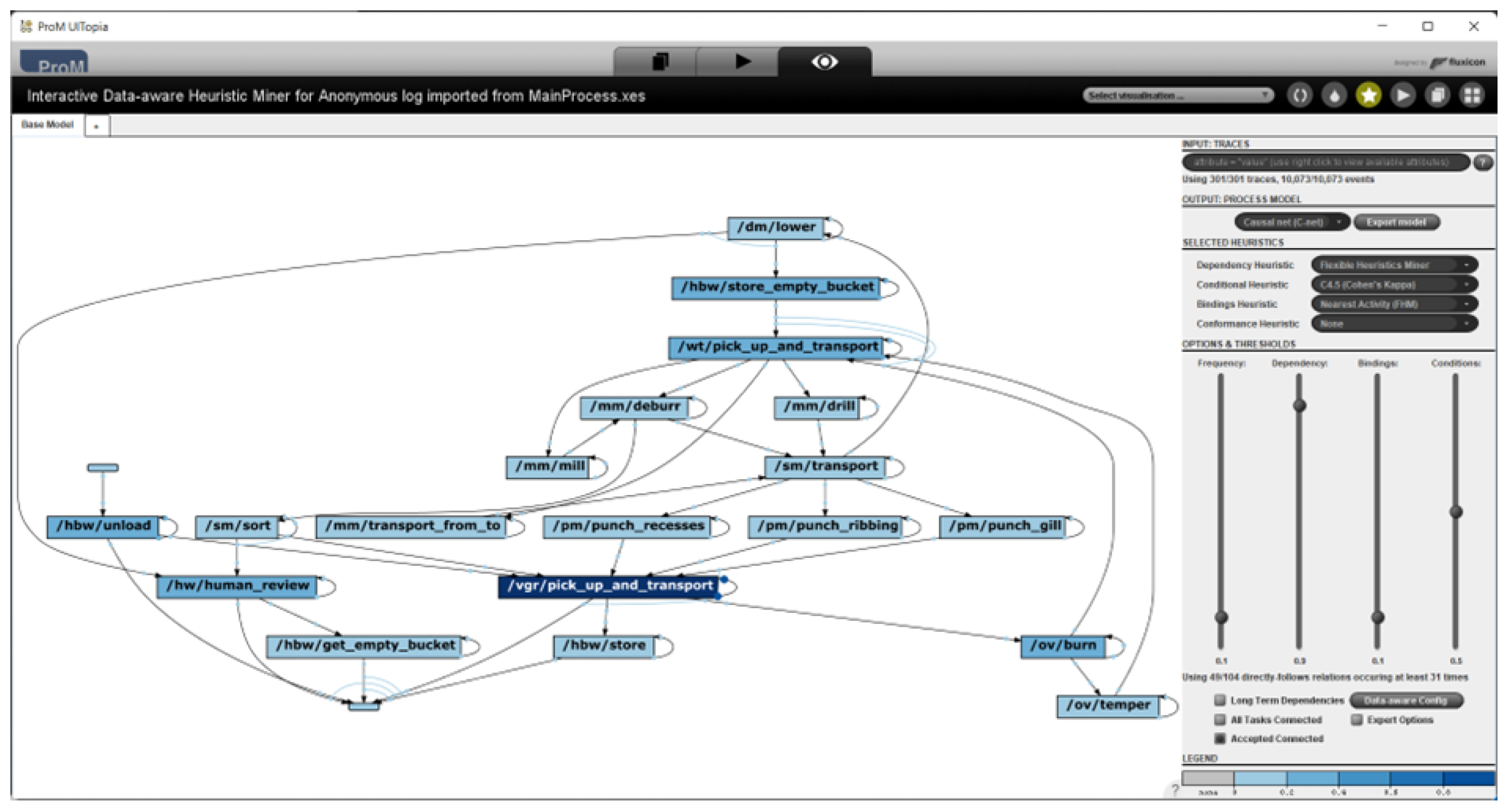
3.2.3. ProM
3.3. Evaluation Framework
3.3.1. Functional Capabilities
3.3.2. Task-Based Evaluation
3.3.3. Benchmarking Protocol
3.4. Evaluation Environment
4. Results
4.1. Functional Capabilities Based on Analysis of Vendor Materials
4.2. Results of Task-Based Evaluation
5. Discussion
5.1. Claimed Functional Capabilities Based on Analysis of Vendor Materials
5.2. Task-Based Evaluation
5.2.1. Usability of the Investigated Tools
5.2.2. Coverage and Consistency of Analytical Outcomes
5.3. Comparison with Related Work
5.4. Limitations
6. Conclusions
Author Contributions
Funding
Institutional Review Board Statement
Informed Consent Statement
Data Availability Statement
Conflicts of Interest
Abbreviations
| IoT | Internet of Things |
| BPMN | Business Process Model Notation |
| ID | Identifier |
| MES | Manufacturing Execution System |
| ERP | Enterprise Resource Planning |
| XES | eXtensible Event Stream |
| AI | Artificial Intelligence |
| KPI | Key Performance Indicator |
| LLM | Large Language Model |
| UI | User Interface |
References
- Janiesch, C.; Koschmider, A.; Mecella, M.; Weber, B.; Burattin, A.; Di Ciccio, C.; Fortino, G.; Gal, A.; Kannengiesser, U.; Leotta, F.; et al. The Internet of Things Meets Business Process Management: A Manifesto. IEEE Syst. Man Cybern. Mag. 2020, 6, 34–44. [Google Scholar] [CrossRef]
- Kesici, C.A.; Ozkan, N.; Taşkesenlioglu, S.; Erdogan, T.G. A Systematic Literature Review of Studies Comparing Process Mining Tools. Int. J. Inf. Technol. Comput. Sci. 2022, 14, 1–14. [Google Scholar] [CrossRef]
- Grüger, J.; Malburg, L.; Mangler, J.; Bertrand, Y.; Rinderle-Ma, S.; Bergmann, R.; Asensio, E.S. SensorStream: An XES Extension for Enriching Event Logs with IoT-Sensor Data. arXiv 2022, arXiv:cs/2206.11392. [Google Scholar] [CrossRef]
- Chapela-Campa, D.; Dumas, M. From Process Mining to Augmented Process Execution. Softw. Syst. Model. 2023, 22, 1977–1986. [Google Scholar] [CrossRef]
- Dumas, M.; La Rosa, M.; Mendling, J.; Reijers, H.A. Process Intelligence. In Fundamentals of Business Process Management; Springer: Berlin/Heidelberg, Germany, 2013; pp. 353–383. [Google Scholar] [CrossRef]
- Van Der Aalst, W. Process Mining; Springer: Berlin/Heidelberg, Germany, 2016. [Google Scholar] [CrossRef]
- Kaelble, S. Process Mining For Dummies®, Celonis Special ed.; John Wiley & Sons, Inc.: Hoboken, NJ, USA, 2022. [Google Scholar]
- van der Aalst, W.M.P. Process Mining: A 360 Degree Overview. In Process Mining Handbook; van der Aalst, W.M.P., Carmona, J., Eds.; Springer International Publishing: Cham, Switzerland, 2022; pp. 3–34. [Google Scholar] [CrossRef]
- Reindler, J. Siemens Healthineers: Process Mining as an Innovation Driver in Product Management. In Process Mining in Action: Principles, Use Cases and Outlook; Reinkemeyer, L., Ed.; Springer International Publishing: Cham, Switzerland, 2020; pp. 143–157. [Google Scholar] [CrossRef]
- Motta, R.C.; De Oliveira, K.M.; Travassos, G.H. On Challenges in Engineering IoT Software Systems. J. Softw. Eng. Res. Dev. 2019, 7, 5. [Google Scholar] [CrossRef]
- Reinkemeyer, L. Driving User Adoption. In Process Intelligence in Action: Taking Process Mining to the Next Level; Reinkemeyer, L., Ed.; Springer Nature: Cham, Switzerland, 2024; pp. 23–29. [Google Scholar] [CrossRef]
- Srivastava, T.; Kerremans, M.; Sugden, D. Magic Quadrant for Process Mining Platforms; Report ID: G00816659; Gartner, Inc.: Stamford, CT, USA, 2025; Available online: https://www.gartner.com/document-reader/document/6363611?ref=pubsite&toggle=1&viewType=Full (accessed on 10 July 2025).
- Verbeek, E. ProM 6 Tutorial. 2010. Available online: https://www.promtools.org/prom6/downloads/prom-6.0-tutorial.pdf (accessed on 10 July 2025).
- Drakoulogkonas, P.; Apostolou, D. On the Selection of Process Mining Tools. Electronics 2021, 10, 451. [Google Scholar] [CrossRef]
- Salas, E.; Arias, M.; Aguirre, S.; Rojas, E. Combining Process Mining and Process Simulation in Healthcare: A Literature Review. IEEE Access 2024, 12, 172562–172580. [Google Scholar] [CrossRef]
- Loyola-González, O. Process Mining: Software Comparison, Trends, and Challenges. Int. J. Data Sci. Anal. 2023, 15, 407–420. [Google Scholar] [CrossRef]
- Viner, D.; Stierle, M.; Matzner, M. A Process Mining Software Comparison. In Proceedings of the ICPM 2020 Doctoral Consortium and Demo Track, Virtual, 4–9 October 2020; 2703, pp. 19–22. [Google Scholar]
- Malburg, L.; Grüger, J.; Bergmann, R. An IoT-Enriched Event Log for Process Mining in Smart Factories. arXiv 2022, arXiv:cs/2209.02702. [Google Scholar] [CrossRef]
- Malburg, L.; Seiger, R.; Bergmann, R.; Weber, B. Using Physical Factory Simulation Models for Business Process Management Research. In Business Process Management Workshops; Del Río Ortega, A., Leopold, H., Santoro, F.M., Eds.; Springer International Publishing: Cham, Switzerland, 2020; Volume 397, pp. 95–107. [Google Scholar] [CrossRef]
- Process and Data Science Group - RWTH Aachen University. Software—Process Mining. 2025. Available online: https://www.processmining.org/software.html (accessed on 10 July 2025).
- Apromore Pty Ltd. Full Spectrum Process Intelligence Platform|Apromore. 2025. Available online: https://apromore.com/ (accessed on 22 July 2025).
- Fluxicon, B.V. Process Mining and Automated Process Discovery Software for Professionals—Fluxicon Disco. 2025. Available online: https://fluxicon.com/disco/ (accessed on 27 August 2025).
- van der Aalst, W.M.P.; van Dongen, B.F.; Günther, C.; Rozinat, A.; Verbeek, H.M.W.; Weijters, A.J.M.M. ProM: The Process Mining Toolkit. In Proceedings of the BPMDemos2009: Business Process Management Demonstration Track 2009, Ulm, Germany, 8 September 2009; Available online: https://ceur-ws.org/Vol-489/paper3.pdf (accessed on 31 January 2026).
- ProM Tools. ProM Tools. 2025. Available online: https://promtools.org/ (accessed on 31 January 2026).
- Davis, F.D. Perceived Usefulness, Perceived Ease of Use, and User Acceptance of Information Technology. MIS Q. 1989, 13, 319. [Google Scholar] [CrossRef]
- Goodhue, D.L.; Thompson, R.L. Task-Technology Fit and Individual Performance. MIS Q. 1995, 19, 213. [Google Scholar] [CrossRef]
- van der Aalst, W.; Adriansyah, A.; de Medeiros, A.K.A.; Arcieri, F.; Baier, T.; Blickle, T.; Bose, J.C.; van den Brand, P.; Brandtjen, R.; Buijs, J.; et al. Process Mining Manifesto. In Proceedings of the Business Process Management Workshops; Daniel, F., Barkaoui, K., Dustdar, S., Eds.; Springer: Berlin/Heidelberg, Germany, 2012; pp. 169–194. [Google Scholar]
- Tratnjek, T.; Polančič, G. Evaluation Materials for a Comparative Analysis of Process Mining Tools for IoT-Centric Process Intelligence. Zenodo 2025. [Google Scholar] [CrossRef]
- Interaction Design Foundation (IxDF). What Is Ease of Use? 2025. Available online: https://www.interaction-design.org/literature/topics/ease-of-use (accessed on 22 October 2025).
- Interaction Design Foundation (IxDF). What Is Cognitive Load? 2025. Available online: https://www.interaction-design.org/literature/topics/cognitive-load (accessed on 22 October 2025).
- Matonya, M.M.; Pusztai, L.; Budai, I. Optimizing Healthcare Business Processes with Process Mining Software: A Comparative Analysis. Decis. Making Appl. Manag. Eng. 2024, 7, 380–400. [Google Scholar] [CrossRef]
- Gomes, A.F.D.; Wanzeller, C.; Fialho, J. Comparative Analysis of Process Mining Tools. In CAPSI 2021 Proceedings; CAPSI: Aveiro, Portugal, 2021; Available online: https://aisel.aisnet.org/capsi2021/4 (accessed on 31 January 2026).
- Parente, C.; Costa, C.J. Comparing Process Mining Tools and Algorithms. In Proceedings of the 2022 17th Iberian Conference on Information Systems and Technologies (CISTI), Madrid, Spain, 22–25 June 2022; pp. 1–7. [Google Scholar] [CrossRef]
- Berti, A.; Koren, I.; Adams, J.N.; Park, G.; Knopp, B.; Graves, N.; Rafiei, M.; Liß, L.; Unterberg, L.T.G.; Zhang, Y.; et al. OCEL (Object-Centric Event Log) 2.0 Specification; Technical Report; RWTH Aachen University: Aachen, Germany, 2023. [Google Scholar]
- van der Aalst, W.M.P. Academic Perspective: How Object-Centric Process Mining Helps to Unleash Predictive and Generative AI. In Process Intelligence in Action: Taking Process Mining to the Next Level; Reinkemeyer, L., Ed.; Springer Nature: Cham, Switzerland, 2024; pp. 219–232. [Google Scholar] [CrossRef]



| Functional Area | Description |
|---|---|
| Data Management | Covers data ingestion, transformation, data cleaning, and preparation for analysis. |
| Process Discovery | Translates raw event logs into visual and interpretable process models. |
| Conformance Checking | Compares observed processes with reference models to detect deviations. |
| Process Analysis | Supports bottleneck detection, performance analysis, and inefficiency identification. |
| Monitoring and Reporting | Enables continuous tracking of process metrics and customizable reporting. |
| Support | Includes documentation, user guides, training, and community or commercial support. |
| Score | Description |
|---|---|
| 1 | Very hard to use. Tasks require a high level of cognitive effort and technical knowledge. The interface is obscure, poorly labelled, or inconsistent, forcing trial and error. |
| 2 | Difficult. Tasks require considerable effort due to confusing navigation, unclear labels, or inconsistent workflows. Users struggle to locate or apply functions. |
| 3 | Moderate. Tasks are achievable but involve noticeable cognitive effort. Some elements are intuitive, but others are inconsistently labelled or non-obvious, creating a learning curve. |
| 4 | Easy to use. Tasks can be completed with little cognitive effort. The interface is well-labelled and mostly consistent, with clear workflows for common functions. |
| 5 | Very easy. Tasks can be completed almost effortlessly. The interface is intuitive, consistent, and self-explanatory, minimising friction at every step. |
| Score | Description |
|---|---|
| 1 | Output is hard to read or interpret. Poor or missing labels. Structure is confusing. An analyst needs outside help or trial and error to make sense of it. |
| 2 | Output is somewhat readable but lacks detail or context. Labels or visuals are inconsistent or vague. An analyst can understand it with effort, but may misinterpret parts. |
| 3 | Output is generally understandable. Basic labels and structure are in place. Some effort is still needed to extract key insights, especially in complex cases. |
| 4 | Output is logically structured, well-labelled and easy to follow. An analyst can interpret key insights without extra help. Some minor improvement in explanation or layout could help. |
| 5 | Output is immediately understandable. Clear labels, helpful tooltips or legends, and strong structure. No extra effort needed. Supports direct decision-making. |
| Score | Description |
|---|---|
| 0 | No support. The tool does not offer this functionality in any form. |
| 1 | Minimal functionality. Limited scope with almost no flexibility. Suitable only for a single, narrow use case. |
| 2 | Limited functionality with some flexibility. Can cover standard needs but lacks depth, consistency, or adaptability. |
| 3 | Moderate functionality with reasonable coverage and basic configurability. Provides solid support for typical use cases but struggles with more complex or specialised scenarios. |
| 4 | Strong functionality with flexibility and user-configurable options. Provides reliable support for the most common and some complex use cases. |
| 5 | Advanced functionality with broad coverage and adaptability. Supports complex and varied scenarios, including those beyond typical use cases. |
| ID | Analytical Question |
|---|---|
| Q1 | What is the most frequent non-failing path that includes at least two activities (excluding start/end)? |
| Q2 | How many different process variants exist in the smart factory? |
| Q3 | Which variant has the longest average execution time (with at least two cases)? |
| Q4 | What is the average number of activities per case? |
| Q5 | Which activity shows the highest deviation in execution duration across cases? |
| Q6 | What is the average completion time of a case? |
| Q7 | How many cases last longer than twice the average case duration? |
| Q8 | Which is the longest path for a case? |
| Q9 | To what extent do cases under the process model WF_101 comply with WF_101? |
| Q10 | What are the most common activities and how often do they occur? |
| Q11 | How often do actual durations exceed planned durations across activities? |
| Q12 | Which activity has the highest total execution time? |
| Q13 | Which resources cause the most failures? |
| Apromore | Disco | ProM | |
|---|---|---|---|
| Data Management | 5 | 4 | 3 |
| Process Discovery | 5 | 5 | 5 |
| Conformance Checking | 5 | 1 | 4 |
| Process Analysis | 5 | 4 | 4 |
| Monitoring and Reporting | 5 | 2 | 1 |
| Support | 5 | 5 | 2 |
| Question | Apromore | Disco | ProM |
|---|---|---|---|
| Q1 | 5 | 5 | 5 |
| Q2 | 5 | 4 | 4 |
| Q3 | 4 | 5 | / |
| Q4 | 5 | / | 5 |
| Q5 | / | / | 5 |
| Q6 | 5 | 5 | 4 |
| Q7 | 5 | 4 | 4 |
| Q8 | 5 | 5 | 3 |
| Q9 | 5 | / | / |
| Q10 | 5 | 5 | 4 |
| Q11 | / | / | / |
| Q12 | 5 | 5 | / |
| Q13 | 5 | 5 | 3 |
| Question | Apromore | Disco | ProM |
|---|---|---|---|
| Q1 | 10 | 21 | 25 |
| Q2 | 2 | 3 | 15 |
| Q3 | 4 | 12 | / |
| Q4 | 6 | / | 13 |
| Q5 | / | / | 25 |
| Q6 | 2 | 12 | 17 |
| Q7 | 6 | 15 | 26 |
| Q8 | 4 | 11 | 18 |
| Q9 | 8 | / | / |
| Q10 | 4 | 11 | 14 |
| Q11 | / | / | / |
| Q12 | 5 | 11 | / |
| Q13 | 10 | 18 | 17 |
| Question | Apromore | Disco | ProM |
|---|---|---|---|
| Q1 | 5 | 4 | 2 |
| Q2 | 5 | 4 | 3 |
| Q3 | 5 | 4 | / |
| Q4 | 5 | / | 3 |
| Q5 | / | / | 2 |
| Q6 | 5 | 5 | 3 |
| Q7 | 5 | 4 | 2 |
| Q8 | 5 | 5 | 3 |
| Q9 | 4 | / | / |
| Q10 | 5 | 5 | 4 |
| Q11 | / | / | / |
| Q12 | 5 | 5 | / |
| Q13 | 5 | 5 | 2 |
| Dimension | Apromore | Disco | ProM |
|---|---|---|---|
| Ease of Use | Very high (intuitive GUI, guided workflows) | High (simple interface, embedded help) | Low (complex menus, high learning curve) |
| Effort (interactions) | Fewest clicks | Moderate | Most clicks |
| Clarity of output | Excellent (clear labels, structured visuals) | High | Moderate (less intuitive in some cases) |
| Functional breadth | Broad (discovery, dashboards, conformance, KPIs) | Moderate (basic conformance and monitoring) | Very broad (many plug-ins, but fragmented, absent monitoring) |
| Support | Excellent | Excellent | Limited |
| Conformance checking with provided BPMN | Supported (after model adjustment) | Not supported | Not supported |
| Real-time/IoT integration | Moderate (available S3 connector, data preprocessing needed) | None | None |
| Reporting and monitoring | Automated dashboards, KPIs | Static exports | Static exports, plug-in dependent |
| Main strengths | Usability, breadth, monitoring | Simplicity, quick discovery | Depth, extensibility |
| Main limitations | Delayed interactions caused by cloud processing | Limited conformance | Poor usability, fragmented UX |
Disclaimer/Publisher’s Note: The statements, opinions and data contained in all publications are solely those of the individual author(s) and contributor(s) and not of MDPI and/or the editor(s). MDPI and/or the editor(s) disclaim responsibility for any injury to people or property resulting from any ideas, methods, instructions or products referred to in the content. |
© 2026 by the authors. Licensee MDPI, Basel, Switzerland. This article is an open access article distributed under the terms and conditions of the Creative Commons Attribution (CC BY) license.
Share and Cite
Tratnjek, T.; Polančič, G. Methodology for Evaluating Process Mining Tools in IoT Contexts. Sensors 2026, 26, 1020. https://doi.org/10.3390/s26031020
Tratnjek T, Polančič G. Methodology for Evaluating Process Mining Tools in IoT Contexts. Sensors. 2026; 26(3):1020. https://doi.org/10.3390/s26031020
Chicago/Turabian StyleTratnjek, Tilen, and Gregor Polančič. 2026. "Methodology for Evaluating Process Mining Tools in IoT Contexts" Sensors 26, no. 3: 1020. https://doi.org/10.3390/s26031020
APA StyleTratnjek, T., & Polančič, G. (2026). Methodology for Evaluating Process Mining Tools in IoT Contexts. Sensors, 26(3), 1020. https://doi.org/10.3390/s26031020